
Medieval Places by Sarah Howarth, 1991, 1992.
This book takes a unique approach to explaining life in the Middle Ages. It focuses on the types of places where people spent their time and what they did there. I like it that the author doesn’t rely on just one country for the descriptions of places, providing examples from various places around Europe, including Germany, France, Italy, and Iceland.
The book is available to borrow and read for free online through Internet Archive. There is also a companion book to this one about Medieval People. The author has also written other books about people and places in different time periods.
The places described in the book are:
The Field
During the Middle Ages, most people lived in small farming communities, making their living through farming. This chapter describes the agricultural year and the feudal system, where peasants worked fields belonging to lords and gave the lords their services and food they produced in return for use of the land.

The Peasant’s Cottage
This chapter explains what a peasant’s house and living conditions were like.
The Castle
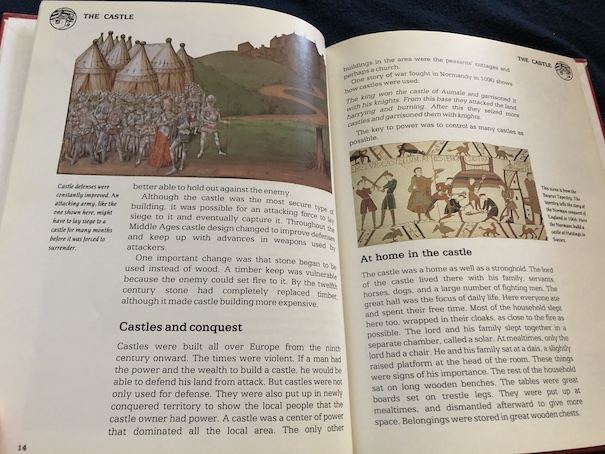
This chapter explains how castles were built and how they were used to control territory. There is also a brief description of what life in a castle was like.
The Battlefield
This chapter describes how warfare and sieges were conducted and what types of weapons were used.
The Forest
People hunted animals in forests for sport and food, but there were rules regarding who could hunt where and what types of animals they were permitted to hunt. Anyone caught breaking these rules would labeled a poacher and could suffer serious consequences.
The Law Court
There were different types of law courts in different places, and they could handle different types of cases or offenders. For example, clergy were often tried in special courts. Punishments for offenders varied with the nature of the offense. Prison wasn’t typically a punishment by itself. Dungeons were more for holding prisoners until their case was tried. After the trial, another punishment would be assigned, possibly a fine or some form of public humiliation. For more severe offenses, offenders might have a hand or an ear cut off or might be executed. However, there were some law breakers who had so many supporters that no one was ever able to bring them to justice.

The School
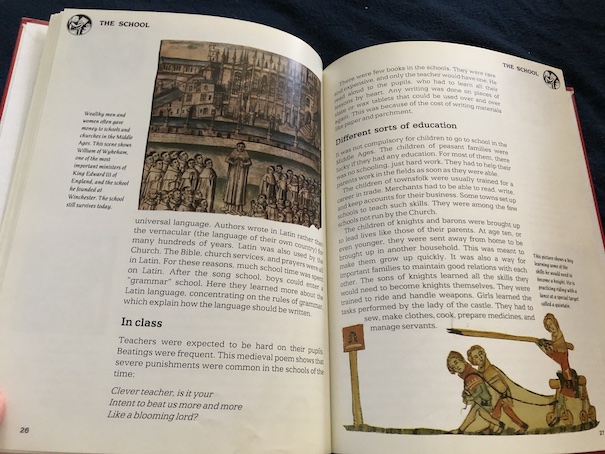
Most schools were church schools held in monasteries, cathedrals, and other churches. There, students would be taught Latin (the universal language of educated people all over Europe during the Middle Ages) and religious lessons. Students practiced writing lessons on wax tables or pieces of slate that could be reused. School was not a requirement, and most lower-class children did not attend, either simply helping their families on their farms or learning a trade. There were some secular trade school run by towns to teach the children of merchants some basic skills, like reading, writing, and keeping accounts.
The University
The format for modern universities began during the Middle Ages. Particularly skilled teachers, often ones who taught at church schools, who gained a reputation for their teaching ability sometimes attracted a following of scholars, and people would travel to the location where they were teaching in order to study with them. Universities grew because of the excellent reputations of individual teachers, who attracted students to come. As they grew, they developed sets of rules, sort of like the a trade guild, organizing courses for students to study and exams to test them on what they had learned. There were no age requirements for students, but they always started by studying some general knowledge subjects, like Latin and mathematics, before choosing a specialty to study, such as law, medicine, or theology.
The Road
There were various reasons why people had to travel during the Middle Ages. Nobles had to travel to to visit different parts of their estates, and peasants had to travel to bring their produce to markets. Merchants would travel in search of customers for their trades. Criminals and judges both had to travel to law courts. Messengers would carry letters. There were also soldiers and religious pilgrims. People from every level of society could be on the roads. However, the roads were rough, making travel uncomfortable, and there was always the danger of robbers.
The Port
People also traveled by ship, and merchants brought goods from other countries through ports.
The Parish Church
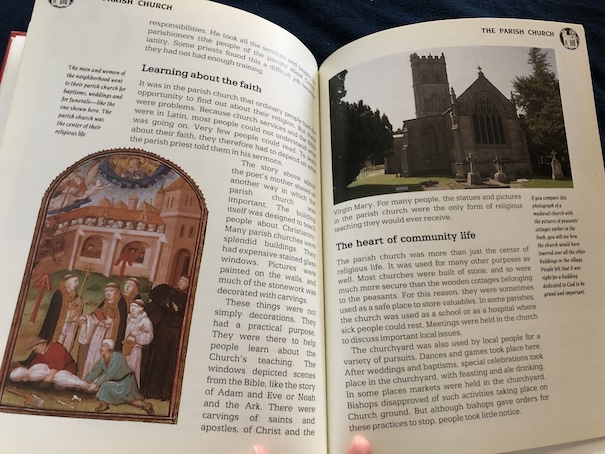
Local parish churches were important centers of life and religion in the community. The local church would perform baptisms, marriages, funerals, and other services for the parishioners. Because most people couldn’t understand Latin and many couldn’t read at all, priests had to use sermons and scenes painted on the walls of the church to teach people Biblical lessons. Sometimes, church buildings and the churchyards surrounding them were also used for other important community functions, like schools, hospitals, meetings to discuss local matters, and even markets, dances, and games.
The Market
People in towns practiced trades other than farming, so towns held regular market days when village farmers could come and sell their produce.
The Guildhall
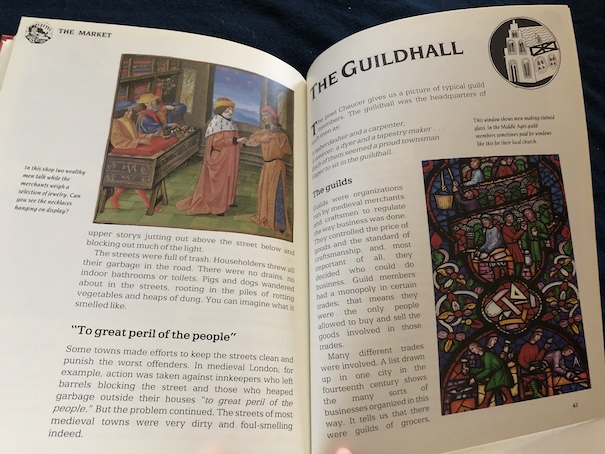
Various types of merchants and craftsmen formed guilds to organize and regulate the standards for their trades and how much their goods and services would be worth. Guilds were also responsible for arranging apprenticeships for those wanting to learn specific trades.
 Jestress's Forgotten Books and Stories
One thought on “Medieval Places”