
The FunCraft Book of Spycraft by Falcon Travis and Judy Hindley, 1975, 1976.
This book is a part of a series of craft and hobby books that was first printed in Britain. It’s meant for kids who like to play at being spies, and it teaches kids how to use secret codes make disguises, and other tips and tricks for being a spy.
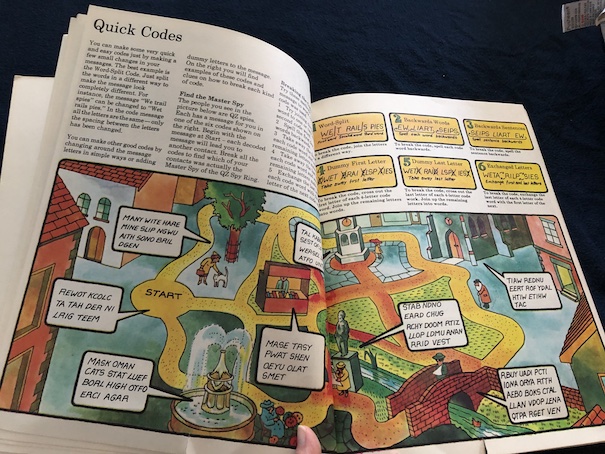
Much of the book focuses on different types of secret codes and techniques for sending secret messages. In fact, I would say that there is more about secret codes and messages than there is about anything else, but what they have to say is interesting. Most of the codes in the book are fairly easy, which is good for kids who are just beginning. The book explains popular codes like the pig-pen code and gives instructions for making simple code machines, like the popular code wheels for alphabet shifts. However, I enjoyed the variety and creativity of other codes and methods of sending secret messages, like the code based on music notes and the suggestion of using clocks or watches to represent semaphore figures.

The book not only explains some well-known and standard codes and signals, like semaphore and Morse code, but also explains how to adapt these codes in new ways. Morse code messages could be shown in a sequence of knots on a rope or in the placement of objects in a picture.

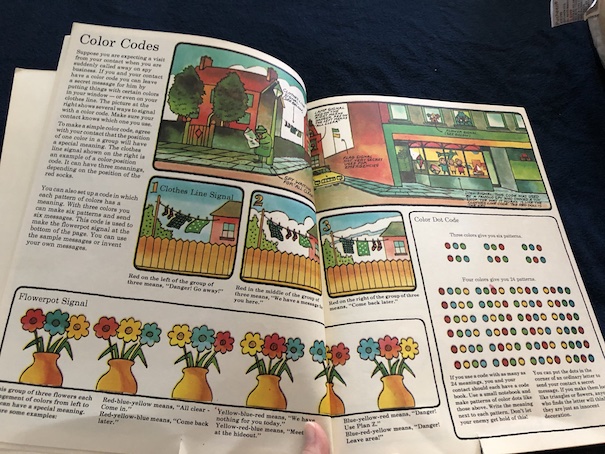
Some methods of sending secret messages don’t rely on codes so much as pre-arranged signals, like the placements of certain objects or arrangements of certain colors. These objects or color patterns might look completely ordinary to most people, but they can have special meanings to those who understand what each signal stands for.
The book also covers other topics related to spies, like how spy rings are organized, where messages can be concealed, types of equipment spies use, how to make maps, how to spot and interpret clues, and how to set traps.

There are also disguise tips. The book points out various ways that people can make themselves look different, like changing the way they comb their hair, changing their hair color, or trying to make themselves look older or fatter. One piece of advice about changing your skin tone by rubbing talcum powder on it to make it look lighter or cocoa powder on it to look darker sounds messy, and I’m not sure I’d recommend it, but the other parts seem okay. There are instructions for making a false beard, nose, and glasses and a bald-headed wig. None of these would really be convincing disguises, but they could be entertaining for kids to try to make and might be useful for Halloween costumes.

There is also a spy-themed board game in the book where one player controls a pair of spies and the other controls a pair of spycatchers. The player controlling the spies has to evade the spycatchers in order to win.
Overall, I think that the book is pretty entertaining, and kids who are really into spies and spy games would find it fun. With all of the different codes, disguise ideas, and the board game, there are plenty of fun activities to try!
The book is available to borrow and read for free online through Internet Archive (under an alternate title – The Knowhow Book of Spycraft).

 Jestress's Forgotten Books and Stories