
Indian Sign Language by William Tomkins, 1969.
This is the third book I’ve reviewed on the topic of Indian Sign Language, and the reason why I wanted to include this one is that it was part of the list of recommended reading in one of the others, a book that was written much later. I can see why it was recommended. I found the readability of this book to be lower than the later book, but there is information found in this book that isn’t found in the later book.

The introductory notes at the beginning of the book explain a little about the author’s background. He grew up near the Sioux Indian Reservation in the Dakota Territory during the late 1800s, which was where he was first introduced to this form of sign language. He was not Native American himself, but he was later ceremonially adopted into the Sioux tribe. He became a lecturer about American Indian issues, and he discovered that people were very interested in his sign language demonstrations. He wanted to create this book so there would be a readily-available text explaining how the language works. He credits this form of sign language as being “probably the first American language. It is the first an only American universal language. It may be the first universal language produced by any people.” I’m not completely sure that’s true, but the author does have great respect for the beauty and utility of the sign language and the role that it played in Native American history.

The later book had the vocabulary of the sign language organized by topic, but this book (like an earlier one) had it organized in alphabetical sections, like a dictionary. The hand signs are shown in drawings on one side of the page, with lines and arrows to indicate movement where necessary, and written descriptions of the hand signs on the other.

The range of vocabulary is much more broad in this book than in the newer book, and it includes descriptions of more complex words and concepts that can be conveyed by combining some of the signs for simpler words. For example, the word “generous” can be indicated by making the signs for “heart” and “big”, and there is a list of synonyms for words. The book also demonstrates how to form sentences using the vocabulary words.


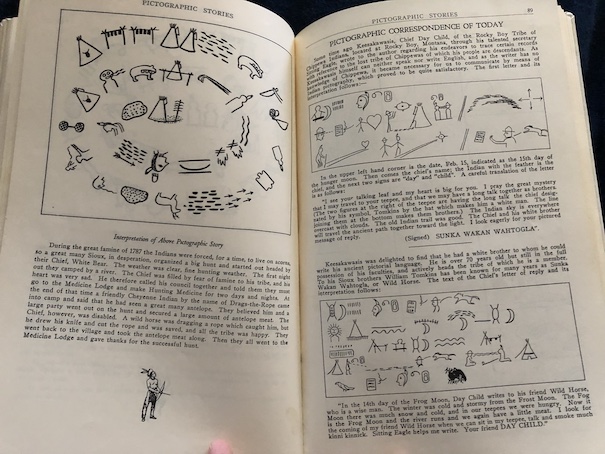
There are a couple of sections in the back of this book that provide additional information about other forms of communication, pictographs and smoke signals, which is interesting because the later book that I mentioned also made references to these other forms of communication but didn’t really offer details about how they work. This book is very detailed on the subject of pictographs, showing what different ideographs mean and explaining how to tell entire stories with them. It even explains the correlations between sign language and pictography. The book ends with some historical information about this form of sign language and suggestions for a unit about Indian sign language for a boy scout troop meeting, which include a somewhat cheesy play where the boy scouts pretend to be American Indians and use words like “How” and “paleface” with each other. The book seems very good and thorough on the technical explanations of the language, but I suspect it could be a little better on the subject of cultural representation.
The book is available to borrow and read for free online through Internet Archive (multiple copies).
 Jestress's Forgotten Books and Stories