The Famous Five
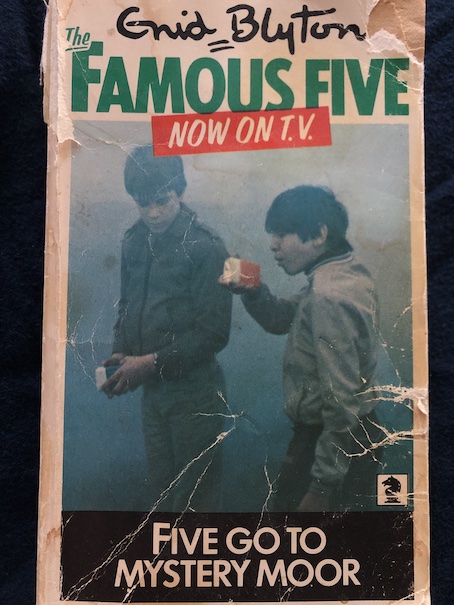
Five Go to Mystery Moor by Enid Blyton, 1954, 1974.

The girls, George and Anne are attending a riding school, and the boys, Julian and Dick, are camping when George receives a letter that her father is ill, and her mother wants the girls to stay on at the riding school for a while longer. The girls are disappointed and think that the boys will probably stay on at their camp, but they soon get a letter that the boys will be coming to the riding school to join the girls. The children are hoping that they will find another adventure when they’re all together again.
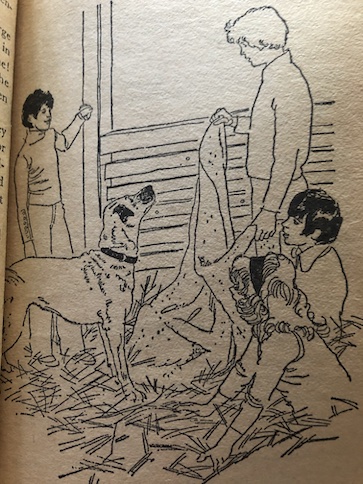
At the riding school, George has developed a rivalry with another girl called Henry. Henry’s real name is Henrietta, like George’s real name is Georgina, and like George, Henry likes to dress and act like a boy. However, rather than bonding over their shared interests and styles, George and Henry resent each other. (George makes a big deal of not liking to be a girl and wanting other people to look at her and refer to her as a boy. I’ve wondered whether the implication is that she’s actually transgender, without using that word to describe her, or if she’s merely a tomboy who things girl things are sissy stuff. Enid Blyton’s books are often full of the implication that boys are tougher and braver than girls, and it seems to be a mark of praise for a girl to be like a boy. In this particular book, it seems like both George and Henry are trying hard to be “not like other girls“, and the reason why they resent each other is that they’re both disgruntled to realize that at least one other girl is like them, making each of them seem less exceptional. They each seem to feel like the other is horning in on their shtick.) In spite of the rivalry between George and Henry, the other children like Henry. Eventually, George and Henry settle their differences. Henry joins the other children on some of their rides and explorations.


While the children are still at the riding school, a gypsy boy comes to the stables with an injured horse, asking for help. (They’re referred to as “gypsies” all throughout the book, although that’s considered a kind of insult. The proper name is really Romani, and they’re also sometimes called “Travelers.” The name “Gypsy” comes from an earlier misunderstanding that their ancestors were originally from Egypt, kind of like how Native Americans were mistakenly referred to as “Indians”, and the name stuck. I only use the word “gypsy” here because the author does, and I want to make sure that fans of the original book understand what I’m talking about. This note is here to clarify the difference. Gypsies are stock characters in Enid Blyton books, and they’re all pretty stereotypical.) The boy is told that it will take a few days before the horse is able to walk, let alone pull a caravan wagon. The boy is very upset because his father has a nasty temper, and he’s not willing to wait. The other children soon see how abusive the boy’s father is, and they’re sympathetic to him. Julian and Dick catch the father trying to steal a horse or reclaim his in spite of its injury during the night. When they ask him why he needs a horse so badly and can’t wait until his is properly healed, and he tells them that his group needs to go to Mystery Moor. Seeing that he’s not going to get another horse, the father decides to move on with other members of their party, leaving his son behind to tend to their horse and catch up to them when he can.

Julian, Dick, George, and Anne are intrigued by Mystery Moor, although they can’t imagine what could be there that would make someone so desperate to go there. The name of the place intrigues them, and they are told that it used to be called Misty Moor until some strange things happened there years ago. A wealthy family established a sand quarry there and built a small railroad line that crossed the moor, but they had a dispute with the gypsies who lived on the moor. The gypsies sabotaged the railroad, and when the sons of the family went to deal with the situation, they all vanished and were never seen again. The local rumor is that the gypsies probably murdered the sons, but nothing was ever proven, and to be honest, nobody really misses the sons because they weren’t nice to anybody else, either.

The children think that this is the adventure that they’ve been looking for, and when the riding school becomes crowded because of the arrival of new students, they decide that they want to go camping on Mystery Moor. They look forward to heading out onto the moor to see if they can find any traces of what happened to the missing family. However, there’s a modern mystery on the moor as well. The children spot a plane that flies low and circles the area, seemingly guided by a mysterious light. The children discover that the plane dropped a package, and that package is stuffed with packets of US money! Who would drop that much money from an airplane, and who was supposed to come pick it up?
The book is available to borrow and read for free online through Internet Archive (multiple copies). There is also an audiobook on YouTube. As the cover of the book notes, the Famous Five series was made into a television series, and you can sometimes find clips or episodes on YouTube.
My Reaction and Spoilers
Old and New Versions
I find that many of Enid Blyton’s mystery/adventure stories, no matter which series, are very much on par with Stratemeyer Syndicate books (Bobbsey Twins, Hardy Boys, Nancy Drew, etc.), especially the earlier ones. On the one hand, they contain many of the elements that children love in stories – mystery and adventure, independence from parents and other adults, spooky and mysterious happenings, kids who save the day, and a lovable dog. On the other, both Enid Blyton’s books and the Stratemeyer Syndicate books were revised in later reprintings to update the language and to remove or alter racially-insensitive and offensive terms.
I didn’t know how much some of the Stratemeyer books I read as a kid had changed from their original versions because I was born in the late 20th century, after many of these revisions had already taken place and didn’t read some of the original editions until I was an adult. I was surprised. Since I grew up in the US, I didn’t read any Enid Blyton books as a child at all. They’re available here, but not nearly as popular as the various Stratemeyer Syndicate series, and many American children don’t know about them at all. I’d heard of Enid Blyton books because they were referred in other books and movies I saw, but I didn’t read any until I was an adult. By that time, I wasn’t too shocked at some of the more problematic parts of the books.
“Gypsy” isn’t really a shocking word for me because there’s less emotional baggage attached to that word from the time and place where I grew up than there is attached to certain other racial words that I’d rather not mention. When I was a kid, I thought it was a more neutral, generic word than it really is, although someone did explain to me at some point what the name comes from and that it’s not really the proper name. However, when you find out that something really bothers people or that they don’t want to be called certain things, it’s better to just call them whatever they like to call themselves. I think the later reprintings of this book use the word Traveller (British spelling) instead, like this audiobook on YouTube.
As with Stratemeyer Syndicate books, I think the revised reprintings are fine for modern children, and the earlier versions are best kept for adults with an interest in vintage and nostalgic children’s literature. I find these books interesting particularly because they have the classic setup of a mystery-solving group of children and their dog, just like the Scooby-Doo mysteries, which is something that I grew up loving! The Scooby-Doo mysteries have a similar format to the Famous Five, and the working title for the original concept of the cartoon series was Mysteries Five, which might be an indication that the writers had Enid Blyton’s books in mind.
Interesting Information
One interesting piece of trivia is that the book discusses patrins, signs that the Travellers leave for each other to indicate which way they’re going. During the course of the story, the Traveller boy leaves patrins to help the other children.
The Mystery and spoilers
Like many vintage children’s mysteries, the story leans a little more toward adventure than mystery. The Travellers are definitely the ones who are there to get the dropped packets of money, and that’s why they were so worried about getting out on the moor in time. The real mystery is why they’re doing this and where the money comes from.
Toward the end of the book, the police reveal that the money is counterfeit, and that’s why it had to be smuggled into the country. Henry is helpful to the others at a point when they’re in danger, and that helps George to reconcile with her. Because the Traveller boy’s father is abusive and is about to be arrested for smuggling counterfeit money, he is likely to be sent to a foster home, which is actually good news for him because he was unhappy with his father and afraid of him. He says he would like to live a settled life in a house where he can ride his bike to school, and George promises to give him a bicycle as a reward for helping them when they needed it.
 Jestress's Forgotten Books and Stories
I was a big fan of the Famous Five TV show as a kid, (the 70s one, not the 90s one), but I didn’t really read the books much-I may have checked out a few at the library. I remember the St Clares and Malory Towers a lot more
As for George, this was way before people were doing such things, so I think the meaning behind her is that she is just a tomboy that doesn’t want to be thought of as not tough or sissy.
LikeLike
Probaby. It’s funny, but the whole girl-wanting-to-be-a-boy or wanting to be like a boy seems to be a trope of mid-20th century British children’s books. I just started reading another series that has a girl named Petronella who wants to be called “Peter” all the time and is praised for being better at sports than the boys. It was written around the same time but by a different author. It just seems to have been the fashion of the time. Maybe it’s a somewhat earlier version of the “not like other girls” trope.
LikeLike
Yes. There were some English books that I liked as a kid, but the Famous Five was more the TV show than the books. I kind of had a crush on Anne from the show (before you freak out, I was probably about 7 or 8 when I saw it for the first time)
Did you have childhood crushes from shows as a kid? Another one was “Edison” from Supergran (the first series actress, not the second)
I just realised that these are both British shows (English and Scottish), so they may not have aired in the States. Have you seen any of these shows? If not, I am sure they are on youtube
LikeLike
lol! I haven’t seen many of the Famous Five tv show, but I did find a few episodes on YouTube and some from the Adventure series. I never saw Supergran. I don’t think it played here. Most of my favorite shows when I was a little kid were cartoons, so not exactly crush-worthy. I did like to watch Star Trek and Sherlock Holmes with my dad, though, and I got a couple of crushes there when I got older.
LikeLike