
The Story of Ferdinand by Munro Leaf, drawings by Robert Lawson, 1936.
Ferdinand is a young bull living in Spain. He has been different from the other young bulls since he was a little calf. While the other young bulls liked to run around and butt their heads together, Ferdinand preferred to simply enjoy the peaceful countryside and smell the flowers. His mother sometimes worried about him, sitting all by himself under his favorite tree. She was afraid that he would be lonely, but Ferdinand told her that he just liked sitting under the tree and smelling flowers and that he didn’t want to play rough with the other young bulls. As long as Ferdinand was happy, his mother was content to let him do what he wanted to do.


As time went on, Ferdinand and all of the other young bulls grew up big and strong. The young bulls who had always played rough together were fascinated by the bull fights held in Madrid. They thought that it would be exciting to be picked to participate in the fights. But, Ferdinand had no interesting in fighting of any kind. Although he was big and strong, he still preferred to just enjoy his flowers and his favorite tree.
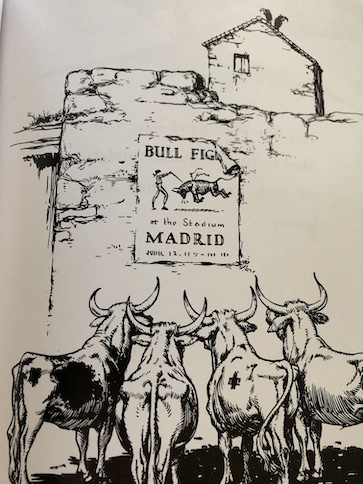
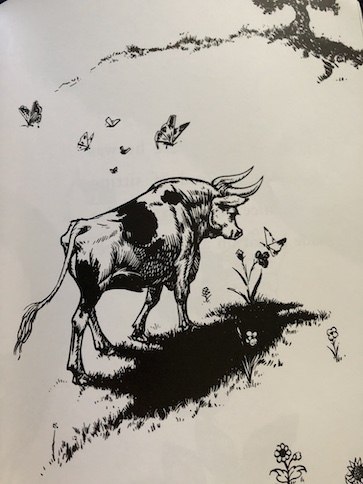
When some men come to the field to pick out bulls for the bull fight, the other bulls try to show off for the men. Ferdinand doesn’t, but by accident, he sits on a bee and is stung. When the men see him jumping around in pain, they assume that he must be the fiercest bull in the field!
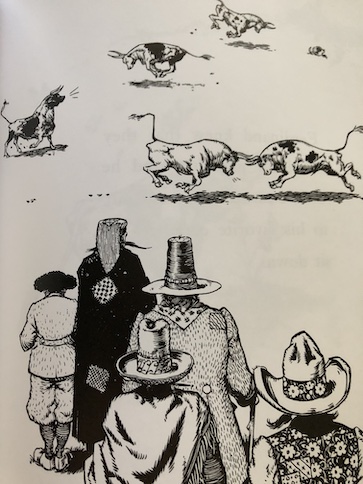

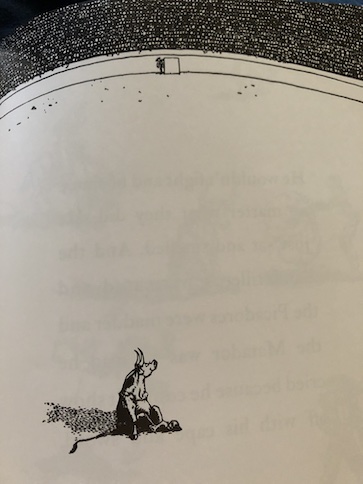
Poor Ferdinand is carted off to Madrid, but no matter what the bull fighters do in the arena, they just can’t get Ferdinand interested in fighting them. There is only one thing that interests Ferdinand, and that’s flowers. When the men put him in the bull fighting arena, he just sits and looks at the pretty flowers that the women in the stands are wearing in their hair, enjoying the smell. They are so disappointed at the lack of fighting that they put Ferdinand back in the cart and put him back in the field … which is exactly where he wants to be.

The book is available to borrow and read for free online through Internet Archive (multiple copies, including some in different languages). It has been reprinted many times. It has not been out of print since its first publication, and it has been made into a movie.

My Reaction and A Little History
I remember that I didn’t care for this book when I first read it years ago. I was really worried for poor Ferdinand when he was picked to join the bullfight. Because the book is for young children, it doesn’t make it fully clear that the bullfight is supposed to end with the death of the bull. The bullfighters all have spears and swords “to stick in the bull”, and the book says it’s to make the bull mad, but adults and older kids realize that they’re really going to hurt and kill the bull during the fight. There are vultures in some of the pictures as a clue that death is a real risk.
Fortunately, nothing bad happens to Ferdinand in the story. Because Ferdinand is a peaceful bull, who has no interest in fighting and only wants to enjoy flowers, he is not exciting enough for the bullfight, so he gets sent home to the field and the peaceful life he loves. The other bulls may not know that their lives could be much shorter because of their willingness to fight.
It’s also interesting to note that this book was written in the 1930s, when the world was headed for World War II. It was also published shortly before the Spanish Civil War. Because of its pacifistic themes, it was banned by both Franco and Hitler. The author, Munro Leaf, said that he didn’t really mean the story to be a serious one, but its themes resonated with even the adults of his time, in different ways, as this article from Sotheby’s notes:
“In 1937 Leaf wrote that he had published a book he “thought was for children… but now I don’t know” and in 1938 The New Yorker wrote “Ferdinand has provoked all sorts of adult after-dinner conversations.””
It wasn’t just Hitler and Franco who were suspicious of the book’s intentions. Some people also suspected it of being “Red Propaganda” or “Fascist Propaganda”, presumably because some people feared the pacifism in the story would encourage people not to fight communists or fascists. Some people also questioned the book’s message on the topic of masculinity. I could see that the story could be regarded as a commentary on men who think they have to tough, macho fighters, like the bulls. Even though Ferdinand might be regarded as a failure as a bull for not engaging in the fighting and rough play of the other bulls and not going through with the bullfight, he lives a happier, more peaceful, and ultimately, longer life because of it. Maybe he’s not a failure after all but just smarter than the average bull. Ferdinand is certainly a non-conformist who finds a way to make it work for him. How any reader might feel about that could depend on what they think conformity means and how they feel about that.
However, the book also received a lot of positive support. There is an anecdote that Gandhi loved it, and President Franklin Roosevelt requested a copy. The Sotheby’s article also recounts a story that I first heard from my children’s literature teacher when I was in college, that 30,000 copies of the book were sent to Germany after World War II as a peace gesture. When my teacher told the story, she explained that few children’s books were published during the war (and if you’ve already read my review of Emil and the Detectives, you already know that even children’s books were not exempt from book burnings if they had anti-war themes), so the distribution of the copies of The Story of Ferdinand were welcome, and the children who received them loved the story.
 Jestress's Forgotten Books and Stories