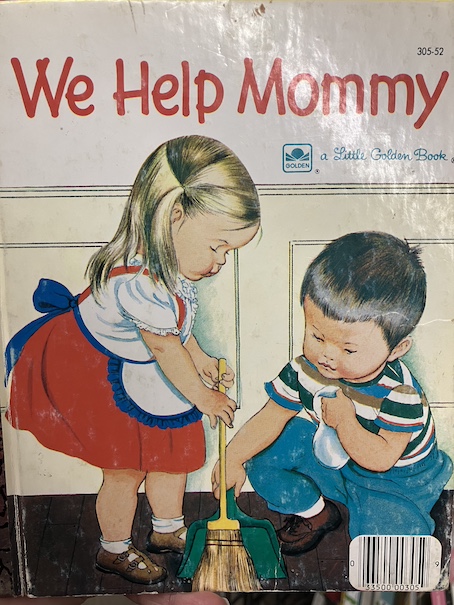
We Help Mommy by Jean Cushman, pictures by Eloise Wilkin, 1959.
In this classic Little Golden Book, two small children help their mother with various household chores throughout the day. There is a note in the beginning of the book that says that the children in the story are based on the author’s own children, Martha and Bobby, but the children shown in the pictures are based on two other children, who were asked to pose by the illustrator.
When the two little children in the story get up in the morning, the first thing they do is change from their pajamas into their clothes for the day. Sometimes, they need a little help from their mother because they’re still little. Then, they go downstairs and start making breakfast.
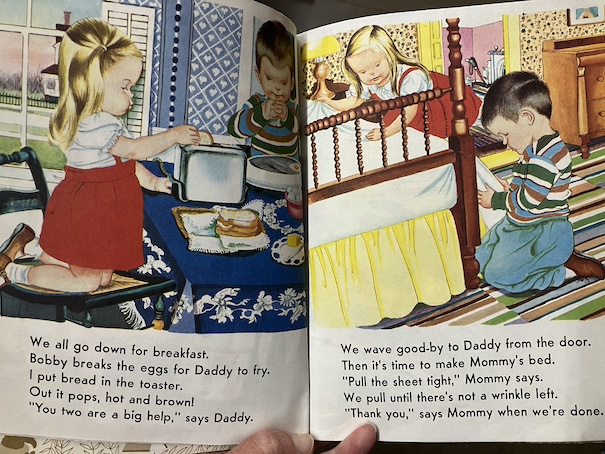
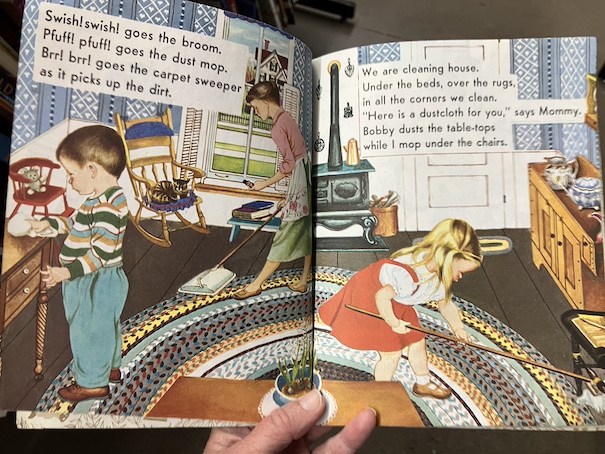
After their father leaves for work, they help make their parents’ bed. Then, they dust furniture and sweep the floors and put their clothes in the washing machine. Martha hangs her doll’s clothes up on a small clothesline, while her mother hangs up the family’s clothes on the high one. The children go to play with some friends next door.
Sometimes, the children go to the supermarket with their mother to buy groceries. When they get home, they put the groceries away and make lunch.

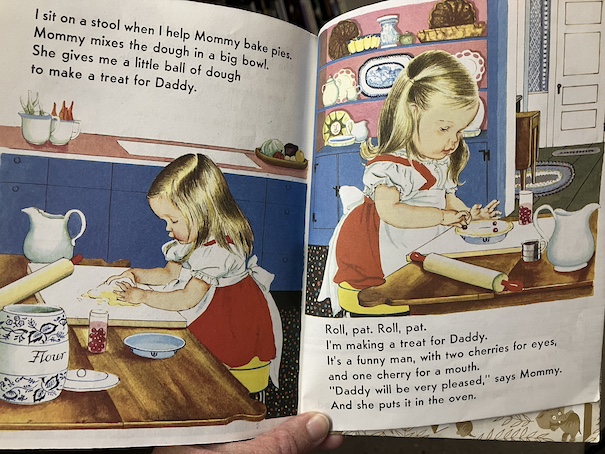
After lunch, they wash their dishes, and Martha makes a special little pie for their father for dessert.
At the end of the day, the children put away their toys. Their father comes to tuck them in when it’s time for bed, and he thanks Martha for the pie and both of the children for helping their parents.

The book is available to borrow and read for free online through Internet Archive.
My Reaction
I remember reading this book with my mother when I was a little kid in the 1980s. It’s just a cute, simple book for young children about helping their mother with daily chores. We still sometimes quote the line from this book, “Napkins for us all” when we set the table because, for some reason, that stuck in all of our minds and just got repeated for years.
At the time, I was too little to think about what year the story is from, and there was nothing in the book that was too seriously out of line with my experiences as a little kid. You can tell by the pictures that it’s from an earlier decade because of the family’s clothes and hair styles (particularly the parents), and the carpet sweeper the mother uses is older than I am. However, I have to admit that my parents still had one of those types of carpet sweepers in the 1980s, so I knew what it was when I saw it in the picture. They hang their clothes up to dry instead of using a clothes drier, but even that isn’t too far out of line because, even today, some people prefer to dry their clothes on a clothesline. In fact, there are 21st century people who consider it more environmentally friendly. The style of the clothesline they use is very mid-20th century, but my grandmother had one like that in the 1980s, too, so I had seen it before. Some of the things I was familiar with as a young child were hold-overs from previous decades, just like this book. Modern children might not be as familiar with some of these things, but this book is such a simple story about small children helping with daily chores that I think even 21st century children would understand it, even if it looks a little old-fashioned in some respects.
When I was a kid, I missed the part at the very beginning of the book about the children in the story being based on the author’s children, but I found it interesting when I looked at the book again as an adult. There is another Little Golden Book called We Help Daddy, which we also had when we were little kids. The two books read a little like companion books and were illustrated by the same illustrator, although We Help Daddy was written by a different author and features a different brother and sister. In We Help Mommy, the children mostly help their mother with chores around the house and buying and preparing food. In We Help Daddy, two kids help their father with yard chores, which somewhat shows how people in the mid-20th century typically expected domestic chores to be divided: the mother doing work inside the house and related to cooking, while the father mostly tends to chores outside the house. I don’t think this is a problem because, when the two books are taken together, both parents are still helping out and spending time with the children, but I thought it was interesting to notice that dynamic as an adult.
One of the things the mother and children buy at the grocery store in this book is a picture book. I didn’t understand that part as a little kid, but as an adult who studies and collects children’s books, I know that this is a reference to Little Golden Books because they were often sold at grocery stores, making them accessible to many families as inexpensive books for young children, sold where families would normally shop anyway. In fact, if you look closely at the cover of the Little Golden Book that the boy is taking out of the shopping cart, you can tell that it’s specifically Kittens: Three Complete Stories.
 Jestress's Forgotten Books and Stories