
The Little House Cookbook by Barbara M. Walker, illustrated by Garth Williams, 1979.
This children’s cookbook is based on the foods eaten in the Little House on the Prairie series. The series follows a farm family, and food is very important in the stories. I like the book because it provides historical explanations about the types foods that frontier families would eat. The illustrations in the books come from the original books.
The chapters in the book are:
Food in the Little Houses
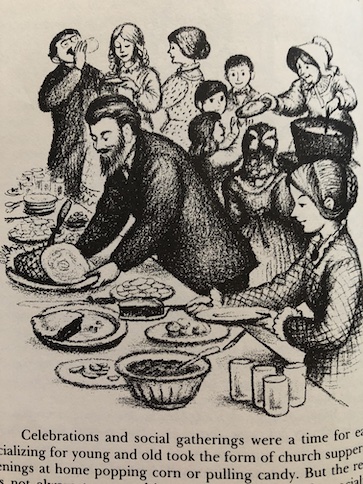
The first chapter of the book explains about the life of Laura Ingalls Wilder and her family and how much of their time on the frontier was occupied with finding and producing food. The foods that they ate were ones they grew and hunted themselves. They had to prepare everything from scratch, and even the children in the family helped. When they had difficult times, there was often little to eat.
The chapter also discusses the nutrition of a pioneer diet. They didn’t understand much about the science behind vitamins and nutrition, but because their lives were based around hard physical labor, they were able to tolerate diets that were heavier in starches and sweets than most modern people would have.
It also describes how celebrations and social occasions centered around food.
The Cook’s Domain
This chapter discusses what pioneer and farming families had in their kitchens and how they would cook and store food.
Staples from the Country Store

Although pioneers tried to be as self-sufficient as they could, nobody could ever make absolutely everything they needed. Country stores supplied a variety of good, especially the things that farmers couldn’t make by themselves, like farm tools, cooking pots, sewing supplies, guns, and some food staples that wouldn’t be produced by farms in the area or that required processing, like molasses and cornmeal. Country stores also allowed farmers to buy on credit or trade produce and other goods they had for ones they needed because they didn’t always have cash on hand.
The first two chapters were just informational, but this is the chapter where recipes start appear. Each of the recipes is accompanied by a quote from one of the Little House books where the dish is mentioned and some historical information. The recipes in this chapter are:
- Fried salt pork with gravy
- Hasty pudding
- Fried cornmeal mush (a dish my grandmother said she ate growing up on a farm in Indiana in the 1920s and 1930s)
- Johnny-cake
- Corn dodgers
- Cornbread
- Crackling cornbread
- Baked beans
- Bean soup
- Bean porridge
- Oyster soup
- Codfish balls
Foods from the Woods, Wilds, and Water
Pioneer families relied heavily on animals they could hunt and plants they could forage for food, like berries. This chapter discusses how they would process and prepare animals they hunted and what they could make with foods found in the wild. Personally, I have no interest in hunting, but the historical information is interesting. The recipes in this chapter are:
- Stewed jack rabbit and dumplings
- Spit-roasted wild duck
- Blackbird pie
- Fried fish
- Roasted wild turkey with cornbread stuffing
- Cranberry jelly
- Blueberry pudding with a sauce
- Huckleberry pie
- Sun-dried wild fruit
- Stewed dried fruit
- Crab-apple jelly
- Plum preserves
- Husk-tomato preserves
- Strawberry jam
Foods from Tilled Fields
This chapter discusses the crops farms produced, particularly wheat. There are recipes for different types of bread, biscuits, dumplings, crackers, doughnuts, and pancakes. There’s also a recipe for hardtack, which was a staple food for people going on long journeys because is wasn’t as perishable as other foods.
Foods from Gardens and Orchards

This chapter is about the types of fruits and vegetables that a family like the Ingalls would grow. It explains that these vegetables have changed over time because farmers developed new varieties of familiar foods, like potatoes. The flavors of these newer varieties aren’t quite the same as the old ones, but the newer varieties produce more food and are more resistant to disease.
The recipes included in this chapter are:
- Mashed potatoes
- Potato cakes
- Fried potatoes
- Hashed brown potatoes
- Creamed carrots
- Dried corn and creamed corn
- Fried parsnips
- Succotash – a dish of mixed vegetables with lima beans and corn
- Lettuce leaves with vinegar and sugar
- Ripe tomatoes with sugar and cream
- Baked Hubbard squash
- Raw turnip snacks
- Mashed turnips
- Stewed pumpkin
- Pumpkin pie
- Green pumpkin pie – It uses an unripened pumpkin, and it tastes a lot like an apple pie.
- Apple turnovers
- Apple pie
- Birds’ Nest pudding – an apple dessert
- Fried apples ‘n’ onions
- Dried apples
- Dried apple and raisin pie
- Apple-core vinegar
- Tomato preserves
- Beet pickles
- Green cucumber pickles
- Green tomato pickles
Foods from the Barnyard
This chapter is about the types of animals kept on a farm as sources of meat, dairy, eggs, and fat.

The recipes included in this chapter are:
- Lard and cracklings
- Baked spareribs
- Homemade sausage
- Roasted pig
- Mincemeat
- Poached fresh eggs
- Fried chicken
- Chicken pie
- Stuffed roasted hen
- Roasted stuffed goose
- Butter
- Cottage cheese balls
- Hard cheese
- Pot roast of ox with browned flour gravy
Thirst Quenchers and Treats
This chapter covers special treats that farming families would have made or been able to buy at the general store. It explains the history and evolution of penny candies and other store-bought treats.

The recipes included in the chapter are:
- Eggnog
- Ginger water
- Cambric tea
- Lemonade
- Pulled candy
- Molasses-on-Snow candy
- Vinegar pie
- Custard pie
- Heart-shaped cakes
- Vanity cakes
- Pound cake
- Laura’s wedding cake
- Sugar frosting
- Ice cream
- Parched corn
- Popcorn
- Popcorn balls
- Popcorn and milk
There is a glossary in the back and a table of conversions.
One more thing I want to note is that the book refers to Native Americans as “Indians”, which is common in older books. There isn’t much information about Native Americans in the book because the focus is on pioneer farming families, but they are mentioned occasionally when there’s historical information about the origin and evolution of certain types of foods.
The book is available to borrow and read for free online through Internet Archive.
 Jestress's Forgotten Books and Stories