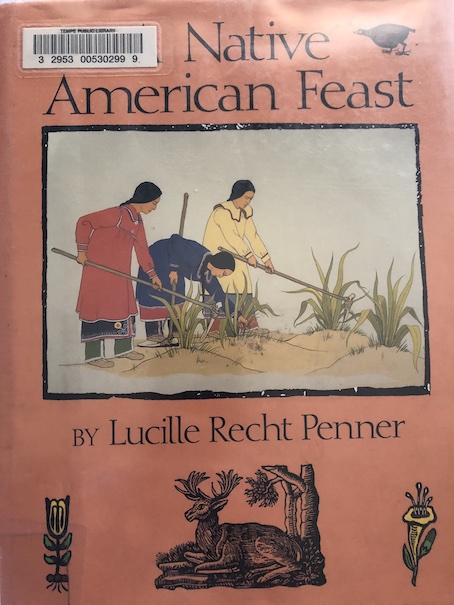
A Native American Feast by Lucille Recht Penner, 1994.
This nonfiction children’s book explains the traditional foods of different Native American tribes and how they were prepared. (Throughout the book, they are referred to both as “Native Americans” and “Indians”, but mostly, the book uses the term “Native Americans.” The focus is on Native American tribes in the area that is now the United States, but the book includes information about various tribes across the United States.)
It starts with an Introduction that explains how European settlers came to North America and how the first settlers almost starved to death because they weren’t prepared for the conditions they found and didn’t understand the plants and foods of the Americas. In those early years of the colonies, the colonists relied heavily on help from nearby Native American tribes in learning techniques for hunting and growing food in North America. These colonists had to adopt some of the Native American foods and techniques of getting food in order to survive. Not only did European colonists adopt some foods used by Native Americans, but Native Americans also adopted foods that were introduced to them from Europeans, including some plants and grains, like apples and wheat, and some domesticated animals, like sheep. The focus of this book is on Native Americans and their cooking and eating habits, both pre-colonization and post-colonization. For more information about what the colonists were cooking and eating, see The Colonial Cookbook.

The book explains how we know what we know about Native American foods and cooking. Some information was recorded by early European colonists in America and European scientists who were interested in plants of the Americas, and archaeology provides information in the form of animal bones, clamshells, and pollen from plants that Native Americans cultivated, going back hundreds and even thousands of years. Native American eating habits shifted throughout their history, although they shifted very abruptly with the European colonization of North America.
The book is available to borrow and read for free online through Internet Archive.
Contents
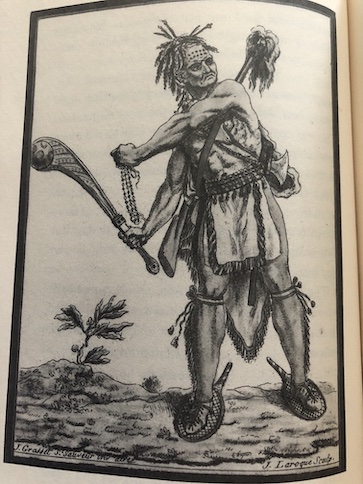
Every chapter, including the Introduction, contains recipes that readers can make at home. Some of them are easier than others. Some recipes include pieces of Native American folklore about them or the foods in the recipes. Many of the illustrations are 19th century drawings.
Rather than organizing the book based on tribe or geographic region, the chapters of the book are based around particular types of food or cooking and eating concepts:
Introduction
This section introduces how historians know about the history of food among Native American tribes and how their diets changed after the arrival of Europeans.
Recipes in this section are:
- Hickory Nut Soup
- Green Succotash
- Pueblo Peach Crisp
Discovering America

This section includes information about the earliest known hunting and cooking habits of Native Americans. It includes a description of the “land bridge” theory of how the ancestors of Native Americans arrived in the Americas from Asia. As of the early 21st century, we still don’t have a definitive answer for precisely how ancient people first arrived in the Americas, more recent theories include the possibility of these ancient people being seafaring rather than finding a land crossing, although the land crossing theory is also still possible.
Then, it explains about the arrival of the European colonists. It doesn’t sugar coat that the arrival of the colonists and their westward expansion led to the extinction and endangerment of native animal species because these newcomers hunted them without restraint. The introduction of unfamiliar diseases, like measles and smallpox, to the Native Americans took many lives, sometimes even killing whole tribes. These drastic changes greatly impacted the lives and lifestyles of Native Americans, although some traditional habits survived, including the preparation of traditional types of foods.
There are no recipes in this chapter.
A Great Mystery
This chapter explains about hunting and gathering and the development of agriculture among ancient Native American tribes. The “mystery” is about the development of corn as we know it. It was never really a wild plant. The evidence suggests that ancient Native Americans deliberately created it by cross-pollinating different wild grass plants, but it isn’t really known which ones. Most of this chapter explains how widespread corn was as a food and the uses and folklore that different tribes had for it.
Recipes in this section are:
- Roasted Corn on the Cob
- Blue Pinole – a blue cornmeal-based drink with sugar and cinnamon, from the Southwest
- Thumbprint Bread (Kolatquvil)
- Hopi Blue Marbles – boiled balls of blue cornmeal dough, a traditional breakfast food
- Wagmiza Wasna – a mixture of cornmeal and dried berries
Treasure
This section is about foods that Native Americans introduced to the rest of the world, like pumpkins, peanuts, chili peppers, sunflower seeds, maple sugar, and different varieties of beans, including kidney beans and lima beans.
Recipes in this section are:
- Cherokee Bean Balls
- Apache Pumpkin with Sunflower Seeds
- Popped Wild Rice
- Zuni Green Chili Stew

The Hunt
This chapter is about Native American hunting techniques and the animals they hunted.
Recipes in this section are:
- Broiled Buffalo Steaks
- Venison and Hominy Stew
Feast and Famine
This chapter is about Native Americans who lived in areas where food was scarce and ways of foraging for food during times of famine. It also explains special feast days.
Recipes in this section are:
- Mouse Cache Soup – made with beef broth and seeds: sunflower seeds, sesame seeds, buckwheat groats, and millet
- Iroquois Strawberry Drink
- Mushrooms Cooked in Oil
Berries, Flowers, and Bear Fat
This chapter explains the seasonings that Native Americans added to food and cooking techniques that added nutrients.
Recipes in this section are:
- Fried Squash Blossoms
- Pemmican Cakes – the origins of beef jerky
- Maple Sugar Drink
- Wild Grape Dumplings
- Inuit Ice Cream – a berry dessert originally made with seal oil but made with egg whites here
- Wojapi – a Sioux fruit pudding
Lighting the Fire
This chapter is about how plants and animals were processed to make them ready for cooking, such as how corn and acorns were ground into flour and how animals were butchered. When they had to boil water, they often used vessels that would have been damaged if they were put directly over fire, so they would heat stones and put them into the water instead.
Recipes in this section are:
- Broiled Salmon Steaks with Juniper Berries
- Broiled Rabbit with Corn Dumplings
- Baked Beans with Maple Sugar

A Basketful of Water
Native Americans didn’t have cooking pots and pans made out of metal or glass until after the European colonists arrived. Before that, their cooking vessels were made of wood, stone, pottery, or tightly-woven baskets. This chapter explains the different types of cooking vessels they had, including the shells of pumpkins and gourds.
Recipes in this section are:
- Pumpkin Shell Soup
Good Manners
This short chapter is about eating manners, superstitions, and taboos among different tribes. There are no recipes.
Thanksgiving
This section explains how Native Americans would give thanks to their Creator or Great Spirit or Nature or to animals and plants themselves for the foods that helped keep them alive. There are no recipes in this chapter.
 Jestress's Forgotten Books and Stories