Voices After Midnight

Voices After Midnight by Richard Peck, 1989.

Three children, Heidi, Chad, and Luke, are traveling from their home in California to spend a couple of weeks in New York during the summer because their father has to do some work for his advertising firm there.  Heidi, the oldest child, didn’t want to go on the trip.  She would rather have stayed at home with her best friend, but her parents insisted that she go because she borrowed her mother’s car without permission and took it out driving without an adult in the car even though she only had a learner’s permit, not a real driver’s license, and barely even knew where the car’s controls were (she took her younger brothers along just so they could tell her about the controls, which shows her level of driving skill).  The resulting accident she had took out a flower bed.  Although her parents didn’t find out about the accident, she decided that perhaps it would be a good idea to get out of town for awhile while the whole incident blows over.

Chad is the narrator of the story, and he explains that his father’s company has rented a house for them to live in while they’re in New York, or rather, part of an old house.  It’s a very old house, and it’s five stories tall.  There is an old cage elevator that has been repurposed as a telephone nook.  It’s a nice place, but there’s something strange about it.  Even before they arrive in New York, both Chad and Luke begin dreaming about snow.  Then, on their first night in the house in New York, Chad hears voices in the house after midnight.  It sounds like a man and a woman.  They are trapped somewhere, and they are cold.  Even the family’s dog, Victoria Alexandrina (Al for short) is frightened in the house.

Luke loves old houses and places with history, and he seems to have an odd ability to sense the past, even being able to describe what places looked like in the past without doing any research to find out.  Luke tries to tell Chad that he has the same ability to get in touch with the past, but Chad doesn’t believe it at first.  Luke thinks that they have a special mission in New York, to resolve some kind of unfinished business, although he’s not sure what. 

Then, Luke admits to Chad that he’s been hearing the voices in the house, too.  The two of them sneak up to the upper floors of the house, the part that they haven’t rented, and they see that the rooms are all empty and in bad repair.  When they look out of the windows, they see the landscape as it was years ago, with buildings being constructed that are already old in modern times.  Heidi finds them up there and becomes fascinated by a dress that they find in an old trunk.

The boys’ abilities to see the past keep getting stronger, and more strange things happen in the house.  A bouquet of flowers suddenly appears in Heidi’s room with a message from a mysterious admirer, and then almost as suddenly, the flowers wilt and the card with the message fades, as if they had aged suddenly.  The boys keep seeing people and things from the past all over town as they explore New York City.

At night, Chad and Luke find themselves going back in time in the house’s history.  Chad is frightened, but Luke knows that they’re looking for an event in the house’s history, something that must be changed.

Back in the late 1800s, the Dunlap family lived in the house, with two teenage children, Emily and her older brother, Tyler.  Their family is fairly well-off, but not as wealthy as the family of the girl Tyler has a crush on.  One night, Chad and Luke witness a conversation between Emily and her mother about Tyler’s marriage prospects.  Emily thinks that Tyler is making the wrong choice, pursuing the wrong girl in his romantic life.  It doesn’t seem like an earth-shattering tragedy, but events are moving closer to an even greater tragedy.  It is Emily and Tyler’s voices that the boys have been hearing after midnight in the house.

Chad finds their trips into the past unnerving and he fears that he and Luke might accidentally become stuck in the past.  He wants to stop, but Luke insists that they keep going.  The situation becomes more urgent because Heidi has also found her way into the past and is falling in love with Tyler!  When Chad and Luke go into the past, they are invisible to the people there, but Tyler not only sees Heidi but dances with her at a New Year’s ball.  From then on, Heidi is also involved in the adventure.  Like Luke, she has a sense that there is something that they need to do in that house, in the past.

Something bad is going to happen to Emily and Tyler.  Somehow, they are going to die.  Cold.  Trapped.  During the Great Blizzard of 1888.  The kids are not sure quite what exactly is going to happen until almost the end, but they can feel it coming.  It has already happened in the distant past, but they need to find the right moment in time to stop it from happening again!

All three of the children, Chad, Heidi, and Luke, have psychic abilities and are able to see and travel through time, although Chad and Heidi have mostly worked to ignore it in their lives, trying to just be normal kids.  When they succeed in saving Tyler and Emily Dunlap, they not only change the past but the present, eventually meeting some of Tyler’s descendants (who he marries is a bit of a surprise, although it’s not either of the girls that Emily had expected it to be).  There is a kind of odd time loop, though.  At the end of the story, they learn about their own, special, previously unknown connection to the Dunlap family and the possible reason why they are gifted with their time-traveling abilities.  In saving Tyler and Emily, they are also saving themselves, which oddly, begs the question of how real they were before . . . but, maybe they were always fated to succeed.  In the end, the house in New York is still “haunted”, but the final joke (unknown to the current owners) is that Heidi becomes the beautiful but mysterious “ghost” who appeared at the right time and then suddenly disappeared and whose story has been passed down through the generations.

The book is available to borrow for free online through Internet Archive.

Angels Don’t Know Karate

The Adventures of the Bailey School Kids

Angels Don't Know Karate Cover

#23 Angels Don’t Know Karate by Debbie Dadey and Marcia Thornton Jones, 1996.

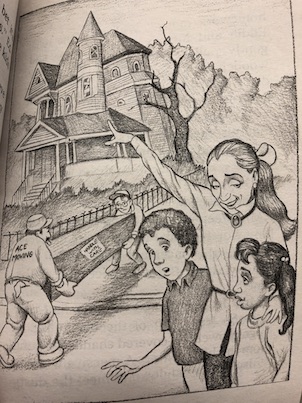
Before Christmas, the kids at Bailey School are making snow angels, and they start talking about whether or not real angels exist. Melody and Liza say that they do and that everyone has a guardian angel. Eddie jokes that the new school crossing guard should have one as she repaints the crosswalk lines in the road. The kids say that she should also be careful not to get paint on the sidewalk in front of Mr. Mason’s house Mr. Mason is the meanest man in the neighborhood.

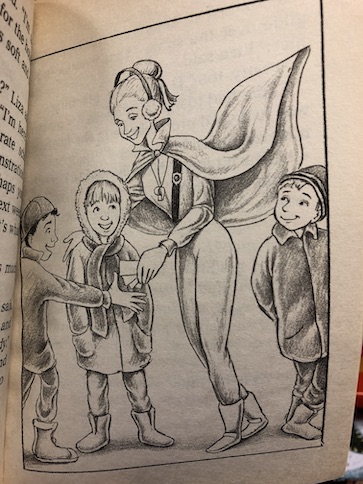
As the kids stand around talking, Ben, the school bully, hits Eddie in the mouth with a snowball. Eddie wishes that he knew karate so that he could take care of Ben, and Ben tells him that he’s a just a chicken, daring him to climb a tree on the playground. The other kids tell Eddie not to do it because the tree branches are snowy and icy and he’d probably fall, but Eddie feels like he has to do it to prove that he isn’t chicken. (Yeah, kid, the best way to prove you’re not scared of things is to do a stupidly dangerous thing because you don’t mind demonstrating that you’re desperately scared of what someone you don’t even like thinks about you.) Of course, Eddie does fall, but the others have the impression that the tree branches seem to be helping to hand him down to the ground, where the new crossing guard catches him. Melody thinks that, for a moment, it looked like the crossing guard had angel wings, but no one else saw it because they were all looking at Eddie.

The crossing guard says that her name is Angela Michaels and that she has just come to town for the opening of a new karate school. She invites the children to come to a karate demonstration at the mall. Eddie thinks that the karate demonstration would be great, and Howie says that karate isn’t about attacking people so much as protecting. More and more, Melody becomes convinced that Angela’s rescue of Eddie was a miracle, that she’s Eddie’s guardian angel, and that she’s come to Bailey City on a mission.

Angela turns out to be a karate expert, and the kids are impressed. Mr. Mason yells at the kids as they walk by his house on the way home, and they wish that Angela would teach him a lesson. Eddie says that if they want to spy on Angela and find out if she’s a real angel, Mr. Mason’s yard is the best place to do it because it’s near the crosswalk and no one would expect kids to be hiding in his yard. The others say that he’s crazy to want to go in mean Mr. Mason’s yard, but Eddie says that if Angela is a real guardian angel, they should be safe.

Mr. Mason catches the children in his yard, and Angela does intervene when Mr. Mason yells at them. She convinces Mr. Mason to let her make him a cup of Heavenly Tea. Melody decides that Angela’s mission is probably to help Mr. Mason be nicer and make some friends. Melody says that they should help Angela by being friends with Mr. Mason and doing nice things for him. The others think that she’s crazy, but she’s convinced that it’s safe to do nice things for Mr. Mason because Angela will make sure that they’ll be safe and that Mr. Mason won’t get mad.

Mr. Mason yells at the kids when they come to help him, but Melody convinces him to accept the cookies they’ve brought him and let them shovel some snow for him and decorate his yard for Christmas. He doesn’t seem particularly grateful at first, but he does accept their kindness. Then, to the children’s surprise, Mr. Mason becomes their new school crossing guard, replacing Angela. He says that Angela had to leave on some important business and that she convinced him that he would like the job, and he admits that he does like it. Melody remains convinced that Angela was an angel. Eddie says that she never proved it, but she says that some things don’t need proof, just belief.

Eddie never does use karate on Ben, but Angela deals with Ben for him. Angela catches Ben bullying another younger boy and teaches him that strong people are supposed to protect weaker people, not bully them. The children take karate lessons from Angela, and she’s tough. Eddie compares her to a drill sergeant. But, being tough isn’t the same as being mean. Angela is serious when she says that strong people have a duty to protect others, and that’s what she teaches other people to do. She uses her strength and toughness to help people, not hurt them. It’s a good philosophy!

The book is available to borrow for free online through Internet Archive.
Elves Don’t Wear Hard Hats

The Adventures of the Bailey School Kids

#17 Elves Don’t Wear Hard Hats by Debbie Dadey and Marcia Thornton Jones, 1995.

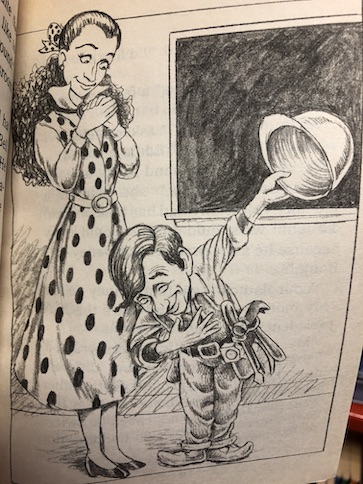
The playground equipment at Bailey School is old and breaking, so the PTA has decided to fund a new playground for the children. The playground is going to be built by the Bell Construction Company, and when the children meet the owner, Hollis Bell, he is an odd little man with curly-toed work boots. In fact, all of his men are unusually short. However, Mr. Bell promises to build the children the best playground they can imagine.

However, the parents at the school are arguing about the playground, how much it’s going to cost, and whether it really needed to be replaced at all. There’s not a lot of Christmas cheer going around, but Mr. Bell puts up Christmas trees and tells the children that they have their own kind of magic that can help fix their parents’ arguing.

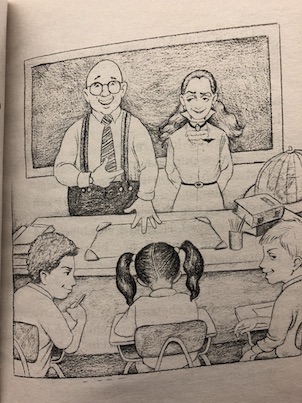
One day, Mr. Bell comes to the third grade class to interview them about what they would like to have on their playground. All of the kids have different ideas, and they end up arguing about the things they’ve heard their parents say about what the playground should be like. However, Mr. Bell urges them to calm down and work together. He tells the children that they should make a list of what they all want and “check it twice.” One of the kids in the class says that it’s impossible to give everyone what they want, but Mr. Bell says that he’s in the business of making wishes come true. Liza asks what happens if someone puts down a really bad idea, and Mr. Bell says that he’ll know if an idea is a bad idea. Because Mr. Bell is short, his tools jingle like jingle bells, and he acts like he can grant their Christmas wishes, the kids start thinking that he might be an elf.

The kids are allowed to watch the workmen work, but Mr. Bell makes it clear that they’re not allowed in the trailer that’s attached to his truck. Naturally, the kids get curious about the trailer. They can’t help but sneak a look inside, and when they do, they find out that it’s a workshop full of toys!

As the children try to figure out if the construction crew might really be elves, they decide to ask the department store Santa more about elves. The kids debate about the department store Santa really being Santa, and the Santa makes a comment about how he’s been meaning to pay a visit to their school, seemingly ignoring a previous book in the series, when Santa apparently became their school’s janitor. However, later in the book, Howie refers to the “new janitor who keeps turning down the heat,” referring to what happened in the previous book, which is confusing. The department store Santa explains that his elves like to fix things, and they are particularly concerned with fixing people who can’t get along, hinting that the arguments over the school’s playground are what brought the elves to the school. Santa’s advice is for the children not to worry because the elves will disappear on their own “when the time is right.”

The deadline for submitting the plan for the new playground is approaching, and the kids realize that if the adults can’t agree on something, they might end up with no playground at all! When the “elves” leave to take care of a job “up north,” and the playground issue still isn’t resolved, the kids think that they probably weren’t magical elves and that they didn’t fix anything, but the kids aren’t ready to give up yet.

When Eddie suggests that they all just build their own playground out of wood and begins drawing his vision of it, it attracts the attention of the adults. At first, the kids think that they’ll have to do all the work on their playground themselves, but the more the adults hear them talk and study the picture Eddie drew, the more involved they become. When the adults were in charge, they each wanted to be considered the leader and authority on the project, with their ideas overshadowing everyone else’s, but with Eddie in charge, the project moves forward. Even though Eddie is a child, he’s the one with the vision to carry the project through, and he neutralizes the adults’ competing egos. The project ends up being finished unexpectedly fast, and in the end, no one knows who actually completed it, hinting that the Mr. Bell might really have been an elf and that he and the other elves secretly returned once everyone came to an agreement about what they really wanted. As always with this series of books, readers are left to draw their own conclusions.

The book is available to borrow for free online through Internet Archive.

Santa Claus Doesn’t Mop Floors

The Adventures of the Bailey School Kids

#3 Santa Claus Doesn’t Mop Floors by Debbie Dadey and Marcia Thornton Jones, 1991.

The school’s janitor, Mr. Dobson, quits one day after some kid spreads peanut butter from the food drive box all over the staircase banister. He’s had enough of their pranks! The third grade class’s substitute teacher, Mrs. Ewing, who is teaching the class while Mrs. Jeepers is visiting her family in Romania for Christmas, says that she’d hate to think that someone in their class actually stole food meant for some poor person and used it for an awful prank. The principal confirms that it was someone in their class when he pulls a couple of empty peanut butter jars from their trash can. The culprits turn out to be Eddie and Howie. So, the principal declares that, until they can get a replacement janitor, the third grade class will clean the entire building.

The other kids are angry with Eddie that they now have to give up their recesses to empty trashes and mop floors all over the school, and Melody says that it’s Eddie’s fault that Mr. Dobson is unemployed at Christmas. Eddie complains that “it was only peanut butter” and that it was Mr. Dobson’s choice to quit his job. The other kids know that part of Eddie’s problem is that he has an issue with Christmas, and that’s why he’s trying to spoil things. Eddie’s mother is dead, and ever since her death, his father hasn’t wanted to celebrate Christmas.

Fortunately, the principal soon tells the children that he has hired a new janitor, Mr. Jolly. Mr. Jolly is a cheerful older man with a thick white beard, and he likes to smoke a pipe. Mr. Jolly seems very nice, and he works very fast, but he has an odd way of watching the children and writing things down in a notebook.

Then, one day, the kids see Mr. Jolly talking to an odd little man, and they hear the man call him “S.C.” The little man seems very worried about something and wants Mr. Jolly to come and straighten out some kind of mess before Christmas. However, Mr. Jolly says that the work he is doing at the school is very important. They notice the kids watching them, so they don’t say any more, but the kids soon begin noticing other peculiar things about Mr. Jolly. He keeps the school’s temperature rather cold, but yet he likes to wear shorts. He doesn’t like it when Eddie turns up the thermostat because he likes the cold.

The temperature issue becomes serious because the kids have trouble working when it’s so cold. They have to wear their coats and sweaters all the time, and it gets to the point where it’s actually warmer outside than it is inside the building. Rather than freeze, Eddie decides that he’d rather get rid of Mr. Jolly. However, the other kids don’t want to help him after what happened with Mr. Dobson. Eddie takes it on himself to decorate the teachers’ lounge with toilet paper and turn up the heat again. However, Mr. Jolly solves both problems impossibly fast, and suddenly, the food drive box is overflowing with jars of peanut butter.

Liza is the one who suggests that Mr. Jolly could be Santa Claus. He looks like Santa Claus, and his short friend, who called him “S.C.” looks kind of like an elf. It would also explain why he likes cold so much and how he seems to do things magically fast. The others don’t believe her, and after Eddie pulls another trick that goes wrong, Mr. Jolly actually talks to him about Christmas and Santa Claus. Eddie says that those things are for little kids and even if there was a Santa Claus, he wouldn’t bring him what he really wants for Christmas.

Although Eddie doesn’t actually say it, what he really wants is attention from his dad. His dad is away a lot, working, and Eddie’s grandmother, who takes care of him, is often busy. However, Eddie becomes convinced that miracles can happen when his dad finally comes home for Christmas and actually wants to celebrate the holiday.

The book is available to borrow for free online through Internet Archive.
The Wicked, Wicked Ladies in the Haunted House

The Wicked, Wicked Ladies in the Haunted House by Mary Chase, 1968.

Nine-year-old Maureen Swanson has a bad reputation in her neighborhood, mostly deserved.  The other kids don’t like her because she tells lies and picks fights with them.  Maureen is fascinated by an old, abandoned house in her neighborhood where the wealthy Messerman family used to live.  Sometimes she likes to pretend that she lives there herself. 

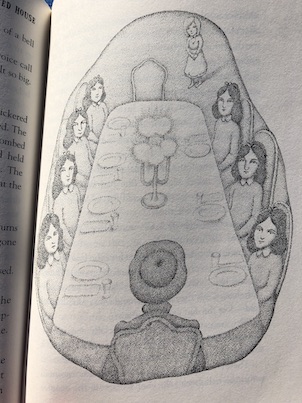
One day, while trying to avoid punishment for her latest antics, she finds her way inside the Messerman estate.  There, she meets a little man who turns out to be a leprechaun.  He tells her that she should leave immediately and not come back, but instead, she ends up exploring inside the house.  To her amazement, she finds paintings of the seven Messerman sisters, who disappeared from the house long ago, and the ladies in the paintings move when she turns her back on them.

When Maureen tries to tell others about it, no one believes it.  When she leaves the house, Maureen takes with her a strange bracelet that she finds on the ground, the same one that she had seen on one of the ladies in the paintings, a gold chain with pigeon feathers.  Later that evening, the same lady from the painting shows up at Maureen’s house, asking for her bracelet back.  The rumors Maureen has heard about the Messerman house being haunted are more true than she knows, and the wicked Messerman girls will stop at nothing to get what they want.

Years ago, the leprechaun came to the Messerman house along with a maid who was from Ireland.  Mrs. Messerman was a very kind woman, and Nora, the maid, was his friend, so he decided to stay.  However, the Messerman girls were always selfish and wicked.  One day, the eldest of the girls stole the leprechaun’s magic bag of tricks and turned herself and her sisters into birds so that they could always go where they wanted and do what they wanted without anyone stopping them.  Mr. and Mrs. Messerman were broken-hearted when their girls disappeared.  Years later, after their parents were dead, they finally returned.  They were not sad at all, but continued their selfish and wicked ways.  Because of the magic, they never age and can turn into birds whenever they like. 

Maureen is afraid to admit that she has the bracelet because she knows that her parents will punish her for trespassing on the Messerman property.  The next day, the women trick her into entering the estate again, only this time, Maureen enters the estate as it was in the past, when the girls were young.  Mr. and Mrs. Messerman are very kind to Maureen and offer to look after her until they can find where she lives.  Mrs. Messerman seems to know that her daughters are mean but doesn’t seem to know what to do about it.  She asks Maureen to help them if she ever has the chance.  It’s a touching moment for Maureen, who suddenly realizes that no one has ever asked her for help before.

Maureen, frightened by the girls, finally gives back the bracelet, and they all fly off again, leaving her alone in the past. How is Maureen going to get home?

This book also goes by the title The Wicked Pigeon Ladies in the Garden. It is available to borrow and read for free online through Internet Archive.

My Reaction and Spoilers

This is partly a story about personal transformation. Maureen has definitely been the resident mean girl, but she gains a new perspective on her own life and behavior when confronted with the frightening wickedness of the Messerman girls.

The leprechaun tells Maureen that the only way to get out of the pretend past created by the Messerman girls is to think about what is going on in the real world.  When Maureen thinks of her mother, she hears her mother calling her and returns to her own time.  The leprechaun catches the birds in a net and almost drowns them in a pond, but Maureen stops him, telling him that Mrs. Messerman had asked her to help them.  The leprechaun releases the birds and tells Maureen that they will continue to be, literally, flighty birdbrains, but that their mother’s love will always be with them.  Maureen, having seen how cold and cruel the sisters were, never appreciating their mother’s love, learns to appreciate her own family more and to behave better. At the end of the story, she acknowledges that she heard her mother calling her and that call, the product of her own mother’s love and concern for her, was what helped her to return home. Maureen ends up better off than the wicked and flighty Messermans because she not only has a home where people care for her but she has learned to appreciate that home and those people and will now treat them better.

One of the things that I appreciated most about this book was the unusual way the leprechaun was used in the story. The story starts out seeming like it will be about ghosts in a haunted house, but that’s not quite what’s happening. Also, when leprechauns appear in stories, they usually have a pot of gold or play tricks on people, but the leprechaun’s role in this story isn’t quite the same.

Vampires Don’t Wear Polka Dots

The Adventures of the Bailey School Kids

#1 Vampires Don’t Wear Polka Dots by Debbie Dadey and Marcia Thornton Jones, 1990.

The kids in the third grade class at Bailey Elementary School have been pretty hard on their teachers. Their last teacher resigned when she suffered a nervous breakdown due to their misbehavior and pranks. Now, the kids have a new teacher, Mrs. Jeepers.

Mrs. Jeepers has just moved to their city from Transylvania, and everyone in class agrees that she’s not a normal teacher. She seems to have a hypnotic power over people, and her mysterious green brooch seems to glow and have magic powers. Not only that, but she has moved into a creepy old house in the neighborhood with a long box that could contain a coffin. Could Mrs. Jeepers be a vampire? No one knows, but none of the kids want to risk making her angry, except maybe Eddie, the class trouble-maker.

Mrs. Jeepers lays down the class rules on the first day. The rules are basically that the students should treat her and each other nicely, talk only when appropriate, and walk instead of run. Eddie asks her what happens if they break the rules, and Mrs. Jeepers only replies, “I hope you never have to find out.” Most of the other students are nervous about creepy Mrs. Jeepers and do their best not to make her angry, but Eddie is annoyed by how good the others are being and tries to various antics to get Mrs. Jeepers angry and make the other kids goof off, like normal. Sometimes, Mrs. Jeepers stops these antics, apparently with the power of her mysterious brooch.

Mrs. Jeepers is strangely evasive about her past, although she mentions that her husband is dead. He is the one who gave her the bat charm bracelet that she wears. Eddie and Melody try sneaking into Mrs. Jeepers’ house one night to see if they can get a look at the long box that might be a coffin, but they are unable to actually open the box, which seems to be locked from the inside.

The question of whether Mrs. Jeepers is really a vampire is never settled. Unlike most mythological vampires, she seems to have no problem going outside during the daytime. When the kids test garlic on her, it makes her sneeze. She does seem to have a strange power to make the children behave themselves, but that is partly because they are afraid of making her angry. At the end, Eddie finally causes Mrs. Jeepers to lose her temper. She takes him out of the classroom for a moment to talk to him, and when they return, Eddie seems to have been badly frightened by something. He never tells the others exactly what Mrs. Jeepers said or did, but he says that she is not normal and that he’ll never do anything to make her angry again.

When the book ends, it says that the children got through the rest of the school year with Mrs. Jeepers without getting her angry or seeing her brooch glow again, making me think that the book wasn’t always intended to be part of a series. However, for the rest of the series, the kids are still in the third grade with Mrs. Jeepers as their teacher.

The fact that the kids can never really prove that Mrs. Jeepers is a vampire, although they continue to believe it throughout the series, sets up the pattern for the books that follow it. Throughout the series, the kids encounter other people (including some relatives of Mrs. Jeepers) who seem strange and may be creatures from mythology or folklore or other supernatural beings, but the books always leave some room for debate. Mrs. Jeepers is the only one of these strange people to remain with the kids throughout the entire series. Other characters come and go, although there are a few recurring characters.

I always like it when children’s books reference other children’s books. In the beginning of the book, after their first teacher leaves, the kids worry about who their new teacher will be, and they make a reference to Miss Viola Swamp from the Miss Nelson books.

The book is available to borrow for free online through Internet Archive.

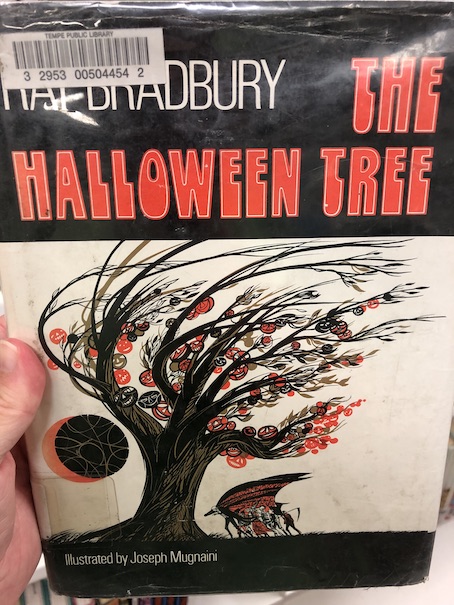
The Halloween Tree

The Halloween Tree by Ray Bradbury, 1972.

A group of neighborhood boys want to go trick-or-treating on Halloween night, but they’re upset because it looks like a friend of their, Joe Pipkin, won’t be coming with them.  When they get to Pipkin’s house, he seems ill and is clutching his side.  His friends worry that he’s sick, but he valiantly reassures them that he’ll be fine.  He sends them on, telling them that he’ll catch up with them and that his costume will be great.  Specifically, he tells them to “head for the House” which is “the place of the Haunts.”

The house that Pipkin is talking about is the creepiest house in town.  It’s large, so large that it’s hard to tell how many rooms it has.  The boys knock on the creepy-looking door knocker on the front door, and a man answers the door.  When the boys say, “trick or treat,” the man says, “No treats.  Only—trick!”  Then, he slams the door without giving them anything.

Not knowing what else to do, the boys walk around the side of the house and see a large tree, filled with jack o’lanterns.  This is the Halloween Tree.  The strange man they saw before rises up from a pile of leaves and scares the boys, giving them the “trick” that he promised them earlier.  He finally introduces himself as Carapace Clavicle Moundshroud.  He begins talking to them about the history of Halloween and asks them if they understand the real meanings behind the costumes they have chosen.  The boys admit that they really don’t know the meanings behind their costumes, and Moundshroud points off into the distance, calling it, “The Undiscovered Country.”  He says that out there likes the past and the history of Halloween and that the boys will learn the answers if they’re willing to go there.  The boys are interested, but they say that they can’t go anywhere without Pipkin, who promised that he would come.

Pipkin suddenly appears in the distance, by a dark ravine, holding a lit pumpkin.  He says that he doesn’t feel well, but he knew that he had to come.  Pipkin trips and falls, and the light in his pumpkin goes out.  From a distance, the others hear him calling for help.  Moundshroud says that something bad has happened.  Pipkin has been taken away to The Undiscovered Country by Death.  Moundshroud says that Pipkin may not be taken permanently but perhaps held for ransom and that, if they follow Pipkin to The Undiscovered Country, they might be able to get his soul back and save his life.

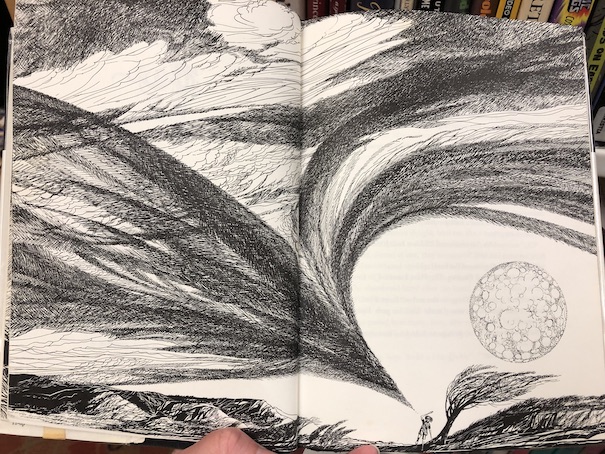
Moundshroud has the boys build a kite that somewhat resembles a pterodactyl, and they use it to travel into the far distant past.  The first place they arrive is Ancient Egypt, where the boys learn about mummies and how the Ancient Egyptians viewed the dead.  They see Pipkin as a mummy, being laid to rest in a sarcophagus, surrounded by hieroglyphs, telling the story of his life.  (Or, as Moundshroud says, “Or whoever Pipkin was this time around, this year, four thousand years ago,” hinting that Pipkin has been reincarnated before and what they are seeing during their journey are his past lives and deaths.)  Pipkin calls out to his friends for help.  Moundshroud tells the boys that they can’t save Pipkin now, but they’ll have a chance later.

They continue their journey through time and around the world, seeing glimpses of Halloweens past in Ancient Rome and the British Isles, where they learn about druids, Samhain, and witches.  Moundshroud describes how the Romans supplanted druidic practices with their own polytheistic religion until that was eventually replaced by Christianity.  All along, they can still hear Pipkin calling to them, and he seems to be carried off by a witch.  As they pursue him, Moundshroud teaches them the difference between fictional witches and real-life witches, which he characterizes as being more like wise women, who don’t really do magic.

From there, they go to Notre Dame to learn about gargoyles.  They continue to see Pipkin in different forms, even as a gargoyle on the cathedral.  Pipkin tells them that he’s not dead, but that he knows that part of him is in a hospital back home.

In Mexico, the boys experience Dia de los Muertos and learn about skeletons and a different kind of mummy from the ones they saw in Egypt.  They find Pipkin, held prisoner in the catacombs by the mummies, and Moundshroud tells the boys that the only way to save him is to make a bargain, both with him and with the dead: each boy must give one year from the end of their lives so that Pipkin may live.  It is a serious decision, for as Moundshroud says, they won’t miss that year now, being only about 11 or 12 years old, but none of them knows how long they will actually live.  Some of them who were destined to die at 55 would now only make it to 54, and as they reach the end of their lives, the year will seem that much more important to them.  Even those who live longer will still want every day they can possibly have.  However, each decides that he is willing to make the sacrifice because, without that sacrifice, Pipkin has no chance, and they can’t just let him die.

They make the bargain and are soon returned home.  When they go to Pipkin’s house to check on him, they are told that Pip is in the hospital because he had his appendix taken out, just in time to save his life.  At the end of the story, Tom (who is the leader of the boys through most of the story), wonders silently who Moundshroud really was, and he hears in his mind, “I think you know, boy, I think you know.”  Tom asks him if they will meet again, and Moundshroud says that he will come for Tom many years from now, confirming that Moundshroud was Death all along, which was why they had to make the bargain with him.

I saw the animated movie version of this story long before I read the book, and it really gave me the creeps!  Moundshroud is creepy because he is kind of two-faced.  On the one hand, he seems somewhat helpful in helping the boys to find Pipkin and teaching them about the history of Halloween, but on the other, he does not admit to the children that he is Death until the very end, that he is the very thing that they need to save Pipkin from, and that they can only do it by offering a sacrifice of years from their own lives. Although it does occur to me that Moundshroud may not be quite as two-faced as he seems because Pip’s illness and potential death may not have been planned by him but simply the fated situation for Pip, and Moundshroud might have just taken it upon himself to provide a way for Pip’s friends to save him in the least painful way. By not telling them that a sacrifice of part of their lives would be necessary until the very end, after they had come to a better understanding of life and death in the history of Halloween, he may have made the choice easier for them to make. Also, he never says exactly how much time they bought for Pip with their sacrifice. The implication is that Pip is now free from his early appointed death date and will now live a full life, similar to what his friends will have. The exchange does not seem to be an even one, a year for a year, with the children needing to decide how many years they will donate to Pip. Although the kids still don’t know at the end how many years each of them will live, it seems that none of the rest of them is in danger of dying in childhood, and they will all live for many more years.

I wouldn’t recommend this book for young children (it still gives me the creeps, and I’m in my 30s), but it is interesting how they take a journey through the origins of Halloween. The book and the movie were somewhat different, partly because there were more kids in the group in the book and partly because the group of kids in the movie also had a girl in a witch costume. In the book, the kid in the witch costume was also a boy.

Both the book and the animated movie are available online through Internet Archive.

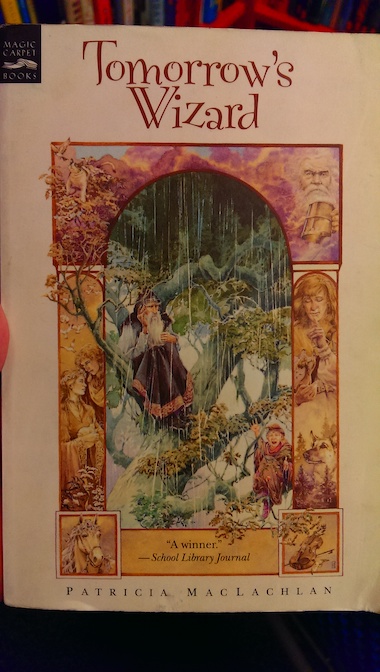
Tomorrow’s Wizard

TomorrowsWizardTomorrow’s Wizard by Patricia MacLachlan, 1982.

In a way, this story is a collection of shorter stories, but they are all tied together. In the beginning, Tomorrow’s Wizard (that’s actually his name, he’s also called Tomorrow) has just been given an apprentice wizard named Murdoch. Their job is to listen for important wishes to grant. Each of the shorter stories in the book involves a different wish and how Tomorrow and Murdoch grant it.

The First Important Wish – Rozelle is a pretty girl but wild and given to fits of temper. Her parents had her later in life and never disciplined her, so she has never had a reason to learn to control herself. However, her tantrums drive everyone else crazy. Rozelle’s father, acknowledging how difficult it is to deal with Rozelle, wishes that he could find a man who was willing to marry her. Tomorrow hears the wish and sends a variety of suitors to meet Rozelle, but she doesn’t like them, and none of them really like her, either. Then, another possibility occurs to the wizards: the villagers have been complaining that they are afraid of a nearby giant. Tomorrow knows that he giant is really harmless and gentle, just lonely. Could it be possible that Rozelle is the company that he needs?

Three-D – Miller Few and his wife, Mona, are nasty people, two of a kind. Because he’s the only miller in town, Miller Few (known to his neighbors as Three-D for Dreadful Dastardly Demon) freely cheats his customers. He and his wife have no friends because they’re so awful. Then, one day, Three-D saves Murdoch’s life. To reward the miller, Murdoch agrees to grant him a wish. The miller and his wife decide that they want a nice, sweet child who would do their work for them. The child Murdoch grants them is indeed sweet. A little too sweet. Not only does little Primrose look pretty and do the housework, but she helpfully reminds the miller about his debts and the other things her parents do wrong. The miller and his wife become more careful and agreeable and gain new friends because of Primrose, but they aren’t very happy. They aren’t really being themselves, and they’re tired of being on their best behavior all the time. But, perhaps there is one thing that can stop Primrose from being overly sweet: the miller’s old cat, Clifford.

The Comely Lady and the Clay Nose – Geneva is a very beautiful young woman and has many admirers, but she knows that they are more in love with the way she looks than with who she is. It worries her, and she wishes for someone who would love her for the person she is. To help solve her problem, Tomorrow makes an ugly clay nose for Geneva to wear, telling her that it will help her to find the person she is looking for. When she puts it on, her former admirers flee, and for awhile, Geneva is very lonely, but she perseveres and ends up finding the love that she is looking for.

The Perfect Fiddle – Bliss, the fiddle-maker, is ironically an unhappy man. The reason is that, no matter how good his fiddles are, he can never make one that’s completely perfect. After Bliss tries several crazy schemes to capture perfection in his fiddles, Tomorrow goes to visit Bliss’s wife, Maude. Like Tomorrow, Maude has seen the problem with Bliss’s approach to his fiddles and finally asks Bliss the question that makes him reconsider whether perfection should be his goal.

The Last Important Wish – Although Tomorrow is impatient with his apprentice, Murdoch, he does like having him live with him, and he has also grown attached to the horse that lives with them both. However, he has come to see that the life of a wizard isn’t the one that Murdoch is really suited for. More than anything, Murdoch wants the experience of being born and living among humans. The horse, too, wishes for a kind master and a family. Tomorrow sees that it’s time to grant both of their wishes, giving the horse and Murdoch (as a baby) to a kind farmer with a wife and other children.

The book is currently available online through Internet Archive.

Wizard’s Hall

Wizard’s Hall by Jane Yolen, 1991.

Henry hadn’t seriously considered becoming a wizard.  It was just one of a number of things he considered being when he was young.  However, when he suggests the possibility when he is eleven years old, his mother unexpectedly jumps on the idea and immediately packs him off to Wizard’s Hall, the school for young wizards.  Although Henry expresses doubts, his mother tells him that it’s only that he try that counts.  Being a dutiful son, he immediately sets out for Wizard’s Hall to enroll.  He has a moment when he gets worried and tries to turn back, but he discovers that he can’t because his destiny is at Wizard’s Hall, the road there won’t let him turn back.

At Wizard’s Hall, the Registrar (after consulting with a strange bird or animal in a cage called called Dr. Mo) changes Henry’s name to Thornmallow, saying that he’s prickly on the outside but squishy on the inside.  Henry isn’t happy about being given a new name, but he accepts it as part of what he has to try at the school.  The Registrar and the teachers also refer to Thornmallow oddly as what they “desperately need.”  Something is deeply wrong at Wizard’s Hall, and the teachers are hopeful that Thornmallow will be the one to save them, although he doesn’t appear to have much aptitude for wizardry.

On his first day, his teachers discover that he is tone-deaf, which is unheard of for wizards.  Wizards have to recite their spells in the proper tones, and Thornmallow can’t do it.  When one of his teachers tries to help him by covering his years while he attempts to recite, Thornmallow accidentally recites a spell that produces an avalanche of snow and roses.  It’s more powerful than anyone expects of a beginning student, especially one like Thornmallow, who has no prior knowledge of spells and doesn’t show much aptitude in other ways.  Thornmallow wonders briefly if he might have some special, hidden talent for wizardry, but he is unable to produce the same results when he is alone.

Although Thornmallow feels lonely and out-of-place at his new school, he persists because he promised his mother that he would try, and the teachers at the school also say that trying is important.  He also makes his first real friends his own age at the school.  A couple of other first-year students, Tansy and Willoweed (called Will for short) are assigned to be his Guardians, helping him to become acquainted with the school and its rules, and another girl, Gorse, also becomes his friend.  Thornmallow realizes that he would miss his new friends if he were to leave, although he briefly considers it, having the feeling that his first spell was just a fluke and that he doesn’t have any real talent for magic.

However, just when Thornmallow goes to tell his teachers that he thinks that his admittance to the school was a mistake, he overhears them talking about the serious threat to the school: the school is in danger from an evil sorcerer and his Quilted Beast (a “quilted beast” doesn’t sound particularly threatening because quilts are soft and comfy, but it’s way worse than that).  The teachers don’t know how to defeat the Master and his Beast, but they know that it’s vitally important for the school to have its full quantity of students, 113.  They were almost full when they sent out a call for the final student and got Henry/Thornmallow.  Although they aren’t sure why Thornmallow is the proper final student, it seems that he has some important role to play in the situation. When he learns the danger that they’re in, Thornmallow realizes that he has to stay and try to help them as best he can.

The book is available to borrow and read for free online through Internet Archive.
My Reaction and Spoilers:

Master Hickory, one of the teachers, explains to Thornmallow and his friends that the Master was one of the original founders of the school years ago.  The main founder had been Doctor Morning Glory, and she sent out a call for others to help her, bringing 13 sorcerers to found the school.  However, one of the others, Nettle, was prickly in every sense of the word.  He enjoyed using his words (and words are very important in magic and in the story) to sting and hurt others.  Eventually, the other 13 founders pushed him out of the school, and he turned to dark magic to get revenge. 

The Quilted Beast is made out of the dark pieces of the souls of each of the other founders, all “quilted” together.  Master Hickory explains that everyone has a little darkness in them in the form of very deep emotions, the kind that can tempt people to do bad things, if they let them get out of control.  I particularly liked the explanations of how people have their dark sides and how mature people deal with them.  At first, Thornmallow struggles to understand why the teachers are so upset that their dark sides have been removed because he thinks that would make them better.  However, Master Hickory explains that by “dark side,” he doesn’t mean the parts that are necessarily evil; he means the parts that could become evil, some of which are actually good.  Master Hickory says that some of the strongest human emotions can turn to evil if they aren’t kept under control.  For example, ambition out of control can become greed, or admiration out of control can become envy.  Having these feelings isn’t evil by itself; it’s the way people respond to their feelings that determines that.  Even love, which is considered good, is a deep emotion that can turn to something evil if used improperly, and so can count as part of a person’s dark side.  Mature people learn to deal with their feelings and control them, using them in the best ways.  People who aren’t mature, don’t.  Thornmallow, who often quotes his mother’s words of wisdom throughout the story, says, “Good folk think bad thoughts; bad folk act on ‘em.” 

I find those words of wisdom familiar because that’s something that my own parents impressed on me, “You can feel anything, but you don’t have to act on it.  You never have to act on it.” It was okay to have feelings and to say how we felt, but just “feeling like it” wasn’t an excuse for misbehavior. Everything has limits. You can’t hit your sibling just because you feel like it, and you can’t call people names just because you’re mad.  You can feel any way you want, but no matter what you’re feeling, you still have to behave, within the rules. If you don’t, there will be problems, and those problems won’t go away because of how you “feel.”  This probably explains a lot of my impatience toward people who don’t control themselves and don’t have limits for their behavior.  It’s not that I think it’s always easy or that people are always completely successful; it’s more that I have no respect for those who think it’s impossible and don’t even want to try, which brings us back to the story …

Master Hickory says that the teachers who had the smallest dark sides have still been basically functional since having them taken away, but those of particularly strong feelings have been damaged by the attack, including Morning Glory, who was both the most loving and the most ambitious of all the teachers.  What happened to Morning Glory isn’t fully explained until almost the end of the story, but the loss of her has been devastating to the school. When Thornmallow tells his friends about the problem, the kids are scared, but if there’s one thing that Thornmallow believes in, it’s trying. He and his friends are determined to try and save the school from the Master and the Quilted Beast, but time is running out.

The importance of trying is the theme of the story. Thornmallow/Henry doesn’t know his real talents or abilities, but just by showing up and trying to help, he learns that he possesses a special ability that makes him the right person to stop the evil wizard. Although he is not good at magic, not an enchanter, he has the ability to act as an enhancer for the abilities of others. The times when Thornmallow succeeds in his spells are when he’s working with, especially touching, one of the other wizards. He is able to use the talents of others and magnify them to be greater than anything either of them would do by themselves. By himself, Henry isn’t particularly special, but he can unite his friends and combine the talents of others, just by trying.

Another interesting aspect of the story is that the magic at Wizard’s Hall is largely based on word play. The characters play off words, using special names to point to the true natures of people and to change situations to be what they need them to be, which turns out to be part of the solution to their problem. Words spoken aloud at Wizard’s Hall have power and can change reality. For example, the names that everyone is given when they arrive at Wizard’s Hall are clues to the kind of people they are and what their abilities are. Thornmallow’s name is already explained, and at first, he puzzles a little over Tansy’s name when he meets her. Tansy is a black girl, and Thornmallow knows that tansy is a bright yellow flower. Gorse later explains to him that Tansy got her name because of her sunny personality. It’s not about what she looks like but what she is. Gorse describes herself as being small and prickly, and she seems proud of it because she’s comfortable with herself as she is. Before they can defeat the Master, who is really Nettle, they realize that they need to learn more about what Nettles are, which gives Thornmallow a clue as to what he needs to do and the words he needs to use.

Jeffrey Strangeways

Jeffrey Strangeways by Jill Murphy, 1990.

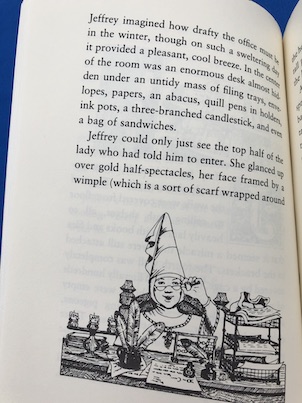
Jeffrey lives with his widowed mother in a Medieval village (not a realistic one, this is a fairy tale type story), where his mother supports the both of them by selling her knitting.  However, when his mother breaks both of her arms after falling off of a cart, eleven-year-old Jeffrey must find a job and earn some money.  As a young boy from a poor family, there aren’t many options for him at first, and he doesn’t try very hard for the ones that are available because what he really wants to do is to be a knight.  As a boy from a non-noble family, it isn’t likely that he’d ever actually become a knight, but it’s all that Jeffrey has ever dreamed of.

One day, after Jeffrey has failed to get the jobs that were available in a nearby town of Axington, he is walking home, sad and worried about what his mother will say, he meets a knight.  In fact, it’s not just any knight but a famous one, Sir Walter!  Jeffrey is thrilled to meet him.  Sir Walter asks Jeffrey for directions and invites him to join him for supper. 

The two of them discuss what it’s like to be a knight.  Sir Walter tells Jeffrey that it’s not all as glamorous as people think it is.  Some parts are very difficult, and he has to travel a lot on his various assignments, keeping him away from his family for extended periods.  Unlike real, historical knights, who would work for a lord, Sir Walter works for an agency in Axington called Free Lance Rescue Services Limited, which gives him his assignments.  They send knights like Sir Walter to rescue damsels in distress or deal with dragons or ogres.  Although it’s not easy work, Jeffrey likes the sound of it!

When Jeffrey returns home and his mother finds out that he didn’t get a job, she is upset.  Jeffrey tells her about his meeting with Sir Walter, and she points out that, even though it’s exciting, he really needs to focus on finding work because they’re running out of money.  Seeing his mother so upset, Jeffrey lies to make her feel better, telling her that Sir Walter has recommended him for a job with his rescue agency.  His mother is doubtful at first, knowing that knights are usually from noble families and that her small son hasn’t had any training or shown any fighting ability.  Jeffrey reassures her that he’ll probably just be helping in the office until he gets more training.  To Jeffrey’s shame, his mother believes him and is proud of the job that he doesn’t have.

The next day, after his mother sends him off to his first day on his new “job,” Jeffrey decides that the only thing to do is to go to the agency in Axington and try to find out if he can get a job there, or failing that, anywhere he can in order to make things right with his mother.  When he gets to Axington, he is hungry, so he asks at a food stand in the marketplace if he can help out for a while in exchange for some food.  He spends the morning peeling potatoes in exchange for lunch.  However, although it’s boring work, Jeffrey does get a good meal out of it, and he catches the eye of a leatherworker, who compliments him for working hard.  Jeffrey confides in the leatherworker that he’s really hoping to get a job at the rescue agency, and the leatherworker tells him that his fiancé is the secretary there.  He gives Jeffrey a message to take to the secretary, and Jeffrey sees it as his opportunity to ask for a job.

When Jeffrey delivers the message to the secretary (which is an invitation to join her fiancé for lunch), the secretary tells him that the rescue agency has no job openings at the moment, but that she’ll pay him a penny to watch the office and her mother’s rambunctious dog, Lancelot, while she’s at lunch.  It’s not much, but a penny is enough to buy his mother a nice dinner, so Jeffrey takes the job.  The secretary tells him a little about how the office works, but she doesn’t expect anything to happen while she’s at lunch because nothing ever does.

However, while the secretary is away, a message comes in that Sir Walter is in trouble!  Sir Walter is in the cave of an evil ogre and needs help at once!  Jeffrey tries to find the secretary to tell her and ask what to do.  When he can’t figure out where she went to lunch, Jeffrey decides that there’s no time to waste and that he must rescue Sir Walter himself!

Although Jeffrey is eager to help Sir Walter, he does worry about the lies that he has told his mother about his new “job”, the fact that he isn’t really qualified for what he’s doing and doesn’t even have permission to be doing it, that the ogre might well end up eating him as well as Sir Walter, and that he left a mess in the office when he ran off on his rescue mission and is currently in possession of a dog that doesn’t belong to him.  The book is a fun adventure story, but it makes some good points about truthfulness and responsibility as well.

Although Jeffrey really only brought the dog along because he had nowhere else to leave him, it is really Lancelot who defeats the ogre, partly by accident.  At first, Jeffrey is tempted to claim the victory for himself, but he decides to be honest and admits the truth about the ogre’s defeat to Sir Walter.  Still, Sir Walter is grateful and offers to sponsor Jeffrey for knight school and give him a part-time job polishing his armor.  Jeffrey accepts, and he also gets to keep Lancelot, who needed a new home anyway, although his mother says that he will have to be responsible for the dog and its training.

The book is available to borrow and read for free online through Internet Archive.