The Witch King

WitchKingThe Witch King by Maeve Henry, 1987.

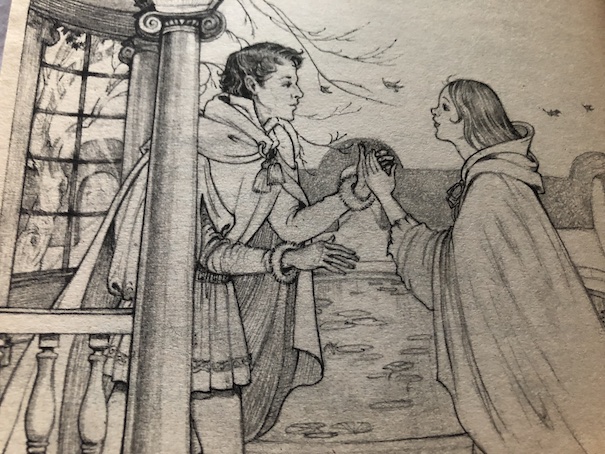
Robert is the son of a fisherman in a small village by the sea. All his life, he’s grown up hearing stories of a mysterious City to the south that was fashioned ages ago from a silver tree. Wondrous things are said to happen there. People from the City used to visit the Witch Women in Robert’s village for advice, but no one has come there from the City in a long time, and people now doubt whether the City really exists. People have even stopped believing in the Witch Women. However, Robert believes in the old stories, and he wants desperately to see the City for himself.

The stories say that someday the Witch King will come to the City and plant a seed so that a new tree will grow. Robert wants to see this story come true, and Granny Fishbone, a strange old woman who tells Robert the old stories, says that the time of the Witch King is close. She gives him a pendant in the shape of a fish and tells him that it came from the City and that it is time for Robert to take it back there.

With some misgivings, Robert’s family lets him set off on his seemingly crazy quest of finding the City. To Robert’s surprise, he is met on the road by the Royal Wizard of the City. As Granny Fishbone said, the time of the Witch King is near, and there is trouble in the City. The Spell that controls the City is failing, and the King has been seeking a remedy for the problem.

The City has become corrupt because a usurper murdered the rightful king years ago and took over the City. He had his wizards cast a spell on the City that let him control everything in it, and he manipulated historical accounts to make it seem as though he was the founder of the City himself. Robert knows differently because Granny Fishbone is really one of the Witch Women, and she told him the true story about the miraculous tree and the founding of the City. The king’s grandson, David, is also corrupt and wants to learn to control the spell over the City for his own power. He believes that he is the prophesied Witch King, and he tries to convince Robert of it so that he will help him.

When Robert learns that David’s plans for controlling the spell may mean sacrificing his own sister, Princess Sophie, who Robert loves, Robert does his best to thwart his plans by telling the king and the Royal Wizard.  Although David at first seems to have the upper hand, he is not the true Witch King. Granny Fishbone was correct that the time of the true Witch King has come, and Robert has a much bigger role to play in the story than he thinks.  As the ancient prophesy says, the City will have to be destroyed in order to be saved.

The Battle for the Castle

battlecastleThe Battle for the Castle by Elizabeth Winthrop, 1994.

This is the sequel to The Castle in the Attic.

William is growing up.  As William’s twelfth birthday approaches, he feels like he and his best friend, Jason, are growing apart. Actually, what he fears is that Jason is out-growing him. Jason has grown taller than William and much more muscular, thanks to his off-road bike training sessions with his father. William, on the other hand, is still short and feels like a shrimp next to Jason.

In their town, it is traditional for boys to “jump the trains” when they turn twelve. It involves grabbing hold of a ladder on the side of one of the cars as the train reaches a point on the track when it slows down, climbing over the top of the car, and jumping off the other side. It’s a dangerous trick to pull, and parents try to keep the kids from doing it. Still, the boys who don’t do it are considered to be wimps by the others. When Jason and William try, Jason makes it, but William gives up when his hand starts to slip. William is not hurt, but he is embarrassed at his failure.

To show Jason that he’s not just a wimp, William decides to let him in on the secret of the castle in the attic. Mrs. Phillips decided not to drop the magic token into the sea along with Alastor as she said she would (see previous book), and she sends it to William as a birthday present. After William explains to Jason how the token works, he convinces him to become small with him and visit Sir Simon and William’s other friends. When the boys arrive, they are welcomed by Sir Simon, who is about to leave for a tournament. William and Jason agree to help look after Sir Simon’s castle until he returns, along with his friend Dick, Dick’s son Tolliver, and Dick’s niece Gudrin. Sir Simon’s old nurse, Callendar, has died, but before her death, she made a prophecy of death and danger. Almost everyone believes that she was just raving, but Gudrin knows that danger is approaching. A strange ship of skeletons has been seen approaching the town, and bones have been floating down the river. Sir Simon had the ship towed out to see again, and Dick thinks there’s nothing more to fear. However, the ship has returned, and the boys and Gudrin know that something must be done in order to keep Callendar’s prophecy from coming true.

There is an army of rats aboard the ship, led by a giant rat that walks on its back legs like a human. The boys and Gudrin attempt to burn the ship, but the rats escape and begin attacking people across the countryside. When one of these people makes it to the castle to warn everyone, Dick finally believes them that something needs to be done. Most of the people are sent away from the castle, Tolliver is sent to bring Sir Simon back to help, and the others stay to wait out the siege. Although William is scared, he manages to keep his head and come up with a plan that defeats the rats once and for all.

In the end, when the boys return to their own world, William declares that he will never jump the trains because he thinks it’s a crazy stunt. Jason doesn’t mind because, as he says, “there’s more than one way to jump the trains.” William doesn’t need to prove that he’s grown up by performing a crazy stunt because he’s already behaved with courage and maturity while facing real problems and saving the lives of other people.

The Blue-Nosed Witch

BlueNosedWitchThe Blue-Nosed Witch by Margaret Embry, 1956.
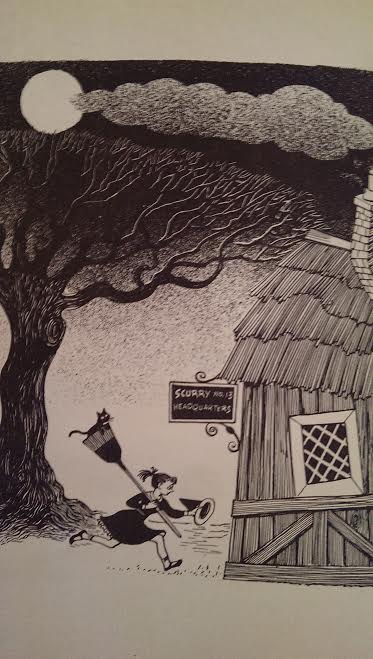
Blanche is still a very young witch, but because of her magnificent blue nose (which she can make glow at will), she’s allowed to join a group of adult witches, Scurry No. 13.  Their specialty is beautiful flight formations on their broomsticks, and they’re planning a special one for midnight on Halloween.

But, Blanche has a bad habit of being late to everything.  Some of the other witches have started complaining about her, saying that she’s too young and irresponsible to be part of Scurry No. 13.  If she’s late for the flight on Halloween, they might decide to send her back to Scurry No. 2 1/2 with the other young witches, where she’d only be allowed to ride a whisk broom.

To make sure that Blanche will be on time for Halloween, her friend Josephine sets her alarm ahead a couple of hours to give her extra time to get ready.  Unfortunately, Blanche doesn’t know that Josephine did that, so she sets her alarm ahead herself.  When she wakes up on Halloween night, it’s still early evening, instead of late at night.

BlueNosedWitchPic1Blanche looks for her fellow witches but ends up joining a group of trick-or-treaters by mistake.  They love her blue nose and introduce her to the idea of trick-or-treating.  Thinking that even the grumpiest man in town would be impressed by Blanche’s amazing nose, they stop at his house, too.  The old man isn’t impressed by anything and plays a mean trick on the kids.  However, Blanche is a real witch, and she and her cat Brockett give the old man a real Halloween scare.

Blanche is having fun on Halloween, but will she keep track of time well enough to join the other witches in their flight?

Even though this wasn’t written to be an historical novel, in a way, it kind of is now.  One of the interesting things about this book is that you can tell from the way the kids are trick-or-treating that it’s the 1950s.  Kids today don’t get jelly donuts or apples while trick-or-treating, and in this day of giving out only prepackaged treats for safety reasons, the kids would probably have to throw them away if they did (sigh).  Also, there is still the implied threat of Halloween tricks when the kids go asking for treats, something less common today.  Instead of saying “Trick or treat!”, the kids say “Candy or cake or your windows we’ll break!” (although the kids later promise the adults that they’re not going to soap any windows).  My mother said that the popular saying when she was young was, “We are the beggars of the street.  Do we soap, or do we eat?”

The book is available to borrow and read for free online through Internet Archive.

BlueNosedWitchPic2

The Treasure of Kilvarra

TreasureKilvarraThe Treasure of Kilvarra by Elizabeth Baldwin Hazelton, 1974.
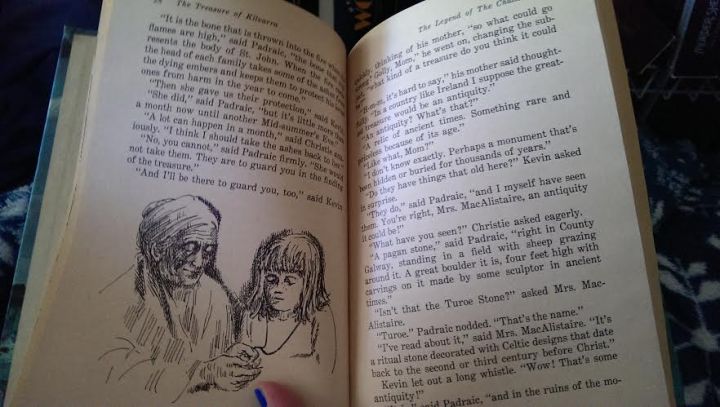
Christie and Kevin MacAlistaire go to Ireland with their mother to visit a family friend, Padraic O’Flaherty, and their visit turns into a terrifying treasure hunt!  Christie is fascinated by the gypsies living nearby and asks to visit them.  It’s her birthday, and the oldest gypsy, Sorcha, tells her fortune.  She says that Christie is fated to discover a treasure during her visit to Ireland, but there will be great danger involved, and she will need her brother to protect her.  Sorcha also gives Christie an amulet filled with holy ashes to help keep her safe.

Christie is eager to find the treasure Sorcha spoke of, although she doesn’t know what kind of treasure she is supposed to find or what kind of danger she will face along the way.  Their new friends tell them the history of the region with stories of ancient kings, fairy folk, and haunted castles.  Christie and Kevin visit some of these supposedly haunted ruins with their new friend Colum (a gypsy boy) and his pet crow, Ben.  Colum tells them the history of the castle ruins and the legends associated with it, and they discover that Christie has the ability to see and hear things that the boys can’t: spirits of the past.  Unfortunately, Ben is fascinated by Christie’s amulet and takes it, losing it in a nearby river.

KilvarraWithout the amulet to protect her, Christie continues her search for the treasure.  An accidental injury takes her to the place where it is hidden, but it’s a dangerous place.  Caught in a terrible storm, the children explore an ancient stone tower.  There, Christie sees the ghost of a long-dead monk, gesturing to her, begging her to follow him to the treasure that she seeks.  The monk died protecting it, and it’s a very unexpected but wonderful treasure indeed.  But, getting out of the place is going to be even more dangerous than getting in.

The book is currently available online through Internet Archive.

This is actually the second book in a series about Christie MacAlistaire and her brother Kevin.  Unfortunately, I don’t have the first one and haven’t read it.  I do know that the first book in the series is called The Haunted Cove.  Christie and Kevin spend the summer in a cottage by the sea in Oregon, where they investigate a cove haunted by the ghosts of sailors and a woman who may be a witch.

The Castle in the Attic

CastleAtticThe Castle in the Attic by Elizabeth Winthrop, 1985.

Ten-year-old William’s life is being turned upside down.  Mrs. Phillips, his nanny, is leaving for good!  Mrs. Phillips has lived with William’s family and helped to take care of William ever since he was born. Both of his parents work, so William spends most of his time with Mrs. Phillips after school. She fixes him his snacks, takes him to his gymnastics lessons, spots for him as he practices his routine, and reads stories about King Arthur with him. However, now that William is ten years old, Mrs. Phillips thinks that she would like to go live with her brother in England, which is where she is from. William is upset because he can’t imagine life without Mrs. Phillips. Mrs. Phillips tells him that he will be fine without her and that his parents will start spending more time with him after she leaves. William tries everything he can think of to get her to stay, but she is determined that it’s time for her to go.

As a leaving present, Mrs. Phillips gives him a toy castle that has been in her family for generations, along with a little lead figure known as the Silver Knight. Still, William is determined to find a way to keep Mrs. Phillips from leaving.  Then, he discovers that the toy castle is magic! When the little knight comes to life and gives him a magic token that can make people small, William thinks he’s found the way he’s been looking for. With Mrs. Phillip’s impending departure and his fears of losing her, William suddenly realizes that he can use the magic coin to keep Mrs. Phillips with him.  Before she can leave, he shrinks her and puts her in the castle with the knight.

Of course, turning his nanny small and keeping her inside the toy castle was unethical, as Mrs. Phillips and the knight point out, but William’s mistake proves to be only the beginning of a fantastic journey that will fulfill a legend, free the knight’s kingdom from the reign of an evil wizard, and give William the confidence he’s been looking for.

Over the drawbridge of the castle is a poem about the beginning of a quest. Mrs. Phillips had said that there was a legend about the little knight, and when he comes alive, he tells William that his name is Sir Simon and that he was turned to lead by an evil wizard who has taken over his kingdom. The poem is the key to defeating the wizard, and the little token is really only half of one that the wizard was wearing around his neck. When William turns Mrs. Phillips small, he cannot reverse the spell because he lacks the other half of the amulet. To get it, he must become small himself and fulfill the poem by crossing the drawbridge as Sir Simon’s squire.  The two of them set out together to defeat the wizard and retrieve the other half of the token. Along the way, they become separated, and William must continue on to the wizard’s castle and finish the quest by himself. William has an inner strength that he doesn’t fully appreciate at first, and he can use it to defeat the evil wizard!

There is a sequel to this book called The Battle for the Castle.

My Reaction

I liked this story when I was a kid, and it’s a good coming-of-age story.  The sequel is also a coming-of-age story, but in a different way.  This book is about William coming to a better understanding of what kind of person he is and what he’s really capable of doing.  He can do more and handle more than he thinks he can.  In the end, although William is still a little sad at saying goodbye to Mrs. Philips when she leaves, he feels a little better about her going because he knows that he can take care of himself now, thanks to his magical adventures. Mrs. Phillips tells him that he always had what he needed inside himself but that he just didn’t believe it before.

The next book focuses on what it really means to be a man instead of a boy.  As William and his best friend grow up and are under social pressure from other boys to do a certain stunt in order to prove that they’re really grown-up, William and his friend set out on a magical adventure that teaches them that there are more ways of becoming a man than one.

Chitty Chitty Bang Bang

ChittyChitty Chitty Bang Bang by Ian Fleming, 1964.
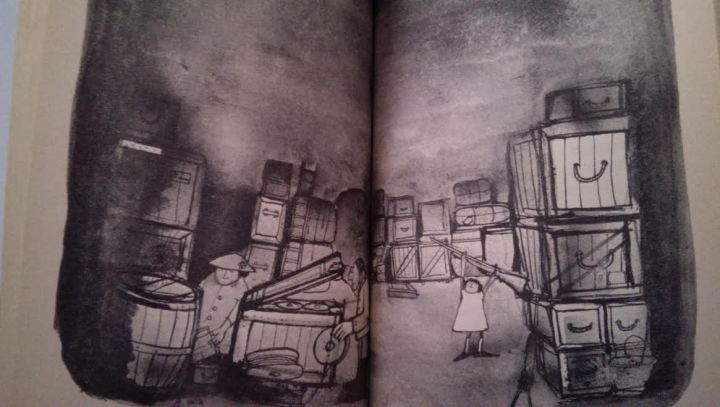
Not everyone is aware that the creator of James Bond wrote a children’s book, although the movie Chitty Chitty Bang Bang is a children’s classic.  However, the movie differs greatly from the original book, which doesn’t have anything to do with a toy-obsessed baron who has forbidden children in his kingdom, and there is no Truly Scrumptious (sorry).

Commander Caractacus Pott, retired, is an explorer and inventor who lives in a little house in the countryside with his wife Mimsie and their children, a set of eight-year-old twins named Jeremy and Jemima.  Some of the locals call Commander Pott, “Crackpott” because of his strange inventions, which never earn him very much money until one of this inventions pays off when he sells the candy whistles he creates to Lord Skrumshus’s candy company.

With the money he earns, Pott decides to buy something that his family has wanted for a while: their own car.  But, they don’t want just any boring car like everyone else.  They want something special.  They find it when they spot a former racing car that’s due for the scrap heap.  No one wants it because it would take a lot of time and money to fix.  The Pott family falls in love with it immediately, and Jemima thinks it might even be magical because the license plate says “GEN 11”, which looks like “genii” (or “genie”).  The garage man is relieved to find a buyer who appreciates the car’s history and potential and says that she’s sure to reward them for saving her from being scrap.

After Pott spends a great deal of time fixing up the car (which they name “Chitty-Chitty-Bang-Bang” because of the sounds it makes) and adding some additional inventions of his own, he begins to suspect that both Jemima and the garage man are right: the car is magical and does want to repay them for saving her life.  He starts to notice changes that the car makes to herself overnight, adding extra buttons and features that he knows he didn’t put there.  He’s not sure what they’re for until the family gets stuck in traffic the first time they decide to take the car out for a picnic. Messages on the car’s dashboard light up, telling Pott to pull some of the car’s mysterious levers.  When he does, the car sprouts wings and flies over the other cars in front of them, over towns and beaches, and even over the English Channel!

ChittyPic2

Chitty-Chitty-Bang-Bang takes the Pott family to a sandbar so they can have a private beach all to themselves.  But, that’s only the beginning of their adventure!  Chitty-Chitty-Bang-Bang can also turn into a hovercraft, and the family decides to take it on a special holiday to France.  When they reach the coast of France, they find a cave and start to explore it.  Someone has set up various devices inside to scare people away, but that only makes the Pott family more curious and determined to find out why.

It turns out that the cave is a hideout for a band of smugglers, and when the Pott family destroys it, they want revenge!

ChittyPic1

At the end of the book, there is a recipe for “Monsieur Bon-Bon’s Secret ‘Fooj'” (they mean ‘fudge’, Monsieur Bon-Bon is a character in the story).

Having known the movie version since I was a kid, I really prefer the movie to the book.  With a magical car at their disposal, the more fairy-tale story about the castle and tyrannical, toy-obsessed baron seems more fitting than the story about smugglers.  But, that being said, the book is still a lot of fun.

The book is available to borrow and read for free online through Internet Archive.

The Seventh Princess

The Seventh Princess

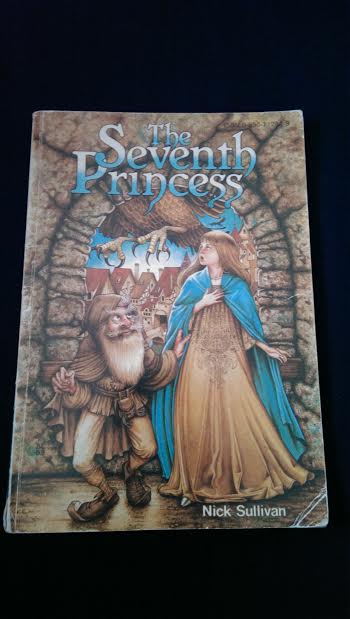
The Seventh Princess by Nick Sullivan, 1983.

Jennifer never remembers her dreams, so she doesn’t think that she’ll be able to complete the essay that her teacher assigned them to write: My Strangest Dream.  While she’s worrying about not being able to finish her homework, she dozes off on the school bus on her way to school.

Suddenly, Jennifer finds herself in a beautiful carriage being driven through a dark forest.  Jennifer is happy that she’s apparently going to have a dream that she can write about, so she decides to enjoy it as much as possible, trying on the beautiful gown, cloak, and jewelry that she finds in the carriage with her.  Eventually, the carriage stops at a huge palace, and Jennifer comes to the realization that the carriage never had a driver.

She is greeted by Duke Rinaldo, the Lord High Chancellor of the kingdom of Eladeria. Jennifer is informed that she is Princess Miranda, the king’s adopted daughter.  Actually, Jennifer is the seventh of the king’s “daughters.”  There were six others before her . . . and their fates are unknown.

This is no ordinary dream.  The king of Eladeria is ill, possibly bewitched.  The king’s son is missing.  There is treachery in the palace.  People live in terror of the evil enchantress Swenhild and her harpies.  Soon, they will demand a tribute: a golden-haired princess with blue eyes . . . like Jennifer, er, Princess Miranda!

The only one who seems to want to help Jennifer is her new friend, Samson the dwarf, who is the palace’s court jester.  He introduces her to his friend, Prospero, who can do magic and understands more of what’s happening than most people.  He tells her that her only hope is to find the Paladian Scroll and use its power.  Can Jennifer and Samson find this mysterious scroll in time?  It might still be possible to save the other princesses, but Jennifer worries about whether she’ll ever wake up in her own world again.

This book is available online through Internet Archive.

My Reaction

One of the things that I love about this book is how it brings in some lesser-used fantasy creatures, like the harpies, and characters, like the dwarf jester.  The “was it a dream or wasn’t it” trope has been used a lot, but the adventure within the dream itself is fun, exciting, and very well-done.

The Ordinary Princess

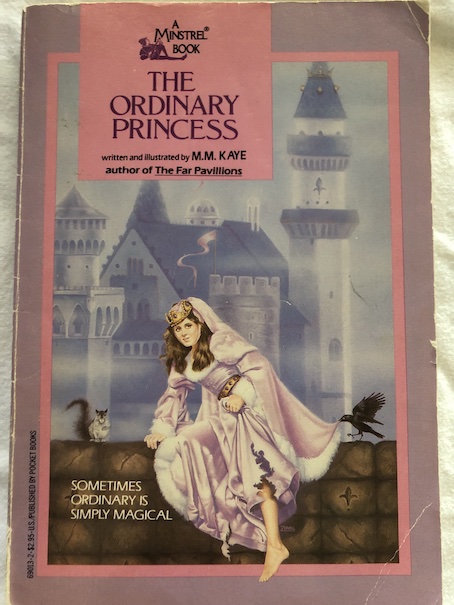
The Ordinary Princess by M.M. Kaye, 1986.

Lavender’s blue,
Rosemary’s green,
When you are king,
I shall be queen.

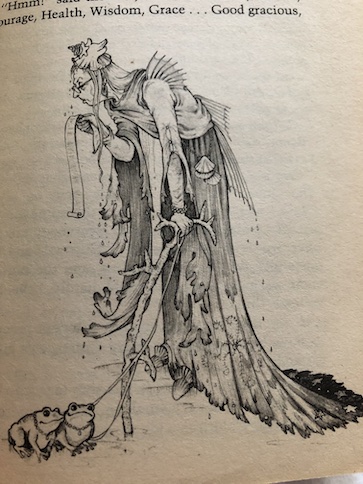
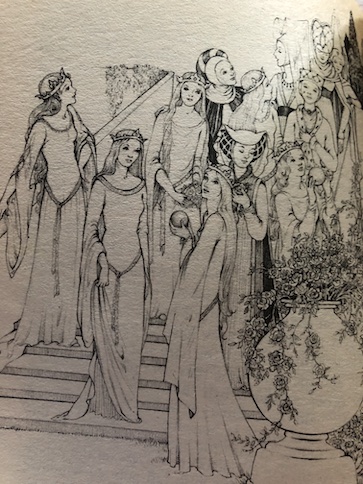
Everyone is excited when a seventh princess is born in the kingdom of Phantasmorania.  Everyone knows that seventh princesses are always the luckiest and the most beautiful.  Indeed, when Princess Amethyst Alexandra Augusta Araminta Adelaide Aurelia Anne is born, she is a beautiful baby who never cries and who has perfect blonde curls and blue eyes.  But, when one of her fairy godmothers, Old Crustacea, comes to the christening to give her blessing and sees all the perfect presents everyone has given her and little Princess Amethyst’s six perfect older sisters, she decides, “I am going to give you something that will probably bring you more happiness than all these fal-lals and fripperies put together.  You shall be Ordinary!”

Of course the king and queen are horrified, but there’s nothing to be done.  From that day on, Princess Amethyst becomes an ordinary baby who grows up to be an ordinary girl.  She cries when she’s hungry and tired.  Her golden hair darkens from golden blonde to a mouse brown and loses its curl.  She gets freckles!  Sometimes, she even makes spelling mistakes!

While everyone else is distressed at Princess Amethyst’s (now called Amy most of the time) lack of perfection, Amy realizes that Old Crustacea was right about it making her happier.  While her perfect sisters must behave themselves and keep their clothes clean, Princess Amy sneaks off to run and play.  She meets ordinary people, makes new friends, and has fun adventures.

But, eventually, all of her sisters grow up and get married.  When it’s Princess Amy’s turn, most of the princes aren’t interested because she’s not the beautiful, perfect seventh princess that she’s supposed to be.  Amy would be alright with that, but when her father and his advisors come up with an outlandish scheme to attract a prince that involves a dragon, Amy decides to put a stop to it by running away.

For a time, she lives a carefree life in the forest, but eventually, like all ordinary people do, she realizes that she’s going to need money to buy new clothes.  On the advice of Crustacea, she journeys to a neighboring kingdom and finds a job in the palace there as a kitchen maid. 

Actually, she finds more than that, finding her place in the world and someone who loves her for the ordinary princess that she is.

The book is divided into four parts, each of them titled after a verse from a version of the old folk song Lavender’s Blue (most versions say “lavender’s green” instead of “rosemary’s green”, although I do like saying “rosemary” better – this is the tune). The book also contains many small, black-and-white illustrations alongside the text.

It is available to borrow and read for free online through Internet Archive.

My Reaction

I think this is a beautiful book with a good message for girls. Being glamorous or trying to conform to someone else’s idea of perfection doesn’t bring as much happiness as knowing who you really are and finding someone who loves you and wants to live the same kind of life you do, imperfections and all. Not every “prince” out there is looking for the same type of “princess,” just the one that’s right for him. In the end, Amy finds a king who is just her kind of person.

The Dragon Charmer

DragonCharmerThe Dragon Charmer by Douglas Hill, 1997.

This is a great fantasy story about a girl who learns to face her fears and persevere in spite of them. It has a good moral and is encouraging to anyone who failed at something but wanted to try again.

Elynne Danneby is afraid of dragons, which is a shame because her family makes its living by dragon charming. Every year, the dragons stop by her family’s farm on their migratory path, and Elynne’s father puts on a show for people who come to see the dragons. By playing a special tune on his pipes, Dan Danneby can put the dragons into a trance and safely walk among them. Only certain people have the ability to charm dragons. Elynne possesses that talent, but she has been unable to use it since she made a mistake while trying to charm dragons when she was a small child. They tried to attack her, and her father had to save her from them. Ever since, the dragons have terrified Elynne, but she is still fascinated by them and desperately wants to conquer her fear in order to charm them like her father does.

DragonCharmerPicThen, one day, a rare crimson dragon comes to the farm and lays an egg. It is extremely uncommon to see a dragon’s nest or a baby dragon, and Dan is excited about trying to charm the baby after the egg hatches. However, Dan’s assistant is greedy and decides to steal the egg and sell it. Elynne overheard him talk about his plans before the egg was stolen, but because she wasn’t sure of what she heard, she didn’t tell anyone. Elynne feels guilty about not preventing the theft of the egg, and in spite of her fear, she is determined to get it back. In the process, she not only conquers her fear but learns about a talent that she never realized she had.
The book is full of black-and-white drawings in a sort of cross-hatch style.

The book is available to borrow and read for free online through Internet Archive.

The Secret of Roan Inish

The Secret of Roan Inish (aka The Secret of the Ron Mor Skerry) by Rosalie K. Fry, 1957, 1959 (first US edition), 1995 (movie tie-in).

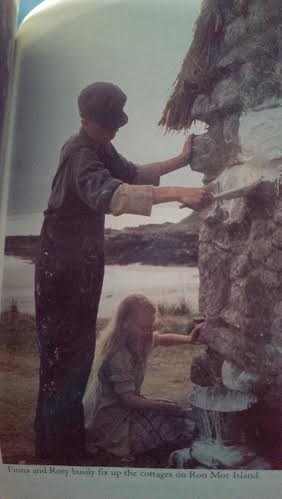
This is the book that the movie The Secret of Roan Inish is based on. The movie tie-in book contains the text of the original book, which was called Secret of the Ron Mor Skerry (Child of the Western Isles), and pictures from the movie (the original book had black-and-white drawings). The movie follows the plot of the original book fairly well, although the location was changed to Ireland and some of the names were altered to reflect the change in location. For example, the family name in the book was McConville, not Coneelly, and Fiona’s cousin was Rory in the book and Eamon in the movie. My book, like the original, takes place in Scotland, and notations under the pictures call the characters by their original names.

Ten-year-old Fiona has been living in a big city ever since her family left the island of Ron Mor about four years earlier to seek new jobs and new opportunities. However, Fiona’s health has been poor, and her doctor has advised her to return to the seaside for the healthier atmosphere. The book begins with her journey to stay with her grandparents who still live close to Ron Mor. Fiona’s homecoming is tinged with both sadness and hope, as she reflects on the mysterious disappearance of her baby brother the day that her family left the island.

Although her brother apparently floated out to sea in his cradle after being left unattended on the beach, Fiona has the feeling that he is still alive somewhere close to the island. She learns that her cousin Rory also believes the local rumors that the boy is still on Ron Mor in the company of the seals that populate the area around the island. Moreover, Rory and other family members share Fiona’s longing to return to their old home and their family’s traditional way of life as fishermen. Fiona’s determination to find her younger brother and bring him and the rest of their family home to the island is touching and emphasizes the importance of family ties.

There is also an element of fantasy because of the story that Fiona’s grandfather tells about the family’s heritage, which helps explain their special connection to the sea and seals around the island. He and other members of the family believe that one of their ancestors was a selkie, a magical person who could change into a seal.  The story is gentle and upbeat, which makes a nice change from a lot of modern children’s books.  I think that it’s just plain magic.

Something that the book clarifies, which is more vague in the movie, is that everyone in Fiona’s family, except for her little brother, has red hair.  All of the McConvilles always have red hair, except for those who are apparently closer to their Selkie ancestry, who have very dark hair.  They couldn’t clarify that point in the movie because the girl playing Fiona is blonde, and everyone else has different hair colors, but that’s why her brother is so markedly different in his appearance.

Physical copies of the original book are expensive collectors’ items, but there is good news: it’s now available on Kindle and through Internet Archive (where you can borrow an electronic copy for free), so if you’re nostalgic or just curious, it’s easier to read it now!