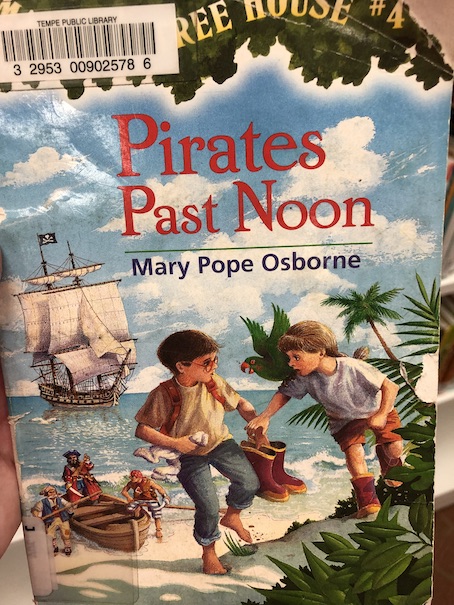
Pirates Past Noon

Magic Tree House

#4 Pirates Past Noon by Mary Pope Osborne, 1994.

One rainy afternoon, Annie urges Jack to go to the tree house with her because she has a feeling that they will soon meet its mysterious owner.  When they arrive, no one is there, so the kids start looking at the books.  The day is cold and wet, and Annie shows Jack a picture of a sunny beach, saying that she wishes they were there.  Soon, they find themselves on the beach. 

They have fun at first, but then some pirates come to the beach, looking for a treasure buried by Captain Kidd.  The evil pirate, Cap’n Bones, makes the kids prisoners aboard his ship until they figure out where the treasure is hidden from the clue written on the captain’s map.

The clue says that the treasure is hidden underneath the whale’s eye, and from the ship, Jack and Annie realize that the island is shaped like a whale with a big boulder for its eye.  The kids make the pirate captain take them back to the island in exchange for telling him where the treasure is.  While the pirates are digging for the treasure, a parrot flies over, saying, “Go back!”  The pirates take that as a sign of an approaching storm and flee, leaving the kids behind. 

A storm does come, but Jack still has difficultly tearing himself away from the treasure that they’ve uncovered.  Finally, the parrot convinces him to leave, and he and Annie use the tree house to go home again. 

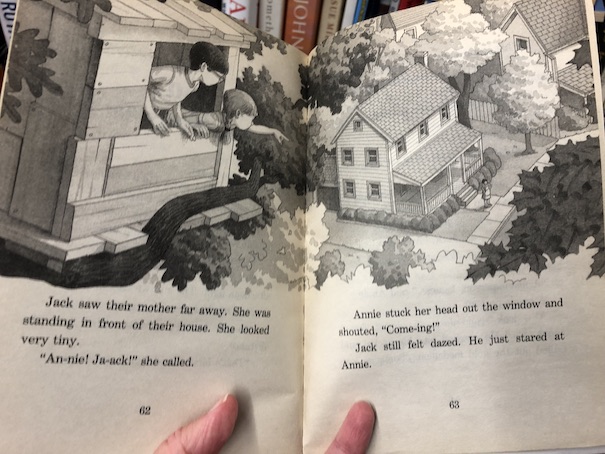
Once they’re back in Pennsylvania, the parrot appears and turns into a woman and says that she’s Morgan le Fay.  She is the owner of the tree house and the amulet.  Besides being King Arthur’s sister and an enchantress, she is also the librarian of Camelot.  She has been using the tree house to travel to other times to collect books that the scribes in Camelot can copy for their library.  She put the spell on the tree house so that she can travel to some of the places in the books herself.  The kids can use the spell only because Annie truly believes in magic and Jack really loves books.  She and the tree house disappear as the kids head home, but Jack discovers that she left her amulet with him as a sign that she will come back.

I was surprised that the owner of the tree house turned out to be Morgan le Fay, both because an Arthurian character didn’t seem to quite fit with a magical children’s tree house and because Morgan le Fay wasn’t one of the good characters in the Arthurian legends. The exact nature of the character of Morgan le Fay changed through different retellings of the Arthurian legends, and she wasn’t always an adversary or villain, but she does do things in some of the stories that wouldn’t make her a good heroine for children’s literature. However, none of that matters in this series because, here, she’s just an enchantress from Camelot who is interested in books.

The book is currently available online through Internet Archive.

Dinosaurs Before Dark

Magic Tree House

#1 Dinosaurs Before Dark by Mary Pope Osborne, 1992.

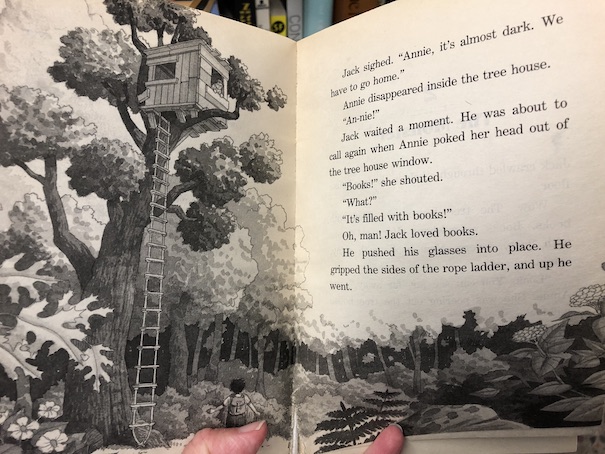
Eight-year-old Jack is walking home with his seven-year-old sister, Annie, when Annie spots a tree house in the woods that they’ve never seen before.  In spite of Jack’s warnings, Annie climbs up into the tree house and yells down that there are a bunch of books in there.  Jack loves books, so he also climbs up into the tree house to see what she’s found. 

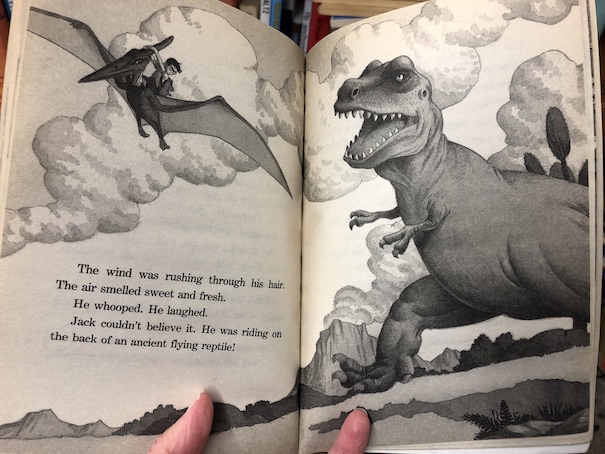
There are books in the tree house about all sorts of interesting times and places.  When Jack starts looking at a book about dinosaurs, he wishes that he could see one himself.  Suddenly, the tree house takes the kids back in time to a land filled with dinosaurs.  The two of them have some hair-raising adventures as they try to figure out how to get back home, getting some help from a friendly Pteranodon when they need to escape from a Tyrannosaurus Rex. 

The kids figure out that the tree house will take them anywhere they want as long as they look at a picture of the place in one of the books and wish to go there.  There is a book about Pennsylvania in the tree house with a picture of their home town in it, so all they need to do is to look at it and wish they were there in order to go home. 

While they are still in the land of the dinosaurs, Jack finds a gold amulet with the letter M on it.  He thinks it belongs to whoever owns the tree house, so he picks it up and brings it back with them, although by the end of the book, the kids still don’t know who it really belongs to. The ownership of the tree house is something that they eventually figure out through their adventures with it. (See book #4 in the series for the answer.)

You Wouldn’t Want to Be a Pirate’s Prisoner

You Wouldn’t Want to Be a Pirate’s Prisoner by John Malam, 2002.

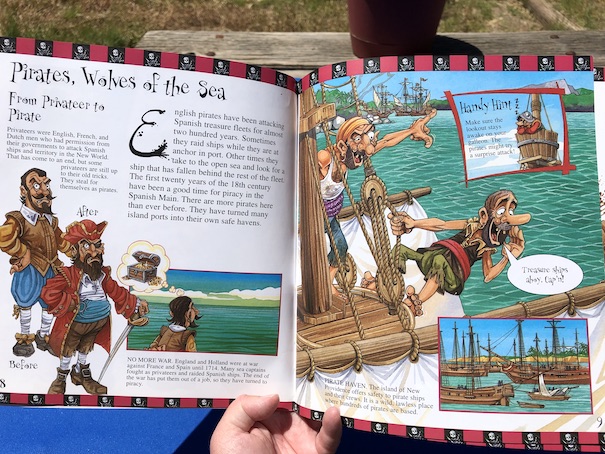
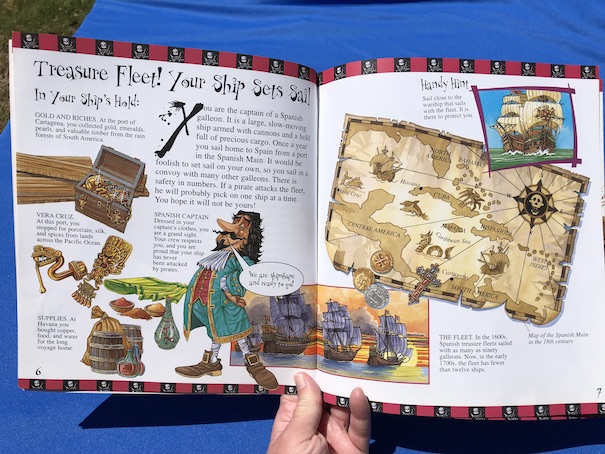
This picture book, which is part of a series, explains what it would have been like to be a pirate’s prisoner in the 18th century.  It sets the stage by casting the reader in the role of a Spanish ship captain in 1716.

The reason why the reader is cast as a Spanish captain, captured by English pirates, is because England and Holland had been at war with Spain until 1714.  During the war, the government of England (as well as Holland and France) authorized some ship captains to act as privateers, conducting raids on Spanish ships and outposts.  When the war ended and the privateers were dismissed from service, some of them continued to act as independent pirates.

The book explains the geography of the “Spanish Main,” the area between the southern coast of North America and the northern coast of South America – basically, the Caribbean Sea and its islands and the Gulf of Mexico.  Spanish galleons in the 18th century carried gold and treasures from the Americas to Spain as well as timber from the rainforests and goods that were transported to the Americas across the Pacific Ocean, such as spices and silk.  All of these goods made Spanish treasure ships tempting targets for English pirates.

As a Spanish ship’s captain, there were a few precautions that you could take against pirate attack.  One of the most basic was traveling as part of a convoy because pirates would be more likely to attack a lone ship than one that was part of a group.  A fleet of ships would have a warship traveling with them for protection, and the closer your ship sailed to the warship, the less likely a pirate ship would try to separate you from the group and attack.

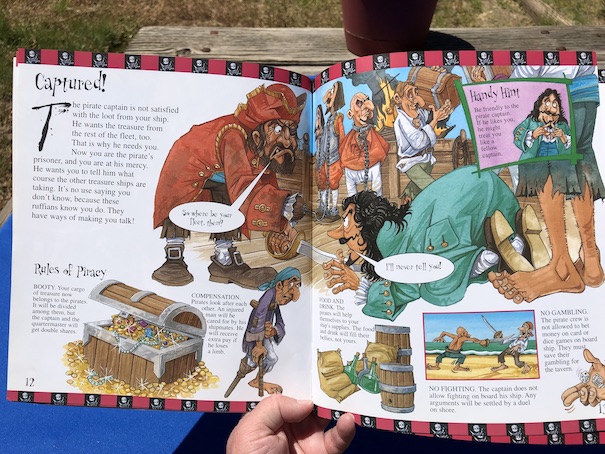
If the worst situation happened and the ship was taken by pirates, a captain could try to dress like other members of the crew to disguise his rank, but that didn’t always work.  The captain of the ship was in danger of being taken captive because he might have information that the pirates would find useful, like the exact route of other ships in a convoy.

The gruesome part of this book (and the source of the title, because this series basically focuses on the gruesome parts of history) is the part where they describe different forms of torture that pirates might use on a ship’s captain to convince him to tell them what they wanted to know.  Besides the direct physical abuse, pirates could also keep a captive in squalid conditions to make him weaker, more vulnerable, and exposed to disease.  In the end, they might simply decide to maroon the captive somewhere, even if they got the information they were after.

However, pirates could also face gruesome fates if they were caught. They could be hung and their bodies displayed publicly, as a warning to others.

The Best Book of Pirates

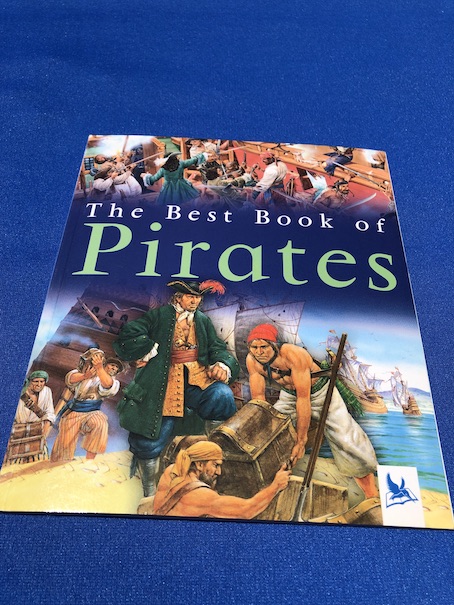
The Best Book of Pirates by Barnaby Howard, 2002, 2006.

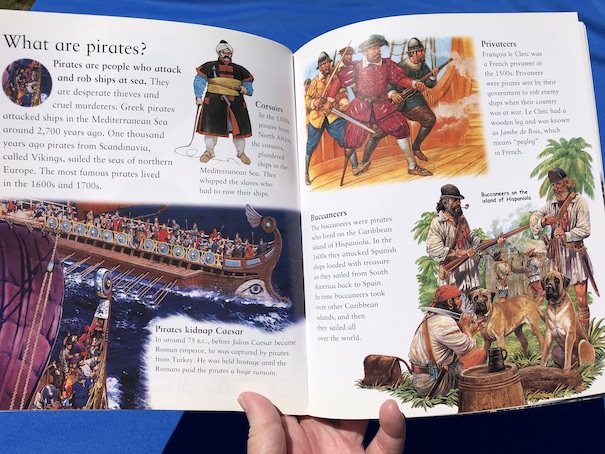
This is an easy and informative non-fiction picture book about pirates.  Rather than focusing on any particular time period or geographic area, the book gives a broad overview.  In the beginning, it explains a little about different groups of pirates through history, including Vikings, Corsairs, Buccaneers, and Privateers.  There is also a brief explanation of the Pirate Round, a sea route often taken by pirates during the late 17th century and into the 18th century.  The route led from North America and the Caribbean to Africa, circling the coast of South Africa to Madagascar and on to the Middle East and India.  (If you’ve seen the movie Cutthroat Island, the crew will basically be taking this route when the movie ends, heading from the Caribbean to Madagascar.)

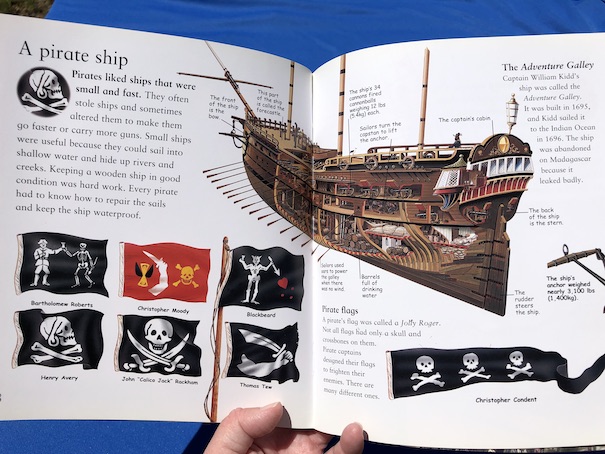
There is a diagram of a pirate ship from the late 17th century, showing what it would have looked like on the inside, and there are also examples of Jolly Roger flags, which were designed by individual pirates as personal identification, typically including skulls and skeletons to frighten their victims.  There is also some general information about what life would be like on board a pirate ship and the types of weapons they might have.

Then, the book begins to focus more on groups of pirates that operated in specific geographical areas and some of the more famous pirates from history.  The Barbary pirates (also called Barbary corsairs) were Muslims who raided Christian ships along the coast of North Africa and the Mediterranean during the 1500s.  Among the most famous Barbary pirates were a pair of brothers called Barbarossa (“Red Beard”).  Sometimes, European and American pirate ships that went to Africa to find gold and ivory also entered the slave trade.

In the section about the Spanish Main, it explains how privateers and pirates raided Spanish ships taking Aztec treasures from Mexico to Spain.  Buccaneers were specifically pirates who raided ships in the Caribbean.  Their name came from the type of fires they used when cooking meat (boucan or buccan).

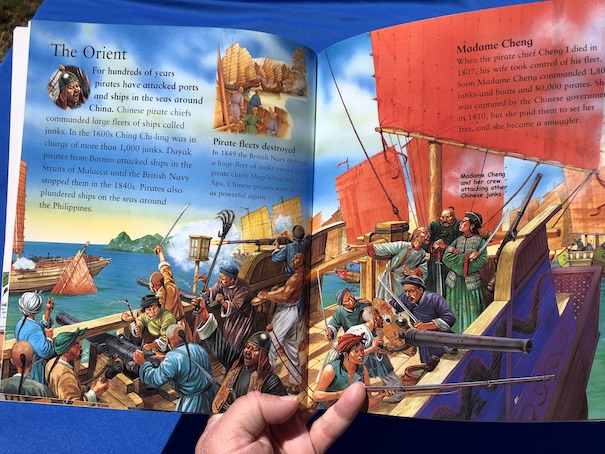
There were also Asian pirates who raided the coasts of China and the Philippines and areas around the Indian Ocean.  Chinese pirates and Dayak pirates from Borneo were powerful in the region until the 1840s, when the British Navy destroyed many of their ships.

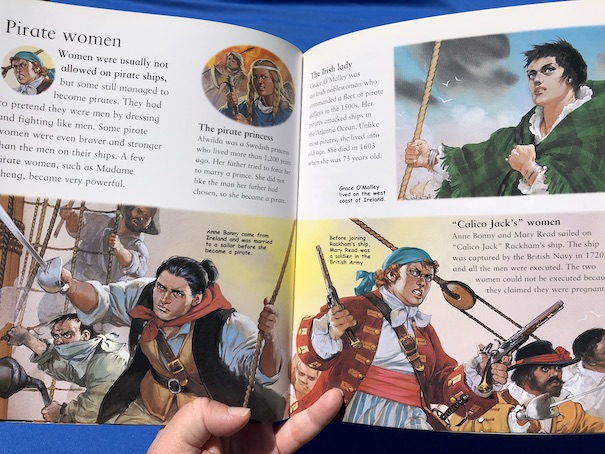
There is a section in the book specifically about female pirates.  Mary Read and Anne Bonny, who sailed with “Calico Jack” Rackham, were famous.  Grace O’Malley was a famous Irish pirate who was also an Irish noblewoman.  Madame Cheng was a Chinese pirate who took over her husband’s fleet after his death (but because this is a children’s book, it doesn’t mention her previous career).  Alwilda was a Medieval Swedish princess who turned pirate after her father tried to make her marry a man she did not want to marry (although her story may only be legend).

The book also talks about the famous stories of pirates burying treasure, although it says that pirates would usually spend their money quickly, sell items for money they could spend, or gamble it all away.

At the end of the book, there is a short section about modern pirates and how their goals and tools of the trade have changed.

The book isn’t very long, but I think that it provides a good, general overview of the subject of pirates throughout history, and the pictures are fascinating and detailed.

The book is currently available online through Internet Archive.

Meet the Men Who Sailed the Seas

Meet the Men Who Sailed the Seas by John Dyment, 1966.

This book is part of a series of historical biographies for children. Unlike other books in the series, the book doesn’t focus on a single person, talking about the lives of many famous sailors and explorers with some historical information about sailors and sailing ships in general.

When I was a kid, I went through a phase where this was a favorite book my mine, and I carried it around and read it constantly. It’s a little surprising that I became so attached to this particular book because I grew up in Arizona, in the middle of a desert, miles from the nearest ocean. I was seven years old before I even saw an ocean and a sailing ship in real life, and even then, it was a matter of years before I saw these things a second time. Because of that, as a child, I wasn’t particularly attracted to boats or interested in ocean travel. I wasn’t even a very good swimmer (liked it, just not good at it because I didn’t get a chance to do it much when I was young), and I was kind of afraid of deep water. We learned about Christopher Columbus in school, but I thought that Columbus Day was the most boring holiday on the calendar (there was no candy and no dressing up in costumes, and I’m not even sure that we got that day off of school, which were my requirements for what made a really good holiday), and Christopher Columbus was not remotely my most favorite historical character. So what was it about this book that caught my attention? Why did I like it so much?

There are a number of things about this book to like. When I was a young kid, I wasn’t fond of nonfiction books because it was a little too much like school, but this book was different. It was one of the first nonfiction books that I really wanted to read. The large, friendly type is encouraging to younger children who are just starting to read nonfiction chapter books, and the detailed drawings are fascinating. Best of all, it’s a journey through time as well as across oceans. I always liked history.

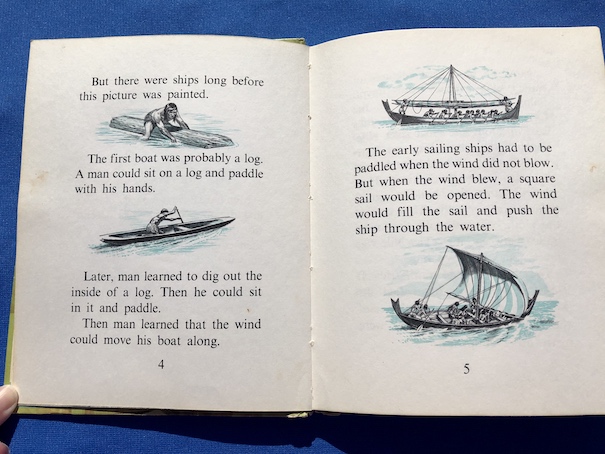
The book starts off by explaining how early sailors might have traveled. It speculates that people first realized that they could travel by water by floating on logs and then realizing that they could carve those logs into canoes and paddle them to move in the direction they wanted to go, eventually adding sails to move even faster with less effort.

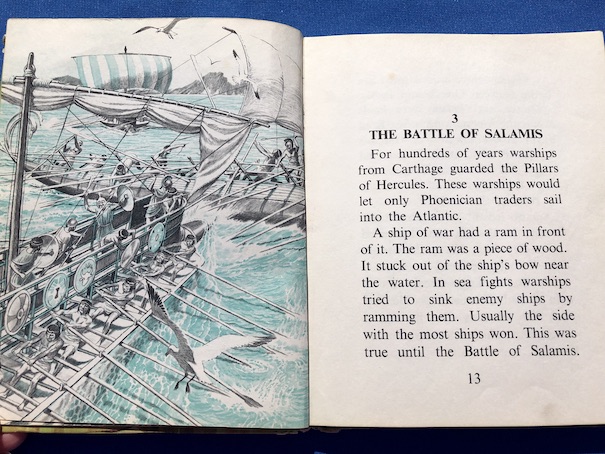
It then describes how ancient civilizations such as the Egyptians and Phoenicians traveled by ship. There is a chapter about Hanno of Carthage, a Phoenician who commanded a fleet of ships and was known for sailing around the coast of Africa. (That section and the next one use the old name for the rocks at the Strait of Gibraltar, the Pillars of Hercules.) The next chapter describes the Battle of Salamis between Greece, led by Themistocles, and Persia, led by Xerxes. This battle is particularly notable because the Greeks defeated the Persians through a clever trick even though they were out-numbered, proving that a good battle strategy could allow even smaller fleets to gain the upper hand in battle. There is also a chapter about Pytheas, a Greek sailor who sailed to Britain in search of tin and “Thule” (it’s not completely clear what he meant by Thule, although it was apparently a place north of Britain) and wrote a book about his travels.

In the early Middle Ages, Viking raiders began attacking Britain. The chapters about Vikings describe Eric the Red and his adventures in Iceland and Greenland, where he founded a colony of people from Iceland. Vikings also established a colony in the Americas that they called Vinland. However, they eventually abandoned Vinland because of conflicts with the people they called Skraelings (Native Americans). (The exact location of Vinland was in dispute for some time, and some people speculated that it might actually refer to multiple locations, but the likely site is at L’Anse aux Meadows in Newfoundland.)

The other explorers and adventurers described in the book are Marco Polo, Christopher Columbus, Ferdinand Magellan (known for sailing around South America to the Pacific), Francis Drake (his section includes an account of the battle with the Spanish Armada), and Captain Cook (known for sailing to Australia and New Zealand and claiming them for England and for insisting that his sailors eat cabbage and onions to prevent scurvy, later killed in Hawaii).

The book also discusses the Mayflower and Pilgrims, and there are chapters about American ships and sailors, like John Paul Jones, and the roles they played in the American Revolution and the new United States shortly after. Because the focus of the book focuses on sailing ships, it ends with Robert Fulton‘s steam ship, the Clermont, and Joshua Slocum, who sailed around the world alone.

So, the reason why I’m still kind of attached to this book, which was old even when I first read it, is that it was my introduction to a world that I wasn’t even really interested in at first, a world that became more interesting after seeing the history and other countries connected to it. I’m still more of an armchair explorer than anything else, but this book added a dimension to my early armchair travels that probably wouldn’t have occurred to me before. As a side note, I don’t think that the book mentions that the navigation instrument that one of the men on the front is holding is an astrolabe, but I now own one of these myself. If you want to try one, you can make a simple version at home yourself. They can be used on land as well as sea!

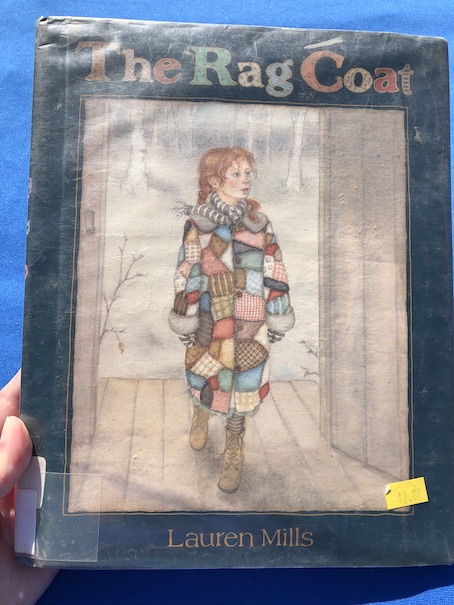
The Rag Coat

Minna is a poor girl, the daughter of a coal miner.  Her father has been ill with the miner’s cough, so Minna has to help her mother to make quilts that the family can sell for money.  She wants to attend school, but she can’t because she is needed at home and her family can’t afford a warm coat for her when winter starts.  It’s too bad because Minna really wants to make some friends her own age, and she would meet other children at school.  Her father says that he will find a solution to the problem, but he dies before he can.

After Minna’s father’s death, some of the other women in the community come to the house to work on making quilts with Minna’s mother.  When the women say that the quilt pattern they are using is named after Joseph’s Coat of Many Colors, Minna wishes again for a coat.  When the other women, who are mothers themselves, realize that Minna cannot go to school until she has a coat, they decide to make one for her.  They don’t have much money, but they do have plenty of quilting scraps.  They decide to make a new, quilted coat for Minna out of their old scraps.

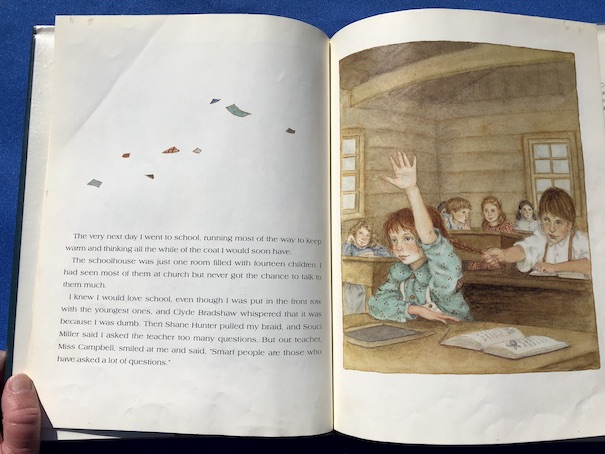
Minna starts going to school and does well, although she gets some teasing because, as a new student who has never been to school before, she has to sit with the youngest children, and Shane pulls her braid.  Something that Minna particularly likes at school is Sharing Day (what my school always called “Show and Tell”), where students are given the chance to show special things to the class and talk about them.  Minna decides that when her coat is ready, she will show it to the class during Sharing Day.

As the coat is being made, Minna admires all of the beautiful colors of the cloth scraps in the coat and adds a piece of her father’s old jacket as well.  Each of the other scraps in the coat also has a story that goes with it.  The cloth pieces come from old clothes and blankets that people in the families of the quilting mothers have used, and they memories attached to them.  The mothers tell Minna all of the stories as they work on the coat, and Minna loves it.

However, when Minna wears the coat to school for the first time, the other kids make fun of her for wearing rags.  Minna is really upset and runs away into the woods.  After thinking about it, Minna remembers what her father said about how people really need other people, and she decides to go back to school.  There, she tells the other students that the rags in her coat are actually their rags, and she begins reciting the stories that go with them.

One of the scraps is from Shane’s old blanket from when he was a baby.  He was born so small that everyone was afraid that he’d die, but the blanket kept him warm, and he later carried it around with him until it fell apart.  Shane is happy, seeing the scrap of his favorite blanket again in Minna’s coat.  Everyone else gathers around Minna, looking for their scraps in the coat and listening to the stories behind them.  Each of the scraps in Minna’s coat is like an old friend that none of them ever thought they’d see again.  The other children apologize to Minna for their teasing and Minna says that friends share and that it took all of them to make her coat warm.

The book doesn’t say when this story is supposed to take place, but based on the children’s clothing, I think it’s about 100 years ago or more. It doesn’t say exactly where this story takes place, either, but a note on the dust jacket says that it takes place in Appalachia. The author said that she was inspired by Appalachian crafts that she learned from the women in her family and a patchwork coat that she wore as a child. However, years later, the author revisited this story and rewrote it in a longer version, and some of the explanations that accompany the new version of the story elaborate more on the background.

The author rewrote this story in a longer, novel form called Minna’s Patchwork Coat (2015). In the back of that book, the explanation behind the story mentions that the year of the story is 1908. It also discusses some cultural references and songs included in the expanded version of the story that were not part of the original. It states that the inspiration for this story came not only from the author’s experiences but from a song written by Dolly Parton, Coat of Many Colors, which was made into a picture book itself after the publication of this book.

There is also an expanded retelling of the story called Minna’s Patchwork Coat, and I’d like to talk about some of the differences. For example, the ending message of the story is slightly changed in the longer version, or at least the emphasis of the moral is different. The original book emphasized how much “people need people” and how the goodwill of many people (in the form of the quilting mothers and their hard work and scraps, cast-off from all of their children) changed Minna’s life. They emphasize it at the end, talking about how Minna’s coat is the warmest of all of them and that it took a lot of people to make it that way. However, in the expanded version, Minna also explains that when she started school, she liked her classmates better than they liked her because, thanks to their mothers’ stories as they made her coat, she already knew who the other children were, but none of them really knew anything about her. The message of the expanded version is that it is important to learn others’ stories to learn who they really are and to become friends with them.

Actually, I don’t like the second version of the story as well as the original. I thought that the moral and the story were stronger when the focus was on how people benefit from having relationships with other people because people can do great things when a lot of people contribute a little. Remember, it took a lot of people to make Minna’s coat warm because each of them contributed at least one scrap to it and others took the time to put them all together. It was their stories that made the coat special, more than just an ordinary coat. The expanded story has that element, too, but more emphasis is placed on Minna needing to share her story with the other children to win their respect and approval. I didn’t like the notion that Minna needed to win their approval by telling her story. Also, this story takes place in a small mining community. I find it difficult to believe that the other kids wouldn’t basically know her story already. Her mother knows their mothers. Their families see each other at church before Minna goes to school. The disease that took her father’s life isn’t terribly unusual for coal miners, and probably, a number of the other children are the children of coal miners as well. It seems to be the major industry in the area. Minna’s family might be more poor than the others’ since her father’s illness and death, but I don’t see why their circumstances would be so different and incomprehensible to people who must have seen her and her family around and who knew them from church or through their parents’ associations. One thing that small towns and communities are known for is everyone knowing everyone else and their business, so why didn’t they all know Minna’s story already? Even if the quilting mothers didn’t talk about helping to make the coat for Minna, the other kids should have known about the family’s money circumstances and the tragic death of Minna’s father. I don’t see why the other kids would have known so little about her or thought that she was so unusual.

The expanded version of the story also features a Cherokee midwife and a biracial friend for Minna who did not appear in the original story. This friend, Lester, is also something of an outcast among the other children, and Minna and the stories from her coat help the other children to be more accepting of him as well. It’s a nice thing, I guess, but it felt a little artificial to me because I knew that it wasn’t part of the original story. I hesitate to criticize it too much because the basic message of the story isn’t bad, but I guess that the way the second version came out just doesn’t have the same feel to me. The author put things into it that weren’t in the original, and with that change in emphasis on the ending, it makes the story and characters feel a little less natural to me now. I often feel the same way when I see a movie version of a story that adds things that weren’t in the original book.

For Those Thinking of Notre Dame …

Sometimes, current events remind me of the events of children’s books. I debated about bringing this one up because I haven’t gotten hold of this particular book recently (partly because I’m probably not the only person who’s thinking about it right now), and I don’t have a proper post prepared for it, but years ago, a teacher introduced my class to Cathedral by David Macaulay. David Macaulay wrote a series of children’s books, explaining the architecture of historical buildings, including one about the construction of Gothic cathedrals, like Notre Dame in Paris.

The pictures in these books are fascinating, which is why I’m sorry that I don’t have a proper post prepared with example pictures. (I’ll probably do one later, when I can get hold of the book again) The book is available in multiple copies through Internet Archive, although there is a waiting list to get it right now.

However, the book was also made into a documentary film. Part of the story-line involves a fictional Medieval town replacing their cathedral after their first cathedral was destroyed by fire. (In the book, the cathedral was damaged by lightning, not destroyed by fire. The two stories aren’t the same.) This fictional cathedral serves as an example of the process of constructing a Medieval cathedral and the difficulties and dangers it might involve. The story of the town alternates with explanations about the history and architecture of cathedrals. This short clip explains the basic architecture of a Gothic cathedral, using Notre Dame as an example toward the end.

One of the aspects of the story that I find most inspiring is the dedication that the people who funded and built the cathedral showed. The construction of a cathedral in the Middle Ages could take a lifetime or even longer, and not everyone who began the task would live to see its completion. Their motivation was not mere personal gain but a glorious accomplishment that would both honor their beliefs and last far beyond them.

I’m not sure how long it will take to complete the renovations after the fire that damaged Notre Dame, but whatever it takes, I’m sure it will be worth it.

The Light in the Forest

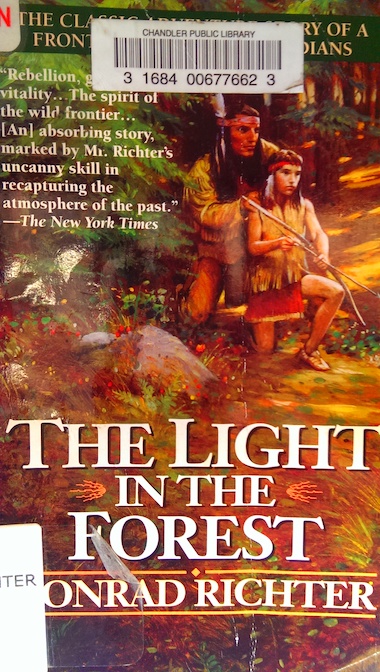
LightInTheForestThe Light in the Forest by Conrad Richter, 1953.

Although this book was adapted into a live-action Disney movie in 1958, this is not a story that I would recommend for young children because of the level of violence.  I think I was in elementary school, about 10 or 11 years old, when I read it as a kid, but I wouldn’t recommend it for anyone that young anymore.  This book is bound to be controversial, but read to the end, where I discuss my reaction to it.

This story takes place in 18th century Colonial America, specifically in Pennsylvania.  Eleven years before the story begins, four-year-old John Butler was abducted by Lenape Indians and adopted by a member of the tribe as a replacement for a Lenape boy who had died.  His new “father” names him True Son and treats him as his son.  John/True Son comes to feel that his Lenape father is his true father, although he is aware that he had another father before.  Years later, in 1764, fifteen-year-old John/True Son remembers very little about his life among white people and now considers himself Lenape.  The Lenape recognize him as a full member of the tribe as well, but a recent treaty requires them to return all white people they have taken captive, including True Son.

The tribe reluctantly hands True Son over to white soldiers to be returned to his birth family, although True Son resists, even attempting to kill himself at one point to prevent it.  However, the suicide attempt is thwarted, and True Son is brought to Fort Pitt, where he is reunited with his birth father, Harry Butler.

Harry Butler takes John/True Son home to the rest of the family, but True Son refuses to acknowledge them as his family.  He pretends like he can’t understand English anymore and continues dressing like a Lenape.  The one member of the family he bonds with is his younger brother, Gordie, whom he had never met before.  Gordie is young and has no particular prejudice against Native Americans.  He finds the things that True Son does fascinating.  (The Disney film cut out the character of Gordie in favor of giving John/True Son a love interest, but I think that is a mistake because I think that the relationship between John and Gordie and how John/True Son views young children is central to the true theme of the story.  Read on.)

The family member that True Son really hates is his Uncle Wilse, who is known to have participated in a massacre against Native Americans.  Wilse thinks that John/True Son has been brain-washed by the Lenape and doesn’t really trust him.  When Wilse tells True Son that the Lenape have taken the scalps of children as well as adults, True Son denies it. The two of them argue, and Wilse slaps him.

True Son pines for his Lenape family, and when he learns that a couple of Lenape have been asking about him in the area, he manages to meet with them in secret.  One of them turns out to be Half Arrow, True Son’s cousin among the Lenape.  When Half Arrow tells him that friends of Wilse have killed a friend of theirs named Little Crane, the boys attack Wilse and scalp him in revenge.  (Not killing him, just scalping him.  It’s disgusting, but possible.  In the Disney movie, this scene is changed to a fist fight.)

True Son returns to the Lenape tribe with Half Arrow, and the tribe furthers their revenge for Little Crane’s death with a raid on a white village.  However, John/True Son is horrified when he sees the scalps of children as well as adults after the raid, proving that members of his tribe have killed innocent children and that Wilse was correct about that much.

When his tribe attempts to get True Son, posing as an ordinary white boy, to lure an unsuspecting group of white settlers into another attack, John/True Son must decide who he really is and what he really stands for.

The book is available to borrow and read for free online through Internet Archive (multiple copies).

My Reaction and Spoilers

In the end, John/True Son decides to alert the settlers to the imminent attack and warn them away because he sees children among them (in particular, a little boy who reminds him of Gordie, which is why that character is so important to the story) and can’t stand to see them killed.  His decision results in his banishment from the Lenape tribe.  At first, they were going to kill him for his disloyalty, but his adoptive father convinces them to spare his life, although he warns True Son that if members of the tribe see him again, they will consider him an enemy, so he can never become a part of their society again.  From this point on, John/True Son is on his own, and his fate lies in his hands alone.

Modern readers may be repulsed at the discussion of scalping (I know I was), and I’ve also heard arguments about whether the practice was more a Native American thing or one more often practiced by white people against Native Americans. Both sides do this in the story, but there are debates about where exactly the practice started.  My thought is that some things are just so disgusting that I can resent anyone who does them, regardless of who started it, but that’s neither here nor there.  Before anyone goes too far in that direction, I’d like to point out that we shouldn’t make the same mistake that most of the characters in the book do: overlooking the more immediate issue, which is True Son himself.

Throughout the story, John/True Son is a victim in more ways than one.  Because of his abduction at a young age, he is not only stuck in a personal identity crisis and a clash of cultures but has become a pawn in a power struggle between two societies that have each committed atrocities against the other.  In the beginning, he understands the most that the Lenape have been victimized by white people.  He comes to despise the white culture into which he was born and empathizes with the Lenapes’ attempts to strike back at the white people. Some of this might be a kind of Stockholm Syndrome (a term I didn’t know when I first read this book), but he is correct that men like his Uncle Wilse have committed great atrocities, and he wants no part of them.  However, against his wishes, he is thrust back into the culture he came from and into the middle of the conflict as a bargaining chip in a treaty.

After his time among his white family, he begins to see the conflict from both sides and to realize that not all white people are guilty of atrocities and deserve to be punished.  At the same time, True Son is forced to acknowledge that people close to him on both sides of the conflict have each done terrible things.  In the end, his sympathy is particularly for the innocent children who, like he was as a young child, have been brought into this cycle of hate, revenge, and killing without even their knowledge, having done nothing to deserve it.

We’re not quite sure what John/True Son’s life is going to be after the end of the story.  He has been rejected by the society he knows best, where he once thought he belonged, but whether his birth family and society will accept him back after what he’s done (the scalping of his uncle) is uncertain.  There is one thing that we do know: True Son has become his own man.  In a moment where he could simply have done what others asked, what they expected him to do, he made a difficult decision to stand up for what he really believed in, the protection of the innocent, regardless of their race, knowing even as he did so that there would be dire consequences for him personally.

We hope that John Butler/True Son manages to find some acceptance somewhere (probably among white society, which is hinted at the end of the book, but also probably on the fringe of it) and settle down to a more peaceful life, but we know that because of his troubled past, it isn’t going to be easy.  I would say that the overall message of the story is for people to consider the children and the generations to come and the impact that their decisions and their quarrels will have on their future and the kind of world the young people will grow up in.  John/True Son understands more about the horrors of fighting than either of the two sides involved, and he wants better for the younger children he finds at his mercy.

When you read other reviews of this book, you’ll see that there is some lingering resentment from people who were forced to read it in school.  It is a popular book for teachers to assign students to read around the middle school level (around age 12 to 14, roughly), and I have to admit that I often resented being forced to read depressing books in school myself.  This isn’t a happy story, but it is memorable and thought-provoking, and now that I’m an adult, what I remember best about the story is how John/True son feels about younger children and how he accepts the role of protecting them.

This story is based somewhat on real-life stories of abducted children from the same time period who also found themselves pawns in the struggles around them and felt conflicted when they once again came into contact with their birth families.  There are other books written on this topic, and the author of this one also wrote a book about a girl captive called A Country of Strangers.

Annie’s Promise

AnniesPromise

Annie’s Promise by Sonia Levitin, 1993.

This is the final book in the Journey to America Saga.  Annie, the youngest of the Platt girls, is more of a tomboy than her older sisters.  Her father thinks that she’s been growing up too wild in America, running around and climbing like a boy.  This summer, in 1945, while her best friend goes to visit their family’s farm in Wisconsin, Annie’s father wants her to stay home and help him with sewing for his coat business, and Annie’s mother has a list of chores for her to do.  It all sounds so boring and dreary.  Twelve-year-old Annie longs for excitement, but because of her recent appendix operation and her migraine headaches, her parents worry about her health.

Then, Annie gets the opportunity to attend summer camp.  She wants to go and do all the fun summer camp activities that other girls do, but her parents worry at first.  They worry about Annie’s health, and they don’t know who is running the camp or what they do there.  Annie’s older sisters, Ruth and Lisa, tell their parents that it’s normal for girls in America to go to summer camp and that the experience might do Annie some good.  When the family doctor says that Annie is healthy enough to go, her parents finally agree.

At first, camp is hard.  Annie faints soon after her arrival, and she worries that maybe her parents were right about her being delicate.  However, one of the counselors tells her that these things happen and that she was probably just overtired, overheated, and still suffering from the rough bus ride to the camp and that she will be fine after she rests.  Annie is physically fine, although one of the other campers, Nancy Rae, makes a big deal about the incident, calling Annie a “sickie” and other names.  Nancy Rae is a terrible bully, and Annie nearly drowns in the lake after accepting a dare from Nancy Rae to swim across it, in spite of not being a good swimmer.  Annie overhears the counselors saying that Nancy Rae should probably be sent home for goading Annie into a dangerous stunt, but they know that Nancy Rae comes from a bad home and that her father abuses her.  For her own sake, they decide to give her another chance.

However, even knowing Nancy Rae’s troubled history doesn’t help Annie when Nancy Rae keeps picking on her and a black girl named Tallahassee (Tally, for short).  Nancy Rae calls Tally and her younger brother (who is also at the camp) “nigger” and says that Annie is a “nigger-lover” when she tries to protect the younger brother from one of Nancy Rae’s tricks that could have really hurt him.  (Note: I’m not using the n-word here because I like it. I’m just quoting because I want you to see exactly how bad this gets.  Nancy Rae uses this word multiple times, and so do others when quoting her. This book is not for young children.  Readers should be old enough to understand this word and beyond the “monkey see, monkey do” kind of imitation some kids do when they learn about bad words.  The management assumes no responsibility if they aren’t.)  Nancy Rae is a thrill-seeker, who frequently does wild stunts to get attention and tries to make other girls hate Annie as much as she does.  At one point, she snoops through Annie’s things and tries to take her diary.  Eventually, she figures out that Annie is Jewish and makes fun of her for that, painfully reminding Annie of what it was like living in Nazi Germany and of her relatives, who died in the concentration camps.

Finally, Annie reaches the breaking point with Nancy Rae.  At a camp talent show, she arranges with other kids to dump horse manure on Nancy Rae’s head after she finishes singing a song.  Nancy Rae is so humiliated by the experience that she ends up leaving camp.  Annie is relieved that she is gone, but one of the camp counselors, Mary, makes her feel guilty about her revenge because she sees Annie as being stronger and more talented than Nancy Rae and wishes that she could have made Nancy Rae her friend instead, giving the bully a chance to improve herself.  (I disagree with what the counselor says, but I’ll explain more later why.)  Annie feels badly about how things turned out, but the incident blows over, and the rest of camp is a great adventure for her.

At camp, Annie mixes with different kinds of children from the ones she usually sees in her neighborhood and at school, and everything is a learning experience.  She becomes friends with Tally and gets a crush on a boy named John.  There is an ugly incident in which an assistant in the camp kitchen tries to molest Annie when he finds her alone (this really isn’t a book for kids), but the camp counselors dismiss him for what he did.  Annie and Tally talk about many things together, and Tally is very understanding.  The incidents with Nancy Rae and the kitchen assistant bring up the subjects of people who try to victimize others and how to deal with them.  Annie resents that people like that force others to be on their guard, limiting them in ways that they can behave in order to avoid being victimized, but Tally says that there’s no help for that.  As long as people like that exist, she says, protecting yourself is a necessity.  They also compare the way Annie feels when John gives her a little kiss to the repulsed and frightened way that she felt when the kitchen assistant tried to force himself on her.  Both incidents involved a kiss, but the way it was delivered and the person delivering it made each experience feel very different.  In the end, Annie’s crush on John turns into friendship rather than love as she realizes that the kiss was just a friendly gesture.  It is a little disappointing to her at first, but it is still a learning experience for her.

Annie learns that everyone at this camp has been through something bad in their lives.  Annie’s family are war refugees, but Tally’s father has been married three times, and she’s often the one to take care of the house and her younger brother, while her current stepmother cleans other people’s houses for money.  Other kids are poor or orphans or have fathers in jail.  The camp gives them a chance to get away from their problems for awhile, to make new friends, and to develop talents that they can be proud of.  Annie really blossoms at camp, learning to ride horses and work on the camp newspaper.  As Annie’s session at camp comes to an end, Mary offers Annie a position as a junior counselor for the final session of camp, helping the young children.  Annie is enthusiastic about the prospect, but family dramas at home threaten to derail her plans.  Ruth’s fiancé is shell-shocked from the war and has broken off their engagement.  Lisa is tired of arguing with their parents about every small piece of independence in her own life and has decided to move to a place of her own.  With all of this going on, and their parents upset about everything, what chance is there that they will sign the permission slip that Annie needs to become a junior counselor?

This book shows how much the lives of the girls in the Platt family have changed since they first left Germany for America.  It’s partly because they are living in a different country, partly because times and habits are changing everywhere, and partly because all of the girls are growing up and making decisions about what they really want to do with their lives.  The older girls in the family, Ruth and Lisa, are women now and thinking about careers and marriage.  As the girls suffer disappointments and changes of heart, their parents suffer along with them, and Annie realizes that she has to make up her own mind about what she really wants.  As Annie tries to decide what she really does want, her parents struggle to cope with all of the changes in their daughters’ lives and in the changing world around them.  They fight against it in a number of ways, and when things go wrong, whether it’s Annie’s illnesses or the older girls’ romantic problems, they tend to get angry or panic.  As the book goes on, it becomes more clear that what the parents really feel is helplessness.  More than anything, they’ve wanted life to be better for their daughters in their new country, and it upsets them when things don’t work out.  They want to help guide their daughters and make their futures work out for the best, but in the process, they often come across as too controlling or making the wrong decisions because they don’t fully understand the girls’ feelings or situations.

Ruth and Lisa each suffer romantic disappointment before they settle down.  Ruth had a fiancé, Peter, who went away to fight in World War II, but having seen the prisoners in the concentration camps, he has returned disillusioned and dispirited.  He was Jewish, but now comes to associate his religion and heritage with pain and suffering and wants to give it up, breaking off his engagement to Ruth in the process.  At first, Ruth is angry with him, saving that it’s like he wants to give up on his whole life, on the whole world.  The girls’ father says that he wants to kill Peter for leading his daughter on, but part of his feelings turn out to be his own feelings for somehow failing his daughter, that he is somehow to blame for allowing this disappointment.  When Lisa is upset because the young man that she’s been seeing says that he doesn’t want to get married, she argues with her parents about the course of her life and leaves home to live on her own.  Her parents see that as turning her back on their love and protection, but Lisa says that she just wants the independence that other girls have.  Even Annie feels abandoned by Lisa because Lisa was always there to comfort her as a sister and help her persuade their parents to listen to her, but Lisa says that she has to deal with problems on her own and that Annie will understand someday, when she’s in the same position.  Annie realizes that, in a way, she already is in the same position.

The one time that Tally comes to visit Annie at her house and the girls go to the beach together, Annie’s parents make a scene when she gets home because she’s left sewing all over the house and eaten more food than she should have.  Tally was going to apply for a sewing job with Annie’s father, which would have helped both of them, but Annie’s parents send her away, thinking that she’s a bad influence who encouraged Annie to goof off.  Then, Annie hears her own parents use the n-word.  It’s the final straw for Annie, and she runs away to camp.

The people at camp are glad to have her because they need her help, but being there, helping them, and thinking about her own life and future help Annie to realize what’s really important to her.  She’s been feeling bad about the hate she got from Nancy Rae and the hate that she felt from her parents with their insults to her friend.  However, her parents don’t really hate her, and in spite of what they’ve done, she doesn’t really hate them.  She realizes that, before she does anything more with the camp, she needs to go back and see them.

Annie rethinks what Nancy Rae was really about, how she was filled with hate for everyone, dealing out hatred because of all that she’d received from everyone else.  The counselors realized that she needed love more than anything, but Nancy Rae’s own hateful behavior pushed away the people who would have given her more positive attention and Annie’s revenge (although provoked) ended her camp experience.  Annie realizes that she doesn’t want to go down the same path and that she must mend her relationship with her family.

I said before that I disagreed with the counselor’s approach to the problem of Nancy Rae and what she said to Annie about her revenge.  I see what they were trying to do with giving Nancy Rae another chance, but what bothers me about it is that they act like Annie was in a much less vulnerable position to Nancy Rae and that she should have been strong enough to take what Nancy Rae dished out without hitting back, and I don’t think that’s true.  All of the kids at the camp were there because they had something troubling in their lives, some vulnerability, including Annie.  To say that Annie was more fortunate and more talented and that it should have been enough was to discount the harm that Nancy Rae was doing.  I know that the counselors were trying to make the camp experience positive for Nancy Rae, but she was making the camp experience more negative for everyone else around her and needed to be stopped.  Everyone suffers from something in life (as this book also demonstrates), but not everyone chooses to become a bully because of it.  Nancy Rae made that decision herself, within herself, and for herself alone.

Part of the problem, I think, was that there were no obvious consequences for Nancy Rae’s bad behavior, and therefore, she had no reason to stop doing what she was doing.  The lack of punishment and the inequity of the situation was what finally sent Annie over the edge with her.  Since the counselors didn’t make it obvious that Nancy Rae was in the wrong, Annie felt that she had to, and that says to me that there was a lack of responsibility and accountability.  I think that life is a balance and that both positive reinforcement (giving rewards to people who do good) and negative reinforcement (punishment for bad behavior) are necessary.  I believe in plain speaking, and if I were in the counselors’ position, I would make it plainly and specifically clear that no campers were to use the n-word, to mess with others’ belongings, or to do the other things that Nancy Rae was doing and that there would be consequences for doing so, telling them exactly what those consequences were so that no one could say that they were surprised.  I would also make it clear to Nancy Rae that I knew exactly what she was doing and why she was doing it and that it was unacceptable.  When we choose what we do and say in life, we all consider (or should consider) what we want to happen in life, and I would put it plainly to Nancy Rae how she really expects others to react to her and how their reactions would change if she did things differently.  Clearly, no one has ever told her that in her life before, and it was about time that she heard it from someone.  I suppose we could guess that the counselors may have said something of the sort to her out of hearing of the others, but I would also say the same thing to Nancy Rae’s victims.  Letting them know that I’d dealt with her adequately might head off their attempts to deal with her themselves and talking about what our behavior might lead others to do might also discourage revenge.

Also, the counselors were counting too much on the idea of friendship with Annie to get Nancy Rae to stop treating her badly, but that’s not at all the way that bullies work.  One of the primary reasons why people bully is that they know that there are a lot of people who like mean humor, and they use their bullying to bond with those people, not their victims.  Their friendships are formed on mutual contempt for the victim and the fun of humiliating that person.  They’re getting everything they want through their bullying, so there’s no reason for them to stop until someone else gives them consequences and puts an end to their bully support network.  I think that the counselors should have also talked to the people Nancy Rae was trying to bond with, explaining that they know what Nancy Rae is attempting to do and telling them that they would also be punished if they tried to help her, further cutting off one of Nancy Rae’s incentives to keep doing what she’s doing.

I’m not saying that it’s a perfect solution or that it would be guaranteed to work, just that I believe in being direct rather than letting things slide and just hoping that people will someday see the light.  Sometimes, people just need to have things spelled out for them in no uncertain terms.  If they chose to ignore what you say, then it’s on their own head, and they can’t say otherwise because you were clear and backed up your words exactly how you said you would.  I do think that the counselors were right that, in the long term, revenge never turns out well.  It often turns into a vicious cycle, as Annie later considers.  However, in this case, some proper handling in the first place, with consequences as well as words, might have headed off the situation before it got that far.

We don’t know what eventually happened to Nancy Rae by the end of the story, but I’m not sure that Annie is right to think that she wronged her.  In fact, she might have actually done her some good.  Sometimes, seeing others react badly to bad treatment can make a difference to someone’s future.  In my experience, people sometimes don’t realize that they’ve pushed another person too far until that other person finally reacts and says or does something.  Realizing that they’ve pushed someone too far can give them a reason to change because they realize that people won’t put up with their behavior forever.  Part of me thinks that maybe, at some point in the future, Nancy Rae might look back on this experience and quietly admit to herself that she had provoked it, being more careful the next time not to pick fights because she can be humiliated or excluded when people get fed up.  It might even help Nancy Rae to realize that she doesn’t have to put up with her father’s ill treatment forever because she also has the right to lose patience with bad treatment, too.  At least, I hope that this was a learning experience for her.

Annie realizes that both her parents and Nancy Rae are angry and hateful because of what they’ve suffered in their lives, but the problem is that both of them are taking it out on the wrong people.  Annie’s parents, at least, seem to realize that what they did was going too far and taking out their feelings on someone who didn’t deserve it.  By the time that Annie arrives home, they are also ready to make their peace with her and even support her return to the camp as a junior counselor, if that’s what she really wants to do.

The final days of World War II frame this story, beginning with the reports of Hitler’s death in the late spring of 1945 and ending with the bombings of Hiroshima and Nagasaki and the Japanese surrender in August.  With the end of the war comes a new chapter in the lives of the Platt family.  They’ve been through a lot together, but in spite of the girls growing up, moving out, and arguing with their parents, they still are a family.  There are no more books in the series, but Annie explains that Lisa gives up the dream she once had of being a dancer because she doesn’t think that she’s star material and because she decides that what she really wants is to get married and have children of her own.  In the end, she and her boyfriend get married, and she is happy with her life.  Similarly, Ruth, who is now a nurse, meets a new love when she visits Annie at camp and later marries him.  Annie realizes that she has found what she loves most in teaching young children, taking care of animals, and writing, and these things will form the basis of what she does with her future life.
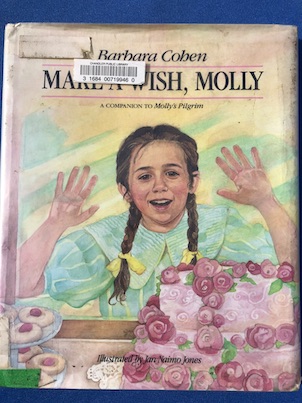
Make a Wish, Molly

Make a Wish, Molly by Barbara Cohen, 1994.

This book is the sequel to Molly’s Pilgrim.

Things have improved for Molly in Winter Hill since she and Emma became friends.  Now, Molly doesn’t feel quite so alone as she once did.  However, Emma is still friends with the nasty Elizabeth (resident mean girl from the first book).  Molly has learned that a major part of Elizabeth’s resentment toward her is that Elizabeth is used to being the teacher’s pet and the center of attention at school.  In both first and second grade, she always seemed to be the favorite student.  Now, in the third grade, Elizabeth thinks that their teacher prefers Molly, and she can’t stand it.  So, she tries to make trouble for Molly whenever she can and make others not like her, too.

Emma tries to ignore Elizabeth’s nastiness and invites both girls to her birthday party.  Molly is excited because she’s never been to a birthday party in America before, and birthdays are celebrated very differently in America from the way they were in Russia.  Emma and Elizabeth (in her condescending way) explain how birthday parties are, that the birthday girl receives presents from her friends and gives them small party favors in return, and that there is cake and ice cream for everyone.  Molly has never had a cake like the ones that the girls look at in the bakery window and is eager to try it.  But, there’s a problem.

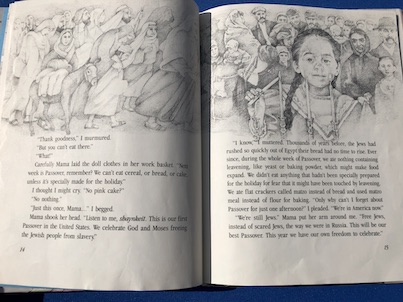
Molly’s mother says that it’s fine for her to go to the party and is willing to make some doll clothes for Emma’s birthday present, but she says that Molly cannot try the cake because the party will take place during Passover, and Jewish families like theirs cannot eat leavened foods during that time. Leavened foods are those that include rising agents, like yeast, baking powder, and baking soda, which includes cakes and breads. For Passover, Molly and her family are limited to things which don’t have these ingredients.

Instead, Molly’s mother packs a snack for Molly to take and eat while the others have the cake.  At first, Molly thinks maybe she could disobey her mother just this once and try the cake anyway without her noticing and without feeling different among the other girls, but when a piece of cake is placed in front of her at the party, she can’t bring herself to eat it.

Of course, Elizabeth takes advantage of Molly’s inability to eat the cake to make her feel bad and look bad in front of the others.  Elizabeth says that Jewish people don’t like to eat in Christian homes.  Molly tries to explain that isn’t the problem and to tell them about Passover, but Elizabeth ignores her explanation and just says that Molly’s reluctance to eat proves that what her mother told her about Jews was true.  (Let me just say that when a kid is as awful as Elizabeth is routinely, I always assume that the parents are exactly the same way.  I decided that Elizabeth’s mother was probably a bully and a snob back in the first book, so hearing that she’s been spewing anti-Semitic comments is no more than what I would have expected.  I view this type of behavior as an off-shoot of a bullying mindset, so I would completely expect that a person who is prone to one type of bullying would also engage in another. The apples never fall far from the tree.)  Molly knows that she can’t make the other kids understand the situation, so she just leaves in embarrassment.

When she gets home, Molly tells her mother about what happened.  Her mother says that everyone is a little different from other people, and there’s no use in pretending that they don’t live different types of lives from some of their neighbors.  However, Molly also has a birthday coming soon, and Molly’s mother thinks that if they invite some of the girls from Emma’s party to their house for a celebration, they will see that Molly’s family isn’t quite as different as they might think.

At first, Molly isn’t sure that it will be such a good idea, but it turns out better than she expects.  Her birthday is full of wonderful surprises.  There’s no cake, but Molly’s mother bakes other wonderful goodies, like rugelach (pastries with apples, raisins, and nuts).  Emma and another girl, Fay, try them and like them, but Elizabeth still refuses.  She also just looks defiant when Molly’s mother proves to her that Jews will wash and reuse plates that Christians have eaten from, not throw them away, like Elizabeth’s mother said before.  Once again, the issue with Elizabeth isn’t how correct or incorrect she (or her mother) was in whatever she said but whether or not she happens to look better than someone else at the current moment.  All Molly’s mother’s demonstration means to her is that she just lost another opportunity to look better than someone, and that annoys her.  But, Molly doesn’t care so much about Elizabeth’s lingering nastiness at that point because she knows that Emma is still her friend and Fay has just become a new friend.

There is also a movie version of this book, although the story was altered slightly so that the girl who insults Molly at the party says that it was her aunt who told her all the bad stuff about Jews, not her mother.  Also, the movie takes place in a time contemporary with when it was made.  The original book takes place in the past, judging by why the reasons why Molly’s family had to leave Russia and the clothes that the girls wear in the pictures.