Medieval Holidays and Festivals

MedievalHolidays

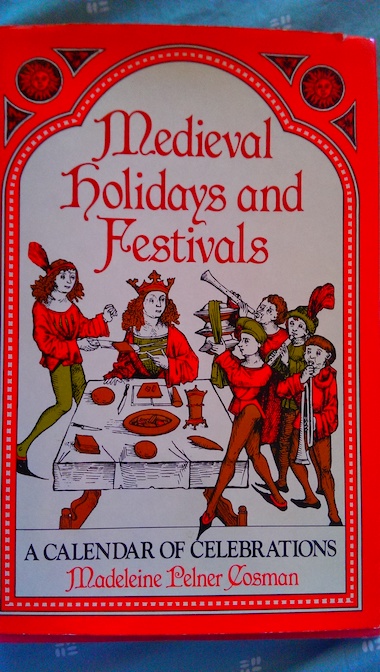
Medieval Holidays and Festivals: A Calendar of Celebrations by Madeleine Pelner Cosman, 1981.

This book explains the holidays that people celebrated in Medieval times and how these holidays would have been celebrated, along with some special information about Medieval feasts.  The author also explains a little about how historians uncover and interpret information about people’s lives in the past.
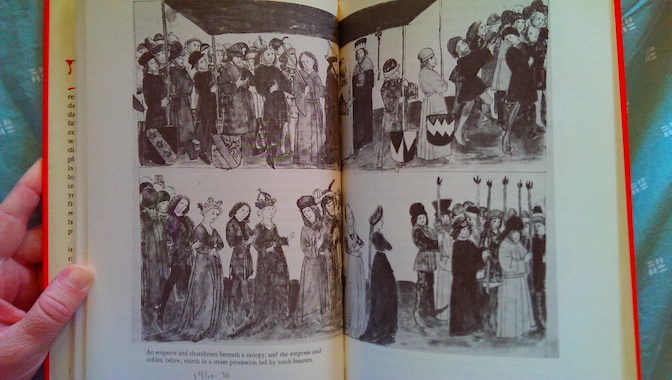
MedievalHolidayProcession

Many of the holidays celebrated in Medieval times tended to be either religious in nature or having to do with the changing of seasons.

The holidays included in this book are listed by month:
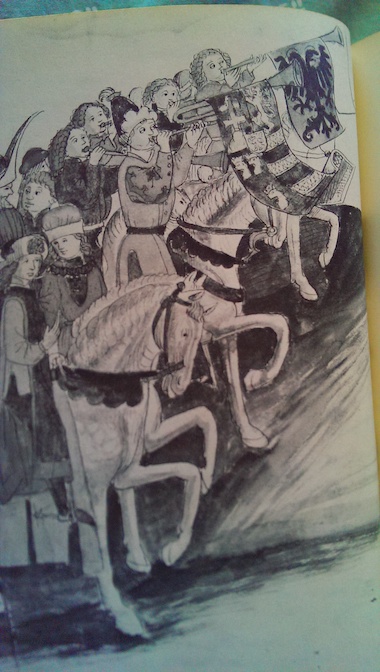
MedievalHolidaysHorsesJanuary — Twelfth Night — An extension of Christmas (remember the Twelve Days of Christmas song?), Twelfth Night is also known as Epiphany — the night that the Three Wise Men supposedly visited baby Jesus after his birth.

February — St. Valentine’s Day

March — Easter

April — All Fool’s Day — Not just a day for pranks, but when everything is turned upside down and backwards, and people intentionally did the opposite of whatever they usually did in many ways.  Basically, a celebration of everything silly and ridiculous.

May — Mayday — A celebration of spring.

June — Midsummer Eve — A celebration of summer.
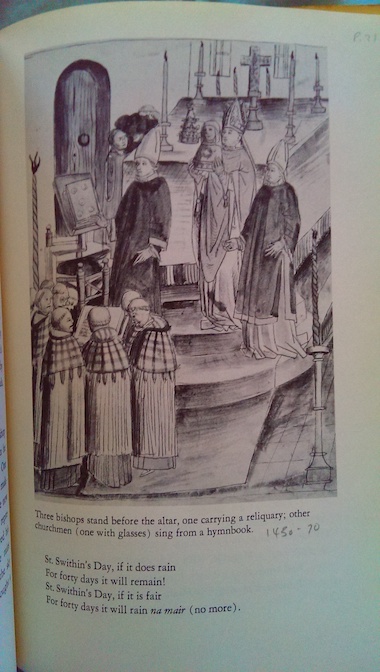
MedievalHolidayBishopJuly — St. Swithin’s Day — St. Swithin was a bishop of Winchester who had asked to be buried without great ceremony upon his death.  However, people later decided to give him a grand tomb.  When they tried to place his body in the tomb, it started raining heavily and didn’t stop until they moved the body to a new location.  They took the rain to be an expression of St. Swithin’s displeasure at the unwanted tomb.  From then on, this time of year was used to predict rainfall for the rest of summer.

August — Lammas Day — The word Lammas meant “Loaf Mass,” which was when there would be special blessings for bread and grain and thanks given for bountiful harvests.  The holiday was marked by the baking of a variety of special breads, including those in usual shapes, flavors, and colors.  Some of them could be very elaborate.

September — Michaelmas — The holiday celebrating St. Michael is oddly associated with three things that few people would associate with each other: gloves, geese, and ginger.  The glove was the symbol of the market of craftsmen held on Michaelmas.  Geese and foods flavored with ginger were popular dishes served at Michaelmas.

October — Halloween

November — Catherning, or St. Catherine’s Day — St. Catherine of Alexandria was learned noblewoman who was killed on a wheel (it was a bizarre and disgusting form of execution).  The holiday honoring her was associated with wheels, women (especially unmarried women and women students), and the professions which were associated with her such as lawyers, carpenters, spinners, lace makers.

December — Christmas

Each section in the book describes special traditions associated with each holiday, including games that would have been played and food that would have been eaten at that time.

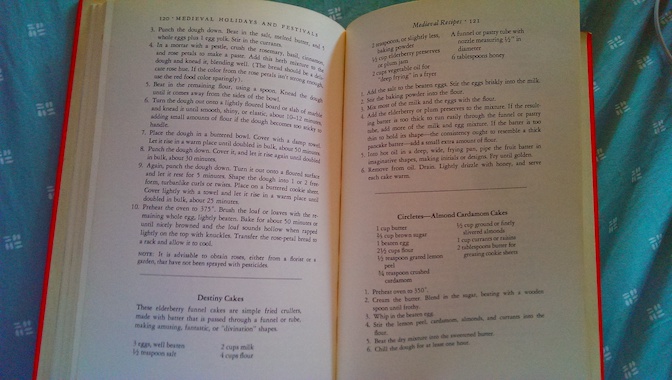
In the back of the book, there is a section that explain decorations used for Medieval feasts, how to hold a Medieval-themed feast in modern times, and Medieval costumes. There is also a section of Medieval recipes.
MedievalHolidaysDestinyCakes

This book is available to borrow and read for free online through Internet Archive.

Happy Holidays

HappyHolidays

Happy Holidays and Other Fun Days Around the Year by E. C. Reichert, illustrated by Suzanne Bruce, 1953.

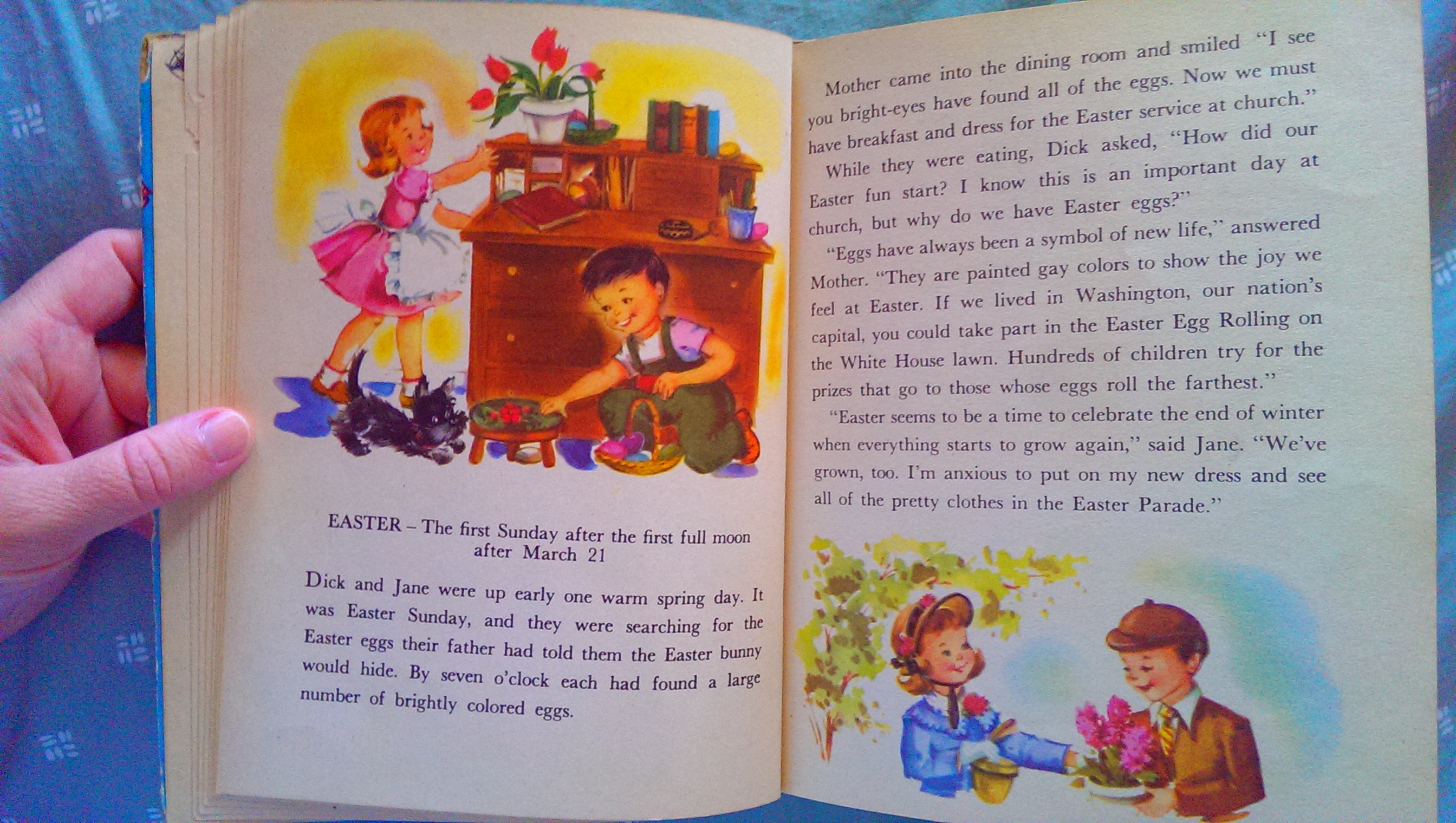
This book explains a little about the origins of various holidays and how they are commonly celebrated.  It was written during the 1950s, and the illustrations clearly show it in the style of the people’s clothes.  The style of one of the illustrations is one of the charming aspects of the book.

For each holiday in the book, different children talk to their parents or friends about what different holidays mean and how they are planning to celebrate.  Many of the explanations are rather simplistic, and I’ve seen books that explain the history of holidays better, but I have some nostalgia for this book because I read it and liked it when I was a young child.

The Holidays:

New Year’s Day — January 1

Sandra talks to her parents about what they’re going to do on New Year’s Day, and her mother explains the purpose of New Year’s resolutions.

HappyHolidaysNewYear

Valentine’s Day — February 14

Sally and Billy open valentines they’ve received and talk about Saint Valentine and other Valentine’s traditions.

Washington’s Birthday — February 22

Stevie’s father tells him about George Washington and the famous cherry tree story.

St. Patrick’s Day — March 17

Rickey’s friends explain to him why they’re wearing green on St. Patrick’s Day and his mother tells him a little more about the holiday and what shamrocks are.

Easter — The first Sunday after the first full moon after March 21

Dick and Jane (not the Dick and Jane from school readers, but yes, those names) hunt for eggs on Easter.  They don’t explain the religious reasons behind the holiday, but they talk about popular Easter traditions, like colored eggs and the Easter Egg Rolling at the White House.  Congratulations to the book for explaining how to calculate the date of Easter!

HappyHolidaysEaster

April Fool’s Day — April 1

When Artie plays a practical joke on Kathy, their father explains the tradition of April Fool’s Day.  (My parents wouldn’t have let my brother give me fake candy because of the choking risk.  Just saying. Actually, I never celebrated April Fool’s Day as a kid because both of my parents hated practical jokes because they both resented jokes their parents played when they were kids, coincidentally around the time this little book was published. My knowledge of April Fool’s Day as a kid came from this book and from things I heard at school.)

Independence Day — July 4

Susie and Johnny go to a parade, have a picnic, and watch fireworks on the Fourth of July.  Their father explains the significance of the holiday.

HappyHolidaysIndependenceDay

Columbus Day — October 12

Miss Nelson’s class at school learns about Christopher Columbus.  (This holiday isn’t celebrated as much today as it was when this book was written. I have to admit, I wasn’t that enthusiastic about it as a kid, either. Columbus Day had no costumes, candy, or presents, and I didn’t get the day off school, and thus, it seemed pretty boring to me when I was young.)

Halloween — October 31

Robin and Judy come back from trick-or-treating, and their mother explains a little about the origins of the holiday.

HappyHolidaysHalloween

Armistice Day — November 11

Terry and Jimmy watch a parade, and their father explains that November 11 was the day that World War I officially ended in 1918.

Thanksgiving Day — The fourth Thursday in November

Ann and Johnny (a different Johnny from the earlier one, I think they either forgot they’d used that name or just couldn’t think of another – they could have called him Jack to be a little different) have dinner with their family at their grandmother’s house.  Johnny talks a little about what he learned in school about the pilgrims and the first Thanksgiving.

Christmas — December 25

Tim and Debbie hang up their stockings, and their mother tells them that it’s Jesus’s birthday and explains the origins of some Christmas traditions.

HappyHolidaysChristmas

Merry Christmas From Eddie

MerryChristmasEddie

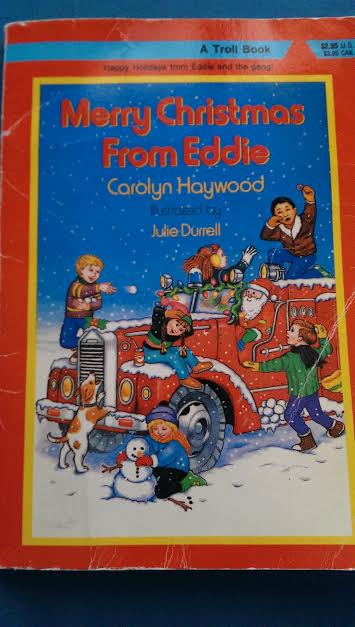
Merry Christmas From Eddie by Carolyn Haywood, 1986.

This is a collection of short stories, most of which involve one of Haywood’s favorite characters, Eddie.  Eddie is often full of big ideas and is eager to get involved in new projects.  Although this book was written in the 1980s, aspects of it seem more like Christmas in the 1950s in a fairly small town.  A few of the stories at the end focus around a special children’s program that the kids take part in.

The book is currently available online through Internet Archive.

Stories in the Book:

Merry Christmas from Eddie Fire EngineEddie’s Christmas Card

Eddie loves the decorations down at the used car lot, especially the fire engine with Santa Claus at the wheel.  Eddie thinks it would be great if his father could take a picture of him sitting next to Santa Claus so he can use copies of it as Christmas cards, but a surprise snow storm changes his plans.

How Santa Claus Delivered Presents

Every year, there’s a large public Christmas party at the town hall, and children from the local children’s shelter are invited and given presents.  This year, Eddie’s father is in charge of the celebration. Mr. Ward is loaning the fire engine from his car lot for transporting the presents, but they need some extra help transporting the extra-large Christmas tree.

Christmas Is Coming

Eddie and Boodles go Christmas shopping.  Boodles wants to get a pet bird for his mother, and Eddie has decided to buy a small present for a little boy on his street who has a broken arm.  Then, Eddie ends up winning a prize for being the ten thousandth child to enter the department store.  It solves the problem of what to buy for the little boy, but getting it home isn’t going to be easy.

Merry Christmas from Eddie TreeHow the Christmas Tree Fell Over

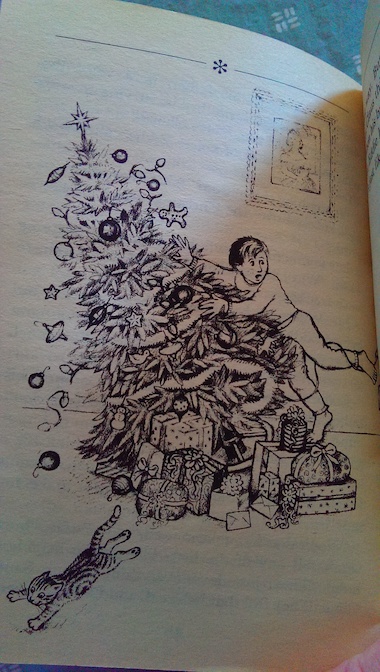
Eddie is old enough to figure out that his father is the one who puts the presents under the Christmas tree on Christmas Eve, eats the cookies they leave out, and leaves a thank you note from Santa.  This year, he gets a funny idea: he’ll leave extra presents under the tree for everyone and a second thank you note for the cookies and make everyone wonder where they came from.  But, his brilliant idea doesn’t quite go as planned.

Christmas Bells for Eddie

Eddie regrets that he never joined the school orchestra now that he’s learned that they will be performing for a Christmas program on television.  His mother suggests that Eddie could sing, but he says that the singing parts have gone to Anna Patricia’s cousin, L.C..  Then, Eddie’s father gives him an early Christmas present that will allow him to join the orchestra after all.

Merry Christmas from Eddie Christmas ProgramThe Christmas Concert

L.C. is spoiled and refuses to sing unless they give him chocolate-covered marshmallows.

New Toys from Old

Eddie’s third grade class is collecting and repairing old toys to be given as presents to the children at the children’s hospital.  Boodles has some fun making Anna Patricia think that Eddie painted the wrong colors on a doll’s face, and people question whether it was such a good idea to turn a nice white horse into a zebra.

The Christmas Program

Eddie has to be Little Boy Blue in the program that his class is putting on at the children’s hospital, but he has doubts about whether his old costume fits him well enough to get through the program.

The Mystery of the Christmas Cookies

Eddie’s mother plans to make some cookies for Eddie to give to his teacher, Mrs. Aprili, for Christmas, but a series of mistakes prevents him from giving those cookies to Mrs. Aprili.  Eddie finally gives up and orders some cookies from the bakery for her.  However, unbeknownst to Eddie, someone else tries to correct for his mistake and ends up creating a mystery for both Eddie and his teacher when a second batch of cookies unexpectedly arrives that is very different from both the cookies he ordered from the bakery and the ones his mother baked.

The Biggest, Most Beautiful Christmas Tree

BiggestChristmasTree

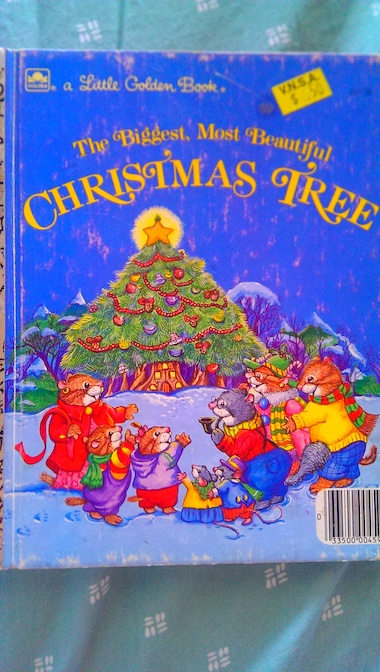
The Biggest, Most Beautiful Christmas Tree by Amye Rosenberg, 1985.

This is a Little Golden Book.

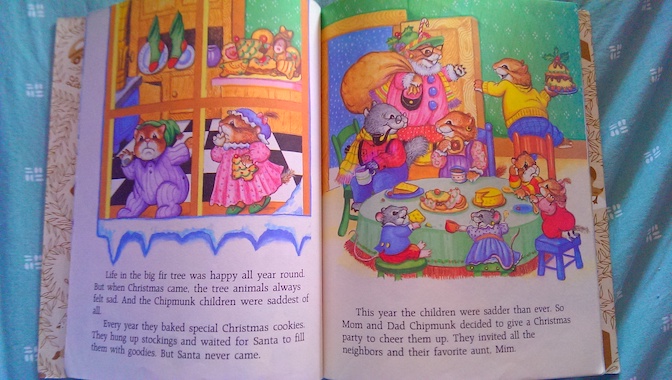
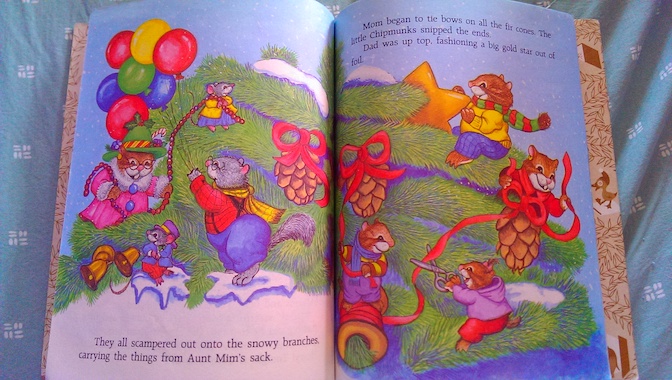
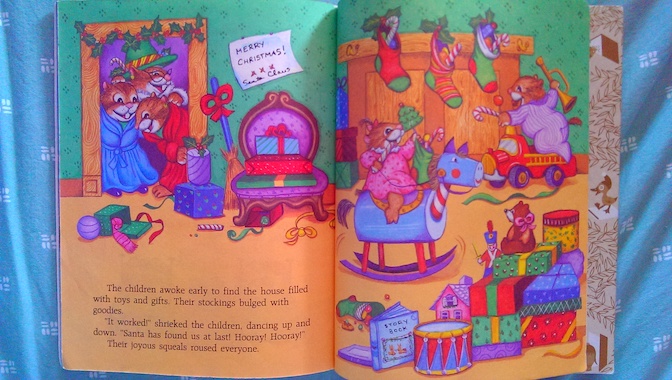
Every year at Christmas, the Chipmunk children, Nina and Nutley, are disappointed because Santa doesn’t visit their home in a large fir tree in the forest.  They always hang up their stockings and put out cookies, but for some reason, Santa never comes.

BiggestChristmasTreeDisappointment

However, this year, their Aunt Mim has figured out the reason why Santa passes them by and what to do about it.  Aunt Mim has realized that Santa can’t find their tree because it looks like every other tree in the forest.  What they have to do is to decorate their tree so that Santa can find it among all the others.

Aunt Mim brings lots of things they can use as decoration, and all of the other animals who live in the tree help with the decorating.  They tie bows on the pine cones, hang strings of berries, and paint balloons to look like large Christmas tree ornaments.

BiggestChristmasTreeDecoration1
BiggestChristmasTreeDecoration2

Sure enough, once Santa knows how to find the Chipmunk children, they get the kind of Christmas they’ve been waiting for!

BiggestChristmasTreePresents

This is just a cute picture book that I liked when I was young.  It is available to borrow and read for free online through Internet Archive.

Cranberry Christmas

CranberryChristmas

Cranberry Christmas by Wende and Harry Devlin, 1976.

Mr. Whiskers normally enjoys Christmas, but this year, he has problems.  To begin with, he can’t go skating on the pond near his house with the children of Cranberryport because his disagreeable neighbor, Cyrus Grape, claims that the pond is actually on his property, not Mr. Whiskers’, and has forbidden the children to set foot on it.  Mr. Whiskers is sure that he’s wrong, but he’s having trouble finding the paperwork to prove that the pond actually belongs to him.

Then, Mr. Whiskers’s sister, Sarah, is coming for Christmas.  She believes that Mr. Whiskers doesn’t take proper care of himself or his house, and she is trying to persuade him to come and live with her.  Mr. Whiskers doesn’t want to do that because he likes his independence.

To help impress Mr. Whiskers’ sister, Maggie and her grandmother help him to fix up his house for Christmas.  In the process, they discover something that helps to settle the question of who really owns the pond.

My favorite part was when Maggie and Mr. Whiskers made Christmas ornaments out of Mr. Whiskers’s seashell collection, which he had been keeping in his bathtub.

In the back of the book, there is a recipe for the cranberry cookies that Maggie makes.  The book is part of a series.

Felicity’s Surprise

American Girls

FelicityChristmas

Felicity’s Surprise by Valerie Tripp, 1991.

FelicityChristmasBenProtestThis is part of the Felicity, An American Girl series.

Christmas is coming, and Felicity is excited. She and Miss Manderly’s other students, Elizabeth Cole and her older sister, Annabelle, have all been invited to the Christmas party at the Governor’s palace! Miss Manderly is a friend of the dancing master who has been giving the governor’s children dancing lessons, so she was able to get invitations for her students. There will be a special dance lesson for all the children who come. With food, music, and dancing at the party, Felicity and Elizabeth are looking forward to dressing up like grown-up ladies going to a ball.

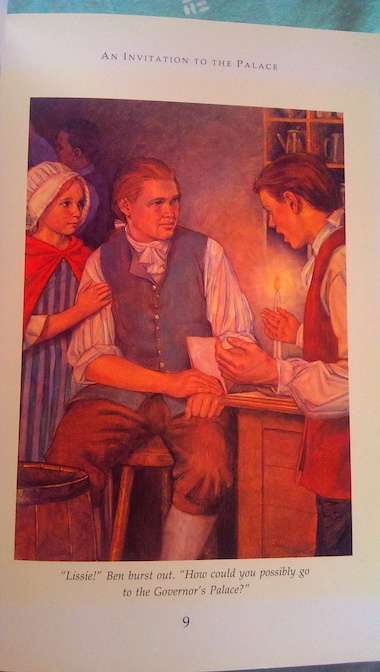
However, Ben, her father’s apprentice is against the idea of Felicity going because the Governor sides with the King and the Loyalists against the Patriots. He can’t understand why Felicity would want to attend a party with people who have treated the colonists so badly and have even boycotted her father’s store because he refuses to sell the taxed tea. However, Felicity’s father understands that the invitation was meant kindly and that it would be a special event for Felicity, so he tells her that she can go if she likes. Christmas should be a time for peace and enjoyment.

FelicityChristmasMotherIllAt Miss Manderly’s the girls start having dancing lessons, and Felicity wishes for a new gown, like the one on the elegant doll at the milliner’s shop. Since Felicity is usually not very interested in clothes, her mother decides to grant her wish.

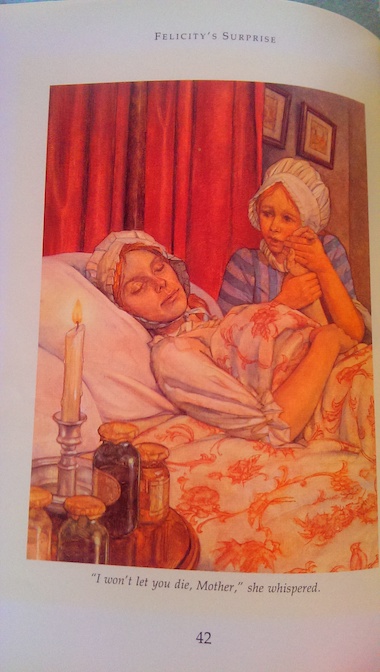
When Felicity’s mother falls ill, not only do Felicity’s Christmas dreams seem dashed, but she worries about whether her mother will recover from her illness. Everything that Felicity was concerned about before, the dress, the dancing, the party, all suddenly seems unimportant and silly in the face of something more serious. However, miracles come to those who work for them, and Felicity receives some unexpected help from friends.

There is a section in the back with historical information about how Christmas was celebrated in Colonial America.

The book is currently available online through Internet Archive.

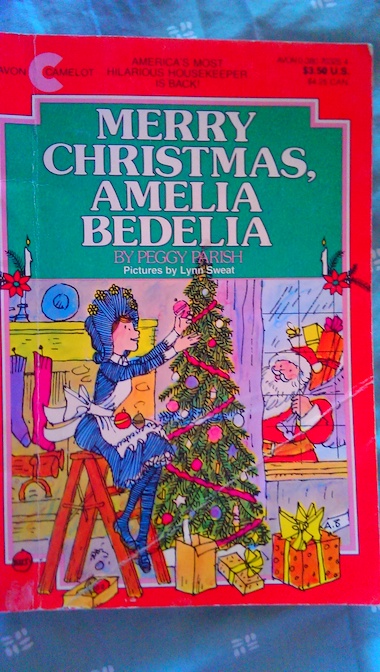
Merry Christmas, Amelia Bedelia

Merry Christmas Amelia Bedelia

Merry Christmas, Amelia Bedelia by Peggy Parish, 1986.

Christmas is coming, and once again, Mrs. Rogers has left a list of things for Amelia Bedelia to do while she goes to pick up her Aunt Myra, who is visiting for the holiday.

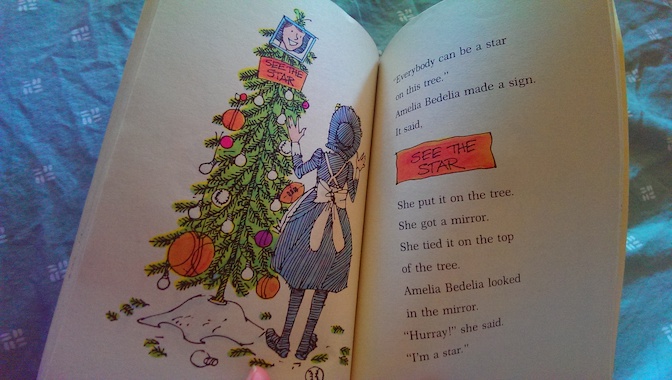
Leaving Amelia Bedelia unsupervised with a list of instructions can be dangerous at any time of the year, but this time, Amelia Bedelia is in the holiday spirit, determined to do her literal best to stuff stockings (with the same kind of stuffing you might use with a turkey), trim the tree (to the size that she thinks Mrs. Rogers would want it), deck it out with lights and balls (light bulbs and sports balls of all kinds), and find an appropriate star to put on top (and, you know, who wouldn’t want to be a star?).

Merry Christmas Amelia Bedelia Balls on Tree
Merry Christmas Amelia Bedelia Tree Star

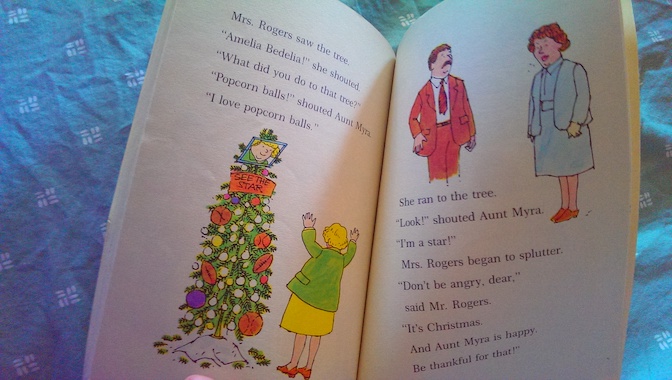
So what will Aunt Myra think of Amelia’s special brand of literal kookiness? Fortunately, she loves the idea of being a star, too. Amelia Bedelia may be aggravating in the way she interprets the instructions given to her, but she’s also endearingly humorous . . . and she bakes a really good spice cake, too.

The book is available to borrow and read for free online through Internet Archive.
Merry Christmas Amelia Bedelia Aunt Myra

Giving Thanks

GivingThanks

Giving Thanks by Kate Waters, 2001.

This book describes the feast of 1621 that we think of as “the first Thanksgiving” from the point of view of two boys: Resolved White (a six-year-old English colonist) and Dancing Moccasins (a fourteen-year-old Wampanoag).  The book explains that the reality of this feast is somewhat different from the way many people think of it.  For one thing, the exact date is unknown, and it wasn’t really a single meal but a kind of harvest celebration that took place over several days.  The events of that celebration were re-created using reenactors from the Plimoth Plantation living history museum.

In the beginning of the book, Dancing Moccasins explains that his family has been harvesting their crops and preparing to move to the place where they live in the winter. Wampanoag lived in different places depending on the time of year, moving between them when the seasons changed.  At their winter home, they would continue hunting and fishing, returning to the place where they planted their crops at the end of winter.

GivingThanksBeginning

Similarly, Resolved’s family has finished harvesting their crops and have stored up food for the winter.  Now that most of the hard work is over, they have time to relax and celebrate.  The community is planning a feast.  Resolved and his friend, Bartle, follow some of the men, who are going out hunting and target-shooting.

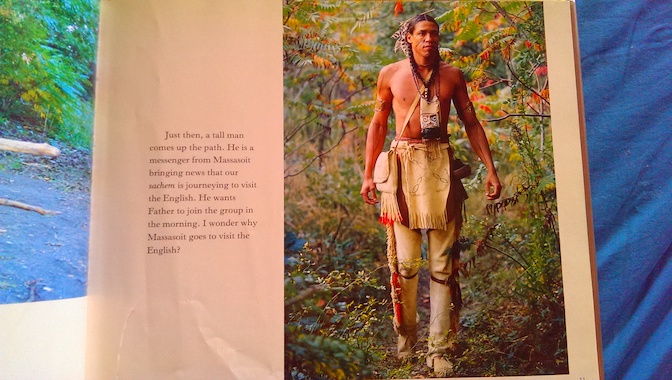
The colonists meet up with some of the Wampanoag, which is how Dancing Moccasins and Resolved first see each other.  Dancing Moccasins returns home and tells his father what he has seen.  Then, a messenger arrives from their chief, Massasoit, saying that he will be visiting the colonists soon, and Dancing Moccasins’s father is invited to come.

GivingThanksMessenger

Just as Dancing Moccasins is wondering about the purpose of this visit, Resolved is wondering the same thing because word has reached the colonists that they will soon be visited by the chief and representatives of the tribe.  (The book explains in the back that the exact reasons for the Wampanoag visit to the colonists are unknown today, only that it happened at the same time that the colonists were planning their harvest feast.) The two boys meet again when Dancing Moccasins accompanies his father on the visit to the colonists’ village.

GivingThanksGovernorDinner

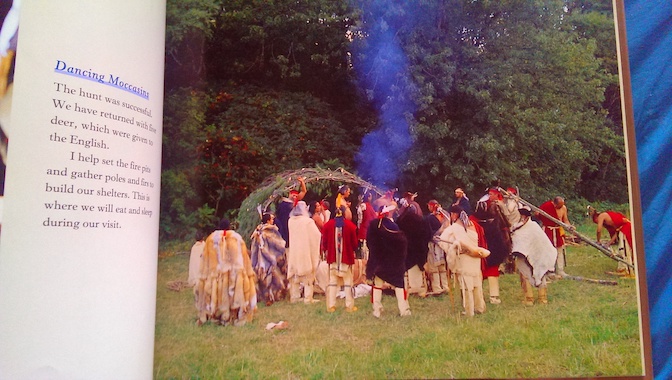
When the Wampanoag arrive at the village, they are treated as honored guests, and some of the Wampanoag go deer-hunting to provide a present for their hosts.  The chief dines with the governor of the colonists.  The Wampanoag build shelters for themselves, where they will stay during their visit.

GivingThanksShelters

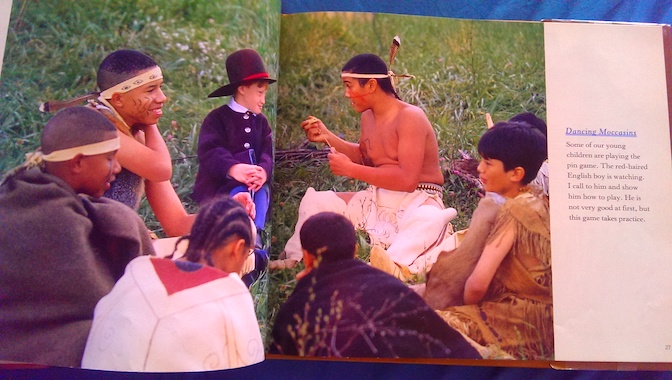
Eventually, Dancing Moccassins invites Resolved to play a game with him and some other Wampanoag boys when he sees him watching them.  Some of the Wampanoag men also join in the games that the English men play, like competing to see who can throw a log the farthest.

GivingThanksGames

At the end of the day, Dancing Moccassins and Resolved each eat with their own families, but there is plenty for everyone.

There is a section in the back with historical information about the harvest feast, traditions about giving thanks among both the colonists and the Wampanoag, and how Thanksgiving eventually became a national holiday in the United States.  There is also information about food and clothing in the time of the story and a recipe for samp (a kind of corn pottage eaten by the Wampanoag and later adopted by the English colonists).  The book also has some information about the Plimoth Plantation living history museum and the reeanctors.  It is part of a series of books by the same author about the lives of children in Colonial America.

The book is available to borrow and read for free online through Internet Archive.

The Best Halloween Ever

BestHalloweenEverThe Best Halloween Ever by Barbara Robinson, 2004.

Every year on Halloween, the Herdmans, who are the wildest, most awful kids in town, run amuck, vandalizing things, stealing, and bullying other kids out of their Halloween candy.  This year, the mayor has decided that he’s had enough of the chaos they cause, so he’s just going to cancel Halloween all together.  Although he doesn’t specifically name the Herdmans as the source of all the Halloween destruction, everyone in town knows that they are.  So, to the shock and dismay of all the other kids, there will be no trick-or-treating this year.

Instead, there will a safe, well-supervised (boring), school Halloween party.  The principal, who always hated Halloween anyway, isn’t happy about it, but admits that it would be better to have a party for the kids at school, with their parents present and helping out, than having them run wild in the streets with the Herdmans on the loose.  But, as every kid knows, running wild in the streets is really the heart of Halloween.  They long for the freedom of roaming the streets without adult supervision, for collecting candy to sort and trade (and, admittedly, lose to the Herdmans eventually), for staying up late, and for the surprises and magic of a real Halloween.

There isn’t going to be anything surprising or magical or even really scary about Halloween at the school.  All the kids already know that the monsters are just their parents and teachers in costume.  The only real benefit that they see to the event is that the Herdmans won’t be there because they say it sounds too boring.  But, with the Herdmans, nothing is ever what anyone would expect, and they not only show up but find a way to turn the event into something that brings back some of the surprises and real Halloween spirit that were missing from a party that was too well-organized and predictable.

Although the Herdmans are a large part of the reason why Halloween is difficult for everyone and the adults try so hard to control it, they manage to redeem themselves a little in the eyes of the other children by taking the events of the night out of the adults’ hands.  Before the other kids know it, strange things start happening at the party with a cat on the loose, worms in the witches’ brew, and children starting to disappear.  As the kids puzzle about these things and wonder where some of the other kids went, things start getting scarier (like they should on Halloween), and they find themselves following mysterious figures through the school in the middle of a black-out with a special surprise waiting for them . . .

I don’t think that this book was quite as good as the others in the series, but it was still fun.  Beth, the narrator, is correct in saying that the well-supervised Halloween party was really more for the adults than the kids.  To the adults, Halloween is kind of a bother, and sometimes, they act like all the kids, not just the Herdmans, get in their way even as they plan the school Halloween party.  At one point, Beth’s mother reminds Alice’s mother that the whole idea of the party is to do something for the children, not the adults.

The adults are so worried about keeping things orderly, safe, and convenient that they become too controlling.  Even on normal Halloweens, some of them have a tendency to overrule the kids on what they want to wear as costumes, with parents often insisting on costumes that are the least amount of bother for them to help with.  Louella’s mother insists that Louella be a pilgrim year after year just because she won a free costume once, even though Louella hates it. Really, what most of the kids like about Halloween is that it is usually a night for them, not the adults.  The kids chafe as the adults insist that they go to their orderly Halloween party and like it.  In real life, most adults know that forced fun isn’t really fun at all.

In the end, the Herdmans return all the candy that they had taken from the other kids over the last Halloweens.  Although the other kids find the Herdmans’ secret candy stash a treasure trove, much of the candy is stale.  They can eat some of it (which grosses me out, considering how old it probably is), and they have fun sorting and counting the rest.  But, the best treat for the kids was adding a sense of unpredictability and suspense to the night to bring back the real Halloween feeling.

The book is currently available online through Internet Archive.

Halloween Treats

HalloweenTreats

Halloween Treats by Carolyn Haywood, 1981.

This is a collection of short stories with the usual Haywood characters as they celebrate Halloween.  These stories have a tone that’s more like Halloween of the 1950s than the 1980s, when they were written.  In this neighborhood, everyone seems to know each other, and parents are unafraid to let even young children go out on Halloween without an adult along.  It isn’t even a problem when older children invite young trick-or-treaters into their Halloween party on a whim to participate in bobbing for apples.

The book is currently available online through Internet Archive.
Stories in the Book:

HalloweenTreatsPic1The Witch and the Balloon

Katie and Mark, a set of twins, believe that the old woman who lives next door is a witch.  She has a black cat and just seems odd, banging on the wall whenever she thinks the twins are being too noisy.  But, one Halloween, when they hear banging on the wall in the middle of the night, they realize that she needs help.

Anna Patricia’s Costume

Anna Patricia loves Halloween, and she especially loves planning new costumes.  By the time Halloween actually comes, she’s changed her mind about her costume many times over.  However, there is still one change more because a surprise invitation to a Halloween party while trick-or-treating causes her to change costumes once more.

The Two Halloween Bears

Penny (a boy) and Patsy (a girl) are best friends, and they have identical teddy bears.  On Halloween, the two of them think it would be fun to wear identical bear costumes to look like their teddy bears, but they’re so much alike, even their mother have trouble telling them apart.

HalloweenTreatsPic2Monkey Business

After Eddie buys an old grind organ at a second hand shop, he realizes that he has the basis for a great Halloween costume: he’ll be an organ grinder with a dancing monkey.  He manages to persuade the girl next door to dress up as his monkey, but the long tail on her costume causes them problems.

Trick or Treat

Eddie likes old Mr. Timkin, a retired sailor, but when Mr. Timkin forgets that it’s Halloween and has no treats for the kids, they feel obligated to play a prank on him. Eddie only hopes that Mr. Timkin won’t be too mad.

Billy’s Halloween Party

When Billy holds a Halloween party only for kids in his grade at school, the younger children in the neighborhood feel left out.  Eddie recruits Betsy’s younger sister and her friend to help him play a prank on the older kids that makes the party more memorable for everyone.

HalloweenTreatsPic3Jonathan and the Jack-o’-Lantern

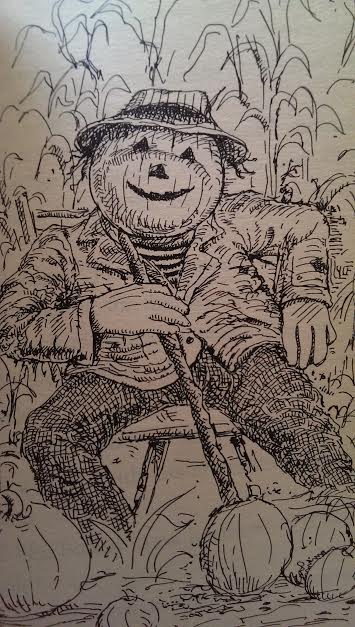
Jonathan’s family has moved from the city to the country, and he’s excited that he can see all the pumpkins growing before Halloween.  Then, some dummies with jack-o’-lantern heads give him the idea for the best costume to wear for the Halloween parade.

Who Scared Who?

Donald and Ronald, another young set of twins, are fascinated by the scary Halloween masks in the stores.  Even though the masks scare them, they think it would be funny if they could buy some really ugly masks to scare the neighborhood policemen.  However, the policemen also think it would be fun to give some of the neighborhood kids a fright.

Pennies for UNICEF

There is a contest for children collecting pennies for UNICEF.  The child who collects the most will win a trip to New York to visit the UN.  As an avid coin collector, Eddie is eager to win the contest, and he makes a special discovery among the coins that he collected on Halloween night.