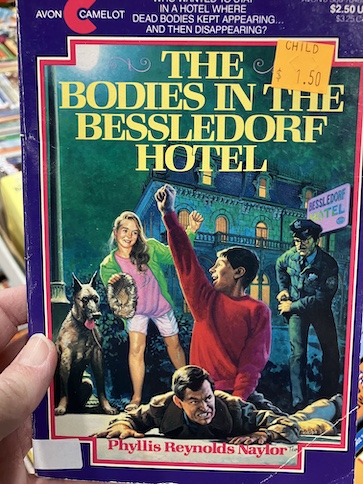
The Bodies in the Bessledorf Hotel by Phyllis Reynolds Naylor, 1986.
Officer Feeney is the first person who suggests that, someday, there might be a dead body at the Bessledorf Hotel. The hotel is coincidentally located next to the local funeral parlor, which is why the subject of dead bodies comes up, and Officer Feeney has a way of suggesting frightening things that scare Bernie Magruder, son of the hotel’s manager. Officer Feeney’s reasoning is that most people die in bed, so it only makes sense that some of them would be hotel beds. The hotel has 30 rooms, and with people coming and going, it’s surely just a matter of time before a guest dies there. It’s a morbid thought, although Bernie reasons that Officer Feeney is overestimating the number of people who pass through the hotel because it isn’t always full and some of the guests are long-term residents.
Still, Bernie gets a shock after he returns to the hotel, and the cleaning lady, Hildegarde bursts in on him and his parents, hysterical about finding a body in a bathtub of Room 107 with all his clothes on. Bernie’s father tells his wife to call Officer Feeney to write a report of the death and considers whether they can remove the body secretly, perhaps in a laundry cart, to avoid bad publicity for the hotel. Unfortunately, some of their guests already heard Hildegarde screaming about a dead body, so word is out. They want to know if it’s a case of murder or suicide and how it’s being investigated, and one of the long-term guests, who is a poet, has already written a short poem for the occasion.
However, by the time they all get to the room where Hildegarde saw the body, it’s gone. There is nothing in the bathtub, not even water. Officer Feeney shows up and demands to know what’s going on, and Hildegarde insists that she really saw something. The Magruders believe her, but they have no explanation for where the body could have gone. The guests speculate about body-snatchers and ghosts.
All they know about the man who occupied that room is that he gave his name as Phillip A. Gusset, he checked in the evening before, and he said that he would be leaving the next morning. Officer Feeney asks them if there was anything odd about him, like if he seemed nervous or unwell. Nobody remembers anything like that. They remember that he had a mustache and a hat with a red feather and just a single bag with him. He did kind of make Bernie’s parents uneasy, and he seemed to have a strange scent about him, although they find it difficult to describe what it actually smelled like. Officer Feeney says that, without a body or any evidence that something has happened, there doesn’t seem like anything to investigate. Bernie’s father is relieved that there won’t be any report of a murder or death occurring at the hotel because, otherwise, the owner might fire him. Bernie remembers that the man’s slippers were still in the room and goes to get them in case they’re evidence. When he gets there, he discovers that the slippers have mysteriously disappeared.
Bernie’s friends, Weasel and Georgene, think that people will probably never want to rent that hotel room ever again, and Bernie’s father renumbers the rooms so there will be no Room 107. Weasel convinces Bernie and Georgene to help him search the area for the body, thinking that whoever took it would most likely want to dispose of it quickly. They search down by the river, but they only find a bag of garbage that Bernie’s younger brother, Lester, left there to trick them.
Even though there’s no evidence that anything happened and the police aren’t investigating the situation, the incident of the disappearing guest appears in a newspaper in Indianapolis, where the hotel owner, Mr. Fairchild, lives. Mr. Fairchild calls the hotel to demand to know what’s going on. Mr. Fairchild says that he want the hotel to put on live entertainment in the evening on weekends to draw attention away from the incident and bring people in. However, he expects Bernie’s father to hire the entertainment out of his own money since Mr. Fairchild thinks this situation is his fault, and most entertainment is out of the Magruders’ price range. Fortunately, Bernie’s father has joined a barbershop quartet, so his group can do their singing at the hotel.
The singing goes well, but a strange woman with orange hair checks into the hotel and keeps making comments about dead bodies there. Then, one of the waiters finds this woman dead in her room, Room 321. Just like the first body, this body also vanishes. By this time, Bernie’s father suspects that the woman faked her “death” just to scare the waiter and ran away as soon as he was gone. As Bernie’s parents investigate the room, they notice an odd smell that reminds them of the first guest who disappeared. The smell really unnerves his father, but strangely, not his mother. It’s a faint smell that’s difficult to identify, but it conjures different images for both of them. Bernie’s father says it reminds him of sweaty clothes, cigars, and pastrami, while his mother says it makes her think of flowers and a porch swing in the evening.
The Magruders aren’t sure why someone wants to fake deaths at the hotel, but this latest faker didn’t pay for either her room or dinner, and somehow, the newspaper has heard about it and reported it again. Mr. Fairchild is angry, and Bernie knows that they need to figure out who the prankster is before they do it again!
The book is part of the Bessledorf mystery series, also known as the Bernie Magruder series. It is available to borrow and read for free online through Internet Archive (multiple copies).
My Reaction
Attempts to investigate the mystery alternate with the Magruders’ attempts at cheap hotel entertainment. The barbershop quartet works until one of the members gets laryngitis. Some of the guests start a food fight when the entertainment is bad. Then, Joseph gets some of his friends from the veterinary college who play instruments to come. Personally, I like the part where Lester suggests that they hold a haunted house at the hotel and take people on tours of the rooms where “dead” bodies have been found. They reject that idea, but there are hotels and bed-and-breakfasts that give haunted tours, and people come to investigate ghosts. That actually can be a successful gimmick. I once intentionally stayed in a supposedly haunted hospital that had been turned into a hotel in an old western mining town. A possible murder once occurred there, but I enjoyed the visit.
When a new guest shows up at the hotel with that same, strange scent, Bernie knows that it’s their culprit, back again in another disguise. Now that he knows who to watch, he starts planning how they’re going to trap the person.
I had a couple of ideas in beginning about who was doing all of this and why, but there are some surprising twists in the story. Bernie’s first attempt to catch the villain is weirdly thwarted by the discovery of a dead body that is actually a real, dead person. It’s not a guest; it’s a body stolen from the funeral parlor next door. The bad guy decided to change his tactics.
One of the clues to the person’s identity is that mysterious smell and the way it has an opposite effect on Bernie’s parents. It irritates Bernie’s father but makes his mother feel strangely nostalgic. The truth is that they’re both remembering the same thing or the same person, but although they can’t remember right away exactly what they’re remembering, they have very different feelings about it.
Surprisingly, although Mr. Fairchild threatens to replace Mr. Magruder with another manager, he actually shows up at the hotel himself and discovers that he likes playing detective and figuring out what’s going on. He’s also impressed with the way Mr. Magruder stayed to finish managing things even after he told him that he was planning to hire someone to replace him, and that secures the family’s position.
Mrs. Piggle-Wiggle by Betty MacDonald, 1947, 1957, 1975, 1987.
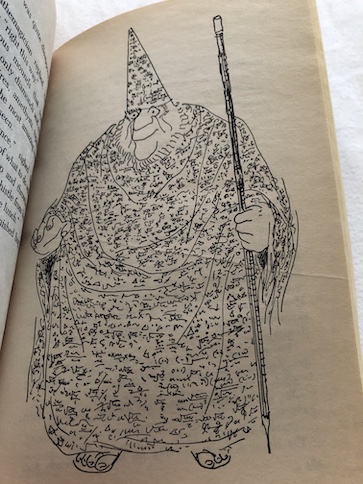
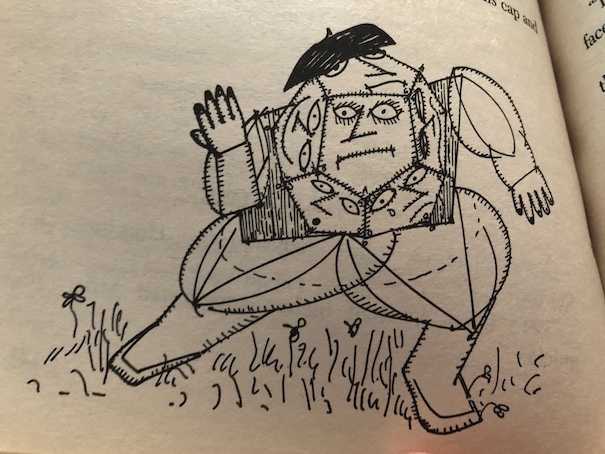
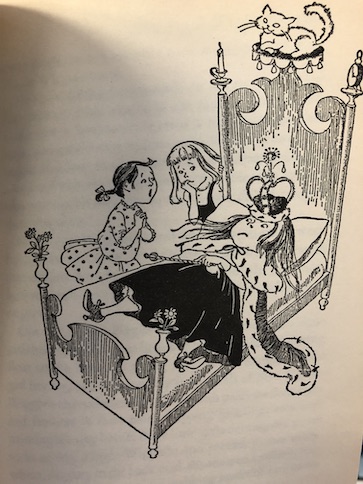
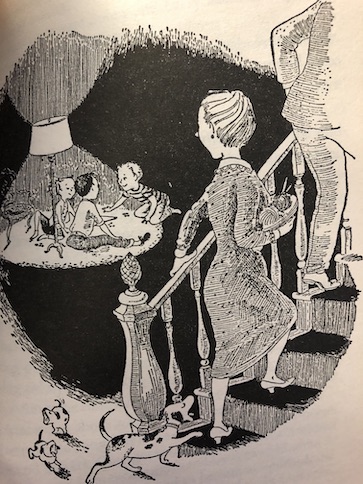
This book has been printed and reprinted many times over the decades. The edition that I used for this review is the same one that I read when I was in elementary school, printed in the 1980s. One of the reasons why the edition matters is that the illustrations were different in the first printings in the book. In 1957, the illustrations were replaced by the ones you see here, which continued to be used in later printings.
Mrs. Piggle-Wiggle is a widow who lives in an upside-down house. Her husband was a pirate, and she has magical cures for the bad habits of the children who live in her neighborhood. Sometimes, she doesn’t need magic for a particular child’s bad habit, just using psychology. Sometimes, certain behaviors, like staying up all night instead of going to bed, are their own punishment, and Mrs. Piggle-Wiggle advises the parents to let the children do them for a certain period of time so they can find out for themselves why these things are a bad idea, usually with very funny results. This book is the first book in the series, and it particularly uses more psychology than magic.
As an adult, I actually prefer the psychological cures to the magical ones. These stories are meant to be humorous rather than practical, and because of that, they’re not realistic. First, they never really go into the psychological reasons why some of these kids do the things they do, like becoming over-protective of their belongings or suddenly becoming afraid of taking baths. Then, when children suffer the consequences of their misbehavior, the consequences are humorous and exaggerated, like the boy whose room gets so messy that he actually traps himself inside until he decides to clean up and the girl who gets so dirty that her parents can grow radishes on her. However, the fact that there are consequences for the children’s behavior is a useful touch of realism. It gives parents or teachers the opportunity to talk to kids about what they expect would happen if they actually did any of the things kids do in the stories and think about some of the consequences of their own actions. These are stories that can make kids chuckle and then make them think.
I think it’s important to point out that Mrs. Piggle-Wiggle never actually blames the children for their bad behavior, seeing it more as an affliction that they need to be cured from. She likes all children in spite of their bad habits and bad behavior (something I admit that I find hard to do with people in real life), and she wants to cure them of their problems so that other people will see how likeable they are underneath. Even though Mrs. Piggle-Wiggle likes the children, she doesn’t spare them from the consequences of their actions because that is part of the cure that the children need to become the best versions of themselves. Sometimes, the consequences are the cure by themselves, and those are the stories I like best. After all, what makes bad habits “bad” is that they have bad consequences to them. They cause problems, both for the person behaving badly and others. Maybe, sometimes, people need to see the problems for themselves and experience the consequences directly before they find the motivation to fix their behavior. I can believe that part of these stories is realistic. The rest of it is just for fun.
The Mrs. Piggle-Wiggle books are collections of short stories, and each one focuses on a different child or set of children, their particular problems or bad habits, and Mrs. Piggle-Wiggle’s solutions for them.
The book is available to borrow and read for free online through Internet Archive (multiple copies).
The Stories in this Book:
Mrs. Piggle-Wiggle, Herself
This section of the book introduces and describes Mrs. Piggle-Wiggle. She is a small woman with a hump on her back, which she says contains magic. (The hump isn’t really shown in the pictures of her in the book, but she’s supposed to have one.) She has very long brown hair, which she usually wears up, but sometimes, she lets it down so that children can comb and braid it or style it in different ways. Her eyes are also brown, and her skin is described as being a “goldy brown.” (Her racial identity is not specified because it’s not important to the stories. The pictures show her as being white, so maybe she just has a tan, but I find the written description interesting because it could leave the character open to different interpretations and playable by different types of actors. Her description could fit quite a lot of people, really.) She wears brown clothing (although that’s not how she’s shown in the pictures) and smells like sugar cookies. She claims not to know her own age, saying that it doesn’t matter, since she’ll never get any bigger than she is now.
Mrs. Piggle-Wiggle is a widow, and she tells the children that her husband was a pirate who buried treasure in the back yard before he died. She has no children of her own, but she loves all the neighborhood children, and she frequently looks after them and has them come over to play. She doesn’t often speak to the children’s parents because she gets nervous around adults. She also has a dog named Wag and a cat named Lightfoot.
Mrs. Piggle-Wiggle lives in a little brown house that is upside down. She says that her house is upside down because, when she was a little girl, she used to look up at the ceiling when she was in bed and wonder what it would be like to walk on the ceiling, so when she grew up, she purposely built her house upside down just to find out. The only parts of the house that are normal are the kitchen, the bathroom, and the stairs because none of them would work properly if they were upside down.
When I was a kid, I thought that the upside-down house was the best part of the stories. When people walk around inside it, they have to step over the sills of the doorways because what should be the tops of doors are not flush with the ceiling the way the bottoms are flush with the floor, and these doorways are upside down. Mrs. Piggle-Wiggle put little steps into and out of doorways to help with that, but kids like to jump the doorways as a challenge. Mrs. Piggle-Wiggle lets them make chalk marks to record the lengths of their jumps. Also, because the ceilings are now the floors, the chandelier is on the floor of the living room, shining upward instead of down, and kids sit around it like it’s a camp fire. The children can also use the slanting ceiling-floors of the house as slides.
Most of this part of the book is backstory for Mrs. Piggle-Wiggle, but it explains that the first neighborhood child she made friends with was a girl named Mary Lou, who was running away from home because she hated doing the dishes so much. Seeing Mary Lou going down the sidewalk in the rain with her suitcase, Mrs. Piggle-Wiggle invited her in for tea and cookies, and Mary Lou told her about her problems. Mrs. Piggle-Wiggle tells Mary Lou that she really likes washing dishes because it’s fun to pretend that she’s a beautiful princess who was captured by an evil witch who makes her do all the cleaning and that the only way she can escape is to have everything clean by the time the clock strikes. Mrs. Piggle-Wiggle draws Mary Lou into a game of pretend, where they both pretend that they’re cleaning the kitchen for the evil witch. Then, Mrs. Piggle-Wiggle puts on her witch’s costume, pretending to be the witch, inspecting the kitchen to make sure that it’s clean.
It’s so much fun that Mary Lou gets over hating washing the dishes. When she tells her parents about Mrs. Piggle-Wiggle, they let her spend time with Mrs. Piggle-Wiggle, and she brings her friend, Kitty, to visit when Kitty says that she hates making the beds at her house. Mrs. Piggle-Wiggle plays a similar game of pretend with Kitty and Mary Lou, where they pretend that they are making beds for a cruel queen who will throw them in the dungeon if the sheets are wrinkled.
Gradually, Mary Lou and Kitty start bringing their siblings and other friends to see Mrs. Piggle-Wiggle, and Mrs. Piggle-Wiggle gets to know all of the children in the neighborhood. She shows them how to make chores fun, teaches them to do things like bake cookies and pies, and lets them dig for pirate treasure in the backyard. Because she is so good with children, parents in the neighborhood call her to ask for help and advice when they’re having problems with their kids.
The Won’t-Pick-Up-Toys Cure
Hubert Prentiss’s grandfather gives him many wonderful toys, but Hubert doesn’t like putting them away. It’s very difficult to get around his room, and the problem gets worse all the time. Hubert’s mother tries asking other mothers what they do with their children, but they either don’t have the same problem or don’t know what to do. Then, one of them suggests asking Mrs. Piggle-Wiggle because she’s so good with children. Mrs. Piggle-Wiggle has met Hubert before because he’s come to her house with the other children.
Mrs. Piggle-Wiggle suggests that Hubert’s mother let Hubert make his room messy and that she not try to pick up after him or even enter his room. Then, when the room gets to the point that it’s difficult for Hubert himself to even go in or out, to give her a call. After a week, Hubert’s room is so bad that he can’t open his bedroom door and can’t even use his bed. His mother has to feed him through his bedroom window. Even though she’s only able to give him things like peanut butter sandwiches through the window and Hubert doesn’t have anywhere comfortable to sleep anymore, he’s still not motivated enough to leave his room and put away all his toys. However, Mrs. Piggle-Wiggle has a plan to motivate Hubert enough that he’s willing to finally clean his room just to get out.
The Answer-Backer Cure
When Mary O’Toole’s teacher picks her to stay in at recess and help clean up the classroom, Mary is so irritated that she tells the teacher to do it herself and to let her go play with the other kids. Her mother tells her that was a rude thing to say to her teacher, but it’s just the beginning of Mary’s bad habit of being rude and impudent to people. Mary thinks that it makes her look smart to contradict people, and her new responses to any order or request her parents and teacher make are “Why should I?” and “I’ll do it because I want to but not because you tell me to.” (Nobody but you cares why you do it, kiddo. They just want it done because they just want to get through the day and accomplish things. You can either be the one who makes that easier or the one who makes that harder or more unpleasant, but things are still going to need to be done either way.)
Mary’s mother goes through the usual routine of calling other mothers for their opinions, and one of them suggests talking to Mrs. Piggle-Wiggle. Mrs. Piggle-Wiggle’s solution is to let Mary keep her parrot, Penelope for awhile. Penelope is as rude as Mary is and repeats many of the things that Mary herself says. At first, Mary thinks it’s funny, but gradually, she begins to see how annoying it is and realizes how she sounds when she talks that way. Her dad actually laughs when he hears how much the parrot sounds like Mary, which makes Mary mad. Penelope also uses remarks that Mary thought that she’d made up herself, but she says them before Mary actually said them around her, making Mary realize that she’s not even as clever and original as she thought she was. When she sees how annoying it is to be around someone as rude and negative as she was, Mary apologizes to her teacher and gives it up.
(Actually, I know a lot of adults who talk just like Mary – “I’ll do it because I want to but not because you tell me to.” If they don’t use those exact words, it’s solidly the exact same attitude. They say they do it specifically because they’re adults and nobody should be telling them what to do under any circumstances, even if it’s something important. For them, it’s a kneejerk reaction to being told something, anything, no matter the circumstances and with little thought or attention to what they’re being told and whether it’s actually worthwhile. I always think of this story whenever I hear them talking that way.)
The Selfishness Cure
Dick Thompson is selfish and greedy. It’s no fun for other kids to come play at his house because he won’t share any of his toys or let anybody touch anything that belongs to him. It’s always “MY” this and “MY” that and everything is “MINE!” Dick’s mother realizes that something must be done when she gives Dick a box of peppermint sticks specifically to share with other kids in order to teach him how to share, and he actually hits Mary O’Toole on the hand with his baseball bat for trying to take one.
When Dick’s mother calls his father at work and asks him what they should do, the father’s first suggestion is a good, hard spanking because that’s something Dick can keep all to himself, but the mother is upset at the idea of more physical violence. The father then suggests that she talk to Mrs. Piggle-Wiggle because she’s helped other children in the neighborhood.
Mrs. Piggle-Wiggle’s Selfishness Cure is her special Selfishness Kit. It contains a variety of padlocks that Dick can use to lock up his stuff. It also has labels and paint that Dick can use to label all of his stuff, and it even has a pastry bag for labeling Dick’s food as his with frosting. The idea is to indulge Dick’s desire to prevent anyone from touching anything that belongs to him until it becomes so much of a hassle that he decides that it’s too much trouble.
At first, Dick is really happy that he can label everything he owns with his name and write “DON’T TOUCH!” on it, but as predicted, it turns out to be a big problem. Because Dick has everything, including his lunch, marked with his name and “DON’T TOUCH”, it isn’t long before everyone at school knows and is laughing at him. Plus, as my mother says, “With some kids, you can tell them not to touch something, and they won’t touch it, but there are also kids who, when you tell them not to touch something, just can’t wait to touch it.”
The Radish Cure
Patsy is a perfectly ordinary girl, but one day, she suddenly decides that she hates baths and refuses to take another one. There is no explanation why, and none of the other mothers in the neighborhood seem to be having that problem with their children, but Mrs. Piggle-Wiggle has a solution.
Mrs. Piggle-Wiggle tells Patsy’s mother to led her go several weeks without washing at all, letting her get as dirty as she wants. Then, she should get a packet of small radish seeds and plant them on Patsy. When Pasty sees that she’s sprouting radishes, she suddenly decides that she’s ready for a bath.
The Never-Want-To-Go-To-Bedders Cure
The three children in the Gray family never like going to bed. Every night, when it’s time for bed, they beg to be allowed to stay up a little later and insist that nobody else in the neighborhood goes to bed as early as they do. It often takes about an hour of whining, complaining, and arguing before their parents are able to get them to bed.
Mrs. Gray goes through the usual routine of asking other parents if they have this problem with their children, but none of her friends do, so she asks Mrs. Piggle-Wiggle what to do.
Mrs. Piggle-Wiggle’s advice is to let the children stay up as late as they want to. Mrs. Gray worries that not getting enough sleep will be bad for the children’s health, but Mrs. Piggle-Wiggle says that a day or two with less sleep won’t make much of a difference, and by that time, they’ll realize why going to bed at night is a good idea.
The Gray children think it’s great at first that their parents no longer tell them to go to bed and even let them stay up half the night, but soon, they’re falling asleep in the middle of the day, missing movies that they go to see when they fall asleep in the theater and missing out on fun activities with other kids either because they’re asleep or too tired to enjoy them.
The Slow-Eater-Tiny-Bite-Taker Cure
A boy named Allen has suddenly become obsessed with eating his food very slowly, taking super-tiny bites. It’s a very odd habit, and it makes meal times difficult because he eats very little and take a very long time to do it. I’d be worried if he was having difficulty swallowing, but his mother calls Mrs. Piggle-Wiggle.
Mrs. Piggle-Wiggle gives his mother sets of dishes in different sizes, from fairly large to ridiculously tiny. At each meal, Allen’s mother uses progressively smaller dishes. Allen is fascinated by the tiny dishes, which fit his new dainty eating, but he’s getting weaker because he’s been hardly eating anything.
I actually found the descriptions of his weakness a little alarming, but his mother then reverses the order of the dishes she gives him, starting with the smallest and then moving to the biggest. As Allen realizes that he feels better when he starts eating more food, his appetite returns, and he gets his strength back.
The Fighter-Quarrelers Cure
Twins Joan and Anne Russell have been fighting with each other a lot, and it’s driving their parents crazy. The twins argue with each other over everything, like who is wearing whose clothing and who had more bacon or the biggest slice of melon on their plate at breakfast, and they even pinch and slap each other. Sibling quarrels are pretty common, but Mrs. Russell asks Mrs. Piggle-Wiggle if there’s anything they can do to end this constant fighting.
Mrs. Piggle-Wiggle advises the girls’ parents to make notes about the types of petty things that the girls argue about and spend a day having staged arguments of their own in front of the girls to show them what it’s like to be around that type of arguing all the time.
From the moment they wake up the next day, the twins suddenly find themselves in the awkward position of trying to reason with their parents and referee their quarrels as they become witnesses to the same kinds of petty behavior they’ve been doing themselves. Finally, the girls have had their fill of fighting, and with their petty quarrels now in perspective, the entire family promises each other that they won’t fight like that again.
The Lancelot Closes at Five by Marjorie Weinman Sharmat, 1976.
“Camelot” is the name of a new housing development being built in Shady Landing, New York. In the beginning of the story, Camelot has only three model homes, demonstrating what the houses in this new neighborhood are going to look like. In keeping with the Arthurian theme, the three model homes are called “the Excalibur”, “the Lancelot”, and “the Guinevere.” Abby’s family decides that they will buy a house there on the Excalibur model because they are tired of their crowded apartment in Brooklyn and Abby’s parents think that buying a house sounds like a good investment for future.
The move isn’t easy for Abby and her family. Abby doesn’t like leaving her old friends behind. There are several things wrong with the new house, including windows that are nailed shut, doorknobs that fall off, and a flooded basement. Also, the people who live in the village of Shady Landing don’t like the newcomers because trees were cut down to build Camelot.
However, Abby soon finds a friend, Heather Hutchins, who likes to be called “Hutch.” Hutch also lives in the new Camelot neighborhood. Hutch’s family is very health-conscious, believing in all-natural foods, which is why Abby doesn’t usually like to eat at their house, and Hutch’s mother is a very competitive person.
Then, Hutch springs a surprise on Abby. Hutch tells Abby that she wants to run away from home. She doesn’t want to be gone for long, just about day during the Memorial Day weekend. She doesn’t want to go far, planning to spend a night in the Lancelot model home. But, she wants Abby to come with her so she won’t be alone.
At first, Abby is a little reluctant, but Hutch is very persuasive, the idea does seem like a fun adventure, and hiding out secretly so close to home doesn’t seem too dangerous. In fact, since the public is invited to come and walk through the model homes, it doesn’t even seem like trespassing. Abby agrees to do it. The girls’ plan is to tell their families that they’re spending the night with each other but conveniently not mention where so they’ll assume that they’re just having a normal sleepover at each other’s house. Then, they plan to visit the Lancelot and hide there until it closes and all the other people leave.
When she proposes her plan, Hutch doesn’t explain her motives for wanting to run away for a day, and Abby decides not to question her, thinking that Hutch will tell her when she’s ready. She does note that Hutch doesn’t seem to get along well with her mother. Hutch’s mother doesn’t seem to connect well with other people in general, being more focused on what she wants them to do than on just acknowledging them or building relationships with them. Worse still, Hutch’s mother is what Abby calls a “scorecard mother,” always comparing her child to everyone else’s child, constantly keeping track of where Hutch is ahead and where she’s behind. Hutch’s mother has overly high expectations of Hutch and pushes for perfection. Hutch’s mother sometimes quizzes Abby about what she does to help out at home and how each of the girls are doing in school so she can compare them. Abby sometimes feels like she’s in the uncomfortable position of defending Hutch to her own mother.
The Lancelot model home is decorated in a fakey pseudo-Medieval style, in keeping with the Camelot theme. When Abby and Hutch sneak in, they pretend to be part of a family group touring the house and then hide under a bed until everyone else leaves. Their plan works, but staying in the house isn’t quite what Abby imagined it would be. The furniture is uncomfortable because it’s made to be looked at and not actually used. Not all of the appliances even work, like the tv, because they’re just for show and not for using. For their “supper”, Hutch has brought candy bars and pastries, things which her mother normally forbids her to have because they aren’t natural and will rot her teeth. Abby still can’t have some of them because she has food allergies and braces, but Hutch brings pound cake for her.
Hutch finally admits to Abby that her main reason for wanting to have this adventure is just to have the chance to do something for no other reason than she just wants to do it. Abby is right about Hutch’s mother. Everything that she wants Hutch to do is centered around gaining something – recognition, awards, physical health benefits, learning things and getting a mental edge. Hutch just wanted the chance to do something without a particular motive other than just wanting to do it and the fun of planning it out and pulling it off by herself, with the help of her friend.
Unfortunately, Hutch gets carried away with the success of her plan and turns on the lights, which attracts the attention of a passing police car, although the police just try the doors, decide that the lights were left on by accident, and leave without finding the girls. Then, Hutch doesn’t want to go to sleep and stays up, eating candy bars in bed, just because she’s normally not allowed to do that. Abby is uncomfortable in the big, fancy bed that isn’t meant to be slept in and can’t sleep, so she leaves and goes home, making Hutch mad. Abby spends the rest of the night sleeping in her sleeping bag in her family’s basement (which is no longer flooded) so she won’t give away Hutch’s secret.
Later, Abby feels guilty about abandoning Hutch, so she sneaks out early in the morning to check on her. Hutch got out of the Lancelot without being noticed, but she’s still mad at Abby for leaving her when she was trying to do something that was important to her. However, there is worse to come. The police hadn’t forgotten about something strange happening at the model home that night, and now, there’s a rumor in the neighborhood that the house was “vandalized” during the night (meaning the mess that the girls left in the house from the food they ate, trying to sleep in the bed, and using the bathroom). Abby is naturally a more timid person than Hutch, and while she has started to appreciate Hutch’s attempts to help her be more bold and take more chances, it makes her nervous that she and Hutch are the “vandals” whose escapades have now made the local paper. Abby’s father, an author, is even attempting his own investigation into the matter.
Abby is not only worried about repairing her friendship with Hutch but not getting found out for what they did. Then, one of the boys at school starts bragging, claiming that he and his friend were the ones who snuck into the Lancelot to hang out that night. He’s not the only one trying to claim credit for the stunt, either. Abby hopes that the whole thing will just die down and be forgotten, but Hutch doesn’t feel the same way. Even though she originally set out to do something just on a whim without looking for recognition, the idea that someone else might claim recognition for what she did galls her. What will happen when Hutch tries to reveal her role in masterminding the night in the Lancelot?
I purposely sought this book out online because I never owned a copy and I remembered it from when I was in elementary school, but the funny thing is that I don’t remember ever hearing the entire story when I was a kid. I think that my class might have just read a selection from the book, maybe as part of one of those story collections that has excerpts from books to demonstrate certain concepts and give samples of stories. I can’t quite remember now. All I remembered was that the main escapade was just a part of the story that took place at the beginning of the book, and the rest was about what happened because of the girls’ secret nighttime excursion. It makes the book a bit different from other children’s books about kids running away and hiding in usual locations, like From the Mixed-Up Files of Mrs. Basil E. Frankweiler, where most of thebook takes place during the kids’ adventure and the kids’ parents are barely seen. In this book, the girls are mostly at their own homes, and the parents have prominent roles.
Runaways generally have two motives – getting away from something or going in search of something, and when you really think about it, they frequently have both. Hutch’s adventure is both about escaping from her mother’s oppressive rules and emphasis on perfection as well as undertaking something unusual and pulling it off for the sense of personal achievement. However, even though Hutch at first insists that she wanted to do it just for the sake of doing something that she wants, with no expectation of recognition or reward, it turns out that isn’t completely true. Part of the reason why she wanted Abby along was to get a sense of recognition from her for the accomplishment as well as her company. Her bad feelings toward Abby for abandoning their adventure and going home were partly because Abby didn’t value that type of uncomfortable adventure as much as she did and didn’t fully acknowledge the cleverness of her plan. Even if it started out as just a fun escapade, undertaken as a brief chance to break a few rules in secret, Hutch badly craves acknowledgement, just not in the form of the constant comparisons he mother makes between her and other people. What Hutch really needs is just to be acknowledged for being herself and to feel valued, no matter how she compares to others. In her attempt to make things right with Hutch again, Abby does something that she never thought that she would ever be bold enough to do: give Hutch’s mother a piece of her mind.
The book is available to borrow and read for free online through Internet Archive.
The Son of the Slime Who Ate Cleveland by Marjorie Weinman Sharmat, 1985.
Frank is the first to admit that he’s a bit eccentric and that his mind doesn’t quite work like other kids’. He’s a bit more imaginative, more daring. When he thinks of something, he can’t resist doing it, even pulling pranks on his best friends, Jack and Lee. He sees it as a way of expressing himself, and he wants to go into show business someday.
One day, the boys spot a jelly bean counting contest at the mall. The prize is two tickets to a move called Monster Mayhem and all the jelly beans they can eat in two hours. Frank isn’t really interested in counting contests. Jack and Lee, who have ambitions to go into law and banking, are more interested in counting things and competing with each other. Jack and Lee both come up with the exact same number of jelly beans that they think are in the jar, and they start arguing about which of them came up with the estimate first. Frank can’t decide which of them was first, so he just tells them that they’re both wrong and guesses his own random number without even trying to count the jelly beans. All three of them enter the contest.
That could have been the end of it, but Frank can’t resist telling other people about the contest. Not only does he tell them that he and his friends have entered the contest, but he tells them the exact number that Jack and Lee both guessed.
A classmate, Bianca, invites everyone to a party at her house where everyone has to come dressed as their favorite monster. Her parents are also there, dressed as Mr. and Mrs. Slime Who Ate Cleveland. Bianca’s parents are both psychologists, and they think it’s emotionally healthy for kids to expend their energies and go wild at parties, so they’re very permissive with Bianca and her friends. At the party, Bianca’s father takes an interest in Frank, calling him “son” (hence the name of the book) and telling him that he should mingle more with the other kids and be less of a loner. He offers to help Frank with vocational counseling for his future, which Frank is not eager to accept from a guy who is currently dressed as a Slime Who Ate Cleveland and who actively encourages the kids to have a potato sack race in the living room. Frank thinks an indoor potato sack race sounds crazy, Jack thinks it sounds dumb, but Lee is all for it. When Jack and Lee argue about the potato sack race, Bianca brings up the story that Frank told her earlier about the jelly bean counting contest and the boys’ argument over which of them guessed the answer first, putting it to a vote among the party guests. Lee wins the vote (which doesn’t mean much since the other party guests weren’t even there when they made their guesses), and Bianca switches her attentions from her current crush, Jack, to Lee (who doesn’t want Bianca’s attentions and becomes afraid to answer the phone when she keeps calling him).
Jack and Lee both get irritated with Frank for turning the jelly bean counting contest into a big deal and ask him to stop telling people about it because neither of them really even expects to win. However, the incident doesn’t even stop there, because it turns out that both Jack and Lee are declared the winners of the contest because their identical guesses are the closest to the real answer. The contest judges decide to award the prize jointly to the two of them – a movie ticket each and all the jelly beans that each of them could eat in an hour.
Sharing the prize could have resolved the incident, but Jack and Lee still have a competitive streak. Even though Frank congratulates them both as winners, Jack and Lee still argue about which of them is the “real” winner for coming up with the answer first. Frank tries to point out that each of them really only needs one movie ticket anyway, so what difference does it make if the other friend gets the other one? That doesn’t do any good, though. Jack and Lee both want to be acknowledged as the “real” winner, and thanks to the vote at Bianca’s party, other kids at school are taking sides to support their votes.
The entire jelly bean counting situation has gotten completely out of control! Jack and Lee won’t stop arguing with each other about who really won the contest, and both of them are mad at Frank for spreading the word about it and turning it into a bigger deal than it had to be. Frank needs to find a way to solve the argument and reconcile with his two best friends. Meanwhile, Bianca’s father, Mr. Wasserman, keeps calling Frank “son” and trying to talk to him about his vocational future, which makes Frank feel as green as the Son of the Slime Who Ate Cleveland.
Just when Frank thinks he’s got everything solved, a new contest threatens to set Jack and Lee against each other again. Frank tries one more outlandish scheme that exposes Jack and Lee’s arguments to an even wider audience than before. It takes some sincere friendship from Bianca, some words that actually make sense from her mother, and some “perfectly frank” talk from Jack and Lee to help Frank to recognize how his own behavior has contributed to the problems and how his friends really feel about some of the things he’s said and done.
The book is humorous, but Frank does develop some empathy through the course of the story, coming to a better understanding of how the people in his life really think and feel and the effects that his various pranks and stunts have had on people around him. Frank learns not just what it means to be “Perfectly Frank”, as he puts it, but what it really takes to be a sincere and honest friend. One of the best parts of the book is the banter between the various eccentric characters, from Frank’s straight-forward responses to the strange offers of advice from Bianca’s well-meaning slime monster father to the school principal’s attempts to convince Frank to take up paper clip collecting as a hobby to keep him out of trouble to the frank discussion of friendship Frank and Bianca have when Bianca asks Frank to kiss her.
The book is available to borrow and read online through Internet Archive.
Who Ran My Underwear Up the Flagpole? by Jerry Spinelli, 1992.
It’s still just a few weeks into the first new school year at Plumstead Middle School, and Eddie still feels a little out of place. He still feels like he’s a grade school kid at heart and doesn’t fit in with the big kids at middle school. The most grown-up impulse that he has is to frequently stare and smile at Sunny Wyler, and she doesn’t even like him to do that.
Then, something horribly embarrassing happens. Mr. Hollis, the social studies teacher is so late that the entire class gives up on him arriving and decides to go to the locker rooms to change early for gym. Mr. Hollis storms into the boys’ locker room a minute later and barks orders at the boys to return to his class immediately. Eddie, scared to death of his angry teacher, follows this order to the letter – forgetting that he isn’t wearing any pants and is just sitting there in his underwear. Eddie is the only person who doesn’t get any punishment from Mr. Hollis, who is sympathetic to his plight, but that’s not enough to make up for everyone seeing Eddie in his underwear.
Eddie’s underwear has cartoon characters on it, which is just another thing that makes him feel like a baby in middle school. He enlists the help of his best friend, Pickles, to help him burn his old cartoon character underwear, planning to buy some new ones with money he was saving to buy comic books. Then, Pickles suggests to him that he do something else to see how grown-up he is: try out for the school’s football team.
Unbeknownst to the boys, Salem and Sunny are both trying out for the school’s cheerleading squad. Salem isn’t at all the cheerleading type, but that’s the very reason why she wants to join the cheerleading squad. She wants to be an author, and she’s trying to understand different types of people so she can create more realistic characters. Therefore, she sometimes does things that would otherwise be out of character for her just for the experience or to get inside the head of different types of people. However, Salem realizes that she isn’t a very good cheerleader, so she invites Sunny over to consult her on what to do.
In spite of her grumpy, prickly personality, Sunny is actually a very good cheerleader, but she can’t help Salem to improve enough to make the squad. The girls do see Eddie at the football try-outs, though. Eddie’s uniform is really too big for him, his helmet gets turned around, and he ends up with a nosebleed. The coach complains about everything that’s going on with the team and how little time he has to train them and says that what he needs is a manager, so Salem volunteers for the position. Salem is very good at organizing things. With Pickles as part of the school’s small marching band, the entire group of friends is now involved in the school’s football games.
The four kids still have lunch with the school principal once a week, having developed a friendship with him during their rocky first days of school. They tell the principal about their football involvement, and Sunny brings up the subject of Eddie’s Superman underwear that everyone in the class saw him wearing. Eddie denies having any Superman underwear (which is now true), and Pickles backs him up, saying that one pair was just an old pair that he had to wear that day because the others were in the wash. The principal tries to hint to Sunny that she should stop teasing Eddie, but she takes it too far, and Eddie ends up smashing a Devil Dog snack cake (link repaired Nov. 2023) into Sunny’s face. The principal is actually impressed that timid Eddie had to the nerve to do it, and oddly, Sunny doesn’t even seem upset afterward.
Thus begins Eddie’s first steps at learning to be more grown-up. However, it’s not going to be easy for him. His current reputation is going to be hard to live down. The other guys on the football team are all bigger than he is, and he’s been bullied by the big kids since school started. At one practice meet, his pants fall down because his uniform is too loose, and a big kid hoists him in the air to show everyone that he’s not wearing Superman underwear.
But, what Pickles had told Eddie when they were burning Eddie’s old underwear was correct: Eddie might be a kid, but so are all the other sixth graders at their school. Eddie isn’t the only boy on the football team who is new and small. He’s not the only one who is sometimes timid and awkward, either. As team manager, Salem soon begins helping the new football players tie the drawstrings of their pants more tightly because other players are worried about losing their pants like Eddie did. She also begins soothing their various injuries, fears, and ruffled feelings. Around their coach, the boys have to act tough and not cry, even when they’re scared or hurt, but since their team manager is an understanding girl, the boys can sometimes let down their guard and be more human with her. Salem gets a lot of insight into the emotions of football players, and in return, she helps the young players to understand and manage their emotions, too. Eddie resists most of Salem’s help because he’s trying to prove that he’s tough and grown-up, but without her support, many of the other boys would have quit the team.
As the season progresses, Eddie gets the chance to a football hero, the very first player to score a touchdown at their brand-new school, and Sunny realizes that she’d rather be a mascot than a cheerleader because she’s too grouchy to be a cheerleader and nobody tells a Fighting Hamster to keep smiling. However, even Eddie’s football victory doesn’t end the teasing, and somebody runs a pair of Superman underpants up the flagpole to mock him. In a desperate attempt to cheer him up, Salem promises to arrange the thing she knows that Eddie wants the most – a chance to kiss Sunny. Will it work?
The book is available to borrow and read for free online through Internet Archive.
My Reaction
The kids do some growing-up in this book, but not unreasonably so for eleven-year-olds. The party where Salem tries to arrange for Sunny and Eddie to kiss is suitably awkward. As the kids talk about the idea of kissing, they tease each other. I didn’t like the part where Salem called Sunny a baby for not wanting to kiss Eddie. It’s not that I don’t think that’s realistic for some eleven-year-olds, but I believe more in the modern idea of giving consent and respecting someone’s “no” when it comes to anything romantic. That didn’t occur to me when I first read this book as a kid, but that’s what real maturity does for you. The word “sex” does appear in the story when Salem challenges Sunny’s maturity, saying that she probably still giggles when someone says that word, to which Sunny quickly replies, “Don’t you?”
“‘No,’ said Salem, ‘as a matter of fact, I don’t. What’s there to giggle about? It’s nature. It’s as natural as trees and cows. Do you giggle when somebody says trees or cows?’ ‘If the tree tries to kiss the cow,’ said Sunny, ‘sure, absolutely.'”
As part of their maturity talk, Salem points out that women do mature faster than men, and that’s why some young women marry older men. Well, that’s one explanation for that, although, as an adult, I can think of at least two more.
To her credit, Sunny thinks of a way to deliver a kiss to Eddie without exactly kissing him. She does it in a joking way as part of a game of Truth or Dare.
As a side plot, the kids were also trying to decide whether or not they want to go to the Halloween Dance at school. On Halloween, they all meet in their costumes, and Eddie is over his Superman underwear embarrassment enough to wear a Superman costume. At first, the kids think that maybe they’ll go to the dance, but on the way, they can’t resist stopping to trick-or-treat and end up changing their minds. They’re not really ready to be completely grown-up yet, any more than they’re interested in romance in any serious sense. What’s more, they’re all fine with that.
This is the book where Pickles makes himself a new skateboard out of an old surfboard that’s big enough to carry not only him but all of his friends, too. He calls it the Picklebus.
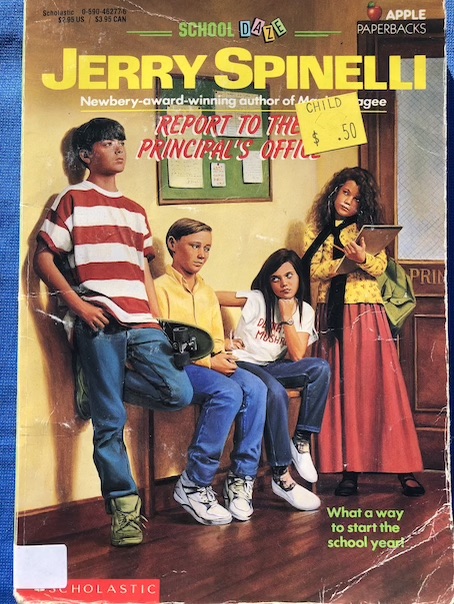
Report to the Principal’s Office by Jerry Spinelli, 1991.
This is the first book in a series about a group of unlikely friends in middle school.
The start of the new school year is a disaster for Sunny Wyler. Her best friend, Hillary, lives directly across the street from her house, and they’ve been close for their entire lives, always attending the same school. However, because of the construction of a new middle school in their town and changing school zone lines, which happen to be drawn directly down the middle of their street, Sunny and Hillary will now be sent to different schools for middle school. (During my childhood, parents could sometimes ask for a boundary exception for kids from the local school district so they could attend a different school with their friends, but that doesn’t appear to be an option here.) Hillary tries to be optimistic, pointing out that the new middle school that Sunny will be attending is much nicer than the old middle school that she will have to attend, but Sunny doesn’t care about that. She just wants to go to school with her best friend.
Sunny thinks that she’s come up with a plan to reunite with Hillary. She’s decided to make herself so obnoxious at her new school that they will kick her out, and her parents will have no choice but to send her to Hillary’s school. She’s decided to wear an old t-shirt that says “Death to Mushrooms” every day, never washing it, so she’ll smell bad. She’ll refuse to wash her hair, so it will be dirty and greasy. Above all, she’ll have the worst attitude, never smile, and never talk, never even answering if her teacher asks her questions in class.
Eddie Mott first encounters Sunny Wyler on the bus to school. She sits next to him, and he can tell right away that she has problems and a bad attitude, and that’s the last thing he wants for the beginning of his new school year. Eddie is trying to adopt a more grown-up image in his middle school years, and he desperately wants to fit in with the other kids. He’s trying to wear the right clothes, be friendly with other kids, and above all, avoid problems. None of that has prepared him for Sunny.
There is one person, though, who has done his best to prepare for all the kids who will be coming to the new middle school, the school’s principal, Mr. Brimlow. Over the summer, he studied the details of the incoming students, and he can recognize them on sight as soon as they arrive. When the school bus driver tells him that there’s a kid on the bus who refuses to get off, he recognizes the kid immediately as Eddie. Between dealing with Sunny’s aggressive unfriendliness and being roughed up by older kids on the bus, Eddie can’t bring himself to come to the school. The bus driver, impatient to get to his other job, actually drives off with the principal, Eddie, and Salem, a girl with literary ambitions who wanted to study the situation for story fodder, still on board.
Things are generally going wrong all over Plumstead Middle School as everyone, including the teachers, try to figure out their way around, but Mr. Brimlow is calm and good-natured, and getting back to school with Eddie and Salem after their bus adventure breaks the ice between them. When Mr. Brimlow gets back to his office, he finds Dennis “Pickles” Johnson waiting for him. Dennis, who gained his nickname from the time he decorated his family’s Christmas tree with actual pickles and the incident made the local paper, is an amateur inventor who made his own oversized skateboard that looks like a pickle. The reason why he was sent to the principal’s office is that his skateboard won’t fit in his locker, and he can’t have it in class. When Pickles asks the principal what could happen if he were allowed to ride his skateboard around the school, the principal asks to try the skateboard himself. He’s unable to stop himself and ends up rolling into a nearby classroom and crashing into the geography teacher’s desk, proving to Pickles (and everybody else) what could happen if Pickles is allowed to use his skateboard in the school hallways. Mr. Brimlow forbids Pickles to bring the skateboard to school again but also thanks him for the fun ride and invites him to lunch.
Far from being upset by the strange beginning to the school year, Mr. Brimlow is actually grateful for the eccentric students and their shenanigans because he really likes to get to know his students, and he particularly learns a lot about Eddie, Salem, Pickles, and Sunny on their first day. It hasn’t escaped his notice that Sunny is being purposely sour to other people, and it isn’t really a surprise when one of her teachers sends her to the principal’s office after she deliberately answers all of her math problems wrong, misspells everything in a writing assignment, writes all of her assignments in extra tiny writing to make them difficult to read, and then pretends to flick boogers at Eddie.
When she’s sent to the principal’s office, Sunny thinks that her plan of being obnoxious has already worked and that she’ll soon be sent home or to Hillary’s school, but the principal ends up inviting her to lunch along with Pickles, Eddie, and Salem. The principal actually enjoys the experience, and rather than punishing any of the students for their various shenanigans from the morning, he decides to give each of them special jobs to help them settle into life at their new school. Since Eddie was a flag raiser at his old school, Mr. Brimlow gives him that job at Plumstead Middle School, assigning Pickles to help him. He puts Sunny in charge of taking care of an escaped hamster that the kids found, and noting Salem’s interest in people’s personalities and organizational skills, puts Salem in charge of all of the other students as they are given the collective job of coming up with a mascot for the school.
Through these activities, the four kids become friends with each other and also start to become a real part of their new school. Instead of being kicked out, Sunny is the one who comes up with the winning idea for the school’s new mascot, the Hamsters, becoming attached to the hamster that she has to care for and upset during a time when she thinks that he’s dead. (Fortunately, the hamster is fine in the end.) Eddie thinks of himself as a wimp for being pushed around by the older kids, but Pickles becomes his friend and sticks up for him, and Salem writes a story about him to show him why he’s actually a hero in his own small way.
It’s a good story about a group of unlikely friends with likable, eccentric characters. In the end, the principal’s tactic of helping the students to adjust to middle school by getting them more involved works well, and even Sunny realizes that she can be happy in her new school with her new friends while still being friends with Hillary from across the street.
The book is available to borrow and read for free online through Internet Archive.
While Murray’s parents are on vacation, his older sister, Blanche, is in charge of the house. One day, he calls Blanche to get a ride home from the dentist and hears what he thinks is Blanche shooting their housekeeper.
Earlier that morning, he had heard Blanche talking on the phone to someone about a gun. Then, when he calls home, a friend of Blanche’s, Harold, answers, and Murray hears a gun going off in the background and Blanche apologizing to the housekeeper and talking about blood on the carpet. When Murray gets home, his mother’s Persian rug is missing and sees what appears to be a head in a bucket under the sink in the kitchen, further proof that the housekeeper is dead and that her blood stained the carpet.
Murray doesn’t know what to do because he is sure that his sister would never shoot anyone on purpose, and he doesn’t want to see her go to jail. He consults a private detective, Mat Cloak, who he met in a doughnut shop, for help.
The detective agrees to look into the case, and along the way, he realizes that it has connections to a case that he is already investigating. What really happened to the housekeeper? Is Blanche really guilty of murder? Moreover, who is the strange man who is following Murray around?
It’s a very funny story with some twists that readers won’t be able to guess right away. Part of the mystery is pretty obvious because Blanche is a theater student, but the real mystery is one that Murray isn’t even trying to solve and the real villain is someone who Murray thinks is a victim.
The book is available to borrow and read for free online through Internet Archive.
This is both the fourth book in the Enchanted Forest Chronicles and the first book in the series that was written. The author wrote this story before the others and then wrote the other three to explain how the characters got to this point. The first three books in the series focus on Princess Cimorene and her adventures, but this book focuses on her son, Prince Daystar.
Partly
because this series is kind of backwards, with the last book being the first
written, I’m going to start with a spoiler.
When the book begins, Daystar is unaware that he is a prince and that
his father is the king of the Enchanted Forest.
He grew up in an ordinary cottage on the edge of the forest, so he is
accustomed to the presence of all kinds of fantasy creatures and fairy tale
characters. He thinks of himself and his
mother as ordinary poor folk. However,
his mother has taught him not only reading and writing but other skills that
are more unusual for peasants, like music, fighting, and even a little magic.
When
Daystar is 16 years old, a wizard named Antorell comes to their house. Daystar’s mother, Cimorene, seemed to know him,
and he knows her. Antorell demands “the
sword” and the boy, and Cimorene casts a spell to melt him. (“’No! Not again!’ he screamed.” If you’ve read the other books, you already
know why. But, again, this book was
written first.)
The
next day, Cimorene gives Daystar a sword that he’s never seen before but which
seems to draw him to it, and she starts giving him instructions. The instructions are vague, but Cimorene
insists that Daystar is to go into the Enchanted Forest and not to come back
until he can explain why he had to go in there in the first place. Also, he is not allowed to draw the sword
from its scabbard unless he really needs to use it. Cimorene says that she can’t explain more
because it might “ruin everything.” Not knowing
what else to do, Daystar starts into the Enchanted Forest. When he glances back, Cimorene and the cottage
have suddenly disappeared. Daystar has
no idea why, but he has no choice but to keep going.
In the
forest, Daystar meets a talking lizard called Suz, who claims to know
everything about the Enchanted Forest and what goes on there (a tall claim, considering
everything that goes on there). When
Daystar asked him if he knows anything about the mysterious, magical sword that
his mother gave him, Suz tells him that it’s the Sword of the Sleeping King and
that everyone has been looking for it.
Daystar knows nothing about it, which surprises Suz. To Daystar’s surprise, both the sword and
Daystar’s lack of knowledge agitate Suz, who says that he must get Kazul, who
will know what to do. Before he then
runs off, leaving Daystar wondering who Kazul is, Suz tells him that he’s going
to have to learn about the sword by himself because there are certain rules
associated with magic, but that he should follow the sword to find out.
The
next person Daystar meets is a red-haired girl who is stuck in a hedge. She is surprised by how easily Daystar can
get into the magical hedge, and at first, she thinks that he is a wizard. She is relieved when she finds out that he’s
not. The girl, Shiara, tells Daystar
that wizards have been chasing her because she burned the Head Wizard’s staff. Most people could never accomplish that
because wizards’ staffs are extremely powerful and have protective spells on
them, but Shiara is a fire-witch.
As the
two of them talk, Daystar learns that, while fire-witches are extremely rare
and powerful come by their powers naturally, Shiara’s abilities are more
unpredictable than most. She has trouble
casting spells on purpose, but when she gets mad, she can do some extremely
powerful ones without really trying. Fire-witches
tend to have tempers, and Shiara is no exception. Because of that, she doesn’t have many
friends. Most people are afraid to be
around her because they never know when she’ll lose her temper and accidentally
set things on fire. Even worse, for
Shiara, is knowing that most fire-witches are able to do very impressive spells
and are almost invulnerable, but yet, she can’t even burn her way through a
hedge when she tries it. The wizards are
very interested in her because most fire-witches are immune to their spells. When they learned that she was a fire-witch who
couldn’t cast her own spells, they tried to kidnap her in order to study her
magic, which she how she ended up setting the Head Wizard’s staff on fire.
Daystar
and Shiara finally get out of the magical hedge when Daystar suggests that
Shiara try being polite to it instead of losing her temper. Creatures and objects in the Enchanted Forest
tend to respond well to politeness. When
they’re out of the hedge, a wizard shows up and tries to kidnap Shiara again,
but Daystar defends her with his sword.
However, Daystar’s hand is injured when he tries to pick up the pieces
of the wizard’s staff, and it explodes.
Daystar
and Shiara seek help from Morwen, a witch who lives nearby. It is from Morwen that Daystar begins to get
a sense of what his sword is capable of doing.
He also meets up with Suz again, who tells him that he should go to the
castle and that Kazul will meet him there.
Daystar still doesn’t know what he’s walking into, but missions in the
Enchanted Forest can’t be ignored, and he has a mission to complete that everyone
has been waiting for since before he was born.
By the end of the story, Daystar has learned what he needs to do to rescue his father, and Cimorene and Mendanbar are reunited. Shiara ends up getting what she wants, partially, because she gains the ability to use her powers, but is forced to be polite in order to do so, which really irritates her. She becomes Kazul’s new princess, where she will learn both the personal skills and magical skills she needs to control both herself and her ability. Cimorene believes that Shiara will end up marrying Daystar eventually and becoming the next queen of the Enchanted Forest. However, the series ends here, and the future is left to the imagination. Morwen also decides to marry Telemain, a character from the previous books.
Like other books in this series, this book contains a lot of humor and parodies on popular fairy tales and fairy-tale creatures. Personally, I like the first two books in the series the best, but this one is also fun. There is a mild touch of romance to it, which is also nice.
The book is currently available online through Internet Archive.
There is one more story after this series, a short story in the collection Book of Enchantments that features Daystar and both of his parents but does not have Shiara.
This is the second book in The Enchanted Forest Chronicles, continuing the adventures of Princess Cimorene, although the story is told from the point of view of Mendanbar, King of the Enchanted Forest. The Enchanted Forest is no ordinary kingdom, and Mendanbar is no ordinary king. To be King of the Enchanted Forest means being a skilled enchanter. Mendanbar can use the forest’s magic directly, making him more powerful than wizards. Most of the creatures in the forest obey him, and unlike ordinary people, he can find his way around the forest almost automatically, even though things in the forest tend to move around.
At the
beginning of the story, Mendanbar’s steward, Willin, pesters him about the
subject of getting married. Mendanbar
hasn’t given the matter much thought since his father died three years earlier,
but then, there’s been a lot to do.
Queen Alexandra has several daughters, any of which would be considered “suitable,”
but Mendanbar doesn’t like any of them.
Mendanbar is annoyed because he’d just gotten the elf clans’ feud
settled and was looking forward to a period of relative calm, so he decides
that he’s going to give himself the day off, for a change.
He
decides to take a stroll by the Green Glass Pool to relax, but on the way, he encounters
a princess. That’s not too unusual for
the Enchanted Forest (home to many fairy-tale creatures and the events that
make up fairy tales), but this princess strikes Mendanbar as a particularly
scheming and ambitious one. She tells
him a great tale of woe in which her wicked stepmother cast her out that Mendanbar
can tell is carefully rehearsed and might have even been the idea of the stepmother
in question, with the idea of hooking an adventurous prince. (Royal families do things like that, see the previous
book in the series.) However, Mendanbar
is puzzled because the forest usually keeps out people who are obviously
selfish. Then, the princess mentions crossing
an area of waste to get into the forest, and Mendanbar is alarmed because there
shouldn’t be a wasteland there.
Forgetting about the princess, he hurries off to investigate.
Sure
enough, Mendanbar discovers that a section of the forest is actually missing,
destroyed to the point where there are just dead stumps. Even the magic is gone. Upon further investigation, Mendanbar finds
dragons scales. He isn’t sure why the
dragons would want to attack the Enchanted Forest because they haven’t had any
quarrels and mostly leave each other alone.
On the advice of a nearby talking squirrel, Mendanbar goes to see the
witch Morwen.
After
examining the dragon scales, Morwen demonstrates that, although they appear to be
different colors and look like they’re from different dragons, they have
actually been disguised. They are
actually from one dragon only. Morwen
also doubts that a dragon was really responsible for the damage to the forest. After all, why would a dragon waste time
disguising his scales when he could just pick them up? Also, healthy dragons don’t shed that many
scales. Morwen is a friend of Kazul, who
is the current King of the Dragons, and she advises Mendanbar to go see
Kazul.
Morwen
also chides Mendanbar for not visiting Kazul when she became the king the year
before. Mendanbar feels a little guilty,
saying that he’s just been very busy, which is true. However, Morwen points out that what he could
use is more effective help to organize things in the kingdom, not just making
lists of things for him to do, like his steward does. It’s part of the reason why people are saying
that Mendanbar should get married.
Before
Mendanbar can visit Kazul, he gets an unexpected visit from Zemenar, the Head
Wizard. Zemenar says that the wizards
have been having problems with the dragons (again, see previous book) and that
the dragons will not let them enter the Caves of Fire and Night. He hopes that Mendanbar will allow them access
from the Enchanted Forest. Mendanbar
doesn’t really trust the wizards, and he refuses the request on the grounds that
he has something important to discuss with the King of the Dragons
himself. Zemenar tells Mendanbar about
Kazul’s princess, Cimorene, blaming her for the the “misunderstanding” between
the wizards and dragons. Mendanbar at
first imagines that Cimorene is much like the scheming princess he met that
morning, but soon discovers that she’s anything but. Taking the enchanted sword that only the
kings of the Enchanted Forest can use with him, Mendanbar goes to visit the
dragons.
At Kazul’s
cave, Mendanbar meets Cimorene, who informs him that her official title is now
Chief Cook and Librarian. She tells him
that part of the point of advertising this title is that it cuts down on the
number of princes who come around. Lots
of princes want to rescue a princess, but few people want to rescue a Chief
Cook and Librarian. Mendanbar finds Cimorene
a surprising change from the other princesses he’s met. Mendanbar also makes a positive impression on
Cimorene by using his sword to fix a broken sink, even if she describes the magic
as being a bit “flashy.”
However,
all is not well among the dragons. Although
Cimorene is reluctant to admit it at first, Kazul has mysteriously
vanished. She was planning to go out and
search before Mendanbar showed up. Kazul
had been visiting her grandchildren when she decided to go by the Enchanted
Forest to investigate someone growing dragonsbane. Mendanbar shows Cimorene the dragon scales he
found, and she indentifies them as belonging to Woraug, a dragon who was
changed into a frog in the previous book.
It
doesn’t take the two of them long to realize that the wizards are back to their
old tricks and scheming. However, what
would they really have to gain by setting the Enchanted Forest and the dragons
against each other? And where is Kazul?
Like the other books in this series, this book is full of humor and a touch of mystery. There are many parodies on fairy tale tropes, including an Wicked Uncle who’s not very wicked and does both a favor and an evil deed for his nephew by sending him to boarding school instead of abandoning him in the forest to have an adventure, as he’d hoped. There is also romance between Cimorene and Mendanbar. As you might have guessed, Cimorene is just the kind of practical princess Mendanbar needs to help him manage the magical chaos that is the Enchanted Forest and Mendanbar is the kind of king who is happy to find an intelligent princess who can do magic and rescue dragons.
The book is currently available online through Internet Archive.
Mr. and Mrs. Rogers are loaning their maid/housekeeper, Amelia Bedelia, to a friend, Miss Emma to help her with a few things around her house. Amelia Bedelia also has her niece, Effie Lou, with her to give her a hand. Effie Lou doesn’t quite know what her aunt does for a living, but although Effie Lou’s first instincts seem to do the normal thing with the instructions that Miss Emma gives them, Amelia Bedelia quickly “corrects” her niece to do things in her quirky, literal-minded way. For example, when Miss Emma tells them to weed the garden, Effie Lou starts to pull the weeds, but Amelia Bedelia convinces her that they are supposed to add more since Miss Emma didn’t say “unweed” the garden.
From there, Amelia Bedelia interprets Miss Emma’s order to “stake” the beans in the garden as tying bits of steak to them. They also give the chickens Miss Emma’s quilting scraps instead of food scraps and sew grass seeds onto thread instead of “sowing” them into the ground.
Is Amelia Bedelia a bad influence on her niece? Maybe, but once again, her baking skills come to the rescue. Miss Emma asks her to bake a “tea cake” for some guests who will be coming over.
Now, depending on where you live, “tea cake” actually can mean different things. Sometimes, it’s just a small cake that’s served with tea, and other times, it’s a special kind of cookie or biscuit (the distinction is regional). The way Amelia Bedelia interprets it is a cake that actually includes tea as an ingredient. Surprisingly, though, everyone loves it, even more than the nut cake she also baked.
The book is currently available online through Internet Archive.