Miss Nelson Has a Field Day by Harry Allard and James Marshall, 1985.
Everyone at school is disappointed in the school’s football team. Even the team itself thinks that they’ll never have a chance at winning, so they don’t bother to practice. They refuse to listen to their coach and spend all of their time goofing off. Finally, the coach starts to crack mentally from the strain, and Miss Nelson decides that something needs to be done.
Some of the kids mention that if Viola Swamp, the meanest substitute teacher ever, were there, she’d know how to deal with the team. Not knowing how to contact The Swamp, the principal tries to turn himself into Viola Swamp, but his outfit is just goofy . . . then the “real” Viola Swamp shows up to coach the team. As usual, she takes no nonsense from anyone.
The Swamp undeniably gets results, however, the principal has started to wonder who Miss Swamp is and how she always knows when to show up. Unlike in previous books in the series, Miss Nelson is teaching her class as usual while Coach Swamp is out on the field with the team. Since the previous books pretty well established that Miss Nelson and Miss Swamp are the same person, how is this possible?
The book is currently available online through Internet Archive.
My Reaction and Spoilers
The story doesn’t contradict the other books, and Miss Nelson is still Viola Swamp, but there is one more surprising thing about Miss Nelson that nobody knows which can allow her to appear to be in two places at once . . . she has a twin!
Stories with a secret twin can sometimes feel like a bit of a cop-out, but this one is funny because this is the first and only time Miss Nelson has called on her twin to help her with her double act as Viola Swamp. Miss Nelson’s twin sister is actually the one who’s teaching the class as the nice teacher while Miss Nelson is out on the field coaching as Viola Swamp. There is a moment at the end of the book where the twins are together and Miss Nelson explains to her sister why Viola Swamp is necessary. Sometimes, students need a little tough love and discipline, but by using her alter ego to dish it out when necessary, Miss Nelson gets to keep her reputation as the nice, sweet teacher she really is.
Even though readers know what’s going on with Miss Nelson and Viola Swamp from the previous books, Miss Nelson’s twin adds a nice twist to the plot. The fun of the Miss Nelson books is watching how Miss Nelson carries out her identity swaps. In this book, I also loved the principal’s hilarious attempt to play the part of Viola Swamp in a Halloween witch costume!
Miss Nelson is Back by Harry Allard and James Marshall, 1982.
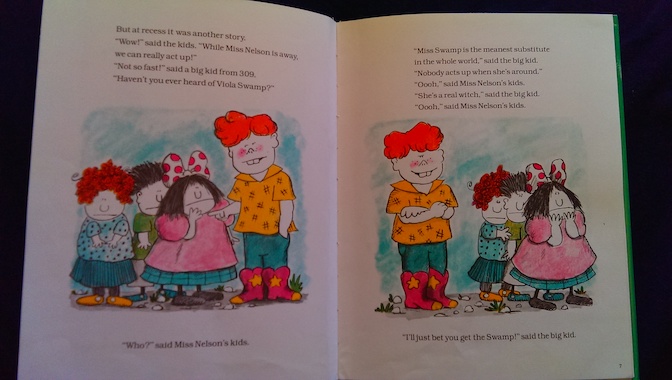
Miss Nelson, a teacher, tells her class that she will have to be away for awhile, having her tonsils removed, so someone else will be teaching their class. At first, the kids think that they’ll be able to get away with a lot while Miss Nelson is away, but an older kid warns them that their substitute will probably turn out to be Viola Swamp, the meanest substitute ever.
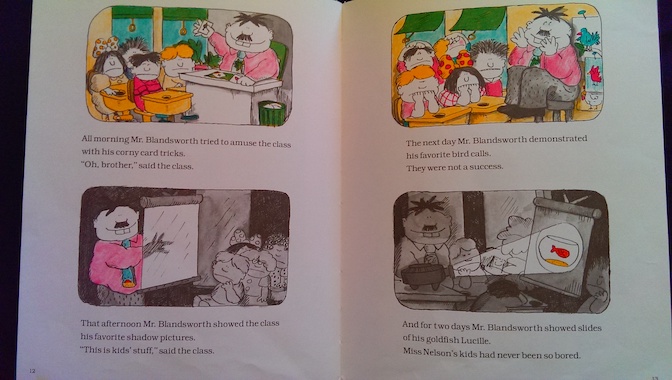
The kids are nervous until they find out that Mr. Blandsworth, the school principal, will be their substitute himself. The worst thing about Mr. Blandsworth is that he’s boring, and he tends to treat them like they’re little kids. They put up with it for awhile, but then, they realize that they can get rid of Mr. Blandsworth by convincing him that Miss Nelson has come back to school.
They put together their own Miss Nelson costume, with some of the kids sitting on each other’s shoulder’s to appear taller in the outfit. It’s cheesy, but it convinces the principal. But, the kids take it even farther than that. Now that there’s no substitute teacher, they can do whatever they want! Their “Miss Nelson” takes the class on an impromptu field trip to the movies and the ice cream parlor, and no one stops them because they’re with their “teacher.”
Unfortunately, they make the mistake of walking past Miss Nelson’s house, and she discovers what they’ve been doing.
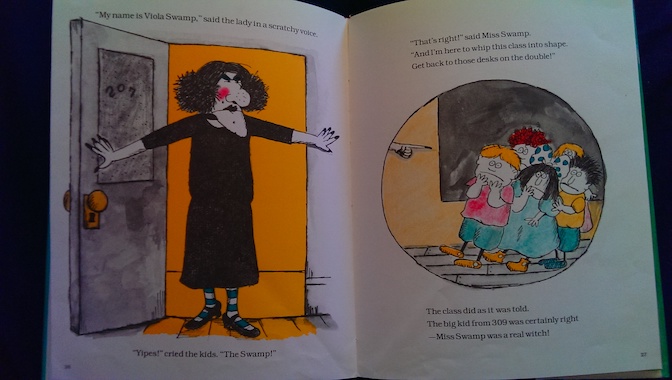
Miss Nelson arranges for Miss Viola Swamp to come and teach the class a real lesson.
The book is currently available online through Internet Archive.
My Reaction
I actually like this book even better than the first book in the series because I think that the kids’ Miss Nelson costume is hilarious! Mr. Blandsworth is completely clueless about the kids’ deception, just as he never figures out what the real truth is about “Viola Swamp.”
As usual for the series, the story never explicitly states that Miss Nelson and Viola Swamp are the same person, but it’s heavily implied in the text (such as Viola Swamp’s scratchy voice from Miss Nelson having her tonsils out) and shown in clues in the pictures. Miss Nelson uses “Viola Swamp” as her alter ego whenever she needs to give her students some tough love, but that’s just a joke that Miss Nelson shares with the readers.
Miss Nelson is Missing! By Harry Allard and James Marshall, 1977.
The kids in Miss Nelson’s class at school are terrible! No matter how nice she is to them, they always act up and refuse to do their work. Miss Nelson knows that this can’t continue.
Then, one day, Miss Nelson doesn’t show up for class. The kids have a substitute teacher, the terrible Miss Viola Swamp. Miss Swamp is super strict. She makes the kids work harder than they’ve ever worked in their lives, and she doesn’t put up with any nonsense.
Miss Swamp is so mean that the kids really start to miss nice Miss Nelson. What happened to her? The kids try to find their nice teacher so they can get rid of the mean substitute. They try to go to the police to report her as a missing person and go to her house to see if she’s there, but the only person they can find is Miss Swamp. They imagine all sorts of terrible things that could have happened to Miss Nelson.
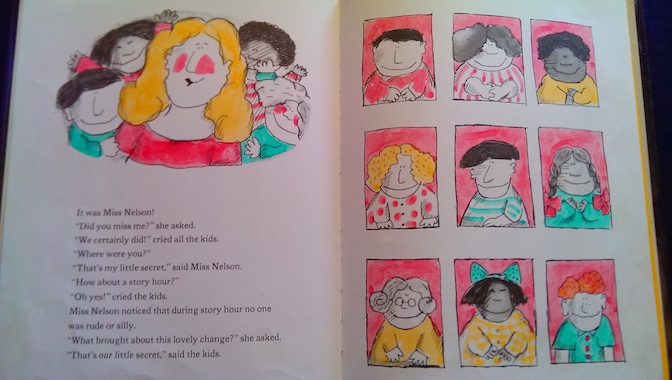
Then, just as they’re sure that they’ll never see Miss Nelson again, suddenly she’s back. Miss Nelson never says exactly where she’s been, but the kids are so glad to see her that they behave much better.
This is the first book in a series. It is available to borrow and read for free online through Internet Archive.
My Reaction and Spoilers
The big joke of the book, and all the others in this series, is that Miss Nelson and Miss Swamp are the same person. It’s not much of a spoiler to say that because, even though the story never explicitly says that they are the same person, it’s heavily implied, especially at the end of the book. The fun is that the kids in Miss Nelson’s class never guess, leaving readers to enjoy the joke along with Miss Nelson.
Some people like to take advantage of people who are “too nice”, but just because a person prefers to be nice doesn’t mean that they’re weak, stupid, or incapable of being tough when they need to be. Miss Nelson just found a creative way to be as tough and mean as she needed to be to get the kids in her class to behave without ruining her own reputation as a nice person. “Viola Swamp” will always be there whenever Miss Nelson needs her again … and that leads into the rest of the books in the series.
Pippi Longstocking is an iconic figure in children’s literature, a little red-haired girl with amazing strength (she can lift a horse all by herself) and a quick wit, who can “always come out on top” in any situation and is frequently doing exciting and hilarious things without adult supervision. The books in her series were originally from Sweden, with the first one written in 1945, but I’m reading a later English translation.
In the first book, she comes to live by herself in a house, which she calls Villa Villekulla, in a small town in Sweden when her father, a ship’s captain, is washed overboard at sea. Although others fear that he is dead, Pippi thinks it more likely that he was washed up on an island of cannibals, where he will soon be making himself their king. (Of course, Pippi turns out to be right, but that’s getting ahead of the story.) Her mother died when she was a baby, so Pippi now lives all by herself, except for her pet monkey and horse. She pays for the things she needs with money from the suitcase of gold coins that her father left for her and spends her time doing just as she pleases.
Tommy and Annika, the children who live next door to Ville Villekulla, are perfectly ordinary, basically obedient children, who live normal lives with their parents. When Pippi moves in next door, their lives get a lot more exciting. The first time they meet her, she’s walking backward down the street. When they ask her why she’s doing that, she says that everyone walks that way in Egypt. Tommy and Annika quickly realize that she’s making that up, and Pippi admits it, but she’s such an interesting person that they accept her invitation to join her for breakfast. They’re amazed when they find out that Pippi has no parents, only a monkey and a horse living with her, and are entertained by the tall tales that she tells.
When they go back to see her the next day, Pippi tells them that she’s a “thing-finder” and invites them to come and look for things with her. Basically, Pippi is a kind of scavenger, looking for valuable things, things that might be useful, or (which is more likely) just any old random junk that she might happen across. Pippi does find some random junk, although she makes sure that Tommy and Annika find better things (probably by hiding them herself).
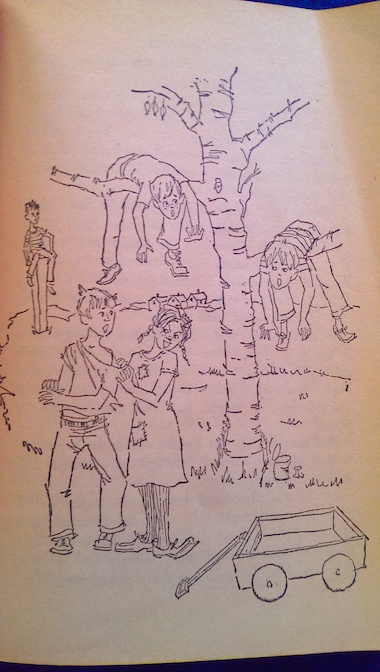
Then, the children see a group of bullies beating up another boy and decide to intervene. The meanest of the bullies, Bengt, starts picking on Pippi, but picking on a girl with super strength isn’t the wisest move. She picks him up easily and drapes him over a tree branch. Then, she takes care of his friends, too.
Word quickly spreads through town about this strange girl. Some of the adults become concerned that such a young girl seems to be living on her own. A couple of policemen come to the Ville Villekulla one day to take Pippi to a children’s home, but she saucily tells them that she already has a children’s home because she’s a child and she’s at home. Then, she tricks them into playing a bizarre game of tag that ends with them being stuck on the roof of the house. The policemen decide that perhaps Pippi can take care of herself after all and give up.
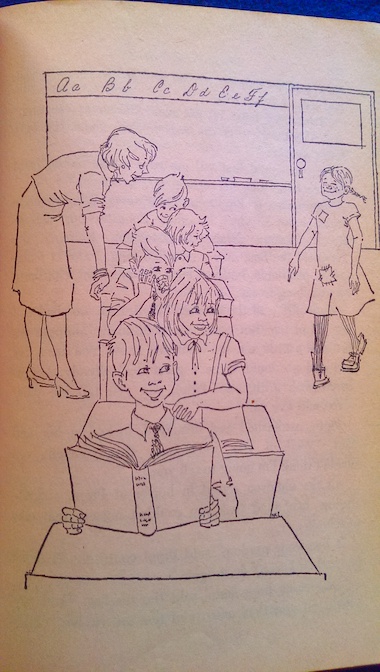
Tommy and Annika try to persuade Pippi to come to school with them, but that doesn’t work out, either. Pippi, completely unfamiliar with the routine of school, thinks that the teacher is weirdly obsessed with numbers because she keeps demanding that her students give her the answers to math problems that Pippi thinks she should be able to solve on her own. The teacher concludes that school may not be for Pippi, at least not at this point in her life.
Tommy and Annika delight in the wild things that Pippi does, like facing off with a bull while they’re on a picnic, accepting a challenge to fight a strongman at the circus, and throwing a party with a couple of burglars. When they invite Pippi to their mother’s coffee party, and their mother’s friends begin talking about their servants and how hard it is to find good help, Pippi (having already devastated the buffet of desserts and made a mess in general) jumps in with a series of tall tales about a servant that her grandparents had, interrupting everyone else. Tommy and Annika’s mother finally decides that she’s had enough and sends Pippi away. Pippi does leave, but still continuing the story about the servant on the way out, yelling out the punchline from down the street.
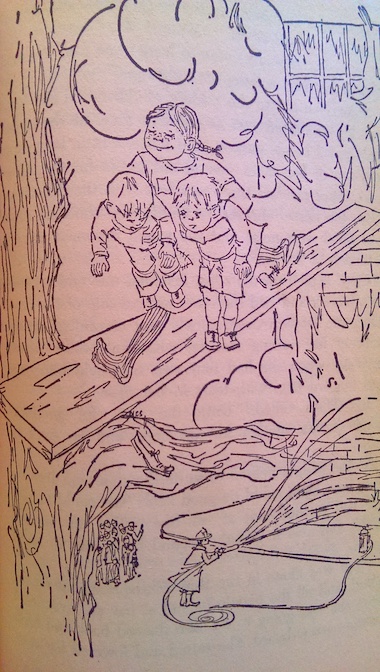
However, Pippi becomes a local hero when she saves some children from a fire after the fireman decide that they can’t reach them themselves.
The book is available to borrow and read for free online through Internet Archive.
My Reaction
I have to admit that, as a character, Pippi sometimes annoys me with her obvious lies and some of the stuff she does. She openly admits that she lies after telling some of her tall tales, but it’s the parts where she admonishes her listeners not to be so gullible that get to me. You can tell that her listeners aren’t really fooled at all; they’re just trying to be polite by not calling her a liar directly, and then she insults them for it. Maybe it’s Pippi who’s really the gullible one, thinking that she’s fooling people when she isn’t really.
Admittedly, Pippi’s wild stories are sometimes amusing. I liked the one where she claimed that the reason why other people don’t believe in ghosts is that all of the ghosts in the world live in her attic and play nine-pins with their heads. When Tommy and Annika go up there to see them, there aren’t any, of course, and Pippi says that they must be away at a conference for ghosts and goblins.
I just don’t like it that Pippi seems to be deliberately trying to make people look dumb when she’s the one saying all the stupid stuff and it’s really obvious that people know it. I also don’t like the part where she makes such a mess at the coffee party because she seems to be trying to be a messy pain on purpose. She insists that it’s just because she doesn’t know how to behave, but I get the sense that it’s just an excuse and that Pippi just likes to pretend to be more ignorant than she is, pushing limits just because she likes to and because she usually gets away with it. I didn’t think it was very funny. But, Tommy and Annika seem to just appreciate Pippi’s imagination, enjoying Pippi’s antics, which bring excitement and chaos to a world controlled by sensible adults, which can be boring to kids, and accepting Pippi’s stories for the tall tales they are, playing along with her.
Pippi herself is really a tall tale, with her super strength, her father the cannibal king, and her ability to turn pretty much any situation her to advantage. Part of her ability to “come out on top” is due to her super strength and part of it is that Pippi approaches situations from the attitude that she’s already won and isn’t answerable to anyone but herself. This approach doesn’t always work in real life (I can’t recommend trying it on any of your teachers, or worse still, your boss – not everyone is easily impressed, especially the people who pay your salary), and nobody in real life has Pippi’s super strength to back it up. The adults in the story frequently let Pippi win because they decide that fighting with her just isn’t worth it. (Admittedly, that does happen in real life, too. I’ve seen teachers and other people give in to people who are just too much of a pain to argue with because they’re too impatient or find the argument too exhausting.) Kids delight in Pippi’s ability to get the better of the adults, who usually have all the control, and in Pippi’s freedom to do what she wants in all situations.
One thing that might surprise American children reading this story is that the children in the story drink coffee. Tommy and Annika say that they are usually only allowed to drink it at parties, although Pippi has it more often. It isn’t very common for American children to drink coffee in general because it’s usually considered more of an adult’s drink and because of concerns about the effects of too much caffeine on young children. Children in Scandinavia tend to drink coffee at a younger age than kids in the United States.
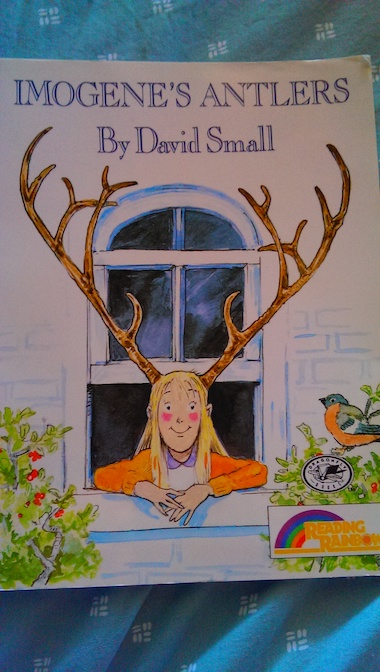
One day, a young girl named Imogene wakes up to find that she has sprouted antlers during the night. It comes as a shock to the rest of her family, and she finds that it’s very difficult to do things with large antlers sticking out of her head.
No one seems to know why Imogene has sprouted antlers or what to do about them. Imogene’s mother faints just about every time she looks at her daughter, and her attempt to help Imogene hide them with a specially-designed hat is pure disaster. Imogene’s brother, Norman, thinks that Imogene might be a rare kind of elk now.
However, Imogene still has a lovely day as the family maid uses her as a rack to dry towels and the cook decks out her antlers with donuts to feed the birds. She even puts candles on her antlers as an elaborate candelabra while she practices her piano lesson.
Still, it’s a most bizarre day, and her family is relieved when the antlers are gone the following morning. But, Imogene’s adventures may only be just beginning.
The book never offers an explanation for why Imogene grew antlers or why she now has a peacock tail, but it doesn’t really matter. This is just one of those books that’s fun to read because it’s silly. While Imogene’s mother panics over her daughter’s condition and tries to hide it under a ridiculously big hat at one point, readers don’t have to worry about the long-term implications of Imogene’s antlers (or any other animal transformations) because she just enjoys them for what they are. The peacock feathers may not have as many practical uses as the antlers did, but one can imagine that Imogene will make the most of them while she has them. I loved this book when I was a kid!
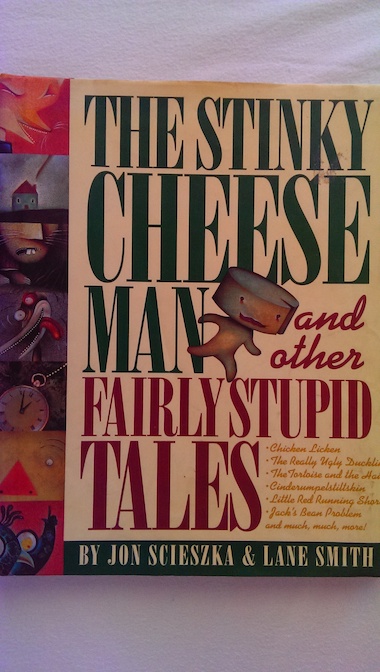
The Stinky Cheese Man and Other Fairly Stupid Tales by Jon Scieszka and Lane Smith, 1992.
This book is a spoof on a number of classic fairy tales. As it explains in the introduction, the short stories included in the book are more Fairly Stupid Tales than Fairy Tales, giving the example of Goldilocks and the Three Elephants: A girl smells peanut porridge and wants to enter the elephants’ house to eat some and try out their furniture, but elephant furniture is too big for her to climb up on, so she just leaves, The End. That incredibly short story isn’t found anywhere else in the book, but it’s a good example of what the other stories are like.
Even the set up of the book is a joke, with the Little Red Hen showing up to demand help with her wheat only for Jack the Narrator to tell her that it’s too soon because they haven’t even had the title page yet. The title page has the words “Title Page” larger than the title itself, and the dedication is upside down because who would actually read it anyway? Then, Chicken Licken thinks that the sky is falling and that everyone should run and tell the President, but it turns out that what’s falling is actually the Table of Contents, which squashes everyone before Foxy Loxy can eat them.
Then, the rest of the stories begin:
Chicken Licken – As described above
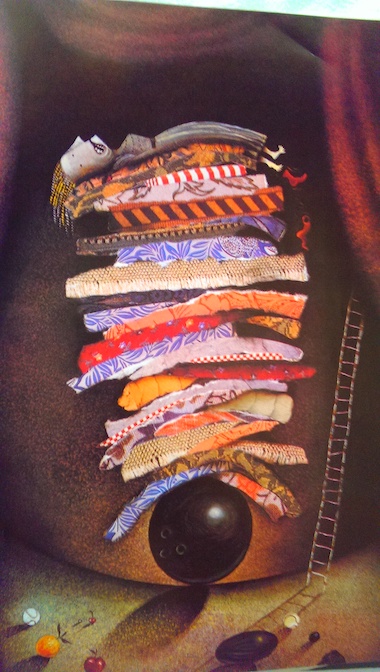
The Princess and the Bowling Ball – parody of the Princess and the Pea – Starts off like the original story with the prince’s parents testing princesses to see if they can feel a pea through a whole bunch of mattresses, but none of them ever do, so the prince takes matters into his own hands to rig the test in favor of the girl he really wants to marry.
The Really Ugly Duckling – parody of The Ugly Duckling – When the really ugly duckling grows up, he’s basically just an ugly duck. The End.
The Other Frog Prince – parody of The Frog Prince – The frog isn’t really a prince. He just said that because he wanted a kiss.
Little Red Running Shorts – parody of Little Red Riding Hood – Jack the Narrator accidentally spoils the story by revealing too much in his introduction to it, so the characters feel like there’s no need to act it out, and the Little Red Hen fills up the extra space, demanding to know why they haven’t gotten to her story yet.
Jack’s Bean Problem – parody of Jack and the Beanstalk – Jack the Narrator starts to tell his own story about defeating the Giant, but the Giant protests because he doesn’t like always being tricked and takes control and reads a story that he “wrote” himself, cut out of pieces of other random stories from different books. When the Giant threatens to eat Jack if he can’t tell a better story, Jack tells a story that constantly repeats until it transitions into the next one.
Cinderumpelstiltskin – parody of Cinderella and Rumpelstiltskin – Starts out like the usual Cinderella story, but Rumpelstiltskin shows up and offers to teach her how to spin straw into gold. Cinderella doesn’t see how that can possibly help her since he doesn’t have a gown for her to wear to the ball, so she ends up without either a gown or any gold.
The Tortoise and the Hair – parody of The Tortoise and the Hare – A rabbit tells the tortoise that he’s so slow that he can grow hair faster than the tortoise can run. By the end of the story, the tortoise is still running, and the rabbit is still growing hair.
The Stinky Cheese Man – parody of The Gingerbread Man – An old couple make a “child” for themselves out of stinky cheese. When he takes on a life of his own and run away, they don’t bother to chase him because they can’t stand the smell. Nobody else wants to chase him, either.
So, why isn’t there a Little Red Hen story listed? At the end of the book, she shows up to complain about how she had to do everything herself to make the bread and nobody even saved space for her story (because Jack had to sneak away from the Giant after he fell asleep). The Giant wakes up and decides to make a chicken sandwich with the bread.
Understanding the jokes in the book requires a knowledge of the stories they’re spoofing, so this isn’t a book for very young children. Any kid who reads this should already know the classic fairy tales and be old enough to appreciate the humorous twists. I think kids feel clever when they realize that they can recognize the references in the stories and know where and how the parodies are different from the originals. Some of the humor has to do with the abrupt endings, simplifying issues that are more drawn-out in the original stories. I remember liking this book when I was in elementary school!
The art style is very distinctive, with a number of cutout elements with different textures. It’s fascinating to see the way that the pictures were put together.
The book is currently available online through Internet Archive.
Princess Elizabeth is a stylish young princess, engaged to the handsome Prince Ronald. But, one day, a dragon attacks her castle, incinerating all of Elizabeth’s fine clothes and carrying Ronald off to its lair.
Donning the only thing she can find to wear, an old paper bag, Princess Elizabeth tracks the dragon down to rescue Ronald.
In this unconventional fairy tale story, Princess Elizabeth must defeat the dragon in a duel of wits in order to rescue her prince, but in a humorous twist ending, Ronald is somewhat less than grateful for her help because Princess Elizabeth is no longer stylish in her old paper bag.
The book is available to borrow and read for free online through Internet Archive.
My Reaction
Books like these can be a good antidote to people who are tired of prissier princess stories with flamboyant gowns and a wedding (or at least kissing) at the end. The story is deliberately humorous and correct in pointing out that people who worry more about the clothes you’re wearing than the things you do for them are not worth bothering with. Prince Ronald is shallow. He has the look of a prince but not much substance, caring more about appearances than about what his princess went through for his sake.
The Sly Spy by Marjorie Weinman Sharmat and Mitchell Sharmat, 1990.
Someone has been trying to steal Olivia’s business by covering up her flyers with ones that say E.J.’s Spy Service. At the same time, Olivia’s friends are trying to keep Desiree’s birthday present a secret even though she has been snooping at their houses to find out what it is.
Olivia’s friends bought her a pet canary because she said that she likes feathers, and they ask Olivia to hide it at her penthouse until the party. However, it looks like Desiree has hired E.J. to spy on her friends and discover what they’re giving her for her birthday. Olivia has to outwit the spy and prove to him that some cases aren’t worth taking.
In a way, this story is kind of like business ethics for kids. First, covering up Olivia’s ads to prevent her from getting business was a form of unfair competition. Then, when Olivia points out to E.J. that he also has a surprise present to give to Desiree, she helps him to understand why the other kids want to keep their present a secret. It wasn’t really ethical for E.J. to take Desiree’s case in the first place since it would be better for her to be surprised on her birthday. Olivia makes sure that E.J. only has a vague notion about what Desiree’s present actually is, and he figures out what to tell Desiree so that he can fulfill his duty to her without giving away the surprise.
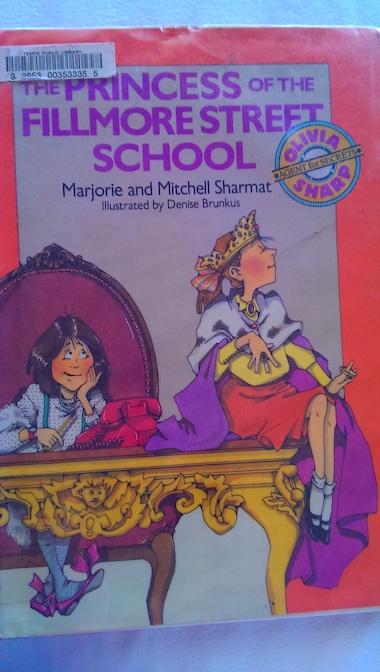
The Princess of the Fillmore Street School by Marjorie Weinman Sharmat and Mitchell Sharmat, 1989.
Desiree, who has always been a bit prissy, tells Olivia that she has decided that she wants to be princess of their school. She plans to prove that she is a perfect princess by trying to make all the other kids perfect. She is getting on everyone’s nerves, telling them to stand up straight or that their hair needs to be fixed.
When the others ask Olivia to help, she suggests to Desiree that she concentrate on making improvements to the school itself, but even that causes problems. Eventually, things get to the point where the school’s principal asks for Olivia’s help. Can anything stop the princess of Fillmore Street School before she drives everyone crazy?
Olivia’s solution is partly pointing out to Desiree the effect that she’s having on other people and partly explaining that a school which is already governed by a principal doesn’t also need a princess. Then, she finds a way to help Desiree to feel like a princess even though she can’t be one.
The Pizza Monster by Marjorie Weinman Sharmat and Mitchell Sharmat, 1989.
Olivia lives in a penthouse in San Francisco with her chauffer, Willie, and her housekeeper, Mrs. Fridgeflake. Her wealthy parents live there, too, but they are often traveling and are rarely home. When her best friend, Taffy, moves away, Olivia is lonely. She buys herself a pet owl named Hoot, but that still doesn’t completely help. She needs something to help keep herself busy. Olivia realizes that she is good at keeping secrets and at helping people with their problems, so she decides to busy herself running a service to help people with their secret problems. She has a bunch of flyers made and hangs them up around town saying that she is an agent for secrets and will help people.
A boy named Duncan, who Olivia knows from school, asks her to help him with his friend, Desiree. He says that they were together at the pizza parlor when she suddenly got angry and walked out. He doesn’t know what made her angry, but he asks Olivia to help him find out and fix their relationship.
Olivia’s attempts to help are a matter of trial and error. At first, Olivia thinks that Desiree was merely offended that Duncan gave her the smallest slice of pizza. She suggests that Duncan buy her another whole pizza, but that doesn’t work. Even Olivia’s idea to buy her a lot of different kinds of pizza doesn’t work. Eventually, Olivia talks to Desiree herself and learns that there is another reason why she is angry with Duncan.
It turns out that the problem doesn’t have anything to do with pizza but with Duncan himself. He’s always full of doom and gloom and criticism for everything. What Duncan needs is an attitude adjustment. He doesn’t realize that his pessimism and negativity makes it difficult for others to be around him. Olivia encourages him to be more positive and to develop his sense of humor. Once his attitude improves, so does his relationship with Desiree.










 This book is a spoof on a number of classic fairy tales. As it explains in the introduction, the short stories included in the book are more Fairly Stupid Tales than Fairy Tales, giving the example of Goldilocks and the Three Elephants: A girl smells peanut porridge and wants to enter the elephants’ house to eat some and try out their furniture, but elephant furniture is too big for her to climb up on, so she just leaves, The End. That incredibly short story isn’t found anywhere else in the book, but it’s a good example of what the other stories are like.
 Chicken Licken – As described above
 So, why isn’t there a Little Red Hen story listed? At the end of the book, she shows up to complain about how she had to do everything herself to make the bread and nobody even saved space for her story (because Jack had to sneak away from the Giant after he fell asleep). The Giant wakes up and decides to make a chicken sandwich with the bread.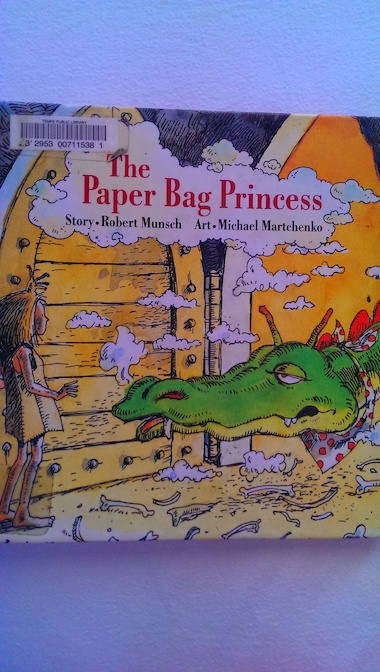




 Jestress's Forgotten Books and Stories