Cam Jansen and the Mystery of the Stolen Diamonds

Cam Jansen

#1 Cam Jansen and the Mystery of the Stolen Diamonds by David A. Adler, 1980.

This book is the first in the Cam Jansen series, introducing readers to her amazing photographic memory. Cam’s real name is Jennifer, but when people discovered her photographic memory, they started calling her “The Camera,” which was later shortened to Cam. When Cam wants to remember something, she says “click,” which she says is the sound that her mental camera makes.

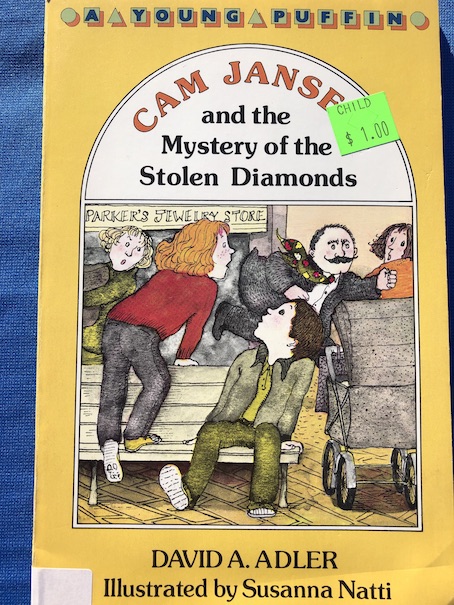
While Cam is at the mall with her friend, Eric, and his baby brother, Howie, a jewelry store is robbed.  The thief got away with some diamonds.  Although the police caught the man who ran away from the scene of the crime, the people who witnessed the crime say that he was not the thief.  As Cam goes over the pictures in her mind, she realizes that something strange is going on.

Partly, Eric and Howie give Cam the clue that she needs to solve the mystery. Cam is an only child, but as she watches Eric taking care of Howie, she realizes how much stuff a baby needs. Howie has an entire diaper bag full of supplies. However, a couple who left the jewelry store earlier appeared to have only a baby in a blanket and a rattle. Cam realizes that a couple with a real baby should have been carrying more than that.

The man and woman with the “baby” were the running man’s accomplices. It was that man who actually committed the crime.  The other man who ran was a distraction.  The couple carried a doll and pretended it was their baby.  They hid the diamonds in the baby’s rattle.  Cam realizes that they were strange because they didn’t have a diaper bag or anything else with them that parents would normally carry around for their baby, like the bag that Eric’s mother has for Howie. 

Cam and Eric follow the thieves to their hideout and then get the police, although there is a tense scene where Cam is caught by the thieves, and she must hide with Howie until the police arrive.

The book is currently available to borrow online for free through Internet Archive.

Alien Secrets

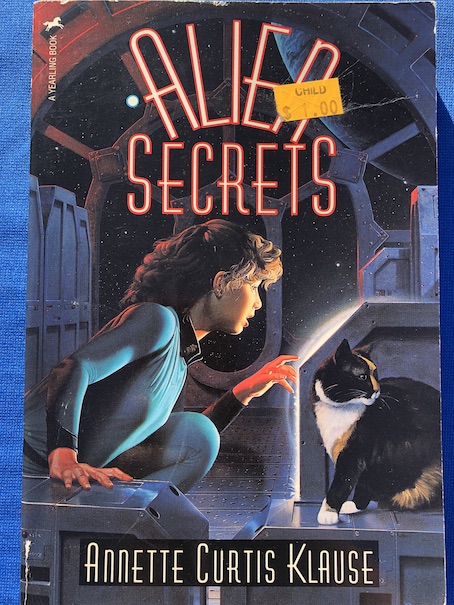
Alien Secrets by Annette Klause, 1993.

Robin Goodfellow, nicknamed Puck (her parents were fond of Shakespeare), is a human girl from Earth in the future.  When the story begins, she has been kicked out of boarding school on Earth and is traveling by space ship to join her parents, who are scientists who have been working on another planet.  They left Robin with her grandmother on Earth, who enrolled her in an English boarding school in order to give her some discipline and some friends her own age, but she was expelled for failing her classes (not to mention throwing a fit and burning her books when she discovered that she had failed).  Puck dreads what her parents will say when she arrives on the planet where they are now living because they had always hoped that Puck would also become a scientist and work with them, but this journey will change Puck’s life.

Before the ship she will be traveling on leaves Earth, Robin witnesses a man attacking someone else, possibly killing him.  Robin does not report the attack because she doesn’t know whether or not the other person was killed, and she doesn’t think that anyone will believe her anyway.  She witnessed this attack while sneaking around a place where she wasn’t supposed to be, and she is being sent to her parents in disgrace after being expelled, so she doesn’t sound like a very credible witness.  However, the man in the fight, Mizzer Cubuk (“Mizzer” is how they say “Mister” in the book), turns out to be traveling on the same ship as Puck.  All Puck can think of to do is to try to avoid him on the ship and hope that he didn’t get a very good look at her after she ran away from his fight.

To Puck’s surprise, the captain of the ship she is traveling on, Captain Cat Biko, asks her if she could make friends with an alien who is also traveling on the ship.  The alien is one of the Shoowa, who were enslaved by another group of aliens called the Grakk.  Now, he is free and finally traveling home to Aurora, the same planet where Puck is going.  The captain feels sorry for him and thinks that he might appreciate a friend and that he might find a human child less intimidating than an adult.

Later, Puck and other passengers are woken out of their sleep by the sounds of wailing and moaning.  One of the women on board, Leesa, says that she saw something that looked like a ghost that walked straight through her. Other people, who didn’t see or hear it, assume that it was nightmares or imagination, but Puck knows that it wasn’t.  One of the crew members, Michael, tells Puck that there have been rumors that the ship is haunted and that other people have seen and heard strange things.

Strange things are happening on the ship, and some of the passengers seem to be hiding something. Who can Puck trust, and who isn’t who they seem to be?

The alien who is traveling on board the ship understands Puck’s feeling of failure.  The alien, called Hush, says that he carries shame because he lost something important, something that his people were counting on him to take home to their planet.  Puck and Hush discuss how people from Earth had fought the Grakk and sought to learn about Grakk technology from Shoowa slaves who were freed after the war.  Even the ship they are now traveling on was once a Grakk ship.  The Earth people kept delaying sending the slaves home because they wanted to pump them for more information and because they were trying to decide if they could really trust them more than the Grakk.  After negotiating with the Earth people about returning home, the Earth people agreed, with some provisions.  They arranged for some of the Shoowa to stay on the Grakk home planet, still working with humans.  Some of them would travel on ships with Earth people, and some others could go home to their own planet.  Hush is the first one to head home, and he was entrusted carrying home an important symbol of his people that his family had protected for generations: a statue that represents a child because children are the future and a source of freedom, according to an ancient Shoowa prophecy. Unfortunately, the statue was stolen from Hush before he could return it to its rightful home. He reported the theft to the Earth security personnel at the station, but they didn’t take him seriously. They thought that he probably just lost it by accident.

The haunting is real in this book.  On a tour of the ship, Puck learns that the ship’s navigator has also seen the ghost aliens.  One of the characteristics of a ship’s navigator is the ability to see hyperspace, something that not everyone has the ability to do, although even scientists in Puck’s future time don’t seem to know why some people can do that and others can’t.  Slowly, it becomes evident that people who are able to see hyperspace are also able to see the ghosts.

On the journey to Aurora, Puck also learns that she is one of the rare people who are able to see hyperspace, giving her a possible future in navigating a space ship, something that she would really enjoy learning.  When she arrives at Aurora and is greeted by her parents, who have missed her while they were apart, Puck also comes to realize that her parents will always love her, even in spite of failing her classes. Even Hush’s people tell him that, although they are happy to have the statue back, his safe arrival was always the most important thing, and they wanted him to come home, whether he successfully brought the statue or not. Both Hush and Puck come to realize that their families will always love and value them even with their imperfections and failings.  With parents who love her and a new vision of the future ahead of her, Puck is ready to make a new life on Aurora.

The book is available to borrow and read for free online through Internet Archive.

Searching for Dragons

Searching for Dragons by Patricia C. Wrede, 1990.

This is the second book in The Enchanted Forest Chronicles, continuing the adventures of Princess Cimorene, although the story is told from the point of view of Mendanbar, King of the Enchanted Forest.  The Enchanted Forest is no ordinary kingdom, and Mendanbar is no ordinary king.  To be King of the Enchanted Forest means being a skilled enchanter.  Mendanbar can use the forest’s magic directly, making him more powerful than wizards.  Most of the creatures in the forest obey him, and unlike ordinary people, he can find his way around the forest almost automatically, even though things in the forest tend to move around.

At the beginning of the story, Mendanbar’s steward, Willin, pesters him about the subject of getting married.  Mendanbar hasn’t given the matter much thought since his father died three years earlier, but then, there’s been a lot to do.  Queen Alexandra has several daughters, any of which would be considered “suitable,” but Mendanbar doesn’t like any of them.  Mendanbar is annoyed because he’d just gotten the elf clans’ feud settled and was looking forward to a period of relative calm, so he decides that he’s going to give himself the day off, for a change.

He decides to take a stroll by the Green Glass Pool to relax, but on the way, he encounters a princess.  That’s not too unusual for the Enchanted Forest (home to many fairy-tale creatures and the events that make up fairy tales), but this princess strikes Mendanbar as a particularly scheming and ambitious one.  She tells him a great tale of woe in which her wicked stepmother cast her out that Mendanbar can tell is carefully rehearsed and might have even been the idea of the stepmother in question, with the idea of hooking an adventurous prince.  (Royal families do things like that, see the previous book in the series.)  However, Mendanbar is puzzled because the forest usually keeps out people who are obviously selfish.  Then, the princess mentions crossing an area of waste to get into the forest, and Mendanbar is alarmed because there shouldn’t be a wasteland there.  Forgetting about the princess, he hurries off to investigate.

Sure enough, Mendanbar discovers that a section of the forest is actually missing, destroyed to the point where there are just dead stumps.  Even the magic is gone.  Upon further investigation, Mendanbar finds dragons scales.  He isn’t sure why the dragons would want to attack the Enchanted Forest because they haven’t had any quarrels and mostly leave each other alone.  On the advice of a nearby talking squirrel, Mendanbar goes to see the witch Morwen.

After examining the dragon scales, Morwen demonstrates that, although they appear to be different colors and look like they’re from different dragons, they have actually been disguised.  They are actually from one dragon only.  Morwen also doubts that a dragon was really responsible for the damage to the forest.  After all, why would a dragon waste time disguising his scales when he could just pick them up?  Also, healthy dragons don’t shed that many scales.  Morwen is a friend of Kazul, who is the current King of the Dragons, and she advises Mendanbar to go see Kazul. 

Morwen also chides Mendanbar for not visiting Kazul when she became the king the year before.  Mendanbar feels a little guilty, saying that he’s just been very busy, which is true.  However, Morwen points out that what he could use is more effective help to organize things in the kingdom, not just making lists of things for him to do, like his steward does.  It’s part of the reason why people are saying that Mendanbar should get married.

Before Mendanbar can visit Kazul, he gets an unexpected visit from Zemenar, the Head Wizard.  Zemenar says that the wizards have been having problems with the dragons (again, see previous book) and that the dragons will not let them enter the Caves of Fire and Night.  He hopes that Mendanbar will allow them access from the Enchanted Forest.  Mendanbar doesn’t really trust the wizards, and he refuses the request on the grounds that he has something important to discuss with the King of the Dragons himself.  Zemenar tells Mendanbar about Kazul’s princess, Cimorene, blaming her for the the “misunderstanding” between the wizards and dragons.  Mendanbar at first imagines that Cimorene is much like the scheming princess he met that morning, but soon discovers that she’s anything but.  Taking the enchanted sword that only the kings of the Enchanted Forest can use with him, Mendanbar goes to visit the dragons.

At Kazul’s cave, Mendanbar meets Cimorene, who informs him that her official title is now Chief Cook and Librarian.  She tells him that part of the point of advertising this title is that it cuts down on the number of princes who come around.  Lots of princes want to rescue a princess, but few people want to rescue a Chief Cook and Librarian.  Mendanbar finds Cimorene a surprising change from the other princesses he’s met.  Mendanbar also makes a positive impression on Cimorene by using his sword to fix a broken sink, even if she describes the magic as being a bit “flashy.”

However, all is not well among the dragons.  Although Cimorene is reluctant to admit it at first, Kazul has mysteriously vanished.  She was planning to go out and search before Mendanbar showed up.  Kazul had been visiting her grandchildren when she decided to go by the Enchanted Forest to investigate someone growing dragonsbane.  Mendanbar shows Cimorene the dragon scales he found, and she indentifies them as belonging to Woraug, a dragon who was changed into a frog in the previous book.

It doesn’t take the two of them long to realize that the wizards are back to their old tricks and scheming.  However, what would they really have to gain by setting the Enchanted Forest and the dragons against each other?  And where is Kazul?

Like the other books in this series, this book is full of humor and a touch of mystery.  There are many parodies on fairy tale tropes, including an Wicked Uncle who’s not very wicked and does both a favor and an evil deed for his nephew by sending him to boarding school instead of abandoning him in the forest to have an adventure, as he’d hoped.  There is also romance between Cimorene and Mendanbar.  As you might have guessed, Cimorene is just the kind of practical princess Mendanbar needs to help him manage the magical chaos that is the Enchanted Forest and Mendanbar is the kind of king who is happy to find an intelligent princess who can do magic and rescue dragons.

The book is currently available online through Internet Archive.

Dealing with Dragons

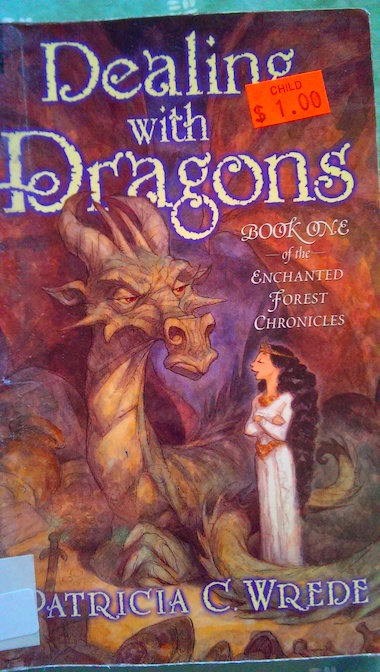
Dealing with Dragons by Patricia C. Wrede, 1990.

This is the first book in the Enchanted Forest Chronicles.  The fun thing about this series is that it parodies many popular fairy tales and their tropes.  Some of the books in the series also take the form of fantasy mysteries with some puzzle or nefarious happenings that the characters have to figure out.

From when she was a young child, Princess Cimorene of Linderwall has been bored with the kind of life that is expected from ordinary princesses.  Unlike her six older sisters, Cimorene doesn’t have golden curls.  She has black hair, and she’s way too tall for a cute little princess.  She’s also very stubborn.  When Cimorene gets bored of the usual princess lessons involving dancing, embroidery, and etiquette, she pushes other people in the castle into giving her different types of lessons.  First, she convinces the armsmaster to give her fencing lessons.  Then, she gets the court magician to give her magic lessons.  She also arranges Latin lessons, cooking lessons, economics lessons, juggling lessons, and so forth.  Each time her parents find out about her unusual lessons, they put a stop to them because none of the subjects that Cimorene finds interesting are “proper” for a princess to study. 

When Cimorene’s parents try to arrange for her to marry a prince that she doesn’t like, she finally decides that enough is enough.  Cimorene meets a talking frog in the castle pond, and after talking over her problem with him and saying that she’d rather be eaten by a dragon than marry the prince, the frog recommends that she run away.  He even gives her directions on where to go after she leaves the castle.  Not having any other plan, Cimorene takes his advice . . . and ends up at a dragon’s lair.

It works out for the best, though.  Rather than being eaten, Cimorene asks the dragons in the lair if they are in need of a princess.  She isn’t quite sure what princesses who are taken captive by dragons do, but she can cook (as part of her earlier cooking lessons) and do other chores.  Although one of the dragons, Woraug, wants to just eat her, the dragon called Kazul takes her on as her princess.

Cimorene finds it interesting being a dragon’s princess.  She cooks for Kazul and also helps to organize her treasure hoard and library.  As is expected when word gets out that Cimorene is a dragon’s princess, knights come to try to rescue her.  They are shocked when Cimorene turns them away, and it takes awhile before Cimorene is able to convince them that she’s really happy with the dragons and doesn’t want to be rescued.

Cimorene even makes new friends.  Morwen, a witch friend of Kazul’s, comes to visit and teaches Cimorene more about magic.  Morwen is also very practical and suggests putting up a sign (something like “Road Washed Out”) to discourage knights from approaching Kazul’s lair.  It is while Cimorene is putting out the sign that she means the wizard Zemenar.  His presence in the area is suspicious because wizards and dragons do not get along.  Wizards do not use their own magic but use their staffs to soak up magic from magical places or magical beings – like dragons.  When wizards take magic from dragons, they actually take part of their essence, and give them a reaction that’s similar to allergies.  Zemenar is also head of the Society of Wizards, so it’s doubly suspicious if he’s been hanging around a dragon’s cave.  When Cimorene tells Kazul and her friends about seeing him, they become concerned, wondering what he’s after.

Cimorene also meets other princesses who are the captives of other dragons: Keredwel, Hallanna, and Alianora.  At first, they also have trouble believing that Cimorene actually volunteered to be a dragon’s princess and that she likes it.  Cimorene doesn’t like the arrogant attitudes of Keredwel and Hallanna, but Alianora is pleasant, and the two of them become friends.  Alianora tells Cimorene that, although she was taken captive by Woraug, her family basically set her up for it.  Like Cimorene, she was under a lot of pressure to do the things that everyone expects of fairy tale princesses, but she wasn’t much good at them, and things never turned out as one might expect.  The wicked fairy who came to Alianora’s christening when she was a baby didn’t curse her; she just enjoyed the party and had a wonderful time.  Alianora also didn’t prick her finger on the spinning wheel that her busy-body aunt gave her, and when she tried to spin straw into gold, she got linen thread instead.  When various fairy tale schemes failed to work for Alianora, her interfering aunt arranged for her to visit a village, knowing that Woraug was going to ravage it.  As Morwen noted, princesses who are taken captive by dragons and then rescued can expect to make good marriages.  Although being abducted by a dragon was a shock, Alianora says it’s not so bad; Woraug mostly ignores her since she doesn’t know how to cook, and it’s a relief for her to get away from her nagging aunt.  The only downside is that the other, more conventional princesses are really annoying.  Alianora and Cimorene bond over their unconventional lives as fairy tale princesses.  Cimorene gets the idea to send some of her knights and princes to go rescue Keredwel, thus taking care of two problems at once.  Alianora also helps Cimorene with her efforts to find a fire-proofing spell to protect the princesses from accidental burning from the dragons, and later becomes her ally when things get more serious.

Zemenar returns to Kazul’s cave and, while Cimorene tries to subtly pump him for information, he sneaks a look at a book about the history of dragons.  He seems to be interested in the section about how they settled in the Mountains of Morning, how they chose their king, and the Caves of Fire and Night, where they found the special stone that they use to choose their king.

Then, the king of the dragons is murdered, poisoned by dragonsbane.  The wizards have a confederate among the dragons themselves, and they want something that only the king of the dragons can give them.

By the time the murder is committed, Cimorene and Kazul have a pretty good idea of who the conspirator among the dragons is.  The wizards think that they’ve found a way to rig the ceremony for choosing a new king so that the dragon who supports them will win, giving them what they really want.  However, Cimorene foils their plan with the help of her friends.  The mystery/conspiracy elements of the story are great and help add weight to balance out the lighter, fairy tale parody elements.

The book is currently available online through Internet Archive.

Magician’s Ward

Magician’s Ward by Patricia C. Wrede, 1998.

This is the sequel to Mairelon the Magician.  When the book begins, it has been about a year since Kim and Mairelon’s previous adventures.  Kim has been living with Mairelon as his apprentice, and he has been teaching her both reading and magic.  (In the previous book, Kim was living on the streets of early 19th century London.  She did not know how to read, and at the end of the previous book, she learned that she had the ability to become a wizard, prompting Mairelon to take her on for training.)  Although Kim enjoys spending time with Mairelon and appreciates what he’s teaching her, other aspects of life with Mairelon’s wealthy family are less appealing.  Kim gets bored reading by herself while Mairelon continues his work with the Royal College of Wizards, and Mairelon’s aunt, Mrs. Lowe, is trying to turn Kim into a proper young lady.  The pressures of the social niceties and obligations wear on Kim, and even more worryingly, Mrs. Lowe has been considering Kim’s marriage prospects.

In order to be socially-acceptable, Mrs. Lowe thinks that Kim should be considering a socially-acceptable marriage for her future.  For most of her life, marriage was about the last thing on Kim’s mind.  She spent most of her youth pretending to be a boy in order to be safer on the streets.  Since she became Mairelon’s apprentice, the challenges of reading and magic have occupied most of her time.  When Mrs. Lowe brings up the subject of marriage, the idea seems ridiculous to Kim.  With her poor background, she can’t imagine what kind of “respectable” man would want to marry her, and she can’t imagine anyone among the upper-class people of London she would want to marry.  However, she sees Mrs. Lowe’s point that she won’t be able to stay Mairelon’s apprentice and ward forever.  At some point, she will need to decide what to do once her training with Mairelon is complete.  It’s a little worrying to her that Mairelon (known to most people by his real name, Richard Merrill) hasn’t discussed the future with her and doesn’t seem to be making any plans.

Then, one night, Kim overhears someone breaking into the library in their house.  At first, Kim can’t imagine what someone would want in the library.  She interrupts the thief, and he manages to escape.  After colliding with her in the hallway, the thief leaves behind one of his buttons and a small piece of wood that seems to be magic.  When Mairelon examines the wood, he says that it appears that someone stored a spell inside it temporarily, to be used by someone else.  Also, whoever put the spell together didn’t do a very good job and probably didn’t really know what they were doing.

As for what the thief was looking for in the library, Mairelon discovers that he was particularly looking through a collection of books that his father purchased years ago from a French wizard who had come to England after fleeing the French Revolution.  In particular, the thief seems to be trying to obtain the memory book that belonged to the wizard’s wife.  A memory book is exactly what it sounds like – a book that that keeper would carry around with him or her and use to record certain things that he or she would particular want to remember, a little like a journal but often containing bits of important instructions, like notes about favorite recipes or cold remedies (not necessarily the entire recipe, just general reminder notes) or, in the case of a wizard, notes about important spells.

As they investigate further, they learn that the wizard and his wife were part of a larger society of wizards in France before the Revolution and that someone has been trying acquire all of their old books and notes to learn the secret of one of their spells, specifically a spell for sharing magical power.  The person who wants this knowledge has a nefarious purpose for it, and when Mairelon tries to interfere with his plans, he uses the knowledge he has acquired to block Mairelon’s own magic!  This spell and its power-hungry master has already harmed other magicians, and now, Mairelon is in danger, too.

Meanwhile, Mairelon and his family have decided that, in order for Kim to truly be accepted in society, she must have a coming out party.  The mystery and intrigue of the story mix with Kim’s new lesson in dancing, fashion, and social etiquette and the unexpected attention that she receives from young men as she begins truly mingling with the upper classes of society.  Part of the mystery actually does involve the tensions between social classes, social mobility, and the extent to which birth and natural ability influence both.  As Kim discovers that she is more acceptable in society and desirable to at least some of the upper-class young men, she also finds herself becoming jealous of the attention that Mairelon receives from young women in search of a good husband.

Like the first Mairelon book, this one is a nice mixture of mystery, fantasy, history, and comedy of manners.  Both of the Mairelon books are a fun mixture of intrigue and humor, and this one also has a nice romantic element as Kim realizes that the only man she could ever see herself marrying is Mairelon.  He’s eccentric and sometimes aggravating, but she loves him, and he has loved her all along, from the time when she was just a thief in the marketplace to her beginnings as a wizard and her transformation into a young lady. The book ends with Kim and Mairelon engaged to be married, and I’m sorry to say that there are no more books in the series after that. I really wish that there were because I think that there’s a lot more room for character development.

The villain’s plot in this book hinges on the earlier established principle that wizards are born, not made.  Only certain people have the ability to use magic.  For some people, like Kim, the ability to use magic can lift them to higher positions in life, and it can be a source of real power.  For a person who is unable to use magic, there aren’t as many options.  The villain in this book thinks that he’s found a way around the problem, but as Mairelon guessed from the first, he doesn’t really know what he’s doing.

Even though this book has been a favorite of mine for years, I noticed something this time that hadn’t really occurred to me before.  Mairelon’s aunt and mother in the book look at fashion and social obligations in a similar manner to people in high society and the business and legal professions (categories that overlap) in modern society, whereas Mairelon, who is considered pretty eccentric for a man of his family’s social standing, and other wizards seem to look at fashion and social obligations more like modern day academics, engineers, computer programmers, and other tech experts (at least, the ones I know because those are the kind of circles I tend to move in).  Within each of these categories, some of these characters are more knowledgeable about fashion or more socially adroit or intuitive, but I noticed that there are two basic schools of thought going on here.  For the high society types, fashion is essential and social activities are their main focus in life because that is how they build their connections, make the best possible marriage matches, gain support from others, and generally move up the social scale, always aiming to do a little better that they did before or set the stage for their children to move up.  For the wizards and academic types, fashion and social obligations are of secondary importance because what makes the biggest difference in their lives is knowledge and skill.  They even say that wizards are always considered socially acceptable because of their abilities and professional standing.  Because of that, they’re socially allowed some eccentricities in personal habits and dress, and many of them take those liberties as much as possible because most of them are kind of socially introverted and prefer either the privacy of their own studies or the company of others who share their professions and interests. 

At first, Mairelon doesn’t do much about Kim’s social education because it is not a subject that’s important to him and he knows that she can go pretty far in the field of magic by putting most of her efforts into building her magical skills.  However, what Mairelon’s mother and aunt try to impress upon both Mairelon and Kim is that they both need some social skills in order to function in wider society.  This is kind of like how tech experts may have some great ideas for creating new software or a new form of online business, but in order to get their ideas off the ground, they have to have some business knowledge or connections.  Wizards may be allowed to be a little less social or more eccentric than other people, and it’s generally understood and expected, but they do much better if they learn to balance their preferences with society’s expectations.  Because the people who normally occupy high society love the latest fashions and attending prestigious social events, they can’t understand why other people don’t. As the story says, they would leap to the assumption that a wizard, who is always acceptable in society, would naturally want to participate in society, and if the wizard didn’t, it must be that they are either not really a wizard or at least not a good one.  In other words, they would assume that something was wrong with the person or their skills, not recognizing that their choices are simply a matter of personal taste.  In order for Kim and Mairelon to truly rise in their professions, they also have to learn to manage their social obligations.

In the book, Renee is an example of a character who has learned this type of social, professional, and personal balance.  She is a wizard, and as a single female, is regarded as something of an eccentric, but she understands that social skills are important.  She is a longtime friend of Mairelon’s, and she lectures him somewhat on his social obligations and acts as something of a big sister/fashion mentor to Kim, along with Mairelon’s female relatives.

The book is currently available online through Internet Archive.
Mairelon the Magician

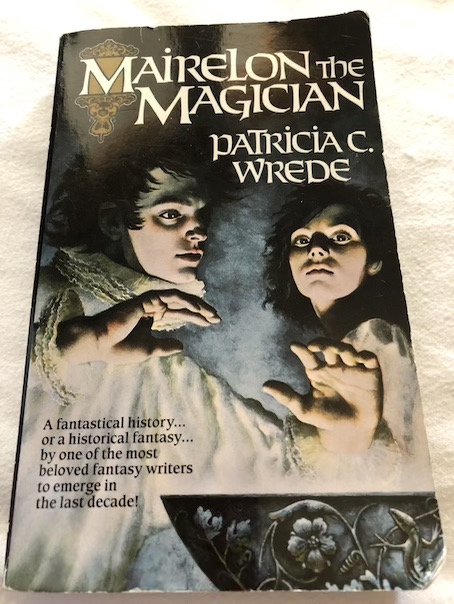
Mairelon the Magician by Patricia C. Wrede, 1991.

This young adult book takes place in an alternate history version of Regency England.  In this world, magic is a normal and accepted part of society.  “Wizard” is an accepted profession, and there is even a Royal College of Wizards dedicated to magic.  Not everyone can be a wizard because not everyone has the ability to use magic.  It is a skill that people are either born with or born without, similar to people who have an innate talent for art or music, compared to people who are born tone-deaf or color-blind.

In this early 19th century world, there is a teenage girl, Kim, who lives on the streets and survives by her own wits, taking whatever jobs she can and committing a little petty thievery whenever she needs to.  She has spent most of her life dressing like a boy and pretending that she is one because life on the streets is even more precarious for a girl.  For a time, she was part of a gang of child thieves run by a woman call Mother Tibb.  As far back as Kim can remember, Mother Tibb was the only one who took care of her as a child.  Kim has no memory of her parents or any knowledge about what happened to them.  She doesn’t even have a last name.  However, before the story begins, Mother Tibb was caught and hanged for her crimes.  Some of the other child thieves were apprehended and put in prison or exiled to Australia, but Kim managed to escape.  Since then, she has been on her own.  So far, she has managed to avoid being pressured in to joining up with other gangs or turning to prostitution to survive, but the fear of that haunts her. Her future is uncertain.

At the beginning of the book, Kim is hired to sneak into the wagon of a traveling magician who is performing in the market and to see what he keeps among his belongings.  The man who hired her doesn’t want her to take anything, but he is particularly eager to see if the magician has a particular silver bowl in possession.  It’s a strange request, but the money that the man offers Kim is too good to pass up.

However, the magician, who calls himself Mairelon, isn’t quite what he seems.  He is not just an ordinary traveling entertainer using some sleight of hand to amuse people in the market.  Kim discovers that he can do real magic as she searches his wagon and is knocked unconscious by a real magical spell that Mairelon uses to protect his belongings.

When Kim wakes up, Mairelon and his servant, called Hunch, have tied her up.  Unlike Hunch, Mairelon has also realized that Kim is actually a girl, not a boy.  The two of them question Kim about why she sneaked into the wagon, and she tells them the truth about being hired to do it.  When she describes the man who hired her, it seems that Mairelon recognizes the description.  The part about the silver bowl also unnerves him.

Surprisingly, Mairelon makes Kim an offer to come with him and Hunch when they leave London.  He is fascinated by Kim’s skills in picking locks, even the lock on the booby-trapped trunk that knocked her unconscious, and he thinks that Kim might be useful to him and Hunch, perhaps helping with the magic act.  In return, he offers to teach Kim some of his magic tricks.  Hunch is dubious about Kim because she has obviously been a thief, and Kim also isn’t sure what to make of Mairelon.  She knows that he’s hiding something, but she isn’t sure what.  No one with real magical abilities like him would ordinarily be making a living with simple magic tricks in the market. 

However, Kim does accept the offer because she’s been worried about one of the major criminals in the area, Dan Laverham, who has been showing too much interest in recruiting her. He is heavily involved with a number of criminal activities, and he knows that Kim is a skilled lock pick.  If he found out that she was a girl, he would probably also press her into prostitution. Dan Laverham would be a good reason to get out of London for a while.  Also, Kim realizes that if she learns a few magic tricks from Mairelon, she might be able to set herself up as an entertainer and make an honest living, safe no matter who finds out that she’s female.  Besides, Kim realizes that if she’s not satisfied with the situation, she could always run away later.

Before leaving London with Mairelon, she returns to the man who hired her, at Mairelon’s suggestion, and tells him that she didn’t see a silver bowl in Mairelon’s wagon (which is true because she was knocked unconscious and didn’t see anything in the trunk).  The man is angry, but Mairelon, who followed her in disguise, helps to create a distraction so that she can get away from the man.  They leave London in the middle of the night because Mairelon says that he was spotted by someone who recognized him when he went out to get magic ingredients.

On the journey, Kim gradually gets to know Mairelon and his situation.  The silver bowl, which Mairelon does have, is actually part of a set of magical objects which, when used together, can compel people to tell the truth without interfering with their ability to answer questions intelligently.  Mairelon’s real name is Richard Merrill, and he is, or was, part of the Royal College of Wizards.  Years earlier, the Royal College of Wizards was analyzing this particular set of magical objects and the unique spell that they control, when they were suddenly stolen, and Merrill was framed for the theft.  At the time, Merrill was unable to prove his innocence (at least not without sounding as if he had done something inappropriate with a lady, which he also did not do – they were just together at the time of the theft because she was helping him and another friend with a magical experiment), but he was also recruited by his friend in the government to be a spy against the French, so the story of his supposed theft gave him a plausible reason for wanting to leave the country.  In the time since then, he and his friend have continued to look into the matter of the theft, and they have made some progress in tracking down the other pieces of the magical set.  At the time that Kim met him, he was on his way to the next piece of the set, a silver platter.

To their surprise, however, they soon discover that someone has been making copies of the platter.  The copies are not magical, but they do confuse the issue.  Who is making the copies and why would they want copies, since they do not have the powers that the original has?  As Kim and Mairelon investigate, they crash a house party at a lavish country estate and spy on a meeting of a rather inept society of druids.  All the while, they are getting closer and closer to finding the original thief.

I loved the combination of mystery, fantasy, history, and humor in this book!  It’s one of my all-time favorites.  It has a happy ending with Mairelon’s name cleared and the thief caught.  They also discover that Kim has the ability to use magic, and Mairelon offers to take her on as his apprentice, saving her from the streets forever.  There is a sequel to this book called Magician’s Ward, about Kim’s life and adventures as Mairelon’s student.  The hints of romance in this book are also much stronger in the next one.  There are only two books in this series, which is disappointing because the characters are so much fun, and I think that there is a lot more room for their development.  By the end of the next book, Kim’s future is looking more certain, but her past is still murky.  Originally, I had expected that there would be secrets revealed about Kim’s past because of her ability to use magic, possibly something that was passed on to her by her parents.  However, by the end of the second book, Kim still doesn’t know who her parents were/are, and it doesn’t look like there’s any chance that she will ever know.  Perhaps it doesn’t really matter. Sometimes, secrets are more tantalizing when you imagine the answers than when you actually find out.

The book is currently available online through Internet Archive.
Mystery of the Pirate’s Ghost

Mystery of the Pirate’s Ghost by Elizabeth Honness, 1966.

Abby and Kit Hubbard’s mother has just received a letter telling her than her half brother, Jonathan Pingree, has died and left her the old Pingree mansion.  He has left over bequests to other family members as well, and money to be held in trust for Abby and Kit.  It’s exciting news, and the family may move to live in the mansion they have inherited, although it partly depends on Mrs. Hubbard’s other relatives. 

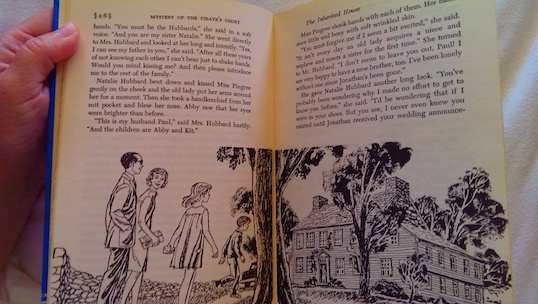
Mrs. Hubbard, who was born Natalie Pingree, has never met her half-brother or half-sister.  They were her father’s children, from his first marriage.  She doesn’t know much about her father’s early life because he died when she was very young, and all that she knows about him is what her mother told her.  Apparently, her father’s first marriage was not a happy one.  He stayed in that marriage long enough for his first two children, Jonathan and Ann, to become teenagers.  Then, he made sure that his first wife and children were settled comfortably enough in the family home and left them to move to Philadelphia to start a new life by himself.  Sometime later, his first wife died and he married Natalie’s mother, who was much younger.  After his death, Natalie and her mother moved in with her mother’s sister, Aunt Sophie.  When Natalie got married, Aunt Sophie sent a wedding invitation to Johnathan and Ann, but they never came to the wedding or made any reply.  Natalie assumed that they felt uncomfortable about their father’s remarriage and didn’t want to see her, which is why she’s so surprised about Jonathan leaving the family home to her.  The only reason she can think of why he would do that is that neither he nor his sister ever married or had children of their own, so there was no one else to leave the house to.  Both of them were more than 30 years older than Natalie, and Ann is now an elderly woman, still living in the house.  Jonathan’s will has made provision for her as well, and the Hubbards go to see her at the Pingree mansion.

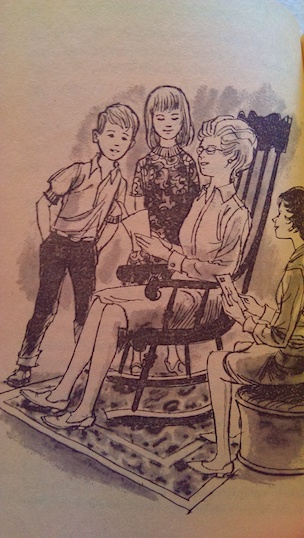
Mrs. Hubbard is pleasantly surprised that Ann is actually happy to see her.  Ann Pingree explains that the reason why she and Jonathan never replied to the wedding invitation was that, until that invitation arrived, neither of them had known that their father had another child, and they felt awkward about it.  However, Ann has been lonely since Jonathan’s death, being the last of the Pingrees, and she is glad to have Natalie and her husband and children with her and is eager to have them move into the mansion and live there. (Ann doesn’t live in the old mansion itself, but she does live nearby.)

Aunt Ann shows the family around the old mansion and explains more about its history and the history of the Pingree family. It turns out that the house, which has existed since Colonial times, although it has been burned, remodeled, and expanded over time. The house also has a number of secrets. Apparently, there used to be a tunnel running from the basement of the house to the beach that was used to bring in smuggled goods during the Colonial Era. There is also a hidden room behind a fireplace upstairs where the children of the family could hide during Indian attacks. (It doesn’t say how often that happened.) To the family’s surprise, Ann also tells them that the mansion is supposed to be haunted. The kids think it all sounds exciting, although Ann doesn’t explain much about the ghost the first time she mentions it. (Kit uses the phrase, “Honest Injun?” when asking Aunt Ann if she really means it when she says that the house is haunted. This isn’t a term that people use anymore because it isn’t considered appropriate.)

Mr. Hubbard is able to get his job transferred to a different branch of the company he works for, so the Hubbard family decides that they will move into the Pingree mansion. The kids like living by the beach, and their parents tell them that they can use the old ballroom of the house as a kind of rec room. Soon, they meet a couple of other children who live in cottages nearby, Chuck and Patty, and make friends with them. Chuck and Patty have already heard that the Pingree house is supposed to be haunted, although they’ve never seen anything really mysterious, just a light in the house once when they thought that the house was supposed to be empty.

The next time Aunt Ann comes to visit, the four children ask her to tell them about the ghost, and she tells them the story of the first Pingree to live at Pingree Point. This ancestor, also named Jonathan Pingree, built the original house in the late 1600s. He was a shipbuilder who owned several ships of his own, and he wanted to live near the sea. Later, he also became a privateer. When the kids call Jonathan a pirate, Aunt Anne agrees and explains that, unlike a pirate, Jonathan’s position as privateer was all perfectly legal because he had a Letter of Marque. (Yes, privateers operated within the law, but yes, they were also essentially pirates who raided other ships for their goods. In other words, they did the same things, but privateers did it with permission whereas ordinary pirates didn’t get permission. Historically, some privateers continued their pirating even after permission was revoked, so as Aunt Ann says, “the line between that and piracy was finely drawn.”) His son, Robert, was sailing on one of his father’s ships when it was taken by other pirates, and Robert was forced to join their crew. The family never saw Robert again and only found out what had happened from a fellow crew member who was set adrift and managed to make it back home. What happened to Robert is a mystery. His family didn’t know if he had really taken to the life of a pirate and couldn’t return home because he couldn’t face his family, if he had been killed in some fight, if he had been hung for piracy because he had gotten caught and couldn’t prove that he was forced into it. However, members of the family claimed that Robert’s spirit did return to the house and that he knocks at doors and windows, begging to be let back into his old home. Aunt Ann says that she’s never seen the ghost herself, but old houses can make all kinds of noises on windy nights, and that’s what she thinks the “ghost” is. As Chuck and Patty leave, they say, “we hope that old ghost doesn’t show up to frighten you.” Of course, we all know that it will because otherwise this book would have a different title.

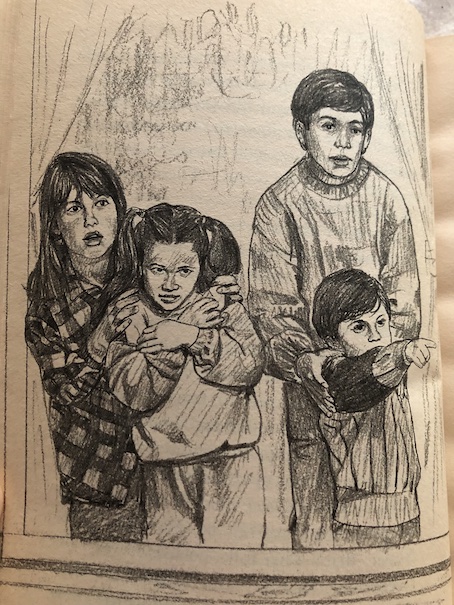
One day, Kit is bored and starts playing around in the secret room, pretending that he’s hiding from American Indians. While Kit is in the secret room, he overhears the servants, John and his wife Essie, who have worked for the family for years, talking. Essie seems very upset and wants John not to do something that might risk their home and jobs, but John says that it’s too late and that they’re already “in it” and “can’t get out.” Kit tells Abby what he heard. That night, Abby hears banging and wailing during a storm and fears that it’s the ghost. Soon, other strange things happen, like a desk that mysteriously disappears and a cupboard that also mysteriously appears in its place. The children like John, and they don’t want to think badly of him, but he’s definitely doing something suspicious. One night, the children try to spy on him, and Abby once again hears the wailing and sees a mysterious, cloaked figure in the fog. Is it the ghost?

There are some interesting facets of this story that make it a little different from other children’s books of this type. For one thing, the children confide their concerns to their parents almost immediately, and the parents immediately believe them. In so many children’s mysteries, either the children decide to investigate mysterious events on their own before telling the parents or the parents disbelieve them, forcing the children to investigate on their own. It was kind of refreshing to see the family working together on this mystery. It actually makes the story seem more realistic to me because I can’t imagine that I would have been able to keep worries about mysterious things secret from my parents as a child, and they would have noticed if I was sneaking around, trying to investigate people, anyway. Abby and Kit do something dangerous by themselves before the story is over, but they also confide what they’ve done to their parents at the first opportunity and do not take the same foolish chance again.

The truth of John’s activities comes to light fairly quickly, although it takes a little longer for the family and the authorities to decide how to handle the situation. Investigating John brings to light some of the Pingree family secrets, and Abby and Kit soon discover the fate of Robert the pirate and the truth of his ghost. I’ll spoil the story a little and tell you that the ghost that Abby sees is apparently real, but it isn’t very scary. Once they learn the truth of what happened to Robert and see that his body gets a decent burial, the ghost appears to be at peace.

One thing that bothered me was the way that the characters talk about Native Americans in the book. It’s not the talk about Native American sometimes abducting children because I know that happened. It’s more how they picture that would happen. In the scene where Kit was hiding in the secret room, Kit imagines that the Indians were attracted to the house by the smell of his mother’s cooking and that he went into hiding while his mother fed them to avoid being abducted. As part of his scenario, he imagines that his mother would have wanted to “hold her nose against the Indian smell.” What? Where did that come from? There are all kinds of tropes about Native Americans in popular culture, from the “noble savage” image to that silly “Tonto talk” that actors did in old tv westerns, but since when are they supposed to smell bad? I’ve never seen characters in cheesy westerns hold their noses before, so what’s the deal? I tried Googling it to see if there’s a trope that I missed, but I couldn’t find anything about it. I’m very disappointed in you, Elizabeth Honness.

This book is currently available online through Internet Archive.

The Secrets of the Pirate Inn

The Secrets of the Pirate Inn by Wylly Folk St. John, 1968.

One day, Jack, Amy, and Sally’s mother receives some surprising mail for her deceased father.  The children never met their grandfather, who died before they were born, but the letters concern their grandfather’s Uncle Will.  Uncle Will is an 88-year-old man, and one of the letters is from Miss Dibble from the Welfare Department in Port Oglethorpe, Georgia, the seaside town where Uncle Will is living.  Miss Dibble is concerned that Uncle Will is no longer in his right mind and not capable of taking care of himself, and she is hoping that his family will persuade him to go live in a retirement home. 

The children’s mother says that Uncle Will was an adventurer and a wild character even in his younger years, always playing games and doing eccentric things, so the situation may not be as bad as Miss Dibble thinks it is.  The mother has never met Uncle Will, either, because her grandmother disapproved of him and discouraged him from hanging around the rest of the family years ago.  She knows that her father always thought of him as being a fun uncle and that he used to own some land in North Georgia, where he found a priceless diamond.

The second letter comes from Uncle Will himself.  It contains a strange rhyme and a letter to his deceased nephew, saying that he sold his land and that the money from that sale and his diamond will go to him upon his death.  Uncle Will says that Miss Dibble is pressuring him to turn over his money to the state and to go live in the old folks’ home.  He’s been resisting her efforts, but he admits that he has gotten absent-minded and has forgotten where he hid his money and diamond.  He knows that the rhyme he wrote down is a clue that he made to remind himself of the hiding place, but now he’s confused, and he’s hoping that his nephew can help him figure it out because it’s based on a game they used to play years ago.  Because it’s been so long since he last spoke to the family, he has no idea that his nephew has died.  Uncle Will also says that he is currently living in an old pirate’s inn near Port Oglethorpe that has its own secret passage where pirates used to shanghai sailors.

The children think that Uncle Will and his pirate’s inn sound exciting, and they’d like to go meet him.  Their mother says that she’ll have to talk to their father about it, but she thinks that it might be a good idea for them to go and check up on Uncle Will and talk to Miss Dibble.  She makes up her mind when Miss Dibble sends an urgent telegram in which she says that Uncle Will is under the delusion that someone is now hiding in his house and trying to kill him for his money. The mother and the children decide to go see Uncle Will, although the father of the family can’t go because he has a business trip.

Of course, Uncle Will isn’t delusional, and there is someone after his hidden money. The old inn where Uncle Will lives is called The Bucket of Blood. When the children and their mother arrive, Uncle Will pretends to be an old pirate parrot, calling out “Pieces of eight! Pieces of eight!” (Yes, he’s definitely an eccentric, and it’s a little more understandable why Miss Dibble thinks he might not have all of his faculties.) They introduce themselves to Uncle Will, and Uncle Will is sorry to hear that his nephew is dead, but he is pleased to meet his nephew’s daughter and her children. The children tell him that they want to help him to solve the rhyme and find his money.

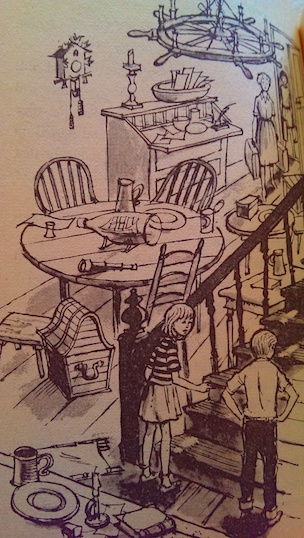
The inn is full of fascinating things, although it’s lacking in modern conveniences. The mother asks Uncle Will if they can stay there, saying that they’ve brought sleeping bags with them. Uncle Will tells them that they can use the bedrooms upstairs but warns them that he’s worried that someone might be hiding somewhere upstairs (as Miss Dibble had said earlier). Uncle Will rarely goes upstairs these days because he finds it difficult to climb up there. However, the children realize that Uncle Will is not deluded when they notice footprints in the dust on the stairs, meaning that someone has been there recently. However, the footprints seem to be only going up, not down. When the search upstairs, they don’t find anyone. Where the footprints left by a ghost? Was someone really hiding in the inn, and if so, how did they leave?

There is a live action made-for-tv Disney movie based on this book. You can see the entire movie online at Internet Archive. The movie is different from the book in a number of ways. In the movie, there are three children, but it’s two boys and a girl (a brother and sister and the brother’s friend) instead of two girls and a boy (all siblings), and none of them are related to the old Irish sea captain living in the old inn. (Note: The child characters in the movie, Scott, Tippy, and Catfish, also appeared in another made-for-tv Disney movie called The Strange Monster of Strawberry Cove, which was also based on a book for children, The Mad Scientists’ Club, but that book was written by a different author, and none of those children actually appeared in either this book or that one.) The old captain in the movie has recently inherited the inn from his brother. The location was moved to Louisiana instead of Georgia, and the treasure they’re looking for was hidden by the pirate Jean Lafitte. There are rhyming clues to the treasure’s location, but they’re not the same as the rhymes in the book. The money and the diamond are also hidden in separate locations in the book. In fact, although the bulk of the money is in one place, some of it is hidden in other places.
In the book, there are also extra characters, a man named Miles who is staying with Uncle Will while he’s working on writing a book and a young runaway nicknamed Hop who is afraid that he will be sent to another foster home like the one he ran away from if Miss Dibble catches him. At first, I suspected one of these characters of being the villain of the story, trying to steal Uncle Will’s money. However, the real villain is someone we don’t really know until the end, although he has connections to other people in the story. This is different from the movie, where the villain is a suspect we meet and see often before his guilt is established. Because of this, I think that the movie was playing more fair with the readers about the mystery.

Near the beginning of this book, the characters reference The Joyous Season by Patrick Dennis (also the author of Auntie Mame), which was published only a few years before this book was. Sally thought that the book was hilarious, but Jack thought that it was boring because the boy in the story, who was his age, “didn’t have a thing to do every day but listen to grownups talking.” I think this is meant to be a sign that the children’s parents are pretty modern and progressive, letting their children read a book about divorce and mixed-up family life in the 1960s. At one point, the mother tells Jack not to use euphemistic swear words like “Cripes!” just because characters in books to it. It gets on the mother’s nerves because she thinks that “They sound even worse than the words they’re being used to avoid.” She actually tells Jack, “When you’re old enough to swear by any words you like, I hope you’ll manage without euphemisms.” I mentioned in my page of 1960s children’s books that the 1960s were a turning point both in society and children’s literature, and this is an example of people’s changing attitudes. Sally, the oldest of the children, is allowed to wear lipstick, and Amy, who is twelve, is also allowed to wear it, although she thinks of it as being too much trouble to bother most of the time. (I can relate. I still sometimes throw out old make-up that I just plain forgot that I had because I’m too busy and preoccupied most of the time to think about it.)

Linda Craig and the Clue on the Desert Trail

Linda Craig

Linda Craig and the Clue on the Desert Trail by Ann Sheldon, 1962.

Linda and her friend, Kathy, are exploring Olvera Street in Los Angeles before a horse show when Kathy notices a strange man watching them.  While the girls were shopping, Linda bought a small horse statue that reminded her of her own horse.  As the girls finish lunch, Linda notices an odd symbol on the statue that looks like an arrowhead, but before she can study it more, the man grabs the horse and runs off.  Linda tries to chase him down to get the horse back, but the man drops it and breaks it.  Linda picks up the horse’s head and decides to go back to the shop where she bought it to see if she can get another one.

The shop doesn’t have another horse like the one Linda bought.  It was unglazed, and the others are glazed.  Disappointed, Linda goes on to the horse show, where she is taking part, along with her brother Bob and his friend Larry.  At the show, they see the mysterious man again, and he apparently steals the broken head of the horse statue that Linda had kept.  Bob thinks that maybe the man is some kind of smuggler and that there was something hidden in the head that Linda hadn’t noticed.

Linda goes back to the shop to talk to the owner again, and he tells her that the horse was a special order from Mexico for a man named Rico.  Rico said that he was a traveling salesman and that he would collect the horse at the shop, but when he didn’t turn up to get it, the shop owner decided to sell it. Linda asks the shop owner to send her another horse statue like the broken one if one comes into his shop and reports all of this information to the police.  Then, when she returns to the horse show, she finds a threatening message, warning her to “Beware. Stay away from C. Sello.”  The note is signed with the symbol of an arrowhead, similar to the one on the horse statue.  Linda also reports this note to the police, but she can’t resist trying to figure out who C. Sello is and how this person fits into the mystery of the possible smugglers.

Soon after, the shop owner calls Linda to say that another horse statue did come into the shop and that he has sent it to her but now someone has broken into his shop and smashed every horse statue he has. Realizing that what they wanted was not in the shop, the bad guys are soon on Linda’s trail, even kidnapping one of her friends by mistake, thinking that it’s her. They even try to poison Linda’s horse!

At the end of a desert trail, the Mojave Trail, there is a ghost town with sinister characters and old cliff dwellings with Native American petroglyphs that may hold part of the secret to the mystery.

The story contains some anecdotes about California history, which is interesting. I have to admit, though, that I thought that the warning note for Linda was pretty silly. C. Sello turns out to not be a person but a clue about what the smugglers are smuggling, and they didn’t have to tell Linda what it was because she hadn’t heard about it at that point and wouldn’t have any reason to know what they were talking about. If they really wanted to get her to leave them alone, they could have left a more vague warning that didn’t include any clues like “Go home!” or “Go away!”