The Dinosaur Mystery

Boxcar Children

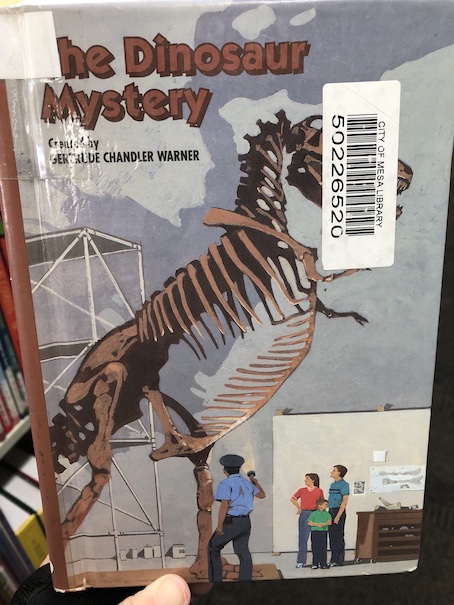
The Dinosaur Mystery by Gertrude Chandler Warner, 1995.

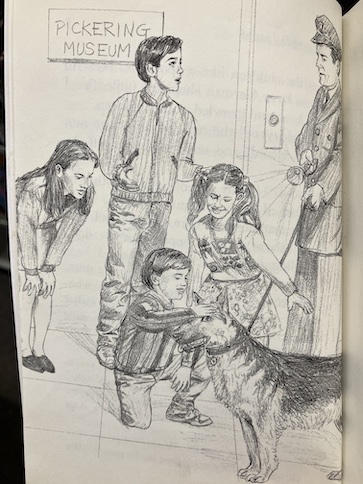
The Alden children and their cousin Soo Lee are visiting the Pickering Natural History Museum to help Mr. and Mrs Diggs, who are on the museum’s board of directors, to set up a new dinosaur exhibit. They will be staying in the Diggs’s apartment, which is connected to the museum by a tunnel. The children love the rooms where they will be staying because they’re decorated with spare exhibits from the museum!

However, very quickly, they notice that strange things are happening at the museum. The alarms seem to go off sometimes for no reason. The night watchman, Pete, is new at the museum and acts oddly. He seems to like having fun with the exhibits more than paying attention to security. On their first night there, Jessie sees a light in the museum windows, in the dinosaur room, where nobody is supposed to be, and she thinks that she sees the shadow of the dinosaur skeleton moving.

The next day, the Aldens meet the other staff at the museum. Dr. Eve Skyler operates the planetarium, and she’s very protective of it. She’s been upset because renovations at the museum have messed up the planetarium. When the Diggs tell her that the Alden children are there to help clean up, Dr. Skyler is dubious and worries that the children will damage the equipment, but the Diggs tell them that the children have worked in museums before.

After the children clear the planetarium and take a lunch break, they catch Dr. Sklyer moving some things that they had thrown out back into the planetarium! When they confront her about what she’s doing, she denies everything, and it ends up taking the children almost twice as long to finish the task. The children don’t know what Dr. Skyler’s problem is and why she would want to sabotage their cleaning of the planetarium when she had badly wanted it cleaned.

When Dr. Titus Pettibone, who is the fossil expert in charge of the dinosaur room, returns from a trip, he discovers that bones are missing from the tyrannosaurus skeleton! Benny and Soo Lee are sure that Dr. Pettibone was the man they saw sneaking around the museum the night before. Dr. Pettibone avoids their questions about sneaking around the museum and is every bit as opposed to the children working on the new dinosaur exhibit as Dr. Skyler is about the children helping to clean the planetarium.

Then, someone removes all the posters that the children put up about the new dinosaur exhibit. Mrs. Diggs knows that someone removed them on purpose because, when she asks people at the places where the children put them up, they say that a woman took them, saying that she wanted them as souvenirs. In spite of that, everyone in town knows about the new exhibit because word about the missing dinosaur bones has spread. Is someone trying to drive people away from the new exhibit, or are things that have been happening part of a publicity stunt? The children known that someone is sneaking around the museum, especially at night, and both Dr. Skyler and Dr. Pettibone seem to have something to hide.

The book is available to borrow and read for free online through Internet Archive.

My Reaction

One of the first things that I noticed about the book is that many of the characters have pun names – Mr. and Mrs. Diggs, who operate the natural history museum; Dr. Sklyer, who is in charge of the planetarium; and Pettibone, who is the fossil expert.

The book does a good job of making everyone look equally guilty. From the beginning, I suspected that was because there are multiple people doing multiple things for different reasons, and it helps to make the mystery more complicated and involved, keeping readers guessing.

This is another instance of the Alden children having the opportunity to do something unusual and build work experience because of their grandfather’s connections. Their grandfather knows Mr. and Mrs. Diggs and arranges for the children to stay with them, and their previous experiences with museums, like in one of the later books, The Mystery of the Mummy’s Curse, were also due to Mr. Alden’s connections. Although the children’s grandfather allows the children to have independent adventures without him, he is usually the one who sets them up in the stories. Most real children never get opportunities like this and may not be allowed to do some of the things the Alden children do because of rules regarding volunteers, especially juvenile volunteers, due to insurance liabilities. I would have loved to work in a museum when I was a kid, but my family never had the connections that the Aldens do.

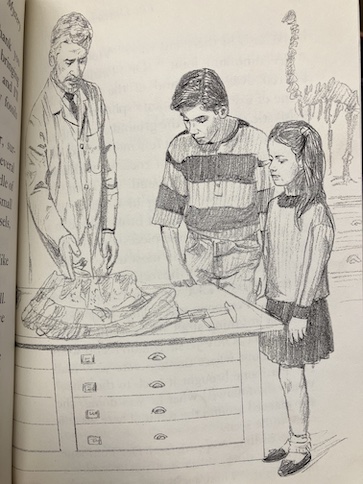
I can understand why children aren’t allowed to do certain jobs. Dr. Pettibone is correct that there are certain tasks that require specialized knowledge and delicacy. After he warms up to the kids more, he begins showing the children some of the details of his work and what his equipment does. He lets Violet do some of the delicate work after he shows her what to do because she does artwork and plays the violin, so she is accustomed to fine, detailed work. In real life, though, I don’t think that a 10-year-old child would be allowed to do this kind of work as quickly or as well as Violet does in the story. The Aldens have to learn to do things quickly in the interest of time in their stories, and they rarely make the kinds of mistakes that beginners do at anything they try.

I have done volunteer work in museums as an adult, and one thing that they don’t tell you in this book is that, when you see an assembled dinosaur skeleton in a museum, it’s probably all or partly a plaster model of the bones rather than the real bones. That’s because fossilized bones are no longer actual bone. They are petrified, so they are as heavy as other stones. When you have stones the size of large dinosaur bones, it’s extremely difficult to mount them so that they stand up, like the dinosaur would in real life. Sometimes, plaster models also fill in for bones that are missing from an incomplete skeleton. Complete skeletons are very, very rare. There were only two places where there were real dinosaur bones on exhibit in the last museum where I volunteered. One was a dinosaur thigh bone that visitors were allowed to touch to learn what fossilized bone feels like. The other was a collection of pterosaur wing bones mounted on a wall, where no one could touch them, and it wasn’t a complete wing. Some museums have exhibits marked so you know which bones are models and which are real fossils.

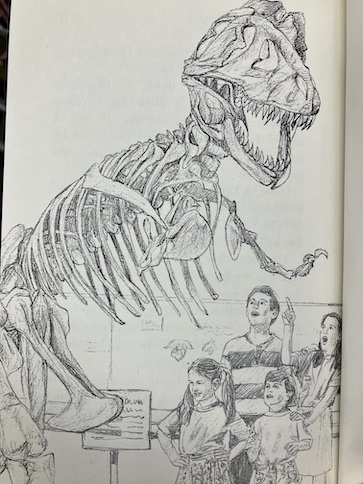
I also liked the art style in this book. Boxcar Children books vary in art style because they were produced over multiple decades, but my favorite illustrations are the ones that look the most realistic. I think realistic illustration styles are best for this book in particular because they show the details of the dinosaur skeleton realistically.

The Summer Camp Mystery

The Boxcar Children

The Summer Camp Mystery by Gertrude Chandler Warner, 2001.

Grandfather Alden is taking the Boxcar Children to Maine to go to summer camp. Henry and Jessie are going to be junior counselors. Violet will be an overnight camper, and because he’s younger, Benny will be a day camper, staying with Grandfather Alden at a nearby inn overnight. The camp is located on an island and can only be reached by boat. It used to be owned by the Pines family, but the family lost of a lot of money trying to keep the camp going and had to sell the camp to Ginny and Rich, who run things differently. The camp activities used to be mostly sports, but Rich and Ginny have added other activities and special awards for other things because not all the campers are good at sport. They want more variety, and they want to give every camper to have a chance to participate in activities that they really enjoy.

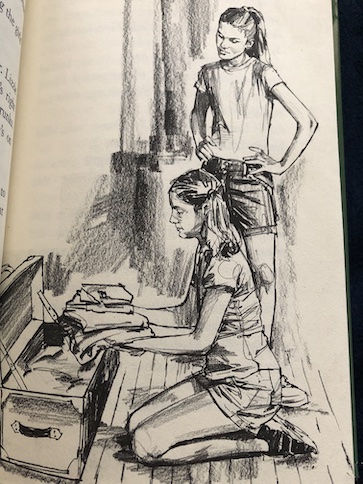
However, things go wrong from the beginning. Kim, one of the other counselors, is mean. She stops the Aldens from loading their own trunks on the boat to go to the island, saying that she’ll take care of it, but she doesn’t. She leaves their trunks behind on the dock and makes a big deal about the Aldens being incompetent and not even taking care of their own belongings. The Aldens are embarrassed, and they don’t even call attention to the fact that Kim stopped them from handling their own trunks.

The missing trunks create more problems because the camp has a running competition between different teams of campers. When the Pines family owned the camp, the competition was entirely based on sports, but the new owners offer points to teams for different projects and events, even incorporating being neat and responsible into the contest, so the Aldens have lost points for their teams by leaving their trunks behind.

Because the teams are randomly assigned, three of the Aldens are on one team, and Violet is by herself on Kim’s team. Kim makes no secret of the fact that she doesn’t like Violet, and because there is a rule that different teams can’t talk to each other about what they’re doing for different parts of the contest, Violet feels even more isolated from her siblings. Also, the Pines children, Zack and Lizzie, who still attend the camp, aren’t happy with their team. Lizzie really wanted to be on Kim’s team because she looks up to Kim. She was on Kim’s team the previous year, when the camp was all sports stuff, and they won every event. Violet thinks that the best solution is for her and Lizzie to switch teams, so Lizzie can be with Kim, and she can be with her siblings, but Ginny says that switching teams is against the rules.

Meanwhile, Zack is resentful of Henry because Henry has been given his usual job of flag raising at the camp. Ginny and Rich say that they’ve reduced the number of things that Zack does at the camp because they want him to experience and enjoy the activities at the camp instead of working and doing all the little jobs he used to do when his family owned the camp. Also, Henry can play the bugle, providing a live bugle performance instead of just using the old bugle recording the camp has been using.

However, besides the incident with the Aldens’ trunks being left behind, someone steals the camp’s flags before the flag raising. Henry looks incompetent when he can’t find them, although Jessie’s cabin comes to the rescue by quickly drawing some new ones as emergency replacements. Then, the missing flags later appear on Henry’s bed, and he has no idea how they got there. The Aldens lose points for this incidents, and Kim’s team also steals Jessie’s cabin’s idea for a good deed event, even submitting it to Rich and Ginny before Jessie does. Jessie isn’t sure how she knew what her cabin was planning, but Kim even gave her event idea the same name. It can’t be a coincidence.

The Aldens are having a frustrating time at camp, and they have to figure out exactly what’s going on and prove that they’re not the ones messing things up.

The book is available to borrow and read for free online through Internet Archive (multiple copies).

My Reaction

Not Much of A Mystery

This mystery story isn’t really a “whodunit” kind of mystery so much as “howdunit” and “how are our heroes going to prove it?” The culprits were really obvious from the very beginning and every step of the way. There are no other suspects. It’s definitely Kim, Lizzie, and Zack, and the rest of the story is how the Aldens prove what they’re doing. There is a slight element of “whydunit” because the Aldens don’t really understand why the three of them are doing all these things, although I thought at least part of that was obvious, too.

I understand that Kim, Lizzie, and Zack weren’t happy about how the camp changed after the Pines family had to sell it, but that’s no excuse for treating other people the way they do. To me, at least at first, it looked like they weren’t so much sad about change as angry that they weren’t the favored, “special” campers anymore. Lizzie and Zack were no longer special for being the owner’s kids and getting to perform special duties the other campers couldn’t do, and Kim was no longer special for winning everything all the time because she’s good at sports. The new owners of the camp got Henry and Jessie to be junior counselors and help with some of the chores around the camp, like the flag raising, because they thought that Lizzie and Zack could use more time to enjoy the fun activities, but instead of having fun, they’re just angry that they lost another status symbol. I didn’t like or feel sorry for Kim, Lizzie, and Zack at all. To me, they were just mean, selfish, and entitled. Because I hate one-upmanship so much, it just made me angry.

There were a couple of points that softened my feelings a bit, but not by a lot. I felt a little less angry when Zack talked about how the flag-raising ceremony had special, sentimental value to him because members of his family have always done that job at camp, and the bugle recording the camp always used for the flag-raising ceremony was made by his uncle. He misses the feeling that he’s following in his family’s footsteps. In the end, he acknowledges that Henry’s live bugle playing is better than his uncle’s recording, but his uncle’s recording was always good enough for them before, and that he’s still attached to it because it’s his uncle on the recording, giving it that personal connection. Emotional attachment and that sense of family and tradition are more understandable and easier to sympathize with than just selfishness and status-seeking.

Lizzie also says that they were resentful of the Aldens because three of them got to be overnight campers, something she’s always wanted to do but was too young to do before. The Pines kids were angry that Rich and Ginny somehow managed to find room in the cabins for three of the Aldens but told them that the overnight slots were full, and they would have to be day campers instead, like Benny. The story doesn’t make it clear whether the camp owners actually bumped the Pines kids to make room for the Aldens as overnight campers or if the Aldens just submitted their request before the Pines kids. If Rich and Ginny canceled the Pines kids’ overnight reservations just to give the Aldens special treatment, that would be bad, and the Pines kids would have a genuine complaint. However, I think that the Pines kids’ father, who runs the ferry to the island where the camp is, probably just didn’t settle their overnight reservations in time because he took it for granted that they would be given places, forgetting that they don’t own the camp anymore and would have to register, just like everyone else.

Competitiveness

Kim is a major part of the reason why I didn’t feel sorry for the culprits. She’s not a member of the Pines family, so she doesn’t really have sentimental reasons behind her behavior. She’s just all about winning, and she’s sore because she used to win all of the camp’s sports events. Now that the camp isn’t just all about sports, sports, sports, she can’t take it for granted that she’s going to win everything, and that makes her angry. She feels entitled to the activities that she’s good at and resentful that she now has to take part in activities where other people are better than she is and where she might lose. She says that leaving the Aldens’ trunks behind was an honest mistake because she was just so busy on the dock, but once she realized the mistake, she didn’t do anything to correct it, just using it to her advantage in the competition. She also encouraged Lizzie to slip away from Jessie and come talk to her, both getting Jessie in trouble for losing track of one of her campers and pumping Lizzie for information about what their team was doing, so she could steal their ideas. She complains that she had to do it because she knows that she’s only good at sports, not the creative things that the Aldens do, and that she had no chance of winning if she didn’t cheat. I think that comment points to what was wrong with the camp under the Pines’ leadership, and probably, why the camp was failing and losing money.

I think the Pines’ camp was probably losing popularity with campers because it mainly catered to the Pines’ interests and those of a select group of sports nuts, like Kim. As Rich and Ginny observed, the camp was all about sports. People who were good at sports won everything, all the time. Kim got used to what she thought of as her guaranteed victories because all the activities were geared to her interests and talents, but most of the other campers felt left out and possibly resentful of the favored ones. To me, it sounded like the Pines’ camp had become like this little clique where certain, favored campers won everything and had everything their way, and nobody else could do much of anything. It was like most of the camp was just along for the ride while certain people did the things they liked and continually won at everything. It was getting to be the same every year. People who were very sportsy and competitive might still have enjoyed the camp, but it was just so niche in its focus that a lot of other campers probably just lost interest. Enrollment in the camp fell because it wasn’t fun anymore for a lot of campers. That’s probably why Rich and Ginny wanted to change things, because they could see how people were feeling left out and tired of the same old things with the same “winners” every time.
What Kim really resents is other people being given the chance to win something and show what they’re good at. She doesn’t care if other people are frustrated at being made to do only activities that she’s good at so she can always “win” against them because she hates being made to do things where someone else is better and she’s less likely to win. In other words, what she really hates and fears is being treated exactly how she treats other people. That’s why she feels compelled to “fix” things, so she gets put in what she views as her rightful place as the eternal winner. I didn’t like her or sympathize with her as a character at all. She’s extremely self-centered and controlling, not even trying the new activities. Because she’s not a creative or thoughtful person, it never even occurs to her that she has an entire cabin full of campers who may be more creative and thoughtful than she is. She shuts down her own teams’ ideas as not being good enough so she can just use her stolen idea. She never even gives her own team a chance because she feels like she, personally, has to be the winner who does everything, and nobody else should even be allowed to contribute. She refuses to even help her campers in their efforts in activities and actively ignores them to focus on what she wants to do.

Kim reminds me of Kate in Color War in the Camp Sunnyside Friends series, although perhaps it’s more accurate to compare her to her rival in that book because of the cheating. When I reviewed that book, I was frustrated with the way Kate was declared the winner of the camp contest. It’s true that she didn’t cheat, like her rival, but they both behaved badly and were terrible sports. (Not terrible at sports, just really bad sports in the sense of being bad teammates, bad attitudes, and bad winners and bad losers.) It’s just really hard to like anybody whose biggest fear is other people treating them the way they treat others. However, I like the way this Boxcar Children book treats the contest better than the way the Camp Sunnyside Friends did. When I reviewed the other book, I wished that the camp counselors had just declared the contest a tie, both because that would have been fair and would have pleased most of the other campers while blowing the little win-monsters’ minds. This book takes a completely different approach, but I still appreciated it.

Spoilers

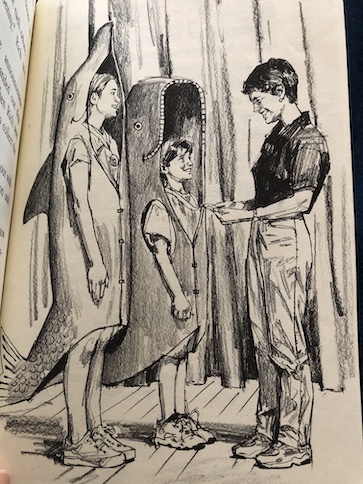
We never learn who wins the overall contest at camp. The book ends before the contest is finished. Once the Aldens realize how Kim is getting her information and stealing their ideas, they set a trap for her. They let her and Lizzie think that they’re going to do a particular theme for the camp’s costume contest when they’re actually doing something else. They write a letter to Rich and Ginny before the contest, telling them what they’re doing, to prove that Kim is cheating and stealing ideas.

Once the cheating is exposed, Kim, Zack, and Lizzie talk about their motivations. Rich and Ginny point out to the kids that they haven’t changed all the old camp traditions. They used to go to this camp when they were kids, and they preserved parts of the camp that they and other campers always liked, such as the camp legends about a monster on the island and offering points for campers who don’t scream during scary stories, events, and pranks. They also decide to allow Zack to retain some of the jobs he loves so much since that’s part of what makes camp fun for him, and they promise Lizzie that she can be an overnight camper next year.

When they have to decide who wins the costume contest, they don’t want to immediately declare Kim’s team the loser for her cheating because none of the other campers on her team were aware that she stole the idea for their costume theme and they honestly made their costumes themselves (without Kim’s help because she was too busy with her own costume and made Violet help the other campers instead). Since Kim’s team was competing honestly even though Kim wasn’t, Rich and Ginny think they deserve to be judged on their efforts and not on Kim’s. The Aldens agree that’s fair, and they suggest that the audience of camp visitors who came to see the event should be the judges of the contest since they’re only seeing the kids’ costumes and don’t know about the other things that have happened. They decide to let the audience vote for the team with the best costumes, and the story ends there, without saying what the results of the vote were.

I liked it that they found a fair, impartial way of settling the contest and that we never find out who won. If the story ended with a known winner, it would feel like the author was using who “wins” to declare who was on the side of right in the story. To declare the Aldens’ team the winners would reward hard work and not cheating, which is good, but Rich and Ginny have a point that Kim’s teammates aren’t responsible for Kim’s cheating. To not let them have their own, honest chance would be to punish them for having a bad leader, which isn’t fair. On the other hand, if it ended with Kim’s team winning, it would suggest that it doesn’t matter if you cheat or not as long as people let you win anyway to keep your teammates from being hurt, which would also be a bad lesson. Personally, I would still favor not having a “winner” at all because, in this type of situation, it’s just really awkward whichever way it goes. Not knowing who won or lost or if it turns out that the audience declared a tie also works. The focus of the story is kept where it should be: not on who won but how they each played the game.

The Mystery of the Purple Pool

The Boxcar Children

The Boxcar Children are all bored, especially Benny. Grandfather Alden tells them that he has to go to New York City on business, and the children can come with him and see the city. That sounds like just the kind of excitement the kids need! Their grandfather calls the hotel where he’ll be staying and reserves a suite of room for all of them. Then, he tells the children to look through some guidebooks for the city and decide what they want to see there. He says that, during the time when he’ll be working, the two oldest children, Henry and Jessie, will be in charge. The children start looking through the guidebooks and talking about things they want to see in New York.

When they arrive at the Plymouth Hotel in New York, the children’s grandfather notices right away that the service isn’t how it usually is at this hotel. For some reason, their reservation was canceled, although they are still able to get rooms. Then, there are no bellhops to be found to carry their bags, and even the hotel management doesn’t know where they are. As they go to their room, they hear another guest complaining that his room wasn’t cleaned, even though the maid said that she’d cleaned it.

All of these things could be mistakes or signs of bad hotel management, but it soon becomes apparent that someone is deliberately trying to sabotage the hotel. When the children try to swim in the hotel pool, they find out that someone dyed the pool purple! Then, someone switches the sugar and salt in the hotel restaurant, ruining everyone’s breakfast. When the kids come back from sight-seeing, they see a crowd of people in the lobby, all complaining about various things missing from their rooms, like pillows and shower curtains. Then, the children get stuck in the hotel elevator when someone turns it off and have to call for help.

The Alden children have another mystery on their hands! Who could be the mysterious saboteur, and what would they want to harm the hotel? There’s a mysterious man who seems to be lurking around when bad things happen. There’s also a maid who is angry about her brother being fired from the hotel. The hotel manager isn’t always on hand to deal with things when they go wrong. There’s also an unfriendly woman who doesn’t like kids (named Karen before that name started to be used as a slang word for a disagreeable, complaining woman) and is always scribbling in her notebook, never letting anybody see what she’s writing. Any of them could be the culprit, or it could be someone they haven’t even thought to suspect.

The book is available to borrow and read for free online through Internet Archive (multiple copies).

I remember reading this book and liking it when I was a kid. One of the hallmarks of The Boxcar Children series is that the children are always allowed their independence in their adventures. Their grandfather lets them explore the city completely on their own, even though the oldest child in the family is only 14 years old. Few people would let their children roam around New York City completely on their own these days, and they didn’t when I was a kid in the 1990s, either. Another guest at the hotel even lets his young son go sight-seeing with the Alden children when they haven’t known each other very long.

The kids have fun exploring the amenities at the hotel, too. The book draws attention to various aspects of staying at hotel, like suites with kitchenettes, hotel restaurants, pools and exercise rooms, and the snacks and toiletries you might find in your hotel room. I thought it was interesting how the book explains how you can call for help in an elevator if it gets stuck. Its a useful thing for kids to know.

One thing that occurred to me when I revisited this story was that it doesn’t mention the World Trade Center. They characters could have visited the original World Trade Center in the story because the book was published 7 years before it was destroyed in the September 11, 2001 terrorist attack, but the World Trade Center was not one of the sights that the children went to see. If it had been, it would have dated the story, but I can’t think of anything the children saw or did in the book that really dates it. The things they mention still exist in New York, and this story could still be set in the early 21st century.

Mystery Behind the Wall

The Boxcar Children

Mystery Behind the Wall by Gertrude Chandler Warner, 1973.

It’s summer vacation, and Benny doesn’t know what to do with himself because his friends have gone away for the summer. Mrs. MacGregor, the housekeeper, suggests that they invite a guest to the house to cure Benny’s loneliness. Her sister in Canada knows a boy who lives on a farm and is often lonely because they live a long way away from other people. The boy, called Rory (short for Roderick), is very lively and full of ideas, and he could use some company as much as Benny does. The kids are all eager to meet Rory and have him visit, so their grandfather calls Rory’s family and arranges for the visit.

The Alden kids are excited about Rory’s visit and start preparing the spare bedroom. They wonder if Rory will like it or not because the room seems old-fashioned and a little sad to them. The walls are covered with a wallpaper with roses, so the kids think that it must have been a girl’s room at one time. They notice an old photograph on the wall of a girl with her parents in front of the house, but the house looked different and smaller when the photograph was taken. There’s also a poster that says “Coolidge for President” in the window, dating the photograph to the 1920s, meaning that the picture is decades old. (The Aldens refer to that as being about 40 years yearly, dating the story to the 1960s.) Mrs. MacGregor puts a bright red bedspread on the bed to brighten the room up a bit, and the Aldens hope that Rory won’t mind that it still seems a bit old-fashioned.
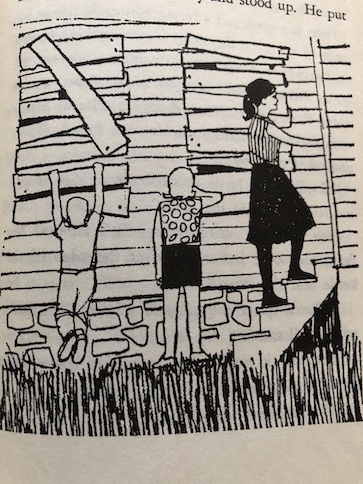
Rory doesn’t mind the room at all. In fact, he is a bright and curious boy, who is interested in everything and notices little details. He notices the photograph in the room when he arrives, and he asks Grandfather Alden about it. Grandfather Alden explains that the people in the photograph are the Shaw family and that they owned the house before he bought it. The girl is named Stephanie, and she was the Shaws’ daughter. The Shaw family sold the house to Grandfather Alden when they moved to France, and Grandfather Alden built an addition onto the house, which is why it looks different now. The children wonder what happened to the Shaw family and to Stephanie, but Grandfather Alden says that he doesn’t know. They never wrote to him after they moved to France.

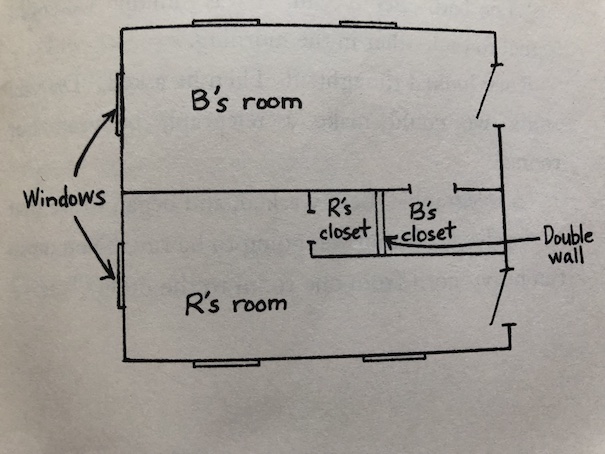
Another thing that Rory notices about the guest room is that it looks like the closet should be bigger than it actually is. Benny has the room next to Rory’s, and he has the idea making a hole in the backs of their closets so they can have a secret communication system between their rooms. Grandfather Alden doesn’t mind the project, so they cut holes in the backs of their closets. That’s when they discover that there is a secret, hidden space between the closets, and there’s something hidden in the space. They pull it out, and it’s a piece of cloth. They wonder what it’s for and why someone would hide it.

Grandfather Alden identifies the cloth as a coin case. He tells the kids a little more about Stephanie Shaw. He knows that Stephanie’s father was a very strict man. Her mother went to France ahead of the rest of the family, and her father was in charge of her in her mother’s absence. He had her tutored at home and didn’t let her play with other children, so she was often lonely. However, he allowed her to indulge in their shared hobby, which was coin collecting. The kids wonder what happened to the coins when Stephanie left for France. There are no coins in the coin case now. Professor Nichols, a coin collector who specialized in rare nickels, also helped Stephanie with her collection. He thought that Stephanie might have left her coin collection behind when she went to France, thinking that she might return one day, but Stephanie never did return. Professor Nichols would have asked Stephanie about it, but he didn’t have their address in France.

When the kids explore the hiding place in the closet further, they find an old notebook that turns out to be Stephanie’s journal from when she was 10 years old. Stephanie explains about her loneliness, and her coin collection. She talks about a puzzle that she created that will fool even her father, but the journal ends, so they don’t know what sort of puzzle Stephanie was talking about.

As the children explore Stephanie’s old room further, they find a clue that shows that Stephanie created a treasure hunt before she left for France, a treasure hunt that nobody has ever solved. The Boxcar Children and their new friend, Rory, begin playing along with Stephanie’s old treasure hunt, hoping that it will eventually lead to her missing coin collection.

The book is available to borrow and read for free online through Internet Archive (multiple copies).

My Reaction

This is one of the early Boxcar Children books, written by the original author. Because the book was written decades ago, a child who was 10 years old in the 1920s would have been about 50 years old at the time the story is set, but the children are sad to learn that Shaw family, including young Stephanie, was killed in a railway accident in Europe, which is why none of them ever returned to solve the treasure hunt and reclaim the coin collection.

The Boxcar Children run into multiple dead-ends in the treasure hunt because things have changed in the decades since Stephanie created her treasure hunt, and clues have been lost. They almost give up, but Benny and Rory realize something that helps them solve the final riddle.

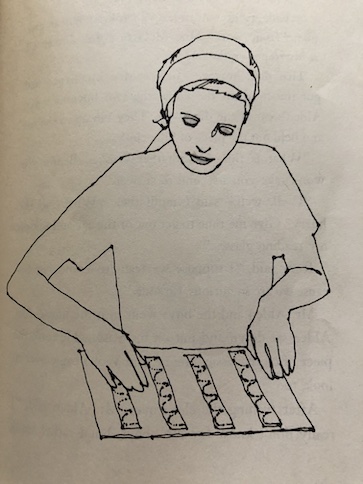
When they finally find the coin collection, they call Professor Nichols to come and look at it, and he tells them about some of the rare coins in the collection, like a 20 cent piece and an Indian head penny. He explains some general principles of coin collecting to the kids, like the fact that the oldest coins aren’t always the most valuable pieces in a collection. There are some very old and even ancient coins that are not quite as rare as some newer coins, and the rarity is what makes them valuable. He helps the children to start their own coin collections. This book could be a fun mystery to help get kids interested in a new hobby!

Bicycle Mystery

The Boxcar Children

Boxcar Children Bicycle Mystery cover

Bicycle Mystery by Gertrude Chandler Warner, 1970.

Boxcar Children Bicycle Mystery fixing a bike

Grandfather Alden tells the Boxcar Children that their Aunt Jane has invited them to visit her on her farm. To make the trip more interesting for the adventurous kids, he suggests that they make the journey to Aunt Jane into a cross-country bicycle trip. There are motels along the route where they can stay, or they can came out. They won’t be able to take Watch the dog with them this time because he’s getting too old to follow their bikes that long distance, but the kids like the idea of the cross-country bike trip.

The cross-country trip gives the Alden children the chance to meet new people and have adventures. Along the way, they stop to help Mrs. Randall, a woman who is worried about having to fix dinner suddenly for her husband’s boss while her house is a mess. The Aldens see how upset she is while they’re shopping for food themselves, so they volunteer to help her. The boss’s visit turns out to be a success, and rather than coming to discuss a problem at work, he’s there to tell the Randalls that he’s considering Mr. Randall for a promotion. However, the Alden children have the feeling that there’s something else worrying Mrs. Randall that has to do with her son, Carl, who isn’t there. Every time Carl is mentioned, Mrs. Randall seems worried.

Boxcar Children Bicycle Mystery dog in the window

As the children continue on their way, they get caught in a rain storm and take shelter in an abandoned house. There, they find a little gray dog, who seems friendly and well-behaved. The dog is very hungry, and they share their food with him. The dog seems eager to follow them when they leave. They try to tell the dog to go home, thinking that he probably lives somewhere nearby, but he insists on going with them. Benny starts calling the dog Shadow for following them. The Aldens don’t think they can keep Shadow because they don’t think Watch would like them getting another dog, and they’re a little worried that letting him follow them might be taking him further away from wherever he lives, but they don’t know what to do but take care of him until they can figure out where he belongs.

Boxcar Children Bicycle Mystery injured boy

Later, they meet a boy who is minding a roadside vegetable stand who has a broken leg. The boy says that he feels badly because his father can use some help picking vegetables, too, but he can’t do much since he broke his leg. The Boxcar children offer to help, and the boy and his father are surprised that they’re willing to work for free. The kids say that they’re just out for adventure right now, and they don’t mind helping. The father, Mr. Smith, notices the way that Shadow whines constantly, even though he doesn’t seem hurt. They talk about the dog and wonder who the owner is. Mr. Smith thinks that, if someone didn’t want the dog, they probably could have sold him instead of abandoning him. His son, Roy, noticed something odd while he was minding the vegetable stand. A pair of girls commented that it was the same dog that they had seen in a parking lot earlier. Mr. Smith suggests that the kids ask Miss Lucy at the post office if anyone in the area has lost a dog because she knows everyone and everything that’s going on. When they ask Miss Lucy, she says that nobody in the area has lost a dog, and Shadow isn’t at all familiar to her. Shadow seems to be an unusual breed, and Miss Lucy thinks that he looks funny.

As the children travel further, they spot a sign for a dog show. They decide that they should go to the dog show and see if they can meet people who are interested in dogs and might know what kind of dog Shadow is. They meet a man who tells them that the dog is a young show dog, and he offers to buy the dog. When the kids say that they can’t sell Shadow because he doesn’t belong to them, the man and his wife seem suspicious, and the woman takes a picture of them and the dog.

When the kids finally reach Aunt Jane’s farm, Uncle Andy recognizes the dog as a Skye terrier. The kids finally manage to locate the dog’s owner, and it turns out to be a surprise.

The book is available to borrow and read for free online through Internet Archive (multiple copies).

My Reaction

This is one of the early Boxcar Children books, written by the original author. Because of the cross-country trip format, the book is somewhat episodic, with incidents taking place at different places where the children stop on their trip. The story has more elements of adventure than mystery, but the mystery element is there, too.

The Boxcar Children frequently have more independence from adult supervision than most kids have today, which is part of the appeal that the series has for kids. I think that most people who rent motel rooms would be concerned about renting rooms to children by themselves, but it’s important to point out that the word “kids” is relative. In the later books in the series, the kids’ ages are frozen, so the eldest, Henry, never ages past 14 years old. However, in the earlier books, like this one, the kids did age. In this book, Henry is college-aged, so he’s not exactly a kid anymore. The book doesn’t provide an exact age for him, but he’s probably 18 years old or older.

The Lighthouse Mystery

The Boxcar Children

The Lighthouse Mystery by Gertrude Chandler Warner, 1962, 1994.

The Boxcar Children and their grandfather have been visiting the children’s Aunt Jane. They are there to see her get married, and now they’re on their way home again. While driving home, they stop to look at a lighthouse and see a For Sale sign. The children are intrigued at the idea of owning a lighthouse, and their wealthy grandfather decides to ask a nearby storekeeper what he knows about the place. It turns out that the storekeeper has recently purchased the lighthouse himself, so it’s no longer for sale, but he’s willing to rent it out to visitors. The children’s grandfather is as fascinated at the idea of living in a lighthouse as the children are, so he decides to rent it for them to stay in.

During their first night at the lighthouse, the children’s dog, Watch, suddenly starts barking and growling. They can’t figure out what is upsetting watch, although Benny thinks that he smells food. They wonder if someone could be cooking something at the little old house near the lighthouse, but after a while, Watch calms down, and they all decide to go back to bed and check out the situation in the morning.

The next day, they go shopping for food, and the children find themselves looking suspiciously at everyone they meet, wondering if someone was near the lighthouse the night before. The first suspicious person they see is a man who almost knocks Violet over because he’s not looking where he’s going. Then, they meet a young man who seems angry about something. The storekeeper says that the young man graduated from high school early because he’s very smart, but his father won’t let him go to college. Grandfather Alden explains to the storekeeper that they had a prowler the night before, and he’s thinking about talking to the police about it. The children persuade their grandfather not to talk to the police because they want to investigate the mystery themselves.

The next night, the children see a woman outside the lighthouse, but when they investigate, they can’t find anyone. They think maybe she went into the little house nearby. Later, they look through the windows of the old house, which are mostly boarded-up. Inside, they see food and cooking equipment, which means that someone might have been cooking there the night that Watch started barking. Strangely, they also see a microscope, seaweed, and something that looks like its glowing. They think maybe someone is doing an experiment of some kind. It could be the woman they saw, or it could be the clever but angry boy who isn’t allowed to go to college, Larry Cook.

When the town holds a special Village Supper, the children learn that Larry loves to cook. They make friends with him while helping him to prepare the food. As the kids become friendlier with Larry and talk with other people in town, they learn more about Larry’s father’s opposition to him attending college and how Larry has been trying to study on his own. They’re pretty sure that Larry is the one who’s been conducting some kind of experiment in the little old house, but what is he trying to do?

The book is available to borrow and read for free online through Internet Archive (multiple copies).

My Reaction and Spoilers

This is one of the early Boxcar Children books, written by the original author. Because it’s one of the early books, the children in the story age. In the books written by other authors after the original author’s death, the children’s ages are frozen, and Henry is always 14, but in this book, he’s in college. That means that he’s not too different in age from Larry, and the kids find out that the college Larry wants to attend is the same one that Henry attends.

At first, I thought that Larry’s father objects to him attending college because they can’t afford tuition, but someone else who knows the family says that Mr. Cook is just a selfish man. I’ve noticed that some people who never went to college take other people’s levels of higher education as some kind of personal insult, like people who go to college are just trying to make them look bad or somehow discredit their personal life choices. It doesn’t seem to occur to them that people might do things for themselves and make decisions for the sake of their own lives that have nothing to do with them in any way. I think that might be the kind of selfishness that the story is trying to describe. Mr. Cook is one of those people who makes everything about himself and feels the need to control other people’s lives to make himself feel good or justify his choices. I’ve also noticed that people who haven’t been to college often don’t understand how changing technology and job requirements cause people to need more education to do jobs that used to require less. They also don’t have the imagination to see how more education can help someone progress further and faster in their field or how it might open the door to new fields they haven’t experienced or even thought about. Because they haven’t sought more education themselves and aren’t accustomed to stretching themselves and looking for new ways to skill up, they don’t think that there might be possibilities beyond their scope. Mr. Cook even admits all of that later, saying, “I just made up my mind that he couldn’t go, and I hated to give in. You see I never had a chance for much schooling. I’ve done all right. I couldn’t see why Larry needed to go to college. A waste of money, I thought. I guess I’m quick to lose my temper and slow to change my mind.”

In spite of his selfishness, this acquaintance says that he thinks Mr. Cook really loves his son. He’s just accustomed to putting his son and his son’s future second to himself. What causes Mr. Cook to change is when Larry is in danger, out on the family’s boat in a storm. Faced with the prospect of losing his son completely, Mr. Cook promises that, if Larry is rescued, Larry can have whatever he want. College turns out to be the right course for Larry. It not only helps him to pursue his field of study but to connect with professors and students who also share his passions and love of learning. It suits him and the life he wants to live.

In some ways, this story is more adventure than mystery. By the time that Larry is rescued from the storm, the Aldens think they have a pretty good idea what Larry is trying to do, but Larry explains it all to them after his rescue rather than the Aldens needing to prove anything themselves. There is also no crime in this story. The mystery part is more about unexplained or mysterious circumstances. Larry hasn’t done anything wrong or illegal. He’s not even trespassing in the little house because his family owns it. Larry’s experiments combine his love of science with his love of cooking. He’s trying to produce new kinds of foods using seaweed and plankton that can help to feed the world.

The Super-Duper Cookie Caper

The Bobbsey Twins

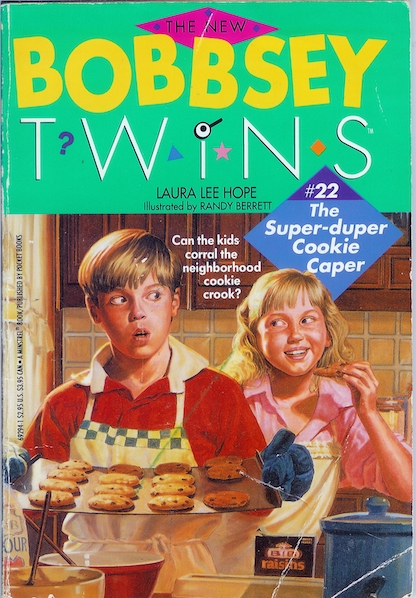
Bobbsey Twins Super-Duper Cookie Caper coverr

#22 The Super-Duper Cookie Caper by Laura Lee Hope (Stratemeyer Syndicate), 1991.

Before I begin, I’d like to acknowledge Sean Hagins, for supplying me with photos of this book! Usually, I take pictures of books myself, but I just couldn’t find a physical copy of this one. Sean is a big fan of the Bobbsey Twins, particularly the New Bobbsey Twins mysteries, and you can see some of his video reviews as well as videos about his photography work on his YouTube channel, SJHFoto. Thanks, Sean!

Freddie decides that he wants to get a new bike, and inspired by the school bake sale, he decides that he’ll make and sell cookies to raise the money. His grandmother makes really delicious oatmeal chocolate chip cookies that everybody loves, so he plans to make and sell them. He persuades his twin, Flossie, to help him by promising her part of the money from the cookie sales. Their parents approve of the plan, and their mother offers to help them because neither of them has much experience with cooking.

When Freddie and Flossie go to sell the cookies in the park, they’re pretty popular. Everyone loves the cookies, and Freddie boasts about his grandmother’s secret recipe. Their last customer is a man who gives them a dollar with some kind of white powder on it, and he doesn’t seem to think much of the cookies. Freddie doesn’t care because everyone else likes them, and they’re making money.

There are some complications to selling cookies. First, Flossie has a sweet tooth, and Freddie has to keep stopping her from eating their stock herself. Then, a boy at school, Brian, announces that he’s going to set up a rival business in the park, selling brownies. Freddie gets the idea of offering broken cookies as free samples and selling orders of cookies door-to-door.

Nan and Bert start helping with the cookie-baking, but things don’t always go well in the kitchen. There are times when they forget ingredients or let the cookies burn. Then, the children realize that the card with the recipe on it is missing! They search the kitchen and realize that there is a chocolate smudge on the kitchen window. It looks like someone reached through the window and stole the recipe!

There are a few logical suspects. It could be Brian, hoping to cash in on the success of the cookie-selling. It could be their old nemesis, local bully Danny Rugg, who stole their free samples earlier and generally likes to mess things up for the Bobbseys. Then again, there is the mysterious man who keeps showing up at the park. The Bobbsey Twins find out that he owns his own bakery. To find out who the recipe thief is, Freddie decides to invent a trap. He tells everyone that his grandmother has given him her other secret recipe for super-duper cookies that’s even better than the first one. Who will take the bait?

The book is available to borrow and read for free online through Internet Archive.

My Reaction

Sean and I were discussing earlier how later books in the New Bobbsey Twins series tended to focus more on the younger set of twins than the older Bobbsey twins and seem to involve lower-stakes mysteries. Earlier books in the series involved definite crimes, police matters, and strange phenomena. A stolen cookie recipe feels like much lower stakes. However, I thought this one was well-done for what it was. There are some definite suspects, enough to sow some doubt about who the recipe thief is. The actual thief is someone I suspected but not necessarily the most obvious suspect, and the thief’s motives do make logical sense, although I’m not sure (spoiler) any real adult would seriously consider that kind of business model. It sounds more like something a kid might do, and that’s partly what allows readers to doubt whether it’s a child or adult who took the recipe.

There is also a punchline to the story. There was one thing that I had guessed early on about the grandmother’s “secret recipe.” It’s not as “secret” as the kids think it is. I guessed that because, when I was a kid, one of my grandmothers always baked chocolate chip cookies. Those cookies were one of the highlights of going to her house. When we were little, my brother and I liked them so much that we guessed that she must have been a baker before she retired. When we were older, we found out that she’d actually been a bookkeeper and that her cookie recipe was just the Toll House recipe from the chocolate chip package. She made two versions, with and without nuts from the pecan tree in her backyard, but it was still the Toll House recipe. It’s a similar situation with the Bobbsey Twins’ grandmother’s secret recipe. The only thing the grandmother changed was the cooking time. Everyone just thought that the cookies were special because her grandchildren thought they were, and they convinced other people. Few things are as special as homemade cookies from your grandmother!
The Chocolate-Covered Clue

The Bobbsey Twins

#10 The Chocolate-Covered Clue by Laura Lee Hope (Stratemeyer Syndicate), 1989.

Before I begin, I’d like to acknowledge Sean Hagins, for supplying me with photos of this book! Usually, I take pictures of books myself, but I just couldn’t find a physical copy of this one. Sean is a big fan of the Bobbsey Twins, particularly the New Bobbsey Twins mysteries, and you can see some of his video reviews as well as videos about his photography work on his YouTube channel, SJHFoto. Thanks, Sean!

Flossie has made a new friend, Casey Baker, whose parents own Baker’s Bakery. They invite her to come for a tour of the bakery to see how they make everything. It means getting up very early on a school morning because the baking has to start very early. They need to have everything freshly baked by the time the bakery opens for customers. Although it’s difficult to get up that early, Flossie enjoys the tour, seeing the large electric mixers where they make the cake batter and the enormous oven where they can bake over 100 cookies at once.

While the Bakers are showing her everything, they all realize that they feel cold. Someone has left the door to the alley open. Nobody is around, so they assume that it must have just been left open by a deliveryman making an early delivery.

Later, while Flossie and Cassie are admiring a beautiful chocolate cake, something really strange happens. A masked man suddenly runs into the shop, grabs the cake, and runs away with it! Who could be so desperate for chocolate cake that they have to resort to theft? The Bobbsey Twins’ mother is covering a series of recent burglaries for the local newspaper, but this is the weirdest theft the kids have ever heard of.

It gets weirder as the day goes on. While Freddie and his mother are running errands, they stop at a diner, and the same masked man runs in and smashes the chocolate cake on the counter with his bare hands! Freddie tries to chase him, and the man throws cake at him. The cake that was smashed was also from Baker’s Bakery.

The Bobbsey Twins talk to Casey, and she tells them that someone stole their delivery list. From then on, this crazy cakenapper starts tracking down and stealing and smashing every chocolate cake Baker’s Bakery made that day – including the one that the Bobbseys had delivered to their house.

What’s behind all of this cake carnage and chocolate destruction? Does someone have a grudge against the Bakers or against chocolate-based desserts?

The book is available to borrow and read for free online through Internet Archive.

My Reaction and Spoilers

I really liked the premise of this mystery! It’s such a fun, crazy concept of someone going all over town, smashing cakes, apparently for no reason. It’s the sort of mystery that I sometimes call a “Bizarre Happenings” mystery. That’s a mystery where strange things happen that encourage the characters to investigate, but it’s not obvious what’s behind it all or what sort of crime is really being committed. An example from adult literature would be the Sherlock Holmes story, The Red-Headed League, where the characters know that someone has been deceived into joining a special club for red-headed men that doesn’t actually exist and paid to copy entries from the encyclopedia, but they’re not sure why at first. In the case of the Bobbsey Twins mystery, the characters know that someone is stealing and destroying chocolate cakes, which is a very bizarre form of theft, but they’re not sure why. Readers can guess from the beginning that this rash of cake thefts is related to a different crime.

Actually, the solution to the story is very similar to that of another Sherlock Holmes story, The Adventure of the Six Napoleons, where someone is stealing and smashing busts of Napoleon. It has nothing to do with Napoleon or the busts themselves. There is something hidden inside one of the busts that someone is desperate to find, but because the busts all look alike, they have to track down and smash them all to find the one they really want. It’s like that with the cakes. The destruction of the cakes has nothing to do with the Baker family, their business, or the cakes themselves. Someone came into the bakery, looking for a place to hide, and dropped something in the cake batter while it was being mixed. Because the batter in the massive mixer was made into multiple cakes, they can’t be sure which cake now contains what they want. They need to track down the right cake in a hurry, before someone else finds what they hid. What seems to be an oddball crime puts the Bobbsey Twins up against a dangerous criminal!

Encyclopedia Brown Takes the Cake

Encyclopedia Brown

Encyclopedia Brown Takes the Cake by Donald J. Sobol with Glenn Andrews, 1982, 1983.

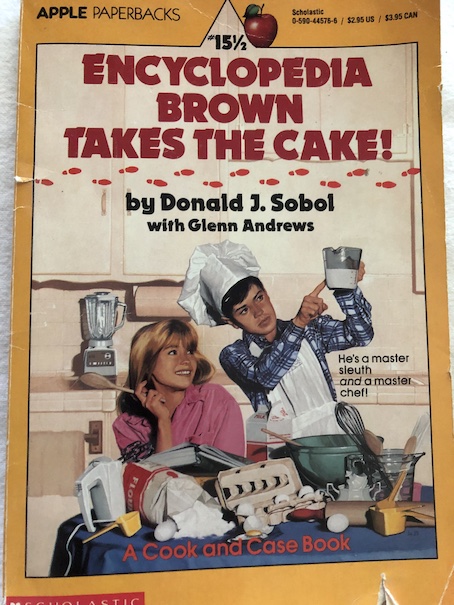
This book is a little different from other books in the Encyclopedia Brown mystery series. Like other books, it’s a collection of short solve-it-yourself mystery stories with the answers to the mysteries in the back. However, this book also has special sections with recipes and cooking tips after each story. The recipe sections are based on things that happen in each of the stories. It’s best to read the stories first to avoid some of the spoilers in the recipe sections.

The book is available to borrow and read for free online through Internet Archive (multiple copies).

Stories and Recipe Sections:

The Case of the Missing Garlic Bread

Encyclopedia Brown’s neighborhood nemesis, Bugs Meany, and his friends stole some garlic bread and a chocolate cake meant for a birthday party. They deny it, but Encyclopedia Brown knows how to prove that they’re the thieves.

Kitchen Basics

The birthday boy’s mother gives the kids kitchen tips, like how to peel and cut vegetables.

The Case of the Fourth of July Artist

On the Fourth of July, a local boy known for trying to cheat people attempts to sell a picture of the Liberty Bell supposedly painted by one of his ancestors on July 4, 1776. Encyclopedia explains why the painting is a fake. (It was a good enough painting that the guy should have just tried to sell it as an ordinary painting instead.)

The Fourth of July Party

Encyclopedia and his friends make oven-fried chicken, some side dishes, and a red, white, and blue shortcake for their Fourth of July party. All the recipes are provided.
The Case of the Oven Mitt

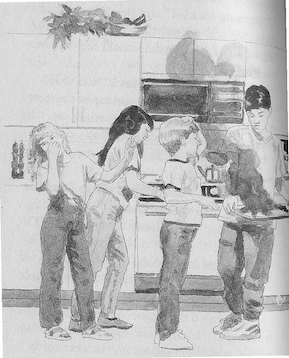
A friend of theirs has started working in her father’s kitchenware store. On her first day, while she’s helping their friend, Hermes, to decide on a present for his mother, someone sneaks in the back and steals a couple of mixers. She feels badly about it, and at Hermes’s birthday party, Encyclopedia realizes that the thief is one of the party guests.

Hermes’s Birthday Brunch

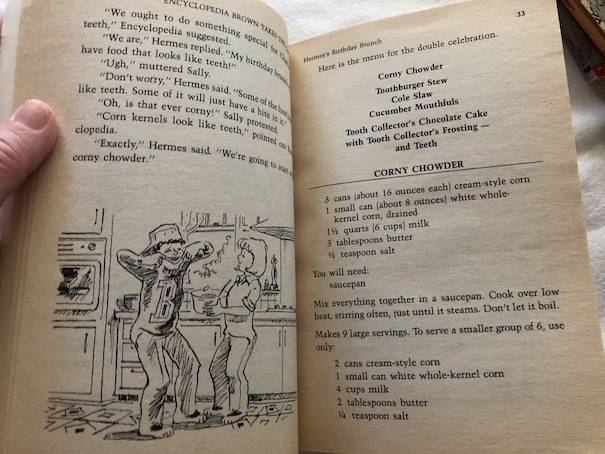
In honor of a friend’s tooth collection, all of the food at the birthday party has something to do with teeth or foods that resemble teeth, like corny chowder and tooth-collector’s chocolate cake with frosting and teeth in the form of bits of marzipan and slivered almonds.

The Case of the Overstuffed Pinata

Bugs Meany steals a pinata from another boy. He insists that it’s his, but Encyclopedia proves it’s not.

A Mexican Fiesta

Encyclopedia and his friends make Mexican food, including cookies called polvorones, which are also known as Mexican Wedding cookies.

The Case of the Missing Watchgoose

A girl’s pet watchgoose goes missing. I didn’t like the solution to this one.

An Italian Dinner

The goose’s name was Christopher Columbus Day, so the kids cook an Italian-themed dinner.

The Case of the Secret Recipe

A friend of Encyclopedia’s, Beauford Twitty, invites his friends to his private potato museum to see his exhibits and sample a new recipe he’s created with a new variety of potato that his grandfather developed on his farm. While they’re there, someone steals a potato autographed by Yankees pitchers.

Dinner at the Twittys’

As a reward for helping to recover the potato, the Twittys give a dinner with no potato dishes at all: cream of chicken soup, meat loaf, corn pudding, baked tomatoes, lemon-buttered green beans, and apple pie.

The Case of the Chinese Restaurant

Oliver, who is a fan of Chinese food and the treasurer of the Service Club, is suspected of stealing from the Letterman’s Club treasury that was entrusted to him. Encyclopedia proves that he’s innocent.

A Chinese Banquet

Encyclopedia and his friends make Chinese food, including egg drop soup, Chinese riblets, egg rolls, and sweet and sour meatballs.

Snacks and Lunches

This section isn’t a story, just a collection of additional recipes for things like pizza made with pita bread, a variety of sandwiches, Twitty’s recipe for French fries from the potato story, French toast, cookies, and brownies.

Pointers from Pablo

Pablo, a young artist, offers advice on how to present and serve food while helping himself to cookies that Encyclopedia and Sally made.

Mystery of the Angry Idol

Mystery of the Angry Idol by Phyllis A. Whitney, 1965.

Janice Pendleton is sad and nervous because the rest of her family will be moving overseas for at least a year, and she is staying in the United States to go to school. Her father is a consultant to the government, and his latest assignment is in Saigon in Vietnam. (This book is set contemporary to the time when it was written, in the 1960s. The Vietnam War lasted from 1955 to 1975, which is probably why Jan’s father is going there, although he is going as some kind of government consultant instead of an ordinary soldier. This book was written after the Bay of Pigs Invasion and President Johnson’s continuing escalation of the conflict in Vietnam.) However, things are dangerous in Saigon, so Jan’s mother and younger brothers, a pair of twins, will be living in Okinawa, Japan, so her father will able to visit them sometimes. (There’s a US Air Force base in Okinawa, Japan, and I know it existed and was in operation during the 1960s because, coincidentally, my older cousin was born there while my uncle was stationed in Japan in the 1960s. The book doesn’t mention this, but I thought I’d tell you that there’s an American presence there, including civilian relatives of military personnel, so Jan’s mother and brothers will likely be among other Americans during their stay there.) Twelve-year-old Jan could have gone to Japan with them, but she is much more advanced in school than her young brothers. They are so young than their education won’t be disrupted much by living in another country for a year or two, but Jan is older, and her family was worried about her losing her place in school.

Instead of going to Japan, Jan will be living with her grandmother and great-grandmother in Mystic, Connecticut and attending school there while her family is gone. It’s summer now, so until school starts, she will be spending her time adjusting to her new living situation and getting to know her relatives. Jan doesn’t know her grandmother very well, and she’s never even met her great-grandmother before. At least when she’s with them, she will be with family. However, her grandmother is a little worried about her great-grandmother’s health. Great-grandmother Althea doesn’t really leave her upstairs rooms anymore, and although she was much more lively and interested in people when she was younger, she doesn’t seem to have much stamina for meeting and talking to people these days. Jan is told that she will have to be careful and behave herself because, if she upsets her great-grandmother too much, she won’t be allowed to stay with them in Connecticut anymore. Instead, she would have to attend a boarding school in Boston. If she goes to Boston, she will be there alone, without any friends and family nearby, and she is nervous about that. She already knows that, by going to Connecticut, she will be removed from her parents and siblings and her friends in California, where she grew up.

To help her feel better, her father tells her more about her family’s history and great-grandmother Althea. When she was younger, Althea traveled through Asia because her father, Jan’s great-great-grandfather, was a merchant dealing in Asian art. (This is very similar to what the author’s father did for a living and why she spent most of her youth in Asia. More about that below.) Althea spent years living in China with her parents while her father bought and commissioned pieces of Chinese art and sculpture that he could sell and collect for himself. However, after her mother died, Althea was sent to a boarding school in Boston. Her father was later killed during the Boxer Rebellion. Althea was in China at the time when they realized that trouble was coming. She survived and escaped to the United States because her father sent her to stay with some friends of his. She took some of the smaller pieces from his collection with her.

Now, Great-grandmother Althea has an impressive collection of Asian art herself, including some of the pieces that she managed to smuggle out of China when she had to flee. There is one piece in her collection that seems particularly mysterious, an ugly statue in the style of a Chinese idol that she keeps turned to the wall. (The “idol” was never used as an object of worship, for those worried that Althea’s father may have looted a temple or appropriated a Chinese national treasure of some kind. Althea says that one of his artist friends made the statue specifically for him. It’s important to the story that it is in the style of an idol but that it is also genuinely ugly and of little intrinsic value.) Jan’s father implies that there is some kind of mystery surrounding that statue, but he doesn’t really explain what it is. Jan’s father worries a little about Althea because she always used to be such a lively woman, and he says that, in her old age, she has become a kind of hermit who has shut herself away from the world and lives like a “vegetable.” He hopes that Jan’s youthful presence in the house will help her become more interested in life again, although Jan doesn’t see how that can happen when she risks being sent away to boarding school if she “bothers” Althea too much.

When Jan arrives in Connecticut, everything is awkward because she doesn’t get her own room in the house. Instead, she has to sleep on a cot in the living room. Her great-grandmother doesn’t even want to see her right away. There is a storm that night, and Jan has trouble sleeping. The next day, she sees a neighbor boy outside and decides to try making friends with him because she really needs someone her own age to talk to. The boy, Neil, doesn’t seem entirely friendly, but he does talk to her down by the nearby boat dock. He tells her that, the night before, he noticed a strange, suspicious-looking man hanging around her family’s house, and he wonders if anything from the house was stolen. Jan says that she doesn’t think so and that she didn’t hear anyone come in, but because of the noise from the storm, it’s hard to say for sure if someone tried to get into the house. Neil points out that the mysterious stranger is still hanging around the house, and Jan sees a man with a beard hanging around nearby.

Their conversation is interrupted by the arrival of a boy in a boat. Neil and the boy in the boat don’t seem to like each other, and the boy in the boat seems to immediately resent Jan for talking to Neil. He tells her that she’d better not try to get into his boat because Neil tried to get in uninvited earlier. Jan is insulted by this rude boy and returns to her relatives’ house. There, she learns two surprising things. The first is that the boy with the boat, Patrick, is actually the son of Mrs. Marshall, the housekeeper, so they will be seeing a lot of each other. Jan’s grandmother had hoped that Jan and Patrick would be friends. (So far, they haven’t gotten off to a good start.) The second is that it looks like something may have been stolen from the house last night. The mysterious statue is missing. Jan tells her grandmother and Patrick about the strange man that she saw and what Neil said. Her grandmother has trouble believing that a theft really occurred. She thinks that great-grandmother Althea may have just moved the statue and forgotten, but Patrick is interested in the mysterious man.

When Jan goes upstairs to meet her great-grandmother for the first time, she discovers that Althea is not the “vegetable” that she’s been lead to expect. Althea is physically feeble and stays upstairs because her knees are bad and can’t handle stairs anymore. However, she is mentally sharp and highly observant. She talks to Jan about her family’s past and her own past. She understands that Jan didn’t really want to come to Mystic and be separated from her family, but her father wanted her to come and learn more about her family’s history. Althea explains that she spent a large part of her youth living in Shanghai until her mother’s death, when her father sent her to a school in Boston, and she really hated it. This is reassuring because Althea is less likely to send Jan away, remembering her own youth.

Althea also explains that she isn’t unhappy with her relatively isolated life in the upper rooms of the house, surrounded by the pieces of Asian art in her collection. She says that it’s just another phase of life. Life moves in phases, and a person knows when they’re ready for the next phase. When she was a little girl, she loved paper dolls and couldn’t imagine life without them, but as she got older, playing with paper dolls became dull, and she was ready for new activities. Similarly, when she was young and active, she couldn’t imagine a life without travel and meeting other people. Now that she can’t get around as well as she used to, she has entered a new phase of life where she enjoys quiet time alone and thinking and remembering. She is still somewhat in touch with the world because her rooms have a nice view of the Mystic Seaport, but she no longer has to deal with crowds and traffic and bothersome household chores and schedules. Jan is still young and active, so she has trouble fully understanding Althea’s isolated life of reflection, but Althea says that she will understand someday, when she’s ready for that phase herself.

Jan is interested in the objects in Althea’s collection, and Althea shows her some pieces and explains a little about their history. There are some pieces of scrimshaw that Jan’s great-grandfather carved himself, like a carving of a woman’s hand that Althea says was originally meant as a paperweight but which she had mounted on the head of one of her canes. Her other cane has a carved cat. Althea also owns a chess board with red and white pieces made of ivory and cinnabar, with the figures carved in an Asian style. Jan notices an empty shelf in the room and wonders if that’s where the missing statue is supposed to be.

While Jan and her grandmother are standing on an upper porch, looking at the view, they look down and see the mysterious man talking to Mrs. Marshall, who seems worried and upset. Mrs. Marshall and the man notice that they’re being watched, and the man waves to Althea and greets her. Even though the greeting is friendly, the man seems to upset Althea. When Jan asks about him and tells Althea what Neil said, Althea says that the man’s name is Eddie. She loved Eddie when he was a little boy, but she thinks he’s become a scoundrel. She says that Eddie came to see her the night before, but she didn’t want to see him and sent him away. Althea thinks he probably took the missing Chinese idol, but she also says that she always hated that statue. It had such a reproachful expression on its face that she turned it to the wall so she wouldn’t have to see it. Rather than dealing with Eddie or discussing the situation further, Althea says that she would rather just forget about it all.

Jan spends more time with Althea, until Althea gets tired. Althea shows Jan other pieces from her father’s collection of jade objects, explaining the different colors of jade and their relative values and the connections the pieces in the collection have to Chinese folklore and mythology. She says that her daughter-in-law, Jan’s grandmother, worries about robbers breaking into the house to steal these things, but Althea prefers to keep her collection close rather than locked away somewhere. The pieces in the collection bring back happy memories for her.

Jan’s grandmother owns a book store in a local historical district. When Jan goes to see the book store, her grandmother allows her to explore the area and tells her to be sure to visit Patrick’s grandfather at the rope walk (the place where they make rope). Jan goes there and encounters Eddie again. Eddie seems to want to speak to her, but Jan is afraid of him and avoids him. Grandfather Marshall had just been arguing with Eddie, and he’s in a bad mood when Jan darts inside. At first, he snaps at her when she rushes in. When Jan introduces herself and explains that she was startled by Eddie, Grandfather Marshall calms down and apologizes for snapping at her. Jan tries to ask him more about Eddie, but all he says is that he doesn’t want to talk to him, and he advises her to keep avoiding him. He shows her around the rope walk and explains to her how rope is made, and he also shows her a model ship he’s making for Althea that looks like the sailboat her husband used to own called the Happy Heart.

On her way back to her grandmother’s book store, Jan meets Eddie again. He explains to her that he’s actually Patrick’s older brother and the black sheep of their family. He also used to be friends with Jan’s father when they were both young, although Jan’s father was older than he was. Eddie badly wants to communicate with Patrick. He asks Jan if she’ll take a message to Patrick for him, and he hands her a note, leaving quickly before she can say anything. Jan shows the note to her grandmother and asks her what she should do about it. Without going into specifics, Jan’s grandmother says that Eddie was always a wild child, and years ago, he did something that was very scandalous, and he had to leave town. That’s why most people in town don’t want to see him or talk about him in public, although there’s been plenty of private gossip about what he did. The Marshalls have been friends with the Pendletons for years, and Jan’s grandmother thinks that it’s probably time to forgive and forget what Eddie did, which is why she doesn’t want to pass on gossip about him and make things harder for him and his family. She tells Jan that it’s fine to give Patrick the note from Eddie.

Jan’s delivery of the note thaws her relationship with Patrick a little, and he gives her a ride back across the river to her family’s home in his boat. There, Mrs. Marshall tells Jan that, because her meeting with her great-grandmother went well, Althea has decided that she can be trusted, so she will now have a room upstairs in the house. Jan just needs to be quiet whenever she’s upstairs because Althea likes to nap. Jan begins to feel a little more at home and less like an awkward visitor.

However, strange things are still happening in and around the house. Eddie is still lurking around, and nobody wants to tell Jan what he did to turn himself into such a black sheep. She overhears a late night conversation between Althea and Eddie where the two of them seem to be discussing secrets and playing cat and mouse with each other. Yet, Althea gives Eddie a job doing yard work and seems to be trying to help him redeem himself. He returns the statue that Althea never liked but seems to take other things. Althea tries to send him away when he causes problems, but he insists on hanging around and claims that he’s trying to help Althea. Like others, he believes that there is a secret behind the ugly statue that seems to make Althea nervous, although Althea doesn’t think that the statue contains any real mystery.

As Jan struggles to understand what’s happening around her, she risks getting on the bad side of the reclusive and temperamental Althea just as her great-grandmother seems like she’s becoming fond of her. The Pendleton house isn’t entirely a happy one, and the reasons why are buried in Althea’s past as well as Eddie’s. The clues have been right in front of Althea the entire time, but although Althea is intelligent and thinks she understands everything, there’s something critical that she’s overlooked all along, which changes everything.

My Reaction and Spoilers

Background of the Book

Many of the themes of Phyllis A. Whitney‘s juvenile mysteries come from her own life. When she was young, she lived with her family in Japan and other countries in Asia because her own father was working overseas. She was born in Japan, and her middle initial stands for Ayame (the Japanese form of the name Iris). Whitney’s parents were American, but she didn’t live in the United States until she was a teenager. Both of her parents died while she was a teenager, and she went to live with an aunt in Chicago, so she understood the feelings that kids could have, moving around, living in different countries, being separated from parents, and living with relatives. Because of her upbringing in Asia, many of her books, even those set in the United States, include some mention or aspects of Asian art or culture, especially Japan.

I think both Jan and Althea are reflections of the author and her life. They both share some aspects of their lives with the author, but Jan is probably more like the author in her youth, and Althea is the older version, looking back on her life and remembering what it was like to be young with the knowledge of what it’s like to be old.

The Atmosphere

I really liked the atmosphere of the story! It’s a lovely, old-fashioned house. Althea’s museum-like collection room is fascinating, and the room that she gives to Jan is cozy. Jan’s upstairs room has rosebud wallpaper and a four-poster bed and rocking chair. The room is a little worn and shabby, but Jan loves it. Her grandmother gives her milk and gingerbread on a china plate decorated with violets as a bedtime snack, and she reads old-fashioned children’s books, like A Little Princess by Frances Hodgson Burnett. Jan doesn’t usually read older children’s books, but there’s a collection of them in the house, left by the generations of children in her family who had grown up there.

Relationships

When Jan first meets Neil and Patrick, she realizes that neither of them is really the ideal friend for her. She continues to associate with them partly because she can’t help it. They’re both always around because Patrick’s mother is the housekeeper at Jan’s relatives’ house, and Neil’s family lives next door. Also, Jan doesn’t have anyone else her own age to talk to, although she is realistic and thinks that she should look for other friends in this town because both of the boys are difficult in different ways. Patrick is impulsive and temperamental (a bit like his grandfather the day Jan meets him – snapping at her just because he’s in a bad mood at someone else), and he has a chip on his shoulder because of his brother’s troubles.

However, Neil is even more temperamental. Jan quickly notices how Neil’s mood can abruptly shift from pleasant to irritable and how he doesn’t seem to have much compassion for other people. She later realizes that he’s most charming when he wants something from her or someone else. Neil’s ambition in life is to be a radio interviewer. His uncle is a radio announcer and has encouraged Neil’s ambition. Neil’s hobby is interviewing people and recording his interviews for practice. Some of his teachers have found his interviews fascinating and have played them in class because, while he has never interviewed anyone famous, Neil has interviewed people who have done some really interesting things, like the janitor who was once a prisoner of war during WWII. Neil’s also a little sensitive about his interviews because his father doesn’t think much about his ambitions and would rather that Neil go into his business when he grows up, and sometimes, other kids tease him. Part of the reason why Neil is interested in being friends with Jan is that he would love to interview her great-grandmother because she had a fascinating early life in China. He is also aware that there is some secret about the angry-looking idol in her collection, which she has always felt compelled to keep even though she doesn’t like it. Neil is obsessed with his life’s ambition and is willing to do just about anything to promote it. He also has a chip on his shoulder toward Patrick and Eddie and others who have made fun of what’s important to him and tried to discourage him from doing what he wants to do.

In the end, as Jan comes to know the two boys better and both confronts them over their behavior and helps them through the troubling situations they have, the relationships between the three of them improve. After everything that happens, they all come to realize that each of them has done something wrong or misjudged someone else. This doesn’t completely absolve any of them from things they’ve done because some of them could have had serious consequences for other people as well as themselves. There are things that each of them has to do to make things right, but because each of them has something they need to do to fix things, something to learn, or something they need to apologize for, they realize that they are willing to let each other make amends and to accept each other’s efforts to change. These feelings also extend to others in the story, especially Althea and Eddie. Everyone in the story has misjudged someone or the situation, and everyone has something they need to learn, understand, and change.

Happiness and Redemption

Themes about happiness and redemption run all the way through the story. Eddie’s part of the story focuses on redemption. Part of his troubles are of his own making, but Jan learns that he’s also been falsely accused and badly misjudged. Like others in his family, he has a quick temper and needs more impulse control, and he used to be pretty wild and hung out with a bad crowd. What others know about him and are initially reluctant to tell Jan is that Eddie went to prison for being involved in a robbery and is now out on parole. However, as both Patrick and Eddie explain, Eddie wasn’t actually involved in the robbery. Some of the friends he used to hang out with did it, and they implicated him out of spite when they got caught because he refused to go along with their plan. Althea believed him when he said he didn’t do the robbery and paid for his legal defense, but he was convicted anyway because of his history with the people who committed the crime and because witnesses misidentified him as one of the people who was there.

Althea still doesn’t really believe Eddie was involved in the robbery, but she does know that he causes trouble because he lacks self-control and has lingering resentment about the way people look at him because of the trouble he’s been in. Eddie later says that he’s unfriendly to other people because they’re not friendly with him, although I think it’s fair to point out that people believe badly of him because he’s lived the kind of life where everything he’s been accused of doing are completely credible. That means that, even before he was falsely accused of robbery, the way he lived and the way he treated other people made almost everyone he knows in his home town willing to believe that he was a criminal. There seem to have been significant lifestyle and behavioral choices on Eddie’s part that created his bad boy image and led up to this situation. He may not look at it this way, but he kind of set himself up almost as much as his supposed friends did because of the choices he made with his life, his choice of friends, and his neglect of people who once might have believed in him. Even his own parents believe the worst of him at the beginning of the story, and the way he’s been acting ever since he reappeared in Mystic supports the view that he’s still the kind of person he used to be and people think he is.

As my grandfather used to say, it’s easier to keep a good reputation than to redeem a bad one. It’s not impossible to redeem a bad reputation, but it takes both work and time, and Eddie doesn’t have much patience with the people whose patience he’s already exhausted. He’s only just reappeared in town, but he’s already angry that people are looking at him suspiciously for just showing up. He’s upset that other people aren’t giving him a chance or instant forgiveness and acceptance, but at the same time, he really isn’t giving them much of a chance to see that he’s changed or giving himself enough time to demonstrate that change. Fortunately, some people, like Jan’s grandmother, are willing to drop the matter and give Eddie the chance to prove that he’s changed, and Althea tries to help Eddie by giving him jobs and letting him stay with them in the house for a while.

For a while, Eddie tries to prove that he’s a hard worker and a steady person, but, when Eddie loses his temper with Neil for carelessly wrecking his yard work while trying to catch his runaway dog and turns the garden hose on Neil, Miss Althea starts to think that she’s made a mistake. She craves peace and solitude, and Eddie is one disaster and temper explosion after another. At one point, she tries to send him away, telling him that it would be easier for him to start over somewhere else, where people don’t know his history, and he can cultivate a completely new life and image. Eddie moves out of her house, but he refuses to leave town. He has another job now, thanks to Althea’s recommendation, and he refuses to leave town as if he’s in disgrace when he hasn’t done anything wrong. I didn’t really like Eddie, particularly in the beginning, because he doesn’t really see the way he has made his own reputation and provoked other people, but I think his redeeming characteristics are his determination and perseverance. His attempts to change his reputation are clumsy and impatient. I think he expects too much of other people too soon as he tries to rebuild his relationships with the people he’s offended and pushed away before, but I appreciate that he still cares enough to keep trying until he gets it right.

In facing up to the situation with Eddie and with Jan’s clumsy efforts to figure out what’s going on and make things right, Althea also comes to some realizations about herself and the way she’s been living. Enjoying some solitude and a slower pace of life is fine as a person gets older, but Althea comes to the realization that the way she’s been going about it has been selfish and has cut her off from the people around her. She is out of touch with the lives of people who were once close to her and has failed to understand them and appreciate what they’re going through because of her determination to avoid becoming involved with other people’s problems or deal with anything unpleasant.

The reason why she doesn’t like the ugly statue is because her father carved a message in the back of it, telling her to find a “happy heart.” The theme of happiness used to be one of her father’s favorite topics of discussion when he was alive, and he often lectured her on how to be happy. Althea never liked it when he would lecture that happiness is based on the way a person lives and the choices they make, pointing out times when her own choices or priorities were making her unhappy. She always thought that her father sent her that ugly statue with the “happy heart” message before his death because he wanted to tell her, yet again, to be happy, and she felt like the statue’s ugly snarl was like a rebuke every time she wasn’t happy or made bad decisions. Being lectured and rebuked doesn’t make a person feel good when they’re already feeling bad, as Eddie knows from his experiences. However, Jan and Althea both come to realize that Althea has misunderstood her father’s message and intentions on multiple levels for most of her life.

Althea gets extremely upset one day when Jan says that someone tried to steal one of her most precious jade statues. At first, Jan’s grandmother thinks that Jan’s imagination is running away with her and that her presence in the house is too disturbing for Althea to handle, talking again about sending Jan to boarding school, but Althea later explains that Jan isn’t the reason why she’s upset. She’s upset with herself. She realizes that Jan was wrong about the person taking the statue because she herself had given the statue to Eddie, telling him to sell it to get money to start over somewhere else. However, part of the reason Eddie wants to stay in town is to help Althea, to pay her back for paying his legal bills when he was in trouble. When she sees that either Eddie or Patrick returned the statue because Eddie cares more about struggling to restore his reputation and relationships than about money, she feels terrible that she tried to bribe Eddie to leave out of her own selfish desires.

Happiness and peace of mind can’t be bought, either with money or precious objects, and it doesn’t come from avoiding the parts of life that are unpleasant. Happiness comes from embracing life, all of it, even the parts that are hard, and from maintaining meaningful relationships with people you love, even through their struggles. You have to take the bad with the good to experience life fully. Once Althea comes to these revelations about the life that she’s been living and the life she really wants to live, she feels the peace of mind she’s been seeking and no longer fears the gaze of the statue or the rebukes that she thought that her father was giving her through the statue. Her life doesn’t have to be perfect, every choice she makes doesn’t have to be perfect, other people don’t have to be perfect, and her happiness doesn’t have to be perfect and constant for it to be real happiness. However, there are a couple of other mysteries surrounding the story that Jan manages to clear up, including the fact that Althea’s father had something else in mind with his last message. Althea was so sure she knew what her father was telling her that she didn’t look deeper, but Jan does and discovers the treasure that Althea has been ignoring the whole time.