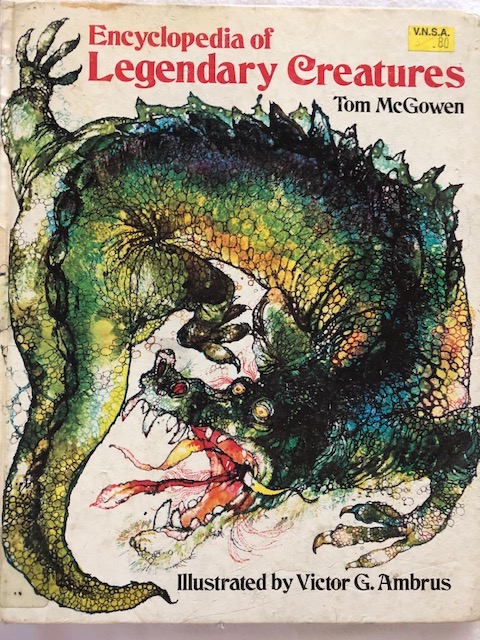
Encyclopedia of Legendary Creatures by Tom McGowen, 1981.
This book is organized into brief encyclopedia-style entries, describing legendary creatures from around the world. Everything is in alphabetical order, not organized by country or any other over-arching categories.
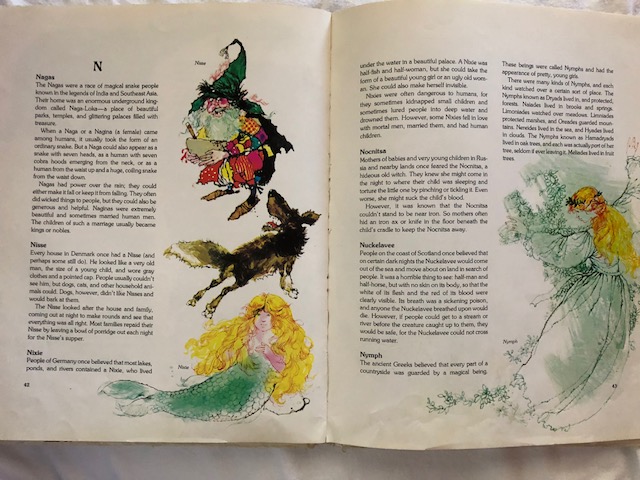
There are two things that I particularly like about this book. One is that the mythological creatures in the book aren’t just limited to the common ones, like giants, vampires, werewolves, and unicorns (although they each have entries of their own); there are also some lesser-mentioned creatures like the Hulder Folk and the Abatwa People. The Hulder Folk, who come from Norse folktales, look like ordinary humans, but they have tails like cows. According to the book, they love to sing and dance, but their songs are always sad, which makes me think of country music. They also can intermarry with humans, although their marriages are usually unhappy, which also, oddly, makes me think of country music. The Abatwa People are part of the folklore of the Zulus in South Africa. They are tiny people, but fierce warriors, and they get offended if people don’t treat them like they are the same size as humans. (There are also real people in Africa called Abatwa who are pygmies. The legendary people in this book may be connected to old legends about them, exaggerating their shorter-than-average height.)
The other thing that I really like about this book is the pictures. There are many books about mythology and folklore that don’t have pictures of the creatures, and it really makes a difference being able to see what something looks like (or supposedly looks like, since these are legendary creatures) as well as read a description.
As a side note, there is an episode of the kids’ cartoon show, Arthur, where his friend, Sue Ellen, who isn’t usually frightened by scary stories, hears a strange noise that makes her think about various mythological monsters that she’s heard about in the different countries that she’s visited with her parents. These unusual monsters, like Baba Yaga, Kappas, and Bashees, which most of her friends haven’t heard about before, do frighten her. When I saw Kappas described in this book, it reminded me of that.
If Your Name Was Changed at Ellis Island by Ellen Levine, 1993.
Like other books in this series, this book explains about a part of American history using a series of questions and answers. Each section of the book starts with a different question about what it was like to come to America as an immigrant in the past and what happened when they reached Ellis Island, one of the main ports of entry into the United States around the turn of the 20th century, just off the coast of New York City, such as, “Would everyone in your family come together?”, “What did people bring with them?”, and “What did the legal inspectors do?” Then, the book answers each of the questions.
The questions and answers start by describing what the journey to America was like from the late 1800s through the early 1900s. Typically, families would come to the United States in stages: the father of a family (or perhaps one of the older children) would make the trip first, find a job in the United States and start saving money to prepare for rest of the family to come. Depending on the family’s individual circumstances, it might be years before all the members completed the immigration process and reunited in America.
People traveled by ship in those days, and an often-forgotten part of their journey was even reaching the port the ship to America would be leaving from. Depending on the starting point of the journey and the travel arrangements each family was able to make, getting to the port might involve crossing borders between other countries, adding another layer of legal difficulties to the journey.
There was also the knowledge that they might be turned away once they arrived at Ellis Island. One of the chief concerns at the time was illness. The inspectors at Ellis Island checked immigrants for signs of infectious diseases, and the ship companies knew that if their passengers were turned away because of the fear of disease, they would be required to pay for the return voyage themselves. To help ensure that their passengers would not arrive with a disease, they would conduct their own health checks before the ship ever left port, looking for signs of illness, giving the passengers vaccines, and disinfecting things. They were particularly afraid of passengers with lice because lice can spread typhus, which is deadly. They would often cut the passengers’ hair or comb it very carefully.
The treatment passengers on ships received depended largely on their class of passage. First and second-class passengers received the best rooms and the best food, and when they arrived in New York (assuming that was their destination), they didn’t even have to go to Ellis Island at all; the immigration inspectors would inspect first and second-class passengers on board the ship. Only steerage passengers (“third class”, the cheapest possible method of travel, used by the poorest people, the largest group) would have to get off the ship for processing at Ellis Island.
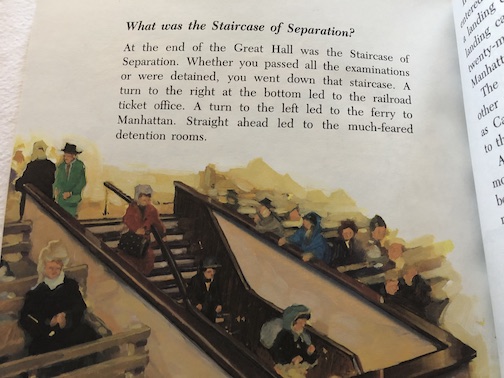
The processing center at Ellis Island wasn’t just a building; it was an entire complex. The Great Hall alone was large enough to contain hundreds of people at a time, and when it was full of immigrants there were so many languages being spoken at once (sometimes as many as 30 different languages) that some people described it as sounding like the Tower of Babel. There were also dormitories that could house more than a thousand people, a hospital for the sick, a post office, banks where people could change their cash for American money, a restaurant to feed everyone (with two kitchens, one kosher and one regular), a railroad ticket office where immigrants who would be moving on from New York could make their travel arrangements, and much more. Some people called Ellis Island the “Island of Tears” because the arrival there after a long journey was an emotional experience and many immigrants were worried that they might be sent back if they couldn’t answer the inspectors’ questions to their satisfaction. At the end of the Great Hall, there was a large staircase that came to be known as the Staircase of Separation. Everyone had to go down this staircase after their examination by the inspectors. At the bottom, they would go their separate ways, depending on their travel plans or whether they had passed inspection. People who turned to the right were heading to the railroad ticket office. People turning to the left were heading to the Manhattan ferry. People who went straight were heading to the detention rooms because they hadn’t passed the inspection.
As I mentioned before, the inspectors were very concerned about people who showed signs of serious diseases. One of the first things that would happen during inspection was a brief examination by the Ellis Island doctors. Because of the massive amount of people who had to be processed, this examination lasted only a few minutes, during which the doctor would quickly check for very specific symptoms and signs of possible illness. If they didn’t see anything obviously wrong, such as red eyes (possible sign of eye infection, although for some, it was just because they’d been crying), difficulty in breathing, or lice, they would let the people pass. If the doctors thought that they saw something that might be sign of illness, they would write a letter in chalk on the person’s clothes and send them on to be examined more thoroughly by another doctor. Getting one of these letters didn’t always mean rejection. If the other doctor decided that the first doctor was mistaken or that the person’s symptoms weren’t serious, they would still be allowed into the country. Sometimes, if a person was ill but had a curable disease, they would be kept in the hospital on Ellis Island until they were better. If the doctors weren’t quite sure if a person was ill or not, they might keep the person in the dormitories for a few days and then check them again after they had a chance to rest. The people who were sent back on the ship were ones who had diseases that were incurable or seriously contagious. (It sounds heartless, but they were trying to head off deadly epidemics. During the 1800s, large cities like New York sometimes suffered serious epidemics of deadly diseases because of the sudden influx of new people who were living in overly-crowded conditions with relatively poor sanitation. By preventing people with signs of serious diseases from joining the rest of the population, they were hoping to head off new epidemics and save lives.)
One of the more controversial parts of the examination was when they tested people for possible mental problems. They wanted to make sure that they were mentally fit enough to find work, but the problem was that the tests designed by people who didn’t take cultural differences into account when they designed them. The parts where they asked people to do simple arithmetic problems or to demonstrate that they could read, count backwards, or match up sets of similar drawings were pretty straight-forward. However, sometimes they were shown a picture and asked to describe what was happening in the picture, and the immigrants gave the inspectors some surprising interpretations because it turns out that some experiences aren’t quite as universal as some people think. For example, one picture was of some children digging a hole with a dead rabbit lying nearby. It was supposed to depict children burying a dead pet. But, some people view rabbits more as food than pets, and some immigrants said that the children were doing their chores because why shouldn’t the children work in the garden (the digging) after hunting a rabbit for dinner? Fiorello La Guardia, himself from an immigrant family, an interpreter on Ellis Island and later, mayor of New York, particularly despised tests like these because the people who designed them and administered them were trying to test the minds of others without any real idea about what their lives had been like or how their minds actually worked.
The inspectors’ examinations in general weren’t always reliable because they were often hurried (dealing with so many people in a limited amount of time) and because the interpreters weren’t always accurate, which brings us to the question of why people’s names were sometimes changed at Ellis Island. Sometimes, it was intentional. Some immigrants thought that they would be more likely to be accepted by the inspectors if they had short, easy-to-pronounce names, so they would purposely give them shorter versions of their names. There was some basis for this belief because, if an inspector didn’t understand a long, unfamiliar name, they wouldn’t have much time to figure it out and so would either take their best guess at the what the name should be, shorten it when they wrote it down, or give up altogether and write a much shorter name instead. For example, when they processed Jewish people from Russia, the inspectors often ran into difficulties in understanding their last names and would sometimes just write down “Cohen” or “Levine”, no matter what the original name really was. Sometimes, name changes were just an honest mistake because the inspector didn’t know how a name was really spelled (I can speak from personal experience because my family’s last name wasn’t always spelled like it is now, and when they found out that it had been changed, it was just too much trouble to fix it) or because they had misinterpreted something that the immigrant said. One of my favorite examples of this was a young man who tried to explain to the inspector that he was an orphan (“yosem” in Yiddish). The inspector dutifully wrote his last name as Josem.
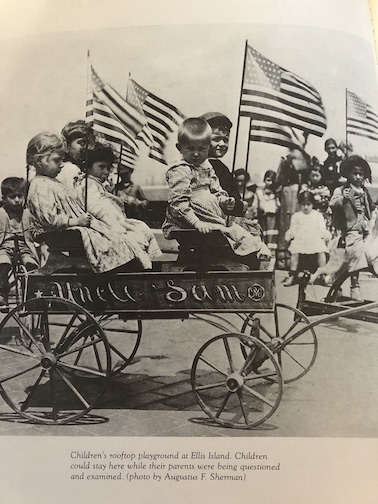
The pictures in the book are paintings based on original photographs of immigrants and Ellis Island. (See Immigrant Kids to compare some of the pictures.)
The book also contains some further information about the lives of immigrants once they arrived in America (Immigrant Kids goes into a lot more detail), the attitudes of Americans toward immigrants at the time (varied but with strong strains of anti-Catholic, anti-Irish, and general anti-immigrant attitudes during the 1800s), and the contributions of immigrants to American society. I actually bought this book as a souvenir on a visit to Ellis Island years ago.
The book is currently available online through Internet Archive.
One of the best parts about this book is the pictures. The preface of the book specifically talks about photography at the turn of the 20th century, how cameras were still fairly new technology but growing in popularity. Cameras that were small enough to be held in a person’s hands were an 1880s innovation, and the book mentions that small cameras like that were known as “detective cameras” because they were small enough that they could be used to take pictures without the subjects noticing. Over time, it became easier for amateurs to learn to use cameras, and it became more common for people to take pictures of their ordinary, everyday lives. Pictures like these open up a window on the past. The pictures in this book are of children whose families had only recently arrived in America from countries around the world. The photographer for many of these pictures was Jacob A. Riis, a journalist in New York City who wanted to document the living conditions of poor immigrants. He published a book called How the Other Half Lives in 1890, in which you can see more of his work. Other pictures in this book are by Lewis Hine, who is known for his photographs of child laborers. They are not the only photographers whose work appears in this book, but they are the most famous.
The book is divided into sections, covering different aspects of the lives of immigrant children. In the chapter called Coming Over, the author describes what the journey to America was like. One of the primary motivations for people to come to America around the turn of the century was money and employment opportunities. If a family had little money and little or no chance of getting better jobs in their home country, they would decide to try their luck somewhere else. Because most of the immigrant families were poor, it was common for families to immigrate gradually. Often, the father of the family would come first, find a job, start establishing a life and home for his family, and eventually send for his wife and children when he’d saved enough money. The actual journey was by ship, often in “steerage,” the cheapest form of passage available, in cramped rooms in the ship’s hold.
Although the journey could be harrowing, one of the most nerve-wracking parts was the immigrant processing that took place at immigrant ports like Ellis Island. There were routine questions that immigrants were expected to answer and exams for them to take, and if the questioners weren’t satisfied, the immigrants could be sent back to the country they came from. Doctors would examine the immigrants to evaluate their health and look for signs of possible mental defects. They were particularly concerned about signs of infectious diseases. Sometimes, it was difficult for immigrants to answer all the questions because of language barriers and the immigrants’ own nerves at being interrogated. If an immigrant seemed too agitated, the examiners would typically let them rest for a while before trying again.
The other chapters in the book are At Home, At School, At Work, and At Play, which give more details about the lives of immigrant children as their families settled in America. They often settled in large cities because those were where the most employment opportunities were to be found. Because they didn’t speak much English and needed help learning how things worked in America, such as how to find jobs and places to live and how laws worked, they tended to settle in neighborhoods with others from similar backgrounds who could help them. That is why, even to this day, there are certain areas of large cities, such as New York, Boston, or Chicago, which are known for people of a particular nationality (like the Irish neighborhood, the Jewish neighborhood, Chinatowns, etc.). New arrivals often joined friends or relatives who had already been living in the US for a while, seeking help in getting themselves established. These ethnic neighborhoods were located in poor parts of town because the people there didn’t have much money. People lived in small, crowded apartments called tenements, sharing water and toilet facilities with other families because the apartments were not provided with individual facilities. However, once these groups of immigrant families became established, they remained established for a long time, and they gave these neighborhoods their own distinctive style.
School was often difficult for new arrivals because the children had to learn English before they could study other subjects. There were some special English language learning classes for them at larger schools with enough demand for them. At smaller schools which didn’t have these classes, they often had help from other children who had arrived in America earlier and could act as translators. They were also frequently put into classes for children who were younger than they were, studying easy subjects, until they had learned enough English to move up to classes with children their own age.
Typically, immigrant children aimed to stay in school until they were fourteen years old because that was the age when they could officially get full-time work. However, because their families were poor, the children might have to leave school early to find jobs and help their families make ends meet. The book describes how rules were frequently bent or broken because the laws were not well-enforced, and children often worked at younger ages, even under harsh conditions. For immigrant children, the most important education was that which taught practical, vocational skills that would help them find jobs quickly. Some agencies, like the Children’s Aid Society (known for the Orphan Trains), would help them with vocational training.
However, immigrant children still like to play. Boys and girls usually played separately. Boys frequently played games like baseball in the street, or stickball, which was a variant that could be played in smaller spaces. In stickball, the “bat” was a stick or the handle of an old broom, and the ball was rubber and allowed to bounce before it was hit. Girls would play other games, like “potsy,” which was a version of hopscotch.
Because of the lessons they were taught in schools and because the immigrant children mixed with children outside of their immigrant groups in school, the children absorbed the local culture and became Americanized faster than their parents. Many of them experienced the feelings of being torn between their parents’ traditions and wanting to fit in with society around them.
In each of the chapters in the book, there are anecdotes from people who had arrived in the US as children around the turn of the century, telling stories about different aspects of their lives.
The book is currently available online through Internet Archive.
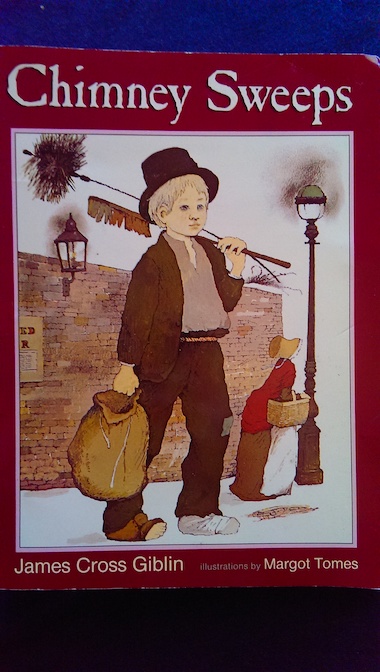
This book explains about the history and traditions of chimney sweeps. I love books that cover odd topics from history like this!
It starts by explaining the origins of chimneys in the Middle Ages. Before they were invented, people would have to have simple holes in the roofs of their houses to let out smoke from heating and cooking fires, or they would have had to rely on windows or doors to perform the function of venting smoke. Chimneys vent smoke more efficiently, but the more they are used, the more soot collects inside them, and they need to be cleaned out from time to time. If they aren’t cleaned, the build-up inside could either block air from getting to the fire in the fireplace, causing the fire to go out sooner, or it could pose a fire risk because the build-up inside the chimney is still flammable. Sometimes, home owners could clean their own chimneys, if they weren’t very tall, but the taller the chimney is, the more professionals are needed to clean it.
Modern chimney cleaners have vacuums that they can use to clean soot out of a chimney, but originally, people were basically relying on brushes. The book explains the evolution of the profession and variations in the profession between England, Germany, and the United States. Germany is significant to the profession because it was one of the first places where chimney sweep became a recognized profession and there were laws even in the 1400s that all chimneys had to be cleaned twice year. (Remember that chimneys that haven’t been cleaned can be a real fire risk, posing a danger not only to you but your neighbors, especially during a time when most buildings are made of wood and other highly flammable materials.) When chimney sweep became a recognized profession during the Middle Ages, members of the profession formed a guild (as was traditional for different professions in general during the Middle Ages) and established rules and standards for the profession. One of the responsibilities of a guild was to decide on the training and qualifications that the profession requires, and in the case of chimney sweeps, the only way to learn was by serving an apprenticeship. The apprentice would live with a master sweep for three years, learning the trade, and at the end of his training, he would have to prove that he could clean a difficult chimney all by himself with thoroughness and reasonable speed.
There are many traditions and superstitions that came to surround the profession of chimney sweep. One of them that you can still sometimes see even in modern times is the image of the chimney sweep in a top hat. The exact reasons for adopting a top hat and tailcoat as part of their uniform are uncertain, but it began back in the 1500s in Europe. The sweeps often got their top hats and tailcoats as secondhand clothing from undertakers (yes, really). Part of the reason for wearing them might have been as an effort to look professional, but the color black was also suitable for a person who was going to end up covered in soot. According to superstition, the top hat would help to protect the chimney sweep from falling when he was on the roof of a house. Chimney sweeps were often thought to be lucky because their jobs were dangerous, yet they survived.
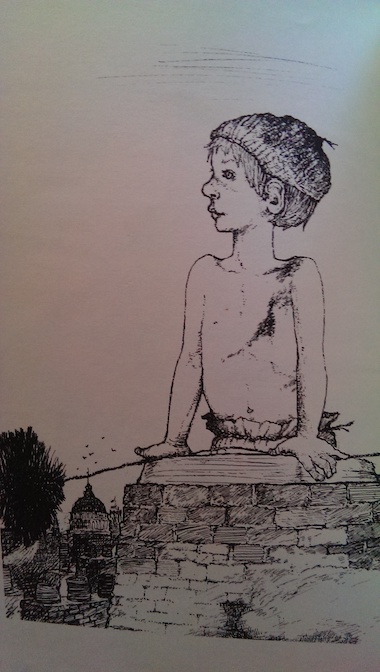
However, chimney sweeps’ lives and work were often hard. In 18th century England, their jobs became more difficult because chimneys were purposely being built in narrow, crooked zigzags. The idea behind the crooked chimneys was that they would keep more heat in, but that made them much harder to clean. Because brushes couldn’t make it around the bends of these chimneys and adults couldn’t get into the narrow flues, sweeps became reliant on young boys to climb up into them and clean them by hand. Although the law required boy apprentices to be no younger than eight years old, many sweeps used boys as young as four or five. Sometimes these boys were official apprentices with the permission of their parents (typically from poor families with many children) or even the sweep’s own children (sometimes, they used their daughters because girls were often smaller than boys). If they couldn’t get children any other way, sometimes sweeps would get children from orphanages or might even resort to kidnapping. The author of this book includes a short story about what a day in the life of a child chimney sweep was like.
The plight of child chimney sweeps came to light during the early 19th century, when people were starting to become concerned about child labor of all kinds. At first, there was strong opposition to banning child chimney sweeps and using new cleaning devices because the adult chimney sweeps saw it as a threat to their livelihoods and home owners were worried that new methods would be more expensive for them (of the two, I think I’m more offended at the home owners’ attitudes because of the implication that they were more upset about a possible slight increase in expense than the risk to the lives of the children they knowingly endangered). Many of the child chimney sweeps suffered severe and permanent health problems because they were forced to do this kind of work at an early age, while they were still growing, and because they inhaled and were covered with soot for such long periods.
In the back of the book, there is a poem by William Blake called “The Chimney Sweeper,” which was published in Songs of Innocence in 1789. Knowing the risks to young children, like the little boys in the poem, makes the poem seem pretty disturbing, which may actually be the author’s intention. Eventually, after long years of struggles in which children were still exploited in chimney sweeping spite of regulations against it, in 1875, Parliament tightened regulations against child labor even further, forcing chimney sweeps to apply for licenses in order to practice their trade, listing each of their apprentices and their ages.
Chimney sweeping in American history was a little different from the way things were done in Europe. The American colonists sometimes tried some strange tactics for cleaning their chimneys. One of the oddest methods was to tie a rope to a goose’s feet and lower it down the chimney. The goose would become frightened and flap its wings, thus knocking the soot loose. When the job was done, the home owner would pull the goose out of the chimney and wash it off. Another tactic was to actually burn the excess soot out of the chimney, although there was a risk of simply setting the house on fire. Later, American cities had official chimney sweeps who were licensed and regulated. On Southern plantations, slaves were used as chimney sweeps, and some of them continued to work as chimney sweeps after they gained their freedom.
Later, when homes began to be heated by other sources than fireplaces, chimney sweeps were in less demand, although there was increased demand in the 1970s, during the energy crisis, because people started using their fireplaces more instead of relying on other heating methods that involved scarce or expensive fuel. Chimney sweeps can also perform other duties beyond simply cleaning chimneys, depending on where they live. For example, in Germany, sweeps perform inspections of factories and homes to make sure that they are using fuels efficiently, looking for sources of needless pollution, which can lead to fines for the owners of the buildings if the problems are not corrected. Some people might also become chimney sweeps as a seasonal part-time job, while they also have another career.
The book is available to borrow and read for free online through Internet Archive.
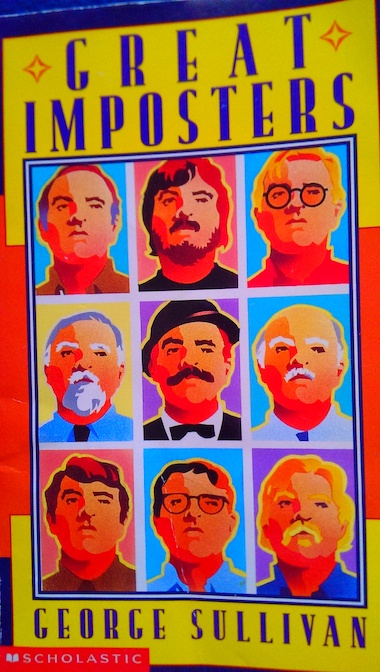
This is one of those unusual history books that I like about odd, little-covered topics. The author begins by explaining what an imposter is: “a person who practices deception under an assumed name or character.” Each of the people in the following collected stories is pretending to be someone they’re not, for a variety of different reasons. The author points out the differences in the imposters’ motives, which range from pure greed to a desire for fame and attention to thrill-seeking behavior. Each of these stories really happened, and the people involved were real people, even if their claimed identities weren’t. The stories skip around in time and location, so they can be read in any order.
Willie the Actor – Willie Sutton started out as a petty thief while growing up in a tough Brooklyn neighborhood and later graduated to pulling a series of daring robberies while wearing various disguises during the 1930s through the early 1950s.
Bad Habit – Ferdinand “Fred” Waldo Demara, Jr. was the son of a fairly wealthy man who later lost the family’s money. Sis family’s loss of their previously well-off position was hard for Fred, and it led to a lifetime of him trying his hand at various professions (winging it without proper qualifications) and adopting (or stealing) new identities. The movie The Great Imposter was based on his life and exploits.
Princess of Pretense – Sarah Wilson was a maid in the household of Queen Charlotte in England during the 18th century. When she stole some clothes and jewelry belonging to the queen, she was exiled to the American colonies as an indentured servant. However, she used her knowledge of royal and the objects she stole to run away and pose as an exiled younger sister of the queen.
Lord Gordon-Gordon – Philip Guy spent his youth stealing and selling stolen goods for extra money until he ended up stealing a trunk that happened to contain gentlemen’s clothes that happened to fit him. When he noticed how much better everyone treated him when he was dressed as a wealthy gentleman, he created a new identity for himself as an English lord, undertaking greater thefts and frauds to maintain it.
The Counterfeit Count – Victor Lustig acquired a skill for languages when he was young and later used them when he masqueraded as an impoverished nobleman, covering up his gambling habits and confidence swindles in Europe and America, including his daring scheme in 1920s Paris to sell people materials from the Eiffel Tower, which was supposedly going to be dismantled. He also once successfully swindled Al Capone.
The Claimant – During the mid-1800s, Arthur Orton pretended to be Roger Tichborne, the long-lost (and probably deceased) heir to an English baron.
The Baron of Arizona – James Addison Reavis, a former Confederate soldier from the American Civil War, learned that he had a talent for forgery and tried to use it to forge land grants, giving himself a large section of land in the Arizona Territory and the title the “Baron of Arizona.”
The Actress – Constance Cassandra “Cassie” Chadwick was a girl from a poor family in the 1800s who posed as a spiritualist, swindling people while claiming to save them from terrible fates, and later, pretended to be a lover of Andrew Carnegie. (This book doesn’t mention it, but other sources say that Cassie’s real name was Elizabeth Bigley, and they say that she claimed to be Carnegie’s daughter, not his lover.)
Electronic Trickery – Reginald Jones was a scientist in Britain during the 1940s. He was also a practical joker who enjoyed taking on new identities in order to play pranks on friends and colleagues over the phone. Later, during WWII, he found ways to put his practical joking to practical use.
The Skywayman – Frank Abagnale took on a variety of new identities while writing bad checks during the 1960s and 1970s. The story of his life was later turned into a book called Catch Me If You Can and a movie of the same name.
Dangerous Game – This chapter is about WWII intelligence agents, who also had to assume new identities to do their jobs without being caught.
The Man of a Hundred Lies – Stanley Clifford Weyman was an imposter from the 1920s through the mid-20th century who held a variety of prestigious positions . . . all self-appointed.
The book is currently available online through Internet Archive.
Four-year-old Charlotte May lives in a small town in Idaho in 1914. May, as her family calls her, wants to visit her grandmother in another town, but travel during this time is difficult and expensive. With a lack of roads that are easy to travel, the only comfortable way to get to May’s grandmother’s town is by train. Unfortunately, May’s family can’t afford to buy a train ticket for her.
May wants so badly to go see her grandmother that she even asks at the local general store if the owner can hire her, but he doesn’t have any work that a little girl could do. Then, May’s mother’s cousin helps the family to find a more affordable alternative. If May can’t travel as a passenger, is it possible for her to travel as . . . mail?
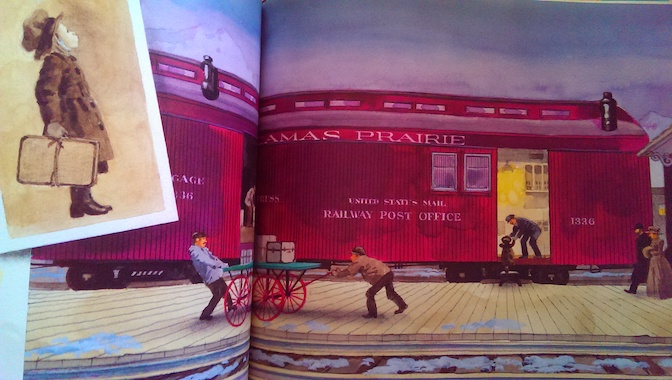
It turns out that the rate for mailing a live package the size of May is much cheaper than the fee for a passenger ticket. Because May’s mother’s cousin works in the mail car on the train, he could take responsibility for her during the trip. So, with a label on her clothes, declaring her to be “baby chicks” and the proper postage stuck to her jacket, May undertakes the journey to her unsuspecting grandmother’s house.
This story was based on a real incident. In fact, May wasn’t the only child to be sent through the mail when their parents couldn’t afford to send them as passengers. I also like the book for its glimpse at travel and mail services over 100 years ago.
The book is available to borrow and read for free online through Internet Archive.
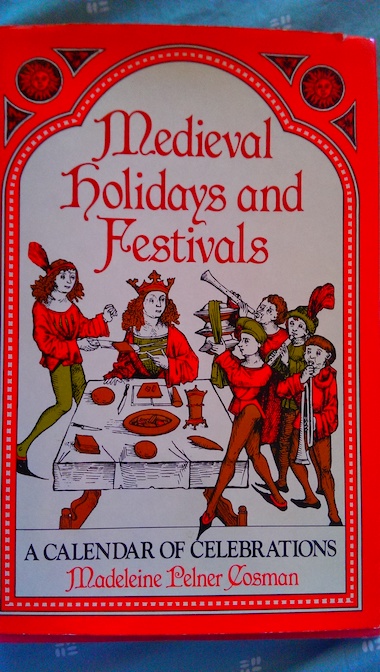
Medieval Holidays and Festivals: A Calendar of Celebrations by Madeleine Pelner Cosman, 1981.
This book explains the holidays that people celebrated in Medieval times and how these holidays would have been celebrated, along with some special information about Medieval feasts. The author also explains a little about how historians uncover and interpret information about people’s lives in the past.
Many of the holidays celebrated in Medieval times tended to be either religious in nature or having to do with the changing of seasons.
The holidays included in this book are listed by month:
January — Twelfth Night — An extension of Christmas (remember the Twelve Days of Christmas song?), Twelfth Night is also known as Epiphany — the night that the Three Wise Men supposedly visited baby Jesus after his birth.
February — St. Valentine’s Day
March — Easter
April — All Fool’s Day — Not just a day for pranks, but when everything is turned upside down and backwards, and people intentionally did the opposite of whatever they usually did in many ways. Basically, a celebration of everything silly and ridiculous.
May — Mayday — A celebration of spring.
June — Midsummer Eve — A celebration of summer.
July — St. Swithin’s Day — St. Swithin was a bishop of Winchester who had asked to be buried without great ceremony upon his death. However, people later decided to give him a grand tomb. When they tried to place his body in the tomb, it started raining heavily and didn’t stop until they moved the body to a new location. They took the rain to be an expression of St. Swithin’s displeasure at the unwanted tomb. From then on, this time of year was used to predict rainfall for the rest of summer.
August — Lammas Day — The word Lammas meant “Loaf Mass,” which was when there would be special blessings for bread and grain and thanks given for bountiful harvests. The holiday was marked by the baking of a variety of special breads, including those in usual shapes, flavors, and colors. Some of them could be very elaborate.
September — Michaelmas — The holiday celebrating St. Michael is oddly associated with three things that few people would associate with each other: gloves, geese, and ginger. The glove was the symbol of the market of craftsmen held on Michaelmas. Geese and foods flavored with ginger were popular dishes served at Michaelmas.
October — Halloween
November — Catherning, or St. Catherine’s Day — St. Catherine of Alexandria was learned noblewoman who was killed on a wheel (it was a bizarre and disgusting form of execution). The holiday honoring her was associated with wheels, women (especially unmarried women and women students), and the professions which were associated with her such as lawyers, carpenters, spinners, lace makers.
December — Christmas
Each section in the book describes special traditions associated with each holiday, including games that would have been played and food that would have been eaten at that time.
In the back of the book, there is a section that explain decorations used for Medieval feasts, how to hold a Medieval-themed feast in modern times, and Medieval costumes. There is also a section of Medieval recipes.
This book is available to borrow and read for free online through Internet Archive.
Happy Holidays and Other Fun Days Around the Year by E. C. Reichert, illustrated by Suzanne Bruce, 1953.
This book explains a little about the origins of various holidays and how they are commonly celebrated. It was written during the 1950s, and the illustrations clearly show it in the style of the people’s clothes. The style of one of the illustrations is one of the charming aspects of the book.
For each holiday in the book, different children talk to their parents or friends about what different holidays mean and how they are planning to celebrate. Many of the explanations are rather simplistic, and I’ve seen books that explain the history of holidays better, but I have some nostalgia for this book because I read it and liked it when I was a young child.
The Holidays:
New Year’s Day — January 1
Sandra talks to her parents about what they’re going to do on New Year’s Day, and her mother explains the purpose of New Year’s resolutions.
Valentine’s Day — February 14
Sally and Billy open valentines they’ve received and talk about Saint Valentine and other Valentine’s traditions.
Washington’s Birthday — February 22
Stevie’s father tells him about George Washington and the famous cherry tree story.
St. Patrick’s Day — March 17
Rickey’s friends explain to him why they’re wearing green on St. Patrick’s Day and his mother tells him a little more about the holiday and what shamrocks are.
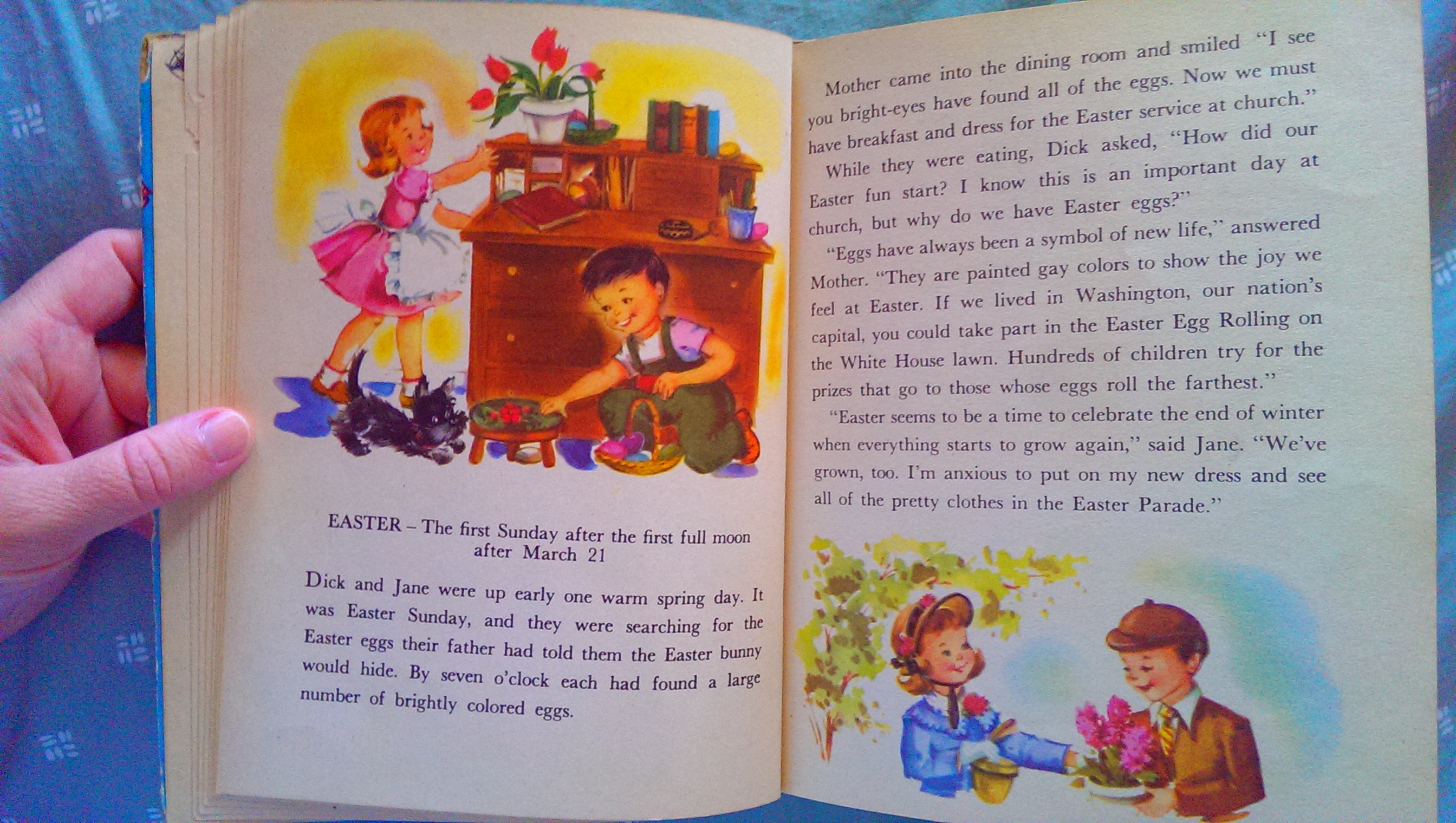
Easter — The first Sunday after the first full moon after March 21
Dick and Jane (not the Dick and Jane from school readers, but yes, those names) hunt for eggs on Easter. They don’t explain the religious reasons behind the holiday, but they talk about popular Easter traditions, like colored eggs and the Easter Egg Rolling at the White House. Congratulations to the book for explaining how to calculate the date of Easter!
April Fool’s Day — April 1
When Artie plays a practical joke on Kathy, their father explains the tradition of April Fool’s Day. (My parents wouldn’t have let my brother give me fake candy because of the choking risk. Just saying. Actually, I never celebrated April Fool’s Day as a kid because both of my parents hated practical jokes because they both resented jokes their parents played when they were kids, coincidentally around the time this little book was published. My knowledge of April Fool’s Day as a kid came from this book and from things I heard at school.)
Independence Day — July 4
Susie and Johnny go to a parade, have a picnic, and watch fireworks on the Fourth of July. Their father explains the significance of the holiday.
Columbus Day — October 12
Miss Nelson’s class at school learns about Christopher Columbus. (This holiday isn’t celebrated as much today as it was when this book was written. I have to admit, I wasn’t that enthusiastic about it as a kid, either. Columbus Day had no costumes, candy, or presents, and I didn’t get the day off school, and thus, it seemed pretty boring to me when I was young.)
Halloween — October 31
Robin and Judy come back from trick-or-treating, and their mother explains a little about the origins of the holiday.
Armistice Day — November 11
Terry and Jimmy watch a parade, and their father explains that November 11 was the day that World War I officially ended in 1918.
Thanksgiving Day — The fourth Thursday in November
Ann and Johnny (a different Johnny from the earlier one, I think they either forgot they’d used that name or just couldn’t think of another – they could have called him Jack to be a little different) have dinner with their family at their grandmother’s house. Johnny talks a little about what he learned in school about the pilgrims and the first Thanksgiving.
Christmas — December 25
Tim and Debbie hang up their stockings, and their mother tells them that it’s Jesus’s birthday and explains the origins of some Christmas traditions.
The Little Indian Basket Maker by Ann Nolan Clark and illustrated by Harrison Begay, 1957.
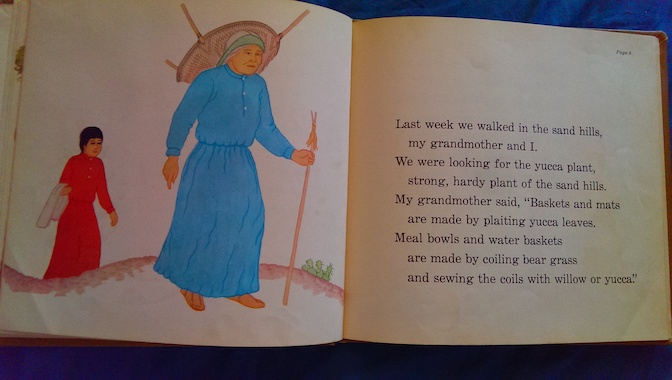
By “Indian,” the author means Native American. This book specifically focuses on the Papago (Tohono O’odam) who live in the Southwestern United States, specifically Arizona. The story is about a young girl who is starting to learn the traditional art of basket-making, and the book goes into the process involved in making baskets, step by step. Although the use of “Indian” instead of Native American is somewhat antiquated, and Tohono O’odam is really the proper name for the Papago people, the book has something of an interesting history and the picture it provides of the practice of traditional crafts is fascinating. There is a section at the beginning of the book which explains a little about the history of the Papago (Tohono O’odam) people and where they live.
A young girl explains how her grandmother teaches her the traditional craft of making baskets. They start by gathering the types of plants that they are going to use.
They also need special plants for the dye they will need in order to decorate the baskets. The girl’s grandmother explains about the different types of decorations they traditionally use.
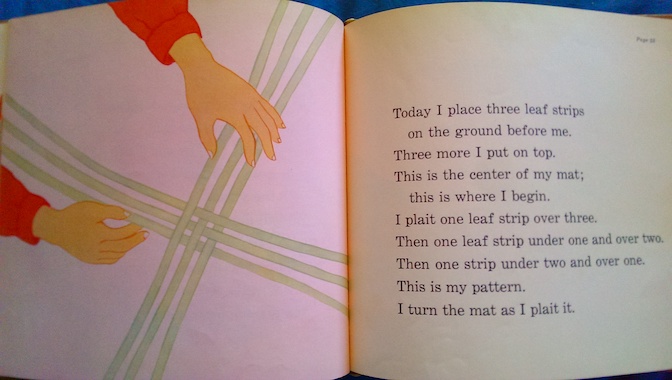
Making baskets is a long process that includes cleaning the plants and tearing them into long strips, bleaching them, soaking them to soften them, dyeing strips used in the design, and weaving them together.
The girl weaves a mat that takes days to finish. It is the first one that she’s made herself.
She is very proud of herself when the mat is finished, and she is pleased with the quality of her work.
I’ve owned this book since I was a young child, and it was my introduction to traditional crafts. Later, I found a related book at a thrift store, The Little Indian Pottery Maker. Until then, I hadn’t realized then just how old the books were and that there were more of them by the same author.
The book, which was written in the 1950s, was one of a group of stories (not exactly a series because they didn’t have a specific set of characters in common and the themes varied somewhat) written by a woman who was a teacher with the United States Indian Service. The other books that she wrote, including The Little Indian Pottery Maker, focus on members of different Native American tribes. She was not Native American herself, and the modern view of Indian schools is not favorable (for good reasons), so one might be a little suspicious of a book written about Native Americans by an Indian school teacher. However, these books interest me because of their explanation of traditional crafts. There are no white people in the stories at all, and they have a timeless quality to them. Reading them, it’s hard to get a sense of exactly when the stories take place because it’s never mentioned, and there aren’t many clues (no mentions of modern technology, it’s all about the crafts). I haven’t found any of the other books that the author wrote, but these two are very respectful in their tone, and they begin with explanations of the history of the tribes involved in the stories. According to Andie Peterson in A Second Look: Native Americans in Children’s Books, the author was deliberately trying to write books that her Native American students could relate to.
The art style of the books vary because they had different illustrators. The illustrator for this particular book was a Navajo painter.
The book is available to read for free online through Internet Archive.
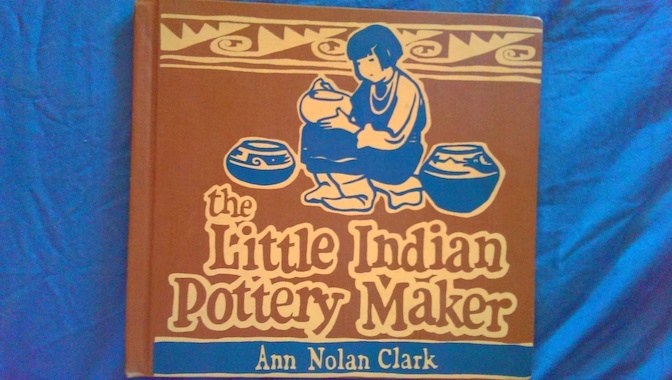
The Little Indian Pottery Maker by Ann Nolan Clark and illustrated by Don Perceval, 1955.
By “Indian,” the author means Native American. This book specifically focuses on the Pueblo Indians who live in the Southwestern United States, specifically New Mexico and Arizona. The story is about a young girl who is starting to learn the traditional art of pottery-making, and the book goes into the process involved in making pottery, step by step. Although the use of “Indian” instead of Native American is somewhat anitquated, the book has something of an interesting history and the picture it provides of the practice of traditional crafts is fascinating. The beginning of the book explains a little about Pueblo Indians, their history, and where they live.
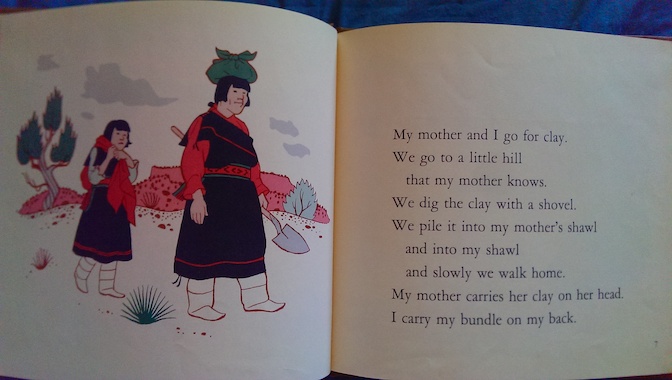
The young girl tells the story of how her mother introduces her to the traditional craft of making pottery and teaches her how to make her first pot. She describes every step in the process, from when they collect the clay themselves from a hillside until the pot is finally complete.
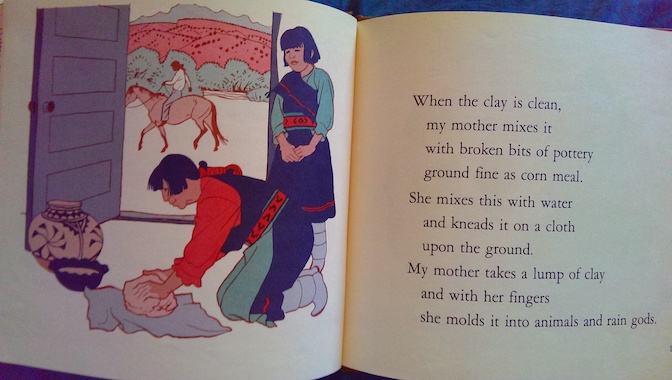
The girl’s mother explains about the different methods used to make pots, and pictures show how pots are shaped.
Making pottery is a long process that takes days to complete, including shaping, scraping and smoothing the sides, drying, decorating, and finally firing the pottery. The girl is proud of the first pot she has ever made.
I found this book at a thrift store a number of years ago and recognized it because I already owned a related book, The Little Indian Basket Maker, that I liked when I was a young child. I hadn’t realized then just how old the books were and that there were more of them by the same author.
The book, which was written in the mid-1950s, was one of a group of stories (not exactly a series because they didn’t have a specific set of characters in common and the themes varied somewhat) written by a woman who was a teacher with the United States Indian Service. The other books that she wrote, including The Little Indian Basket Maker, focus on members of different Native American tribes. She was not Native American herself, and the modern view of Indian schools is not favorable (for good reasons), so one might be a little suspicious of a book written about Native Americans by an Indian school teacher. However, these books interest me because of their explanation of traditional crafts. There are no white people in the stories at all, and they have a timeless quality to them. Reading them, it’s hard to get a sense of exactly when the stories take place because it’s never mentioned, and there aren’t many clues (no mentions of modern technology, it’s all about the crafts). I haven’t found any of the other books that the author wrote, but these two are very respectful in their tone, and they begin with explanations of the history of the tribes involved in the stories. According to Andie Peterson in A Second Look: Native Americans in Children’s Books, the author was deliberately trying to write books that her Native American students could relate to.
The art style of the books vary because they had different illustrators. The illustrator for this particular book was not Native American (unlike some of the illustrators of other books), but he was adopted into a Hopi tribe, apparently as an adult because of his accomplishments in representing Hopi culture in art.













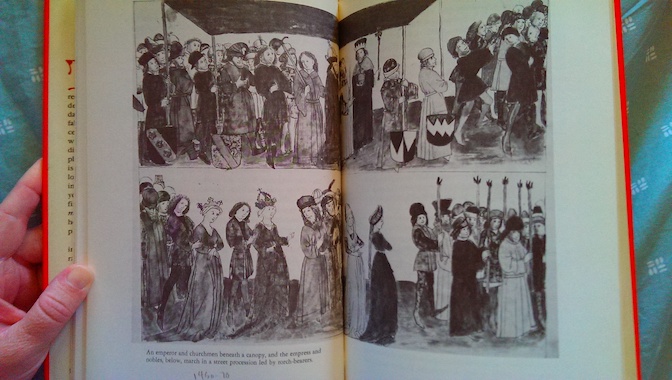
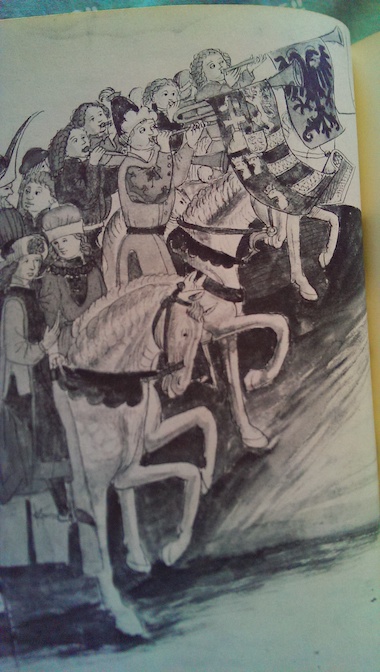 January — Twelfth Night — An extension of Christmas (remember the Twelve Days of Christmas song?), Twelfth Night is also known as Epiphany — the night that the Three Wise Men supposedly visited baby Jesus after his birth.
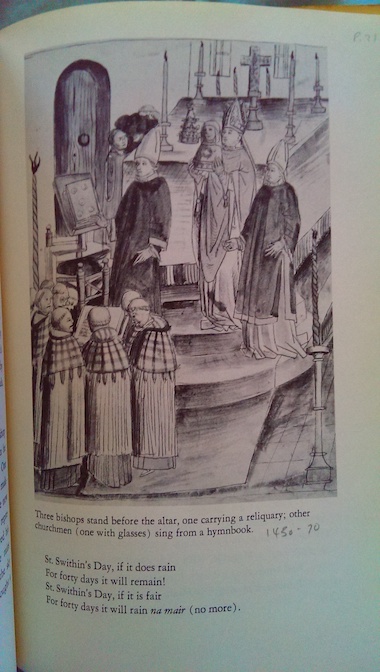 July — St. Swithin’s Day — St. Swithin was a bishop of Winchester who had asked to be buried without great ceremony upon his death. However, people later decided to give him a grand tomb. When they tried to place his body in the tomb, it started raining heavily and didn’t stop until they moved the body to a new location. They took the rain to be an expression of St. Swithin’s displeasure at the unwanted tomb. From then on, this time of year was used to predict rainfall for the rest of summer.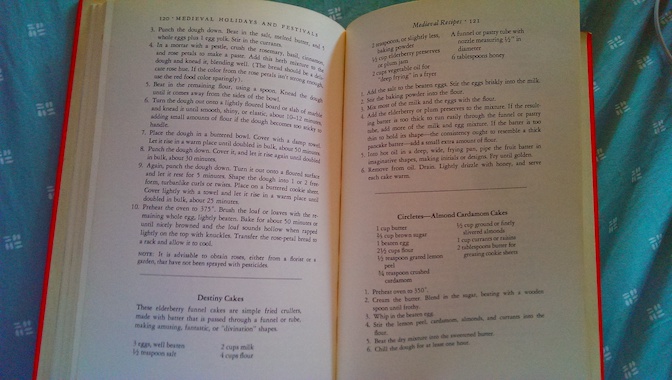









 Jestress's Forgotten Books and Stories