Hand Shadows to be Thrown Upon the Wall by Henry Bursill, 1859, 1967.
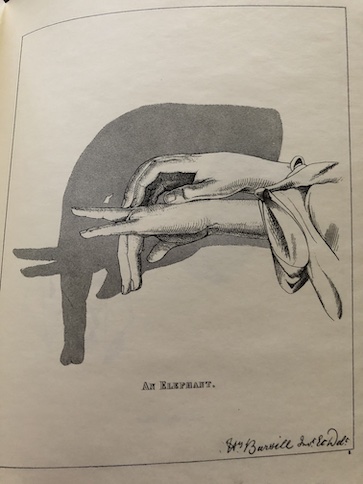
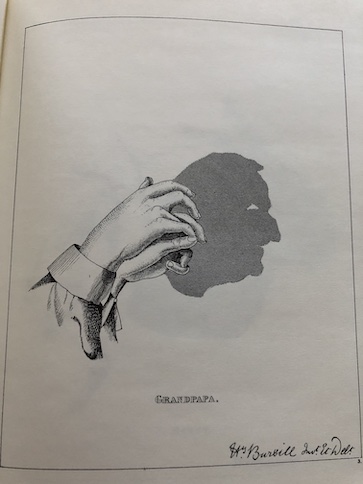
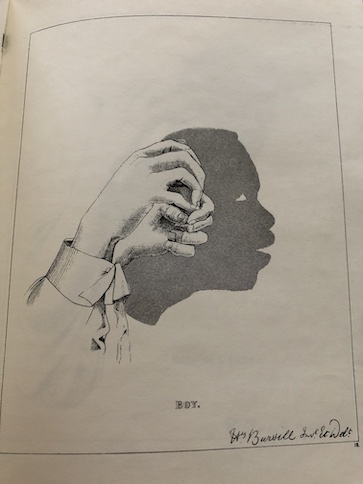
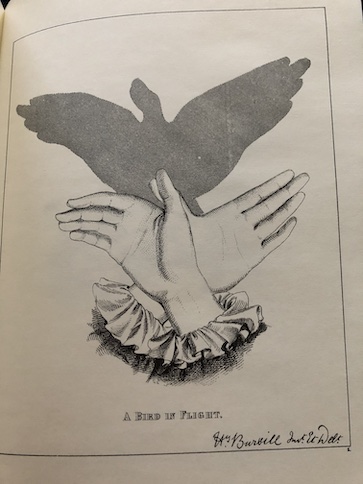
When I first read and started playing with this book as a kid, I didn’t stop to read the preface in the book or look at the publishing date, so I completely missed the fact that this is a reprint of a book from the late 1850s. The author, Henry Bursill (link repaired 9-11-24), was a professional artist
In the preface, Bursill refers to a well-known print from the early 19th century called The Rabbit on the Wall, which shows a father making shadow figures on the wall with his hands to amuse his children. Bursill says that there have been other books about hand shadows before his, but he emphasizes that his book is not the same as theirs because he has worked out his own hand shadows through experimentation. He says that it will take some practice for people making hand shadows to get them perfectly, but he encourages people to practice and not be afraid to work out new hand shadows of their own through experimentation. Bursill did the illustrations for the book himself, and he says that he began sketching some of the designs during his time as an art student and that he would amuse some fellow students by making hand shadows on the wall of his studio.
Other than the preface, the only words in the book are the captions on each of the pictures. I’ve tried some of the hand shadows in the book, and I had a more difficult time than the preface makes it sound. The only ones I’ve really been able to do well were the bird and the greyhound. I haven’t given up on mastering some of the more difficult ones someday, though!
Cat’s Cradle String Games by Camilla Gryski, 1983.
Back when I was in middle school, I went through a phase where I was really into cat’s cradle. I’m one of those people who like to have something to fiddle with in their hands, and it was easy to carry a loop of string in my pocket. If I lost the string, I could always make another string loop and carry that. This was the book that I used to teach myself how to make cat’s cradle string figures.
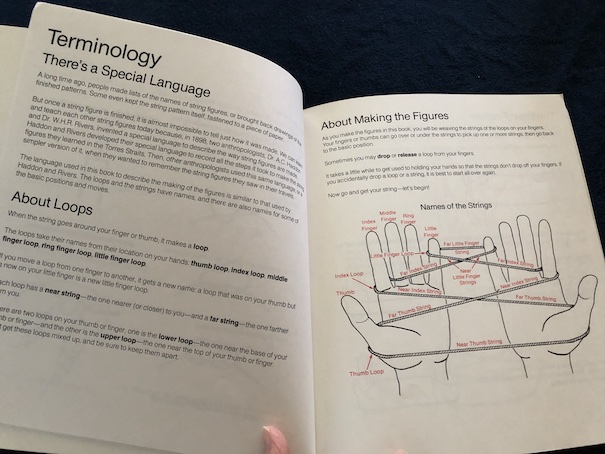
The book begins with a section that explains the terminology of making string figures and how to start out with the string in a basic position on the hands.
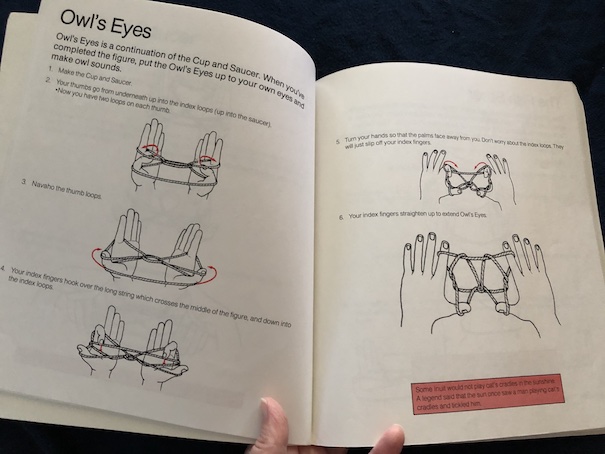
From there, the book covers how to make various string figures. As the book demonstrates how to make different figures, it explains a little about which cultures use them. Cat’s cradle and similar string games are played around the world, and different cultures have had different names for some of the same figures. For example the “cup and saucer” figure can be called a saki cup or maybe a house if it’s held upside down.
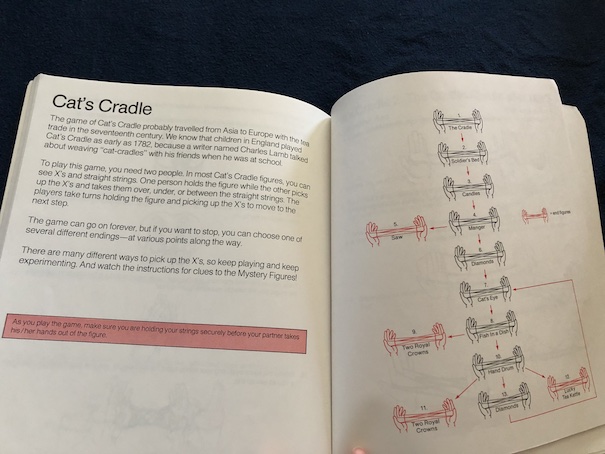
Some figures can be made independently of each other, but what turns making string figures into the game of cat’s cradle is the fact that some figures can be turned into other figures in a sequence. The book demonstrates the sequence of making figures involved in playing a game of cat’s cradle. It’s a game for two players with the players each taking the string from each other to form each of the figures. The game ends when one of the players forms one of the ending figures that doesn’t lead to any other figure.
The book is available to borrow and read for free online through Internet Archive.
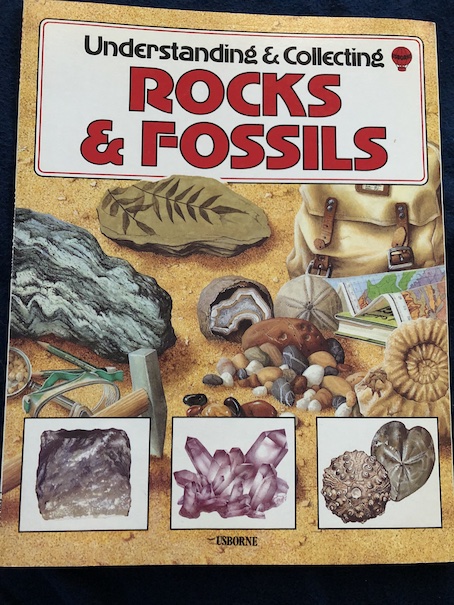
Understanding and Collecting Rocks and Fossils by Martyn Bramwell, 1983.
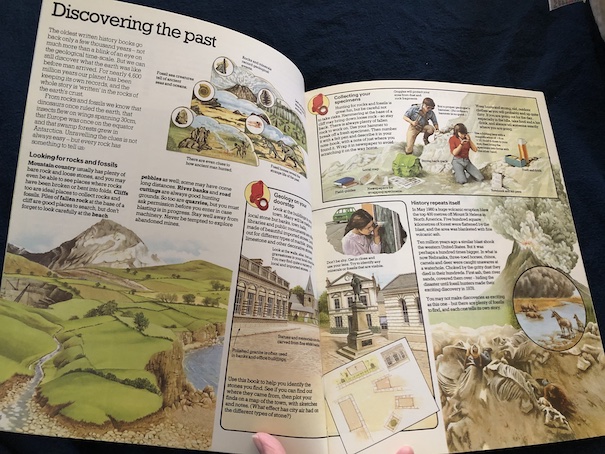
This book is part of a series of beginning hobby guides for kids. It explains how to collect and study rocks and fossils and some of the deeper aspects of geology. The book emphasizes that studying geology helps us to understand the story of the Earth and the forces that have shaped our landscapes and formed the rocks and minerals we use. All through the book, there are suggested activities and experiments for readers, marked with the symbol of a red magnifying hand-lens.
The book explains some the large geological forces, like how the continents move and the plates that make up the Earth’s crust shift. Then, it explains the different types of rocks, igneous, sedimentary, and metamorphic, with examples of each type.
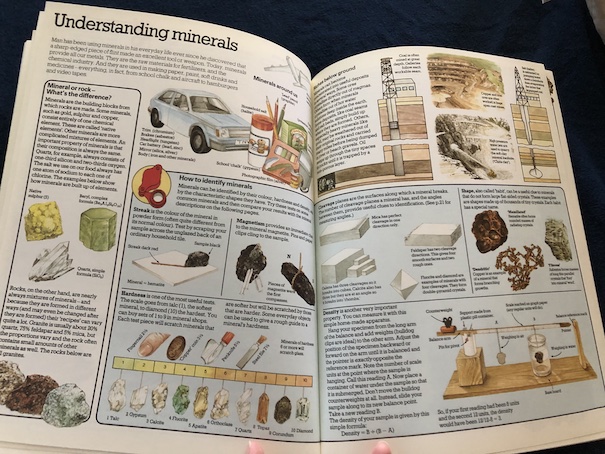
One of the sections I found particularly interesting is the one that explains about how to identify different minerals and what they’re used for. The activity on that page explains how to identify a mineral based on a series of factors, like whether or not it’s magnetic, the color of a streak it might leave when scraped against tile, and its hardness, which you can test by seeing what implement will scratch it.
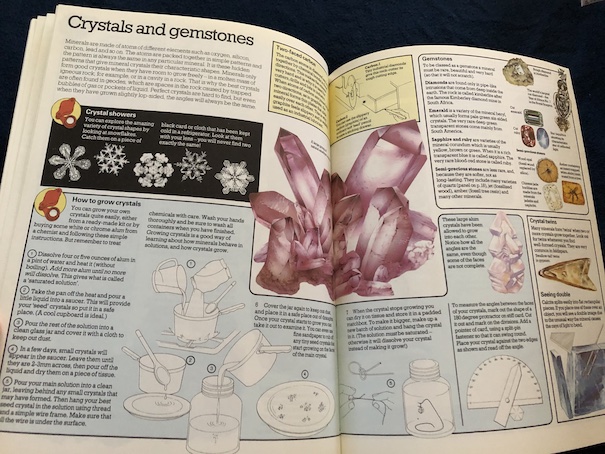
I also liked the section about crystals and gemstones. There are instructions for growing your own crystals.
The section about fossils explains how to collect fossils, clean them, make plaster molds of them, and identify what organisms made the fossils. The book explains how fossils are made and had a timeline of past eras on Earth and the creatures that existed in each era.
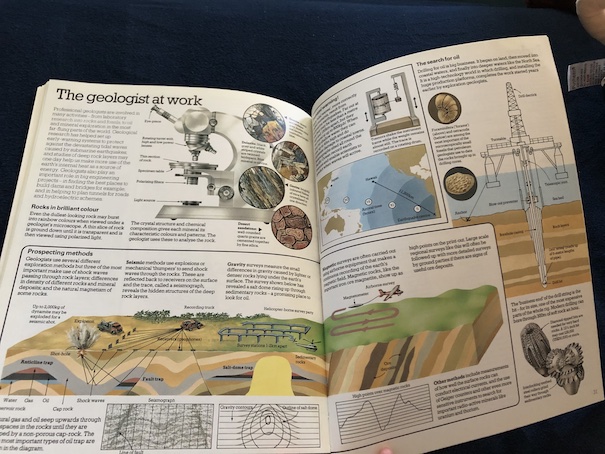
The last section of the book explains the types of work that geologists do and the types of geological surveys they carry out to predict earthquakes and tsunamis and finding useful deposits of ore, minerals, oil, and natural gas.
There’s quite a lot of information to take in. Even though this is a pretty beginner guide to rock collecting and geology, I would say that the book would be better suited to older children than younger ones.
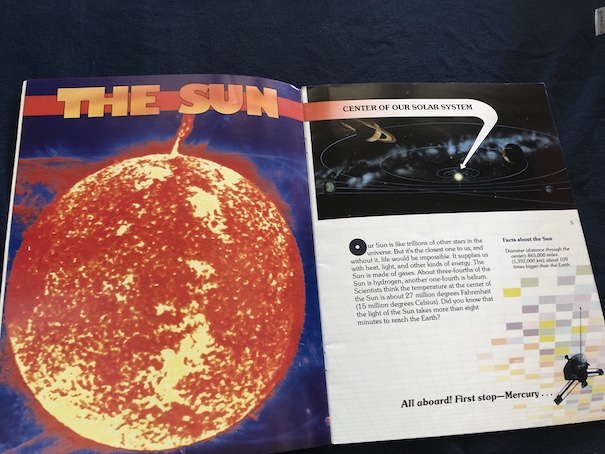
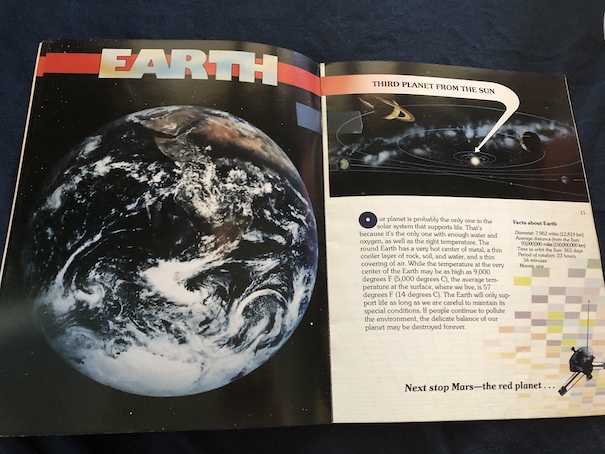
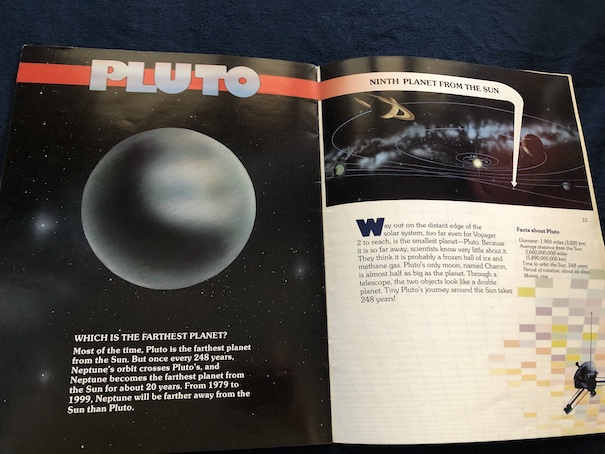
This was my second favorite book about outer space as a kid! It would have been the first favorite, but my first favorite had glow-in-the-dark pictures, and this one doesn’t. I bought them at the same time at a school book fair, but the one with the glow-in-the-dark pictures definitely caught my attention first. This book does, however, have pictures of the planets taken by the Voyager 2 space probe.
The beginning of the book explains a little about the solar system and its place in the galaxy and the Voyager 2 probe.
Then, it takes readers on a journey through the solar system, beginning with the sun at the center of the solar system and moving outward, planet by planet. The page about each planet explains the origin of the planet’s name in Roman mythology and gives facts about the planet, such as its size, distance from the sun, and rotation and orbit periods.
The page about Earth specifically mentions, “The Earth will only support life as long as we are careful to maintain its special conditions. If people continue to pollute the environment, the delicate balance of our planet may be destroyed forever.” Books, movies, tv shows, and teachers in public school gave us environmental messages very early in life when I was young in the 1980s and 1990s.
The book ends with Pluto as the ninth planet, which is what we were taught as kids in the early 1990s. There is no mention of “dwarf planets” or the Kuiper Belt because the book was published in 1990 and scientists didn’t find definite evidence of Kuiper Belt objects until 1992.
Discover the Night Sky by Chris Madsen and Michele Claiborne, 1989.
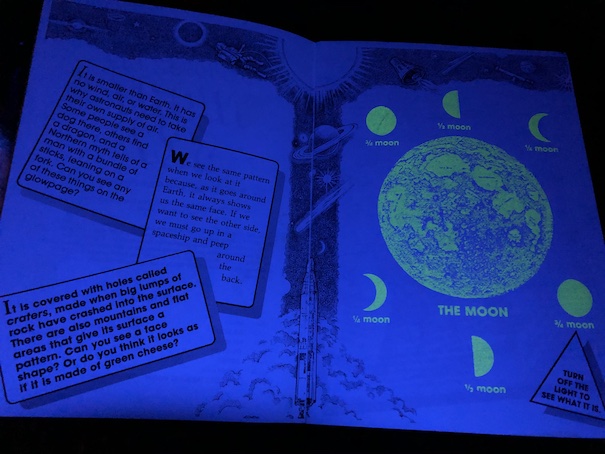
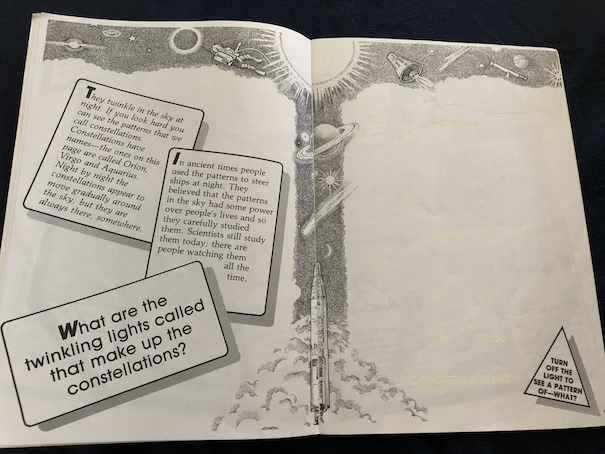
I bought this book at a school book fair when I was a kid, and it was my favorite book about the stars and outer space because it has glow-in-the-dark pictures. As a child, I loved anything that was glow-in-the-dark. Actually, I still do.
Every page in the book is designed to be interactive. There are pages that talk about different aspects of outer space, but the pages with the glow-in-the-dark pictures want you to guess what’s in the picture based on descriptions of it. Then, you’re supposed to turn off the light and look at the glowing picture to see what it is. You can see the what the glow-in-the-dark picture is without turning off the lights if you tilt the book and look at it at an angle or use a black light (like I did to take the pictures), but it is more fun if you really do look at it while it’s glowing in the dark. (Like other glow-in-the-dark toys, it glows better if the page has been in the light first to charge it.)
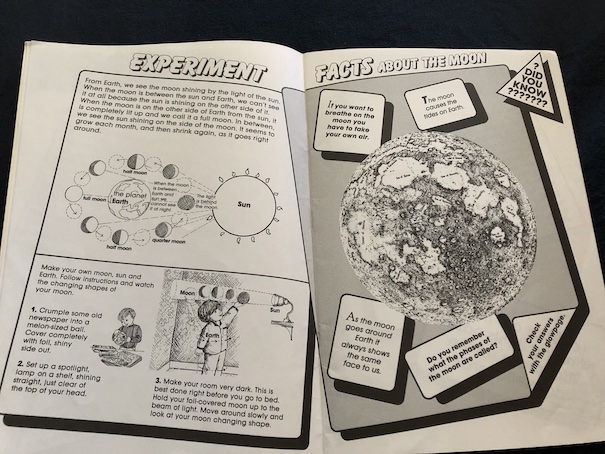
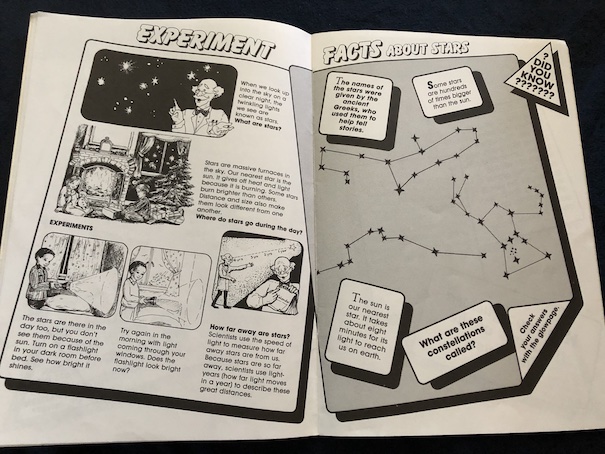
The pages after each glow-in-the-dark page have facts about the object in the glow-in-the-dark picture and an experiment for readers to do. The experiments help demonstrate the nature of the moon, stars, and planets, like what causes the phases of the moon, what causes seasons on Earth, and why you don’t see the stars during the day, even though they’re still there.
The information in the book is still factually correct, although it shows Pluto as being the last planet of the solar system. (Since people still quibble about this, I don’t consider it a big issue.) It isn’t a bad introduction to outer space for young children. The last page in the book is about the Voyager 2 space probe. Its primary mission ended around the time the book was first published, but we have contact with the space probe today (as of early 2021).
The book is available to borrow and read for free online through Internet Archive. The online version of the book doesn’t fully do it justice because you can’t take advantage of the glow-in-the-dark feature, but you can still read the text and see the experiment pages.
Addy’s Cook Book by Rebecca Sample Bernstein, Terri Braun, Tamara England, and Jodi Evert, 1994.
This cook book is one of the activity books that was written to accompany the Addy series that is part of the American Girls franchise. The American Girls books were written to help teach American history (as well as sell the accompanying dolls and accessories), so this book has recipes of the type that people would have eaten during the American Civil War, when the character of Addy lived, and some historical information.
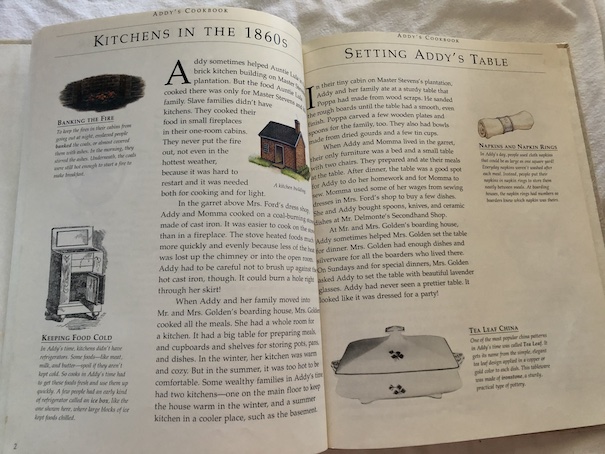
The book begins with sections of historical information about African Americans, kitchens, and table settings in the 1860s. It describes the lives of slaves and explains how they were given basic rations of food which they could supplement and extend by producing or gathering some food of their own, such as vegetables they grew or fish they caught themselves. When they managed to escape from slavery, they had to depend on help from others, such as churches or abolitionists, until they became established in their new lives. When they were able, many of them provided help to others who were in the same position. (This was a topic covered in the Addy books.)
The types of kitchens they used depended on where they were living. As slaves, Civil War era African Americans would do their cooking in small fireplaces attached to the small cabins where they lived. Because they needed the fire for cooking, they kept it burning all the time, even in hot weather. Free African Americans had more options. Depending on their living arrangements, they might have a stove for their cooking, or if they lived in a boarding house, they might be provided with meals as part of their boarding, paid for along with the rent on their rooms.
The recipes in the book are divided into three sections: breakfast, dinner, and favorite foods. There is a section with some general cooking tips, but there are other cooking tips and pieces of historical information included along with the recipes. Some information that I found particularly useful explains why some historical recipes can be confusing to read. Because some people were using cooking fires and some were using stoves, 19th century recipes can have vague-sounding instructions like “fry until golden brown” instead of specific cooking times and temperatures. It was also common for people to cook favorite dishes from memory instead of following written recipes. People learned to cook from their elders, and they just continued doing what parents and grandparents always did when they cooked. The book doesn’t mention it, but this style of cooking also continued into the 20th century, so even when people wrote down recipes, they might seem vague or incomplete to modern readers. It was like that with recipes that my grandmother and great-grandmother wrote down, too. They were accustomed to making certain recipes mostly from memory, and they didn’t feel obligated to write down every little step, assuming that anyone who read it would already know how to make that kind of dish and would just need a few reminders about amounts. Fortunately, the recipes in this book are all written with detailed, modern instructions and include cooking times and oven temperatures.
The book explains that poor people during the Civil War didn’t usually have much for breakfast because they had to rise early and get to work. Most mornings, they might have some leftovers from the previous night or some simple hot foods, like buttermilk biscuits and hominy grits, a traditional Southern breakfast food made from corn (my grandmother said that she had it when she was growing up on a farm in Indiana, too). As a special treat, they might have scrambled eggs or sausage and gravy.
The dinner section includes main dishes, like fried fish, and side dishes, like hush puppies. A particular recipe that gets extra attention is Hoppin’ John, a rice dish with black-eyed peas and bacon. Hoppin’ John is special because it’s a dish traditionally served at New Year’s Day.
The section of favorite foods include chicken shortcake, a few other side dishes, and a few special treats, including peach cobbler and shortbread. I’ve tried the shortbread recipe, and I like it. It’s easy to make and includes only a few ingredients, and it’s really good. It does contain a lot of butter, so it’s just an occasional treat.
The book ends with a section of advice for planning an Emancipation party. It explains how people celebrated when the Emancipation Proclamation was read publicly on December 31, 1862, having been transmitted to communities by telegraph. Children played games like Novel Writers (which is a story-writing game similar to Consequences) and Blindman’s Buff. The book also describes the origins of Juneteenth – slaves in Texas were freed on June 19th, 1865, about two and half years after the Emancipation Proclamation.
The book is available to borrow and read for free online through Internet Archive.
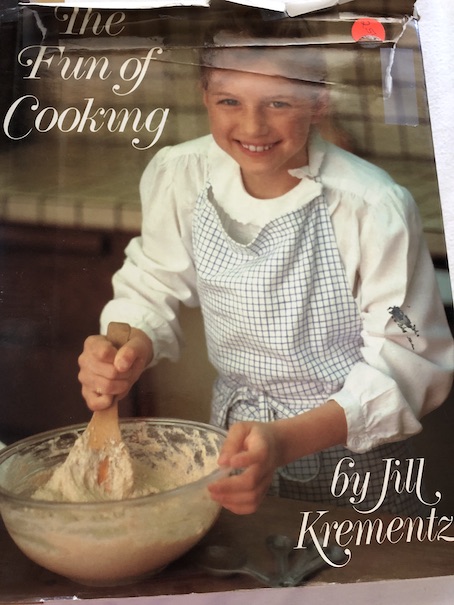
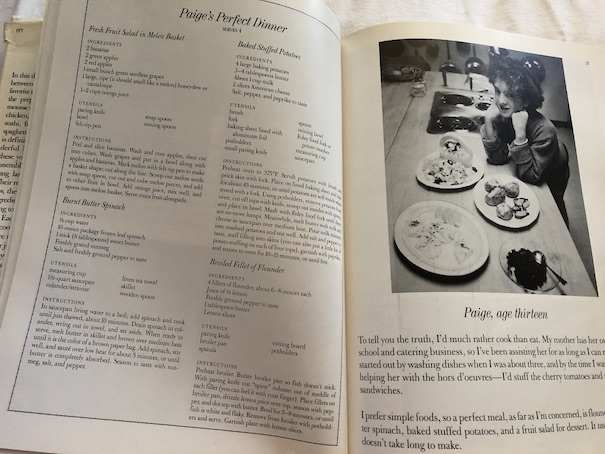
This cookbook was designed not only for children but includes real children making their favorite recipes, sometimes by themselves and sometimes with the help of their parents. The author, Jill Krementz, was also a photographer, and she photographed the children as they cooked. (Another interesting fact is that Jill Krementz was also married to Kurt Vonnegut, until his death. It’s not directly related to this book at all, just a fun fact.)
The recipes in the book aren’t arranged in any particular order, going back and forth between main dishes and desserts of various kinds. Some of the children included recipes for entire meals that included both main dishes and a dessert.
The children themselves are a range of ages from six to sixteen. The older children tend to make more complex dishes or meals, and the younger ones tend to make simpler ones, although even the younger children can make complex dishes with the help of their parents or grandparents. One girl, Michele, has a father who is a professional chef, and she says that it’s her ambition to be a chef, too. She and her father are shown making spaghetti together in the kitchen of his restaurant.
The children all seem to live in or around New York City, where the author lived, and they are from a variety of backgrounds. There are two girls who mention that they are Jewish, including the girl who makes matzo ball soup with her grandmother. There are also two black girls, and one boy with Greek ancestry. Not all of the children have obvious backgrounds like this, but I thought it was interesting where it was noticeable. I think that having a variety of children with different ages and backgrounds was a good idea because it could help many young readers to identify with different types of children.
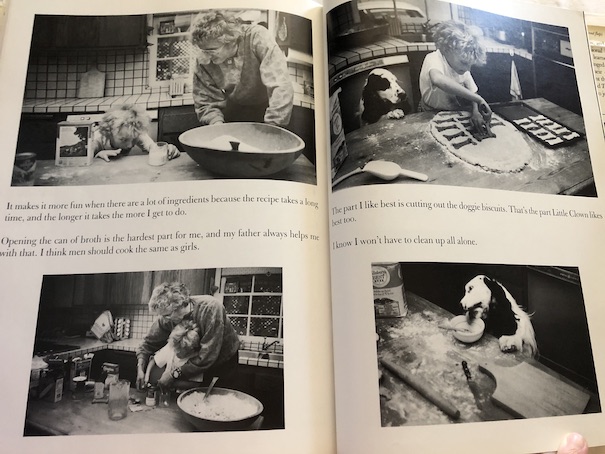
I also liked the fact that there were both boys and girls cooking their favorite recipes. Not only did Michele cook a recipe with her father, but there are other fathers in the book, helping with the cooking, too. One of the boys makes dog biscuits for his dog with his father, and he comments, “I think men should cook the same as girls.” It’s nice to see cooking characterized as something that anyone can enjoy doing, both men and women, as well as children of different ages.
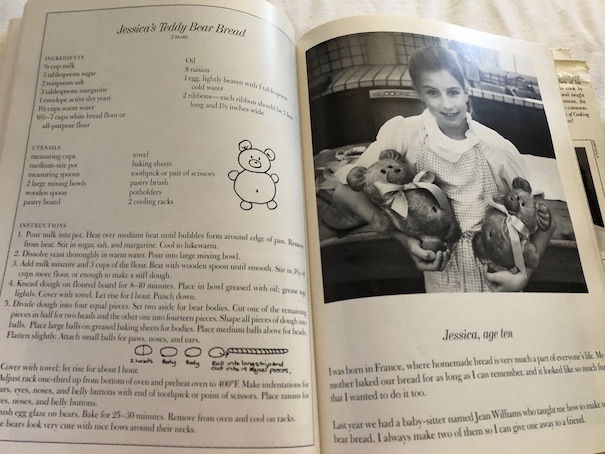
One of the cutest recipes is one for making loaves of bread shaped like teddy bears.
One of my favorite recipes was the one for pumpkin pie. I’ve made pumpkin pie from a whole pumpkin like this before, and it’s a lot of work, but it’s fun! The girl making the pie also roasts the pumpkin seeds.
The book is available to borrow and read for free online through Internet Archive.
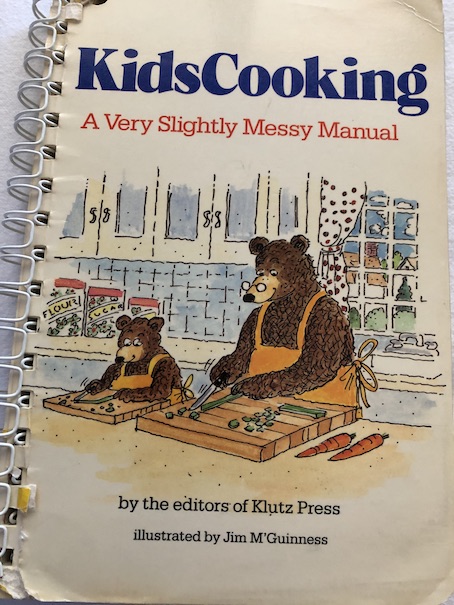
Kids Cooking: A Very Slightly Messy Manual by the editors of Klutz Press, 1987.
This book is part of the classic children’s hobby and activity series from Klutz Press. Originally, this book came with a set of plastic measuring spoons, which was attached to the book at the hole in the upper left corner.
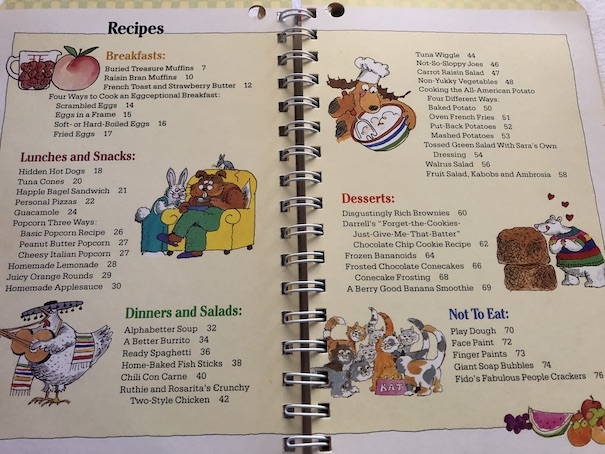
The recipes in the cookbook are listed in categories by the type of meal: breakfasts, lunches and snacks, dinners and salads, and desserts. There is also a section of recipes for non-edible things, like play dough and finger paint.
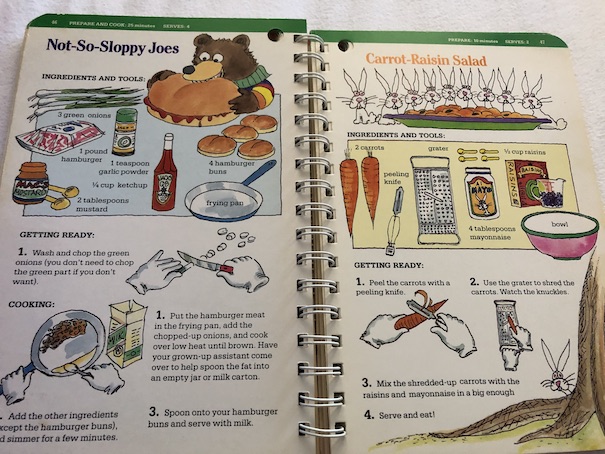
The food recipes are fairly simple, but not the overly-simple, boring recipes that I’ve seen in some children’s books, like how to make a peanut butter sandwich.
Kids can make these recipes, but they’re not for little kids who are still at the level of learning to make their own basic sandwiches. They do involve things like using stoves and ovens and chopping ingredients with a sharp knife. It’s common in the book to include “grown-up assistant with knife” under the list of ingredients and tools needed for recipes.
Some of the recipes in the book include multiple ways to cook something, variations on popular foods or different ways of seasoning a dish. For example, the breakfast section explains different ways to cook eggs, including scrambled eggs, fried eggs, soft or hard boiled eggs, and eggs in a frame.
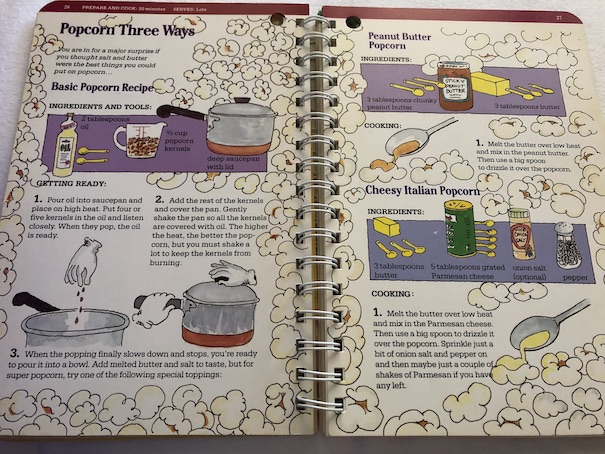
There are different ways of cooking potatoes in the dinner section, and I also like the popcorn variations in the snack section, which include different ways to flavor popcorn with cheese or peanut butter.
The dessert section includes brownies (“Disgustingly Rich”), chocolate chip cookies, and some more unusual desserts, like frozen bananoids, which are pieces of banana covered in chocolate and frozen.
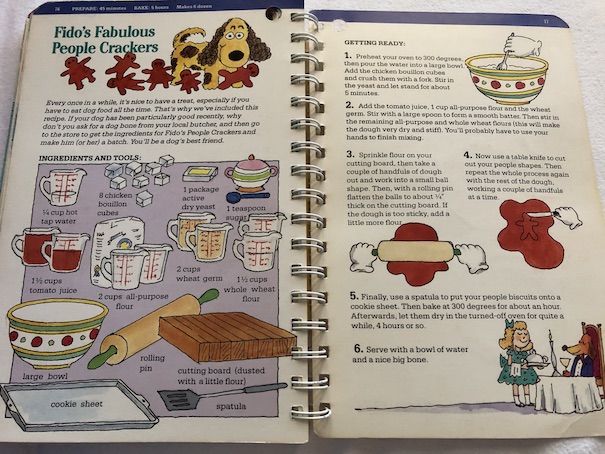
The section of non-edible recipes also includes a recipe for dog biscuits, Fido’s Fabulous People Crackers. They’re edible for dogs, just not something people would enjoy.
The book is available to borrow and read for free online through Internet Archive.
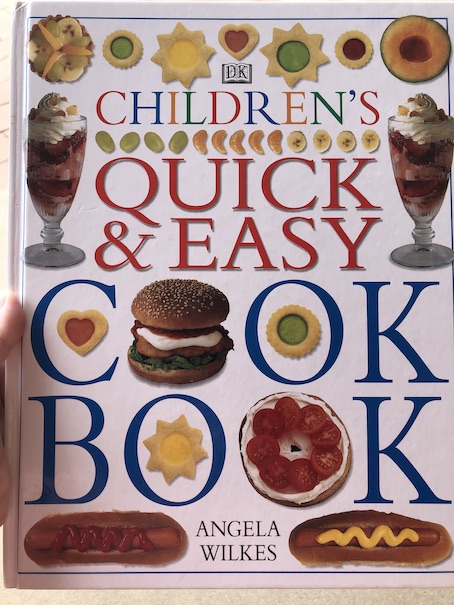
Children’s Quick and Easy Cook Book by Angela Wilkes, 1997.
When I was expanding my cooking skills as an adult, I started doing it using children’s cookbooks instead of cookbooks for adults because of the simplified instructions. When I bought this one, I hadn’t realized that it was originally a British book. I have the American edition, but the reason why I discovered that it was a British book is that the types of recipes the book offers includes some that are more common in the UK than in the US. A friend of my family, who was originally from England, spotted it and was happy to hear that I’d be learning to make some of these recipes. The recipes provide both metric and imperial measurements for the ingredients (another clue that this is an international book). There is a section in the beginning of the book that explains how to use the book and some general cooking safety tips. In the back of the book, there is a helpful Picture Glossary that demonstrates various cooking techniques and concepts used in the book, like how to use a marinade, how to core an apple, how to separate eggs, and how to roll out pastry. It’s all useful information for beginning-level cooks.
The recipes are divided into helpful sections, including snacks, meals, desserts, and sweets. The book is heavy on desserts, candy, and sweets, but many of the recipes under the snacks section are what Americans (and possibly British people, too, although I’m less sure there) might consider as breakfasts, lunches, and general light meals. In particular, the snack section includes sandwiches of various kinds. Some of the ingredients for the sandwiches sound uncommon for the US, although that might also vary by region. I can’t recall seeing salami and cream cheese together before, but I wouldn’t mind trying it sometime. Some sandwiches also call for ingredients like cherry compote and mango chutney. I think that serving grated chocolate on croissants or other bread items is also a European thing. I’ve seen it packaged just for that purpose at international grocery stores and import stores. Some of the snacks are more like snack items in American cook books, like flavored popcorn and smoothies.
The section of Speedy Meals include omelets, two kinds of soup, tacos, and pasta. Some recipes are common ones in the US, too, like chicken nuggets, chicken burgers, and fish sticks. The Turkish Meatballs with lamb, Falafel, Tabbouleh, and Chicken Curry and Rice are less common, but are still eaten here, especially if you live in areas with international restaurants and grocery stores.
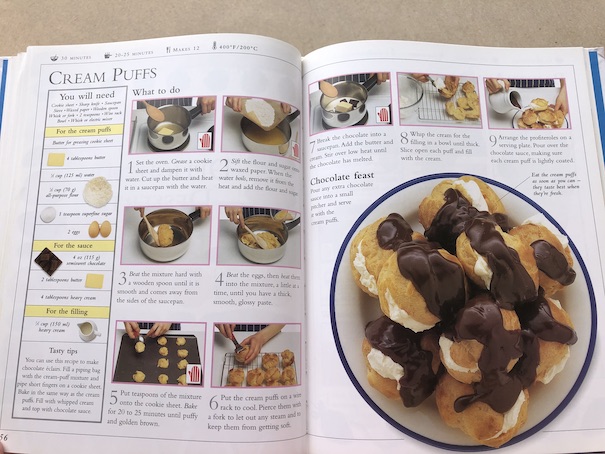
Of course, the desserts and sweets are particularly fun recipes. I particularly enjoyed making the cream puffs! There are different types of cookies included and candies like chocolate truffles and peppermint creams.
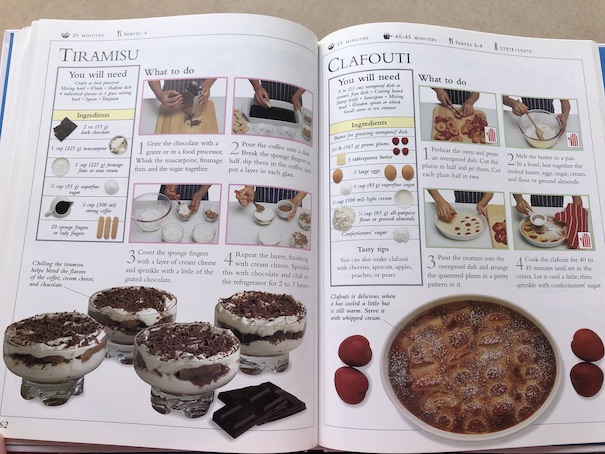
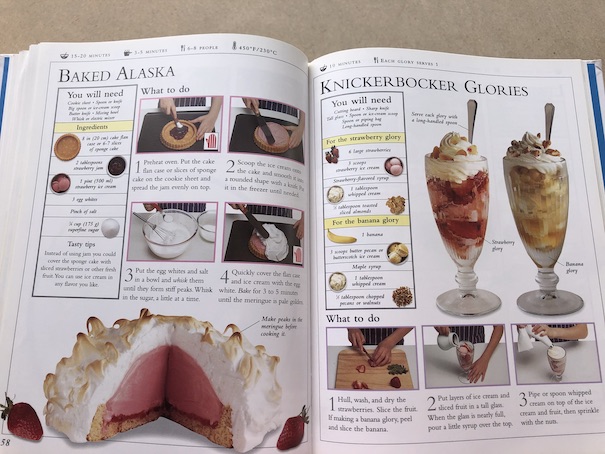
Many of the desserts would be familiar to Americans, like the chocolate cake, carrot cake, lemon cheesecake, and Baked Alaska. However, there were also a few desserts that were new to me. I had never heard of Clafouti before, and this was the first place I had heard of Knickerbocker Glories, a kind of parfait or sundae with layers of ice cream and fruit. (If you remember Harry Potter referring to a Knickerbocker Glory in one of the books, here is what it is!)
The book is available to borrow and read for free online through Internet Archive.
This cookbook has easy recipes that kids can make with their friends at sleepovers, parties, or anytime they want to eat together and include cooking as an activity. Some of the recipes are made from scratch, and some include shortcuts, like using pre-packaged pie dough and crescent roll dough.
The recipes are divided into sections with two sections devoted to snacks, Starter Snacks and Sacktime Snacks (bedtime snacks). There are other sections for meals – dinners, breakfasts, and brunch or lunch. There is also one extra section for birthday treats. The introduction to the book says that it isn’t really important when readers use the recipes – if you want to use a starter snack as a bedtime snack or eat a dinner recipe for breakfast, it’s all up to you. The sections are just to make it easier to find certain types of recipes.
As expected in a book of sleepover recipes, there are plenty of sugary treats, but there is one specifically “healthy” recipe for each section in the book, marked by a heart in the table of contents. The snacks include traditional kid favorites like cookies, popcorn balls, and s’mores. However, even some of the recipes that aren’t specifically labeled “healthy” are still non-sugary, like guacamole and hot taco dip.
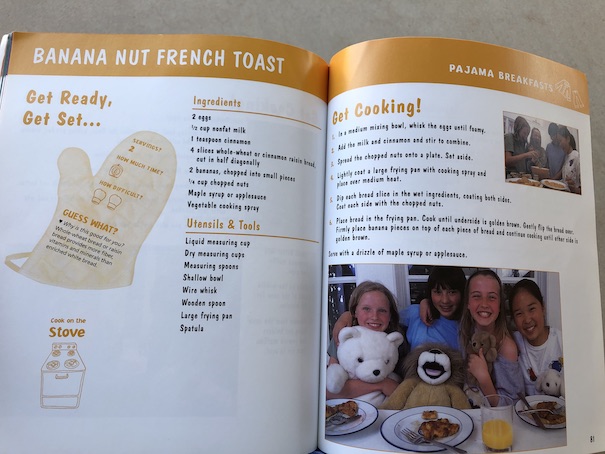
The meal recipes also include many popular favorites. Dinner recipes include chicken pot pie, taco salad, spaghetti and meatballs, and homemade pizza. Breakfast recipes include cream cheese and ham omelettes, chocolate chip muffins, and banana nut French toast. Lunch recipes include tuna melts (called Tuna Meltdowns), bow-tie pasta salad, chicken veggie sticks (kebabs), and turkey burgers.
The section of birthday treats has recipes for different types of cakes and a few non-cake treats like brownie sundaes and Fundue (chocolate dessert fondue).
Each of the recipes in the book comes with ratings, indicating the difficulty of the recipes, although none of them were are really very difficult in general, and the amount of time it takes to make them. One of the things that I liked about this book, besides the ease of the recipes is that the book, is that the pictures show boys cooking as well as girls. I think it’s good that the book portrays cooking as something that both boys and girls can do because it’s a useful life skill for everyone and something that anybody can do for fun.
The book is available to borrow and read for free online through Internet Archive (multiple copies).































 Jestress's Forgotten Books and Stories