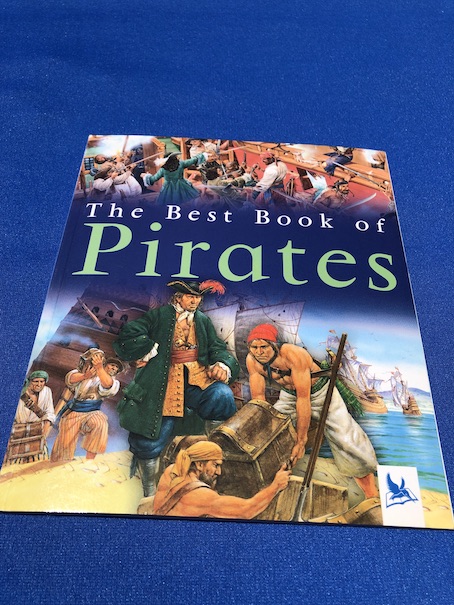
The Best Book of Pirates by Barnaby Howard, 2002, 2006.
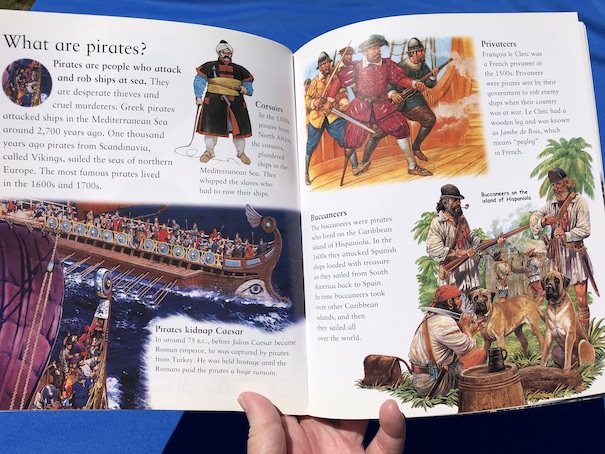
This is an easy and informative non-fiction picture book about pirates. Rather than focusing on any particular time period or geographic area, the book gives a broad overview. In the beginning, it explains a little about different groups of pirates through history, including Vikings, Corsairs, Buccaneers, and Privateers. There is also a brief explanation of the Pirate Round, a sea route often taken by pirates during the late 17th century and into the 18th century. The route led from North America and the Caribbean to Africa, circling the coast of South Africa to Madagascar and on to the Middle East and India. (If you’ve seen the movie Cutthroat Island, the crew will basically be taking this route when the movie ends, heading from the Caribbean to Madagascar.)
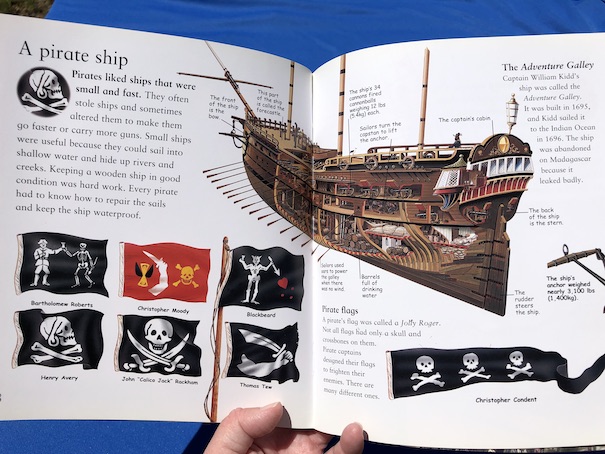
There is a diagram of a pirate ship from the late 17th century, showing what it would have looked like on the inside, and there are also examples of Jolly Roger flags, which were designed by individual pirates as personal identification, typically including skulls and skeletons to frighten their victims. There is also some general information about what life would be like on board a pirate ship and the types of weapons they might have.
Then, the book begins to focus more on groups of pirates that operated in specific geographical areas and some of the more famous pirates from history. The Barbary pirates (also called Barbary corsairs) were Muslims who raided Christian ships along the coast of North Africa and the Mediterranean during the 1500s. Among the most famous Barbary pirates were a pair of brothers called Barbarossa (“Red Beard”). Sometimes, European and American pirate ships that went to Africa to find gold and ivory also entered the slave trade.
In the section about the Spanish Main, it explains how privateers and pirates raided Spanish ships taking Aztec treasures from Mexico to Spain. Buccaneers were specifically pirates who raided ships in the Caribbean. Their name came from the type of fires they used when cooking meat (boucan or buccan).
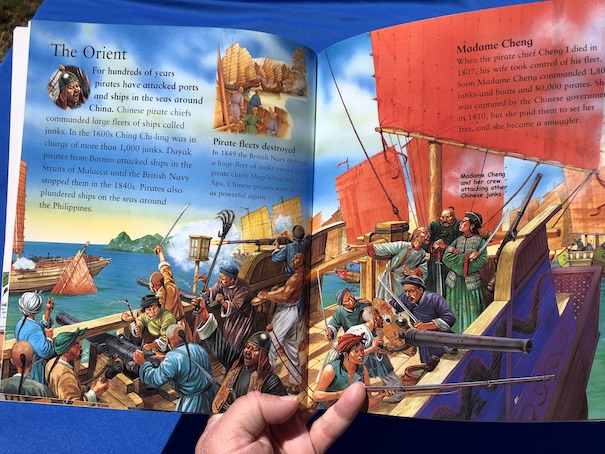
There were also Asian pirates who raided the coasts of China and the Philippines and areas around the Indian Ocean. Chinese pirates and Dayak pirates from Borneo were powerful in the region until the 1840s, when the British Navy destroyed many of their ships.
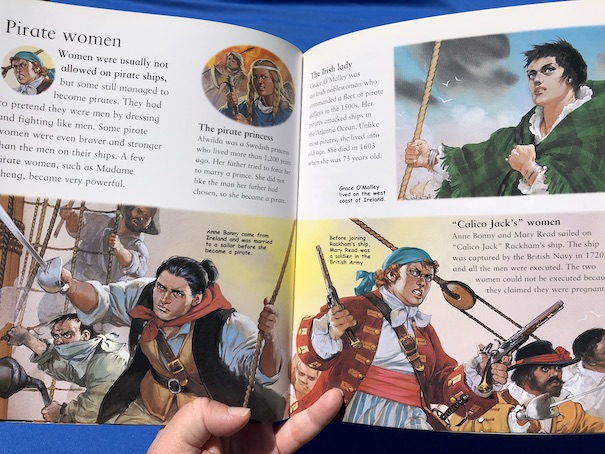
There is a section in the book specifically about female pirates. Mary Read and Anne Bonny, who sailed with “Calico Jack” Rackham, were famous. Grace O’Malley was a famous Irish pirate who was also an Irish noblewoman. Madame Cheng was a Chinese pirate who took over her husband’s fleet after his death (but because this is a children’s book, it doesn’t mention her previous career). Alwilda was a Medieval Swedish princess who turned pirate after her father tried to make her marry a man she did not want to marry (although her story may only be legend).
The
book also talks about the famous stories of pirates burying treasure, although
it says that pirates would usually spend their money quickly, sell items for
money they could spend, or gamble it all away.
At the end of the book, there is a short section about modern pirates and how their goals and tools of the trade have changed.
The book isn’t very long, but I think that it provides a good, general overview of the subject of pirates throughout history, and the pictures are fascinating and detailed.
The book is currently available online through Internet Archive.
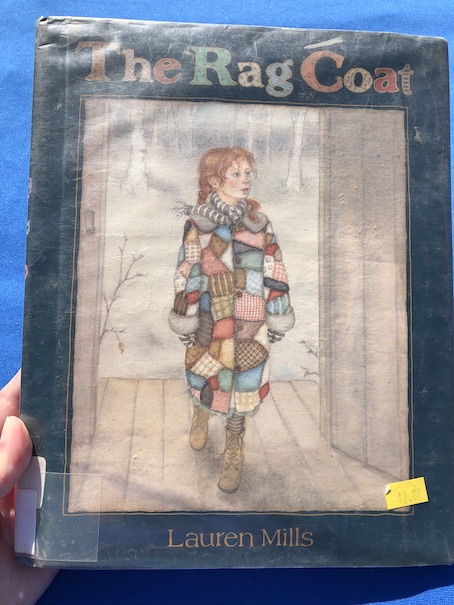
Minna is a poor girl, the daughter of a coal miner. Her father has been ill with the miner’s cough, so Minna has to help her mother to make quilts that the family can sell for money. She wants to attend school, but she can’t because she is needed at home and her family can’t afford a warm coat for her when winter starts. It’s too bad because Minna really wants to make some friends her own age, and she would meet other children at school. Her father says that he will find a solution to the problem, but he dies before he can.
After Minna’s father’s death, some of the other women in the community come to the house to work on making quilts with Minna’s mother. When the women say that the quilt pattern they are using is named after Joseph’s Coat of Many Colors, Minna wishes again for a coat. When the other women, who are mothers themselves, realize that Minna cannot go to school until she has a coat, they decide to make one for her. They don’t have much money, but they do have plenty of quilting scraps. They decide to make a new, quilted coat for Minna out of their old scraps.
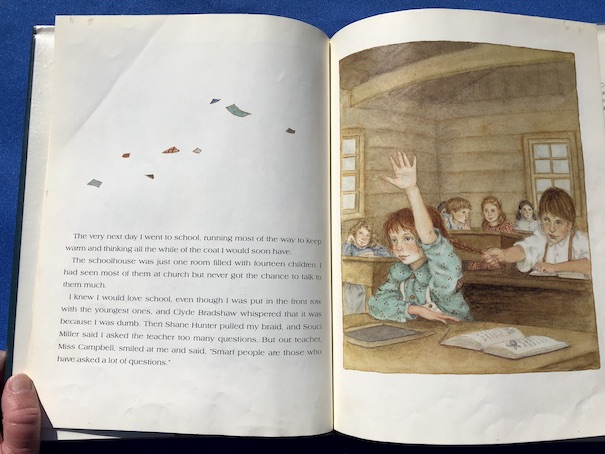
Minna starts going to school and does well, although she gets some teasing because, as a new student who has never been to school before, she has to sit with the youngest children, and Shane pulls her braid. Something that Minna particularly likes at school is Sharing Day (what my school always called “Show and Tell”), where students are given the chance to show special things to the class and talk about them. Minna decides that when her coat is ready, she will show it to the class during Sharing Day.
As the coat is being made, Minna admires all of the beautiful colors of the cloth scraps in the coat and adds a piece of her father’s old jacket as well. Each of the other scraps in the coat also has a story that goes with it. The cloth pieces come from old clothes and blankets that people in the families of the quilting mothers have used, and they memories attached to them. The mothers tell Minna all of the stories as they work on the coat, and Minna loves it.
However, when Minna wears the coat to school for the first time, the other kids make fun of her for wearing rags. Minna is really upset and runs away into the woods. After thinking about it, Minna remembers what her father said about how people really need other people, and she decides to go back to school. There, she tells the other students that the rags in her coat are actually their rags, and she begins reciting the stories that go with them.
One of the scraps is from Shane’s old blanket from when he was a baby. He was born so small that everyone was afraid that he’d die, but the blanket kept him warm, and he later carried it around with him until it fell apart. Shane is happy, seeing the scrap of his favorite blanket again in Minna’s coat. Everyone else gathers around Minna, looking for their scraps in the coat and listening to the stories behind them. Each of the scraps in Minna’s coat is like an old friend that none of them ever thought they’d see again. The other children apologize to Minna for their teasing and Minna says that friends share and that it took all of them to make her coat warm.
My Reaction
The book doesn’t say when this story is supposed to take place, but based on the children’s clothing, I think it’s about 100 years ago or more. It doesn’t say exactly where this story takes place, either, but a note on the dust jacket says that it takes place in Appalachia. The author said that she was inspired by Appalachian crafts that she learned from the women in her family and a patchwork coat that she wore as a child. However, years later, the author revisited this story and rewrote it in a longer version, and some of the explanations that accompany the new version of the story elaborate more on the background.
The author rewrote this story in a longer, novel form called Minna’s Patchwork Coat (2015). In the back of that book, the explanation behind the story mentions that the year of the story is 1908. It also discusses some cultural references and songs included in the expanded version of the story that were not part of the original. It states that the inspiration for this story came not only from the author’s experiences but from a song written by Dolly Parton, Coat of Many Colors, which was made into a picture book itself after the publication of this book.
There is also an expanded retelling of the story called Minna’s Patchwork Coat, and I’d like to talk about some of the differences. For example, the ending message of the story is slightly changed in the longer version, or at least the emphasis of the moral is different. The original book emphasized how much “people need people” and how the goodwill of many people (in the form of the quilting mothers and their hard work and scraps, cast-off from all of their children) changed Minna’s life. They emphasize it at the end, talking about how Minna’s coat is the warmest of all of them and that it took a lot of people to make it that way. However, in the expanded version, Minna also explains that when she started school, she liked her classmates better than they liked her because, thanks to their mothers’ stories as they made her coat, she already knew who the other children were, but none of them really knew anything about her. The message of the expanded version is that it is important to learn others’ stories to learn who they really are and to become friends with them.
Actually, I don’t like the second version of the story as well as the original. I thought that the moral and the story were stronger when the focus was on how people benefit from having relationships with other people because people can do great things when a lot of people contribute a little. Remember, it took a lot of people to make Minna’s coat warm because each of them contributed at least one scrap to it and others took the time to put them all together. It was their stories that made the coat special, more than just an ordinary coat. The expanded story has that element, too, but more emphasis is placed on Minna needing to share her story with the other children to win their respect and approval. I didn’t like the notion that Minna needed to win their approval by telling her story. Also, this story takes place in a small mining community. I find it difficult to believe that the other kids wouldn’t basically know her story already. Her mother knows their mothers. Their families see each other at church before Minna goes to school. The disease that took her father’s life isn’t terribly unusual for coal miners, and probably, a number of the other children are the children of coal miners as well. It seems to be the major industry in the area. Minna’s family might be more poor than the others’ since her father’s illness and death, but I don’t see why their circumstances would be so different and incomprehensible to people who must have seen her and her family around and who knew them from church or through their parents’ associations. One thing that small towns and communities are known for is everyone knowing everyone else and their business, so why didn’t they all know Minna’s story already? Even if the quilting mothers didn’t talk about helping to make the coat for Minna, the other kids should have known about the family’s money circumstances and the tragic death of Minna’s father. I don’t see why the other kids would have known so little about her or thought that she was so unusual.
The expanded version of the story also features a Cherokee midwife and a biracial friend for Minna who did not appear in the original story. This friend, Lester, is also something of an outcast among the other children, and Minna and the stories from her coat help the other children to be more accepting of him as well. It’s a nice thing, I guess, but it felt a little artificial to me because I knew that it wasn’t part of the original story. I hesitate to criticize it too much because the basic message of the story isn’t bad, but I guess that the way the second version came out just doesn’t have the same feel to me. The author put things into it that weren’t in the original, and with that change in emphasis on the ending, it makes the story and characters feel a little less natural to me now. I often feel the same way when I see a movie version of a story that adds things that weren’t in the original book.
The Quilt Story by Tony Johnston and Tomie dePaola, 1985.
A woman
(at some point in the 1800s, from the pictures) makes a special quilt for her
young daughter, Abigail. It has Abigail’s
name on it and a pattern of falling stars.
Abigail loves it!
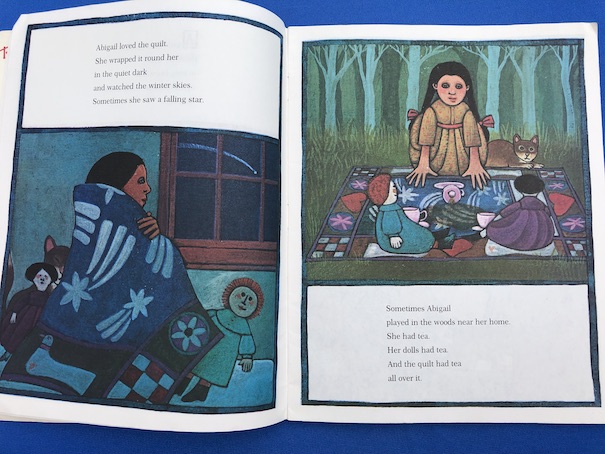
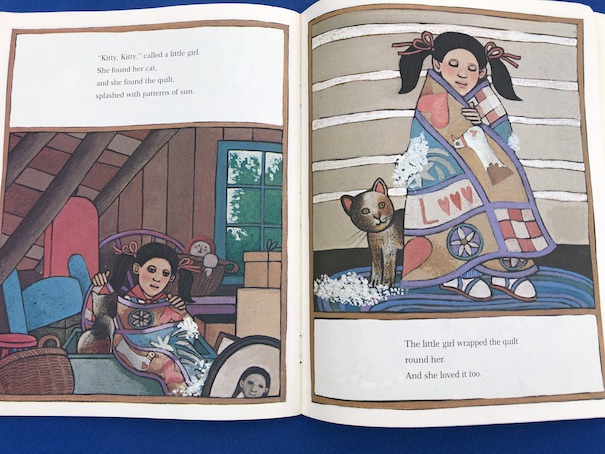
Abigail uses the quilt all the time, not just in bed. She has tea parties with her dolls on the quilt, hides under it when playing hide-and-seek, generally taking it everywhere and playing all kinds of games with it. The quilt gets worn and torn in the playing, but her mother mends it when necessary.
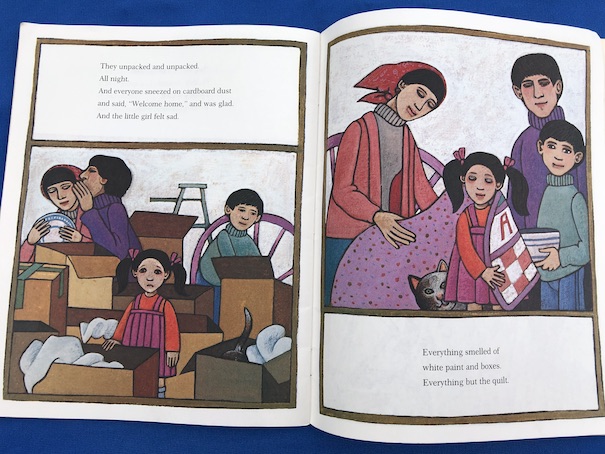
Eventually, Abigail and her family move to a new home, traveling in a covered wagon. Everything in their new home seems strange to Abigail, but her old quilt comforts her.
Eventually, when Abigail is older, she puts the quilt away in the attic, and people forget about it. Still, animals use the quilt. A mouse makes a nest it in. A raccoon hides food in it, and a cat naps on it. Then, one day, another girl finds the quilt in the attic. She loves it and brings it to her mother to be repaired.
Like Abigail, though, the modern girl’s family soon moves to a new home, where everything seems new and strange. However, the old, familiar quilt comforts the girl once again.
This is a gentle, comforting story that would make nice bedtime reading or a story that could be read to a young child who is moving or has recently moved, reminding them that, even in a new place, you can bring a sense of home and the familiar with you.
The book is currently available online through Internet Archive.
When I Was Young in the Mountains by Cynthia Rylant, illustrated by Diane Goode, 1982.
This nostalgic picture book is based on the author’s experiences living with her grandparents in West Viriginia when she was young. It paints a vivid picture of Appalachian life in the past. The story doesn’t give any particular years to describe when it takes place, but the author apparently lived with her grandparents during the 1960s, although from the pictures, it would be easy to believe that the story takes place in a much earlier time. Partly, the style of the clothes and stoves give that impression, but for me, it was really the cloth cover over the camera that made me think it was during the first half of the 20th century. You can still get these covers, but they’re not as common in modern times.
In the story, the author describes various aspects of Appalachian life, starting each section with “When I was young in the Mountains . . .” She remembers her grandfather coming home after working in a coal mine and how they would all have cornbread, fried okra, and pinto beans for supper.
For fun, the kids would go swimming in the swimming hole. They would also use the swimming hole for baptisms. They would also use the schoolhouse as their church.
She describes the general store where her family would go for groceries and how they would have to heat water on the stove for baths.
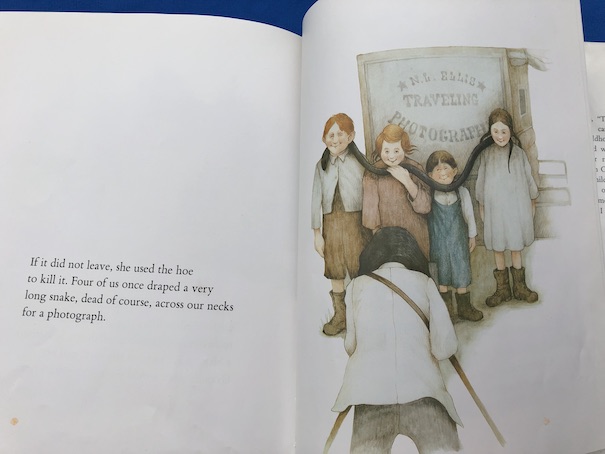
Sometimes, they had to deal with snakes, and once, when their grandmother killed a particularly big one with a hoe, they took a picture of the children with it.
Overall, the story is about enjoying the simple pleasures in life in a place you love, surrounded by people you care about.
This is a Caldecott Honor Book. It is currently available online through Internet Archive. Sometimes, you can also find people reading this book aloud on YouTube. I particularly like this reading because I think the reader has a good accent for reading this story, and she comments on her own experiences growing up in the country.
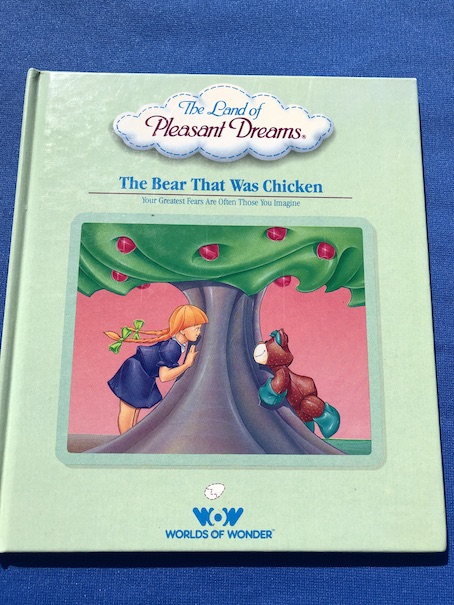
The Bear That Was Chicken by Ane Weber, Ron Krueger, Tony Salerno, 1986.
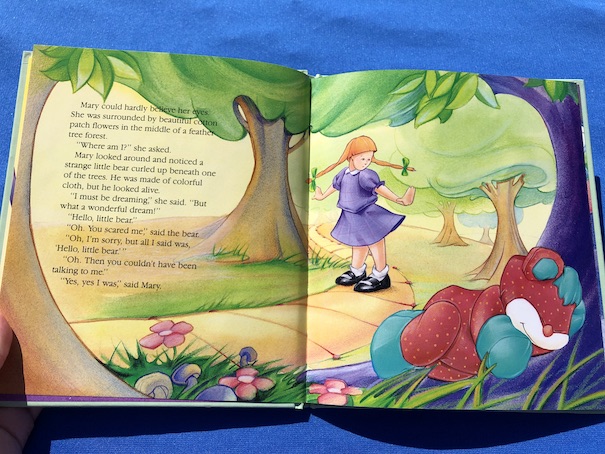
In her dream, Mary meets Threads the Bear. When she meets him, he’s trying to sleep under a tree. He’s sad and tells Mary that he thinks he’s a chicken and that all of his friends say so. (It’s not a nice thing for friends to say, and I wish the story had said so. There’s a song about it on the tape that accompanies the book with the words given in the book, but it bothers me because calling people “chicken” is something that I associate with people who are trying to goad people into doing things that they really shouldn’t do. I don’t think that it’s good to teach children to react to being called “chicken” or any other insulting names.)
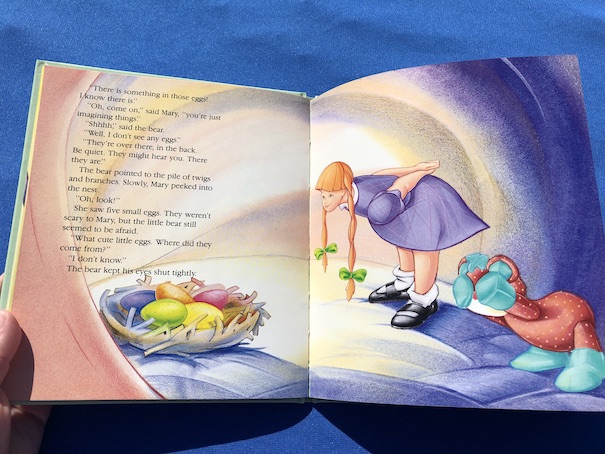
Mary thinks that Threads’ imagination is getting the better of him and that’s why he’s so afraid of so many things. However, Threads tells Mary something that isn’t imaginary: there are some strange eggs in his cave that appeared there suddenly and mysteriously. That’s why he’s sleeping in the forest, because he doesn’t know where the eggs came from or what they are. Mary bravely offers to go with him to have a look at the eggs.
When they go to look at the eggs, Mary thinks that they look pretty harmless. They’re kind of cute and colored like Easter eggs. Threads is still worried about them and what they might hatch into. Mary says again that Threads is imagining the worst and volunteers to sit with Threads while he takes his nap and keep an eye on the eggs to see what happens.
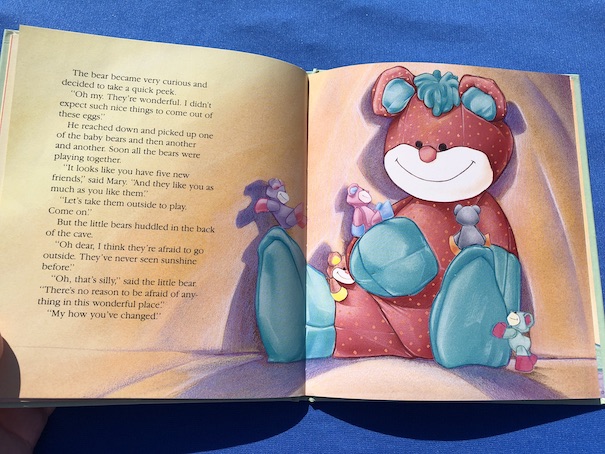
The eggs do hatch, and it turns out that they contain tiny teddy bears, very much like Threads. When Threads sees the little bears, he loves them and thinks that they’re adorable. The little bears seem worried when Threads wants to take them outside to play, but Threads encourages them, telling them that there’s nothing to be afraid of.
Moral: Your Greatest Fears Are Often Those You Imagine.
The main message of the story is that it’s better to face your fears than imagine the worst. However, I found some of this story a little confusing as a kid, and some of the implications are a little alarming when you begin to analyze it. Where did those little bear eggs come from? Did Threads lay them himself in his sleep? Are those little bears his children? Did Threads lay eggs because he was a “chicken”? But, Threads is a boy bear! Then again, this is supposed to be a dream, so I guess it doesn’t really have to make sense.
I still don’t like that the story uses “chicken” as an insult and in a way that implies that people who are called “chicken” should try to prove that they’re not. This just seems like a recipe for disaster, encouraging children to accept dares.
The book is available to borrow and read for free online through Internet Archive. This book is currently available online through Internet Archive. It was made into an episode for the tv show version of this series with puppets.
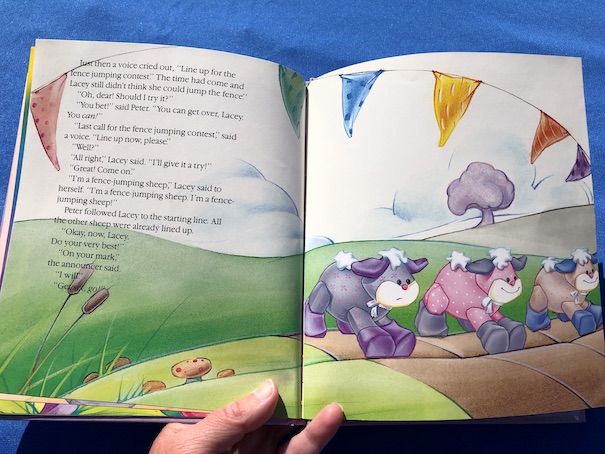
A Fence Too High by Jeanine Bartelt, Jeff Parker, and Tony Salerno, 1986.
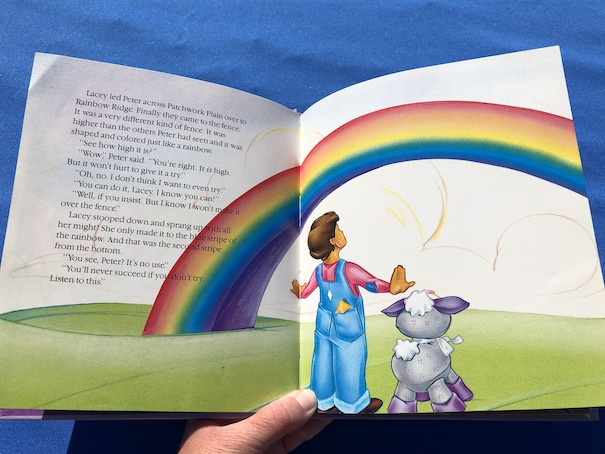
Peter falls asleep while counting sheet jumping over the fence and meets Lacey the Lamb in his dream. Lacey the Lamb is sad and worried because, even though she’s growing up to be a fence-jumping sheep, there is one fence that she just can’t get over. Peter offers to take a look at the fence with her and see if he can help. When he does, it turns out to be a giant rainbow.
It’s important that Lacey make it over this fence because she is taking part in a fence-jumping contest in less than an hour. Lacey doesn’t think that she can learn to jump this fence in so little time. However, Peter encourages Lacey to try again.
After a few more tries in which she hits the blue stripe on the rainbow and then the yellow stripe and then the orange stripe, Lacey is ready to give up. She thinks that it’s hopeless. Peter points out that it isn’t hopeless because each time that Lacey has tried, she has improved, gradually hitting higher and higher marks on the rainbow. He doesn’t think that Lacey should give up so easily.
Even though she’s still feeling very unsure of herself, she decides to participate in the contest. This time, Lacey does make it over the fence, and she feels much better about herself because of her success. She thanks Peter for giving her the encouragement to try one more time.
Moral: If At First You Don’t Succeed, Try, Try Again.
It’s a nice story about the importance of making an effort, trying again, and not giving up just because there are obstacles and challenges. Life has many challenges, and just because something is difficult doesn’t mean that it’s impossible or not worth doing. People don’t need to be perfect; it’s enough to be willing to improve.
This book was made into an episode for the tv show version of the series with puppets.
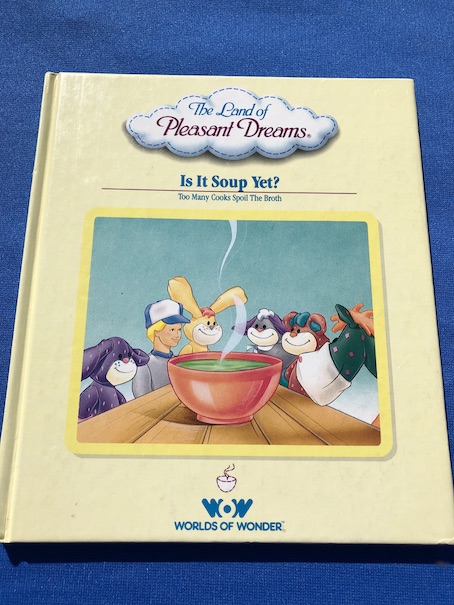
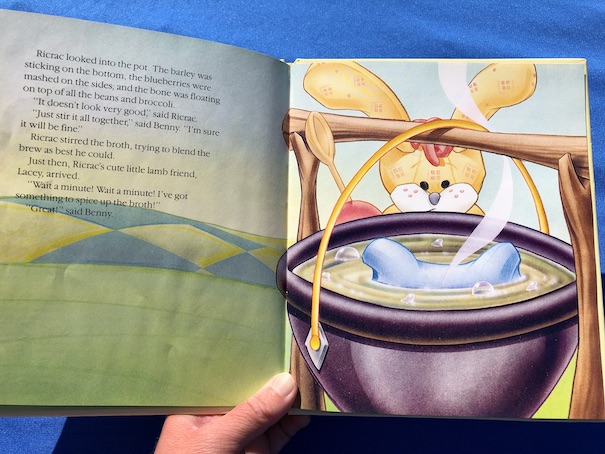
Is It Soup Yet? By Ane Weber, Ron Krueger, and Tony Salerno, 1986.
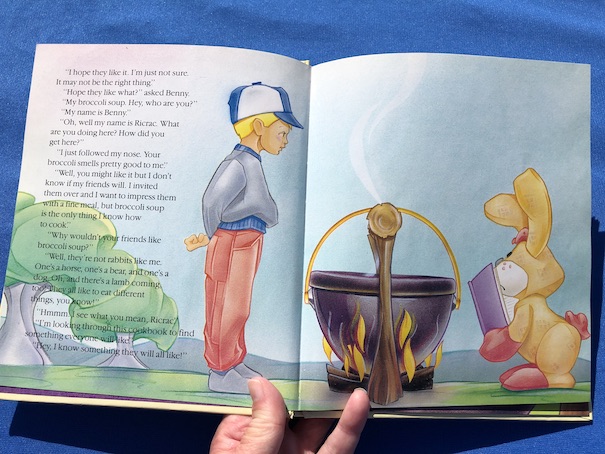
When Benny enters the Land of Pleasant Dreams, he meets Ricrac Rabbit. Ricrac is trying to cook something for his friends, but he’s worried because the only thing he knows how to make is broccoli soup, and he doesn’t know if his friends will like it because they all have different tastes.
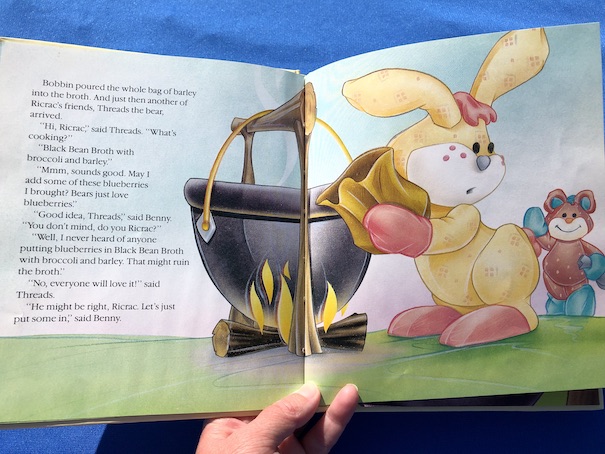
Because Benny’s father is a chef, he suggests that Ricrac try his recipe for black bean broth because everyone loves that when his father makes it. Ricrac decides to give it a try, adding the black beans to his broccoli soup.
However, as each of Ricrac’s friends arrive, they also decide to bring their favorite ingredients with them. Bobbin the Horse brings barley, and Threads the Bear brings blueberries. Then, Snips the Dog brings a bone, and Lacey the Lamb brings buttercups. In an effort to please everyone, Ricrac adds each ingredient to the soup.
When they finally try it, the soup is horrible. At first, everyone argues about which ingredient ruined the soup, but Benny realizes that their real mistake wasn’t trying the soup according to Ricrac’s original recipe. When they try the broccoli soup as it was supposed to be made, without the extra ingredients, it’s really good.
Moral: Too Many Cooks Spoil the Broth.
The point of the story is that trying to please everyone often means pleasing no one. When planning a project, if you try to stretch it in too many different directions, it’s difficult to accomplish anything because you’re not focusing on anything in particular. In the end, you have to pick one way and stick with it, focusing on what you can do best.
The book is available to borrow and read for free online through Internet Archive. This book was made into an episode for the tv series with puppets. Sometimes, you can find it or clips of it on YouTube.
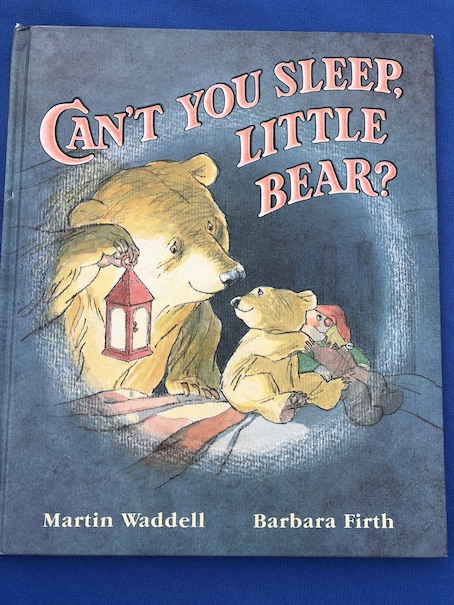
Can’t You Sleep, Little Bear? By Martin Waddell and Barbara Firth, 1988.
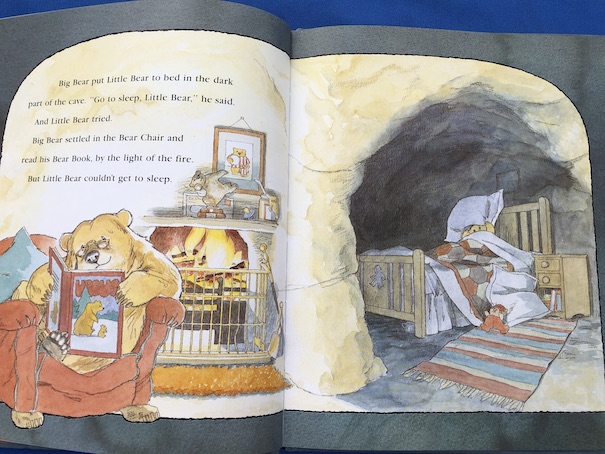
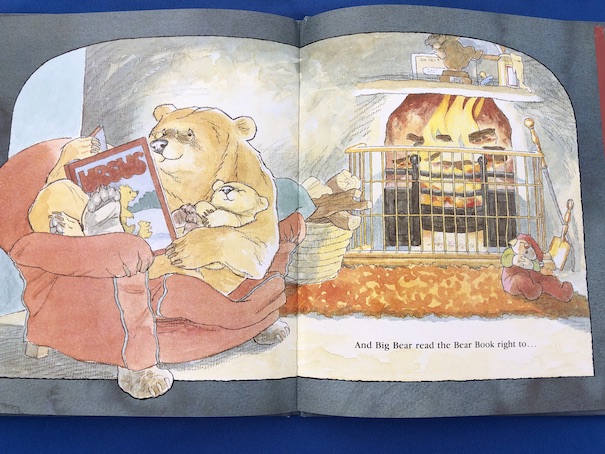
Big Bear and Little Bear live in their Bear Cave. (Big Bear is apparently the father of Little Bear, but they don’t call him that.) After Big Bear puts Little Bear to bed at night, Little Bear has trouble sleeping. Little Bear says that he can’t sleep because he’s afraid of the dark.
Big Bear gives Little Bear a lantern, but that doesn’t work. Little Bear says that the lantern isn’t big enough. Big Bear tries to bring two larger lanterns, but neither of those helps, either.
Little Bear says that the dark beyond the cave bothers him. To prove to Little Bear that the darkness outside isn’t scary, Big Bear takes him outside.
Outside, he shows Little Bear the moon and the stars, so he’ll know that it’s not completely dark. Little Bear falls asleep in Big Bear’s arms.
This is one of those cute bedtime stories that can help to reassure young children at bedtime. Sometimes, it is a big, scary, dark world out there, but it’s not always as dark as it seems when you take a second look, especially if you’re with someone you can really trust. Because the bears appear to be father and son, it also makes a nice father/son story.
The book is currently available online through Internet Archive. There is also an animated version of this story. I haven’t seen it for sale (if anyone knows where to get it, let me know), but it sometimes appears on YouTube (link repaired July 18, 2024).
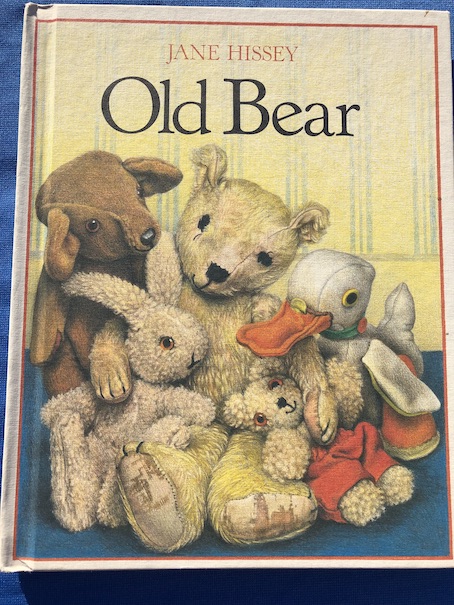
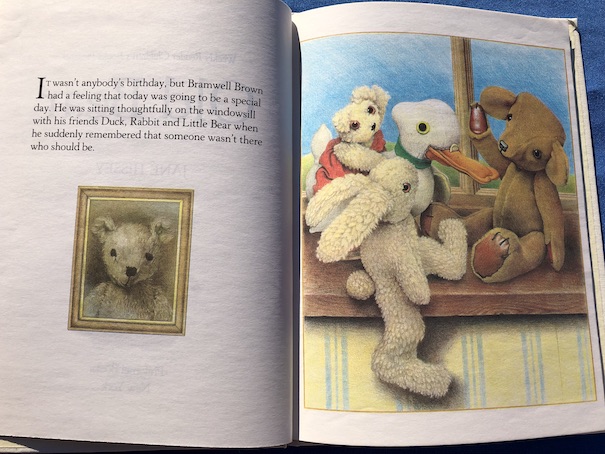
A group of stuffed animals remember that an old friend of theirs, Old Bear, was put up in the attic because he was an old toy and the children of the house were too rough with him. The other stuffed animals miss him and worry that the humans in the house have forgotten about him, so they try to think of a way to get him out of the attic.
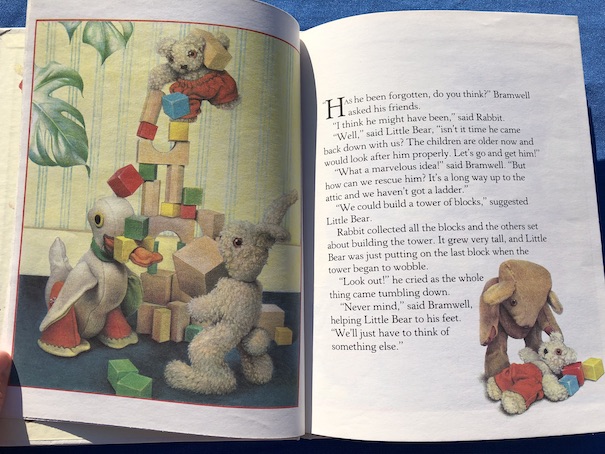
The problem is that the entrance to the attic is in the ceiling, high above their heads. The stuffed animals try various tricks to get up to the attic, from building a tall tower of blocks to jumping on the bed.
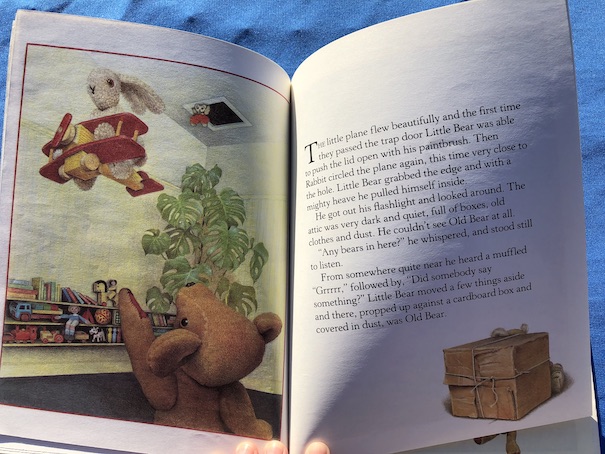
Eventually, they are successful when they use a toy airplane. After Little Bear finds Old Bear in the attic, they use parachutes made of handkerchiefs to parachute back into the playroom to rejoin the other stuffed animals.
Old Bear says that he spent most of his time in the attic sleeping, but he is glad to be back with his friends.
I remember my mother reading this book to me when I was a young child in the 1980s! One of the things that I like about this book is the detailed pictures. The textures on the stuffed animals are excellent, giving readers the feeling that they could reach into the book and touch the fluffy Little Bear, Bramwell’s paws (which look like they’re made of vinyl), and the Duck, who looks like he’s made of felt. The stuffed animals’ schemes to reach the attic are also fun and clever, using other children’s toys.
The book is part of a series originally published in the UK. The series was later made into a British television series during the 1990s. This particular story is one of the episodes, and you can see this episode on the author’s YouTube channel.
The book is available to borrow and read for free online through Internet Archive. (To borrow a book through Internet Archive, you have to sign up for an account, but it’s free, and then you read the book in your browser window.)
Bear really loves the moon and decides that he would like to give the moon a birthday present. The problem is that he doesn’t know when the moon’s birthday is. He tries asking it, but it doesn’t answer.
Deciding that he needs to get closer to the moon to talk to it, Bear goes to the mountains to ask the moon when its birthday is. In the mountain, Bear hears his own echo and thinks that it is the moon answering him. When Bear tells the moon that his birthday is tomorrow, the “moon” replies that its birthday is tomorrow. Bear is pleased, especially when the moon echoes his wish for a hat for its birthday.
Bear buys the moon a hat and puts it on top of the moon by putting it in a tree. The following morning, the hat is on Bear’s doorstep, and Bear accepts it as the moon’s present to him.
When the wind blows poor Bear’s hat away, Bear goes to the mountains again to apologize to the moon for losing the hat. It’s okay, though, because Bear and the moon still love each other.
Bear never realizes that what he’s hearing is his own echo. It’s sweet although somewhat silly. If you wonder what happened to the hat in the end, it’s shown on the back cover of the book, holding a bird’s nest.
The book is currently available online through Internet Archive. (When you borrow a book from Internet Archive, you have to set up an account, but it’s free.)


















 Jestress's Forgotten Books and Stories