
Castle Diary: The Journal of Tobias Burgess, Page by Richard Platt, 1999.
Tobias is an eleven-year-old boy living in England in 1285. He is from a noble family, and his father is sending him to his uncle to become a page. As a page, Tobias will learn manners and skills that he will need as he eventually becomes a squire and then a knight. During the first year of his training that he spends with his uncle, he keeps a diary of everything that happens to him and everything he learns. Toby is a fictional boy, but his life and family are meant to illustrate what life was like for a young boy from his social level during the Middle Ages.

The castle were Toby’s uncle lives is much bigger than his parents’ manor house. Toby has to learn the roles of all the servants who live there: who is in charge of what and who reports to who. Not all servants are equal, and some command more respect than others. Some of them are even from noble families like his, including his aunt’s companion, Isbel. Toby himself is assigned to do chores for his aunt like running errands, delivering messages, serving food at meals, and holding up the hem of her cloak when she walks outside.
Toby shares a room with the other pages at the castle, all boys of noble families and destined to become knights, just like him. They have lessons in reading, writing, mathematics, Latin, and scripture from the castle’s chaplain, and he is a harsh disciplinarian. They practice their lessons on wax tables that can be smoothed out and used again. The boys also learn manners and start learning archery and about all the weapons and armor that knights use. When they have time to play, they try walking on stilts and play at being jousting knights by carrying each other on their backs and trying to knock each other off.
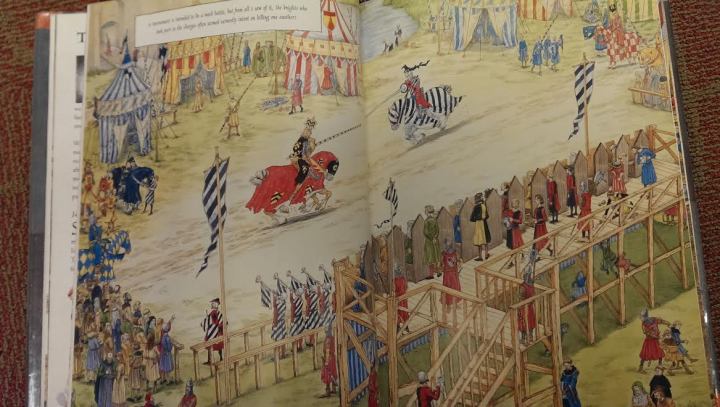
During the course of the year, Toby gets to witness a hunt, a joust, and a banquet with important guests. At one point, he gets sick and receives treatment from a physician. He also encounters a poacher on his uncle’s land. This man is eventually caught (although Toby decides not to turn him in) and put on trial, but in the end, he is not punished because the jurors were sympathetic. The book ends with a Christmas celebration, after which Toby goes home to visit his parents.

In the back of the book, there is a section with more information about Medieval society, castles, sieges, weapons, armor, and the changes that eventually brought an end to feudal system that Toby knew.
The book is part of a series of historical picture books. It is currently available online through Internet Archive.


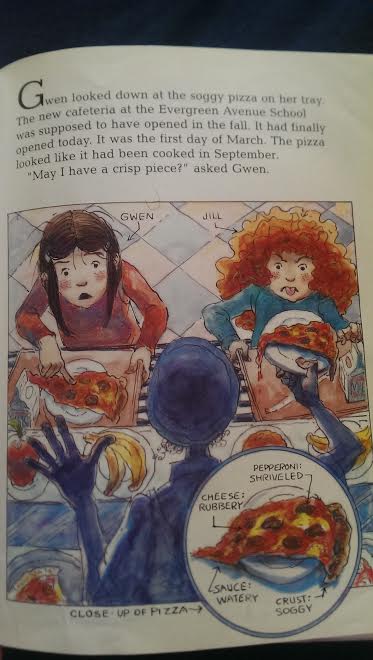 Ms. Lensky, the cafeteria lady at Gwen and Jill’s school, is just plain mean. All of the food that the cafeteria serves is yucky, even though the cafeteria is new. There will be a party to celebrate the opening of the new cafeteria, and even the kids’ parents and the mayor are invited. Gwen and Jill are happy because their class will get to help decorate the cake. However, Ms. Lensky, the M.C.L. (Mean Cafeteria Lady), doesn’t like the girls, and she blames them for a number of accidents that happen in the cafeteria.


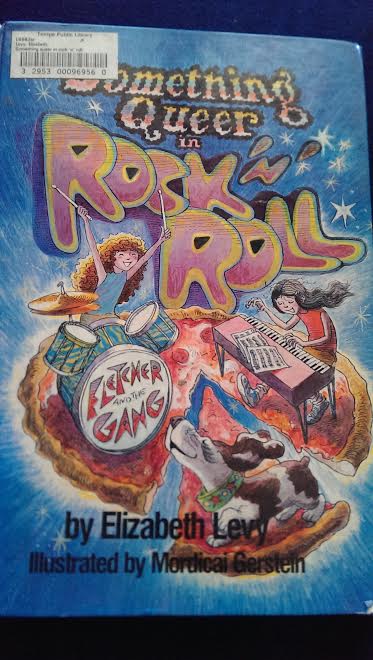
 Gwen and Jill join a couple of other friends in forming a rock band. They want to enter a rock contest run by a local tv station. In order to enter, they have to have an original rock song, so they write one about Jill’s dog, Fletcher. They discover that Fletcher loves pizza so much that he gives a spectacular howl when they offer him some. They make Fletcher and his wonderful howl part of their act.
 Fletcher is all right, but now, he suddenly hates pizza! It seems that Fletcher’s abductor fed him nothing but pizza until he started to hate it. Did someone do that on purpose to ruin their act for the contest? How would this person have even known about their act? Also, what can they do about the contest now that Fletcher is more likely to run from the sight of pizza than howl for it?
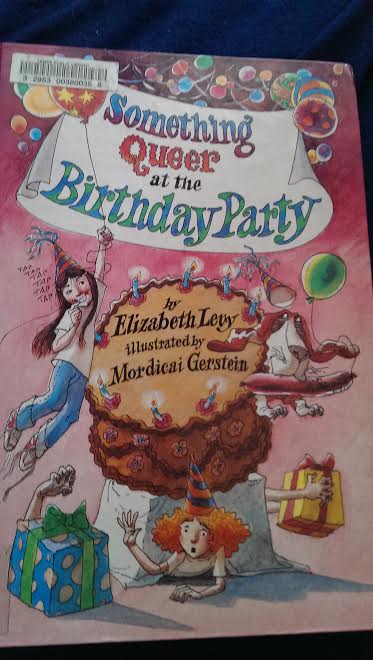 Something Queer at the Birthday Party by Elizabeth Levy, illustrated by Mordicai Gerstein, 1989.
 Gwen takes her party and all the guests on a hunt across town for her missing presents, but the big clues turn out to be right back where they started, and Fletcher leads them right to what they’re looking for.






 Cranberry Thanksgiving by Wende and Harry Devlin, 1971.


 Sarah Morton’s Day: A Day in the Life of a Pilgrim Girl by Kate Waters, 1989.
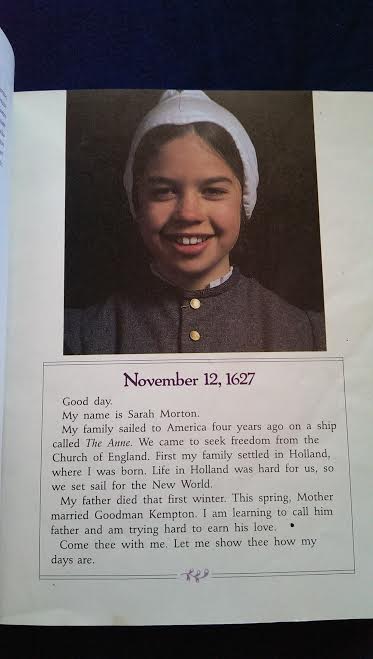 Although much of Sarah Morton’s day is taken up with chores, she also discusses her relationship with her mother and her new stepfather. The death of a parent was something that pilgrim children often experienced. After her father’s death, Sarah’s mother remarried, and Sarah is concerned about whether her new father likes her.


