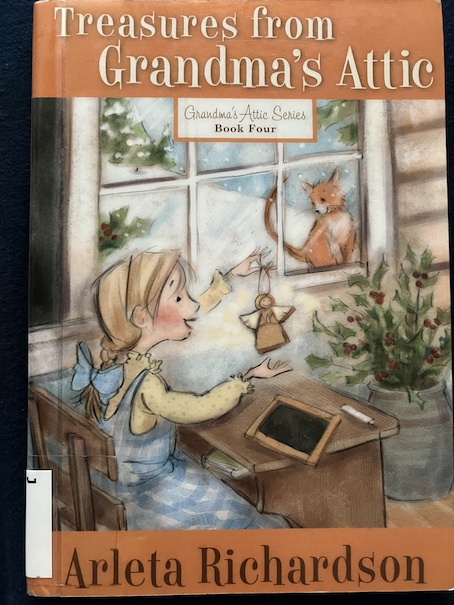
Treasures From Grandma’s Attic

The Grandma’s Attic series by Arleta Richardson is based on her grandmother’s reminiscences about life growing up on a farm in Michigan during the 1800s.  This is the fouth book in the series, and like the first three, it’s a collection of short stories.

Usually, the stories are framed as grandmother, Mabel, telling her granddaughter some story about herself or her family when she was young, but in this book, the stories don’t have the framing element of the grandmother talking to her granddaughter. Instead, each story is just Mabel, talking about something that happened when she was young. Many of the stories in this book focus on things that happen at the small local school and lessons that they learn. The books don’t always say exactly how old the children are or what the year is, but the beginning of this book says that the year is 1886, and Mabel and Sarah Jane are thirteen and a half years old. The stories that follow the first one take place in order because characters and situations introduced in the earlier stories are referenced in the later ones.

Many of the scrapes the Mabel and her friend Sarah Jane are relatable, the kinds of minor trouble that many children (and even some adults) get into. I particularly liked the story about the fortune teller because it’s similar to something my mother told me about someone who heard something frightening from a fortune teller (or someone who claimed to be able to read palms). Even as an adult, this person similarly couldn’t get the idea out of their head once they heard something that they dreaded would happen, even though it never did. Fortunately, nothing truly tragic happens in any of the stories in this book or in the series in general. The stories are pretty calm, and many of them have a moral to them, many of them Christian-based.

The book is available to borrow and read for free online through Internet Archive.

Cousin Agatha

Mabel’s father’s Cousin Agatha invites herself to join the family for Thanksgiving, further inviting herself to stay through Christmas. Cousin Agatha is highly critical and difficult to get along with, so the family starts getting nervous when she talks about wanting to stay with them for the long term. Mabel and her brothers consider doing things to irritate her so she won’t want to stay, but Mabel comes to realize that part of the reason why Agatha acts the way she does is that she’s a nervous and insecure person, starved for attention and affection.

A New Friend

A new girl named Mary comes to school, and when she gets a crush on one of Mabel’s brothers, she tries to make herself into Mabel’s best friend. However, when Mabel refuses to help her scheme to ingratiate herself to Mabel’s brother, Mary turns spiteful and tries to get Mabel in trouble.

Christmas Spirit

The children at school draw names for a gift exchange at Christmas. However, one girl, Hannah, is sour and grouchy, and she says that, if she doesn’t draw a name she likes, she won’t bring a gift. Mabel gets Hannah as her name, and she gives Hannah a gift, but when Mabel doesn’t get a gift herself, she blames Hannah. She later realizes that she’s misjudged the situation.

The Perfect Paper

Warren is a boy at school who shows off how well he does at school, and he makes it a point that he thinks boys are smarter than girls. Mabel prays that she’ll do better than Warren on their next math test to teach him a lesson, and at first, it seems to work. However, her father notices that one of the problems was marked incorrectly, meaning that Warren actually got a better score than she did. Mabel finds herself in the position of having to tell the teacher about it, but both she and Warren learn lessons about qualities that are more important than perfect test scores and the relative worth of boys and girls.

Wesley’s Lesson

Wesley is a big boy at school, and the others sometimes tease him or scold him about how much he eats. Wesley’s eating habits can sometimes be a problem when he eats things that everyone was supposed share (as in the Christmas story), but his size is mainly a problem when he’s careless. One day, he runs hard into Sarah Jane while playing, knocking her to the ground. He’s apologetic, but Sarah Jane is angry and embarrassed. She persuades Mabel to help her get some revenge and teach Wesley a lesson, but their teacher ends up teaching the girls a lesson about respecting their classmates’ feelings.

The Seamstress

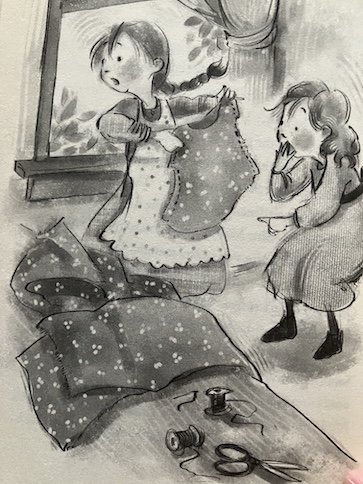
Mabel wants a new dress for the ice cream social, but her mother doesn’t have time to make one. Mabel insists that she’s old enough to make a dress on her own, but her mother knows that’s harder than Mabel thinks.

The Autograph

Cousin Agatha sends Mabel a special present, a book autographed by the author. Mabel is eager to take it to school to show everyone, but her mother doesn’t think it’s a good idea. It turns into a problem when Warren offers to buy the book from Mabel. She loves the gift, but the money Warren promises her could mean more because she wants to buy something for her mother. Then, Sarah Jane suggests forging the author’s signature in a cheap copy of the same book. Does Mabel have it in her to be a forger?

The Farewell Party

The children learn that their teacher, Miss Gibson, will be leaving, and she’ll be replaced by another teacher, Mrs. Porter. The children at school aren’t happy about it because they like Miss Gibson, and they worry that Mrs. Porter might be mean or that she wouldn’t like them. The children decide that they can’t let Miss Gibson leave without having a farewell party for her, but they learn that the adults are planning a surprise of their own.

Really Responsible

Mabel starts thinking of all the things she’d like to do with her future. Sarah Jane thinks getting married is the best thing to do, but Mabel wants to do something that she can do on her own rather than having her role in life defined by the man she marries. Sarah Jane doesn’t think that she can do anything big like that on her own because she isn’t always reliable and responsible, and Mabel complains that nobody has any faith in her, but she worries that maybe Sarah Jane is right. Mabel’s mother uses a lesson from the Bible to show Mabel that, if she wants to prove that she’s responsible in big ways, she should prove herself responsible in small ones first. However, Mabel’s absent-mindedness soon gets her into trouble again!

The Tangled Web

Mabel is looking forward to a birthday party, but everything goes wrong from the moment she wakes up. It’s a rainy day, and Mabel is sick. Mabel’s mother insists that she stay home. Sarah Jane says that’s fine because the party has been rescheduled. The problem is that the party has been rescheduled to Sunday, and their families believe that Sunday should always be a day of rest. When the girls sneak out to the party without permission, they get caught up in their own scheme.

Gypsies

Mabel’s mother takes in a gypsy family temporarily because their baby is sick, and they need help. Their neighbors ask her if she’s doing the right thing because they think that gypsies can’t be trusted, and even Mabel’s brothers have heard that they’re thieves. However, Mabel’s father says that they shouldn’t assume things about other people because good and bad people can be found among any group, and Mabel’s mother points out that, whatever else they are, they’re human beings who need help. The gypsies themselves prove their own character when it’s time for them to leave, and they repay their hosts’ generosity.

The Expensive Bookcase

When Sarah Jane’s father makes a new bookcase for her, Mabel decides that she’d also like one for her birthday. Mabel’s father agrees on the grounds that it will help Mabel to be more neat and tidy. However, the project turns out to be bigger than they thought when Mabel’s mother decides that Mabel could also use new curtains and new paint in her room, and then, Mabel decides that she would like her bed spread dyed to match. Mabel ends up owing her brother a surprising amount of favors in exchange for the work.

Monday’s Child

Mabel is fascinated by the poem about the days of the week that children are born on. Since Mabel was born on a Monday, according to the poem, she should be “fair of face.” Sarah Jane was born on a Friday, so she’s supposed to be “loving and giving.” Mabel’s mother says that it’s only a poem, not something to live by, and that beauty is as beauty does. The person who does the right thing is the most beautiful person. Mabel has trouble believing that until she sees a lovely girl at the general store who demonstrates the concept that beauty doesn’t bring happiness or character.

The Fortune-Teller

Mabel and Sarah Jane wonder about the future and what the fortune teller in town might have to say to them. Mabel’s mother warns her that curiosity can lead to trouble and that if she tries to have her fortune told, she might hear something she won’t like. However, the girls can’t resist seeing the fortune teller. Although the girls promise themselves that the fortune telling is just for fun and that they won’t take it seriously, when Mabel hears something that she doesn’t like, she has trouble getting it out of her head. Because she’s been primed to believe the prediction, she misinterprets something that she overhears.

Revenge

Mabel can’t find her cameo pin, and she blames her brother Roy because of his teasing and tricks he plays. Later, a comb disappears from her room, and Mabel again blames Roy. He doesn’t exactly deny that he didn’t take these things, although he implies that Mabel probably lost them herself. When a quarter disappears from the money that Mabel has been saving to buy a present for her mother, Mabel is sure that Roy is responsible, but she can’t spoil the surprise for her mother by admitting that she’s been saving money for a present. Mabel decides that she needs to take matters into her own hands and teach Roy a lesson but ends up teaching herself one.

Still More Stories from Grandma’s Attic

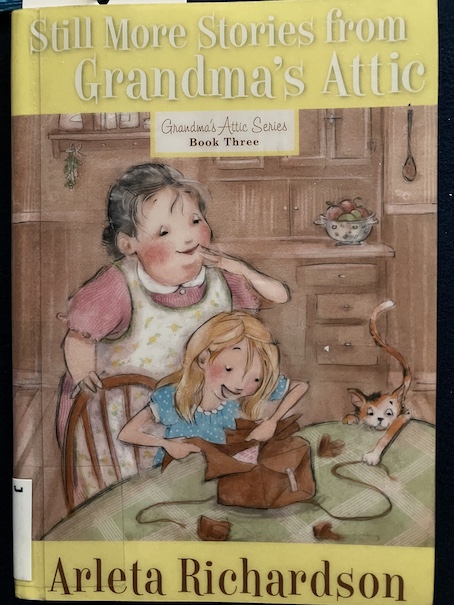
Still More Stories from Grandma's Attic cover

The Grandma’s Attic series by Arleta Richardson is based on her grandmother’s reminiscences about life growing up on a farm in Michigan during the 1800s.  This is the third book in the series, and like the first two, it’s a collection of short stories. Each of the stories are framed as a story being told by the grandmother to the granddaughter about something that happened when she was young, inspired by something the granddaughter is experiencing in her life. Some of them are funny stories, others are though-provoking, and many of them have a moral or life lesson to them. The grandmother, Mabel O’Dell, has two older brothers and a best friend, named Sarah Jane, and many of the stories center around things they did as children. There are Christian themes in the stories, and some of them contain Biblical references.

What I like are the small details about life in the past. We get to see children going about their farm choices and attending school in a one-room schoolhouse, and we get to see what was important to the children back then. The children in the story have their own wishes and plans, fun things they like to do in their spare time, things that worry or frighten them, and special occasions that they look forward to.

One thing that I would like address, though, is the religious aspects of the stories. Something that would probably stand out to modern readers is that the Bible readings and lessons aren’t restricted to home and church but are also taught in the school every day. There are some people in the 21st century who seek out private schools that still do this, and some people who wish public schools still did, but there’s an important aspect of this that I’d like to make clear to everyone: This is a small rural community with only a one-room schoolhouse and around 15 or so children at a time and a single church that everybody in the area attends.

Everybody there is the same religion, which is why this school and others from this time period, particularly in small communities, were completely comfortable incorporating Bible readings into their school lessons. There was nobody around whose beliefs were different from theirs. They could happily take it for granted that was the case because it definitely was. They didn’t have to give it a second thought or even much of a first one because they’d all see each other every Sunday in that one little church. There is no need to to accommodate diversity in communities where there isn’t any. We don’t see how the characters in these stories respond to people of different religions because they never meet any, at least not during the course of the stories in this book. I think some people who are nostalgic about that element forget that this is the primary reason why modern public schools don’t do things like that anymore, and there are definite trade-offs.

If you accommodate a group of diverse people, it’s true that you can’t concentrate on religious sub-groups in the same way and don’t get the reinforcement of beliefs that those people also receive at home and at church that make life seem consistent across all channels, but at the same time, if you live in a community that intensively studies its own beliefs and customs and has nothing else to accommodate, you have to forfeit the experience of learning more about the variety of people that exist in the wider world or the lessons that diverse groups learn about getting along with people who are different, not taking social agreement or a shared vision of life for granted, and learning to understand and accommodate people with concerns that you don’t necessarily share just because you care about how someone else feels and need to find a way work with each other. Nobody gets to have everything in life or learn everything in life, and putting all of your emphasis on one thing means passing up other opportunities. It’s just the way life is. Mabel and her friends learn many valuable things about life and the choices they make, but how to live in a diverse community with people who have different beliefs just isn’t one of them. They don’t talk about any of that because they don’t need to.

The books in the Grandma’s Attic series cater to a sense of nostalgia, which is pleasant, but I just wanted to remind readers that there are reasons why most people don’t live this way anymore and that most schools aren’t run this way anymore, and there are some benefits to new ways doing things that are a better fit for the world that 21st century people live in. Enjoy this “simpler time” for what it is, but just understand that there are things modern people experience that are worth something, too, and things we get to do with people who 19th century people who were being educated in one-room schoolhouses might not have even imagined meeting!

That being said, I do find this book charming and cozy. It makes for a relaxing read, and I think the morals and life lessons in the stories are positive ones. The characters in the stories do have some consequences for their childhood escapades, but nothing tragic or overly serious. It’s fun to see them getting into childhood scrapes, enjoying simple pleasures, and planning parties and special surprises for friends and family.

The book is available to borrow and read for free online through Internet Archive.

Still More Stories from Grandma's Attic girls making face cream

Face Cream from Godey’s Lady’s Book

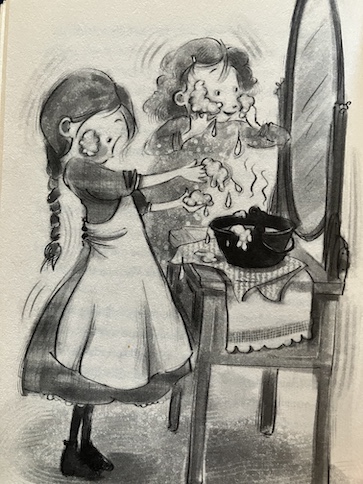
Mabel and her best friend, Sarah Jane, attempt to make face cream from a recipe in a women’s magazine, with unexpected results!

It Rhymes with Mop

Mabel was often a careless and sloppy child, but she learns her less when her family has dinner with the minister and his wife.

High Society

Mabel is invited to come with Sarah Jane on a visit to her cousin’s house in the city. Sarah Jane’s relatives are more wealthy, and they have a big house with servants, but the girls come to realize that the high life in the city isn’t really the life that they want to live.

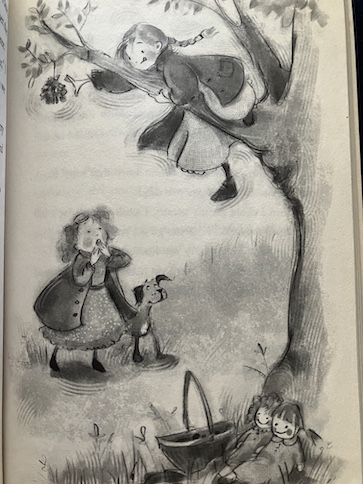
Still More Stories from Grandma's Attic girl climbing tree

The Dog Who Could Spell

Mabel proves to Sarah Jane that her dog is smarter than she thinks when the girls get into trouble, and Mabel gets the dog to understand and fetch help.

The Wrinkled Stockings

Mabel and Sarah Jane are tired of wearing their heavy long underwear under their clothes because it wrinkles their stockings and makes them feel uncomfortable. Since it’s nearly spring, they decide to modify their long underwear for better comfort, but they’re sorry when they realize just how changeable the weather can be.

Whenever I’m Afraid

Grandma remembers a time when she was a child and found herself home alone while she was sick and how she comforted herself with prayer and the thought that God was looking after her.

Grandpa Hobbs

Grandpa Hobbs is a neighbor whose memory has become confused in his old age. He sometimes lives in the past and confuses past events and people with present ones. When he stays with Mabel’s family for a time, though, they are surprised at some of the things that he does remember!

The Spelling Bee

Mabel and her brother have a habit of leaving things where they don’t belong because they forget to put them away. When Mabel’s father decides that he will confiscate anything that’s not in its proper place, he takes something important of Mabel’s. However, in driving home the lesson about personal responsibility and accountability, Mabel’s father learns that he also needs to teach the children about forgiveness and mercy by demonstrating some himself.

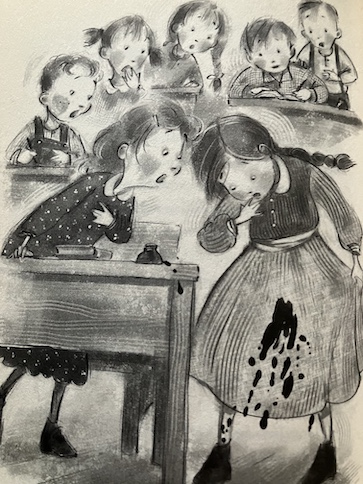
Still More Stories from Grandma's Attic ink stain on dress

The Prettiest House in the Country

Mabel’s mother says that the house needs to be repainted, but Mabel’s father keeps putting it off. When she learns that he’s making plans to repaint the barn instead of the house, Mabel’s mother takes matters into her own hands.

My Own Boss

Mabel is tired of her parents always telling her what to do and insists that she wants to make some decisions about things herself. When her parents allow her to make some choices on her own, she learns that making choices means learning to live with the results.

The Harvest Home Festival

The kids in Mabel’s class at school each have to memorize something from the Bible to recite at the Harvest Home Festival. Mabel, being a procrastinator, puts off memorizing her piece until a couple of days before she recites it. However, when she has last-minute doubts about whether or not she’s really committed it to memory

The Surprise Birthday Present

Mabel’s father needs a new suit, but the family needs to raise the money to buy one for his birthday. At first, they don’t think they’ll be able to raise enough money to get him a new suit in time for his birthday, but Mabel finds something other than money that gives them what they need. The moral of this story is that God sometimes answers prayers in unexpected ways.

The Perfect Party

Mabel and Sarah Jane decide to throw a surprise birthday party for their teacher at school. They think they’ve got everything planned well, but they forget that, even at a surprise birthday party, sooner or later, someone has to tell the birthday person when to arrive.

Windfalls

Mabel and Sarah Jane are allowed to take apples that have already fallen from a neighbor’s trees (the “windfalls), but one day, they see what they think is the perfect apple to give to their teacher and try to make it fall on purpose. In the process, they end up getting into a scrape that Mabel knows she won’t be able to hide from her parents.

Homer Price

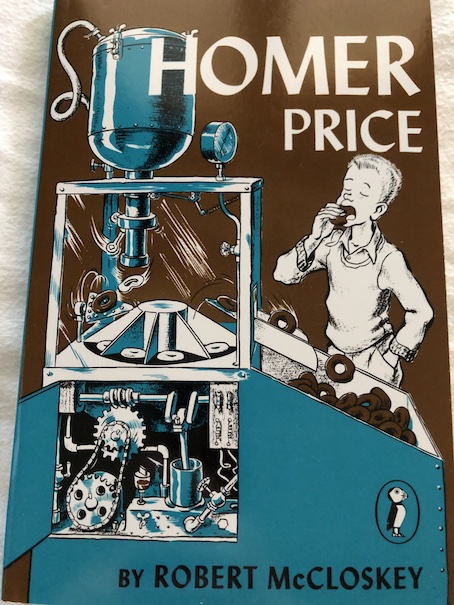
Homer Price is a collection of short, humorous stories about a boy who lives in a Midwestern town called Centerburg. His parents own a tourist camp with cabins and a filling station, and Homer helps out there with odd jobs. In his spare time, he has a hobby, building radios.

Many people remember this book specifically for the episode of the doughnut machine that goes out of control. Stories in the collection have been made into tv episodes or short films three times, and two of those are based on the doughnut machine story. (Sometimes, they appear on YouTube.) There is also a sequel to this book called Centerburg Tales: More Adventures of Homer Price.

It didn’t occur to me until I started reviewing the book for this site, but it was first written and published during WWII. The war doesn’t play any part in any of the stories in the book, but it occurred to me as a fun collection of stories that its first audience of 1940s children might have enjoyed as a break from the chaos of the world around them. Various aspects of 1940s society and culture appear in the stories in humorous ways, like the comic book superhero who resembles Superman (a character introduced in comic books in 1938), lunchrooms (small diner-style restaurants), and the concepts of advertising, mass production, and suburbs with prefabricated houses.

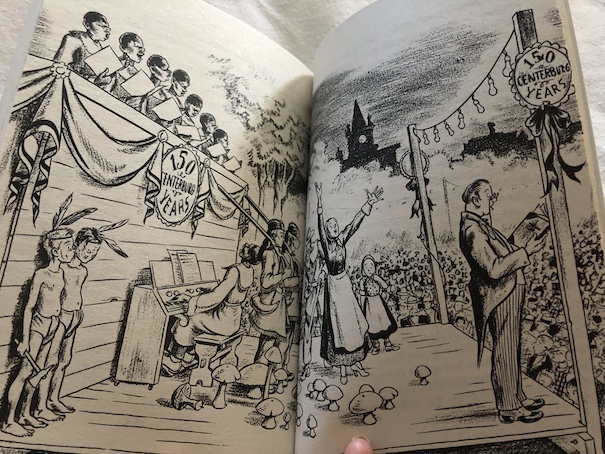
There is one incident that readers should be aware of that concerns descriptions of Native Americans. When the town holds its 150th anniversary celebration, Homer and his friends have roles in skits about the history of the town, playing Native Americans, and part of their costume involves dyeing their skin, which would be considered tasteless and racist in the 21st century. Their skit also includes a “scalping scene” (not really described, except saying that it “had to be modified somewhat”), which would also definitely not pass modern standards in any public performance. Because this is a collection of intentionally humorous stories, I’m not sure whether the author included this stereotypical depiction of kids playing Native Americans in a tasteless way to poke fun at such depictions or not, but I though it was worth mentioning for the benefit of people sharing these stories with children, so you know that part is there.

I didn’t notice anything particularly concerning about the depiction of black people in the book. Black people are included in the stories as members of the community without too much attention to the fact that they’re black. They’re simply part of the town, and nobody makes a big deal about them being there or refers to them by any derogatory names. One black boy finds a wealthy lady’s bracelet inside a doughnut in the doughnut machine story, and the local African Baptist Church choir performs at the town celebration.

The Case of the Sensational Scent

One evening, Homer gets his usual bedtime snack of milk and cookies and leaves some milk out for his pet cat. However, a skunk wanders in and finds the milk. Homer decides to try keeping the skunk as a pet, naming it Aroma. Aroma helps to thwart a gang of robbers.

Case of the Cosmic Comet

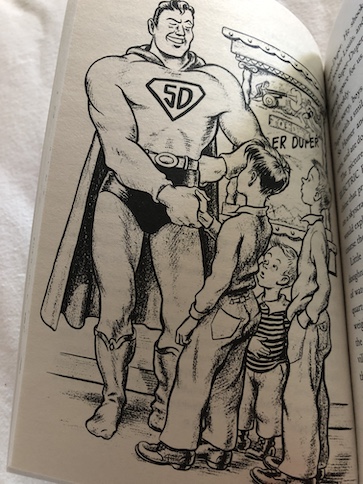
Homer and a couple of friends are reading comics and marveling over a superhero called Super Duper (who is sort of like Superman). Later, Homer’s friend Freddy says that there’s going to be a Super Duper movie playing in town and that Super Duper himself will be there. Homer isn’t quite as enthralled with Super Duper as Freddy is because he knows it’s just fiction, and he thinks the stories are kind of formulaic, but he agrees to come to the movie. When the Super Duper’s car crashes as he leaves, they see that the Super Duper is actually an ordinary human who doesn’t really have super strength and can get hurt. Fortunately, he isn’t hurt badly, and the boys take their disillusionment well, profiting from the help they give him.

The Doughnuts

Homer’s aunt and uncle own a lunchroom, and his uncle is a gadgeteer with a weakness for buying labor-saving devices. One of these devices is an automatic doughnut-making machine. One day, Homer’s uncle is trying to fix the doughnut-making machine, and he asks Homer if he can finish fixing it and make some doughnuts for him while he runs an errand (really, he’s going to play pinochle at the nearby barber shop) because Homer is good with mechanical devices. When Homer gets some help from a patron, mixing up masses of doughnut dough from her family’s old recipe and runs the machine, Homer has trouble turning off the machine. It just keeps making more and more doughnuts! What are they going to do with all these doughnuts, and will they ever get the machine to stop?

Mystery Yarn

Miss Terwilliger is locally known as a great knitter. She’s taught most of the local women how to knit, and everybody also loves her fried chicken. She has two admirers who would like to marry her, the local sheriff and Homer’s Uncle Telly, but she just can’t make up her mind which she would like to marry. When the Sheriff and Homer’s Uncle Telly compete to see which of them has the largest collection of string, the Sheriff arranges for the two of them to unroll their giant balls of string at the local fair to prove which of them has more string. They also decide that whichever of them win the contest will also win Miss Terwilliger … until they discover that Miss Terwilliger also collects string and is determined to enter the contest … and she just might be beat them both. All’s fair in love and string collecting, and to the winner go the spoils!

Nothing New Under The Sun

A strange man comes to town. He seems a little odd and kind of shy. The sheriff is a little concerned about who he might be. The stranger himself just makes an odd comment about having been away from people for a long time. The stranger might be a shy eccentric, but the sheriff is concerned that he might be some kind of fugitive. The sheriff talks to various people around town, and they all offer their advice about how to judge a person’s character and what they think about the stranger. Various people say that he reminds them of someone from a story, and the town librarian identifies the character they’re thinking of as Rip Van Winkle. Could this stranger really be an old man who fell asleep for 30 years in the mountains, like in the story? If so, what’s with the bizarre vehicle the stranger has? When Homer finally persuades the man to show him his car and tell him who he is, the story turns out to be stranger than fiction: he’s a man determined to literally “build a better mousetrap” and turns out to be a kind of modern-day Pied Piper.

Wheels of Progress

Centerburg is celebrating its 150th anniversary with a public celebration and the creation of a new suburb with mass-produced, prefab tract houses (the kind made fun of in the song Little Boxes by Malvina Reynolds, which “all look just the same”). The identical nature of the houses turns into a nightmare when the street signs aren’t ready in time for the grand opening celebration, confusing the townspeople.

Fun fact: The original name of the town is revealed to have been “Edible Fungus” after the edible fungus that kept the original settlers who founded the town alive. The choir in the story sings a song about it.

After the Sun Sets

This was my favorite book of fairy tales when I was a kid! I gave away my copy years ago and regretted it, but I was thrilled to find another copy later at an antique/vintage mall.

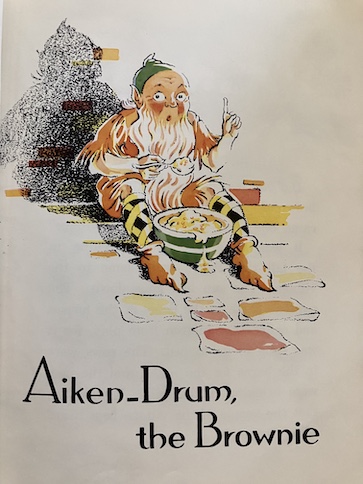
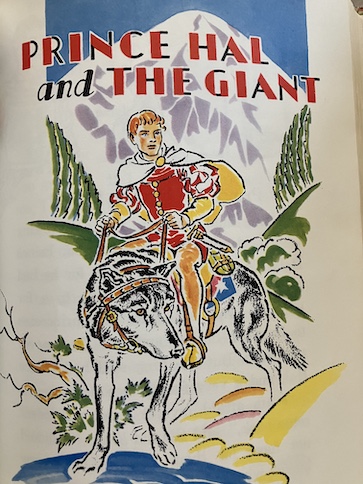
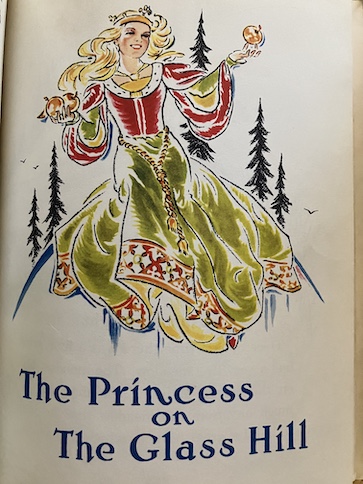
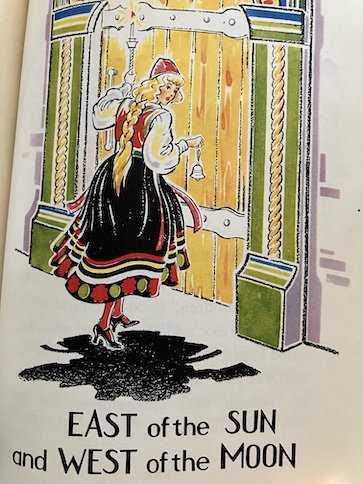
The collection includes some popular fairy tales that you can find in other fairy tale collections, like Cinderella, Brier Rose (the Sleeping Beauty story), and Hansel and Gretel. It also has some stories that are less commonly known these days, like Aiken-Drum, the Brownie and Prince Hal and the Giant. When I was young, my favorite stories in the book, the ones I read over and over, were Snow-White and Rose-Red, The Princess on the Glass Hill, and East of the Sun and West of the Moon.

One of the things that makes this collection unique is that it includes a section of poems at the back of the book. I love the one called Cinderella’s Song, and it was one of the reasons why I missed this collection so badly. I don’t think I’ve seen that poem in any other book.

The illustrations in the book are beautiful! I loved them as a child, and I still find them enchanting as an adult. Some are in black-and-white, but some are in full color.

I didn’t realize it when I was a kid, but this book is actually the third book in a series, The Wonder-Story Books, and it was a unit in The Row, Peterson Basic Reading Program. I have the 1962 edition, but the book is actually older than that. Its copyright was renewed multiple times.

The book is available to borrow and read for free online through Internet Archive. There is also an earlier edition of this book available through Internet Archive, and it doesn’t have the section of poetry included, so the poetry might only appear in the 1962 edition.

Aiken-Drum, the Brownie

Aiken Drum is a Brownie, a magical little man who likes to do chores for other people for little reward. Reward a Brownie too much, and he will leave.

Pat and the Fairies

Pat joins the fairies in a dance, and they loan him a pair of shoes when his wear out. When he later comes to return the shoes, he gets a wonderful reward. A greedy shoemaker tries to join the fairies in their dance and borrow a pair of shoes to get the same reward, but the fairies punish him when he tries to cheat them.

Change About

A husband grumbles about how little his wife accomplishes in the course of a day while she minds the house and their child and he works out in the fields. The husband and wife decide to switch places for a day to prove which of them works harder, and the husband has a surprise about what really happens at home while he’s away.

Cinderella

A girl who is abused by her stepmother and stepsisters receives magical gifts from her fairy godmother so she is able to attend the prince’s ball.

Snow-White and Rose-Red

A widow and her two daughters let a gentle talking bear spend the winter with them so he won’t freeze, but this bear is under a spell.

Snip, The Tailor

A tailor sets out to make his fortune. He uses his wits to defeat a pair of giants and win a castle and half the kingdom from the king.

Brier Rose

This is the Sleeping Beauty story. A young princess is cursed by a bad fairy. When she hurts her hand on a spindle, she and everyone in her castle falls asleep for a hundred years.

Prince Hal and the Giant

Prince Hal is the youngest of a king’s seven sons. The other six have left home to find brides and have never returned home. No one knows what happened to them. Prince Hal sets out to find what happened to his brothers. He finds out that they and their brides have been turned into stone statues in the house of a giant. Prince Hal must find a way to save them and the princess who has become the giant’s latest captive.

Hansel and Gretel

A pair of children are abandoned in the woods, and they find a strange house made of gingerbread. They are almost eaten by the witch who lives in the house.

The Princess on the Glass Hill

Every year on Midsummer Night, the hay disappears from a farmer’s field. Each of his sons tries to find out why, but each of them is frightened by the strange things that happen, until the youngest son faces the phenomenon and discovers a strange horse with a coat of mail that fits him perfectly. The same thing happens twice more so that the youngest son acquires three fine horses and three sets of mail. He keeps them secret at first, but later, he uses them to perform an amazing feat and ride to the top of a glass hill to win the hand of a princess.

East of the Sun and West of the Moon

A white bear comes to a family with many children and says that he will make them rich if the eldest daughter, Freda, will come with him. At first, she doesn’t want to go, but when she does, he takes her to a magical castle. Unfortunately, she disobeys the bear’s instructions while she’s there. He is under a witch’s spell, and Freda must find a way to undo the damage she’s caused and break his spell, following him to the witch’s castle by riding the winds, east of the sun and west of the moon.

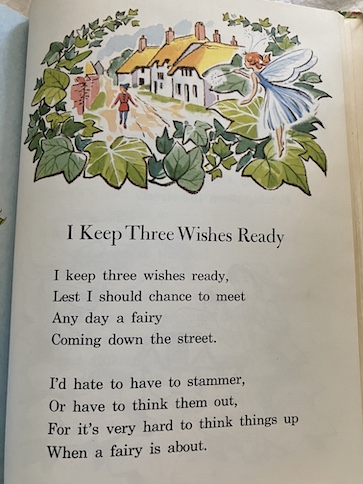
I Keep Three Wishes Ready by Annette Wynne – It’s good to know what you want to wish for, just in case you get the chance.

At the Zoo by A. A. Milne – There are many fascinating things to see in a zoo!

Some One by Walter de la Mare – Someone knocked at the door. Who?

Little Nut Tree by Mother Goose – A traditional rhyme about a magical tree. One of my favorites!

The Duel by Eugene Field – The gingham dog and the calico cat have a fight.

Queen Mab by Thomas Hood – About the fairy queen and how she gives pleasant dreams to children.

Cinderella’s Song by Elizabeth Madox Roberts – Cinderella confides her secret to her cat.

Trees by Harry Behn – Trees are wonderful things!

The Story of the Baby Squirrel by Dorothy Aldis – A child finds a baby squirrel and raises it. When it grows up, it runs away, but they think he’s probably still living with the other squirrels nearby. They sometimes see a squirrel who seems to be saying hello to them.

The Hens by Elizabeth Madox Roberts – It sounds like the hens are talking, but what are they saying?

Roads by Rachel Field – Roads might lead anywhere and to all sorts of wonderful things!

Washington by Nancy Byrd Turner – About George Washington. This one seems like an odd inclusion to me, adding a poem about a historical figure to a collection that has more fairy tale themes.

Revenge of the Mummy

Clue

This book is a collection of short solve-it-yourself mini-mysteries based on the Clue board game. Each book in the series contains short mysteries that the reader is urged to attempt to solve before the characters do. The solutions to the mysteries come after each chapter.

Most of the mysteries involve a crime of some kind, but not all. Sometimes, characters try to steal things from each other, but there’s also a scavenger hunt, an ice cream tasting party, and a hot air balloon race.

In the final chapter of the book, it seems like Boddy, our host, has been murdered, and the reader has to solve his murder, just like in a game of Clue. However, Mr. Boddy doesn’t actually die. It’s a pattern in the series that he seems to have been killed in each book, but he always survives somehow to reappear in other books in the series.

At the end of the previous book of solve-it-yourself mini-mysteries, it looked like Mr. Boddy had been murdered, but at the beginning of this book, he explains how he survived. All of the books in the series follow this pattern. There’s generally a humorous twist to how he survives and explains the situation.

The book is available to borrow and read for free online through Internet Archive.

The Lion Ring – Mr. Boddy has obtained a new treasure for his collection: an ancient and valuable ring with a lion on it that once belonged to an African king. Naturally, his sticky-fingered guests all want it for themselves.

Full of Hot Air – Mr. Boddy and his guests are having a hot-air balloon race. Who will be the winner?

Urge to Earn an Urn – Mr. Boddy stops Mrs. White and Mrs. Peacock from arranging flowers in an old urn they found in the basement. It turns out that it’s a valuable Greek urn, and when the other guests realize it, someone plots to steal it.

Please Don’t Sneeze – Miss Scarlet is coming down with a cold and spreading it among the other guests. Mr. Boddy introduces them to his grandmother’s secret cold remedy.

For Goodness’ Snakes! – Mr. Boddy’s guests are frightened of his new pet boa constrictor, but when they try to catch the snake, the snake catches one of them.

The Inky Trail – Mr. Boddy has discovered that someone attempted to forge his signature on a $250,000 bond. Fortunately, the forger tried to use the pen that explodes ink if anyone other than Mr. Boddy uses it. Mr. Boddy thinks that it’s going to be easy to track down the ink-stained guest, but it’s more complicated than he thinks.

The Scavenger Hunt – Mr. Boddy’s guests are bored one evening, so he starts a scavenger hunt with them.

Screaming for Ice Cream – Mr. Boddy has an ice cream tasting party with his guests to determine the best flavor. However, not everyone is willing to eat certain flavors of ice cream. Readers have to determine who is the only person who tried every flavor.

Caught Bare-Handed – Someone attempts a daring but unsuccessful theft of Mr. Boddy’s priceless chandelier, which sends it crashing. Who was the attempted thief?

Revenge of the Mummy – Mr. Boddy shows his guests the mummy case that he has recently acquired. The guests are a little too fascinated after someone mentions that mummies were buried with their valuables. Mr. Boddy warns the guests that the mummy may get angry and seek revenge, but they don’t believe it … until someone has an encounter with the mummy.

The Screaming Skeleton

Clue

This book is a collection of short solve-it-yourself mini-mysteries based on the Clue board game. Each book in the series contains short mysteries that the reader is urged to attempt to solve before the characters do. The solutions to the mysteries come after each chapter.

Most of the mysteries involve a crime of some kind, but not all. Sometimes, characters try to steal things from each other, but there’s also an apple-bobbing contest at a Halloween party, a snowball fight, and a pie-eating contest.

In the final chapter of the book, it seems like Boddy, our host, has been murdered, and the reader has to solve his murder, just like in a game of Clue. However, Mr. Boddy doesn’t actually die. It’s a pattern in the series that he seems to have been killed in each book, but he always survives somehow to reappear in other books in the series.

At the end of the previous book of solve-it-yourself mini-mysteries, it looked like Mr. Boddy had been murdered, but at the beginning of this book, he explains how he survived. All of the books in the series follow this pattern. There’s generally a humorous twist to how he survives and explains the situation.

The book is available to borrow and read for free online through Internet Archive.

Murder in the Cockpit – Mr. Boddy wants to take his guests for a flight on his private jet, but a fight breaks out over seating arrangements.

Baby Booty – Mr. Boddy has to watch his young nephew for a while, and he bribes his guests into helping him. Various guests take turns trying to make baby Frank happy, and readers are asked to figure out who has Frank.

Dance Until You Drop – Mr. Boddy and his guests were planning to have a croquet tournament, but they had to cancel it due to rain. To cheer everyone up, Mr. Boddy starts a dance party, but a couple of his guests take advantage of the situation and steal Miss Scarlet’s necklace.

The Halloween Costume Caper – Mr. Boddy is having a Halloween party for his friends, and he wants everyone to come in costume. When the guests arrive, no one is sure who is wearing which costume, but their identities are gradually revealed during a highly competitive game of bobbing for apples, where the guests are trying to find the apple that contains a “gold nugget.”

The Snowball Effect – It’s snowing, and the guests are getting on each other’s nerves because they’re cooped up inside. To change the mood, Mr. Boddy enlists everyone in a snowball fight. It’s up to the readers to determine who won from the information given.

The Case is All Sewed Up – Mr. Boddy is having an heirloom quilt restored, but the guests become interested when he says that one his ancestors hid the family treasures in the quilt during WWI. What are the Boddy family treasures, and who gets their hands on them?

Pie in Your Eye – Mr. Boddy is holding a pie-eating contest with his friends that unfortunately ends in a food fight. But, who is the winner?

Pea is for Pretender – The guests are talking about fairy tales when Miss Scarlet says that, like the Princess and the Pea, she would bruise if she tried to sleep on top of a single pea. The guests decide to put her claim to the test, and Mr. Boddy promises her a crown if she really bruises from sleeping on a pea. However, Miss Scarlet enlists the help of another guest to fake the results of the test. Who is her confederate?

The Thanksgiving Murder – Thanksgiving starts off peacefully enough with various guests volunteering to help Mrs. White prepare the meal and set the table … at least until Miss Scarlet realizes that Mrs. Peacock has removed her valuable jade ring and set it aside while helping. After Miss Scarlet swipes the ring, it changes hands several more times as others notice and take it for themselves. It’s up to the readers to figure out who finally ends up with it.

The Screaming Skeleton – Mr. Boddy unveils his latest acquisition – a skeleton made entirely of platinum. He’s planning to sell it to a museum, but of course, his guests plot to either steal the skeleton (or parts of it) or intercept the money from the museum. But, knowing his guests as he does, Mr. Boddy has also installed a security device on the skeleton that screams when someone tries to touch it.

Encyclopedia Brown Takes the Cake

Encyclopedia Brown

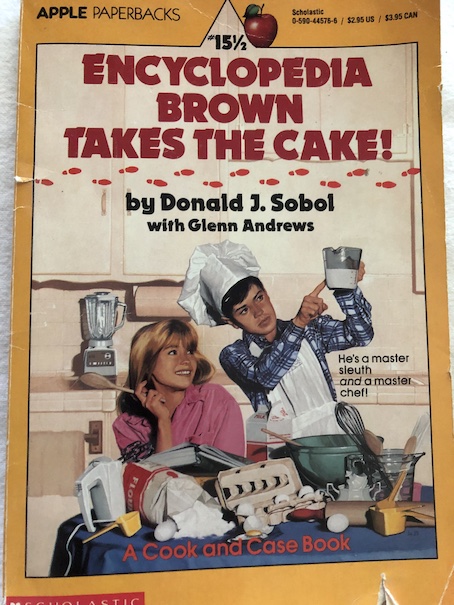
Encyclopedia Brown Takes the Cake by Donald J. Sobol with Glenn Andrews, 1982, 1983.

This book is a little different from other books in the Encyclopedia Brown mystery series. Like other books, it’s a collection of short solve-it-yourself mystery stories with the answers to the mysteries in the back. However, this book also has special sections with recipes and cooking tips after each story. The recipe sections are based on things that happen in each of the stories. It’s best to read the stories first to avoid some of the spoilers in the recipe sections.

The book is available to borrow and read for free online through Internet Archive (multiple copies).

Stories and Recipe Sections:

The Case of the Missing Garlic Bread

Encyclopedia Brown’s neighborhood nemesis, Bugs Meany, and his friends stole some garlic bread and a chocolate cake meant for a birthday party. They deny it, but Encyclopedia Brown knows how to prove that they’re the thieves.

Kitchen Basics

The birthday boy’s mother gives the kids kitchen tips, like how to peel and cut vegetables.

The Case of the Fourth of July Artist

On the Fourth of July, a local boy known for trying to cheat people attempts to sell a picture of the Liberty Bell supposedly painted by one of his ancestors on July 4, 1776. Encyclopedia explains why the painting is a fake. (It was a good enough painting that the guy should have just tried to sell it as an ordinary painting instead.)

The Fourth of July Party

Encyclopedia and his friends make oven-fried chicken, some side dishes, and a red, white, and blue shortcake for their Fourth of July party. All the recipes are provided.

The Case of the Oven Mitt

A friend of theirs has started working in her father’s kitchenware store. On her first day, while she’s helping their friend, Hermes, to decide on a present for his mother, someone sneaks in the back and steals a couple of mixers. She feels badly about it, and at Hermes’s birthday party, Encyclopedia realizes that the thief is one of the party guests.

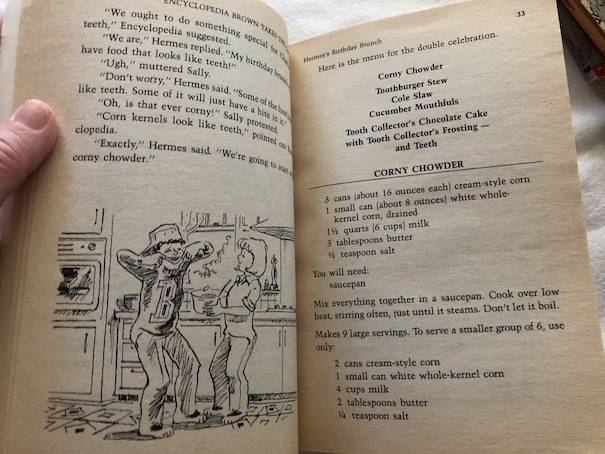
Hermes’s Birthday Brunch

In honor of a friend’s tooth collection, all of the food at the birthday party has something to do with teeth or foods that resemble teeth, like corny chowder and tooth-collector’s chocolate cake with frosting and teeth in the form of bits of marzipan and slivered almonds.

The Case of the Overstuffed Pinata

Bugs Meany steals a pinata from another boy. He insists that it’s his, but Encyclopedia proves it’s not.

A Mexican Fiesta

Encyclopedia and his friends make Mexican food, including cookies called polvorones, which are also known as Mexican Wedding cookies.

The Case of the Missing Watchgoose

A girl’s pet watchgoose goes missing. I didn’t like the solution to this one.

An Italian Dinner

The goose’s name was Christopher Columbus Day, so the kids cook an Italian-themed dinner.

The Case of the Secret Recipe

A friend of Encyclopedia’s, Beauford Twitty, invites his friends to his private potato museum to see his exhibits and sample a new recipe he’s created with a new variety of potato that his grandfather developed on his farm. While they’re there, someone steals a potato autographed by Yankees pitchers.

Dinner at the Twittys’

As a reward for helping to recover the potato, the Twittys give a dinner with no potato dishes at all: cream of chicken soup, meat loaf, corn pudding, baked tomatoes, lemon-buttered green beans, and apple pie.

The Case of the Chinese Restaurant

Oliver, who is a fan of Chinese food and the treasurer of the Service Club, is suspected of stealing from the Letterman’s Club treasury that was entrusted to him. Encyclopedia proves that he’s innocent.

A Chinese Banquet

Encyclopedia and his friends make Chinese food, including egg drop soup, Chinese riblets, egg rolls, and sweet and sour meatballs.

Snacks and Lunches

This section isn’t a story, just a collection of additional recipes for things like pizza made with pita bread, a variety of sandwiches, Twitty’s recipe for French fries from the potato story, French toast, cookies, and brownies.

Pointers from Pablo

Pablo, a young artist, offers advice on how to present and serve food while helping himself to cookies that Encyclopedia and Sally made.

Encyclopedia Brown and the Case of the Dead Eagles

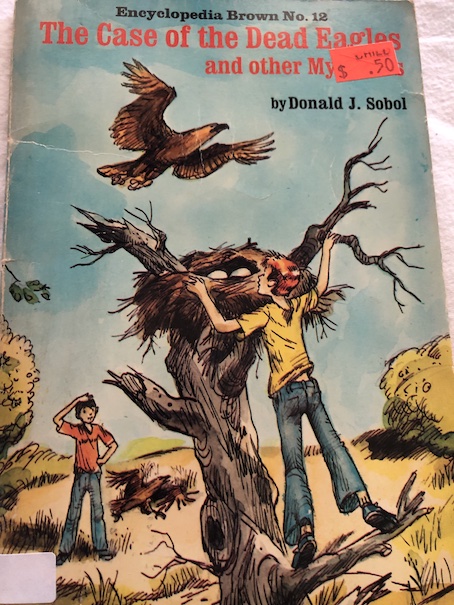
Encyclopedia Brown and the Case of the Dead Eagles and Other Mysteries by Donald J. Sobol, 1975.

The Idaville police department has an excellent record, but that’s because the chief of police’s ten-year-old son is Encyclopedia Brown. People praise Chief Brown, and Chief Brown doesn’t feel like he can admit how much help his son gives him because he doubts anyone would believe him. Encyclopedia himself doesn’t want to admit to other people that he helps his father figure out tough cases because he doesn’t want to seem too different from the others kids at school. However, Encyclopedia also has a detective business, helping the neighborhood kids to solve their problems for only 25 cents a day, plus expenses. Sally, a smart and tough girl, is his partner in the detective business, and Bugs Meany, a bully who’s the leader of a local gang of youths called the Tigers, is their main nemesis, although they also deal with other bullies and criminals.

I always liked Encyclopedia Brown books when I was a kid! There are a couple of instances where modern kids might not understand the solutions to some cases because of certain habits and traditions that modern people don’t follow anymore. There is one case in this book in particular that I didn’t understand when I was a kid, and I wouldn’t expect modern kids to get the answer, either.

The book is available to borrow and read for free online through Internet Archive (multiple copies).

Stories in the Book:

The Case of the Dead Eagles

Encyclopedia is camping with his friend Charlie Stewart when they hear a gunshot. When they go to investigate, they find a dead eagle. They think they know who’s responsible because this person has killed eagles before. Can they prove it in time to save the mother and babies from the same fate?

The Case of the Hypnotism Lesson

A boy named Dave hires Encyclopedia because he thinks Bugs Meany cheated him. (Always a likely possibility in anything Bugs does.) This time, Bugs charged Dave a dollar for a lesson on hypnotizing lobsters. Dave saw Bugs and his friends cooking and eating lobsters they had caught earlier, and Bugs told him that the secret to catching lobsters is to hypnotize them. However, when Dave gave him the money, Bugs just showed that he could pick up a lobster, and the lobster wouldn’t move. He didn’t actually show Dave any hypnotism and refused to teach him anything unless he paid more money. Dave realizes that Bugs was trying to trick him and wants his money back. When Encyclopedia sees a picture that one of Bugs’s friends took, he knows how to prove that Dave was cheated.

The Case of the Parking Meters

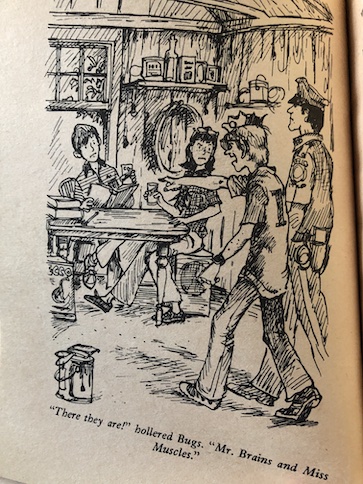
Both Encyclopedia and his detective partner Sally have received phone calls asking them to meet people at different locations, but each time, they waited around, and nobody showed up. They’re starting to suspect that this is another of Bugs Meany’s tricks, trying to get back at Encyclopedia for foiling his schemes. Sure enough, Bugs Meany shows up at Encyclopedia’s house with a police officer, claiming that Encyclopedia is running a racket to get money from people parked at parking meters by putting money in the meters, telling them that they’ve been saved from the fine for an expired meter, and asking them for money for the favor. The police officer isn’t sure that such a thing is actually illegal, although he’d have to inquire with a judge about the matter. Bugs claims that he could prove what happened except that Sally stole the film that he had of Encyclopedia putting money in the meters. When Bugs manages to “find” the film where Sally supposedly ditched it after taking it, Encyclopedia points out why Bugs’s story can’t be true. The solution would make more sense to somebody who understands how reel-to-reel films work.

The Case of the Hidden Will

Encyclopedia’s father, Chief Brown, tells him that a wealthy man named Brandon King has died, but his will is mysteriously missing. Evidently, Mr. King hid the will himself and swore his own lawyer to secrecy about it. The reason for the secrecy is apparently because one of Mr. King’s four sons, who all helped to run the family business, is a thief. Mr. King’s friends knew that was the case, although none of them knew which son it was. Mr. King’s lawyer gave Chief Brown a note written by Mr. King which hints at which son is the thief and saying that his property will go to the other three sons. Chief Brown isn’t sure which of the Kings is considered the “odd King out” until Encyclopedia tells him who it has to be, and Encyclopedia also tells him where the will is.

The Case of the Mysterious Thief

Encyclopedia and Sally go to a restaurant to order a pizza for lunch. While they’re waiting for their pizza, someone attacks the owner’s daughter in the ladies’ room and steals the money she was going to take to the bank. The owner’s daughter is very strong, and it must have taken someone very strong to overpower her and knock her unconscious so quickly and easily. It doesn’t seem likely that it would be a woman, but people would have noticed if a man had gone into the ladies’ room. Sally figures out the answer to this one, but it isn’t likely that modern readers. I didn’t get it when I was a kid, either, because the solution is based on an old piece of etiquette in restaurant seating that I don’t think people observe anymore.

The Case of the Old Calendars

Encyclopedia and Sally hurry over to Butch Mulligan’s house because they hear that Butch is fighting Bugs Meany and the Tigers. Butch is a big, strong 18-year-old, and the Tigers are no match for him. Encyclopedia asks Butch’s younger brother how the fight started, and he explains that Butch’s math teacher recently moved and gave Butch a stack of old calendars with some cool Civil War pictures on them. Then, Bugs claimed that he asked the teacher for those calendars himself, but the teacher forgot. He produced a note supposedly from the teacher that asks Butch to share the calendars with Bugs. Butch was willing to share, but there are an odd number of calendars, and Butch thinks Bugs cheated on the coin flip they had to determine who would get the odd one. He probably did, but Encyclopedia can prove that Bugs faked the note from the teacher, too.

The Case of Lightfoot Louie

Only a few days before the state worm-racing championship, Encyclopedia’s friend Thad accidentally stepped on his prize worm. It’s sad, but as a member of the Worm Racers’ Club of America, Thad can time other people’s worms to be entered in the race. He’s worried because Hoager Dempsey wants him to time a worm, and if he says the worm isn’t fast enough to enter the race, Hoager might beat him up. Thad asks Encyclopedia and Sally to watch the time trial as witnesses to make sure there’s no foul play.

The Case of the Broken Window

John Hall is a wealthy man with an impressive stamp collection. Some of his stamps are worth thousands of dollars. One evening, he calls Chief Brown and asks him to come to his house but to wear a costume because he’s giving a costume party, and he doesn’t want his guests to know that he’s called the police. Chief Brown and Encyclopedia put on their Halloween costumes and go to the Hall estate to investigate the theft of one of Hall’s expensive stamps. Hall thinks one of his guests is the thief, but which one?

The Case of the Gasoline Pill

“Twinkletoes” Willis is a young track star, and he comes to see Encyclopedia about a run-in that he had with Wilford Wiggins, a local high school dropout who’s into get-rich-quick schemes. Wilford has called a meeting of local kids at the city dump to tell them his latest money-making idea, which can only mean trouble. Wilford’s latest money-maker is a pill which he says allows cars to drive thousands of miles if you put it in the gas tank. Fortunately, Encyclopedia knows just how to prove that Wilford is a fraud.

The Case of the Pantry Door

Hilda’s hobby is fly hunting, and she’s a crack shot with rubber bands. She invites Encyclopedia and Sally to a little birthday party that she’s having for her pet frog, who lives in the birdhouse in her backyard. When Encyclopedia and Sally go into the pantry at Hilda’s house for sugar for catching flies, someone locks them in and steals the household money that Hilda’s mother hid in the kitchen. Hilda’s cousin, Lois, says that she saw a boy running away from the house, but Encyclopedia knows who really took the money.

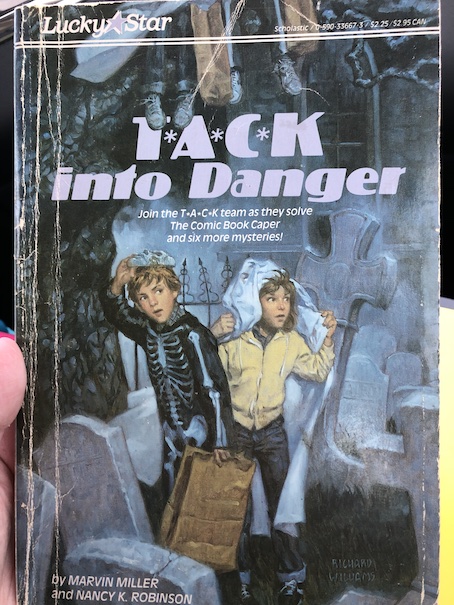
TACK into Danger

TACK into Danger by Marvin Miller and Nancy K. Robinson, 1983.

This book is part of the TACK mystery series, which is very much like the Encyclopedia Brown series, although it’s not as well known and doesn’t have as many books. In fact, my copy references Encyclopedia Brown on the back: “Move over Encyclopedia Brown … make way for the TACK Team!”

The books in the series are collections of short mysteries that readers are invited to solve along with the characters before looking at the answers. TACK is an acronym for the names of the main characters. They’re kind of a mystery-solving club of neighborhood kids, although they say that they don’t really have a clubhouse or regular meetings. They just help out members of their community by solving problems whenever they can.

T = Toria – Her full name is Victoria Gardner, but she doesn’t like being called Vicky. She is the one who narrates the stories. She wants to be a newspaper reporter when she grows up, and she considers the journals she keeps of the group’s cases to be good writing practice.

A = Abby – Her full name is Abby Pinkwater. Abby and Toria were best friends before she moved away. Now, Abby is considered their “Agent-on-Remote” because the others still consider her part of the group, and she still comes back to visit and becomes involved with their mysteries, even though she no longer lives close.

C = Chuck – Chuck is the best speller at school, and his participation in a spelling bee is part of one of the stories.

K = Will – His full name is Will Roberts, and he’s the leader of the group, although he leads in a very informal way. Will’s initial is the odd one out. They use ‘K’ in place of his initial both because it makes their acronym easier to pronounce and because ‘K’ stands for “SWITCH” in telegraph language, and they think that’s an appropriate code name for him “because of the way his mind can switch all over the place.”

Overall, I like the characters in the stories, and I think they’re well-written. They would be of interest to people who like Encyclopedia Brown and similar types of Solve-It-Yourself style mysteries.

Stories in the Book:

The Comic Book Caper

Toria and Will are on their way to Will’s father’s hardware story, where they’re supposed to be helping out, when Toria’s sister Holly says that she wants a comic book. Toria takes Holly to buy one so she’ll be entertained while the older kids are helping at the store. While Holly is looking for a comic to buy, Toria overhears a couple of rough sailors talking about someone they’re waiting to meet. They don’t know what the man they’re waiting for looks like, but there’s a code word that he’s supposed to use. Unfortunately, the code word turns out to be the name of the comic Holly wants to buy, and the men start following Holly, thinking that she might be some kind of courier. Toria is afraid of what the men might do to Holly because her comic contains a secret message relating to a boat that’s recently been stolen.

Spelldown!

Chuck is taking part in the county spelling bee, but the bad news is that so is a kid from Monrose, and the Monrose kids are known to be cheaters. The meanest kid at Monrose (and that’s saying something) is Red Jamieson, and he’s made it known that he’s going to do something terrible to Chuck if he doesn’t let the Monrose student win the spelling bee. Will tells Chuck not to worry about that because he’ll come up with a plan to distract Red so he won’t have time to come after him. One thing that Red can never refuse is a chance to bet on something. After the spelling bee, Will offers Red the chance to hit him while the two of them are standing very close together, but only on the condition that he pick the spot where they’ll stand.

The Great Blueberry Pie Robbery

Will and Cyrus are spending the day with Toria’s family. They were going to have a cookout, but they have to change their plans because it rains. Instead, they decide to spend their time inside, reading. However, Cyrus brings Toria’s mother some blueberries, which she makes into a pie. Everyone is looking forward to having the pie after dinner, but when dinner ends, they discover that someone has eaten all of the filling out of the pie. Toria’s mother demands to know who the guilty party is, and this time, Toria is the one who comes up with the solution.

TACK into Danger

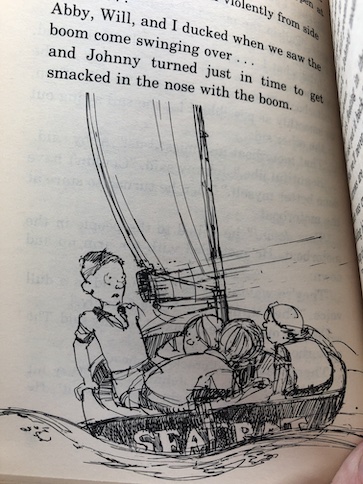
Abby comes to visit her friends for the summer, and they tell her about the cases they’ve recently solved, especially the one about the boat theft. As their reward for catching the thieves, they’ve been getting free sailing lessons from the boat owner, Johnny, and Abby gets to join them. However, while they’re out sailing, someone else driving their motorboat recklessly breaks a sign and rocks their boat. The boom swings over and hits Johnny in the face, breaking his nose. The kids need to get Johnny to the Coast Guard station, but how will they figure out which way to go with the sign broken?

Zoo TACT-tics

Will’s aunt takes the kids to the zoo along with her young son, Nicholas. While they’re at the zoo, they spot a dog who has somehow found his way into the polar bear enclosure. Fortunately, the polar bear is asleep, but can they get the dog out without waking the bear?

E-Z Parties, Inc.

Holly’s birthday is coming up, and Toria’s mother is overwhelmed with playing for it. Every year, it seems like Holly’s birthday part is difficult: kids fighting and crying, Holly not wanting to invite certain girls to the party, Holly wanting to buy a wedding cake she saw in a store window, etc. Toria’s mother wishes someone else could handle all the fuss, so she hires Toria and Will to do it. They manage to pull off the party without the kids getting into any fights, although it gets tricky when trying to divide a piece of cake between a set of twins in a way that satisfies each of them.

Halloween Shadows

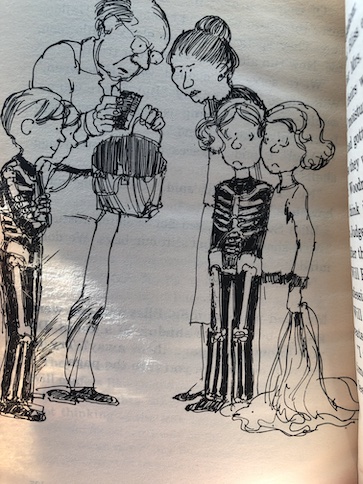
Toria isn’t happy that her mother made her a haystack costume for Halloween because it feels clumsy and it’s difficult to see out of. As soon as she and Will are finished taking their younger siblings trick-or-treating, she makes herself a ghost costume for when she and Will are going to meet Chuck for more trick-or-treating by themselves. However, while she’s waiting for the boys, she sees someone in a skeleton costume like Will’s with someone dressed like a ghost and follows them into the graveyard, where they climb a tree and just look down at her creepily. At first, Toria thinks the boys are playing a trick on her, but then Will shows up, proving that the kid in the tree wearing a skeleton costume isn’t him. It’s just a coincidence that there are two sets of kids wearing similar costumes. However, some angry adults come along because a kid in a skeleton costume and a kid in a ghost costume just played some nasty tricks at their houses. When the adults see that there are two sets of kids who look alike, can Toria and Will prove to them that the pranksters are the other kids?

TACK Secret Service

TACK Secret Service by Marvin Miller and Nancy K. Robinson, 1982.

This book is part of the TACK mystery series, which is very much like the Encyclopedia Brown series, although it’s not as well known and doesn’t have as many books. In fact, my copy references Encyclopedia Brown on the back: “Move over Encyclopedia Brown … make way for the TACK Team!”

The books in the series are collections of short mysteries that readers are invited to solve along with the characters before looking at the answers. TACK is an acronym for the names of the main characters. They’re kind of a mystery-solving club of neighborhood kids, although they say that they don’t really have a clubhouse or regular meetings. They just help out members of their community by solving problems whenever they can.

T = Toria – Her full name is Victoria Gardner, but she doesn’t like being called Vicky. She is the one who narrates the stories. She wants to be a newspaper reporter when she grows up, and she considers the journals she keeps of the group’s cases to be good writing practice.

A = Abby – Her full name is Abby Pinkwater. Abby and Toria were best friends before she moved away. Now, Abby is considered their “Agent-on-Remote” because the others still consider her part of the group, and she still becomes involved with their mysteries, even though she no longer lives close.

C = Chuck – The stories in this book don’t explain very much about Chuck and his background compared to the other characters, although he has a dog named Duchess who is the subject of one of the stories.

K = Will – His full name is Will Roberts, and he’s the leader of the group, although he leads in a very informal way. Will’s initial is the odd one out. They use ‘K’ in place of his initial both because it makes their acronym easier to pronounce and because ‘K’ stands for “SWITCH” in telegraph language, and they think that’s an appropriate code name for him “because of the way his mind can switch all over the place.”

Overall, I like the characters in the stories, and I think they’re well-written. They would be of interest to people who like Encyclopedia Brown and similar types of Solve-It-Yourself style mysteries.

The book is available to borrow and read for free online through Internet Archive.

Stories in the Book:
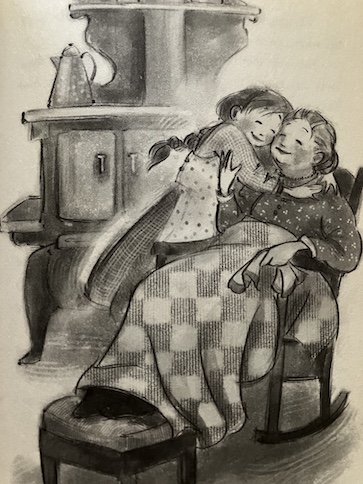
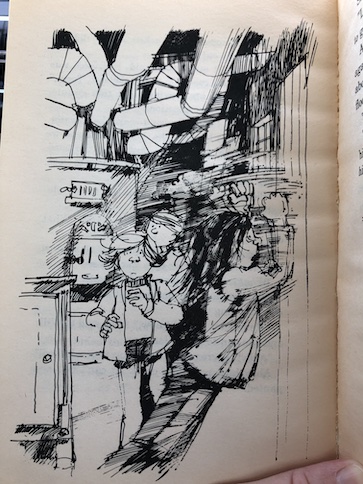
TACK Secret Service: Operation Goldfish

The kids are getting ready for the science fair at school. They are not looking forward to the arrival of kids from a rival school because they don’t play fair, and a boy called Red Jamieson sometimes deliberately wrecks other kids’ projects. Will is helping a boy named Hugo to protect his project because someone stole the plans for the project the day before. The kids suspect Red and his friend, Lester. As the kids try to maintain surveillance on the exhibits, someone steals one of their walkie talkies and threatens to ruin it if they don’t turn over Hugo’s invention for remotely feeding goldfish.
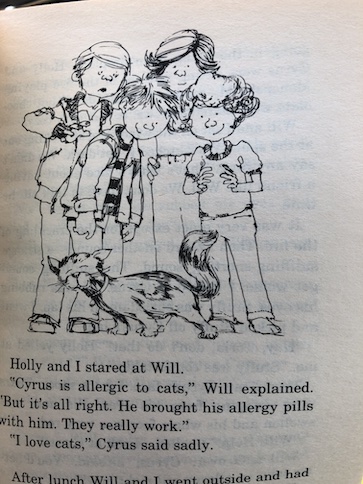
The Locked House Mystery

Will and his brother Cyrus are staying with Toria’s family for a few days while their parents are on a skiing trip. The only problem is that Toria’s family has a cat, and Cyrus is allergic to cats. At first, they think it will be okay because Cyrus has his allergy pills, but it turns out that he forgot them at home, and he also forgot the house key. How can they get his allergy medicine from a locked house when they can’t reach the spare key?

The Pirates of Sandy Harbor

Toria is writing a report about the founder of their town, Simon Hawk, but she needs more information. She goes to the local historical society, but there, she discovers that an old note has been found that indicates that Simon Hawk may not have been the hero that everyone believes he is. Rather than chasing off the pirates that plagued the area, he may have been in league with them! Toria can’t finish her report until she knows the truth, but fortunately, Will spots something about the message that clarifies everything.

The Dance of the Trees

Toria’s sister, Holly, is in a dance recital with her ballet class where the best dancer in class gets to be a fairy, and the other girls get to be living trees. (Holly isn’t thrilled about that until she see the tree costumes, which are pretty cool.) Unfortunately, the girl playing the part of the fairy gets sick, and there isn’t enough time for someone else to learn her part. What can they do?

A Slipper for Ripper

Chuck worries that his mother will give away his dog, Duchess, if she doesn’t stop chewing things. They’ve tried giving her all kinds of chew toys, but she doesn’t like any of them. She just wants to chew things that belong to people. Will’s younger brother, Cyrus, thinks he’s found a solution, figuring out how to make what he calls “dognip.” However, when they arrive at Chuck’s house, Duchess has a slipper belonging to Chuck’s mother. Cyrus hurriedly gets the slipper away from Duchess and throws it into the next yard, but that’s where the violent dog Ripper lives. At first, the kids’ attempts to distract the dog and get the slipper only make the situation worse, but Will figures out how they can retrieve everything from Ripper’s yard safely.

The Case of the Haunted Dollhouse

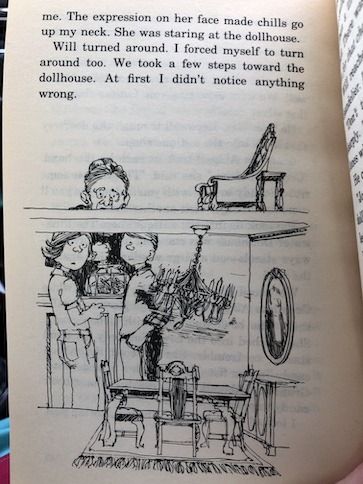
Toria’s best friend, Abby, who moved away before the beginning of the book, calls Toria to tell her that her family is coming back to town to visit her grandmother, and she can see Toria when they come. However, this isn’t just an ordinary visit. Abby’s family is concerned because her grandmother is acting strangely, and her parents are worried that she might be getting senile. She’s talking about selling the fantastic dollhouse that she’s had since she was little, which is now a family heirloom. She’s become afraid of it because she thinks it might be haunted.

The Haunted Dollhouse – Part II

The kids figure out what’s created the haunting phenomena in the doll house, but when they go to tell Abby’s grandmother about it, they learn that she’s moved out of the old family home where she also runs her antique shop because other strange things have been happening. The temperature in the house inexplicably drops, and she’s been hearing music that seems to come from the dollhouse with no apparent cause. The adults are still concerned about her mental state, but the kids realize that there’s someone who’s behind all the strange things that have been happening. Who is playing ghost?