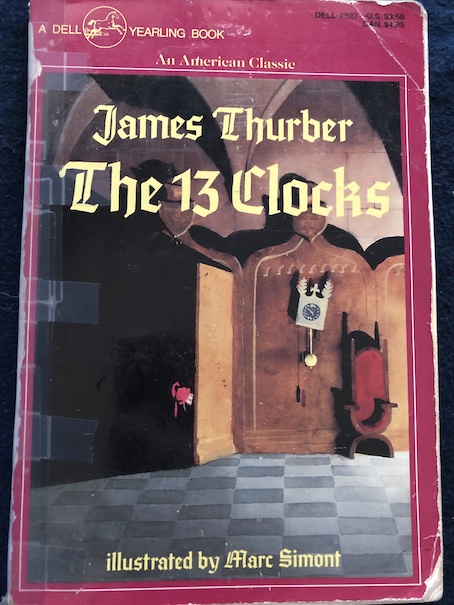
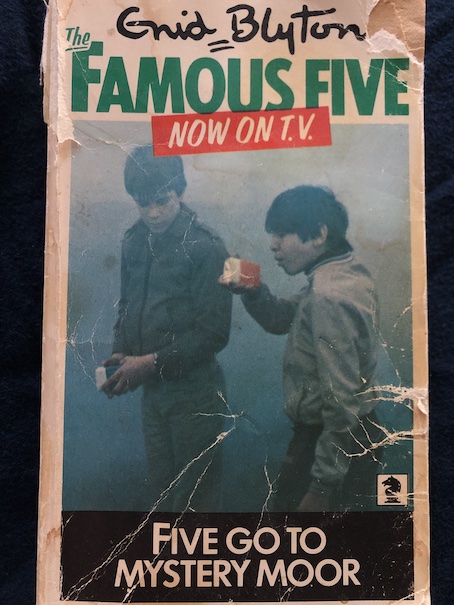
Five Go to Mystery Moor

The Famous Five

Five Go to Mystery Moor by Enid Blyton, 1954, 1974.

The girls, George and Anne are attending a riding school, and the boys, Julian and Dick, are camping when George receives a letter that her father is ill, and her mother wants the girls to stay on at the riding school for a while longer. The girls are disappointed and think that the boys will probably stay on at their camp, but they soon get a letter that the boys will be coming to the riding school to join the girls. The children are hoping that they will find another adventure when they’re all together again.

At the riding school, George has developed a rivalry with another girl called Henry. Henry’s real name is Henrietta, like George’s real name is Georgina, and like George, Henry likes to dress and act like a boy. However, rather than bonding over their shared interests and styles, George and Henry resent each other. (George makes a big deal of not liking to be a girl and wanting other people to look at her and refer to her as a boy. I’ve wondered whether the implication is that she’s actually transgender, without using that word to describe her, or if she’s merely a tomboy who things girl things are sissy stuff. Enid Blyton’s books are often full of the implication that boys are tougher and braver than girls, and it seems to be a mark of praise for a girl to be like a boy. In this particular book, it seems like both George and Henry are trying hard to be “not like other girls“, and the reason why they resent each other is that they’re both disgruntled to realize that at least one other girl is like them, making each of them seem less exceptional. They each seem to feel like the other is horning in on their shtick.) In spite of the rivalry between George and Henry, the other children like Henry. Eventually, George and Henry settle their differences. Henry joins the other children on some of their rides and explorations.

While the children are still at the riding school, a gypsy boy comes to the stables with an injured horse, asking for help. (They’re referred to as “gypsies” all throughout the book, although that’s considered a kind of insult. The proper name is really Romani, and they’re also sometimes called “Travelers.” The name “Gypsy” comes from an earlier misunderstanding that their ancestors were originally from Egypt, kind of like how Native Americans were mistakenly referred to as “Indians”, and the name stuck. I only use the word “gypsy” here because the author does, and I want to make sure that fans of the original book understand what I’m talking about. This note is here to clarify the difference. Gypsies are stock characters in Enid Blyton books, and they’re all pretty stereotypical.) The boy is told that it will take a few days before the horse is able to walk, let alone pull a caravan wagon. The boy is very upset because his father has a nasty temper, and he’s not willing to wait. The other children soon see how abusive the boy’s father is, and they’re sympathetic to him. Julian and Dick catch the father trying to steal a horse or reclaim his in spite of its injury during the night. When they ask him why he needs a horse so badly and can’t wait until his is properly healed, and he tells them that his group needs to go to Mystery Moor. Seeing that he’s not going to get another horse, the father decides to move on with other members of their party, leaving his son behind to tend to their horse and catch up to them when he can.

Julian, Dick, George, and Anne are intrigued by Mystery Moor, although they can’t imagine what could be there that would make someone so desperate to go there. The name of the place intrigues them, and they are told that it used to be called Misty Moor until some strange things happened there years ago. A wealthy family established a sand quarry there and built a small railroad line that crossed the moor, but they had a dispute with the gypsies who lived on the moor. The gypsies sabotaged the railroad, and when the sons of the family went to deal with the situation, they all vanished and were never seen again. The local rumor is that the gypsies probably murdered the sons, but nothing was ever proven, and to be honest, nobody really misses the sons because they weren’t nice to anybody else, either.

The children think that this is the adventure that they’ve been looking for, and when the riding school becomes crowded because of the arrival of new students, they decide that they want to go camping on Mystery Moor. They look forward to heading out onto the moor to see if they can find any traces of what happened to the missing family. However, there’s a modern mystery on the moor as well. The children spot a plane that flies low and circles the area, seemingly guided by a mysterious light. The children discover that the plane dropped a package, and that package is stuffed with packets of US money! Who would drop that much money from an airplane, and who was supposed to come pick it up?

The book is available to borrow and read for free online through Internet Archive (multiple copies). There is also an audiobook on YouTube. As the cover of the book notes, the Famous Five series was made into a television series, and you can sometimes find clips or episodes on YouTube.

My Reaction and Spoilers

Old and New Versions

I find that many of Enid Blyton’s mystery/adventure stories, no matter which series, are very much on par with Stratemeyer Syndicate books (Bobbsey Twins, Hardy Boys, Nancy Drew, etc.), especially the earlier ones. On the one hand, they contain many of the elements that children love in stories – mystery and adventure, independence from parents and other adults, spooky and mysterious happenings, kids who save the day, and a lovable dog. On the other, both Enid Blyton’s books and the Stratemeyer Syndicate books were revised in later reprintings to update the language and to remove or alter racially-insensitive and offensive terms.

I didn’t know how much some of the Stratemeyer books I read as a kid had changed from their original versions because I was born in the late 20th century, after many of these revisions had already taken place and didn’t read some of the original editions until I was an adult. I was surprised. Since I grew up in the US, I didn’t read any Enid Blyton books as a child at all. They’re available here, but not nearly as popular as the various Stratemeyer Syndicate series, and many American children don’t know about them at all. I’d heard of Enid Blyton books because they were referred in other books and movies I saw, but I didn’t read any until I was an adult. By that time, I wasn’t too shocked at some of the more problematic parts of the books.

“Gypsy” isn’t really a shocking word for me because there’s less emotional baggage attached to that word from the time and place where I grew up than there is attached to certain other racial words that I’d rather not mention. When I was a kid, I thought it was a more neutral, generic word than it really is, although someone did explain to me at some point what the name comes from and that it’s not really the proper name. However, when you find out that something really bothers people or that they don’t want to be called certain things, it’s better to just call them whatever they like to call themselves. I think the later reprintings of this book use the word Traveller (British spelling) instead, like this audiobook on YouTube.

As with Stratemeyer Syndicate books, I think the revised reprintings are fine for modern children, and the earlier versions are best kept for adults with an interest in vintage and nostalgic children’s literature. I find these books interesting particularly because they have the classic setup of a mystery-solving group of children and their dog, just like the Scooby-Doo mysteries, which is something that I grew up loving! The Scooby-Doo mysteries have a similar format to the Famous Five, and the working title for the original concept of the cartoon series was Mysteries Five, which might be an indication that the writers had Enid Blyton’s books in mind.

Interesting Information

One interesting piece of trivia is that the book discusses patrins, signs that the Travellers leave for each other to indicate which way they’re going. During the course of the story, the Traveller boy leaves patrins to help the other children.

The Mystery and spoilers

Like many vintage children’s mysteries, the story leans a little more toward adventure than mystery. The Travellers are definitely the ones who are there to get the dropped packets of money, and that’s why they were so worried about getting out on the moor in time. The real mystery is why they’re doing this and where the money comes from.

Toward the end of the book, the police reveal that the money is counterfeit, and that’s why it had to be smuggled into the country. Henry is helpful to the others at a point when they’re in danger, and that helps George to reconcile with her. Because the Traveller boy’s father is abusive and is about to be arrested for smuggling counterfeit money, he is likely to be sent to a foster home, which is actually good news for him because he was unhappy with his father and afraid of him. He says he would like to live a settled life in a house where he can ride his bike to school, and George promises to give him a bicycle as a reward for helping them when they needed it.

Gone-Away Lake

Gone-Away Lake by Elizabeth Enright, 1957.

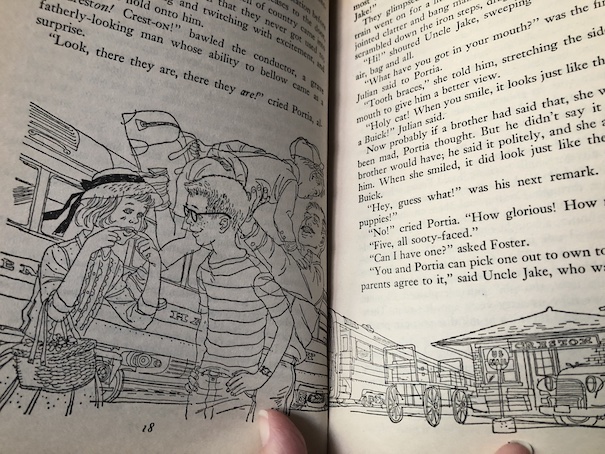
Eleven-year-old Portia and her six-year-old brother Foster are traveling alone by train to visit their aunt and uncle and twelve-year-old cousin Julian in the country for the summer while their parents are on a trip. Portia likes spending time with Julian because Julian is an amateur naturalist and tells her things about animals and birds. When Portia and Foster arrive, their aunt, uncle, and cousin tell them that their dog has had puppies. Portia is allowed to name them, and if her parents agree, she and Foster will even be able to keep one!

While Portia is out exploring the countryside with Julian one day, they find some garnets in a rock. They start chipping some out to take to Julian’s mother, and they find a carved inscription in Latin on the rock with the date July 15, 1891. They’re not sure what the Latin words mean. They figure out that part of the inscription refers to the Philosopher’s Stone, which was supposed to turn different substances to gold. Portia asks if this stone could be the real Philosopher’s Stone, but Julian says that’s impossible because they’ve been using knives to pry out the garnets, and they haven’t turned to gold. They continue to wonder what the inscription really means and why someone put it there.

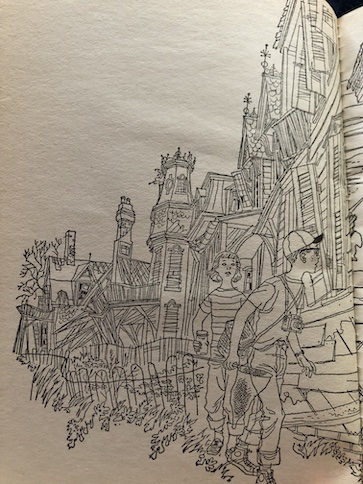
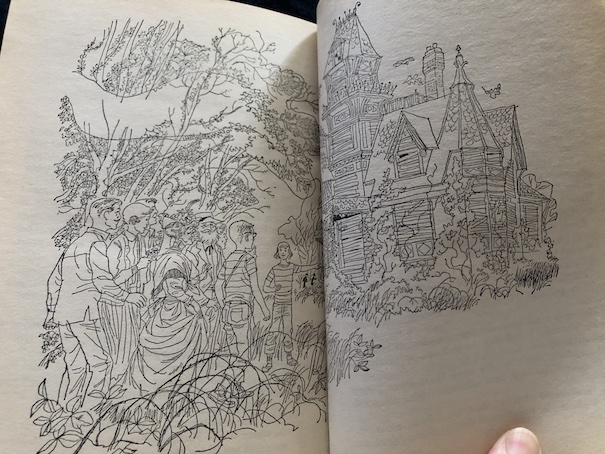
They explore the countryside further, getting lost. They aren’t too worried because they don’t need to be back soon. They follow a brook and find themselves in a swampy area. Strangely, they stumble over an old rowboat. Then, they spot a row of old, abandoned houses. The houses are in bad condition, but the kids can see that they were built in elaborate Victorian styles. The children wonder why those houses are there on the edge of swamp. Portia finds it a little creepy, but Julian wants to get a better look.

Then, the children hear a voice. Strangely, the voice is repeating an advertisement for medicine for indigestion. The children think it’s funny because no ghost would say something like that. Taking a closer look at the houses, they notice that one seems to be in better condition than the others that it has animals and a garden, so someone must be living there. Thinking about it more, Julian says that the swamp was probably once a pond or a lake, and that’s why it had houses and a rowboat. He hasn’t heard of a lake in the area, but he and his parents haven’t lived in the area for long. The children wonder who lives in the house and decide to find out.

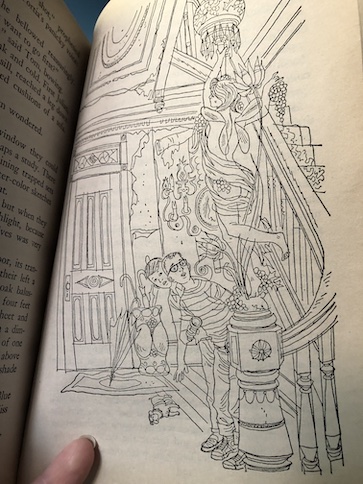
They find an old woman in old-fashioned clothing, listening to a radio. The old lady is surprised to see them but welcomes them, saying that it’s been a long time since she has seen children. She invites them to come inside her house, and the children find themselves in a cluttered and chaotic parlor with each wall covered in a different kind of wall paper. The woman introduces herself as Minehaha Cheever.

The children explain how they ended up there by coming through the swamp, and Mrs. Cheever says that they shouldn’t go through the swamp because there is a dangerous sinkhole there that they call the Gulper. She says that when it’s time for the children to go home, she’ll have her brother show them a better and safer way. Mrs. Cheever says that there used to be a lake there, and that her family and about a dozen others had summer houses there, but the lake largely dried up when a new dam was built. After that, the summer houses were abandoned, and many of them were vandalized. However, her father and another woman locked up their houses with the furniture inside, thinking that they would come back and move them, but they never did. The large and fancy old Villa Caprice is still untouched, but Mrs. Cheever says that she supposes that much of the contents is probably deteriorated. She says that the Villa Caprice gives her the creeps.

The children ask Mrs. Cheever why she’s there, and she says that she used to live somewhere else. After her husband died, she didn’t have much money, and she remembered that the house at the former lake was still there. Her brother, Pindar, also wanted to retire somewhere quiet, so they decided to go live in their family’s old summer house. There was enough furniture and old clothes left there for the two of them, and it suits them. They keep animals. Pindar still has their old car, so he can sometimes go into town for things they need. “Pindar” was one of the words in the inscription on the rock.

Pindar explains that he and his best friend when he was a kid, Tarquin (another of the words on the rock), were the ones responsible for the inscription on the rock. Tarquin was three years older than Pindar, but they were still close friends. However, they had a temporary falling out when Tarquin was 13 years old. Tarquin had gone away to boarding school for the first time, and the next time they met at their summer homes, Tarquin had brought a friend from his new school with him, Edward. Tarquin and Edward were putting on airs and showing off how sophisticated they were because they were 13 years old and knew so much more now that they had been to boarding school. Pindar felt bad about his old friend shunning him and treating him like a little kid, so he started hanging out with his other best friend, Barney. Then, Pindar had the idea of showing Barney the big rock with garnets stuck in it where he and Tarquin used to meet and hang out together.

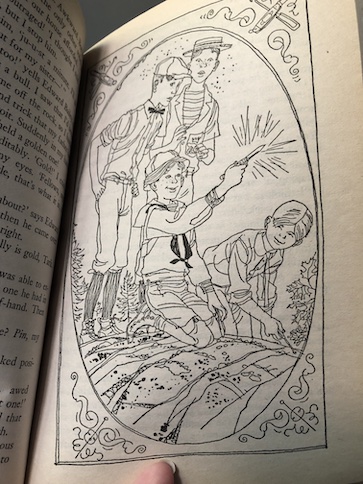
When Pindar and Barney got to the rock, they discovered that Tarquin and Edward were already there, and the older boys said that they had claimed the rock for themselves. They called the rock the philosopher’s stone and wrote the inscription labeling it as the philosopher’s stone in Latin, which they had learned at their boarding school. The older boys said that the younger ones were too little to be philosophers, like the two of them. Pindar’s feelings were hurt all over again, and he told his father about the situation. Pindar’s father was amused by the older boys and their sophisticated philosopher talk. He said that there was no age limit on who could be a philosopher and explained to Pindar what a philosopher’s stone was supposed to be and how it was supposed to turn things to gold. Then, he suggested a prank that Pindar and Barney could play on the older boys, convincing them that the stone really did have the power to turn things to gold. The older boys were temporarily fooled by the trick. At first, Tarquin was angry about being tricked, but then, he had to acknowledge that he had provoked Pindar and that the trick was a clever one. Tarquin made up with both Pindar and Barney, and he added Pindar’s name and his own to the inscription on the rock. Pindar still considers Tarquin and Barney to be his best friends, and they still write letters to each other in their old age.

Julian and Portia are fascinated by the stories that Pindar tells about the childhood summers he and his siblings and friends spent at this now-vanished lake. Mrs. Cheever said that she loves having children around the place again, and she suggests that Julian and Portia could use one of the old houses that is still in reasonably good condition as a kind of clubhouse. Julian and Portia love the idea, and Pindar and Mrs. Cheever suggest that they use the old house where Tarquin and his family used to stay. It’s in disrepair, but it’s much better than some of the other houses. There is plenty of furniture in the attic that the children can use, too. The children decide to invite some other kids to join them, and they call their club the Philosopher’s Club, after Pindar and Tarquin’s old group of friends.

Julian and Portia invite some other local children to join the Philosopher’s Club and spent a magical summer exploring this abandoned community, picking blackberries, learning about local plants and their uses, and scavenging things from old houses and trying on the clothes from Pindar and Mrs. Cheever’s youth. The boys help Pindar build a bridge over the large sinkhole they call “the Gulper” after Foster falls into it and has to be rescued. When Julian and Portia’s parents meet Uncle Pin and Aunt Min (as they come to call Pindar and Mrs. Cheever) and come to see Gone-Away Lake, the adults also experience the magical, dream-like qualities of this place, and Portia’s parents consider plans that may make the children’s future summers magical.

The book is available to borrow and read for free online through Internet Archive (multiple copies – including a couple of copies of the sequel, Return to Gone-Away).

My Reaction

I remember a teacher reading this book or part of it to us when I was in elementary school, but I couldn’t remember much about the story except for the lake that had gone away and caused the town to be largely deserted. For some reason, I had thought this story was a mystery story, but it’s not.

In many ways, I think this is the perfect nostalgia book because a large part this story is about the nostalgia that the elderly brother and sister in the story have for the place where they used to have their childhood summer adventures, even though the place isn’t what it used to be. Through the stories that they tell the children and the children’s own adventures and explorations of this largely abandoned summer community, they begin building their own attachments to the place and their own nostalgic summer memories.

Because the story takes place in such a unique location, I think it would make a fun kids’ movie with a vibe of nostalgic summer adventure. Although, because the story is largely low-key slice-of-life and the flashbacks of Uncle Pin and Aunt Min to incidents in their youth, I can see that the story might have to be changed a bit to fit the usual movie format, focusing on one definite problem or a particular adventure to give the story its climax. I picture the kids and their Philosopher’s Club making it their mission to preserve this vanishing community, which fits with the way the original story goes, although the kids in the book enjoy the old community for the magic of its dilapidated state rather than wanting to fix it up and restore it to its former glory. I think they could lean into promoting the preservation of nature and the ecosystem of the area, with Julian in particular pointing out what makes this environment unique and how it has become home to animals and insects since the lake changed to a swamp and most of the people left. The Philosopher’s Club might connect with a local naturalist society, and they could build the bridge in the story together to make the swamp safer to traverse for nature lovers and bird watchers. Uncle Pin and Aunt Min could remain on the site as its caretakers. Perhaps, the kids might even find some old notes and drawings in one of the old houses that show some interesting aspects of how the environment has changed and some of the unique animals that make their home there. That didn’t happen in the book, but it would be a sort of environmentally-connected treasure the children could find.

Mystery Ranch

The Boxcar Children

Boxcar Children Mystery Ranch

Mystery Ranch by Gertrude Chandler Warner, 1958, 1986.

Boxcar Children Mystery Ranch Grandfather

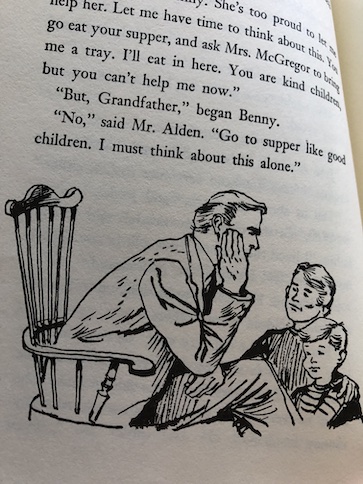
The children can tell that something is wrong when their grandfather, Mr. Alden, comes home and bangs the doors. When they ask their grandfather what’s the matter, he says that he’s worried about his sister, Jane, because he just got a disturbing letter about her. The children have never met their Great-Aunt Jane before, and she lives on a ranch out west. The trouble is that Jane is a difficult person to get along with. She can’t stay at the ranch alone because she’s elderly and needs help, but the person who was helping her before is leaving, and because Jane is such a difficult person, their grandfather doesn’t know where he’s going to find someone else willing to help her. Their grandfather admits that he doesn’t even get along with Jane himself, confessing that he hasn’t been very nice to her, either. (We never find out exactly why the children’s parents originally told them that their grandfather wasn’t a nice man, as established in the first book of the series, but this confession hints that he used to be much harder on his relatives than he is now, perhaps having mellowed a bit with age and experience.)

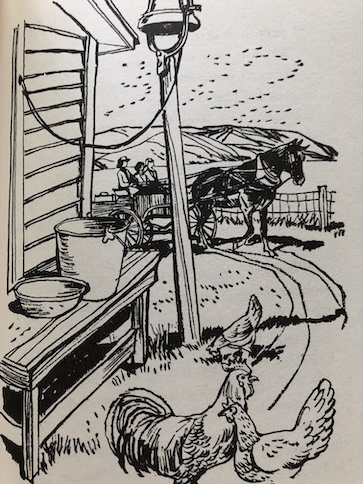
Boxcar Children Mystery Ranch wagon

Their grandfather says that the ranch where Jane lives is the ranch where both of them grew up. When he moved east years ago, Jane wanted to stay on at the ranch. He knows that Jane doesn’t have much money and doesn’t even keep many animals anymore, but because of her sense of pride and their past quarrels, Jane won’t accept any money or help from him. The children wish they could do something to help, and their grandfather says that he has to think things over. They ask who wrote the letter about Jane, and their grandfather says that it was written by the neighbor who has been staying with Jane. She says that she can’t put up with the bad treatment from Jane anymore. The letter further says that Jane wants to see Mr. Alden’s grandchildren. Naturally, the children say that they would like to see Jane themselves and try to help her. However, their grandfather isn’t sure that it’s a good idea because he doesn’t know how Jane would treat the children.

After talking it over some more, they all decide that the two girls, Jessie and Violet, will go to see Aunt Jane without the boys because Jane might find all four children at once to be too overwhelming. Mr. Alden says that if Jane gives them too much trouble, they should go to the neighbors, who are nice and will help them. When the girls get off the train at the town near their aunt’s ranch, they notice that a man gets off at the same time and quickly disappears. They are curious about him and wonder where he went. The townspeople are curious, too, because it’s rare that anybody comes to their little town, let alone a mysterious stranger.

Boxcar Children Mystery Ranch arrival of the girls

When the girls arrive at the ranch, the neighbor, Maggie, helps them get settled. Aunt Jane refuses to get out of bed, and Maggie says that she hasn’t been eating much and won’t let her eat much, either. The girls ask Maggie what’s wrong with Aunt Jane, and she says Jane feels like she doesn’t have anything to live for, so she’s kind of given up. Jessie and Violet insist that they’re all going to eat, and they fix some food. The girls and Maggie eat first, and then, the girls take Jane some orange juice with a beaten egg. Jane finds it difficult to refuse the girls, so she drinks it. Aunt Jane starts asking the girls questions about their brothers and says that she would like to see them.

Aunt Jane begins eating better because she finds these interactions with her young nieces interesting and because they speak more kindly to her than anybody else has for years, and she enjoys the attention. Maggie stays on at the house and continues to help because the girls have money and buy more and better food. Things seem like they’re getting better at the ranch, but when Maggie and the girls return from buying food in town, Aunt Jane says that three strange men came to the house while they were gone, even entering her bedroom, and they tried to badger her into selling her ranch to them. At first, Maggie doesn’t believe that, but Aunt Jane has the paper the men left to prove it. Of course, Aunt Jane refused to sign anything and told the men to go away, but she seems a little shaken by the experience.

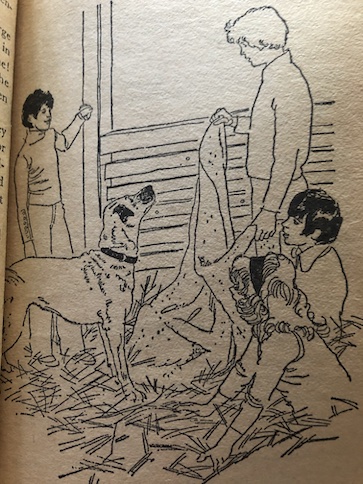
Boxcar Children Mystery Ranch Jane and Benny

The girls miss their brothers, and Aunt Jane tells them that the boys can come and stay, provided that they’re not like their grandfather. When the boys come, Aunt Jane likes them, too. To the children’s surprise, she tells them that she’s decided to give her ranch to the four of them because she has no children of her own and she would rather they have it than those men who tried to get her to sell. The prospect is thrilling, but when the lawyer comes to arrange everything, they make sure that the arrangement includes providing for Aunt Jane, too.

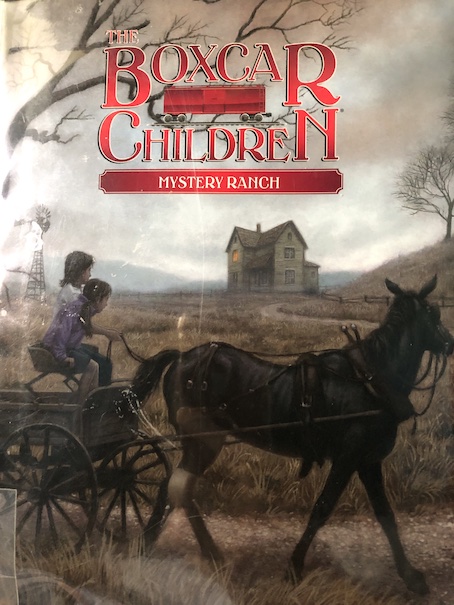
As the children explore their new ranch together, they see that things are as their grandfather described to them. The only animal Aunt Jane currently has is an old, black horse that Benny ironically names Snowball. However, they find an old hut that looks like someone has been living there recently. Who has been secretly camping out on Aunt Jane’s land? Is it the mysterious stranger who got off the train or the three tough guys who tried to get Aunt Jane to sell the ranch to them? Why would anybody even want the ranch anyway? The children find it charming, and while the girls like to imagine how they’d like to fix up the house, they know it isn’t worth much monetarily. There aren’t many animals, and while there’s fool’s gold on the land, there’s no real gold. Is there something else on the ranch that they don’t know about?

The book is available to borrow and read for free online through Internet Archive (multiple copies).

My Reaction and Spoilers

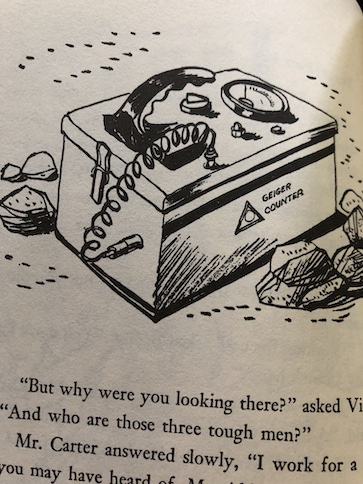
Boxcar Children Mystery Ranch geiger counter

As readers might have guessed, there is a resource on the ranch that the Aldens have overlooked for years, but other people have figured it out. However, more than the mystery, I like this book for the insights into the Alden family’s past. As I said, we never fully find out why Mr. Alden’s son and his wife had a falling out with him years ago and told the children he wasn’t very nice, but his sister’s feelings about him offer some clues to the type of boy and young man Mr. Alden was. Mr. Alden admits that he wasn’t always nice to his sister, and Jane says that he was always “bossy.” I get the feeling that Mr. Alden used to be the kind of man who thought that he knew best about everything and started feeling like he could tell everyone what to do. Perhaps his falling out with his son helped show him that he didn’t really know best about everything, including how to get along with his own family, but admittedly, that’s speculation.

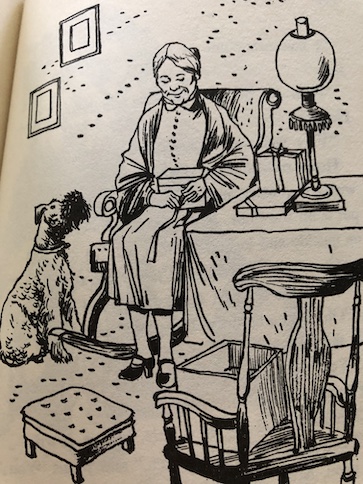
Boxcar Children Mystery Ranch Jane's Presents

Jane also admits to being difficult to get along with in other ways. Her major problem has been her sense of pride, which is one of the reasons why she never wanted to listen to her brother or go to him for help when she needed it. One of their chief disputes had been about the ranch itself. Years ago, her parents and brother were ready to give up the ranch and move east, but Jane felt more attached to it than the others and insisted on staying there and running it herself. Unfortunately, Jane admits that she didn’t really know how to run the ranch properly. There were points when she could have asked for help, but that would have been admitting to the others that she had been wrong to insist on staying, and she couldn’t bring herself to do that. Things gradually got worse over time because Jane wouldn’t listen to anybody or ask for help, which is how the ranch got into its current state.

The discovery of an important resource on the ranch brings more money to the family, greater security for Jane, and a chance for the brother and sister to make up. Jane invites Mr. Alden to the ranch to celebrate her birthday and to help her and the children arrange things. Mr. Alden is careful to arrange the situation so that the resources can be mined while not disturbing the old ranch house, so his sister can continue to live in the house she always loved so much.

Famous American Negros

Famous American Negroes by Langston Hughes, 1954.

I sought out an electronic copy of this book because I don’t own a physical one, and after I found out that it existed, I knew that I had to cover it at some point! The book is part of a series of biographies for children that I covered earlier, but what caught my attention was the author of the book, Langston Hughes, the famous poet of the Harlem Renaissance of the 1920s and 1930s. I mostly knew Langston Hughes for his poetry, and I wasn’t aware that he had written any children’s books until I found out that he had written several biography books for this series. When I found out that he specifically wrote books about African Americans and other notable black people from history, it occurred to me that he might have even written biographies of people he knew personally because of the circles he traveled in.

This book focuses on prominent African Americans through history. It contains a series of short biographies and profiles, beginning in the Colonial times and continuing into the mid-20th century, when the book was written. Some were contemporaries of Langston Hughes, but since the biographies are brief and focus only on providing an overview of the subjects’ lives, there is no indication whether Hughes ever met any of them himself. I was a little disappointed about that because I would have enjoyed hearing a personal perspective, but the personalities covered are still fascinating. I also enjoyed how some of the earliest biographies in the book relate to some of the later ones because of the influence some of the earlier people had on the lives of others.

If you’re wondering why he uses the term “Negro” instead of “African American”, it’s because that term was one of the more polite and acceptable terms during his youth and around the time when he wrote this book. (That’s why the UNCF, or United Negro College Fund uses it as well. It was one of the polite terms in use at the time of its founding.) It sounds a bit out of date to people of the 21st century because, around the time of the Civil Rights Movement, which began around the time this book was written, people began advocating for a shift in the words used to describe black people. They wanted to distance themselves from old attitudes about race by using newer terms that didn’t have as much emotional baggage attached to them. This is when terms like “colored” and “Negro” feel out of use and were replaced by “African American” as the correct, formal term to specifically describe an American with African ancestry and “black” (considered somewhat impolite a century earlier, as I understand it, see the Rainbow and Lucky series for an example – I discussed it in the historical description of the 1830s) as the generic term to describe a person with dark skin and African ancestry, regardless of their nationality.

Because this book was written in the mid-1950s, some of the information included is long out of date. People who were alive when Langston Hughes wrote the book are obviously not alive now, almost 70 years later. There are more recent books that cover the same topic and include information about late 20th century and early 21st century musicians Langston Hughes wouldn’t have known about. However, this vintage book is still interesting because of its famous author and because it was written at a turning point in American history, when society was changing and racial issues were being challenged.

The book is available to borrow and read for free online through Internet Archive.

The biographies included in the book are:

Introduction

The book begins with a brief history of black people in America. Langston Hughes points out that histories of African Americans often begin with slavery, but there were people of African ancestry who came to the Americas before that, not as slaves. Some traveled with explorers from Europe as members of their crews and expeditions.

After the slave trade began, slavery affected the lives of black people throughout the American Colonies and, later, the United States. Some slaves managed to find ways to take their fate into their own hands by running away, and of those, some helped others to escape to freedom. Some slaves were able to hire themselves out for wages on the side and saved up enough money to purchase themselves and gain freedom in that way. Some slaves were even freed by the the people who owned them, although others simply lived and died in slavery.

After the end of the Civil War and the end of slavery, former slaves were free to pursue their own destiny, but they were in a precarious position because they had no resources from which to start building their independent lives. Slaves had work experience, but much of their experience was in unskilled labor, which brought low wages. Most slaves had no education. (In many places, it was illegal to teach slaves to read. There were a few exceptions, and some people skirted the law, but this was a major problem for many formerslaves once they were granted their freedom, lacking an essential skill.) They had no money or land of their own. Getting established in their new lives meant building something from nothing or almost nothing, and it was a long, uphill struggle.

Even generations later, racial discrimination added obstacles to the lives of African Americans. The biographies in this book are about people who triumphed over the obstacles in their lives to leave a lasting mark on society.

Phillis Wheatley (c. 1753-1784) – Whose Poetry George Washington Praised

Phillis Wheatley was brought to the American colonies from Senegal as a slave when she was only a small child (approximately age 6 or 7 because she was still losing baby teeth when she arrived). Phillis was not her original name, but it is unknown what her original name was, exactly when she was born, how she became a slave, or what happened to her parents. She was purchased by a tailor named John Wheatley in Boston to be a servant for his family, and the Wheatley family gave her the name Phillis. When she first arrived in Boston, Phillis could not speak England and no one could speak Senegalese, so it was some time before anybody could truly communicate with her, which is part of why we know so little about her earliest years.

Fortunately, the Wheatley family was kind and even nurturing toward Phillis. Even though they purchased her to work for them, they cared about educating her. They taught her read and write, even though it was discouraged to teach slaves those skills and even illegal in some areas. When Phillis learned English and was able to read and write, it soon became apparent that she had a talent for poetry. The Wheatleys supported her poetry, and the granted Phillis her freedom in 1772. By the time she was about 21 years old, her poetry had been printed all over the colonies and in England. Although her poetry was successful, Phillis’s life took an unfortunate turn when she married a ne’er-do-well, and she died in poverty.

Richard Allen (c. 1760-1831)- Founder of the African Methodist Episcopal Church

Sometimes, slave owners used Christianity as an excuse for slavery, claiming that they were saving the souls of heathens. However, even though they converted slaves from Africa to Christianity, they didn’t provide much opportunity for their slaves to have religious worship. Richard Allen was born into a slave family in Philadelphia, and he was a child when he was sold to a farmer in Delaware. When he grew up, he became a Methodist preacher, and his owner let him perform religious services for the other slaves. He also became a wagon driver during the Revolutionary War and earned enough money to buy his freedom.

Once he was free, he returned to Philadelphia as a preacher. There was no Methodist congregation that was only for black people at that time, so he sometimes preached for a mixed congregation. However, some of the white members of the congregation protested to his presence as a black preacher, and some also objected to the presence of the other black parishioners as well. When Allen and a couple of friends were interrupted while praying one Sunday and told to leave the church, Allen realized that the only way any of them would be able to worship in peace would be to form their own group. The society he and his friends formed was the Free African Society, and that group went on to found the Bethel Methodist Episcopal Church. They were among those who helped to tend the sick and bury the dead during the yellow fever epidemic that struck the city in the 1790s.

Ira Aldridge (1807-1867) – A Star Who Never Came Home

Ira Aldridge was the son of a Presbyterian minister in New York. Aldridge started acting at a young age and became part of a black theater troupe, performing in a theater close to the African Free School he attended and the famous Fraunces’ Tavern (mentioned earlier in Phoebe the Spy, this book says that it was owned by a black family but other accounts say that the Fraunces family was mixed race – it has never been firmly established which is more accurate). His father wanted him to further his education, so he sent him to the University of Glasgow in Scotland, which accepted black students. It is unknown whether Ira Aldridge ever completed his degree there, but from there, he went to London to continue his acting career and won acclaim for his portrayal of Othello at the Royalty Theater. Ira Aldridge toured Europe and gathered a prominent following, even winning awards from some of the royal families of Europe. The reason why he never returned home was that he remained in Europe for the rest of his life, still touring as a successful actor up until his death at age 60.

Frederick Douglass (c. 1817-1895) – Fighter for Freedom

Frederick Douglass was born into slavery, originally with the last name of Bailey. In most cases, we know very little about the early lives of individual slaves because few slaves could read and write and their owners didn’t think it was important to even record their birth dates. Frederick Douglass is an exception because he learned to read and write and later wrote his famous autobiography. (The autobiography is now public domain, and you can read it for free online in many places, including Documenting the American South, Project Gutenberg, and Internet Archive (multiple copies). The reading level isn’t difficult, although parts are emotionally wrenching.) His autobiography contains many details of his early life (although even he never knew his own birth date, which is why we can only estimate). The description that follows is a brief summary of both the chapter in this book and the contents of his autobiography:

Frederick’s mother was a slave, but his father was a white man (or in some sources I’ve seen, possibly mixed race). (The book doesn’t identify his father, and his identity has never been definitely established, although there are theories. According to the Library of Congress, Frederick’s “Mother is a slave, Harriet Bailey, and father is a white man, rumored to be his master, Aaron Anthony.”) Because his mother had to work in the fields all the time, he rarely saw her when he was a child. (This book doesn’t mention it, but Frederick’s mother died while he was still young.) He was raised by his grandmother during his earliest years and later by a woman who abused and neglected her young charges. Then, young Frederick was sent to live with and work for another part of the family who owned him in Baltimore. At first, the mother of family was nice to Frederick and gave him his first reading lessons, but her husband put a stop to that, telling his wife in Frederick’s presence that if a slave learns to read and write, they’ll probably run away. Frederick managed to continue his reading lessons in secret with the help of some of the white children in the neighborhood. His new skills did help him to learn more about human rights and what freedom meant, and he also learned about the existence of abolitionists. Newspapers in Baltimore called abolitionists anarchists and accused them of being in the service of the devil, but young Frederick began to see them as possible allies.

As a teenager, Frederick was sent to live with a different branch of the same family in a smaller town. This family became suspicious of him when they found out that he could read and write and that he had joined a Sunday school that was run by a free black man. They decided to send Frederick to a man named Covey who was a “Negro breaker“, which was someone who would “tame” slaves by “breaking” them physically, mentally, and spiritually. In his autobiography, Frederick states that Covey did break him and very nearly killed him, but after a particularly vicious beating at Covey’s hands, Frederick realized both that he couldn’t take anymore and that he wasn’t going to take any more. He fought back. That’s when he began planning to run away. Somehow, plans of his escape leaked out, and he was sent away to work in the shipyards in Baltimore. There, he disguised himself as a sailor, borrowed some papers belonging to a sailor, and sneaked onto a train headed for New York.

When he arrived in New York, he was free, but he wasn’t quite sure where to go or what to at first. He had no place to stay and didn’t know anybody he could trust. Fortunately, a real sailor gave him a place to stay and helped him to connect with a society that helped escaped slaves. He found a job on the wharves and gave himself the name surname Douglass.

What truly makes Frederick Douglass famous is not just that he escaped from slavery, but once he did so, he wanted to help others gain their freedom. He became an abolitionist and gave public talks about slavery alongside many other famous abolitionists. When he met with violence, he moved his family to Canada, but he returned when the Civil War broke out to meet with President Lincoln. His sons became Union soldiers, and after the war, Frederick Douglass held various government offices, including US Marshall, Recorder of Deeds for the District of Columbia, and US Minister to the Republic of Haiti.

Harriet Tubman (c. 1823-1913) – The Moses of Her People

Like Frederick Douglass, Harriet Tubman was born as a slave in Maryland, but unlike Frederick Douglass, she had no early education. From an early age, she had a willful and rebellious personality, which was part of the reason why she was assigned to work in the fields instead of the house. One day, another young slave had gone to a local store without permission, and the overseer decided to whip him. He told Harriet help him to tie up the young slave first. When she refused to do it, the young slave ran away. I’m not completely clear on whether what happened next was deliberately aimed at Harriet or whether she was just in the way when the overseer tried to vent his wrath, but what is known is that the overseer picked up an iron weight and threw it. The weight struck Harriet in the head, cracking her skull. Harriet almost died of the injury and spent days lying unconscious. She eventually recovered, but she never recovered completely. Throughout the whole rest of her life, she bore a scar from the injury and would suffer from periodic seizures and sudden loss of consciousness. Her owner thought that the head injury had left her with diminished intelligence, which wasn’t true, but Harriet realized that it was useful to let him think that.

A few years later, her owner died, and she found out that she and two of her brothers were going to be sold to someone else. At first, they planned to run away together, but her brothers backed out of the plan, and Harriet left by herself. She managed to make her way to Philadelphia, found a job there, and established a new life. However, she didn’t stay in Philadelphia. She returned many times to help other people escape as one of the “conductors” on the Underground Railroad. Her own parents were among the people she rescued, and she never lost any of her “passengers” (partly because if anybody started to panic or turn back, she’d threaten to shoot them, but it worked without her actually shooting anyone). When the Civil War began, she became a Union nurse. She lived a long life, and although her exact age was unknown, she was probably somewhere in her 90s when she passed away.

Booker T. Washington (c. 1858 -1915) – Founder of Tuskegee

Booker T. Washington was also born as a slave to a black mother and a white father. (His mother was a cook called Jane. The identity of his father is still unknown, although the popular belief was that his father was a plantation owner. His mother later married a man named Washington Ferguson, who became Booker’s stepfather.) During the Civil War, Booker’s stepfather was with the Union army, and after the war ended, he rejoined the family and took them to Malden, West Virginia, where he worked in the salt mines. Although Booker was still a child, he also had to work, tending a salt furnace, because his family was poor and needed the money. Both he and his mother wanted to learn to read, but they had to struggle to learn by themselves at first because there was no school for them. When a black man who was able to read moved to the community, the others in town paid him to open a school to teach them. Booker began to take lessons after work, and the school was where he gave himself his last name. In his early life, he had only been known by one name – Booker, but when all the students at the school introduced themselves, he realized that most had two names. Wanting a second name for himself, he called himself Booker Washington.

Wanting a better life than working in the salt mines, Booker decided to pursue an education. He had heard that there was a school in Virginia he could attend called Hampton and decided to go there. It was a difficult journey, and he had to work along the way for money, but he finally made it. When he arrived at Hampton, he was dirty, looked somewhat disreputable, and didn’t have much money, so the head teacher initially had some doubts about admitting him, but he was willing to work at the school as a janitor to pay for his education, so she accepted him. Booker made the most of the opportunity and eventually graduated with honors in 1875. After he graduated, he returned to Malden, West Virginia, as a teacher. Since the previous teacher had left, Booker T. Washington was the only teacher in town. He encouraged his students, including his own brother, to go on to Hampton for higher education, like he had. The founder of Hampton was so impressed with Booker’s students that he offered Booker a job as a teacher at Hampton and house father for a dormitory of Native American students. Booker accepted the job and did well. Then, he received a new offer to establish a school in Tuskegee, Alabama.

Establishing a school for black children in Tuskegee was no easy task. Between limited funds, poor facilities, and threats of violence from the Ku Klux Klan, it was an uphill struggle all the way. However, Booker persevered, and his school became the Tuskegee Institute. One of the innovations that of the Tuskegee Institute that I particularly found interesting was that they had a “movable school”, meaning that they carried books and teachers to rural areas where people could not come to school, bringing school to them. It’s not quite the same as the bookmobiles I grew up with because these were more mobile schools than mobile libraries, but it seems like a kind of precursor. The Tuskegee Institute eventually became Tuskegee University, which still exists.

Daniel Hale Williams (1858-1931) – Great Physician

Daniel Hale Williams‘ early life was more peaceful than many black people of his time because his family was free, not slaves. His earliest years were spent in Pennsylvania, but after his father died, his mother moved the family to Wisconsin. Williams loved to read and received an education in his youth. At first, he thought that he might like to be a lawyer, but he soon learned that he didn’t like the constant arguing in presenting law cases. Instead, he developed an interest in medicine. He found a job working for the Surgeon General of the State and attended Northwestern University in Illinois. After obtaining his medical degree, he became a surgeon in Chicago. He helped other young black people who wanted to study medicine and were having difficulty finding training schools that would accept them and hospitals that would accept them as interns. Dr. Williams became famous for a successful operation on a man who had been stabbed in the heart, the first successful operation of its kind.

Henry Ossawa Tanner (1859-1937) – Who Painting Hangs in the Luxembourg

Henry Ossawa Tanner was the son of a bishop of the African Methodist Episcopal Church and was raised in Pennsylvania. When he was still a child, he saw a man painting a picture in a park, and it inspired him to become an artist himself. His father thought that his artistic ambitions were impractical, but Tanner began experimenting with different types of media, including paint and clay, and he attended the Pennsylvania Academy of Fine Arts. He began selling his paintings professionally while he was still a student. After he graduated, he found a job teaching art at Clark University. He continued to paint and opened a photography studio on the side. A generous churchman gave Tanner some money so he could study art in Europe, so Tanner lived and painted in Paris for several years. He found the artistic life of the city inspiring, and he did a series of paintings with religious themes. In particular, he is known for his painting of The Resurrection of Lazarus, which he painted in 1896. The French government purchased this painting to hang in the Luxembourg, a famous art gallery. Tanner did return to the United States for a time, but finding life in Europe easier because Europe did not practice racial segregation like the United States did at that time, he decided to return to Paris, where he lived the rest of his life.

George Washington Carver (c. 1864-1943) – Agricultural Chemist

George Washington Carver was born a slave, and his father died in an accident while he was still an infant (or shortly before his birth, according to other sources – since he was a slave and slave birthdays were not recorded, that might explain the differing accounts). In fact, while he was still an infant, he and his mother were abducted from the farm where they lived in Missouri by Night Riders, a gang of criminals who kidnapped slaves to sell to different owners in other states. The fate of his mother is unknown (according to the book, although other sources say that she and George’s sister, who was also abducted, were sold to someone in Kentucky), but little George was found because he was ill with whooping cough, so the Night Riders simply abandoned him by the road. George was returned to the people who owned him and his mother, the Carvers, who had offered a reward for his return. The Carvers had no other slaves beyond George and his family. George also had an older brother who managed to avoid being captured by the Night Riders and remained with the Carvers. The Carvers ended up raising George and his brother like adopted children after the loss of their parents and the end of slavery.

During his childhood, George liked to play in the woods and fields near the Carvers’ farm, and he developed a fascination for plants. He often brought samples of different plants to Mrs. Carver to ask her what they were. The Carvers didn’t have much education, but they told him what they knew and gave him his first lessons in reading. Later, George attended a school for black children in another town, Neosha, living with a black woman named Mariah Watkins. From there, he became an itinerant worker, finding jobs and continuing his education wherever he could. Eventually, he attended Iowa State College, studying agriculture. He graduated at the top of his class and wrote a thesis called “Plants as Modified by Man.” He stayed on at the college to get his Masters degree, working as an assistant botany instructor. After he got his MA, Booker T. Washington invited him to teach at Tuskegee as the head of the agriculture department. Carver’s work at Tuskegee made him famous. He ran experiments to determine new uses for agricultural products, devoting the rest of his life to agricultural research.

Robert S. Abbott (1870-1940) – A Crusading Journalist

Robert Sengstacke Abbott was the son of a minister in Georgia. He loved books since childhood and found a job as an apprentice printer after graduating from Hampton. Because his opportunities for advancement were limited in the South, he moved to Chicago, but he still met with discrimination and found it difficult to get work in the printing industry. Discouraged, he studied and practiced law for a time, but he missed his printing work. Instead, he decided to buy his own printing press and start his own newspaper. He knew that African Americans and their concerns weren’t being represented in existing newspapers, so he wanted to become their voice. The newspaper he started was called the Chicago Defender, which became a national newspaper (and which still exists in an online format), although some Southern communities outright banned the newspaper and even made it a crime for a black person to simply possess a copy under the claim that it would incite black people to riot.

Paul Laurence Dunbar (1872-1906) – The Robert Burns of Negro Poetry

Paul Laurence Dunbar‘s father escape from slavery in his youth, returning to fight on the side of the Union during the Civil War. Paul was born after the war, and his father died when he was only twelve years old. His mother didn’t have much education, but she wanted him to be educated and worked hard to make it possible. Paul enjoyed writing poems since he was a child, and when he was in high school, he became the editor of the school paper. One of his English teachers was so impressed by his poetry that she arranged for him to write a poem and read it before a meeting of the Western Association of Writers. When Paul had enough poems to make a book, he had them published with the help of a publisher who loaned him money to cover the publishing costs. He sold enough copies of the book to cover the loan and make a nice profit.

After a stint working for Frederick Douglass at the World’s Columbian Exposition in Chicago, Paul wrote a second book of poetry that made him nationally famous. He received many orders for copies of the book, and he was invited to give public readings of his poems. He even went to London to give readings during Queen Victoria’s Diamond Jubilee. When he returned to the US, he got a job at the Library of Congress and got married, but unfortunately, his life was cut short by tuberculosis.

W. C. Handy (1873-(later D. 1958)) – Father of the Blues

W. C. Handy is mentioned in a later book by Langston Hughes in the same biography series, Famous Negro Music Makers, but his biography doesn’t appear in that book although he made his living in music.

William Christopher Handy was born in Alabama. When he started school, his favorite subject was music. His teacher was a graduate of Fisk University (an African American college with a strong musical tradition, which is also described in Famous Negro Music Makers), and he introduced his students to a variety of musical styles. Handy’s father was a Methodist minister, and he didn’t believe in music outside of church and school. Musicians had a bad reputation, so he didn’t support his son’s musical interests and wouldn’t let him have an instrument of his own. Handy often improvised instruments, and he was inspired by traveling musicians who came to town. In spite of his father’s opposition, Handy joined up with musical groups.

Handy’s father wanted him to follow in his footsteps and be a minister, but Handy told his father that he’d rather be a teacher. When he found out how bad teachers’ salaries were, he found a job in a foundry instead. In his free time, he continued to play music in his church and started an orchestra and brass band. When he lost his job at the foundry due to an economic depression, he formed a quartet with some other young men, and they headed off to the World’s Fair in Chicago. They sang for their food and transportation along the way, only to learn that the World’s Fair was postponed. Instead, they decided to go to St. Louis, but still unable to find singing jobs, the group broke up.

Handy was too proud to go home to his father and admit defeat, so he continued to travel around and pick up whatever odd jobs he could find. Eventually, he joined up with a minstrel group, and he began to make a career in music. He traveled all over the country, giving performances, but when he became a father, he decided that it was time to settle somewhere to give his child a stable life. He took a job teaching music and English in Alabama, but he didn’t like the job because he wasn’t allowed to teach popular music, only hymns and classics. He returned to playing minstrel shows and became the bandmaster for a Knights of Pythias band in Mississippi. He composed music, writing The Memphis Blues and The St. Louis Blues. These songs were big hits, and The St. Louis Blues made Handy a great deal of money. Handy became a music publisher on Broadway, and his company was the largest African American owned publishing company in the US.

Charles C. Spaulding (1874-1952) – Executive of World’s Largest Negro Business

In the years immediately following the end of the Civil War and the Emancipation of the slaves, things were very difficult for black people. The newly-freed slaves had no money or assets to help them establish their new lives or even to take care of their sick or bury their dead. To help each other, they banded together and formed benevolent societies and fraternal organizations to share the resources they had and support each other. Some organizations of this type already existed, but Emancipation led to the expansion of such groups and the formation of new ones.

Charles C. Spaulding was the first manager and later president of the North Carolina Mutual Life Insurance Company. He had grown up poor and only had an eighth grade education. He worked at various jobs until he was approached by the owner of a series of barber shops who was interested in starting an insurance company. Spaulding’s uncle was also interested in the venture, and they hired Spaulding to be the manager of this small company. At first, Spaulding didn’t know much about insurance, and he had to wear a lot of hats in the business, starting out as bookkeeper and janitor of the business as well as its manager. In fact, he was originally the only employee of the company. The very first customer of the insurance company died only a few days into his policy, putting the company into debt immediately, but the owners of the company dutifully paid what they owed to the man’s widow, giving the company a reputation for reliability and earning them more customers. As the business grew, the company also supported public projects of interest to the African Americans in their community, such as the formation of a new library and a new hospital. Spaulding inherited the company after his uncle’s death, and he continued supporting civic projects.

A. Philip Randolph (1889-(Later D. 1979)) – Distinguished Labor Leader

Asa Philip Randolph was born in Florida. His father was a Methodist preacher, and he grew up reading his father’s books of sermons and Shakespeare. After he graduated from high school, he decided to go to New York to look for work. He worked at various jobs, and he became interested in improving working conditions for black people. Randolph gave public talks on the subject in Harlem and helped to start a magazine called The Messenger to advocate for the rights of African Americans. He began to travel to other cities to give talks and fiery speeches, and at one point, he was called “the most dangerous Negro in America” because some people feared what he might stir up in discontented African Americans faced with discrimination and bad working conditions.

Randolph was invited to speak to the Pullman Porters Athletic Association about the importance of trade unions because the porters had unsuccessfully tried to unionize before. Their working conditions were harsh, their pay was low, and the porters hadn’t made any real progress toward improvement. Randolph hadn’t worked as a porter, but he was interested in unions and labor organizations. The porters in New York asked him to help them organize, and they formed the Brotherhood of Sleeping Car Porters in 1925. Some porters were reluctant to join at first because they were afraid of being fired, but Randolph continued to travel and speak about the importance of unions, recruiting new members. The Great Depression was hard on the porters, but the union managed to negotiate for better working conditions and pay.

Ralph Bunche (1903- (later D. 1971)) – Statesman and Political Scientist

This particular biography begins with a brief history of Israel and Palestine and the conflict between the two because of the aftermath of WWII, a conflict that has continued into the 21st century.

Ralph Bunche was the son of a barber in Detroit, Michigan. While he was still young, his parents suffered health problems and were advised to go to a drier climate, so the entire family moved to New Mexico. Ralph enjoyed living in the Southwest, but unfortunately, his parents died, leaving him and his sister with their grandmother. Ralph’s grandmother insisted on him continuing his education, and he also worked part time. After he graduated from high school, his grandmother insisted that he go on to college. He got a scholarship for the University of California, and from there, he got another scholarship to attend Harvard. At Harvard, Ralph studied political science, and after he graduated, he accepted a job from Howard University in Washington DC which wanted to set up a political science department of its own. Washington DC was more segregated than other places Ralph had lived, and he turned his attention to seriously studying racial relations. In 1936, he became one of the co-directors of the Institute of Race Relations at Swarthmore College.

During WWII, Dr. Bunche could not serve in the armed forces because he was deaf in one ear. However, he served the Office of Strategic Services, researching cultural and political attitudes in Africa where the US had strategic interests and wanted to establish military bases. Because he performed this job well, he was chosen to be the Associate Chief of the Division of Dependent Territories in the State Department, making him the first black person to be in charge of a State Department office. After the war, he became one of the consultants in the drafting of the charter of the United Nations, which is how he became involved with the conflict in Israel. Dr. Bunche attended session of the UN, and in 1947, he became part of a UN Special Committee sent to Palestine to negotiate peace. It was a dangerous mission, and other members of the committee were actually assassinated. While the situation in Israel and Palestine has yet to be completely resolved, Dr. Bunche made more progress than the rest of the committee in the 1940s, getting the two sides to agree to an armistice. At the end of the tense negotiations, he had the respect of both sides, and his work earned him a Nobel Peace Prize is 1950.

Marian Anderson (1897-(Later D. 1993)) – Famous Concert Singer

Marian Anderson was a famous singer who became the first black person to sing for the Metropolitan Opera Company the year after this book was written. A later book by Langston Hughes in the same biography series, Famous Negro Music Makers, describes this achievement and other details of her life and work.

Jackie Robinson (1919-(Later D. 1972)) – First Negro in Big League Baseball

Jackie Robinson was the youngest of a family of five children. His father died when he was still an infant, and his mother moved the family from Georgia to California to live with her half brother and find non-segregated schools for the children. Jackie was young during the Great Depression, and times were hard for his family. He sometimes had little to eat. However, he excelled at athletics in school, which helped him to get into Pasadena Junior College and the University of California. He played football for UCLA, but he left college in his final year to find a job and help his family financially. He got a job as an athletic director for a Civilian Conservation Corp camp. When the US joined WWII, Jackie Robinson joined the army, but he was honorably discharged before the end of the war due to an old football injury that began troubling him again. After that, he took a job as an athletic director at a small college, and then, he joined a baseball team called the Kansas City Monarchs.

During the 1940s, black people were barred from joining major league teams, so at first, Jackie Robinson didn’t take it seriously when he was approached by a scout for the Brooklyn Dodgers. However, WWII had brought about changes in racial attitudes and new opportunities for black people. After a stint with the Montreal Royals, Jackie Robinson did join the Dodgers and became famous as a baseball player.
Famous Negro Music Makers

Famous Biographies for Young People

Famous Negro Music Makers by Langston Hughes, 1955.

I sought out an electronic copy of this book because I don’t own a physical one, and after I found out that it existed, I knew that I had to cover it at some point! The book is part of a series of biographies for children that I covered earlier, but what caught my attention was the author of the book, Langston Hughes, the famous poet of the Harlem Renaissance of the 1920s and 1930s. I mostly knew Langston Hughes for his poetry, and I wasn’t aware that he had written any children’s books until I found out that he had written several biography books for this children’s biography series. When I found out that he specifically wrote books about African Americans and other notable black people from history, it occurred to me that he might have even written biographies of people he knew personally because of the circles he traveled in.

This book focuses on prominent African American musicians. It contains a series of short biographies and profiles, beginning with musicians from the 19th century and continuing into the mid-20th century. Most of the musicians described in the book were contemporaries of Langston Hughes, but since the biographies are brief and focus only on providing an overview of the subjects’ lives, there is no indication whether Hughes ever met any of them himself. I was a little disappointed about that because I would have enjoyed hearing a personal perspective, but the personalities covered are still fascinating.

If you’re wondering why he uses the term “Negro” instead of “African American”, it’s because that term was one of the more polite and acceptable terms during his youth and around the time when he wrote this book. (That’s why the UNCF, or United Negro College Fund uses it as well. It was one of the polite terms in use at the time of its founding.) It sounds a bit out of date to people of the 21st century because, around the time of the Civil Rights Movement, which began around the time this book was written, people began advocating for a shift in the words used to describe black people. They wanted to distance themselves from old attitudes about race by using newer terms that didn’t have as much emotional baggage attached to them. This is when terms like “colored” and “Negro” feel out of use and were replaced by “African American” as the correct, formal term to specifically describe an American with African ancestry and “black” (considered somewhat impolite a century earlier, as I understand it, see the Rainbow and Lucky series for an example – I discussed it in the historical description of the 1830s) as the generic term to describe a person with dark skin and African ancestry, regardless of their nationality.

I enjoyed the range of different styles of music covered in the book. Recognized some of the most famous singers in the book by name alone, before I even started reading, but this book also introduced me to some musicians I hadn’t known about before. I knew about Duke Ellington, Louis Armstrong, Bessie Smith, and Marian Anderson, but I hadn’t heard of Lena Horne or Roland Hayes and some of the others. I’m sure that modern children would also be unfamiliar with some of the musicians included in the book. The biographies begin with musicians from the 19th century and end with musicians who were contemporaries of Langston Hughes in the 1950s.

Because this book was written in the mid-1950s, some of the information included is long out of date. People who were alive when Langston Hughes wrote the book are obviously not alive now, almost 70 years later. There are more recent books that cover the same topic and include information about late 20th century and early 21st century musicians Langston Hughes wouldn’t have known about. However, this vintage book is still interesting because of its famous author and because it was written at a turning point in American history, when society was changing and racial issues were being challenged.
The book is available to borrow and read for free online through Internet Archive.

The biographies included in the book are:

The Fisk Jubilee Singers, The Story of the Spirituals

This musical group began touring and singing spirituals in 1871. Some of the first members of this group had been born in slavery. After the end of the Civil War, the American Missionary Association of the Congregational Church established the Fisk School in abandoned army barracks in Nashville to teach black children at the high school level. However, it attracted a much larger student body than high school students. Many of the students had grown up in slavery and never learned to read, so that was the first skill they had to master. In addition to children of all ages, the school attracted older adults who wanted to learn enough to read Bible stories before they died. There was local opposition to a school for black people, and a lack of funding endangered the school’s existence. The school’s treasurer came up with the idea of holding musical performances to raise money. At first, the performers weren’t sure they wanted to sing their spirituals in front of white audiences, but they turned out to be very successful. They even did a European tour and sang before Queen Victoria. The Fisk School continued to grow and later became Fisk University, which still exists in Nashville and is considered one of the top historically black colleges in the US.
James A. Bland (1854-1911), Minstrel Composer

This section begins with an explanation of the creation of the banjo as an American instrument by slaves. People have negative associations with the term “minstrel show” in modern times, but the book explains that the first minstrel shows were performed by black slaves who had a talent for music. They were allowed to travel between plantations to perform their musical shows. Later, white actors and musicians adopted the style of these performances and started wearing blackface to perform their own minstrel shows.

However, James Bland fell in love with banjo music and the style of minstrel performances from a young age. Although minstrel music had a poor reputation, and his parents disapproved of his interest in this style of music, Bland earned extra money by giving street performances while he was in college. Although most theaters only wanted to book all-white minstrel groups in blackface as opposed to all-black minstrel groups, Bland managed to join an all-black group and make a name for himself as both a performer and composer.

Bert Williams (1875-1922), Artist of Comedy Song

In his youth, Bert Williams helped earn money for his family by singing in the street. Later, he formed a partnership with George Walker, and the two of them developed a musical comedy act. Bert Williams became famous for his act, but it also troubled him because he weirdly had to use blackface, even as a black person, because that’s what audiences expected, and he also had to act dumb when he was actually very smart. He wanted to move on to more serious roles as an actor, but people didn’t think he could play anything other than comedic roles. Also, in spite of his fame, he was treated as a second-class citizen everywhere outside of the theater because of Jim Crow laws. He was quoted describing the situation, “It is no disgrace to be a Negro, but it is very inconvenient.”

Bill Robinson (1878-1949), Music with His Feet

Bill Robinson was a famous tap dancer, often credited under his nickname, Bojangles. He was orphaned at a young age and partially raised by his grandmother, who was a former slave. He left school at the age of eight and got a job in a riding stable because he loved horses. He also earned extra money by dancing on street corners and ended up joining a traveling show. He became famous for his dancing and had dancing roles in movies. He is particularly remembered for his appearances in Shirley Temple movies in the 1930s.

(Note: He and Shirley Temple are regarded as the first interracial dance team in movies. While people of the time might have been scandalized by an interracial adult dancing team, it was acceptable for little Shirley Temple to dance with Bill Robinson because of her youth and innocence. Basically, because she was a young child, and he was in his 50s, it was obvious that there could be no romantic relationship between the two of them. Segregationists of the early 20th century feared interracial marriages and created laws to prevent them, which is why they feared any suggestion of romance between a black person and a white person. Shirley Temple was a safe person for Robinson to dance with because she was just a cute little girl dancing with her “Uncle Billy”, not a potential romantic partner.)

Leadbelly (1880s-1949), The Essence of Folk Song

His original name was Huddie Leadbetter, and he had a wild youth. He was a rough fighter who was even charged with murder and assault and sent to prison and escaped multiple times. (The book notes that he may not have actually killed anybody. The book explains that he was involved in brawls with other local people at Saturday night dances, where he was in demand as a musician. During one of these fights, in which a large number of people were involved, a man was killed, and Leadbelly, as he came to be called, was the one who was apprehended and charged for his death. However, in this type of free-for-all fight, it’s difficult to tell who did what, so it isn’t definite that he was responsible for the man’s death. I’m not completely sure whether the description of the fight in the book is fully accurate, though, because I saw it described differently elsewhere. It’s enough for readers to know that he had a rough youth, that he got in trouble for a fight in which someone was killed, and that he was in and out of prison for a time.) However, he had a natural talent for music and a love of folk songs that helped him to build a better life. His performances and recordings are credited for preserving songs that might otherwise have been lost to time.

Jelly Roll Morton (1885-1941), From Ragtime to Jazz

His original name was Ferdinand Joseph Le Menthe, and he grew up in a mixed race family in New Orleans. New Orleans was an exciting city with many different types of music, and Morton (as he later called himself) discovered his love of music early in life. He worked a variety of jobs in his youth, but through it all, he continued to play his music. He traveled the country, learning and playing ragtime and jazz music, eventually composing his own songs.

Roland Hayes (1887-(later D. 1977)), Famous Concert Artist

Roland Hayes was a student at Fisk University (whose origins were described in the first chapter of this book) in his youth. However, while the Fisk Jubilee Singers had popularized Negro spirituals and helped make it acceptable for theaters to book black people to sing these songs, Hayes was in love with classical music from Europe, the style of Beethoven and Brahms and classical opera, and theaters would not book a black performer to perform that style of music. Still, Hayes was determined to find a way to perform the music he loved. Strangely, motion pictures helped him to get his start. Because movies were silent then, all music had to be provided by live musicians in the theater. Hayes got his start singing behind the screens of movie theaters, where no one could tell that the performer was a black man. He also toured with the Fisk Jubilee Singers and made a name for himself in London, where he even sang before King George V.

William Grant Still (1895-(later D. 1978)), Distinguished Composer

In his day, William Grant Still was considered “the most prolific of American Negro composers.” He was raised to have a love of learning and music, although his mother and stepfather thought that music would be an unreliable career, unless he was teaching. For a while, he studied science at Wilberforce University, but he later attended Oberlin College to learn musical composition. He also worked for W. C. Handy’s music publishing company. He later moved to California and composed and arranged music for movies in Hollywood. However, his work extended beyond movies, and he is mainly remembered as a symphony composer.

Bessie Smith (1896-1937), “The Empress of the Blues”

Bessie Smith is described as being a large and tall woman with a powerful voice. She was a blues singer who mainly performed before black vaudeville audiences. The blues style of music had its roots in folk music, and it was considered lowbrow in the early 1900s. Gradually, it began to enter the wider culture and helped to form the style of popular jazz, but at the time, Bessie Smith’s style wasn’t taken seriously by Broadway. Bessie Smith was well-loved in her performances and may have gone on to be a bigger star, but unfortunately, she died from injuries in a car accident. According to the book,she might have survived, but the nearest hospital was for white people only and refused to take her. She died on the way to a hospital that would accept black people. This was just one of the harsh realities of life and death in the segregated South. However, the story about the whites-only hospital appears to have been discredited since this book was written. It seems that she did reach a hospital that accepted black people and lived to have her badly-damaged arm amputated, but she was too badly injured to survive.

Duke Ellington (1899-(later D. 1974)), Composer and Band Leader

Duke Ellington‘s birth name was Edward Kennedy Ellington. His father worked for the Navy Department of the Government, and he was born in Washington, DC. His early interests in life were art and baseball, but his mother had him take piano lessons. In high school, he and some friends started a ragtime band. The band was successful, and they moved to New York. After a few years, they began recording for Columbia Records and other recording companies. He composed music throughout his career, jazz and symphony orchestra.

Ethel Waters was born into a poor family in Pennsylvania and had a hard childhood. She started working as a hotel maid in her early teenage years, and she worked her way up through adversity in the theatrical world. She became a vaudeville singer and actress, eventually going on to make Hollywood movies.

Louis Armstrong (1900-(later D. 1971)), King of the Trumpet Players

Louis Armstrong began his musical education in a very odd way. When he was twelve years old, he was apprehend on the streets of New Orleans for firing a gun in the air on New Year’s Eve. Firing a gun in the air is a dangerous thing to do (people are sometimes killed by celebratory fire), and the authorities decided that he was he was a young hoodlum for running around, firing a gun in the streets. The sent him to the Colored Waif’s Home, which was being used as a youth reformatory as well as an orphanage. As a younger child, he had played music on street corners with some of his friends and had admired musicians who played horns, but he had never had a horn of his own. At the reform school, he was given a coronet and music lessons. Louis loved it, and he loved playing in the reform school’s band when it marched in local parades. He was disappointed when he didn’t get to keep the coronet when he left the reform school. However, his talent had become known. The owner of a local restaurant bought him a horn from a pawnshop so he could play in some of the local bands. At first, he had trouble adjusting to playing again because it had been so long since he had played regularly at the school, and his lip got sore. When that happened, he would fill in the trumpet part by singing in his gravelly voice. It was such a unique sound that word of it spread, and soon, he was getting attention from audiences and other musicians. Early on, he found it difficult to read music, so he learned to play by ear, and he had a talent for adding his own embellishments and variations to songs. He became famous for his scat singing.

Marian Anderson (early 1900s-(later D. 1993)), Metropolitan Opera Star

Marian Anderson began singing in the church choir as a child, and she was so talented that her church raised money to pay for her musical education. Later, she was also sponsored by the Philadelphia Choral Society. In 1925, she entered the New York Philharmonic Competitions and won first place. She did a singing tour of Europe, where she made a name for herself, and when she returned to the US, she became an acclaimed concert artist. In January 1955, she became the first black performer to sing for the Metropolitan Opera Company. (That was the year this book was written, and it discusses this event as a landmark for black musicians.)

Bennie Benjamin (1907-(later D. 1989)), Broadway Song Writer

I couldn’t remember having heard of Bennie Benjamin before, but I had heard of one of his songs, I Don’t Want to Set the World On Fire. It was his first big success, and he became a famous Broadway song writer. Something that made his music different from other black song writers of his day was that his music wasn’t inspired by spirituals, blues, or jazz. He was originally from the West Indies, and he moved to New York as a young man, so he was always more interested in Broadway styles of music than Southern music. At the time this book was written, he was still alive and writing songs.

Mahalia Jackson (1911-(later D. 1972)), Singer of Gospel Songs

As a child in New Orleans, Mahalia Jackson listened to Bessie Smith’s records and was inspired by her singing style. Mahalia’s specialty was gospel music. She never wanted to perform secular songs, but her music wasn’t the same as spirituals. Gospel music is different from spirituals because spirituals evolved from folk music with no known composer, and gospel music is more modern with known professional composers.

Dean Dixon (1915-(later D. 1976)), Symphony Conductor

Dean Dixon‘s mother was a music lover, and when he was a young child, she would take him to symphonies at Carnegie Hall. She had him learn to play the violin, and he played in his high school orchestra. He developed an interest in orchestration, and he formed a small chamber orchestra at the local YMCA, where he acted as the conductor. After high school, he attended the Julliard School of Music and did graduate work at Columbia University. While he was studying, he also led a mixed race symphony of children and adults in Harlem. He went on to become the first black person to conduct the New York Philharmonic Symphony.

Lena Horne (1917-(later D. 2010)), Singing Star of Hollywood

Lena Horne was an actress and singer. In 1942, she became the first black female singer to appear in a Hollywood move as a featured star in a film with white actors. At that time, typical movie roles for black people were minor comedic parts and servants. Even though black people in American society were educated and held professions like doctor or lawyer, movies typically showed them in more menial jobs, like chauffeur or maid. Lena Horne’s role in the movie Panama Hattie, in which she played a singer, helped to set a new precedent. During WWII she toured with the USO. After she became famous, she was known to turn down singing engagements in places that practiced segregation.

Famous Jazz Musicians (1800-1955), Congo Square to Carnegie Hall

This chapter explains the history and evolution of jazz music and discusses some prominent musicians from the early to mid-20th century who have not been discussed earlier in the book. Toward the end of the chapter, the author discusses a particularly interesting point that the National Association of Music Therapy was researching therapeutic uses for jazz music in the 1950s. Langston Hughes was also pleased that jazz could be used to encourage people to take an interest in other aspects of African American culture, like poetry, and how this style of music has spread all over the world.

Marianne Dreams

Marianne has been looking forward to her birthday because her parents have promised her that when she is ten years old, she will be old enough to have riding lessons. She and her family live in town, so she doesn’t have easy access to horses, like children in the country do. Her special birthday present is going to have her first lesson at the local riding stable. Her birthday is wonderful, and the riding lesson goes very well, even if some of the more spectacular things that she had imagined before didn’t happen. Marianne would be perfectly happy except, at the end of the lesson, she is more tired than usual and feels achy. By lunchtime, she is feeling definitely ill, and she has a fever.

Marianne’s birthday illness quickly turns into the worst illness she’s ever had. Because of her illness, Marianne has to be confined to her bed for weeks, and she loses track of time. About three weeks after her illness began, she begins to feel a little more like herself and has more awareness of time and what’s happening around her. When she was at her worst, it was hard for her to be interested in anything or focus on anything, but now, she can think clearly enough to be bored and look for something to entertain herself. Marianne’s mother allows her to look through her grandmother’s old workbox, which mostly contains old needlework tools and an array of buttons, ribbons, beads, and other odds and ends that are interesting to look through and sort.

Among the things in the workbox, Marianne finds an old pencil. She immediately likes the look of the stubby old pencil and has the sense that it would be fun to use for drawing, so she picks up her drawing book and begins to draw a picture of a house with a fence around it and some flowers. Marianne’s drawing isn’t particularly great, not as good as what she pictured in her mind’s eye when she started it, but it is the start of something very special.

Although she is starting to feel better, Marianne’s doctor tells her that she is going to miss the whole rest of this term at school. He prescribes strict bed rest for her for the next six weeks. The doctor doesn’t actually say what’s wrong with Marianne, but he tells her that if she doesn’t rest, she could harm herself in a way that would last for the whole rest of her life. Even though she’s bored and says she’d rather be harmed or permanently ill than have to spend more weeks in bed, her doctor is firm with her that this is the way things are. He’ll see that she follows his instructions and recovers whether she likes it or not. Her condition is not contagious, so she can have visitors, but she must remain in bed and rest.

Marianne is sure that these weeks of bed rest are going to be horrible and boring, but soon, something strange begins to happen. She starts having dreams about the house that she drew with that special pencil. When she finds herself in the country with the house, the house is a little misshapen, and it unnerves her. The house is located on an empty, windy prairie, and Marianne can’t even get into the house because she didn’t draw a door handle on the door or put anyone inside the house who could let her inside.

Marianne realizes that she could easily remedy these things by adding more to her drawing, so when she wakes up, she adds a knocker and handle to the door. She also draws a boy looking out one of the windows of the house. The boy seems a little sad when she draws him, but she isn’t sure how to fix his expression, so she just leaves it. Although Marianne isn’t sure whether she’ll ever dream of the house again, she does. In her next dream, the door has the knocker and handle, just like she drew, and there is a sad-looking boy at one of the windows of the house. Marianne waves to the boy and asks him to let her into the house, but he can’t. The boy is upstairs in the house, and there aren’t any stairs down to the ground floor. Marianne asks the boy how he got up there without any stairs, but he says he doesn’t know. Marianne insists that she needs to get into the house, and the boy says that he needs to get out. Marianne gets angry at the boy and the situation, which seems impossible. However, this is not the end of the dreams, and the boy isn’t just a figment of her imagination.

Marianne’s mother hires a temporary governess to tutor Marianne at home so she doesn’t fall too far behind in school. Marianne doesn’t like the idea of the governess at first, but Miss Chesterfield turns out to be friendly, and her visits and lessons add variety to Marianne’s days. When Marianne asks Miss Chesterfield about her career as a governess, she learns that, unlike governesses in books, Miss Chesterfield doesn’t live with her clients. Instead, she tutors different children in their homes, visiting each for a couple hours at a time. All of the children she tutors are children who are behind in their studies or who are studying special subjects that aren’t covered at their school or whose circumstances prevent them for going to school for a time, like Marianne. One of the other children being tutored by Miss Chesterfield is a boy named Mark, who has been left partially paralyzed from a severe illness and can’t walk. Marianne asks Miss Chesterfield if Mark will be able to walk again someday, and she says that it’s likely he will if he takes care of himself in the next couple of months and does what his doctor says.

However, as with Marianne, obeying the doctor’s orders isn’t easy for Mark. While Marianne wishes that she could just be up and about instead of resting like she should, Mark is just the opposite. He loves being at home with his books, and he has trouble pushing himself to start getting up and moving again, which is what his condition really requires. Mark needs to do physical therapy to strengthen his body and retrain his muscles, but it’s difficult and painful. Marianne is sympathetic to Mark because she knows what it’s like to be ordered to do something she doesn’t want to do even though it’s for her own good. She wishes that the two of them could switch places for a time so he could do at least some of her bed resting for her, and she could have the chance to get up and move around. Miss Chesterfield says that she thinks the two of them are better off being themselves and doing what each of them needs to do.

Marianne continues to feel the urge to draw in her spare time. She discovers that she’s unable to erase anything that she’s drawn, but she can continue to add to the picture. She adds more to the background so the house won’t seem to be in such an empty void, and on the opposite page in her drawing book, she draws the interior of the house, adding the stairs that the boy said were missing. This time, when Marianne dreams of the house, she finds herself in the interior, which is mostly empty because she hasn’t drawn furniture yet. She explores the house and finds the boy sitting on a window seat, looking outside, like he did before. The boy has noticed that the world outside the house has changed since Marianne drew hills and a tree. The two of them talk about their situation, trying to understand how they came to be in the house, and Marianne tells the boy that, now that there are stairs, he can go outside. The boy tells her that he still can’t because he can’t walk. He explains to Marianne about how he’s been ill for a long time, and he has special exercises he’s supposed to do to help his muscles, but it still isn’t definite whether he’ll be able to walk again or not. That’s when Marianne realizes that she’s talking to Mark, the same Mark that Miss Chesterfield told her about.

The two children could be dream companions for each other, but Marianne becomes more temperamental the longer she’s cooped up. One day, in a fit of anger because Mark made Miss Chesterfield late to see her and ruined her special surprise present for Miss Chesterfield’s birthday, Marianne turns the house in her drawing into a prison and the rocks outside into monsters that watch the house. Marianne thinks it would be a fitting punishment for Mark to be a prisoner in their dream house, but the problem with that is that Marianne still goes to the house when she’s asleep, too. Whenever she’s there, she’s also in a scary prison, surrounded by rock monsters.

It takes Marianne an embarrassingly long time to realize that everything she adds to her drawing changes the environment of the dreams that both she and Mark share, and even when she realizes that’s the case, Mark has a difficult time accepting it. It seems like, when the kids are in the dream world, they have some trouble remembering the waking world and making connections between the two, although Marianne has more memory of her waking life than Mark does, probably because Mark is more seriously ill. While Marianne has control of the special pencil and more ability to alter the world of their dreams, she can’t change everything, and the two children will have to work together to overcome their obstacles and escape the house. The house is useful for them during their recovery, but they quickly realize that it’s also a dangerous place, and they can’t stay there forever. Although Marianne didn’t draw a way for the rocks with the eyes to move, they are moving, and they’re getting closer all the time.

The book is available to borrow and read for free online through Internet Archive (multiple copies). In 1988, the story was made into a movie called Paperhouse. Paperhouse is a much darker version of the original story, though. There was a much earlier television mini-series from 1972 based on the book called Escape Into Night, which was much more faithful to the original story, although in that version, Marianne had a broken leg from a riding accident instead of being ill. All six episodes of Escape Into Night are currently on YouTube. I don’t know of any other way to watch it if you live in the US. There are dvds available on Amazon, but they’re region coded. For sci-fi fans, I swear that the rock monsters in Escape Into Night also sound like Daleks from the original Doctor Who. The book was originally published in Britain, and the movie versions are also British. There is also a sequel to this book called Marianne and Mark, where the two children from this book meet as teenagers in real life instead of in the dream world.

My Reaction and Spoilers

To begin with, I’d like to explain that, while the concept of a drawing coming to life somewhat reminds me of Harold and the Purple Crayon, this is definitely a more serious book with greater depth. The children in the story are dealing with some serious and frightening problems, both in the real world and the dream world.

I love the way that the pictures in the book alternate between Marianne’s drawings and the children’s “real” experiences. First, we get to see what Marianne draws, and then, we get to see how her drawing comes to life in the children’s dreams. Marianne’s drawings are child-like, with crooked houses, misplaced windows, and stick figures. The dream drawings are as misshapen as Marianne’s drawings, but at the same time, they are more three-dimensional, as the children perceive them when they’re inside them in their dreams.

The book never explains exactly why Marianne is sick or what might happen to her if she doesn’t rest, although I have a couple of ideas. There are illnesses which can leave people severely weakened for long periods of time, and they have to rest or suffer lasting organ damage. When my aunt was young, she was extremely ill with valley fever. That’s probably not the illness Marianne has because valley fever comes from a fungus found in the soil in certain parts of the Americas, but I don’t think it’s found where Marianne lives in Britain. I mention it because I think that it’s similar in severity to Marianne’s illness. Most people who get valley fever don’t have it severely. In fact, most long-term residents of the area where I live have had it at some point in their lives, and it’s often mistaken for a mild flu. However, once in a while, someone has a much more serious case, like my aunt did. My aunt had to spend weeks at home, resting, and a tutor came to the house to help her with her schoolwork until she recovered enough to return to school. Even then, she had certain restrictions. Valley fever is hard on the lungs, so she couldn’t over-exert herself. For a period after she returned to school, she still tired quickly from ordinary activities, she could not take physical education classes, and she even had to use the elevator at her school (which was reserved only for those who needed it) instead of taking the stairs to classes like most of the other students. If my aunt had pushed herself too hard before she had fully built back her strength and stamina, she might have damaged her lungs permanently. I think that the doctor in this book is warning Marianne that her condition is similar, that she might cause herself some form of lasting organ damage if she doesn’t rest and let herself fully recover.

In Marianne’s case, I suspect that Marianne’s illness could potentially damage her heart because her doctor is concerned that she not get angry or over-excited, but that’s just a guess. Illnesses like that are relatively uncommon, but they do happen in real life. Depending on the condition she has, it’s possible that Marianne’s extended bed rest might also be shortened by more modern treatments, if this story happened during the 21st century. It’s difficult to say without knowing what her ailment is, but I think it’s worth pointing out that this story was written during the 1950s, which is also coincidentally the time period when my aunt had her illness in her youth.

In the movie version of the story, Paperhouse, they say that Marianne had glandular fever, but since the book never specifies, some readers have speculated that she might have had rheumatic fever, since the symptoms fit the description of her illness. I tend to think rheumatic fever is more likely because it can potentially cause a risk to the heart, and that seems to be the concern in the book, the reason why Marianne has to rest and be careful to avoid long-term damage to herself until she is fully healed. In Paperhouse, Mark is described as having muscular dystrophy, but the book actually says that Mark has polio. The first polio vaccine was developed by Jonas Salk in the early 1950s, although it took a few years for it to come into widespread use, so it’s plausible that Mark could have caught the disease before he had a chance to be vaccinated.

My parents were both in elementary school during the 1950s, and they remember getting their polio vaccinations and the boosters that they gave to kids in an edible form on sugar cubes. Other people who were young around that time period may have similar memories. Although I never saw a child or young person with polio when I was a kid, probably because all the kids I knew were vaccinated, my parents say that it was a real menace when they were young, and the serious consequences of the disease were a real fear. While my mother was still young, her aunt contracted polio as an adult. Her aunt survived having polio, but there were lasting effects. Even people who recover their strength after having polio while young or relatively young can have it come back on them when they’re older as post-polio syndrome. My mother remembers her aunt before she became ill, but by the time I met my great-aunt, she was an elderly lady in a wheelchair because of the condition. That’s part of the reason why my family believes in the benefit of vaccines in general. We’ve noticed definite improvements between generations because of them.

The characters in the story experience some personal growth from their ordeals. I liked it that, in the beginning of the story, Marianne considers some of the old-fashioned stories she’s read where girls suffer from severe illnesses or ailments that keep them in bed for long period of time. It is a common trope of 19th century and early 20th century books that characters’ lives and personalities are changed by illness because dealing with the illness and the restrictions imposed on them because of it teaches them patience and understanding. (See What Katy Did in the Carr Family series from the late 19th century for an example.) Marianne wonders if she’ll experience the same type of transformation or if she’ll still be the same Marianne she always was after her ordeal is over. Both Marianne and Mark have things they need to learn in order to overcome their respective problems. Miss Chesterfield’s belief that it’s best for them both to learn to manage their problems rather than envying each other is the correct one.

Marianne has to learn about emotional control. During her period of forced rest, Marianne’s temper gets worse because she’s frustrated with her situation, and her doctor warns her that she’s going to have to learn to keep calm because fits of temper are as bad for her health as physical over-exertion. Marianne needs to learn to relax, to not try to push herself or situations to move faster than they need to go, and to keep her temper even when she’s frustrated. When she realizes that the things she draws on paper with the special pencil have real consequences for Mark, who is also struggling through his illness, Marianne also becomes more compassionate and considerate, trying to find creative ways to help Mark through her drawings. It takes some trial and error, but Marianne does become a more thoughtful person. When it’s finally time for Marianne to get out of bed and start to strengthen herself again, she experiences some of what Mark has been struggling with, and it increases her understanding of his situation.

Meanwhile, Mark has to learn to push himself a little harder and to persevere even in the face of hardship. Miss Chesterfield has noticed that, while Mark will work and study hard at things he likes or things that are easy for him, he has a tendency to give up too soon or only make half-hearted efforts at things that are difficult or don’t come naturally to him. While his body is getting the the medical attention it needs, his spirit needs some stirring so he can find the inner strength to keep going with his efforts to restore and improve his physical health. He explains to Marianne how he feels, being physically weak and dealing with the uncertainty of whether or not the exercises he’s been given to do are even going to make a real difference or not. Because his condition is serious, even things that his doctor says are likely to help aren’t completely guaranteed to help. These feelings of uncertainty are a heavy burden for Mark to bear and another obstacle that he has to overcome. He finds it hard to continue making an effort when he knows that it might not make a difference in the long run. He needs to remind himself that, while trying his best may not be enough to help him walk again, doing nothing at all guarantees that he will lose that ability. A chance at improvement is better than no chance at all. Marianne provides support and encouragement for Mark, and seeing the results they experience from their efforts in the dream world encourages the children to do what they need to do in the waking world.

Although the book has fantasy themes, I thought that the descriptions of the children’s struggles in the real world and Marianne’s feelings about her illness were very realistic. Mark and Marianne have to use some different tactics when battling their illnesses because they have different problems. I think the book makes a good point that what’s necessary for one person’s situation isn’t always the same for another’s. Some people need to push themselves a little harder and tackle problems head-on while others need to develop a little more creativity and patience to work around their problems. In the end, Marianne and Mark do both. The children are an inspiration to each other, helping each other every step of the way.

Mary Poppins in the Park

Mary Poppins in the Park by P. L. Travers, 1952.

This Mary Poppins book is supposed to take place during the first three books in the series. It’s a collection of incidents that take place in the park. Each chapter is a short story, and each of the stories can stand alone.

I thought that the stories were fun, but there are a few instances of racial language that I didn’t like in the original version of the book. At various points throughout the original version of book, Mary Poppins chides the children for things they’re doing by calling them “Blackamoors”, cannibals on an island, or “Hottentots. ” In other words, she’s implying that they’re being “savages.” I know that notions of “savage natives” appear in other old children’s books, but I don’t think it’s a good idea to give modern children these ideas, and I don’t like it that Mary Poppins uses racial words as insults for the children in the story. Fortunately, later printings of this book rewrote these scenes to remove inappropriate racial language.

When I was writing this review, I told my brother the plot of one of the stories in the book,Lucky Thursday, and we had a good laugh over it. It was a pretty funny story to read. My brother asked whether the story was supposed to have a moral or teach children anything. I thought about it, and I suppose that part of the moral could be “Be careful what you wish for”, but in the end, I don’t think any real lessons were learned.

The book is available to borrow and read for free online through Internet Archive (multiple copies).

Stories in the Book:

Every Goose a Swan – When everyone seems to be daydreaming and pretending that they’re someone they’re not, Mary Poppins tells the children a story about a vain goose girl and the others around her who have grand ideas about who they think they really are. When someone points out the realities of being the people they like to think they are, they all decide that maybe it’s better to just be themselves.

Faithful Friends – Miss Andrews, a neighbor of the Banks families, has been advised to go traveling for the sake of her health by her doctor. Before going away, she asks the Banks family to look after her “treasures” during her absence. Mrs. Banks puts them in the nursery because she knows that Mary Poppins will look after them, although Mary Poppins is a little put out by this extra duty. The “treasures” turn out to be a collection of random knickknacks, battered and incomplete. The children are particularly interested in a pair of hunters with lion friends, but one of them is mostly missing, and they think that the lion missing his hunter looks rather sad. By coincidence (apparently), they meet a couple of policemen who are reminiscent of the hunters. One of them used to live near a jungle but had to return home because he lost a foot, like the knickknack hunter. He’s been sad since he got back because he says he’s missing a friend. However, he gets his friend back when a loose lion suddenly appears in the park. When children get home, the missing hunter is back in the knickknack, and the lion looks happy.

Lucky Thursday – Michael is unhappy because the other children got to go to the park while he had to stay home with a cold. The only interesting thing that happens is that he sees a strange cat out the window. Michael goes to bed in a bad mood, but the next day, all sorts of lucky things begin happening. However, it turns out that it’s not quite as lucky as he thinks. First, he doesn’t take care of some of the nice things he receives and loses them. Then, the mysterious cat leads him on what seems like a magical journey from the park to a castle of cats, and he is told that everything he’s received has been because he wished on the Cat Star the night before. Part of what he wished was just disgruntled grumblings, though, and part of the cats’ idea of fun and games is to make Michael answer riddles. If Michael answers the riddles correctly, he’ll get to marry one of the cat princesses, and if he doesn’t, he’ll have to work in the kitchen of the castle with other children who made foolish wishes. Michael does answer the riddles correctly, but he doesn’t want to marry a cat, and he has a desperate struggle to escape from the castle of the cats. He only manages to escape when he blows Mary Poppins’s whistle.

The Children in the Story – The park keeper isn’t very happy about the fair set up near the park because it always leaves such a mess. Mary Poppins and the children are also in the park, and Jane is reading aloud from The Silver Fairy Book. She and Michael start talking about the princes in one of their favorite stories. Then, the three princes come out of the story to see Jane and Michael. The princes say that Jane and Michael are the children in the stories they read, and they’ve entered their own book to visit them. They say that they’ve visited generations of other children before.

The princes have brought their unicorn with them, and when adults around them start noticing that there’s suddenly a real unicorn in the park, they start panicking and arguing among themselves about whether the unicorn belongs in the zoo, in a museum, or as a sideshow at the fair. The adults seem to feel like the princes and unicorn are vaguely familiar, but they can’t seem to remember why. Most adults forget about the princes when they get older, but not all. Bert the matchman remembers, and it turns out that Mary Poppins has also been nanny to the princes.

The Park in the Park – The children are playing in the park on a hot day. Jane is making little figures out of plasticine and a little park for them all. Michael is hungry, and the baker figure comes to life and gives him pie. The children get to know the other figures, and Jane is amazed that the characters have lives that she didn’t create for them. The figures don’t seem to remember that Jane made their little world, and Jane and Michael are astonished to realize that they have now become child-size in the little park she created.

Hallowe’en – On Halloween, as the children are heading home with Mary Poppins with nuts and toffee apples, they meet the strange Mrs. Corey and her tall daughters. The children are told to be careful of stepping on shadows and that they should take care of their own shadows so they don’t run away. Mary Poppins hurries the children home and to bed, but the children find leaves that seem to be invitations to some kind of party. The children look outside and see shadows without people in the garden. The children follow the shadows, including their own, to the park. There, they see the shadows of everyone they know and even nursery rhyme characters. Mrs. Corey, her daughters, and Mary Poppins are there, and they explain that it’s the night before Mary Poppins’s birthday, and that’s what the celebration is about. They all dance with the shadows until Mrs. Boom arrives, upset, because her husband is distressed that his shadow is missing. Soon, other people also arrive to reclaim their shadows.

The Children of Green Knowe

Green Knowe

The Children of Green Knowe by L. M. Boston, 1954, 1955, 1982, 1983.

Seven-year-old Toseland is traveling by train to stay with his great-grandmother Oldknow at the old family home, Green Noah, for Christmas. His mother is dead, and his father now lives in Burma with his new wife, who Toseland doesn’t know very well. He has no brothers or sisters, and he spends most of his time at boarding school, so he is often lonely, wishing that he had a family outside of school, like the other boys. His great-grandmother is the only other relative he has, and he has never met her before. He is a little nervous at the idea of meeting her because he knows that she must be very old.

When Toseland arrives at the station, it’s raining, and there has been flooding, but there is a taxi-man waiting to take him to the house. When he arrives, he is immediately fascinated by the large, old house and all of the things in it. It reminds him of a castle, and he marvels at how his great-grandmother could live in such a place. He is surprised at how at home he feels there and how easily he likes and gets along with his great-grandmother. For the first time in his life since his mother died, he really feels at home, and when he asks if the house partly belongs to him, too, his great-grandmother reassures him that it does.

The two of them talk about what to call each other. Toseland’s great-grandmother asks him to call her Granny (although she is still often called Mrs. Oldknow throughout the book), and she asks him if he has any nicknames. Toseland says that the boys at school call him Towser and his stepmother calls him Toto, but he doesn’t like either nickname. Granny Oldknow says that Toseland is a family name and there have been other Toselands before him. The last one was his grandfather, and his nickname was Tolly, so Granny asks him if he would like to be called that also. Toseland says that he likes that nickname better than the others, and his mother used to call him that, so he is called Tolly from that point on.

Granny Oldknow shows Tolly to his room and helps him begin to unpack. It’s a wonderful room with many old toys that used to belong to the other children who have lived in the house in the past. Among the toys is an old dollhouse which Tolly realizes is a miniature version of the house they’re in. When he finds the miniature version of his room, he notices that there are four beds in it instead of one. He asks Granny Oldknow if other children stay at Green Noah, and she cryptically says that they do sometimes, and he might see them, but they come when they want to.

Tolly becomes fascinated by a portrait of three children in old-fashioned clothes with their mother and grandmother. Granny Oldknow tells him that those three children lived in the house long ago. The oldest boy was an earlier Toseland, who was nicknamed Toby. His younger brother was named Alexander, and their little sister was named Linnet. Granny Oldknow had been an orphan when she was a child and was raised at Green Noah by an uncle. Because she was an only child, she often lonely and liked to pretend that the children in the picture were her siblings, so Tolly decides that he’d like to do the same thing.

Tolly asks his great-grandmother questions about Toby, Alexander, and Linnet and learns details of their lives. Toby had a sword because he was going to be a soldier when he grew up, a pet deer, and a horse named Feste who loved him. Alexander had a book in Latin that he loved to read and a special flute. Linnet used to keep birds in a wicker cage that is still in Tolly’s room, along with the toy mouse that used to belong to Toby. Sometimes, Tolly thinks that toys in his room move when he’s not looking, and at night, he hears children moving about and laughing, and he thinks that it’s the three children from the painting.

Tolly comes to the conclusion that the three children are still around Green Noah and that they’re playing hide-and-seek with them. He tries to play with them, too, and the children apparently give him a twig in the shape of a ‘T’. Granny Oldknow tells him that she used to play hide-and-seek with the children when she was young, and they would give her an ‘L’ twig because her first name is Linnet, like the little girl in the painting. Later, he hears the children singing Christmas carols. Tolly becomes frustrated that the children tease him and never really show themselves to him, but Mrs. Oldknow tells him that “they’re like shy animals” and that he has to give them a chance to decide that they’re ready to come to him.

He finds the key to the old toy box in his room, and inside the box, he finds more things that belonged to the three children. When he shows them to Mrs. Oldknow, she talks about how things were when the three children were alive at Green Noah. Tolly is shocked when he realizes for the first time that Toby, Alexander, and Linnet are all dead. Mrs. Oldknow gently tells him that they lived at Green Noah centuries ago and could not be alive now. Sadly, the children all died young in the Great Plague during the 17th century. Their illness was sudden and brief, and they all sickened and died in one day along with their mother. Tolly and his great-grandmother are descended from the children’s older brother, who wasn’t at home when this happened. However, the children never left Green Noah, which used to be called Green Knowe years ago. Tolly still loves the children, even though they’re ghostly and elusive. He craves the sense of family he gets from them, having been deprived of family feelings for so much of his young life.

Mrs. Oldknow continues to tell Tolly stories about the three children and other members of his family. As his connection to his ancestors grows, Tolly begins to catch glimpses of the children more and more, and eventually, he’s able to see them and talk to them. He asks the children about their mother, and the children say that she’s in heaven but doesn’t mind them coming back to visit their old home from time to time. The children don’t seem sad at being dead, enjoying the freedom of playing around their old home with the animals and the spirits of their old pets, who keep them company. Their final illnesses had only lasted a few hours before they died, and their deaths happened so long ago that they say that they hardly remember the Great Plague and what it felt like. Tolly is still sad and frustrated that the children appear and disappear so suddenly, but his attachment to them grows and so does his attachment to Green Noah itself. As Christmas comes, Tolly develops a bond with his family, both living and dead, and a realization that the old family home that connects them is also his home, a place they can all return to.

The book is the first in a series and is available to borrow and read for free online through Internet Archive (multiple copies).

My Reaction and Spoilers

This is a ghost story, but it’s not a scary ghost story. There’s nothing frightening about the three ghost children. It’s sad that they died so young, but at the same time, they’re not very sad about it themselves. They seem to enjoy playing together endlessly with the animals around their old home and seeing the new relatives who inhabit the house, their older brother’s descendants. Even their former pets are no longer sad at the children’s passing because they are also spirits who continue to play with them through the centuries. There is one semi-scary part of the story involving a witch’s curse placed on an old tree called Green Noah, which is how the name of the house was changed from Green Knowe, but Tolly is protected by the ghosts of his ancestors.

There is never any desire for the characters to rid Green Noah of its ghosts. They are family and are part of the place, as much a part of it as the living are. The ghosts do not feel trapped there, either. They are just revisiting the home they loved and the family members who now live there. They can come and go as they please, and the ghost children often do.

This also is not the kind of story where a child knows that a place is haunted but can’t convince the adults or tries to hide the ghosts’ presence from the adults. Mrs. Oldknow is fully aware that the ghosts are there and has known about them since her own childhood. Generations of children in the family have probably known about them and played with them, and they are also not the only family ghosts who inhabit the old house. At one point, Tolly and Mrs. Oldknow hear a woman singing and the rocking of a cradle, and Mrs. Oldknow says that she’s heard it before around Christmas, a grandmother singing to a baby. Tolly is confused because even little Linnet wasn’t a baby when she died, and Mrs. Oldknow says that this isn’t the children’s grandmother but somebody from generations earlier than the three children. This grandmother ghost has been around so long that Mrs. Oldknow doesn’t know who she or the baby are supposed to be, although we are told that they are about 400 years old, where the three children died about 300 years earlier. Generations of the same family have lived in the house and have all left their mark on it, and part of them is still there. Now, Tolly has also become part of this family home, and it’s also a part of him. The ghosts are hesitant to fully show themselves to Tolly at first and seem more attached to Granny Oldknow, probably because she’s lived there longer, since she was an infant. The ghosts know her, and she knows all of their stories. However, they are all family, and Tolly develops a new connection to his family as his great-grandmother tells him the stories about them, and he can hear and see the ghosts more often.

Really, that feeling of connection and connectedness is the primary focus of the story. In the beginning, Tolly is lonely, feeling like he doesn’t have a family and doesn’t belong anywhere or to anyone. His father lives far away in Burma with his new wife, and Tolly doesn’t feel connected to them. His mother is gone, and he spends most of his time at school, even having to remain there during the holidays when other students are going home to their families. His great-grandmother inviting him to Green Noah is the first time that Tolly feels a real connection to anyone in his family since his mother’s death, and through her stories and his encounters with the ghosts, he comes to see that he really is part of a much larger family, going back ages. Just because most of his family is now dead or scattered doesn’t mean that they’re not his family. They still love him, and he loves them, even across the centuries. Green Noah really is a family home, and it’s a place that family can return to, even those who seem to be gone forever. It’s a place that has known both the joys of a happy family and the tragedies of loss that families experience from time to time. Through it all, it’s still home, and importantly, it becomes the home that Tolly has been wishing for.

The story takes place in the days leading up to Christmas, and by Christmas, Tolly has received important presents. First, the ghostly Alexander grants him the give of his special flute, which had been a reward from King Charles II for singing so beautifully for him when he was alive. Tolly also has musical talents, and his great-grandmother decides to switch him to a different school so he can develop his talents and so he can stay at Green Noah during his school holidays. On Christmas, Tolly also receives his own pet dog, very much like the one that the ghostly Linnet owned, and he names his dog after hers, just as he has been named after all the other Toselands who have gone before.

In some ways, the story reminds me a little of When Marnie Was There (some people might know the story from the Miyazaki movie version), which has similar themes of family and belonging and ancestors reaching out across time to remind children that, while life is brief and often complicated, love is eternal and everyone belongs somewhere and to someone. However, The Children of Greene Knowe is a much gentler story, and it also contains some shorter stories about Tolly’s family.

How Sign Talk in Pictures

How; Sign Talk in Pictures by Iron Eyes Cody, 1952.

I like nonfiction books on esoteric topics! This one has kind of a kitschy feel to it. It’s partly the “How” in the title, like the way Native Americans talk in old movies, but it was written around the time those old black-and-white westerns were made, and this sort of movie theme is actually a major issue with both the book and the author. We found this book as a library discard, and part of the interest for me is that another book by the same author (available through Internet Archive) was used as recommending reading in a later book on the same subject.

The author and his wife appear frequently in pictures in the book, demonstrating different signals in Indian sign language. Part of the book near the beginning explains about the author’s life, and what it says actually isn’t true, but the real story of the life of “Iron Eyes Cody” is pretty interesting. The main reason for the deception is that Iron Eyes Cody was an actor known for playing Native Americans in films, beginning in the 1920s. To support his film persona, he claimed to be of Native American descent, but the truth is that both of his parents were Italian. His birth name was Espera Oscar de Corti. In the book, he says that he was born on his family’s ranch in Texas, but he was actually born in Louisiana, and his parents owned a grocery store. The family did live in Texas for awhile. After his father died, he and his brothers moved to California to pursue acting careers, changing their last name to Cody. As part of his film persona, he was known to wear his Native American costumes on a daily basis, as if he were living a Native American lifestyle. Many people really believed he was Native American, but this costume quality is part of what gives the book that kitschy vibe. If you think that you’ve never seen or heard of Iron Eyes Cody before, it’s actually very likely that you have because one of his acting roles was that of the “Crying Indian” in the “Keep America Beautiful” anti-pollution PSAs of the 1970s. Yep! He’s that guy, and that’s the man who wrote this book.

So, you can disregard many of the details of Cody’s brief autobiography (there’s a fanciful story there about how he got the name “Iron Eyes”, but Chief Iron Eyes was actually the name of the character he played in the 1948 movie The Paleface with Bob Hope), but what is real is that he was married to an archaeologist of Native American descent, Bertha Parker (referred to as Yeawas in the book and also appearing in pictures to demonstrate the sign language), and they had two adopted children, also of Native American descent (one of which appears in pictures in the book). Outside of his acting work, Cody supported many charitable causes that helped Native Americans and promoted the study of Native American culture. He had a collection of Native American costumes and art that he called the Moosehead Museum, and he offered lessons in Native American arts and crafts, songs and dances, and lore out of his home. (The book doesn’t really offer details about how that worked, but my guess would be that his wife, the archaeologist, provided much of the instruction or at least educated Cody about these subjects before he taught others.) Cody also worked with the Boy Scouts, helping with Scout-O-Ramas and acting as an adviser about Indian (Native American) lore. He also sometimes helped the Girl Scouts. The book is dedicated to “the youth of America, especially the Boy Scouts of America.” If you would like to know a little more about Cody, I recommend this YouTube video and this one.

On the one hand, a person who is deceptive or misleading about their identity and credentials is worrisome and probably rightly considered unreliable. However, as near as I can tell (not being an expert on this topic myself), the information presented here seems reasonably accurate, and I think that’s probably due to research, consulting with experts, and the influence of the author’s wife, who did have credentials as an archaeologist and ethnologist and had connections to other scholars through her museum work. One of the beginning sections of the book is called “A Brief History of Sign Language by Bertha Parker Cody” with an accompanying list of works consulted (texts spanning 1880 to 1926, the 19th century ones apparently written by army officers because their ranks are given, if you’re curious – Bertha’s a woman after my own heart because she also added a note to her citation about a book with a particularly good bibliography section, and I’m a great believer in notes).

So, now that you know who’s talking here, let’s discuss what they have to say about Indian Sign Language, the main topic of this book.

In a foreword to the book, F. W. Hodge, director of the Southwest Museum in Los Angeles, where Bertha Parker used to work, discusses the concept of sign language and non-verbal cues used in communication by people all over the world. People in different countries, speaking different languages, might recognize a nod of the head as meaning “yes” or a finger placed against the lips as a gesture to be quiet, but sign languages convey much more than these simple ideas, allowing people to hold entire conversations. The Indian Sign Language presented in this book was used by many different tribes, ranging from Canada all the way south to Mexico. If members of different tribes encountered each other, they could use this language to communicate, no matter which language they spoke verbally. When people of European descent learned this sign language, they also gained the same ability to communicate with a wide range of Native Americans, without even needing to speak a single word aloud. Hodge said that this was an uncommon skill for people of European descent, although he does mention one of the army officers referenced by Bertha Parker Cody in her essay.

In her essay, Bertha Parker Cody also explains the concept of sign language, referring to it as a kind of “universal language.” She explains how people have used hand signs and gestures to convey ideas and concepts throughout history. She says that the reason why this type of universal language based on gestures was necessary because, in the territory now known as North America, there were once more than 500 different spoken languages among Native Americans. Even groups who were living no more than 10 miles away from each other might be speaking completely different languages, but they would need to be able to interact with each other and communicate. It is unknown exactly who invented this particular system of sign language (although there are some possible theories), but it was particularly developed by the Plains Indians because they were nomadic buffalo hunters, often encountering other tribes as they followed the herds. As an added benefit, because the language is completely silent, hunters could use it without startling their prey, and warriors could use it with each other before a surprise attack on an enemy. Chiefs of tribes would even use sign language to convey important messages because it would guarantee that people would pay attention and focus on the hand signs to interpret what they were saying. She explains that there are signs that the language changed over time and variations existed among different tribes, there was enough commonality that members of different tribes could communicate with each other effectively. She concludes by saying that their hope was that this book would help to keep knowledge of this sign language alive among young people at a time when it was falling out of use and living knowledge.

The actual vocabulary of the sign language is presented in sections organized alphabetically, with drawings and photographs of Cody and his wife performing each of the hand signs.

The book ends with a section about hand signs for numbers and counting and a section presenting examples for forming complete sentences using the hand signs presented in the book.

The final part of the book contains an Acknowledgement from Cody to all of the people who helped with the research and writing of the book, including the photographer and the artist who did the drawn pictures.

My Reaction

I’ve already given some of my thoughts and reactions in the review above, but there is one more thought that I had about this book. I completely understand why this book was library discard. It is an older book, and there are newer ones that cover the same topic as well or better. The author is an actor who is not as culturally relevant as he once was, and although it wasn’t known at the time of his popularity, he was deceptive about his life and past. In some ways, though, reading and researching this book and its background was educational. The education I would say that I got from this book wasn’t just about sign language but also about perceptions vs. reality, the roles people play, the personas created by the movie industry, and also the expectations of the public and the credentials we require or are willing to accept from those with a message to spread.

That last part is the most complicated part, but the resources that I consulted to get the details of Cody’s life pointed out that he did genuinely encourage interest in Native American culture and support causes important to Native Americans, which begs the question of whether he would have been accepted in that role of spreading interest and providing support if it had been known at the time that he was not actually a Native American himself. The truth is that he was something of a fake and a poser. He wasn’t really what he pretended to be, and in a sense, he was acting in a permanent role, even outside movies. He was given roles as a Native American in films because his physical appearance made it credible that he could have been one, and as far as movies are concerned, that’s really all that matters. Average people believed he really was a Native American because he was a good actor and convincing, and they didn’t know enough about real Native Americans to spot the parts about his dress and act that didn’t quite ring true. However, I think that Cody’s interest in Native American culture was genuine, probably the most genuine part of his performance, and he appears to have taken a genuine pride in it. A person lying about their background is deceptive and makes other things that they do suspect, but I’m still left with some questions. If he had been honest about his family’s background, would his interest in Native American culture been accepted or would people have sneered and said that he should have stuck to speaking only about the culture his family came from? Is it possible for someone to adopt a new culture not based on family or upbringing but pure personal interest and choice, and if so, could it ever be as deep or authentic as the culture one is born into and brought up in? Or, will it only ever just be an act or a deception, something that might only fool those who don’t know how to see the reality? What is the difference, or is there one? Could the person doing it even get so deep into the act that they themselves don’t know the difference anymore?

The 13 Clocks

The 13 Clocks by James Thurber, 1950.

An evil Duke lives with his niece, Princess Saralinda, in a castle with 13 clocks that do not work. The Duke is a cold-hearted man, so cold that his hands are always cold, and he has frozen all of the clocks. Time itself seems frozen in the cold castle. The Duke comes to believe that he has actually “murdered” time, that it will never again be “Now” in the castle. The Duke is afraid of “Now.” “Now” has urgency and consequences, and he hopes that by stopping time, he will never have to confront “Now.”

One of the Duke’s fears is of his niece’s suitors. Princess Saralinda is lovely and as warm as the Duke is cold, so the Duke does not want to let her go. He needs her warmth as relief from his own coldness. Every time a potential suitor attempts to call on Princess Saralinda and ask for her hand, the Duke thinks up some impossible task for the suitor to accomplish with a sentence of death for failing to accomplish the impossible so Princess Saralinda will never be married.

Then, a prince comes to town disguised as a minstrel named Xingu, which is dangerous because using a name that starts with ‘X’ is one of the things that the Duke sometimes kills people for doing. The prince is a youngest son, and as youngest sons often do in fairy tales, he has gone into the world to seek his fortune, adventure, and the lady of his dreams. At the town’s inn, the minstrel prince hears stories about Princess Saralinda, her suitors, and the Duke’s impossible challenges. In spite of the gruesome consequences for failing to complete the impossible tasks, the prince finds himself contemplating how he might be able to gain entrance to the castle and try his hand at defeating the Duke and winning the princess.

The minstrel prince begins making up a joking song about the Duke, and the people in town are nervous because the Duke kills people for any form of impertinence. One of the Duke’s spies, known as Whisper, witnesses the song and runs off to tell the Duke about it. Then, the prince is approached by a strange little man who calls himself the Golux and who offers to help him, although he freely admits that he makes up stories and often forgets what’s made up and what’s real. The prince doubts how helpful he can be, but the Golux suggests a story he can tell the Duke when the Duke considers killing him and feeding him to his geese, that Princess Saralinda can only be married two days after his death. The Duke would do almost anything to prevent Princess Saralinda’s marriage, so he wouldn’t kill him if his death might be the omen that causes her marriage to happen.

Soon, the Duke’s guards come to arrest the minstrel prince and take him to the dungeon. When he is brought before the Duke, the minstrel prince tells him what the Golux told him to say. The Duke isn’t sure whether he’s telling the truth or not, but since he’s not sure if he can kill him outright, he decides to set one of his impossible tasks for the minstrel to complete. The minstrel says that he can’t do an impossible task because he’s not a prince (as far as the Duke knows), but the Duke says that they’ll make him one just so he can do it.

As the guards escort the minstrel prince back to the dungeon, he sees Princess Saralinda, and she wishes him well, which is all that she can say in her uncle’s presence because she’s under a spell. The minstrel prince falls in love with her, and he realizes that his love is returned when she later manages to give him a rose.

In the dungeon, the minstrel prince encounters the Golux again and asks him how he got in and if there’s a way out, but the Golux is evasive, just telling another one of his stories about his mother being a witch and his father a wizard. However, the Golux has a useful suggestion for managing the Duke’s next impossible task: control what the task is through reverse psychology. He doesn’t use those exact words, but he tells the minstrel prince to beg the Duke to set him any task he likes but not to send him out in search of a thousand jewels. The Duke, being evil, will automatically set him the one task he begs not to be given. The minstrel prince says that he still can’t give the Duke a thousand jewels because he doesn’t have any jewels. The Golux points out that he’s no ordinary minstrel. He is actually Prince Zorn of Zorna, and his father will surely supply the jewels he needs. That’s all very well, but the prince isn’t sure if the Duke will give him the time he needs to reach his father and return.

Sure enough, the Duke sets the prince the task of getting a thousand jewels, but the matter is complicated because it turns out that he’s aware of who the prince really is. Knowing that it would take Prince Zorn 99 days to get the required jewels from his father and return, the Duke gives him only 99 hours to do it, and he further requires that all of the 13 clocks in the castle strike five o’clock (they are frozen at 10 minutes before five o’clock) when he returns with the thousand jewels.

The stakes of the task are high for both the Prince and the Duke because, as a guard explains to Prince Zorn, the Todal, which is a kind of blob monster in the service of the devil, waits to gobble up the Duke if the Duke fails to be sufficiently evil. If Prince Zorn passes whatever test the Duke sets for him, rescues the princess, and escapes, the Todal will surely put an end to the Duke.

The book is available to borrow and read for free online through Internet Archive (multiple copies).

My Reaction and Spoilers

This isn’t a princess book for young children because it has some dark content in it. The Duke is cruel to animals and has even killed children. The cruelty and killing isn’t described in detail, but the story is better for older elementary school children or middle school level. I’d say about 9 or 10 years old and older.

Through the course of the story, it’s revealed that Princess Saralinda isn’t actually the Duke’s niece. He later confesses that he actually abducted her from a castle as an infant, and even he isn’t completely sure of her true identity. Even as a child, she had that magical, glowing warmth that the Duke craves. He’s been raising her with the idea of marrying her himself when she’s old enough. He’s been unable to marry her up to this point because her former nurse was a witch and cast a spell that prevents him from marrying her until she’s 21 years old, and that time is approaching soon.

Part of the fun of this book is that it draws on many elements from fairy tales, like the woman who can cry jewels, which somewhat resembles the fairy tale about the kind girl whose words produce jewels and flowers when she speaks. The solutions to many of the problems in the story are also riddles. For example, if nothing makes a person laugh or cry, then literally nothing is what you have to provide. In the case of how to get the clocks moving again, Princess Saralinda has been the key all along. The clocks aren’t dead, merely frozen, and her warmth can get them moving again.

Of course, it all ends happily. Princess Saralinda’s true identity is established by the end of the story, and Prince Zorn is able to marry her. The Duke is thwarted and eaten by the Todal.