The Mansion of Secrets

Kay Tracey

The Mansion of Secrets by Frances K. Judd, 1951, 1980.

Kay’s cousin, Bill, is relieved when he finds a buyer for the old Greeley mansion. The former owner, Manuel Greeley, was an elderly man who passed away without leaving a will. As a lawyer, Bill was put in charge of trying to find the nearest Greeley relative as heir, who turned out to be a distant nephew of Manuel’s. The nephew isn’t interested in keeping the house for himself because he’s an airplane pilot and spends most of his time traveling, so he asked Bill to sell it on his behalf. It’s not a particularly desirable property because it’s a few miles outside of town and rather isolated. There’s also a local rumor that the place is haunted and that there’s a treasure hidden somewhere on the property, earning it the nickname “Mansion of Secrets.” The man who says he wants to buy the mansion, Clarence Cody, is from another state, Wyoming, and he doesn’t care about the isolated nature of the house because he wants to turn the place into a resort and riding school. The mansion would be an idea location because it already has stables and pastures on the property.

Kay is still fascinated by the stories of ghosts and treasure she’s heard about the house and asks Bill if she and some friends could take a look around the place before he completes the sale. She’s always wondered what it was like inside, and she thinks this might be her last chance to find out. Bill decides that the request is harmless enough, lends her the key to the house, and tells Kay that she and her friends can go out to the property and take down the “For Sale” sign for him. He doesn’t expect that Kay and her friends are really going to find any ghosts or treasure.

However, when Kay and her friends go out to the old mansion, they spot a strange woman on the property. This strange woman uses some tools to pry up one of the boards of the stairway and seems to find something hidden under the step, but she becomes frightened and runs away when she realizes that Kay and her friends are there. When the girls try to run after her, she gets away from them.

Then, a man shows up and introduces himself as Peter Greeley, Manuel’s grandnephew. He says that he just came to take some of the pictures from the walls of the house. The girls ask him if the stories about treasure in the house are true, but Peter says he doesn’t think so. He admits that he’s searched the house himself to see if he could find anything, but he never has, so he thinks that it’s just a story.

The girls investigate the steps where the mysterious woman was searching and discover another step with something hidden inside. The papers they find turn out to be blueprints of the house, and there are several spots marked with red ‘X’s and labeled “IMPORTANT.” Two of the ‘X’s represent the step where the woman was searching and the step where the girls found the blueprints, so the girls figure out that the other ‘X’s are also secret hiding places. The girls decide to try checking another one to see what they find, and they discover a hidden panel that holds diamond jewelry! The girls realize that they need to tell Bill and Peter immediately because this treasure and anything else hidden in the house legally belong to Peter, and he should claim it before moving forward with selling the house.

When they show the diamond jewelry to Bill, he takes it to the bank for safe keeping, and he goes out to the house with the girls to check out the other hiding places marked on the blueprints. They split up to search different spots, and Kay’s friends discover some antique Bibles that are valuable collectors’ items. Kay decides to consult the blueprints again, but someone stole them while everyone was looking at the Bible! Realizing that the thief could be hiding somewhere in the house, Bill decides to search, but the thief knocks him down and runs away. They don’t know who it was except that it was a man wearing a mask. Bill decides that the only thing to do is to call Peter Greeley and arrange for someone to guard the house.

They don’t know who either the man or the woman sneaking around the house are, but somehow, both of them seem to know something about what Manuel Greeley was hiding in his house and even where some of it was hidden. With Clarence Cody pressing to finalize the sale of the property, Bill, Kay, and their friends try to find the other stashes of hidden treasures in the house before anyone else can steal them.

The book is available to borrow and read for free online through Internet Archive. That copy is one of the older versions, where Kay’s friend “Wendy” is still called “Wilma”, and her nemesis at school is called “Ethel” instead of “Chris.” Those names changed in later printings of the stories. It also shows the girls with their true hair colors on the cover, something which most other books in the series don’t do. Kay is supposed to have brown hair, Betty is blonde, and Wendy/Wilma has dark hair (I think they usually just say “dark”, implying dark brown or black hair).

My Reaction and Spoilers

Spooky old houses with secret hiding places and hidden rooms are classics in children’s literature, and it’s fun in this book to see them find various kinds of valuable objects hidden in this house by its eccentric former owner. I have to admit that the hidden room of animal trophies was more creepy for me than it was for the characters in the story. I’m an animal lover, and I would not be happy to find myself in a room with deceased animals staring at me reproachfully from the walls. The last thing on my mind at that point would be figuring out how much they were worth. It’s also a bit coincidental that one of Manuel’s “treasures” turns out to be a valuable jar of ambergris, a key ingredient in perfumes, when Kay accidentally broke a jar of the stuff on a class trip to a perfume factory.

Of course, Kay breaking the jar wasn’t actually her fault but that of her school nemesis, who bumped into her on purpose and made her drop it. Kay is one of those characters who seems a little too perfect at everything she does, and even her missteps are often someone else’s fault. I don’t hate Kay, but I have to admit that I’d prefer her being a little more realistic as a human character. Minor klutziness that wasn’t someone else’s fault wouldn’t be a bad characteristic for her to have. There is only one minor flaw that I’ve seen in Kay, which is occasional impatience. Her impatience is only very minor and never enough to seriously interfere with her investigations, but it does appear in this book, toward the end.

Even though they mention rumors of the house being haunted early in the story, there was never a point where the characters really thought that there were ghosts in the house or had to come to the realization that strange things happening were caused by humans instead of ghosts. They knew right from the beginning that there were real humans lurking around the house, looking for hidden treasures. Between the two people initially caught sneaking around the old house, looking for things, the man is more sinister than the woman, and he becomes the repeat visitor. It turns out that the woman used to work for Manuel Greeley and she was searching under one of the steps because Manuel told her to do that if her wages weren’t completely paid by the time he died. When Kay learns the reason why she was searching in the house, her situation is easily resolved.

In many Kay Tracey books, the mystery is less about who the villains are than where they’re hiding and how to catch them. What I mean is that the Kay Tracey mysteries are generally not the kind of mystery book where you have maybe five or six main suspects for committing a crime and the story is about figuring out which of them did it. Instead, the villains and criminals are typically people Kay and her friends have never met or seen before in their lives. In this case, they figure out that they’ve seen the man sneaking around the old mansion before in advertisements because his main career is being a model. It doesn’t take too long to find out his name (at least his professional name) by tracing the advertisements back to an agency, but tracking him down is harder. They eventually catch him when he returns to the mansion but the more mysterious part is how he knew about the mansion’s treasures and the secret hiding places marked on the blueprints. Kay eventually realizes that the man doesn’t have a connection to old Manuel Greeley but to the architect who designed his house. In a rare display of imperfection, Kay almost misses the key clue to the relationship because she gets impatient with the woman who is telling her about the architect and his family.

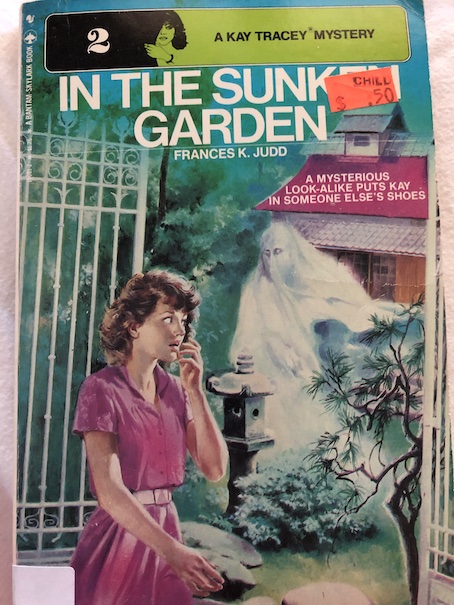
In the Sunken Garden

Kay Tracey

In the Sunken Garden by Frances K. Judd (Stratemeyer Syndicate), 1952 (revised from 1941 edition), 1980.

Kay Tracey discovers that she has a doppelganger when she’s running some errands for her mother and some people in town act like they know her even though she’s never seen them before. As she heads home, a dog even follows her car, as if it thinks that she’s his owner. Kay is bewildered by this, but she decides to take the dog home with her until she can figure out who really owns him.

This is just the beginning of Kay’s entanglement with her mysterious double. Ronald Earle, the boy who likes Kay, gets angry because he thinks that he’s seen her out riding with someone else in his car after turning down a ride with him to attend her mother’s luncheon party. Kay straightens Ronald out only to be confronted with her cousin, Bill, who returns home, very upset because he has heard that Kay was in a car accident and is now in the hospital. Bill is relieved to see Kay perfectly fine at home, but that still doesn’t clear up the question of who this mysterious double is.

According to the hospital, the girl who was in the car accident told them she was Jane Barton, but she checked herself out of the hospital because she only had minor injuries. That isn’t the end of the matter, though. A man named Joe Craken shows up and accuses Kay of wrecking his car in the car accident. He says that the police identified her as the driver of the other car in the accident based on her physical description. With Joe Craken attempting to sue her for damages and the injuries done to a passenger in his car, Kay needs to find her mysterious double!

This mysterious double seems to have some connection to the old Huntley place, a mansion outside of town. The Huntleys were distant relatives of Ronald’s, and Kay learns about the family scandal from someone who used to work for the family. Years ago, Mrs. Huntley’s sister, Trixie Rue, was a dancer with a promising career, but she gave it all up to get married. Unfortunately, the marriage didn’t really work out, and she and her husband fell on hard times. Mrs. Huntley gave her sister some money to help her get by, but apparently, it wasn’t enough because the sister resorted to stealing to help support herself and her baby daughter and ended up having to leave town in disgrace. Does this local scandal have any bearing on the sudden appearance of Kay’s double? One night, while having a look at the old Huntley mansion, Kay sees a ghostly white figure dancing in the garden. Was it her mysterious look-alike or someone else? Before the mystery is over, Kay’s look-alike will need her help as much as Kay needs hers.

The book is available to borrow and read for free online through Internet Archive.

My Reaction

The various parts of this mystery fit together much better than the first Kay Tracey book I read. The first book I read in this series seemed rather awkward, but there is a more cohesive thread in this story. The mysterious double, the Huntley family scandal, and the ghostly dancing figure in the garden all fit together in a way that makes sense. However, there are two sets of villains in this story, and although Kay was not involved in the car accident, it turns out that, rather than her double trying to fob off responsibility on Kay, it’s actually the driver of the other car who was responsible for the accident and had always planned on trying to blame Kay for the accident to extort money from her. It was just his bad luck that he crashed his car into the car Jane was driving instead of Kay’s. This story also has a side plot involving a benefit show that Kay and her friends are putting on with others who are also taking dance lessons, and there’s more rivalry with Chris Eaton, the nasty snob they know from school.

I still find that the Kay Tracey books aren’t particularly good on readability, though. The language is a little old-fashioned, and at times, the plot seems to drag. I think this is one of the better books, plot-wise. The story felt more cohesive than the previous one and mystery stories with mysterious doubles, long-lost relatives, spooky mansions, and inheritance are pretty classic and compelling. However, I did get a little bored while reading it because I just didn’t find the writing style to be very engaging.

The Double Disguise

Kay Tracey

The Double Disguise by Frances K. Judd (Stratemeyer Syndicate), 1952 (revised from 1941 edition), 1980.

Kay and her friends, Betty and Wendy, stop to help a woman who was knocked down at the train station. As they help the woman up, a man who claims to be the woman’s son picks up the woman’s suitcase and takes her purse away from Kay. However, the man is not the woman’s son and runs away with her things while Kay and the other girls focus on the woman. The woman, Alice Janey, is very distressed when she finds out that she’s been robbed, and Kay invites her to come stay at her house with her mother and cousin, who is a lawyer, while the police try to find her missing belongings.

The invitation to stay at the Tracey house turns out to be fortuitous because Alice Janey is actually an old friend of Kay’s mother, Kathryn. Kathryn Tracey tells Miss Janey that she’s sure Kay and her friends can help her because they’ve solved mysteries before. (Even though my copy of the book numbers this as the first book in the series, when the series was published for the first time, it was much further along in the series. The order of the books was changed in different reprintings, so the girls have had other adventures before this.) Miss Janey used to live in their town, Brantwood, and she has now returned in order to finish some work that her late father was doing. Her father’s old papers were in the suitcase that was stolen. Miss Janey thinks that the person who stole her suitcase was after those papers.

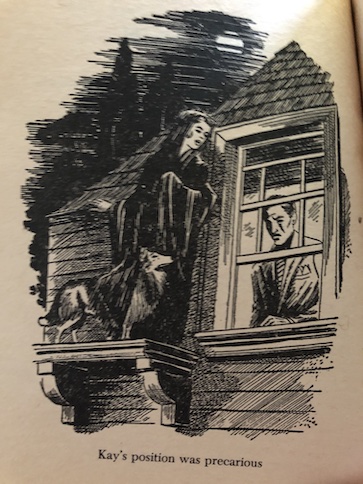
The next day, Kay takes Miss Janey to the house that she’s purchased on the edge of town, but the house is somewhat lonely and isolated. Miss Janey is a bit nervous about being there alone, so she asks Kay if she’s willing to stay with her until she can get a housekeeper. During the night, Kay wakes up because she hears voices, and she discovers Miss Janey talking to a woman who looks like a witch and seems to be some kind of medium or fortune-teller, telling her where to find her missing suitcase and purse. The next day, Miss Janey claims that she a dream about where to look for the purse and suitcase, not saying anything about the witch woman. Kay knows that Miss Janey is hiding something, but she’s not sure why.

When Miss Janey goes to the empty old house that the witch woman described as the place where she would find her bags, Kay and her friends follow her. The bags are there, but they’re empty. Miss Janey disappears, apparently taken away by a couple of men, and she later turns up at her own house.

As Kay befriends Miss Janey, Miss Janey opens up to her and explains a few things. She admits to Kay that she’s been consulting with the fortune teller, Nanna, for some time. Although Kay is suspicious of Nanna, Miss Janey trusts her. Miss Janey also explains that she used to help her late father in his chemical research and that she now has a laboratory set up in her house. Specifically, she’s trying to finish a formula that her father started working on for a substance that is like glass but which has more uses. She was carrying the formula in her bags when they were stolen, and that’s what the thief must have wanted. This technological development would be very valuable, at least when it’s finished, and the thieves might not have realized that the formula was incomplete.

The situation becomes more complicated when Kay discovers that the men who removed Miss Janey from the old house before are detectives who are investigating her because they suspect her of participating in a fraud that has robbed widows of their money. Kay knows that Miss Janey would never take part in such a thing, but this fraud has a connection to the theft of Miss Janey’s formula.

My Reaction

I found this book rather meandering and disjointed. It started off with a pretty strong premise – a lady has her bags stolen at a train station, and it turns out that she’s carrying an unfinished chemical formula that may be worth a lot of money once it’s finished. The fact that the formula is incomplete adds a complication to the story. Are the people who stole the formula capable of completing it on their own or will they have to trick or force the original owner to finish it for them?

Then, the plot is further complicated by a mysterious fortune teller who turns out to own the house where she told the lady her bags would be found. Is she in the plot to steal the formula? There’s a pretty case for it because it would explain how she seems to know things that she shouldn’t know otherwise, and also it turns out that the thieves have actually been renting her house and using it as a base for their plots without her knowledge, so that plot angle doesn’t really go anywhere in the end.

But, then, the plot is further complicated by a couple of detectives who suspect Miss Janey of being part of a fraud to steal money from widows. A widow’s son is briefly arrested breaking and entering because he entered the mysterious old house for his mother’s money, while various other people have entered and left that same old house with no complaints from anyone. Kay and her friend Ronald see a couple of men at the house who dress as women, and realizing that they must be part of the fraud, try to turn them over to the police only for them to drag Kay with them as a hostage when they go rob a train like bandits from a old western movie, resulting in her being temporarily accused of being their accomplice. Then, a vial marked “POISON” (not any specific poison, mind you, just “POISON” – why a chemist would have something with such a vague label is beyond me) is stolen from Miss Janey’s laboratory and ends up in the hands of the widow’s son. However, they don’t really explain why he had it or what he meant to do with it, he doesn’t use it on anybody, and he tells Kay that the fortune teller make him hand it over to her before Kay even reaches him, so that plot point doesn’t go anywhere, either. All the while, the school mean girl and Kay’s nemesis, Chris Eaton, competes with her to solve the mystery in a vague sort of way and spreads various wild rumors about her at various times that don’t really do anything and also don’t really go anywhere but provide temporary distractions from the plot.

Why would people who steal chemical formulas and have the connections to sell them also perpetrate financial frauds targeting widows and also rob trains? This criminal group is quite diversified. The book also has the criminals speaking a foreign language at times because, with such diversified skills, why wouldn’t they also be from some exotic foreign country? It never even leads anywhere. At first, I thought that they were setting it up for the thieves to also be spies, but that is also never explained and doesn’t go anywhere. The “double disguise” part of the story is that the two thieves are men who also periodically disguise themselves as women, but Kay actually sees them putting on their disguises at one point, so that isn’t a plot twist for very long.

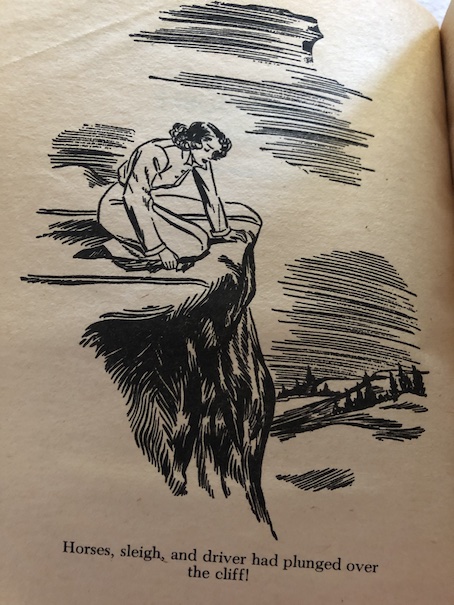
The scene with the sleigh crash happens toward the end of the book, and they get one of the thieves from the wreckage. Kay locates the thieves’ apartment and finds the items they stole there, but she doesn’t get the other thief herself. The other thief gets away from her, and a detective just tells her that they caught him at the hospital, visiting his partner in crime. The end. It ends happily, but it was a confusing ride with a lot of points that didn’t really go anywhere along the way.

Mother Goose Rhymes

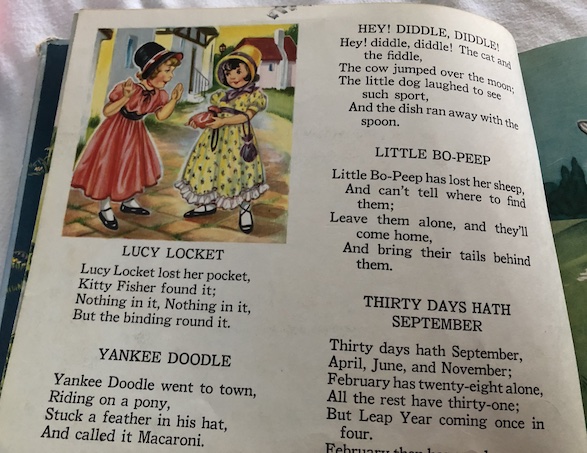
Mother Goose Rhymes, illustrated by Eulalie, 1950-1953.

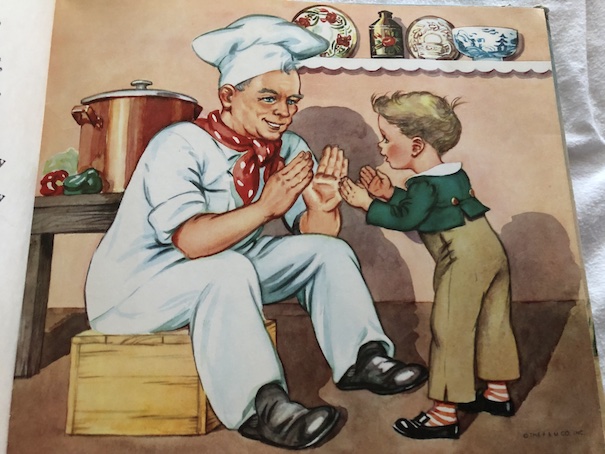
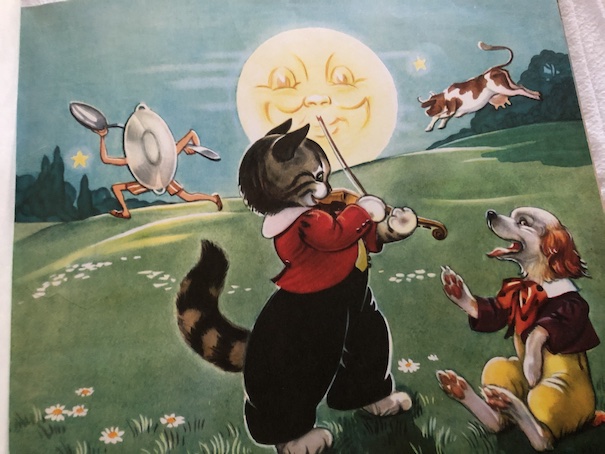
This was one of my first books of rhymes and poems as a child. We’ve had this book for as long as I can remember. I always loved the illustrations in the book, which are realistic in style, and like the illustrations in old Kate Greenaway books from the late 19th century, showing children in clothes that would be appropriate for the early 19th century, with high waists and short jackets. I suspect that Kate Greenaway’s work may have been some of the inspiration for the illustrations in this book. Some of the illustrations are small ones that appear in corners of the pages, surrounded by the text of the rhymes. Other illustrations take up a full page. All of them are full color illustrations.

People can recite popular nursery rhymes like Mary Had a Little Lamb, Old Mother Hubbard, Little Bo-Peep, and Lucy Locket from memory because many of us heard and memorized them early in life. But, since we’re on the subject, who is/was Mother Goose and what are these rhymes about really?

Mother Goose rhyme books don’t really have an author because the rhymes are short little folk poems with no known original author. When an “author” is credited for a collection, they are credited as being “collectors” of the rhymes included, not as the original creators of those rhymes. The first person to collect and describe folk and fairy tales as being “Mother Goose” stories was the French author and folk tale collector Charles Perrault. In 1697, he published a collection of stories called Stories or Tales from Past Times, with Morals or Mother Goose Tales. It isn’t completely clear how many of the stories in this book were completely Perrault’s own creation, based on common themes often found in folk and fairy tales, and how many were stories he collected from other sources and modified to fit his style and purpose. The stories included in this original Mother Goose book included many fairy tales that are now childhood classics, like Cinderella, The Sleeping Beauty, Puss in Boots, Little Red Riding Hood, and the scary Bluebeard. This collection of stories was not meant for children. The stories were intended for adults because fairy tales were in fashion among the aristocratic literary circles in Paris at the time the book was published. The exact reasons why Perrault decided to use the imaginary “Mother Goose” as the supposed source of these stories or even who “Mother Goose” once was are uncertain. American legend sometimes cites “Mother Goose” as being the wife of Isaac Goose and the mother Elizabeth Goose, who lived in Boston in the 17th century and told stories and sang songs to her (a story referenced in The Only True Mother Goose Melodies published in Boston in 1833), but it’s unlikely that Perrault was referencing her. A more likely theory is that “Mother Goose” was a reference to a somewhat forgotten figure of French folklore who would have been more familiar to people living in the late 17th century who studied folk and fairy tales. There was a French legend from the Middle Ages about a queen who told stories that amazed children and was sometimes called “goose-footed”, and possibly, this story or a similar figure from French history or legend became known as “Mother Goose.”

In the 18th century, Perrault’s book was translated into English, and English authors began putting together their own “Mother Goose” books that included English nursery rhymes. The book that shifted the association of “Mother Goose” from stories to rhymes was Mother Goose’s Melody, or, Sonnets for the Cradle, a collection of English nursery rhymes published by John Newbery, a famous English publisher of children’s literature in the 18th century who was nicknamed “The Father of Children’s Literature” and who would later become the namesake of the Newbery Medal for excellence in American children’s literature. Mother Goose’s Melody popularized the association of “Mother Goose” with children’s nursery rhymes in both England and America, and ever since, it has been used in the title of collections of nursery rhymes. Many of the popular Mother Goose rhymes are centuries-old ones from England, although some later classics, like Mary Had a Little Lamb, were added to American books of nursery rhymes in the 19th century.

But, what do these rhymes mean, or do they mean anything? Are they just nonsense rhymes for children about things like a cow jumping over the moon or a boy and girl falling down the hill, or is there some additional meaning behind these rhymes that have kept them in the public consciousness for so many centuries? The exact origins as well as the original authors of many old nursery rhymes have been lost to time, but there are indications that various nursery rhymes may have begun as folk songs or rhymes referencing current events that were happening at the time they were originally composed. Although they sound like harmless and innocent nonsense, people who heard them at the time when they were first composed would have recognized references or pieces of dark humor about real events or scandals that were public knowledge. In modern times, there is some debate about the exact meaning behind some of these rhymes because, while the references in the rhymes may have seemed clever and humorous to people at the time of their creation, they are too esoteric for modern people, who are centuries removed from the events they were referencing. For generations, people passed on the rhymes to their children but not the explanations of their meaning, so most were simply forgotten. However, there are articles that you can about The history lessons that may be hidden in nursery rhymes and The Dark Side of Nursery Rhymes, which discuss what we know about the creation of these nursery rhymes and theories about their original meanings. Sometimes, there are multiple theories about certain rhymes because there just isn’t enough evidence to firmly settle on one, and also, it’s possible that rhymes could be inspired and shaped by more than one event or source.

This particular book of Mother Goose Rhymes is available to borrow and read for free online through Internet Archive. However, there are also many other books of Mother Goose rhymes available through Internet Archive and Project Gutenberg, including Perrault’s Tales of Mother Goose.

Miss Pickerell Goes to Mars

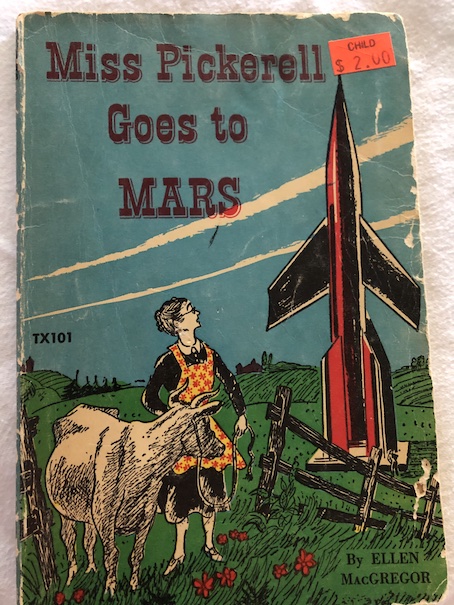
Miss Pickerell Goes to Mars by Ellen MacGregor, 1951.

This is the first book in the Miss Pickerell series, which was written to introduce scientific concepts to children in an entertaining way.

The story begins when Miss Pickerell is visiting her brother and her nieces and nephews. She takes the children to ride on a ferris wheel, but she refuses to get on it herself because she’s afraid of heights. Really, all she wants to do is take her pet cow home and start getting her rock collection ready for the exhibition at the state fair.

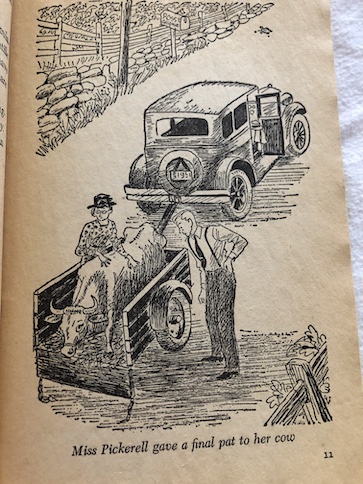
As she leaves, she offers a ride to a man when the bus he was waiting for didn’t stop for him. Although she isn’t anxious for conversation and would prefer silence after her visit with her noisy nieces and nephews, she does make a comment about the sound of a jet overhead. She explains that airplanes are her nieces’ and nephews’ newest obsession, and she’s glad because they were obsessed with flying saucers before, and at least airplanes actually exists. The man riding with her, Mr. Haggerty asks Miss Pickerell if she believes in flying saucers and space travel. Miss Pickerell says that she doesn’t believe in flying saucers and doesn’t think any intelligent person would, but Mr. Haggerty tells her that he will soon be traveling to Mars. At first, Miss Pickerell doesn’t believe him. He says that he works for a scientific expedition whose headquarters is nearby, but the captain in charge of the expedition wouldn’t want him to say too much about it too soon, just in case it doesn’t work out well.

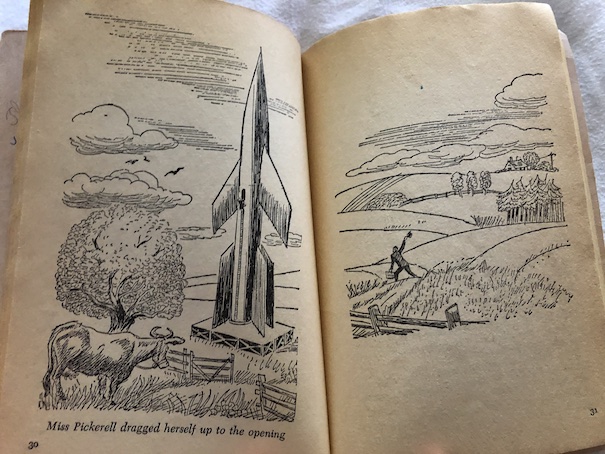
However, Miss Pickerell can’t help but get involved in the project, considering that they’re doing it on her land. Miss Pickerell lets Mr. Haggerty out of the car in front of her farm, but when she enters her own house, she can tell that someone else has been there in the weeks that she’s been gone. Then, she spots the space ship at the end of her cow pasture.

Miss Pickerell marches up to one of the people working on the expedition and demands to know what they’re doing on her property. The man says that they thought that the house was abandoned because it had been empty for weeks and they wanted a quiet place to work on their project. Miss Pickerell threatens to call the governor and report them. She picks the governor to call because, since she lives in the country, there are no police nearby, and she’s met the governor before at the state fair, where he’s given her prizes for her rock collection.

When she calls the governor, he isn’t there, so she leaves a message with his wife and decides to talk to the men at the space ship again while she waits for the governor to call her back. Although she’s afraid of heights, Miss Pickerell climbs into the space ship to talk to the men – right before it launches.

Soon, Miss Pickerell is in outer space and headed for trouble because it turns out that, not only was she not supposed to be there but they’ve accidentally left Mr. Haggerty behind. Mr. Haggerty is important because he’s the one who’s supposed to do the calculations for the flight.

The book is available to borrow and read for free online through Internet Archive.

My Reaction

I vaguely recalled my mother reading us one or two of the Miss Pickerell books from the library when we were kids. I think I liked them at the time, but it had been so long that I’d really forgotten what they were like.

I can definitely see the educational lessons in the book. After the ship launches, it takes awhile to impress on Miss Pickerell the seriousness of their situation and why they can’t just turn around and go back, during which they talk about Mars as a planet and how the ship’s course is programmed into the computer. A young man on the crew, Wilbur, shows Miss Pickerell how to drink water in outer space, and they talk about what gravity is and why there isn’t any in space. By accident, Miss Pickerell has caused further problems by bringing her hammer with her onto the ship because the hammer is magnetic, and the magnet is interfering with the ship’s equipment. Miss Pickerell’s first instinct is to throw the hammer out a door or window, but there are no windows, and Miss Pickerell is treated to an explanation about atmospheric pressure and oxygen in the space ship. Each event on the ship and on Mars itself requires explanation.

Fortunately, they do make it safely to Mars and back, and Miss Pickerell turns out to be surprisingly helpful and is actually glad that she made the trip. On their return, she finds out that Mr. Haggerty has been taking care of her cow, and the governor has invited her for a visit. The governor gives her an award, and she even brings back rocks from Mars with her and gives some to her nieces and nephews.

The Puppy Who Wanted a Boy

The Puppy Who Wanted a Boy by Jane Thayer, illustrated by Lisa McCue, 1958, 1985.

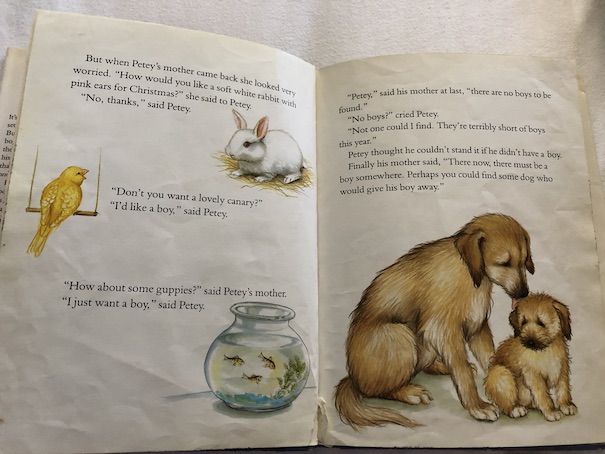
A puppy named Petey tells his mother that he wants a boy for Christmas. His mother says that he might get one if he’s good, and when Petey is a good puppy, his mother tries to find one for him.

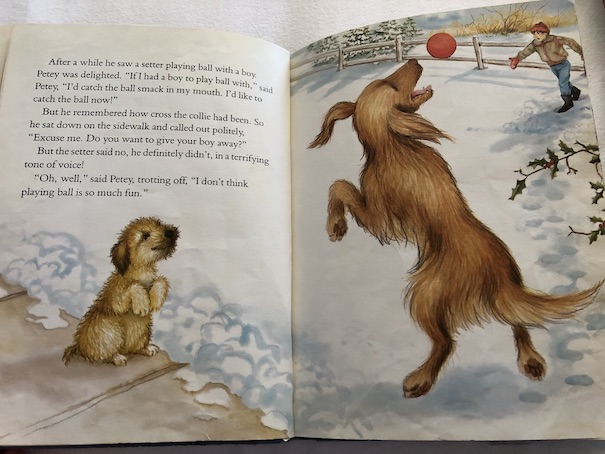
Unfortunately, Petey’s mother just can’t seem to find a boy for Petey anywhere. She suggests trying to see if any other dog is willing to part with his boy. However, no other dog wants to give up his boy.

Eventually Petey comes to an orphanage with a sign that says Home for Boys. Petey decides that if the boys have no parents, maybe they could also use a dog. It’s Christmas Eve, and most of the boys are inside are singing Christmas carols, except for one boy, sitting by himself outside.

Petey jumps into the lonely boy’s lap, and the boy loves him right away. When a lady comes to check on the boy, the boy asks if he can bring the puppy in, and she says yes.

All of the boys in the home love Petey and want to keep him. The lady says that Petey can stay if his mother lets him, and Petey knows that she will. Instead of getting just one boy for Christmas, Petey found fifty!

The story was first published in 1958, but my edition is from 1985 and has different illustrations. In the older book, the puppy looked like a beagle.

The book is available to borrow and read online through Internet Archive (multiple copies).

The Witch of Blackbird Pond

The Witch of Blackbird Pond by Elizabeth George Speare, 1958.

This is a book that is often used in American schools or recommended to students, but because of the complexity of the story and dark subject matter, I wouldn’t recommend it to young children. It’s more appropriate for middle school level children and older.

The year is 1687, and a sixteen-year-old girl named Kit (short for Katherine) Tyler is traveling by ship from Barbados to the Connecticut Colony. Kit was born in Barbados, where her grandfather owned a plantation, which he received in a grant from the king. However, Kit was orphaned at a very young age, and now, her grandfather has died, so Kit is on her way to live with her Aunt Rachel, her mother’s sister, who is married to a Puritan and is living in Connecticut.

In Barbados, Kit was part of a prominent, slave-owning family, but in Connecticut, she’s just another girl. The people in Connecticut are Puritans, which puts Kit on the opposite site of a political conflict. Her father’s side of her family in Barbados was on the side of the Cavaliers, who supported the king against the Puritans, or “Roundheads” in the English Civil War (1642-1651). Because her Aunt Rachel has married a Puritan, Kit’s Connecticut relatives are on the side of the Roundheads. When Kit first sets off on her journey, she has very little idea of the difference between the two and what it’s going to mean for her future life.

People in Connecticut do things differently, and from the very beginning, Kit strikes them as strange and unpredictable. She is impulsive, and even her grandfather used to warn her about thinking before she acts. Kit is accustomed to living in luxury, giving orders to slaves, and generally being allowed to do as she pleases. It comes as a shock to her that not only can she no longer do these things, but others may heap harsh judgement on her for behaving oddly, even when she does it in the name of a good cause.

Kit gets her first impressions of what life in Connecticut will be like when she talks to the ship captain’s son, Nat Eaton, and an aspiring clergyman named John Holbrook. John Holbrook is the son of a tanner who has had to work by day and study by night since he was young, and he struggles to complete his education because his family doesn’t have enough money to send him to college. Because Kit’s grandfather was wealthy, Kit has never really had to think much about money before. She never had to work or even do chores when she was young, and when she tries to talk to John Holbrook about the books that she’s read, he disapproves of her choice of reading material because he thinks that reading should be reserved for the serious study of religion.

Kit’s naivety and views of slavery are challenged when Nat Eaton talks her about the horrible conditions slaves endure when they are transported from Africa to the Americas and how many of them don’t survive the experience. Kit is accustomed to owning slaves and having them work for her, but just as she has never had to think about the cost of the fancy clothes and other luxuries that her grandfather gave her, she realizes that she’s never given a thought to where slaves come from and how. Kit learns that, while there are people in the North American colonies who own slaves, there are others who vehemently disapprove of the practice, including Nat Eaton. He says that if his family had dealt in slaves, they could have a lot more money, but they’re doing fine carrying more humane cargo and passengers.

Note: Racial issues are more of a side issue than the main part of the story, and this is the part of the story that addresses the issue the most. I can’t say that Kit ever comes to reverse her early view of slaves completely, but this is the beginning of a revelation to her, one of the first indications to her that the life she previously lived is actually the exception instead of the norm, and not everyone looks favorably on people who live the way she used to live. None of the main characters in the story are black.

Kit is dismayed that there seem to be few topics from her old life (politics, money, slaves, the luxuries she owned, the relative freedom she had, not having to work, having plenty of time to read whatever books she liked whether they were useful or instructive or religious or not, etc.) that don’t cause some awkwardness, discomfort, or disapproval from the people who live in the community she is about to join and who will now be playing significant roles in her life. People don’t seem eager to be friends with her, and they look at her suspiciously as a stranger.

As her ship nears its destination, a little girl on board loses her doll overboard and Kit jumps into the water to get it back, alarming everyone. Most of the other women and girls don’t know how to swim, and they think it’s strange when Kit says that her grandfather taught her how to swim when she was little. The sea around Connecticut is too cold for swimming, so they’re not used to the idea of recreational swimming. (This time period was part of the Little Ice Age, so the area was even colder then than it is today.) Some people also consider that one of the tests for witchcraft involves seeing if a woman could float in water, and they begin whispering that Kit might be a witch.

When Kit finally arrives at the town where her Aunt Rachel and Uncle Matthew Woods live, Wethersfield, she is disappointed to see that it’s much more rural than the community where she used to live. The streets are not paved. Kit is dressed in an overly-elegant way for the community and even for her own family. When she finally meets her aunt, she thinks that she must be a servant at first because she is dressed so plainly. Aunt Rachel is happy to see her, and Kit meets her cousins, Judith and Mercy. Judith is very pretty, and Mercy walks with crutches. Kit is surprised at the very simple way they live, and they are taken aback at her fine clothes and all of the possessions she brought with her in her trunks from Barbados.

Her relatives are stunned when they find out that Kit plans to stay with them. They had not even expected her to come for a visit, and they had not heard about her grandfather’s death. Uncle Matthew asks why she didn’t write to tell them that she was coming, and Kit admits that she was afraid to write to them because she didn’t want them to tell her not to come and she didn’t have any other choice but to come to them. After her grandfather’s death, the overseer of the plantation sold off the entire crop and kept the money for himself, and all of the other plantation owners in the area presented Kit with debts her grandfather had with them that needed to be repaid, so she was forced to sell off the slaves and almost everything else to pay them. (From Kit’s description about the sudden influx of supposed debts after her grandfather’s death, I wondered whether at least some of these supposed debts were fraudulent and if Kit was simply too young and naive to challenge them, being accustomed to her grandfather handling all of the family’s money and business arrangements, but I can’t really be sure. She doesn’t go into detail about what proof the creditors offered of the debts or if she simply took them at their word, and its only real importance is in helping to provide her with a reason for going to live with her relatives.) Aunt Rachel says that Kit did the right thing by repaying the debts and coming to them, but Uncle Matthew seems less sure. He disapproves of Kit’s grandfather for being a royalist and seems reluctant to take on a now impoverished relative accustomed to a luxurious life.

Kit tries to share some of her fancy clothes with her cousins when they admire them, and Judith and Mercy love the new clothes, but Uncle Matthew puts a stop to it. He disapproves of Kit’s clothes because they are just too fancy and he thinks they encourage vanity. Uncle Matthew is very direct with Kit, explaining to her that people in this family and in this community live a very different life from the one she is used to, and she is going to have to adjust to their ways if she wants to live with them. Adjusting to this new life, which is so different from everything she knew before, is a major struggle for Kit throughout the story.

Privately, Kit confides in Mercy that she had another reason for wanting to leave Barbados. There was a man there who was a friend of her grandfather’s. Her grandfather also owed money to him, but he would have forgiven the debt and paid the other debts if Kit had agreed to marry him. Other people in Barbados said that it was a smart match and that she should marry him, but he was fifty years old, and Kit couldn’t bring herself to marry someone so much older than herself. That’s why she wanted to leave Barbados in such a hurry and didn’t want to wait even long enough to write to her relatives. (The issue of the girls’ marriage options and what they mean for their family and future lives is a major focus of the story. It is taken for granted throughout the story that all of the girls will get married at some point and that their primary future occupation will be being someone’s wife. However, what being a wife means for them depends on who they marry, what their husband’s occupation and position in society are, and the type of lifestyle they can support.) Mercy says that Kit did the right thing by leaving Barbados and that her Uncle Matthew will get used to her being there if she can demonstrate that she can be useful (an important factor in the occupation of being a wife or daughter of a Puritan family).

Being useful is a problem for Kit, who is unaccustomed to doing work of any kind. She doesn’t know how to do even basic chores. People need to explain to her how to do everything, and even then, Kit is extremely clumsy and lacks the patience to follow their instructions properly. Judith loses her patience trying to teach her and isn’t happy to learn that they’re now going to have to share a bed. Kit appreciates Mercy for her understanding and her quiet strength. Even though some people disregard Mercy because of her disability, Kit knows that Mercy has valuable skills and that she can work as hard as anyone. Life with the Woods family is a monotonous series of chores that previously Kit would have thought of only as labor for slaves that she would never have to do.

Then, there are religious differences between her and her relatives. When Kit lived with her grandfather, they never attended regular church services, but Uncle Matthew’s Puritan household is strictly religious, so Kit is expected to go to church with the family. At the church services, she sees that other people in the community are wearing clothes that are about as fashionable as her own, so not everyone in the community is as strict in their dress as the Woods family is. However, Kit is bored by the services (which last all day), the other parishioners don’t seem very friendly, and it seems like word has spread that Kit is a charity case that her aunt and uncle have taken in. However, she does attract the attention of a young man named William Ashby, and Judith meets John Holbrook for the first time.

As Kit spends more time with her relatives, she discovers that Uncle Matthew is a local selectman but that he has political disagreements with some of the other men in town, and some of them think that he is less loyal to the king than he should be. Kit also becomes involved in the romantic interests of her cousins and confronted with some choices she needs to make about her own future. William Ashby is from a wealthy and socially prominent family, but Uncle Matthew dislikes the Ashby family for being Royalists. Kit learns that Judith was interested in William Ashby before she came, and she worries that Judith will be angry with her for attracting his attention, but Judith tells her not to worry about it because she is now in love with John Holbrook. Kit still feels uncomfortable at William’s sudden interest in her because she has only just come to live in the area, she knows very little about William, and the two of them don’t seem to have much to talk about during his visits with her. However, Aunt Rachel and her cousins encourage her to pursue the relationship because William Ashby’s family is prosperous and he can provide a good living for her. Kit is flattered by William’s attention because he admires her whether she is “useful” or not. With his family’s money and position, William Ashby could give Kit a life similar to the one she had before with her grandfather with nice clothes and relative freedom from routine household chores.

However, Kit’s views and ambitions in life begin to change when she starts helping her cousin Mercy to teach young children in the community’s dame school. Basically, a dame school was when a woman of the community would teach children basic lessons, such as reading and writing, informally in her own home for a fee. (For more information, see Going to School in 1776.) Mercy explains that after children learn to read in the dame school, they can go on to the more advanced lessons in the community’s formal grammar school. Kit always enjoyed reading and discovers that she likes working with the children. As a dame school teacher, Kit earns fees from the students and performs a useful service that she enjoys much more than weeding gardens, scrubbing floors, and other household chores. Kit was not raised to have a profession, but there is more than one kind of work in the world and even in this small community, and this particular kind of work suits her. It pleases Kit that the students appreciate her and enjoy her lessons and stories.

The girls’ romantic dreams and life decisions as they come of age and begin making lives for themselves in the community could make for an interesting historical novel by themselves, but there is more to this story. This is a witch trial story. Kit has already had people making witch comments about her because of her odd behavior, but through her work at the dame school, she demonstrates other odd habits that cause her to get on the wrong side of community members. When she gets the idea of having students act out the story of the Good Samaritan instead of simply listening to it, the situation gets out of hand. She is criticized for using the Bible for play-acting, and the dame school is temporarily closed. Then, Kit befriends Hannah Tupper, a somewhat eccentric widow who lives in an undesirable area near Blackbird Pond that often floods. Nobody understands why she wants to live out there, all alone with her cats, and people in the area say that she’s probably a witch. The truth is that she is known to be a Quaker, and the Puritan community doesn’t like to associate with her because of her religion. Kit likes Hannah because she is kind and understanding to her and calms her when she is upset, but her family doesn’t like her to associate with Hannah, saying that evil can seem innocent at first. Kit also realizes that, while William Ashby admires her, he is also scandalized by her behavior. Hannah, on the other hand, is supportive of Kit and helps her continue to secretly teach a young girl whose mother doesn’t want her to have reading lessons.

Kit’s friendship with Hannah gets her into trouble with community and even puts her life in danger. People in Wethersfield start to die from a disease that has struck the community, and Hannah is blamed. Kit risks her life to save her from an angry mob. Although she successfully gets Hannah to safety, Kit is also accused of witchcraft and put on trial.

I often find stories of people falsely accused frustrating, but this one has a good ending. There is a note in the back of the book that explains the historical background behind the story. Kit Tyler is a fictional character, but there are some real historical characters in the book, and the political situation involving the colony’s charter is real.

The book is a Newbery Award Winner. It’s available to borrow and read for free online through Internet Archive (multiple copies).

My Reaction

The time period of the story is a time of witchcraft suspicions, like those that sparked the infamous Salem Witch Trials in Massachusetts (1692-1693). Historically, suspicions of witchcraft and actual witch trials were more likely to occur in communities suffering from internal divisions and instability, especially when the community suffered some further calamity with no apparent explanation, such as a sudden epidemic of illness (possibly ergotism in Salem), heaping panic on top of existing community tension and anger. Then, the community would take out its feelings on someone who was generally disliked by a majority of community members, usually targeting someone who lacked resources to fight back against the allegations of witchcraft, like a poor woman or a widow. Basically, the community wanted someone who could serve as a convenient scapegoat (as described by the Salem Witch Museum) or whipping boy for the commu,nity’s roiling emotions and real problems that they either didn’t want to address or lacked the means to address. Even when it became obvious in hindsight that they had killed innocent people, most of those involved wouldn’t even suffer feeling guilty or bad about themselves for murder because there was always Satan and his trickery to blame for their own actions and decisions. No one could prove that they hadn’t been honestly deceived by the devil, so they would not be held responsible by their friends, who liked them personally and had been actively involved in the entire episode themselves. The community would already be accomplished at mental blame-shifting, so their minds would be relatively untroubled by personal responsibility. Knowing that they didn’t experience regret or remorse for their actions, that they felt right and good about their personal choices, doesn’t help the people they killed, the families of their victims, or people vicariously experiencing the injustice through history or historical novels. Miscarriages of justice are deeply frustrating, which is why I don’t normally like this type of story, although in the past, I’ve been fascinated by the historical background of this incidents, which is why I wrote a couple of papers on witchcraft trials, both American and European, in college, back when I majored in history. (Don’t make the mistake of saying anyone was burned at the stake for witchcraft in America. It’s not true, not even at Salem. The accused were hanged, and some were pressed to death with heavy rocks, but nobody was burned at the stake for witchcraft in the American colonies. That happened in Europe but not America, and it always annoys me when people get that wrong.)

In the book, the community in Wethersfield has all of the historical elements necessary for producing a witch hysteria. From the beginning, Kit notes the the political divisions in the community. Particularly, her uncle is at odds with other prominent community members about specific local issues and the amount of loyalty owed to the king, and there is also a conflict over the colony’s charter. Even though Kit would be the side of those favoring the king, more so than her uncle, the feelings that community members have about her uncle’s political position would give them a natural prejudice and suspicion toward what they would view as the strangest and most problematic member of her uncle’s family. Then, there is a sudden sickness that causes community members to die. The community also has an outcast who would make a convenient scapegoat, Hannah Tupper. When Kit first hears about her, her cousin Judith tells her that some people already think that she may be a witch. As both a widow and a Quaker outcast, she would have been unable to save herself from the townspeople without Kit’s help. When Kit provided that help, and the community lost their first choice of scapegoat, they picked Kit as their second choice, an acceptable substitute.

On the one hand, my own anger at the injustices of the past leads me to return the witch hunters’ judgement with some harsh judgement of my own. Some of the world’s most judgemental people are so unaware of any other emotions besides their own that they are shocked to discover that other people actually have minds and feelings and an equal ability to look back at them and assess what they see. I suppose that these people wouldn’t have guessed what future people would think when they looked back at them because their views of themselves wouldn’t match what independent observers, seeing their actions and the consequences across time, would see. Human beings often have internal fantasies about themselves where they are more brave, clever, attractive, and on the side of moral right than they actually are, and I think the witch hunters are a definite example of that. I don’t like people who wriggle out of personal responsibility, no matter why they do it, and if I’ve said it once, I’ve said it a thousand times, I only consider people as “good” as their own personal behavior and the way they affect other people around them. Nobody’s “good” simply because they say they are or like to think of themselves that way, especially if their real actions say otherwise. Actions speak louder than words. There are many things about the people in the community in this story (as well as in real historical communities) that don’t live up to my high personal standards. Offending me isn’t a criminal offense, and there aren’t many consequences for doing it, but it does provoke a lot of griping.

I think that there’s little point in having standards if you don’t actively live them, and although I think some of that sentiment would have been in the witch hunters’ thoughts, I further believe that everyone has an equal responsibility for both the standards they have and how they choose to demonstrate them. If people would give more thought to the “hows” of their actions and the consequences of what they do, I think there would be fewer problems in the world in general. I also think letting people get away with harmful behavior and not at least clearly criticizing it sets a terrible precedent that is likely to lead to further harm. In the book, once Kit’s name is cleared, she is inclined to forgive her accusers, although she is offered the opportunity to charge them with slander. I understand the reasons why Kit would decide not to pursue these charges, but at the same time, there is clearly one person in the story who was more responsible than the others for the charges brought against Kit and who has also been shown to be hostile toward her own innocent young daughter, and this person does not receive punishment for her actions in this story. I did feel better that the father of the child, realizing that his wife has been wrong about their daughter, falsely labeling her as a half-wit and keeping her from the education that she should have, stands up for the child and her continued education in the end, but I still kind of wanted to see the rest of the community give the mother more of a direct, official warning or censure to bring it home to her that there would be consequences for further misbehavior on her part because of the serious consequences, even possible death, that she almost imposed on others. Sometimes, I feel like this sort of conflict comes to an end too quickly and easily in stories with kind of an air of “We’re all good here now” without some of the underlying problems really being confronted or resolved. It happens sometimes like this in real life, but it’s not very satisfying, and just because some people say “We’re all good here now” doesn’t mean that everything is really fine and everybody involved is really fine. I’m never comfortable with pretending that things are okay that are clearly not. The mother of the child seems to have some mental issues of her own and some kind of emotional conflict over her own child that gives her a warped view of reality. That isn’t fully explained or resolved in the story, probably because the other characters don’t fully understand it, either.

Perceptions are important, but a person’s perceptions don’t stop reality from being, well, real. I know that, in real life, all or many of the supposed witch threats probably seemed real to the individual accusers in the middle of their personal panic, but the reality of the situation is that they did a great deal of harm to innocent people who were unable to stop them. In fact, they specifically targeted people they knew couldn’t stop them, which sounds pretty calculating. They did it because of their own personal problems and the demons that lived in their own minds, whether or not those mental demons had any supernatural help. It’s frustrating because you can’t communicate completely rationally with determinedly irrational people any more than you communicate can with dead people or fictional people and convince them to change their minds. There are times when there’s just nothing you can do when there is no way for the other person to receive new information or they’re just determined not to and no way to help someone who not only doesn’t want help but doesn’t think they need it and would be deeply offended and suspicious at the mere offer. On the other hand, the psychology of such incidents is kind of interesting.

Years ago, I attended a talk given by a team of professional ghost hunters where they said that people who call them to investigate hauntings in their homes tend to be people who are already troubled about something else in their life, such as money problems, marital problems, health problems (mental and/or physical), problems with their kids, or some combination of these. Then, when something happens that seems strange and inexplicable, they get startled by it because they’re already on edge. People who are more secure in their lives and are generally happy might brush off one or two odd things that happen as just rare oddities and forget about them, but people who are already upset about something else tend to seize on them. They become hyper-vigilant. They start noticing more and more odd things that they might otherwise have overlooked and draw connections between these things in their minds, actively looking for more. Soon, they have themselves convinced that they’ve got a full-blown haunting in their house, when at least some of what they’ve experienced is just the ghosts in their own minds. In one case, they said that a man was troubled by a mask he bought at a garage sale. He thought it was cursed because, soon after he got it, a bunch of bad things happened to him. (As I recall, his wife divorced him, he lost his job, and he had health problems.) The ghost hunters said, “To be fair, we don’t think that this mask was cursed when the man bought it. We think it became cursed because he bought it, and he continually blamed it for every bad thing that happened to him around that time, even though these things were probably going to happen anyway.” This is basically the same process that leads to witchcraft trials, except that in witchcraft trials, it happens on a larger scale. Witchcraft trials involve whole troubled communities instead of just a single troubled household.

This still happens in modern communities, but in places where people don’t believe in witches, it’s more likely to take the form of a kind of moral panic, where people get upset about a possible infiltration or excess of people seen as some kind of disruptive moral deviants, rather than a witch hysteria. In both cases, the community experiences extreme fear or paranoia about some perceived threat, but in moral panics, the perceived threat comes from some part of human society, like Communists during the Red Scare or some variety of criminal, not a supernatural force. Actually, I believe that we’ve been living in a state of moral panic in the US for at least the last few years, probably longer, on more than one front. I can’t help but notice that much of what’s been happening in modern times fits all the criteria and follows the typical stages of a moral panic, particularly the parts about the “hidden dangers of modern technology“, a belief in “a ‘hidden world’ of anonymous evil people“, and fear of an “evil stranger manipulating the innocent” (which, weirdly, is what I think is behind the willingness of some people to believe conspiracy theories in the first place as they accept stories that come from apparent “friends”, or at least people who look like people they might want to get a beer with or something – some people use them as their primary source of media, thus checking another box in the requirements for a moral panic and leading up to the final point). In my experience, the fear is particularly about evil people who want to “control” others and tell them what to do, the ultimate community boogeymen where I live. I’ve heard a lot about it for years from real people who habitually like to tell me what to do and how I should feel about things themselves.

This is kind of a digression from the story, but I put it here to illustrate that we might not have to question how people can get themselves into community hysteria over perceived threats, most of which prove to be not that threatening in the long term. Most people might not believe in witches anymore, but they’ve found plenty of creative substitutes for the same basic process over the years. A complete list would take too long to compile, but if you spend any amount of time on social media, you can come up with several “evil” or “deviant” groups or ideological concepts that people hate and fear in the space of a few minutes. Thanks to modern technology, you don’t have to wonder what’s going on in people’s heads. You can Google it. Many people will just tell you right up front what boogeymen are lurking in their minds, and they’ll gladly share that information with untold numbers of total strangers through Twitter, Facebook, and Quora, feeling validated and supported if faceless usernames agree and spread their stories, no matter why they do, and often raging against sinister forces trying to spy on them at the same time. It’s not rational, but it is recognizable. I put it to you that a few moments of honest self-reflection, considering not how you feel but what you’re actually going to do and what it’s going to mean in real terms, can be the stitch in time that saves nine. There are dangers to modern technology, but I don’t think they’re really that hidden. They’re the same dangers human society has caused itself in the past, just much faster, and they come mostly from the demons in the minds of the people involved. There is nothing online that wasn’t designed, written, promoted, spread around, and ultimately accepted by individual humans. It’s when people lose touch with the realities of the situation and the consequences that their actions have for real people around them in the real world that I really worry. It seems to me that blaming the Internet or the media for the things people have decided to do themselves has become the 21st century version of “The devil made me do it.”

The Most Wonderful Doll in the World

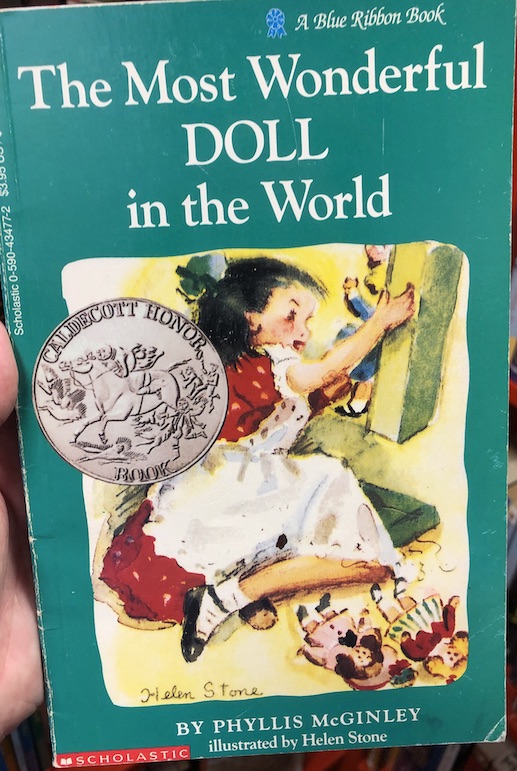
The Most Wonderful Doll in the World by Phyllis McGinley, 1950.

Dulcy is a little girl who is rarely satisfied by anything. She has a big imagination, and is always wishing for something better than what she has. Dulcy has an impressive collection of dolls, but even though she loves all of her dolls, she can’t help but think sometimes that some of them would look better with a different hair color or with different clothes or with some other small detail changed. No matter how good something is, it’s never completely perfect.

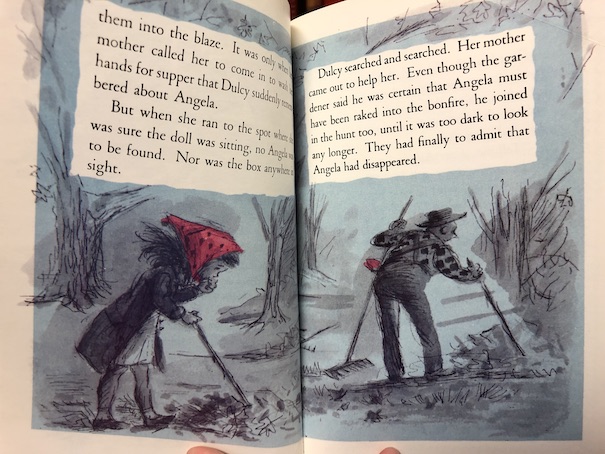
Then, one day, an elderly friend, Mrs. Primrose, gives Dulcy a doll named Angela. Dulcy likes Angela, although her immediate thought is that Angela would be even better if she had dark hair instead of blonde, finding a tiny fault as she always does. But, by accident, Dulcy loses Angela on the way home. She sets Angela’s box down when goes to help rake leaves into a bonfire, and when she goes to retrieve her, she can’t find her.

Once Angela is gone, Dulcy’s attitude changes. Dulcy is upset about the loss of Angela, realizing that Angela really was a precious and special doll. Her mother offers to get a replacement doll that looks like Angela, but Dulcy can’t imagine that any doll would be as special as Angela. As Dulcy describes the doll to her mother, she says that Angela was blonde with a blue dress and pinafore and eyes that could open and close. Those aren’t terribly unusual qualities for a doll, but Dulcy also adds that Angela had shoes with heels and could say “Mama” and “Papa” and sing Rockabye Baby. Those are more unusual, and Dulcy’s mother agrees that she probably won’t be able to find a doll that does all that.
However, readers soon begin to notice that Angela becomes increasingly wonderful each time that Dulcy describes her. When her father offers to buy her another doll, Dulcy adds that Angela could also walk and wave her hand. Dulcy tells her teacher about Angela’s little purse and gloves. She tells her friend Margery about Angela’s raincoat and umbrella.

The more Dulcy thinks about and talks about her wonderful doll, the less satisfied she is with her other dolls. None of them can compare to the amazing Angela! When her Aunt Tabitha gives her a skating doll, suddenly the missing Angela acquires the ability to skate as well. No doll that Dulcy has or ever could have could compare to the missing Angela!

Other children at school are fascinated by Dulcy’s descriptions of Angela and all of the marvelous things Angela had and Angela could do, which get more and more wonderful every time Dulcy tells the story. Then, people start getting tired of hearing about Angela. Dulcy’s friends don’t like hearing that their dolls aren’t as good as Angela, and people stop giving Dulcy dolls as presents because she always says that they’re not as good as Angela.

Then, one day, when Dulcy is playing with a new girl in the neighborhood, they find the box with the missing Angela. When Dulcy sees how the real Angela compares to the one that she dreamed about and imagined when she was lost, Dulcy comes to a greater understanding of the power of her imagination and the need to appreciate things being just the way they are.

Dulcy doesn’t completely give up imagining things and dreaming of perfection, but she does learn that part of growing up is remembering the difference between what she imagines and what is real. She realizes that when she was moping about the doll she didn’t have, she kept herself from having fun with the dolls she did have and discouraged people from giving her other nice dolls. Dulcy saves all the of the amazing qualities that she dreamed of for Angela and gives them to an imaginary doll called Veronica. Dulcy keeps Veronica as her perfect doll in her imagination, and she knows that Veronica is imaginary. As long as she can have her imaginary doll to be as amazing and perfect as she wants, she can be happy with her other dolls being just the way they are, and they make her happy, too.

The book is a Caldecott Medal winner. It is available to borrow for free online through Internet Archive.

Harold and the Purple Crayon

Harold and the Purple Crayon by Crockett Johnson, 1955.

Harold loves drawing things with his purple crayon. In fact, everything in the story is a creation of Harold’s, drawn with his purple crayon.

First, Harold decides that he wants to go for a walk in the moonlight. He draws a moon and a path that he can follow.

Along the way, he decides to draw a forest with an apple tree. However, he makes the mistake of drawing a dragon to guard the tree, and it frightens him.

Harold’s hand shakes, and he accidentally draws water and falls in. Fortunately, he also draws a boat and sails to a beach where he can have a picnic lunch.

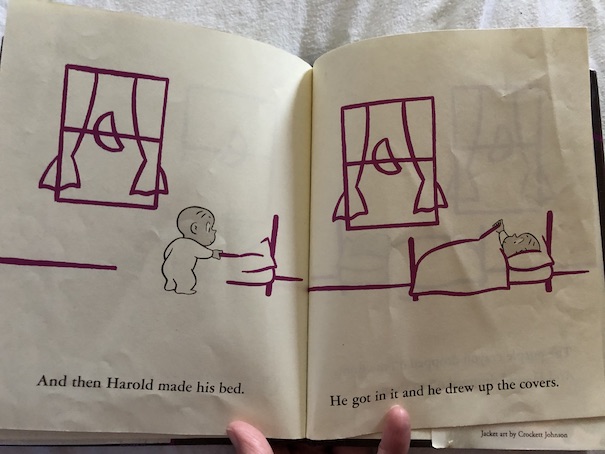
After a series of adventures, Harold decides that he wants to go home, but he has trouble finding his home. He looks for his bedroom window, and then realizes that his window should look out on the moon, which is still in the sky.

After drawing his window and bed, Harold goes to sleep.

The story is rather surreal. We never see Harold’s real home or any other people who are not drawn by Harold. All we see in the story is Harold and the things he draws with his purple crayon. This is a story about the power of imagination, and at the end, we can only imagine Harold’s real life because we never see him return to it.

The book is available to borrow for free online through Internet Archive (multiple copies).

I Can Fly

I Can Fly by Ruth Krauss, 1950.

This is a cute Little Golden Book about a little girl playing.

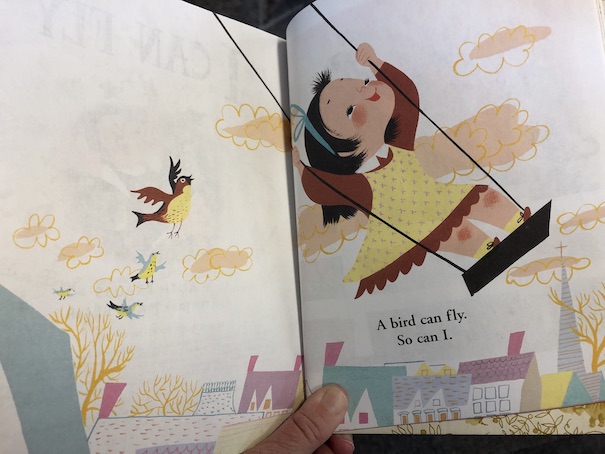
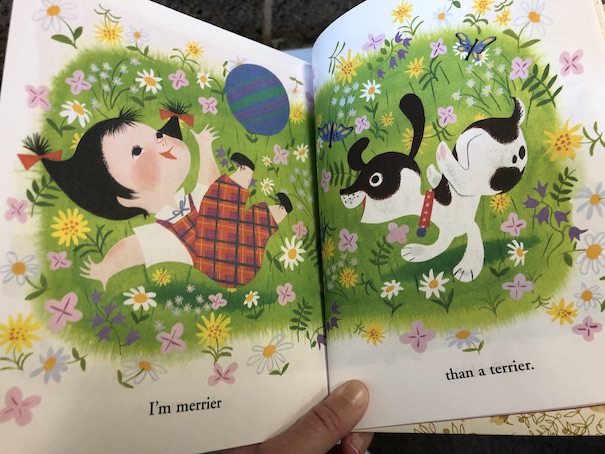
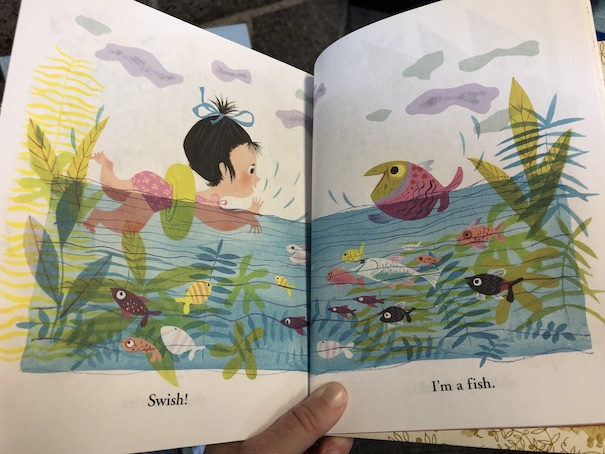
As she plays, she compares herself to various animals. When she’s on her swing, she feels like she’s flying like a bird, and when she swims, she feels like a fish.

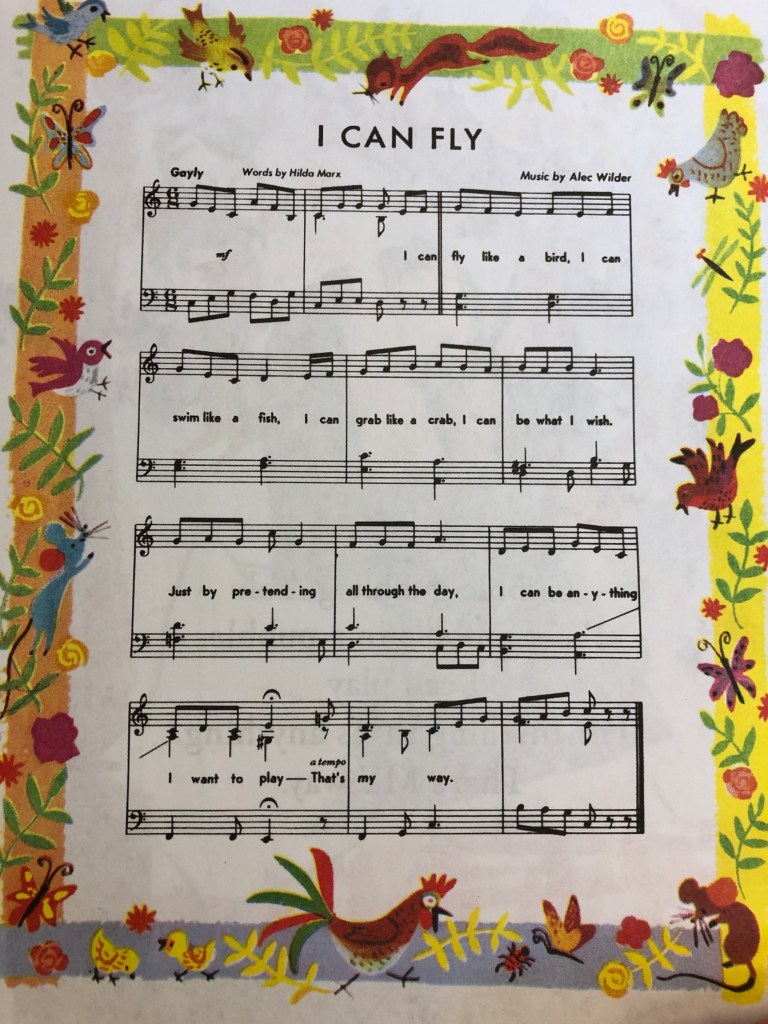
The story is told in rhyme, and in the back of the book, there is actually music so you can sing the rhyme as a song.

There are different printings of this book, some with different illustrations. The different versions also have different words, and it looks like the newer one includes both a boy and a girl and doesn’t have the music for the song. One of the newer versions is available to borrow for free online through Internet Archive.