Knight’s Castle

Knight's Castle

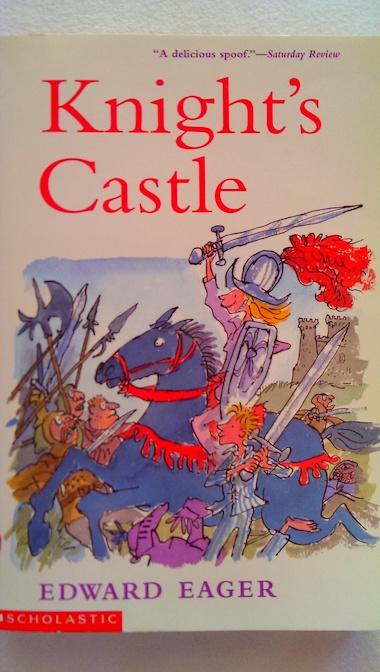
Knight’s Castle by Edward Eager, 1956.

Roger and Ann are the children of Martha from the previous two books in the series. Like their mother’s family when they were growing up, they live in Toledo, Ohio. Their Aunt Katharine (one of Martha’s older sisters) used to live close to them in the Midwest but now lives in Baltimore, Maryland. Roger and Ann don’t particularly get along with Aunt Katharine’s children, Eliza and Jack, because Eliza is bossy and Jack is only interested in photography. However, the four children end up spending the summer together when Roger and Ann’s father needs to have an operation at a hospital in Baltimore.

Like their mother and her siblings when they were young, Roger and Ann also like fantasy stories, which their father likes to read to them. Roger starts to believe in real magic when it seems like one of his toy soldiers comes to life at night. Roger collects toy soldiers, and he has over 200 of them, but this one is special because his father says that its been handed down in their family for generations. Roger calls it the Old One. It’s rather worn, so it isn’t obvious at first, but the Old One is actually a knight. Worried about his father’s illness, Roger takes the Old One to bed with him (which he thinks is more manly than taking a teddy bear to bed), and then feels it wriggling in his hand.

Knight's Castle Roger

Realizing that the Old One is magic and is coming to life when he holds him, Roger asks him if it’s part of his magic to grant wishes. If it is, then he wishes for his father to get well, and if possible, for him and his sister to have an adventure in Baltimore over the summer. The Old One doesn’t answer him immediately, but over time, he makes it clear to Roger that wishes have to be earned, and that will be the source of his summer adventure.

When the children arrive in Baltimore to stay with wealthy Aunt Katharine while their father is in the hospital, Aunt Katharine gives them presents. Ann gets a new dollhouse, and there is a toy castle for Roger. Since Aunt Katharine has also just taken all the children to the movies to see Ivanhoe, all of them become immediately interested in playing with the castle.

That night, Roger has a strange dream that he finds himself within the story of Ivanhoe, which is being acted out in his toy castle. The Old One is there as well, although he is mainly watching the action as Roger begins to take part in the story. When Roger comes face-to-face with the villain, he accidentally lets Ivanhoe’s plans slip to him. Things are looking pretty bleak when Roger suddenly realizes that the castle is still a toy and everyone around him is just a lead soldier. This revelation ends the magical adventure and brings him back to reality. However, Roger is disappointed that he ended the adventure so early when perhaps he could have done something really heroic.

Seeing the toy soldiers scattered around instead of poised for the battle they were planning the night before, Eliza and Ann think that Roger was just playing with the castle without them, but he explains to them what happened. The girls were just reading The Magic City by E. Nesbit, and they start building their own “magic city” out of random things from around the house, surrounding the toy castle. Roger is upset about the city because he says that it doesn’t fit in with the Ivanhoe story, and he’s sure that it will ruin everything, maybe from preventing the magic from working again at all. The Old One tells Roger that magic works by threes, so the next opportunity for magic will be in three days.

Knight's Castle Magic City

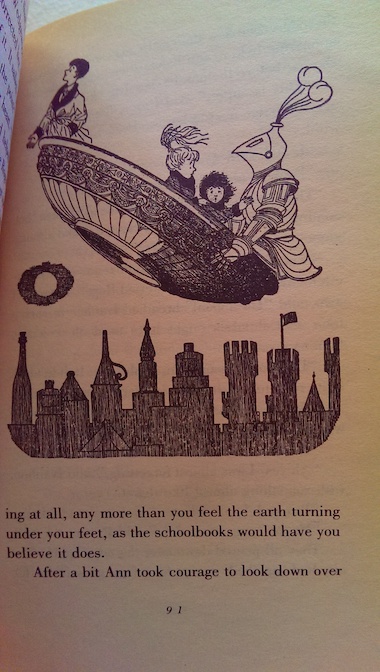
As it turns out, the city does end up becoming part of the story when the magic brings it all to life on the third night. Roger, Ann, and Eliza find themselves in the middle of the city, surrounded by knights attempting to drive modern cars. Ivanhoe has become a fan of science fiction books, via the public library in the city that the girls built. Although Ivanhoe has turned into something of a geek, the children persuade him to come on a mission to rescue the captive Rebecca, and they end up traveling in a flying saucer (made from a real saucer) to the Dolorous Tower, where the adventure ends as soon as Eliza remembers that the villain threatening them is still just a lead soldier.

Knight's Castle Flying Saucer

It was an even weirder adventure than Roger’s first one, but by now, the children are starting to understand the rules that go along with the magic. Jack, who says he doesn’t really believe in magic, accompanies the other children on the next adventure, as they try to prove to him that it’s real. They end up having to rescue some of the others from the “giant’s lair”, which turns out to be Ann’s new dollhouse. The dolls are angry that Ann has been neglecting them, only paying attention to the dollhouse when she and Eliza needed to borrow things for their magic city. They manage to escape again by remembering that the dolls are just dolls.

However, Roger is still worried about their father, who is about to undergo his operation. The Old One had told him that wishes needed to be earned, and he doesn’t think that they’ve managed to accomplish much in their adventures. Roger thinks that they need to do something really heroic so that his wish for his father to get better will come true. The Old One gives Roger a rhyme, hinting at what the children need to do on their next adventure, but Roger doesn’t understand what it means, and he doesn’t know if he can figure it out in time.

Actually, it is Ann who eventually realizes what the rhyme means and provides Roger with the “wisdom” that he needs to earn his wish. All throughout the story, Roger was criticizing his little sister for things she did wrong, saying that she was too little and only a girl. Because Roger thinks of her as being just his little sister, he overlooks what she has to contribute to the adventure. Roger’s acquired wisdom is to value the contributions of others and not underestimate their ability to contribute. Ann, being young and shy, frequently doubts herself, but she also learns confidence when she realizes that she has the answer to the riddle. Jack and Eliza learn lessons as well. Doubting Jack learns to believe in magic, and Eliza learns that she can’t always be the boss, that sometimes it is better to let someone else take the lead when they’re the right person for the job. (Although, she does say at the end of story, “If that wouldn’t be just like that magic’s impudence! Trying to teach me moral lessons!”)

Like other books in this series, there are a lot of references to popular pieces of children’s literature and jokes about things that happen in children’s stories.

The book is currently available online through Internet Archive.
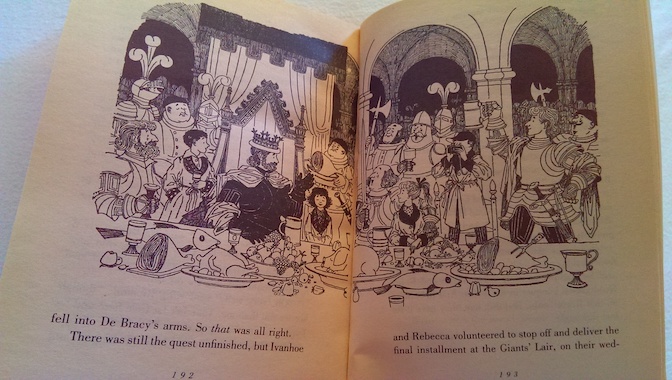
Knight's Castle Feast

Magic by the Lake

MagicByLake

Magic by the Lake by Edward Eager, 1957.

Jane, Mark, Katharine, and Martha are finally going to spend the summer at a lake with their mother and their new stepfather! The children were never able to do that before because their widowed mother always had to work during the summer. When they arrive at the cottage by the lake that their stepfather, Mr. Smith, has rented, there is a sign that says, “Magic by the Lake.” The children think that it could just be the name of the cottage because sometimes cottages are giving interesting or amusing names, but having had experience with magic before (this being the second book in the series), they consider the idea that they could be headed for more adventures. Of course, they are correct, but it turns out to be the lake that’s really magical, not the cottage.

MagicByLakeTurtle

The children are playing by the lake when they wish for more magic, and a talking turtle comes up to tell them that, because of their wish, the entire lake is magic. That sounds amazing, but too much magic all at once can be overwhelming. Fortunately, the turtle is also magical, and he has some ability to influence magic in the lake. The children make a deal with him that he can arrange for them to have adventures with magic in the lake, but only one at a time, because that’s what they feel that they can handle. Also, the adventures won’t happen every day, so they can have a chance to rest in between. The grown-ups around them won’t notice any of the magical happenings, and little Martha insists that nothing truly scary will happen to them. Jane protests at that request because she thinks that it will make their adventures as boring as overly-tame children’s books, but the turtle says not to worry because what he thinks of as “not scary” isn’t necessarily what Martha would think of as “not scary.” The turtle tells the children that when they’re ready for adventure, they should think about what they wish for and then touch the lake, and if the time is right for it to happen, it will.

That sounds simple enough, but what they consider the right time and what the lake considers the right time aren’t always the same thing, and just as before, their wishes and adventures don’t go quite as planned. In their first adventure, a mermaid takes them to an island of pirates, the stuff of high adventure. The children are delighted when they discover that the pirates, being adults, can’t really see them, as per their earlier wish for adults not to see their magical activities. It opens the potential for playing dirty tricks on rotten pirates, who seem to perceive them as some sort of ghosts. It’s all fun and games until the pirate captain decides to see if he can make ghosts walk the plank. Their turtle friend saves them by turning them into turtles, which, while magical, makes the rest of the day rather difficult for them because they have to go home and on errands with their mother. Walking on land can be difficult for turtles, and their mother has no idea that they’ve changed at all, still seeing them as children. Whatever magic the children get during the day seems to last until the sun sets, even when they wish it would end sooner.

MagicByLakeGrownUp

Then, while watching their mother and Mr. Smith at a dance, Jane and Katharine wish that they were old enough to join in, about age sixteen. Suddenly, the two of them are teenagers in evening dresses, getting attention from some teenage boys. The girls seem to enjoy the romance of it, but Mark and Martha follow them around, trying to convince the boys that the girls are really younger than they seem to be and dreading the moment when they will inevitably change back to themselves.

The children discover that they don’t even need to be at the lake in order to make the magic happen as long as they’re touching water from the lake. On a rainy date, when the roof of their cottage is leaking, the children realize that the rain water is also lake water. By making a wish on that, they end up at the South Pole in time to save a lost explorer and help him make an important discovery.

MagicByLakeDisappearance

The children enjoy their adventures, but they become worried about Mr. Smith, who has been making the commute back and forth from the lake to his bookshop, and it seems that business hasn’t been good at his bookshop this summer. They consider the idea of using the magic of the lake to solve Mr. Smith’s problems, perhaps by going back to the island where they saw the pirates bury a treasure chest. They figure that if they could bring Mr. Smith an entire chest of pirate treasure, he wouldn’t have to worry about money anymore.

But, of course, that idea doesn’t go as planned. When Martha argues with the others and goes to the island by herself to get the treasure, she breaks all the rules associated with the magic.   Because the rules that previous protected her and her siblings are gone, there is nothing to prevent her from being captured by the cannibals that live on the island. When her brother and sisters try to save her, they are also captured. It’s only the sudden appearance of Martha’s future children and Katharine’s future daughter (although they don’t know it yet), who are on a magical adventure of their own, in a cross-over from another book in the series, The Time Garden.

MagicByLakeTreasure

The children make one more attempt to get treasure for Mr. Smith in a kind of Arabian Knights adventure, but that doesn’t work, either. However, although the children seem to have used up their wishes on the lake, they have the feeling that the magic might allow them one last opportunity to get what Mr. Smith needs. It does in a way that may or might not be magical, although the buried treasure that they find and get Mr. Smith to dig up may be a representation of the pirates’ treasure and not of the old miser (now deceased) who was said to have lived at the old, abandoned cottage by the lake that the children decide to explore. It does seem like quite a coincidence that the old miser’s initials would match those of the pirate captain, and they are carved on the stone over the buried treasure, just like the marker the pirate captain left.

In the scene with the cannibals on the island, the cannibals are stereotypical “savage natives” (or “native savages”, or something generic of that sort, since the terms are used pretty interchangeably in the story). You find things like this pretty commonly in old children’s books, especially prior to the 1960s. But, what made this more palatable for me was that the entire scene is written as a joke on the usual stereotypical books that children of the era would have read. The cannibals speak kind of like American Indians in cheesy old Westerns, using words like “heap” for “very” and randomly adding “-um” to end of words. You know that it’s not really how anybody, even cannibals living on some remote island in an indeterminate ocean, would talk, but it might be how children raised on adventure stories and movies from the 1920s might imagine they would (adding to my earlier theory from the last book that at least some of the children’s adventures might actually take place in their own minds, not in their “real world”).  It may also be a reference to things in tv shows from the 1950s, the time period when the story was written. The best part for me is when the children try to remember what shipwrecked explorers do when confronted with cannibals in some of the stories they’ve read. They start throwing out random words that are meant to sound impressive combined with some gobbledy-gook in an effort to communicate/impress the cannibals. Then, Mark tries to convince them that he’s a powerful god with the ability to control fire. The cannibal chief is unimpressed, telling him that he recognizes what Mark has as an ordinary safety match, which he blows out. So much for the old adventure stories.

The book is currently available online through Internet Archive.

Half Magic

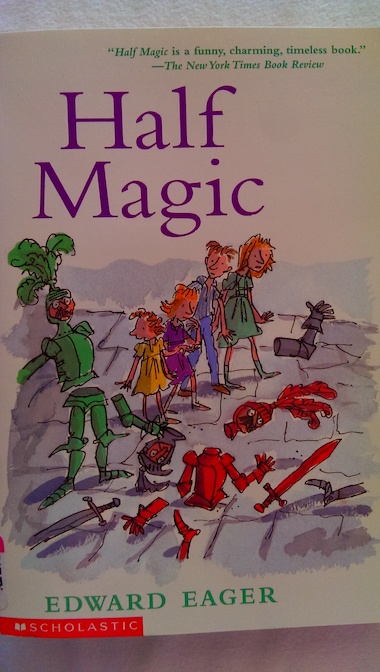
HalfMagicHalf Magic by Edward Eager, 1954, 1982.

Jane, Mark, Katharine, and Martha are siblings living in the 1920s. Their father is dead, and their mother works for a newspaper. While their mother is at work, Miss Bick takes care of the house and the children, although she isn’t really good with children. The children are often free to amuse themselves on their own during the summer, and they like to pick out books from the library for entertainment. They particularly enjoy the fantasy books by E. Nesbit (a real author, and they reference her real books during the story), and they wish that exciting, magical things like the ones that happen in her stories would happen to them.

They get their wish (and a great many others) when Jane finds a strange coin on the sidewalk that they mistake for a nickel at first. By accident, they discover that this coin grants wishes, but it has a peculiar habit of only granting half of what a person wishes for (and the coin seems to interpret the idea of “half” pretty liberally, depending on the type of wish, so results can be pretty unpredictable).

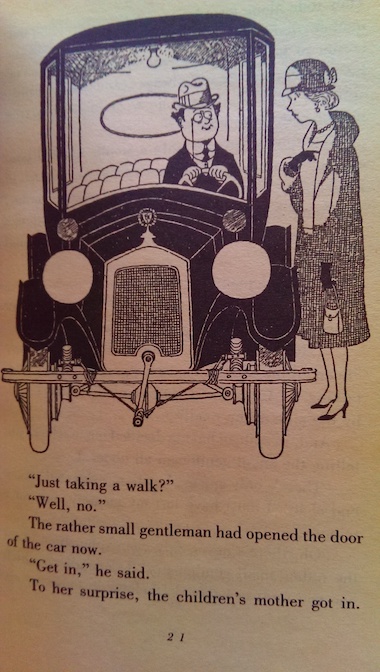
Jane is so bored after she finds the coin that she wishes that there would be a fire for some excitement. Suddenly, the children hear a fire engine and discover that a child’s playhouse had caught fire. It could have been coincidence, except that their mother borrows some change from Jane, getting the magical coin by accident. While she is visiting the children’s aunt and uncle and finds their conversation boring, she wishes that she were at home, but finds herself unexpectedly by the side of the road halfway home. She is confused but thinks that she must just be very tired or something and forgot that she was walking home. She ends up accepting a ride from a very nice man who happened to be passing her on the road and thought that she looked lost and confused.

HalfMagicChildrenThese early experiences and a series of odd wishes Mark makes when he doesn’t realize that he has the coin demonstrate to the children not only that the coin is magical but that they have to be extremely careful what they wish for when they have it. They have to word their requests very carefully, asking for twice as much of anything they want in order to counteract the half magic of the coin. Even so, they can’t help but make mistakes and get themselves into trouble.

When Katharine uses her turn with the coin to take them back to the days of King Arthur, she ends up causing trouble and disrupting history by defeating Lancelot in a tournament. Fortunately, Merlin realizes what the children have done and forces them to explain themselves and show him the magic coin. After inspecting it, Merlin gives the children a stern lecture about interfering with the natural course of history. He uses the coin’s magic to undo what the children have done and further uses it to restrict the children’s wishes to affecting only their own time period. He warns them to be more careful about what they wish for, keeping their wishes smaller and more personal, adding that the coin’s magic will eventually be exhausted, so they should save their wishes for what is important.

HalfMagicTheaterThere is one more disastrous experience when the children go to the movies (a silent film because this is 1920s), and Martha accidentally wishes that she wasn’t there while touching Jane’s purse, which holds the coin. Martha, of course, ends up being only halfway “not there,” almost like a living ghost, which terrifies onlookers. Straightening out that mess brings them into contact with Mr. Smith, the nice man who gave their mother a ride home. He owns a bookstore, and he enjoys fantasy stories as much as the children do. He becomes the only adult who knows that the children have been using magic, and he’s fascinated by it, enjoying witnessing their adventures.

When the children’s mother comes to pick them up, Mr. Smith is pleased to meet her again and invites the family to join him for dinner. Mr. Smith is obviously fond of the children’s mother, and most of the children like him, too. However, Jane is uneasy. It’s partly that she worries that Mr. Smith will interfere with their use of the magic coin and partly that she worries about his new relationship with their mother. Of the four children, only Jane, as the oldest, really remembers their father, and she can’t stand the thought that Mr. Smith might become their stepfather and take his place.

HalfMagicSmithWhen Jane argues with the other children about Mr. Smith and rashly wishes that she belonged to another family, the other children call upon Mr. Smith to help them rescue Jane from her foolish wish, her unsuitable new family, and from herself.

In the end, Mr. Smith does marry the children’s mother, and even Jane is happy with the arrangement, having come to appreciate Mr. Smith much better.  Once their mother and Mr. Smith each have what they wished for most — each other and a happy family with the children — they forget about the magic coin.  Although none of the children realize it, the coin also grants Jane one final half-wish in which her father comes to her in a dream-like form, letting her know that he approves of her mother’s remarriage and the children’s new stepfather because he wants them all to be happy.  This gives Jane the reassurance she needs to fully accept Mr. Smith.  The children, deciding that the coin has given them all the wishes it’s going to, leave it in a convenient place for a new owner to find.

You don’t find out what happens with the coin’s new owner apart from when the children see a young girl pick it up and realize that it’s magic when she makes her first wish. However, there is a cross-over scene in another book in the series, Seven-Day Magic, which explains a little more about what happens next.  Books in this series frequently reference and sometimes parody other children’s books that were popular at the time they written, and individual books in the series even sometimes reference each other, even when the main characters have changed.

Speaking of literary references and parodies in this series, sometimes it’s a little difficult to tell for certain which scenes are really meant as parodies and which aren’t.  Knowing a bit about vintage children’s fiction helps, but there may be some scenes in the stories which can make modern readers a little uneasy.  One scene in the book that bothered me was near the beginning, when Mark wishes to be on a desert island.  This was before the children fully realize that the coin only grants half of a wish, so the children just end up in a desert, but not on an island.  The part that bothers me is that they are briefly kidnapped by a kind of wandering Arab man who seems to be planning to ransom or sell them.  This scene is like an old stereotype out of the sort of silent movies that the children would have been watching, and because of that, it was a little painful to read.  The man’s name is Achmed (still in keeping with the stereotype), and they keep referring to him as “Achmed the Arab,” in case you need reminding that that’s what he is.  They get out of their predicament with him by wishing for something that would make him really happy so that he’ll forget about them.  By then, they realize that they need to double their request in order to make the coin work properly, so their wish works.  The coin ends up giving Achmed a beautiful wife and “six plump Arab children” (in case you forgot that Achmed’s children would be Arab as well) and generally improves what Achmed owns, so Achmed becomes a happy family man and gives up his earlier, shady ways.  It’s eye-rollingly stereotypical and cliche, so I think it’s worth telling potential readers that this scene is there.

The cliches and stereotypes (not to mention the constant, unnecessary repetition of the word “Arab” just to remind you that that’s what everyone is, in case you were confused) in that scene were annoying, but unfortunately, things like that crop up pretty regularly in children’s literature from the 1950s and earlier when there are scenes that take place just about anywhere outside of the United States, Canada, or Europe.  That being said, there are a couple of things that make this scene easier to bear.  One is that Mark, realizing that the magic coin can get them out of this situation and that they have the power to put Achmed at their mercy, decides not to do it because it occurs to him that Achmed is probably a desperate man because he is poor.  Mark decides that Achmed would be a better person if he had whatever would make him feel the most fulfilled in life, so he wishes for that for him.  It’s nice that Mark sees him as being a person whose well-being needs to be considered, not just an enemy to be defeated.  Also, it occurs to me that it’s not completely certain that the desert they’re in is a real-life one, even in the children’s fictional world.  I think the assumption is that it is, like we’re supposed to assume that the world of Camelot that they visit is a real part of history, but it may not be.  In fact, the children in different books in this series in general sometimes get philosophical about their magical adventures, wondering about how their magical adventures fit into the real world around them or if they really do, and they never fully get all the answers.   Perhaps the coin took the children to their idea of what a desert or what Camelot would be like, not to those real places.  In 1921, there was a famous silent movie called The Sheik in which Rudolph Valentino played an Arab sheik named Ahmed (Achmed’s name could be a joke on that).  It’s not a movie for children, but it was very popular in the 1920s, and it inspired other movies with Arabian themes, at least a couple of songs, and probably a number of the stereotypes about Arabs of the time.  So, if the kids in the story were imagining an Arabian desert, it would probably be something resembling what they’d seen in movies like that.  This little adventure may have only taken place in the imaginary world, even from the children’s perspective, and the author may be poking fun at the notions children get from popular culture.  Even in the end, the children admit that there are many things they don’t understand about the coin and how it works, like where the other half of Martha went when she was only half there.   In a world where magic works, pretty much anything is possible.  Then again, since the entire book is fictional, it may be best not to worry too much about it.  Still, I just plain didn’t like this scene.  The rest of the book wasn’t so bad.

Overall, it’s a fun story.  Part of the fun for book lovers is in spotting the various literary references in the story because the children talk about the books they like and read and compare their adventures to ones they’ve read about.  The concept of the half-wishes also makes you think.  It’s worth pointing out that, although the children enjoy the general adventure of the coin, most of the children’s wishes, no matter how carefully they word them, don’t turn out the way that they expected, even when they get exactly what they asked for.  Mr. Smith marrying their mother is actually the best wish that comes true in the whole book.

The book is currently available online through Internet Archive (multiple copies).

Tawny Scrawny Lion

TawnyScrawnyLion

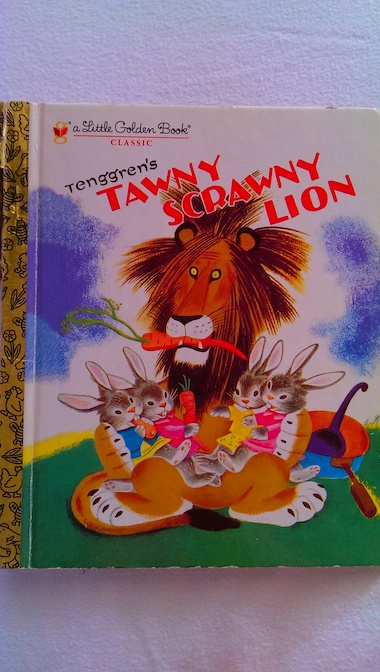
Tawny Scrawny Lion by Kathryn Jackson, illustrated by Gustaf Tenggren, 1952.

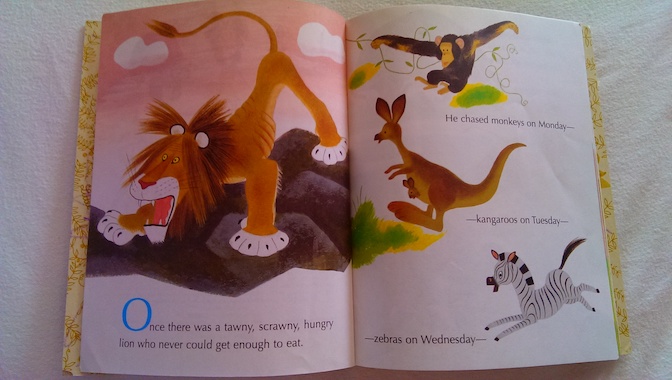
The tawny, scrawny lion can never get enough to eat! No matter how much he hunts and eats, he’s always hungry, and his ribs are showing. He thinks that it’s because hunting is so much work that he wears off anything he eats right away. If only the other animals didn’t run so much, trying to get away from him! (Gee, I wonder why.) He tries to tell the other animals that if they would just not run so much, he would have to eat less of them. Needless to say, that argument doesn’t impress them much.

TawnyLionHungry

Trying to get the lion to stop chasing the rest of them, the other animals convince the fat rabbit to go “talk things over” with the lion, thinking that if the lion eats the fat rabbit, he’d get fat for awhile and leave the rest of them alone.

Seeing how scrawny the lion is, the rabbit decides to invite the lion to join him and his siblings at his house for dinner. The lion likes the idea of going to the rabbits’ house, thinking of the nice dinner he could have on all the fat little rabbits, but things don’t turn out the way that the lion thinks they will.

TawnyLionRabbitTalk

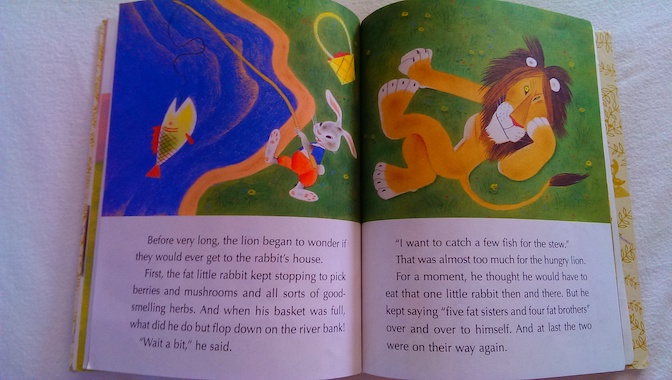
The rabbit tells the lion that they are making carrot stew tonight, but before they can eat, they need just a few more things for the stew. The lion follows the rabbit around as he gathers berries, mushrooms, and herbs and catches a few fish to add to the stew. By the time they’re done with all of that, the lion is too hungry and exhausted to chase the rabbits, so he accepts some of their stew instead.

TawnyLionFishing

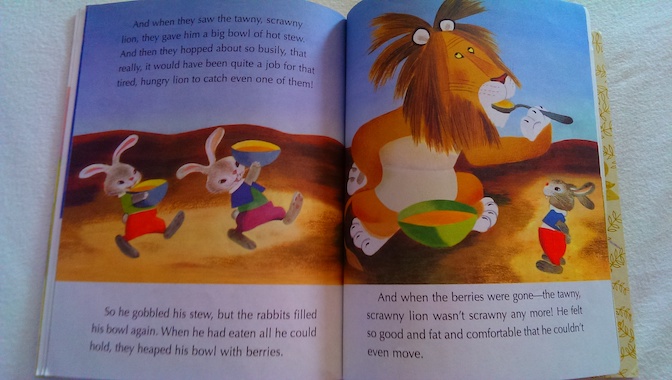
To the lion’s surprise, the stew is actually very filling, and when he has eaten it, he isn’t hungry anymore. For the first time, he feels fat and satisfied. Because of that, the lion ends up not chasing the other animals anymore but helping the rabbits catch fish and gather berries for more of their amazing, wonderful stew!

TawnyLionStew

This is a popular Little Golden book that kids have loved for generations! The stakes are high for the rabbits, who could be eaten by the lion, but I think kids know that the rabbits are going to find a clever way to satisfy the lion without getting eaten. I think it’s also not bad to have a story that points out that, if you aren’t healthy eating the things you’re eating, it’s okay to change.

It is currently available online through Internet Archive (multiple copies).

Happy Holidays

HappyHolidays

Happy Holidays and Other Fun Days Around the Year by E. C. Reichert, illustrated by Suzanne Bruce, 1953.

This book explains a little about the origins of various holidays and how they are commonly celebrated.  It was written during the 1950s, and the illustrations clearly show it in the style of the people’s clothes.  The style of one of the illustrations is one of the charming aspects of the book.

For each holiday in the book, different children talk to their parents or friends about what different holidays mean and how they are planning to celebrate.  Many of the explanations are rather simplistic, and I’ve seen books that explain the history of holidays better, but I have some nostalgia for this book because I read it and liked it when I was a young child.

The Holidays:

New Year’s Day — January 1

Sandra talks to her parents about what they’re going to do on New Year’s Day, and her mother explains the purpose of New Year’s resolutions.

HappyHolidaysNewYear

Valentine’s Day — February 14

Sally and Billy open valentines they’ve received and talk about Saint Valentine and other Valentine’s traditions.

Washington’s Birthday — February 22

Stevie’s father tells him about George Washington and the famous cherry tree story.

St. Patrick’s Day — March 17

Rickey’s friends explain to him why they’re wearing green on St. Patrick’s Day and his mother tells him a little more about the holiday and what shamrocks are.

Easter — The first Sunday after the first full moon after March 21

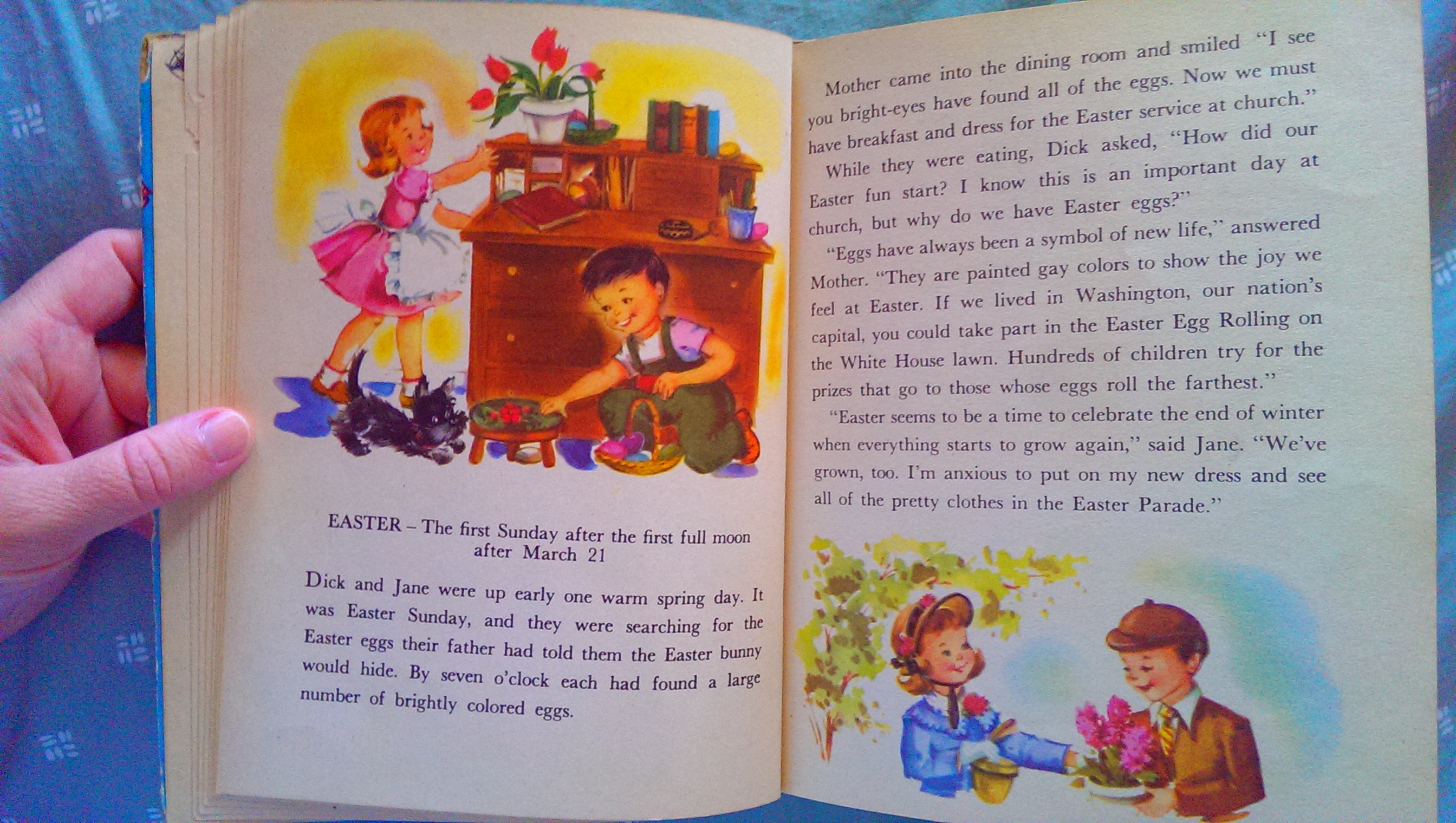
Dick and Jane (not the Dick and Jane from school readers, but yes, those names) hunt for eggs on Easter.  They don’t explain the religious reasons behind the holiday, but they talk about popular Easter traditions, like colored eggs and the Easter Egg Rolling at the White House.  Congratulations to the book for explaining how to calculate the date of Easter!

HappyHolidaysEaster

April Fool’s Day — April 1

When Artie plays a practical joke on Kathy, their father explains the tradition of April Fool’s Day.  (My parents wouldn’t have let my brother give me fake candy because of the choking risk.  Just saying. Actually, I never celebrated April Fool’s Day as a kid because both of my parents hated practical jokes because they both resented jokes their parents played when they were kids, coincidentally around the time this little book was published. My knowledge of April Fool’s Day as a kid came from this book and from things I heard at school.)

Independence Day — July 4

Susie and Johnny go to a parade, have a picnic, and watch fireworks on the Fourth of July.  Their father explains the significance of the holiday.

HappyHolidaysIndependenceDay

Columbus Day — October 12

Miss Nelson’s class at school learns about Christopher Columbus.  (This holiday isn’t celebrated as much today as it was when this book was written. I have to admit, I wasn’t that enthusiastic about it as a kid, either. Columbus Day had no costumes, candy, or presents, and I didn’t get the day off school, and thus, it seemed pretty boring to me when I was young.)

Halloween — October 31

Robin and Judy come back from trick-or-treating, and their mother explains a little about the origins of the holiday.

HappyHolidaysHalloween

Armistice Day — November 11

Terry and Jimmy watch a parade, and their father explains that November 11 was the day that World War I officially ended in 1918.

Thanksgiving Day — The fourth Thursday in November

Ann and Johnny (a different Johnny from the earlier one, I think they either forgot they’d used that name or just couldn’t think of another – they could have called him Jack to be a little different) have dinner with their family at their grandmother’s house.  Johnny talks a little about what he learned in school about the pilgrims and the first Thanksgiving.

Christmas — December 25

Tim and Debbie hang up their stockings, and their mother tells them that it’s Jesus’s birthday and explains the origins of some Christmas traditions.

HappyHolidaysChristmas

The Little Indian Basket Maker

BasketMaker

The Little Indian Basket Maker by Ann Nolan Clark and illustrated by Harrison Begay, 1957.

By “Indian,” the author means Native American.  This book specifically focuses on the  Papago (Tohono O’odam) who live in the Southwestern United States, specifically Arizona.  The story is about a young girl who is starting to learn the traditional art of basket-making, and the book goes into the process involved in making baskets, step by step.   Although the use of “Indian” instead of Native American is somewhat antiquated, and Tohono O’odam is really the proper name for the Papago people, the book has something of an interesting history and the picture it provides of the practice of traditional crafts is fascinating. There is a section at the beginning of the book which explains a little about the history of the Papago (Tohono O’odam) people and where they live.

BasketMakerGrandmother

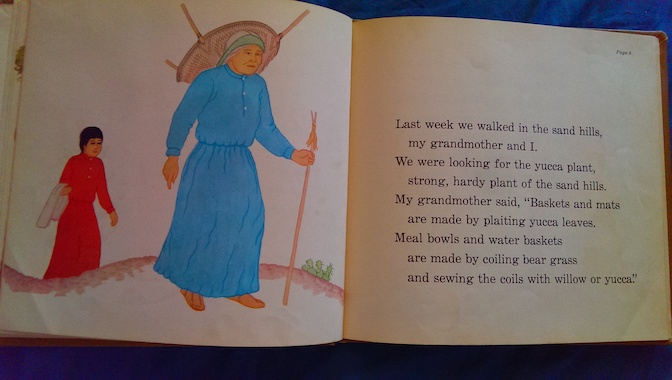
A young girl explains how her grandmother teaches her the traditional craft of making baskets.  They start by gathering the types of plants that they are going to use.

BasketMakerPlants.jpg

They also need special plants for the dye they will need in order to decorate the baskets.  The girl’s grandmother explains about the different types of decorations they traditionally use.

BasketMakerDesigns

Making baskets is a long process that includes cleaning the plants and tearing them into long strips, bleaching them, soaking them to soften them, dyeing strips used in the design, and weaving them together.

BasketMakerSoftening

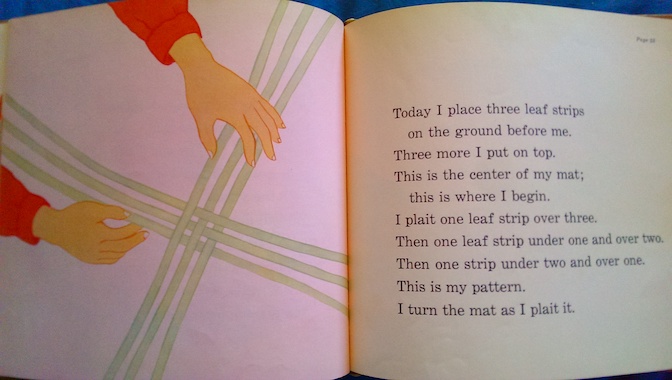
The girl weaves a mat that takes days to finish.  It is the first one that she’s made herself.

BasketMakerWeaving

She is very proud of herself when the mat is finished, and she is pleased with the quality of her work.

BasketMakerFinishing

I’ve owned this book since I was a young child, and it was my introduction to traditional crafts.  Later, I found a related book at a thrift store, The Little Indian Pottery Maker.  Until then, I hadn’t realized then just how old the books were and that there were more of them by the same author.

The book, which was written in the 1950s, was one of a group of stories (not exactly a series because they didn’t have a specific set of characters in common and the themes varied somewhat) written by a woman who was a teacher with the United States Indian Service.  The other books that she wrote, including The Little Indian Pottery Maker, focus on members of different Native American tribes.  She was not Native American herself, and the modern view of Indian schools is not favorable (for good reasons), so one might be a little suspicious of a book written about Native Americans by an Indian school teacher. However, these books interest me because of their explanation of traditional crafts. There are no white people in the stories at all, and they have a timeless quality to them.  Reading them, it’s hard to get a sense of exactly when the stories take place because it’s never mentioned, and there aren’t many clues (no mentions of modern technology, it’s all about the crafts).  I haven’t found any of the other books that the author wrote, but these two are very respectful in their tone, and they begin with explanations of the history of the tribes involved in the stories.  According to Andie Peterson in A Second Look: Native Americans in Children’s Books, the author was deliberately trying to write books that her Native American students could relate to.

The art style of the books vary because they had different illustrators.  The illustrator for this particular book was a Navajo painter.

The book is available to read for free online through Internet Archive.

The Little Indian Pottery Maker

PotteryMaker

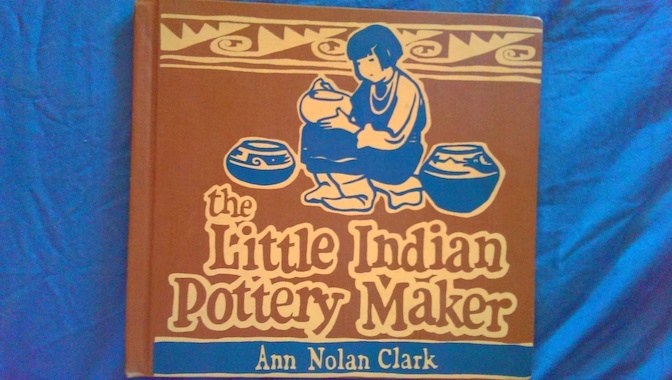
The Little Indian Pottery Maker by Ann Nolan Clark and illustrated by Don Perceval, 1955.

By “Indian,” the author means Native American.  This book specifically focuses on the Pueblo Indians who live in the Southwestern United States, specifically New Mexico and Arizona.  The story is about a young girl who is starting to learn the traditional art of pottery-making, and the book goes into the process involved in making pottery, step by step.   Although the use of “Indian” instead of Native American is somewhat anitquated, the book has something of an interesting history and the picture it provides of the practice of traditional crafts is fascinating. The beginning of the book explains a little about Pueblo Indians, their history, and where they live.

PotteryMakerGettingClay

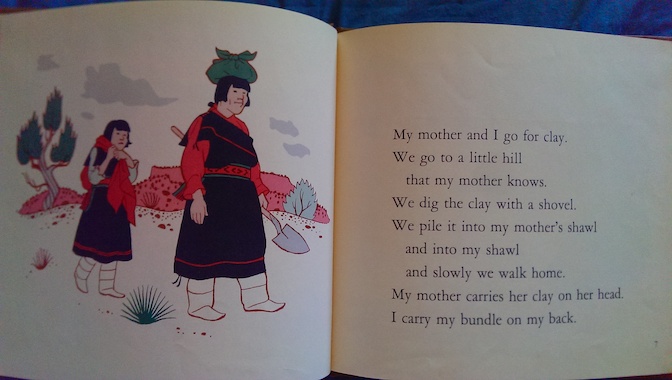
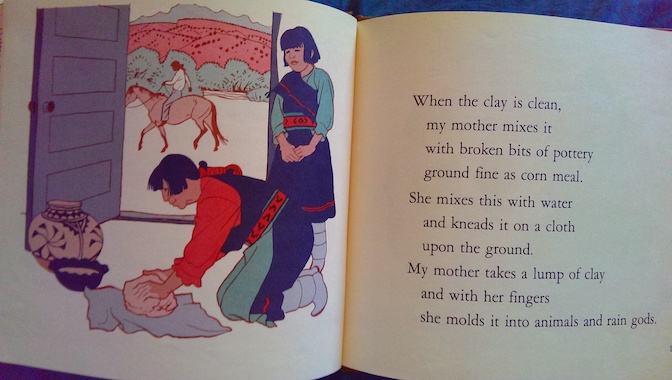
The young girl tells the story of how her mother introduces her to the traditional craft of making pottery and teaches her how to make her first pot.  She describes every step in the process, from when they collect the clay themselves from a hillside until the pot is finally complete.

PotteryMakerMixingClay

The girl’s mother explains about the different methods used to make pots, and pictures show how pots are shaped.

PotteryMakerRollingClay
PotteryMakerMakingPots

Making pottery is a long process that takes days to complete, including shaping, scraping and smoothing the sides, drying, decorating, and finally firing the pottery.  The girl is proud of the first pot she has ever made.

PotteryMakerFiringPots

I found this book at a thrift store a number of years ago and recognized it because I already owned a related book, The Little Indian Basket Maker, that I liked when I was a young child.  I hadn’t realized then just how old the books were and that there were more of them by the same author.

The book, which was written in the mid-1950s, was one of a group of stories (not exactly a series because they didn’t have a specific set of characters in common and the themes varied somewhat) written by a woman who was a teacher with the United States Indian Service.  The other books that she wrote, including The Little Indian Basket Maker, focus on members of different Native American tribes.  She was not Native American herself, and the modern view of Indian schools is not favorable (for good reasons), so one might be a little suspicious of a book written about Native Americans by an Indian school teacher. However, these books interest me because of their explanation of traditional crafts. There are no white people in the stories at all, and they have a timeless quality to them.  Reading them, it’s hard to get a sense of exactly when the stories take place because it’s never mentioned, and there aren’t many clues (no mentions of modern technology, it’s all about the crafts).  I haven’t found any of the other books that the author wrote, but these two are very respectful in their tone, and they begin with explanations of the history of the tribes involved in the stories.  According to Andie Peterson in A Second Look: Native Americans in Children’s Books, the author was deliberately trying to write books that her Native American students could relate to.

The art style of the books vary because they had different illustrators.  The illustrator for this particular book was not Native American (unlike some of the illustrators of other books), but he was adopted into a Hopi tribe, apparently as an adult because of his accomplishments in representing Hopi culture in art.

Tornado Jones

TornadoJonesTornado Jones by Trella Lamson Dick, 1953.

This book was recommended by a reader of this blog.  I haven’t been able to find a copy of it myself, but the reader thoughtfully supplied a picture of the cover.

The reader says:

“I lived in North Platte Nebraska from about February of 1953 till about April of 1955. During that time a book was written by Trella Lamson Dick entitled “Tornado Jones”. Everyone in my school in North Platte read that book many many times. We all loved it. Trella Lamson Dick was born, lived and died in small town of Orleans, Nebraska, Just East and a bit South of North Platte Nebraska. I have two copies of the book one for each of my grandsons. It may be something you might look into investing in I know there are copies available.

It is about a boy whose parents had died and he lived with his Aunt on a farm. In his adventures he discovered people who were digging dirt out in a gully and a pit in the middle of prairie land and he could not figure out why. It turns out that the book is a work of fiction but it is based on fact about the determination that the ‘Jeffrey Reservoir’ East of North Platte could actually be built and would function.”

The orphan boy, Tornado Jones, also has a mystery surrounding his name.  He doesn’t like to talk about it with other people, but when he makes a friend (the first one he’s ever had), Paul, he finally confides that the only clue he has to his real name is a glass bell.  The secrecy surrounding his name has made him uneasy for his entire life.  Tornado also believes that there is gold buried in the canyon nearby, and when he sees people digging there, he is sure that’s what they’re looking for.  Paul is fascinated at the secrets Tornado confides in him, and he and Tornado team up to uncover both the secret of the gold and Tornado’s name.  At the same time, Tornado’s family is worried about the beginning of the reservoir and dam, the construction of which threatens to flood the family’s home.  Can they save their home or will they have to give it up in the name of progress?

This book won the Charles W. Follett Award and is actually the first in a series about Tornado Jones.  There are two others.

The Mystery Off Glen Road

Trixie Belden

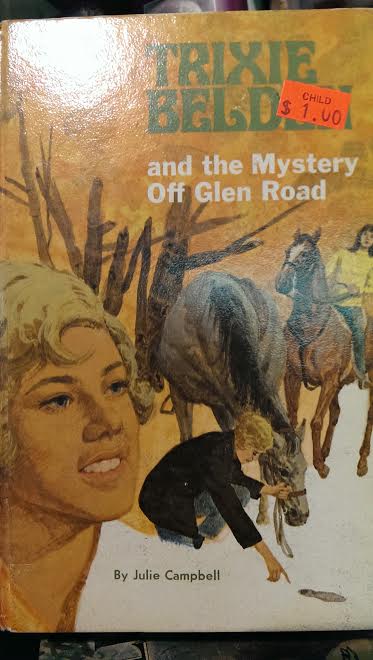
tbglenroad#5 The Mystery Off Glen Road by Julie Campbell, 1956.

When their clubhouse is damaged by a storm shortly before Thanksgiving, the Bob-Whites realize that they will have get some money to fix it soon before the really bad winter weather comes. The Wheelers’ gamekeeper has recently quit, so they offer to patrol Mr. Wheeler’s game preserve for awhile to earn some extra money.

While Trixie and Honey are patrolling, they find a dead deer. They don’t tell anyone about it right away because their dogs, Patch and Reddy, were with the carcass when they found it. If the dogs killed the deer, they might be killed because people would be afraid that the dogs would go wild and start killing more animals. However, Trixie later finds signs that a human butchered and hauled away the carcass. There seems to be a poacher in the wood, and the dogs are innocent of the deer’s death, but how can Trixie and Honey tell the others about it when they tried to cover up the crime in the first place?

To make the situation more complicated, Trixie’s brother, Brian, wants to buy a used car from Mr. Lytell but doesn’t feel that he can spare the money until the clubhouse is fixed. To keep Mr. Lytell from selling the car, Trixie gives him an expensive ring that Jim gave her as security for the car. Since Trixie normally isn’t interested in jewelry at all, she pretends that she wants to wear it to impress Honey’s cousin, Ben, who is visiting for Thanksgiving. Trixie doesn’t actually like Ben at all, but it was the only excuse she could think of for getting her parents to take the ring out of her safe deposit box in the first place. Trixie’s reluctant efforts to fake a crush on Ben and act more girly add humor to the story.

The book is currently available online through Internet Archive.

The Mysterious Visitor

Trixie Belden

tbvisitor#4 The Mysterious Visitor by Julie Campbell, 1954.

Now that school has started again, Trixie and Honey see more of the other kids who live in Sleepyside, including a girl named Diana Lynch. Trixie has known Diana for a long time, but ever since her father made a lot of money, Diana has been distant.

Di is deeply unhappy because her parents, particularly her mother, have been trying to live up to their new status by having the household run by fussy servants who don’t care much for children. Diana always has to wear formal clothes, she doesn’t get to play with her younger siblings as much, and she finds it increasingly hard to just relax and have fun with friends.

When Honey and Trixie invite Diana to become a member of the Bob-Whites, she tells them about her long-lost uncle who has recently come to visit her family. Her mother is happy about finally meeting the brother she has not seen since she was a baby, but Uncle Monty has been making Di’s life miserable. Whenever she makes plans to have a Halloween party or do things with friends, he tries his best to interfere and ruin everything. Uncle Monty is rude and offends people. Trixie is convinced that Di’s Uncle Monty is not what he seems to be, but she’s not sure how to prove it.

I love the description of the Halloween party that the kids have at Diana’s house!

The book is currently available online through Internet Archive.