The Black Jacket Mystery

Trixie Belden

TBBlackJacket

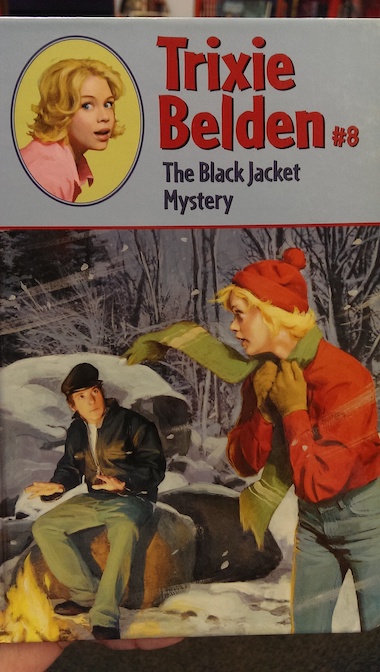
#8 The Black Jacket Mystery by Kathryn Kenny, 1961.

Trixie and the other Bob-Whites are concerned about their pen pals in Mexico because an earthquake has damaged their town. To help them rebuild their school library, the Bob-Whites decide to hold a benefit carnival to collect books.

While they are planning the carnival, Trixie becomes worried about Regan, who is in charge of Mr. Wheeler’s stable. She overhears him speaking to her mother about a problem, asking her advice, but saying that he doesn’t want the kids to know. Although Trixie doesn’t want to pry to into Regan’s business, she can’t help but worry about him and wonder what he doesn’t want them to know.

Then, a boy called Dan Mangan comes to live with Mr. Maypenny. Dan wears a black jacket and looks like a member of some kind of street gang. At school, he brags about brushes with the law. The Bob-Whites try to be friendly with him, but something about Dan gets on Trixie’s nerves.

When someone sells Honey’s missing watch at Mr. Lytell’s store, people begin to suspect that Dan may be a thief. But, soon, Trixie and the others start to suspect that someone else may be hiding out in the woods.

The book is currently available online through Internet Archive.

The Mysterious Code

Trixie Belden

TBMysteriousCode

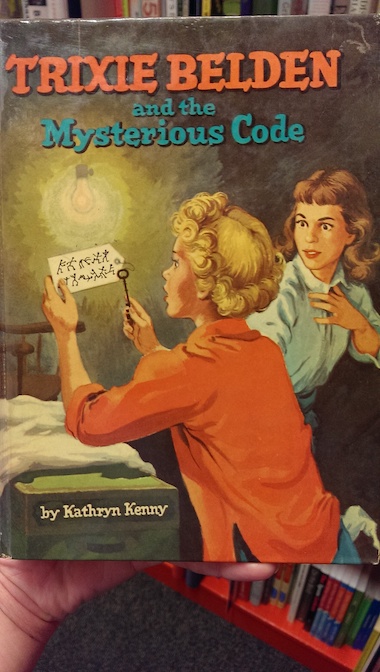
#7 The Mysterious Code by Kathryn Kenny, 1961.

TBMysteriousCodeBobWhites

The title is a little misleading because the code is really only a mystery for a small part of the book.

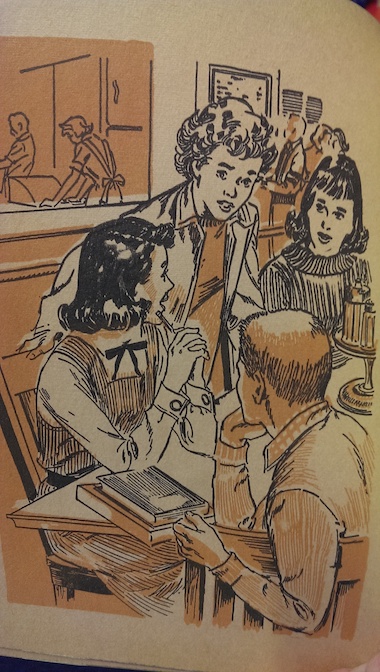
When the story begins, the existence of the Bob-Whites is threatened because there has been some vandalism at the school and there are fears of gang activity in the area. The school board is considering outlawing all clubs that are not directly supervised by the school and do not serve a specific purpose.

The Bob-Whites explain to their principal that they are a club that supports benevolent causes, but the principal says that they must demonstrate that they support something specific. Trixie suggests to the others that they raise money for UNICEF because it is a good cause and something that the school board would approve of. The Bob-Whites decide that they will hold an antique show to raise money, and they get people to donate items for them to exhibit and sell.  Honey’s mother says that they can have some things that were left in their attic by the former owner of the Manor House.

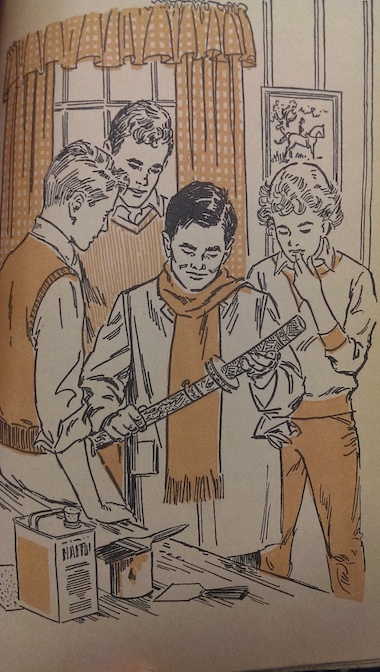
TBMysteriousCodeSwordIn the attic, Trixie finds a key with a tag on it. The tag is covered with a bunch of little stick figures, which turns out to be a form of code (one that fans of Sherlock Holmes would be likely to recognize). The key opens a box hidden in the attic, which contains a treasure that will raise a considerable sum of money for their cause. However, there is more mystery to come.

While Trixie and her little brother are on their way home from picking up an antique lap desk from a neighbor, they are attacked by three robbers, who steal the desk. A set of samurai swords is also stolen from the Bob-Whites, and someone attempts to burn their clubhouse. Can they find the criminals and recover the missing antiques, or will their antique show be ruined?

Mystery of the Silent Friends

SilentFriendsMystery of the Silent Friends by Robin Gottlieb, 1964.

Nina Martin loves her father’s antique store. Although selling antiques is how her family makes their living, there are some that Nina finds it difficult to let go of when someone wants to buy them. Nina especially doesn’t want her father to sell the two automatons that she calls Henri and Henriette. The automatons are beautiful mechanical dolls that each do something special. Nina calls the boy doll “Henri” because he writes the name “Henri Bourdon” on a piece of paper. (Her father points out that it might be the name of the maker, not the doll itself.) The girl doll, Henriette, is a little more complicated and draws a series of different pictures. Most of the pictures seem to be of a little Swiss village, although one of them is oddly of a monkey that looks like the “speak no evil” monkey in the saying “hear no evil, see no evil, speak no evil.”

SilentFriendsAutomatonsFor a time, it seems like there’s no risk of the automatons being sold because no one seems particularly interested in buying them. Then, suddenly, two different men come to the shop and ask to buy the dolls. Weirdly, each of them tells the same story to Nina’s father: that their name is George Ballantine the Third, that their family once owned the automatons, that the dolls are actually part of a set of three, that they own the third doll (a girl doll that plays the spinet), and that they want to purchase the other two in order to reunite the set. Nina’s father is bewildered by these two men with identical stories and identical names and refuses to sell the automatons because of his daughter’s attachment to them and because he doesn’t know which of the two men to believe and doesn’t trust either of them.

Nina comes to think of the two men as “Red Ballantine” and “Brown Ballantine” because of their different hair colors. Brown Ballantine seems to be the more credible of the two. He invites Mr. Martin and Nina to his home in order to show them the third automaton and, hopefully, persuade Mr. Martin to sell him the other two. They visit Brown Ballantine’s apartment in an old brownstone, and he shows them the beautiful, spinet-playing doll as well as the rest of his collection of mechanical toys. However, Mr. Martin still refuses to make the sale.

SilentFriendsMechanicalToys

Nina tells her friend, Muffin, about the two mysterious Ballantines. The two girls are curious about which of the men is the genuine George Ballantine the Third and decide to investigate. When “Red Ballantine” comes to the shop again, trying to persuade Mr. Martin to sell the automatons, the girls ask if he would consider showing them the automaton he owns as a test. At first, the red-haired man is hesitant, but then he agrees that they can come and see his doll. Mr. Martin is embarrassed at the girls’ forwardness in asking, but he admits that he is also curious about the two Ballantines.

SilentFriendsSpyingAt first, they all expect that Red Ballantine won’t be able to show them the third doll and will give up trying to buy the other two, but to their astonishment, he takes them to the same apartment where Brown Ballantine said that he lived and shows them the exact same doll they saw before. Instead of clearing things up, the identities of the two men seem to get all the more confusing. However, Muffin notices something strange about the tune that the doll plays on the spinet that gives them a clue as to why the three dolls are so important.  Later, someone breaks into the antique store and uncovers a hidden secret about Henri as well.

Together, the three automatons are hiding a secret, and only by considering the message that each of them offers can the girls discover what it is.

The book is currently available online through Internet Archive.  There is also a sequel to this book called Secret of the Unicorn, which involves a secret message hidden in a tapestry.

My Reaction

Although I was pretty sure which of the two Ballantines was the genuine one, I was never completely sure until almost the end.  In a way, I was a little disappointed by the dolls’ final secret because I though it was something that was especially old, from when the dolls were first created, but the secret messages were actually a more recent addition to the dolls’ repertoire by an eccentric man with a treasure to hide and a taste for practical jokes and riddles.  Muffin is a habitual practical joker, and that partly figures into the solution of the mystery.

I thought it was kind of interesting, too, that Mr. Martin has the habit of walking around with a cigarette in his mouth that he never lights, like Inspector Cramer in the Nero Wolfe mysteries.

Magic Elizabeth

MagicElizabeth

Magic Elizabeth by Norma Kassirer, 1966.

Young Sally’s parents are away on a business trip, so she’s been staying with Mrs. Chipley, but now Mrs. Chipley has a family emergency to tend to. Mrs. Chipley’s daughter is ill, and Mrs. Chipley needs to go and help her with her children. While Mrs. Chipley is gone, there is only one other person for Sally to stay with: her Aunt Sarah, an elderly woman who Sally doesn’t really know. Aunt Sarah moved to California when Sally was just a baby, and the only reason why she has returned is that she has decided to sell her old house.

MagicElizabethArrival

Sally is a rather shy girl. She’s uneasy around Aunt Sarah, who is obviously unaccustomed to spending time with children, and Aunt Sarah’s creepy cat, Shadow. The house is old, chilly, and filled with strange things. However, Sally is enchanted with the bedroom that Aunt Sarah gives her and the portrait of a girl and her doll that hangs on the wall. The girl looks very much like Sally herself, and Aunt Sarah tells her that the girl was also called Sally and lived in that bedroom as a child, many years ago.

MagicElizabethKitchen

Fascinated by this earlier Sally and her beautiful doll, modern Sally decides to try to find the doll. Although her aunt tells her that she shouldn’t go poking around in the attic, Sally can’t help herself. She finds a trunk with Sally’s name on it full of girls’ clothes, just the right size for modern Sally to wear. There is a doll in the trunk also, but it’s not the same doll as the one in the portrait. When Sally reads the diary in the old trunk she learns the reason why. The doll in the picture, Elizabeth, was lost many years ago, when the earlier Sally was still young. As modern Sally plays dress up with the earlier Sally’s old clothes and studies herself in the mirror, she finds herself taken back in time, seeing the house through earlier Sally’s eyes. In the past, it was a busy and happy household with parents, an elderly aunt, earlier Sally, Sally’s little brother, and Sally’s pet cats.

A short time later, Aunt Sarah wakes modern Sally on the floor of the attic, and they assume that it was all a dream, but this look into the past changes Sally’s feelings about the house and her aunt’s cat, who suddenly seems friendlier and reminds her of the mother cat she saw in the past. Aunt Sarah also seems a little less stern as they discuss earlier Sally and her lost doll. Aunt Sarah says that no one ever saw the doll again after it disappeared on Christmas Eve all those years ago.  Earlier Sally had put the doll on top of the Christmas tree, like an angel, and after the family finished singing Christmas carols, the doll was gone.  They could never figure out what happened to her.  Modern Sally thinks that sounds very sad and wants to investigate the mystery of the missing doll, although Aunt Sarah isn’t very enthusiastic. She says that if the doll could be found, it would have been found long ago, and the earlier Sally has long since grown up and no longer needs it. Although, oddly, Aunt Sarah remarks that the earlier Sally had always thought that Elizabeth was “a little bit magic.”

Modern Sally continues to look for the doll anyway and also continues having moments when she sees the past as the earlier Sally did many years ago, especially when she looks into the mirror in the attic. One day, she invites a neighbor girl named Emily over, and while the two of them are looking around the attic, Emily finds Elizabeth’s old doll bonnet. The girls are excited because they now know for certain that Elizabeth is still in the house, waiting to be found. The girls are running out of time to find her. If Aunt Sarah agrees to sell the house, it will be torn down to build apartments. But, Sally falls ill with the flu, and it isn’t until Shadow gives her an important clue that Sally realizes where Elizabeth must be.

This book is currently out of print, but it’s one that I’d dearly love to see in print once more!  It is available to borrow and read for free online through Internet Archive.

My Reaction and Spoilers

Adults reading this story will probably realize before the children do (spoiler) that Aunt Sarah herself was the earlier Sally, the one who lost her favorite doll many years ago. “Sally” is a nickname for Sarah, like “Molly” can be for Mary and “Peggy” can be for Margaret, although any of those names can also be used by itself.  (In the Middle Ages, it was common for popular names to get different variations of nicknames by changing one sound in the original name and then changing one more sound in the first nickname to get another one, and sometimes even moving on to change one more sound to get yet another nickname that was very changed from the first. Those nicknames that look significantly different from their original names are a holdover from that practice, having lasted even into modern times.  John/Jack works on the same principle.  Fun fact!)  When Aunt Sarah grew up, she stopped using her childhood nickname, but the name was passed on to modern Sally.

At first, modern Sally sees her stern aunt as being witch-like, all dressed in black and fussy, but gradually, the memories of the past, her new relationship with young Sally, and the finding of her slightly-magical doll soften her. There are hints of Aunt Sarah’s youth in the attic, although Sally at first dismisses thoughts that some of the lovely things there could have belonged to her cranky old aunt because she has trouble thinking of her aunt as once having been young, pretty, and sweet. However, part of the theme of the story is that everyone was young once. Aunt Sarah is is bent and achy from arthritis, giving her the witch-like appearance and making her short-tempered at times. She also hasn’t been around children much for years, and part of her fussiness comes from forgetting what it was like to be young herself. Modern Sally, with her resemblance to her elderly aunt, and Elizabeth the doll both work their magic on her, reminding her what it was like to be a young girl and helping to revive a more youthful spirit in her.

I was happy that (further spoiler) Aunt Sarah decides not to sell the house after all, not just because she and Sally will get to spend more time together, but because old houses like that are rare these days. I like the idea that the old family heirlooms in the house will now be preserved, like the sleigh out in the old barn and the melodeon, a type of small organ.  I liked the way the book described the melodeon making musical sounds as people walk past it because of the way the floor boards move.  I also loved the description of the gas plant that Sally sees in earlier Sally’s memories.  If you’d like to see what a gas plant looks like when it’s lit, have a look at this video on YouTube.MagicElizabethMelodeon

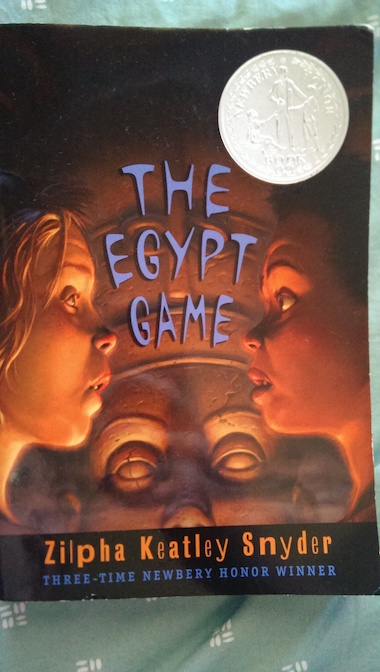
The Egypt Game

EgyptGame

The Egypt Game by Zilpha Keatley Snyder, 1967.

EgyptGameGirlsApril Hall has come to live with her grandmother (the mother of her deceased father) because her actress mother is touring with a band as a singer.  April’s mother isn’t a big star, although April likes to brag about her and their Hollywood life.  Really, her mother is mostly a vocalist who occasionally gets parts as an extra, hoping for that big break.  April is sure that when her mother gets back from her tour, she will send for her, and they will live together in Hollywood again. Although, from the way her grandmother behaves, it seems as though April may have to prepare herself for living with her for the long term.  April resents her grandmother’s apparent belief that her mother has dumped her because she is unwilling or unable to take care of her.
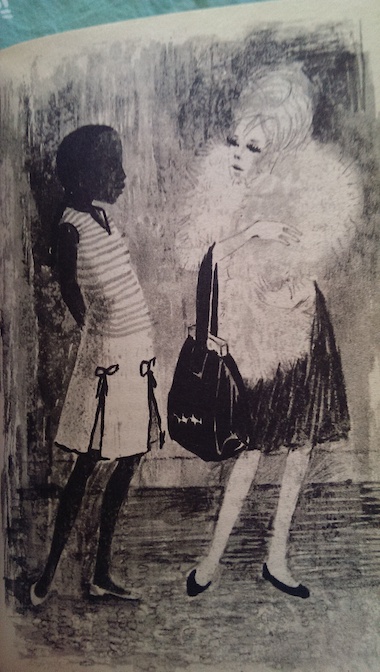
April is homesick and misses her mother.  To hide her feelings, she tries to act grown-up and ultra-sophisticated, which makes most people regard her as a little weird.  In spite of that, she makes friends with a girl named Melanie, who lives in a nearby apartment and sees through April’s act to her insecurity and creative side.  April has never had many friends (partly because of her mother’s chaotic lifestyle), but Melanie appreciates April’s imagination.  The two girls realize that they both like playing games of pretend and they both have a fascination with Ancient Egypt.  They go to the library and read everything they can find about Egypt, and it sparks the best game from pretend they’ve ever played.  Along with a few other friends, they start pretending to be Ancient Egyptians, building their own Egyptian “temple” and holding rituals in the old junk yard behind a nearby antique shop.

On Halloween night, the adults try to keep the children together in groups for safety, but the “Egyptians” sneak off alone to conduct one of their “rituals.”  It’s a dangerous thing to do because a child has been murdered in their area.  A young girl who was apparently abducted was later found dead, and people are frightened that other children could be in danger.  Fortunately, the only thing that happens on Halloween is that the Egyptians recruit a couple of new members when some boys from school find out what they’re doing.

However, the game starts taking on a life of its own when it seems that some other, unknown person has also joined in.  As part of their game, the children make up a new ritual and write messages to their “oracle,” asking questions that they want answered. To their surprise, someone starts writing replies.  Whoever is playing oracle and answering their questions, it doesn’t seem to be a child.

EgyptGameRitual

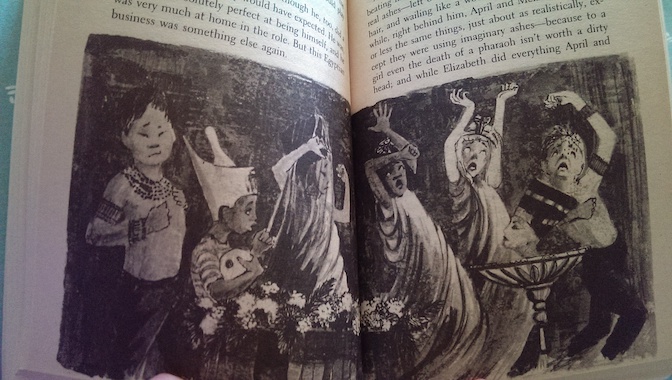
EgyptGameCostumesThe children are uneasy about this unexpected game player because frightening things are happening in their neighborhood.  The kids wonder if the mysterious messages could be from the crazed killer who murdered the young girl. People have been looking suspiciously at the loner who owns the antique store, an older man who everyone calls the Professor.  However, the kids have become too enmeshed in the Egypt game to give it up in spite of their fears.

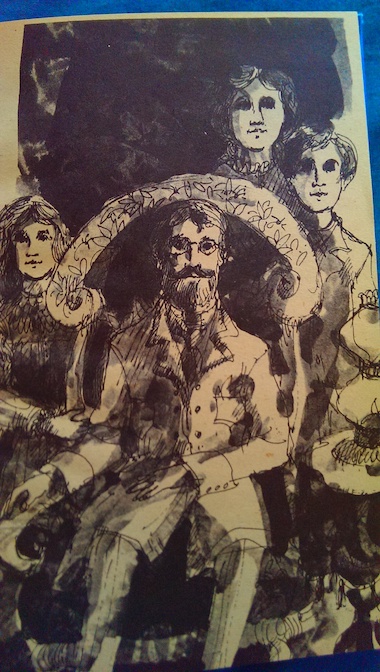
When April slips out one night to retrieve a text book she left in “Egypt,” she comes frighteningly close to being the killer’s next victim.

This is a Newbery Honor Book.  It is currently available online through Internet Archive (multiple copies).  There is a sequel called The Gypsy Game.

My Reaction

Although there are mysteries in the story (who killed the girl and who the unknown player of the Egypt game is), the development of the characters, especially April, is really at the heart of the story.  All through the story, what April wants most is for her mother to come for her and take her home again.  April fears that her mother doesn’t love her or want her, and at first, that keeps her from even trying to love the grandmother who took her in and really wants her.  However, she finds comfort when she realizes that she is creating a new life with her grandmother and friends, who really care about her.  Her mother does write to her later about coming to stay for a brief visit with her and her new husband (her acting manager, who she married on short notice without even telling April or inviting her to come to their wedding), but by then, April has started to feel at home in her new home and wants to share Christmas with the people who have been sharing in her life and adventures more than her mother has.  She never even tells her mother about her brush with death.

EgyptGameChristmas

The characters in the book are diverse, representing different racial backgrounds, ages, and family situations.  Melanie and her younger brother are African American.  Melanie understands more about human nature and how the world works than April does, partly because her mother talks to her about people and explains things.  Melanie realizes from the way that April behaves and how she doesn’t understand certain things, like the fact that there disturbed, dangerous people in the world, that her mother never really talked to her much or explained things when they were living together.  Melanie helps to ground April’s more flighty, insecure personality.  She joins in her imagination games eagerly, but she also helps to bring April more into sync with reality and other people.

The first new player they add to the game, Elizabeth, is Asian and lives with her widowed mother and other siblings.  Like April, she is a little lonely and looking for new friends in her new home.  Each of the kids, like April, have their own inner lives and personalities.  The Egypt game binds them together and provides them with friendship and insights into their lives.

The Ghost of Windy Hill

GhostWindyHill.jpg

The Ghost of Windy Hill by Clyde Robert Bulla, 1968.

GhostWindyHillFamilyIt’s 1851, and Professor Carver of Boston is living in an apartment above a candle shop with his wife and two children, his son Jamie and daughter Lorna.  One day, a man named Mr. Giddings comes to see Professor Carver to request his help.  For years, he has wanted to buy a particular farm with a beautiful house called Windy Hill.  However, when he finally succeeded in buying the house and he and his wife went to live there, his wife became very upset.  She said that she felt strange in the house and that she had seen a ghost.  Now, she is too upset to return to Windy Hill.  Mr. Giddings has heard that Professor Carver once helped a friend get rid of a ghost haunting his house, and he asks the professor if he would be willing to do the same for him.
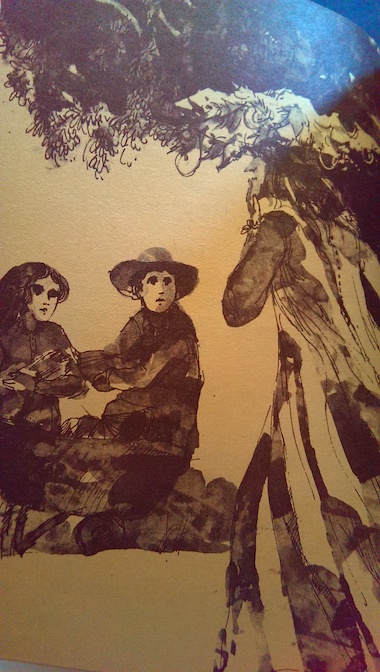
At first, Professor Carver is reluctant to agree to help.  He doesn’t believe in ghosts, and when he helped his other friend, he didn’t get rid of any ghosts.  His friend had only believed that his house was haunted, and after the professor and his family had stayed there for awhile without experiencing anything unusual, his friend relaxed and was reassured that the house was alright.  Mr. Giddings asks if the professor and his family would be willing to stay at Windy Hill for the rest of summer and see if they see anything unusual.  If they don’t, perhaps Mrs. Giddings will feel better about the house and be willing to return there.  Although the professor is still not that interested in the house, his family is, so he agrees to spend the rest of the summer there, about a month.  His family can escape the summer heat in the city, and he can work on his painting while someone else teaches his class.

GhostWindyHillLadyJamie and Lorna are thrilled by the house, which is much bigger than their apartment in town.  They can each have their own room, and there is an old tower in the house that was built by a former owner, who was always paranoid about Indian (Native American) attacks (something which had never actually happened).  However, their new neighbors are kind of strange.  Stover, the handyman, warns them that the house is haunted and also tells them about another neighbor, Miss Miggie.  Miss Miggie is an old woman who wanders around, all dressed in white, and likes to spy on people.  There is also a boy named Bruno, who apparently can’t walk and often begs at the side of the road with his pet goat, and his father, Tench, who is often drunk and doesn’t want people to make friends with Bruno.

The kids make friends with both Bruno and Miss Miggie.  Bruno is unfriendly at first, but Lorna brings him cookies, and she and her brother tell him about life in the city.  Miss Miggie brings Lorna a bag of scrap cloth so that she can make a quilt.  Nothing strange has been happening in the house, so the family knows that they will be returning to the city soon, reassuring Mr. Giddings that the house isn’t haunted.

GhostWindyHillBoyThen, strange things do start happening in the house.  The quilt that Lorna has been making disappears and reappears in another room in the middle of the night.  At first, the family thinks maybe she was walking in her sleep because she had done it before, when she was younger.  However, there is someone who has been entering the house without the Carvers’ knowledge, and Jamie and Lorna set a trap that catches the mysterious “ghost.”
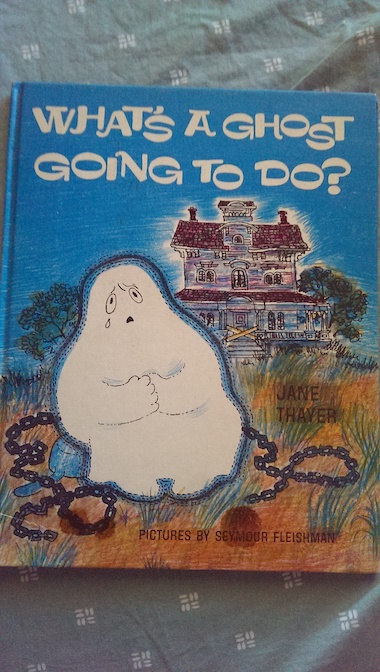
As Professor Carver suspected, there is no real ghost at Windy Hill, but this story has a double mystery.  First, there is the matter of the mysterious ghost, who is not there to scare the Carvers away but actually to make them stay.  Then, there is the question of what Mrs. Giddings saw that upset her so much, if anything.

The book is easy to read for younger readers and accompanied by black-and-white pictures.  My only complaint is that some of the pictures are a little dark, and the artistic style makes them a little difficult to interpret.

The book is available to borrow and read for free online through Internet Archive.

What’s a Ghost Going to Do?

WhatGhostDo

What’s a Ghost Going to Do? by Jane Thayer, 1966.

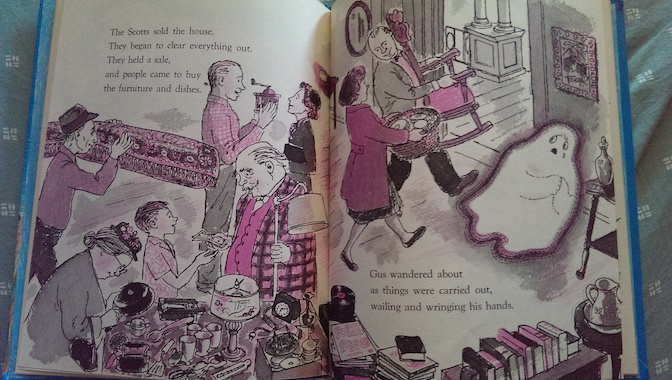
Gus is a friendly ghost who lives a quiet life alone in his old house, which is run-down and shabby, with winter visits from his mouse friend.  However, Gus discovers one day that the property is being sold.  The government wants the land to turn into a park, and if that happens, Gus’s house will be torn down!  If they decide to tear the house down, where will he go?

WhatGhostDoSale

For a time, Gus tries living with another ghost in another old house nearby, but that arrangement doesn’t work because the other ghost doesn’t like Gus rattling chains.  Then, Gus tries living in a hole with his mouse friend, but it’s really too small for him.  The only place that seems right for Gus is his old house, which is in danger of being destroyed!

WhatGhostDoHints

In desperation, Gus whispers in the ears of the man in charge of preparing the park for the government, Mr. McGovern, trying to get him to notice the virtues of his house.  Fortunately, Mr. McGovern accepts Gus’s vision of the house as a beautiful piece of the past and finds a way to restore it to its former glory so that Gus can keep his home and others can appreciate it, too.

WhatGhostDoRepairs

Gus’s house becomes a museum in the park, and Mr. McGovern also officially acknowledges Gus as the resident ghost.

The book is available to borrow and read for free online through Internet Archive. It’s part of a series.

WhatGhostDoMuseum

My Reaction

I’ve had this book since I was a little kid. I always felt sorry for poor Gus throughout the book, but the story has a nice ending, with Gus and Mr. McGovern finding a creative way to restore the house and put it to good use, filling it with antique furniture for both Gus and the public to enjoy. I haven’t read any of the others in the series yet because this is the only one I’ve ever had.

Old Black Witch

OldBlackWitch

Old Black Witch by Wende and Harry Devlin, 1963.

OldWitchChimneyA boy called Nicky and his mother are looking for a new place to live somewhere in New England.  The mother wants to buy an old cottage with the idea of turning it into a tea room.  At first, they have trouble finding a place, but finally they buy an old house that badly needs fixing up, not knowing that there is an old witch living there.
The witch (whom they call Old Black Witch, since she’s dressed all in black and sooty and doesn’t seem to have any other name) has been sleeping in the chimney of the house for about a hundred years, and they wake her the first time they try to start a fire in the fireplace.

The witch is furious to discover that the house has new owners and worried about where she’s going to live because she needs an old house to haunt.  Nicky and his mother invite her to stay and live in the attic, which has enough dust and cobwebs to satisfy her tastes, while they clean up the lower part of the house for the tearoom.

The locals have heard stories about the house being haunted, but the nice tearoom soon becomes popular with ladies in the area, especially after Old Black Witch decides to help out Nicky’s mother in the kitchen.  Old Black Witch’s blueberry pancakes are wonderful and win many fans for the tearoom.

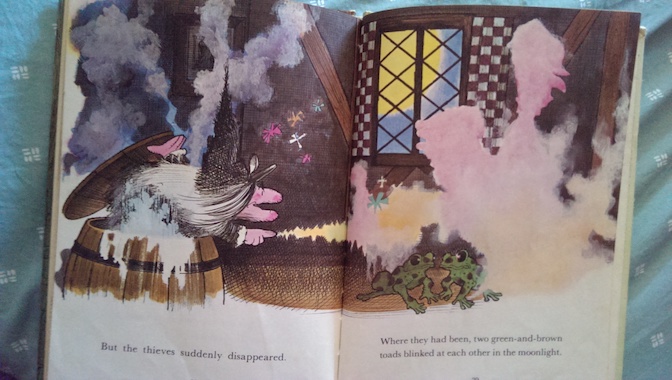
Then, one night, a couple of burglars break in.  Since Old Black Witch is kind of evil herself, she can’t really fault them for wanting to rob the place . . . until she suddenly realizes that they’re stealing from her, too, and uses her magic to fix the burglars for good and give herself the pet toads that she’s been wanting.

This book is available to borrow and read for free online through Internet Archive.

OldWitchToads

My Reaction

One of the things that I like about this story, which was a favorite of mine when I was a kid, is that Old Black Witch isn’t particularly evil although she isn’t too nice, either.  She’s as bad and disagreeable as a cranky old witch who’s lived in a chimney for over 100 years ought to be, but not so bad that she can’t make some new friends and help them out once in a while.  Friendly enough for the kids, but not too sweet to be a real witch.  It’s part of a short series, although I haven’t managed to find any of the other books yet.  Some of the pictures are in full color and some are in black and white.  Don’t ask me why she has a spoon in her hat because I’ve never been completely sure, either.  Somehow, on her, it looks good.

The back cover of the book has the recipe for the blueberry pancakes.

OldWitchPancakeRecipe

There was a short film version of this story from 1969 called Winter of the Witch.  It follows the book fairly well, but with some variations (there were no burglars).  In the film, the pancakes have the power to make people happy, and that’s what gives Nicky’s mother the inspiration to open a pancake parlor in their house.  The witch finds a new sense of purpose, although she still plans on going back to her old, wicked ways once the world is happy enough to need a good, old-fashioned scare.  I don’t think that it was ever released on dvd, but it is possible to see it on YouTube and Internet Archive.

Basil and the Lost Colony

BasilLostColonyBasil and the Lost Colony by Eve Titus, 1964.

A Norwegian scholar from the British Mousmopolitan Museum approaches Basil about a letter that he has recently received along with an arrow.  The letter mentions a recent sighting of the mysterious Adorable Snowmouse (no, that’s not a typo, he’s big for a mouse, but really adorable and saves people lost in the mountains), and the arrow is evidence that points to the whereabouts of a lost colony of mice who fled Switzerland during the time of William Tell, about 600 years previously.  These particular mice lived in William Tell’s basement, and like Tell himself, the Tellmice (as they are called) left their home because they opposed the rule of a tyrant.  However, even after the tyrant’s reign ended, the Tellmice did not return home and no one knows for sure what became of them.

Basil is eager to join the expedition to search for the lost colony, but he is also concerned about opposition from his nemesis, Professor Ratigan.  Professor Ratigan has recently made attempts on his life, and he now knows about the expedition to find the lost colony, even stealing the evidence from Basil’s home.  Basil is sure that Professor Ratigan will do everything he can to prevent them from reaching the lost colony.

In Switzerland, the expedition is joined by a pretty and adventurous opera singer, Relda (a take-off on Irene Adler, from the original Sherlock Holmes stories, read her name backwards), who comes in disguise after Basil tells her that the mission is too dangerous for her.  That’s just one of the jokes on original Sherlock Holmes stories that appear in this book.  These jokes would go over the heads of kids who aren’t familiar with the original stories, but make the story more entertaining for adults.

Basil and his friends do meet up with the Adorable Snowmouse, find the lost colony, and defeat Ratigan (well, temporarily, at least).

Although the Basil of Baker Street Series is supposed to be about a mouse detective kind of like Sherlock Holmes, some of the entries in the series, like this one, are really more adventure than mystery.  The book is currently available online through Internet Archive.

Mystery of the Secret Message

secretmessageMystery of the Secret Message by Elizabeth Honness, 1961.

Penny lives with her aunt and uncle because her mother is dead and her father travels on business much of the time, dealing in Asian art.  Thanks to his travels, Penny and her aunt and uncle have quite a collection of Asian art themselves.  However, Penny has just been told that her father’s airplane crashed in the Pacific Ocean.  No survivors have been found, although Penny still has hope that perhaps her father survived and might yet be found.

At the same time, Penny and her aunt and uncle are moving into a house from the apartment where they used to live. Penny is happy about the move because she knows that she won’t have to worry as much about being quiet and not disturbing the neighbors, like she had to do in their apartment. This means that Penny can bring her friends over to the house to play and have parties. Also, their new house has a very special feature: its own private elevator.

Penny loves the new house and soon begins building a tree house with the help of Pete, a boy who lives nearby.  She tells Pete about her father and her hopes that he might still be alive.

However, events take a disturbing turn when Penny receives a package from Japan containing a beautiful wall scroll. The package appears to have been sent by her father, who meant it as a present for her new room in her new house. Was the package sent before his death, or did he somehow survive the crash?

There is also something odd about Penny’s new neighbors.  Penny’s new house is actually half of a duplex, and the new neighbors, the Carruthers, have also recently moved in after renting the other half. When Penny accidentally gets stuck in the elevator and hears voices coming through the wall, she starts to suspect that her neighbors might not be what they seem to be.  They show an unusual interest in her family’s collection of Asian art, asking to see pieces and borrow pieces for an exhibition that Mr. Carruthers is holding at his gallery.  One of Penny’s friends even catches Mrs. Carruthers sneaking around, looking at things uninvited.

When Penny and her friends have a sleepover on an evening when her aunt and uncle are out, someone sneaks into the house, leaving muddy footprints on the floor.  Penny isn’t sure that her aunt and uncle will believe her because they seem to like the Carruthers, so at Pete’s suggestion, she continues to spy on them, using the elevator to listen in on their conversations through the walls.

When her uncle catches her one day, using the elevator without permission (something she is not supposed to do), she finally explains her suspicions and what’s she’s heard the Carruthers say.  Together, Penny and her uncle discover a hidden secret about the wall scroll Penny recently received, which points to a number of secrets that Penny’s father kept from her and the rest of his family for years.  A stranger from the government helps Penny to fill in some of the blanks, but he has a favor to ask in return that requires Penny to take a big risk.

My Reaction and Spoilers

Although this book is much older than I am, it was a favorite of mine when I was a kid, yet another of my used book sale treasures! I actually got rid of my first copy years ago, when I was cleaning some things out, but I missed it, so I got another one. It’s actually a collector’s item these days.

I always liked the feature of the elevator in the story and how Penny uses it to find the right spot to hear what her neighbors are saying through the wall. I love intrigue, and as a kid, I liked the idea both having a house with an elevator and of overhearing clandestine conversations that reveal sinister secrets. There are points in the story where the two-faced Carruthers think that they have the upper hand, and Penny has to be careful not to let on just how much she knows.

As I explained, the neighbors are not what they seem to be, and Penny’s father was involved in things that his family knew nothing about. Since it’s not easy to get hold of this book right now, I’ll include a couple of spoilers. Penny’s father was acting as a spy for the US government, using his profession as an art dealer to travel to locations he needed to go and to smuggle information back to the US. He is apparently dead, killed in the plane crash, although there are hints that the crash wasn’t an accident, that it may have been intended to kill him. However, before his death, he managed to smuggle his last important information to Penny in the wall scroll that he sent her. When Penny manages to convince her uncle that something isn’t right about the Carruthers, he begins making inquiries and learns the truth about Penny’s father. A government agent speaks to the family and arranges a plan to fool the Carruthers into thinking that they’ve found what they were looking for, but the plan requires Penny to spend an evening in the house alone with them.