Clues in the Woods

clueswoods

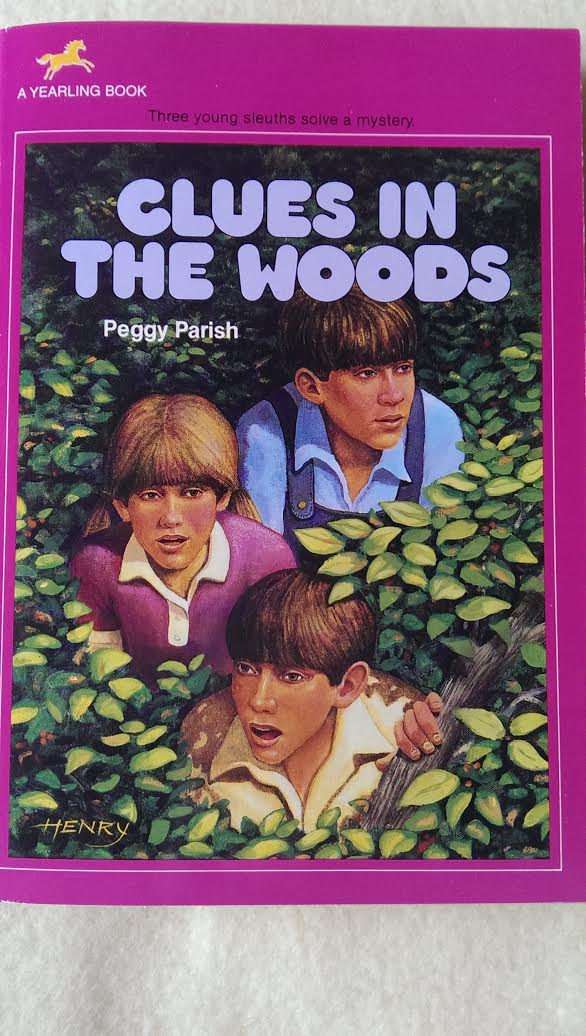
Clues in the Woods by Peggy Parish, 1968.

While Liza, Bill, and Jed are staying with their grandparents, their grandmother starts saving table scraps to give to some neighboring children who have adopted some kittens but who don’t have much money to buy food for them.  Unfortunately, someone keeps taking the scraps when the grandmother leaves them by the back door.  The grandmother even tries leaving them inside the can by the back door to make sure that no other animals can get to them, but they still disappear.  Although it doesn’t sound as exciting to the children as solving their family’s old treasure hunt was, the Roberts children decide to take on the case for the sake of the poor kittens!

The kids try sitting up and night and watching from a window, but Bill’s impatience and temper keep them from seeing what happens at the right moment and causes them to accidentally break their grandmother’s lamp.

They adopt a puppy from a neighbor and keep him on the back porch, hoping that he’ll bark if anyone trespasses out back, but the puppy suddenly disappears!  Can the children find both the scraps thief and their poor puppy, Jelly Bean?

Just when the kids think that they have everything figured out, they learn something surprising that changes everything!

This book is part of the Liza, Bill, and Jed Mysteries series.  It is available to borrow and read for free online through Internet Archive.

clueswoodspic1

Key to the Treasure

keytreasureKey to the Treasure by Peggy Parish, 1966.

When twins Liza and Bill and their older brother Jed visit their grandparents for the summer, their grandfather tells them the story of a treasure hidden somewhere on their farm. Over a hundred years ago, their great-great-grandfather was friends with an Indian (Native American) woman. When she died, she left her belongings to him, including a feathered bonnet, a leather shield, a mask, and a doll.

When he grew up, he went away to fight in the Civil War. Before he left, he hid three of the items (the shield, the mask, and the doll) and made up a series of clues to help his children find them.  Unfortunately, the first clue was lost, and he never returned to tell his children where he hid the treasure. The only clue that was left was a picture of the feathered bonnet, a little pot, and a strange-looking key.  From then on, each generation in their family has tried to solve the puzzle. Since so many generations of their family have failed to find the treasure, Liza, Bill, and Jed don’t have much hope for success until they accidentally stumble on something that gives them their first clue.

keytreasurepic1Together, the three children quietly work on the clues, following each to the next.  They hope to surprise their grandfather with the solution to this old family mystery.  But, can they?

The clues to the treasure take the form of word games and codes (the first is a simple substitution code, and the other two are word games). Young readers will find it challenging to solve the codes along with the children in the book (Liza, Bill, and Jed walk readers through their solutions as they work on the puzzle, even showing how they correct for mistakes along the way), although older readers may find them rather easy.  It’s a good book for introducing children to codes and word games if they haven’t really encountered them before.  For the challenge of it, you can stop reading at each new puzzle and attempt to solve it before the kids do!

This is the first book in the Liza, Bill, and Jed Mysteries series.  It is currently available online through Internet Archive.

The View From the Cherry Tree

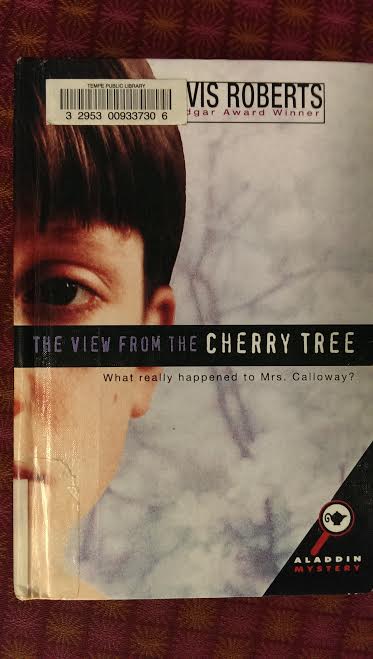
viewcherrytreeThe View From the Cherry Tree by Willo Davis Roberts, 1964.

Things have been difficult around Rob Mallory’s house since preparations for his sister’s wedding began, but things are about to get a whole lot worse. While his mother and sisters are rushing around, making last minute arrangements for the wedding guests and finding a replacement for a sick bride’s maid, Rob’s father is trying to help Uncle Ray stay out of jail after he stole some money from his boss. To make matters worse, old Mrs. Calloway, their unpleasant, eccentric next door neighbor, has been causing trouble again, spying on people with her binoculars and provoking arguments with everyone in the neighborhood.

The only peaceful place Rob can find to escape all the chaos at his house is the cherry tree that stands between his house and Mrs. Calloway’s. While he is up in the tree, Rob witnesses an argument between Mrs. Calloway and a man Rob can’t see inside her house. Then, Rob sees the man shove Mrs. Calloway out of her window. Her binoculars get tangled on a tree branch, and she is strangled to death. Rob runs to his house to get help, and the authorities come and take Mrs. Calloway’s body away. However, no one believes Rob when he says that Mrs. Calloway was pushed. Everyone thinks that her death was an accident. Then, a series of strange “accidents” happen that seem to threaten Rob’s life.

Rob’s family is too caught up in the wedding plans and family troubles to realize what is happening, but Rob is convinced that Mrs. Calloway’s murderer is trying to silence him forever.  Can he outwit the murderer and learn his identity?  More importantly, can he survive until the evening when his father is supposed to return home and can help him convince the police that he’s in real danger?

I have to say that I really hated the mother in this story.  She struck me as being a very silly and shallow woman, obsessed (and that is not too strong a word) with the trappings of her daughter’s wedding.  She speaks of the wedding as an “opportunity” that she doesn’t want spoiled, a word that seriously bothers me in this context.  “Opportunity” implies some kind of expected benefit, not just a momentous “event” in their lives or a rare “celebration.”  I kept wondering, and still wonder what kind of gains she was anticipating from her daughter’s marriage and why.  The only thing I can think of is a selfish desire to be at the center of attention, or as close to it as she can get.  As a married woman, she can no longer be the beautiful, blushing bride on her special day, but she might get a vicarious thrill from being the mother of the beautiful, blushing bride, reliving her own glory “day” from the past.

Maybe I’m getting a little too psychological with her, but that was the vibe I got, a grown-up mother-of-the-bride-zilla who can’t see past the champagne and pretty dresses to anything more important, whether it’s her own brother’s serious brushes with the law or the attempts on her young son’s life.  When Rob tries to tell his mother what’s happening, she almost slaps him because she’s so “overwhelmed” by everything that she has to do, but I’m not buying it because it seems like everyone else is really taking care of pretty much everything for her.  She has plenty of people around her and plenty of support if she wanted to recruit more.  She freaks out about any problems that happen, no matter how big or small, and wants to sweep every bad thing under the rug as much as she can because, apparently, weddings should be perfect at all costs and she wants nothing to invade that lovely bubble in her mind.  I didn’t like her when I read this story as a kid, and I’ve discovered that I hate her even more now.  Her motives have become less understandable and her personality less sympathetic now that I’ve grown older instead of more so, and that’s not a good sign.  As an adult, I would have urged her prospective son-in-law to reconsider marrying into this family on the basis of the mother’s behavior, although the bride’s offer to call off the wedding until her brother is found when he goes into hiding shows that she might have her priorities more straight than her mother’s in the end.

The book is currently available online through Internet Archive.

Mystery Aboard the Ocean Princess

MysteryOceanPrincessMystery Aboard the Ocean Princess by Robin Gottlieb, 1967.

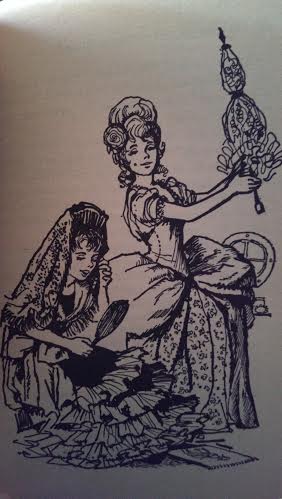
Jill Washburn is about to make her first trip to Europe on the same ship as a priceless painting!  Her Uncle Chow and Aunt Rose have invited her to accompany them on the cruise ship to Europe over the summer because her cousin Connie isn’t enthusiastic about the trip, and they thought that the girls would be good company for each other.  Lately, Connie has been trying to act ultra-sophisticated, declaring anything and everything that she doesn’t think is cool to be simply “tedious” (Connie loves big words, and “tedious” is her pet word).

Jill is fascinated by the presence of the famous painting on the ship, a painting of a young Spanish prince by Goya, “Don Manuel Osorio de Zuñiga.”  Jill loves art, and her ambition in life is to be an art teacher, like her father.  She has also read about recent art thefts in the newspaper and wonders whether Don Manuel is at risk during its journey.  She can’t help but seek out the room where the painting is kept and talk to one of the guards about security.  The guard just tells her that he appreciates her concern but that everything is under control.  But later, Jill finds the guard meeting secretly with a mysterious man by the lifeboats.

MysteryOceanPrincessPicCould the two men be plotting to steal the painting?  Jill persuades Connie to help her investigate and spy on the them, but things aren’t what they seem.

A mysterious gift left in Uncle Chow and Aunt Rose’s cabin frames Jill’s aunt and uncle for art theft.  Although Connie thinks their snooping has caused enough problems already, Jill thinks that the only way to clear their names is for her and Connie to find the real thieves.  With the ship’s costume ball coming up, Jill comes up with a daring scheme to get the thieves’ attention and hopefully get them to reveal themselves.  One thing is for sure: Connie was wrong about this trip being “tedious.”

Chitty Chitty Bang Bang

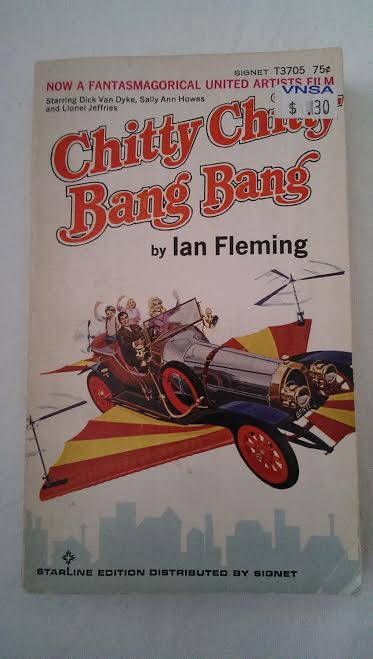
ChittyChitty Chitty Bang Bang by Ian Fleming, 1964.

Not everyone is aware that the creator of James Bond wrote a children’s book, although the movie Chitty Chitty Bang Bang is a children’s classic.  However, the movie differs greatly from the original book, which doesn’t have anything to do with a toy-obsessed baron who has forbidden children in his kingdom, and there is no Truly Scrumptious (sorry).

Commander Caractacus Pott, retired, is an explorer and inventor who lives in a little house in the countryside with his wife Mimsie and their children, a set of eight-year-old twins named Jeremy and Jemima.  Some of the locals call Commander Pott, “Crackpott” because of his strange inventions, which never earn him very much money until one of this inventions pays off when he sells the candy whistles he creates to Lord Skrumshus’s candy company.

With the money he earns, Pott decides to buy something that his family has wanted for a while: their own car.  But, they don’t want just any boring car like everyone else.  They want something special.  They find it when they spot a former racing car that’s due for the scrap heap.  No one wants it because it would take a lot of time and money to fix.  The Pott family falls in love with it immediately, and Jemima thinks it might even be magical because the license plate says “GEN 11”, which looks like “genii” (or “genie”).  The garage man is relieved to find a buyer who appreciates the car’s history and potential and says that she’s sure to reward them for saving her from being scrap.

After Pott spends a great deal of time fixing up the car (which they name “Chitty-Chitty-Bang-Bang” because of the sounds it makes) and adding some additional inventions of his own, he begins to suspect that both Jemima and the garage man are right: the car is magical and does want to repay them for saving her life.  He starts to notice changes that the car makes to herself overnight, adding extra buttons and features that he knows he didn’t put there.  He’s not sure what they’re for until the family gets stuck in traffic the first time they decide to take the car out for a picnic. Messages on the car’s dashboard light up, telling Pott to pull some of the car’s mysterious levers.  When he does, the car sprouts wings and flies over the other cars in front of them, over towns and beaches, and even over the English Channel!
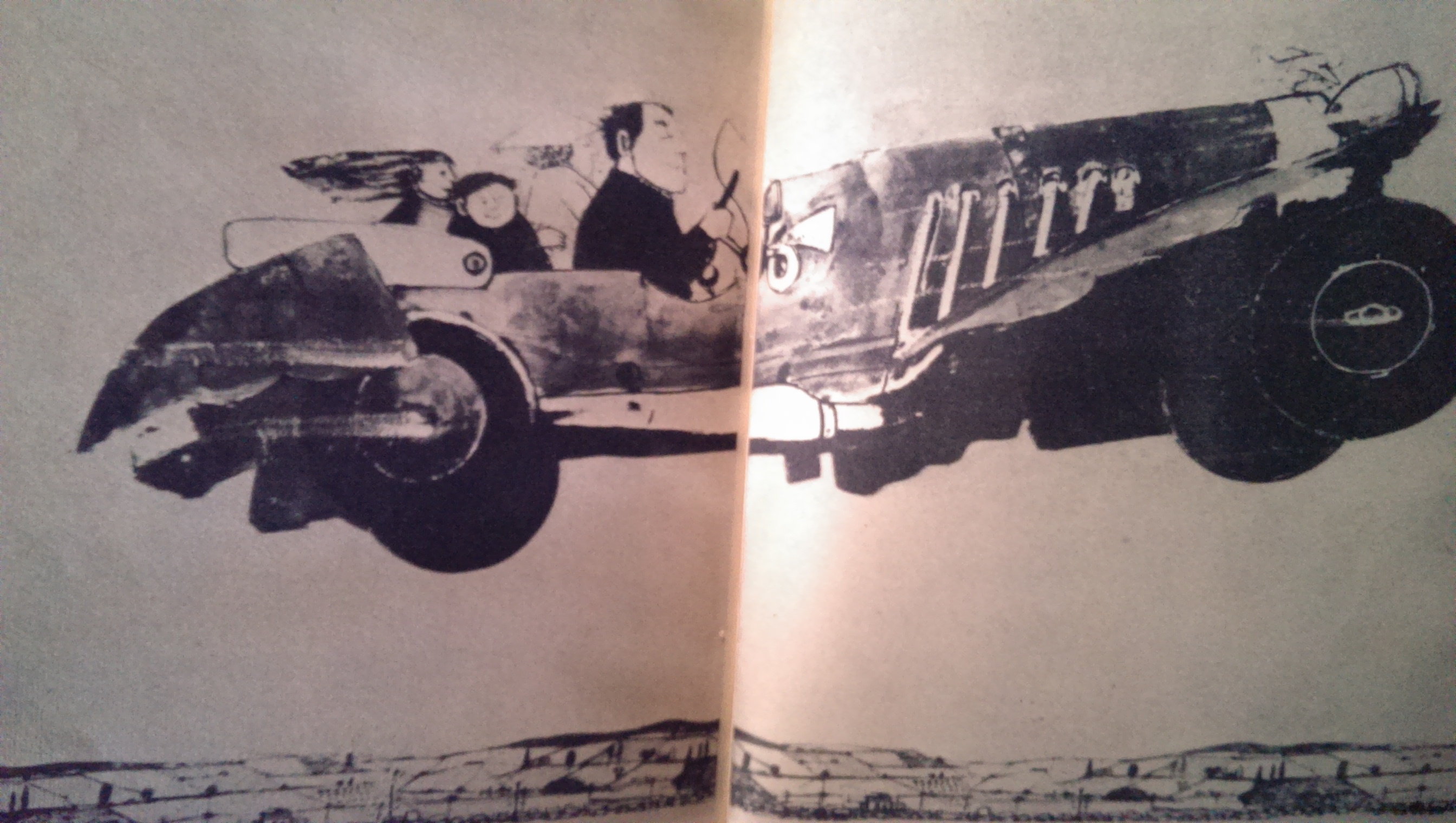
ChittyPic2

Chitty-Chitty-Bang-Bang takes the Pott family to a sandbar so they can have a private beach all to themselves.  But, that’s only the beginning of their adventure!  Chitty-Chitty-Bang-Bang can also turn into a hovercraft, and the family decides to take it on a special holiday to France.  When they reach the coast of France, they find a cave and start to explore it.  Someone has set up various devices inside to scare people away, but that only makes the Pott family more curious and determined to find out why.

It turns out that the cave is a hideout for a band of smugglers, and when the Pott family destroys it, they want revenge!

ChittyPic1

At the end of the book, there is a recipe for “Monsieur Bon-Bon’s Secret ‘Fooj'” (they mean ‘fudge’, Monsieur Bon-Bon is a character in the story).

Having known the movie version since I was a kid, I really prefer the movie to the book.  With a magical car at their disposal, the more fairy-tale story about the castle and tyrannical, toy-obsessed baron seems more fitting than the story about smugglers.  But, that being said, the book is still a lot of fun.

The book is available to borrow and read for free online through Internet Archive.