The Mystery of the Disappearing Cat

Five Find-Outers

The Mystery of the Disappearing Cat by Enid Blyton, 1944, 1966.

Bets is happy that her brother, Pip, is coming home from boarding school, and he’s bringing his friends to visit. Now that the children are reunited, Bets and the others hope that they will find another mystery to solve! The others ask Bets if anything interesting has happened since they were home last, and she says not very much, although someone has moved into the empty house next door. The new neighbor is Lady Candling, who keeps Siamese cats.

The boy who helps the gardener, Luke, is nice and allows the children to visit and see the cats. Lady Candling says that the Siamese cats are valuable prize-winning cats. She keeps them in a large cage most of the time for safety, but Miss Harmer, the housekeeper, takes one out to show the children. Unfortunately, one boy, Fatty, owns a Scottie dog named Buster, and Buster comes into the garden looking for him. Buster frightens the cat and chases her! The cat claws Buster after he chases her into the bushes, and they manage to get Buster under control, but they have trouble finding the cat. Miss Harmer is upset that her cat is lost, and Bets goes to search for the cat.

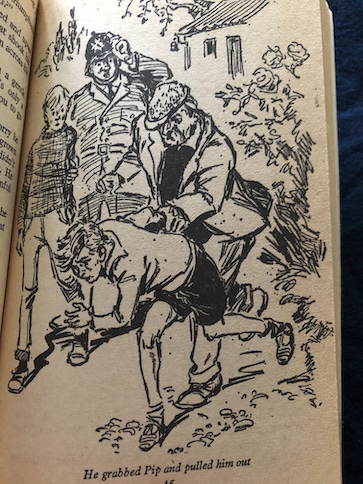
While Bets is looking for the cat, the gardener, Mr. Tupping comes to find out what the fuss is about. Mr. Tupping is a violent and short-tempered man. (They also emphasize that he has a hooked nose, which I think is probably a stereotype. Enid Blyton’s books often contain derogatory racial stereotypes, although later printings have been revised to remove them.) Mr. Tupping hates children and animals, and he grabs Buster and locks him up, threatening to beat him later. The children try to help Buster, but he chases them out of the garden. Bets is left behind, but she locates the missing cat, and Luke helps to free Buster and get Bets out of the garden without Mr. Tupping seeing her. However, Mr. Tupping threatens Luke with dire consequences if he ever lets the children into the garden again.

This is just the beginning of their troubles with Mr. Tupping. When Mr. Tupping finds out that Bets has visited Luke again, he storms into Bets’s own little garden, rips her strawberry plants out of the ground, burns them, and yells at her. Bets is afraid to report him to the adults because she’s afraid that Luke will get in more trouble with Mr. Tupping. Luke is a poor orphan who lives with his stepfather, and he desperately needs the job, which is the only reason why he continues to work with the nasty Mr. Tupping. Mr. Tupping is also friends with the local policeman, and the children know that the local policeman resents them for solving a mystery before he did, so they’re sure that he will side with Mr. Tupping, no matter what they say about him.

Then, Lady Candling’s prize cat, Dark Queen, disappears, and Luke is blamed for stealing her! The children are sure that Luke is being framed for the cat-napping, but the evidence is against him. Pip and Bets’s own mother saw the cat in its cage when she went to tea with Lady Candling, and Luke was working in a garden bed nearby. Even Luke says that no one else went near the cage between then and the time when the cat disappeared. When a wooden whistle Luke made is found in the cats’ cage, the children are sure that it was planted to frame Luke, but how can they prove it? Then, the cat reappears, and later disappears again! What is going on?

The book is available to borrow and read for free online through Internet Archive (multiple copies).

My Reaction and Spoilers

I found this story frustrating because all of the adults in the story are so oblivious to Mr. Tupping’s violence and aggression. He is actively abusive to the children and animals, but nobody seems to notice or even inquire about signs of trouble. Bets’s mother never seems to notice that all of her daughter’s strawberry plants have suddenly disappeared from her garden and never asks her daughter what happened. Mr. Tupping is able to just march onto the family’s property and abuse an 8-year-old girl with complete impunity, and her mother never notices a thing. (Of course, if I were the girl in question, I would have done what I used to do when I was picked on as a kid – take a deep breath, throw back my head, and scream continuously until help arrives. I figured out at a young age that if you scream from your diaphragm, you can get extra volume and keep the scream going for longer without straining your throat, and it’s difficult for the adults to ignore. You can’t scream like that at every inconvenience or people will start to ignore it, but it’s definitely an attention-getter if you use it when it really counts! Just let Mr. Tupping explain his presence and actions when the adults come to find out why their daughter is screaming like she’s being murdered!)

Mr. Tupping is a very obvious villain. He’s also the first person on the scene each time the cat disappears, the one who strategically assigns Luke to work near the cats’ cages just before the prize cat disappears each time, and the keeper of the key to the cats’ cages when Miss Harmer is away, which she is each time the prize cat disappears. Yet, even though he has means (the key), motive (he hates the kids and animals and wants to get rid of Luke), and opportunity (always the first person in the cats’ cages whenever the cat disappears and the one person who controls where Luke is working), all of the adults immediately look at Luke as the thief, never even questioning Mr. Tupping. An adult would be more likely than a kid to know where to sell a prize-winning cat (heck, as a an adult, I wouldn’t even know where to deal in black market animals), but nope, all of the adults first think a kid did it, like kids have those kinds of criminal connections to the prize cat black market. It drove me completely crazy!

It’s worse because Mr. Tupping is friends with the local policeman and gets favoritism because of it. When the kids consult their friend who is a police inspector, he finds out that Mr. Tupping has a police record for being involved in a dog-napping case (surprise, surprise), which establishes his criminal history and connections to people who deal in stolen animals. I was disgusted that the local policeman never looked into his background himself, but I felt a little better when the inspector reprimands him for making friends with a criminal and overlooking evidence that implicated him and trying to prevent the children from bringing evidence and concerns to light. The local policeman is embarrassed, but at that point, I felt like he deserved to be.

The villain was obvious, but what saved this mystery was that he actually used a clever trick to confuse the time when he actually took the cat. I knew from the beginning who the cat thief was, so the real mystery for me was how he got the cat out of its cage without people seeing him. It turns out that Mr. Tupping takes the cat earlier in the day than everyone thought the cat was stolen. The Siamese cats look very much alike, but the one that was stolen had a marking that was different from the others. With a bit of paint, Mr. Tupping makes a different cat look like the missing one for most of the afternoon, quickly using a bit of turpentine to remove the paint at a strategic moment to make it seem like the cat disappeared at a time when Luke was near the cats’ cages.

Five Go to Demon’s Rocks

Famous Five

Five Go to Demon’s Rocks by Enid Blyton, 1961.

Uncle Quentin and Aunt Fanny are expecting their daughter George and her three cousins and dog to come for a visit because their parents are going away on a cruise when Uncle Quentin hears from a friend of his, a professor, who also wants to come for a visit to discuss his latest invention.  Aunt Fanny says that they won’t be able to accommodate the children and the professor at the same time, and Uncle Quentin had better tell the professor not to come. However, Professor Haling is already on his way, and he’s bringing his son with him.  The children have also already left home, so there’s nothing for them to do but try to accommodate their guests as well as they can.

It’s not going to be an easy visit.  Uncle Quentin and Professor Haling both want quiet to discuss their work, but the professor’s nine-year-old son, Tinker, is obsessed with cars and keeps making noises to imitate them.  Tinker has also brought his pet monkey, Mischief, with him.  At first, Mischief and George’s dog, Timmy, don’t get along with each other.  The animals eventually make peace with each other, but Uncle Quentin and Professor Haling decide that they can’t put up with the children’s noise.  Uncle Quentin insists that Aunt Fanny send the children away somewhere so they can continue their important work. 

Aunt Fanny doesn’t like it that such important men, who are admittedly working on things that will help people, don’t seem as interested in making their families happy, and George points out the hypocrisy that Uncle Quentin can’t stand their noise when he often slams doors that interrupt her studies and that he wants to push her out of the home where she lives, too.  Aunt Fanny says that part of the problem is that George and her father are too much alike, but the noise issue and overcrowding in the house are still problems that have to be solved.

The children ask if they can go camping, but Aunt Fanny says that it’s too cold for that.  Tinker suggests that they could all go to his lighthouse. They ask him what he means by “his” lighthouse, and Tinker happily explains that he owns a lighthouse. Actually, his father bought it when he was working on an important project and wanted a quiet place to stay where he wouldn’t be interrupted by phone calls or visitors or other distractions. When his project was finished, he no longer cared about the lighthouse, but Tinker love it, so his father gave him the key and told him that it could be his lighthouse now. The other children are amazed at the idea of a private lighthouse, and they agree to go there. Aunt Fanny agrees to let them go, and they begin planning for the trip. It’s at a place called Demon’s Rocks.

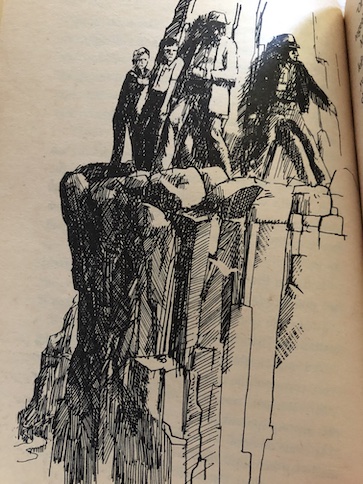
On the way to the lighthouse, their taxi driver, who was born at Demon’s Rocks tells them a little about the history and legends of the place. He says that it’s called Demon’s Rocks because there are formidable rocks there that people say could only have been placed by demons. The old lighthouse was meant to steer ships away from the rocks, but one time, some wreckers captured the lighthouse keeper and turned off the light to intentionally wreck a ship so they could raid the wreck for its cargo. The driver says that his great-grandfather still lives in the area, and if they ask him, he can tell them more stories about the place and maybe show them the cave where the wreckers used to hide out.

When the children meet the taxi driver’s great-grandfather, Jeremiah, he is an eccentric old man, but he likes children and even knows how to get along with Mischief the monkey. The children ask him about the wreckers, and he tells them the story about how One-Ear Bill and his wreckers put out the light in the lighthouse and used a lamp to misdirect a ship to make it crash. Jeremiah says he witnessed what they did and reported them, sending One-Ear Bill to prison. But, he says that One-Ear Bill didn’t care that much about going to prison because he hid the treasure that he took from the wrecked ship and expected to be rich when he got out. However, he died in prison, and nobody ever found the hidden treasure. The relatives of the other wreckers have tried to find it, but nobody has ever succeeded. The children are fascinated by the story and ask Jeremiah if he will show them the wreckers’ cave, and he agrees to show them sometime.

A local shopkeeper says that there is a kind of rivalry between Jeremiah and the descendants of the wreckers because the wreckers’ descendants make a marginal living by giving paid tours of the wreckers’ cave. The children don’t really expect that there’s still a treasure hidden in or around the cave. They think that, probably, someone found the treasure years ago and didn’t tell anyone or that the treasure might have been in some insecure spot and got washed out to sea.

However, strange things soon start happening. Someone steals the key to the lighthouse when Tinker leaves it in the lock and some other things from the lighthouse. The local police discover one of the wreckers’ descendants, Jacob, stole the things from the lighthouse, and the children get them back, but they can’t find the key on Jacob.

Then, when Jeremiah gives the children a tour of the cave, Mischief gets lost and finds a gold coin. The children aren’t sure where Mischief found the coin or if there are any others, but they begin to think that maybe the treasure is still in the cave after all. They also begin to consider that there may be a tunnel that leads from the lighthouse to the cave. However, someone else seems to have the same idea, and they’re trying to stop the children from finding the treasure before they do!

My Reaction

Part of the concept of the Famous Five series is that the children are very independent and have adventures that are unsupervised by adults. Children like stories about independent kids, but as an adult, I’m still struck by the family relationships the children have. I’ve noticed that the adults in Enid Blyton’s stories often have personal issues or dysfunctional relationships.

The reason why the children are having their independent adventure in this story is that the children’s fathers are too absorbed in their work and bothered by the presence of the children, so they just want them out of the house. Although George likes having adventures with her cousins, she does feel a little resentful that her father is basically pushing her and the others out of the house. I particularly noticed the part where Aunt Fanny reflects that important men who are working on things that will help people, don’t seem as interested in making their families happy. Uncle Quentin seems oblivious about the effect he has on his family, and when the children are getting ready to go to the lighthouse, he seems confused about where they are going, apparently having even forgotten that they were going anywhere. I keep getting the feeling that part of the reason why the children are so independent is that the adults in their family aren’t particularly nurturing and don’t make their home lives very pleasant.

Tinker’s home life isn’t terribly happy, either. His father is very permissive, letting him have a pet monkey and even giving him the lighthouse, but he also seems pretty oblivious to the things Tinker does. The other children find out that Tinker’s mother died giving birth to him, and with his father so utterly absorbed in his work, Tinker hasn’t had much supervision or guidance in how to behave, which is why he’s so wild. Tinker’s father takes him places and lets him have things or do things that other children can’t, but he doesn’t seem to get much personal attention or affection from his father. At one point, the other children are sending post cards home, and Tinker says there’s no point in sending one to his father because he won’t read it. That says a lot, and the other children feel sorry for him.

What I’m saying is, while I like the adventure and would have loved that sense of freedom as a kid, as an adult, I recognize that behind the children’s independence in many of the stories are some unresolved family issues and self-absorbed adults. The adults don’t worry as much about the children as most parents would, not only because they trust them on their own, but because they seem too absorbed in their own issues to think that much about what the children are doing and what could happen to them. The children go to boarding school much of the time, but their parents don’t seem too eager to spend time with them and bond as a family during their breaks, content to let them go off by themselves so they can get back to what they were doing. This also seems to be the case in other series by Blyton, like the Adventure series, which starts off with a pair of siblings going to stay with an aunt and uncle who seem to have a dysfunctional marriage and a pair of orphans who live with a strict uncle who seems to see them as a nuisance. Since the kids are fictional and the children’s circumstances are only there to set up their adventures, it’s not that big of an issue to enjoying the adventure, but yet, as an adult, these things do jump out at me.

Mystery of the Inca Cave

Mystery of the Inca Cave by Lilla M. Waltch, 1968.

Thirteen-year-old Richard Granville has been living in Peru for the last two years. His family moved from California to a mining town in the Andes because his father is a manager for a mining company. Richard enjoys living in Peru because he’s developed an interest in archaeology and the history of the Incan civilization. Richard feels like the mountains are a connection to the distant past, and he loves the historical feel of the place. His parents don’t understand how he feels and would rather see him work harder at his schoolwork instead of spending all of his time exploring the mountains. Richard’s father tells him that he won’t become an archaeologist if he doesn’t apply himself to his studies, and his mother worries that something could happen to him in the mountains. They think he should finish school first and then decide if he wants to go into archaeology or not, but Richard’s mind is already made up, and he doesn’t want to waste this golden opportunity to do what he loves most right now. Richard feels hurt that his parents don’t really listen to him, don’t share his interests, and don’t appreciate the finds he’s already made.

Richard loves to explore the area with his friend, Todd Reilly, and see if they can find pieces of Incan relics. They’ve found some interesting bits of pottery and broken tools, but one day, they make a particularly exciting discovery – an ancient stone road mostly covered with grass. Although Richard knows that there are many other remains of Incan roads, this one is particularly tantalizing because it seems more hidden than most. Richard is fascinated with how neatly the stones of the road fit together so precisely without mortar, and he wonders where the road leads.

The boys explore the old road further, but they discover that at least part of the road was buried in a landslide. Todd doubts that they’ll ever be able to find where the road leads, but Richard wants to keep trying. When they return to the spot to try again, Richard spots the remains of an ancient building! Richard is sure that the building was once a chasqui station (also called tambos), which was a place where Incan messengers could stop, rest, and trade off with other messengers, who would continue to carry messages along the route, like the members of the Pony Express used to trade off with each other. Richard knows that stations like that were placed about 2.5 miles apart along roads, so there might be other stations located along this route.

The boys go a little further and find a stairway leading up the side of a cliff to a cave. On the stairs, Richard finds a small doll. The doll is puzzling because Richard isn’t sure if it’s an Incan relic that somehow managed to survive or if it’s a more modern doll made by the South American Indians in the area. He has trouble believing that any more modern person could have been at this spot recently because it’s pretty isolated and rough territory. It looks like other landslides could happen. He can’t tell his parents about his discovery because they probably wouldn’t let him return to the area to explore it further if they knew how dangerous it was, and he can’t bring himself to abandon the most exciting discovery he’s ever made.

On a trip to the marketplace, Richard and Todd spot a mine foreman, Jeb Harbison, yelling at a boy in Quechua. He stops as soon as he sees the other boys watching, and they wonder what that was about. Then, the boys spot a merchant selling dolls that are similar to the one they found at the ruins. They ask the merchant where the dolls came from and who made them, and he gives them the name of the doll maker, a woman named Deza. Todd thinks that the most likely explanation for the doll they found is that some young girl living in the area got a doll from the same doll maker, and she lost it while playing around the cave. However, Richard doesn’t think that’s likely because the cave is such an out-of-the-way place, not somewhere a young child could easily reach alone.

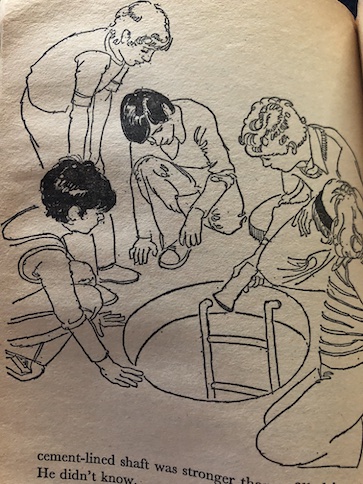
On another visit to the area of their discovery, the boys find a mine shaft that doesn’t belong to the company their fathers work for, even though it’s on land that they know the company owns. There are signs that someone is actively mining there, but who?

The boys also discover that the activity at the cave is connected to the mine when they see some men there, breaking up rocks and stuffing them inside of little dolls, like the one they found earlier. It seems like the miners are smuggling gold or other minerals in the dolls, but when the boys talk to Richard’s dad about what they’ve seen, the situation points to a possibly larger conspiracy.

The book is available to borrow and read for free online through Internet Archive. The book was originally titled Cave of the Incas.

My Reaction

The first thing that I liked about this book was the pieces of information about the ancient Incas. Our knowledge of ancient civilizations has increased since the 1960s, but the information in this book is still good. I liked the book’s descriptions of Inca building techniques, how they used closely-fitted stones instead of mortar, and how their system of messengers was organized. There are also points where the characters notice parallels between the way the ancient Incas lived and the way their descendants live, such as their system of cooperative farming.

However, this story is also about human relationships as well as adventure, mystery, and ancient civilizations. Through most of the book, Richard is troubled about his relationship with his parents, especially his father. His parents are frustrated with him because he is absorbed by his interest in archaeology and exploring the countryside and isn’t applying himself to his schoolwork. At the same time, Richard hates it that his parents don’t understand what interests him and only seem to want him to focus on what they want. They’re having a clash of priorities.

When I was a kid, I hated homework with a vengeance. That might be a surprising revelation about an adult who willingly does what are essentially book reports on a regular basis as a hobby. Reading is fun. Research produces interesting information. I like knowing things and writing to other people about them. Basically, I was always good at the skills necessary for homework, so that wasn’t the problem. The problem is that there were many other things I wanted to do, and homework got in the way. I didn’t always get to read about what I wanted to read about in school because someone else was always choosing the school material for me, and I frequently hated their choices. Even the arts and crafts weren’t always the ones I wanted to learn, and I was usually told what to make instead of getting to make what I wanted. Because I was a good student, I ended up in the honors classes, so I always had more homework to do than everyone else. I was proud that I was a good student, but at the same time, I also hated it because I found it stifling. I’ve always been interested in many different subjects and handicrafts, but all through my childhood, I felt like I could never just take up all the different projects I wanted to do because I had to do my never-ending supply of homework first. Everything I wanted to do always had to wait. Even after I graduated, it was difficult for me to shake off the feeling that I had to wait on things I wanted to do , which was also kind of irritating.

I could sympathize with Richard’s attitude toward his own studies. He knows what he really wants to do, and he finds it infuriating that his parents want him to put it off and finish his homework and his education first. There is something to be said for making the most of finding himself in the very place he wants to be with direct access to what he knows he wants to study seriously. The move to Peru was an enriching experience for Richard that gave him a direction and life ambition, and I think he would regret it forever if he didn’t use this opportunity to explore it as much as possible. At the same time, though, my adult self knows that there is truth to what Richard’s parents say about his explorations in the mountains. The mountains are dangerous, like Richard’s mother says, and even Richard knows it. Also, Richard’s father is correct that if Richard seriously wants to be a professional archaeologist, he’s going to have to finish his education.

Nobody in modern times becomes a serious, professional archaeologist without a college degree, and even archaeologists need to study things beyond their specialist field. Archaeology isn’t just wandering around, digging, and seeing what you find. You have to recognize what you find, study its context, understand its significance, and know how to treat it to preserve it. You can’t study past lives and interpret artifacts without having real life and world knowledge. Archaeology is also where science and history intersect. Archaeologists need to know mathematics, geology, and how humans are affected by climate (which can and does change over time, for various reasons) and access to resources. There are legal and ethical principles to archaeology that Richard will also have to understand. Archaeologists can also benefit from learning drawing and photography to record and interpret finds and perfecting their writing skills to present their findings to the world. Richard has made a good start in his field of interest, but to get serious about it, he will need more education and greater depth and breadth of knowledge.

As annoying and stifling as homework feels, the skills it imparts are necessary for doing many more interesting things. Getting through the studying phase can be a pain, but sometimes, you really have to lay a solid foundation before you can build something solid on it. I still think that my past school assignments could have been more interesting and less stressful if I’d had more flexibility about them and more time for personal projects in between. However, I have realized over the years that, once you’ve really learned something, you will use it, even if you only use it indirectly as part of something else. I don’t regret learning the things I learned because, as hard as it was along the way, I have used things I learned in more interesting ways later in life. I’ve also realized that, if I had spent less time and emotions complaining about how stifling my homework situations were, I also could have used the time I spent lamenting about homework and procrastinating about it to accomplish some of the other things that I complained that I never had enough time to do. Not all of them, but more than I did when I was too busy being upset and resentful about homework. That’s also a lesson that Richard learns in the story.

At one point, Richard talks to Todd about his relationship with his own father, and Todd says that they get along pretty well. Richard realizes that Todd and his father don’t fight over his studies because Todd is an easy-going type who doesn’t mind doing his homework much and takes care of things without making anybody nag him to do it. Todd just accepts that there are some things that just need to be done, so he doesn’t waste time complaining or procrastinating about them. That’s harder for Richard because he feels the strong pull of what he really wants to do.

Todd admits that he and his parents don’t always get along perfectly because he doesn’t always do what he’s supposed to do. There are times when he leaves messes or physically fights with his brother or talks back to his mother, and his parents get angry or irritated about it. When Richard asks Todd what he does in those instances, Todd says that, eventually, after the initial argument, he typically apologizes or cleans up his mess or does whatever he needs to do to fix the situation. Todd’s reasoning is that, while people aren’t perfect and don’t always do what they should, “when you’re wrong, you’re wrong.” He accepts that, sometimes, he screws up and needs to do something to fix it without getting too overwrought about having been in the wrong. He sees it as just a normal part of life. When it happens, he can correct himself and move past it.

In the case of Richard and his father, each of them has to admit to being a little wrong and accept that the other is partly right. Both of them have to do some work to fix their relationship. Richard has to admit to his father that he does need to continue his education and apply himself to getting his work done. In return, his father needs to try harder to understand Richard’s interest in archaeology and allow him some time and opportunities to make the most of his time in Peru, getting the firsthand knowledge and experience he needs for the future he really wants and that won’t come from the standard classes he’s taking.

Through their adventures in the course of the story, Richard and his father come to a better understanding of each other and have an honest conversation about how to manage the conflicts in their relationship. Richard’s father admits that he needs to stop looking at his son as being just a younger version of himself and to see Richard for the independent person he is, with his own interests and goals in life. Meanwhile, Richard connects somewhat to his father’s interests through their investigation of the illegal mining operation he and Todd discovered.

This mystery story is a little unusual for children’s books, where kids often investigate mysteries on their own, having adventures without the adults, because Richard’s father joins the boys in their investigations and he stands up for them and what they’ve discovered when their discovery is challenged. The shared adventure becomes a bonding experience for Richard and his dad. At the end of the story, Richard’s father helps Richard connect with a museum curator, who helps the whole family to see the true value and significance of Richard’s archaeological finds. The curator also emphasizes to Richard that, while he has the potential to excel in his chosen field, he’s going to have to study and move on to higher education to get where he wants to go. Richard agrees, now having a greater understanding of its importance and satisfied that his parents understand the direction he’s chosen for his life.

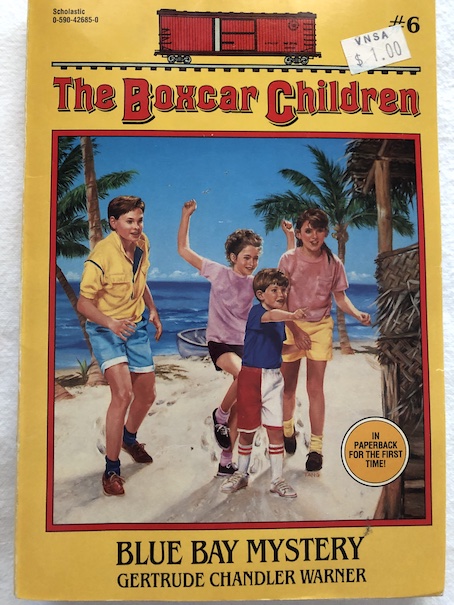
Blue Bay Mystery

The Boxcar Children

#6 Blue Bay Mystery by Gertrude Chandler Warner, 1961, 1989.

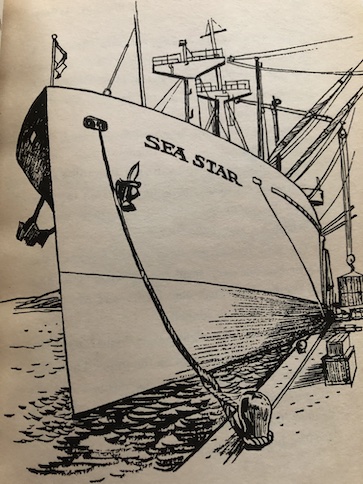
Grandfather Alden has a surprise for his grandchildren. He is arranging a special trip for them as an extension of a business trip of his. A business associate of his, Lars, has a ship going to Tahiti, and he offered to let them come along. However, rather than just having a tour of Tahiti, which would be pretty exciting by itself, Lars is going to take them to camp out on a tropical island. Lars found this island while escaping from a shipwreck himself. No one lives there, but there is plenty of fresh water and edible plants and no dangerous animals. Not every family would like to be on an uninhabited island when they could be in Tahiti, but the kids love camping out and do-it-yourself activities. Grandfather Alden has also invited the children’s friend, Mike Wood (who was introduced in a previous book), to join them. Mike is the same age as Benny.
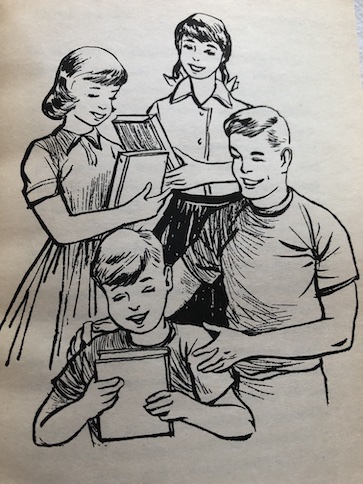
The trip will take place during the school year, so their grandfather has arranged for the children to bring along some school supplies and lessons to study while they’re on the boat to the island. The lessons help not only to pass the time while they’re traveling but also to enhance it. They have science lessons about marine animals and how parts of the ship, like the radio room, work. Violet tells the others about how she’s been reading about Captain Cook and how he realized that eating certain types of food, like citrus fruit and sauerkraut, helped to prevent scurvy, even though he didn’t realize that the reason is that those foods are rich in vitamin C.

Once they reach the island, their grandfather says that they won’t have time for school lessons because they will have to set up their shelter and learn how to fish and forage for food, although he considers those to be educational lessons as well. They bring some supplies and tools with them so they won’t have to forage for everything, but the kids like assembling their own shelter and improvising things, like they did when they made their own home in a boxcar in the first book. They eat out of shells they find, whittle their own spoons, and use a huge turtle shell they find as a cooking pot.

However, they soon realize that they are not as alone on the island as they thought. Some of their food disappears, and they find some colored stones arranged in patterns. There is a stone with a carved face, sort of like the Easter Island heads, and the turtle shell they find has been carved with a knife. Later, they encounter a myna bird who keeps repeating the phrase, “Hello, Peter!” Someone taught the bird the phrase in English, but who is on the island, and why does this person seem to be hiding from them?

The book is available to borrow and read for free online through Internet Archive (multiple copies).

My Reaction and Spoilers

In the early Boxcar Children books, the children aged as the series progressed. After the death of the original author, when other authors continued the series, the children became frozen in age, but this book is one that was written by the original author. At the beginning of the story, the children’s grandfather mentions that the two oldest children, Henry and Jessie, are in high school, showing that they’ve aged about two or three years from the first book. This remark about the children’s ages only appears once at the beginning of the book, and their increasing ages aren’t really reflected in the story. The lessons the children have on the boat seem to be roughly about the same subjects, although it seems like the children’s lesson books aren’t identical because Violet seems like she’s the only one with the lesson about Captain Cook and scurvy.

This book also varies a little from the other books in the series because the children’s grandfather plays a larger role than usual. One of the hallmarks of the Boxcar Children books is that the children usually do things by themselves, with as little adult help or interference as possible. However, this time, their grandfather is with them on the island, sharing the adventure with them.

As with other vintage children’s mystery series, the early books of this series sometimes lean more toward adventure than mystery. The mystery in this story is pretty light, and the solution is pretty straight-forward. The children eventually find the person who’s camping out on the island with them. The person turns out to be a boy who was also shipwrecked. There was an adult sailor with him before, but the boy, Peter Horn, says that he went swimming one day and never came back, so he’s been alone ever since. The others say that he might have been attacked by a shark but they don’t dwell on it very long, as they do any time someone’s death is mentioned in one of the books in the series, so it doesn’t get too sad. Peter says his parents went overboard while they were escaping the shipwreck, and he doesn’t know whether they’re still alive. Mr. Alden says that he read about some people being rescued from a shipwreck, so it’s possible that they’re still alive. When they return to the mainland, Peter is reunited with this parents for a happy ending.

The Little Red Hen

The Little Red Hen pictures by Tadasu Izawa and Shigemi Hijikata, 1968.

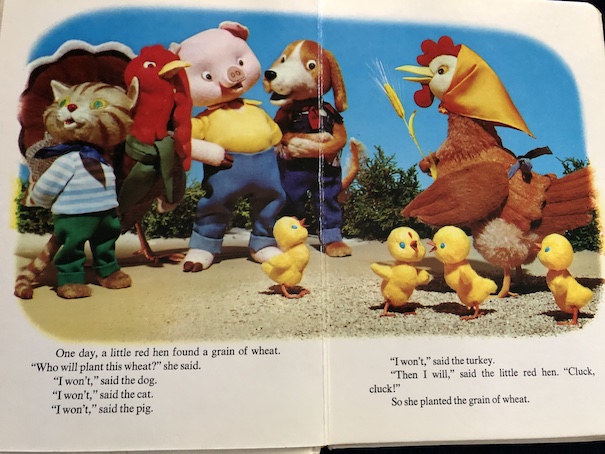
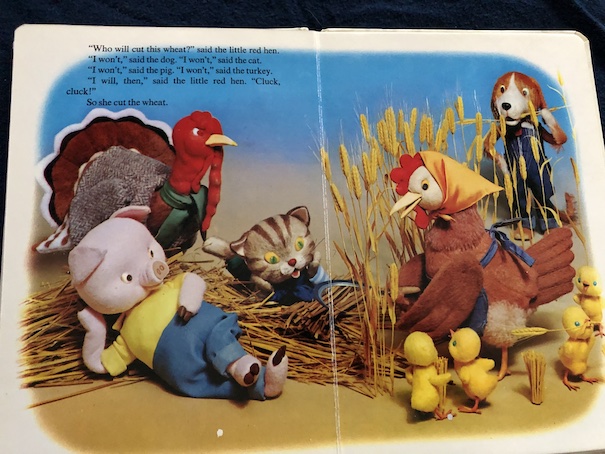
This cute picture book is part of a series of Puppet Storybooks. What makes it distinctive from other picture books is that the pictures are all photographs of tableaux with detailed puppets. The story is a retelling of the classic Little Red Hen folktale.

A hen finds a grain of wheat, but no one is interested in helping her plant it, so she does it herself. When it’s time to harvest the wheat, none of the other animals will help her, so she also cuts the wheat herself.

Because no one wants to help her, she takes the wheat to the mill to be made into flour and bakes it into bread all by herself.

When she has the nice loaf of bread that she has made, all of the animals who didn’t want to help before suddenly come to help her eat it. However, since none of them helped with making the bread, the Little Red Hen eats the bread herself with her chicks.

My Reaction

I’ve had this book since I was a little kid, and I always liked the pictures! The puppets are detailed and posed in realistic ways. The picture on the cover of the book is a 3D hologram, and I was fascinated by it as a young child. It was one of the first holographic images that I saw as a child!

(In my defense, I might not have been the one who scribbled crayon on that cover image. I was pretty good about not drawing on books when I was little, and most of my childhood books were used, so that scribble might have happened before I got it. I don’t remember anymore, so it’s hard to deny it completely, but according to my memory, my messy scribbles were done on the back wall of my closet, behind my clothes, because I knew that drawing on walls wasn’t allowed, and I was realized that if you’re going to draw on the wrong surface, it’s best to do it where nobody’s going to see it and complain. I was sneaky like that.)

While my copy of this book was printed in English, the books in the series were originally written, illustrated, printed, and bound in Japan. I never noticed that when I was a kid because I never bothered to look at the names of the illustrators and had no interest in where it was printed, but I found it interesting as an adult. It makes me think that there are probably also versions of this book written in Japanese, but I’ve never seen any.

How Fletcher Was Hatched

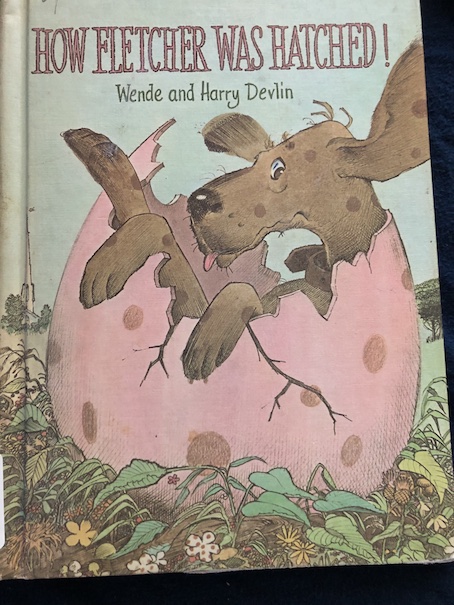
How Fletcher Was Hatched! by Wende and Harry Devlin, 1969.

Fletcher the dog is sad and upset because it seems like his owner, Alexandra, is forgetting about him. She’s been playing with the new baby chicks, which she thinks are cute, and she’s been forgetting to pet her dog or even fill his water bowl!

Distressed, Fletcher goes to see his friends, Beaver and Otter, at the pond. Beaver and Otter don’t have human owners, so they don’t understand Fletcher’s feelings about Alexandra, but they try to think of ways to get her attention. They think it would help if Fletcher could make himself more like the chicks Alexandra has been obsessed with. Aince he can’t make himself small and yellow, they decide that he should hatch out of an egg, like the chicks do. Fletcher is skeptical about this plan, but Beaver and Otter think that hatching out of an egg will be like having a new beginning in his relationship with Alexandra.

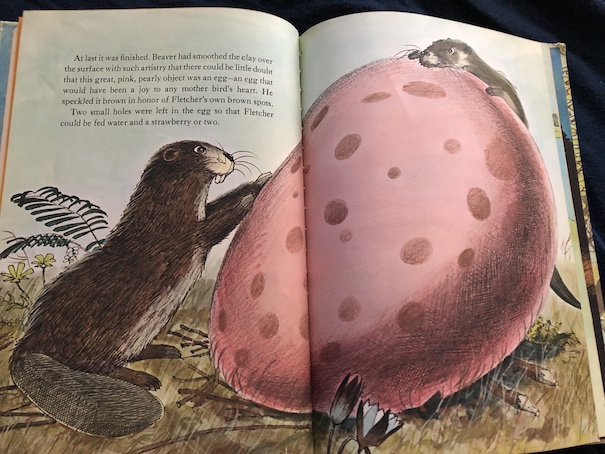
Beaver and Otter build an egg around Fletcher with reeds, grass, and clay from the river, leaving a little hole so they can give Fletcher water and food. When they’re done, it’s a very convincing but giant egg.

By the time they’re finished, it’s night. Fletcher is uncomfortable sleeping in the egg and wonders what Alexandra is doing. Meanwhile, Alexandra is having trouble sleeping because she’s worried about her lost dog.

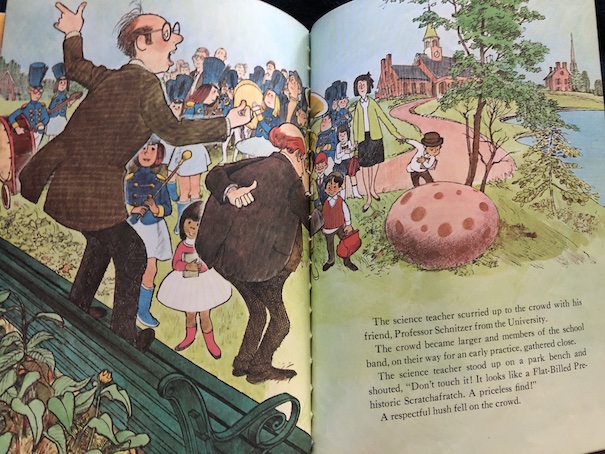
In the morning, Beaver and Otto roll the egg over to Alexandra’s school to make sure that she sees it. The first person who sees the egg, though, is the school’s custodian. He’s shocked at the sight of such a giant egg and starts yelling for the science teacher to come look at it.

Soon, the egg is surrounded by children and adults, marveling over what kind of it could be and where it came from. The science teacher brings a friend who is a university professor, and the two of them are convinced that the egg must belong to a rare creature, although they disagree about the type of creature it is.

Fletcher waits to hatch until he hears Alexandra. Alexandra’s friends are excited about the egg, but she’s just upset and only wants to go looking for her lost dog.

Fletcher decides it’s time to hatch, and he busts his way out of the egg. Alexandra is happy to see him, even though Fletcher’s attempt at peeping is a little weak. Everyone is confused, but Alexandra is just relieved that she has her dog back. Fletcher feels better, realizing that he is important to Alexandra, and she really cares about him, even though he’s not yellow and doesn’t peep.

The book is available to borrow and read for free online through Internet Archive.

My Reaction

I read this book as a kid, but I had forgotten much of the story. I remembered that Fletcher hatched out of an artificial egg and that he did it to get his owner’s attention, but I couldn’t remember why he needed attention. I can understand Alexandra being temporarily distracted by the little chicks on the farm, but forgetting to give her dog water is really bad for a pet owner. I felt like her parents should have noticed and said something. But, mostly, the situation is just set up for the purposes of this humorous hatching of a dog from a giant egg. Because the egg was created by animals, the humans in the story never find out how or why Fletcher got in the egg, which is actually the funniest part for me as an adult.

Abraham Lincoln Joke Book

The Abraham Lincoln Joke Book by Beatrice Schenk de Regniers, 1965.

I love joke books on oddly specific topics! This one is a little bittersweet because it was published 100 years after Abraham Lincoln’s death, but the book isn’t about that. Instead, it’s a fun celebration of some funny stories about Lincoln and some of his favorite jokes.

The jokes are mostly in story form, and many of them are stories about incidents from Lincoln’s own life. Some of them are stories about his youth, like the time he helped a classmate secretly during a spelling bee and the time he played a prank on his stepmother by holding some younger boys upside down so they could walk across the ceiling of the house, leaving muddy footprints.

Not all of the stories in the book are true tales about Lincoln. The book admits that some of them are “tall tales” that other people told about him. Many of them were jokes that people told about Lincoln’s height because that was one of the first things that people noticed about him. It was all the more notable when he was standing next to his wife because he was especially tall and she was especially short.

The end of the book discusses how Lincoln would often use jokes and stories to make a point in a conversation or soften the blow of criticism. As President, he liked to read joke books or humorous stories to cheer himself up during stressful times. He is quoted as saying, “I laugh because I must not cry.” The book ends with a timeline of events in Lincoln’s life.

The book is available to borrow and read for free online through Internet Archive (multiple copies).

The Phantom Tollbooth

The Phantom Tollbooth by Norton Juster, 1961.

Milo is a boy who never really knows what he wants or what to do with himself.  He is always bored because he doesn’t really know the purpose or point of doing anything.  Nothing he learns in school interests him because he can’t see what he could ever do with the knowledge.  He never bothers to read the books he has, play with his toys, or learn to use his tools because he just doesn’t have the imagination to appreciate them or what he could do with them.

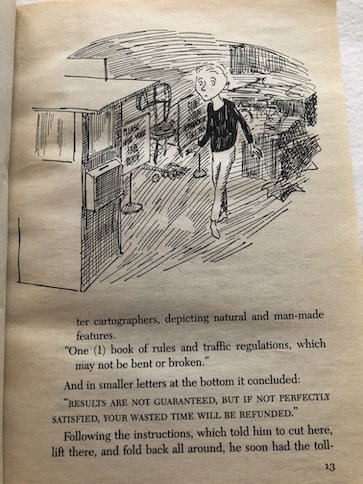
One day, when Milo gets home from school, he finds an unexpected package.  It’s not his birthday or Christmas, but the package is definitely intended for him because it has his name on it: “For Milo, who has plenty of time.”  There is a list of items contained in the package: 1 tollbooth (which must be assembled, according to the directions), 3 precautionary signs (“to be used in a precautionary fashion”), some coins for the tollbooth, a map (with no familiar places on it), and a driver’s rule book (which must be obeyed).  Interestingly, it promises that if Milo is not satisfied with his tollbooth experience, his time will be refunded.  Since Milo doesn’t think he has anything else to do anyway, he decides that he might as well unwrap the tollbooth and set it up. 

Although Milo thinks that the map is purely fictional and that the tollbooth is just a playset, he decides that he might as well select a destination on it for his trip through the tollbooth.  He closes his eyes, puts a finger on the map, and selects a place called “Dictionopolis.” He gets in the toy car, puts a coin in the tollbooth, and goes through it.

To his surprise, Milo suddenly finds himself driving down a real highway, no longer in his own apartment.  He sees a sign pointing the way to a place called Expectations, and he stops to ask a man about it.  At first, he thinks he’s talking to a weather man, but the man corrects him, saying that he’s really the “Whether man.”  Part of his job is to hurry people along, even if they have no expectations.  Nothing the Whether Man says to Milo makes sense to him, so he decides that he’d better just get going.

As Milo drives down the highway, he gets bored and starts daydreaming.  As his mind wanders, the scenery gets duller and grayer, the car slows down, and eventually, the car stops and won’t move further.  Milo looks around and wonders where he is.  It turns out that he’s in the Doldrums, the home of the Lethargarians.  They tell him that thinking isn’t allowed there.  Milo says that’s a dumb rule because everybody thinks.  The Lethargarians say that they never think and Milo must not have thought either because, if he had, he wouldn’t be there.  People usually get to the Doldrums because they’re not thinking, and once they’re there, nobody is allowed to think.  They refer Milo to the rule book that came with the tollbooth.  Milo looks in the rule book and sees that is a rule.  There are also limits on laughing and smiling in the Doldrums.  Milo asks the Lethargarians what they do if they can’t think or laugh.  They say that they can do anything as long as they’re also doing nothing.  Mainly, they do things like daydreaming, napping, loafing, loitering, and wasting time.  They say it gives them a full schedule and allows them to get nothing done, which they consider an important accomplishment.  Milo asks them if that’s what everybody here does, and they say that the one person who doesn’t is the Watch Dog, who tries to make sure that nobody wastes time.

At that point, the Watch Dog shows up.  The Watch Dog looks like a dog, but his body is an alarm clock.  The Watch Dog asks Milo what he’s doing, and is alarmed when Milo says that he’s “killing time.”  It’s bad enough when people waste time, but killing it is horrible!  (The book is full of these kinds of puns. It’s just getting started.)  Milo explains how he got stuck in the Doldrums while he was on his way to Dictionopolis and asks the Watch Dog for help.  The Watch Dog explains that if he got there by not thinking, he can also get out by thinking and asks to come along because he likes car rides.  Milo agrees, and the two of them get in the car.  Milo thinks as hard as he can (which the book notes isn’t easy for Milo because he’s not used to thinking and doesn’t do it too often).  Gradually, as Milo thinks of various things, the car begins to move.  The faster Milo thinks, the faster the car goes.  Milo learns that it’s possible to accomplish a lot with just a little thought.

The Watch Dog’s name is Tock because his older brother is named Tick. However, their names are a mistake because his older brother only makes a tock sound, and Tock only makes a tick sound.  It’s a source of pain and disappointment.  Tock tells Milo about the origin of time and why Watch Dogs find it important to make sure that people use time well.  He says that time is the most valuable possession because it always keeps moving.

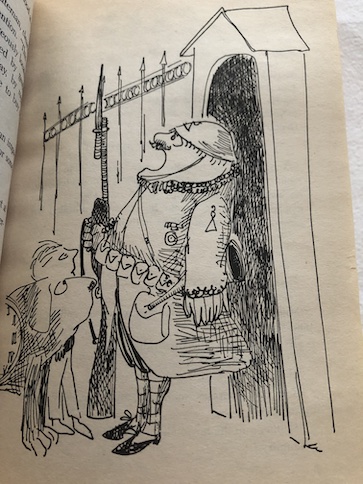
When they arrive at Dictionopolis, the gatekeeper won’t let them in immediately because Milo doesn’t have a reason for being there.  Nobody gets let in without a reason.  Fortunately, the gatekeeper always keeps a few spare reasons lying around, and he decides to let Milo have one.  The one he selects is “WHY NOT?”, which the gatekeeper considers a good, all-purpose reason for doing anything.  (I don’t know. I’ve heard that one followed up by an angry “I’ll tell you why not!” before.)

As readers have probably guessed, Dictionopolis is all about words. When Milo enters the city, he finds himself in the marketplace, which is called the “Word Market.”  The ruler of Dictionopolis is Azaz the Unabridged, and when Milo is welcomed to the city by the members of the king’s cabinet, they do so in multiple ways, using synonyms.  Milo asks them why they don’t just pick one word and stick with it, but they’re not interested in that.  They say that it’s not their business to make sense and that one word is as good as another, so why not use them all?  (That isn’t true, but the story tells you why not later.)  They go on to tell Milo that letters grow on trees here, and people come from all over to buy all the words they need in the Word Market in town.  Part of the cabinet’s duty is to make sure that all of the words being sold are real words and have real meanings because people would have no use for nonsense words that don’t mean anything and that nobody will understand.  The cabinet doesn’t seem to care about whether or not the words are being used in a way that makes sense as long as they’re real words. (If you’re familiar with business speak or buzzwords, you’ve probably noticed that much of it works on a similar principle.)  Putting the words into a context that makes sense isn’t their job.  (Later, you meet the person who had that job.)  However, the cabinet does advise Milo to be careful when choosing his words and to say only what he means to say.  They excuse themselves to get ready for the banquet and say that they’ll see Milo there later, although Milo doesn’t know what banquet they’re talking about.

Milo and Tock explore the Word Market.  Milo is fascinated by the variety of words available.  He doesn’t know what they all mean, but he thinks that if he can buy some, he can learn how to use them.  He chooses three words he doesn’t know: quagmire, flabbergast, and upholstery. (I’m surprised he didn’t know the last one because, surely, he has upholstered furniture in his apartment.)  Unfortunately, Milo quickly realizes that he has only one coin with him, and he’ll need that coin to get back through the tollbooth.  Eventually, he finds a stall selling individual letters for people who like to make their own words.  The stall owner gives them some free samples to taste. They taste good to Milo, and the stall owner tells them that sets of letters come with instructions.  Milo doesn’t think he’s very good at making words, but the Spelling Bee, a giant bee, begins showing him how to spell words.  However, the Humbug, a grumpy bug, tries to tell Milo not to bother learning.  The Spelling Bee tells Milo not to listen to the Humbug because he just tells tall stories and doesn’t actually know anything, not even how to spell his own name.

The Spelling Bee and the Humbug start fighting and knock over all the word stalls around them. There is a big mess, all the words get scrambled, and it takes some time before everyone sorts everything out.  By that time, the Spelling Bee is gone, and when the policeman comes, the Humbug blames everything on Milo and Tock.  At first, it seems like Milo will get off lightly because the policeman (who is also the judge) gives him the shortest “sentence” he can think of (“I am”).  Unfortunately, he’s also the jailer and takes Milo and Tock to prison for 6 million years.

In the prison, Milo and Tock meet the Which.  At first, Milo thinks that she’s a “witch”, but she says many people make that mistake.  The Which is King Azaz’s great-aunt, and her job used to be to make sure that people correctly chose which words to use and didn’t use more words than necessary. (A problem that Milo noticed in the market.)  The Which explains that she was thrown into prison because she got too carried away with her job and became too miserly with words. Word economy is good (and something I struggle with), but rather than promoting brevity, the Which started promoting silence instead,. It got so bad that people eventually stopped buying words and the market was failing, so the king had to put a stop to it.  The Which says that she understands now where she went wrong, and Milo asks her if there’s anything that he can do to help her.  The Which says that the only thing that would help her would be the return of Rhyme and Reason.  When Milo asks who they are, she tells him the story of the founding of the Kingdom of Wisdom.

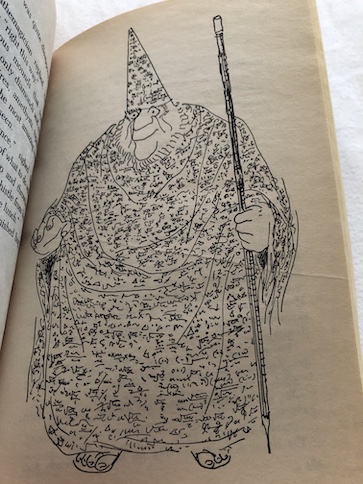
Years ago, the King of Wisdom had two sons, and he was proud of both, but one of them had an obsession with words, and the other had an obsession with numbers.  The king didn’t realize how bad their conflict was growing, and it got worse over time. One day, the king found a pair of abandoned infant twins.  The twins were both girls, and the king had always wanted daughters as well as sons, so he adopted them and named them Rhyme and Reason.  Everyone loved Rhyme and Reason, and they had a talent for resolving problems and disputes. When the king died, he left his kingdom to both of his sons and left instructions for them both to look after Rhyme and Reason. The word-obsessed son, Azaz, established a capital city of his own, Dictionopolis, and the number-obsessed son, the Mathemagician, established the city of Digitopolis.  Rhyme and Reason remained in the city of Wisdom and acted as advisers to the brothers, mediating their disputes.  This system worked until the brothers got into their worst fight over whether words or numbers are most important.  They took this dispute to Rhyme and Reason, who said that both are of equal importance. This satisfied most people, but both brothers were angry because they had wanted the girls to make a definite choice between them. In their last joint act, they banished Rhyme and Reason to the Castle in the Air. Since then, there has been continued fighting between the two brothers and their respective cities, the city of Wisdom has been neglected, and there’s been no Rhyme or Reason to any of it. (Ha, ha.)

Milo says that maybe they could rescue Rhyme and Reason from the Castle in the Air. The Which says that would be difficult because there’s only one stairway to the castle, and it’s guarded by demons. Milo remembers that there is also the matter of them being stuck in prison for 6 million years. The Which says that being in prison isn’t really a problem. Although the policeman/judge/jailer likes putting people in prison, he doesn’t care much about keeping them there, so Milo and Tock can leave when they like, and he probably won’t notice. (Sounds like he’s not very good at the “jailer” part of his job.)  The Which points out a button on the wall, Milo presses it, and a door opens.

When they step outside, the king’s cabinet members come to take him to the banquet that they mentioned earlier. They have Milo and Tock step into their wagon and tell them to be quiet because “it goes without saying.” (Ha, ha.) They take Milo and Tock to a palace shaped like a book, where they meet King Azaz and join the banquet.

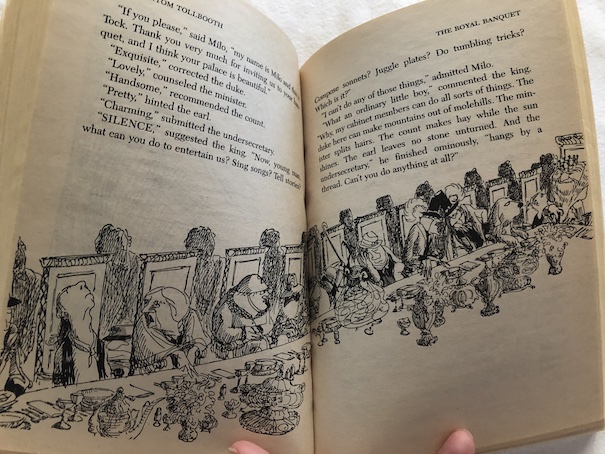
The banquet is a pun-filled meal where everyone has to literally eat their words and have half-baked ideas for dessert.  (Half-baked ideas look good, but you shouldn’t have too many because you can get sick of them. Tock says so.)  Nothing makes sense, and even the king realizes it, which gives Milo the opportunity to suggest bringing back Rhyme and Reason.  The king isn’t sure that’s possible, and the Humbug, of course, volunteers Milo and Tock for the job.  The joke turns out to be on him because the king volunteers the Humbug to assist Milo.  Reaching Rhyme and Reason will be a perilous journey, and possibly the most difficult part will be getting the Mathemagician to agree to let them do it.

The book is available to borrow and read for free online through Internet Archive (multiple copies). There is also a movie version of this book (mostly animated but part live action) with songs. You can see a trailer for it on YouTube.

My Reaction

The Phantom Tollbooth is a fantasy story, but like many fantasy stories, it’s also a morality story.  It’s a little like Charlie and the Chocolate Factory, which aims to correct children’s bad habits.  Milo’s boredom problems are due to his lack of thought for the things he could do and imagination to figure out how to make use of what he has.  His adventures after he goes through the Phantom Tollbooth help him to see things differently and to learn to use his mind creatively.

However, I wouldn’t say that the story is too preachy.  A couple of parts started to feel a little like a lecture, but it’s set in a fantasy land that feels a little like Alice in Wonderland.  There’s a healthy dose of nonsense that keeps things interesting and fun.  The book is peppered with puns and peopled by a fascinating variety of characters.  There’s the boy who can see through everyone and everything, who teaches Milo to look at things from an adult perspective and helps him to realize the benefit of keeping his feet on the ground (both of those are also puns). There’s the man who is the world’s shortest giant, the world’s tallest midget, the world’s thinnest fat man, and the world’s fattest thin man all at the same time.  Basically, he’s just an ordinary guy who’s noticed that people think of him in different ways when they compare him with themselves.

I was first introduced to this story when I was in elementary school, as many people were.  Our teacher read it to us and showed us the cartoon version.  Parts of songs from that version still get stuck in my head, almost 30 years later.  (“Don’t Say There’s Nothing To Do the Doldrums …”) The part of the story that stuck with me the longest was the Dodecahedron, a shape with twelve sides. If you’ve seen the twelve-sided dice used for Dungeons and Dragons and similar role-playing games, those are dodecahedrons. In the book, the Dodecahedron is talking character as well as a shape, but I remember it because our teacher gave us paper cut-outs to make our own dodecahedrons. I made two of them, and I might still have one somewhere.

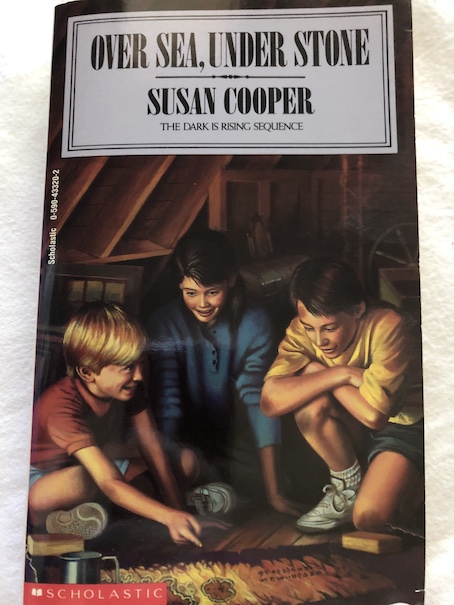
Over Sea, Under Stone

The Dark is Rising Sequence

Over Sea, Under Stone by Susan Cooper, 1965.

The Drew family is spending the summer in Cornwall with their Great-Uncle Merry. Professor Merriman “Merry” Lyon isn’t really a relative, but a very old family friend who teaches at a university and has a somewhat mysterious past. Of the three Drew children – Simon, Jane, and Barney – Barney is the one most looking forward to their time in Cornwall because he loves Arthurian stories, and he is fascinated by Cornwall’s connections with King Arthur. Simon is more interested in watching boats.

One day, while the children are bored because it’s raining, they start playing at being explorers inside the house where they’re staying and discover a secret passage to a hidden room. There, they find an old manuscript that seems to be some kind of treasure map! It seems like parts are written in Latin, but even Simon, who has studied Latin in school, can’t read it all. At first, they wonder if they should tell their parents about it, but they decide not to, at least not right away, because their parents would probably tell them not to touch it because it doesn’t belong to them. They feel like they just have to figure out what it means and what it might lead to.

The family makes the acquaintance of a yacht owner, Mr. Withers, and his sister, and the two of them invite the whole family to go for a ride on their yacht. Mrs. Drew is an artist and wants to spend the day painting, so she declines, and so does Jane. Jane says that she’s afraid of getting seasick, but really, the Witherses give her an uneasy feeling. Jane feels like there’s something that’s not right about them, and it’s strange that Miss Withers asks them if they’ve found any secret passages in the house just after they actually found one. None of the children confide anything in Miss Withers. Mr. Withers seems oddly interested in the books in the house.

The next day, while her father and brothers go out on the yacht with the Witherses, Jane studies the manuscript and tries to figure out what it means. When she also finds an old guidebook to the area in an old trunk, she realizes that the map on the manuscript shows the area where they are staying, but there’s something strange about the coastline. The coastline on the old map is a slightly different shape. Jane wonders if one of the two maps could be wrong or if the coastline has changed somehow over the years because the manuscript looks very old.

Since the guidebook was written by the local vicar, Jane decides to go see him and ask him about the coastline and whether it’s changed over the years. She takes along the guidebook but not the manuscript. However, the vicar she meets says he’s the new vicar, not the old one who wrote the book. She talks to him about the book and the coastline anyway, but he gives her a bad feeling, similar to the one that the Witherses give her. The vicar discounts the idea of the coastline changing, and he asks Jane uncomfortable questions about the books in the house, pressing her for answers that she doesn’t have and doesn’t want to give him.

When the boys come back from the yacht, and Jane tells them about the guidebook and the vicar, Simon is irritated that Jane tried to investigate the manuscript without them, and he doesn’t think she should have talked to the vicar. Jane says that she didn’t tell the vicar about the manuscript, only the guidebook, and Barney says that what Jane learned is important.

The next morning, they wake up to find that the house has been ransacked. Books have been tossed all over in the middle of the night by someone who was clearly hunting for something. The children are sure that their mysterious intruder was searching for the manuscript, which is safe because Jane had it hidden in her bed. But, who was it? Was it the vicar or the Witherses? All of them seemed interested in old books and manuscripts, and they all seem suspicious. What is the real significance of the manuscript anyway?

Still not wanting to tell their parents or the police who were called to investigate the break-in, the children confide in Great-Uncle Merry about the manuscript and their suspicions. Uncle Merry knows more about the manuscript than the children know, and he tells them about a lost grail, a copy of the original Holy Grail, inscribed with the true story of King Arthur and about an ancient struggle between good and evil, a struggle that the children have now joined.

The book is available to borrow and read for free online through Internet Archive (multiple copies). The book was once adapted as a tv mini-series, but apparently, no copies of it survive.

My Reaction and Spoilers

This book is the first in a series about the struggle between good and evil, known as the Light and the Dark, and all of the other books in the series also draw on Arthurian legends. Merry and the children appear in other books, although not always together. Merry (the children sometimes call him Gumerry, which is short for Great-Uncle Merry) isn’t quite what he appears to be, which is how he knows things that other adults don’t know. There are hints in this book about Merry’s real identity, but it isn’t explained in this book, although Barney has a feeling that his name is a clue.

When Merry explains about the battle between good and evil, he says that the struggle has been going on for ages, and neither side ever completely wins or completely loses. It’s like that in this story, too. At first, I wasn’t completely sure whether they would actually find the grail or if it would turn out to be a MacGuffin, only existing to drive the action without it being really important whether it was actually found or not. The heroes do actually find and successfully retrieve the grail, but they also lose the manuscripts they’ve found before they can completely study them. It’s a victory, but not a total victory, and the villains are still around and may reappear in the future. This story ends in a way that indicates that this could have been a standalone book, which it might have been originally, before the author decided to continue the series, but the ending is also open, making the continuation of the series natural.

There are references to old folklore traditions throughout the story. I’ve never seen The Wicker Man, but I saw a comment on a YouTube video where someone compares a public festival from this story to a scene in The Wicker Man, so there may be the implication that this is a more ancient form of celebration with more significance than the modern characters think. In fact, old traditions and folklore from the British Isles also appear in various forms throughout the series, and there are references to pagan beliefs.

I didn’t like the part where the kids were pretending to be explorers, and they were talking about acting out one of those scenes with “rude natives” (Simon’s words, and even he has to admit that he doesn’t quite know what it means when Barney asks him, although he’s aware that it’s a different sort of “rude” from the word meaning “impolite”) who want to make them gods and encountering cannibals. That type of scene always annoys me in books, and I’m sure that they’re referencing some of the vintage books I’ve read where that happens or ones very much like them. It’s really my only complaint about this story. Fortunately, that part doesn’t last very long because the kids find the manuscript and get on with the fantasy story.

Two Are Better Than One

Two Are Better Than One by Carol Ryrie Brink, 1968.

This is a gentle coming-of-age story about two thirteen-year-old girls in Idaho during the early 1900s, but it’s told in a interesting format, as the reminiscences of one of the girls as an old woman and focusing on a story that the girls were writing together as teenagers. It’s like a story about a story within a story.

One Christmas, elderly Chrystal Banks receives a special present from her old friend, Cordelia Crump. The package contains two miniature dolls (she calls them “pocket dolls”) that Chrystal gave to Cordelia 60 years before. At first, Chrystal doesn’t remember giving her friend Cordy” these dolls but admits that her memory is starting to fail her. As she studies the little china dolls and their exquisite details, she begins to remember them and when she gave them to her friend. The dolls’ names are Lester and Lynette, and Chyrstal remembers how Cordy used to say that the little dolls were magical because any day she carried them seemed to become special and exciting. Even when Chrystal and Cordy grew older, supposedly too old for dolls, they still continued to love and believe in the magic of their special pocket dolls.

Before young Chrystal Reese (as she was known before her marriage) gave the dolls to Cordy, they were a Christmas present to Chrystal from her Uncle Dick. That was the Christmas when the girls were in seventh grade and were early thirteen years old. Uncle Dick had acquired a number of interesting presents for Chrystal on his trip to Europe. He doted on his niece because she had no parents or siblings, living only with her grandmother and Aunt Eugenia and their dog, Rowdy. All of the presents are wonderful, but the little dolls are something special. As she unwraps them, they are hidden within a small box inside another box inside of another box (not unlike the story itself). Chrystal loves the elegant, detailed, jointed dolls immediately and names them Lester and Lynette because they just seem like the right names for the dolls.

Immediately, she goes to see if the little dolls will work well in the dollhouse that she’s made out of orange crates. She has spent considerable time and most of her allowance money putting paint and wallpaper into the little house and making furniture for it. She made all of the dollhouse furniture to fit two small dolls that she already has, Elsie and Eileen. However, Elsie and Eileen are four inches tall, and Lester and Lynette are only about two-and-a-half inches tall, so they won’t work in the house. At first, Chrystal is unsure what to do with the tiny dolls. She loves them, but she’s going to have to figure out where to put them and how to play with them if they won’t fit into the doll house. Then, she gets the idea to give the little dolls to her best friend, Cordy. It’s a sacrifice to part with such a lovely present so soon after getting it, but she wasn’t satisfied that the little bottle of perfume she was going to give Cordy was really a good present. Besides, the girls are so close that they already share everything with each other, and as they like to say “Two are better than one.” Giving the dolls to Cordy won’t be like giving them so much as sharing them with someone who can help to make them even more fun.

Cordelia Lark (her maiden name) grew up in a well-off family with mostly boys. Her father was president of the local bank and president of the school board and a civic leader in other ways, and Cordy had four brothers and no sisters. Cordy and Chrystal are kind of like the sisters neither of them ever had. They like to call each other “Tween”, which is their special pronunciation of “Twin.” They justify being twins because their birthdays are only two weeks apart, so they’re almost exactly the same age.

On the way to Cordy’s house to give her the special Christmas present, Chrystal passes by the courthouse. When she and Cordy pass the courthouse, they can see the barred windows of the jail, and they make up stories to spook each other about how one of the prisoners might escape. On this particular day, Chrystal sees one of the prisoners gripping the bars of his window and looking out. He’s the first prisoner Chrystal has ever actually seen. She’s a little afraid of him, and when he starts talking to her, she doesn’t know what to say at first. The man first asks her what she’s staring at, and then he wishes her a Merry Christmas, even though he’s not having one. Not knowing what else to do, Chrystal murmurs “Merry Christmas” back and hurries on.

When Chrystal gets to Cordy’s house, the two girls exchange presents. It turns out that each of them almost got the other some perfume, but each of them changed their mind at the last minute and decided on something better. Cordy’s present to Chrys (as she sometimes calls her) is a book, which makes Chrystal happy because she loves books and didn’t get any for Christmas this year. But, it’s not just any book. This is Chrystal’s first grown-up novel instead of a children’s book. (They mention the Oz books, the Little Peppers, and the Little Colonel series as books they’ve read.) It makes Chrys feel grown-up. It’s a romantic story about a Southern girl during the Civil War who falls in love with a Northern soldier and eventually marries him. Chrys says that Cordy shouldn’t have told her the ending before she’s read it, but she’s still thrilled at having her first grown-up book.

Chrys worries that, since Cordy gave her a grown-up present, she’ll think that the little dolls are babyish, but Cordy loves Lester and Lynette immediately. She says nobody gave her a doll this year, and she felt disappointed because she loves dolls, and it just didn’t seem like Christmas without one. Chrys explains that these are pocket dolls, and they’re meant to be carried around in pockets, so they can go everywhere with the owner. Cordy says that they’re so tiny and perfect that they must be magic, and she decides to keep the names that Chrys gave them, Lester and Lynette. Cordy thinks that the little dolls are perfect to take along on adventures.

When Chrys tells Cordy about the prisoner, the two of them are nervous, although they don’t really think he can escape. Chrys asks Cordy to walk her home, but after they pass the courthouse, Cordy realizes that she’d have to walk past the courthouse alone on her way home. So, Chrys and Cordy turn around and walk the other way again, but then, they realize that they still have the same problem. No matter which way they go, they have to pass the courthouse, and no matter who walks who home, one of them will have to go alone at least partway. After they go back and forth a couple of times, they pause in front of the courthouse, and Cordy has an idea. She gives Chrys the Lester doll, keeping the Lynette doll for herself. That way, each of them will have someone to keep them company, and it will be like they aren’t alone. It gives each of them enough courage to go the rest of the way home, and it’s the beginning of their adventures with the dolls.

Chrys is inspired by her first grown-up book, and she thinks that maybe she’d like to write novels when she grows up. When the girls are in school, they like to write notes and funny poems with each other when they’re supposed to be studying, and Chrys suggests to Cordy that they start writing a novel together. Cordy agrees, and they decide to take turns writing chapters. They decide that the story will be about Lester and Lynette, and Chrystal writes the first chapter. Chrystal calls the story “The Romantical Perils of Lester and Lynette.”

However, the girls get in trouble for goofing off and not paying attention in class. Their strict teacher, Miss Hickenlooper, decides that the two girls can’t sit together anymore, and she confiscates Lester and Lynette and locks them in her desk. The girls are devastated. If the teacher wanted them to move desks, that was disappointing but justified, but she had no right to just take the dolls. The girls think that they’ll have to wait until the end of term to get them back, but they continue writing the story about the dolls. Chrystal had been going to write the first chapter about an elopement, but because the dolls are now imprisoned in the teacher’s desk, she decides to write it as a prison escape instead.

In the new version of the first chapter of the story, Lester and Lynette are brother and sister, and they are imprisoned in a castle overlooking the Rhine river in Germany (part of the the girls’ geography lesson in school) by their evil guardian, Baron von Hickenlooper. Lynette is rescued/kidnapped by a Viking pirate named Oskar, who carries her away from her brother, who still remains in the castle.

From this point on, the events in Chrys and Cordy’s lives alternate with new chapters of their tandem story about Lester and Lynette. Pieces of the girls’ lives work their way into the story. When the girls are ready to trade turns writing the story, they give each other what they’ve written so far and say “Muggins!” (The word comes from playing games like Dominoes and Cribbage where, if one player spots that another has missed a score or failed to count something properly, they can call “Muggins!” and add the overlooked points to their own score. I think what they’re implying is that this story is a game where one person picks up whatever the other one has left unfinished.) The girls also continue adding verses to an unflattering poem that they started writing about their teacher.

By accident, the girls loose track of the mean poem about their teacher, and Miss Hickenlooper finds it. At first, the girls are terrified that Miss Hickenlooper is going to be furious with them and do something horrible in punishment, but to their surprise, she starts crying. Miss Hickenlooper end up having a heart-to-heart talk about the girls’ experiences in Miss Hickenlooper’s class, what Miss Hickenlooper hoped for when she started teaching, and why she took Lester and Lynette from them. Miss Hickenlooper had wanted to be a teacher for a long time and was looking forward to it, but she had been away from it for a long time because she had to take care of her mother during a lengthy illness. Since she started teaching again, she can tell that her students haven’t been happy with her, but after reading the poem, she realizes that it’s worse than she thought. Even strict teachers can be respected by their students as long as they’ve taught their principles well and the students are learning valuable lessons. Miss Hickenlooper feels like she’s failed as a teacher because she hasn’t managed to connect with her students at all, and she’s making them miserable. The girls come to the surprising realization that their teacher really does care about her students and what they think of her.

The talk between the girls and Miss Hickenlooper was a little uncomfortable because the girls realize that they’ve done an injustice to Miss Hickenlooper by writing the mean poem about her, but I actually liked this part of the story because it’s the kind of honest communication that I often find missing in stories. Rather than anyone blustering or dodging or trying to save face, the girls and their teacher honestly discuss what happened and how they feel, and everyone involved learns something from the experience. The girls appreciate having this “human” communication with their teacher, and it earns their respect, more than any angry tirade or show of strength on their teacher’s part ever would have. It’s this very kind of open honesty and humanity with real feeling behind it that’s been missing from the class so far, and it’s what has prevented Miss Hickenlooper from really connecting with her students.

The girls apologize to Miss Hickenlooper about the poem, and Miss Hickenlooper admits the justice of some of their complaints. Miss Hickenlooper admits that maybe she went a little far in making Cordy turn out her pockets and taking her dolls from her for an extended period of time. Getting into someone’s pockets and taking personal possessions is a kind of invasion of privacy, and Miss Hickenlooper says that she only did it because the girls weren’t paying attention in class, which is true. In return, Chrys and Cordy acknowledge that they only wrote the poem to blow off steam because they were angry, but they also went too far, and they really should have considered their teacher’s feelings. The girls promise not to write any more poems like that, and Miss Hickenlooper gives Lester and Lynette back to them. Miss Hickenlooper says Cordy can keep the dolls in her pocket if she wants as long as the girls pay attention in class from now on. To further apologize, the girls make cards for their teacher and give her the two bottles of perfume that they almost gave each other for Christmas (“Two are better than one.”), and they start going out of their way to be nicer to her.

The girls’ talks with Miss Hickenlooper through the rest of the school year give her feedback that helps her to improve as a teacher. Later, when the girls are watching a lightning artist (someone who paints pictures very fast, not the more modern definition of someone who works in animation) at work and happen to see Miss Hickenlooper in the store as well, they point out that one of the artist’s pictures reminds them of the Rhine that they studied in class. Miss Hickenlooper doesn’t think much of the quality of the painting, but she admits that it does look like the Rhine and that another painting the artist did reminds her of Switzerland when she was there. The girls are amazed that Miss Hickenlooper has been to Europe because, other than Chrys’s Uncle Dick, they don’t know anyone who has. They ask her why she never talked about it in their geography lessons because that would have made them much more exciting, hearing about other countries from the perspective of someone who was actually there. Miss Hickenlooper is surprised. She says that she was only focused on teaching the lessons that she was assigned to teach and just never thought about including anything personal because she didn’t think her students would be interested in her personal stories. Again, it’s that personal element that Miss Hickenlooper needs if she wants to connect with her students on a personal level.

As the story continues, the girls also start to consider their attitudes about boys and men and future husbands. So far, most of their knowledge of boys has come from the boys at school and Sunday school and Cordy’s brothers, all pretty immature and rowdy. But, the girls are growing up, and so are some of the boys. New young men also come into the girls’ lives.

A friend of Chrystal’s grandmother asks her if she would be willing to rent a room to her 19-year-old son, who is looking for a place to stay as he takes his first teaching job at the local college. (That sounds young for a college teacher. In modern times, a nineteen-year-old would be a college student himself. Remember, this is the early 1900s, and education in the United States was very different then. Back then, teachers didn’t need to have the advanced degrees that they do now, and Mr. Banks later explains that he skipped grades when he was younger to get through school faster.) Chrystal’s grandmother agrees, although Chrystal isn’t anxious to have a teacher living in her house after her problems with her own teacher at school. Chrys also isn’t sure what to expect from a man living in the house because there’s never been a man in this house before. Cordy’s brothers are pretty rowdy. However, their new lodger, Mr. Banks, turns out to be quiet, polite, and very nice. (His last name is an indication that he’s going to be Chrystal’s future husband. There’s six years’ difference in their ages, but as times goes on, and Chrystal gets older, that’s not going to seem like as much of a gap.) He is the first person to ever address Chrystal as “Miss Reese”, which makes her feel grown-up.

Cordy’s family also has a boarder, Mr. Crump, who is attending the local college (obviously, Cordy’s future husband, based on her future last name). Mr. Crump is working his way through college by selling pots and pans, and Cordy goes with him to help carry things, bringing along Chrys because “Two are better than one.” The girls end up giving him some advice on his sales patter that helps him make more sales.

Meanwhile, the girls’ Sunday school class, which calls itself the Dorcas Club, decides to host a masquerade party with the boys’ class (who have dubbed themselves the Armored Knights) as their guests. Chrys and Cordy think of the boys as immature and uncouth and roll their eyes at the older girls who are boy-crazy. Then, because the party is on Presidents’ Day, all of the girls in the group want to go dressed as Martha Washington, and there’s a big argument about it. Originally, Chrys and Cordy wanted to be Martha Washington, too, but since that’s what all the others want, they decide that they want to do something completely original. Inspired again by the dolls, they decide to go dressed as dolls. However, because they don’t want to be like the prissy girls trying to be pretty and impress the boys, they decide not to go as elegant dolls but as old rag dolls in patched clothing.

The girls do win prizes for both the funniest and most original costumes at the party because they’re the only girls who don’t show up as some version of Martha Washington. However, the triumph turns against them because the girls who are in charge of the main entertainment for the evening have decided to turn it into the girls’ very first dance party with the boys, something that Cordy and Chrys weren’t expecting. Rag doll costumes are good for fun and games, but not so much for serious dancing and the possibility of budding romance. While all of the boys are wearing various fanciful costumes themselves, like pirates and clowns and cannibals, it turns out that they’re only interested in the girls who dressed in pretty clothes as Martha Washington, and none of them want to dance with the rag dolls. Chrys and Cordy were proud of themselves for being more original than the other girls, but it seems that the boys prefer “pretty” to “original.” At the end of the evening, none of the boys even want to walk Chrys and Cordy home. Chrys and Cordy feel embarrassed because their efforts to be “original” seem to have strayed a little into the outlandish at a time when the other girls and boys are starting to seriously get interested in each other.

Fortunately, their families guessed that something of the sort might happen and asked the young men boarding with them to go to the house hosting the party and walk the girls home if they had no one else to walk with them. Mr. Crump confirms to the girls that boys would prefer to walk with girls who made an effort to look pretty instead of girls who look like rag dolls. Mr. Crump says that there will be other parties, and next time maybe they’ll go as something more elegant, like Martha Washington, but the girls aren’t too thrilled about doing this type of party again. Mr. Banks takes a different view and says that he actually thought that the rag doll costumes were rather clever and that it was really better for the girls to be different instead of trying to be like every other girl in order to not stand out. “Sometimes it may hurt, but I think it’s better to be original.” Mr. Banks the college teacher is more mature than Mr. Crump the college student, and I think he has the right idea. Looks and clothing styles change, and people have different priorities when they get older, but original thinking and an interesting personality are hard to replace and never go out style. When Chrystal says that she doesn’t even know how to dance, Mr. Banks offers to teach her, so she can be more confident at future parties.

Having the boarders walk them home actually turns out to be an unexpected victory for Chrys and Cordy because, while the other girls were making fun of them for not having any of the boys dance with them or walk them home, Chrys and Cordy ended up being escorted by young men. Getting boys is all well and good for young girls, but being escorted by young men makes Chrys and Cordy look like young women, putting them on a higher level than mere girls. Chrys and Cordy don’t see it that way at first because Mr. Crump and Mr. Banks are just their families’ boarders and friends and treat them like younger sisters (at this point in their lives, anyway), but the other girls notice that the young men are more mature than the Sunday school boys, and it causes them to look at Chrys and Cordy with a little more respect for having their attention. In some respects, Chrys and Cordy might seem less mature than the girls who are excited about wearing makeup and getting boys because they’re into outlandish costumes and dolls and “romantical” stories, but in other respects, they may actually be a little more mature than the other girls for being confident in their individuality and the new awareness they’re acquiring of other people’s feelings. In the end, girls want to marry men, not little boys, anyway.

Through the spring, the girls have other adventures and continue writing their story with their dolls. Along the way, there are other signs that the girls are growing up. They notice that this is the first year when they’re more interested in getting new Easter bonnets than they are in their Easter eggs. Cordy’s family is heavily involved in the social life of the local college because two of their boys are students there, and Cordy even gets to go to some of the campus parties. She helps to serve punch there and sometimes gets to dance. She eventually arranges for Chrys to come with her to help with serving and have her first dance, too. Miss Hickenlooper also discusses the girls’ future with them, suggesting that they take exams to see if they can skip the eighth grade and go straight into high school because she thinks they’re smart enough to pass. The girls are uncertain if they want to go on to high school so quickly. They know they’re growing up, but they haven’t thought about high school yet (and this is a time period when not everyone even attended high school). There is also the horrible thought that one of them might pass the test while the other didn’t, and they might end up going to different schools and being in different grades. Miss Hickenlooper says that they don’t necessarily have to go on to high school yet, if they feel that they’re not ready, even if they’re offered the opportunity, but she urges them to take the tests anyway to see if they have the option. It makes the girls start questioning their future lives, what they really want, and where their education will take them.

At one point, Cordy’s brothers find their unfinished novel in Cordy’s room, steal it, and use it to make fun of the girls. The story isn’t really very well written because Chrys and Cordy are only thirteen years old. As readers will have noticed, there are spelling mistakes all through the story, and the girls also get mixed up about geography because they’re just focused on making the story exciting instead of really thinking about the setting. After their characters’ adventures on the Rhine, the girls send them floating in a boat to a tropical island with coconuts and palm trees because they don’t think about just how far away the tropics actually are. (Being shipwrecked on an island is also a common trope of vintage and antique children’s books, so they’ve probably read this type of story themselves. Just scroll through my lists of children’s books from the 1900s and earlier, and you’ll see what I mean.) Although Mr. Crump was laughing at the girls, too, he rescues the story from Cordy’s brothers and gives it back to them when he sees that the joke is going too far. However, the girls are somewhat dispirited, thinking that their story might be deeply flawed. At first, they don’t know if they really want to continue writing it, but in their desperation, they turn to the one person they know will be honest with them about what they’ve written and can not only tell them whether or not the story can be fixed but how to do it – their teacher, Miss Hickenlooper.

The book is available to borrow and read for free online through Internet Archive (multiple copies).

Themes, Spoilers, and My Reaction

The story is one of those gentle, calm stories with a few funny episodes and some genuinely touching moments. Fans of slice-of-life historical books like the Betsy-Tacy series will like this book. It is a coming-of-age story for Chrys and Cordy, as they begin to develop new attitudes and come to a deeper understanding of themselves and other people and start thinking about the future. However, the girls’ adventures also teach other people around them some lessons.

One of the themes of the book involves how people let their personalities show. Although the girls were originally thought silly for their outlandish rag doll costumes at the party, they were more bold and creative than the girls who just wanted to look like everyone else. Even though their creativity wasn’t fully appreciated at first, it ends up working in their favor in the long run.

One of the biggest developments in the story is the relationship between the girls and their teacher, and the keys to that relationship are learning how to see other people as people, how to be open about showing their personal sides, and how to appreciate people with different personalities. The girls begin as thoughtless students, and their teacher is a strict disciplinarian with little patience for their goofing off, which is why the girls see her as their antagonist. However, the girls’ eventually realize that, through their mean and complaining poem, they’ve hurt their teacher’s feelings as much as she’s hurt theirs, maybe more. It leads them to see her in a new light, as a person and just just their jailer (the role of her alter ego in the girls’ story). The honest talks between the girls and their teacher not only helps the girls to become more thoughtful and considerate of others’ feelings but also show their teacher that the key to improving her teaching and developing a better relationship with her students is to be a little more personal with her students. She gradually learns that letting her students see her as a person with interesting life experiences earns their respect more than just acting like an unfeeling drill sergeant enforcing discipline. Inspired by the girls’ interest in her travels when she was younger, Miss Hickenlooper starts bringing postcards and souvenirs from her travels to class to show during geography lessons. The students are fascinated by her souvenirs and stories and start thinking of her as an a kind of intrepid explorer or sophisticated world traveler instead of a dull woman who focuses on dry memorization and gets mad at them for daydreaming in class. As she tries new ways of approaching her lessons and adding in personal experiences, Miss Hickenlooper takes on a whole new role in the children’s lives and sparks all of their imaginations. All of the students, not just Chrys and Cordy, start behaving better because they become genuinely interested in what Miss Hickenlooper has to say and show them. They don’t want to make her angry because she’ll stop telling the interesting stories if they don’t get their work done. Just because she’s gotten more interesting and personal doesn’t mean she’s gotten soft. Don’t be afraid to be interesting and different!

The girls never actually show Miss Hickenlooper their story because they’re a little embarrassed by what they’ve gotten wrong, but they ask her questions about some of the things that they put in their story to find out what’s right. They do end up finishing the story and giving Lester and Lynette a grand wedding, but they also acknowledge that they are getting too old and busy with other things to continue playing with dolls, even Lester and Lynette. They plan to put Lester and Lynette away for now as souvenirs of their childhoods. Later, they do tell Miss Hickenlooper about their novel, and while she hasn’t read it, she has the feeling that she knows what it’s like from knowing the girls and their writing. (The girls wrote about scenes from their novel when asked to describe places they know for their high school entrance exams.) She tells them that she appreciates their imaginations but that they should remember to focus on the real world around them and gaining real experiences to write about in the future.

There are also themes that focus on what growing up and maturity mean. Because the story focuses on one school semester in the girls’ lives, there are many questions that the book leaves unresolved about what happened in the girls’ later lives, but it seems that their lives turned out well, and they look back on their experiences with Lester and Lynette as a turning point when they really started growing up. Toward the end of the story, the girls begin appreciating some of the possibilities of life and the wider world that they never considered before. Through it all, there is also the girls’ constant friendship. At the very end, elderly Chrys writes a letter to elderly Cordy, thanking her for sending the dolls and reminding her of this special time in their lives.

The author of this book, Carol Ryrie Brink, was also a child around the time that Chrys and Cordy were children. There is a picture of her as a child above her biography on the dust jacket of the book. She is also the author of Caddie Woodlawn, which is better known than this book.

I love books that contain details about life in the past, and there are a lot of fun details included in this story. I’ve mentioned some above, but that’s just scratching the surface. At one point, Chrystal says that the only paper she has that’s good for painting pictures is the pieced of paper that separate pieces of Shredded Wheat in the box. The lined paper from the notebooks she uses for school isn’t as good. When she’s out of those pieces of paper, she has to eat more Shredded Wheat to get more. I don’t remember seeing any similar kind of paper in shredded wheat boxes in my lifetime, so this must be something that existed before modern packaging.

At the college dances, the girls have dance cards for the young men to write their names and initials in to secure spots for dances. There are also occasional mentions of food, and Chrys mentions having floating island pudding for dessert, which I’d never heard of before. It’s a kind of meringue that floats on a base of vanilla custard.