A small caterpillar hatches out of an egg and is very hungry. Each day, the caterpillar goes out looking for food, finding different things to eat.
Part of the book is a counting story, as the caterpillar eats different numbers of different types of fruit in different numbers. The format of this part of the book is really interesting because each of those pages isn’t a whole page but sections of pages that are different sizes, showing how the amount that the caterpillar eats increases each day.
Also, there are real holes in the pages to show where the caterpillar ate through different types of food. Kids like books with interesting physical features that encourage them to interact with the book as a toy as well as a story. I think that’s part of what has caused this book to have lasting appeal.
The book does also have a story to it about the growth and development of the caterpillar along with the counting part. At the end of the part that counts the number of pieces of fruit the caterpillar eats, the caterpillar eats a bunch of random junk foods and gives himself a stomachache. Eating a green leaf makes him feel better. By this point, the caterpillar is a fat caterpillar who is no longer hungry. At the end of the book, the caterpillar makes a cocoon and turns into a butterfly.
This is a cute picture book that is fun to show to very young children. The counting element is good both for teaching young children and for the children who have already learned to count because they can predict what the caterpillar is going to do next. The unusual format of those pages with the holes also makes the book distinctive.
On the 50th anniversary of the book in 2019, the BBC produced an article about the book’s history and its appeal to generations of young readers.
The book is available to borrow for free online through Internet Archive.
This story takes place during World War II and focuses on a child evacuee from London. The title of the book comes from a quote from Winston Churchill:
“Victory at all costs, victory in spite of all terror … for without victory there is no survival.”
Winston Churchill, May 13, 1940
It’s September 1939, and Liz Hawtin is an orphan living with her aunt, uncle, and cousins in London. Her mother died when she was a baby, and her father was killed when he was hit by a car a few years earlier. Liz’s overbearing aunt is making her life miserable and has been since she moved in with her relatives. It takes Liz some time to realize why her aunt doesn’t like her, but it has to do with social class, political philosophy, one-upmanship, and her aunt’s sense of fairness and entitlement – what sort of people are “deserving” and what sort of people aren’t.
The main problem is that Liz’s father was into socialism before he died. In fact, he used to give public talks about it, and Liz would watch them as a child, although she admits in hindsight that she doesn’t entirely agree with everything her father believed. One value that she and her father definitely shared was the belief that education is important. Liz’s entire family is working class, including her father, and none of them have ever had more than just very basic education. Her father was a very bright man, but like other members of their family, he had to leave school early and get a job because their family was poor. However, he urged Liz to study and get the best education she could because he realized that higher education is the way to move up in the world and get better jobs and a better position in life.
Liz’s current situation when the book begins is irritating to her aunt because Liz has both the academic potential to attend a better school than the ones her own children have attended and because Liz’s father had the foresight to take out an insurance policy on his life that has provided Liz with enough money to attend this better school and to buy good school clothes and the extra equipment and books that this better school requires. Every time Liz has needed something for school, her aunt gripes about how much it costs and what a waste of time and money it is. Liz gets her aunt’s permanent wrath by telling her straight out that the insurance money belongs to her and not her aunt and that it was meant for her education. This enrages her aunt because she had labeled her father as the foolish, idealistic socialist who was undeserving, so the idea that, because of him, Liz has both academic aptitude and the money to support her education seems supremely unfair to her. On some level, she probably realizes that Liz’s more advanced education will probably help her to be more prosperous than the rest of the family, and she hates it and is jealous. She takes every opportunity to criticize Liz and to tell her that her time spent reading and studying is wasteful. She encourages her children who, like other members of their family, all have to leave school early to get menial jobs, to give Liz a hard time. The only members of the household who like Liz are her gentle cousin Rose and her uncle, but it’s difficult for them to stand up for Liz and help her because the aunt bullies both of them as well.
At the beginning of the story, Liz is fifteen years old, and she is faced with a difficult decision. She is getting close to graduating from her grammar school. She badly wants to finish, but she knows that the insurance money is running out. Soon, she will be faced with the difficult decision of whether to leave the school without graduating and get a job, which is bound to be the menial work that her cousins are doing. Her aunt has always resented her and is eager to get rid of her, so she wants Liz to get work and start supporting herself as quickly as possible.
When World War II breaks out, Liz’s life is changed forever, and Liz realizes that, ironically, the changes are going to be for her benefit. Because Liz is still a student, she will be part of the government’s program to evacuate children from London to protect them from bombings. None of her cousins will be evacuated, even though they’re not much different in age from Liz, because they are no longer students, but Liz will be sent to the countryside with the rest of the students at her school. The government will also provide money for her support and education during the period of the evacuation, so Liz realizes that she will be able to finish her education after all. Rose and Liz’s uncle are sad at her leaving, but her aunt makes it clear that she is pleased that Liz will be leaving very soon and that she doesn’t want Liz to come back after the evacuation period is over. Once Liz is finished with her education and no longer part of the government program, Liz will be on her own in the world. It’s both a little scary but also liberating for Liz. She doesn’t know where she will be staying during the evacuation, but at this time in her life, it’s really better for her to leave her aunt’s house, finish her education, and establish an independent life.
Before she leaves, she says goodbye to her grandmother in London. She worries what will happen to her grandmother, her uncle, and Rose when she’s gone. Her grandmother isn’t worried for her own sake because she’s lived through war before, and nothing ever seems to happen to her. Besides, she knows where the shelters are for safety, and she’s sure that she can take care of herself. Liz knows that, once she is gone, her aunt won’t be able to pick on her all the time, and things are bound to get worse for her uncle and Rose, but there’s nothing she can do about that.
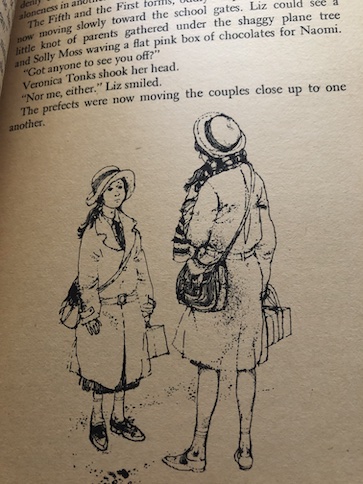
When she arrives at school, she and the other students are told that they are being sent to a small village called Chiddingford in Oxfordshire. It’s such a small town that it doesn’t even appear on the map in their school atlas. There, they will be staying in the homes of people living in the village. The headmistress reminds them all that this will not be an easy experience for them. Many children are being evacuated along with them, and all of them will experience homesickness and difficulties adjusting to the place where they will stay. She urges all of them to be kind to each other and considerate of their hosts in Chiddingford. The girls in Liz’s form (grade) are also going to be paired up with girls in the lowest form because these younger girls are new to the school and don’t even really know each other yet. The headmistress thinks that the experience will be easier on them if they have an older girl as a buddy, like an older sister. Liz pairs up with a shy girl named Veronica, who is wearing a school uniform that is way too big for her. Her parents were trying to save money by buying her a uniform that she could grow into. It makes Veronica a laughingstock among the other students, but Liz sympathizes with her, knowing what it’s like to worry about money and to feel different from everyone else.
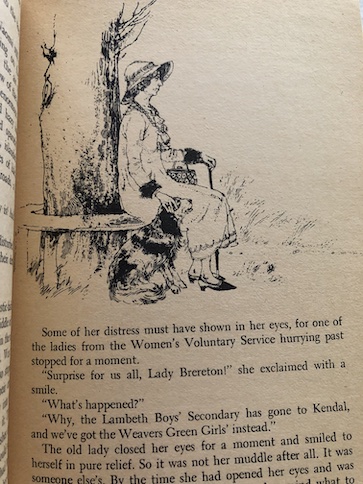
The students are excited by their trip into the countryside. The village of Chiddingford is already expecting them, although they had originally been told that they would be hosting a boys’ school instead of a girls’ school. Lady Brereton’s daughter-in-law asked her to pick out a boy from the arriving students who would be a good companion for her sons. However, since there are no boys on offer after all, and she knows little about girls, having only a son and three grandsons, Lady Brereton decides that she’ll pick out a girl from the evacuees in the same way she would pick out a dog, which is something she does understand. She chooses Liz because Liz has an alert expression and stands with her head up and a look of spirit and resilience.
Liz finds the move to the countryside disorienting, although she likes the peacefulness of it. Her reception at the Brereton house is disappointing because Mrs. Brereton had her heart set on getting a boy. She has three sons and is single-mindedly devoted to them. A girl simply wouldn’t do as a companion for her boys. In fact, she thinks that having a teenage girl in their house might well lead her teenage sons astray. However, people are commanded by the government to take in evacuees, and Mrs. Brereton can’t just give Liz back or trade her for someone else just because she’d rather have a boy. It’s awkward for both of them because Liz knows that Mrs. Brereton really doesn’t want her and that she tried to get rid of her.
Mr. Brereton is an historian, and he once worked at a college near Liz’s old neighborhood. He describes the history of the area and the type of housing there to his sons. The Breretons are a genteel, highly-educated family. They’re also the sort of intellectuals Liz’s father used to disparage, the ones who came to the college in their area and observed their lower-class living like scientists watching an ant colony and would leave, thinking that they understood their lives, when they had only ever seen them from the outside.
The youngest of the Brereton boys, Miles, makes fun of Liz when he finds out that her school doesn’t teach Latin because he says that she’ll never be able to go on to university. It stings because Liz is more educated than the rest of her family and is proud of it. She angrily retorts that she doesn’t want to go on studying forever because she wants to do something that will help win the war. Unknowingly, she’s prodding a sore point in the Brereton family because the eldest boy, Simon, wants to enlist, but his family would rather that he continue his education at Cambridge and become a doctor. Simon does want to be a doctor, but he also feels called to aid the war effort. He feels torn because his family is telling him that he should let others take care of the war while he goes to school and learns something that will make a difference later, but he feels guilty for staying out of it. His grandfather, Sir Rollo, who was a brigadier general, says that 19-year-old Simon is a man now and must make up his own mind about what he wants and what he’s going to do. Liz wishes that she hadn’t said anything about helping the war effort because she didn’t know that it was a sore point for this family, and she certainly wouldn’t want to influence Simon to do something that was dangerous or wrong for him. He seems too gentle and intellectual to really be a soldier.
When her teacher, Miss Garnett, comes to check on her, and see how she’s doing in the Brereton house, Liz says that she doesn’t think she fits in with this family. Miss Garnett advises her to give it time. Liz realizes that the Breretons are a tempestuous family, and it’s not really her fault for setting them off. They get set off by other things and people, too. Liz’s family back in London wasn’t the nicest, and they had their fights and spurts of meanness, but Liz feels like the Breretons are more unpredictable. She doesn’t know their history, quarrels, and sore spots, so she has no way of knowing what will set them off next.
Liz feels a little better after talking to the other girls from her school, comparing their host families. As she describes the Breretons to her friends, their absurdities jump out at her, making the whole situation seem more humorous instead of tragic. Mrs. Brereton doesn’t want her, which is hurtful, but she’s stuck with her anyway, which is funny. Young Miles keeps teasing her about not knowing Latin by shouting random Latin words at her, which don’t even make sense when translated. Miles is learning Latin vocabulary and can conjugate verbs, but he doesn’t really speak it as a language. Mr. Brereton, the professor, reads in the bathroom, which is the girls say is pretty normal, but what he reads are heavy historical texts, and he keeps a notebook and pencil in there, too, so he can take notes. The other girls laugh at the silly habits of the Breretons and tell Liz about their own host family. Three of them are sharing a room over a local shop, and the family that keeps the shop are certainly not intellectual. They have no books at all in their house, and they seem to be slow thinkers, who have only “one thought about every two hours.” Liz, whose source of pride back in London was being more educated than the rest of her family and most of the people in her working-class neighborhood, realizes that the Breretons’ higher intellectualism has been making her feel inadequate, like just a silly school girl. However, she and her friends are really more in the middle, doing better than some people, if not as well as others, and that’s not a bad way to be. Their learning isn’t over yet, either.
There are also some consolations to life with the Breretons. The live in an old, converted mill, and Liz has her own room next to the wheel house. Mrs. Brereton thinks of it as a rough room, very simply furnished and really more suited to a boy than a girl, but Liz likes it and is grateful that she doesn’t have to share a room with anyone else. When she doesn’t want to talk to the Breretons, she can go to her room to be alone and read, burying herself in Pride and Prejudice and other books she enjoys. When Miss Garnett sees Liz’s room, she also thinks it seems fun, and the water sounds from the millstream and waterwheel remind her of being on a ship.
There is one other member of the family that Liz hasn’t met yet, the Breretons’ middle son, Ben. Ben is 17 years old, and from the way his family talks about him in his absence, he’s something of a disappointment to his parents. Although he is two years older than Liz, they are about the same level at school, which is hard for his rigorously intellectual family to accept. He also has a tendency to get into various scrapes. None of them are truly shocking, mostly ridiculous teenage escapades. Liz knows that she’s seen much worse in her old neighborhood in London, but Ben’s family disparages his foolish and embarrassing behavior.
The reason why he isn’t there when Liz first arrives is that he’s taking a bicycle tour of Wales. His family starts to worry about him because he doesn’t return when he was supposed to. Then, they get a call that explains his latest escapade. In a wave of patriotism because of the starting war, he tried to enlist in the RAF, even though he was underage. At the recruiting office, he tried to avoid telling the recruiters much about himself, so they wouldn’t know that he was really too young, but he forgot that he wrote his name and address on the outside of his kit bag. The recruiters contact his parents and send him home. It’s the sort of well-meaning but thoughtless mistake that Ben often makes. His parents again disparage his thoughtlessness, and Miles makes fun of him, but Simon angrily tells them all off. He says that he understands Ben’s feelings of wanting to make a difference. Even if what he tried to do was clumsy and not well-thought-out, it was still noble. The grandfather of the family says that he and their grandmother certainly won’t make fun of him when he returns home. Liz gets the feeling like Ben might be more her kind of person than the other Breretons.
Liz and Ben get along well with each other when they meet. Liz learns that the room where she is staying used to be Ben’s art studio. Liz feels badly that she’s taken his space, but he tells her that it can’t be helped. He tells her that he wants to be an artist, although his parents disapprove. His mother doesn’t think that it’s possible to make a living off of art, and his father doesn’t think his paintings are any good. Because his father is an historian and an intellectual, he thinks of art in terms of fine art. He had another professor he knows, an art expert, take a look at Ben’s work, and he didn’t think much of it, so Mr. Brereton concluded that his son had no art potential. Ben’s family whitewashed over all the artwork he did on the walls of his studio before Liz arrived. Liz thinks this is terribly unfair because there are many different styles and tastes in art. Just because Ben’s father and one art critic didn’t like Ben’s art doesn’t mean that he doesn’t have talent. Ben is still determined to be an artist in spite of what his parents say. He and his brother Simon are very close and understand each other because neither of them quite fit their parents’ expectations and have different priorities from their parents. Liz understands how both of them feel because her family also never understood her or supported what was important to her. She comes to view both Ben and Simon as brothers and enjoys spending time with them. Ben takes her out on the river in the family’s punt, and during the winter, he teaches her how to ice skate.
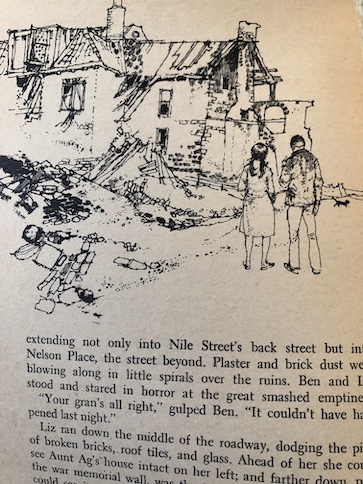
The book continues through the next year and a half, through the developments of the war and the lives and education of Liz and the Brereton boys. Although Mrs. Brereton didn’t initially want Liz, the Breretons become fond of her as she shares in their lives, and they come to understand one another. Each of them finds a way to make a difference in the middle of war, and through the hardships they face together and their shared lives, they become a family. When Liz gets a letter from her grandmother that lets her know that Rose is “in trouble” in London, she and Ben make a daring trip into the bombed city to rescue her cousin. The book ends at the beginning of 1941, just after the New Year, with the war still going on, but by that time, each of the young people in the story has found a direction in life and hope for the future.
The book is available to borrow and read for free online through Internet Archive (multiple copies). Because of the themes and some of the language in the story, I would recommend this book for teens and young adults. There are descriptions of bombings, war deaths, a teenage pregnancy (Rose, not Liz), and some mild swearing in several places. The violent parts aren’t as graphic as some descriptions I’ve seen in other books, but there is definite violence and death, so it’s not really a book for young children.
My Reaction and Spoilers
The Atmosphere
This story could fit well with both the Cottagecore aesethic and Light Academia. In the countryside, Liz is living in an unusual, atmospheric house, a converted mill, and the descriptions of her room sound enchanting! In some ways, the beginning of the book reminds me a little of Anne of Green Gables: an unwanted orphan who is taken in by a countryside family that originally wanted a boy, and a girl who loves books and is determined to pursue an education and make something of herself. Liz is a true book lover, and the story mentions the books that she reads and loves, like Pride and Prejudice by Jane Austen, Jamaica Inn by Daphne du Maurier, and Beau Geste by P. C. Wren. Liz doesn’t just read because she is required to read for her classes but because she really enjoys books. She also comes to understand things from books she reads, like the war around her and the feelings of some of the Breretons from reading Shakespeare’s Henry V. The insights that people gain from reading are part of the reason why literature is regarded as one of the disciplines of the humanities, the areas of study that provide insight into human nature and human potential. Liz combines the insight and knowledge she gains from reading and what she perceives around her to better understand the world and other people. In some ways, she fits a little better with the intellectual Brereton family than she thinks she will at first.
Later in the book, after Liz has seen more of the war directly, she wonders if there’s really a point to continuing her education or if she should just try to get a job in a factory and do her part. Studying things like poetry and Shakespeare in class just feel pointless and irrelevant in the face of the larger, life-and-death events happening around her. She could relate to the themes in Henry V, but Romeo and Juliet begins sounding pretty silly to her. Her teacher persuades her to continue her education, telling her that the more educated she is, the better she will be as a worker and an asset to her country. At first, Liz doesn’t see how, and her teacher explains that she is learning mathematics, which are used for the construction and calibration of weapons. She is also learning biology, which would be useful if she becomes a nurse or has to care for someone who is wounded. As for things like poetry and literature, anything she studies will teach her humility and give her mental maturity and greater understanding of other people – the goals of the humanities. We don’t know about all of her long-term career goals by the end of the book, but along the way, Liz continues her education, takes on part-time jobs, and finds ways to help the war effort and the people she loves.
Evacuees, Social Class, and Socialism
The experiences of the evacuees in the story are very realistic. It’s important to note that child evacuations went in waves throughout the war, and Liz and her friends are part of the very first wave of Operation Pied Piper. When the war started, people expected that bombings would start almost immediately, which was why they tried to hurry as many children out of London as fast as they could. However, the book covers the real events and attitudes of the early war years, including the fact that the bombings didn’t begin as quickly as expected. When the bombings didn’t start right away, people started to think that the fear of bombings was an overreaction, and many families brought their children back to London from the countryside. Some called this phase of the war the “Phoney War” because people on the home front didn’t feel like there was a war really happening yet, and even on the front lines, there was relative quiet because the large scale operations hadn’t started yet. Liz feels more alone in Chiddingford when some of her friends from school return to London and leave her behind in the country. Liz knows that there’s no point in going back to London herself because her aunt won’t want her, and remaining with the evacuation program will allow her to finish her education. Of course, readers know that the Blitz is coming before the characters in the book do, and the people who returned to London will probably end up regretting it.
In real life, some of the children who returned to London prematurely were killed in the coming bombings, and others were sent away again in the next wave of evacuations. In the case of the kids in the story, Liz’s friends Annette and Naomi return to London, thinking that the risks of bombings were overrated. After the bombings start in the Battle of Britain, Liz’s grandmother writes to Liz and says that Naomi has been sent away again, this time to Wales, which was a destination for many evacuees. We never hear what happens to Annette.
The book did a good job of showing how evacuees and their host families experienced some awkwardness with each other because of their different lifestyles and social classes. Not only is Liz not from an intellectual family like the Breretons, but she also comes to realize that she lacks some of the table manners and social graces of people of their class. The book also explains how Liz and her friends speak differently from the Breretons. Liz and her friends are described as being “bilingual in two kinds of English.” When they’re with family and friends, they speak cockney English, but at school, they speak a more “posh” version of English. However, even their more “posh” English isn’t as high class as the way the Breretons speak because they are a family of people who have been to boarding schools and have higher levels of education. You can hear what a cockney accent sounds like, how it works, and the social significance it has from these videos:
1976: COCKNEY accents from the BCC Archive (about 11 min.) – The people talking would have been alive during WWII, some of them probably around Liz’s age at the time. Some of them talk about the differences between the way they talk and how younger generations speak.
The Story of COCKNEY the (London) Accent and its People (about 35 min.) – Explains more about the social history and cultural identity of Cockney people. This includes some of the historical information that Mr. Brereton, history professor, could recite, although Liz knows that doesn’t mean that he fully understands the realities of day-to-day life in the East End. Toward the end of the video, at about 27 min., there is a clip from a 1930s film as an example of how the accent used to sound because accents change over time.
The Breretons are using “received pronunciation” (RP), which is called “received” because people in England don’t tend to speak that way until they are taught to do it in the higher-class schools. It comes directly from having an education, particularly a higher education, so people who speak that way are immediately announcing their social class and education level with the way they speak. You can hear it and get an explanation of how it works from these videos:
Make Do and Mend (about 3 min.) – A 1940s educational film about making and mending clothes, to save on material for the war effort. Received pronunciation (RP) is also sometimes called “BBC pronunciation” because this is the accent that radio announcers would use. The announcers in this short film, one male and one female, are using 1940s RP.
1967: John REITH explains the “BBC ACCENT” (about 10 min.) – From the BBC Archive, about why the BBC particularly wanted its announcers to speak RP. John Reith was the Director-General of the BBC, beginning in the 1920s and ending in the late 1930s. During WWII, he became Minister of Information, and from there, moved to various other governmental roles. This interview was his very last appearance on television. It took place when he become Lord High Commissioner to the General Assembly of the Church of Scotland. The interviewer asks him about the reason why, during his BBC years, he wanted his broadcasters to speak with an RP accent. Basically, the logic behind RP was to put more emphasis on education and ability to communicate clearly rather than the speaker’s regional origin. Particularly in radio, where listeners only have the voice to rely on and no visuals to clarify anything, it was important to have an accent that would be as clear as possible to the general population, where there would be no confusing regional pronunciations and slang. In the video, John Reith specifically says that they didn’t want there to be any accents that would seem comical or irritating to the listeners by seeming overeducated, undereducated, or too regional. They also debate the social implications of this and the effect of television, which was relatively new technology to them in the 1960s. Both of the men in the video are speaking a kind of RP, although they’re not completely the same as each other. John Reith admits that his speech still has regional influences because he’s from Scotland.
The RP English Accent (about 9 min.) – About who speaks RP, how it sounds, and the social implications. It also mentions how there are people, like the presenter, who speak a kind of RP but still with regional influence, which is similar to the way Liz and her friends are learning to speak in their school. It also discusses how WWII changed the way this accent was perceived and who would speak it because of social changes.
RP (Received pronunciation) vs POSH ENGLISH (about 23 min.) – Explains the origins and evolution of RP and the differences between standard received pronunciation (RP) and the more high-class or “posh” version that the upper classes would speak and how regional accents influence even RP. It also explains that, although this accent was known for being used by radio broadcasters, during WWII, radio broadcasters started using more regional accents to make it clear that they were authentic British people because Germans broadcasting propaganda were speaking English with an RP accent. This is one of the factors influencing changes in professional and social views about different types of British accents.
Why does all of this stuff about accents matter? It comes back to social class and education, both of which influence people’s prospects in life. A person’s accent, particularly during the mid-20th century and earlier times, reveals their background and the type of level of education they have. (Less so in the 21st century, after the influences of mass media – tv and the Internet – which enable people to hear more accents than they encounter in person in daily life, changes to the education system, and changing cultural attitudes.) Schools of the time knew that and would make sure that their students could speak in a way that would make them sound as educated at possible. A person who sounded as educated as they said they were would sound more skilled and competent to potential employers, enabling them to get “white collar” jobs, involving more clerical or specialized skills rather than manual labor, and rise up in the middle class. People who only had the the minimal level of education, like Liz’s relatives, wouldn’t have this influence on their speech, and that could be a barrier to finding better jobs, keeping them at a lower, working class level.
Liz and her friends have been learning some RP in school, which is why they can speak more “posh” than the general cockney spoken around them in daily life, but the Breretons speak a higher level of RP because of their boarding school backgrounds and college educations, so even Liz’s more educated version of English isn’t up to their level of RP. Liz and her friends are learning to speak at a middle class level because they’re being prepared for possible white collar jobs and middle-class living. The students’ cockney families speak like the working classes because that’s what they are, and they’re less likely to move up in the world because listeners can tell that they don’t speak in an educated way. The Breretons speak like academics because that’s what they are, that’s what they’ve trained to be, they’ve had higher-class education, and they’re relatively upper-class or upper-middle class. Although the girls’ families think that the girls are learning to speak “posh”, and they are when compared to their relatives, the Breretons can still hear their background in their speech and know they’re not from the same class. This ability to almost diagnose someone’s background and education from a person’s accent influences the way people in the story and society of the time would think of each other right from their first meeting. Because they can tell some significant factors of a person’s background immediately, there was a tendency to jump to conclusions about a persons’ life, habits, and capabilities. Part of this story is about how they assumed too much before getting to know the details of other people’s lives and personalities, and that’s a factor that influenced social attitudes before and after the war. As the videos that I’ve referenced explain, the modern, 21st century versions of the dialects and accents in this story wouldn’t be quite the same as the ones the characters would have spoken in the 1930s/1940s because language evolves over time, but the videos will give you a sense of how the characters hear each other.
When Liz tells Lady Brereton that her father was a Communist, Lady Brereton is intrigued and fascinated but not overly shocked or disparaging. Liz is happy that Lady Brereton appreciates that he was a good and loving father and that Liz badly misses him even if his political views were unorthodox. Today, Britain is more of a democratic socialist nation than the United States, and the social programs of WWII, like the child evacuations, are part of the reason. Britain was a country that was very focused on social class, and before the war, the social classes seldom mixed. However, the war was a nationwide effort. People of all social classes were expected to do their part and work together, and programs like the child evacuations brought people of different social classes together in ways they had never been before. The result was that people of different social classes learned more about the ways other people lived, and because the evacuation system saved many lives and led to improvements in living conditions for some children from poor areas of the city, people in Britain became more interested in social programs to help the poor and create a more stable society. This isn’t the only reason for such social programs, but it was a contributing factor.
In the book, when Liz looks back on her father’s political views, she realizes that she shares some feelings with him but wouldn’t agree on everything he used to say, and that’s because of her own experiences. The social programs of the war helped her to continue her education and find a more stable life than the one she had with her aunt, but she also knows that she can’t rely on that type of support for everything and starts to look for ways that she can earn money herself and live an independent life. Her experience with and approach to social programs seems like a broader, more blended view. She has had experience with different social classes and different systems and can see the benefits and downsides of different ways of living.
For more information about the conditions and experiences of child evacuees, I recommend the following videos:
This series of interviews with former child evacuees is much longer than the other one, about 40 minutes long. Part of this one brings up the subject of racial minority children who were evacuated. Children of different racial backgrounds or ones who looked like they might be could be discriminated against by people who were reluctant to host them because of the way they looked, but there were also some nice families who were willing to host them.
An hour-long documentary about evacuees’ experiences, good and bad, with interviews with individual evacuees as older adults. It includes the experiences of evacuees who were sent overseas and not just to the countryside. It also covers the effects that the experience had on their education and how they found it difficult to relate to certain types of lessons, like poetry lessons, because the themes were so far from their wartime lives. It also explains what happened to them after the war was over and the long-term effects that their experiences had on t hem.
Explains what conditions were like for those who remained in London during the war and what the evacuees were escaping. Timeline Documentary. About 50 minutes.
For other children’s books about WWII and child evacuees, I have a list of WWII books with additional resources. For books about child evacuees, I especially recommend Carrie’s War (1973) and All The Children Were Sent Away (1976).
Education and Children
A detail that I particularly liked about this book was the explanation of the the 1940s British school system at the beginning of the book. I’ve seen other explanations of the British school system online (like this one from Anglophenia on YouTube), but the explanation in this book does help because the main character’s education and future prospects are a major part of the story.
The attitudes about class and education surprisingly still resonate today. The type of education a child receives is often determined by the economic level of their parents and the type of life that the adults expect that the child will lead. All of the parents in the story have their own notions about what the young people should be doing with their lives, but the young people know that the world is changing, especially because of the onset of war. The things they want to do and the things they will have to do no longer match their elders’ expectations.
Liz knows that getting a good education is vital to her future, where she will have to make a living by herself, even though her aunt tries to shame her for being grand about her education and tries to make her feel like she should just go out and get a job like her kids did. The Breretons are just the opposite, seeing higher education as the only path to a secure future, while their sons realize that there are more immediate problems shaping their world and posing real threats to all of their lives. Each of the young people come to realize that there are decisions that they each need to make for themselves to take charge of their lives and handle what life has given them, even if the adults don’t understand.
Overall levels of education in society have risen in the decades since World War II. Technically, where I live, children are only legally required to attend school through 8th grade, but in actual practice, almost everyone gets at least a high school education because even the lowest levels of jobs in our society expect a high school level of education or an employee who is working toward one. There is very little that anyone can do with only an 8th grade education in the 21st century, and almost everything that provides a living wage requires either a college degree or some kind of vocational training beyond high school. There are almost no jobs that will take a person with a minimal level of education and no prior experience.
In 1940s England, there were more opportunities for people with little education to get jobs, which is how Liz’s cousins get jobs even though they leave school at about age 14, but even then, there aren’t many opportunities for jobs that pay well and little opportunity for advancement. Rose later has problems when she gets pregnant as an unmarried teenager, and her cruel mother throws her out of the house, into the bombed streets of London with no way to make her living. Liz and the Breretons help her, but they worry about her future prospects. She has little education and has worked in a shoe store, but she doesn’t know much else and has no other experience. Without an education or other means of support, there isn’t much else she can do. She doesn’t even have very many domestic skills and can’t sew or knit. The end of the book implies that Rose will learn to manage because she decides that she is determined to keep her baby and find a way to support them both, learning whatever she has to learn along the way, and Liz’s teacher, Miss Garnett, will also help her.
Liz loves her cousin enough to take some risks to reach her during the bombings of London and bring her to Chiddingford, but she comes to realize that she has underrated her cousin for being less educated and a bit foolish in her life choices. On the one hand, she is irritated with Rose for her foolish love affair with a man who doesn’t really seem to care about her and marries someone else instead. She and Ben face some real dangers going to London to find her and get her out of the terrible situation she’s in, so a foolish choice on her part does create some risks and hardships for others. However, she finds out that Rose understands some things about life and human relationships that Liz is just now beginning to understand. The reason why she had that love affair was that she felt emotionally neglected by her hard-hearted mother and desperately lonely after Liz left for the countryside. Her choice of lover turned out to be a bad decision, but she was so starved for companionship and affection that she was vulnerable. Part of the reason why Rose is now determined to keep her baby and not place it out for adoption is because she saw the awful way her mother treated Liz as an orphaned child and how badly Liz was starved for affection. Rose’s mother was cruel to her as well, but much more cruel to Liz because Liz wasn’t her own child. Rose wants her own child to know what it is to be genuinely loved and wanted, in spite of the hardships and stigma of being a single, unmarried parent in the 1940s. Liz is touched that Rose truly understands that important emotional need just to feel loved and wanted by someone, something Rose’s mother never seemed to understand or care about. Rose might turn out to be a better parent than her own mother.
The feeling of not being wanted and only reluctantly accepted was one that real-life evacuees experienced, and I thought that was well-represented in the book. When Liz first meets Mrs. Brereton, she reminds her of her aunt. She puts her own children first and is so absorbed with what she thinks are in her family’s best interests that she sees Liz as an inconvenience and possible threat instead of the vulnerable girl she really is. However, where Liz’s aunt never warmed up to her after they lived together for years, Mrs. Brereton does become fond of Liz and starts to think of her as part of the family. With her elder sons going off to war, she admits that it’s a comfort to her to have Liz there. Liz shares in the family’s ups and downs through the war and really becomes one of them. Her attitude contrasts with Liz’s aunt, who is self-absorbed and ready to abandon any of the children in the family, including her own, when they become too much of an inconvenience to her. Mrs. Brereton is different. There are times when she is disappointed or worried by decisions her sons make, but they’re still her sons. Once she starts thinking of Liz as one of the family, she extends the same loyal affection to her. She worries about Liz when she disappears for a time instead of being relieved that she’s gone, and she even takes in her cousin when Liz brings her from London.
It’s hard to say how much of the differences because Liz’s aunt and Mrs. Brereton are due to their relative social positions and how much are because they have different personalities. I’m inclined to think that it’s a combination of both. I can see that Liz’s aunt may feel more precarious in life because she’s a poor, working class woman and feels less able to provide for an extra person or someone in a situation that might require some sacrifices, like her orphaned niece or pregnant daughter. However, Liz’s gran, who is part of the same social class, thinks that Rose’s mother has behaved horribly, both for mistreating Liz for years and for sending her pregnant and penniless young daughter out into the streets while the city is being actively bombed, so it seems that not everyone in that social group would have the same reactions to these situations, and some might be willing to make more sacrifices to help someone in desperate circumstances.
There are themes all through the story about the human need for affection and relationships with other people. Partly, the ability to build relationships with others is recognizing the need for them and being open to building relationships. Mrs. Brereton isn’t really open to building a relationship with Liz at first, and Liz and the Breretons don’t really understand one another, but relationships are also built through shared experiences. Not all of the experiences that the characters in the story share are positive ones, but facing difficult situations together can also be a bonding experience. Mrs. Brereton bonds with Liz and Rose because, even though it’s difficult for her at first, she comes to recognize how Liz supports her family in difficult circumstances, and she’s willing and able to help them through difficult circumstances in return, as a family. Liz’s aunt loses her relationship with both girls because she never develops that appreciation for them or willingness to share in their lives and troubles.
War
The war is always around the characters, and the story is shaped by it. I thought the author did a good job of representing the early events of WWII and how characters would have reacted to them as they actually happened. Each of the young people in particular wants to actively participate in the events that are shaping their world, even though Mr. and Mrs. Brereton would prefer to keep their sons out of it.
The grandfather of the Brereton family understands how the young people feel, having once been a soldier himself. Ben and his grandfather are very much alike, noble-minded and eager to participate. Liz joins Ben and Sir Rollo when they take Sir Rollo’s boat to participate in the Dunkirk Evacuation as one of the “Little Ships.” They know that British soldiers need help returning to England, and they hope to rescue Simon, who has joined the army, and others like him. They end up leaving Liz behind at Ramsgate because they decide that it would be too dangerous to take her the rest of the way with them. Sir Rollo is in bad health and probably shouldn’t be undertaking such a long-shot mission, but family love and his desire to once again be in the thick of things, making a difference, override any thoughts for safety. In the end, he helps save many people, and because of his prior experience in war, he is able to teach Ben how to avoid the floating mines and sandbars in their way.
However, he doesn’t survive the mission himself. He is killed by enemy fire, but Lady Brereton reveals that he knew he was ill and dying anyway. One of the pen-and-ink pictures in the book is actually of Sir Rollo after he got shot, and I was a little surprised that the book would show a blood-stained dead body in that way. It’s not overly graphic, even in the illustration, and because it’s a black-and-white drawing, it’s a less alarming than seeing someone with a red blood stain. Still, I think sensitive readers should be aware that it’s there. The book doesn’t sugarcoat the nature of war at all.
Lady Brereton knew her husband very well and loved his noble qualities. Although he didn’t tell her ahead of time what he and Ben were planning to do, she suspected that he was going to attempt something of that sort. He was a veteran of the First World War, and he wanted his last act to be something heroic, to feel like he made a difference again before he died. Ben is injured during the mission, but he and his grandfather still manage to save many soldiers. It’s Ben’s first view of war directly, and although it was a terrifying experience, it doesn’t change his mind about wanting to join the RAF. His parents finally agree to let him enlist after he finishes his school exams that summer.
At the time the book ends, none of the young people are killed in the war. We don’t know what’s going to happen to all of them by the time the war is over because the story ends in early 1941, but their experiences have made them all realize what’s important to them and given them the determination to do their part in the war effort. The overall situation by the time the book ends is that Britain is feeling like it’s largely fighting the war alone because France has fallen to Germany and is now occupied, and while Britain is getting some supplies from the US, the US would not fully enter the war until the attack of Pearl Harbor in December 1941. For a more detailed explanation of the war situation in Britain in 1940, I recommend the Timeline documentary 1940: When Britain Stood Alone In WW2 on YouTube. Understanding the general course of events in context adds depth to the story.
Toward the end of the book, there seems to be a romance developing between Liz and Ben. Personally, I like to imagine that Liz and Ben might marry after the war. I’d like to imagine, too, that Rose might end up marrying Simon and have a comfortable life as a doctor’s wife after the war. That’s left to the imagination, though.
Snowbound Mystery by Gertrude Chandler Warner, 1968.
The school that most of the Alden children attend is closed temporarily because there was a fire and the building needs to be repaired. Henry is in college (this is one of the books in the early part of the series where the children age), but he doesn’t have to go back for another week, so the family is talking about what they’d like to do. Benny says that he wants to go up to the hunter’s cabin in the Oak Hill woods. Grandfather Alden belongs to the sportsman’s club that owns the cabin, but the hunters in the club don’t use it during the fall. It’s early for there to be snow, so Grandfather Alden thinks it will be okay. Grandfather Alden isn’t eager to go himself, but he thinks that it’s okay if the kids want to spend a week there.
The kids bring some food with them to the cabin, but they plan to buy more from the nearest store, which is a five-mile hike away. On their arrival, they choose the places where they’re going to sleep in the cabin, and they look through the cabin’s guest book for names they recognize. One name they recognize is the Nelson family. The Nelsons are the ones who own the store, and they kids wonder why they’ve visited the cabin three times recently because they wouldn’t have come there to hunt. They decide to ask the Nelsons about it when they go to the store.
The Nelsons are friendly and helpful at the store. When the kids ask about their trips to the cabin, Mr. Nelson just says that they sometimes like a change of scene. The cabin used to belong to the Nelson family before the sporting club bought it. However, the Nelsons’ young son, Pugsy, says that whenever they go to the cabin, they “look and look.” His parents stop him from saying more, but the Aldens wonder what the Nelsons could be looking for at the cabin.
The Nelsons give them useful advice about dealing with the squirrels at the cabin and about cooking. Mr. Nelson loves cooking and baking. In particular, he likes to make buns, but he makes an odd comment about how they’re not as good as they could be.
Back at the cabin, the Aldens find a hidden broom closet and a strange message that seems to be in some kind of code. They can’t understand what it means, and they wonder if this message could be what the Nelsons are looking for. Because they don’t understand the significance of the message, they’re not sure what to do about it. The Nelsons are nice, so the kids don’t want to think that they might be involved in anything bad, but if there’s an innocent reason for them to have this message, why are they being so secretive about it?
Although it is early for snow, a bad snow storm comes that leaves the Aldens snowbound in the cabin. Fortunately, they have plenty of supplies, and they can use their radio to hear about weather conditions. There are messages on the radio for people who have been separated from family members, and one of them is from the children’s grandfather, telling them to remain in the cabin and wait for help because he will get to them as soon as he can.
However, the Nelsons were also worried about the Aldens and made their ways through the snowy woods to check on them. The snow was worse than they thought, so now, the Nelsons are also stuck at the cabin with the Aldens. While they wait for their rescuers to arrive, the Aldens and Nelsons discuss the secret message and what the Nelsons are really looking for.
The book is available to borrow and read for free online through Internet Archive (multiple copies).
My Reaction and Spoilers
The Nelsons are actually a nice family, and there is an innocent reason for their behavior. Mr. Nelson’s father and grandfather also loved baking, and they had a special recipe that they used for making buns. Their recipe had a secret ingredient, but unfortunately, they both died before passing on their secret. Mr. Nelson thinks that, if he could make the buns like they did, he could become famous or at least earn more money for his family. He is a good baker, but the recipe is something special. The secret message is part of the recipe, but there’s still a missing piece of the puzzle. The Aldens and the Nelsons use their time when they’re snowbound in the cabin to look for the rest.
This story is equal parts adventure and mystery. Fans of the Cottagecore aesthetic will appreciate how the Aldens make do with the primitive conditions at the cabin, use plants as decoration, and gather nuts in the woods before the snowstorm.
Years after this book was published, another author wrote a cookbook based on food references in the Boxcar Children series, and she included a recipe for the buns in this story. The story never reveals the secret ingredient, and the author uses some shortcuts in preparing them, but it’s an easy recipe that kids can learn to make.
“Sooner or later everyone has to go away from home for the first time. Sometimes it happens when a person is young. Sometimes it happens when a person is old. But sooner or later it does happen to everyone. It happened to Victoria North when she was eight.”
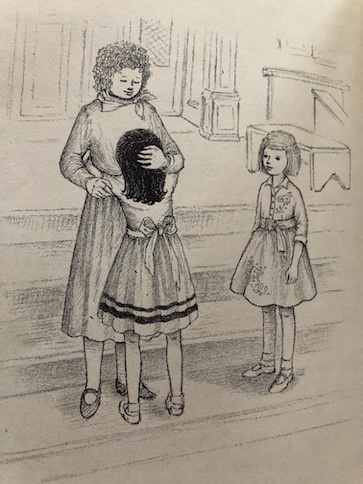
Victoria North is attending boarding school for the first time at the Coburn Home School. Victoria is only eight years old, and this is her first time being away from home at all, so she is very nervous and shy. When she arrives at the school, she is met by an older girl named Ann, who shows her where her room is in the dormitory. Ann shares a room with Victoria and is supposed to show her around and tell her the rules, but she doesn’t really explain much. Victoria still feels lost and has trouble even finding the table where she is supposed to sit at dinner.
At dinner, one of the other girls, Martha Sherman, starts uses funny words, and she tells the other girls that they are part of a secret language that she made up. However, she refuses to tell anybody what they mean. Martha is moody and rude to the other girls at dinner, so the housemother sends her to her room before the meal is over.
Overcome with homesickness, Victoria cries at dinner and during the songs they have to sing afterward. No one has any patience with poor Victoria. Ann tells her that she’s being a crybaby. Other girls laugh at her when they see that she’s been crying. Victoria doesn’t know how she’ll be able to handle boarding school if every day is going to be like this!
The other girls in the dormitory say that Miss Mossman, the housemother, is strict. She blows her whistle at them and makes them line up for inspection every morning. Miss Blanchard, another teacher, is nicer, and she tries to reassure Victoria that things will get better when she gets to know the other students and makes some friends. However, nobody seems to want to be friends with Victoria. Nobody except Martha.
Martha is the only girl who seems interested in talking to Victoria. Martha doesn’t like Coburn Home School, either. More than anything, Martha wants to live at home and just go to an ordinary day school instead of being boarder. Victoria knows just how Martha feels! The other girls are surprised at how well Martha seems to get along with Victoria because Martha doesn’t usually want to be friendly with anyone.
The two of them start to talk about their homes and families. Martha’s father is an importer. She keeps saying that her parents are going to let her come home from boarding school and just go to day school, but it quickly becomes apparent that it isn’t likely. Victoria only has her mother, who works and sometimes needs to travel for work. She doesn’t even remember much about her father. Martha likes math, a subject which Victoria finds hard, but Martha says that she doesn’t reading, which is Victoria’s favorite subject. The two complement each other well.
Although Martha misses home, like Victoria does, and doesn’t really want to be a boarder, she is more experienced about boarding school life, and she helps Victoria to adjust to the school. Martha starts teaching Victoria about pieces of boarding school lore, like school rhymes and the traditions made up and passed down by students, and she also begins teaching her the secret language that she made up. There are only three words in Martha’s secret language, but Martha explains to Victoria what they mean, and the girls decide that they’ll make up more together. Martha becomes Victoria’s best friend all through the rest of her first year at boarding school.
Being friends with Martha makes boarding school feel better to Victoria. Martha still constantly talks about hating boarding school and how she definitely won’t come back next year, although Victoria realizes that’s just a wish of hers. Victoria also comes to realize that many other kids at the boarding school feel the same way. Even the ones who like the school admit that they’d really rather be at home with their parents. They daydream about just going to school during the day and coming straight home afterward, where they can just relax at home and eat what they want and not have to answer to whistles or line up for inspections. When Ann’s family decides to bring her home, Martha and Victoria ask Miss Mossman if they can share a room, and she agrees as long as the girls behave themselves.
Victoria is fascinated at the things that Martha knows about life at boarding school. Martha teaches her about “pie beds.” (I always heard it called “short-sheeting” when I was a kid, although I was never good at making beds the normal way in the first place, so I never fully grasped how to pull off the trick, and I didn’t go to summer camp or boarding school, where people typically did this anyway.) The girls argue about what costumes to wear to the school’s Halloween party, but the school’s handy man helps them make ice cream cone costumes that win a prize for the most original costume. The costumes are uncomfortable to wear, but Victoria is pleased and thinks that Martha should get the credit because the costume concept was her idea. Martha says that, next year, they’ll start planning their costumes earlier and come up with an even better idea. That’s the moment when Victoria realizes that Martha is no longer talking about how she’s definitely not coming back next year.
After the girls come back from Christmas vacation, Victoria is homesick again, but it turns out that their old, strict housemother has left to take care of her father, who is ill. Instead, they get a new housemother, Miss Denton, who is much nicer. She doesn’t blow whistles at the girls to wake them up. Victoria likes Miss Denton right away, and even the other girls in the house start calling her “Mother Carrie” as Miss Denton requests, even though the name strikes them all as silly at first. Martha finds Miss Denton to be overly sweet (“ick-en-spick” in the secret language), although she admits that she’s better than Miss Mossman.
Martha also finds herself liking Miss Blanchard, who teaches math. Miss Blanchard was nice to Victoria in the beginning, but Victoria can’t bring herself to like her much because she has so much trouble in math. Victoria has a fanciful imagination and likes to imagine that certain numbers are boys and others are girls, and Martha finds it frustrating because the idea doesn’t make sense to her, and Victoria doesn’t even follow an exact pattern, like odds vs. evens in her designation. Meanwhile, Victoria is confused by the math tricks that Miss Blanchard teaches Martha. Martha thinks they’re fun, but Victoria isn’t as good at math and has trouble following them.
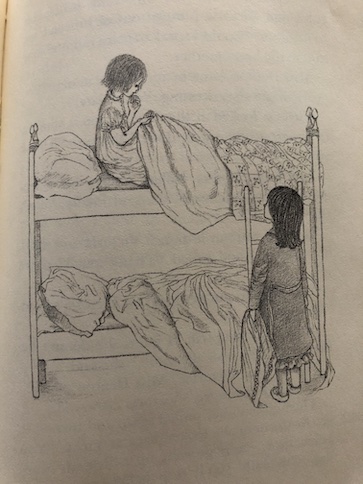
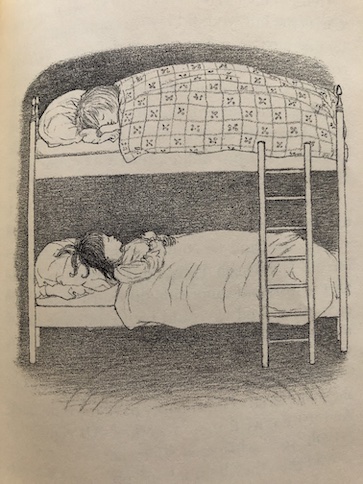
The two girls find themselves arguing sometimes because of their different preferences, but they remain friends. It’s more that, now that they’re getting comfortable with each other and their school, more of their individual personalities are coming out. Victoria is also surprised to realize that, while she still frequently misses her mother, she no longer agrees with her mother about certain things. When her mother comes to visit the school, she worries about Victoria sleeping in the top bunk of their bunk bed, but Victoria herself loves it and has to assure her mother that she likes the top bunk. One thing that boarding school has done for Victoria is to give her a sense of independence and room to develop her own identity and preferences. She no longer has to get her mother’s permission for everything she does, as long as her housemother approves.
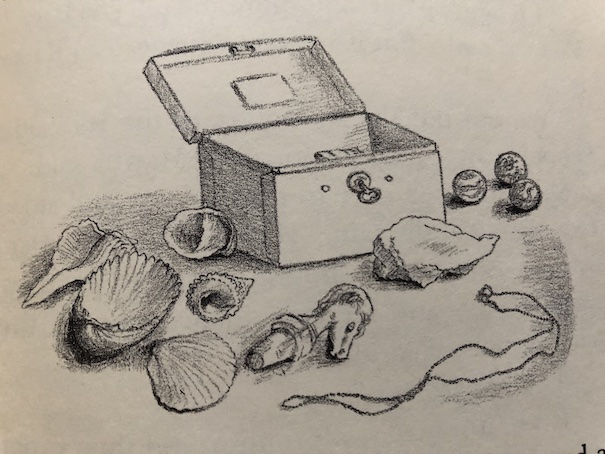
Victoria and Martha are both imaginative, and they begin enjoy their shared adventures at school. They try to hold a midnight feast in their room and search for hidden passages or secret compartments in the dormitory because Martha has heard or read that these things happen in boarding schools. Neither of those adventures goes as planned, but Miss Denton allows the girls to build a little play hut of their own with help from the school’s handy man. Miss Denton also gives the girls a little lockbox to keep some of their treasures in, and they hide it so they can have a buried treasure.
As the year comes to an end, Victoria knows that she’ll be coming back to boarding school next year, and the prospect doesn’t seem so bad as it did before. Martha isn’t sure whether she will or not, talking sometimes about what they’ll do next year but still hoping to live at home with her parents. But, if Martha doesn’t come back to school, it just wouldn’t be the same for Victoria!
The book is available to borrow and read for free online through Internet Archive.
My Reaction and Spoilers
One of the things I found interesting about this book is that it is set in the US. The iconic boarding school stories for children tend to be British stories, but the Coburn Home School is in New York state. The girls’ parents live in New York City.
Most of the story focuses on the girls’ relationship with each other and their growing sense of self-identity and confidence at their boarding school. They talk about classes they take and how they each feel about the other’s favorite subject, but they aren’t shown in classes themselves. The school is also a co-ed school, with both boys and girls, but the boys don’t enter into the story much because most of the action takes place around the girls’ dorm. The boys live in a different dorm. There is only one instance where a boy is shown talking to Victoria, with a hint that he might have a crush on Victoria, another new development in Victoria’s life at school. The little developments in the girls’ lives and attitudes through the school year and each little experience and adventure they have are the main focus of the story. These are the things that are helping the girls understand and develop their identities, self-confidence, and sense of independence.
Toward the end of the book, Miss Denton encourages the girls to think about all of the things they’ve learned this year, and not just the ones they’ve learned in class. The girls don’t fully understand and appreciate that Miss Denton is talking about personal growth and development, but they do consider things they’ve learned, like how to make beds, that midnight feasts aren’t as fun as they sound, and how Victoria learned not to be homesick. These are some of the little things that are part of their school experience and that are slowly making them more grown up and independent than they used to be.
Although Martha is a little older than Victoria and sometimes chides her for being babyish about some things (like putting a lose tooth under her pillow) or still homesick, the truth is that Martha has been just as homesick the entire time. Martha doesn’t appear to be as upset about boarding school as Victoria because she is not a new student in this book, like Victoria. She already went through her first year at boarding school before Victoria got there, so she no longer openly cries about being away from home. Still, the reason why she keeps talking about going home and living with her parents all the time is that she misses them. While the girls’ adventures during the school year and Victoria’s realizations about how boarding school gives her the opportunity to do things and be with people she wouldn’t at home make her feel better about coming back next year, Martha still feels uncertain about it. Martha has also come to love being friends with Victoria and even loves Miss Denton, but her feelings of homesickness leave her feeling torn about what she really wants.
There are hints that Martha will probably return to boarding school anyway, but Miss Denton reassures Victoria that she will be fine at boarding school even if Martha decides not to come next fall, reminding Victoria that she is now one of the “old girls” instead of a scared new one, like she used to be. Victoria also starts to feel that way herself. Martha will probably be back the next year to be with Victoria, Miss Denton, and Miss Blanchard, but readers can be reassured that, even if she doesn’t return, Victoria will be all right with her new sense of identity and independence. This first year at boarding school with Martha may be the beginning of a lifelong friendship or just one step to Victoria finding herself and building other friendships. Maybe it’s both. Victoria’s future life will be fine in general as she continues growing up and finding her way, learning to manage her life one step at a time.
There is a modern 21st century documentary about young children going to boarding school for the first time at 8 years old, What’s Life Like in a Private British Boarding School? | Leaving Home at 8 Years Old, on YouTube. The school in that documentary is British, but I was struck by the common feelings in the documentary and the book, even though they take place decades apart in different countries. There are just some parts of the human experience that last through the generations. The documentary also shows the parents’ side of the boarding school experience, the reasons why they choose to send their children to boarding school, and how they cope with their feelings about sending their children away and being separated from them.
Boarding school isn’t always easy for parents in terms of emotions, and there are hints of that in The Secret Language. We never see Martha’s parents in the book, so we don’t know what’s going on with them, but Victoria’s mother fusses over Victoria when she gets the chance, and she talks about how great it would be if she could arrange things so that Victoria can be home with her all the time again, too. If Victoria’s mother wasn’t a working single mother who has to travel for work, she probably wouldn’t have sent her away to boarding school at all. Miss Denton is very in tune with people’s feelings, and I think that she’s aware of all the complexities in the lives of the girls and their parents. She does her best to look after the girls emotionally, and that’s part of her urging the girls to consider other people’s feelings, to be thoughtful about each other, and to think about the ways they’ve been changing inside as well as outside. I think that the universal nature of the girls’ and adults’ feelings in the book are a sign of the author’s emotional awareness, understanding of how different types of people feel.
Ursula Nordstrom, the author of the book, was actually a famous children’s book editor. She is credited with helping to transform mid-20th century children’s literature to have more of a focus on children’s feelings, experiences, and imagination instead of being morality tales, focused on what adults want children to know or understand. The Secret Language was the only children’s book that she wrote herself. This YouTube video explains about her life and career.
One moonlit evening, as Gail Foster walks home from the movies with her brothers, a pair of twins named Ted and Tim, and their friend, they pass the old house called Morgan’s Green. The old house was ruined by fire years before. The house hasn’t been repaired since the fire, but the owner, Miss Morgan, pays someone to maintain the grounds and to keep trespassers away. The old ruin bothers people in the neighborhood because Miss Morgan seems to have no intention of ever repairing it so anybody can live there again. For some reason, she seems to want it to just stand there, a ruined and empty eyesore.
As the children pass the house, Gail suddenly hears a knocking or rapping sound. She stops the boys and gets them to listen, but by the time they do, the sound has stopped. The children debate about what the sound could have been. One of her brothers worries that maybe someone has wandered into the old house and gotten hurt, but the other one thinks that maybe Gail just imagined the sound because she likes to write stories and recently wrote a scary one about a ghost. The brothers’ friend, a boy named Conan, has a job helping the groundskeeper at Morgan’s Green, and he says that he’ll check everything over when he goes to work there the next morning.
Gail feels uneasy about the idea of some unknown person being at the old house because the truth is that she has been secretly trespassing on the grounds herself. She went there one day when she was chasing her brothers’ dog, and she found an old, disused tool shed with a workbench inside. This forgotten shed struck her as a good place to go and write in secret. Her brothers have been teasing her about the stories she writes, so she could use a little privacy. Actually, she could use any privacy. Her brothers routinely sneak into her room, read her stories and her private diary, and even deface the diary and tell their friends what she wrote. Their father always tells Gail that the boys’ teasing and bullying is her fault because she makes it too easy and fun for them by showing her emotions, and her parents refuse for punish the boys for any of it or allow Gail to have a lock on her bedroom door to keep them out. It’s no wonder Gail feels the need to escape. Now, Gail worries that maybe someone (or some thing?) knows about her trespassing and that the knocking sound was some kind of warning for her to stop.
The next day, she reconsiders that idea, remembering that she has heard about thefts in the area lately. Maybe what she heard was actually thieves! Miss Morgan still has some furniture stored in part of the old house that might tempt a thief. Conan’s father is the local sheriff, and he hasn’t had leads on the robberies yet.
The next time that Gail goes to write in the old shed, Conan comes to talk to her. At first, she is worried that her secret hiding place has been discovered, but Conan tells her that he’s known about it for a while because he’s seen her going there before. Gail tells him how badly she needs a place with some privacy. He hasn’t told Gail’s brothers about it, and he says that he doesn’t care if Gail wants to continue using the shed.
Conan is also the only one who’s really taken the rapping that Gail heard seriously. Conan tells Gail that he’s looked around Morgan’s Green, but he hasn’t found any sign of whatever made the noise. However, he has some worse news. The groundskeeper at Morgan’s Green, Mr. Hopkins, has fired Conan, and he won’t even give Conan a reason. They’ve always gotten along well enough before, and Mr. Hopkins has never had any complaint about Conan’s work. Conan feels badly about getting fired, but all he can think of that’s changed lately is the rapping sound and the way he looked over the old house to see if he could find a source. It makes Conan wonder if Mr. Hopkins knows something about what caused the noise and wanted to keep him from finding out about it.
Gail wonders if Miss Morgan could be involved with the local thieves and told Mr. Hopkins to get rid of Conan to keep him from finding their secret hideout or something. The kids pause to consider what they really know about Miss Morgan. She does seem to have odd feelings about the old, burned house. It used to belong to her aunt and uncle, who didn’t used to socialize with the people in town much. After they died, Miss Morgan only lived in the house for a few years before it burned. Now, she doesn’t seem to want to either fix it up or sell it, and no one knows why or what she plans to do with it. However, the kids conclude that she has too much money of her own to get involved with thieves. Still, Conan wants to investigate the situation more because he’s sure something strange is going on at Morgan’s Green, and he wants to find out what it is and if it has something to do with him getting fired.
Gail volunteers to help him investigate, and Conan says that he wants to investigate with just her and not the twins. The twins don’t take things seriously and would be less likely to keep quiet about the whole operation. Conan and Gail do involve Gail’s friend, Lianne, because visiting her gives Gail a reason to walk past Morgan’s Green, both on her way to Lianne’s house and on her way back.
The kids see a strange young man hanging around Morgan’s Green with a sketch pad, and Gail learns that his name is Steve Craig. He’s an art student who makes custom Christmas cards to fund his education at design school. Even Gail’s parents have hired him to make a set of Christmas cards for them with a drawing of their own house on them. When Steve comes to talk to Gail’s parents about the sketches he’s made of their house, Gail mentions that she saw him at Morgan’s Green earlier and asks him why he was there. He says that he was fascinated by the house, but he doesn’t think it will do for his paintings. Gail asks Steve if he has a studio, and he says yes, that he has a room in the attic at his house where he had do his work and that it’s important to have a private place to work. Tim and Ted take this opportunity to jump in and publicly tease their sister about her writing again, the reason why she wants and needs some privacy (from them, specifically). Fortunately, Steve isn’t having any of that, and he makes it clear. The dinner guest speaks to the boys more severely than their father ever did, telling them the plain truth, for once, “You two boys don’t sound very understanding. I can see why your sister would need a place of her own for her writing. But then, you’re rather young. Gail will have to be patient with you.” (Oh, thank God! I hope those useless, idiot parents listened, too. I hated them by this point in the story.) The twins are stunned and embarrassed by this response because no one has ever said anything like this to them in their entire lives. (They would have if the parents weren’t useless twits with obvious favorites among their children. I enjoyed seeing someone tell the twins what they’re really like.) The parents say absolutely nothing. (Again, useless.)
Later that evening, Conan walks Gail home from Lianne’s house, and as they pass Morgan’s Green, they hear voices. They can’t catch everything the voices say, but they do hear one talking about “a few more days.” Who was it, and what’s happening for “a few more days”? When Gail tells Lianne what they heard, Lianne is afraid that maybe the place is haunted.
From Lianne’s parents, they learn that Mr. Hopkins has been moving furniture at the old house. Lianne’s parents think that Miss Morgan might have decided to sell the place after all. However, when Conan mentions that to his father, he talks to Miss Morgan, and Miss Morgan says that she didn’t know Mr. Hopkins was moving anything around at Morgan’s Green. She also doesn’t know anything about Conan being fired.
Mr. Hopkins looks kind of sinister when they hear this, but there are still other suspects and an interesting twist that reveals a secret that Miss Morgan herself has been trying to keep for years. There is a reason why she hasn’t wanted to sell Morgan’s Green, and the revelation of one mystery also reveals the other.
The book is available to borrow and read for free online through Internet Archive (multiple copies). This book is also still in print and available on Kindle through Amazon.
My Reaction and Spoilers
The Mysteries
I liked the layers of mystery in the story and range of possible suspects. First, there is the mystery of why Miss Morgan doesn’t want to fix up and sell the house, why she’s left it empty and ruined for years. There is a reason that is revealed toward the end of the book. I liked the reason, which opens up some intriguing elements in the story and a device that the kids themselves use, although I felt like there could have been a little more priming for the reason if people had talked a little more about the aunt and uncle’s history. They were involved in something that Miss Morgan didn’t want to reveal, but surely at least some people in the area should have known about their interests in spiritualism and seances. A good book along some similar lines is The Talking Table Mystery.
Then, there is the question of who, aside from Gail, has been sneaking around Morgan’s Green and why. There are some thieves active in the area, which provide logical suspects, and there are some valuable pieces of art in the possession of the Morgan family that could make targets for thieves. However, Mr. Hopkins has also been acting strangely, and Steve Craig, as an art student, would have a special interest in art. Even though Mr. Hopkins and Steve are usually nice, they behave suspiciously enough to give readers more suspects to consider, and each of them turns out to know more about the Morgan family than they initially let on. Overall, I really liked the setting and mysteries in the story.
Gail’s Family and Teasing
I have very strong feelings on the subject of teasing, and I was appalled at the way Gail’s parents allowed her brothers to treat her and her personal belongings. It wasn’t just that the boys were ribbing her a little about liking to write stories. They kept going into her room and not only reading her stories and making fun of what she says in them, but they also read her diary, actively deface her diary, and tell all of their friends about things in her private diary to invite public teasing. This is a serious privacy violation, and when she asks if she can have a lock on her door to keep them out, not only do the parents not punish the boys for any of this, her father says, “They only do it because you get so excited about it. You’re just too teasable, Gail.”
Oh, I see. It’s all Gail’s fault for having emotions and caring about her privacy and the fact that her parents are refusing either to help her or punish the boys for what they’ve done. Her parents always promise her that they’ll punish the boys “next time”, but each time “next time” arrives, they don’t! They’ve repeatedly broken promises, refused to actively parent their children, and enabled the twins’ bad behavior and abuse of their sister. They’re also gaslighting Gail, trying to make her think she is in the wrong for being a human. The father’s basically saying that it’s right for people to victimize others in any way they want as long as it’s easy and fun to do, and that the way bullies act is 100% the fault of the victim and 0% the responsibility of the bullies themselves. That’s the level of personal responsibility he teaches his sons. It’s the level of parental responsibility he shows for teaching his sons how to act and treat other people.
As I was reading, I couldn’t help but think that the father would probably be the first to holler if someone just walked into his room and started going through his drawers and finding those embarrassing things that adults often have hidden away from kids, and I can just imagine his response if that person told him they did it because he made it “too easy”, so it was all his own fault. I don’t know what things he might have hidden away specifically, although as an adult, I think I could make some decent guesses. (Just for starters, a search of the parents’ room would probably reveal what kind of birth control they use, if any, and whether or not they have any private reading material that would be unfit for kids and not safe for work. Should we also count the number of pairs of underwear the father has that have stains or holes?) I just know that everyone has something that they wouldn’t want the general public to see, whether it’s a private diary or clothes that we just can’t get rid of even if they might be embarrassing to wear or something that indicates much more personal habits that might change the way other people might see us if they were made public. The parents are either unable or unwilling to see how they would feel in Gail’s place and take an active role in teaching their sons how to act, imposing consequences for bad behavior.
Gail’s parents say that they worry that she spends too much time alone writing as it is to let her have privacy or a lock on her door, but privacy is also about trust. The fact is that Gail can’t really trust either her brothers or her parents, not with her private belonging and not even with her personal feelings. They repeatedly and deliberately disrespect and violate both and try to gaslight her like it’s her fault, and that’s deeply damaging to personal relationships. They say that they’re worried about her, but how can they be if they’re not in tune with her feelings and continually allow and support the boys in making her feel uncomfortable, embarrassed, disrespected, violated, and abused? The fact that they can’t figure that out or maybe do know it and just don’t care just makes me angry with them.
I don’t think the twins are bad for doing this kind of thing to their sister once, but I do think that they’re bad for doing it repeatedly, knowing that it causes her distress, because they enjoy her distress. Kids do act up and tease siblings, but it’s the parents’ job to lay down the house rules and enforce them and teach the children standards of behavior that they will carry out into the rest of the world with them. These parents are very deliberately not doing that and dodging every opportunity to do it, giving the twins the impression that what they’re doing it fine and fun and there’s no reason to ever stop. This father makes me sick because I can tell that he’s not stopping the boys from teasing their sister and violating her privacy because he identifies with them and is secretly enjoying his daughter’s distress himself.
Pain-in-the-butt people raise pain-in-the-butt kids, and if those boys don’t somehow get some personal awareness or get someone else to make them shape up, they’d be hashtag material in their later years and deeply offended that anyone sees a problem with their behavior because they’ve never had anybody give them consequences for their behavior in their entire spoiled lives. At every single misbehavior, they’ve experienced only excuses, justifications, and free passes from their parents. I’ve always hated this kind of attitude from people and every single person who does this because it does not get better with age alone. Without something to make them realize that there are reasons to restrain themselves, it just escalates until someone finally hits them with a consequence, and then, they’re stunned because it’s never happened to them before, just like the twins are stunned when Steve points out at dinner that they’re behaving badly and that they should think of their sister’s feelings. You can tell that nobody, certainly not the parents, has ever mentioned it to them before, ever. Just imagine them at age 50, explaining to a police officer, a set of angry parents, and a distraught teenager, that the 14-year-old girl they up-skirted made it “too easy”, they were “just having fun”, it was all her fault for being pretty and wearing the wrong clothes, and phones wouldn’t be equipped with cameras if there were any restrictions on how they could use them, no clue why everyone’s mad at them, because that’s the level of morality and personal responsibility, they were raised with. It’s good for people to get feedback on their behavior when they’re young and learning how to be around other human beings. If they don’t get any rules for behavioral standards or an emphasis on considering other people’s feelings during their formative years, they won’t have any basis for understanding behavioral standards, consequences, or human empathy later in life. The older they are when someone finally gives them a consequence for inappropriate behavior of any type, the angrier they typically get because they think they know what they’re entitled to as adults, and they just want the free passes and apparent tacit approval they always get.
The key is confrontation, facing behavior and the consequences of misbehavior directly and honestly. Maybe Gail’s parents are afraid to punish the boys because they think that punishing them would be a reaction to them and the volatile boys will just act up more, but that’s not really the case. The boys take their nonreaction as approval for what they’re doing and, in the father’s case, I think that might really be it. He strikes me as one of those awful people who thinks that nothing should matter when the boys are having fun, and it’s everyone else’s responsibility to deal with the situation because the people having fun shouldn’t be bothered. The mother at least says once that they shouldn’t be messing with Gail’s things, even though she does absolutely nothing at all about it, but I noticed that the father never says that even once and didn’t say anything to agree with his wife that the boys were doing something they shouldn’t.
The twins are shocked and embarrassed whenever anybody says something negative about the way they’ve behaved or even just calls it into question. They don’t know what to do when that happens because, apparently, nobody has ever said anything negative to them about their behavior or questioned them about it … certainly not their own parents. Even when Lianne is careful not to react much to one of the boys repeatedly taking her hat and throwing it in the gutter and in the street, the boy keeps on doing it three times in a row. The nonreaction doesn’t stop him. What finally stops him is Lianne asking him calmly what he’s trying to do. The boy is again shocked and embarrassed. It’s like he’s never had to think about his own actions before in his life. He probably hasn’t because his parents have never taught the twins that they should think about their actions, the consequences, and other people’s feelings before. It’s not just when people don’t react to them (like “Don’t feed the trolls”), it’s when someone actually says something to them that makes them take a hard look at what they’re doing that makes them realize that they’re just being mean and stupid and how that looks to everyone who sees them, and then, they get embarrassed. These are things that they need to hear from somebody, and they’re sure as heck not going to hear them from the people who are supposed to be raising them and teaching them how to function in life. The twins’ parents never say anything about how they should behave, never make them stop and think, and never talk to the twins about thinking of other people or thinking before they act. They let near strangers and other kids do that important piece of parenting for them, and at no point do they present any follow-up to these comments from other people to support the idea.
I found the twins and their parents to be the most stressful parts of the book. It’s partly by design because they represent obstacles for Gail to overcome and reasons for Gail to look for privacy and support outside of the family home. Her need to get away from them helps to move the action forward, but I still found them stressful because of how awful mean people and irresponsible parents are in real life. Like I said, they’re the kind of people who end up getting called out in hashtagged social media messages later and getting angry about it, like people haven’t been trying to deal with them for years, even decades, leading up to it.
The twins never become really great people by the end of the book, either. People are giving them direct messages and hints about their behavior, and there are brief moments when they show some effort to understand why peoples’ reactions to their bad behavior are embarrassing to them, but they never fully get the message, probably because the parents are still enabling them. They’re still kind of mean little twits at the end of the book. They also almost poison their dog by feeding her 21 pieces of chocolate, and they don’t seem very concerned about that, either. Apparently, that’s another thing that their parents never talked to them about. Gail is the one who is concerned about the dog and looks after it, not the boys or the parents. I get the feeling that even the twins’ friends are getting fed up with their babyish meanness, partly because Conan starts preferring to hang out with their more serious sister instead.
Fortunately, at least some of the other adults in the story are starting to get the idea that maybe Gail needs a little privacy, even though the parents aren’t caring enough and are deliberately ignoring Gail’s direct requests and other adults’ comments. Gail’s grandparents give her a diary with a lock on it, so they seem to know how much she likes to write and how much she needs a little privacy and protection from her brothers. She also finds a way to get a desk with a lock, so she can at least lock her work in her desk so the twins can’t get in the desk, even though they can still get in her room.
The Lighthouse Mystery by Gertrude Chandler Warner, 1962, 1994.
The Boxcar Children and their grandfather have been visiting the children’s Aunt Jane. They are there to see her get married, and now they’re on their way home again. While driving home, they stop to look at a lighthouse and see a For Sale sign. The children are intrigued at the idea of owning a lighthouse, and their wealthy grandfather decides to ask a nearby storekeeper what he knows about the place. It turns out that the storekeeper has recently purchased the lighthouse himself, so it’s no longer for sale, but he’s willing to rent it out to visitors. The children’s grandfather is as fascinated at the idea of living in a lighthouse as the children are, so he decides to rent it for them to stay in.
During their first night at the lighthouse, the children’s dog, Watch, suddenly starts barking and growling. They can’t figure out what is upsetting watch, although Benny thinks that he smells food. They wonder if someone could be cooking something at the little old house near the lighthouse, but after a while, Watch calms down, and they all decide to go back to bed and check out the situation in the morning.
The next day, they go shopping for food, and the children find themselves looking suspiciously at everyone they meet, wondering if someone was near the lighthouse the night before. The first suspicious person they see is a man who almost knocks Violet over because he’s not looking where he’s going. Then, they meet a young man who seems angry about something. The storekeeper says that the young man graduated from high school early because he’s very smart, but his father won’t let him go to college. Grandfather Alden explains to the storekeeper that they had a prowler the night before, and he’s thinking about talking to the police about it. The children persuade their grandfather not to talk to the police because they want to investigate the mystery themselves.
The next night, the children see a woman outside the lighthouse, but when they investigate, they can’t find anyone. They think maybe she went into the little house nearby. Later, they look through the windows of the old house, which are mostly boarded-up. Inside, they see food and cooking equipment, which means that someone might have been cooking there the night that Watch started barking. Strangely, they also see a microscope, seaweed, and something that looks like its glowing. They think maybe someone is doing an experiment of some kind. It could be the woman they saw, or it could be the clever but angry boy who isn’t allowed to go to college, Larry Cook.
When the town holds a special Village Supper, the children learn that Larry loves to cook. They make friends with him while helping him to prepare the food. As the kids become friendlier with Larry and talk with other people in town, they learn more about Larry’s father’s opposition to him attending college and how Larry has been trying to study on his own. They’re pretty sure that Larry is the one who’s been conducting some kind of experiment in the little old house, but what is he trying to do?
The book is available to borrow and read for free online through Internet Archive (multiple copies).
My Reaction and Spoilers
This is one of the early Boxcar Children books, written by the original author. Because it’s one of the early books, the children in the story age. In the books written by other authors after the original author’s death, the children’s ages are frozen, and Henry is always 14, but in this book, he’s in college. That means that he’s not too different in age from Larry, and the kids find out that the college Larry wants to attend is the same one that Henry attends.
At first, I thought that Larry’s father objects to him attending college because they can’t afford tuition, but someone else who knows the family says that Mr. Cook is just a selfish man. I’ve noticed that some people who never went to college take other people’s levels of higher education as some kind of personal insult, like people who go to college are just trying to make them look bad or somehow discredit their personal life choices. It doesn’t seem to occur to them that people might do things for themselves and make decisions for the sake of their own lives that have nothing to do with them in any way. I think that might be the kind of selfishness that the story is trying to describe. Mr. Cook is one of those people who makes everything about himself and feels the need to control other people’s lives to make himself feel good or justify his choices. I’ve also noticed that people who haven’t been to college often don’t understand how changing technology and job requirements cause people to need more education to do jobs that used to require less. They also don’t have the imagination to see how more education can help someone progress further and faster in their field or how it might open the door to new fields they haven’t experienced or even thought about. Because they haven’t sought more education themselves and aren’t accustomed to stretching themselves and looking for new ways to skill up, they don’t think that there might be possibilities beyond their scope. Mr. Cook even admits all of that later, saying, “I just made up my mind that he couldn’t go, and I hated to give in. You see I never had a chance for much schooling. I’ve done all right. I couldn’t see why Larry needed to go to college. A waste of money, I thought. I guess I’m quick to lose my temper and slow to change my mind.”
In spite of his selfishness, this acquaintance says that he thinks Mr. Cook really loves his son. He’s just accustomed to putting his son and his son’s future second to himself. What causes Mr. Cook to change is when Larry is in danger, out on the family’s boat in a storm. Faced with the prospect of losing his son completely, Mr. Cook promises that, if Larry is rescued, Larry can have whatever he want. College turns out to be the right course for Larry. It not only helps him to pursue his field of study but to connect with professors and students who also share his passions and love of learning. It suits him and the life he wants to live.
In some ways, this story is more adventure than mystery. By the time that Larry is rescued from the storm, the Aldens think they have a pretty good idea what Larry is trying to do, but Larry explains it all to them after his rescue rather than the Aldens needing to prove anything themselves. There is also no crime in this story. The mystery part is more about unexplained or mysterious circumstances. Larry hasn’t done anything wrong or illegal. He’s not even trespassing in the little house because his family owns it. Larry’s experiments combine his love of science with his love of cooking. He’s trying to produce new kinds of foods using seaweed and plankton that can help to feed the world.
Mystery of the Angry Idol by Phyllis A. Whitney, 1965.
Janice Pendleton is sad and nervous because the rest of her family will be moving overseas for at least a year, and she is staying in the United States to go to school. Her father is a consultant to the government, and his latest assignment is in Saigon in Vietnam. (This book is set contemporary to the time when it was written, in the 1960s. The Vietnam War lasted from 1955 to 1975, which is probably why Jan’s father is going there, although he is going as some kind of government consultant instead of an ordinary soldier. This book was written after the Bay of Pigs Invasion and President Johnson’s continuing escalation of the conflict in Vietnam.) However, things are dangerous in Saigon, so Jan’s mother and younger brothers, a pair of twins, will be living in Okinawa, Japan, so her father will able to visit them sometimes. (There’s a US Air Force base in Okinawa, Japan, and I know it existed and was in operation during the 1960s because, coincidentally, my older cousin was born there while my uncle was stationed in Japan in the 1960s. The book doesn’t mention this, but I thought I’d tell you that there’s an American presence there, including civilian relatives of military personnel, so Jan’s mother and brothers will likely be among other Americans during their stay there.) Twelve-year-old Jan could have gone to Japan with them, but she is much more advanced in school than her young brothers. They are so young than their education won’t be disrupted much by living in another country for a year or two, but Jan is older, and her family was worried about her losing her place in school.
Instead of going to Japan, Jan will be living with her grandmother and great-grandmother in Mystic, Connecticut and attending school there while her family is gone. It’s summer now, so until school starts, she will be spending her time adjusting to her new living situation and getting to know her relatives. Jan doesn’t know her grandmother very well, and she’s never even met her great-grandmother before. At least when she’s with them, she will be with family. However, her grandmother is a little worried about her great-grandmother’s health. Great-grandmother Althea doesn’t really leave her upstairs rooms anymore, and although she was much more lively and interested in people when she was younger, she doesn’t seem to have much stamina for meeting and talking to people these days. Jan is told that she will have to be careful and behave herself because, if she upsets her great-grandmother too much, she won’t be allowed to stay with them in Connecticut anymore. Instead, she would have to attend a boarding school in Boston. If she goes to Boston, she will be there alone, without any friends and family nearby, and she is nervous about that. She already knows that, by going to Connecticut, she will be removed from her parents and siblings and her friends in California, where she grew up.
To help her feel better, her father tells her more about her family’s history and great-grandmother Althea. When she was younger, Althea traveled through Asia because her father, Jan’s great-great-grandfather, was a merchant dealing in Asian art. (This is very similar to what the author’s father did for a living and why she spent most of her youth in Asia. More about that below.) Althea spent years living in China with her parents while her father bought and commissioned pieces of Chinese art and sculpture that he could sell and collect for himself. However, after her mother died, Althea was sent to a boarding school in Boston. Her father was later killed during the Boxer Rebellion. Althea was in China at the time when they realized that trouble was coming. She survived and escaped to the United States because her father sent her to stay with some friends of his. She took some of the smaller pieces from his collection with her.
Now, Great-grandmother Althea has an impressive collection of Asian art herself, including some of the pieces that she managed to smuggle out of China when she had to flee. There is one piece in her collection that seems particularly mysterious, an ugly statue in the style of a Chinese idol that she keeps turned to the wall. (The “idol” was never used as an object of worship, for those worried that Althea’s father may have looted a temple or appropriated a Chinese national treasure of some kind. Althea says that one of his artist friends made the statue specifically for him. It’s important to the story that it is in the style of an idol but that it is also genuinely ugly and of little intrinsic value.) Jan’s father implies that there is some kind of mystery surrounding that statue, but he doesn’t really explain what it is. Jan’s father worries a little about Althea because she always used to be such a lively woman, and he says that, in her old age, she has become a kind of hermit who has shut herself away from the world and lives like a “vegetable.” He hopes that Jan’s youthful presence in the house will help her become more interested in life again, although Jan doesn’t see how that can happen when she risks being sent away to boarding school if she “bothers” Althea too much.
When Jan arrives in Connecticut, everything is awkward because she doesn’t get her own room in the house. Instead, she has to sleep on a cot in the living room. Her great-grandmother doesn’t even want to see her right away. There is a storm that night, and Jan has trouble sleeping. The next day, she sees a neighbor boy outside and decides to try making friends with him because she really needs someone her own age to talk to. The boy, Neil, doesn’t seem entirely friendly, but he does talk to her down by the nearby boat dock. He tells her that, the night before, he noticed a strange, suspicious-looking man hanging around her family’s house, and he wonders if anything from the house was stolen. Jan says that she doesn’t think so and that she didn’t hear anyone come in, but because of the noise from the storm, it’s hard to say for sure if someone tried to get into the house. Neil points out that the mysterious stranger is still hanging around the house, and Jan sees a man with a beard hanging around nearby.
Their conversation is interrupted by the arrival of a boy in a boat. Neil and the boy in the boat don’t seem to like each other, and the boy in the boat seems to immediately resent Jan for talking to Neil. He tells her that she’d better not try to get into his boat because Neil tried to get in uninvited earlier. Jan is insulted by this rude boy and returns to her relatives’ house. There, she learns two surprising things. The first is that the boy with the boat, Patrick, is actually the son of Mrs. Marshall, the housekeeper, so they will be seeing a lot of each other. Jan’s grandmother had hoped that Jan and Patrick would be friends. (So far, they haven’t gotten off to a good start.) The second is that it looks like something may have been stolen from the house last night. The mysterious statue is missing. Jan tells her grandmother and Patrick about the strange man that she saw and what Neil said. Her grandmother has trouble believing that a theft really occurred. She thinks that great-grandmother Althea may have just moved the statue and forgotten, but Patrick is interested in the mysterious man.
When Jan goes upstairs to meet her great-grandmother for the first time, she discovers that Althea is not the “vegetable” that she’s been lead to expect. Althea is physically feeble and stays upstairs because her knees are bad and can’t handle stairs anymore. However, she is mentally sharp and highly observant. She talks to Jan about her family’s past and her own past. She understands that Jan didn’t really want to come to Mystic and be separated from her family, but her father wanted her to come and learn more about her family’s history. Althea explains that she spent a large part of her youth living in Shanghai until her mother’s death, when her father sent her to a school in Boston, and she really hated it. This is reassuring because Althea is less likely to send Jan away, remembering her own youth.
Althea also explains that she isn’t unhappy with her relatively isolated life in the upper rooms of the house, surrounded by the pieces of Asian art in her collection. She says that it’s just another phase of life. Life moves in phases, and a person knows when they’re ready for the next phase. When she was a little girl, she loved paper dolls and couldn’t imagine life without them, but as she got older, playing with paper dolls became dull, and she was ready for new activities. Similarly, when she was young and active, she couldn’t imagine a life without travel and meeting other people. Now that she can’t get around as well as she used to, she has entered a new phase of life where she enjoys quiet time alone and thinking and remembering. She is still somewhat in touch with the world because her rooms have a nice view of the Mystic Seaport, but she no longer has to deal with crowds and traffic and bothersome household chores and schedules. Jan is still young and active, so she has trouble fully understanding Althea’s isolated life of reflection, but Althea says that she will understand someday, when she’s ready for that phase herself.
Jan is interested in the objects in Althea’s collection, and Althea shows her some pieces and explains a little about their history. There are some pieces of scrimshaw that Jan’s great-grandfather carved himself, like a carving of a woman’s hand that Althea says was originally meant as a paperweight but which she had mounted on the head of one of her canes. Her other cane has a carved cat. Althea also owns a chess board with red and white pieces made of ivory and cinnabar, with the figures carved in an Asian style. Jan notices an empty shelf in the room and wonders if that’s where the missing statue is supposed to be.
While Jan and her grandmother are standing on an upper porch, looking at the view, they look down and see the mysterious man talking to Mrs. Marshall, who seems worried and upset. Mrs. Marshall and the man notice that they’re being watched, and the man waves to Althea and greets her. Even though the greeting is friendly, the man seems to upset Althea. When Jan asks about him and tells Althea what Neil said, Althea says that the man’s name is Eddie. She loved Eddie when he was a little boy, but she thinks he’s become a scoundrel. She says that Eddie came to see her the night before, but she didn’t want to see him and sent him away. Althea thinks he probably took the missing Chinese idol, but she also says that she always hated that statue. It had such a reproachful expression on its face that she turned it to the wall so she wouldn’t have to see it. Rather than dealing with Eddie or discussing the situation further, Althea says that she would rather just forget about it all.
Jan spends more time with Althea, until Althea gets tired. Althea shows Jan other pieces from her father’s collection of jade objects, explaining the different colors of jade and their relative values and the connections the pieces in the collection have to Chinese folklore and mythology. She says that her daughter-in-law, Jan’s grandmother, worries about robbers breaking into the house to steal these things, but Althea prefers to keep her collection close rather than locked away somewhere. The pieces in the collection bring back happy memories for her.
Jan’s grandmother owns a book store in a local historical district. When Jan goes to see the book store, her grandmother allows her to explore the area and tells her to be sure to visit Patrick’s grandfather at the rope walk (the place where they make rope). Jan goes there and encounters Eddie again. Eddie seems to want to speak to her, but Jan is afraid of him and avoids him. Grandfather Marshall had just been arguing with Eddie, and he’s in a bad mood when Jan darts inside. At first, he snaps at her when she rushes in. When Jan introduces herself and explains that she was startled by Eddie, Grandfather Marshall calms down and apologizes for snapping at her. Jan tries to ask him more about Eddie, but all he says is that he doesn’t want to talk to him, and he advises her to keep avoiding him. He shows her around the rope walk and explains to her how rope is made, and he also shows her a model ship he’s making for Althea that looks like the sailboat her husband used to own called the Happy Heart.
On her way back to her grandmother’s book store, Jan meets Eddie again. He explains to her that he’s actually Patrick’s older brother and the black sheep of their family. He also used to be friends with Jan’s father when they were both young, although Jan’s father was older than he was. Eddie badly wants to communicate with Patrick. He asks Jan if she’ll take a message to Patrick for him, and he hands her a note, leaving quickly before she can say anything. Jan shows the note to her grandmother and asks her what she should do about it. Without going into specifics, Jan’s grandmother says that Eddie was always a wild child, and years ago, he did something that was very scandalous, and he had to leave town. That’s why most people in town don’t want to see him or talk about him in public, although there’s been plenty of private gossip about what he did. The Marshalls have been friends with the Pendletons for years, and Jan’s grandmother thinks that it’s probably time to forgive and forget what Eddie did, which is why she doesn’t want to pass on gossip about him and make things harder for him and his family. She tells Jan that it’s fine to give Patrick the note from Eddie.
Jan’s delivery of the note thaws her relationship with Patrick a little, and he gives her a ride back across the river to her family’s home in his boat. There, Mrs. Marshall tells Jan that, because her meeting with her great-grandmother went well, Althea has decided that she can be trusted, so she will now have a room upstairs in the house. Jan just needs to be quiet whenever she’s upstairs because Althea likes to nap. Jan begins to feel a little more at home and less like an awkward visitor.
However, strange things are still happening in and around the house. Eddie is still lurking around, and nobody wants to tell Jan what he did to turn himself into such a black sheep. She overhears a late night conversation between Althea and Eddie where the two of them seem to be discussing secrets and playing cat and mouse with each other. Yet, Althea gives Eddie a job doing yard work and seems to be trying to help him redeem himself. He returns the statue that Althea never liked but seems to take other things. Althea tries to send him away when he causes problems, but he insists on hanging around and claims that he’s trying to help Althea. Like others, he believes that there is a secret behind the ugly statue that seems to make Althea nervous, although Althea doesn’t think that the statue contains any real mystery.
As Jan struggles to understand what’s happening around her, she risks getting on the bad side of the reclusive and temperamental Althea just as her great-grandmother seems like she’s becoming fond of her. The Pendleton house isn’t entirely a happy one, and the reasons why are buried in Althea’s past as well as Eddie’s. The clues have been right in front of Althea the entire time, but although Althea is intelligent and thinks she understands everything, there’s something critical that she’s overlooked all along, which changes everything.
My Reaction and Spoilers
Background of the Book
Many of the themes of Phyllis A. Whitney‘s juvenile mysteries come from her own life. When she was young, she lived with her family in Japan and other countries in Asia because her own father was working overseas. She was born in Japan, and her middle initial stands for Ayame (the Japanese form of the name Iris). Whitney’s parents were American, but she didn’t live in the United States until she was a teenager. Both of her parents died while she was a teenager, and she went to live with an aunt in Chicago, so she understood the feelings that kids could have, moving around, living in different countries, being separated from parents, and living with relatives. Because of her upbringing in Asia, many of her books, even those set in the United States, include some mention or aspects of Asian art or culture, especially Japan.
I think both Jan and Althea are reflections of the author and her life. They both share some aspects of their lives with the author, but Jan is probably more like the author in her youth, and Althea is the older version, looking back on her life and remembering what it was like to be young with the knowledge of what it’s like to be old.
The Atmosphere
I really liked the atmosphere of the story! It’s a lovely, old-fashioned house. Althea’s museum-like collection room is fascinating, and the room that she gives to Jan is cozy. Jan’s upstairs room has rosebud wallpaper and a four-poster bed and rocking chair. The room is a little worn and shabby, but Jan loves it. Her grandmother gives her milk and gingerbread on a china plate decorated with violets as a bedtime snack, and she reads old-fashioned children’s books, like A Little Princess by Frances Hodgson Burnett. Jan doesn’t usually read older children’s books, but there’s a collection of them in the house, left by the generations of children in her family who had grown up there.
Relationships
When Jan first meets Neil and Patrick, she realizes that neither of them is really the ideal friend for her. She continues to associate with them partly because she can’t help it. They’re both always around because Patrick’s mother is the housekeeper at Jan’s relatives’ house, and Neil’s family lives next door. Also, Jan doesn’t have anyone else her own age to talk to, although she is realistic and thinks that she should look for other friends in this town because both of the boys are difficult in different ways. Patrick is impulsive and temperamental (a bit like his grandfather the day Jan meets him – snapping at her just because he’s in a bad mood at someone else), and he has a chip on his shoulder because of his brother’s troubles.
However, Neil is even more temperamental. Jan quickly notices how Neil’s mood can abruptly shift from pleasant to irritable and how he doesn’t seem to have much compassion for other people. She later realizes that he’s most charming when he wants something from her or someone else. Neil’s ambition in life is to be a radio interviewer. His uncle is a radio announcer and has encouraged Neil’s ambition. Neil’s hobby is interviewing people and recording his interviews for practice. Some of his teachers have found his interviews fascinating and have played them in class because, while he has never interviewed anyone famous, Neil has interviewed people who have done some really interesting things, like the janitor who was once a prisoner of war during WWII. Neil’s also a little sensitive about his interviews because his father doesn’t think much about his ambitions and would rather that Neil go into his business when he grows up, and sometimes, other kids tease him. Part of the reason why Neil is interested in being friends with Jan is that he would love to interview her great-grandmother because she had a fascinating early life in China. He is also aware that there is some secret about the angry-looking idol in her collection, which she has always felt compelled to keep even though she doesn’t like it. Neil is obsessed with his life’s ambition and is willing to do just about anything to promote it. He also has a chip on his shoulder toward Patrick and Eddie and others who have made fun of what’s important to him and tried to discourage him from doing what he wants to do.
In the end, as Jan comes to know the two boys better and both confronts them over their behavior and helps them through the troubling situations they have, the relationships between the three of them improve. After everything that happens, they all come to realize that each of them has done something wrong or misjudged someone else. This doesn’t completely absolve any of them from things they’ve done because some of them could have had serious consequences for other people as well as themselves. There are things that each of them has to do to make things right, but because each of them has something they need to do to fix things, something to learn, or something they need to apologize for, they realize that they are willing to let each other make amends and to accept each other’s efforts to change. These feelings also extend to others in the story, especially Althea and Eddie. Everyone in the story has misjudged someone or the situation, and everyone has something they need to learn, understand, and change.
Happiness and Redemption
Themes about happiness and redemption run all the way through the story. Eddie’s part of the story focuses on redemption. Part of his troubles are of his own making, but Jan learns that he’s also been falsely accused and badly misjudged. Like others in his family, he has a quick temper and needs more impulse control, and he used to be pretty wild and hung out with a bad crowd. What others know about him and are initially reluctant to tell Jan is that Eddie went to prison for being involved in a robbery and is now out on parole. However, as both Patrick and Eddie explain, Eddie wasn’t actually involved in the robbery. Some of the friends he used to hang out with did it, and they implicated him out of spite when they got caught because he refused to go along with their plan. Althea believed him when he said he didn’t do the robbery and paid for his legal defense, but he was convicted anyway because of his history with the people who committed the crime and because witnesses misidentified him as one of the people who was there.
Althea still doesn’t really believe Eddie was involved in the robbery, but she does know that he causes trouble because he lacks self-control and has lingering resentment about the way people look at him because of the trouble he’s been in. Eddie later says that he’s unfriendly to other people because they’re not friendly with him, although I think it’s fair to point out that people believe badly of him because he’s lived the kind of life where everything he’s been accused of doing are completely credible. That means that, even before he was falsely accused of robbery, the way he lived and the way he treated other people made almost everyone he knows in his home town willing to believe that he was a criminal. There seem to have been significant lifestyle and behavioral choices on Eddie’s part that created his bad boy image and led up to this situation. He may not look at it this way, but he kind of set himself up almost as much as his supposed friends did because of the choices he made with his life, his choice of friends, and his neglect of people who once might have believed in him. Even his own parents believe the worst of him at the beginning of the story, and the way he’s been acting ever since he reappeared in Mystic supports the view that he’s still the kind of person he used to be and people think he is.
As my grandfather used to say, it’s easier to keep a good reputation than to redeem a bad one. It’s not impossible to redeem a bad reputation, but it takes both work and time, and Eddie doesn’t have much patience with the people whose patience he’s already exhausted. He’s only just reappeared in town, but he’s already angry that people are looking at him suspiciously for just showing up. He’s upset that other people aren’t giving him a chance or instant forgiveness and acceptance, but at the same time, he really isn’t giving them much of a chance to see that he’s changed or giving himself enough time to demonstrate that change. Fortunately, some people, like Jan’s grandmother, are willing to drop the matter and give Eddie the chance to prove that he’s changed, and Althea tries to help Eddie by giving him jobs and letting him stay with them in the house for a while.
For a while, Eddie tries to prove that he’s a hard worker and a steady person, but, when Eddie loses his temper with Neil for carelessly wrecking his yard work while trying to catch his runaway dog and turns the garden hose on Neil, Miss Althea starts to think that she’s made a mistake. She craves peace and solitude, and Eddie is one disaster and temper explosion after another. At one point, she tries to send him away, telling him that it would be easier for him to start over somewhere else, where people don’t know his history, and he can cultivate a completely new life and image. Eddie moves out of her house, but he refuses to leave town. He has another job now, thanks to Althea’s recommendation, and he refuses to leave town as if he’s in disgrace when he hasn’t done anything wrong. I didn’t really like Eddie, particularly in the beginning, because he doesn’t really see the way he has made his own reputation and provoked other people, but I think his redeeming characteristics are his determination and perseverance. His attempts to change his reputation are clumsy and impatient. I think he expects too much of other people too soon as he tries to rebuild his relationships with the people he’s offended and pushed away before, but I appreciate that he still cares enough to keep trying until he gets it right.
In facing up to the situation with Eddie and with Jan’s clumsy efforts to figure out what’s going on and make things right, Althea also comes to some realizations about herself and the way she’s been living. Enjoying some solitude and a slower pace of life is fine as a person gets older, but Althea comes to the realization that the way she’s been going about it has been selfish and has cut her off from the people around her. She is out of touch with the lives of people who were once close to her and has failed to understand them and appreciate what they’re going through because of her determination to avoid becoming involved with other people’s problems or deal with anything unpleasant.
The reason why she doesn’t like the ugly statue is because her father carved a message in the back of it, telling her to find a “happy heart.” The theme of happiness used to be one of her father’s favorite topics of discussion when he was alive, and he often lectured her on how to be happy. Althea never liked it when he would lecture that happiness is based on the way a person lives and the choices they make, pointing out times when her own choices or priorities were making her unhappy. She always thought that her father sent her that ugly statue with the “happy heart” message before his death because he wanted to tell her, yet again, to be happy, and she felt like the statue’s ugly snarl was like a rebuke every time she wasn’t happy or made bad decisions. Being lectured and rebuked doesn’t make a person feel good when they’re already feeling bad, as Eddie knows from his experiences. However, Jan and Althea both come to realize that Althea has misunderstood her father’s message and intentions on multiple levels for most of her life.
Althea gets extremely upset one day when Jan says that someone tried to steal one of her most precious jade statues. At first, Jan’s grandmother thinks that Jan’s imagination is running away with her and that her presence in the house is too disturbing for Althea to handle, talking again about sending Jan to boarding school, but Althea later explains that Jan isn’t the reason why she’s upset. She’s upset with herself. She realizes that Jan was wrong about the person taking the statue because she herself had given the statue to Eddie, telling him to sell it to get money to start over somewhere else. However, part of the reason Eddie wants to stay in town is to help Althea, to pay her back for paying his legal bills when he was in trouble. When she sees that either Eddie or Patrick returned the statue because Eddie cares more about struggling to restore his reputation and relationships than about money, she feels terrible that she tried to bribe Eddie to leave out of her own selfish desires.
Happiness and peace of mind can’t be bought, either with money or precious objects, and it doesn’t come from avoiding the parts of life that are unpleasant. Happiness comes from embracing life, all of it, even the parts that are hard, and from maintaining meaningful relationships with people you love, even through their struggles. You have to take the bad with the good to experience life fully. Once Althea comes to these revelations about the life that she’s been living and the life she really wants to live, she feels the peace of mind she’s been seeking and no longer fears the gaze of the statue or the rebukes that she thought that her father was giving her through the statue. Her life doesn’t have to be perfect, every choice she makes doesn’t have to be perfect, other people don’t have to be perfect, and her happiness doesn’t have to be perfect and constant for it to be real happiness. However, there are a couple of other mysteries surrounding the story that Jan manages to clear up, including the fact that Althea’s father had something else in mind with his last message. Althea was so sure she knew what her father was telling her that she didn’t look deeper, but Jan does and discovers the treasure that Althea has been ignoring the whole time.
Emily Elizabeth and her parents don’t usually take long trips during the summer because it’s too difficult to bring Clifford along. He’s just too big to go on trains or buses. One summer, Emily Elizabeth’s parents decide to go camping in the mountains. They can’t take Clifford, so they leave him behind with a neighbor.
However, Clifford misses Emily Elizabeth too much, so he decides to go find her! A gigantic red dog can create a lot of chaos on a cross-country trip.
Along the way, he does help a man with a broken-down grocery truck, and the man is grateful enough to feed him.
He also arrives at the family’s campsite just in time to save Emily Elizabeth after she thought it would be fun to play with some baby bears she found.
The family considers that next year, they may find a way to take Clifford with them somewhere else.
The book is available to borrow and read for free online through Internet Archive (multiple copies, including one in Spanish).
My Reaction
Like all Clifford books, the humor is based around Clifford’s enormous size. Even though the family thought that it would be too far for Clifford to walk to come to the mountains with them, he tracks them down there anyway. Then, after he rejoins his family, he sleeps with Emily Elizabeth, his ear propped up to be her tent. The idea they’re considering next for transporting Clifford is a flat-bed truck. I could well imagine my own dog trying to track me down if I went on vacation without her, but fortunately, when your dog is about the same size as Toto in the Wizard of Oz, traveling with a dog isn’t as difficult.
The Bobbsey Twins’ Adventure in the Country by Laura Lee Hope,1907, 1961.
Before I explain the plot of this story, I have to explain that this is one of the early Bobbsey Twins books, originally published in the early 20th century, and like other Stratemeyer Syndicate books that were still in print during the mid-20th century, it was revised from its original form to update the language, culture, and technology in the story and, especially, to remove questionable racial terms and caricatures. The physical copy of the book I read as a kid was the revised version, and I didn’t know about the revisions until I was an adult. When I describe the plot at first, I’m talking about the revised version, but I’m also going to explain some of the differences between the original version and the revised version, so you can see what changed.
The two sets of Bobbsey Twins (Nan and Bert are the elder set of twins and Freddie and Flossie are the younger set) are enjoying their summer vacation at home when their mother receives an invitation for the family to visit the children’s aunt and uncle on their farm and to attend an auction that will be held somewhere nearby. The aunt says that there is something that will be sold at the auction that she thinks will interest the family, but the adults are keeping it as a surprise. The children are excited because they like visiting the farm, and they’ve never been to an auction before.
Mr. Bobbsey has to work at his lumber yard, so the children and their mother take the train to the farm ahead of him, accompanied by their cook/housekeeper, Dinah. (Dinah is black and is a recurring character in the series. The book refers to her as “colored.”) The train trip is a bit chaotic because they nearly forgot to bring their packed lunch, and then, Fred’s cat escapes from its carrier and is nearly left behind when they reach their destination. However, they do get there safely.
At the farm, the children enjoy seeing their cousin, Harry, and visiting all the animals. Freddie loses one of the calves when he tries to take it for a walk, like it’s a dog, and at first, the children fear that it fell in the river and drowned. Fortunately, someone from a nearby farm finds the calf and brings it home. These unrelated misadventures are just the beginning of the children’s summer because there is a mystery that seems to be unfolding at the farm.
On their first night at the farm, Flossie wakes up in the middle of the night because she hears someone playing the piano. She wakes Nan, and the two of them go downstairs, but by the time they get there, whoever was playing the piano is gone. At first, the children’s uncle thinks that it was just a dream, but Nan knows that it wasn’t because a piece of sheet music was knocked off the piano. Later, when they hear the piano at night again, there are smudges on the keys.
The auction is fun. The children each have a little money to buy something small for themselves, just for the experience of bidding on something at an auction. They all find something to buy, and some of the things they find are funny and eclectic. The mystery object that their mother is there to buy is a pony and cart. A neighbor of the aunt and uncle had a pony and cart that his grandchildren used, but they’ve moved away, and the Bobbseys have decided to buy it for their children. The twins’ aunt and uncle are willing to keep them at their farm because they can’t have a pony in the city, and their cousin can use them when the twins aren’t there. The children love the pony, and they have fun with him and the cart with some other kids. However, when they return to the farm after they auction, they discover that the family’s prize bull has been stolen!
The story is somewhat episodic, but there is a thread of mystery that runs through the whole book as the children try to find the missing bull. There’s a boy from New York City who was lost from a group heading to a nearby Fresh Air Camp (part of a charity that has existed since the 19th century to provide poor city children with enriching summer experiences in the countryside – I referred to it before in another vintage children’s book, Ruth Fielding at Sunrise Farm) who witnessed the theft but didn’t realize that the men he saw didn’t own the bull. There’s a Fourth of July celebration and a picnic with other kids, including a local bully. There is some real danger, where Flossie falls over the edge of a cliff and has to be rescued, and the family has to evacuate the farm temporarily when they fear that a nearby dam might break after a fierce storm. Along the way, the Bobbsey twins gather pieces of information that help them find the missing bull.
The book is available to borrow and read for free online through Internet Archive (multiple copies). The original edition of the book is public domain and available online through Project Gutenberg.
My Reaction
The Mystery
The mysteries in the story are pretty simple. The story is pretty episodic, and the nighttime piano-playing is unrelated to the theft of the bull. The reasons for that are partly related to the way the book was written in the original version. Originally, the book was more of a general collection of stories about how the Bobbsey Twins spend their summer on their aunt and uncle’s farm and have little adventures there, and it wasn’t really a mystery story. One of the features of Stratemeyer Syndicate books is that chapters are always supposed to end on cliffhangers to keep the stories exciting and encourage children to keep reading. That format lends itself well to the mystery genre, which is why some Stratemeyer series that originally started as more general fiction or adventure gradually evolved into mysteries, but some of the early books, like this one, kind of end up being somewhere between mystery and general fiction and read almost like collections of shorter, interrelated stories.
The theft of the bull didn’t occur at all in the original story, but there was a thread through the book about the piano playing at night. In both the new and the old versions, they eventually find out why, but there are different explanations between the versions. In both versions, the nighttime piano player is an animal, not a human.
Original Version vs. Revised
Like other Stratemeyer Syndicate books that were in print in the mid-20th century, the early Bobbsey Twins books were revised and reprinted around the time of the Civil Rights Movement, both to update the technology and slang in the stories and to remove inappropriate racial language. The 1960s edition of the book uses the word “colored” to refer to the housekeeper/cook who works for the Bobbsey family and her husband, which was an acceptable term in the early and mid-20th century (as in The National Association for the Advancement of Colored People, or NAACP), but the word “black” became the common accepted informal, generic term and “African American” became the accepted formal, specific term post-Civil Rights Movement because people were trying to distance themselves from racial words that, while they were not meant to be derogatory, had some emotional baggage attached to them. In the case of this particular book, the changes from the original version to the version I have include making Dinah more intelligent and eliminating the use of stereotypical black people speech. In the original book, even though she’s an adult, Dinah seems childlike in her reactions to things and seems to need the children to explain things to her, like the scale they see at the train station. When she speaks, her speech is spelled out with a strong accent (ex. “dat chile” instead of “that child”), and she throws out phrases like, “Lan’ o’ massy!” In the revised version, she acts and speaks more like the other adults.
Something else that changed from the original version is how much emphasis there was on poor people vs. upper middle class people, like the Bobbseys. The older version of the story emphasizes more how poor the kid from the Fresh Air Camp is and how charitable the Bobbseys are toward him. There are also other instances of charity toward the poor, like when Nan lends another girl a dress because they need to wear white dresses for the Fourth of July celebration, and the other girl doesn’t have a white dress. The book is careful to mention that nobody else knows that the other girl was borrowing a dress from Nan, with the implication that it would have been embarrassing or a mark of shame for people to know that it was a borrowed dress instead of one of her own. Things like this appear in many vintage children’s books from the 19th century and early 20th century, but it’s not something you find much in modern modern books, at least not described like that. Even when I was a middle-class kid in the late 20th century, it wouldn’t be assumed that a kid would necessarily have certain types of clothes for a special occasion or that their family would be able to just quickly buy something new for one-time use. It was also normal for people to borrow things from friends, even just on whims, so borrowing a dress for one-time use for a special occasion wouldn’t have been regarded as either an act of charity or anything to cause embarrassment, if other people just happened to know about it.
Even though there are things in the stories that were changed to make the stories contemporary with the time of the revisions, the 1960s, there are still aspects of the stories that would be out-of-date culturally by 21st century standards. One of those issues relates to how the adults in the story handle the children. One of the adults in the story tries to resolve the bully situation by letting Bert physically fight the boy who was picking on him, telling both the boys to wrestle with each other to settle their differences and get it all out of their systems. This is not advice that most modern adults would give to kids, and one good reason for not giving that advice is that it doesn’t work, not even in this book. First of all, the kid being bullied might not be the winner of the wrestling match in real life, and no kid should be forced to fight physically just because some bully wants to beat them up. In the book, Bert wins the wrestling match because he’s had wrestling classes before, but as the case would probably be in real life as well, it resolves nothing. The bully is resentful about losing the fight and continues to bully him and play mean tricks on the other kids. The bully episodes are basically there just to add conflict and excitement to the story, and they don’t do much more than that.
I was a little surprised that they left in the part from the original story where the kids put on their own circus, and they have an act they call the “Sacred Calf of India.” In the revised version, Nan wears an improvised sari for this act, and they teach the calf to do a trick. Animals doing cute little tricks are just fine, but adding in the exoticism seems in poor taste. I suppose that they left this part in the revised version because it’s not trying to be insulting to people from India, more that the kids are trying to play on the concept of circus acts and snake charmers, but it is another example of something that you find sometimes in vintage books but wouldn’t be likely to find in modern ones.
The Bobbsey Twins of Lakeport by Laura Lee Hope (Stratemeyer Syndicate), 1904, 1961.
Before I begin discussing the story, I need to explain that this story, I need to explain that, in the 1950s and 1960s, children’s series books from the Stratemeyer Syndicate that were still in print were rewritten and reprinted to update slang and cultural references and, importantly, to remove inappropriate racial language and stereotypes. This was the time of the Civil Rights Movement, and people were becoming more self-conscious about the language they were using and what they were teaching to children. The Bobbsey Twins was one of the series that was rewritten, and I was surprised by some of the things that appeared in the original printings of the first Bobbsey Twins series. As a kid, I was more familiar with The New Bobbsey Twins series, which was written in the 1980s and 1990s. The Bobbsey Twins was one of those series that has multiple sub-series, sort of like the various incarnations of Scooby-Doo cartoons, each one updated to fit the decades when they were written. The original Bobbsey Twins series was first written in the early 1900s, and the way it originally portrayed the black couple who work for the Bobbsey family was very problematic. I was really surprised. The edition that I’m describing below is the revised 1960s edition, with the problematic elements changed or removed.
The story begins with both sets of Bobbsey Twins – the older set, Nan and Bert, and the younger set, Freddie and Flossie – disassembling their old tree house because they’re planning to build a new one. Six-year-old Flossie mentions that a spooky old house near their school is also going to be torn down, and Freddie says that another kid at school claims that house is haunted. The children’s father says that they must be talking about the old Marden house. It used to a farmhouse, but the town has grown around it. Mr. Marden was a wealthy man who had once been ambassador to Great Britain, and he build the large house when he retired. Since then, the place has become disused and badly run-down, which is why the kids think it’s spooky and why it’s going to be torn down.
The children’s mother explains that she knows Mrs. Marden, who is the widow of the original Mr. Marden’s grandson. Mrs. Marden is now elderly, and she sold the old Marden house to the school when she went to live in a nursing home. Mrs. Bobbsey says that she hasn’t been to visit Mrs. Marden lately, she decides to pay her a visit that afternoon. The kids are still curious about whether the house could be haunted, and they ask their mother to ask Mrs. Marden about it. It doesn’t seem likely that the house is really haunted, even though it is old and spooky-looking. Danny, the kid at school who claims that he’s seen ghosts around the place, is known for playing mean tricks, so he’s not a reliable witness.
Bert suggests to the others that they could go take a look at the house themselves. When they get there, they see men surveying the property. The men say that, after the house is torn down, it will be replaced by an addition to the school. The kids ask the men if they’re worried about the house being haunted. One of the men says that he heard some strange sounds, but he thinks it was just a couple of local boys playing a prank. The men don’t think that there’s a real haunting there. The Bobbsey Twins want to see the inside of the house, but the surveyors tell them that they can’t go inside because the house is locked up to discourage vandals. The kids spend a little more time with the surveyors, helping to hold their equipment and seeing how it works. However, the children are still curious about the house and wish they could investigate it more.
Then, when their mother comes home from visiting Mrs. Marden, she tells them that there really is a mystery about that house. Mrs. Marden’s memory is failing her, but she knows that some valuable souvenirs from old Mr. Marden’s time as an ambassador are missing. One of them is a cameo surrounded by diamonds (the book defines what a cameo is for the benefit of kids who don’t know) and a collection of obsidional coins. (The book also explains what these coins are. The characters had to consult a book because even Mrs. Bobbsey doesn’t know. I hadn’t heard of them before, either, because I don’t know much about coin collecting. They’re basically improvised coins made during times of siege to pay off soldiers. They’re made from whatever materials the makers had at hand and are often irregular in shape. I love stories that explain interesting and unusual historical details!) Mrs. Marden knows that she hid these things somewhere in the old Marden house, but she just can’t remember where. Since the house is going to be torn down, there isn’t much time left to find them!
Mrs. Bobbsey gives the children permission to investigate and tells them that the principal at their school has the keys to the house. She thinks that the principal might let the kids into the house if they explain that they want to retrieve something for Mrs. Marden. The school principal is surprisingly agreeable to the idea of the children poking around the old house and gives them the key, but Danny overhears their conversation and tries to convince them again that the house is haunted.
When the twins and a couple of their friends go inside the house, there isn’t much there. All the furniture has already been cleared out of the house, and it doesn’t seem to leave many possible hiding places to search. The only thing Mrs. Marden seems able to remember about the hiding place is that it has something to do with a hearth, but there are many fireplaces in the old house.
It turns out that the old house is hiding many secrets! There are secret passages and hidden trap doors. The kids also discover that someone is sneaking around the old house, someone who seems to know its secrets. Could it be Danny, playing ghost to scare them, or could it be someone who’s after the same treasure the children are trying to find?
The revised edition of the book is available to borrow and read for free online through Internet Archive (multiple copies).
My Reaction and Spoilers
New vs. Old Editions
I have trouble talking about the original edition of this book because I haven’t been able to find it. I’m not sure if that’s because the racial language was just too objectionable for anyone to want to put a copy online, even though it should be public domain now. Although, it could be that it is online but I just don’t recognize it because it’s called something different. Some of the revised Stratemeyer Syndicate books are so different from their originals that they’re barely recognizable as being the same story. Some original stories were considered so outdated that they were completely rewritten. I know something about the level of racial language and stereotypes in the Bobbsey Twins because I did find an older edition of the next book in the series, and I’ve read articles about some of the other books I haven’t read yet.
Even though this printing doesn’t contain the problematic racial language and stereotypes of the original, there were things some of the characters said that I still didn’t like. Mr. Bobbsey calls Flossie “my little fat fairy” as a term of endearment, but it sounds a little rude to me to call attention to her being “fat.” Flossie doesn’t seem to mind, probably partly because she’s only 6 years old and not at the stage where girls really start worrying about their appearance, but some girls can really be affected by being called “fat”, especially if there’s a lot of teasing at school aimed at “fat” people. The father similarly calls Freddie his “little fat fireman” because Freddie wants to be a fireman. Freddie doesn’t seem to mind it, either, but I still feel like the “fat” part is just unnecessary. If he’s going to give nicknames, why not just say “my fairy princess” or “little fireman”, sticking to words with positive connotations, without adding an extra, unnecessary word that can easily turn negative? I’m not fond of teasing, and I don’t think it’s a good idea to teach kids to tease or set them up for teasing later.
The Mystery
One thing that makes this story a little different from other books in the Stratemeyer Syndicate series is that the children get some adult help with the mystery. Usually, the children in Stratemeyer Syndicate series try to do everything themselves, but when the kids realize that there is a strange adult sneaking around the house and trying to scare them away, they tell their school principal, and he comes to investigate with them. However, even when the adults realize that there’s some strange adult lurking around and trying to scare the kids, nobody stops the kids from continuing to investigate the house.
There are various other little adventures that happen throughout the book, like Freddie getting lost in a department store and adopting a cat he names Snoop and the boys camping out with a friend but ending the trip when it starts to rain too hard. However, these incidents also help the kids to gather some additional clues to the main mystery.
The identity of the adult sneaking around the house would be impossible for readers to guess because we don’t really get to meet him until later. The kids are the ones who find the treasure, although it happens by accident. I would have liked it better if they had reasoned it out, but it’s still a pretty good kids’ mystery story.