Mystery of the Empty House

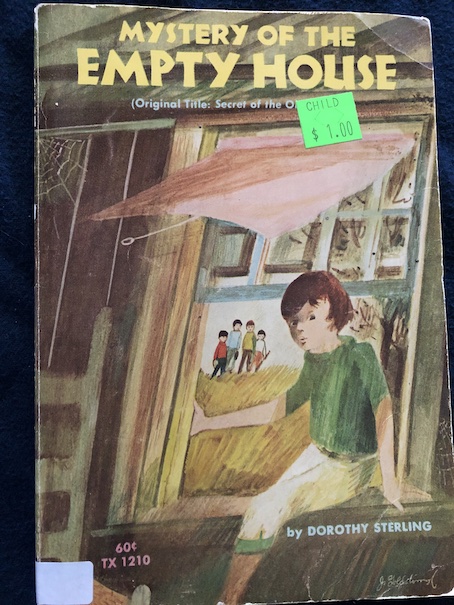
Mystery of the Empty House by Dorothy Sterling, 1960.

Patricia Harrison’s family has recently moved from their apartment in New York to a house in Haven. Her father used to live in Haven when he was a boy. His mother still lives in town, and he still knows some of the other people who live there. Patricia, called Pat, is still unpacking her belongings when a boy from across the street, Jim Gray, calls to invite her to play ball with him and some of his friends in the field behind her house because his mother used to know his father when they were kids. Pat isn’t very used to playing with boys because she went to an all-girls school when she was in New York, but she agrees to go play ball with the boys.

When she goes to meet the boys, some of the other boys, the Paine brothers, don’t want her to play with them. When Jim said they were meeting “Pat”, they assumed that “Pat” was another boy. Jim says he doesn’t care if Pat is a girl or not because they could really use another player. Pat thinks they’re rude, and since they don’t seem to want her, she starts to leave, but Jim stops her and persuades her to stay. Even though Pat is usually good at baseball at school, she finds herself making clumsy mistakes when she plays with the boys, probably because she feels uncomfortable with them. Finally, she hits a home run, which is great, but there’s a problem. She accidentally hit the ball into the window of an old, abandoned house nearby that looks haunted.

The boys are mad because it’s the only baseball they have. Pat says they could just go get the ball, but the boys say they can’t. When she asks them if they’re scared, they say that’s not the problem; they’ve just promised that they won’t go near the old house. Pat says that, since she didn’t promise, she can just go get the ball, but Jim stops her from going into the house. He tells her that they can just buy a new ball. When Pat asks him why he doesn’t want her to go in, Jim says that it’s a secret having to do with the Paines. Pat says that she’s sick of the Paines and insists on going into the old house.

The old house is dark and spooky. When she climbs in through the window, Pat is startled when she runs into another person inside. At first, she can’t see the other person too clearly because it’s dark, but when she asks the girl who she is, the girl tells her that she’s Patricia Harrison. Pat is shocked and tells her that she can’t be Patricia Harrison because that’s her name. The girl finally laughs and admits that her real name is Barbara Thomas. Barbara lives next door to Pat’s grandmother and decided to stop by and meet her. When she saw Pat playing with the boys, she decided to go explore the old house instead.

Barbara is the one who explains the history of the house and the Paines’ attitude to Pat. The Paine family used to live in the old house. It’s the oldest house in town, dating back to the Colonial era. Nat Paine, the oldest of the Paine boys, was always proud of his family’s old home and used to brag about how George Washington and Lafayette visited the house during the Revolutionary War. It was even occupied by British soldiers at one time. Unfortunately, the father of the Paine boys was killed during the Korean War several years earlier (dating this story to the late 1950s or 1960, the year it was published). Since then, the family has fallen on hard times, and they’ve been unable to pay the taxes on the house. Now, because of the unpaid taxes, the town council is threatening to sell the old house to pay the unpaid taxes. The Paines have been forced to move out of the house and into a much smaller place, and Nat is very upset about it. Plus, he’s been going through this phase where he’s decided that he hates girls because he’s just getting into middle school, where all the boys either start developing crushes or decide that they hate girls. His younger brothers are being pests because they’re following his lead.

Barbara says that her father felt bad about what happened to the family and tried to convince other people in town to help the Paines pay the taxes on the old place. They could have helped, but they’ve made it plain that they just don’t want to. As Barbara’s father put it, “people in Haven are a bunch of rock-ribbed, rugged individualists who wouldn’t help their own grandmas.” (I have strong feelings about that, and I’ll explain them in the reaction section.) Barbara reveals right away that the secret Jim is keeping for the Paine brothers is that Nat made his brothers take a vow with him that they wouldn’t enter that house again “until it was rightfully theirs.” Barbara says that Nat’s sense of pride talking, and “You know how boys are.” She thinks Nat’s being overly dramatic, although she sympathizes with the family’s plight. When Pat suggests that maybe they shouldn’t be in the house, either, Barbara says that she comes there all the time to explore. Barbara thinks the old house is fascinating and that there might be a secret passage somewhere. She invites Pat to help her look for it sometime.

At dinner that night, Pat finds out that her parents already know about the death of the boys’ father and the trouble that the family is having over their old house. Pat’s mother says that the old house is a good example of the saltbox style of house that was popular in Colonial New England. (I remember my old high school history teacher explaining how the slope of the roof was meant to help snow slide off during the winter, but the uneven slope also allows more living space to be added onto an existing house.) However, Pat’s mother says that there probably aren’t any secret passages in the house because houses from that time were built pretty simply and didn’t even have closets or bathrooms. She doesn’t think that there’s any place in the old house to conceal a secret passage.

Now that Pat knows the issues with the Paine family, she begins to feel better about them, and they start being nicer to her. As Pat begins settling in, she becomes better friends with Barbara and is happy that she has another girl as a friend. They ride their bikes downtown together, and Barbara sleeps over at Pat’s house. As the girls are getting ready for bed, Pat looks out the window and sees a light in the old Paine house when no one is supposed to be there. Barbara says that whoever’s in the house is probably looking for the secret passage and the treasure. When Pat asks what she means by “treasure”, Barbara says that there’s a rumor that there’s treasure hidden in the house from Revolutionary times. The family used to be rich, but after the American Revolution, when the children of the family returned to the house after their parents were killed, the family fortune had vanished. People think that the ancestors of the Paines hid their fortune somewhere during the war and that it’s still waiting to be found. (I already had some misgivings about the people of Haven and their intentions in kicking the Paines out of their house, and now, suddenly, my suspicions are even worse.)

Barbara says that they can’t just let this mystery sneak steal what should rightfully belong to the Paines and ruin the only chance they have left of regaining their house. The girls sneak over to the house to spy on the intruder, and they end up frightening him away. The girls tell the boys about what they witnessed the next day, and they persuade the Paine brothers to come into the house with them in spite of their “vow” to look around and see what the intruder was searching for. As they inspect the kitchen fireplace, where the man was searching, and look at the flashlight he dropped, the man shows up again. It turns out that he’s a college student doing research on the Paine family.

Back in Revolutionary times, the family that lived in the house was the Woodruff family. (A Paine ancestor married into the Woodruff family, changing the family name, but the Woodruffs are also ancestors of the current Paines. It’s the same family.) The college student, Robert Popham, found some old papers that indicate that the head of the Woodruff family, the first Nathaniel Woodruff, was a Tory. Nat, who was named for this ancestor (full name Nathaniel Woodruff Paine IV), angrily denies it, saying that his family was known to associate with George Washington and Lafayette, hosting them at their house. Robert explains more about the papers he found, but he also says that the last letter Nathaniel Woodruff wrote to his wife before he was killed indicates that he feared for his life and left something hidden in an old post box to pass on to his young son. However, as Nat points out, the date on this final letter was shortly after Nathaniel Woodruff’s wife was murdered by unknown assailants. (She was found scalped, so people blamed her death on American Indians, but it’s also possible that she was killed by someone else who just wanted to make it look that way to cover up the real reason for her murder.) Nathaniel Woodruff didn’t know his wife was already dead, and since she never got the letter and he was also killed soon after, the box is probably still hidden somewhere. Robert thinks that what Nathaniel hid was proof that he was actually a spy for the Patriots and that he feared for his life because he suspected that the British knew he was a spy. He says that he wants to find this hidden box and the information it holds because it would make a fantastic historical research paper.

The kids are completely on board with the search for the hidden box, both because the Paines want to preserve the reputation of their ancestors and because there may be valuables hidden in the box that will help the Paines pay their taxes and keep their home. However, they only have until August 15, the date that the town council has set for selling the Paine house. They only have until the end of summer to figure it out!

The book is available to borrow and read for free online through Internet Archive. The book is also known by the title Secret of the Old Post Box.

My Reaction and Spoilers

To begin with, I didn’t like the people of Haven right from Barbara’s description of them as “rugged individuals who wouldn’t help their own grandmas.” It is pretty cold to turn out a war widow who is working as an underpaid nurse in the community and her children after their father was killed serving his country. I completely agreed with Barbara’s father’s assessment of the townspeople’s levels of generosity from the first. I suppose at least some of the townspeople of Haven probably thought they were actually being kind, giving Mrs. Paine several years after her husband’s death to come up with the mounting tax money, while doing nothing to help her and not actually paying her enough to manage and letting her family sink deeper into the hole until there was no way for them to escape, but in realistic terms, that’s not really kind at all.

We don’t actually hear the townspeople express their own feelings because the children don’t talk to the adults about their search and discoveries until they’re sure of what they found. When Barbara explained how her father felt about the townspeople’s unwillingness to help the Paines, I was also a little suspicious of their motives, and when Barbara mentioned that there’s been a popular rumor about hidden treasure in the Paine household for years and everyone has heard of it, I got really suspicious. Basically, I started looking for thieves among the townspeople. I immediately suspected that the “rugged individuals”, or at least some influential ones in the community, wanted to steal some historical treasure from a veteran’s widow and orphans because people who would would kick the widow and orphans out of their home might as well be out to steal their legacy, too.

If that was part of their plan, they weren’t very good at it, and they never even show up in the story. Perhaps I’m judging them a bit harshly, although in a way, I’m a little disappointed because that kind of Machiavellian plot would have made the story much more exciting. From the way the story goes, the townspeople might just not believe that there’s any treasure to be found because that rumor has been going around for so long and nothing has come of it. Still, I was suspicious of them for a good part of the book because it looked like the author was setting them up to be suspicious.

I was also annoyed by the townspeople because I found them ineffectual and uncreative in their approach to a community problem. They miss opportunities, and worse, they deny opportunities to others because they’re apparently stuck in their “rugged individual” mindset and won’t even entertain ideas that might help themselves as well as others when people like Barbara Thomas’s father suggest them. I often think that high-and-mighty rugged individualistic attitude cuts out so many genuinely fun, creative, and amazing possibilities that can make a community rich in character as well as money. It’s maddening to a person who thrives on creativity and likes to consider possibilities.

When I started getting really irritated at the townspeople, I guessed that, before the end of the story, they would do something to redeem themselves that would simultaneously leave me unsatisfied. I figured that the point where the townspeople finally come together would probably result in something that I thought they should have been working on from the beginning, and then, they’d act like it was such an amazing idea that they’d never thought of before and I’d be really irritated with them all over again because I thought of something like it very early in the story. Actually, that’s not how the story goes, and it’s still irritating to me.

So, what would I want them to do in this situation? Basically, the community wants its tax money, and the family wants to keep their house with a living wage that can support them. Fine. So, I asked myself, why not make this historic house, which is known to be the oldest house in town, into a community project which would actually contribute to the common good of the community (I don’t think “common good” is a dirty word, although I’m aware that some “rugged individualists” think so) and provide the Paine family with an additional source of income? If the town council invested in fixing up the house, which is also known to contain some very interesting Colonial antiques as well as fascinating architectural details and a unique history, the house could be turned into either a museum or a period bed-and-breakfast to encourage local tourism. (Sleep where George Washington and Lafayette slept!) Since it does have original furnishings and actual bedrooms, it probably wouldn’t take a lot to make the conversion for either of those projects.

The town and its business owners would benefit from the tourism, giving them an actual monetary return on their investment, and the Paine family could stay on with the house as its caretakers, receiving additional wages from visitors. People couldn’t say that the Paines simply received a handout because they would be doing valuable community work to support the town’s image and industry. It would satisfy Nat Paine’s family pride because he could talk to tour groups on the weekends and during the summer about his family’s great legacy to the history of his town. The whole community could even expand on the idea to further attract visitors, setting up a sort of local living history center, where people can learn Colonial crafts and recipes (something like what the Townsends demo on their YouTube channel), and schools from neighboring towns and cities could book field trips. Local business owners could support it with a themed restaurant and shops selling Colonial-era replicas and memorabilia and books about the time period. The town could hold special celebrations a few times a year to draw in more visitors, like a big Fourth of July parade or a Colonial Christmas celebration (although I known not all of the American colonies actually celebrated Christmas) or a re-creation of old harvest parties (more historically accurate) with plays by the local theater group (if they don’t have one, they could form one) or dramatic readings from Washington Irving at the local library or a themed fair with people selling local artisan crafts. They wouldn’t have to do all of this at once, but they could start with the matter of the house and build up from there. It’s an idea that has the potential for future expansion. This story is even set pre-Bicentenniel, so imagine what the town could do if they already had everything up and running by July 4th, 1776! Doesn’t anybody plan ahead? That’s creative use of resources. That’s community action. That’s job creation. Even if it’s not as big as Plimoth Plantation (now called Plimoth Patuxet to better incorporate the Native Americans) or Colonial Williamsburg (which both already existed by the time this story was written and could have provided inspiration), it’s still a money-making industry that is inherently built into the town’s very nature and won’t disappear tomorrow because some outside business decides to move or close a job-providing factory or something. Even if they didn’t get national or international attention, they would probably still be a destination for people from around their state and neighboring ones, and there’s potential for continued development. The project just need to be supported and promoted by the community.

Unfortunately, that’s not what they do. My griping aside, I guess if the solution was really that simple and the townspeople were more thoughtful and pro-active, we would lose the source of tension and the obstacle that our heroes have to overcome. The August 15th deadline is what pressures the kids to hurry up and find the treasure, so as irritating as it is to me, I have to put up with it.
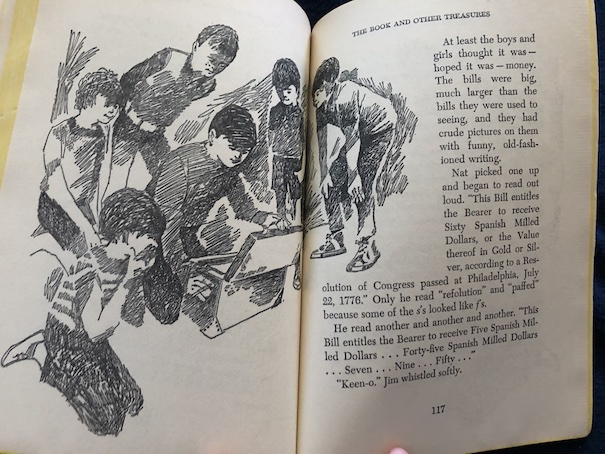
The treasure hunt part is a lot of fun, and I liked the children’s logical, methodical approach to their search. When the children eventually find the hidden box, the story isn’t over. There are coded messages in the box that they have to decode to learn the full truth about Nathaniel Woodruff. Part of the story explains how they figure out how to decode the substitution code and the book code that compose parts of the message. The story they learn about Nathaniel Woodruff is better than anything the Paines had originally thought.

So, did they save the old house and do anything cool, like start a unique museum? Yes, and no. Although they don’t find any jewels, gold, or traditional sort of treasure, the letters that they find in the box are worth quite a bit. They sell them to a wealthy local business owner, and he donates them to a local university library. (So, you know, the wealthy business owner who never makes an actual appearance in this story and who wouldn’t have helped a war widow and her orphans for their sake can buy their family legacy and present it as his magnanimous gift to the university. I can’t say that he’s terrible for doing this because it does help, but I still think my idea was better.) The Paine family has enough money to keep their house and fix it up. It’s a pretty good ending, but I still prefer my vision. The story points out that it’s not a matter of everyone living happily ever after because they’re all their imperfect selves and still have some problems, but one lesson that they all learned from this experience is how to create their own book code to use for passing notes in class. It’s not profound, but codes are fun.

Tales of Ancient Egypt

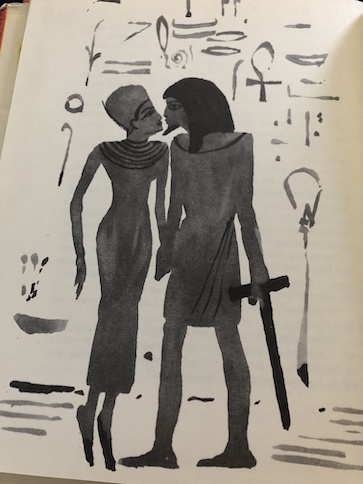
The First Book of Tales of Ancient Egypt by Charles Mozley, 1960.

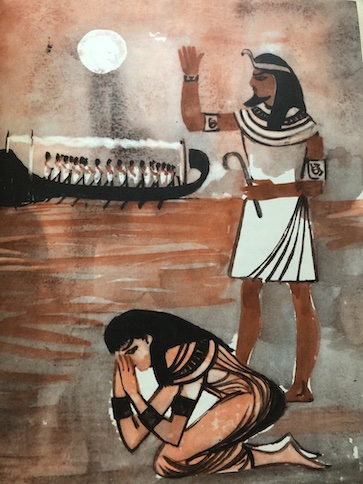
The book begins with a section “About this book” that introduces the stories, but I felt like it could have said a little more. The introductory section points out how amazing it is that these folktales and myths from Ancient Egypt have survived thousands of years to reach us, but there’s a bit more to the story than that. For a long time, people were unable to read texts written in Ancient Egypt because knowledge of ancient writing was lost when Egyptian culture changed and developed new writing systems. Modern people eventually regained the lost knowledge of Ancient Egyptian writing when the Rosetta Stone was discovered because the Rosetta Stone contains the same message written in three different systems of writing – Ancient Greek, Ancient Egyptian hieroglyphics, and Ancient Egyptian demotic script. Because European scholars knew Ancient Greek at the time the Rosetta Stone was discovered, they were able to use the Ancient Greek portion of the stone to learn how to read the rest of it. It took years of study for them to fully understand not only the message on the stone in all three writing systems but to learn to apply the rules of Ancient Egyptian writing to other messages and carvings and decipher what each of them meant. Even in modern times, scholars are still working on translations of Ancient Egyptian writing and publishing new books of Ancient Egyptian stories that modern people have not read in English. It’s not just that these stories have survived for thousands of years to reach us; it’s also that people worked very hard to learn exactly what did survive for those thousands of years and make it possible for ordinary people to understand it. This book for children would not have been possible without many years of scholarly research.

The pictures in the book are sometimes monochromatic in different colors and sometimes full color.

The book is available to borrow and read for free online through Internet Archive.

The stories in the book are:

The Magic Crocodile – When King Khu-fu is bored and nothing seems to please him, his sons tell him stories to amuse him.

In his first son’s story, in the distant past, during King Nebka’s reign, magic was commonplace, and King Nebka had a young magician named Uba-na-ner at his court. At first, the magician was very happy, but then, the woman he was going to marry ran off with another man. Angry, the young magician made a magical crocodile out of wax and sent it to attack his former fiance’s new husband. After the crocodile killed the new husband, the magician’s former fiance went to the kind and accused the magician of murder. Faced with the king’s questions, the magician confessed what he had done. The magician expressed remorse and turned over the box where he kept the wax crocodile. The king pardoned him because of his remorse but hid the box with the wax crocodile so it couldn’t be used again. That seems to be letting a magical murderer off lightly, and King Khu-fu doesn’t find the story very interesting.

In the second son’s story, there is a powerful wizard named Zaza-man-khu in the reign of King Sene-fe-ru. When Sene-fe-ru is feeling down, he asks Zaza-man-khu for something to cheer him up. Zaza-man-khu suggests a boating trip on the palace lake, rowed by singing maidens. At first, the trip is pleasant, but then, something happens that upsets all of the maidens, and they stop singing and start crying. Soon, everyone is crying so hard that it’s difficult for the king or his wizard to find out what’s wrong. It turns out that one of the maidens lost a precious jewel in the water, and it was some kind of lucky amulet. Now, she’s worried that something bad will happen to her, and all of the other girls are crying in sympathy with her. The king promises that he will give the maiden plenty new jewels if she stops crying, but she says that she needs that particular amulet, and none of the other maidens will start rowing the boat again until they figure out what to do. The king’s wizard is able to retrieve the lost jewel by parting the waters in the lake so he can walk out across the bottom of the lake and find it. King Khu-fu finds the story mildly interesting and says that it would be impressive if there was such a wizard in their time.

King Khu-fu’s eldest son says that he knows of such a wizard, a man named Didi, who is supposed to be 110 years old. Interested at last, King Khu-fu says that he wants to meet Didi. According to stories about Didi, he can restore life to a person or animal after it’s been beheaded, but how far will they make him go to prove it?

Isis and the Secret Name of Ra – This story explains the origins of the goddess Isis. In the beginning, Isis is not a goddess but a clever young woman. Although she is clever and has extensive magical knowledge, it isn’t enough for her. She wants to learn the secret name of the sun god Ra (Ra isn’t the secret name itself) to gain power over the whole world. People call Ra by many different names, but Isis is aware that he has one secret name that no one knows and from which he derives his power. Isis creates a magical snake that bites Ra, and Ra experiences pain for the first time. Isis offers to help heal him from the bite (that she caused), but she says that she needs to know Ra’s secret name. Ra says that if she knows the name, she will also become immortal, and Isis says that she’ll try to bear it (wink, wink). So, Isis becomes immortal and heals Ra from the poisonous snake wound.

After she becomes a goddess, Isis continues living as a mortal woman for awhile, but then she marries King Osiris. Osiris is a great king who teaches his people how to farm, and Isis teaches them healing arts. Their kingdom is great and peaceful, and Osiris and Isis have a son they name Horus. For a long time, no one, not even Osiris, knows that Isis is actually an immortal goddess. However, Isis’s powers allow her to sense evil and deception from Osiris’s jealous brother, Set. Osiris can’t believe that his brother is evil. Then, Set tricks Osiris into getting into a chest and throws him into the river and drowns him.

When Isis realizes what has happened, she realizes that she has the power to restore Osiris to life. At first, Isis is unsuccessful in her attempt to bring Osiris back to life because too much time has gone by since his death, but Thoth, the god of wisdom, has pity on her and Osiris and raises Osiris to serve as king of deserving spirits among the dead.

King Setnau and the Assyrians – King Setnau is a gentle and peaceful king, so even though Egypt has enemies, he does not try to improve Egypt’s army. Although most citizens love King Setnau, his generals don’t. When the King of Assyria decides to invade, seeing Egypt as easy prey, the angry Egyptian army refuses to obey the king and fight for Egypt. In despair, King Setnau prays at the temple and then tells his people about the army’s refusal to obey him. The ordinary citizens decide that they will be the king’s new army themselves. They are untrained and have mostly improvised weapons, and Egypt’s official army doesn’t take them seriously. However, King Setnau is appreciative of their loyalty and prays the he will be a suitable leader to them so they can save their kingdom. In the end, they are successful with a little help from the gods and a swarm of field mice.

The Wonder Child – King Usi-ma-res has a son who is a wise sage, Sat-ni. However, Sat-ni is unhappy because he and his wife have been unable to have a child, and they want one more than anything. Sat-ni’s wife prays for a child, and finally, she gives birth to a son, Se-Osiris. Se-Osiris turns out to be remarkably intelligent and learns very quickly. As he progresses in his studies, he begins learning magic, and by the age of twelve, he is already a master magician.

One day, a man from Ethiopia comes to the pharaoh’s court with a challenge: he has a sealed book and he wants to see Egyptian wizards attempt to read the book without breaking the seal. The pharaoh consults with all of his wizards and magicians about the book challenge, and Sat-ni says that he suspects that the book and its contents are protected by some kind of spell that will prevent the Egyptian wizards from reading it. However, Se-Osiris insists that he can read the book. To demonstrate, he proves to his father that he can read any book from his father’s library even though he has never seen it before while his father holds it sealed in another room. Pleased and amazed with his son’s skill, Sat-ni brings Se-Osiris to court to answer the challenge.

At first, the Ethiopian man sneers at the young boy who claims that he can answer his magical challenge, but the pharaoh says that it’s a sign of how great Egyptian magic is that even a twelve-year-old Egyptian can answer any challenge that Ethiopia could set. In front of everyone, Se-Osiris reads the book without even touching it, telling an ancient story about three Nubian magicians and their boasting of the ways that they would punish the King of Egypt for the amusement of their king and how the King of Egypt gets revenge.

However, the story doesn’t end there. The mysterious Ethiopian turns out to be the spirit of one of the magicians from the story in the book, who was disgraced through the magic of the Egyptian magicians and who has come back to settle the score. Se-Osiris must now face him in a magical duel.

The Thief and the King’s Treasure – King Rhamp-si-ni-tes loves gold and treasure more than anything. He loves it so much, he allows criminals and corrupt official to buy their way out of trouble. The king compromises law and justice in the land, thinking only of getting more gold and jewels. He neglects the state of his kingdom and even his own daughter. Soon, the king also becomes paranoid, constantly afraid that someone might take some of his beautiful treasures. Finally, the king hires an architect to design a safe place to keep his treasure, a vault no thief could enter.

However, the king is a terrible ruler and also a dishonest man. He pays the architect only a fraction of the money he promised him, so the architect clever engineers a secret entrance to the treasure vault so he and his sons can enter any time they want and help themselves to the money that the king owes them and all of his other subjects.

For awhile, it works, but then, the king notices that someone has been taking some of his treasures. He has some metal workers build a terrible mantrap that traps one of the architects sons. When it becomes clear that he is hopelessly trapped and their whole family may suffer the king’s wrath once he realizes who has been stealing from him and how it was done, the trapped son tells his brother there is only one, terrible solution – his brother must cut off his head. The trapped brother will die anyway because the king will have him killed, but if his brother removes his head, no one will be able to identify him, and the rest of their family will be safe. Reluctantly, his brother does as he asks.

However, the fact that the head was removed from the body tells the king that the dead thief must have had a confederate. He has his guards display the body of the thief publicly on a hill and watch for anyone who shows grief at seeing it. The dead man’s mother quietly grieves at the loss of her son, and when she says that she wants to see her son properly buried, his brother figures out a clever way to retrieve the body.

The king is enraged, but his neglected daughter decides that she also wants to find the thief, seeing it as her chance to secure her future in spite of her father’s neglect. She promises her father that she can find the thief but only if he promises her that she can have whatever she wants afterward. The king promises, not realizing that the one thing that the princess wants is to marry the thief.

Tales of Ancient Araby

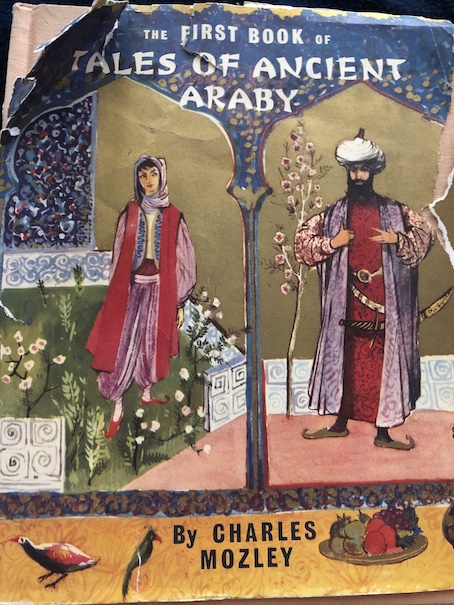
The First Book of Tales of Ancient Araby by Charles Mozley, 1960.

I’ve had this book for years, and one of the questions that I’ve had about this book is why is it Ancient “Araby”? Why “Araby” instead of “Arabia”? According to Wikipedia, “Araby” is an archaic name for Arabia, which explains it, I guess. This book was published in 1960, and I don’t think people were using “Araby” back then, but the book is trying to sound ancient.

The stories in the book are based on those from the collection of folktales called One Thousand and One Nights, in which Scheherazade tells stories to the murderous king who is her husband, but they’re simplified for children. The introductory section to this book says that . The book doesn’t explain, but the original stories in the book were rather racy.

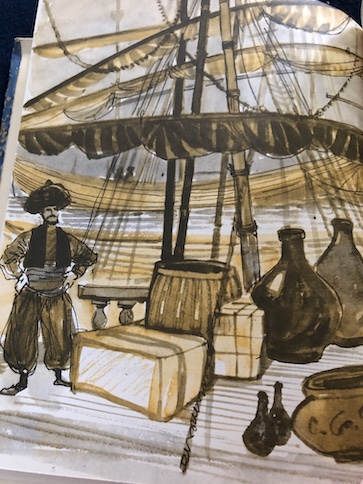
The book has pictures for each story, but some are in black-and-white, some are monochromatic with a color other than black, and some are in full color.

The book is available to borrow and read for free online through Internet Archive.

The book contains the following stories:

Scheherazade – When the sultan’s wife betrays him, he not only has her executed but loses his mind with hatred for all women because he believes that they are all untrustworthy. He begins a murderous series of weddings, where he has his wives all executed the day after the wedding, so they can never betray him. (It’s dark stuff, but this story wasn’t originally intended for children). All of the unmarried women in the kingdom are terrified that they’ll be next, and the sultan’s vizier is beside himself because he doesn’t know how to stop the sultan and has an obligation to obey the sultan’s commands to bring him new brides. Then, his eldest daughter, Scheherazade, requests that her father send her to the sultan as his next wife. At first, the vizier doesn’t want to send her because it’s certain death to marry the sultan, but Scheherazade tells him that she has a plan to put an end to the weddings and executions. Every night, she starts to tell a story but leaves it unfinished, so the sultan keeps putting off her execution to hear the end of the story. This continues for 1,001 nights, until the sultan realizes that he’s actually happy with Scheherazade and no longer has any desire to execute her or any other woman. The rest of the stories in the book are among the ones that Scheherazade told the sultan. (The Scheherazade story is a frame story, a story that contains other, internal stories or creates the basis for the other stories.)

Aladdin and the Wonderful Lamp – A poor boy and his widowed mother are approached one day by a man claiming to be the brother of the widow’s dead husband, the boy’s uncle. At first, he is very nice to them, bringing them to live with him and providing them with everything they need. However, one day, he stakes the boy, Aladdin, to retrieve a strange old lamp from a series of treasure caves, giving him a ring to protect himself. Before the boy returns to the man, he comes to the realization that the man isn’t really his uncle but an evil magician who is just using him to get the lamp. The boy and his mother discover that there is a genie living in the lamp who will do their bidding and provide them with all they need. They use the lamp not only to provide for themselves but to make it possible for Aladdin to marry a princess. The evil magician almost ruins everything when he tricks the princess into giving him the lamp, but Aladdin and the princess get it back through some trickery of their own.

Ali Baba and the Forty Thieves – Ali Baba marries a kind but poor woman and makes his living as a woodcutter, while his brother, Kassim, marries a disagreeable woman from a wealthy family and becomes an wealthy merchant. One day, while cutting wood in the forest, Ali Baba sees a large group of horsemen. They are robbers, and they have a secret hideout nearby. Ali Baba hides and watches how they open the entrance to their secret cave with the magic words “Open, Sesame!” After the thieves stash their loot and leave, Ali Baba realizes that he can use their secret words to enter the cave himself and see what they left. He helps himself to some of the stolen loot. He and his wife decide to stash the second-hand loot and spend it a little at a time, ensuring their family’s security. However, Kassim’s wife finds out about their loot and tells Kassim, and Kassim damands that Ali Baba tell him where he acquired so much money. When Ali Baba explains about the thieves and the treasure cave, Kassim wants to go there and loot the place himself, but Ali Baba thinks it’s too dangerous to go back again because the thieves will be angry and will probably kill them if they get caught. When Kassim goes anyway and is caught and killed, Ali Baba must arrange a deception to prevent the thieves from learning who Kassim was and everyone else from learning how Kassim met his death so the thieves won’t take revenge on the rest of the family with the help of a clever slave girl, Morgiana.

The Fisherman and the Genie – A fisherman pulls a strange bottle from the sea that contains a genie, but to the fisherman’s shock, the genie threatens to kill him when he frees him from the bottle. The fisherman asks why he would do such a thing when the fisherman did him a favor, and the genie explains that he was imprisoned in the bottle by King Solomon for sins against Heaven. At first, the genie thought that he would reward whoever freed him, but as his imprisonment grew into hundred and hundreds of years with no rescue, he became increasingly enraged and decided to kill whoever released him. However, the genie decides to grant the fisherman one wish before death. The fisherman asks him to prove that he can actually fit into the bottle and imprisons the genie there again. He refuses to let him out again until the genie swears he won’t kill him. The genie promises the fisherman anything he wants, but the fisherman is a modest man and only asks that he always be successful as a fisherman. He gets his wish, and he uses the money he acquires from his success to build a better life for his family.

Sinbad the Sailor – When Sinbad’s father dies, he leaves Sinbad a considerable amount of money, but Sinbad quickly squanders most of his inheritance. When he realizes his foolishness, Sinbad uses what he has left to set himself up as a merchant sailor. However, this decision takes him on a series of wild adventures, from being nearly drowned to befriending a king to a hair-raising encounter with a roc (a giant bird that’s big enough to carry a grown man).

The Twice-blessed Arab – This is a legend about the origins of horses and camels.

The Story of Little Mukra – Little Mukra is a dwarf, and his father, fearing that the rest of the world will laugh at him and treat him cruelly for his size, hides him for his early life. When Little Mukra is sixteen years old, his father dies and the rest of his relatives declare that they don’t want him, so Little Mukra decides to go out and seek his fortune. One day, while Little Mukra is hungry, he hears an old woman calling for someone to come to eat. It turns out that she’s talking to her cats, but he persuades her to let him eat with the cats because he’s starving. The woman hires him as a servant to take care of her cats. It gives Little Mukra a place to live, but the problem is that the woman blames him for damage that the cats cause while the lady isn’t looking. The clever cats are always perfectly behaved when she’s watching but not when they’re alone with Little Mukra. Little Mukra escapes this situation with the help of the lady’s dogs, who are not so pampered as her cats and reveal to Little Mukra a paid of magical slippers that can make him run fast, securing him a position as the king’s special courier.

Sidney’s Ghost

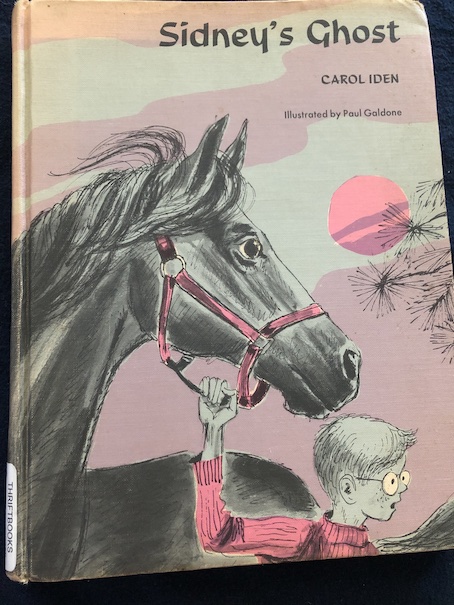
Sidney’s Ghost by Carol Iden, illustrated by Paul Galdone, 1969.

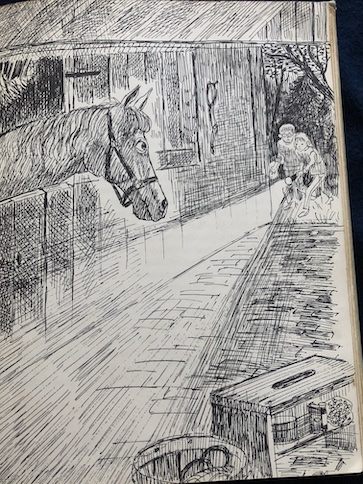
Nine-year-old Sidney Robinson’s best friend is a girl named Megan McKenna. The two of them have many interests in common, including fishing, cars, ghost stories, and horses. Megan’s father owns a stable, and Sidney envies Megan for having her own pony. Because Megan’s father sells horses to other people, the kids are used to seeing horses come and go. When Megan’s father can’t find a buyer for a horse, he’ll try to sell it at public auction. However, if he can’t sell a horse at auction at all, he sometimes sells it to the slaughterhouse, where they use the horse parts for glue and dog food. It’s sad, but the kids accept this as part of life until Megan’s father acquires a retired police horse whose former owner died, and Sidney realizes that he can’t let this beautiful black horse suffer this terrible fate.

The horse, officially named Sergeant O’Hara but called Uncle Charley by Megan’s family is a beautiful animal with a gentle temperament. Sidney wishes that he could persuade his parents to buy the horse for him. He is easy to ride and obeys commands, and he has an excellent history of his time as a police horse.

Megan’s father isn’t completely honest as a horse seller. The book goes into some detail about how he prepares horses for sale, painting on dapples and filing their teeth down to make them seem younger than they really are. Even Sergeant O’Hara gets this treatment, although Sidney worries that it hurts the horse. (I looked it up, and it turns out that it can be beneficial to file the sharp points off of a horse’s teeth, which is called teeth floating. However, this is something that should only be done by someone who has been trained to do it because it can hurt the horse to file the teeth down too much.)

Sidney and Megan love to watch the horse auctions and pretend they’re bidding on the horses, but Sergeant O’Hara is auctioned off as planned. Megan’s brother Michael let him loose in the paddock when he was supposed to be watching him, and he got all dirty, so he isn’t fit to be shown. Then, to Sidney’s shock, Megan tells him that her father is planning to just sell Sergeant O’Hara to the slaughterhouse instead of trying again at the next auction. If Sidney and Megan are going to save poor Sergeant O’Hara’s life, they’ve got to do something, fast!

Megan tells Sidney that she’s thought of a plan to save Sergeant O’Hara. The two kids sneak out and take the horse in the middle of the night and hide him in an old barn. As they go to hide the horse, they see a shadowy figure near the barn. Megan is afraid, and Sergeant O’Hara wants to chase the figure because of his police training, but Sidney stops him.

However, even with the horse safely in the barn where hardly anybody ever goes, there is the very real worry that they’ll be caught. The horse will need exercise, so Sidney will have to go ride him at night or when they’re sure nobody else will be around. Still, they feel like they need to come up with an additional plan in case the horse is spotted. Then, Sidney takes a hint from the way Mr. McKenna painted dapples on a horse earlier and suggests that they could paint Sergeant O’Hara a different color so he won’t be recognized. Megan thinks that’s a great idea, and they decide to paint him white, like the Lone Ranger’s horse, Silver.

They get the painting supplies from Sidney’s father’s hardware store, but Sidney grabs a can of paint labeled “Super Glo – White.” It turns out that it’s not just a really bright white; it’s a glow-in-the-dark white. The kids don’t figure it out until they’ve already painted half of the horse. When Sidney sneaks out to feed and exercise Sergeant O’Hara again, he’s frightened when this big, glowing thing comes out of the darkness at him. Somehow, the horse got out of the barn and scared him by running out in the dark, glowing. Sidney realizes after a moment of panic that’s what happened. Because they only painted half of the horse before they stopped, one side of Sergeant O’Hara is glowing white, and the other is pitch black. When the horse gallops back and forth, he looks like a glowing ghost that vanishes with each turn. It’s a neat effect, but having a ghost horse certainly isn’t inconspicuous.

One night, Sidney accidentally frightens his old teacher, Miss Winthrop, when she’s walking home from visiting a friend. Soon, she spreads the story of her ghost sighting all over town. Most people think that she’s getting a touch of senility in her old age, but Mr. McKenna thinks it over and notices Sidney’s comings and goings in the area. When he goes to the old barn to investigate what Sidney’s been doing. Seeing the horse and the glow-in-the-dark paint, he realizes what happened. He appreciates that Sidney and Megan wanted to save the horse and sees the humor in their unintentional ghost act.

Since the kids feel that strongly about wanting the horse and are taking good care of him, Mr. McKenna decides to let them continue to do so, but there’s still one thing that nobody has answered: Who was that mysterious figure they saw around the barn? The answer comes when this mysterious person sets fire to the McKenna’s stables and Sergeant O’Hara has the opportunity to show his skills as a police horse.

My Reaction

When I first read this book as a kid, I was expecting it to be a mystery. It kind of is, but the mystery isn’t about the horse or about any ghost. There are hints from the very beginning of the story that there is a thief in the area, but the story doesn’t really focus on that until near the end. Sidney and Megan hear people talking about a prowler, and they do see the mysterious prowler around the barn, but they’re too busy with their plans to save the horse to pay too much attention. Fortunately, their horse and his ghostly appearance help them to catch the the thief, and the reward money for catching him straightens out a lot of problems so Sidney can keep Sergeant O’Hara.

The gimmick of the “ghostly” painted horse has stayed in my mind for years since I first read this story, but it’s not the only memorable part of the book. One of the things that I remembered best about this book from when I read it as a kid was the difference in Sidney and Megan’s homes and families. The book puts some emphasis on the difference in their family lives, and it’s shown when each of the kids has dinner at each other’s home. Megan has several siblings, and their house is always noisy and boisterous. Sidney is Sidney is a fussy eater at home, but he just eats what’s put in front of him at the McKennas’, like the other kids do. Megan gets a rap on the knuckles from her father for starting to eat before Grace is said. One line from the book that stuck with me for years was when Megan’s brother, Frank, says Grace with this joking prayer: “We thank the Lord for the next meal – we’re sure of this one.” I still think of this whenever someone says Grace aloud.

By contrast, dinner at the Robinson house is much calmer, quieter, and more formal. Sidney is an only child, and his father owns a hardware store, so the Robinsons can afford nicer things. Megan is impressed at the nice tile in the bathroom, and the table is set with embroidered placemats and matching cloth napkins. Megan accidentally bites into one of the cloves in the ham, and when it burns her mouth, she spits the bite of food into her cloth napkin, feeling terribly guilty about it because the napkin really seems too nice for that sort of thing.

I could identify with the feelings the children have about being in houses where people have different habits. There were times when I was young when I felt a little out of place because they were either more formal than I was accustomed to being or more boisterous than I feel comfortable being. People always feel more comfortable with what they’re used to.

Famous French Painters

Famous French Painters by Roland J. McKinney, 1960.

This book is part of a series of Famous Biographies for Young People. Reading older non-fiction books can be problematic because non-fiction books are often updated with new information. In this particular book, there are people who are described as being still alive because they were at the time of the book’s publication, but they are not alive anymore. However, older non-fiction books sometimes interest me both because they are an indication of what people knew and studied at the time of publication and they sometimes cover odd topics that don’t commonly appear in new books. So far, this is the only book I own from this particular series, but the other biographies in the series

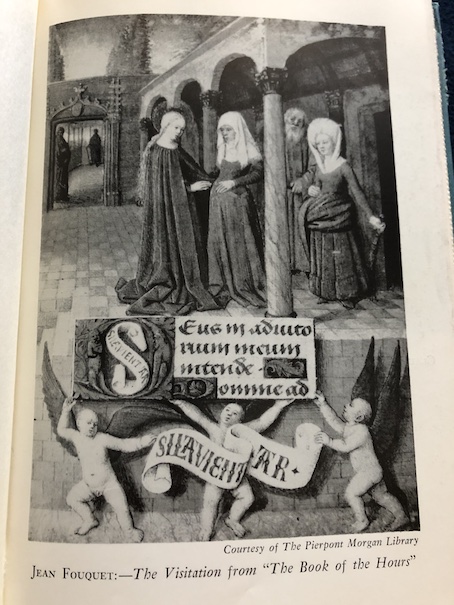
It begins with a section of black-and-white prints of famous French paintings and an introduction to the history of French painting in general. The introduction begins with a discussion of illuminated manuscripts in the 15th century and the artistic and architectural endeavors promoted by King Francis I in the 16th century. Francis I was particularly fascinated by Italian art, and he hired artists of the Italian Renaissance, including Leonardo da Vinci, to work at his court. Francis I helped to fuel an increasing interest in the arts in France called the French Renaissance. Although the French Renaissance was initially heavily influenced by the Italian Renaissance, French artists continued to develop their own styles. Popular subjects in French art were portraits, realistic landscapes, scenes from Classical mythology, and religious themes. The introduction ends with artists who painted during the late 18th century and early 19th century, explaining how their departure from neoclassical styles led to the development of new art styles.

After the introduction, there is a series of short biographies of famous French artists, beginning in the early 19th century and leading into the early 20th century. One of the first things that struck me about the list of artists included in the book is that, when their birth and death dates are included, none of the artists were born later than the 1880s, and the last two in the book have no death dates listed. Since the book was published in 1960, those last two artists were still alive at the time of publication, although they have died since then.

The artists included in the book are:

Eugene Delacroix (1798-1863) – He was a leader in the Romantic style of painting and one of the first French artists to use watercolor paints, which the French learned from English artists.

J. B. (Jean Baptiste) Camille Corot (1796-1875) – Originally, he trained in business, but he didn’t think he was suited to business and decided that his future was in art. He was particularly known for his landscapes, which were his specialty. He was also known as a charitable benefactor.

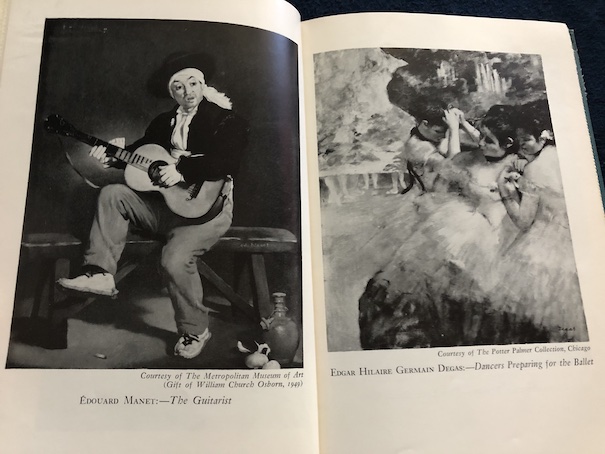
Edouard Manet (1832-1883) – Manet’s parents originally wanted him to become a lawyer, but it soon became apparent that he did not have the interest or temperament for a law career. When he first began his art studies, he quarreled with his teacher over the teacher’s strict insistence on realism in art because Manet preferred a more creative form of expression. He eventually developed a more simplified realistic style that did not focus on small details, a style that contributed to the development of impressionism.

Edgar Hilaire Germain Degas (1834-1917) – His specialty was portraits, and following the lessons that his teacher impressed on him, he emphasizes the importance of lines and drawing in his work. Much of his work was in oil paint, but he switched to pastels because he found that it was easier to work with and less of a strain on his eyes. Some of his best known works were of ballet dancers.

Paul Cezanne (1839-1906) – He initially doubted his own artistic talents, but a fellow painter, Pissarro, advised him to stop trying to imitate others and put his focus on studying nature. Cezanne’s association with Pissarro helped him to develop his own style.

Pierre Auguste Renoir (1841-1919) – Early in his life, Renoir was known for his singing ability, but his parents insisted that he learn a trade. He started learning how to decorate china, but this was the era when factories began using machines to decorate china. For a time, Renoir decorated fans and window shades, but his focus on improving his drawing abilities led him to a career in art. He became a friend of Monet, and the two would discuss art techniques with each other, although they had different styles.

Vincent van Gogh (1853-1890) – He was originally from the Netherlands but lived in France. He was a contemporary of Gauguin, and the two were even friends. Unfortunately, van Gogh was plagued by mental illness, leading to the fit where he cut off part of his ear after an argument sparked by ridicule from Gauguin. Eventually, he committed suicide. He was not a famous artist during his lifetime, partly due to his mental illness and early death, but his work became famous after his death.

Paul Gauguin (1848-1903) – Although he was originally from France, Gauguin is known for his travels to islands in the South Pacific, where he eventually died. Much of his work was inspired by his travels in the South Pacific.

Henri Matisse (1869-1954) – He was a leading figure in a group of artists known as the fauves, which mean “wild beasts.” They painted in an unorthodox way that included few details and ignored perspective.

Pablo Picasso (1881- ) – Picasso was originally from Spain, but he lived in France for most of his adult life. He began studying art at a young age and is known for his work in surrealism and cubism. He was alive at the time this book was written, but he died in 1973.

(Odd fact not included in the book – Picasso was actually born one day before the shootout at the OK Corral in Tombstone, AZ. It doesn’t mean anything and isn’t important, but I noticed the date and just thought I’d tell you.)

Georges Braque (1882- ) – Braque was a contemporary of Picasso, and the two artists were instrumental in the development of cubism, although they each did their own work. The collaboration between the two artists was interrupted by the outbreak of WWI. Braque was alive at the time this book was written, but he passed away in 1963. On the subject of limitations in art, he once said, “Progress in art does not lie in extending its limits, but in knowing them better.”

Something that struck me was how much artists who were contemporaries of each other worked together, met to discuss and analyze each other’s art, and were actual friends. I prefer collaboration to competition, and I like that many of these artists seemed to appreciate and learn from each other’s skills and techniques.

I was also surprised at the number of artists whose parents initially wanted them to become lawyers, like Manet, Degas, Cezanne, and Matisse.

The book is available to borrow and read for free online through Internet Archive.

The First Book of Painting

The First Book of Paintings by Lamont Moore, 1960.

This book is meant to be a beginner’s introduction to understanding and appreciating paintings. I thought it was interesting how, in the book’s introduction, it points out that the word “art” is based on the Latin word for “skill.” Art work is skilled work, and it explains how other types of skills are referred to as “arts.” Artists are people who are skilled at making things, but they also have an ability to see things more clearly than most people, form strong mental images, and convey those mental images and their feelings about them through their art.

The book is divided into sections that focus on different elements of paintings and artistic principles, explaining their role in art and providing examples of their use. The elements of paintings are line, shape, space, light, and color. The artistic principles covered in the book are pattern, balance, rhythm, contrast, and unity. Some of these sections also include suggested activities for readers to try that demonstrate these concepts.

Line – The lines of a painting define shapes in the painting. They also convey the idea of movement and direct the eyes of the viewer to important points of interest. This section shows a cave drawing a rhinoceros and suggests that readers trace it onto another piece of paper but change some of the lines to see the difference it makes.

Shape – Shapes are defined by lines. Shapes are flat, but their placement can create the illusion of depth and distance. The book suggests studying shape in drawing by drawing a friend’s silhouette.

Space – Shapes occupy and fill space. The placement of shapes within space create balance and suggest depth.

Light – Light is used to create the illusion of three-dimensional shapes because physical objects have sides that reflect light and cast shadow. It can also be used to give viewers a sense of substance because metal objects in paintings should look particularly reflective. Lighting can also convey mood in a painting. Part of this section explains how impressionists use light to give paintings more of an appearance of depth when viewed at a distance.

Color – The colors help to convey the mood of the painting. Certain colors also look better in combination with each other.

Pattern – Patterns are repeated features, like repeated shapes, lines, colors, and/or repeated light and dark spaces. Patterns can be used turn a few simple elements into part of a larger concept.

Balance – The concept of balance means that elements of a painting should balance each other, like placements of shapes and objects, points of interest, and areas of dark and light colors. If elements are out of balance, it can unsettle the viewers and give them the impression that something is wrong and needs to be fixed.

Rhythm – Rhythm in a painting suggests movement and energy, like the subjects of a painting are alive and moving.

Contrast – Contrast in a painting creates visual interest. If the elements of a painting are too much alike, they can look dull. The contrast could be in the placement and grouping of elements in the picture (such as some objects in the picture being grouped while others are isolated) or contrast between light and dark elements, making some of them stand out from others.

Unity – Unity refers to how well all of the elements of a painting combine to form a whole. All of the previously listed aspects of a painting need to work together effectively to convey the subject of the painting and the mood and message of the artist.

One of the things I like about this book is that is uses a wide selection of paintings from different countries and time periods as its examples, from cave paintings and paintings on Grecian pottery to Renaissance portraits and modern art.

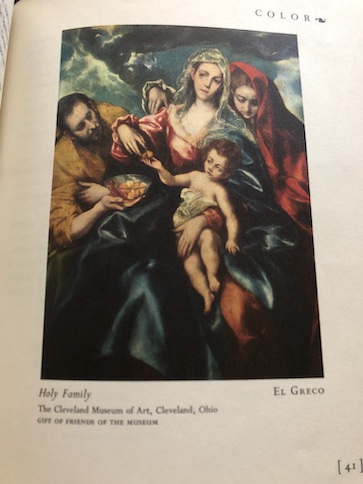
At first, when I was reading the book, I was annoyed that almost all of the pictures of paintings in the book are black-and-white. Then, I discovered that the pictures in the chapter about the use of color in paintings are full color. That is the only place in the book (aside from the cover) where there are color images. I think the reason why they did that is to draw attention to the colors in that chapter while emphasizing other aspects of painting in the other chapters, but I think I would still prefer more color images throughout the book.

The book is available to borrow and read for free online through Internet Archive.

Hand Shadows

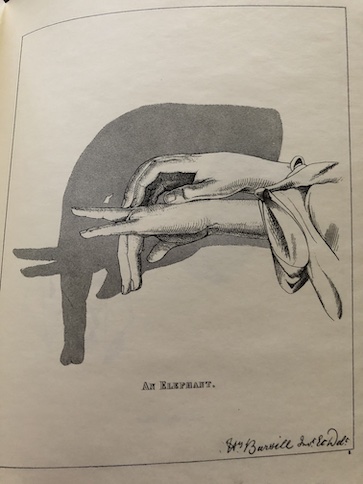
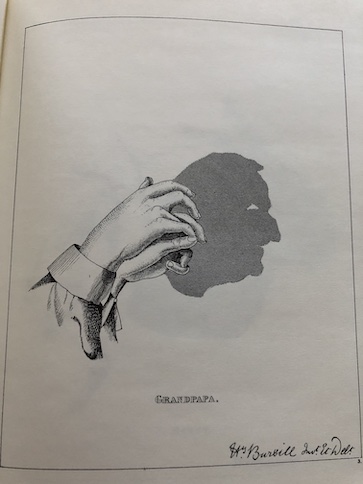
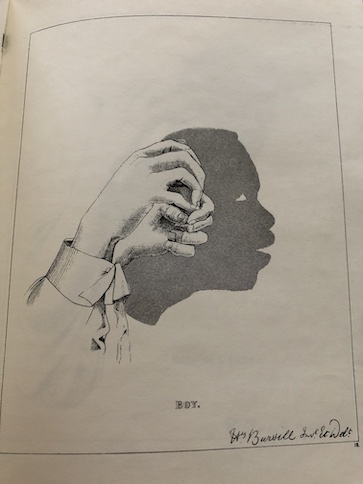
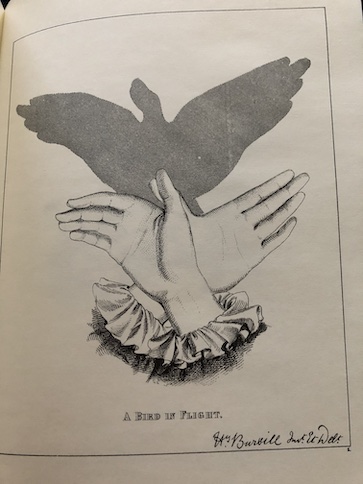
When I first read and started playing with this book as a kid, I didn’t stop to read the preface in the book or look at the publishing date, so I completely missed the fact that this is a reprint of a book from the late 1850s. The author, Henry Bursill (link repaired 9-11-24), was a professional artist

In the preface, Bursill refers to a well-known print from the early 19th century called The Rabbit on the Wall, which shows a father making shadow figures on the wall with his hands to amuse his children. Bursill says that there have been other books about hand shadows before his, but he emphasizes that his book is not the same as theirs because he has worked out his own hand shadows through experimentation. He says that it will take some practice for people making hand shadows to get them perfectly, but he encourages people to practice and not be afraid to work out new hand shadows of their own through experimentation. Bursill did the illustrations for the book himself, and he says that he began sketching some of the designs during his time as an art student and that he would amuse some fellow students by making hand shadows on the wall of his studio.

Other than the preface, the only words in the book are the captions on each of the pictures. I’ve tried some of the hand shadows in the book, and I had a more difficult time than the preface makes it sound. The only ones I’ve really been able to do well were the bird and the greyhound. I haven’t given up on mastering some of the more difficult ones someday, though!

The book is available to read for free online through Project Gutenberg and Internet Archive (multiple copies).

Mystery of the Fog Man

Mystery of the Fog Man by Carol Farley, 1966.

This is the first book of the Kipper and Larry mystery series. Kipper (real name Christopher) and Larry are 13-year-old cousins. The two boys meet each other for the first time in this book, when Kipper comes to visit Larry and his family in Michigan. The boys had written letters to each other before, but they were both excited to finally meet in person.

Larry and his father live in Ludington, on the shores of Lake Michigan, and Larry takes Kipper fishing soon after he arrives, which is when Kipper first encounters the mysterious figure known only as The Fog Man. This strange old man starts Kipper, and Kipper finds him eerie. Larry explains to Kipper that The Fog Man is kind of a local eccentric. He is apparently both deaf and mute. No one knows his real name. He apparently lives in the nearby forest, but during the summer, he comes to the beach to collect driftwood, which he sells to tourists, who are fascinated by this eccentric old man, and to the lady who runs the nearby gift shop, Miss Norton.

Shortly after this encounter, the boys learn that someone has stolen thousands of dollars from the safe on one of the car ferries that travel back and forth across Lake Michigan and Wisconsin. (Another book by the same author but in a different series takes place on one of these car ferries, The Case of the Vanishing Villain.) Kipper and Larry are able to see the scene of the robbery because of Larry’s father’s position as the local chief of police. However, the boys’ adventures are just beginning.

The most likely suspect in the robbery seems to be a man called Karminsky, who worked on the ferry. He disappeared around the time of the robbery, and Larry’s father thinks that he’s hiding out somewhere in the area, waiting for the police to stop looking for him so he can make his getaway. Larry is intrigued by the idea that the robber might be hiding out in the woods nearby. Although his father forbids the boys to go looking for the robber, they can’t resist checking out the woods anyway.

Larry confides in Kipper that he really wants to help his father catch this robber so that his father will be a big success and get public recognition. Larry sometimes feels bad that he and his father have been alone since his mother died when he was young. He thinks that, if his mother was still alive to help his father take care of him, his father would be able to do much more in his life and career, so Larry wants to be the help that he thinks his father really needs.

Soon, the boys think that they’ve found Karminsky’s hideout in the woods, but even though they lie in wait for him all night, they don’t manage to catch him there. The only person they see in the area is the Fog Man, and to Kipper’s shock, he sees the Fog Man walking without his characteristic limp!

When the boys later find the Fog Man’s coat and a fake white beard, they reach different conclusions about what happened. Kipper thinks that the Fog Man was involved in the robbery all along and that he was always in disguise from the beginning. However, Larry is accustomed to thinking of the Fog Man as a harmless old eccentric who has hung around town for the last few years, selling driftwood to tourists. Larry thinks that the Fog Man might be an innocent victim of Karminsky’s, that Karminsky may have killed him so he could take his place and blend in with the usual beach scene until he could make his escape.

Then, Larry’s father tells them that Karminsky has been found in another town, apparently having missed being on the ferry in the first place. So, if Karminsky was never on the ferry and never in Ludington, who stole the money and masqueraded as the Fog Man?

The book is available to borrow and read for free online through Internet Archive.

My Reaction

I bought this book because I always liked the Flee Jay and Clarice mystery story that I mentioned before and wanted to see more by the same author. I liked it because, while I thought that I understood things pretty quickly in the story, there are some surprising twists to the mystery. I thought that I had it figured out twice, but I was surprised both times, and the true identity of the Fog Man remains a mystery until the very end.

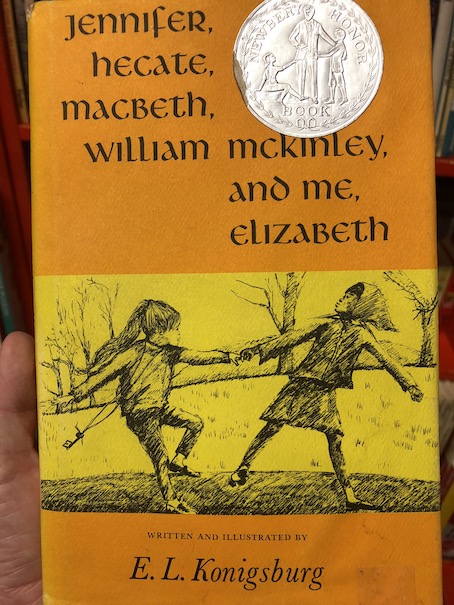
Jennifer, Hecate, Macbeth, William McKinley, and Me, Elizabeth

Jennifer, Hecate, Macbeth, William McKinley, and Me, Elizabeth by E. L. Konigsburg, 1967.

Elizabeth tells the story about how she first met her friend Jennifer one Halloween. Elizabeth is new in town, and doesn’t know many people yet. She doesn’t have any friends to walk with to or from school, and she encounters Jennifer in the woods she passes through on her way to school. When they meet, Elizabeth is dressed as a Pilgrim for the school’s Halloween parade. Jennifer also happens to be wearing a Pilgrim costume, and she’s sitting in a tree. Elizabeth sees that Jennifer is about to lose a shoe because it’s too big for her, so she impulsively pushes the shoe back onto Jennifer’s foot. Jennifer says that witches don’t lose things, and Elizabeth tells her that she’s not dressed like a witch because she’s wearing a Pilgrim costume. Jennifer says that this is what real witches dress like, not like the silly pointed hat costumes. (It becomes more clear later that Jennifer is referring to the accused witches at Salem, Massachusetts.) Elizabeth admires Jennifer’s costume because it looks more authentically old-fashioned than hers does, like a real antique. Elizabeth points out that they’ll have to hurry or be late to school, and Jennifer says that she’ll walk with her in exchange for the cookies Elizabeth is carrying. Elizabeth gives her the cookies because she isn’t hungry and badly needs some company. Jennifer makes it barely on time to her class, but Elizabeth is slightly late because she’s in a different class that’s further down the hall.

Elizabeth describes the Halloween parade at school, and you can tell that this book was written decades ago because there are kids wearing cardboard boxes because their costume is a pack of cigarettes, which would never happen at a 21st century school. Even in the 1980s and 1990s, when I was a kid, nobody would have dressed as a pack of cigarettes. There were a lot of anti-smoking campaigns when I was young, our teachers and most of our parents wouldn’t have allowed it, and with more exciting things to be, like super heroes and Ninja Turtles as well as the traditional witches, ballerinas, robots, vampires, and monsters, why the heck would somebody want to be a pack of cigarettes anyway? Lung cancer may be scary, but dressing as a pack of cancer sticks isn’t exactly fun Halloween scary. If you want to be a box of something, at least pick crayons so you can tell people you’re the sharpest crayon in the box. But, I digress.

At the parade, Elizabeth sees Jennifer unsnap the tutu of school mean girl Cynthia, who is dressed as a ballerina, so it falls down. It’s not a serious embarrassment because Cynthia’s still wearing her leotard underneath. Still, Cynthia is one of those two-faced kids who are good-looking and act like perfect angels when adults are watching but turn into nasty little monsters when the adults look away, so this minor embarrassment pleases Elizabeth and many of the other kids. Jennifer also passes a note to Elizabeth to meet her for trick-or-treating that evening, telling her to bring two bags. As the students parade across the stage for the costume contest, Jennifer amazes everyone by wearing a paper bag over her head that doesn’t have any eye holes cut into it, yet she doesn’t have any trouble walking, somehow seeing where she’s going or knowing where to go anyway. This is one of the odd things that Jennifer does that makes Elizabeth wonder if she really does have powers of some kind.

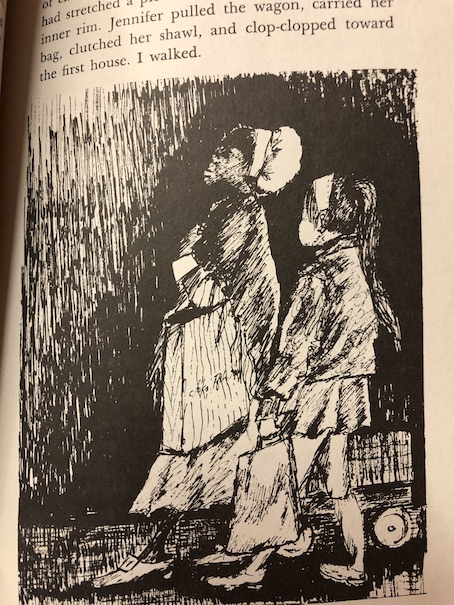
When the girls meet for trick-or-treating, Jennifer tells Elizabeth to give her the bigger bag of the two bags she brought. It’s a bit rude, but Elizabeth is fascinated by Jennifer and lets it go. Also, Jennifer has brought a small wagon with her. Jennifer has invented and mastered an act to get extra candy. At each house, she acts weak and breathless and asks for a drink of water. When the home owners give her a drink of water, she drops her empty bag, so the home owners will feel sorry for her and give her more candy. Then, out of sight of the home owner, Jennifer empties her bag of candy into the little wagon and does the same performance at the next house. Elizabeth wonders how Jennifer is able to drink so much water, but they collect an amazing amount candy from Jennifer’s act.

After Halloween, Jennifer tells Elizabeth to meet her at the library on Saturday, and she invites Elizabeth to become her apprentice witch. Elizabeth thinks it over and decides to accept. Jennifer begins leading Elizabeth through a series of rituals to make her into a witch. The first ritual involves both of them putting a drop of their blood on an old key that Jennifer was wearing around her neck. Afterward, Jennifer gives the old key to Elizabeth to wear. This ritual is kind of like a friendship pact.

Jennifer gives Elizabeth books to read from the library about witches and tells her to eat a raw egg every day for a week (she does it by mixing it into a milkshake), insisting that she also bring her a hard-boiled egg. From there, they progress through a list of other strange foods. When their grade starts rehearsing for their Christmas play, the food of the week is raw onions, which Elizabeth happens to love, in spite of being a notoriously picky eater. People notice the onions because Elizabeth is supposed to be a puppy in their school play that the princess played by nasty Cynthia gets for Christmas, and Cynthia can’t bear to get close to her.

Being Jennifer’s apprentice also means putting up with her rudeness and bossiness. When the girls decide to try making an ointment to change themselves into animals, they argue about what animals they’re going to be. Sometimes, Elizabeth finds Jennifer difficult to deal with because she isn’t considerate of her feelings, but she’s also fascinating because Jennifer is a serious reader and likes to talk about a wide range of interesting things, from witchcraft trials to Vincent Van Gogh to shipwrecks to the guillotines used in the French Revolution to secret codes. Their rituals continue through Christmas and the New Year and into the spring, with Jennifer promoting Elizabeth to Journeymen Witch and assigning her various “taboos”, things that she isn’t supposed to do.

For most of the book, Elizabeth doesn’t tell her mother about being friends with Jennifer. Jennifer, as a witch, is rather odd, and Elizabeth’s mother wants her to be friends with nice, normal children. In particular, she wants her to be friends with Cynthia because, like other adults, Elizabeth’s mother has been taken in by Cynthia’s two-faced act and thinks that Cynthia is a sweet, well-behaved little girl. When Cynthia invites her to her birthday party, Elizabeth knows that the invitation was really from Cynthia’s mother because she and Cynthia aren’t friends. However, Elizabeth’s mother makes her accept the invitation. The party is a trial because, thanks to Jennifer’s taboos, there are many party activities that Elizabeth can’t do (no eating cake, no pin-the-tail-on-the donkey because she can’t touch pins, etc.), but Elizabeth decides to make the most of it and enjoy being an oddball. Elizabeth has some fun when she realizes that she can act mysterious and witchy about knowing certain things and winning at the games she plays. She knows where the treasure is in the treasure hunt because it was just behind a pillow on the couch and she accidentally sat on it earlier, she wins at the clothespin drop game because she’s shorter than the other girls and finds the game easier, and she knows who brought which gift to the party without looking at the tags because she was the first to arrive and remembered what everyone else brought when they came. Of course, she doesn’t explain this to anyone, she just acts mysterious and witchy, like Jennifer. When she talks to Jennifer about the party, Jennifer acts like Elizabeth has actually used her witch powers to do those things, but Elizabeth insists that they were just ordinary incidents and her good memory for remembering the presents. Jennifer seems a little disappointed that Elizabeth doesn’t seem to see what she’s getting at with the witch business, and Elizabeth is disappointed that Jennifer doesn’t seem interested in the gossip she’s collected about the “normal”, non-witchy girls at the party.

The girls get a toad, which they name Hilary Ezra, their first compromise with each other by combining the two names that they wanted. Jennifer says that the toad will help them with their flying spell. They treat the toad like a pet, giving it insects that they’ve caught and measuring how far he can jump. They both love Hilary Ezra, but when Jennifer plans to add Hilary Ezra to their flying potion, Elizabeth refuses to allow it. She makes Jennifer set Hilary Ezra free. Jennifer tells Elizabeth that she’ll never be a witch because she’s too sentimental and dismisses her as her student witch.

Elizabeth is angry at Jennifer and thinks that their friendship is over as well as the witch business. However, after thinking it over, Elizabeth realizes something: Jennifer actually wanted Elizabeth to stop her from putting the toad in the pot with the other ingredients because she changed the order in which the ingredients were added from the order that was given in MacBeth, saving the toad for last and making a big show of dangling him over the pot, waiting for Elizabeth to stop her. Still, it makes Elizabeth mad that Jennifer made her stop her when she could have stopped herself and probably would have if Elizabeth hadn’t intervened.

Elizabeth has a right to be angry, but she also goes back to being lonely, and she doesn’t like that. While she’s alone at her family’s apartment one day, she spends some time looking at the greenhouses on a nearby farm called the Samellson Estate, and some of Jennifer’s cryptic comments about Hilary Ezra’s origins and her father being a “plant wizard” fall into place. The more Elizabeth thinks about it, the more the things Jennifer acquired for their “spells” make sense and the more Jennifer herself begins to make sense. Then, Jennifer makes the first move in repairing their friendship.

The book is a Newbery Honor book. It’s available to borrow and read for free online through Internet Archive (multiple copies).

My Reaction

One of the important points about this story that helps make Jennifer more understandable as a character is that she’s African American and this book was written in the 1960s. The book doesn’t refer to Jennifer’s race or describe her physical appearance apart from her clothes until about halfway through the story, although she does appear in pictures before that. The 1960s was the time of the Civil Rights Movement, and in 1967, when this book was first published, Martin Luther King, Jr. was still live. School desegregations were a recent issue. The only time in the book that Elizabeth mentions race is when she notices Jennifer’s mother at the performance of the school play for the PTA, and she says that she knew that the woman must be Jennifer’s mother because “she was the only Negro mother there.” This one line says, without really saying it, that Jennifer is the only African American kid in her class because, if there was even one other, the black woman in the audience could have been somebody else’s mother.

When the story begins, each of the girls has a reason to feel like an outcast – Elizabeth because she’s new at school and doesn’t know anybody and Jennifer because she’s the only black kid. Both of them are lonely, and they’re actually a good fit for each other in terms of their interests, but in order to become real friends, they have to learn to relate to each other without the cover of their made-up witchcraft rituals. After Elizabeth realizes where Jennifer actually lives and what her life is really like, and Jennifer shows that she cares about Elizabeth’s feelings, the two of them are able to bond as friends instead of witches.

Elizabeth never explains why Jennifer came up with the witch idea in the first place, and the book ends soon after their friendship is repaired, so it’s left up to the readers’ imaginations. It might have something to do with feeling like an outcast because of her race and because her father is a blue-collar worker when the kids who live in the nearby apartment building are the children of white-collar workers. Because Jennifer feels different from other kids and often spends time alone, reading books and playing games of pretend, she might have felt uncomfortable explaining herself to Elizabeth, fearing that she might not accept her. Training Elizabeth to be a witch gave the two girls a reason to see each other, adventures to share, and something interesting to talk about. As long as Elizabeth needed Jennifer to teach her witch things, Jennifer would feel confident that she’d stick around as a friend. The girls gave that up when Jennifer realized that Elizabeth would be her friend anyway and might actually like her better just as Jennifer instead of a witch.

Mystery of the Witches Bridge

Mystery of the Witches’ Bridge by Barbee Oliver Carleton, 1967.

Thirteen-year-old Dan Pride is an orphan. His father was an international correspondent, and during his early years, Dan lived in different European countries, as his parents traveled around to his father’s assignments. However, three years ago, his parents died in a plane crash. Since then, Dan has been living in a British boarding school. Now, he has returned to the United States to live with his father’s brother, Uncle Julian. Dan doesn’t know what to think about his new town because it’s very different from everything that he’s known before, but he likes the idea of belonging to a family once again because he has been lonely since his parents died.

The Pride family lives in a New England seacoast town. They were one of the founding families of the town in Puritan times, but Dan discovers that the local people aren’t particularly friendly with the Pride family. Billy Ben Corey, a man who works for his Uncle Julian, explains that the Pride family has been rather stand-offish with the townspeople, and there are also rumors and stories about witches that go back to Puritan times. Billy Ben says that most of the modern locals don’t really know all the details of the witch incidents, but the vague rumors that have circulated about the Pride family have caused the townspeople to treat them with suspicion.

This sounds like a somewhat sinister beginning to Dan’s life in York, Massachusetts as he comes to understand how much of life there is governed by the past relationships between the oldest families of the area. Billy Ben tells him that the Coreys have worked for the Prides for generations, but relations between the Prides and the Bishop family haven’t been good and that Dan should avoid them.

Dan presses Billy Ben for more information, and Billy Ben tells him the story of how one of his ancestors, Samuel Pride, was accused of witchcraft back in Puritan times. Some unfortunate happenings at the time, which were probably just the result of bad luck and bad weather, were blamed on him because he was kind of an odd, temperamental person. He was known for playing the fiddle extremely well, and people said that he used it to summon up the devil in the form of a black dog out of the marsh. The person who made the accusation and who led the group that came to arrest Samuel Pride was an ancestor of the Bishop family. Samuel came out to meet the group that came to apprehend them on the old stone bridge that leads to the island in the marsh where the Pride family has their house and farm, Pride’s Point. The story goes that when Samuel met the mob on the bridge, he placed a curse on them, that doom would come for them out of the night, out of the fog, and out of the marsh. Samuel and his wife were executed for witchcraft, and not only after, there was a terrible fog and a sickness that killed many people in town. People said that it was the result of Samuel’s curse. That’s why the Prides and the Bishops have a bad relationship even though they’re neighbors, why the townspeople are still a little suspicious of the Prides, why the Prides are somewhat standoffish of the townspeople (When you think about it, who really wants to be outgoing and friendly with people whose ancestors not only killed yours but who are not welcoming or friendly themselves because they have continually looked at you and your family with suspicion for generations, like you’re the weird ones? The townspeople basically created this situation and have been perpetuating it ever since, yet they act like the problem is with the Pride family instead of themselves. Gaslighting is a relatively new term from the 20th century, but the concept has been around forever, used even by people who don’t know what it is and that it’s what they’re really doing.), and why people in the area are afraid of the stone bridge that they call the Witches’ Bridge, the place where the curse was supposedly delivered. Even into modern times, people in the area see strange lights in the marsh and hear mysterious fiddle music or dog howls that they think might be Samuel’s ghost.

There is still more to come because the mysterious misfortunes of the Pride family have continued even into modern times. Dan is named for his grandfather, Daniel Pride, who died suddenly under very mysterious circumstances, something that still haunts his Uncle Julian. Young Dan learns the story from Mrs. Corey, a relative of Billy Ben’s, who is Uncle Julian’s housekeeper. Daniel Pride had been working to change the family’s image in the eyes of the local people, debunk all the old ghost and witch stories, and lay past quarrels to rest. To try to make peace with the Bishop family and restore the Pride family’s former fortunes, Daniel had been trying to arrange to buy the shipyards that the Bishop family owned, which had formerly been owned by the Pride family. The Bishop family initially agreed to the sale, and one foggy night, Daniel went to see the Bishops to finalize the sale. What happened after that is still a mystery. Daniel was found dead the next day near the old chapel with a look of terror on his face. It’s known that he had a heart condition, so he apparently had a heart attack, but from the marks on the ground, it also appears that he had been running before he collapsed, possibly deliberately frightened to death. Also, there were marks on the ground nearby where his briefcase fell, but the briefcase containing the sale papers was never found. The superstitious people in the area think that Daniel’s death was another symptom of the family’s curse, but it might also have been deliberate murder and theft. The Bishop family insist that they never finalized the sale of the shipyard with Daniel before his death, but Uncle Julian believes that the sale was finalized and that the Bishops are lying to take advantage of his father’s sudden death, just like their ancestors arranged the execution of Samuel for their own advantage. Uncle Julian remains suspicious and bitter about what has happened, just as the townspeople continue to look at the Prides suspiciously.

All of this makes York seem like it’s not the best place to raise a sensitive young orphan, and that’s basically what Uncle Julian says to Dan when Dan arrives at Pride’s Point. Uncle Julian seems elderly and physically frail, and Dan senses that he is a deeply troubled man. Uncle Julian tells Dan that the family and the old family home have a troubled history. That’s why Dan’s father decided to go away and live his life traveling to different places, and that’s why Uncle Julian delayed sending for Dan for so long after his parents’ deaths. Uncle Julian doesn’t seem to think that Pride’s Point is a very healthy place, and he hints at buried secrets. However, he does say that, now that Dan is there, there are going to have to be some changes.

Dan doesn’t think this sounds too hopeful, and he’s lonely and disappointed that he hasn’t found the happy family and home he was hoping for and that he doesn’t even seem particularly welcome there. He can’t even really enjoy playing his violin because of the connection people there seem to have between “fiddle” music, witchcraft, and his supposedly sinister ancestor. As Dan is looking around his new bedroom that night, he suddenly spots a mysterious flashing light from his window, outside in the marsh. It’s creepy because it not only supports all the ghost and witch stories that Dan has just heard but because he recognizes the patterns in the flashes of light as Morse Code … and the message being sent is his own name: D-A-N P-R-I-D-E.

Dan doesn’t believe that any supernatural force was using Morse Code to flash his name at night. It was obviously some human person, but who would do that and why? What is the truth about his grandfather’s death? Is Uncle Julian right that the Bishops caused Daniel Pride to die and then lied about the sale of the shipyard to cheat the Pride family? Or is someone else responsible?

The book is available to borrow and read for free online through Internet Archive.

My Reaction

I stand by my earlier statement that there is basically inter-generational gaslighting of the Pride family going on. It’s gone on for so long that the townspeople have trouble recognizing what they’re doing or stopping themselves from doing it, even though some of them seem to have the feeling that it isn’t right. At one point, some of the townspeople who come out to Pride’s Point to help fight a fire make jokes about the Pride curse. I could sense tension in them, and I think it was an attempt to lighten the mood, but under the circumstances, it wasn’t really appropriate for them to joke around, especially not about something that’s been a sensitive topic for the Prides, something that has literally caused members of their family to die and others to be persecuted for generations. Keep your audience in mind, and learn how to read a room, people of York!

Uncle Julian hates the stories and rumors that have circulated about his family since before he was born, but he doesn’t know what to do to stop it, and he sometimes wonders if it wouldn’t be better for the family to simply leave their old family home and start up again somewhere else. Mrs. Corey tells Dan that every single time anything bad happens in the area, people either look at the Prides suspiciously or find a way to blame them, even though they didn’t have anything to do with whatever it was. Dan can tell that Uncle Julian is so accustomed to having people blame him and his family for things and repeat scary stories about them that he halfway believes the stories in spite of himself, and he’s overly sensitive anytime it looks like the townspeople might be trying to blame the Prides for something yet again. That’s what makes this situation gaslighting, because the community’s constant untrue stories have warped even the Prides’ sense of reality and views of themselves. The community of York as a whole has created a situation that makes it difficult for the Prides to make friends with other people and get reality checks, and the most dangerous part of it is that among the few people that the Prides are in the habit of trusting is someone who turns out to be the person they should fear the most.

I couldn’t help but notice that there was someone in the story that Dan trusted too much in the beginning. It’s partly because Dan is young and in a situation where he is just getting to know the circumstances and people involved, but even when this person says things that are untrue, contradictory, or just plain mean, he doesn’t call him on it or seem to question within himself why this person is talking like that, at least not until about the middle of the book. Gaslighters will do this to a person, playing mind games, lying, alternately being friendly and praising their victim and then putting down their victim and/or trying to blacken their name to other people, discouraging them from getting close to people who care about them and might actually help them, acting like normal things that the victim does or feels are somehow weird or abnormal, trying to keep their victims in a constant state of confusion, unsure of what the reality of the situation really is. Although I found myself angry with the people of York in a general way for perpetuating something awful that their ancestors did for generations and for being apparently oblivious to what they’re doing in modern times, there is a definite villain in the story who is both deliberately and concretely evil.

There is a parallel drawn in the story between Uncle Julian’s big, black dog, Caliban, who is disfigured from an old injury and the Pride family themselves. Dan is afraid of the big dog, and Billy Ben tells him that it attacked him once, but Uncle Julian says that Caliban is just distrustful because he was badly abused and injured in his earlier life. People are like that, too. I understand that because I used to volunteer at an animal shelter, and that’s where I got my dog, Betty. (If you look at my About page, you’ll see a picture of Betty.)

I’ll never know Betty’s complete history because she was found wandering alone without a collar before she was brought to the shelter. However, I’m pretty good at reading between the lines, and I can read at least part of the story from her behavior. Betty is afraid of anyone, even me, walking behind her, and I’ve noticed since her shelter days that sometimes, her back end looks a little off-center when she runs. Her tail has an odd, permanent bend at the very tip that we didn’t discover until we had the hair on it trimmed. I think she’s been kicked hard from behind before, hard enough to leave permanent injury. She’s not as scared of things as she used to be after having lived with my family for a few years, but she used to be terrified of newspapers or anybody standing over her with anything in their hands, so I think she’s been hit with things before. Betty also gets scared when people laugh. She’s not as scared as she used to be because she’s gotten used to us laughing at something funny on tv, but there are times when she’s cringed and slunk away with her tail between her legs from people when they laugh and she can’t figure out why they’re laughing. Betty’s fear of laughter actually disturbs me because I think I know why it scares her. Based on her reaction, I’ve think that it’s likely that whoever hurt Betty before laughed when they did it. I think Betty has an association between laughter and pain, and that’s why she takes laughter as a bad sign, reacting fearfully to it when she thinks it might be directed at her. Laughing while inflicting pain is a sick thing to do, the product of a sick mind. There are stories in Betty’s reactions, and I’m disturbed by the mental picture I have of the person who had Betty before.

I have to admit that my own history has also both colored/given me insight into Betty’s behavior. If it isn’t obvious from comments in my previous reviews, I don’t see teasing as a positive thing. I’ve reacted to it in the past much like Betty does to sudden, unexplained laughter, which is why I understand the feeling behind it. Some people say that they like to tease their friends and people they like, but I just don’t like it, and I’ve learned to be more open and honest about how I never will like it. I do not have good feelings about people who tease others for fun, and I deeply resent being told that I have to like it because the people doing it are “just having fun.” It’s not a bonding activity, not with me, no matter who says it is. I absolutely refuse to “bond” with anyone who does it. Anyone telling me that I have to change myself to like people who tease is 100% guaranteed to get on my bad side. I have a bad history with teasing and bullying, I have a bad history with the people who do it, and I just don’t want to be around it. Teasing involves getting a laugh at someone else’s expense, benefiting from their discomfort, and getting a good feeling from making someone else feel bad. I don’t think any of that is right, and it doesn’t take much for it to get way out of hand, especially when people have the impulse press harder to get the reaction they want to their “jokes”, like the other person just didn’t get it, instead of cutting it out when their “jokes” just aren’t funny. It’s always awkward when it comes from people who don’t know the sore spots that they shouldn’t poke at and try to act like they’re special friends who should be cut some slack when the reality is that we don’t really know each other that well, we’re not really close friends, and no such special relationship actually exists between us. Real friends understand and demonstrate respect for each others’ feelings, and they don’t intentionally poke at a friend’s sore spots, like the people of York did to Uncle Julian with their jokes in this story.

What ties all of this together is that Betty’s reaction to laughter is like Uncle Julian’s reaction to the townspeople and their jokes and comments; it’s a conditioned response from long-term negative association. The townspeople are uneasy because Uncle Julian doesn’t laugh with them, but Uncle Julian doesn’t laugh with the townspeople because none of it was actually funny. By perpetuating these witch stories, even in the form of “jokes”, they’re constantly feeding the myths and ghost stories and making the situation worse, and they don’t seem to care about how he or his family feels or how it affects their lives. You can tell who respects you and who doesn’t by seeing who tries to treat you the way you want to be treated. The people of York were making jokes to soothe their own feelings, sharing in-jokes that they’ve had with each other at the Prides’ expense, and they got really uncomfortable when suddenly confronted with Uncle Julian’s, feelings that they helped to provoke and didn’t want to deal with.

Don’t worry about Betty. It’s sad that she’s been afraid of things and it’s kept her from being more outgoing and friendly, but we’re working through it. In non-pandemic times, I take her to places where I know she’s welcome, and she has acquired a fan club of people who like to see her and say hi whenever we visit. Anytime she seems uneasy because we’re laughing about something, I sit next to her, pet her, and praise her for being a Good Girl so she knows that nobody is trying to be mean to her and that we value her. When someone has been programmed through negative reinforcement, positive reinforcement is needed for balance. I’m trying to build more positive associations for her. It’s working, and she’s improving. She behaves very well and is very happy little dog when she’s treated well. Don’t worry about me, either. I’ve had some bad experiences, but I’m not the only one who’s had to deal with this stuff. There are lots of different kinds of people in the world, and I’ve learned some things about finding the kind of people I want to be around and making it clear how I want to be treated. I just gripe and vent now and then because I don’t like mean behavior or seeing others in these situations, and I’m all out of patience for it. I’ve learned what to do to help remedy such problems, but that doesn’t stop me from resenting the people who create problems that need to be solved.

The way both people and animals behave offers clues about what’s been happening with them. Sometimes, they offer warning signs of people to avoid, and sometimes, they are signs that the person or animal is in distress and needs some outside help and support. Caliban’s behavior in the story is more defensive than aggressive. That is, Caliban is reacting, not instigating … and if I saw what Dan saw in the story, I would know immediately to be very suspicious of the person Caliban hates the most because it explains where the source of harm in his life is. In a similar way, the Pride family is mostly reacting, not instigating. They have been harmed, both physically and psychologically, for an extended period of time, and while they seem to have the sense that’s the case, they’ve been too close to the problem for too long to see what the source of the greatest harm really is. But, about halfway through the book, Dan does learn to correctly read the people around him and comes to realize who is really his friend and how isn’t, based not on how others talk about them but by how they each actually treat him. When you pay attention and think about people’s actions in context, you can see who really has your best interests at heart and who doesn’t.

Dan spends much of the story, particularly at the beginning, feeling like he is unwanted, both in York and at Pride’s Point. At first, he thinks that his Uncle Julian doesn’t want him, but he gradually realizes that’s not it. There is someone else who doesn’t want Dan there, for reasons of their own. As I was reading, I noted times when this person said and did things that manipulated Dan’s feelings, even actively trying to make Dan feel bad while carefully seeming “honest” or “helpful” so Dan would continue to listen. I felt so much better when Dan finally realized the truth about this person. I have to say that I was really angry with Uncle Julian when I discovered that he was fully aware of who hurt his dog and that he still trusted this person. For me, the first hint of that would have caused me to permanently sever the relationship because it’s sick behavior and a sign of a disturbed mind, but I can only suppose that he felt unable to because he had been dependent on this person for too long, largely shunned by the wider community, who could have given him a reality check if they’d had a firmer grasp on reality themselves.

Dan, who had never heard of the Bishops before arriving in York, finds himself becoming angry and resentful of them, hating them for what they’ve done to his family for generations. His uncle even warns him not to get involved with the family, but that’s exactly what the real villain wants. When Dan makes friends with a boy named Pip Cole and his twin sister, Gilly, he confides his anger at the Bishops and how he blames them for this whole mess and for perpetuating it for generations, but Pip knows more about the situation than Dan suspects, and he has seen a different side of the problem. Pip tells Dan his family would have less problems if they would just forgive the Bishops, but Dan doesn’t believe it at first because, the way he sees it, the Bishops are the villains, who have actively profited from their villainy all along. I appreciate Dan’s situation. Pip doesn’t fully appreciate that, for Dan and his uncle, it’s not just about the past because they’re still actively suffering from the townspeople’s stories, rumors, and suspicions about them. It’s hard and maybe impossible to forgive something that’s ongoing from people who see no problem with the situation and aren’t particularly sorry. On the other hand, the resolution of this situation requires at least one of the parties involved to make the first move. Dan’s grandfather was trying, but his mysterious death prevented his mission from being completed. Even Uncle Julian reveals that he had been prepared to forgive the Bishops and marry their daughter, but some of the circumstances of his father’s death led him to believe that his fiance actually had a hand in it, and that apparent betrayal is what has left him such a haunted man all of these years.

The stories that Dan has heard about his family are not the complete story. Dan eventually comes to realize that the Prides and the Bishops each have only half of the real story, and because of their reluctance to associate with each other, the Bishops partly out of continued superstition and guilt, not knowing how to deal with the Prides’ anger, and the Prides, because they are both justifiably angry and accustomed to unfair treatment and being shunned by the community. However, it’s important that they do talk to each other because it’s the only way for each of them to get the complete picture of what’s really been happening and learn the real villain’s true motives.

The key to establishing the truth is in the missing briefcase, and both Dan and his enemy are searching for it. Dan needs to make peace with his family’s past, and he finds some help from a mysterious hermit called Lamie, who lives alone in the marsh. Lamie is another outcast of the York community. People avoid him because he has a reputation for being weird. People in this community in general may be “normal” in the sense that their behavior is fairly uniform, but uniformity by itself isn’t a virtue. When you’ve got an entire community doing something they shouldn’t, being the odd one out can be a good thing. Lamie helps Dan when he needs it, and Dan discovers that Lamie is actually a very kind and understanding person. Lamie’s solitary lifestyle is rather unorthodox, but he’s actually happy in his solitude because he knows who he is, he takes care of himself, he’s comfortable with himself, and he’s living the kind of life he likes, in touch with the natural world. When Dan talks to Lamie, he realizes that Lamie is comfortable with his own identity and at peace in his own mind in a way that his uncle isn’t. Even more importantly, Lamie sees things from a different perspective because he isn’t part of the groupthink of this community.

Lamie was friends with Dan’s grandfather, and he tells Dan about a hidden chamber built by the Prides’ ancestors, where Dan’s grandfather kept important family papers. However, Lamie tells Dan that he isn’t sure that he should look for it if his only motive is revenge. Dan does have a desire for revenge after all of the stories of injustice toward his family that he’s heard and what he’s suffered himself since he arrived in this area. Lamie helps to calm Dan’s desire for revenge by quoting from St. Francis of Assisi, emphasizing the importance of forgiveness instead of revenge. The part about truth speaks to Dan, and he comes to realize that what he really wants, more than revenge, is to know the truth about what happened to his grandfather. Lamie tells him that he saw some of what happened the night his grandfather died, from a distance. Because of the fog, he couldn’t see everything, but he knows that the Bishops were telling the truth that Dan’s grandfather didn’t make it to their place that night to complete their deal, defusing Dan’s anger at them for their supposed lies. Lamie’s memories also give him clues about the true identity of his grandfather’s attacker and the location of the secret hiding place. However, to find it and to evade his enemy, Dan will need the help of the very people his uncle has forbidden him to associate with.

I found the parts about the gaslighting of the Pride family and the poisonous duality of their true enemy frustrating and anger-inducing, but once Dan speaks to Lamie (really, my favorite charcter in the story) and begins to sort out who he can trust and who he can’t, I felt a lot better. The story is very atmospheric, with a grand old house and property, surrounded by a foggy marsh, and even when the characters know who their enemy really is, they are kind of trapped with him in a dangerous cat-and-mouse situation as they both race to find what they’re really looking for. By the end of the book, all of the old mysteries are wrapped up, including the source of the the mysterious “fiddler” music.