From the Mixed-Up Files of Mrs. Basil E. Frankweiler

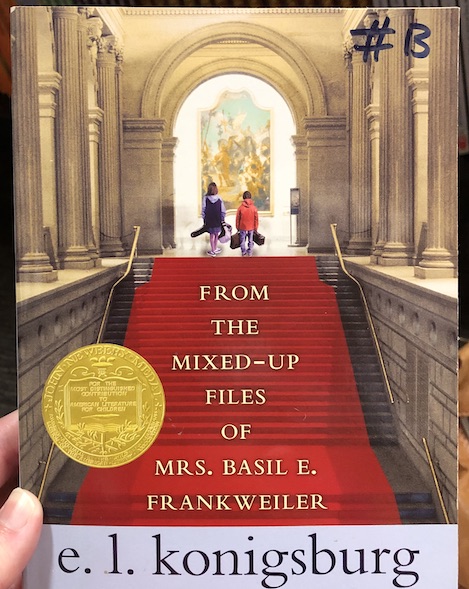
From the Mixed-Up Files of Mrs. Basil E. Frankweiler by E.L. Konigsburg, 1967.

Twelve-year-old Claudia Kincaid is bored with her dull suburban life in Connecticut with her parents and her brothers. Her life also often seems unfair, like she has more responsibilities than her brothers do and she has more chores than her others friends. Basically, Claudia is bored and feeling unsatisfied with her life. She wants to get away from it all and have a little adventure … although not too much adventure because Claudia isn’t the overly-adventurous type.

Claudia is cautious and methodical. When she plans to run away from home, she carefully plans every step and invites her more adventurous nine-year-old brother Jamie to go with her, both for the companionship and because he is a tightwad and has the cash necessary to fund their adventure. Although Claudia and Jamie bicker as siblings, they’re closer to each other than to either of their other brothers. Jamie eagerly accepts Claudia’s proposition to run away, although at first, he’s a little disappointed when he finds out where they’re going.

Claudia plans for them to run away to New York City because, as she puts it, it’s “a good place to get lost.” The city is so big, Claudia is sure that two runaway children will be easily overlooked. She’s also found a great place for them to stay during their adventure: the Metropolitan Museum of Art. Claudia loves comfort, convenience, and beauty, and the museum can offer all of that without the fees of staying in a hotel. There are exhibits of furniture, which provide them with a bed to sleep in, and interesting exhibits to keep them entertained and educated, and all they have to do is evade the security guards. At first, Jamie thinks that sounds a little too tame, but their adventure soon proves to be exciting and challenging, with enough mystery to satisfy both of them.

Claudia and Jamie develop routines for sneaking around the museum, evading the guards, hiding the backpacks and instrument cases that hold their clothes, and raiding the coins in the fountain for extra money. One day, while they’re hiding in the restrooms and waiting for the museum staff to leave, the staff set up a new exhibit for an angel sculpture sold to the museum by the wealthy and mysterious widow Mrs. Basil E. Frankweiler, who is actually the person narrating Claudia and Jamie’s story in a letter to her lawyer.

Claudia develops a fascination for the angel and a desire to learn the truth about the theory that the statue was made by Michelangelo. Between the two children, Claudia is the more imaginative and romantic, but Jamie’s logical mind and zest for adventure serve them well as they delve deeper into the mystery. They do learn something important at the museum, but to get the full truth, they have to leave their planned hiding place in the museum and go see Mrs. Basil E. Frankweiler herself.

Mrs. Frankweiler is a delightfully eccentric student of human nature, who is fascinated by the young runaways who come to her for answers to a mystery hundreds of years old. In exchange for the details of their exploits, Mrs. Frankweiler gives the children a chance to locate the answers they’re seeking in her strange, mixed-up files. In the process, the children learn a secret that gives both of them the sense of being part of something secret and exciting and much bigger than their ordinary, hum-drum lives, which is what they were originally looking for when they ran away from home.

The book is a Newbery Award winner, and it is available to borrow for free online through Internet Archive (many copies).

My Reaction

During the course of the adventure, Claudia and Jamie become closer to each other than they were before they ran away from home. They learn a little more about each other and themselves, and neither of them is quite the same as they were before they started, which is at the heart of Claudia’s reasons for wanting to run away from home in the first place. The language and descriptions in the book are colorful, which is part of the reason why this book is popular to read in schools.

There were two movies made of this story. One is a made-for-tv movie version from 1995, although it changed some of the details from the original story. In the 1995 movie, there is a scene with Jamie getting sick and Claudia worrying about him and taking care of him that never happened in the original book. Also, in the movie, Claudia stops Jamie from taking the coins from the fountain when they had no qualms about raiding the fountain for money in the book. At the end of the book, the children don’t tell their parents where they were hiding when they return home, but in the movie, the parents do find out. There is also an older movie from 1973 which is sometimes called The Hideaways.

Day and Night

Day and Night by Roger Duvoisin, 1960.

Night is an owl who likes to go out hunting for food at night, and Day is a poodle who lives with family called the Pennyfeathers. Because Day is usually only out during the day and sleeps in the family’s house at night, they don’t usually meet. However, by chance, Day rescues Night from a fox.

Night is grateful, and the two of them become friends. However, because they are normally active at very different times, they can’t easily meet to talk to each other.

They sometimes leave each other little treats, like a bone with some meat or something from one of Night’s hunts.

They also begin meeting at the kitchen door at night to talk to each other.

However, Day’s barking and Night’s hooting is too loud, and they start keeping the Pennyfeathers awake at night. At first, they can’t figure out why Day keeps barking every night, but their son, Bobby, sneaks out one night and sees the way Day seems to be talking to the owl.

Bobby correctly realizes that Day and the owl are friends and that they’re just trying to talk to each other. To solve the problem, Bobby builds a dog house for Day so that Day can comfortably sleep outside and talk to his owl friend without disturbing everyone.

Day likes the new dog house, and Night meets him there every night so the two friends can talk whenever they want.

My Reaction

This is a cute picture book that I’ve liked since I was a kid. I like the way that Day and Night talk to each other and some of Day’s misconceptions about what his humans are thinking. When Mr. Pennyfeather yells at them to be quiet, Day tells Night that he thinks Mr. Pennyfeather is barking at the moon.

Some of the pictures are in black-and-white and some are in color. It seems to be common in older picture books to have a mixture of black-and-white and color images. I think it might partly have been done to save money on printing.

Where the Wild Things Are

Where the Wild Things Are by Maurice Sendak, 1963.

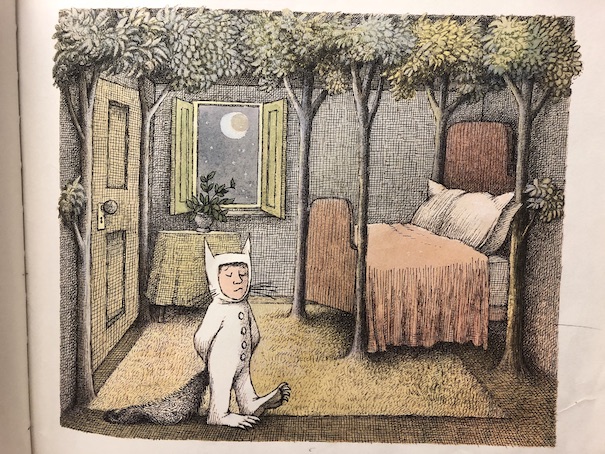
One evening, Max puts on his wolf costume and starts causing trouble all over the house. His mother calls him a “wild thing” and sends him to bed early without supper.

As Max mopes in his room, a forest grows around him, and Max climbs into a boat and sails away.

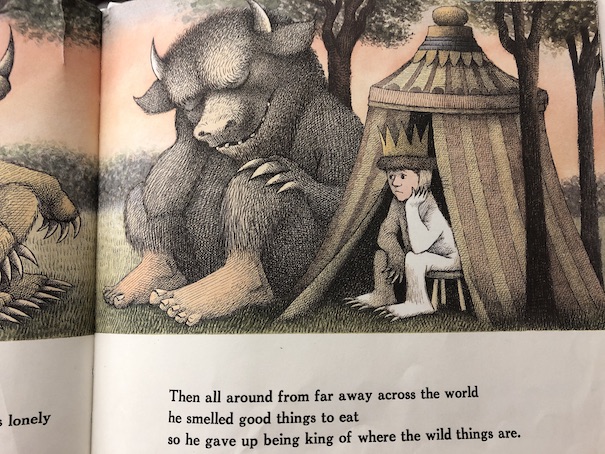
Max eventually arrives at “the place where the wild things are.” There are all kinds of wild beasts and monsters there, and they make Max their king because he’s the wildest of them all.

After they all go parading about and swinging from trees, Max sends all the wild things to bed and is lonely because he wants to be with someone who loves him.

So, Max sails home again to have his supper, which is waiting for him, still hot.

Max’s magical journey is in his own head. Angry and hurt at being told off for his behavior, he imagined himself far away from where he was being punished, in a place where he could act any way he wanted and tell other people what to do. But, that wasn’t satisfying because what he really wants is to be loved and cared for. Wild monsters don’t get the kind of nurturing that small human boys get from their mothers, so there are benefits to being a civilized human. This is a classic children’s book about the power of a child’s imagination and how love and human feeling wins out over anger.

The book is a Caldecott Medal Winner. It’s available online through Internet Archive.

Egg in the Hole Book

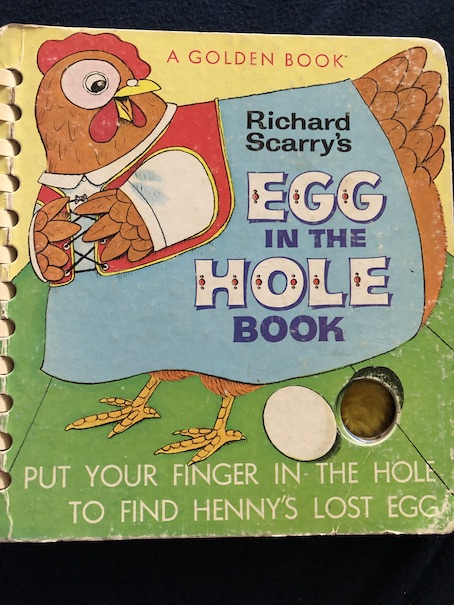
Egg in the Hole Book by Richard Scarry, 1967.

This is a board book with a very special feature: a hole that goes all the way through the pages to the back of the book. There is something yellow, soft, and fuzzy in the hole, and it becomes obvious as you read the book what it is.

Henny lays an egg in the barn’s hayloft, but she loses it when it rolls through a hole. The anxious chicken immediately chases after it.

Down below, Billy Goat tells her that the egg fell on the ice cream that he was going to eat for dessert and then rolled out the window.

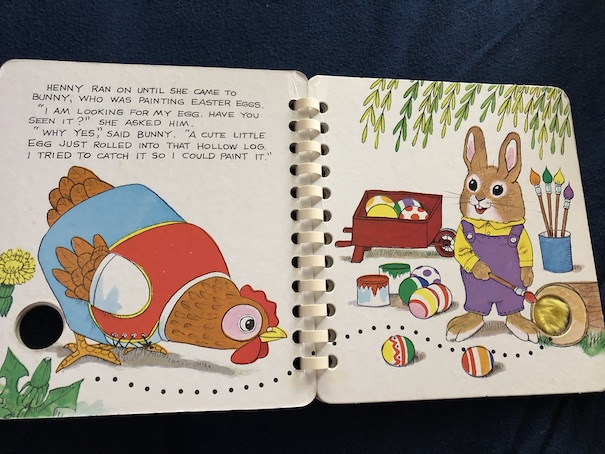
From there, Henny follows the egg’s path along a rain gutter, out a down spout, through a fence, into a hollow log, and eventually, into a hole in the ground.

When Henny fears that her egg is lost in the hole, a mouse comes out to tell her that the egg broke, but it has hatched into Henny’s new baby chick! (The yellow, soft, fuzzy thing.)

My brother and I used to like this book when we were little kids. I think of it as a kind of Easter story because of the bunny painting Easter Eggs, although the book isn’t really about Easter. Baby chicks are also often associated with Easter. It’s cute how the egg’s path is marked by little dots as it rolls across the barnyard, and the gimmick with the holes in the pages is clever.

The book is available to borrow and read for free online through Internet Archive (multiple copies). Of course, you can’t quite enjoy the effect of the hole feature with the electronic copies.

The Sleepy Puppy

The Sleepy Puppy by Mary Jo Chamberlin, illustrated by Florence Sarah Winship, 1961.

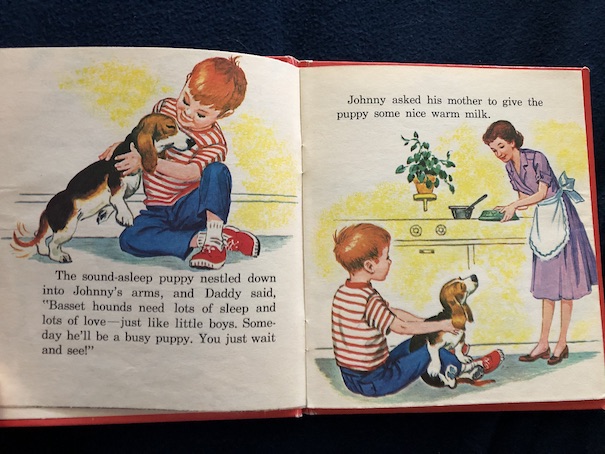
Johnny’s father brings a new basset hound puppy home to his son. Johnny is excited about his new dog, but the puppy is sound asleep. Johnny’s father tells him that puppies are like small children, that they need sleep and love, and when they grow bigger, they’ll be more active. Johnny has to be patient and let his puppy grow.

The puppy falls asleep in his dinner and on the grass outside when Johnny takes him out to play. The puppy seems to be able to sleep through anything, and Johnny wonders if the dog will ever be able to do more than sleep.

On the Fourth of July, Johnny tries to get his dog to pull a little cart in the pet parade, but Johnny ends up having to pull the cart with his dog on it instead.

Then, one day, Johnny’s puppy wakes Johnny because he wants to play. Suddenly, Johnny’s dog is full of energy, and Johnny can play with him!

The book is available to borrow and read for free online through Internet Archive.

My Reaction

I loved this book when I was a little kid, and I think it has a good lesson for young children about caring for pets. Animals, especially young ones, do require patience and time to grow, just like human children do. Johnny is bound to also learn that they also require some training once they get active, but there’s time for that, and that’s been the subject of other children’s books.

Clifford's Tricks

Clifford

Clifford’s Tricks by Norman Bridwell, 1969.

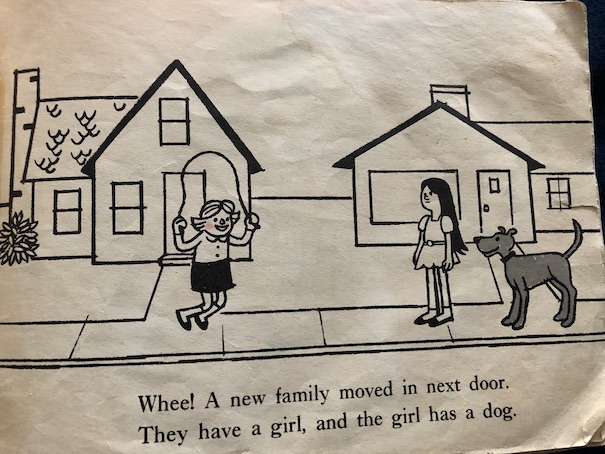
A new girl moves next door to Emily Elizabeth. The new girl, Martha, also has a dog, although her dog, Bruno, is a normal-sized dog, unlike Emily Elizabeth’s dog, Clifford.

Martha is competitive and brags that her dog is probably smarter than Clifford. Martha and Emily Elizabeth compare the tricks that their dogs can do, although Clifford’s tricks are different from those of normal dogs. His tricks tend to go wrong or cause problems because of his large size. For example, Bruno can retrieve a newspaper for Martha, but when Clifford tries to do the same thing, he comes back with the whole news stand.

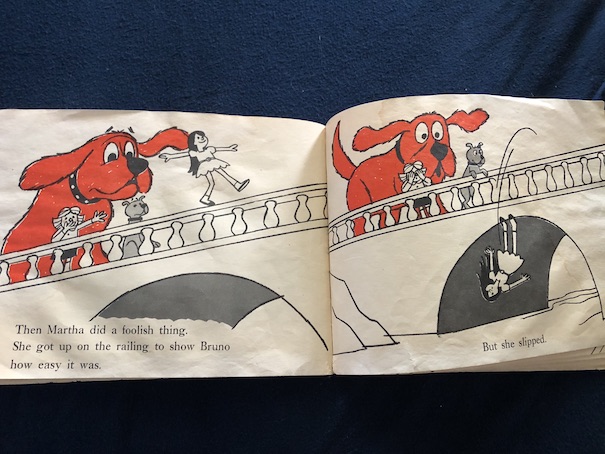
Martha tries to show off Bruno’s bravery by getting him to walk the railing of a bridge, but Bruno doesn’t want to do it because it’s too dangerous. When Martha tries to show Bruno how easy it is, she falls off the bridge into the river. Bruno jumps in to save her and also gets into trouble.

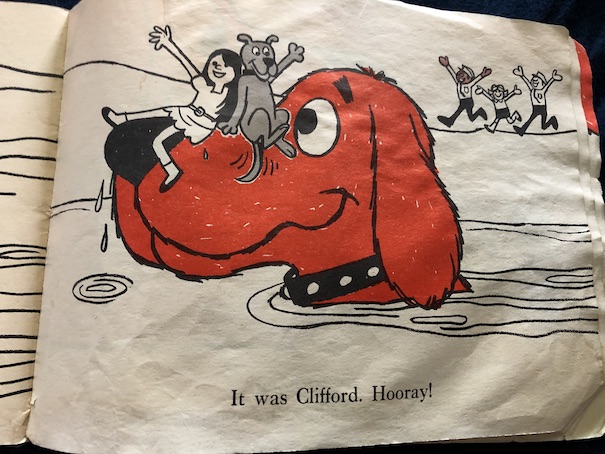
Fortunately, Clifford is big enough to save them both.

Martha is grateful that Clifford saved her and her dog, but each girl still loves her own dog the best.

The book is available to borrow for free online through Internet Archive. The edition that I have is the older edition of the book with pictures that are mostly black-and-white, except for Clifford, who is red. However, there is also a newer edition with full color pictures.

Clifford the Big Red Dog

Clifford

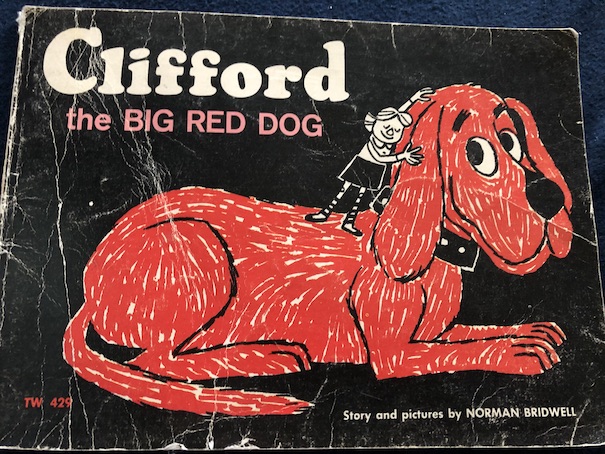
Clifford the Big Red Dog by Norman Bridwell, 1963.

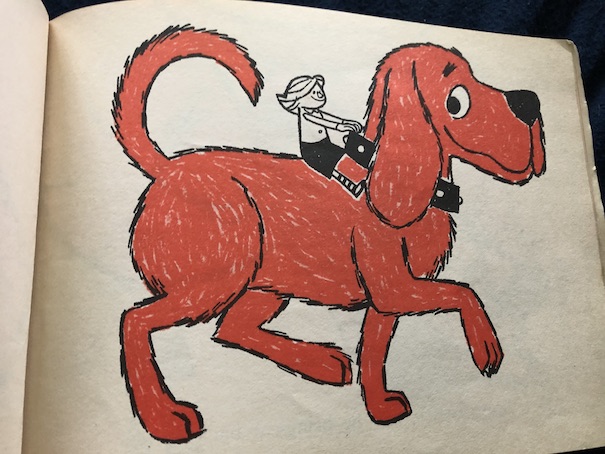
Emily Elizabeth introduces readers to her big, red dog, Clifford. Clifford isn’t just big; he’s humongous.

Like other kids, Emily Elizabeth likes to play with her dog, but playing even the usual games of fetch have unpredictable results because of Clifford’s size. When they play hide-and-seek, there aren’t many places where Clifford can hide, and even then, he’s not too difficult to find.

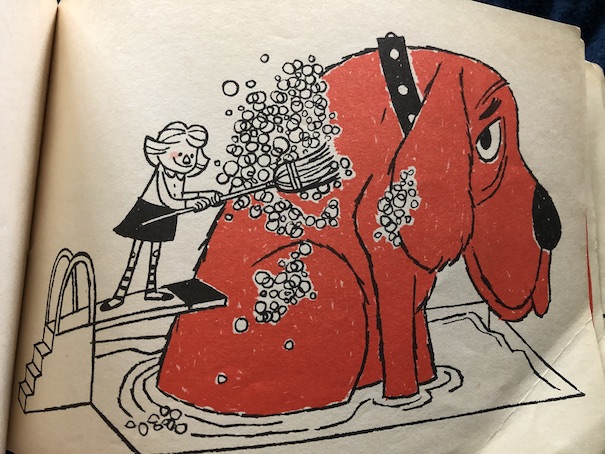
He also requires a lot of food and special accommodations because of his size. His baths aren’t like those of normal-sized dogs.

Clifford’s doggy bag habits, like chasing cars, can be even more unpredictable. Other dogs might chase cars, but Clifford has a real chance of actually catching them.

However, there are good sides to having a big dog. For one thing, bullies never bother Emily Emily Elizabeth.

Emily Elizabeth loves Clifford and wouldn’t trade him for any other dog.

The book is available to borrow for free online through Internet Archive. The edition that I have is the older edition of the book, but there is also a newer edition with full color pictures.

Charlie the Tramp

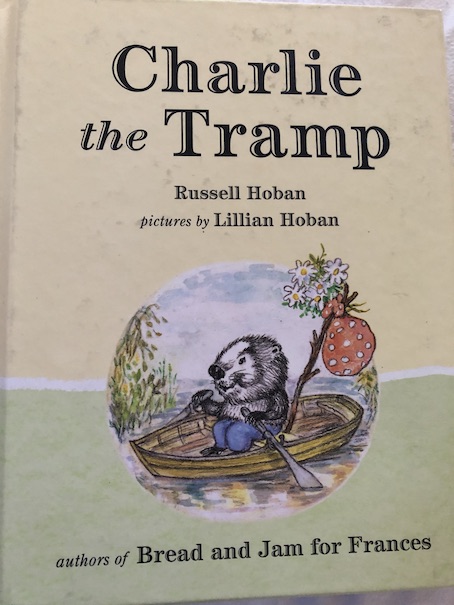
Charlie the Tramp by Russell Hoban, illustrated by Lillian Hoban, 1966.

Disclosure: I am using a newer edition of the book, published by Plough Publishing House.  Plough sent a copy to me for review purposes, but the opinions in the review are my own.

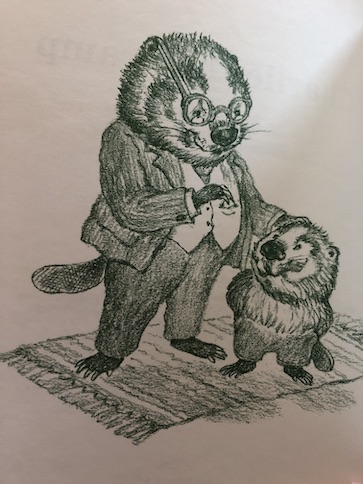
One day, when Charlie Beaver’s grandfather comes to visit, his grandfather asks him what he wants to be when he grows up. The grandfather assumes that he knows the answer to the question because everyone in the family is a beaver, and beavers naturally do beaver work. (Beaver is apparently both species and profession in books where beavers talk and wear clothes.) However, Charlie stuns his family when he declares that he wants to be a tramp.

Few families would be happy to hear a child say that he wants to be a tramp. Charlie’s grandfather says that he’s never heard a child want to be tramp, and his mother says that she doesn’t think he means it. However, Charlie thinks that being a tramp would be good because he wouldn’t have to learn how to chop trees or build dams or other routine jobs. Charlie thinks that tramps have a lot of fun and just work now and then at little jobs when they need something to eat. Charlie thinks that the little jobs would be much more fun than the ones his father really wants him to do. Charlie’s grandfather says that kids these days just don’t want to work hard.

However, Charlie’s parents decide that if he wants to be a tramp, they’ll let him try it out. Charlie makes himself a little bundle with some food, and his parents let him sleep outside, telling him to come back for breakfast. Both the father and grandfather quietly admit that they both wanted to be a tramp when they were his age, so it’s not just kids these days.

Charlie has some fun, roaming the countryside, sleeping under the stars, and enjoying his freedom. In the morning, he comes home and does some chores to earn his breakfast, lunch, and dinner. In between, he goes out to roam the countryside again.

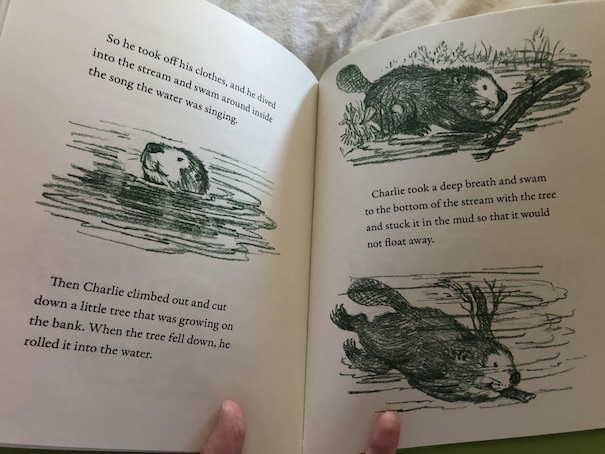
Charlie begins to notice that something keeps waking him up in the night, an odd sound that he can’t identify at first. Eventually, he realizes that it’s the sound of a nearby stream. For some reason, the trickling sound of the stream seems nice but makes him feel restless. It inspires him to swim in the stream and begin building his own dam, working through the night.

When Charlie sleeps through breakfast, his family comes looking for him and admires the good job that Charlie did on his dam and the pond that he has created. When they ask him about why he was making a dam when he was trying to be a tramp, Charlie says that he likes doing both and can do either sometimes. His family is satisfied that Charlie is a good worker, and his grandfather says, “That’s how it is nowadays. You never know when a tramp will turn out to be a beaver.”

It isn’t that Charlie expects to go through life without doing work because he insisted on working to earn his meals even when he was being a tramp. It was more that Charlie wanted the freedom to decide when he wanted to work and what kind of work he was going to do. However, he is a beaver and has a beaver’s instincts. In the end, he sees the appeal of doing a beaver’s work, building dams, enjoying it because he made the dam himself in the way he wanted to make it. I think it shows that when a person has the knowledge and ability to do something and the interest in doing it, they will eventually use their skills, perhaps in surprising ways. I remember reading some advice to writers that said that people write because “they can’t not do it,” and that’s true of many aspirations in life. Sometimes, when people know what they really want to do with their lives, they can’t resist doing it, and sometimes, people realize what their aspirations are when they find something that they can’t resist doing. Charlie is a beaver because it’s a part of who he is, and he can’t not do it. As he grows up, he will continue growing into that role, just as human children eventually grow up to be the people they are going to be.

This book is available to borrow for free online through Internet Archive, but it’s also back in print and available for purchase through Plough. If you borrow the book and like it, consider buying a copy of your own!

The House of Dies Drear

DiesDrearThe House of Dies Drear by Virginia Hamilton, 1968.

Thomas Small, a thirteen-year-old African American boy, is moving from North Carolina to Ohio with his family in order to live in an old house with an unusual history.  His father is a history professor and has rented a house for them that was once owned by an abolitionist named Dies Drear.  Dies Drear was part of the Underground Railroad that smuggled escaping slaves out of the South around the time of the Civil War, and his old house still has secret passages from that time.  The local people believe that Dies Drear still haunts the house along with the ghosts of a couple of slaves who never made it to freedom.

The caretaker of this strange old house is a strange old man called Mr. Pluto.  He lives on the property in a cave that he has made into a house.  Mr. Pluto frightens Thomas, and Thomas is sure that he’s hiding something.

The Smalls’ new town is a close-knit community that doesn’t welcome outsiders. The people seem unfriendly and suspicious of the Smalls, especially the Darrow family.  They know something about the secret passages at the house, but Thomas’s parents don’t want him poking around the passages anymore after he is briefly lost in them.  However, that is where the real secret of the house lies.

Thomas comes to believe that someone is sneaking into the house at night, using the old secret passages.  One night, this person leaves three small metal triangles at the bedroom doors.  These mysterious triangles seem to fit together, but there also seems to be a missing piece.  The Smalls have no idea what these pieces mean or who put them there.  Mr. Pluto holds many of the answers, and he is going to need their help to protect the secret that he has kept safe for many years.

The book is currently available on Internet Archive (multiple copies).  The book won the Edgar Award for Best Juvenile Mystery in 1969.  There is also a made-for-tv movie version of the book.  Sometimes, you can find it or clips of it on YouTube.

There is a sequel to this book called The Mystery of Drear House.  There are only two books in this short series.

My Reaction and Spoilers

I love how the Smalls help Mr. Pluto deal with the Darrows in the end, using the ghost stories about the house to their advantage.  There are hints that besting the Darrows, although it hurt their pride, may actually lead to a better relationship with them in the future.

Thomas and Pesty (a nickname for the young adopted daughter of the Darrow family, her real name is Sarah) are also memorable characters.  Pesty is brave for learning the secret that her family has tried to learn but choosing to protect it instead of reveal it.  Thomas is a thoughtful boy who, because of his earlier upbringing, actually feels more comfortable around older adults than around people his own age.

If you’re wondering about why the abolitionist had a strange name like “Dies Drear”, it isn’t exactly explained.  At one point, the story says that he was from New England.  A possible explanation that I found online is that Dies might actually be another form of the Germanic surname Diess, which may be related to the Biblical name Matthias.  Perhaps Dies Drear might have some Germanic ancestry.  Some people use the mother’s maiden name as a first or middle name for a child.  But, that’s just a theory.

Some teachers use this book to introduce students to the concept of the Underground Railroad.  While I was researching the book online, I also found this pdf of classroom worksheets related to the story. (I had a link to a different set of worksheets before, but those were removed, and I found a different set.)  If you’re looking for additional lesson plans, I suggest looking at Teachers Pay Teachers, where teachers can buy lesson plans from other teachers.  (I’m not sponsored by them, I just know about them from a friend who is a teacher and think it’s a useful resource.)

One final point that I would like to make is that there are no white characters in the story.  Dies Drear was a white man, but he doesn’t actually appear in the book, having died over 100 years before.  Every character who does appear in the book is black.  The funny thing is that I can’t remember any point where the book explicitly describes the characters as black.  It might be my memory playing tricks on me, but I seem to remember knowing that they were all black as I read the book, but I can’t think now why I knew it, and I don’t remember a point where the book actually described anyone’s appearance.  I think I probably knew it partly from context, perhaps subtle hints in the story, but it might also be that I knew what the book was about before I read it because someone told me.  I might even have seen the movie version at some point before reading the book, although I’m not sure now because it’s been years since I first read this story, and I can’t remember if I read the book or saw the movie first.  The movie or clips of it sometimes appear on YouTube.  It’s also available on dvd, although I haven’t seen many copies available.

Corduroy

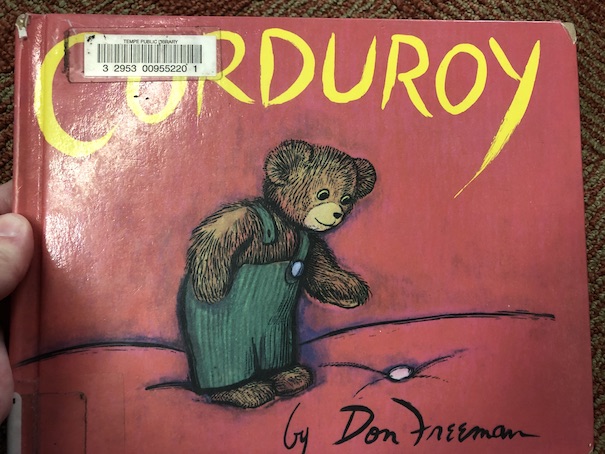
Corduroy by Don Freeman, 1968.

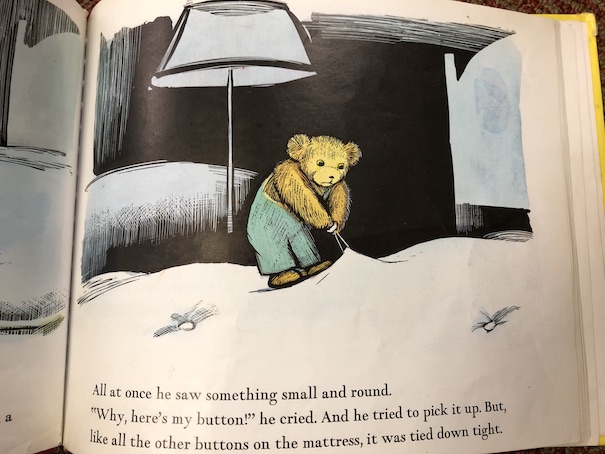
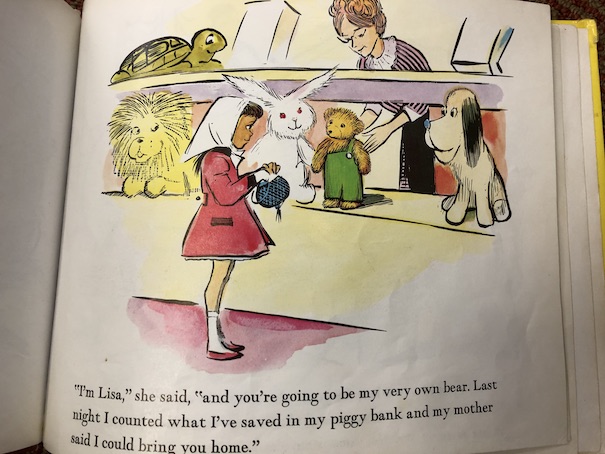
Corduroy is a small teddy bear who lives in a department store, waiting for someone to buy him and take him home. However, he is missing one of the buttons on his overalls, and it makes people reluctant to buy him.

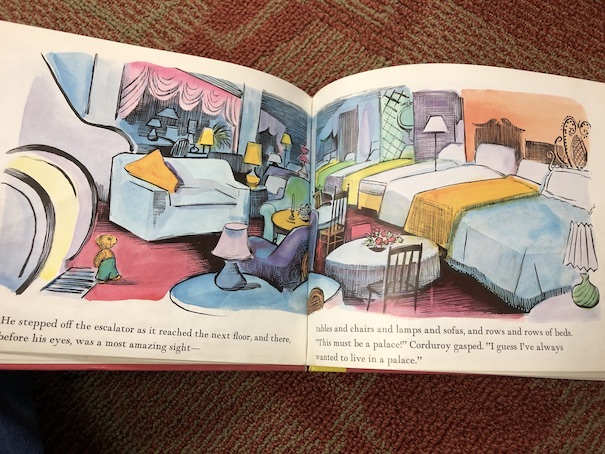
One night, after the store is closed, Corduroy sneaks out of the toy department to go looking for his lost button. After a trip up the escalator, he finds himself in the furniture department. To Corduroy, it’s like climbing a mountain and finding himself in a palace.

When he spots a button on a mattress, he thinks it might be his and pulls it off. By accident, he knocks over a lamp, which attracts the attention of a night watchman, who spots him and returns him to the toy department.

The little girl who wanted Corduroy before, Lisa, returns to the store and buys him. Lisa takes Corduroy home and sews a new button on Corduroy’s overalls. Corduroy is happy because he’s always wanted a home and a friend, and now he has both.

At first, this book was a stand-alone story, but later, the author wrote a sequel called A Pocket for Corduroy. Later, other authors continued the series.

The book is available to borrow for free online through Internet Archive.