The House Without a Christmas Tree

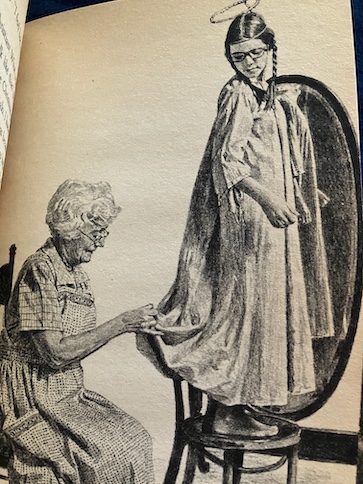
Addie Mills starts the story reminiscing about a special Christmas that she had when she was young and living in a small town in Nebraska with her father and grandmother in the year 1946. The story talks about the things that she did with her friends while they were getting ready for Christmas and buying presents for each other and such, but it mostly centers on how badly Addie wants a Christmas tree.

Addie is ten years old, and she can’t remember ever having a Christmas tree in the house. Apparently, the last time there was a tree in the house was when Addie’s mother was still alive, when Addie was a baby. Addie tries to talk to her father about it, but he just gets angry. Addie’s father doesn’t want a Christmas tree because it reminds him of Addie’s mother, and he still misses her.
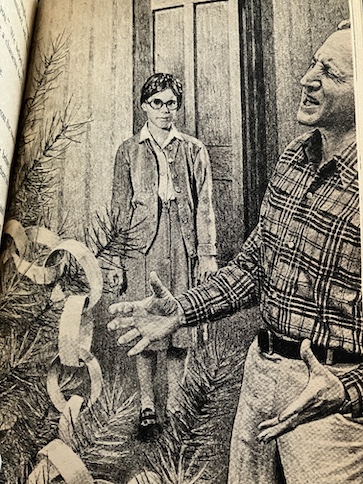
Addie feels self-conscious because other families have Christmas trees, and she schemes to find a way to get one. When Addie wins a tree in a guessing contest at school, beating a girl from a needier family, Addie’s father gets angry and makes a scene, which makes Addie feel terrible. She gives the tree to the other family, and worries that her father doesn’t really love her. 

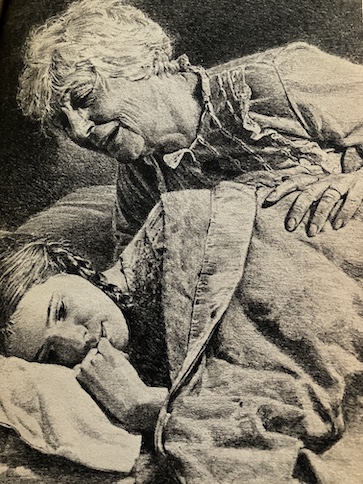
Seeing Addie’s desperation, Addie’s grandmother lectures Addie’s father, saying that his grief over his dead wife is keeping him from being happy and is making his daughter miserable too.  In the end, Addie’s father sees the importance of the tree to Addie and decides that it’s time the family had one again.

This book is a little unusual in that the movie version came first, and then the book was written.  Sometimes, you can find the movie or clips of it on YouTube.  The book is currently available online through Internet Archive.  There are also other books in the Addie Mills series.

Some people in real life also struggle with Christmas because Christmas can sometimes bring out sad memories or highlight losses. Christmas is often a time of reflection, the last major holiday before the end of the year and a very sentimental and idealized time, but life isn’t always idea. People who have suffered a loss or are unhappy with their lives in some way tend to reflect on what they don’t have, whatever or whoever is missing from their lives. This is how Christmas is for Addie’s father at the beginning of the story, and Addie’s grandmother is correct that either wallowing in sad memories or trying to hard to avoid them is holding Addie’s father and Addie herself back. It’s time for them to move on and build new memories with each other.
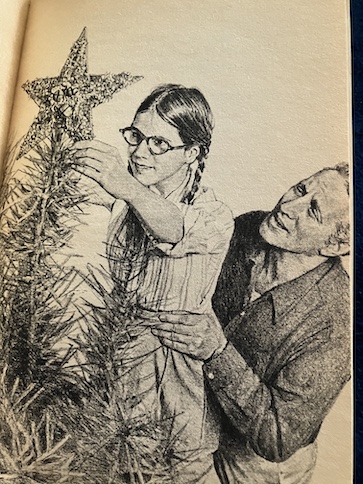
I like the story because the characters are very realistic. Addie and her father, like real people, often find it difficult to communicate and understand each other, but in the end, family love wins over the situation. Addie does get the tree she’s been longing for, and for the first time, her father talks to her about her mother. The Christmas tree and coming to terms with the memories of Addie’s deceased mother help the family to heal old wounds and establish better relationships with each other.
The Ghost Belonged to Me

GhostBelongedToMe

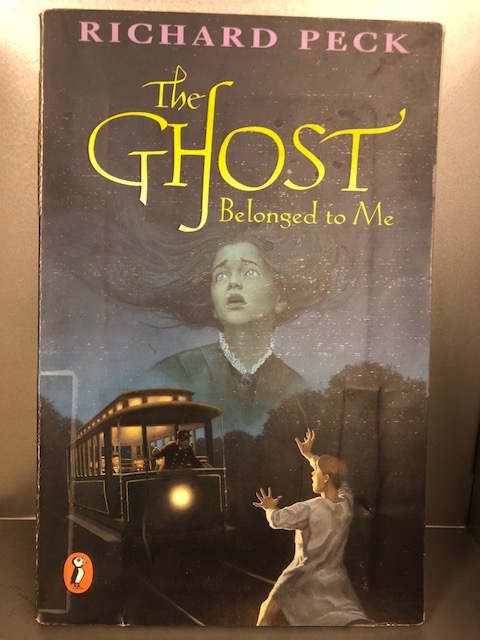
The Ghost Belonged to Me by Richard Peck, 1975.

The book takes place in the 1910s in a small town on the Mississippi River. Alexander Armsworth, a boy in his early teens, is approached by a girl from his class who tells him that the barn on his family’s property is haunted and that Alexander himself has the ability to see the “Unseen.” The girl, Blossom Culp, is a poor girl from a family of outcasts who has been known to tell tall tales, so Alexander isn’t sure he believes her at first. However, he can’t help but be curious, and when he sees a light coming from the barn at night, he decides to investigate.

Inside, he finds the ghost of a young girl who warns him of danger on the trolley tracks near his house and tells him that he must act fast to save everyone. Frightened, Alexander gets the trolley to stop and learns that by doing so, he has saved the lives of everyone on board from a disaster at the bridge further on. Naturally, everyone wants to know how Alexander knew to warn them. When Alexander explains, he is met with skepticism from his social-climbing mother and sister and unwelcome attention from news people and curiosity-seekers from town.

The ghost, who tells Alexander that her name is Inez Dumaine, is also in need of help before she can rest peacefully. Alexander will need the help of those who believe in him and the ghost to find Inez’s body and return it to her home in New Orleans.

In this first book in of the Blossom Culp series, Alexander is the main character, but the other books focus more on Blossom, who discovers that she also has the ability to see ghosts.  The book is available to borrow and read for free online through Internet Archive.

This is the movie that the Disney movie Child of Glass was based on, and the movie is available on dvd. Sometimes, you can also find it on YouTube, at least clips and reviews of it.

My Reaction

The story has sad and scary points, but those are balanced out by humorous situations. Alexander’s sister’s turmoil over the fiasco at her coming-out party is hilarious, and his mother’s change in attitude when she realizes that, instead of making them social outcasts, the ghost business actually attracts attention from one of the town’s leading citizens is a hoot. Blossom, of course, is wonderfully nosy, elbowing her way into Alexander’s life and selling tours of the haunted barn.

I was very young when I saw the Disney movie based on this book, Child of Glass (a live action movie that aired on television), and I was afraid of ghosts. However, years later, I took another look at the movie and decided to read the book that it was based on. When I did, I saw things I didn’t appreciate when I was young. The dialog and depiction of life in the early 20th century in the book are wonderful. It conjured up memories of Meet Me in St. Louis, especially the Halloween scene (which took place only about a decade earlier than this story). Unfortunately, this early 20th century setting wasn’t present in the movie version of this book because Child of Glass was placed contemporary with the time it was made, during the late 20th century.

The Disney movie was also different from the original book because it added the feature of the “child of glass” which didn’t exist in the original book. The “child of glass” was mentioned in a poem at Inez’s grave that explained how to lay her ghost to rest. At first, the Alexander and Blossom in the movie don’t know what it means, but it turns out to be Inez’s doll, which was lost when she was murdered by her wicked uncle. In the book, Inez died under different circumstances. However, the discovery of the doll in the movie uncovers the secret motive behind her murder, which is similar to the reason why Inez’s body was hidden in the book after she died in a riverboat accident.  In the book, Inez’s spirit finds rest after her body is found and taken to her family’s cemetery in New Orleans.  The Disney movie also turns this story specifically into a Halloween story, which wasn’t the case in the original book.

Miss Nelson is Missing

NelsonMissing

Miss Nelson is Missing! By Harry Allard and James Marshall, 1977.

The kids in Miss Nelson’s class at school are terrible! No matter how nice she is to them, they always act up and refuse to do their work. Miss Nelson knows that this can’t continue.

NelsonMissingClass

Then, one day, Miss Nelson doesn’t show up for class. The kids have a substitute teacher, the terrible Miss Viola Swamp. Miss Swamp is super strict. She makes the kids work harder than they’ve ever worked in their lives, and she doesn’t put up with any nonsense.

NelsonMissingMissSwamp
NelsonMissingSwampWork

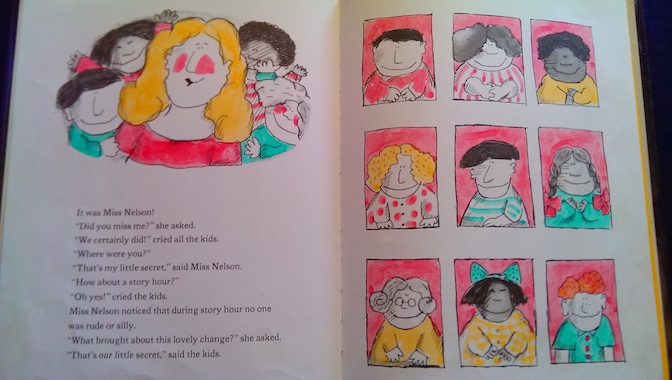
Miss Swamp is so mean that the kids really start to miss nice Miss Nelson. What happened to her? The kids try to find their nice teacher so they can get rid of the mean substitute. They try to go to the police to report her as a missing person and go to her house to see if she’s there, but the only person they can find is Miss Swamp. They imagine all sorts of terrible things that could have happened to Miss Nelson.

Then, just as they’re sure that they’ll never see Miss Nelson again, suddenly she’s back. Miss Nelson never says exactly where she’s been, but the kids are so glad to see her that they behave much better.

NelsonMissingReturn

This is the first book in a series.  It is available to borrow and read for free online through Internet Archive.

My Reaction and Spoilers

The big joke of the book, and all the others in this series, is that Miss Nelson and Miss Swamp are the same person. It’s not much of a spoiler to say that because, even though the story never explicitly says that they are the same person, it’s heavily implied, especially at the end of the book. The fun is that the kids in Miss Nelson’s class never guess, leaving readers to enjoy the joke along with Miss Nelson.

NelsonMissingSecret

Some people like to take advantage of people who are “too nice”, but just because a person prefers to be nice doesn’t mean that they’re weak, stupid, or incapable of being tough when they need to be. Miss Nelson just found a creative way to be as tough and mean as she needed to be to get the kids in her class to behave without ruining her own reputation as a nice person.  “Viola Swamp” will always be there whenever Miss Nelson needs her again … and that leads into the rest of the books in the series.

Ira Sleeps Over

IraSleepsOver

Ira Sleeps Over by Bernard Waber, 1972.

Ira, a young boy, is happy when his friend, Reggie, who lives next door, invites him to sleep over at his house. Then, his sister asks him if he’s going to take his teddy bear with him. At first, Ira says no, but his sister points out that he’s never slept without it.

Ira starts to worry about whether he should take the teddy bear with him or not. He worries that Reggie might laugh at him for having a teddy bear. His parents say that he won’t and that Ira should go ahead and take the bear with him. However, his sister says that Reggie probably will laugh.

IraSleepsOverWorry

Ira tries to talk to Reggie and sound him out on the idea of teddy bears to see if Reggie will laugh, but Reggie ignores Ira’s questions. Reggie is excited about all the things that he and Ira can do at the sleepover and eagerly explains his plans. It all sounds like fun, but Ira gets nervous when Reggie mentions ghost stories.

IraSleepsOverReggie

Ira continues to debate about whether or not he should take his bear with him. Before going over to Reggie’s house, he decides to leave his teddy bear at home.

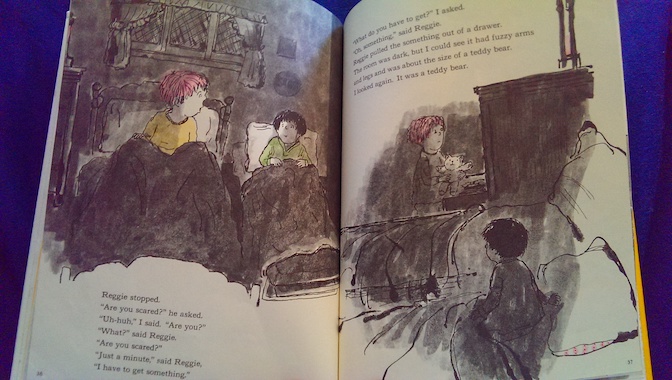
The two boys have a lot of fun playing together at the sleepover. At bedtime, Reggie starts to tell a ghost story, and both of the boys are a little spooked. That’s when Ira discovers that Reggie has a teddy bear of his own.

IraSleepsOverTeddy

The book is currently available online through Internet Archive.

My Reaction

This is a nice story about how the things that we worry other people will find ridiculous or embarrassing are often more common and less embarrassing than we think. At first, Ira worries (because of what his sister said) that Reggie will think that his teddy bear, named Tah Tah, is silly and childish, but after discovering that Reggie has a teddy bear named Foo Foo, Ira realizes that Reggie will understand how he feels about his bear and decides to run home and get it.  Reggie probably dodged Ira’s earlier questions about teddy bears because he was similarly worried about what Ira would think of his bear.  Sometimes, when people really open up to each other and talk honestly about the way they feel, they learn that other people have shared their feelings and experiences more than they might have thought.

Why Mosquitoes Buzz in People’s Ears

Mosquitoes

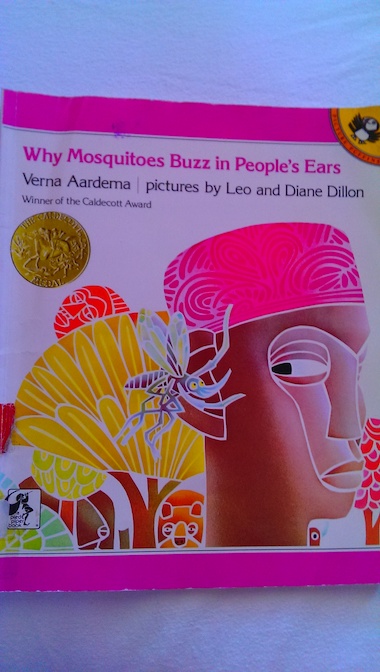
Why Mosquitoes Buzz in People’s Ears retold by Verna Aardema, pictures by Leo and Diane Dillon, 1975.

The story comes from a West African folktale, and all the characters are animals.

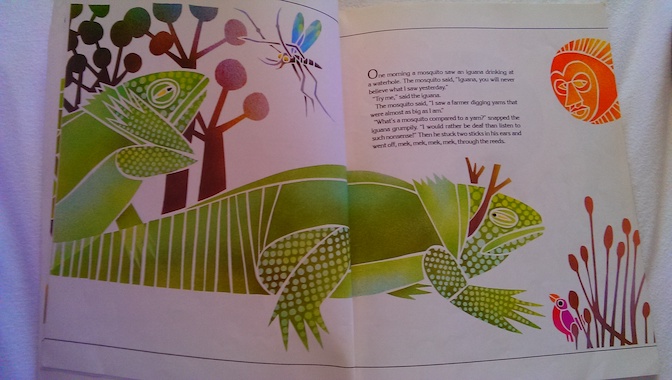
In the beginning, a grumpy iguana gets tired of hearing a mosquito telling tall tales. He sticks a couple of sticks in his ears so that he won’t have to listen anymore, and this decision leads to a series of unfortunate events that leads to the accidental death of a baby owl.

MosquitoesIguana

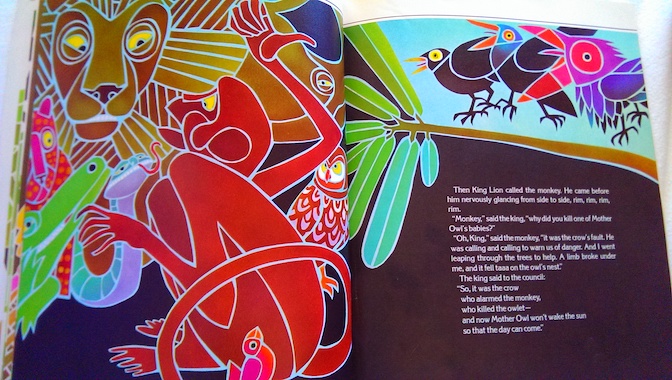
It starts with a snake trying to talk to the iguana, who does not hear him. The snake, thinking that perhaps the iguana is angry with him, goes to hide from him in a rabbit hole, startling the rabbit out. The chain reaction of events continues, with different animals startling each other, until a frightened monkey crashes through a tree branch, which breaks, killing the baby owl.

MosquitoesMonkeyTree

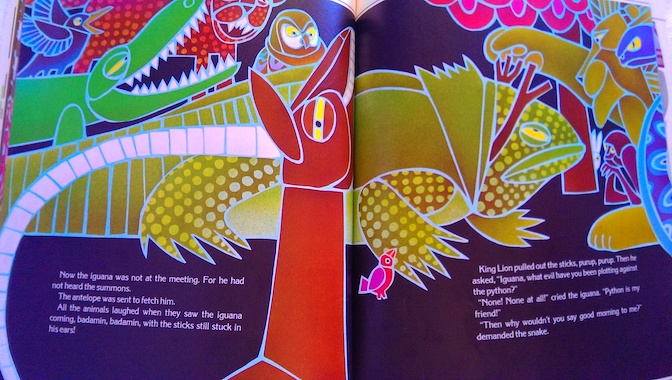
The Mother Owl is so distraught at the death of her baby that she doesn’t wake the sun so that dawn can come, as she usually does. When the other animals realize that dawn isn’t coming, King Lion calls a meeting to determine the reason why. Together, they trace the events backward to the iguana. The iguana is not at the meeting because he still has sticks in his ears and hasn’t heard a thing about it.

MosquitoesMeetingMonkey

When the other animals track down the iguana and take the sticks out of his ears, they demand to know why he wouldn’t talk to the snake. When he tells them that he had sticks in his ears because he couldn’t stand listening to the mosquito’s stories anymore, the mosquito ends up taking the blame for everything. The Mother Owl is satisfied with the explanation and hoots to wake up the sun, although the mosquito escapes punishment by hiding. So, ever since, the mosquito whispers in people’s ears to find out if everyone is still angry.

MosquitoesMeetingIguana

The art style in the book is a little unusual. When I looked at the pictures the first time, I thought of them as looking stenciled. However, there is a note in the beginning of the book, near the copyright information, that says that the pictures are a combination of watercolors and india ink. The artists used an airbrush and pastels, and they created the “cut-out effect” with frisket masks and pieces cut out of vellum.

This book is a Caldecott Award winner. It is currently available online through Internet Archive.

Nate the Great and the Phony Clue

NatePhonyClue

Nate the Great and the Phony Clue by Marjorie Weinman Sharmat, 1977.

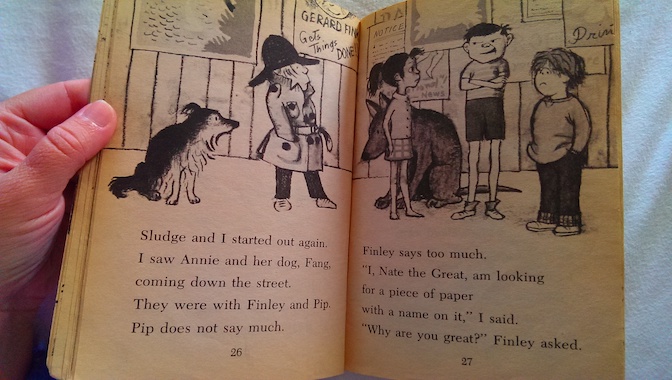
One day, as Nate is coming back from a run with his dog, Sludge, he finds a torn piece of paper on his doorstep that says “VITA.”

NatePhonyClueJog

Realizing that this odd word is actually part of a longer word in a message, he decides to hunt down the rest of it.

Thinking that perhaps Rosamond’s cats may have found the message and torn it, he goes to Rosamond’s house. When he gets there, he sees that more of the message is up in a tree with Big Hex.

Even when Nate gets that piece, it still doesn’t tell him the full story of the message. It seems that someone is inviting Nate to come to their house at three that afternoon, but without a name or address, how will Nate know where to go?

It looks like there’s still one more piece missing from the message, so he begins looking for it. One of the other boys in the neighborhood, Finley, says that he doesn’t think Nate is really as “Great” as he says he is, and he doubts that Nate will find what he’s looking for. When Finley walks away, dropping a piece of paper behind him, Nate thinks that perhaps Finley is giving him a clue.

It turns out that the paper that Finley dropped says “phony clue” on it. However, Finley’s “phony clue” turns out to be the clue that Nate needs to solve the mystery!

NatePhonyClueKids

My Reaction and Spoilers

This test of Nate the Great’s detective skills is actually a test set up by Finley and his friend, Pip, who have a bet about whether or not Nate will put all the pieces together by three o’clock.  I thought that might be the case from the beginning, but I’m not sure whether that’s because the mystery is obvious or if I helf-remembered the solution to the mystery from when I first read the book when I was a kid.

Alexander and the Terrible, Horrible, No Good, Very Bad Day

Alexander

Alexander and the Terrible, Horrible, No Good, Very Bad Day by Judith Viorst, 1972.

Everything is going wrong for Alexander today, from the very moment when he wakes up.  When he wakes up with gum in his hair and trips on his skateboard getting out of bed, he can tell that this isn’t going to be a good day at all.

AlexanderCereal

From getting crammed into the middle seat on the way to school to getting things wrong in class to fights with friends, things just get worse as the day goes on.  He sees other people getting good things and doing things right, but nothing works for him.

AlexanderDay

His bad luck continues all day long, right up to when he goes to bed.  His mother consoles him a little, saying that “some days are like that.”  Alexander threatens to run off to Australia to get away from everything that’s bothering him, but it won’t work because people can have bad days anywhere, even in Australia.

AlexanderDentist

The book doesn’t offer any real tips to avoiding bad days, mostly just sympathy, showing that bad days can happen to anyone, and they usually do at some point.  Sometimes, there’s nothing to be done about it except try to get through the day as best you can and hope that tomorrow will be better.  Readers can sympathize with Alexander because his problems are the kind of problems that everyone has had at some point, from little things like seeing siblings and friends get treats that he can’t share in to things like fights and cavities at the dentist.

AlexanderBedtime

There is a movie based on the book, but, of course, it’s a much longer story.  In the movie, when everything seems to be going wrong for Alexander and no one seems to care, he makes a wish that everyone could experience a day like the one he’s been having.  The next day, everyone in his family has everything going wrong for them.  It’s one chaotic event after another all day, but dealing with their problems together helps bring them closer.  In an odd sort of way, some of the pieces of bad luck end up working out for the best.

This book is the first of a series and was also featured on Reading Rainbow.

The Bassumtyte Treasure

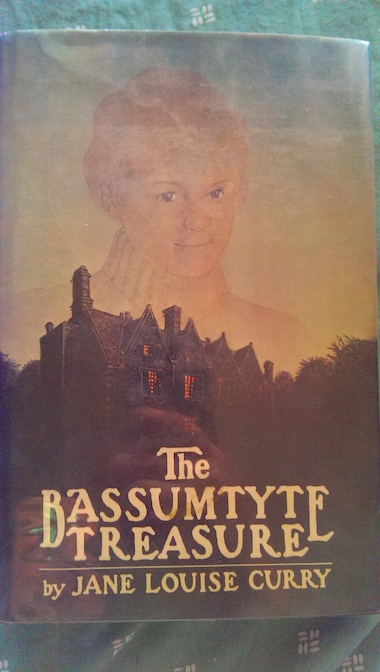
BassumtyteTreasureThe Bassumtyte Treasure by Jane Louise Curry, 1978.
When young Tommy Bassumtyte’s parents died, he went to live with his grandfather. However, his grandfather is now dead, and he is living with his 92-year-old great-aunt, who is in a wheelchair, and her 72-year-old daughter, who has recently had her driver’s license revoked due to her poor eyesight. Although the pair of them have taken good care of Tommy, neighbors have become concerned that they will not be able to do so for much longer because of their age and failing health. Rather than see Tommy sent to a foster home, they decide that he must go to the man who Tommy learns should really be his legal guardian, a distant cousin also named Thomas who lives in the family’s ancestral home, Boxleton House, in England.

The elder Thomas Bassumtyte, who should have taken Tommy when his grandfather passed away, has also since died, but his son, also named Thomas, agrees to take him. Tommy is quickly shipped off to England before there can be a custody hearing in the United States about him because the relatives fear that some official might try to prevent Tommy from being sent out of the country. Tommy is eager to go because he remembers fantastic stories that his grandfather told him about Boxleton House. The current Thomas Bassumtyte also lives there, although the place has become rather run-down, and he fears that he will not be able to keep the place much longer. Thomas was a mountain climber, but he was injured in a fall and hasn’t been able to work much since. He tells Tommy that the two of them might have to move when he is fully recovered and can do more work for the Foreign Office, but Tommy loves Boxleton House from the first moment he sees it and wants to stay.

According to the lore of Boxleton House, a distant ancestor of theirs hid a treasure there, but no one has been able to find it. If young Tommy and Thomas can find it, it would solve many of their problems, and they would be able to keep the house and restore it. All young Tommy has is the mysterious rhyme that his grandfather told him and the strange medallion that his great-grandfather brought with him when he went to the United States in the late 1800s. Thomas tells him that the treasure was supposedly hidden by a distant ancestor of theirs who was fond of riddles, called Old Thomas.

The Bassumtytes were secretly Catholic during the reign of Elizabeth I. Old Thomas was alive then and had a son called Tall Thomas. Tall Thomas traveled frequently and was mysterious about the places he went. One night, he returned to Boxleton House with a young baby, who he said was his son. He had married in secret, and his young wife had died shortly after giving birth. Tall Thomas also brought her body back to Boxleton for burial. However, that wasn’t Tall Thomas’s only secret. Although he remarried, giving his son a stepmother, and lived on for a number of years, he was eventually executed for smuggling messages for the captive Catholic queen, Mary, Queen of Scots. The family was stripped of its noble title and only barely managed to hang onto their house and land. If there was a treasure hidden during this time, it was probably something that the Bassumtytes were afraid would be confiscated by the queen’s soldiers as punishment for the family’s disloyalty or something that Mary had given to Tall Thomas to hide for her.

As Thomas tells Tommy more about the house and the family’s history, he points out Tommy’s uncanny resemblance to Small Thomas, Tall Thomas’s son, as shown in an old painting. Tommy feels a strange connection to Small Thomas, and begins seeing and hearing strange things. An older woman comforts him in the middle of the night, having him recite the same rhyme that his grandfather taught him. A small painting later reveals that this woman was Small Thomas’s grandmother. She appears to Tommy other times, giving him a glimpse back in time and clues to solve the puzzles of Boxleton House.

It is only when Thomas accepts the advice of a family friend who works for a museum that they come to understand the full significance of their family’s heirlooms and the hidden treasure. The treasure may not be quite what the Bassumtytes have always believed it was, but then, the Bassumtytes themselves aren’t quite who they always thought they were, either.

The book is available to borrow and read for free online through Internet Archive.

Good Work, Amelia Bedelia

Good Work Amelia Bedelia

Good Work, Amelia Bedelia by Peggy Parish, 1976.

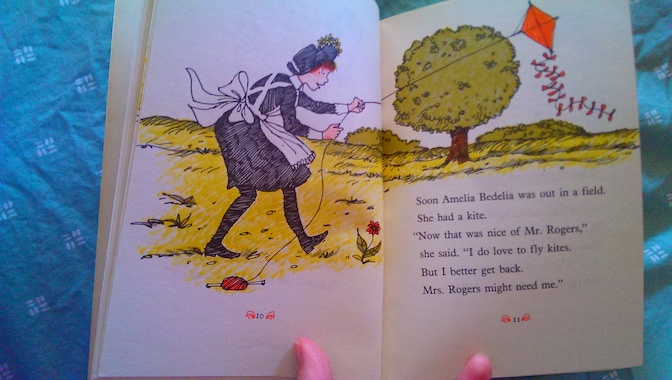
Amelia Bedelia works as a maid/housekeeper for Mr. and Mrs. Rogers. They like her, but they have to be extremely careful about the orders and instructions that they give her because Amelia Bedelia takes everything literally. For example, when Mr. Rogers asks her for toast and an egg for breakfast, she gives him a raw egg straight out of the refrigerator because he never told her to cook it. Telling her to “go fly a kite” is also pointless because she’ll simply go to the park and do it.

Good Work Amelia Bedelia Fly a Kite

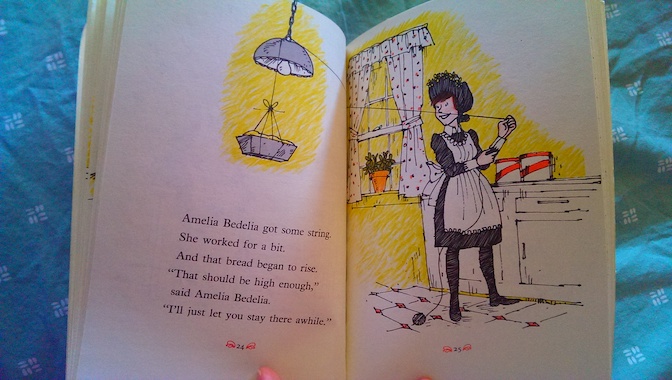
Possibly the most dangerous thing Mr. and Mrs. Rogers can do is leave Amelia Bedelia alone in the house with a “to do” list. Unsupervised, she reads each item on the list and does her best to obey all of the instructions to the letter. From putting plants in pots from the kitchen to making sure that the bread rises by hanging it from a string to making a “sponge cake” that includes actual sponge, Amelia Bedelia muddles her way through, getting everything wrong while still being technically correct.

Good Work Amelia Bedelia Bread Rises

Good Work Amelia Bedelia Sponge Cake

So, why do Mr. and Mrs. Rogers put up with her? Well, for one thing, she makes a terrific butterscotch cake.

The book is currently available online through Internet Archive.

Good Work Amelia Bedelia Butterscotch Cake.jpg

Strega Nona

StregaNona

Strega Nona by Tomie dePaola, 1975.

Strega Nona is a witch who lives in a small town and uses her magic to help people in various ways, everything from small cures or love potions.  However, she runs into problems when she hires Big Anthony to help her around her house.  Big Anthony is helpful, but he doesn’t always pay attention or follow orders.

StregaNonaAnthonyPot
Strega Nona has a magical pot that makes pasta.  To get it to make a never-ending pot full of pasta, she recites a certain rhyme.  To get it to stop making pasta, she recites a different rhyme and blows three kisses to it.

Big Anthony is forbidden to use the pasta pot himself, but he can’t resist telling people in town about it.  At first, no one believes him because it sounds so strange.  Everything thinks he’s just making it up.  Big Anthony is offended that no one believes him, so one day, while Strega Nona is gone, he sets out to prove to everyone that this magical pot exists.

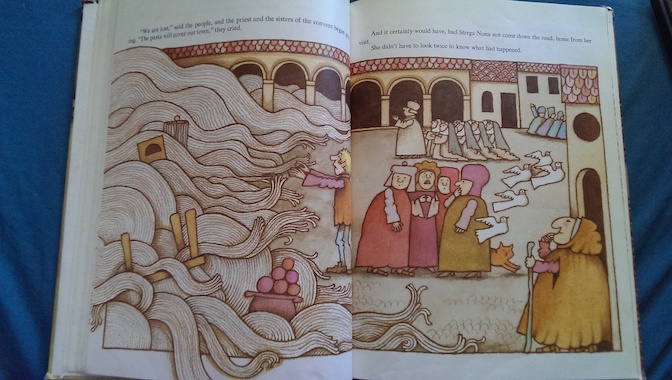
Big Anthony knows the rhyme to get the pot to start making pasta, and he uses it to make pasta for everyone in town so they will know that he was telling the truth.  Unfortunately, he doesn’t really know how to get it to stop because he didn’t know that Strega Nona blows kisses to the pot.  With the pot now sending a massive river of pasta through the town, what can Big Anthony do?

This is a Caldecott Honor Book.  It is currently available online through Internet Archive.

StregaNonaPastaRiver