Pirate Island Adventure

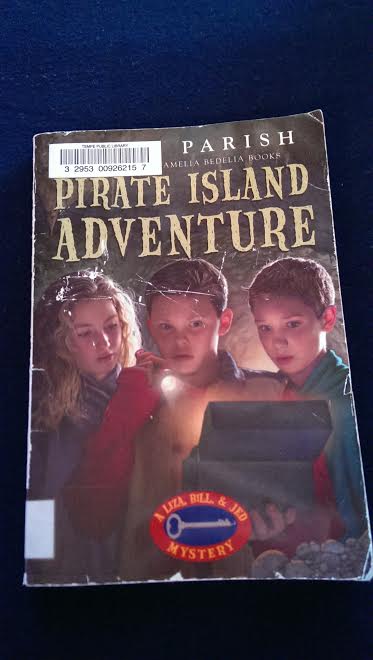
pirateislandPirate Island Adventure by Peggy Parish, 1975.

The Roberts kids must solve another family treasure hunt! This time, they are staying with their grandparents at the family’s vacation home on Pirate Island. It has been many years since the family has been able to go there during the summer. For years, they rented the house out to a couple who lived there most of the time, and the grandparents could only go there when the couple left to visit relatives at Christmas. Now, the house is vacant again, and the grandparents have decided to take the Liza, Bill, and Jed there for the summer.

The last time that their grandfather spent the summer there as a child, his older brother decided to take something from every member of the family and make a treasure hunt just like the old family treasure hunt that the kids solved in Key to the Treasure. Just like that treasure hunt, other circumstances arose that kept the treasure hunt from being solved, so no one ever got back what grandfather’s brother hid. The only clue they have to the treasure now is a picture that grandfather’s brother drew. Since the children were able to solve the last treasure hunt, their grandfather is hopeful that they will be able to solve this one, too.

Unlike other treasure hunts that the Roberts kids solve, this treasure hunt does not involve codes and word games.  The clues are given in the form of drawings, most of which (unfortunately) are not shown to the readers.  The readers wouldn’t have a chance to solve the puzzles anyway because the objects in the drawings are things which the children’s grandfather has to recognize, places where he and his brother went as kids.  This book also introduces Hermit Dan, who appears in another book.

This book is part of the Liza, Bill, and Jed Mysteries series.

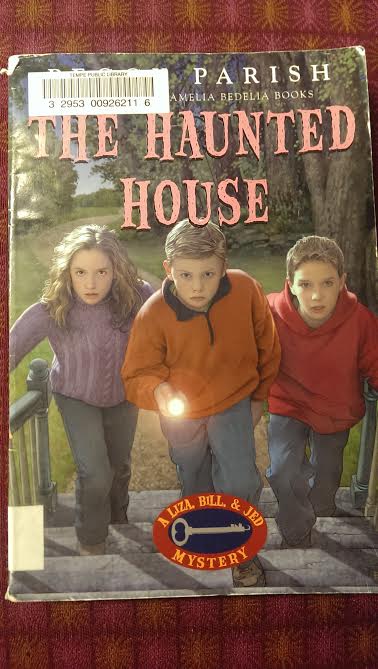
The Haunted House

hauntedhouseThe Haunted House by Peggy Parish, 1971.

The Roberts family is moving to a different house across town because they want a bigger place to live. Liza, Bill, and Jed are not very happy about moving, at least at first, because they will be farther away from their friends, especially Jimmy and Mary, who have been their best friends and next door neighbors. Liza is also worried because the house they will be living in is the old Blake house, which is rumored to be haunted. A couple of past caretakers have left because they claimed to hear ghostly noises.  The boys tease her about it, and their father insists that there is no such thing as ghosts.

The house is definitely much bigger than their old one, and there is a barn, a garden, and a large wooded area on the property. When they actually move in, the kids become fascinated with the old things in the attic, which the children are allowed to go through.  The kids also plan to start building a tree house.  The boys become excited about the house, but Liza is still nervous about the ghost stories.

Then, strange notes and coded messages appear for the children, starting with a note taped to Liza’s window in the middle of the night. Little presents are left for them in a hollow tree with promises of bigger surprises later. Who is sending these messages? Could it be the ghost?

Like other books in this series, there are coded messages and word games that the readers can solve alongside the children.  Some of them are easily recognizable, like word scrambles and Pig Latin, and others are a little harder.  The kids walk readers through their solutions, but readers can attempt the puzzles on their own first.

The book is available to borrow and read for free online through Internet Archive.

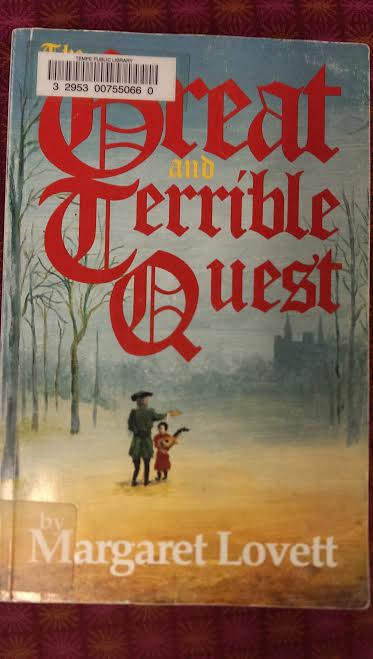
The Great and Terrible Quest

greatterriblequestThe Great and Terrible Quest by Margaret Lovett, 1970.
This story takes place in a fictional kingdom during the Middle Ages. Trad is a ten-year-old boy who has lived most of his life with his abusive grandfather. He barely remembers his parents, who died in a plague when he was only four. This grandfather consorts with robbers and evil men. Trad often pretends to be stupid to avoid their notice and warns travelers away from their territory.

One day, he rescues a man who has been badly wounded and cares for him in a secret cave. This man, whose white hair makes him seem elderly, insists that he is on a mission, a great and terrible quest . . . but because of a head wound, he can’t remember what his quest is. All that he knows is that time is short, and he does not have long to complete his quest to find something very important.

Trad soon learns that his grandfather’s wicked friends are the ones who attacked this mysterious stranger. Taking Trad’s father’s old lute, a couple of coins, and a mysterious ring dropped by one of the robbers which seems to have once belonged to the stranger, Trad and the stranger embark on a journey across the land, making friends and pursued by enemies as they go. While the stranger struggles to remember his identity and the nature of his mission, Trad begins to learn a few things about his own forgotten past and the nature of his family. Nothing is what it seems. Their country is in trouble because of the evil men who have been controlling it. Everything depends on the success of the stranger’s mission, and Trad has a much larger role to play than he had ever dreamed.

It’s a beautiful and fascinating story about good and evil, loyalty, friendship, and determination to do the right thing, even against the odds. There are parts that might frighten younger readers. The fights are violent and bloody, and there are a couple instances of cruelty to animals (partly, it seems, to show how truly evil Trad’s enemies are). Still, it’s a great story for tweens and teens, and readers will want to cheer Trad on as he struggles to help those around him and find his own destiny.

Although the kingdom is fictional and the themes are similar to fantasy stories, there is no actual magic in the story.

The book is currently available online through Internet Archive.

The Best Christmas Pageant Ever

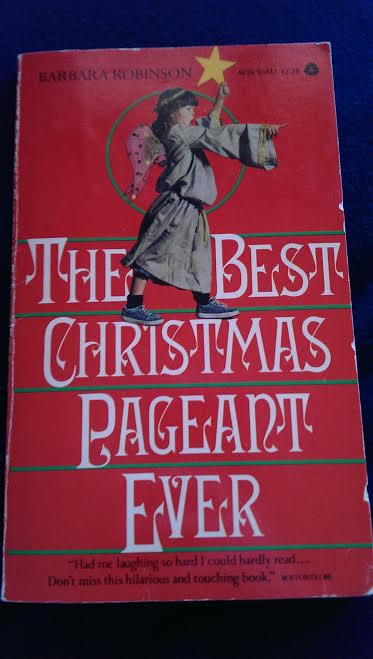
christmaspageantThe Best Christmas Pageant Ever by Barbara Robinson, 1972.
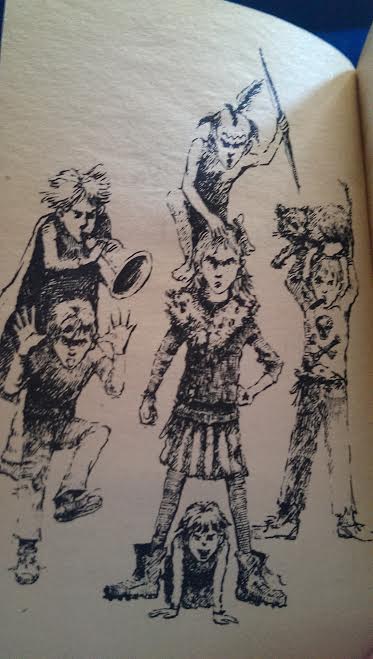
The Herdmans are the meanest, toughest kids in town.  They lie, cheat, steal, and when the mood strikes them, set things on fire.  Their father deserted the family, and their mother works all the time, so the six Herdman kids are pretty much left to their own devices, giving them plenty of opportunity to cause trouble.  Certainly, no one ever made the Herdman kids go to Sunday school.

But, to everyone’s surprise, the Herdmans suddenly show up at Sunday school in time to get cast for the annual Christmas pageant.  It wasn’t because the Herdmans suddenly found religion.  They were mostly there because they heard that there would be snacks.  Charlie told them so when they stole the dessert from his lunch at school.  In reality, Charlie exaggerated the snacks just to get back at the Herdmans.

christmaspageantpic1Although the Herdmans don’t get the cake Charlie mentioned and have little interest in Jesus, they begin to be fascinated by the description of the pageant and decide to stick around.  The Herdmans love movies, and the idea of being in any kind of play strikes them as fun.  Although the Christmas pageant basically goes the same way every year, typically using the same kids for the same parts, once the Herdmans make up their minds that they want the starring roles, they manage to push and bully their way right into the center of everything.
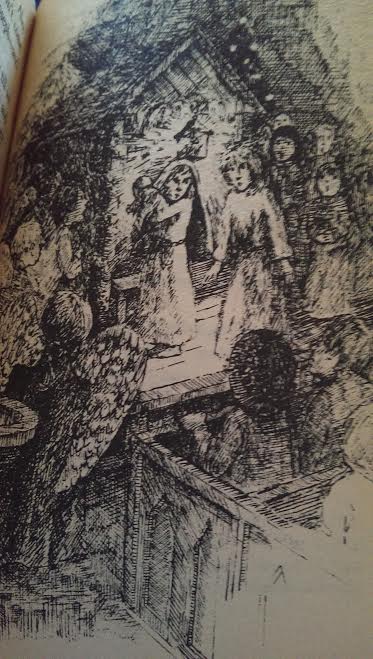
All of the other kids in Sunday school already know the story of Christmas and how the pageant usually goes, and they’re usually bored with the whole thing, but this year, the Herdmans make the pageant so unpredictable that even the kids the Herdmans tend to pick on find it fascinating.  The Herdmans are only hearing the story of Christmas for the first time as they assume their new roles of Mary, Joseph, the three wise men, and the angel.  Because they aren’t as familiar with the story and the routine of the pageant, they end up adding their own little twists to their performance.

christmaspageantpic2At first, the more conservative adults in the church are horrified at the prospect of what the wild Herdmans might do on Christmas itself, but the minister and the lady overseeing the pageant decide to give the Herdmans a chance.  As the title says, it ends up being The Best Christmas Pageant Ever as the Herdmans unexpectedly bring out parts of the Christmas story that the other people who had taken the story for granted hadn’t really thought about much: the simple human reactions of a poor young couple who were strangers in a new town, the fear and expectation that accompany doing something great but unfamiliar and confusing, and the sense of wonder and surprise that are at the heart of the Christmas season.
Parts of the book are laugh-out-loud funny, and parts are actually touching.  While the awful Herdman kids stumble their way through the Christmas pageant, changing things, is it possible that the play is also changing them?

This is the first book in a short series about the Herdmans.  It is available to borrow and read for free online through Internet Archive (multiple copies).  There is also a movie version of the book.  Sometimes, you can find it on YouTube.

This Can’t Be Happening At MacDonald Hall

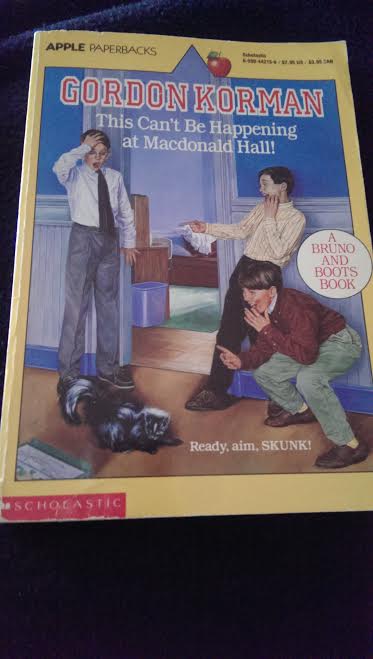
macdonaldhallThis Can’t Be Happening at MacDonald Hall by Gordon Korman, 1978.
Bruno and Melvin (called Boots) have been roommates ever since they began attending boarding school at MacDonald Hall.  The two of them are best friends, and they do everything together.  Quite a lot of what they do involves practical jokes.  But, they’ve really been pushing the limit with their antics, and when they go a little too far during a hockey game, the headmaster gives them the ultimate punishment: they can no longer share a room.  Mr. Sturgeon thinks that they’re a bad influence on each other.  Each of them is assigned to a new roommate, and they won’t even be able to hang out together.

The prospect of losing each other as best friends is too much for Bruno and Boots. Besides, neither of them likes their new roommates.  Boots has to share a room with George, who comes from a wealthy family and is only interested in money.  George is also a germophobe who hates it that Boots sneezes every morning when he wakes up.  Bruno’s new roommate is Elmer, the school’s supreme science nerd.  Elmer isn’t happy about Bruno’s presence, either, because Bruno and his belongings take up valuable space that Elmer requires for his many projects.  Obviously, the situation is completely intolerable for everyone.

Bruno, the idea man of the duo, declares that he will find a way for him and Boots to become roommates again.  They meet secretly at night to discuss their plans.  The boys try every tactic they can think of.  They try making themselves completely obnoxious to their new roommates so that Mr. Sturgeon will have pity on them and give them their old room assignments.  They try framing George and Elmer for some outrageous pranks of their own so Mr. Sturgeon will think that they’re a bad influence on Bruno and Boots.  Bruno and Boots even try (as an extreme measure) behaving themselves!  What will finally work?

This is the first book in the MacDonald Hall Series (or Bruno and Boots) series.  It is currently available online through Internet Archive.

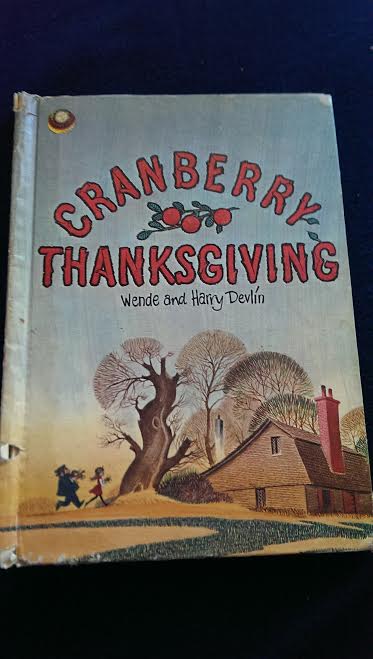
Cranberry Thanksgiving

cranberrythanksgivingCranberry Thanksgiving by Wende and Harry Devlin, 1971.

Maggie and her grandmother like to invite friends to spend Thanksgiving with them.  Grandmother always tells Maggie to invite someone who doesn’t have anyone else to spend the holiday with.  This year, Grandmother has invited Mr. Horace, a pleasant man with an elegant manner staying at the local hotel.  Maggie has invited Mr. Whiskers, a friendly but somewhat scruffy sailor who has been on his own for years.

Grandmother has never really approved of Maggie’s friendship with Mr. Whiskers (whose real name is Uriah Peabody, but is called Mr. Whiskers because of his long, busy beard).  Mr. Whiskers’s unkempt appearance and lack of refinement have always bothered her.  She also suspects Mr. Whiskers of wanting to steal the secret recipe for her famous cranberry bread because he often shows up when she’s making it.  Some people have offered her a great deal of money for her recipe, but she insists that it’s a family secret that she’s leaving to Maggie.  Still, Mr. Whiskers has been a good friend to Maggie, so she allows him to come to Thanksgiving dinner.

As it happens, someone is out to steal Grandmother’s recipe, but not the person that she suspects.  It’s a nice holiday story about how appearances can be deceptive and real friendship is shown through honest behavior.

This book is part of a series, and like all the other books in the series, there is a recipe in the back.  The recipe in this book is for Grandmother’s Famous Cranberry Bread.

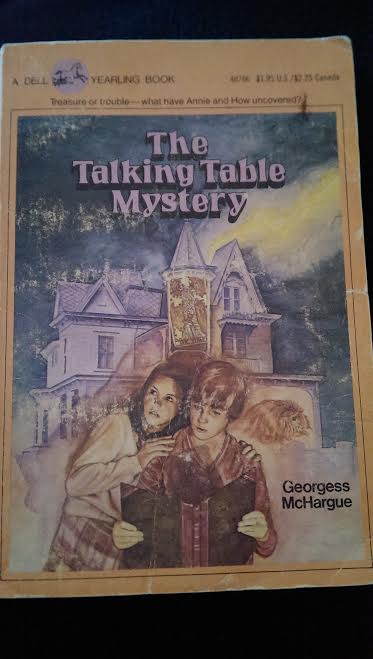
The Talking Table Mystery

TalkingTableThe Talking Table Mystery by Georgess McHargue, 1977.
Annie Conway and her friend How are helping her great aunt to clear out her basement when they find a table that How thinks would work for his pet guinea pig’s cage. However, it’s not an ordinary table. It makes strange noises whenever they press on it, and in the box tied to the top of the table, they find a strange assortment of objects, including a little silver piccolo and some diaries.

Most of the diaries belong to Annie’s great grandfather, but there is one written by an unknown young girl. The girl apparently stayed in Annie’s great grandfather’s house years ago, and her diary refers to the girl’s mother’s strange behavior and the girl’s fears that something bad will happen. The diary itself is mysterious, but soon the kids start receiving threatening notes, telling them to hand over the diaries or something bad will happen. Who wants the diaries and why?

The book is available to borrow and read for free online through Internet Archive.

My Reaction and Spoilers

The basis for the mystery is 19th century spiritualism.  The former owner of the table was a spiritualist who used it for seances, creating rapping noises when the “spirits” were present.  Her daughter was the girl who wrote the diary.  She wasn’t happy about how she and mother kept moving around in search of new clients and how she had to help her mother by playing ghost during seances. They were staying with Annie’s great-grandfather because he was suffering from grief over the death of his young son, and the spiritualist was holding seances to try to contact his spirit.  At least, that’s what Annie’s great-grandfather thought.  The bad thing that the girl thought would happen was that she and her mother would be caught faking their seances, which turns out to be exactly what happened.  Annie’s great-grandfather was angry at being deceived and threw them out of the house, but he confiscated the rigged table and other things they used in their seances, including the girl’s beloved silver piccolo, so they wouldn’t be able to try their act on anyone else.

However, there is one more secret about Annie’s great-grandfather and the spiritualist. Annie and How eventually discover that they had a love affair during the spiritualist’s stay in the house. There is some discussion among the adults about how the spiritualist suffered more consequences and stigma for the affair than the great-grandfather did, although he was a married man when it happened.  As for what eventually happened to the girl and her mother after this incident, the clues are contained in the diary and with the people who now want them.

I thought that the use of the rigged spiritualist table in the story was fascinating. It’s basically like a piece of antique magician’s equipment that not everyone would know existed.  The story also introduces some interesting historical details about the concept of 19th century spiritualism and the types of people who followed it.  Annie’s great-grandfather was grieving for the loss of one of his young children, and like others of his time, he wanted to reach out to the spirit of the one he lost, in search of solace for the loss.  How much of the affair with the spiritualist was fueled by his grief and gratitude for someone he thought was helping him is unknown because we never hear his perspective on that, but his anger at discovering how he had been deceived shows that he did honestly believe that the seances were real and felt betrayed to realize they weren’t.  However, actions have consequences, and there were still some consequences from this incident that were never fully resolved.

The author is very knowledgeable on the subject of spiritualism, and she also wrote a nonfiction book on the subject.

The Mystery at Fire Island

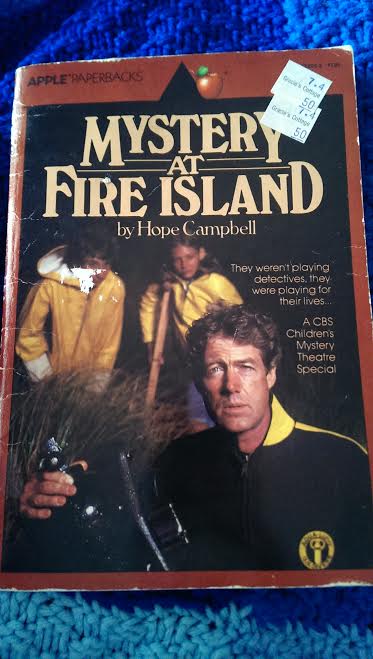
mysteryfireislandThe Mystery at Fire Island by Hope Campbell, 1978.

Darcy Littlewood, called “Dash,” is appalled when her art teacher tells her not to draw anything over the summer.  Drawing comes almost as naturally as breathing to Dash, who wants to be a cartoonist when she grows up.  She’s always doing sketches and caricatures of people she sees, especially her younger brother, JC (James Colson Littlewood, also known as “Coleslaw”).  But, her art teacher thinks that her style has grown too strong and inflexible too early in her life.  He thinks that if she takes a break from drawing for the summer, she’ll be able to come back to it with a fresh approach that will allow her to try different styles as she grows older.

To Dash, the idea of not drawing at all is intolerable, especially since she broke her leg shortly before the start of summer vacation.  She can’t go much of anywhere or do much of anything while her family is staying at their beach house on Fire Island.  Without much to do, she doesn’t know how she’d entertain herself if she couldn’t draw.

Her older sister, Candace, isn’t happy about spending the summer on Fire Island, either.  She says that there’s never anything to do there, although their mother attributes part of her boredom to the fact that she’s the only one in the family who doesn’t have an outstanding talent or a particular goal in her life.  Everyone else in the family is artistically-inclined in some way.  Mrs. Littlewood is a writer, Mr. Littlewood teaches drama, JC has acting skills and a special talent for imitating people, and Dash has her art.  Mrs. Littlewood thinks that Candy’s attitude would improve if she found something that she was especially good at and truly cared about.

While Dash is brooding about her inability to stop drawing in spite of her art teacher’s request, she makes the acquaintance of Mrs. Guizot, an eccentric older woman who spots her drawing caricatures.  It turns out that Mrs. Guizot is an art lover, and she quickly becomes a fan of Dash’s work.  But, there is something mysterious about Mrs. Guizot, or at least the man they see her talking to.

Both Dash and JC notice that the man has a peculiar way of standing and walking.  Dash draws it, and JC imitates it.  So, when they see the same man on the beach later that night, looking different without his beard and wig, but still walking and standing the same way, they wonder why the man was in disguise.  Also, he seems to be going out surfing when there aren’t any waves for surfing.  Then, they discover that he’s bringing scuba tanks with him, and they aren’t real scuba tanks.  What is the man doing?

The kids try to investigate the mysterious man with JC doing much of the leg work at first because Dash can’t get around very well.  JC is worried about what they might learn because the man might turn out to be truly sinister and violent.  He even has suspicions about Mrs. Guizot.  Later, Dash’s leg improves and she’s able to take a more active role in the investigation, but the kids pretend like she’s still laid up as a cover for their activities.  The kids’ investigation doesn’t go as planned, but they do uncover a crime and also inadvertently help their sister to find her life’s vocation.

Part of the story has to do with seeing with depth.  Part of the reason why Dash’s art teacher wants her to observe more and draw less is so that her art will contain more depth.  Dash also learns to see the depths of people, the things they keep hidden behind their facades.  Her sister, Candy, also has hidden depths which even she doesn’t appreciate yet.

The story was later made into a tv movie by the same name, and the picture on the front cover of this edition of the book is from the movie.

The Treasure of Kilvarra

TreasureKilvarraThe Treasure of Kilvarra by Elizabeth Baldwin Hazelton, 1974.

Christie and Kevin MacAlistaire go to Ireland with their mother to visit a family friend, Padraic O’Flaherty, and their visit turns into a terrifying treasure hunt!  Christie is fascinated by the gypsies living nearby and asks to visit them.  It’s her birthday, and the oldest gypsy, Sorcha, tells her fortune.  She says that Christie is fated to discover a treasure during her visit to Ireland, but there will be great danger involved, and she will need her brother to protect her.  Sorcha also gives Christie an amulet filled with holy ashes to help keep her safe.

Christie is eager to find the treasure Sorcha spoke of, although she doesn’t know what kind of treasure she is supposed to find or what kind of danger she will face along the way.  Their new friends tell them the history of the region with stories of ancient kings, fairy folk, and haunted castles.  Christie and Kevin visit some of these supposedly haunted ruins with their new friend Colum (a gypsy boy) and his pet crow, Ben.  Colum tells them the history of the castle ruins and the legends associated with it, and they discover that Christie has the ability to see and hear things that the boys can’t: spirits of the past.  Unfortunately, Ben is fascinated by Christie’s amulet and takes it, losing it in a nearby river.

KilvarraWithout the amulet to protect her, Christie continues her search for the treasure.  An accidental injury takes her to the place where it is hidden, but it’s a dangerous place.  Caught in a terrible storm, the children explore an ancient stone tower.  There, Christie sees the ghost of a long-dead monk, gesturing to her, begging her to follow him to the treasure that she seeks.  The monk died protecting it, and it’s a very unexpected but wonderful treasure indeed.  But, getting out of the place is going to be even more dangerous than getting in.
The book is currently available online through Internet Archive.

This is actually the second book in a series about Christie MacAlistaire and her brother Kevin.  Unfortunately, I don’t have the first one and haven’t read it.  I do know that the first book in the series is called The Haunted Cove.  Christie and Kevin spend the summer in a cottage by the sea in Oregon, where they investigate a cove haunted by the ghosts of sailors and a woman who may be a witch.

All The Children Were Sent Away

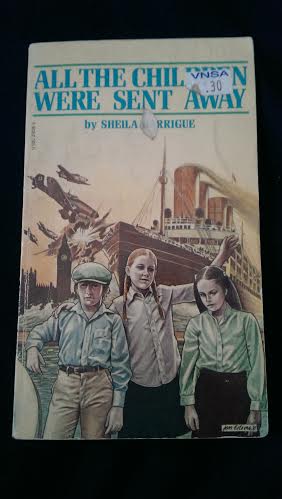
It’s 1940, and Sara Warren’s parents are sending her to stay with her uncle in Canada until the war is over.  With the increasing bombings of England, her parents have decided that it’s just too dangerous for Sara to stay, and her uncle has written, asking them to send her.  Many other British families are sending their children away to escape the bombings, and Sara travels to Canada on a ship with other British child evacuees.  All of them are worried about the families they’ve left behind and what it’s going to be like, living in another country.  They also worry about whether or not they’re ever coming back.

Sara’s escort for the trip is Lady Drume.  She is a bossy, over-bearing woman with very definite ideas about how children should be raised.  She doesn’t like Sara to talk to the sailors on the ship because they can be “impertinent,” and she doesn’t want her to play with the other children because they’re “guttersnipes!”  She even refuses to attend the lifeboat meeting or let Sara go without her!  To Sara’s mind, Lady Drume is as bad as any Nazi.

Sarah still manages to make friends with some Cockney children, Ernie and Maggie, seeing them whenever she can get away from Lady Drume, and an old sailor called Sparky makes sure that she understands safety on board the ship and attends the lifeboat drills.

But, when Lady Drume forces Sara to cut her hair after she’s been waiting so long for it to grow out, Sara decides that’s the last straw!  With the help of her friends, Sara hides from Lady Drume on the ship.  In the process, she learns something about Lady Drume which changes some things for the better, although it takes an outbreak of measles for Lady Drume to really understand and appreciate Sara.

This book is available to borrow and read for free online through Internet Archive.

Part of trouble with Lady Drume and her behavior is that she’s actually very afraid.  She doesn’t like to talk about lifeboats or life jackets because the war and the possibility of sinking frighten her.  She deals with problems by being brusque and trying to ignore frightening things, charging on ahead with whatever seems like a practical course of action to her.  It’s not even just the war but the changing world around her that frightens Lady Drume, a woman who’s used to knowing who’s who and what’s what and getting things done the way she likes them.  But, the rigors of their journey and their mutual vulnerability when they’re sick help lower Lady Drume’s barriers.  Lady Drume isn’t a bad person, and in the end, she arranges a special surprise for Sara to make her exile from England more bearable.

The end of the story is a brief section explaining Sara’s return to England, having been away for a few years, and her feelings at seeing how England and her parents have changed during that time.

There is a sequel to this book that shows what happened during Sara’s time in Canada called The Eternal Spring of Mr. Ito.  It focuses on suspicion of Japanese people following the bombing of Pearl Harbor.  There were Japanese internment camps in Canada as well as the United States during World War II.

Sheila Garrigue’s books about child evacuees from England were partly based on her own experiences as a child evacuee during World War II, as explained in her obituary after her death in 2001.