Frankenstein Moved In on the Fourth Floor by Elizabeth Levy, illustrated by Mordicai Gerstein, 1979.
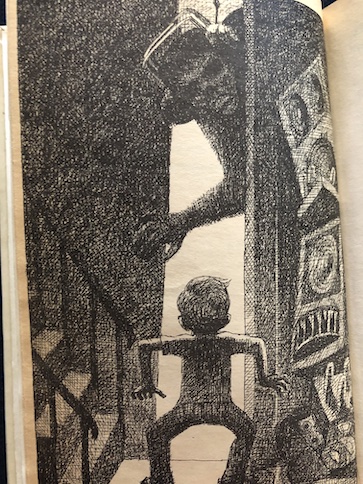
Sam lives with his brother and mother on the 19th floor of a large apartment building. One day, when he and his mother are going to meet his brother at a friend’s house, they try to take the elevator down to the ground floor, but it doesn’t seem to be working. With no other choice, they take the stairs, and when they reach the fourth floor, they discover the reason why the elevator isn’t working.
A new neighbor, Mr. Frank, is moving into the apartment building, and he’s stopped the elevator at his floor to unload all of his stuff. He has boxes and boxes of wires and other electronic components, and he gets really upset when anybody else touches them. He has refused all offers of help to unload the boxes, he’s kept the elevator tied up, and he’s been rude to his new neighbors about these things.
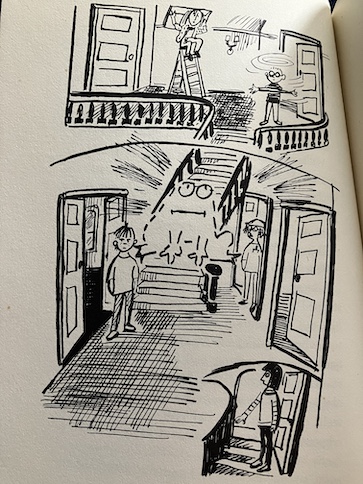
Sam thinks that Mr. Frank is frightening. He looks weird with those strange headphones with an antenna he keeps wearing. When he and his mother go to pick up his brother, Robert, Sam tells him about Mr. Frank and his theory that Mr. Frank is actually a monster. Sam thinks that Mr. Frank looks like Frankenstein. Both of the boys are into movie monsters, but Robert thinks at first that Sam is making it up. The boys have a debate about whether Mr. Frank would actually be Frankenstein the scientist or the monster that Frankenstein created in the book and movie because, although many people call the monster Frankenstein, that was actually the name of the monster’s creator. When the boys consult an abridged version of Frankenstein, Sam becomes convinced that the book’s description of Frankenstein the scientist sounds like Mr. Frank.
The next day, the boys go down to the apartment house’s basement, where tenants have storage rooms. Sam wants to see what Mr. Frank is storing in his storage room, but when the boys start talking about the possibility that he might keep bodies in there, they chicken out. In the meantime, Mr. Frank gets on everyone’s nerves at the apartment house. He’s always bringing in new boxes of stuff and leaving empty ones around. Neighbors hear weird noises coming from his apartment that sound like moans and groans. Mr. Frank claims that the noises are his music. Then, he overloads the electrical circuits in his apartment and causes the entire building to black out. Nobody knows what he’s doing with all that electrical equipment of his. Mr. Frank’s weird electrical experiments make Robert think maybe Sam was right about Mr. Frank being Frankenstein.
The boys decide that it’s important for them to take a look in Mr. Frank’s storage room, but when Robert accidentally leaves his Dracula doll behind, they realize that Mr. Frank will find out that they’ve been snooping. They may have to face the wrath of Frankenstein!
The book is available to borrow and read for free online through Internet Archive (multiple copies). There is a sequel to this book called Dracula is a Pain in the Neck.
My Reaction and Spoilers
This story is a kind of mystery story because the boys are trying to figure out if Mr. Frank is actually Frankenstein and if he’s making monsters with his electrical experiments. However, it really reminds me of the The Adventures of the Bailey School Kids, a series about kids who suspect various people in their town of being different supernatural creators. This book is older than that series, and from the way the story goes, there are more logical explanations for Mr. Frank’s behavior. However, like with The Adventures of the Bailey School Kids, the kids don’t really get firm answers at the end. It looks like Mr. Frank is probably just some weird, temperamental musician who likes to experiment with electronics, but the story leaves it open to interpretation.
#23 The Mystery of the Invisible Dog by M. V. Carey, 1975.
Shortly after Christmas, a frightened man, Fenton Prentiss, calls the Three Investigators to his apartment to help him. Mr. Prentiss is an elderly art collector, and he says that he is being haunted. Things in his apartment get moved around when he’s not there, and he can tell that someone has been reading the mail in his desk. Sometimes, he even sees a shadowy figure when he is home, although he’s never gotten a good look at it before it disappears. He swears that it can’t be another person because he’s the only one who has a key to his apartment. He is also sure that there are no secret passages in his apartment building and that there’s no way for any living person to enter his apartment without being seen by someone. Mr. Prentiss could just be imagining the haunting, but Jupiter is intrigued, and if the boys don’t have a mystery to work on during the holidays, they know that Jupiter’s aunt will just assign them a bunch of chores.
They tell Mr. Prentiss that they need to talk over the assignment together before they accept his job, but Jupiter’s mind is made up when he also sees a shadowy figure that he initially mistakes for Pete just before they leave the apartment. However, Pete is not in the room where Jupiter saw the shadow. Did Jupiter just see Mr. Prentiss’s mysterious ghost?
When the boys get outside the apartment, they hear a loud bang and running feet and see a man in a ski mask running away. Pete tries to follow, and the police stop him, thinking that he might have something to do with a burglary that has just taken place. Fortunately, Mr. Prentiss speaks up for Pete, saying that the boys only just left his apartment and couldn’t have anything to do with what the police are talking about. The police think that the suspect who ran away could have gone into a nearby church, but he seems to have vanished. Mr. Earl, the janitor and caretaker of the church swears that he was in the church the whole time and no one came in, although the housekeeper at the rectory, Mrs. O’Riley, says that Mr. Earl is practically deaf and wouldn’t have heard anybody.
The place that was burgled turns out to belong to a deceased artist friend of Mr. Prentiss. His friend’s death is part of the reason why Mr. Prentiss is so on edge because it was very upsetting to him. The artist’s brother, Charles, hadn’t finished clearing out his brother’s house when it was robbed. He tells the boys that his brother was a sculptor, and his best piece was based on a legend of a ghostly, demonic hound from Eastern Europe. This is the sculpture that was stolen. It’s a bitter blow to Mr. Prentiss because the artist made this sculpture especially for him.
Jupiter believes Mr. Prentiss that someone has been sneaking into his apartment, so he sets a trap that will cause the intruder’s hands to be stained. Mr. Prentiss leaves for a while with the boys, and when they return, his nosy landlady’s hands are stained, indicating that she has been the intruder. Mr. Prentiss confronts her, and she admits that she had a spare key made for his door. The landlady has a long-term habit of spying on her tenants. Mr. Prentiss confiscates her spare key and thinks that his problem is over, but really, it’s just beginning.
Having seen the shadow in Mr. Prentiss’s apartment himself, Jupiter knows that the mysterious shadowy figure was not the landlady. For Jupiter to have mistaken the shadowy figure for Pete, he knows that the person is male and of similar size to Pete. Jupiter is not surprised when Mr. Prentiss calls them up to say that he’s seen the shadow again. The landlady was undoubtedly snooping, but there must also be a second intruder. At first, Jupiter thinks that he knows who the second intruder must be because there is another person in the apartment building who vaguely resembles Pete and who also seems to know about things that Mr. Prentiss owns when he’s supposedly never been in Mr. Prentiss’s apartment before. However, this person is accounted for when the intruder makes another appearance. Jupiter investigates the nearby church when he sees a light there, and he has a frightening encounter with a figure that Mrs. O’Reilly believes is the ghost of the former pastor.
Mr. Prentiss soon gets a ransom demand from the person who stole the sculpture. Then, strange misfortunes start to befall Mr. Prentiss’s neighbors. Some of these misfortunes look like accidents while others are direct attacks. Someone is apparently attacked by the thief, someone else is poisoned, someone’s apartment catches fire, and someone else’s car is sabotaged, and people are ending up in the hospital. It seems like someone who is close to these people is responsible for sneaking around Mr. Prentiss’s apartment, stealing the valuable sculpture, and harming the neighbors, but who is doing these things and why?
The book is available to borrow and read for free online through Internet Archive (multiple copies).
My Reaction and Some Spoilers
I enjoyed this mystery because it has many different facets. First, there is a wonderful cast of eccentric characters. All of Mr. Prentiss’s neighbors/suspects are eccentrics. There’s the nosy, sneaking landlady and a guy who takes care of stray cats. Mrs. O’Reilly at the church believes that the church is haunted by the ghost of a former pastor, adding another haunting figure to the mystery. Another resident of the apartment house works nights at the local market and is saving up money so he can go to India and find a guru to help teach him the secrets to life. His father wanted him to be a dentist, but instead, he wants to study meditation so he can see through life’s illusions and be truly awake, achieving the ultimate level of consciousness. It’s ironic because he’s so tired from working nights that he often falls asleep while meditating. The mystery somewhat resembles a classic old dark house mystery in the sense that it takes place in a contained area with a very definite set of suspects who are also either victims or potential victims.
Second, I enjoyed the layers of the mystery. We have a mysterious intruder (or intruders), the theft of a valuable sculpture, a possible haunted church, and a series of mysterious accidents or attacks on residents of the building. Are these things all connected or are some of them unconnected incidents that confuse the issue? Readers have the feeling that there are at least some connections, but it’s not clear for most of the story what the connections are and who’s responsible for what. On the one hand, books with several different mysterious happenings can feel a little cluttered and confusing to readers, but on the other, figuring out which of these incidents are connected to the main issues provide clues to the identity of the real villain.
There is a surprising supernatural element to the story that the Three Investigators discover when they consult a parapsychologist at a university. There was a strong interest in parapsychology during the 1970s and 1980s, which is why the subject of psychic abilities and people who study it appears in children’s books and tv shows around this time period. (Spoiler) It seems that the guy who is studying meditation has some psychic ability, and the things he experiences while meditating aren’t just him falling asleep and dreaming, although it seems like that at first. Because he really wants to get away from his boring life and dead end job when he meditates, he’s actually been using a kind of astral projection without being fully aware that’s what he’s doing. The characters realize this because he knows things that he shouldn’t really have any way of knowing from places where he shouldn’t have been and how he can sometimes appear in certain places when he’s actually somewhere else. Some of the strange things that people see around the apartment building at due to his astral projection, possibly including the ghost in the church, although part of that is left unclear at the end. However, there is a real thief and villain in the story who is unrelated to the psychic phenomena, and incidents that harm people in the building are related to the thief’s attempts to keep people away from the hiding place of the stolen sculpture. I thought both the psychic angle and the solution to the theft were clever, and I kept guessing all the way through the book who was responsible for what.
The Case of the Phantom Frog by E. W. Hildick, 1979.
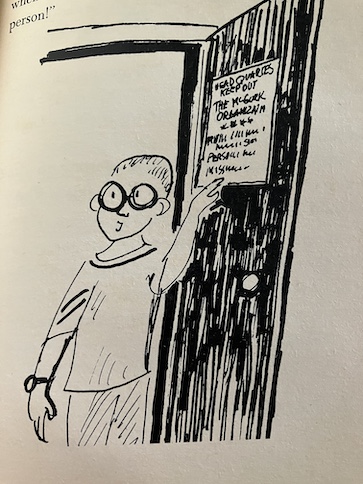
Mrs. Kranz, an elderly sculptor, has been looking after her nephew’s 7-year-old son, Bela, because his parents were in a car accident and are still in the hospital. She consults the McGurk Organization because strange things have been happening since Bela came to live with her. At first, she is reluctant to say what is really bothering her. She was referred to the McGurk Organization by Willie’s mother, and she frames her request as hiring the kids to watch Bela while she’s working. McGurk turns down the offer, saying that the oldest members of the McGurk Organization are only 10 years old, not really old enough to babysit, and babysitting isn’t the kind of job they handle anyway. Wanda tries to refer Mrs. Kranz to a regular babysitter she knows, but Mrs. Kranz is strangely desperate and insists that she wants the McGurk Organization.
Because they’re reluctant to accept the job, Mrs. Kranz finally admits that there is a mystery connected to Bela. She starts by telling them that she’s afraid of frogs, like some people are really afraid of bugs or rats or other creatures. Ever since Bela came to stay with her, Mrs. Kranz has been hearing an unusually loud frog sound in her house, particularly in the evening, after Bela is in bed. Bela insists that he never hears it, but it’s giving Mrs. Kranz the creeps. She’s tried to search the house as best she can, but she can’t find the frog anywhere. It’s not the kind of thing that she can go to the police about, but it’s driving her crazy. The real reason why she wants the McGurk Organization to spend time with Bela is to see if they hear the frog, too, and if they can figure out where it is.
This time, McGurk is intrigued enough to accept the case, plus Mrs. Kranz offers them a larger fee for their services than they usually have. They consider the idea that Mrs. Kranz could be making up the story about the phantom frog she hears just to get them to accept her babysitting job, but they decide that isn’t likely, both because of the generous amount of money she’s paying them and because she seems genuinely frightened.
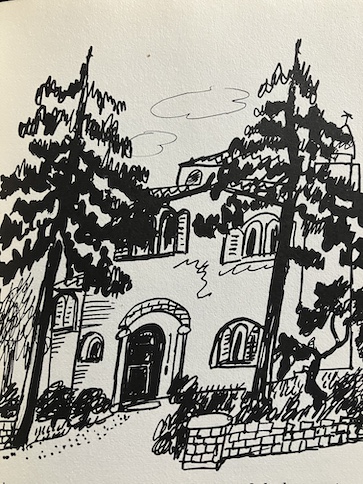
When they get to Mrs. Kranz’s house, it’s a big place that looks almost castle-like, and it’s surrounded by trees. Mrs. Kranz invites them in and introduces them to Bela. Bela was born in Hungary, where Mrs. Kranz was from originally. He doesn’t seem glad to meet the members of the McGurk Organization. In fact, he tries to ignore them and talk to them as little as he can. He doesn’t really want to talk to them about the frog when they ask him about it. He just says that maybe he’s heard a frog and that his aunt has frogs on the brain.
McGurk is annoyed with the kid, so he teases him about his name, saying that Bela sounds like a girl’s name. Bela defends his name, saying it’s Hungarian. Joey tries to defuse the situation, saying that Bela Lugosi was a famous actor in old horror movies, and he was also Hungarian. McGurk is intrigued by the mention of old horror movies because he loves them, and he starts asking Bela about whether there are things like vampires and werewolves in Hungary. Bela says that monsters are just stupid kid things. Brains is inclined to agree with Bela because there’s no scientific evidence that such things exist, and McGurk gets irritated with both of them.
When McGurk consults with the other members of the organization about Bela, he says that he thinks Bela is hiding something. His theory is that Bela is making the frog sounds himself to scare his aunt as a prank and that his hostility toward their presence and their questions is to cover up for what he’s doing. Wanda takes a different view because she thought that Bela seemed scared of something when they were talking to him, and she thinks that Bela is covering up his fear. Maybe he’s afraid of the frog or the frog sound and doesn’t want to admit it. Brains thinks that the sound could have some ordinary explanation, like sounds from the plumbing system that have been misidentified.
Aside from his hostility toward their questions, Bela seems like a well-behaved kid to watch. When it’s time for bed, he doesn’t argue with the older kids or make a lot of special requests or excuses to stay up later. In fact, he seems eager to go to bed. His only requests are that they leave the lights on and the window slightly open for air. As soon as Bela is in bed, the members of the McGurk Organization station themselves at strategic points around the house, waiting to see what they can hear and where it seems to be coming from.
They do hear the frog, and it sounds unnaturally loud, like it’s a monster frog! Most of them aren’t sure where the sound came from, but Brains is pretty sure that it came from Bela’s room. When they go inside, Bela seems like he’s asleep, and they don’t see a frog anywhere. They’re convinced that Bela is faking that he’s asleep, although Bela puts on an act like he was really asleep. McGurk knows that he must have been awake while they were out of the room because they left the light on for him, and when they first entered the room, the light was off. At some point, Bela must have gotten up and turned it off himself, although they don’t know why he would do that. For some reason, he also shut his window.
It seems pretty clear that Bela has something to do with the frog noise. The next night, they rig up a microphone in Bela’s room so they can monitor the sounds there. When they hear a loud frog sound, they hurry up to Bela’s room and find a frog sitting on his pillow .. and there is no sign of Bela! McGurk stuns the others when he makes the announcement that Bela is a werefrog! McGurk thinks that Bela has the transformation powers of a werewolf, but he’s turning into a frog instead of a wolf. They go to the kitchen, where McGurk finds some garlic, and when they return to Bela’s room, the frog is gone, and Bela is back in bed. Is Bela really a werefrog, or is there another explanation for what’s happening?
The book is available to borrow and read for free online through Internet Archive.
My Reaction
I remember reading this book when I was a kid, and I did a book report on it for school. I even did a little diorama about the story that looked like Bela’s bedroom, with a little frog made out of modeling clay. It was cute, but I can’t show it because I don’t have it anymore.
I found the story pleasantly creepy when I first read it as a kid. Even though I was sure that there must be some logical explanation for the phantom frog and Bela’s apparent transformations, I honestly wasn’t sure what it was at first. The mystery isn’t that complicated for an adult, but it’s creepy and mysterious for a child.
It sometimes seems to me that kids in the McGurk books are a little mean to each other and call each other names too much. I didn’t like it that McGurk was teasing Bela about his name in this book. However, it does serve a purpose in this story because the discussion of Bela’s name is what introduces the mention of Bela Lugosi and the idea that there might be a supernatural explanation for the phantom frog and that Bela might be a werefrog. Mrs. Kranz doesn’t suggest that idea to the kids when she first consults them about the frog. McGurk is the one who thinks of it because he’s really into old horror movies, and Bela being Hungarian, like Bela Lugosi, suggests a connection to the supernatural to him.
Not all the others are really as convinced as McGurk is, but they are creeped out by the phantom frog that appears and disappears and Bela’s odd behavior. Brains is the least convinced of everyone that there’s a supernatural explanation for the frog, reminding everyone that he invented an “invisible dog” in a previous book. He knows that it’s possible to create some pretty convincing illusions. He’s the one who convinces McGurk to investigate the possibility that Bela is faking everything somehow.
I like to take note of times when characters in books reference pieces of pop culture from the time when they were written. At one point, the kids in the story are watching a Peanuts special on tv, based on the characters from the comic strip. That comic strip was still being written and published at the time this book was written, and I remember watching Peanuts specials on tv myself as a little kid in the 1980s.
The Case of the Invisible Dog by E. W. Hildick, 1977.
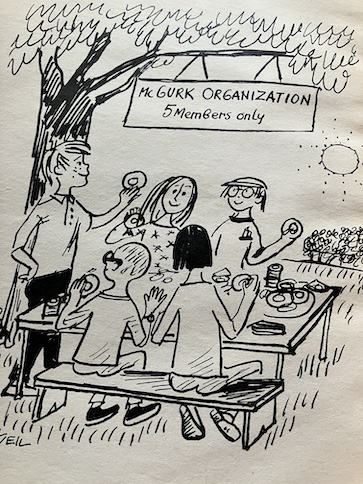
The members of the McGurk Organization are having their annual picnic in McGurk’s backyard when, suddenly, a doughnut leaps off the table and begins traveling through the bushes and grass. None of them can understand what’s happening because they can’t see anything that would cause the doughnut to move like that.
They go after the doughnut to see what happened, and they find Brains Bellingham, the nephew of Miss Bellingham, who lives next door. Brains has been staying with his aunt while his parents are out of town, and he always has a put-down for the members of the McGurk Organization. Brains is holding his aunt’s Yorkshire terrier, Dennis, and the missing doughnut, which has apparently been chewed by the dog. Brains apologizes for the dog ruining their “crummy” picnic, but he says that Dennis can’t resist doughnuts. However, that explanation doesn’t satisfy the McGurk Organization because none of them saw a dog carrying the doughnut, just the doughnut moving by itself. Brains makes an excuse about the dog being small and blending in with his surroundings, but the others can tell that he’s hiding something.
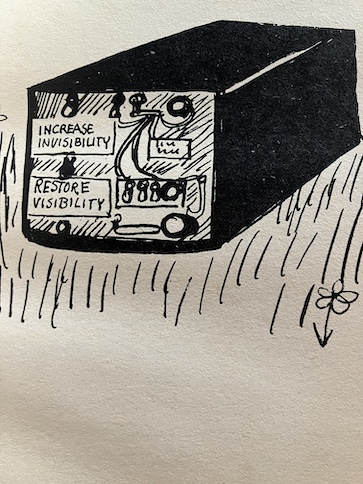
When Brains leaves for a moment because he says his aunt is calling him, they spot a strange black box in the grass. The box has dials and switches on it, and there are two labels: “Increase Invisibility” and “Restore Visibility.” Brains is known for building various inventions, so they know this is probably something he made, but does this device really make things invisible? Is that why they couldn’t see the dog when he stole the doughnut? They have a look inside the device, but since none of them is particularly good with electronics, they just know that it contains a bunch of wires and seems to be powered by batteries, and there is some kind of light inside the box. There are also doughnut crumbs inside the box.
When Brains sees them messing with the box, he yells at them to stop snooping. Joey, the organization’s secretary, knows that part of Brains’s problem with the organization is that he’s jealous because he really wants to join. He’s hinted before that they need a laboratory man to help them with forensics. McGurk might have taken him up on the offer except that Brains was condescending and insulting in the way he made it, calling them “dummies.” He’s a little younger than the rest of them, too, so his condescending attitude makes him seem even more like an annoying little kid. McGurk tries to ask Brains about his strange device, but Brains just refuses to answer and takes the box and the dog away.
The members of the McGurk Organization return to their picnic, but they can’t stop wondering about Brains, his strange invisibility device, and how he accomplished the trick with the dog and the doughnut. Most of the organization members are pretty sure that there must be some kind of trick to it, but they can’t figure out how Brains did it. While they discuss it in their basement meeting room, they hear what sounds like the jingle of dog tags, and Willie, who has a very sensitive nose, says that he smells a dog. They search the basement and find a dog’s rubber bone. Then, Brains shows up, looking for Dennis. To their astonishment, Brains seems to pick up an invisible dog, who seems to be struggling and making dog noises, growling and jingling tags!
When the organization goes to confront Brains about what just happened, they find him with his strange box. The box appears empty on the inside, but they hear dog sounds from it. Brains operates the controls and opens the box again, and Dennis comes out! Brains claims that he invented the invisibility box by accident while he was trying to develop a treatment for getting rid of Dennis’s fleas and ticks using light rays. Brains says that there is a side effect where Dennis sometimes turns invisible at random times without Brains intentionally turning him invisible but that he’s working on the problem.
McGurk is thrilled at the possibility that Brains might be able to build a machine big enough to turn a person invisible, and he even offers Brains membership in the organization if he can do it. Brains says he could, but to everyone’s surprise, he turns down the membership offer. He says that he knows they don’t really want him in the organization; they just want his machine. It’s a little embarrassing, but it’s true.
The members of the McGurk organization consider ways that they could get Brains to change his mind. McGurk considers blackmail, but Wanda says that wouldn’t be right for a detective organization. Wanda thinks McGurk should apologize to Brains for the way he turned Brains away when he tried to join earlier, but McGurk can’t stand the idea of apologizing. Willie thinks they could offer to pay Brains, but they don’t really have anything they could pay him. They all ponder what would happen if they let word of Brains’s invention get out to the public or even the government.
Then, Brains comes to them, asking for help. He says that Dennis has turned invisible again, and he’s run off! Can the McGurk Organization find an invisible missing dog?
The book is available to borrow and read for free online through Internet Archive (multiple copies).
My Reaction
I didn’t read this book when I was a kid, although I read many others in the series. Because I didn’t read this book before, I didn’t really know the story of how Brains joined the McGurk Organization. There are some references to it in some of the later books in the series, so I knew that, when the other members of the organization first met Brains, they were investigating him for some trick he’d played on them. I was used to Brains being their friend, so it seemed odd to see him as the antagonist/suspect they are investigating in this book.
During the story, the members of the McGurk Organization are pretty sure from the beginning that Brains is playing some kind of trick, but they’re not sure how. He does manage to convince them temporarily that he has successfully developed an invisibility device, but McGurk soon realizes that something Brains has said contradicts what’s happened. Then, he and the others reexamine what happened to figure out how Brains staged his tricks. They’re a little mad at being tricked, so they pull one more trick on Brains to get even before they all forgive each other. Brains shouldn’t have called the others “dummies” or been condescending to them, and the others shouldn’t have been too quick to write him off just because he’s a year younger than they are. In the end, McGurk says that anybody who’s clever enough to work out a complicated trick like this one deserves to be a member of the organization, and they hold another picnic to celebrate their new member.
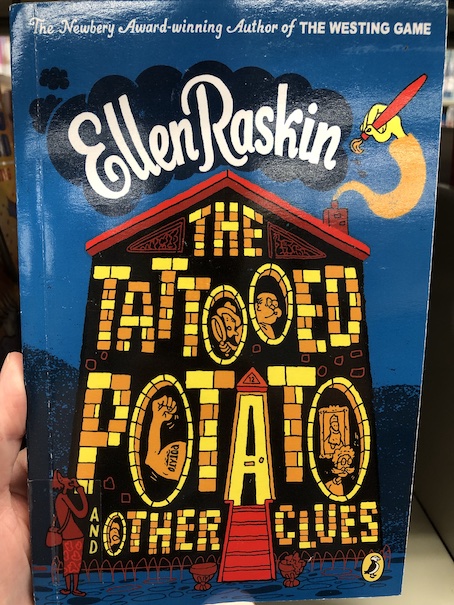
The Tattooed Potato and Other Clues by Ellen Raskin, 1975.
Dickory Dock (yes, that’s her name) is a 17-year-old art student in New York. She takes a part time job as an assistant to a mysterious artist who only calls himself Garson. She really needs the job because she’s very poor and often only has markers to use in making drawings for her art classes. She lives with her brother and his wife because their parents are dead, but her brother and his wife struggle financially and sometimes can’t even pay their bills. However, Garson is a strange person who seems determined to keep the details of his past secret.
Garson requires Dickory to be quiet, well-organized, and observant as his assistant, and she tries her best to be these things. He periodically tests her powers of observation and perception, pointing out that these are valuable skills for artists to have to see beyond the outward appearances of things and into their very essence. Garson lives in a house with a deaf-mute man called Isaac. Isaac frightens Dickory at first because he is a large man who appears scarred and is brain-damaged. Garson says this is just his outward appearance and tells her that Isaac is a gentle soul. On the other hand, Manny Mallomar, the fat, greasy man who rents the lower apartment in the house, is rough and rude. Because he dresses all in white, Dickory describes him as looking “like the ghost of a greasy hamburger.” Manny Mallowmar’s associate, Shrimps Marinara comes to visit him, and Garson praises Dickory for guessing his name because he’s a shrimpy little man. (This pair sounds like the criminals in The Maltese Falcon.) Garson stresses the importance of seeing behind the outward appearance of people and objects to their inner natures, what they hide behind the disguises they wear. Garson himself, however, remains a mystery, purposely covering himself up with bland manners.
Garson is good at reading people, and he accurately realizes that Dickory is a haunted person. Dickory admits that the reason why she lives with her brother is that their parents were murdered. Their parents ran a pawn shop, and they were killed in a robbery. Dickory’s brother (his name is Donald Dock, and he’ll hit anybody who makes quacking sounds at him) is terrible at managing money, which is why they can’t always pay their bills, and they no longer own their parents’ pawn shop as a source of income because he lost it to a bookie.
Strangely, Dickory realizes that, even though Garson is perceptive to people’s hidden deaths, this isn’t always reflected in his work, which does focus on showing people the way they want to be seen, not how they actually are. It’s just the sort of thing Garson tells her not to do, so why does he do it himself?
Then, the Chief of Detectives Quinn comes to see Garson. Garson was talking about the need to see behind people’s disguises with an artist’s eye at a party, and Quinn has come to take him up on the offer. Quinn has been struggling with a case of fraud where widows have been duped out of their savings by a mysterious hair dresser who got them to invest in a new kind of hair treatment. At first, the hair treatment made them look really good … and then, their hair fell out, and the hair dresser was gone with their money. Garson interviews the three fraud victims, and they all describe the hair dresser, who called himself Francis, slightly differently, although there are certain details of their accounts which are the same. In the end, Garson’s conclusion is that “Francis” is actually a woman named Frances, and that she probably had the extremely short hair they described because she was the first victim of her own hair tonic that doesn’t work, and her own hair has only just started to grow back. Garson tells Quinn that she has probably used these ladies’ money to set herself up with her own hair salon.
Garson’s theory of the case turns out to be accurate, so Quinn asks his opinion on another case. This next case involves a counterfeiter whose bills are almost perfect, except he puts his own self-portrait on them where the presidents’ picture is supposed to be. Garson seems to like playing detective in these cases, but Dickory realizes that he is still a mystery himself. He seems to love using disguises, and he tries to trick Dickory with them. Dickory can tell that these disguises aren’t just tests of her observation skills but also seem to be ways for Garson to try out different disguises for his own sake. She also begins to realize that Manny Mallomar isn’t just a disagreeable character but actually a criminal. He’s blackmailing the people who come to visit him, and also Garson, which is the reason why he’s allowed to live in Garson’s house. What is there in Garson’s past that Manny knows and Garson doesn’t want to reveal?
The book is available to borrow and read for free online through Internet Archive (multiple copies).
My Reaction
Ellen Raskin is also the author of The Westing Game. The Westing Game is better-known than this book, and I read The Westing Game first as a kid, which is what led me to this one when I was in middle school. It’s interesting to note that The Tattooed Potato and Other Clues was actually written and published a few years before The Westing Game, and it has some similar themes in the story. Both books involve people with mysterious, hidden pasts, and they delve into the psychology of a cast of characters whose pasts are linked, even though the characters themselves don’t know all the connections between them initially.
Dickory knows from the beginning that Garson is being secretive about his past, but everyone involved in the situation has secrets. Manny Mallowmar and Shrimps are blackmailers, but they also have guilty secrets from their other crimes. Quinn is also not just consulting Garson for help on cases but using those cases as excuses to investigate Garson and the other people in his house. Quinn is aware of Mallowmar’s shady history, and he thinks that he knows what Garson’s guilty secret is. Dickory inadvertently learns the truth behind the murder of her own parents, and she becomes the only person to figure out the full story behind Garson’s past crime.
Garson teaches Dickory how to see behind people’s facades, which is how she is able to learn his true identity and the secrets of his past. Garson didn’t intentionally do anything evil, but he recognizes that, while he is considered a gifted artist for being able to see the truth about people, he has caused great harm to someone he really cared about by revealing painful truths in a heartless way. Garson harbors guilt for the harm he has caused, and in a way, he actually seems to fear his gift for the harm it can do. However, not every kind of truth is hurtful. Dickory shows Garson that some truths can heal, and that he can expose the good and lovable sides of people as well as their dark sides.
The Big Orange Splot by Daniel Manus Pinkwater, 1977.
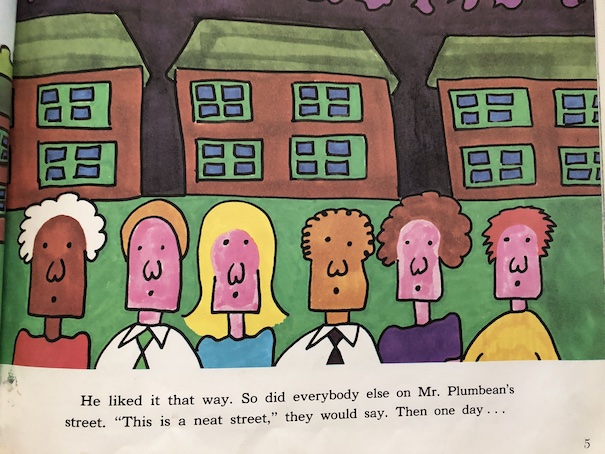
Mr. Plumbean lives in a neighborhood where all the houses look alike. He and his neighbors all think of the uniformity as making their street “neat” and tidy, and they appreciate it. Then, something happens that makes them reconsider.
For reasons that nobody ever understands, a seagull carrying a can of orange paint happens to fly over Mr. Plumbean’s house and drops the can, leaving a big orange splot on Mr. Plumbean’s roof. Mr. Plumbean realizes that the big orange splot means that he’ll have to repaint his house, but the painting project makes him think.
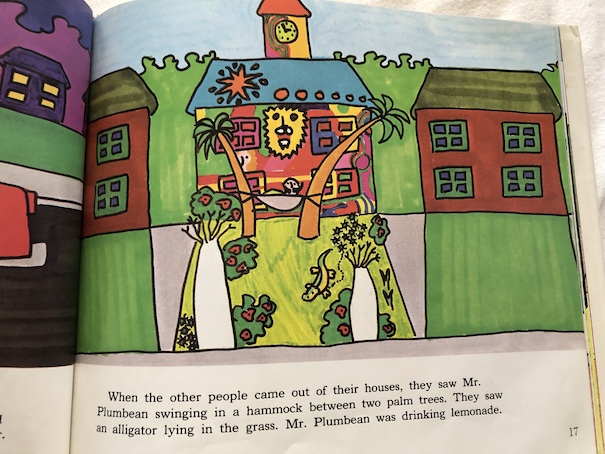
Instead of painting his house to look like everyone else’s, the way it was before, he gets a bunch of wild colors and turns the exterior of his house into a rainbow explosion, working around the big, orange splot on his roof! He adds paintings of animals and other things he likes and colorful patterns. It’s such a wild and crazy design that his neighbors think he went mad. Before long, he adds a clock tower onto his house and an alligator and some trees with a hammock in the front yard.
The neighbors think he’s gone too far, but Mr. Plumbean says, “My house is me and I am it. My house is where I like to be and it looks like all my dreams.”
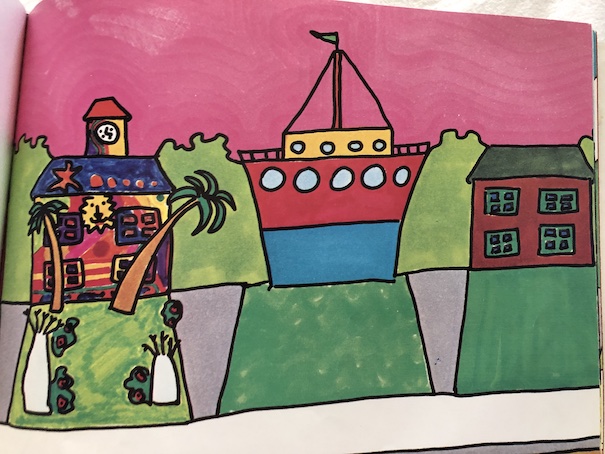
One of Mr. Plumbean’s neighbors tries to talk some sense into him, but instead, Mr. Plumbean talks to him about his dreams. The next day, the man goes out to buy some building supplies. It turns out that he always loved ships, so he turns his house into the ship of his dreams!
With Mr. Plumbean’s encouragement, other neighbors also start to change their homes to reflect their dreams, changing their quiet, “neat” street into a magical wonderland of imagination!
The book is available to borrow and read for free online through Internet Archive (multiple copies).
My Reaction
I remember this book from when I was a kid, and I always liked the pictures! It’s fun to imagine all the creative themes a house could have and what you might choose if you had the opportunity to live in a house that could look like anything you wanted. The houses shown in the pictures of the neighborhood end up looking nothing like their original shapes, except for Mr. Plumbean’s house, oddly. The others are vastly different from their original shapes, and the windows aren’t even in the same places, making them look like they’ve been completely rebuilt. This level of renovation would be difficult and costly in real life, but this story is meant to be fun and to celebrate imagination and the capacity people have to add a touch of color to their lives. If you read this book with a child, you can invite them to decide which of the house was their favorite at the end (mine was the one that looked like a castle) or what they would do if they could make their house look like anything they want.
In real life, I’ve never particularly liked those neighborhoods where all the houses look alike. I’m not the only one because tract homes and uniform suburbs were controversial from their beginnings in the mid-20th century. In the early 1960s, a song called Little Boxes (listen to it on YouTube) poked fun at the uniformity of suburban houses and the lives of the people in them (although the houses in that song were still different colors – just saying). The connection between the uniformity of homes and the conformity of the people living in them is a topic that resurfaces periodically in popular culture and other songs, like “Subdivisions” by Rush (listen to it on YouTube).
The themes of non-conformity and self-expression are pretty profound, but the story is lots of fun and isn’t too deep for kids. If you read the back section about the author, it explains that the inspiration for this story came from a time when he spilled orange ink on his own pair of new yellow boots.
This picture book is a fun story about non-conformity and self-expression. In the beginning, Mr. Plumbean is as content as anyone with his neat, uniform neighborhood until a strange, inexplicable accident creates a situation where Mr. Plumbean has to paint his house. Once he’s confronted with the task of repainting his house, Mr. Plumbean begins to consider the creative opportunities this chore provides, and he enjoys exploring the possibilities and changing his house to be more of a reflection of the wild and wacky person he really is or dreams of being. Once his creative side is unleashed, it begins to get his neighbors thinking along similar lines. True, they liked it when their street was neat and uniform because they could see the appeal of having things orderly, but it turns out that each of them also has an inner creative side that’s been waiting for a chance to get out. The non-uniformity and non-conformity of their street becomes more comfortable for each of them as they each embrace those sides to their personalities that they don’t normally show. When they come to accept and embrace their own dreams and each other’s, it doesn’t matter to them anymore that they’re not all alike. They’re comfortable with the wacky and whimsical parts of their personalities, and they’re not afraid to show them anymore. They’re happy with themselves, their homes, and their different visions.
I really liked the art style of the illustrations in the book. It’s very simple but colorful, and you can tell that the artist used markers because you can see the marker lines, especially in the backgrounds of the drawings. It makes it different from more modern books that use digital art. I like seeing signs of the physical materials used, and it gives the story a funky, organic feel that goes well with the theme.
As I said earlier, I did notice that many of the new home designs in the pictures don’t take into account where the houses’ windows used to be, but that’s just part of the whimsy of the story. We don’t need to worry about how these people accomplished these drastic changes so quickly and easily. It’s just fun to think about how you can personalize your space to reflect what’s important to you.
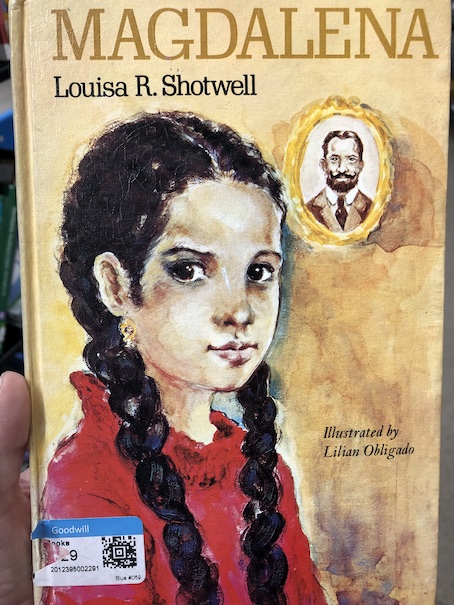
Magdalena by Louisa R. Shotwell, illustrated by Lilian Obligado, 1971.
Magdalena is switching classes at school. She’s happy about it because she found her old class too chaotic. She thinks she will be happier in her new class. Her friend in her current class at school, a boy named Saul, tells her that she must be an IGC, an Intellectually Gifted Child, in order to get transferred to that class because that class only takes gifted children. However, she is told that she will also have to wait a little for them to give her a desk in the room. When months go by without her being told that there is a spot ready for her and she can make the switch, Saul thinks that they were probably lying to her about her being able to switch classes.
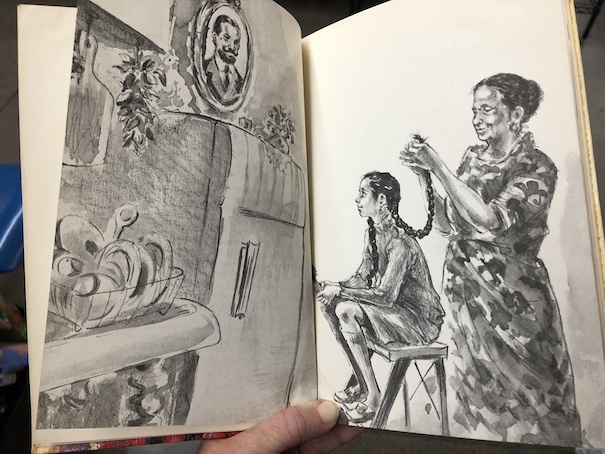
Finally, in January, she is able to switch to the new class, but right away, she runs into trouble with the class bullies. A boy named Andy and his friend start calling her “Miss Two-Ropes” because of her long braids, and the name sticks. Magdalena wishes that she didn’t have to wear her hair in braids, but her grandmother, Nani, insists on it. She loves Nani, who is from Puerto Rico and has looked after her for last two years, ever since her mother died when she was nine years old, but Nani has some old-fashioned ideas about how girls ought to be raised.
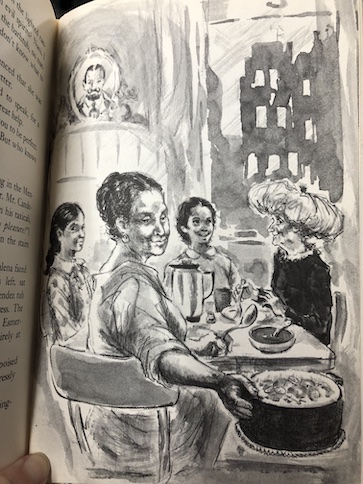
Magdalena’s father is a sailor, and he spends much of his time away at sea, so Magdalena and her grandmother are alone most of the time. Nani speaks Spanish to Magdalena at home because she thinks that’s proper for a Puerto Rican family like theirs, although Magdalena speaks English at school. She thinks that her grandmother probably knows more English than she pretends. Nani also keeps a portrait of Great-Grandfather Mendez, which she brought from Puerto Rico. Although he has been dead for years, the portrait always feels like a living person to Magdalena.
After some further teasing from the boys in her class, Magdalena decides to tell her grandmother that she doesn’t like her braids. Nani says that not unusual, that many children don’t like their braids, but they get over it. Magdalena doesn’t think she’s going to just get over it. Like a lot of kids, she would rather just look like everyone else so she won’t get teased, but Nani doesn’t approve of the short hairstyles that are popular among American girls at Magdalena’s school. She says that Magdalena’s braids are a mark of pride and a caring grandmother who brushes and braids her hair. She thinks the American girls wear their hair short because their mothers can’t be bothered to spend time on caring for long hair, and they don’t have grandmothers to nurture them. When Magdalena tells her that the boys at school are calling her names because of her braids, her grandmother decides that she should talk to the teacher about it. Magdalena thinks that having her grandmother talk to the teacher might be more embarrassing than having the boys call her names, so she persuades her grandmother to forget about it for now and let her handle it.
Then, Magdalena is called to the principal’s office at school. At first, Magdalena is upset because it sounds like she’s in trouble, and she can’t understand what she could have done to cause that. She is calmed a little when a black boy in the office, who is also waiting to talk to the principal, is nice to her. It turns out that Magdalena isn’t really in trouble. Instead, the principal wants to talk to her about one of her classmates, a girl named Daisy Gonzales, who is also transferring into her new class.
Madgalena is surprised because Daisy hasn’t struck her as a gifted child. Most of the other students call her “Spook” because she tends to lurk around the school and suddenly jump out at people to scare them, and she is known to frequently skip classes. The principal says that Daisy might be gifted, but it’s difficult to tell. The teachers think that she’s at least bright, but she’s an “under-achiever.” The principal explains that means that Daisy could do better at school than she does, but for some reason, she doesn’t seem motivated to do better. That’s why they’ve decided to transfer her to the class with the gifted students. They think that she isn’t being challenged enough in the class where she is. The teachers are also concerned that Daisy has no friends at school. They’ve noticed that the other girls at school seem to be afraid of Daisy, although they don’t seem to understand about Daisy’s “Spook” act. They do know that Daisy has behavioral problems and an unhappy home life. The reason why the principal is telling Magdalena about this is that she wants Magdalena to try to be Daisy’s friend when she transfers into her new class. The reason why she selected Magdalena to be Daisy’s new friend is because Daisy’s family is also Puerto Rican, like Magdalena’s family, so she thinks that the girls might understand each other better than their other classmates. The principal thinks that Daisy might settle down at school if she had a friend to help her feel more comfortable there. Magdalena isn’t comfortable with the idea of trying to be Spook’s friend because she also finds Daisy spooky, but the principal persuades her to try but not to let on that the principal asked her to do this.
Magdalena has no idea how to approach Daisy/Spook to be friends, since she’s not the easiest person to approach about anything. Then, Sue Ellen, the most popular girl in class tells Magdalena that she wants to be friends with her. She says that she’s been feeling empathy for her since the first day that she came to class and the boys started teasing her, and she felt it again when she got called to see the principal. She asks her what the principal wanted, and Magdalena explains that she asked her to do something, but it’s something really hard, and she isn’t supposed to talk about it. Sue Ellen offers to help her with whatever the principal’s task is. Magdalena thinks maybe making friends with Spook won’t be so bad if Sue Ellen helps, so she takes Sue Ellen into her confidence. Sue Ellen agrees with Magdalena that making friends with Spook would be hard because she’s so weird and spooky. Both girls admit that they’re a little afraid of her, but Sue Ellen agrees to try to be basically nice to Spook along with Magdalena and see what happens. Sue Ellen says that the principal ought to have more empathy for the students and see just how hard it would be to get along with someone like Spook.
Their first attempts at making friends with Spook are clumsy. Sue Ellen tries offering her advice, pointing out that she wore the wrong thing to the school assembly, but criticism and advice aren’t the best ice-breakers. Then, to Magdalena’s surprise, Spook approaches her in the school library, when she is trying to find a specific book for her grandmother. The school library doesn’t have the book she wants, but Spook says that she knows where to find it. However, she will only help Magdalena if she plays hooky and goes with her right now. Magdalena hesitates because she doesn’t really want to skip class and get in trouble, but Spook says that Magdalena will have to come with her because she’s “emotionally disturbed” and might do crazy things if she doesn’t get her way. Magdalena points out that school will end in only 20 minutes, and she asks Spook to wait for her. Spook makes her promise that she won’t change her mind and let her down in that time.
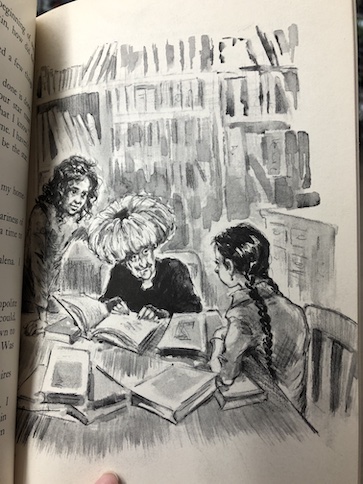
When Magdalena waits for Spook, she doesn’t show up at first, but Spook jumps out at her just when she’s giving up waiting. Spook says that she just wanted to see if Magdalena was serious about wanting to come with her. The place where Spook knows they can find the book turns out to be the Brooklyn Public Library. Along the way, Magdalena begins to learn more about Spook. The reason why she wasn’t dressed right this morning was that the sweater she was wearing was the only thing she had to wear that was clean. She skipped out during the school assembly to go home and see if her mother was back from the laundromat so she could put on something else. Also, Spook isn’t completely friendless. She is friends with a strange woman named Miss Lilley, who wears an unusual, large hat. When Daisy tells Miss Lilley that she got put into the class at school with the smart kids, Miss Lilley congratulates her and tells her that she knew she was smart. Daisy admits that she’s been trying not to let her teachers know that she’s smart because she knows that they will expect more of her and insist that she do all her homework. People don’t expect so much of kids who aren’t bright. There is method to Daisy’s madness. All of her weird and spooky acts are tools that she uses to get her, get out of things that she doesn’t want to do, cover up for problems that she has, and keep people she doesn’t like or doesn’t think would understand her at a distance.
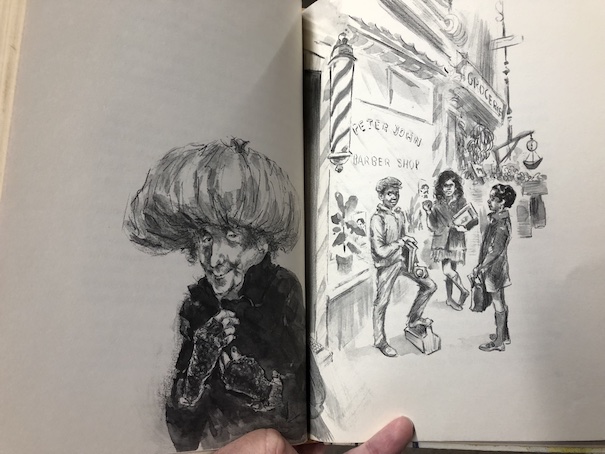
Daisy introduces Magdalena as one of the smart kids from her class, but Miss Lilley thinks that Magdalena’s manners aren’t very polite because she keeps staring. Magdalena has trouble getting over the large hat, which looks like a large pumpkin. Miss Lilley begins evaluating Magdalena’s appearance, and Magdalena comments about how she hates her braids, but her grandmother makes her wear them. Miss Lilley says that she understands that her grandmother likes the quaintness of the braids, but she knows how to deal with that. She also knows where to find a good barber. The black boy who was nice to Magdalena earlier, Samson Shivers, makes money after school by shining shoes outside the library, and when Miss Lilley asks him if he would be willing to lend them money for the haircut, he joins the others at the barber shop. Miss Lilley takes the kids to the barber shop, and Magdalena gets a haircut. Magdalena feels wonderfully free after he haircut, although she saves the braids as a souvenir and worries about what her grandmother will say when she gets home.
Nani is very upset when she sees Magdalena’s short hair and worries that Magdalena is rejecting her care for her and her Puerto Rican heritage. Magdalena says that’s not the case and explains about going to the library and meeting Miss Lilley. Magdalena’s grandmother thinks that she’s bewitched and says that she knows how to deal with that. She uses herbs on Magdalena to break the bewitchment.
Getting the haircut changes things for Magdalena. The boys stop teasing her, which is a relief. However, Sue Ellen is annoyed that Magdalena didn’t tell her that she was going to get her hair cut. Magdalena explains that it was a sudden decision and a possible bewitchment by Miss Lilley. Sue Ellen thinks that Spook is probably the one who bewitched Magdalena because she’s so spooky and that maybe Magdalena would rather be best friends with her. Magdalena says that’s not the case and that she doesn’t see why she can’t be friends with both girls. Sue Ellen still expects that Spook is going to do something to ruin the class, but Magdalena notices that Spook is becoming less spooky in their class. She stops skipping classes, does more of her homework, and cuts out some of her previous spooky behavior.
Samson, often called Sam, is a practical boy, and when Magdalena tells him how her grandmother thinks Miss Lilley is a witch and bewitched her, he says that she can’t be a witch. Sam sees her often because he shines shoes by the library, and he realizes that Miss Lilley is actually just a poor, old woman. She goes to the library all the time because she can’t afford proper heating for her apartment. She often has little to eat, and she partly survives off of candy that he gives her. Like Spook, she seems spooky because she looks odd and behaves oddly, but there are explanations for what she does that show that she’s actually unfortunate.
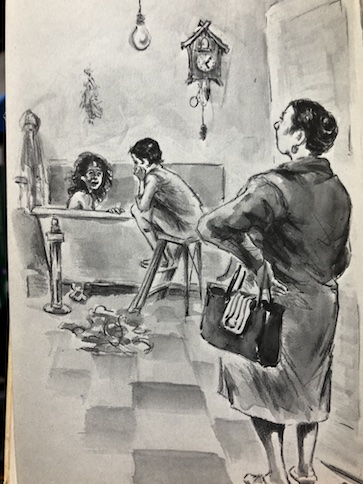
Magdalena’s grandmother meets Spook for the first time when Spook hangs out with Magdalena at her apartment after school. Nani isn’t home at the time, but the girls talk to each other about their lives and families. Magdalena gets to know more about Spook, and Spook admires the place where Magdalena lives. Spook’s family lives in a much poorer apartment, and it’s crowded with Spook’s younger siblings. Spook admires the nice bathtub that Magdalena and her grandmother have and says that she wishes they had one at her apartment. Part of the reason why she looks so strange is that she doesn’t get the opportunity to take baths often. Magdalena tells her that if she wants a bath, she can go ahead and take one. Nani arrives home before Spook is finished with her bath, but Nani stops her when she tries to get out and get her clothes. Nani can see how badly Spook needs some care, so she insists that she finish the bath, clean the tub, and let her shampoo her hair. When she’s done, Nani has Magdalena loan her some clean clothes, and the girls are amazed at the transformation.
After the bath incident, Spook avoids Magdalena for a while, and she can’t understand why, but it’s about Spook realizing what’s been lacking in her life and envying what Magdalena has: someone who really cares for her. She was so emotional when she looked at herself in the mirror that she spit at the image and then was embarrassed that she had done that. Nani surprisingly understands Spook’s behavior. She can see that Spook lacks impulse control and the ability to understand and manage her feelings. Nani comments that she’s angry with Spook’s mother because she can tell that the girl has been badly neglected. Having been a mother and grandmother herself, she knows exactly how to deal with this.
Meanwhile, Sam is correct about Miss Lilley. Miss Lilley is poor and not in very good health, but she also knows what Magdalena and Spook/Daisy need. She is eager to help the girls, but she also needs some help and attention herself. When Miss Lilley decides that it’s time to have a word with Nani about the needs of modern girls and her fears about her granddaughter becoming too American, a number of things get better.
The book is available to borrow and read for free online through Internet Archive.
My Reaction
The heart of this story is understanding and empathy. By the time it’s over, many of the characters come to a better understanding of each other and maybe themselves. Although Spook’s transformation is the most dramatic, the other characters are also changed after their experiences in the story.
Magdalena’s changes come with her admission to her grandmother that she really doesn’t like her braids and then with her decision to have her hair cut against her grandmothers wishes. She knew that her grandmother wouldn’t like it when she said that she didn’t want braids because her grandmother is a traditionalist, and she knew that Nani wouldn’t react well to the haircut. At first, it was easier for Magdalena to buy into the idea that Miss Lilley was a witch who bewitched her into doing it, but that’s not really the truth. It wasn’t even that Magdalena was getting her hair cut just because of the teasing. When Magdalena and Spook are talking about whether or not they truly understand the reasons why they do things, Magdalena acknowledges that she has reasons for the things she does, and the truth is that she got the haircut because she herself really hated wearing braids. If she had really loved her braids, she could have kept them in spite of the teasing, and she could have turned down the offer of a haircut, but she really wanted to change her hairstyle, and she just took advantage of the opportunity to do it.
Nani understands from the first time she meets Spook that she has not had nearly the level of care and attention that she has needed in life. Spook doesn’t even really understand all of the motivations she has for the things she does. Her behavior is odd partly because she acts on impulse, not fully thinking about the consequences or the affect her behavior has on others. She initially doesn’t have much self-awareness because she has not had caring adults in her life to teach her how to behave, how to understand her feelings, and how to control herself. Because she hasn’t really had any friends before, she hasn’t really had anyone to talk to about these things and help give her some perspective. When Spook and Magdalena talk about why she spit on the mirror, Spook says at first that she isn’t sure why she did it. As they continue to talk about reasons for doing things, though, Spook admits that she did it because, while she was stunned at how nice she looked, she quickly became upset because she didn’t think that nice look could last.
Nani is the nurturing type of person, and she quickly sees that Spook is in dire need of some nurturing and guidance. She also recognizes that Spook doesn’t have much confidence in herself. She is bright, but she has grown used to hiding it. She also thinks, because she doesn’t really understand her feelings or behavior, that is can never really control herself. She thinks that she will always be a “stinker” who does things that she shouldn’t and acts weird. Nani has a frank talk with her and tells her that she can be herself without being a “stinker”, and the first step is believing that she can. Even if she’s not in the habit of understanding and controlling herself, she can learn. People have different sides to their personalities and different ways of expressing themselves, and Spook can learn how to show the best sides of herself in the best possible ways.
Magdalena appreciates that Nani is understanding and helping Spook, but she also has a frank talk with her grandmother about why she doesn’t understand her own granddaughter as well. When Magdalena tries to tell her what she wants or doesn’t want, Nani contradicts her or ignores her feelings. Nani is understanding with Spook because she can tell that Spook is a disadvantaged child, but she doesn’t see her granddaughter the same way, so she doesn’t try to understand why Magdalena sometimes does things she doesn’t like. Nani admits that she wanted her granddaughter to be “perfect”, but maybe she doesn’t really know what “perfect” actually is. She wants the traditional ways for her granddaughter because she really thinks that’s what’s best, but even grandmother doesn’t always know what’s best.
Miss Lilley is concerned about the girls and offers them attention and support. When she goes to see Nani and open her eyes to her grandmother’s needs and the ways of modern girls, she collapses because of her bad health. Fortunately, Nani is a nurturing person, and she nurtures Miss Lilley, making sure that she gets the treatment she needs and even looking after her when she gets out of the hospital. Miss Lilley’s health improves, and the two of them become friends. Although they are both older ladies, they each admit that they have things to learn in their lives, and they can learn from each other. Nani helps her to make changes to her living arrangements so she will be healthier and more comfortable, and Miss Lilley helps her understand what modern American life has to offer for girls like Magdalena.
Samson is always a very understanding character because he is genuinely interested in people, and he meets many different types of people through his shoe-shining business. Although Sue Ellen is the first person who brings up the topic of empathy, she is really the one who understands it the least. I think her relatively narrow view of empathy is because of her relatively narrow life experiences. She feels some empathy for Magdalena because she sees Magdalena experiencing something she understands, but she doesn’t seem to know what to do when she encounters something she doesn’t understand. Admittedly, Spook’s spooky act is off-putting, partly by design and partly because Spook has issues she herself doesn’t know how to handle. However, because Sue Ellen only wants to stick to the familiar and understandable, she doesn’t notice when Spook begins to change and doesn’t see how some support from her could influence her for the better. Sue Ellen’s attempts at friendliness and helpfulness often involve offering some kind of criticism, like pointing out that Spook isn’t dressed right. Magdalena can tell that Sue Ellen is trying to be helpful, but she’s also kind of snippy and smug in the way she does it, and that gets on Magdalena’s nerves, too. Sue Ellen kind of fades out of the story toward the end, so we don’t know if she continues being friendly with Magdalena or not or if she ever recognizes Spook’s transformation.
There is also a subplot that I haven’t mentioned about the literary magazine that the girls’ class starts. Their teacher has some thought-provoking descriptions about what good writing is and does, and the girls’ choices of what to write about are based on their experiences and the changes in their lives.
The book doesn’t shy away from the harsh realities of life. Magdalena’s mother is dead, and her father is away most of the time, so she is being raised by her grandmother. Her father never even makes an appearance in the story. Miss Lilley is a poor and lonely old woman who needs help and friends. It is acknowledged that Spook is a neglected child, and she even tells Magdalena that her favorite brother died at age three because he was asthmatic, and they were living in bad conditions. We don’t know exactly how her family came to be living in such bad conditions, but Spook says that, if she wrote a story about her family, the teacher would think she had a filthy mind.
Since the story is about understanding other people, one could consider whether we might view Spook’s neglectful mother more sympathetically if we knew her past and what led her to the situation they’re now in, but we do not see Spook’s mother at any point in the story. I think it’s also important to note that understanding does not equal approval. You can know a person’s history and reasons for doing things and still not agree with them. Maybe Spook’s mother is another unfortunate soul who needs some help, but if she is, she doesn’t seem to be looking for that help. Her vulnerable children are suffering for it, and one has died. Empathy doesn’t mean saying that things are okay when they really aren’t, and this mother’s neglect of her children is not okay.
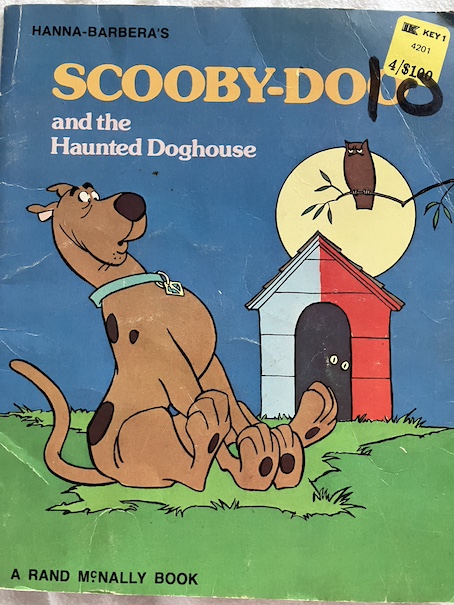
Scooby-Doo and the Haunted Doghouse by Jean Lewis, illustrated by Richard Lowe, 1975, 1983.
Scooby-Doo’s friends are building a new doghouse for him! They can’t decide what color to paint it, so they make half of it red and half of it blue. Scooby loves his new doghouse, at first, but then, something spooky happens!
One night, Scooby comes running into the house, scared. While Scooby cringes under the covers of Shaggy’s bed, Shaggy gets a flashlight and goes outside to see what scared Scooby.
When Shaggy looks in the doghouse, he sees a glowing pair of eyes, and then, something white runs past him with a shriek! Scooby and Shaggy both stay inside for the rest of the night, and in the morning, they tell their friends that they think the doghouse is haunted.
Their friends are sure that there must be some other explanation for what happened, but who or what was in Scooby’s doghouse?
The book is available to borrow and read for free online through Internet Archive.
My Reaction
Scooby-Doo was my favorite cartoon when I was a kid, especially Scooby-Doo, Where Are You!, and I’m still nostalgic about it! The mystery in the story is very simple, but suitable for young children with nothing truly scary about it. Even kids might guess what the solution is before the characters realize what’s in the doghouse.
Now that I think about it, it seems out of character for Scooby-Doo to have a doghouse because I don’t think he had one in the original cartoon series. I remember that he had a fancy one in one of the later spin-off series, but in the original series, he just always slept inside with his human friends. Of course, one of the hallmarks of the Scooby-Doo series is that there isn’t really a strict canon. Details about the characters and the Mystery Machine can change from episode to episode to suit the story without any real explanation because it’s a just-for-fun series.
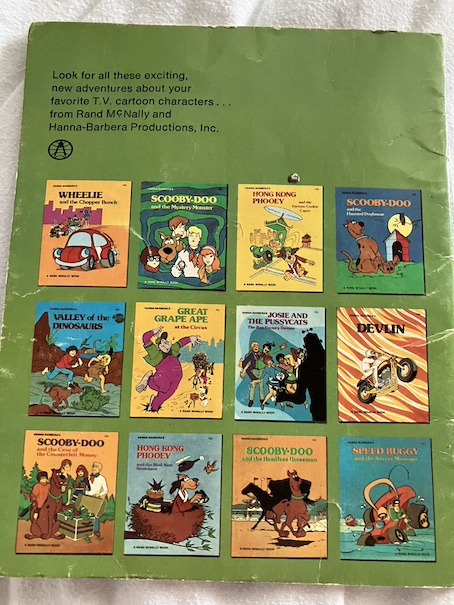
One of the things that I liked about this book was that it reminded me of all the other books I read as a kid that were based on popular cartoon characters. I think most of the cartoon series from my childhood in the 1980s and 1990s also had related books. On the back of this book, there are pictures of other books in this series, based on other Hanna-Barbera cartoon series, including other Scooby-Doo picture book mysteries.
Sniffy books or scratch-and-sniff books were a new development during the 1970s, and they remained popular through the mid-1980s, along with scratch-and-sniff stickers. This particular book features characters from Richard Scarry‘s Busytown series, especially Lowly Worm. The first part of the book has Lowly and his friend Huckle Cat looking at a sniffy book and teaching readers how to use the scratch-and-sniff parts of the picture.
The rest of the book takes readers through the four seasons: spring, summer, fall, and winter. In each season, there are different objects and foods associated with the season for readers to scratch and sniff. In the spring, the characters smell violets and bananas that they eat at the circus.
During the summer, there are lemons for making lemonade and chocolate ice cream sticks that they eat at the beach.
During the fall, there are apples and pumpkin pie at Thanksgiving.
The winter parts focus on Christmas, with pine-scented Christmas trees and gingerbread pigs.
My Reaction
Sniffy books and stickers were common features of my early childhood in the 1980s. I think they still exist, although I don’t know if they’re as popular in the 21st century as they were back when they were relatively new developments. This particular sniffy book was a favorite of mine and my brother when we were little kids.
One of the interesting things about finding some of these older sniffy books decades later is seeing which of the scratch-and-sniff patches have held up over the years. They do wear out over the time, especially the ones that have been scratched more than others, meaning that favorite scent patches will wear out faster. Milder scents are also harder to detect years later than the ones that were always strong. In our old copy of this book, I can’t smell the lemon, chocolate ice cream, pumpkin pie, or gingerbread any more, but the violet, banana, apple, and pine are still fine. I think those scents were always the strongest.
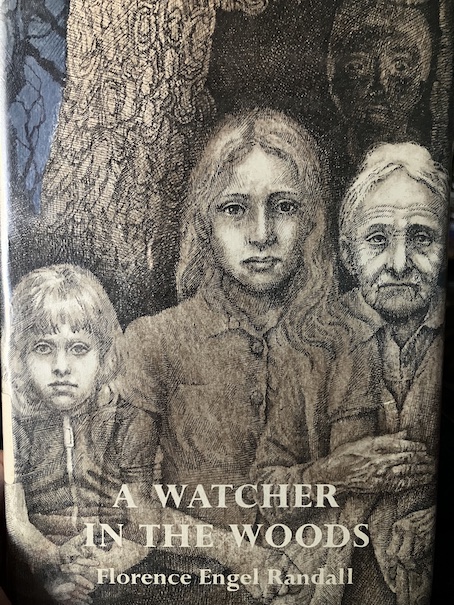
A Watcher in the Woods by Florence Engel Randall, 1976.
The Carstairs family is moving from Ohio to a small town in Massachusetts because Professor Carstairs will be taking a new job as head of the English department at the local college. Fifteen-year-old Jan knows that she will find the move harder than her parents or her younger sister. Her father will be busy with his work, and her mother will make friends with the wives of other faculty at the college. Jan knows that her little sister, Ellie, is still very young and in elementary school, and she won’t find changing schools as difficult as she will. Jan isn’t looking forward to trying to fit in at the local high school.
The family’s first difficulty in moving is finding a house in this new town that they like. Because it’s a small town, their options are limited, and it seems like there’s something wrong with each of the houses they see. Then, their realtor suggests that they view the old Aylwood place outside of town. Living there would mean a longer distance to drive to the college and the girls’ schools, but it’s a nice, big house with some land attached to it. The land includes woods and a pond. Elderly Mrs. Aylwood can’t afford to maintain the place anymore, but she has been reluctant to sell the house. She is very attached to it and she wants to make sure that, if she sells, that she will sell it to the right kind of people, who will take care of the land and woods.
From the first time that Jan and her family visit the house, it gives Jan a strange feeling. She has the oddest feeling that someone (or something) is watching them from the woods, and it frightens her. However, when she tries to explain her uneasy feelings to her mother, her mother thinks that it’s her imagination. Jan can’t deny that the house and wood give her the feeling of a fairy tale and that Mrs. Aylwood reminds her of a fairy tale witch.
For some reason, Mrs. Aylwood becomes more welcoming to the Carstairs family after she sees Jan, and she begins asking Jan some rather odd questions about herself. Mrs. Aylwood admits that Jan reminds her of her own daughter, Karen, who she lost 50 years ago when she was only 15 years old. Jan begins to understand that Mrs. Aylwood’s attachment to the house is because it’s a link to her daughter’s memory, but she soon begins to realize that there’s more to it than that. Mrs. Aylwood asks Jan what kind of person she is and makes a cryptic comment about how Jan is a human but there are other things besides humans.
Jan’s uneasy feeling of being watched continues, and mirrors in the house are inexplicably broken in an x-shaped pattern. When she befriends a neighbor, Mark, and talks to him and his mother about the house, she learns that Karen did not die but that she disappeared 50 years ago. She apparently went out for a walk to the pond in the woods one summer morning and simply vanished with no explanation. Searches for her never lead anywhere. Most of the local people believe that Karen ran away from home, although it would have been out of character for her to do that. Jan begins to wonder if the watcher she senses in the woods could be Karen, somehow hiding out or having returned after all these years, although Mark says that doesn’t make sense. Then, remembering Mrs. Aylwood’s comment about things that aren’t human, Jan wonders if the watcher could be Karen’s ghost. What if she died all those years ago, and her spirit haunts the woods?
It seems like someone or something is communicating with Ellie. Ellie seems to hear something speaking or humming when Jan can’t. Something even suggests to Ellie that she name her new puppy Nerak, which Jan realizes is “Karen” spelled backwards. Is Karen trying to communicate with them, or is it something else?
The book is available to borrow and read for free online through Internet Archive. This book has been made into movie versions twice, but the Disney movie from 1980 is more faithful to the original story. I’ll explain why below, but it involves spoilers.
My Reaction and Spoilers
When talking about my opinion of this book, I really need to include some spoilers. This is a very unusual book because it isn’t obvious until about halfway through what kind of story it really is. From the beginning, it’s set up like a ghost story, with Karen’s mysterious disappearance, the sense of something watching the house and family from the woods, and something trying to communicate through Ellie. It’s very suspenseful and mysterious, but this is not actually a ghost story. It’s really science fiction.
Karen isn’t dead, but she has been trapped in an alternate dimension since she disappeared 50 years ago. A being from that other dimension has also been trapped in our world since then. This other being is the mysterious watcher in the woods. Jan correctly senses that this other being is also female and a child, although beings of its kind live extraordinarily long lives because time works differently in their dimension. What has been 50 years for everyone else has only seemed like a day to her. She wants to return home, but she has had to wait for conditions to be right. She also wants to help Karen, and she has been struggling to communicate with Mrs. Aylwood and Jan and her sister so she can tell them what they need to do.
In the Disney movie, there are a couple of major changes from the original book. The first is that the location is changed from the US to England, although Jan and her family are Americans. It also features a kind of initiation ritual that Jan was undergoing just as her switch with the creature from the other dimension happened, adding an element that seems supernatural, although it is still science fiction. At the very end of the Disney movie, Jan brings Karen back from the other dimension, but in the book (Spoiler!) Mrs. Aylwood goes to join Karen in the other dimension instead.
In the book, Jan’s mother worries about what life would be like for Karen if she returns, aged 50 years in what must have seemed like only a day, having lost most of her life, or what it would be like if she has not changed at all but her mother has aged 50 years, and the world has been through so many major changes since she left. It isn’t clear whether or not Karen has aged in the other dimension, but Jan’s mother’s point is that the world she came from has definitely changed. Karen can’t go back to her old life, and there is some sadness about that and about what Mrs. Aylwood has been going through since Karen disappeared. However, Mrs. Aylwood decides to join Karen in this other world, where she’s been. We don’t really know what Karen’s condition is in the other dimension because we don’t see her. She may have aged very fast there, although I think they imply that she has not aged at all because time works differently in the other dimension. Since time works differently there, it seems like they either won’t age further there or will do so much more slowly than they would on Earth.
Between the two movie versions, the Disney movie version of this book from 1980 is more faithful to the original story because it maintains the concept that this is a science fiction story and that the watcher in the woods is a being from another dimension. The movie version from 2017 turns the story into a ghost story with no science fiction elements. In the ghost story version, Karen is also still alive and hasn’t aged after being gone for many years, but the watcher in the woods is a ghost who is holding her captive. It’s a spookier version, but I think the logic of the original book, with its science fiction theme, makes more sense.
The premise of the ghost story didn’t make as much sense to me because the ghost’s motives seem confused. First, the ghost takes Karen captive because she was staging a stunt for some friends where she appeared to be mocking the way he died. Then, he seemed to want to keep a girl for company, which is weird because it doesn’t seem like he interacts with Karen while he has her. He tries to make a bargain where he would be willing to release Karen in exchange for Ellie, but in the end, it turns out that human company isn’t really what he wants. (Spoiler!) He wants a ritual for his death that he was deprived from having when he was killed. The story just seemed to be all over the place with the ghost’s motives and desires. Is he out to punish Karen for her disrespect, lonely without human company, or just trying to get attention from the living to fulfill his final wishes? Even he doesn’t seem clear about that, which is why I prefer the sci-fi version.
I also thought that the premise of the sci-fi story was more original, and I enjoyed the twist of a story that seems like a ghost story but really isn’t. If any sufficiently advanced technology might look like magic to someone who had never seen it before, as Arthur C. Clarke said, it makes sense that any being who was sufficiently different from the human experience might appear to be some kind of supernatural creature to human beings who didn’t know what they were perceiving.
The Disney version from 1980 actually has multiple endings because the first endings they filmed didn’t quite work and didn’t get a good reaction from audiences. If you’re curious about what the three endings are like, Jess Lambert explains them in her YouTube review of the movie.


















 Jestress's Forgotten Books and Stories