Encyclopedia Brown and the Case of the Dead Eagles

Encyclopedia Brown and the Case of the Dead Eagles and Other Mysteries by Donald J. Sobol, 1975.

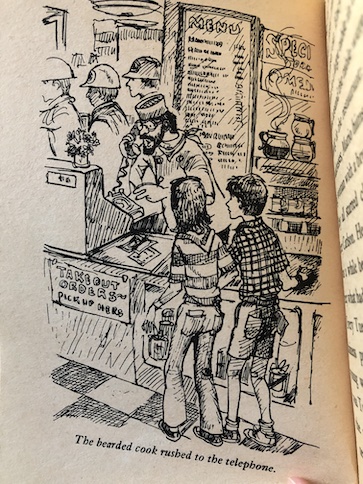
The Idaville police department has an excellent record, but that’s because the chief of police’s ten-year-old son is Encyclopedia Brown. People praise Chief Brown, and Chief Brown doesn’t feel like he can admit how much help his son gives him because he doubts anyone would believe him. Encyclopedia himself doesn’t want to admit to other people that he helps his father figure out tough cases because he doesn’t want to seem too different from the others kids at school. However, Encyclopedia also has a detective business, helping the neighborhood kids to solve their problems for only 25 cents a day, plus expenses. Sally, a smart and tough girl, is his partner in the detective business, and Bugs Meany, a bully who’s the leader of a local gang of youths called the Tigers, is their main nemesis, although they also deal with other bullies and criminals.

I always liked Encyclopedia Brown books when I was a kid! There are a couple of instances where modern kids might not understand the solutions to some cases because of certain habits and traditions that modern people don’t follow anymore. There is one case in this book in particular that I didn’t understand when I was a kid, and I wouldn’t expect modern kids to get the answer, either.

The book is available to borrow and read for free online through Internet Archive (multiple copies).

Stories in the Book:

The Case of the Dead Eagles

Encyclopedia is camping with his friend Charlie Stewart when they hear a gunshot. When they go to investigate, they find a dead eagle. They think they know who’s responsible because this person has killed eagles before. Can they prove it in time to save the mother and babies from the same fate?

The Case of the Hypnotism Lesson

A boy named Dave hires Encyclopedia because he thinks Bugs Meany cheated him. (Always a likely possibility in anything Bugs does.) This time, Bugs charged Dave a dollar for a lesson on hypnotizing lobsters. Dave saw Bugs and his friends cooking and eating lobsters they had caught earlier, and Bugs told him that the secret to catching lobsters is to hypnotize them. However, when Dave gave him the money, Bugs just showed that he could pick up a lobster, and the lobster wouldn’t move. He didn’t actually show Dave any hypnotism and refused to teach him anything unless he paid more money. Dave realizes that Bugs was trying to trick him and wants his money back. When Encyclopedia sees a picture that one of Bugs’s friends took, he knows how to prove that Dave was cheated.

The Case of the Parking Meters

Both Encyclopedia and his detective partner Sally have received phone calls asking them to meet people at different locations, but each time, they waited around, and nobody showed up. They’re starting to suspect that this is another of Bugs Meany’s tricks, trying to get back at Encyclopedia for foiling his schemes. Sure enough, Bugs Meany shows up at Encyclopedia’s house with a police officer, claiming that Encyclopedia is running a racket to get money from people parked at parking meters by putting money in the meters, telling them that they’ve been saved from the fine for an expired meter, and asking them for money for the favor. The police officer isn’t sure that such a thing is actually illegal, although he’d have to inquire with a judge about the matter. Bugs claims that he could prove what happened except that Sally stole the film that he had of Encyclopedia putting money in the meters. When Bugs manages to “find” the film where Sally supposedly ditched it after taking it, Encyclopedia points out why Bugs’s story can’t be true. The solution would make more sense to somebody who understands how reel-to-reel films work.

The Case of the Hidden Will

Encyclopedia’s father, Chief Brown, tells him that a wealthy man named Brandon King has died, but his will is mysteriously missing. Evidently, Mr. King hid the will himself and swore his own lawyer to secrecy about it. The reason for the secrecy is apparently because one of Mr. King’s four sons, who all helped to run the family business, is a thief. Mr. King’s friends knew that was the case, although none of them knew which son it was. Mr. King’s lawyer gave Chief Brown a note written by Mr. King which hints at which son is the thief and saying that his property will go to the other three sons. Chief Brown isn’t sure which of the Kings is considered the “odd King out” until Encyclopedia tells him who it has to be, and Encyclopedia also tells him where the will is.

The Case of the Mysterious Thief

Encyclopedia and Sally go to a restaurant to order a pizza for lunch. While they’re waiting for their pizza, someone attacks the owner’s daughter in the ladies’ room and steals the money she was going to take to the bank. The owner’s daughter is very strong, and it must have taken someone very strong to overpower her and knock her unconscious so quickly and easily. It doesn’t seem likely that it would be a woman, but people would have noticed if a man had gone into the ladies’ room. Sally figures out the answer to this one, but it isn’t likely that modern readers. I didn’t get it when I was a kid, either, because the solution is based on an old piece of etiquette in restaurant seating that I don’t think people observe anymore.

The Case of the Old Calendars

Encyclopedia and Sally hurry over to Butch Mulligan’s house because they hear that Butch is fighting Bugs Meany and the Tigers. Butch is a big, strong 18-year-old, and the Tigers are no match for him. Encyclopedia asks Butch’s younger brother how the fight started, and he explains that Butch’s math teacher recently moved and gave Butch a stack of old calendars with some cool Civil War pictures on them. Then, Bugs claimed that he asked the teacher for those calendars himself, but the teacher forgot. He produced a note supposedly from the teacher that asks Butch to share the calendars with Bugs. Butch was willing to share, but there are an odd number of calendars, and Butch thinks Bugs cheated on the coin flip they had to determine who would get the odd one. He probably did, but Encyclopedia can prove that Bugs faked the note from the teacher, too.

The Case of Lightfoot Louie

Only a few days before the state worm-racing championship, Encyclopedia’s friend Thad accidentally stepped on his prize worm. It’s sad, but as a member of the Worm Racers’ Club of America, Thad can time other people’s worms to be entered in the race. He’s worried because Hoager Dempsey wants him to time a worm, and if he says the worm isn’t fast enough to enter the race, Hoager might beat him up. Thad asks Encyclopedia and Sally to watch the time trial as witnesses to make sure there’s no foul play.

The Case of the Broken Window

John Hall is a wealthy man with an impressive stamp collection. Some of his stamps are worth thousands of dollars. One evening, he calls Chief Brown and asks him to come to his house but to wear a costume because he’s giving a costume party, and he doesn’t want his guests to know that he’s called the police. Chief Brown and Encyclopedia put on their Halloween costumes and go to the Hall estate to investigate the theft of one of Hall’s expensive stamps. Hall thinks one of his guests is the thief, but which one?

The Case of the Gasoline Pill

“Twinkletoes” Willis is a young track star, and he comes to see Encyclopedia about a run-in that he had with Wilford Wiggins, a local high school dropout who’s into get-rich-quick schemes. Wilford has called a meeting of local kids at the city dump to tell them his latest money-making idea, which can only mean trouble. Wilford’s latest money-maker is a pill which he says allows cars to drive thousands of miles if you put it in the gas tank. Fortunately, Encyclopedia knows just how to prove that Wilford is a fraud.

The Case of the Pantry Door

Hilda’s hobby is fly hunting, and she’s a crack shot with rubber bands. She invites Encyclopedia and Sally to a little birthday party that she’s having for her pet frog, who lives in the birdhouse in her backyard. When Encyclopedia and Sally go into the pantry at Hilda’s house for sugar for catching flies, someone locks them in and steals the household money that Hilda’s mother hid in the kitchen. Hilda’s cousin, Lois, says that she saw a boy running away from the house, but Encyclopedia knows who really took the money.

Blackbeard’s Ghost

Blackbeard’s Ghost by Ben Stahl, 1965, 1976.

This is the novel that the live action Disney film Blackbeard’s Ghost from 1968 was based on. My copy is a later edition designed as a tie-in with the Disney movie, based on the cover, but it contains the text of the original story.

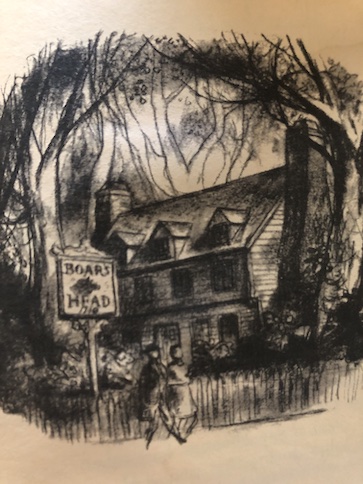
The story begins with a prologue that explains how Blackbeard the pirate evaded execution for piracy by offering to collect tolls from ships on behalf of the colonial governor, Governor Eden, in the town of Godolphin. However, instead of collecting tolls from the ships, he decided to use his position for his own benefit. Knowing that he would eventually need a source of stability on land instead of spending the rest of his life at sea, he looted wood from various ships and used it to build a tavern for himself called the Boar’s Head. He hired a woman rumored to be a witch, Aldetha, to tend the tavern for him. In the end, though, Blackbeard was killed by someone who wanted to collect the bounty on him for piracy. After his death, the poor woman who tended his tavern was burned at the stake for witchcraft.

(Note: The witch burning is historical inaccuracy because no witchcraft executions in North America involved burning, at least not in English-controlled parts of the American colonies. Accused witches in North America were typically hanged. None of this story is meant to be historically accurate, but I always feel compelled to point that out in stories that make that mistake. The town of Godolphin and the Boar’s Head Tavern are fictional. In real life, Blackbeard did receive a pardon from the real Governor Eden in Bath, North Carolina, and he was eventually killed in 1718 in a battle with Lieutenant Robert Maynard and his crew, as he did in this story. However, in the book, the tavern is now owned by a descendant of Maynard’s, and in real life, Maynard didn’t have any children.)

Most of the story takes place in the 20th century, when two 14-year-old boys, J.D. and Hank, talk about how the old Boar’s Head Tavern is about to be torn down because the former owner sold it, and there’s going to be a gas station built on the land instead. They think it’s a shame because they’ve heard ghost stories about the place and think the old tavern is fascinating. The boys go to watch the workmen tearing down the old tavern, but the workmen haven’t made any progress so far. Although they’d love to loot some of the expensive woods from the old tavern, they just can’t seem to dismantle the building. They’ve been able to dismantle some of the newer additions to the building, but somehow, they can’t seem to touch the original structure. The site has been plagued with mysterious accidents. Their equipment fails, heads fall off the ends of their hammers, and workmen keep getting injured in small accidents, not enough to seriously hurt anyone but enough to keep them away from their work for days at a time.

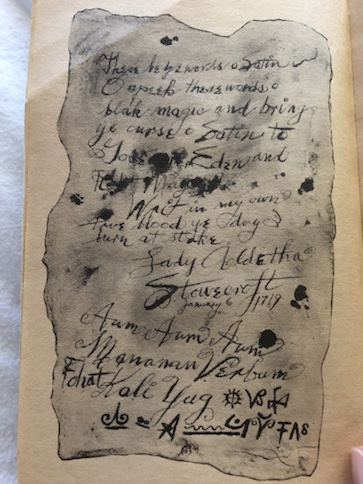
When J.D. and Hank see the workmen leaving the building in frustration soon after arriving, they decide to go inside and look around to satisfy their curiosity and see if there’s anything of value that they can salvage before the tavern is demolished. They don’t find much of value, but they do find their way into Blackbeard’s secret dungeon under the tavern. There, they find a piece of old parchment with a satanic curse written by Aldetha. (So, apparently, people were actually right about her being a witch. Plot twist!) Inspired by this creepy message from the past, the boys realize that they can make money from other kids by capitalizing on the ghost stories about the old tavern and holding seances to contact the spirits. They don’t really believe that seances are real, but they figure that, if they can get enough ghost-story fans to come to their seances, they can make a profit from this enterprise.

Of course, the boys’ seance awakens the ghost of Blackbeard. Blackbeard is invisible to everyone except for the boys, but he’s a solid ghost, who can manipulate physical objects. The boys quickly realize that Blackbeard can be a dangerous ghost, and he’s not at all happy when he finds out that a descendant of the man who killed him wants to have his tavern torn down.

The book is available to borrow and read for free online through Internet Archive. The Disney movie is available to buy or rent through YouTube or Amazon Prime. There is also a sequel to this book called The Secret of Red Skull, which involves spies and is also available online through Internet Archive.

My Reaction and Spoilers

There is some humor in this book because only the boys are able to see and hear Blackbeard, but by the end of the story, adults become aware of Blackbeard’s ghost, too. The boys’ history teacher is helpful in finding a way to appease the ghost by helping him to negotiate to buy back his tavern using his hidden treasure. When it becomes obvious both to Maynard and the company he tried to sell the tavern to that it’s haunted, they’re willing to accept pirate gold in exchange. The company also sees that it can use the building for public relations purposes by sponsoring a pirate museum in the old tavern. It’s good news for the teacher, too, because he gets to be the director of the museum. There, he can show off his collection of pirate memorabilia and indulge his love of pirate history. The tavern continues to be haunted by the ghosts of Blackbeard and his witch friend, leaving the story open for the sequel.

As expected of Disney films, the Disney movie version of the story is quite different from the book. In the movie, the person who can see the ghost is a college track coach who is staying in the old inn, which is still being operated by elderly descendants of Blackbeard’s old crew. There is a track meet in the movie that never appeared in the book, and at the end of the movie, Blackbeard disappears, having been freed from his haunting by performing a good deed.

I prefer the concept of the boys being the ones who accidentally summoned Blackbeard’s ghost, but the boys got on my nerves at first. In the early part of the book, they bickered a lot and didn’t seem to like each other enough to be best friends, although they seemed to be friendlier with each other later, when they were both trying to figure out what to do about Blackbeard. I think the teacher character was my favorite. He takes the matter of the ghost in stride, coming up with a practical solution that helps everyone.

Carrie’s War

Carrie’s War by Nina Bawden, 1973.

The story begins with an adult Carrie reflecting on her youth during World War II, taking her children to see the place where she stayed as a child evacuee and remembering an incident that has haunted her for the last 30 years. Adult Carrie is a widow who was married to an archaeologist who died only a few months before the story begins. In some ways, Carrie says that her husband was very much like a boy she used to know during the war, Albert Sandwich. The family trip and Carrie’s memories take them back to a small mining town in Wales and an old house called Druid’s Bottom, now a ruin, that used to house a mysterious skull … and what Carrie regards as the worst mistake of her life. Although adult Carrie knows that, logically, what happened couldn’t have really been her fault, there are some things in life that are difficult to prove or disprove, and she’s always blamed herself for what happened.

When Carrie Willow was eleven years old, she and her younger brother, Nick, were evacuated from London along with other children to avoid the bombings. All of the children were told to report to their schools with a packed lunch and a change of clothes, and none of them had any idea where they would be taken after that, only that their parents wouldn’t be going with them. Their mother tried to frame it all as a great adventure that they would enjoy, but the children were understandably worried. They had to wear labels on their clothes with their names on them, and they had to carry gas masks, which is never a reassuring thing to be told you might need. (Young Carrie thinks to herself that her mother is such an optimist that, if they found themselves in Hell, she’d look on the bright side and say, “Well, at least we’ll be warm.”)

The children’s teacher takes them aboard a train, and they head off into the countryside, ending up at a coal-mining town in Wales that doesn’t look like much. That’s where Carrie meets Albert, another boy who rode with them on the train. Albert is tall and serious and wears glasses. His first concern is that the town isn’t big enough to support a proper library. Carrie is mostly concerned about keeping her brother with her and making sure that someone will be willing to take them both together. (Hosts for WWII evacuees were told how many children they were expected to take in, but they were given the opportunity to choose which ones they would host from among the children available. Sometimes, siblings were split up if they couldn’t find accommodations that could house them together.)

Carrie and Nick are eventually chosen by Miss Evans, a woman who lives with her brother. Originally, Miss Evans had been hoping for two girls so they can share the one spare room that she and her brother have, but Carrie persuades her that she and Nick sometimes share a room at home because he has bad dreams. Miss Evans is a shy and nervous woman, and her brother, Samuel Evans, is ultra-strict and fussy. Everything in their house is super neat, and they have special rules to keep it that way. Carrie and Nick aren’t even accustomed to picking up after themselves because their family has a maid who does all the cleaning. The house has a bathroom with running hot and cold water, but if they have to go to the bathroom in the middle of the day, Mr. Evans wants them to use the outdoor one in the yard to avoid messing up the new carpet on the stairs with too much “traipsing” up and down. Even Miss Evans uses the outdoor bathroom, although Samuel Evans never does because he thinks it’s unseemly because of his position in the community as a store owner and town Councillor. So, for starters, Mr. Evans makes strict rules for others to follow that he doesn’t follow himself.

Carrie can tell right from the first that Samuel Evans is a bully who pushes people around, especially his sister. He’s much older than his sister and helped to raise her after their parents died. Really, Miss Evans was raised with Mr. Evans’s son, Frederick, who is now in the army, being more like her brother than her nephew. Now that Mr. Evans’s wife is dead, there’s no one else in the household but the two of them. When Miss Evans and Frederick were young, Mr. Evans used fear, intimidation, and harsh physical punishment to keep them in line. However, Mr. Evans can’t really bully the children because Carrie is careful not to show that she finds him intimidating, and Nick just isn’t intimidated because he refuses to be impressed by anybody with false teeth. Still, Carrie realizes that they should try to keep out of his way and not make him angry.

Samuel Evans is also very strict about religion. One day, when Nick eats some biscuits in his shop, Mr. Evans declares that he’s been stealing and that he’s going to get the strap for it. Carrie is horrified because their parents don’t use physical punishment, and Nick is terrified. Miss Evans is too afraid to intervene, so Carrie steps in and defends Nick, just saying that he didn’t understand that it was stealing to eat the biscuits. Mr. Evans says that’s not a good excuse, but Nick says that if he whips him, he’ll go to school and tell the teacher that Mr. Evans beat him for taking food because he was hungry. Mr. Evans realizes that, while other adults might not fault him for punishing a thief, they would if it looked like he was starving and neglecting his charges as well as beating them. Instead of giving Nick a beating, he prays out loud for Nick to turn from his “evil ways.” It’s difficult for Carrie to listen to because she realizes that Nick hasn’t been starved, wasn’t really hungry, and should have known better than to take the biscuits, and now, he’s made an enemy of Mr. Evans. They don’t have much choice other than staying in the Evans house because they can’t go back to their parents yet, and there just aren’t any other places in town for them to stay. The kids become fond of Miss Evans, who they start calling “Auntie Lou”, but they always have to be wary of Mr. Evans.

When their mother comes to visit, Mr. Evans acts extra nice to the children and tries to be charming to their mother. The children’s mother has some misgivings about how the children are being treated, but the children don’t complain about some of the harder aspects of living with Mr. Evans because they don’t want their mother to worry. She’s been working as an ambulance driver in Glasgow because her husband’s ship makes port there, and she can see him sometimes. She needs to know that her children are safely settled somewhere to continue her work, and the children have also grown attached to Auntie Lou and don’t want her to get into trouble, even if they don’t like Mr. Evans.

Shortly before Christmas, Auntie Lou explains to the children that she and Mr. Evans have an older sister named Dilys, and she’s giving them a goose for Christmas dinner. The reason why the children haven’t met Dilys before is that Auntie Lou and Mr. Evans don’t really get along with her and hardly ever see her. Mr. Evans in particular resents Dilys because, years ago, she married into the Gotobed family. The Gotobeds owned the mine nearby where their father was killed in an accident. Mr. Evans always blamed the Gotobeds for their father’s death because they didn’t have adequate safety measures, and he felt like Dilys was turning her back on the family by marrying Mr. Gotobed’s son. Now, Dilys is a widow, and she’s not in very good health, which is another reason why she doesn’t get out much. She lives in the old house known as Druid’s Bottom, at the bottom of Druid’s Grove, where the yew trees grow. A woman named Hepzibah Green looks after her and the farm where they raise poultry. Local people are rather superstitious about Druid’s Grove, but Carrie thinks it sounds wonderfully spooky and exciting. Auntie Lou and Mr. Evans send Carrie and Nick to Druid’s Bottom to pick up their Christmas goose from Hepzibah Green because Auntie Lou gets sick and can’t go herself.

On the way to Druid’s Bottom, Carrie and Nick are scared because they think they hear something chasing them, making odd sounds. It turns out that it’s only Mister Johnny, a cousin of Mr. Gotobed, Dilys’s deceased husband. Mister Johnny has developmental disabilities and can’t talk very well or understandably to most people, which is why he lives with Dilys in Druid’s Bottom and is cared for by Hepzibah. Hepzibah has been Johnny’s nurse since he was a baby, and she now cares for the elderly and ill Dilys as well.

Albert Sandwich has been staying at Druid’s Bottom, also in Hepzibah’s care, since Carrie and Nick last saw him. Albert tells them that Hepzibah is a kind of witch who knows some kind of healing magic. Albert hasn’t been to school with the other children because he was very sick after they last saw him, and Albert thinks that he only survived because Hepzibah gave him herbal medicines. Albert loves Druid’s Bottom because of Hepzibah and also because the old house has an impressive library. In the library, Albert also shows Carrie a strange curiosity – an old skull. The story surrounding this skull is that it’s the skull of an African slave boy who was brought to this house years ago. (Albert explains to Carrie that he doesn’t believe that because he’s examined the skull. He explains that the number of teeth suggest that the skull was from an adult, not a boy, and the size and shape suggest that it’s the skull of a woman. Albert suspects that some local person actually found the skull at the site of an Iron Age settlement nearby.) According to the legend of this skull (or what people say the legend is), the young slave boy died of a fever, and on his deathbed, told the Gotobed family that they must keep his skull in the house or the walls would fall. Hepzibah says that one of the Gotobeds’ ancestors tried removing the skull from the house once, and during the night, all the crockery in the kitchen broke and the mirrors in the house cracked for no apparent reason. When they brought the skull back into the house, they didn’t have any further problems. Albert is skeptical of this story, but it’s captivating for Carrie.

Carrie finally meets Dilys Gotobed one day when everyone else is busy and Hepzibah asks her to take tea up to Mrs. Gotobed. Dilys is a sad and weak old woman who doesn’t have much time left to live. She lives mostly in her memories, spending each day wearing the fancy ball gowns that her husband bought for her years ago one last time before she dies. All of her talk of death gives Carrie the creeps, but Dilys makes her promise to take a message to her brother after she dies. She insists that the message must be delivered only after her death because it’s sure to make Mr. Evans angry and Dilys isn’t up to dealing with his anger. The message is somewhat cryptic. Basically, Mrs. Gotobed wants Mr. Evans to know that she hasn’t forgotten him and she remembers that they’re still brother and sister, but she feels like she owes more to others than she does to family. Dilys has done something that is sure to make Mr. Evans angry, but she wants him to know that she did it only because she thought it was the right thing to do and not just to spite Mr. Evans. Carrie reluctantly agrees to deliver the message after Dilys is dead.

The meaning of the message becomes clear when Dilys finally does die. Dilys’s only relatives are Mr. Evans and Auntie Lou, but she wanted to provide for Hepzibah and Johnny because of their companionship over the years. At first, Carrie thinks that Mr. Evans will be reassured that his sister thought of him near the end, but Carrie hasn’t fully grasped Mr. Evans’s reactions. Mr. Evans flies into a rage at the suggestion that Hepzibah might inherit from Dilys instead of him. He storms over to Druid’s Bottom to search for a copy of Dilys’s will to establish who is going to inherit. Mr. Evans later says that he couldn’t find one, and even Dilys’s lawyer says that Dilys’s didn’t make a will or leave one with him. If that’s true, and there is no will, Dilys’s estate would go to her nearest relatives, which basically means Mr. Evans. But, is that the truth?

While Dilys may have meant to provide for Hepzibah and Johnny, she was so ill near the end of her life that she may have forgotten about making a will. Her mind wasn’t entirely there, so she may have thought that she’d already done it when she hadn’t. However, there is another explanation. What if Mr. Evans did find something in writing from Dilys about her last wishes for her estate? What if he stole or destroyed Dilys’s will or something she left behind? That’s what Albert believes. He’s ready to believe the worst about Mr. Evans because he is unquestionably a mean, bitter, and vindictive man, but Carrie still has trouble believing that Mr. Evans could do something so deliberately evil. Albert somewhat blames Carrie for delivering the message Mrs. Gotobed gave her for Mr. Evans, alerting him to the possibility that there might be another heir to the estate, depleted though that estate is. Carrie was only doing as Mrs. Gotobed asked as one of her final wishes, but Carrie does feel responsible, especially if Mr. Evans did what Albert suspects.

In the midst of Carrie’s guilt that Mrs. Gotobed’s wishes are not being honored and her anger at Mr. Evans for wanting the house all to himself and kicking out Hepzibah and Johnny, Carrie decides that there’s only one thing left to do in order to make sure that Mr. Evans never takes possession of the house. It’s a terrible, impulsive decision, and it’s only after she’s done it that Carrie realizes that she also may have misjudged the situation yet again. It’s also only when she returns to Druid’s Bottom as an adult that she comes to see the full truth of the situation and that what she’s done may not have been as bad as she thinks.

This book is very well-known, and it was made into a television mini series in 1974 (you can sometimes find clips or episodes on YouTube) and a movie in 2004. The book is available to borrow and read for free online through Internet Archive (multiple copies).

My Reaction and Spoilers

I saw the 2004 movie before I read the book. The movie follows the book very well, and after I looked up the television mini series, I decided that it also follows the book well. The section in the back of the book about the author explains that Nina Bawden was also a child evacuee from London during World War II, so the book was partly inspired by her experiences.

In real life, when children were evacuated from London to be safe from the bombings during World War II, they went through some of the same feelings of homesickness and unfamiliarity that the children in this story also go through. First, they’re worried about being far from home. They don’t even know where they’re going and who they’re going to be staying with when they get there. During the scene where they’re being selected by foster families, they worry about who will choose them and what will happen to them if no one wants them. It’s all very realistic, and people who were among the child evacuees of the time describe going through a similar process.

There’s also the adjustment that the children have to make living in a household with unfamiliar people and different rules and circumstances from what they’re used to in London. London at the time was a large cosmopolitan area, like it is today, but back in the 1940s, small towns and houses in the countryside had far fewer amenities than in modern times. Real life child evacuees were accustomed to indoor plumbing in London, but they didn’t always find that in the places where they had to stay during the evacuation. The characters in the story find a mixture where they’re staying. The fussy head of the Evans household has indoor plumbing, but he doesn’t allow everyone to use it during the day because he doesn’t want everyone constantly going up and down his wonderful carpet on the stairs, so they also have to use the outdoor privy.

Mr. Evans’s fussiness and anger issues are also, sadly, true to life. The real life evacuees came from a variety of backgrounds and were accustomed to different styles of home and family life, and what they encountered in their foster homes during evacuation could be wildly different from the life they had at home, both for better or for worse. Some foster families could be warm and welcoming to the child evacuees, but sadly, many were not, resenting the new obligations that had been thrust on them because of the war. (Households were told that they had to accept evacuees if they had room for them, and there was no option to refuse.) There were foster families who ended up keeping or adopting children they took in during the war because they were orphaned or abandoned by their parents by the time the war ended. Some children ended up drawing closer to their foster families than their birth families because they came from an unhappy home life in the beginning, and they found themselves liking the new life they found. Others had a very unhappy experience, feeling unwanted, unwelcome, or even abused by their temporary foster families. Unhappy children could try to reunite with their parents, transfer to a different household, or even just run away, and some did all of these things. (To hear about the experiences of real life evacuees in their own words, listen to this documentary or this interview series on YouTube.)

In the story, Carrie and Nick seem to come from a happy home life with close-knit family. Their family is not poor because they could afford a nice house with a maid, and their parents seem kind and understanding and do not use physical punishment of any kind with the children. The Evans household is a step down for them. The fact that Mr. Evans, as a shopkeeper, doesn’t seem to have as much money as their family did when they lived in London isn’t so much of a problem as Mr. Evans’s personal issues and bullying nature. Mr. Evans is a troubled person, twisted by anger and resentment, and rather than dealing with these issues himself, he takes them out on other people, even people who are not the source of his anger and resentment.

As the story unfolds, the children learn about Mr. Evans’s sad history with his older sister, Dilys. He and Dilys were once rather close, but their relationship unraveled when she married Mr. Gotobed, the son of the man who owned the mine where their father was killed in an accident. Not only did it seem like a betrayal, to marry into the family of the man Mr. Evans blamed for their father’s death, but Dilys also suddenly became a wealthy woman by marrying into a wealthy family, while the rest of her family was still poor working class. There were apparently even times when Dilys rubbed it in, making the situation worse. Mr. Evans had to work his way up from the son of a miner to becoming the local shopkeeper and a prominent member of the community, and even then, he’s still not as well-off as his sister, who simply married into money and has never had to work herself. Instead of just taking pride in his achievements, Mr. Evans can’t get over the injustice of his relative position with his sister, that she has it all easy, and he’s had to work and scrimp for everything he has. That’s why’s he’s ultra-protective of things he owns, like the biscuits in the shop or the new carpet on the stairs, and why he’s so controlling of the people in his life. In spite of his accomplishments, he feels “small” next to his sister who married wealth and always has more than he has. He’s constantly trying to assert his authority to avoid feeling “small”, but it never really works because he can’t change who his sister married, he’s never going to be rich, and he can’t internalize the idea that he can still be somebody worthwhile even if he’s not the guy who has the most money and power. He’s tied his sense of self-worth to what he has and the amount of control he has over everyone, so he can’t give up any part of it. He’s had all of these resentments for so many years that they’ve all been brewing inside him and explode out whenever any little thing in his tightly-controlled world goes wrong or he thinks he stands to lose something he regards as his. This life hasn’t been healthy for his younger sister, Auntie Lou, who has lived with Mr. Evans and his controlling nature and temper tantrums since she was young, and it’s not really healthy for Carrie and Nick, either.

Carrie becomes sympathetic to Mr. Evans, although Nick can’t understand why, because she sees the sadness and loneliness at the core of his bad behavior. Carrie is a very sympathetic/empathetic person, but one of the questions of this story is how far should someone go with sympathy/empathy when they’re dealing with a person who is causing harm to people around him. Mr. Evans is a toxic person. He is causing harm to others, and before the story is over, Auntie Lou runs away from the house to marry an American soldier she met, leaving her brother to live alone. By this point, the children know that they won’t be living with Mr. Evans much longer because their mother has sent for them to join her in Glasgow because she’s found a place for them to all live together. Carrie and Nick won’t be living with Mr. Evans or facing his temper problems, stinginess, or selfishness anymore. Carrie feels sorry for for Mr. Evans, an aging man who is now left alone. His only other living relative, his son, has already said that he isn’t planning to come back and run his father’s store after the war, although Mr. Evans doesn’t know it yet, so he’s going to be even more alone than he knows. Carrie sees the sadness of Mr. Evans’s situation and feels badly for him, even though at least part of this situation is his own making. However, Nick and Albert don’t like Carrie’s sympathy for Mr. Evans because her attempts to reach him emotionally put everyone else in a vulnerable position to Mr. Evans’s wrath because he’s never as sympathetic, understanding, or rational as Carrie expects him to be.

When the question arises of whether or not Mr. Evans could have stolen or destroyed Dilys’s will in order to get her house and get rid of Hepzibah and Johnny, Albert is prepared to believe that he did. He is a vindictive man, driven by his bitterness, and does not always behave rationally. Nick says he sometimes cheats his customers in petty ways, like giving them 97 saccharine tablets instead of the full 100 he owes them, but other times, he has Carrie give someone the correct change when she’s made a mistake. Sometimes, he extends extra credit or provides free groceries for people in need. Mr. Evans is definitely flawed, but he does still seem to have a system of ethics. Would he really commit a crime, like inheritance fraud?

For all of her sympathy for the sad Mr. Evans, Carrie doesn’t really understand him. For much of the story, she expects him to react to situations as she would and thinks that she can reach him through her own kindness and understanding. By the end of the story, she is partially successful, and she ends up getting to know him better than other characters do, but at the same time, she can’t control Mr. Evans, and it must be acknowledged that Mr. Evans doesn’t control himself. He has a long-standing habit of lashing out at other people that he doesn’t fully confront until he finds himself completely alone with no one else to lash out at but himself. As hard as Mr. Evans works at his professional life, his personal life is a mess because of the way he’s treated the people who should have been close to him, and Carrie can’t solve that for him. While Mr. Evans recognizes the kindness and sympathy that Carrie offers him and becomes fond of her for it, she’s still a child, and Mr. Evans is an adult who has control issues and temper tantrums and long-standing personal issues that have gone unaddressed for far too long. Perhaps Mr. Evans realizes that toward the end, partly through Carrie’s kindness, but it’s hard to say because he’s been wrapped up in feeling resentful and sorry for himself for so long.

Apparently, Mr. Evans wasn’t lying when he said that his sister didn’t leave a will. During a rare moment of candor, Mr. Evans reveals to Carrie that he was deeply hurt when Dilys didn’t even leave him a note or letter on her death. All he found in her jewelry box when she died was a single envelope with his name on it, and all it contained was an old photograph and a ring that he had bought for her as a present years before, when they were still close. Carrie thinks that it’s a hopeful sign, that Dilys remembered how much the present meant to both of them and how much it reminded them of better times, but Mr. Evans says that there wasn’t even a word of farewell with it. This candid moment reassures Carrie that Mr. Evans didn’t find a will and steal it, and more than just being greedy for the property, he is feeling hurt and abandoned by the final loss of his sister and the relationship they once had. What he really craved in the end, more than authority, control, money, or property, was a genuine connection with his sister that he realized he would never have again.

It’s sad, and much of it is still Mr. Evans’s fault, although Dilys also deserves some of the blame because there were times when she rubbed salt into Mr. Evans’s wounds by flaunting the difference in their wealth and social status. A death can make people rethink the relationships they had with other people, but those relationships were forged and maintained (or not) when the person was alive. Death can’t change the way people lived when they had the chance. Mr. Evans and Dilys both had chances to fix things between the two of them in the years leading up to the end, and they never took them. Not only that, but Mr. Evans’s bitter feelings and vindictiveness also poisoned the other relationships in his life. So, in the end, it seems that Mr. Evans isn’t evil, even though he can’t really be called “good”, either. Mr. Evans isn’t out to steal his sister’s estate. If he had found a will and an explanation from his sister, he probably would have honored it, even though it would have hurt to do so. What hurts him the most is not finding anything, only the ring, probably because Dilys wasn’t really in her right mind toward the end and couldn’t get her thoughts together well enough to leave anything in writing, which is why she asked Carrie to talk to her brother instead. There also isn’t as much money connected with the estate as there once was. Since Dilys’s husband died, Dilys hasn’t had any income, she hasn’t been able to keep the house up or retain a staff other than Hepzibah, and she has very little money left. She was living in prideful, genteel poverty while Mr. Evans was feeling resentful of what he thought she still had. In the end, Mr. Evans was the victim of his own pride and bad relationships.

The worst mistake that Carrie ever made in her life was trying to sabotage Mr. Evans’s attempt to take the house away from Hepzibah and Johnny by removing the skull from the house. Caught up in the stories about the skull and its supposed curse that would destroy the house if it was ever removed from the house, Carrie comes to believe that the stories are true and decides to use the legend of the skull to destroy the house and keep it out of Mr. Evans’s hands since he won’t let Hepzibah and Johnny live there. As Carrie and Nick leave Wales, they see that the house is on fire from the train, and Carrie comes to believe that the fire was her fault because of the skull. For years, she believes that Hepzibah, Johnny, and Albert were killed in the fire and blames herself for their deaths. But, again, Carrie still doesn’t understand the full situation.

So, does Carrie end up changing anything for Mr. Evans? I think she touched his heart a bit because she cared about him in ways few other people did (mostly because Mr. Evans himself didn’t have much caring for other people), but as far as Mr. Evans’s life and behavior goes, it’s hard to say whether she would have had any long term effect because (spoiler), she later learns that he died not too long after she and her brother left Wales to rejoin their mother in Scotland. He was under stress when Carrie last saw him, full of unresolved grief and anger at Dilys’s death and feeling abandoned by Lou because of her elopement. Then, while he was in the midst of taking control of what was left of his sister’s estate, Dilys’s house caught fire and burned, and then, Mr. Evans received word that his son was killed during the war. The shock of it all was too much for him, and he had a heart attack and died. Sad as that is, Mr. Evans’s death ends up changing things for the better for Hepzibah, Johnny, and Albert.

In spite of her sense of guilt, Carrie does grow up, get married, and have children. The return to Wales with her children when she’s an adult leads her to confront the past and her feelings about it, but it also reveals the truth (also a spoiler): Hepzibah, Johnny, and Albert are all still alive. The house was damaged by the fire but not completely destroyed. In fact, not only were Hepzibah and Johnny allowed to stay on the property after Mr. Evans died, but Albert has saved up enough money to buy the property and restore it. Albert has never married, and there are hints that he might marry the widowed Carrie and become her children’s new stepfather.

Knights & Castles

The Usborne Time Traveller Book of Knights and Castles by Judy Hindley, illustrated by Toni Goffe, 1976, 1993.

This nonfiction picture book for kids is part of the Usborne Time Traveller Books series, originally published in Britain.

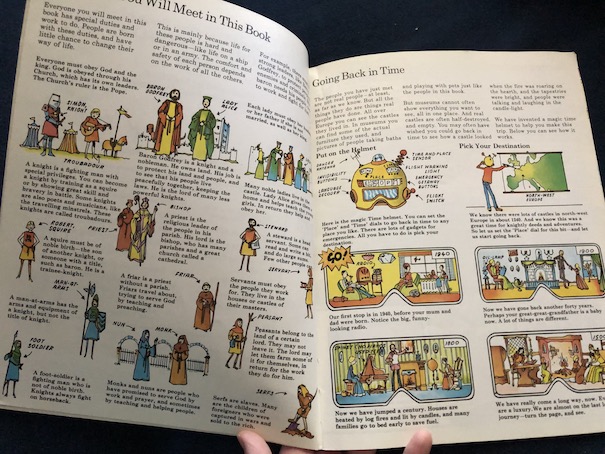
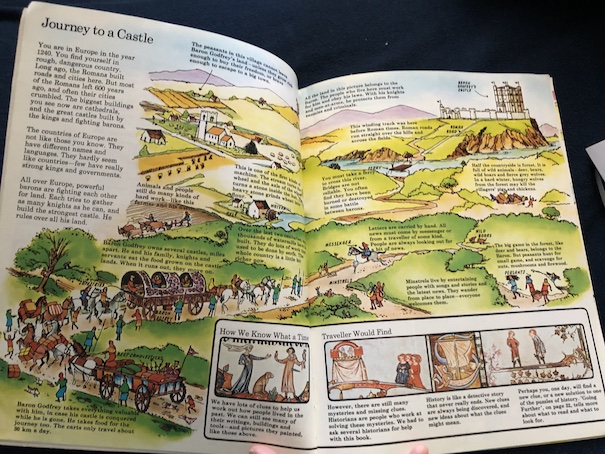
The contents are framed as a time back in time to the Middle Ages, specifically 1240 AD, to see how people would have lived in Medieval times and what castles were like when people actually lived in them. Readers follow a specific set of Medieval characters as they go about their lives.

Our trip back in time begins with a road journey to a castle. Readers see how people in the Middle Ages traveled. The journey page also explains how the Romans built the roads Medieval people used centuries earlier, which is a good historical segue because the period that we call the “Middle Ages” begins with the fall of the Roman Empire and the withdrawal of Roman forces from the furthest parts of its empire. On some pages of the book, there are extra panels at the bottom of the page with additional information, and the first set explains how we know what people would find if they were able to travel back in time to the Middle Ages, explaining how historians have gleaned information from Medieval writings and pictures and from studying physical objects, like buildings and tools.

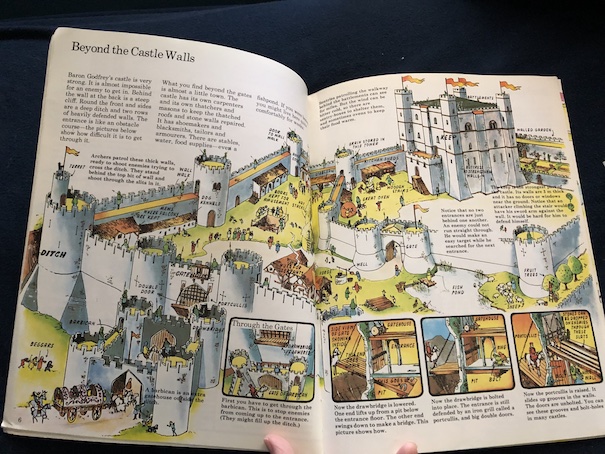
When readers arrive at the castle, the book explains different parts of the castle and how they were used for defense.

I particular like the cutaway pictures of the interior of the keep because I enjoy the details of people’s living quarters and daily life in the past. There is a page that shows the morning routine of the castle and how people would get dressed for the day. There are also pages about hunts, feasts, a visit to a building site, and a trip to town.

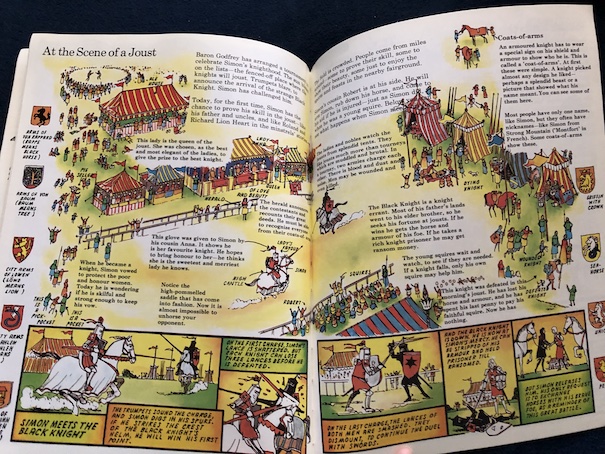
There are a couple pages about knights and how a boy would train to be a knight. There are also pages about jousts, the Crusades, and attacking and defending a castle.

The pictures are cartoon-like, but they are busy and full of details for readers to study, accompanied by notes that offer more information and historical background.

At the end of the book, there is a map showing locations of famous European castles.

The book is available to borrow and read for free online through Internet Archive (multiple copies).

Seashells for Katie and Andy

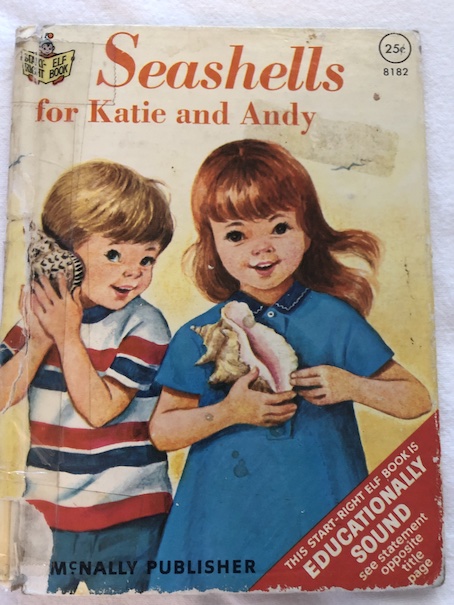
Seashells for Katie and Andy by Solveig Paulson Russell, illustrated by Marjorie Cooper, 1973.

This is a cute little picture book that presents information about seashells in story form.

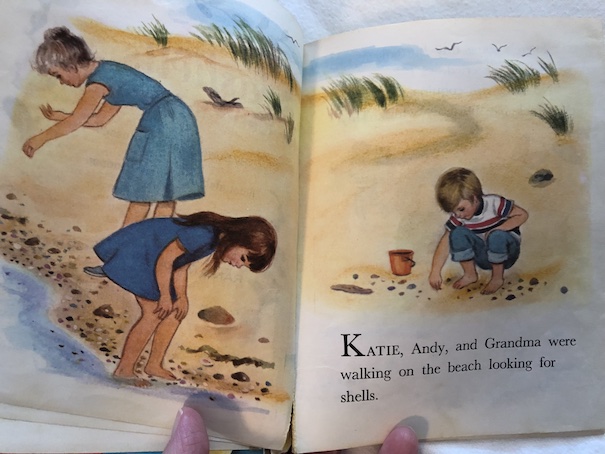
Katie and Andy are at the beach with their grandmother. As the children collect seashells, their grandmother tells them what kind of shells they are and a little about them.

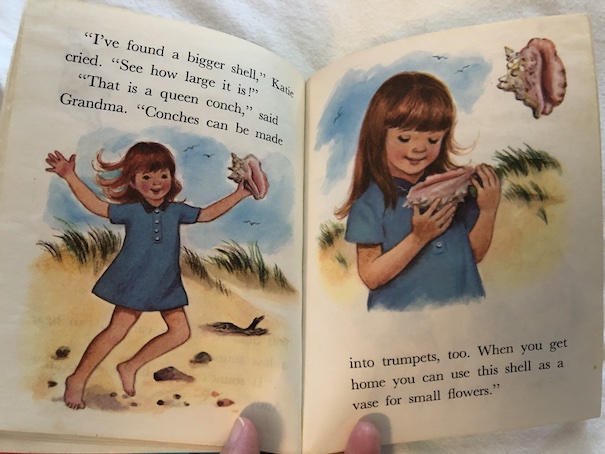
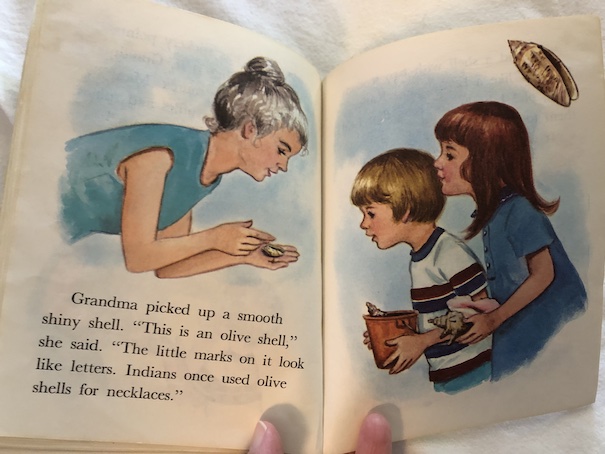
The shells included in the book are: coquina shells, cowrie shells, triton shells, conch shells, lace murex, olive shells, scallop shells, and limpets.

Toward the end of the book, the kids ask their grandmother if they can find shells anywhere else besides the beach, and she tells them about snail shells.

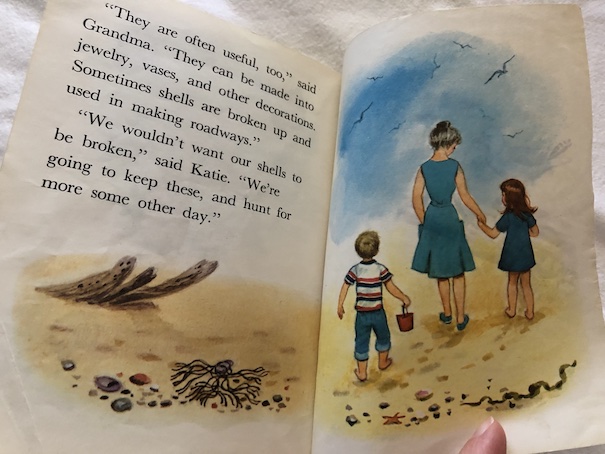
The grandmother also tells the children about different uses people have for seashells. She talks about how they can be used for jewelry, vases, and decorations of different kinds. She also mentions that they can be broken up and used in roads, but the children don’t like the idea of breaking shells.

My Reaction

This book is nostalgic for me because my own grandmother was an amateur naturalist, and she used to give us gifts of seashells that she found in her own travels. Some of the shells in my old collection still have labels with the names of the shells in my grandmother’s handwriting.

In the beginning of the book, there is a note to parents and teachers from the National College of Education in Evanston, Illinois about how the information in the book is educationally sound. I don’t have anything to criticize about the information in the book except one instance where the grandmother talks about “Indians” making necklaces from a certain type of shell. I’m pretty sure from context that they mean American Indians and not people from India, but I think that “American Indians” or “Native Americans” would be better terms to use for the sake of clarity.

They never say exactly where the beach in the story is, which would make a difference in the types of shells that the characters might find. Most of the shells covered in the book have a pretty broad worldwide distribution, but I suspect from the selection of shells given that the characters are probably in the Southeastern United States.

The Poky Little Puppy Follows His Nose Home

The Poky Little Puppy Follows His Nose Home by Adelaide Holl, illustrated by Alex C. Miclat, 1975.

This book is part of the Poky Little Puppy series of picture books from Little Golden Books.

The puppies’ mother allows them to go exploring a little outside of their own yard, but she warns them to stay away from the highway because the cars are dangerous and reminds them to be home in time for dinner. She also adds that if they get lost, they should rely on their sense of smell to get home.

As the puppies explore, they meet other animals in the countryside and stop to play. Eventually, they find themselves on the edge of the city. They are frightened of the noise of the cars, and a pigeon tells them that they’d better stay away from the city if they want to avoid cars.

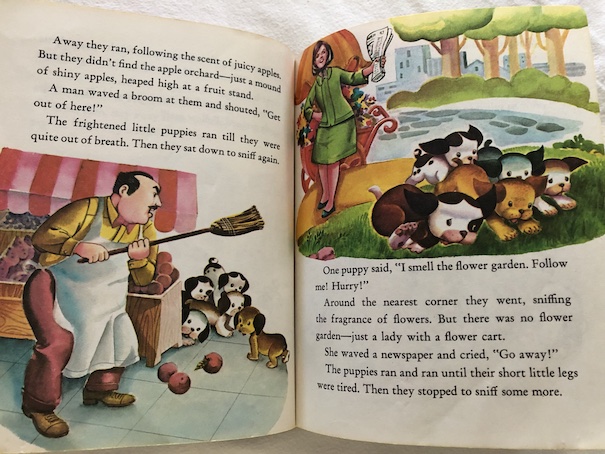
The puppies realize that they need to turn around and go home, but when they try to sniff for familiar smells to go home, they have trouble. When they try to smell the apple orchard, they accidentally find a stand where a man is ffselling apples instead. Trying to smell flowers leads them to a flower cart. Trying to sniff for animals smells leads them to the zoo.

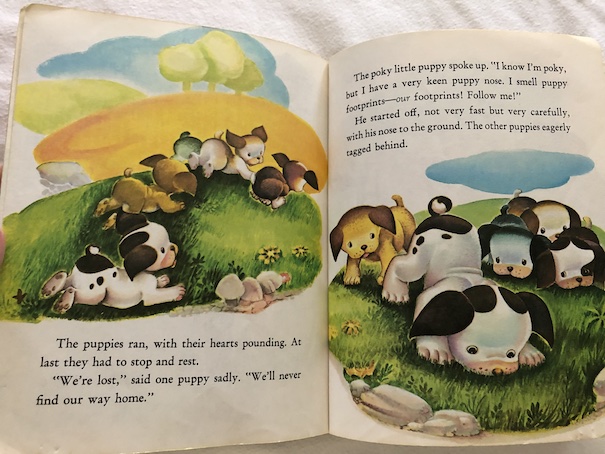
Then, the Poky Little Puppy realizes that what they really need to do is sniff for their own smell so they can retrace their steps home. Sniffing for their own trail works, and the puppies get home in time for dinner!

My Reaction

Like other Poky Little Puppy books, the story is cute. Nothing very stressful happens in the story, making it a good story for bedtime. Even though the puppies get lost temporarily, it isn’t for very long, and they get home in time for dinner, as they do in other Poky Little Puppy books.

Where Will All the Animals Go?

Where Will All the Animals Go? by Sharon Holaves, illustrated by Leigh Grant, 1978.

This book is one of the Little Golden Book picture books.

A little boy named Matt goes to visit his grandfather on his farm. They notice a storm approaching, and Matt worries about where the animals will go when the storm comes. His grandfather tells him that the animals all know where to go.

The animals also notice the approaching storm. When the rain comes, Matt and his grandfather go inside the house with the cats. After the storm is over, Matt’s grandfather takes him outside to show him where all the animals went during the storm.

Matt watches as all of the animals, both the domesticated animals of the farm and the wild animals who also live there, emerge from their hiding places. Every animal has a place to go, and they’re all fine after the storm.

The book is available to borrow and read for free online through Internet Archive.

My Reaction

I like this story because it’s very calm. I think it could make a good bedtime story for young children. Although the boy in the story is concerned about the animals and where they will go during the storm, the animals are never in any danger. The grandfather knows that the animals will all be fine, and he reassures his grandson that they all have a place to go. It’s reassuring that the storm is natural, the animals know what to do when it happens, and the boy sees that everything is fine. The story ends with the boy and his grandfather watching the sun come out after the storm.

The Neverending Story

The Neverending Story by Michael Ende, 1979, 1983.

Bastian Balthazar Bux has problems. He’s smaller and fatter than the other boys, no good at sports or fighting, and not even a particularly good student.  Because of this, other kids tease him, bullies chase him, and the one time that he tried to talk back to them, the mean kids shoved him into a trash can, so he was afraid to ever try it again.  One day, on the way to school, he seeks sanctuary from his bullies in an old bookshop that belongs to Carl Conrad Coreander.  Bastian loves books more than anything.  In fact, his love of books and his imagination are his only apparent strengths at this point in his life.

Coreander doesn’t like children, and as soon as he sees Bastian, he makes it clear that the boy isn’t welcome in his shop, that he doesn’t carry books for children, and that he won’t sell Bastian any books for adults. Coreander says that children are just noisy and make messes and ruin books.  Bastian protests that not all children are like that, and the two them talk about why Bastian is there and why the other children bully him.  Bastian says that one of the reasons why the other kids think he’s odd is that he likes to make things up, like imagining places and characters and odd names. He rarely shares these things because nobody else seems interested. Coreander asks what his parents have to say about all of this, and Bastian reveals that his mother is dead and his father doesn’t take much interest in him or things that happen to him in his daily life.  Coreander is rather condescending to Bastian but also strangely interested in some of the details about him and his life.

When Coreander gets up to take a phone call, Bastian finds himself looking at the book that Coreander was reading when he came into the shop.  It’s called The Neverending Story, a title which captures Bastian’s imagination at once because he always hates it when a book he likes ends. The book seems to call to Bastian, and he suddenly feels like he has to have it.  Because Coreander has already made it clear that he won’t sell any books to Bastian, Bastian simply snatches up the book and leaves the shop with it.

After he’s out of the shop, Bastian suddenly feels guilty for stealing the book, even though he still feels compelled to have it and read it. He knows that he can’t take the book home with him because, even though his father doesn’t notice much, he would notice if Bastian showed up at home when he’s supposed to be at school.  Bastian knows that he’s already terribly late for school, but he can’t bring himself to go to class, especially not with a stolen book.  Desperately, he tries to think of a place to go.  Then, he remembers that his school has an attic.  Hardly anybody goes up there, and even those who do don’t go there very often.  He can hide there for a while and read.

Without giving much thought to how long he’s going to hide and what he’s going to do for food when he gets hungry, Bastian hurries up to the attic of the school, locks himself in, and starts to read The Neverending Story.

From this point on, most of the book is the story in the book Bastian stole, but at the same time, it’s also a story about Bastian himself.  There are periods when things in the story remind Bastian of things happening in his life or times when he pauses to think about what his class at school would be doing at this time without him, things that he’s glad to be missing himself.  However, gradually, Bastian himself starts to enter the story.

The Neverending Story Begins

The story in Bastian’s book takes place in the magical land of Fantastica.  The first characters we meet are messengers who are on their way to see the Childlike Empress who rules the land.  Within that land are many fantastical people and creatures who inhabit countries of their own, but strange things are happening here that have nothing to do with the usual magic of Fantastica.  A small group of messengers who happen to meet each other talk about what they’ve observed and why they need to talk to the Childlike Empress.  Whole sections of their countries and even some of the people and creatures who normally inhabit them have simply disappeared.  By “disappeared”, they mean that nothing is left in their place.  Whenever people try to look at the areas that used to be there, they see absolutely nothing, as though they have all gone blind when looking in their direction.  Nobody knows why this is happening, and people are panicking.

The Childlike Empress lives in a beautiful tower.  When the messengers arrive there, they discover that so many messengers have arrived from every corner of Fantastica that they have to make appointments and wait their turn to talk to the Childlike Empress.  Everyone seems to have the same problem, and to make matters worse, word has spread that the Childlike Empress is ill, and the doctors can’t seem to understand the nature of her illness and have no idea what to do to help her.  The messengers wonder if the Childlike Empress’s illness could have something to do with all the strange things that have been happening.  All of the creatures in the kingdom know that the very existence of their kingdom depends on the well-being of the Childlike Empress.  If anything ever happened to her, the rest of them would simply cease to exist.

At this point in the story, Bastian is reminded of his mother’s death and stops to think about her.  He remembers being at the hospital with his father while his mother was undergoing an operation to try to save her life, but unfortunately, it was unsuccessful.  After that point, Bastian’s father changed, becoming mentally and emotionally withdrawn, so it seems as though Bastian not only lost his mother completely but also part of his father.  His father continues to look after him physically and even gives him nice things, like a bicycle, but he rarely takes much notice of his son’s day-to-day life, making Bastian feel almost like he isn’t there himself.  His father no longer talks to him about ordinary, everyday things, and he’s always preoccupied with his grief.

The doctors trying to treat the Childlike Empress say that she doesn’t have any obvious symptoms of illness.  For some reason, she simply seems to be fading away, making it seem likely that her malady is tied to the fading away of Fantastica itself.  Chiron the centaur, the greatest of the healers, says that the Childlike Empress has said that someone must go on a quest to find the solution to her problem. She doesn’t say what the solution is, but she has chosen the hero who will go on this quest by name and has given Chiron her medallion to give to this hero.  The Childlike Empress’s amulet, Auryn, takes the form of the twined snakes (it’s a sort of elaborate ouroboros) that appears on the cover of the book that Bastian is reading.

Chiron takes the medallion to the Greenskins, a people who resemble nomadic Native Americans who hunt purple buffalo, to find the hero called Atreyu.  Atreyu turns out to be a 10-year-old boy, and Chiron is upset at first that a child so young has been given this important mission.  Even though he is doubtful that a child could save the Childlike Empress, he has to trust the empress’s decision.  He explains the situation to Atreyu and his people, and Atreyu sets off on his quest, although he has little to go on.

Bastian comes to identify somewhat with Atreyu, who is an orphan, raised communally by his people.  In a way, Atreyu is like what Bastian himself wishes he was.  Atreyu is also an orphan, but where Bastian feels neglected by his remaining parent and has no one else to rely on, Atreyu is regarded as the “son of all” his people, with everyone raising him.  Bastian wishes that he could feel like he could rely on everyone around him to care about him.  Atreyu is also strong and brave, which Bastian is not, or at least, he doesn’t feel like he is.

Atreyu travels far and asks everyone where he stops if they know how to help the Childlike Empress, but no one does.  However, in a dream, a purple buffalo tells him that he must visit an ancient woman called Morla, who lives in the Swamp of Sorrows.  She is the oldest creature in Fantastica, and she will know the answer.  Atreyu loses his beloved horse in the Swamp of Sorrows because the horse is overtaken by a dreadful depression and cannot save himself from being dragged down into the swamp.  (This was the worst part of the movie version of this story for me as a kid although somewhat less traumatic in the book.)  Atreyu is protected from the depression by the Childlike Empress’s amulet and is able to reach Morla.

Morla turns out to be a giant and ancient tortoise.  She does know the answer to the problem, but Atreyu has trouble persuading her to explain it at first because Morla is so old that she has come to feel like life is meaningless and doesn’t really care if she and everyone else disappears or not.  Fortunately, Atreyu’s arguments with her revive enough of her interest for her to talk to him. Morla says that the Childlike Empress has always been young because her life isn’t measured by time like others’ lives.  The Childlike Empress’s life is measured by names.  She has had many, many names over the years, most of them forgotten now, and even Morla doesn’t know what her current name is.  In order for her life and existence to be renewed, the Childlike Empress needs a new name.  Atreyu asks Morla how she can get one, and Morla says that she doesn’t know who can give her a new name, only that it can’t be anyone from Fantastica.  Atreyu must visit the Southern Oracle to find the answer.

At this point, Bastian thinks it’s too bad that he can’t give the Childlike Empress her name because thinking up unusual names is something that he’s really good at, and this might be the one place where his talent has a use and people who would welcome it.  However, the things that are happening in the story are so scary that Bastian is also grateful that he is safe where he is, just reading about them.

Bastian reads that Atreyu wanders out of the swamp on foot. He doesn’t know where he’s going, and he lost all of his supplies with his horse.  Then, Bastian hears the clock chime and knows that school is out for the day. As the other children leave the school, Bastian has to decide what to do. He knows that he really should go home and own up to his father about stealing the book, but when he gets up to go, he has the feeling like he has to keep reading, to finish what he’s started, like Atreyu, who is still fulfilling his mission in spite of hardship.  Bastian feels a little proud of making a difficult decision because he’s not running away from his responsibilities so much as continuing a quest of his own.  He knows that he must finish that book. Indeed, he must because the existence of Fantastica now depends on him.

As he continues reading and following Atreyu’s adventures, Bastian begins to feel more like the story isn’t just a story, that there is something more to it. When Atreyu reaches the Oracle, which communicates only through rhyme, it tells Atreyu that nobody in Fantastica can give the Childlike Empress a new name because the truth is that all of them are only characters in a book who exist as they are because of the needs of the story.  The people of Fantastica didn’t invent their world, they don’t create it as it exists, and they don’t have any real power to change anything, even a name.  All of those powers belong to humans who live in what they call the “Outer World.”  The Oracle says that generations of human children have read the book that contains all of Fantastica, and they are the ones who have used their powerful imaginations to give the Childlike Empress new names, over and over.  The problem is that the book has not been read by anyone for too long and children tend not to believe in stories like theirs anymore, so it has been too long since the Childlike Empress was given her last name. The memories of all the names she’s been given have faded, so she is losing her ability to maintain her existence and the existence of all of Fantastica.  They need a human child with the ability to believe in Fantastica and think of a new name to rename the Childlike Empress.  They need Bastian … if Bastian can manage to believe in himself as the hero of his story.

The book is available to borrow and read for free online through Internet Archive (multiple copies, plus a computer game about it and the theme song from the movie). It was originally written in German, and the version I have is the English translation. There is a movie version from the 1980s that is very well-known among people who were young then and fantasy fans. There are also two movie sequels that aren’t as well-known.

My Reaction and Spoilers

I saw the movie version of this book long before I ever got hold of a copy and way before I was old enough to read a book that long.  The movie was big in the 1980s, when I was a young child, and it has a magical and very 1980s theme song that was also used as a cultural reference in the show Stranger Things.  I’m actually attached to that song because it’s one of the sounds of my early childhood. For reference, I’m younger than all the Stranger Things kid characters are supposed to be, even Erica, but old enough to have memories of the time period of that show. The mall scenes in that show are practically right out of my childhood. Those electronicized ‘80s songs, bright-colored clothes and clothes with paint splatter designs, Cold War with two Germanies – East and West – these things were all part of my early life, and that is the time period when this book was popular and the movie was new.  As Stranger Things points out, things like fantasy books and movies and playing Dungeons and Dragons were all considered part of nerd culture back in the day.  To a certain extent, they still are, but Harry Potter brought a renewed interest in and popularization of fantasy books in the late 1990s.

The story is about the power of imagination and the roles that fantasy play in human lives.  The story actually gets deep in places about the philosophy of stories and how people use them.  It explains that humans fear stories, particularly fantasy stories, because, when fantasy characters get out in the real world and take over people’s minds, they can cause madness and delusions or be used as lies by unscrupulous people to fool and manipulate others.  They don’t use the word “propaganda”, but that’s part of what they imply, and it’s a fitting concern for the Cold War era when this story was written.  Madness can also be a real risk for people who can’t separate reality from fantasy, as shown in Bastian’s further adventures in Fantastica, described below.  Humans are creatures that live and function in the real world, and while we sometimes venture into the realm of fantasy and stories, we can lose ourselves if we don’t know how to keep the two separate in our minds.  So, what’s a human supposed to do?

The book suggests the idea that people can’t simply avoid fantasy entirely for fear of the effect that it might have on them, like people who refuse to allow children to read fantasy books.  Even though people like that might think they’re smart for avoiding “lies” and “delusions”, but the problem with that is that there are many types of delusions that people have, even in their everyday lives, and people who are convinced that they’re being thoroughly realistic and avoiding any sort of fantasy actually make themselves vulnerable to lies and delusions of other kinds.  Anybody who’s lived through the era of accusations of “fake news” should be able to grasp that concept.  A real world fact is that people use stories of all kinds to explain and understand the world around them.  We all use stories, and those stories have shades of emotion and varying degrees of elements of fiction.  The principal of Fantastica is that fantasy is fine when people approach it as fantasy, coming to it willingly in the full knowledge that it is fantasy.  Even in fantasy stories there can be elements of realism, such as the reality of human emotions, but people can pick out the real bits from the fictional ones when they know what they’re dealing with and are willing participants, not having it pushed at them by people who are actively seeking to trick them. 

People with broad, real-world knowledge, who are used to stories of various kinds in the real world, get accustomed to distinguishing between different types of stories and recognizing fictional elements from false ones.  There have been a couple of times when I’ve actively pointed out to people on my neighborhood website who shared “shocking” stories about horrific kidnapping attempts of kids or young women that those stories were false.  The local police have even said that they were false, but I knew that they were even before getting that confirmed with the local police.  How?  I’ve seen them before, or ones very much like them.  Honestly, they were basically the type of kidnapping stories that appear on Wattpad, the infamous Internet home of badly-misspelled stories of that ilk, and because I read fanfiction, I’ve seen them before in all their grammatically-incorrect glory.  I recognized elements of the fake stories from ones that I read before in the full knowledge that they were completely fictional and probably written by teenagers, most of whom don’t understand how chloroform actually works.  I could see their ridiculously complicated premises anywhere and go, “Yep, it’s one of those stories.”  The people attempting to share these stories as shocking things that their neighbors need to know about have probably never read Wattpad or any similar amateur fiction and equally don’t know how chloroform works.  They just experienced a feeling of shock when reading these stories on Facebook (yes, that is where they said they got them) and did what they automatically do when they feel shocked about something, passed it on to someone else without asking someone more knowledgeable.  Some of the other people reading their posts on the neighborhood website called the local police to check their stories, but the original posters did not do that before posting them. It seems that never crossed their minds.  I’m telling you this because I’m pointing out that I’m immune to this particular kind of shocking fake kidnapping story because I’ve seen it before, I’m familiar with the general format, and I actually did look up what chloroform does and how it works because I was curious.  I’ve sort of inoculated myself against this sort of story.  I don’t feel shocked when I see it.  I roll my eyes. 

I’m not saying that it’s completely impossible to fool me on anything because human beings are limited, and I can’t say that I’ve heard every story out there, but I’ve heard quite a lot of them.  I’m a voracious, long-term reader in different genres, fictional and non-fiction, badly-written and award-winning.  I don’t fear fiction or fantasy or even “fake news” because I’ve seen it before in various forms.  I know how to verify information and already have reliable sources of information lined up on various subjects.  Above all, I have the knowledge that I’m always responsible for myself and in control of myself and that no amount of fiction or “fake news” can ever make me do anything without my consent.  Even people under hypnosis can’t be made to do anything that is truly against their will or morals, and I’m pretty comfortable with my sense of self and what I’m willing or not willing to do.  (By the way, I got the Pfizer vaccine back in April 2021 and the Moderna booster in December 2021, and I’m perfectly fine. It’s not poison, unlike some of those idiot horse cures some people try when they’re so afraid of being tricked by some people that they leave themselves open to being tricked by other people, who can see their real fears. It’s also not magnetic.  I used to stick coins to my skin way back in elementary school in the early 1990s, although I preferred the trick where you roll a coin down your forehead and nose. Sticking coins to your skin works because of sweat, not magnetism, like that trick of sticking a spoon to your nose because you licked it first. This is a digression, but honestly, how does anyone get out of childhood without knowing how that works? I wasn’t aware that anybody who had ever been to school with other kids in their childhood hadn’t seen this stuff before.) Fear is one element I know that can cloud people’s perceptions about what’s real and what’s not, and while I’m naturally a nervous person in a lot of ways, this isn’t something that scares me at all.  I’m not afraid of being tricked.  I never was.  I was a fan of magic tricks at a young age, and that led me to read about magic and the tricks that people use. None of them scare me because I’ve done them before myself and know how they work.  It’s like that with fiction, too.  Been there, done that, seen it, know it, and I urge other people to do the same.  This kind of mental vaccination works as well as the other kind.  At least, it always has for me.

Book vs. Movie

There are many incidents in the book that are not in the movie, although some appeared in the first movie sequel.  In fact, the original movie really only covers about the first half the book.  Rather than ending with Bastian giving the Childlike Empress her new name, Moon Child, while she and Atreyu are at the Ivory Tower where she lives, Bastian hesitates because he’s not sure what he’s supposed to do, if he’s really chosen the right name, if he’s really going to enter Fantastica and how, and above all, if a small, weak boy like himself can really be a hero.  Seeing that his indecision could ruin Fantastica forever, the Childlike Empress finds a way to put the story into a loop, repeating over and over, making it truly a never-ending story until Bastian finally names her.

After Bastian names her, Moon Child gives him the last grain of sand from Fantastica, like in the end of the movie, so he can rebuild it.  At first, Bastian isn’t sure how, but she explains to him that he can do it with his wishes. He has as many wishes as he wants, and he can wish for anything and everything.  Bastian feels overwhelmed at the thought that he can think of anything, and that makes it difficult to think of anything because he doesn’t know where to start. Yet, Bastian must make wishes to rebuild Fantastica.  From here, I’ll basically describe Bastian’s continuing adventures in Fantastica, although I’m going to leave out a lot of detail and individual incidents and characters because there’s far too much to describe:

Bastian’s Continuing Adventures

To get him started, Moon Child asks Bastian what made him hesitate before to name her.  Bastian explains how he doesn’t look or feel like a hero should. He thinks that heroes should be like princes, handsome and strong, not small, weak, and fat like himself.  With this first wish, Bastian becomes a handsome prince.  Moon Child gives Bastian the Auryn, which gives him the power to control things in Fantastica and yet keep him safe from all dangers at the same time.  Using it, Bastian makes himself strong and brave as well as handsome, and his wishes take him on new adventures through new lands, creating things as he goes.

Then, his wish for companionship leads him to find Atreyu.  He is glad to be reunited with him, but Atreyu remembers Bastian’s real appearance because he saw him in a mirror before.  By now, Bastian’s memories of his former self are fading.  The people of Fantastica appreciate Bastian’s ability to make new stories because they lack that ability themselves, but it starts getting out of hand.  Bastian’s creations start getting out of his control, and Atreyu realizes that Bastian is losing more and more of his memories, forgetting who he really is and what his home is really like.  As Bastian loses touch with his real self, he also gets confused about what he really wants, and his confusion is causing his wishes to produce uncontrollable results. To make matters worse, Bastian is losing his desire to return home along with his memories of home.  His friends are distressed because they know that Bastian must return home in order to inspire other children to come to Fantastica.  If he doesn’t, other children won’t come and give Moon Child new names in the future, and Fantastica will be in danger once again.  Basically, Bastian has lost of the plot of his own story.

Persuaded by his friends, Bastian makes a wish that will help him figure out what to do: he wants to see the Childlike Empress/Moon Child again.  Although Atreyu and Falkor wanted him to make a new choice to guide their quest, they’re not convinced this is the right one because one of the rules of Fantastica is that nobody can see her more than once.  Bastian says that he thinks he’s different because he’s human and not from Fantastica, and he’s already seen her more than once.  As they continue their journey, Bastian continues losing more and more of himself, getting offended with his friends because they treat him like a child, forgetting that’s what he actually is.

At one point, an evil character separates Bastian from his friends by feeding his vanity.  As Bastian loses more and more of his memories, he becomes uncertain about whether or not he really wants to continue his journey to see Moon Child, forgetting his original reason for wanting to see her.  They do finally arrive at the Ivory Tower, but the Childlike Empress is not there, and nobody knows where she is.  At the evil character’s urging, Bastian tries to make himself emperor in her place, thinking that she has left Fantastica forever and that the reason she gave him Auryn is because she wanted him to be her successor.  However, the other residents of Fantastica know that it’s not right.  Atreyu and Falkor end up leading the forces of Fantastica against Bastian to get the amulet, return his memories, and put things right.  I don’t like stories where people turn against their friends like Bastian does because it’s pretty uncomfortable.  In this case, many people are killed in the battle against Bastian, Bastian wounds Atreyu, and the Ivory Tower collapses.

At first, Bastian blames Atreyu for his own failures and tries to go after him to get revenge, but along the way, he stumbles on a town occupied with former emperors and empresses of Fantastica.  A little monkey explains to Bastian what the town is and who the people there are.  All of the people in the town were people who tried to take over Fantastica but lost their minds in the effort.  They’re humans and have lost their memories and now do crazy things.  Because they’ve lost their minds and memories, they’re unable to wish themselves home.  This is what happens to humans who lose their desire to go home to the real world.  Readers can look at it as people who become detached from reality and live in a madness based on fantasy.  Humans need reality to keep themselves grounded and sane, and they need their memories and their pasts to help themselves build a future.

The monkey shows Bastian how he taught the crazy ex-emperors a game where they spell words with alphabet blocks.  Most of what they create is gibberish, but the monkey says that, when they’ve played for a hundred years or so, they’ll occasionally spell out a poem, and since they play endlessly, they’ll eventually spell out all of the works of literature, poking fun at the theory that monkeys pounding endlessly on typewriters could do the same thing.  Bastian is horrified and questions the monkey about how he can avoid this fate.  Auryn is a liability because it’s removing the memories that Bastian needs to return home, yet the monkey says that Bastian will need Auryn in order to return home.

As Bastian journeys further, he finds a land where people always work together and use the word “we” instead of “I.”  It’s inspiring in a way, but Bastian is troubled because, in a land where nobody is distinctive or special, everyone is easily replaceable in the work force, and nobody seems to really love anybody else as an individual.  Here, Bastian realizes that his true wish, one that he has long forgotten, is not to be the strongest or handsomeness or most powerful but simply to be loved.  He wants to be loved for the person he really is, even with all of his imperfections.  The problem is that Bastian is uncertain now about who he really is because he’s changed so much since he came to Fantastica and has lost his memories of who he used to be.

Journeying further yet, Bastian meets a singing woman.  He has a strange feeling like he wants to run to her, hug her, and call her “Mama,” but he knows that this woman is not his mother.  He remembers that his mother is dead, and she was a very different woman from this one.  This is a plant woman who grows fruit herself.  The strange woman gives him some fruit to eat and begins telling Bastian a story.  The story she tells is Bastian’s own story, the story of how he came to Fantastica, how he gave the Childlike Empress her name, and how he had made wishes that were both good and bad and lost himself along the way.  The house where the woman is called the House of Change, which not only changes itself but changes people who are there.  The woman says that Bastian’s problem is that he always wanted to be someone else other than what he was, but at the same time, he didn’t want to change himself.

During his time in the House of Change, Bastian becomes like a child again, and the plant woman, Dame Eyola, is motherly to him, fulfilling the need for love that Bastian has had for so long.  He feels guilty about all the things that he’s done since he arrived in Fantastica, but Eyola comforts him and advises him to seek the Water of Life.  However, when he does, she cautions him that it will be his last wish.  Bastian is afraid because he knows now that every time he wishes, he will lose a part of himself.  Still, Dame Eyola fills up him with her motherly love, and Bastian finds himself needing less love himself and wishing that he also had the ability to love someone.  This is his last wish.  With that wish, Bastian forgets his parents, his last memory aside from his own name.  Dame Eyola says that Bastian will be able to give that kind of love to others when he has drunk the Water of Life, and he will only be able to return to his own world when he brings some of that Water of Life back to his world with him.

To get to the Water of Life, Bastian must pass through a picture gallery of forgotten dreams and find one of his own forgotten dreams.  His wish is to love someone, but to do that, he must choose someone in particular to love and forget the last person he still remembers – himself. 

Bastian has to dig to find his forgotten dream because it’s buried, but when he finds it, it’s a dream of his father, sad and trapped in ice, begging him to help free him.  Bastian’s troubled relationship with his father has been at the heart of most of his feelings, but now, he finds himself wanting to help his father.  He now has the power to reach the Water of Life.  There is another problem that he has to deal with before he can reach the Water of Life, and he encounters Atreyu and Falklor again. 

The Water of Life is inside Auryn itself, and Bastian reaches it when he finally takes it off.  When the three of them get to the Water of Life, he has trouble reaching it because he’s lost all memory of himself.  However, Atreyu speaks on his behalf as a friend because he remembers who Bastian really is.  Bastian sheds all of the changes that he’s gained in Fantastica, becoming fully himself again and actually being happy with himself for the first time, able to truly love himself and love other people.  Bastian wants to bring some of the Water of Life to his father.

There is some consternation when the white snake of the Auryn realizes that Bastian has left uncompleted stories in Fantastica.  It wants Bastian to stay in Fantastica and finish them all, but Bastian says he’ll never get to go home if he does that.  However, Atreyu and Falkor promise to complete all of the unfinished stories on Bastian’s behalf, and the snakes of Auryn allow Bastian to go home.

Bastian finds himself in the school attic once again.  He’s not sure how long he’s been there, but his clothes are still wet, like they were from the rain when he started reading.  Bastian remembers that he should return The Neverending Story to the bookshop, but he can’t find it.  It seems like the book has disappeared.  He decides all he can do is talk to the owner of the bookshop and explain the situation.  As he walks through the school, he can’t find anybody and worries that he’s completely alone in the world.  He’s forgotten that it’s Sunday, and there’s no classes on Sunday.  Since the school building is locked, he has to let himself out through a window and climb down some scaffolding, a fear that would have been terrible for him before his adventures in Fantastica.

Bastian goes home and sees his father, who is glad to see him.  His father hugs him.  He’s been worried about him and wants to know where he’s been.  Bastian learns that he’s only been missing for a day.  Bastian explains the whole entire story to his father, and his father listens in a way he hasn’t before and actually understands.  When his father holds him on his lap and cries, Bastian knows that his father has received the Water of Life.  His father says that things are going to be different between them from now on.  At this point, Bastian’s adventures might seem like the imaginings and dreams of an unhappy and neglected boy and his father’s changes as the realization that both he and Bastian experienced loss and that Bastian badly needs his love.  However, the story isn’t quite over yet.

The next day, Bastian feels compelled to visit Mr. Coreander and explain to him about the book.  When he does, Mr. Coreander questions him about which book he took.  Bastian tells him, but Mr. Coreander says that none of his books are missing.  He denies ever having had a book called The Neverending Story.  Bastian insists that he’s telling the truth, and Mr. Coreander says that he’d better tell him the whole story.  Bastian once again tells the whole story.  When he’s finished, Mr. Coreander says that Bastian isn’t a thief because the book he took wasn’t from his shop.  He says that the book is from Fantastica and it has now moved on to another reader.  Mr. Coreander admits that he knows about Fantastica, and the book that Bastian read is only one door into it.  Mr. Coreander didn’t read that one, but he has read others, and he also gave the Childlike Empress a name.  He says that maybe Bastian will find other books that will return him to Fantastica.  When Bastian says that he was told that he could only meet Moon Child once, Mr. Coreander reveals a secret that only humans know: humans can see the Childlike Empress again if they give her a different name.  People can only see her once under each name she has, but humans can name and rename her again and again.  Mr. Coreander appreciates that he can discuss Fantastica with Bastian because there aren’t many people who have experienced what they’ve experienced, and Mr. Coreander thinks that Bastian will guide others to Fantastica and all of them will also bring back the Water of Life.
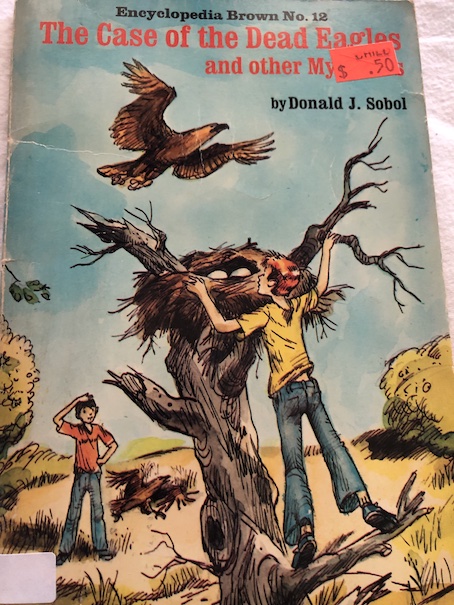
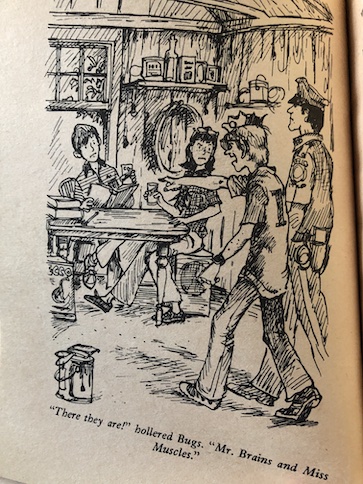
A Pattern of Roses

Tim Ingram has been feeling depressed since his parents decided to move from London to an old house in the country that they’re fixing up. It’s hard for him being separated from his friends and living in this overly-quiet place, where it seems like nothing ever happens, but the truth is that he was depressed even before his family moved. A large part of Tim’s problem is not knowing what he wants out of life. He works hard in school to get good grades, and his school has a reputation for getting its students into good universities, but it all seems so futile because Tim doesn’t know what he really wants to study or what he’ll do when he gets out of school. His father quit school early and went to work, working his way up the ladder in an advertising firm and becoming monetarily successful. However, Tim doesn’t feel like he has either the wit or self-confidence for starting off from practically nothing and working his way up in a direction he’s not even sure he wants to go. His father’s plans and suggestions for the future don’t excite him or make him happy. They actually make him feel more stressed and depressed when he thinks about them. His father is in a position to just give him a job with his company, so Tim does have a guaranteed job if he can’t think of anything else, but advertising doesn’t appeal to Tim. He’s not sure what does appeal to him. He fears and dreads the future, specifically his own future. He doesn’t know what to do with himself, and in this new place, it seems like there isn’t a lot he can do.
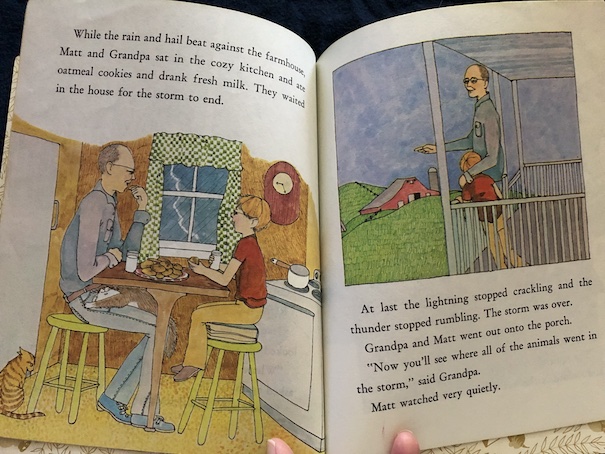
Tim has also been arguing with his parents, discovering that he has different interests and priorities in life than they do. While they’re enthusiastic about expanding onto this country house with a new and stylish modern wing, Tim prefers the older part of the house and its simpler style. He thinks the modern additions his parents made look ugly and out-of-place, ruining the natural beauty of the countryside. His parents feel like he’s unappreciative of their standards and the sort of lifestyle they’ve worked hard to build, and his mother even goes so far as to call him “perverse and awkward.” He kind of feels that way, too. Tim often feels like he’s a nobody, not very outstanding at anything. His ambitious parents are disappointed in him because they’ve invested so much in his education to show him off as another one of their achievements in life, and he doesn’t think he’s much to show off. He’s even a little disappointed with himself because, not only does he not seem to live up to his parents’ expectations, he doesn’t even have it in him to stand out as a rebel or a troublemaker, like some of his friends. He’s not an aggressive person, and it’s just not his nature to fight or get into trouble, and that makes him feel like even more of a nobody. If he neither excels at meeting people’s expectations or at deliberately flouting them, what is he? Who is he? Where does he fit in? With all of this, Tim hasn’t been feeling well, and he fakes being sicker than he is so he doesn’t have to get out of bed and deal with any of it. Since he’s been unwell, he’s also excused from school until after Christmas, leaving him with nothing to do in this countryside house but lie in bed and think about all the things that are worrying him.

Then, one day, the builder who’s been working on their house finds an old tin box hidden in the chimney of the room that Tim has chosen for his bedroom. The box catches Tim’s attention. It looks like a very old biscuit (meaning cookie, this book is British) tin decorated with a faded pattern of flowers. The builder opens the box and is disappointed to see that it just contains papers, not anything that looks really valuable. However, Tim is curious and insists that he wants to see the papers.

The papers are drawings, quite old and done in black crayon. Most of them are landscapes and buildings, but there is also a girl, who is labeled “Netty.” Netty’s name is written in a heart, so the artist must have loved her. The date on one of the drawings is February 17, 1910 (the story seems to be contemporary with the time when it was written in the early 1970s because Tim thinks that was 60 years ago), and to Tim’s surprise, the author signed with his initials: T.R.I. Tim’s full name is Timothy Reed Ingram. Tim is intrigued that the artist who lived so long ago had the same initials and apparently lived in his room.

The builder, called Jim, asks Tim if he likes to draw or knows anything about art. Tim gets good grades in art, but he’s not very self-confident about his abilities. Still, he knows enough to tell that the artist wasn’t particularly great at his art. There are places where he got the proportions of his drawings wrong, but Tim is impressed that they convey a lot of feeling. Even though the drawing of Netty isn’t perfect, Tim feels like he can tell what kind of girl she was. She looks like she’s in her early teens and has a kind of proud, somewhat naughty or daring look. Tim asks the builder if he knows anything about the artist or the people who lived in the house back in the 1910s. The builder says that was before his time, but he thinks that he remembers hearing that the family name was Inskip, and he says that he could ask his father if he knows more. Tim wonders why the drawings were hidden in the chimney and begins to imagine what the first T.R.I was like, picturing a boy close to his own age.

Tim is surprised at how real the boy he imagines seems because he’s often found it difficult to imagine old people as once having been young. He’s seen old men and known that they were part of the generation that fought in WWI but is unable to picture them as once having been soldiers. In fact, he knows that his own father flew a Spitfire during WWII, but even though he knows it happened, he has trouble picturing that of the middle-aged advertising manager his father has become. Yet, somehow, T.R.I. seems incredibly real to him, someone he can connect with, even more so than his own father. Details of this past boy’s life flash through Tim’s head without him knowing quite where they came from. However, Netty seems even more real to Tim because of her picture.

When Tim’s mother makes him get out of bed and go visit the local vicar to get a copy of the parish magazine, Tim has a strange vision of the boy artist he imagines as being named Tom Inskip passing him in the lane. It’s so real that Tim feels like Tom is actually there. As he pauses to look around the churchyard, he spots some beautiful purple roses by a gravestone. Taking a closer look, he sees that the grave has the initials T.R.I., a birth date of March 1894, and a death date of February 18, 1910. Tim is shocked to realize that the artist was not only a little less than 16 years old when he died, just a little younger than Tim is now, but that he also died the day after he drew that last picture. It seems like the boy’s death was sudden and unexpected, more like an accident than a long illness.

Tim doesn’t meet the vicar, but the vicar’s daughter, Rebecca, spots him in the churchyard and asks him if he’s all right. Tim just says that he’s there to get a parish magazine. Rebecca isn’t too cheerful or friendly, and she just gives him one and sends him on his way. Tim later learns that Rebecca is the youngest of the vicar’s children and the only one still in school. Her older siblings are all grown up and have jobs working for good causes and charity organizations.

Tim talks to Jim the builder about the grave he saw, and Jim is interested. He suggests that, since T.R.I. is buried in the churchyard, there will be church records about who he was and how he died. Tim has another vision of the boy, and the boy says, “Find out. But be careful it doesn’t happen to you.”

Tim returns to the vicarage and talks to Rebecca about T.R.I. Rebecca says that she doesn’t believe in ghosts and that she thinks the visions he’s had are just his imagination. However, Tim’s guess that the artist’s first name was Tom turns out to be correct. His full name was Thomas Robert Inskip. The records don’t say how he died, but Rebecca suggests that Tim ask an old local man called “Holy Moses.” The old man says that he remembers Tom Inskip but he doesn’t know what happened to him because he left the village to work somewhere else and didn’t come back until after Tom was dead. When Moses shows them an old photograph of all the children at the local school, Tim recognizes Tom instantly as the boy from his visions and strangely even knows the name of Tom’s friend, Arnold, standing next to him in the photograph, without being told.

From this point forward in the story, scenes with Tom alternate with scenes with Tim. Tom’s scenes start with the day the photograph was taken, when Tom was eleven years old. It was also the day that Tom first met the new vicar of the parish, Reverend Bellinger, a fire-and-brimstone kind of preacher, very different from the gentle man who was the last vicar. Like Tim, Tom was bright, imaginative, and artistic, but he was not much of a worrier. Tom fails to impress the new vicar because he is not very good with religious knowledge and often doesn’t pay attention. Tom loves to draw, but after he gets out of school and starts working, he finds that he doesn’t have time anymore. The vicar’s daughter, however, is kind and encourages him to draw because it’s a talent from God and must be used. People often underestimate her and don’t appreciate her because she has a disability, so she understands what it’s like not to have the opportunity to use and develop her talents to the fullest. It’s only sad that a tragic accident cuts Tom’s life short before they can see what he might have developed into, although when Tim and Rebecca manage to contact the people who knew and remember Tom best, one of them points out that, if Tom hadn’t died when he did, he might have been sent off to fight and die with the other young men during WWI, and with his gentle soul, he might have suffered more from the war than he did from the accident that took his life, when died young in an act of self-sacrifice.

Tim’s scenes involve his parents and school discussing his future, asking for little input from him, not caring about how he feels or what he wants. Tim actually does love art, and his art teacher thinks he should go further with it, but his teacher realistically acknowledges that, with Tim’s good grades in his other classes, his family and the school will want to push him into more lucrative and higher-status fields. But, does Tim really care about money and status as much as his parents? Is that really what he wants?

Gradually, Tim begins to consider the idea of the legacies people leave behind. Few living people remember that there was once a boy named Tom Inskip who died young, and after those people are gone, no one will remember. It occurs to Tim that few people would likely remember either him or his father as advertising workers. If all you care about is just getting money to afford the good things in life, any job could do, and there are many well-paying jobs that make little lasting or meaningful impact on the world. On the other hand, if what you want is to leave a lasting and meaningful legacy, you have to think a little deeper and maybe sacrifice some material gain. Money comes, and money goes, and one coin or bill looks like another, but what lasts as long and has as much individual character as a collection of imperfect but evocative drawings hidden away in an old tin box?

The question of what Tim wants to do with his life becomes the question of what Tim wants to leave as his life’s legacy. The quietness of the country, rather than being the torture it initially seemed, gives Tim a chance to think and really consider what he wants. Through his search for Tom’s past and consideration of Tom’s legacy, Tim finds a new vision of his own future that makes him more hopeful instead of more frightened and that may lead him to find what one of Tom’s friends called Tom’s “perfect spiritual grace.”

The book is available to borrow and read for free online through Internet Archive (multiple copies). Some US versions of the book are titled So Once Was I.

That alternate title is fitting for the theme of the story. Tom was once a living boy with choices to make in his future, much like Tim is now. That phrase also appears in the story as part of an epitaph from another tombstone, which I’ve also seen elsewhere. That same epitaph has been used in different forms in real life. It refers to the inevitability of human mortality – all those living will someday die, like every other generation before. As one of my old teachers used to say, “Nobody gets out of life alive.” But, I would also like to point out that the sentiment also refers to growing up. Every adult used to be young (although Tim has trouble picturing it), and every child will someday be an adult (if they live to grow up – Tom was unfortunate). Every person in a profession of any kind was once a student and a beginner, struggling to learn and find or make their place in the world, and every student will one day find or make some place for themselves and try to make a mark on the world. Change is inevitable. Time passes, people grow and change, and everyone moves on in one way or another. Tim won’t always be a student with his parents controlling his education. He will eventually grow up, graduate, and become an adult. That part is inevitable. What else he becomes is up to him and whatever opportunities he seeks and finds for himself. His future legacy is still in the making.
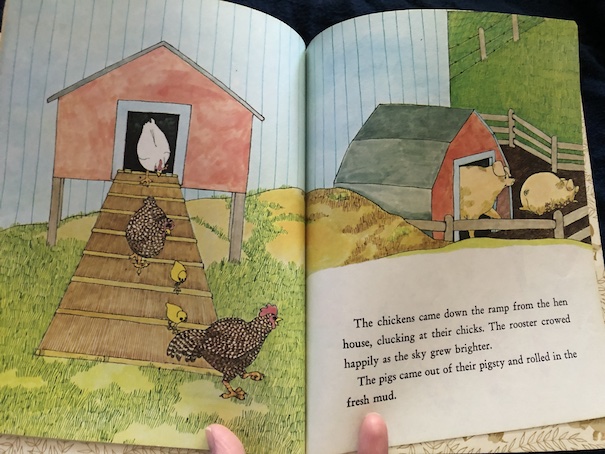
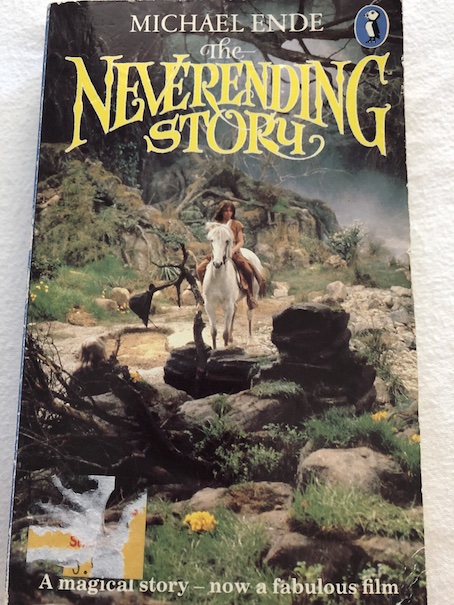
There is also a made-for-television movie version that is available to rent cheaply online through Vimeo. The movie version is notable for being Helena Bonham Carter’s first movie role. She played young Netty.

I found this story very sad, particularly Tom’s death, trying in vain to rescue beloved hunting dogs but drowning along with them in an icy lake when they all fell in. The death of the dogs was as traumatic as Tom’s, and it is described in awful detail. I also hated a part earlier in the story, where one of the dogs kills a pet cat. I love animals, and that was hard to take. It’s all a tragedy, but Tim’s story has a more hopeful ending. Besides leaving behind a box full of drawings, Tom’s effect on Tim’s life becomes a part of his legacy. Even though they lived in different periods of time, Tom and his life story helps Tim, who has been going through a personal crisis, to realize what’s really important and what he wants out of life.

Through much of the book, both Tim and Rebecca are in a similar situation when it comes to their future lives and their family’s expectations for them. As Tim gets to know Rebecca, he discovers that she has hidden depths and is inwardly quite sensitive. She often uses a blunt and abrasive manner to keep people at a distance and hide how sensitive she really is. Like Tim, she is also unimpressed by the money and business-oriented priorities of the modern world and Tim’s parents, preferring things with an old-fashioned, natural beauty – things that, sadly, are often cleared away by modern people in the name of money, business, and being modern. Yet, Rebecca also doesn’t feel like she fits with the lives that her family lives. She doesn’t have the patience to deal with the people her family tries to help, many of whom are nasty and ungrateful instead of kind and appreciative of the help they get, and she feels like her parents don’t have time for her because they spend all of their time helping everyone else. Rebecca is considering a career in social work, but it’s mostly because it’s what her parents want and expect of her. As they compare their family lives, Tim and Rebecca both realize that neither of them quite fits their families’ lifestyles and expectations. They both feel pressured. Their families are also extremes: extreme business and high-achievement vs. extreme charity. Tim and Rebecca are looking for a happy medium that neither one of them knows how to achieve. They feel overwhelmed by a world full of choices, their parents’ expectations, and their own uncertainty about what path to choose.

It occurs to them that a boy like Tom in the 1910s would have limited choices in life and expectations from his family and community. Tom died young, but if he hadn’t, he probably would have been expected to do what other young men in his community did, which was mostly farming or joining the army. In some ways, Rebecca thinks life was probably much easier for those who had no choices than it is for modern people with many more choices and little to no guidance about how to use them. Tim and Rebecca aren’t really bound to their parents expectations because there is less social stigma with being different in their time, but being young, inexperienced, and uncertain of their options in life, they aren’t sure what to do with their relative freedom. They feel trapped, but not in quite the same way as each other and in a different way from people in the past.

Perhaps all people have limits and obstacles no matter when or where they live, and nobody is ever fully in control of their destiny because they are subject to limits in knowledge, ability, and available options. Maybe not everybody is even really suited to where they end up in life. They learn that the man who was the vicar in Tom’s time was more of a bully than a loving and charitable man. Tim’s art teacher comments that he used to work in a job similar to Tim’s father before he found his calling teaching art. Having followed two different professions in his life and seen the people who thrive in each, he thinks that Tim’s personality fits better in the art world than the business world, but he can also see that Tim is going to have to learn to fight and stand up for himself to get where he really needs to be.

But, happiness in life depends on more than fighting or earning money. May, the vicar’s daughter, who is still alive and has lived a happier life than anyone expected after the death of her father, says that one of Tom’s greatest gifts was “perfect spiritual grace.” She explains that Tom never asked a lot out of life and was satisfied with what he had. His life was tragically short, but he enjoyed it to the fullest as long as he lived. Tim thinks that Tom might have gotten less satisfied with his limited prospects in life if he had lived longer, but it’s difficult to say. However, May’s description makes Tim realize that he wants that same sense of “perfect spiritual grace”, making the most of the opportunities open to him and being satisfied that he pursued those opportunities to the best of his ability.

Life has a way of taking many people in directions that they never expected. People often don’t know what they want to do with their lives when they’re young, some of us still question our career choices when we’re older, and many of us end up doing things we didn’t expect or entering fields we didn’t originally study. Tim’s new home and new acquaintances and the inspiration that he receives from Tom’s life story cause him to consider different directions that his life might take. Tim finds a job in the country as the local blacksmith’s assistant. Blacksmithing appeals to Tim’s creative side, and there is enough demand for specially-crafted decorative metal objects that Tim is confident that he can build his own business around it. He’s confident enough about it that he finds the ability to stand up to his parents and insist on the future he really wants. He probably won’t make as much money at it as his father does in his advertising firm, but he’ll be independent and creating real things that will leave the lasting legacy that he now craves. He hopes that, along the way, he’ll also find the “perfect spiritual grace” that Tom had.

Tim also comes to realize that the company that his father built was his father’s act of creation, and that’s why he takes so much pride in it, wanting Tim to continue it as his legacy. However, Tim also realizes that what his father did with his life was his decision, done for his own reasons and his own sense of fulfillment, and he doesn’t need to stifle his own creative urges to validate his father. Tim is adamant that he wants to create something of his own, to know the satisfaction of that kind of creation for himself. His parents are angry with him, seeing his decision as throwing away all that they’ve given him and all they say that they’ve sacrificed for. Still, Tim points out that the lifestyle that his parents chose was their choice, not his. He didn’t ask them to do any of it, they did it because it was what they wanted to do, and he wants the right to make his own choices. It affects their relationship, but Tim already had the feeling that their relationship was strained because of his parents’ expectations for his future, which were making him unhappy. When they argue about it, it becomes apparent that his parents have been emotionally manipulative, and having a say in his own future isn’t an unreasonable thing for Tim to ask for, even though his parents claim that it is. His parents really have been selfish and even neurotic, planning to use Tim as something to show off, ultimately depending on him to make themselves feel successful and fulfilled and validating their life choices. They make it clear to him that their support for him hinges on him doing exactly what they want him to do. Their love is conditional and transactional. In an odd way, it feels like a relief to Tim to have it all out in the open and to take control of his destiny in spite of their opposition. Whether or not his parents will eventually accept Tim’s decision and independence or whether they will remain estranged is unknown.

I don’t think I’d read this book again because of the sad and stressful parts, but it does offer a lot to think about. I’d also like to point out that this story is not for young kids because of the subject matter, and there are also instances of smoking and underage drinking.

Silver on the Tree

The Dark is Rising Sequence

Silver on the Tree by Susan Cooper, 1977.

This is the final book in The Dark is Rising Sequence, and it focuses on the epic battle between the forces of good (the Light) and the forces of evil (the Dark). Like the other books in this series, it uses and references folklore and Arthurian legends. At the end of the previous book, the characters used a magical harp to wake “the Sleepers” in Wales. The man that the children know as Merriman Lyon is actually Merlin from the Arthurian legends, and Will Stanton has discovered that King Arthur had a son named Bran who was brought into the 20th century by Guinevere and Merlin to protect him from his parents’ troubles in their own time.

Twelve-year-old Will Stanton is spending some time with his brothers at Midsummer because his oldest brother, Steven, has come home for a visit from his service in the navy. While the boys are out fishing, Will begins having visions of the distant past. He sees people who seem to be fleeing from something, and these people are talking about the terrible things that their pursuers would do to them if they caught them. Will watches as they bury something, some kind of treasure. He sees smoke on the horizon and has a sense of fear that tells him these people are right to be afraid. Then, suddenly, Will is back with his brothers in modern times, and a strange black animal, probably a mink, is sitting there, staring at Will. His brothers run the mink off, commenting on how oddly it was behaving.

Steven talks to Will in private about some odd things that have been happening that have let him know that Will must be involved in something strange. Strangers in other countries that Steven has visited have approached him and, with no explanation, have asked him to tell Will that the Old Ones of different regions are “ready.” Steven wants to know who these people are, how they know Will and know that Steven is will’s brother, what Will is involved in, and what they mean when they say that they’re “ready.” Will doesn’t want to answer at first because he knows that Steven won’t understand, but Steven insists that he wants an explanation. Will explains to him, as best he can, about the Old Ones, the magic of the world and the universe, and the opposing forces of the Dark and the Light that are fated to battle with each other. (This is the most complete and concise explanation of how magic works in these stories and how their universe is ordered.) As Will expected, Steven doesn’t believe him and insists that he can’t be an “Old One” because he is only twelve years old and Steven remembers when he was born, but Will asks him whether it’s any more plausible that a twelve-year-old boy would be involved in smuggling or other suspicious activities. Steven doesn’t know what to think, but then, some white moths come, and Will recognizes them as creatures that are reputed to carry away memories. After they leave, Steven doesn’t remember their conversation at all and is no longer interested in the idea of the “Old Ones.”

On the way home, Steven deals with a young local bully who stole an instrument case from a smaller boy. The bully threatens to send his father after Steven, and Steven, being a tough member of the navy, says that he’d be happy to talk to his father about the bully. The father does come to talk to Steven eventually, and the Stantons see that the young bully’s bad behavior is fueled by racist things that his father thinks and says. The father of the bully has no self-awareness. The Stantons are disgusted by him, but Will’s father says to his kids that they know that such disagreeable people exist and “You can’t convince them, and you can’t kill ’em. You can only do your best in the opposite direction—which you did.” (The part of the observation about not killing people sounds a bit violent, but I think I understand. You might not like certain people, and you might find them a hardship to have around, but you can’t just get rid of them, out of the world, anymore than the racist bully has either the right or the ability to get rid of all the people he doesn’t like. All people are a part of the world and all have a right to be there … no matter how much of a trial and hardship some of them make themselves to other people because they either don’t understand that other people are making allowances for them on a daily basis that they don’t make for others or deny knowing it to preserve their self-image and justify their bad behavior. Yeah, I’m a bit fed up with some people myself, but we’re all stuck with each other, so we all have to make the best of it.) Will finds himself evaluating this man as an Old One, trying to decide if he is also an agent of the Dark. He seems to be an ordinary human, but it has already been established that even ordinary humans can also serve the Dark, even unknowingly. Will finds himself thinking that people have multiple sides to their personalities, indicating that this obnoxious man may have a role to play in the upcoming struggle, either for good or evil, and whichever role it is will be his personal choice. On the other hand, there is a concept in this story that there are people and things outside of the battle between Light and Dark, people who are either neutral or a mixture of Dark and Light. In other words, this jerk could simply be just a random jerk and hold no other significance but that. (Spoiler: He doesn’t appear again in this story, and the jerk isn’t significant. He’s just a rude guy with a nasty son and some personal issues that are causing him to be a bad example. On the one hand, I’m was a little disappointed because I thought they were setting something up with this incident, but on the other hand, the character was so oblivious and full of himself that saying that he’s insignificant in the grand scheme of things actually pleases me.)

Later, the mink shows up again and kills some of the Stanton family’s chickens, not even carrying them off. It seems like the mink is merely killing for the pleasure of killing, not to eat. Will recognizes that the animal is another creature of the Dark and almost kills it, but he decides not to because it wouldn’t do any good. He knows that the Dark is rising, and killing this small creature won’t stop what is about to happen.

Will continues to have visions of the past and a sense that he is sometimes between time periods. Old Ones can travel between time periods, and even Will has done this before. The rising of the Dark that is happening in the 20th century is actually the Second Rising. The First Rising of the Dark was during the time of King Arthur, about 1500 years earlier. Will travels to that time with Merriman/Merlin and witnesses that struggle. There is a connection between the First Rising and the Second Rising. They are both part of the same, larger battle. Old Ones aren’t bound by time like normal humans, and the struggle between Light and Dark also transcends time.

To protect the six signs that Will had to gather in the second book of the series, he and Merriman hid them in the past, during Roman Britain. Now, Will has to retrieve them because they will be needed for the upcoming struggle. Will and Merriman have to go through multiple time periods to get the signs, and then, they have to summon the other Old Ones for the final battle. However, one of the Old Ones, a vital one, is missing. Will realizes that he must go to Wales once again to find the Old One known as The Lady.

In Wales, Will is reunited with Bran from the previous book and with the three Drew children from previous books, whose parents are staying at a local golfing hotel at Merriman’s suggestion. All of them will be needed for the battle is coming. They will each have to face their own tests of character and courage, and when it’s over, their futures will be in their own hands. They all go on their own trips through time, and Will and Bran visit the Lost Land, where Bran was actually born.

The book is available to borrow and read for free online through Internet Archive (multiple copies).

My Reaction and Spoilers

I often find myself feeling a little disappointed at the ends of books or tv shows that have a long wind-up to some kind of epic battle or revelation because what happens rarely meets my expectations. When a single event or plot point has been built up over a long time, the imaginations of readers and viewers sometimes have such high expectations that the final resolution of it can feel a little like a let down. With this one, I had some mixed feelings.

I liked it that all of the major characters had roles to play in the final events. I would have been disappointed if some of the major characters had fallen away. I didn’t want Bran to replace the Drew children in the story, for example. However, everyone has a role and at least one major test of character or bravery. There is a twist toward the end where a minor character but someone we’ve seen before in a sympathetic role turns out to have been secretly evil all the time. It’s a terrible blow to one of the other characters, but he comes to accept that this person deceived him about who she really is and the attachment he felt was to the facade not the person as she actually is.

One of the aspects of this series that interests me the most is that it’s pretty thorough in the way it addresses the problem of evil in human beings. Throughout the series, it has shown what the agents of evil in the form of agents of the Dark are like. Some of them are deceptive about who they really are and what they really want, like the secretly evil character in this book, shocking even people who are close to them when they learn the truth. It’s true that many of us have been shocked by someone in our lives who wasn’t quite what we thought they were or had something unsavory about them or their behavior that we never suspected because they were careful to hide it. In the first book of the series, there was a betrayal of trust that led someone to turn to the Dark side. In other books, we’ve also seen neutral people or natural forces, people who choose a side by accident and aid the causes of good or evil unwittingly because they’re wrapped up in their own issues and don’t see the bigger picture, and as mentioned about the bully and his father, there are also people who are a mixed bag, with the potential go to either way, shift back and forth, or just hover somewhere in the middle. The series covers quite a lot of the nuances of the choices people make about their behavior and the choices they make between good and bad.

That being said, even though this book explains the background to the battle between Light and Dark in a more straightforward way than other books, I felt like I never completely understood the motives of the Light and the Dark. It seems like the two of them are just naturally opposing forces. They don’t seem to have any specific over-arching goal that they’re trying to accomplish other than defeating each other. What their exact plains are once they’ve achieved victory isn’t clear.

Of course, readers know that the Light will win, and when it does, Merriman says that there won’t be further battles between Dark and Light. Merriman and other Old Ones move on to another world, where they say they have work to do, although Will Stanton will remain as “the Watchman” to continue watching over the world. Merriman says that the two of them will see each other again someday. Merriman says that the future of this world is in the hands of the children and other people of the world, referencing man’s ability to destroy the world. This book, and the rest of the series, was written during the Cold War, when people were particularly afraid of the threat of nuclear weapons. It seems like the legends and prophecies are over. Bran remains in the present although his father, Arthur, invited him to the past because he has become part of the 20th century and is bound to his friends and adoptive father by affection.

I enjoyed all the references to old legends during the course of the story. The Lost Land is a legendary country off the coast of Wales. They don’t use the name Lyonesse, but I think that’s what they’re referring to. Accord to the book, people can still hear the bells of the lost city, a legend that’s been applied to other lost towns in legends, and a phenomena that has a scientific explanation, When Bran and Will go there, they meet a bard named Gwion (Taliesen).