Sing Down the Moon

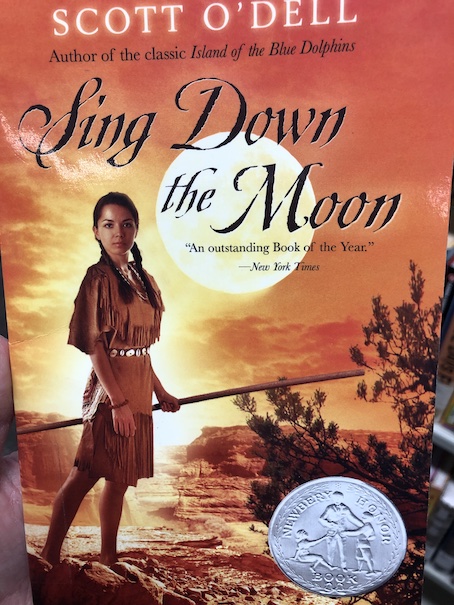
Sing Down the Moon cover

Sing Down the Moon by Scott O’Dell, 1970.

The story begins with a young Navajo girl, Bright Morning, admiring the beginning of spring, but she is caught in a storm and hurries home without the sheep she was supposed to be tending. When the girl’s mother realizes that she abandoned the sheep, she takes the girl back to the sheep, and they watch them all night. The sheep are very important to the family, and the girl’s mother refuses to allow her to take the sheep out by herself again for the rest of that spring.

When Bright Morning finally proves that she can be responsible and not leave the sheep to tend themselves, she is allowed to take them out again. Bright Morning likes to talk to the other girls, Running Bird and White Deer, as they watch all of their sheep together. The girls like to talk about their futures, who they will marry and what kind of children they have. They like to tease each other. Bright Morning’s friends know that she is likely to marry a young man called Tall Boy. The rumor is that Tall Boy’s parents want him to marry her because her mother owns so many fine sheep. Bright Morning knows that her friends tease because they are curious about Tall Boy and want her to talk about him, but she refuses. The girls know that he is supposed to be riding out with the warriors soon, and they tease that maybe he will bring back some other girl from the Ute tribe, but Bright Morning ignores them.

After the warriors have left for their raid on the Utes, the girls see some white men on horses approaching the village. The girls recognize them as oldiers and are worried that their village could be vulnerable to attack without the warriors. Later, the girls encounter more white men, but these men are not dressed as soldiers. They stop to talk to Bright Morning and Running Bird, asking them for directions, but the girls realize that they are slavers. They kidnap both girls and ride away with them!

They take the girls to a town of Spanish people and separate them from each other. They sell Bright Morning to a woman who uses her as a servant. The woman has other Native American girls as slaves, including a younger girl called Rosita. Rosita doesn’t mind her captivity or her life as a servant much. She came from a tribe that was very poor, and since she was brought to this woman’s household to work for her, she has had better food and clothing than she did at home. Rosita tells Bright Morning that the family they work for isn’t bad, and Bright Morning is allowed to keep her dog, who followed her when she was abducted. However, Bright Morning can’t stand her captivity. The woman who owns the house gives her new clothes, but Bright Morning doesn’t care. All she wants to do is find a way to go home.

Bright Morning is reunited with Running Bird when another captive girl comes up with a plan for the three of them to escape. They manage to steal horses and ride away from the town. Along the way, they meet up with Tall Boy and one of his friends, and the boys help fight off the Spaniards who are pursuing the girls. Unfortunately, Tall Boy is badly injured in the fight. He loses the use of one of his arms, and the other Navajos know that he can no longer be a warrior. Bright Morning still cares about Tall Boy, but her mother and sister tell her that she should no longer consider marrying him.

However, the Navajos’ troubles are just beginning. They haven’t heard the last of the soldiers. The American soldiers return and drive the Navajos off their land. They destroy all of their homes and eventually round them up and start them on a long march with little food, where many of them die. The Navajos fear that all of them will die. How will Bright Morning and her family survive, and will they ever see their homeland again?

The book is a Newbery Honor book. It’s available to borrow and read for free online through Internet Archive (multiple copies).

My Reaction

I remember reading this book when I was about 13 years old, in middle school! It takes place in my home state, the northern part, where the Navajo reservation is now, in the Four Corners region. I’ve been to Canyon de Chelly (“Chelly” is pronounced like “shay”, like in French) before, although I hadn’t been there at the time when I first read this book. Since I read this book as a kid, I’ve been to places and seen things that helped me understand the setting of the story better. As an adult, I appreciate the historical aspects of the story even more because I know more about the background. The book doesn’t give a date for the story until the postscript at the very end of the book, but the death march described in the story is Long Walk of 1863 to 1865.

The second half of the book is very depressing because there are horrible conditions and many deaths, including the deaths of children. I wasn’t sure that I really wanted to revisit this book at first because I remembered that it was depressing, but the book is well-written. The narrator describes events in an exciting, compelling way.

I had forgotten many details of the story, but there were some things that jumped out at me as an adult that I hadn’t noticed the first time. The postscript at the end of the story explains how life and Navajo culture changed after this traumatic event. If you see photographs of Navajo in “traditional” costumes now, they often include velveteen clothing, but that’s actually a relatively new tradition. The velveteen was adopted from white people during their captivity because they didn’t have access to wool to make their older style of traditional clothing. When Bright Morning was held captive in the Spanish town, she was given velveteen clothing there.

Another odd topic that is touched on only very briefly but that I know more about from other sources concerns the subject of flour. The book mentions that the Navajo were unused to eating wheat flour until it was their only form of rations during the Long Walk. Until then, their staple grain was corn, and when they started eating wheat flour, it made them feel sick. Their bodies just weren’t used to it. The book doesn’t explicitly explain this, but I know from other sources that the Long Walk and those flour rations were the origins of Navajo fry bread. Fry bread was not part of Navajo diet until that point. I grew up eating it on special occasions as a treat because it is greasy but good with powdered sugar, and it’s often served at carnivals and fairs here. However, as an adult, I came to realize that its origins as a food come from a very dark source. It was starvation food. It can keep you alive if there’s nothing else, but it’s not going to keep you healthy if you eat nothing else. It’s greasy and fatty, and it has little nutritional quality. Even now, I don’t have as much tolerance for it as I did when I was a kid. I can’t stomach it well these days if it’s too greasy or I eat too much.

That’s actually not a bad metaphor for the events described in this book. They’re heavy, and the more of it you understand and absorb, the sicker you feel. I absorb much more now than when I was a kid and only half understood the full significance of the events, and it makes me feel much worse than I did the first time.

So, do I recommend this book for kids? Actually, yes. I’m not a fan of depressing books with a lot of death, and I struggled through some depressing books when I was in school. If you had asked my 13-year-old self whether books with this much death and suffering were worth it, she might have had trouble answering that question, but time and further understanding have changed the way my adult self feels. There are some depressing topics that are worth the struggle to absorb them, but if I were the one teaching the lessons, I think I would do it a little differently than my teachers did for me back then.

I think this book is still a good introduction to topics that can be difficult to discuss. It’s worth reading once to understand the historical background of these events and what they really meant to the people who experienced them directly. It’s painful to read the bad parts, but it’s the kind of pain that leads to something better: real understanding. I recommend the book for kids in their early teens because I think that’s the best level for understanding it and accepting the bad parts. I think it should also be accompanied by nonfiction history lessons about the time period and events and discussion about their feelings about the story and historical events. I remember being told some of the history the first time I read this book, but I think that maybe there should have been more discussion about feelings.

I think it’s important to discuss feelings because they’re the hardest part of this book and they’re also the reason why it’s difficult to study some of the darker parts of history. I had a hard time with this when I was younger, and I still do in some respects, but I think understanding what causes those feelings is key to handling them. Reading books like this while discussing tools to handle difficult feelings could help students to better handle their emotions in other areas of life as well.

One of the first points that I think is important to understand and which my teachers didn’t really explain to me is that it’s natural to feel bad when you hear about bad things happening to other people, even when the bad things happened generations before you were born or even when those individual characters are fictional. (Bright Morning and her friends and family are fictional characters even though the events around them are historical. Real Navajos did experience what they experienced.) Empathy is a natural human emotion, and it’s an important tool for living with other people. Humans are social creatures. We live as part of larger groups, and we need at least some empathy to understand other people’s emotions and circumstances, how our actions affect them, and how to treat other people as we ourselves would truly like to be treated. The ability to experience empathy is a sign that you are mentally and emotionally healthy. It’s really only worrying when someone can’t feel it.

One of the most disturbing feelings about this story comes from realizing that the soldiers who are inflicting all of this death and pain either don’t feel empathy for the people they are harming or have actively chosen to ignore it to further their own purposes. That’s not a sign of being mentally or emotionally healthy or behaving in a moral way. When the readers feel repulsed by the soldiers and what they’re doing, it’s because they recognize that these people are a serious danger to others, and they are not functioning in a normal way. Your brain is warning you of a threat. It’s a past threat rather than an immediate one, but if you find the soldiers and their actions upsetting, it’s a sign that your brain has accurately assessed the risk associated with these people and the harm they do. You have accurately connected the suffering of other people for whom you feel empathy with the people who are the direct cause. I’m not saying that the soldiers were necessarily psychopaths, but lack of empathy and remorse and calculated manipulation are all symptoms of psychopathy and should raise alarms for anyone confronted with those signs. So, feeling bad about this situation and the people causing it is a sign that you yourself are mentally and emotionally healthy and have correctly recognized the seriousness of the situation and the harm being done to other people. What I’m saying is that, even when you’re feeling bad, it’s for good reasons, and that deserves recognition.

When I was young, I felt angry and frustrated by stories where people were doing terrible things to others. I still do because that’s part of empathy, but I also came to realize that part of my frustration when it came to historical situations came from my inability to change the situation. When harm has been done, it’s impossible to undo it. What was done was done. I can’t help the people who died, and I can’t even punish the wrong-doers because they’re dead now, too. It’s frustrating to find yourself confronted by a situation where nothing can change. But, I think it’s important to realize that change has happened and is currently happening. History is being written all the time, not even just through writing but through the ways that people live their lives every day. Even when a particular event is over, events and people keep moving. Bad events can cast long shadows, causing harm long after the initial event. That’s part of what makes them so bad. However, as time moves on, new people enter the scene, and new things happen, including things that people in the past would never have foreseen. It eventually reaches a point where the things that continue to happen rely on what we, the living, continue to do or allow to be done. History takes the long view, and I think people need to be reminded of that.

Do you suppose that the people in this story who act as villains thought of themselves like that? Further point, how much does it matter how they thought of themselves? Maybe they thought of themselves as winners at the time because they were getting their way and the people they were hurting were unable to stop them from hurting and killing them, but is that really “winning”? Lazy historians frequently brush things off by saying that “history is written by the victors“, but if that were really true, would we even be hearing or reading stories like this? Would we ever hear about slaves or care about the victims of war and atrocity? Would we ever consider the perspectives of people who died at all? Or does it change your mind about what “winning” really is and who’s really a “winner”? Maybe, in life and history, there aren’t any “winners” because neither of those was ever really a contest to begin with. (Or, as some put it, life is a collection of contests that people can simultaneously be both winning and losing. Personally, I think life is just for living, not for winning against someone else who is also trying to just live and probably couldn’t care less about you “winning” or not.) Apparent victories aren’t always real accomplishments, and people who see that reality are the ones who write the most accurate histories. Individual human lives only last so long, so any apparent “win” by an individual or group is never more than temporary. Our sense of what history includes and what people in the past were really like changes as we increase our knowledge of it and reconsider the context, not unlike the way my 40-year-old self has a deeper understanding of this book than my 13-year-old self did.

Remember that, at the beginning of this particular story, the Navajo warriors were going to raid the Utes. We never really find out in the book why they were going to do this, but does it matter anymore when the Navajos themselves get raided and subjected to something that might be even worse than what they were originally planning to do to their enemies? The story drops this subplot when the march begins. Life is like that, constantly moving, ever changing. History goes on and on. Sometimes, a young warrior who was praised for his prowess gets shot in the arm and can’t pull a bow anymore. Sometimes, a 40-year-old woman from the 21st century looks back on 19th century soldiers who may have thought of themselves as heroes and wants to tell them, to their faces, that they couldn’t be more wrong about that. If they’re not evil psychopaths, they’re doing a dang good job of pretending, and I never once thought of them as being “heroes” in my entire life. That’s life for you. Each of the people who have read this book or ever will read it are among the new people entering the story and its sequels, and we all have the ability to decide what role we want to play in the on-going story of history.

What happens after the book ends, is important, too. If I were teaching this, I would follow up this particular chapter of Native American and Navajo history by talking about some of the developments that continued to happen in their history, including some of the better moments, like the development of the written form of the Navajo language (for much of it’s history, Navajo was only a written language – that’s why the soldiers in the story couldn’t leave a written message in Navajo) and how code talkers used the Navajo language during WWII. The people who realized that these things were possible and something worth working toward were creative individuals. Rather than seeking to destroy something or repress it, they found creative ways to make use of what was there and put people’s talents to good use, helping others. The worst moments of history have been when people without empathy use others or seek to destroy them for personal gain, but the triumphant moments are when people take what they have and find a way to make it better. Noting these positive moments doesn’t make the bad parts of history any better than they actually were, but what we want is more of these positive moments of creativity and development and the type of people who are willing to work to make them happen.

It helps to balance out the explanations of what went wrong and people who did wrong with examples of what was better. Some teachers stress how we teach the bad moments so people learn from the past and don’t repeat it, and that’s true. However, I think we also need to add on what has worked and what we want people to do instead. A “don’t do this” needs to be followed up by “do this instead” to be an effective instruction. As a society, we don’t want more destroyers and takers. We want innovators and makers. We want creative people who find new uses for resources, including human resources and talents, and who are dedicated to truly helping others and human society as a whole instead of merely helping themselves to what others have that they want. This book demonstrates the dark side of humanity, but as I said, history is still being written every day with new players.

On the lighter side of this story, I enjoyed the descriptions of the coming-of-age ceremony for young women that Bright Morning has and the marriage ceremony later. During her time in captivity in the Spanish town, Bright Morning also attends Easter celebrations. She doesn’t understand Christianity and has never heard of Jesus before, and she doesn’t understand what the holiday is about or what’s going on. Rosita tries to explain to her who Jesus is in terms of Navajo religion. I found the explanation fascinating, but Bright Morning is still confused.

And This is Laura

And This is Laura by Ellen Conford, 1977.

Twelve-year-old Laura Hoffman feels out of place in her family. Her other three siblings are over-achievers. They all have particular talents and interests and earn awards for them or just have the ability to impress people. Laura gets good grades in school, but apart from that, she doesn’t seem to have any unique talents or interests. She doesn’t think there’s anything about her that would earn an award or impress anybody. Laura feels depressingly average next to the other members of her family.

It isn’t that her family is pressuring her to achieve anything in particular or to be like them or do what they’re doing. It’s just that Laura wishes that she had something more interesting and distinctive about herself. Other people who know Laura’s siblings keep comparing her to other members of her family. When she joins the drama club at school, one of her teachers seems a little disappointed that she’s not quite as good at acting as her older sister is. Laura’s friend, Beth, tells her that she’s good, but Laura feels like she’s never good enough, never as distinctive as she should be.

By contrast, Beth’s family is much more conventional. She only has one younger sibling, not three siblings, like Laura. Her mother is a lawyer, and their house is always neat and stylish. Laura’s house is noisy and chaotic, and she describes their household clutter as looking like a rummage sale. Laura thinks of herself as being a more ordinary, conventional person, and it occurs to her that she feels more at home in a conventional house. When Beth comes to visit Laura’s house, Laura worries at first that Beth will think her family is too weird. However, Beth is charmed by their eccentricity. In fact, Laura feels a little hurt at how interesting Beth finds the rest of her family. Laura worries that she’ll always be boring and ordinary compared to everyone else. However, Laura has a special talent that even she doesn’t realize that she has.

While Beth is having dinner with Laura and her family, Laura’s mind wanders from the chaotic conversation at the dinner table. She suddenly finds herself having a vision of her scientist father in his laboratory. She sees him meeting a man in a white shirt and then acting excited, like he’s just had an important discovery. The vision feels strange to Laura different from a daydream. When it’s over, she hears her father saying that he has a lot on his mind, and Laura absent-mindedly tell him that he’ll figure it all out tomorrow, after the man with the white shirt comes. Suddenly, everyone stops eating and stares at her, wondering what she meant, but even Laura herself isn’t sure. She’s aware that she knew her father was working on some difficult problem because he was juggling hard-boiled eggs earlier (something her eccentric father does whenever he needs to think), but she’s never had visions like that before and doesn’t know who the man in the white shirt is or what her vision really means. She just thinks it’s nice that everyone seemed to notice her.

There must be something to Laura’s visions because her father later tells her that he figured out his problem just like she said she would. Beth is intrigued by Laura’s apparent ability to predict things and tries to help her have another vision. Laura sees Beth on a stage with flowers at her feet and takes that to mean that she’ll be the star of the drama club play. However, Laura isn’t sure that her visions are always true because, when Beth tries out for the lead, she only gets the second best part in the play.

Another odd thing about Laura’s ability is that the girls realize that it doesn’t work well in a quiet environment, like Beth’s house. Laura gets visions when she’s surrounded by noisy chaos and starts to feel like she’s either outside of the situation or wants to be outside of it.

At first, Laura likes feeling special and noticed because of this unusual ability she seems to have, but it soon starts to worry her. She’s not sure that she can always trust her visions to be right or her ability to interpret them. She also begins to realize that it’s not so much that people are starting to notice her as a person but to pay attention to her ability, which is different. It starts to make her feel even more out of it than before.

Then, Laura has a terrifying vision where her younger brother, Dennis, is missing and her mother is frantic with worry. Is that vision real? Is something really going to happen to Dennis, or is there another explanation? The vision wasn’t clear on what would happen to Dennis, and if it is a real vision, can Laura do anything to protect her little brother?

The book is available to borrow and read for free online through Internet Archive.

My Reaction and Spoilers

This story starts off like many other kids’ books I’ve read, where a character feels out of place in their family or wishes that they had some talent that would make them stand out from their siblings. Then, it takes a turn for the mysterious when Laura begins to have visions that make it seem like she can predict the future. At first, Laura enjoys the feeling of being special and noticed, but then, her visions start to frighten her.

Another girl at school, Jamie, hears her talking about it with Beth, and she tells Laura that she’s fascinated by people with psychic abilities. She’s read about it before, and she points out to Laura that not being right all the time or not knowing what a vision means at first doesn’t mean that she isn’t gifted. When she explains to Laura how alarming visions can have perfectly innocent explanations because visions can be metaphorical, Laura feels better.

Jamie persuades Laura to give psychic readings to classmates for money, but the idea of turning her newfound ability into a business doesn’t feel right to her. Sometimes, she sees things that she doesn’t like, things that frighten her. It’s bad enough to predict that a classmate will fail a class, but another vision suggests that a classmate will die. He doesn’t die, but he does get into a car accident, and that’s bad enough. Laura realizes that it’s horrible to see that bad things will happen without having a way to do anything about it. Also, instead of being pleased and proud of her, her family finds the whole business unnerving and all of the kids who come to see her for psychic readings too chaotic, even for them.

There are also the disturbing visions that Laura keeps seeing about Dennis. She takes her friends and her old sister, Jill, into her confidence. Jill says that she will keep a close eye on Dennis to make sure nothing happens to him. Dennis does disappear during the story, and people worry about him, but nothing bad happens to him. Nobody in this story dies, and Laura uses her visions to figure out where Dennis is.

Toward the end of the book Laura talks to her parents about whether or not they’re proud of her because of her psychic abilities. They have a family talk about what it means to be proud of someone. The parents say that they’re not proud of their children for being talented because they don’t see themselves as being directly responsible for their talents. They love all of their children simply because they’re their children, and they’re good people, who do what they think is right and care about others. As far as talents and accomplishments go, the parents see their role as parents as making resources available to their children so they can develop whatever talents they have to the fullest, whether that means letting them have music lessons or encouraging them to try out for the school play. Whatever talents the children have are simply what they were born with, and their achievements are signs that they’re making use of what they have. The children accomplish what they work for themselves, and they’re doing it because they love doing it, not because the parents require it. What makes the parents proud of their children is when they find out what they’re good at and what they love doing. It doesn’t matter to them what their children’s talents are or how their talents compare to each other’s; they just want all of their children to find fulfillment in what they do.

In fact, her mother says that she thinks part of Laura’s trouble is that she’s good at too many things. She’s always gotten good grades in every class, so none of her subjects seems to stand out. If she only got mediocre grades in most subjects and good grades in just one, she would feel like she had a particular talent for that one subject. When she gets equally good grades for everything, nothing stands out to her as her special talent. Rather than being “boring” and “ordinary”, as Laura thinks of herself, she’s actually well-rounded and multi-talented.

Her parents have always been confident that Laura would find her own interests and talents in life. She just feels unaccomplished next to her siblings because, except for Dennis, her siblings are older than she is and have had more time to figure out what their interests are and build up accomplishments. Laura is also a good, caring person, who has been using her talent to help other people to the best of her ability. She looked into everyone else’s future but her own. Her parents say that having a lovable and loving daughter means more to them than any number of impressive accomplishments would be. Whatever anyone else in the world thinks about Laura and her abilities, her family loves her for who she is, not her abilities.

I like the parents’ attitudes, and it seems that the rest of Laura’s family feels the same way, especially her older sister, Jill. I enjoyed how supportive Jill was about both Laura’s psychic abilities and about her acting. When Laura tells Jill that she’s thinking about quitting the drama club because her teacher seems disappointed that her acting isn’t as good as Jill’s, Jill persuades her not to quit. Jill tells Laura that she would understand if she wanted to quit the drama club because she discovered that she really didn’t like drama after all, but she doesn’t want her to quit because she thinks she isn’t good enough. Jill says that Laura is good but that she just needs a little more coaching. She wants her sister to see that she is more talented and capable than she thinks and to make the best use she can of her talents, all of them.

There were a few instances of mild swearing in the book and one semi-dirty joke. When Laura thinks that she’s hopeless at acting because her teacher is disappointed that she’s not like her sister and says that she’s going to give up the drama club, Jill insists that Laura read the role for her so she can see what her performance is really like. Laura doesn’t really want to, but Jill insists that she stand up and read it properly because “You can’t act lying down.” Laura quips that “You can if you’re in an x-rated movie”, and Jill wryly tells her that she’s too young for that. The joke only works if the reader knows what an x-rated movie is, so it would probably go right over the heads of anyone too young to understand it.

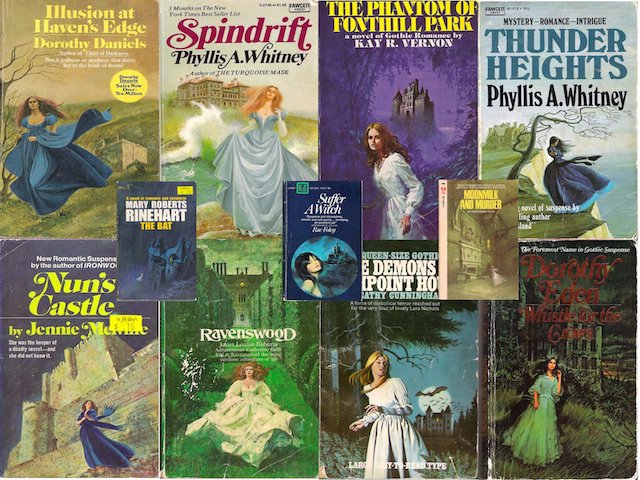
One part of this book that I thought was amusing was when Laura explains about her mother’s writing career. When her mother was younger, she played bit parts in movies, and now, she writes gothic romance novels and westerns. Laura doesn’t like the westerns, but she’s read a couple of the gothic romances, and she has noticed that her mother’s gothic romances are very formulaic – “heroines who go to live in crumbling old castles where dark family secrets are buried and everyone acts strangely and the heroine finds herself in Terrible Danger.” That is a concise and accurate description of that entire genre of books. Her mother says that’s part of the challenge of writing gothic romance – writing the same story over and over in different ways so readers can hardly recognize that it’s the same story at all.

The reason why that’s funny to me is that, years ago, my brother and I were sorting through some old books, and we found our mother’s old collection of gothic romance books. I was immediately struck that all the covers on the books looked alike. They weren’t completely identical, but they all had young women in dresses running away from crumbling old manor houses or castles while looking scared. Sometimes, the heroine had a blue dress and sometimes a red one. (More often than not, the dress was blue, but sometimes, there would be a girl in red, pink, or white. Other colors were rare.) There were a few where it looked like it was even the same girl or the same castle viewed from a different angle. I thought it was so funny, I picked up a couple more with very similar covers from a thrift store and made a couple of digital collages with them that I turned into backgrounds for my computer screen. The same story, told over and over in different ways. You can’t judge a book by its cover, but these covers do explain a genre. I’m not saying it’s not a fun genre, only that I find it funny. Whoever did the covers for these books was undertaking the same sort of challenge that writers like Laura’s mother did in writing them.

The Mystery of the Sinister Scarecrow

The Three Investigators

#29 The Mystery of the Sinister Scarecrow by M. V. Carey, 1979.

Jupiter Jones is going on a buying trip with Hans and Conrad, the men who work for his uncle’s salvage yard, to see someone who had some things to sell to his uncle. Jupiter’s friends, Bob and Pete, go with them, but they’re all stranded when their truck blows a tire. They look around for a place where they can call the salvage yard to explain their situation and get help, and they see a large house with a cornfield nearby.

However as Jupiter approaches the house to ask to use the phone, he is suddenly tackled by a man with a jagged rock in his hand! Hans comes to his defense, and the man is surprised and sorry when he realizes that he’s just tackled a boy. It turns out that the man is nearsighted and has lost his glasses on the ground. He starts to explain that he thought that he was tackling a scarecrow, and then, he suddenly stops and says that he’s been having trouble with trespassers. Jupiter asks him what meant when he talked about the scarecrow, but the man dodges the question. Instead, he asks them why they’re there, and they explain about wanting to use the phone.

The man invites them into the house to use the phone. The man isn’t really a farmer. His name is Dr. Wooley, and he’s an entomologist who’s working on a book. He’s studying army ants, which are carnivorous. He shows them the colony he’s studying, but the sight of all those ants just encourages them to finish their call and leave fast.

However, Jupiter is still intrigued about why Dr. Wooley seemed to attack him because he thought he was a walking scarecrow. He persuades Bob and Pete to return to the area with him to investigate. When they stop in a cafe, a man there hears them talking about the scarecrow, and he says that he’s seen the walking scarecrow himself. He works in the area, doing security for a nearby museum. The boys ask him for details about his sighting of the walking scarecrow, and he says that he saw it near the Radford house, which is where the boys met Dr. Wooley.

When they go to the place where the man saw the scarecrow, they meet a woman named Leticia. Leticia asks them what they’re doing, and they explain about looking into a sighting of a walking scarecrow. Suddenly, Leticia gets very excited. She has seen the scarecrow herself, but no one will believe her. She asks the boys if they will come to the house and explain to Mrs. Chumley that she really did see a walking scarecrow.

Leticia Radford is a jet-setting heiress who lives in the mansion by the cornfield. Mrs. Chumley has been with her family a long time as a secretary and housekeeper, but she’s been confined to a wheelchair for years after being in a car accident. Leticia spends most of her time traveling in Europe, but she returns home periodically, usually after one of her disastrous romances. She has phobias of both insects and scarecrows. Actually, her fear of scarecrows is related to her fear of insects and other creepy-crawly things. Leticia explains that, when she was a child, a scarecrow fell on her when she visited a pumpkin patch one Halloween, and when it broke apart, it had spiders in it, so she always associates scarecrows with bugs. Until the boys explain that other people have seen the walking scarecrow, Mrs. Chumley had thought that Leticia had imagined it.

Leticia blames Dr. Wooley for the walking scarecrow because he made a scarecrow after he moved into the cottage on the estate property to do his research on the ants. Dr. Wooley makes her nervous because she associates him with both bugs and scarecrows. Leticia says that the scarecrow seems to be targeting her because it has shown up multiple times, seemingly looking for her, and once, it hid in her car and threw bugs on her.

While the boys are in Leticia’s mansion, explaining to the other people in the house that Leticia hasn’t imagined the scarecrow, Dr. Wooley shows up, angrily accusing the boys of faking their car trouble the day before just to get into his lab. Dr. Wooley says that someone dressed as a scarecrow entered his lab, hit him on the head, and stole a jar of some of the ants he’s been studying. It doesn’t take them long to figure out where the ants went because Leticia finds them in her bedroom, along with the jar from Dr. Wooley’s lab.

It’s obvious that someone is purposely trying to frighten Leticia by dressing as a scarecrow and tormenting her with bugs, the two things guaranteed to terrify her. The boys are surprised when Dr. Wooley is the one who hires them to find the person tormenting Leticia. Dr. Wooley says that he isn’t responsible for frightening Leticia, but he can see that it all looks bad for him because he was the one who made a scarecrow and the ants in Leticia’s room were his ants. He doesn’t want his professional reputation ruined, and he also feels sorry for Leticia. Leticia can’t figure out why anyone would target her because she’s never been a threat to anyone, but she may be more of a threat to someone than she knows.

My Reaction

The combination of a mystery involving scarecrows and insects and someone who is afraid of both scarecrows and insects is a little strange, but I thought the author did a good job of explaining how the two are related in this story. Leticia’s two fears are connected because she thinks of scarecrows as being homes for bugs.

One of my questions during the mystery was wondering whether someone is trying to convince Leticia that she is crazy (“gaslighting” her, like in the movie of the same name) or just trying to drive her away from the house. I had a couple of theories about what could be going on. Some of what I considered turned out to be right, but someone I suspected turned out to be completely innocent.

At first, I also wondered if there would be an unexpected romance between Leticia and Dr. Wooley because the story establishes that they are both single, and there are points when they hang out together when they don’t have to. However, the story doesn’t end with any clear romance. Leticia is still afraid of insects at the end, which would make romance with an entomologist awkward. She does allow Dr. Wooley to continue his work on her property, though. The boys also notice that Leticia seems to branching out and finding new interests at home rather than running off to Europe again, so that might represent some new developments in her character and a possible turning point in her life.

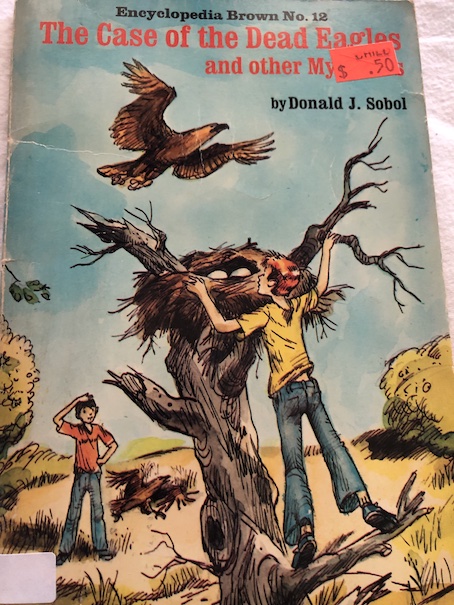
Encyclopedia Brown and the Case of the Dead Eagles

Encyclopedia Brown and the Case of the Dead Eagles and Other Mysteries by Donald J. Sobol, 1975.

The Idaville police department has an excellent record, but that’s because the chief of police’s ten-year-old son is Encyclopedia Brown. People praise Chief Brown, and Chief Brown doesn’t feel like he can admit how much help his son gives him because he doubts anyone would believe him. Encyclopedia himself doesn’t want to admit to other people that he helps his father figure out tough cases because he doesn’t want to seem too different from the others kids at school. However, Encyclopedia also has a detective business, helping the neighborhood kids to solve their problems for only 25 cents a day, plus expenses. Sally, a smart and tough girl, is his partner in the detective business, and Bugs Meany, a bully who’s the leader of a local gang of youths called the Tigers, is their main nemesis, although they also deal with other bullies and criminals.

I always liked Encyclopedia Brown books when I was a kid! There are a couple of instances where modern kids might not understand the solutions to some cases because of certain habits and traditions that modern people don’t follow anymore. There is one case in this book in particular that I didn’t understand when I was a kid, and I wouldn’t expect modern kids to get the answer, either.

The book is available to borrow and read for free online through Internet Archive (multiple copies).

Stories in the Book:

The Case of the Dead Eagles

Encyclopedia is camping with his friend Charlie Stewart when they hear a gunshot. When they go to investigate, they find a dead eagle. They think they know who’s responsible because this person has killed eagles before. Can they prove it in time to save the mother and babies from the same fate?

The Case of the Hypnotism Lesson

A boy named Dave hires Encyclopedia because he thinks Bugs Meany cheated him. (Always a likely possibility in anything Bugs does.) This time, Bugs charged Dave a dollar for a lesson on hypnotizing lobsters. Dave saw Bugs and his friends cooking and eating lobsters they had caught earlier, and Bugs told him that the secret to catching lobsters is to hypnotize them. However, when Dave gave him the money, Bugs just showed that he could pick up a lobster, and the lobster wouldn’t move. He didn’t actually show Dave any hypnotism and refused to teach him anything unless he paid more money. Dave realizes that Bugs was trying to trick him and wants his money back. When Encyclopedia sees a picture that one of Bugs’s friends took, he knows how to prove that Dave was cheated.

The Case of the Parking Meters

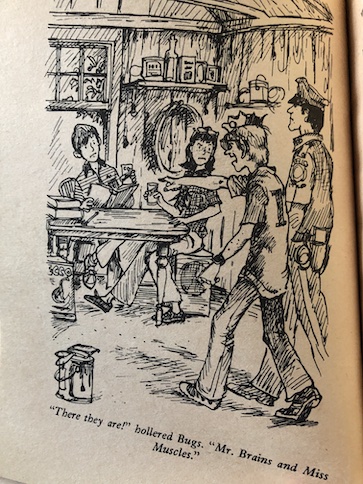
Both Encyclopedia and his detective partner Sally have received phone calls asking them to meet people at different locations, but each time, they waited around, and nobody showed up. They’re starting to suspect that this is another of Bugs Meany’s tricks, trying to get back at Encyclopedia for foiling his schemes. Sure enough, Bugs Meany shows up at Encyclopedia’s house with a police officer, claiming that Encyclopedia is running a racket to get money from people parked at parking meters by putting money in the meters, telling them that they’ve been saved from the fine for an expired meter, and asking them for money for the favor. The police officer isn’t sure that such a thing is actually illegal, although he’d have to inquire with a judge about the matter. Bugs claims that he could prove what happened except that Sally stole the film that he had of Encyclopedia putting money in the meters. When Bugs manages to “find” the film where Sally supposedly ditched it after taking it, Encyclopedia points out why Bugs’s story can’t be true. The solution would make more sense to somebody who understands how reel-to-reel films work.

The Case of the Hidden Will

Encyclopedia’s father, Chief Brown, tells him that a wealthy man named Brandon King has died, but his will is mysteriously missing. Evidently, Mr. King hid the will himself and swore his own lawyer to secrecy about it. The reason for the secrecy is apparently because one of Mr. King’s four sons, who all helped to run the family business, is a thief. Mr. King’s friends knew that was the case, although none of them knew which son it was. Mr. King’s lawyer gave Chief Brown a note written by Mr. King which hints at which son is the thief and saying that his property will go to the other three sons. Chief Brown isn’t sure which of the Kings is considered the “odd King out” until Encyclopedia tells him who it has to be, and Encyclopedia also tells him where the will is.

The Case of the Mysterious Thief

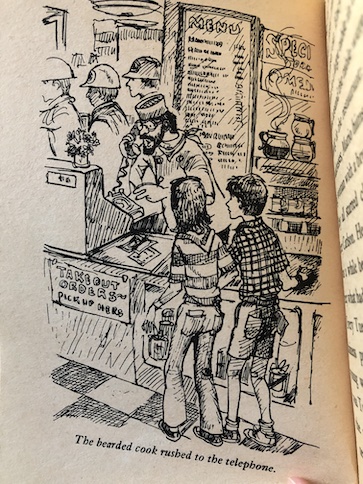
Encyclopedia and Sally go to a restaurant to order a pizza for lunch. While they’re waiting for their pizza, someone attacks the owner’s daughter in the ladies’ room and steals the money she was going to take to the bank. The owner’s daughter is very strong, and it must have taken someone very strong to overpower her and knock her unconscious so quickly and easily. It doesn’t seem likely that it would be a woman, but people would have noticed if a man had gone into the ladies’ room. Sally figures out the answer to this one, but it isn’t likely that modern readers. I didn’t get it when I was a kid, either, because the solution is based on an old piece of etiquette in restaurant seating that I don’t think people observe anymore.

The Case of the Old Calendars

Encyclopedia and Sally hurry over to Butch Mulligan’s house because they hear that Butch is fighting Bugs Meany and the Tigers. Butch is a big, strong 18-year-old, and the Tigers are no match for him. Encyclopedia asks Butch’s younger brother how the fight started, and he explains that Butch’s math teacher recently moved and gave Butch a stack of old calendars with some cool Civil War pictures on them. Then, Bugs claimed that he asked the teacher for those calendars himself, but the teacher forgot. He produced a note supposedly from the teacher that asks Butch to share the calendars with Bugs. Butch was willing to share, but there are an odd number of calendars, and Butch thinks Bugs cheated on the coin flip they had to determine who would get the odd one. He probably did, but Encyclopedia can prove that Bugs faked the note from the teacher, too.

The Case of Lightfoot Louie

Only a few days before the state worm-racing championship, Encyclopedia’s friend Thad accidentally stepped on his prize worm. It’s sad, but as a member of the Worm Racers’ Club of America, Thad can time other people’s worms to be entered in the race. He’s worried because Hoager Dempsey wants him to time a worm, and if he says the worm isn’t fast enough to enter the race, Hoager might beat him up. Thad asks Encyclopedia and Sally to watch the time trial as witnesses to make sure there’s no foul play.

The Case of the Broken Window

John Hall is a wealthy man with an impressive stamp collection. Some of his stamps are worth thousands of dollars. One evening, he calls Chief Brown and asks him to come to his house but to wear a costume because he’s giving a costume party, and he doesn’t want his guests to know that he’s called the police. Chief Brown and Encyclopedia put on their Halloween costumes and go to the Hall estate to investigate the theft of one of Hall’s expensive stamps. Hall thinks one of his guests is the thief, but which one?

The Case of the Gasoline Pill

“Twinkletoes” Willis is a young track star, and he comes to see Encyclopedia about a run-in that he had with Wilford Wiggins, a local high school dropout who’s into get-rich-quick schemes. Wilford has called a meeting of local kids at the city dump to tell them his latest money-making idea, which can only mean trouble. Wilford’s latest money-maker is a pill which he says allows cars to drive thousands of miles if you put it in the gas tank. Fortunately, Encyclopedia knows just how to prove that Wilford is a fraud.

The Case of the Pantry Door

Hilda’s hobby is fly hunting, and she’s a crack shot with rubber bands. She invites Encyclopedia and Sally to a little birthday party that she’s having for her pet frog, who lives in the birdhouse in her backyard. When Encyclopedia and Sally go into the pantry at Hilda’s house for sugar for catching flies, someone locks them in and steals the household money that Hilda’s mother hid in the kitchen. Hilda’s cousin, Lois, says that she saw a boy running away from the house, but Encyclopedia knows who really took the money.

Blackbeard’s Ghost

Blackbeard’s Ghost by Ben Stahl, 1965, 1976.

This is the novel that the live action Disney film Blackbeard’s Ghost from 1968 was based on. My copy is a later edition designed as a tie-in with the Disney movie, based on the cover, but it contains the text of the original story.

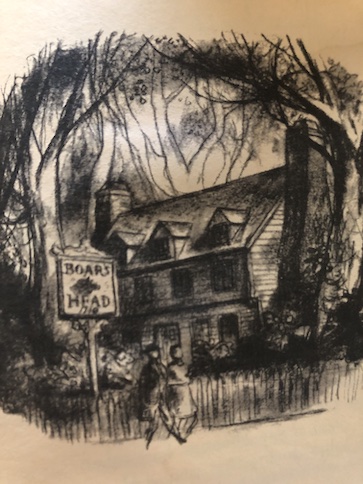
The story begins with a prologue that explains how Blackbeard the pirate evaded execution for piracy by offering to collect tolls from ships on behalf of the colonial governor, Governor Eden, in the town of Godolphin. However, instead of collecting tolls from the ships, he decided to use his position for his own benefit. Knowing that he would eventually need a source of stability on land instead of spending the rest of his life at sea, he looted wood from various ships and used it to build a tavern for himself called the Boar’s Head. He hired a woman rumored to be a witch, Aldetha, to tend the tavern for him. In the end, though, Blackbeard was killed by someone who wanted to collect the bounty on him for piracy. After his death, the poor woman who tended his tavern was burned at the stake for witchcraft.

(Note: The witch burning is historical inaccuracy because no witchcraft executions in North America involved burning, at least not in English-controlled parts of the American colonies. Accused witches in North America were typically hanged. None of this story is meant to be historically accurate, but I always feel compelled to point that out in stories that make that mistake. The town of Godolphin and the Boar’s Head Tavern are fictional. In real life, Blackbeard did receive a pardon from the real Governor Eden in Bath, North Carolina, and he was eventually killed in 1718 in a battle with Lieutenant Robert Maynard and his crew, as he did in this story. However, in the book, the tavern is now owned by a descendant of Maynard’s, and in real life, Maynard didn’t have any children.)

Most of the story takes place in the 20th century, when two 14-year-old boys, J.D. and Hank, talk about how the old Boar’s Head Tavern is about to be torn down because the former owner sold it, and there’s going to be a gas station built on the land instead. They think it’s a shame because they’ve heard ghost stories about the place and think the old tavern is fascinating. The boys go to watch the workmen tearing down the old tavern, but the workmen haven’t made any progress so far. Although they’d love to loot some of the expensive woods from the old tavern, they just can’t seem to dismantle the building. They’ve been able to dismantle some of the newer additions to the building, but somehow, they can’t seem to touch the original structure. The site has been plagued with mysterious accidents. Their equipment fails, heads fall off the ends of their hammers, and workmen keep getting injured in small accidents, not enough to seriously hurt anyone but enough to keep them away from their work for days at a time.

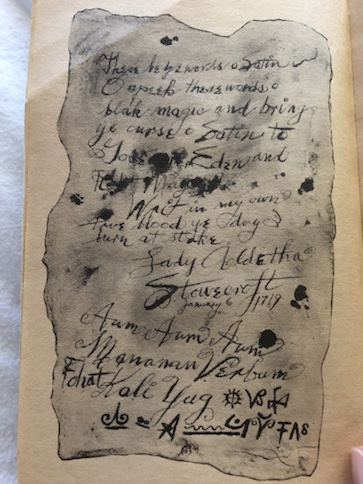
When J.D. and Hank see the workmen leaving the building in frustration soon after arriving, they decide to go inside and look around to satisfy their curiosity and see if there’s anything of value that they can salvage before the tavern is demolished. They don’t find much of value, but they do find their way into Blackbeard’s secret dungeon under the tavern. There, they find a piece of old parchment with a satanic curse written by Aldetha. (So, apparently, people were actually right about her being a witch. Plot twist!) Inspired by this creepy message from the past, the boys realize that they can make money from other kids by capitalizing on the ghost stories about the old tavern and holding seances to contact the spirits. They don’t really believe that seances are real, but they figure that, if they can get enough ghost-story fans to come to their seances, they can make a profit from this enterprise.

Of course, the boys’ seance awakens the ghost of Blackbeard. Blackbeard is invisible to everyone except for the boys, but he’s a solid ghost, who can manipulate physical objects. The boys quickly realize that Blackbeard can be a dangerous ghost, and he’s not at all happy when he finds out that a descendant of the man who killed him wants to have his tavern torn down.

The book is available to borrow and read for free online through Internet Archive. The Disney movie is available to buy or rent through YouTube or Amazon Prime. There is also a sequel to this book called The Secret of Red Skull, which involves spies and is also available online through Internet Archive.

My Reaction and Spoilers

There is some humor in this book because only the boys are able to see and hear Blackbeard, but by the end of the story, adults become aware of Blackbeard’s ghost, too. The boys’ history teacher is helpful in finding a way to appease the ghost by helping him to negotiate to buy back his tavern using his hidden treasure. When it becomes obvious both to Maynard and the company he tried to sell the tavern to that it’s haunted, they’re willing to accept pirate gold in exchange. The company also sees that it can use the building for public relations purposes by sponsoring a pirate museum in the old tavern. It’s good news for the teacher, too, because he gets to be the director of the museum. There, he can show off his collection of pirate memorabilia and indulge his love of pirate history. The tavern continues to be haunted by the ghosts of Blackbeard and his witch friend, leaving the story open for the sequel.

As expected of Disney films, the Disney movie version of the story is quite different from the book. In the movie, the person who can see the ghost is a college track coach who is staying in the old inn, which is still being operated by elderly descendants of Blackbeard’s old crew. There is a track meet in the movie that never appeared in the book, and at the end of the movie, Blackbeard disappears, having been freed from his haunting by performing a good deed.

I prefer the concept of the boys being the ones who accidentally summoned Blackbeard’s ghost, but the boys got on my nerves at first. In the early part of the book, they bickered a lot and didn’t seem to like each other enough to be best friends, although they seemed to be friendlier with each other later, when they were both trying to figure out what to do about Blackbeard. I think the teacher character was my favorite. He takes the matter of the ghost in stride, coming up with a practical solution that helps everyone.

Carrie’s War

Carrie’s War by Nina Bawden, 1973.

The story begins with an adult Carrie reflecting on her youth during World War II, taking her children to see the place where she stayed as a child evacuee and remembering an incident that has haunted her for the last 30 years. Adult Carrie is a widow who was married to an archaeologist who died only a few months before the story begins. In some ways, Carrie says that her husband was very much like a boy she used to know during the war, Albert Sandwich. The family trip and Carrie’s memories take them back to a small mining town in Wales and an old house called Druid’s Bottom, now a ruin, that used to house a mysterious skull … and what Carrie regards as the worst mistake of her life. Although adult Carrie knows that, logically, what happened couldn’t have really been her fault, there are some things in life that are difficult to prove or disprove, and she’s always blamed herself for what happened.

When Carrie Willow was eleven years old, she and her younger brother, Nick, were evacuated from London along with other children to avoid the bombings. All of the children were told to report to their schools with a packed lunch and a change of clothes, and none of them had any idea where they would be taken after that, only that their parents wouldn’t be going with them. Their mother tried to frame it all as a great adventure that they would enjoy, but the children were understandably worried. They had to wear labels on their clothes with their names on them, and they had to carry gas masks, which is never a reassuring thing to be told you might need. (Young Carrie thinks to herself that her mother is such an optimist that, if they found themselves in Hell, she’d look on the bright side and say, “Well, at least we’ll be warm.”)

The children’s teacher takes them aboard a train, and they head off into the countryside, ending up at a coal-mining town in Wales that doesn’t look like much. That’s where Carrie meets Albert, another boy who rode with them on the train. Albert is tall and serious and wears glasses. His first concern is that the town isn’t big enough to support a proper library. Carrie is mostly concerned about keeping her brother with her and making sure that someone will be willing to take them both together. (Hosts for WWII evacuees were told how many children they were expected to take in, but they were given the opportunity to choose which ones they would host from among the children available. Sometimes, siblings were split up if they couldn’t find accommodations that could house them together.)

Carrie and Nick are eventually chosen by Miss Evans, a woman who lives with her brother. Originally, Miss Evans had been hoping for two girls so they can share the one spare room that she and her brother have, but Carrie persuades her that she and Nick sometimes share a room at home because he has bad dreams. Miss Evans is a shy and nervous woman, and her brother, Samuel Evans, is ultra-strict and fussy. Everything in their house is super neat, and they have special rules to keep it that way. Carrie and Nick aren’t even accustomed to picking up after themselves because their family has a maid who does all the cleaning. The house has a bathroom with running hot and cold water, but if they have to go to the bathroom in the middle of the day, Mr. Evans wants them to use the outdoor one in the yard to avoid messing up the new carpet on the stairs with too much “traipsing” up and down. Even Miss Evans uses the outdoor bathroom, although Samuel Evans never does because he thinks it’s unseemly because of his position in the community as a store owner and town Councillor. So, for starters, Mr. Evans makes strict rules for others to follow that he doesn’t follow himself.

Carrie can tell right from the first that Samuel Evans is a bully who pushes people around, especially his sister. He’s much older than his sister and helped to raise her after their parents died. Really, Miss Evans was raised with Mr. Evans’s son, Frederick, who is now in the army, being more like her brother than her nephew. Now that Mr. Evans’s wife is dead, there’s no one else in the household but the two of them. When Miss Evans and Frederick were young, Mr. Evans used fear, intimidation, and harsh physical punishment to keep them in line. However, Mr. Evans can’t really bully the children because Carrie is careful not to show that she finds him intimidating, and Nick just isn’t intimidated because he refuses to be impressed by anybody with false teeth. Still, Carrie realizes that they should try to keep out of his way and not make him angry.

Samuel Evans is also very strict about religion. One day, when Nick eats some biscuits in his shop, Mr. Evans declares that he’s been stealing and that he’s going to get the strap for it. Carrie is horrified because their parents don’t use physical punishment, and Nick is terrified. Miss Evans is too afraid to intervene, so Carrie steps in and defends Nick, just saying that he didn’t understand that it was stealing to eat the biscuits. Mr. Evans says that’s not a good excuse, but Nick says that if he whips him, he’ll go to school and tell the teacher that Mr. Evans beat him for taking food because he was hungry. Mr. Evans realizes that, while other adults might not fault him for punishing a thief, they would if it looked like he was starving and neglecting his charges as well as beating them. Instead of giving Nick a beating, he prays out loud for Nick to turn from his “evil ways.” It’s difficult for Carrie to listen to because she realizes that Nick hasn’t been starved, wasn’t really hungry, and should have known better than to take the biscuits, and now, he’s made an enemy of Mr. Evans. They don’t have much choice other than staying in the Evans house because they can’t go back to their parents yet, and there just aren’t any other places in town for them to stay. The kids become fond of Miss Evans, who they start calling “Auntie Lou”, but they always have to be wary of Mr. Evans.

When their mother comes to visit, Mr. Evans acts extra nice to the children and tries to be charming to their mother. The children’s mother has some misgivings about how the children are being treated, but the children don’t complain about some of the harder aspects of living with Mr. Evans because they don’t want their mother to worry. She’s been working as an ambulance driver in Glasgow because her husband’s ship makes port there, and she can see him sometimes. She needs to know that her children are safely settled somewhere to continue her work, and the children have also grown attached to Auntie Lou and don’t want her to get into trouble, even if they don’t like Mr. Evans.

Shortly before Christmas, Auntie Lou explains to the children that she and Mr. Evans have an older sister named Dilys, and she’s giving them a goose for Christmas dinner. The reason why the children haven’t met Dilys before is that Auntie Lou and Mr. Evans don’t really get along with her and hardly ever see her. Mr. Evans in particular resents Dilys because, years ago, she married into the Gotobed family. The Gotobeds owned the mine nearby where their father was killed in an accident. Mr. Evans always blamed the Gotobeds for their father’s death because they didn’t have adequate safety measures, and he felt like Dilys was turning her back on the family by marrying Mr. Gotobed’s son. Now, Dilys is a widow, and she’s not in very good health, which is another reason why she doesn’t get out much. She lives in the old house known as Druid’s Bottom, at the bottom of Druid’s Grove, where the yew trees grow. A woman named Hepzibah Green looks after her and the farm where they raise poultry. Local people are rather superstitious about Druid’s Grove, but Carrie thinks it sounds wonderfully spooky and exciting. Auntie Lou and Mr. Evans send Carrie and Nick to Druid’s Bottom to pick up their Christmas goose from Hepzibah Green because Auntie Lou gets sick and can’t go herself.

On the way to Druid’s Bottom, Carrie and Nick are scared because they think they hear something chasing them, making odd sounds. It turns out that it’s only Mister Johnny, a cousin of Mr. Gotobed, Dilys’s deceased husband. Mister Johnny has developmental disabilities and can’t talk very well or understandably to most people, which is why he lives with Dilys in Druid’s Bottom and is cared for by Hepzibah. Hepzibah has been Johnny’s nurse since he was a baby, and she now cares for the elderly and ill Dilys as well.

Albert Sandwich has been staying at Druid’s Bottom, also in Hepzibah’s care, since Carrie and Nick last saw him. Albert tells them that Hepzibah is a kind of witch who knows some kind of healing magic. Albert hasn’t been to school with the other children because he was very sick after they last saw him, and Albert thinks that he only survived because Hepzibah gave him herbal medicines. Albert loves Druid’s Bottom because of Hepzibah and also because the old house has an impressive library. In the library, Albert also shows Carrie a strange curiosity – an old skull. The story surrounding this skull is that it’s the skull of an African slave boy who was brought to this house years ago. (Albert explains to Carrie that he doesn’t believe that because he’s examined the skull. He explains that the number of teeth suggest that the skull was from an adult, not a boy, and the size and shape suggest that it’s the skull of a woman. Albert suspects that some local person actually found the skull at the site of an Iron Age settlement nearby.) According to the legend of this skull (or what people say the legend is), the young slave boy died of a fever, and on his deathbed, told the Gotobed family that they must keep his skull in the house or the walls would fall. Hepzibah says that one of the Gotobeds’ ancestors tried removing the skull from the house once, and during the night, all the crockery in the kitchen broke and the mirrors in the house cracked for no apparent reason. When they brought the skull back into the house, they didn’t have any further problems. Albert is skeptical of this story, but it’s captivating for Carrie.

Carrie finally meets Dilys Gotobed one day when everyone else is busy and Hepzibah asks her to take tea up to Mrs. Gotobed. Dilys is a sad and weak old woman who doesn’t have much time left to live. She lives mostly in her memories, spending each day wearing the fancy ball gowns that her husband bought for her years ago one last time before she dies. All of her talk of death gives Carrie the creeps, but Dilys makes her promise to take a message to her brother after she dies. She insists that the message must be delivered only after her death because it’s sure to make Mr. Evans angry and Dilys isn’t up to dealing with his anger. The message is somewhat cryptic. Basically, Mrs. Gotobed wants Mr. Evans to know that she hasn’t forgotten him and she remembers that they’re still brother and sister, but she feels like she owes more to others than she does to family. Dilys has done something that is sure to make Mr. Evans angry, but she wants him to know that she did it only because she thought it was the right thing to do and not just to spite Mr. Evans. Carrie reluctantly agrees to deliver the message after Dilys is dead.

The meaning of the message becomes clear when Dilys finally does die. Dilys’s only relatives are Mr. Evans and Auntie Lou, but she wanted to provide for Hepzibah and Johnny because of their companionship over the years. At first, Carrie thinks that Mr. Evans will be reassured that his sister thought of him near the end, but Carrie hasn’t fully grasped Mr. Evans’s reactions. Mr. Evans flies into a rage at the suggestion that Hepzibah might inherit from Dilys instead of him. He storms over to Druid’s Bottom to search for a copy of Dilys’s will to establish who is going to inherit. Mr. Evans later says that he couldn’t find one, and even Dilys’s lawyer says that Dilys’s didn’t make a will or leave one with him. If that’s true, and there is no will, Dilys’s estate would go to her nearest relatives, which basically means Mr. Evans. But, is that the truth?

While Dilys may have meant to provide for Hepzibah and Johnny, she was so ill near the end of her life that she may have forgotten about making a will. Her mind wasn’t entirely there, so she may have thought that she’d already done it when she hadn’t. However, there is another explanation. What if Mr. Evans did find something in writing from Dilys about her last wishes for her estate? What if he stole or destroyed Dilys’s will or something she left behind? That’s what Albert believes. He’s ready to believe the worst about Mr. Evans because he is unquestionably a mean, bitter, and vindictive man, but Carrie still has trouble believing that Mr. Evans could do something so deliberately evil. Albert somewhat blames Carrie for delivering the message Mrs. Gotobed gave her for Mr. Evans, alerting him to the possibility that there might be another heir to the estate, depleted though that estate is. Carrie was only doing as Mrs. Gotobed asked as one of her final wishes, but Carrie does feel responsible, especially if Mr. Evans did what Albert suspects.

In the midst of Carrie’s guilt that Mrs. Gotobed’s wishes are not being honored and her anger at Mr. Evans for wanting the house all to himself and kicking out Hepzibah and Johnny, Carrie decides that there’s only one thing left to do in order to make sure that Mr. Evans never takes possession of the house. It’s a terrible, impulsive decision, and it’s only after she’s done it that Carrie realizes that she also may have misjudged the situation yet again. It’s also only when she returns to Druid’s Bottom as an adult that she comes to see the full truth of the situation and that what she’s done may not have been as bad as she thinks.

This book is very well-known, and it was made into a television mini series in 1974 (you can sometimes find clips or episodes on YouTube) and a movie in 2004. The book is available to borrow and read for free online through Internet Archive (multiple copies).

My Reaction and Spoilers

I saw the 2004 movie before I read the book. The movie follows the book very well, and after I looked up the television mini series, I decided that it also follows the book well. The section in the back of the book about the author explains that Nina Bawden was also a child evacuee from London during World War II, so the book was partly inspired by her experiences.

In real life, when children were evacuated from London to be safe from the bombings during World War II, they went through some of the same feelings of homesickness and unfamiliarity that the children in this story also go through. First, they’re worried about being far from home. They don’t even know where they’re going and who they’re going to be staying with when they get there. During the scene where they’re being selected by foster families, they worry about who will choose them and what will happen to them if no one wants them. It’s all very realistic, and people who were among the child evacuees of the time describe going through a similar process.

There’s also the adjustment that the children have to make living in a household with unfamiliar people and different rules and circumstances from what they’re used to in London. London at the time was a large cosmopolitan area, like it is today, but back in the 1940s, small towns and houses in the countryside had far fewer amenities than in modern times. Real life child evacuees were accustomed to indoor plumbing in London, but they didn’t always find that in the places where they had to stay during the evacuation. The characters in the story find a mixture where they’re staying. The fussy head of the Evans household has indoor plumbing, but he doesn’t allow everyone to use it during the day because he doesn’t want everyone constantly going up and down his wonderful carpet on the stairs, so they also have to use the outdoor privy.

Mr. Evans’s fussiness and anger issues are also, sadly, true to life. The real life evacuees came from a variety of backgrounds and were accustomed to different styles of home and family life, and what they encountered in their foster homes during evacuation could be wildly different from the life they had at home, both for better or for worse. Some foster families could be warm and welcoming to the child evacuees, but sadly, many were not, resenting the new obligations that had been thrust on them because of the war. (Households were told that they had to accept evacuees if they had room for them, and there was no option to refuse.) There were foster families who ended up keeping or adopting children they took in during the war because they were orphaned or abandoned by their parents by the time the war ended. Some children ended up drawing closer to their foster families than their birth families because they came from an unhappy home life in the beginning, and they found themselves liking the new life they found. Others had a very unhappy experience, feeling unwanted, unwelcome, or even abused by their temporary foster families. Unhappy children could try to reunite with their parents, transfer to a different household, or even just run away, and some did all of these things. (To hear about the experiences of real life evacuees in their own words, listen to this documentary or this interview series on YouTube.)

In the story, Carrie and Nick seem to come from a happy home life with close-knit family. Their family is not poor because they could afford a nice house with a maid, and their parents seem kind and understanding and do not use physical punishment of any kind with the children. The Evans household is a step down for them. The fact that Mr. Evans, as a shopkeeper, doesn’t seem to have as much money as their family did when they lived in London isn’t so much of a problem as Mr. Evans’s personal issues and bullying nature. Mr. Evans is a troubled person, twisted by anger and resentment, and rather than dealing with these issues himself, he takes them out on other people, even people who are not the source of his anger and resentment.

As the story unfolds, the children learn about Mr. Evans’s sad history with his older sister, Dilys. He and Dilys were once rather close, but their relationship unraveled when she married Mr. Gotobed, the son of the man who owned the mine where their father was killed in an accident. Not only did it seem like a betrayal, to marry into the family of the man Mr. Evans blamed for their father’s death, but Dilys also suddenly became a wealthy woman by marrying into a wealthy family, while the rest of her family was still poor working class. There were apparently even times when Dilys rubbed it in, making the situation worse. Mr. Evans had to work his way up from the son of a miner to becoming the local shopkeeper and a prominent member of the community, and even then, he’s still not as well-off as his sister, who simply married into money and has never had to work herself. Instead of just taking pride in his achievements, Mr. Evans can’t get over the injustice of his relative position with his sister, that she has it all easy, and he’s had to work and scrimp for everything he has. That’s why’s he’s ultra-protective of things he owns, like the biscuits in the shop or the new carpet on the stairs, and why he’s so controlling of the people in his life. In spite of his accomplishments, he feels “small” next to his sister who married wealth and always has more than he has. He’s constantly trying to assert his authority to avoid feeling “small”, but it never really works because he can’t change who his sister married, he’s never going to be rich, and he can’t internalize the idea that he can still be somebody worthwhile even if he’s not the guy who has the most money and power. He’s tied his sense of self-worth to what he has and the amount of control he has over everyone, so he can’t give up any part of it. He’s had all of these resentments for so many years that they’ve all been brewing inside him and explode out whenever any little thing in his tightly-controlled world goes wrong or he thinks he stands to lose something he regards as his. This life hasn’t been healthy for his younger sister, Auntie Lou, who has lived with Mr. Evans and his controlling nature and temper tantrums since she was young, and it’s not really healthy for Carrie and Nick, either.

Carrie becomes sympathetic to Mr. Evans, although Nick can’t understand why, because she sees the sadness and loneliness at the core of his bad behavior. Carrie is a very sympathetic/empathetic person, but one of the questions of this story is how far should someone go with sympathy/empathy when they’re dealing with a person who is causing harm to people around him. Mr. Evans is a toxic person. He is causing harm to others, and before the story is over, Auntie Lou runs away from the house to marry an American soldier she met, leaving her brother to live alone. By this point, the children know that they won’t be living with Mr. Evans much longer because their mother has sent for them to join her in Glasgow because she’s found a place for them to all live together. Carrie and Nick won’t be living with Mr. Evans or facing his temper problems, stinginess, or selfishness anymore. Carrie feels sorry for for Mr. Evans, an aging man who is now left alone. His only other living relative, his son, has already said that he isn’t planning to come back and run his father’s store after the war, although Mr. Evans doesn’t know it yet, so he’s going to be even more alone than he knows. Carrie sees the sadness of Mr. Evans’s situation and feels badly for him, even though at least part of this situation is his own making. However, Nick and Albert don’t like Carrie’s sympathy for Mr. Evans because her attempts to reach him emotionally put everyone else in a vulnerable position to Mr. Evans’s wrath because he’s never as sympathetic, understanding, or rational as Carrie expects him to be.

When the question arises of whether or not Mr. Evans could have stolen or destroyed Dilys’s will in order to get her house and get rid of Hepzibah and Johnny, Albert is prepared to believe that he did. He is a vindictive man, driven by his bitterness, and does not always behave rationally. Nick says he sometimes cheats his customers in petty ways, like giving them 97 saccharine tablets instead of the full 100 he owes them, but other times, he has Carrie give someone the correct change when she’s made a mistake. Sometimes, he extends extra credit or provides free groceries for people in need. Mr. Evans is definitely flawed, but he does still seem to have a system of ethics. Would he really commit a crime, like inheritance fraud?

For all of her sympathy for the sad Mr. Evans, Carrie doesn’t really understand him. For much of the story, she expects him to react to situations as she would and thinks that she can reach him through her own kindness and understanding. By the end of the story, she is partially successful, and she ends up getting to know him better than other characters do, but at the same time, she can’t control Mr. Evans, and it must be acknowledged that Mr. Evans doesn’t control himself. He has a long-standing habit of lashing out at other people that he doesn’t fully confront until he finds himself completely alone with no one else to lash out at but himself. As hard as Mr. Evans works at his professional life, his personal life is a mess because of the way he’s treated the people who should have been close to him, and Carrie can’t solve that for him. While Mr. Evans recognizes the kindness and sympathy that Carrie offers him and becomes fond of her for it, she’s still a child, and Mr. Evans is an adult who has control issues and temper tantrums and long-standing personal issues that have gone unaddressed for far too long. Perhaps Mr. Evans realizes that toward the end, partly through Carrie’s kindness, but it’s hard to say because he’s been wrapped up in feeling resentful and sorry for himself for so long.

Apparently, Mr. Evans wasn’t lying when he said that his sister didn’t leave a will. During a rare moment of candor, Mr. Evans reveals to Carrie that he was deeply hurt when Dilys didn’t even leave him a note or letter on her death. All he found in her jewelry box when she died was a single envelope with his name on it, and all it contained was an old photograph and a ring that he had bought for her as a present years before, when they were still close. Carrie thinks that it’s a hopeful sign, that Dilys remembered how much the present meant to both of them and how much it reminded them of better times, but Mr. Evans says that there wasn’t even a word of farewell with it. This candid moment reassures Carrie that Mr. Evans didn’t find a will and steal it, and more than just being greedy for the property, he is feeling hurt and abandoned by the final loss of his sister and the relationship they once had. What he really craved in the end, more than authority, control, money, or property, was a genuine connection with his sister that he realized he would never have again.

It’s sad, and much of it is still Mr. Evans’s fault, although Dilys also deserves some of the blame because there were times when she rubbed salt into Mr. Evans’s wounds by flaunting the difference in their wealth and social status. A death can make people rethink the relationships they had with other people, but those relationships were forged and maintained (or not) when the person was alive. Death can’t change the way people lived when they had the chance. Mr. Evans and Dilys both had chances to fix things between the two of them in the years leading up to the end, and they never took them. Not only that, but Mr. Evans’s bitter feelings and vindictiveness also poisoned the other relationships in his life. So, in the end, it seems that Mr. Evans isn’t evil, even though he can’t really be called “good”, either. Mr. Evans isn’t out to steal his sister’s estate. If he had found a will and an explanation from his sister, he probably would have honored it, even though it would have hurt to do so. What hurts him the most is not finding anything, only the ring, probably because Dilys wasn’t really in her right mind toward the end and couldn’t get her thoughts together well enough to leave anything in writing, which is why she asked Carrie to talk to her brother instead. There also isn’t as much money connected with the estate as there once was. Since Dilys’s husband died, Dilys hasn’t had any income, she hasn’t been able to keep the house up or retain a staff other than Hepzibah, and she has very little money left. She was living in prideful, genteel poverty while Mr. Evans was feeling resentful of what he thought she still had. In the end, Mr. Evans was the victim of his own pride and bad relationships.

The worst mistake that Carrie ever made in her life was trying to sabotage Mr. Evans’s attempt to take the house away from Hepzibah and Johnny by removing the skull from the house. Caught up in the stories about the skull and its supposed curse that would destroy the house if it was ever removed from the house, Carrie comes to believe that the stories are true and decides to use the legend of the skull to destroy the house and keep it out of Mr. Evans’s hands since he won’t let Hepzibah and Johnny live there. As Carrie and Nick leave Wales, they see that the house is on fire from the train, and Carrie comes to believe that the fire was her fault because of the skull. For years, she believes that Hepzibah, Johnny, and Albert were killed in the fire and blames herself for their deaths. But, again, Carrie still doesn’t understand the full situation.

So, does Carrie end up changing anything for Mr. Evans? I think she touched his heart a bit because she cared about him in ways few other people did (mostly because Mr. Evans himself didn’t have much caring for other people), but as far as Mr. Evans’s life and behavior goes, it’s hard to say whether she would have had any long term effect because (spoiler), she later learns that he died not too long after she and her brother left Wales to rejoin their mother in Scotland. He was under stress when Carrie last saw him, full of unresolved grief and anger at Dilys’s death and feeling abandoned by Lou because of her elopement. Then, while he was in the midst of taking control of what was left of his sister’s estate, Dilys’s house caught fire and burned, and then, Mr. Evans received word that his son was killed during the war. The shock of it all was too much for him, and he had a heart attack and died. Sad as that is, Mr. Evans’s death ends up changing things for the better for Hepzibah, Johnny, and Albert.

In spite of her sense of guilt, Carrie does grow up, get married, and have children. The return to Wales with her children when she’s an adult leads her to confront the past and her feelings about it, but it also reveals the truth (also a spoiler): Hepzibah, Johnny, and Albert are all still alive. The house was damaged by the fire but not completely destroyed. In fact, not only were Hepzibah and Johnny allowed to stay on the property after Mr. Evans died, but Albert has saved up enough money to buy the property and restore it. Albert has never married, and there are hints that he might marry the widowed Carrie and become her children’s new stepfather.

Knights & Castles

The Usborne Time Traveller Book of Knights and Castles by Judy Hindley, illustrated by Toni Goffe, 1976, 1993.

This nonfiction picture book for kids is part of the Usborne Time Traveller Books series, originally published in Britain.

The contents are framed as a time back in time to the Middle Ages, specifically 1240 AD, to see how people would have lived in Medieval times and what castles were like when people actually lived in them. Readers follow a specific set of Medieval characters as they go about their lives.

Our trip back in time begins with a road journey to a castle. Readers see how people in the Middle Ages traveled. The journey page also explains how the Romans built the roads Medieval people used centuries earlier, which is a good historical segue because the period that we call the “Middle Ages” begins with the fall of the Roman Empire and the withdrawal of Roman forces from the furthest parts of its empire. On some pages of the book, there are extra panels at the bottom of the page with additional information, and the first set explains how we know what people would find if they were able to travel back in time to the Middle Ages, explaining how historians have gleaned information from Medieval writings and pictures and from studying physical objects, like buildings and tools.

When readers arrive at the castle, the book explains different parts of the castle and how they were used for defense.

I particular like the cutaway pictures of the interior of the keep because I enjoy the details of people’s living quarters and daily life in the past. There is a page that shows the morning routine of the castle and how people would get dressed for the day. There are also pages about hunts, feasts, a visit to a building site, and a trip to town.

There are a couple pages about knights and how a boy would train to be a knight. There are also pages about jousts, the Crusades, and attacking and defending a castle.

The pictures are cartoon-like, but they are busy and full of details for readers to study, accompanied by notes that offer more information and historical background.

At the end of the book, there is a map showing locations of famous European castles.

The book is available to borrow and read for free online through Internet Archive (multiple copies).

Seashells for Katie and Andy

Seashells for Katie and Andy by Solveig Paulson Russell, illustrated by Marjorie Cooper, 1973.

This is a cute little picture book that presents information about seashells in story form.

Katie and Andy are at the beach with their grandmother. As the children collect seashells, their grandmother tells them what kind of shells they are and a little about them.

The shells included in the book are: coquina shells, cowrie shells, triton shells, conch shells, lace murex, olive shells, scallop shells, and limpets.

Toward the end of the book, the kids ask their grandmother if they can find shells anywhere else besides the beach, and she tells them about snail shells.

The grandmother also tells the children about different uses people have for seashells. She talks about how they can be used for jewelry, vases, and decorations of different kinds. She also mentions that they can be broken up and used in roads, but the children don’t like the idea of breaking shells.

My Reaction

This book is nostalgic for me because my own grandmother was an amateur naturalist, and she used to give us gifts of seashells that she found in her own travels. Some of the shells in my old collection still have labels with the names of the shells in my grandmother’s handwriting.

In the beginning of the book, there is a note to parents and teachers from the National College of Education in Evanston, Illinois about how the information in the book is educationally sound. I don’t have anything to criticize about the information in the book except one instance where the grandmother talks about “Indians” making necklaces from a certain type of shell. I’m pretty sure from context that they mean American Indians and not people from India, but I think that “American Indians” or “Native Americans” would be better terms to use for the sake of clarity.

They never say exactly where the beach in the story is, which would make a difference in the types of shells that the characters might find. Most of the shells covered in the book have a pretty broad worldwide distribution, but I suspect from the selection of shells given that the characters are probably in the Southeastern United States.

The Poky Little Puppy Follows His Nose Home

The Poky Little Puppy Follows His Nose Home by Adelaide Holl, illustrated by Alex C. Miclat, 1975.

This book is part of the Poky Little Puppy series of picture books from Little Golden Books.

The puppies’ mother allows them to go exploring a little outside of their own yard, but she warns them to stay away from the highway because the cars are dangerous and reminds them to be home in time for dinner. She also adds that if they get lost, they should rely on their sense of smell to get home.

As the puppies explore, they meet other animals in the countryside and stop to play. Eventually, they find themselves on the edge of the city. They are frightened of the noise of the cars, and a pigeon tells them that they’d better stay away from the city if they want to avoid cars.

The puppies realize that they need to turn around and go home, but when they try to sniff for familiar smells to go home, they have trouble. When they try to smell the apple orchard, they accidentally find a stand where a man is ffselling apples instead. Trying to smell flowers leads them to a flower cart. Trying to sniff for animals smells leads them to the zoo.

Then, the Poky Little Puppy realizes that what they really need to do is sniff for their own smell so they can retrace their steps home. Sniffing for their own trail works, and the puppies get home in time for dinner!

My Reaction

Like other Poky Little Puppy books, the story is cute. Nothing very stressful happens in the story, making it a good story for bedtime. Even though the puppies get lost temporarily, it isn’t for very long, and they get home in time for dinner, as they do in other Poky Little Puppy books.

Where Will All the Animals Go?

Where Will All the Animals Go? by Sharon Holaves, illustrated by Leigh Grant, 1978.

This book is one of the Little Golden Book picture books.

A little boy named Matt goes to visit his grandfather on his farm. They notice a storm approaching, and Matt worries about where the animals will go when the storm comes. His grandfather tells him that the animals all know where to go.

The animals also notice the approaching storm. When the rain comes, Matt and his grandfather go inside the house with the cats. After the storm is over, Matt’s grandfather takes him outside to show him where all the animals went during the storm.

Matt watches as all of the animals, both the domesticated animals of the farm and the wild animals who also live there, emerge from their hiding places. Every animal has a place to go, and they’re all fine after the storm.

The book is available to borrow and read for free online through Internet Archive.

My Reaction

I like this story because it’s very calm. I think it could make a good bedtime story for young children. Although the boy in the story is concerned about the animals and where they will go during the storm, the animals are never in any danger. The grandfather knows that the animals will all be fine, and he reassures his grandson that they all have a place to go. It’s reassuring that the storm is natural, the animals know what to do when it happens, and the boy sees that everything is fine. The story ends with the boy and his grandfather watching the sun come out after the storm.