Stone Soup

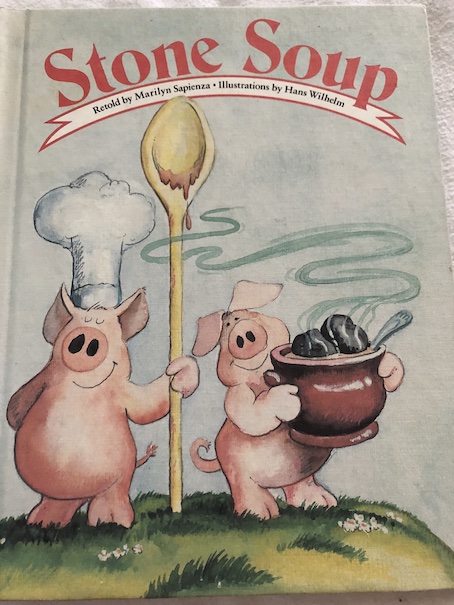
Stone Soup retold by Marilyn Sapienza, illustrations by Hans Wilhelm, 1986.

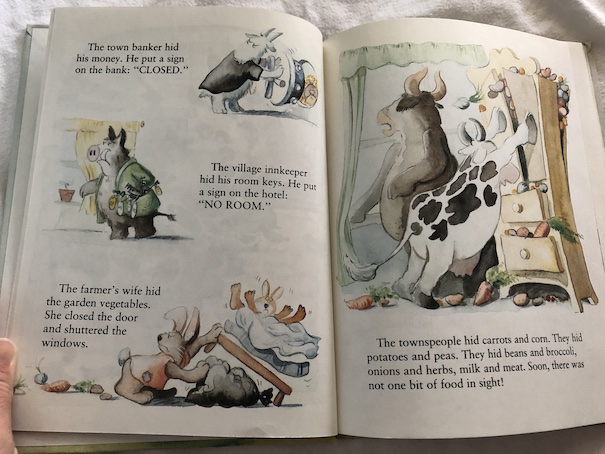
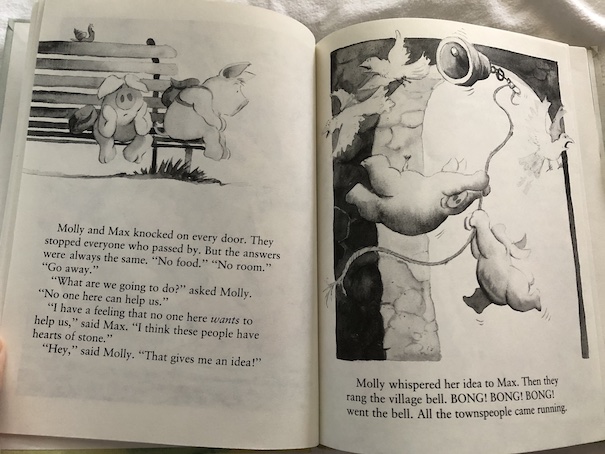
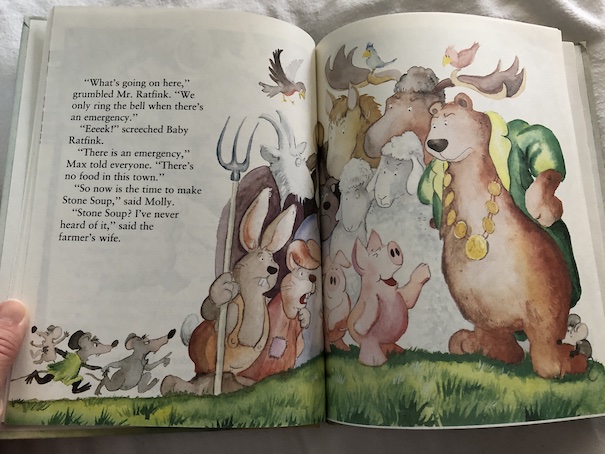
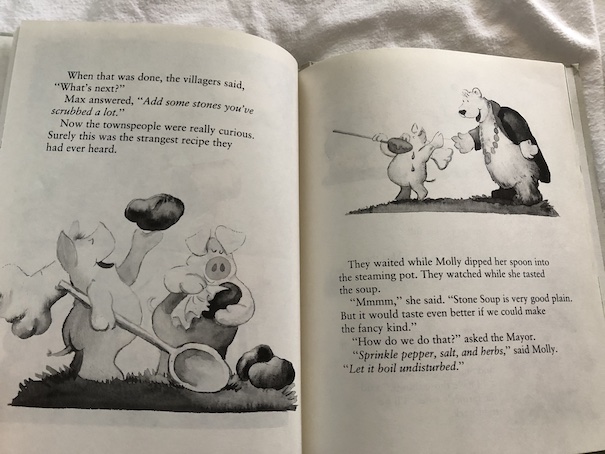
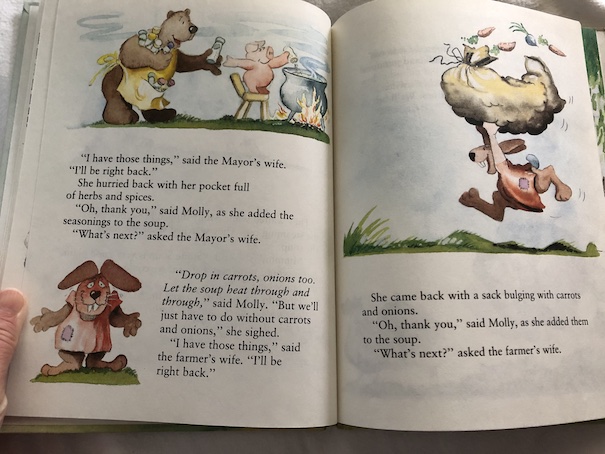
This is a retelling of a traditional folktale, sometimes called Stone Soup and sometimes Button Soup (and other names). The basic story is the same, but sometimes, it uses a stone and sometimes a button. All of the characters in this particular version of the story are represented by animals. Some of the pictures are in color, and some are black-and-white.

Max and Molly are backpacking across country, and they are getting tired and hungry when they spot a village. Hoping to get something to eat there, they decide to approach the villagers and ask for food.

However, the villagers are not friendly, and the last thing they want is to share their food or anything else with strangers. As soon as they see Max and Molly coming, they quickly hide their food and anything else the travelers might want them to share. (I’m not sure why the innkeeper closes his hotel as soon as he sees potential customers coming. You can’t stay in the hospitality industry very long like that.)

When Molly and Max get into town, all of the villagers pretend like they’re starving and refuse to help Molly and Max. However, they see through the villagers’ act and come up with a plan of their own.

They ring the village bell to call of the people in the village. At first, the villagers are irritated because the bell is only for use in emergencies, but Molly and Max say that having no food is an emergency and that they have a plan to solve it. They are going to teach the villagers to make Stone Soup.

The villagers say that they’ve never heard of Stone Soup, and Molly says that it’s a secret recipe that she’s willing to share. It starts with a pot of hot water and some stones. Molly makes a show of tasting the “soup” and says that it’s good, but it’s even better if you make “the fancy kind.”

When the villagers ask how to make the fancy kind, she asks for some salt, pepper, and herbs. After the mayor’s wife supplies those, Molly asks for some carrots and onions. When she says that she supposes that they’ll have to do without them, the farmer’s wife steps up and offers some.

Little by little, Molly and Max coax the villagers into supplying other ingredients, almost without realizing what they’re doing. In the end, the Mayor of the village says that it’s the best soup he’s ever tasted, and it’s amazing, considering that it was only made with stones and water.

The moral of the story is that everyone benefits when people are wiling to share. Everyone gets a share of the soup, but when they start serving it, the villagers also provide other food to eat alongside it, and they all have a feast. The innkeeper gives Molly and Max a room for the night, and when they leave in the morning, they remind the villagers to “Share Stone Soup with everyone.”

In the back of the book, there is the complete recipe for Stone Soup, with rhyming steps. It doesn’t have details, like amounts and cooking times and temperatures, but I suppose someone could use these general guidelines to make an improvised soup. Really, I think the meat should be precooked if you’re adding it as a final ingredient. Otherwise, the veggies would be overdone before the meat is fully cooked.

There are many different versions of this story that have been made into picture books. I haven’t been able to find a copy of this particular book available to read online, but you can find various versions other versions of the same story online through Internet Archive.

The Elves and the Shoemaker

The Elves and the Shoemaker story adapted by Lucy Kincaid, illustrated by Gillian Embleton, 1981.

I loved to read this folktale when I was a kid! This particular copy was made specifically for beginning readers with large type and a section in the back that shows key words in the story with little pictures to explain what they mean. Aside from my nostalgic associations with this book, I also really enjoy the detailed, realistic pictures.

There was a shoemaker who worked very hard but never seemed to get much money for the shoes he made. He and his wife are on the verge of starvation, and he only has enough leather to make one final pair of shoes.

Before going to bed, he cuts out the leather for the last pair of shoes, planning to sew them in the morning. However, in the morning, he discovers that someone else has already sewn the shoes together, and the shoes are very fine quality. The shoemaker has no idea who finished the shoes for him, but they did an excellent job, and he is able to sell them for enough money to buy food and enough leather for two more pairs of shoes.

Once again, he cuts out the leather for the shoes, and again, in the morning, he discovers that someone else has sewn the shoes together. The shoes are excellent, and he is able to sell them for enough to buy leather for four more pairs.

This continues night after night, and the shoemaker’s business begins to prosper, but he and his wife wonder who is helping them. One night, they hide and watch to see who will come to do the sewing. As they sit up, waiting, they see a pair of small elves who enter through the window and begin sewing the shoes together.

The shoemaker and his wife want to thank the elves for their help. Noticing that the elves are wearing ragged clothes and have no shoes of their own, they decide to make the elves their own sets of clothes and shoes.

On Christmas Eve, they put the elves’ new clothes on the table where the shoemaker usually puts the shoes that need to be cut and watch to see what the elves do. The elves are overjoyed to see the new clothes, realizing that they are presents for them. They immediately put the clothes on and dance around with happiness, singing that they don’t need to work anymore.

That is the last time the shoemaker and his wife see the elves, but the shoemaker’s business continues to prosper.

In the Harry Potter series, J.K. Rowling used the device of gifts of clothing ending a house elf’s service to a particular household, but she didn’t invent that concept. It was already a feature of folktales like The Elves and the Shoemaker, which was one of the folk tales collected by the Brothers Grimm.

This book is available to borrow and read for free online through Internet Archive. There are also many other versions of the same story.

A Child’s Garden of Verses

A Child’s Garden of Verses by Robert Louis Stevenson, illustrated by T. Lewis and Sara Gutierrez, 1989.

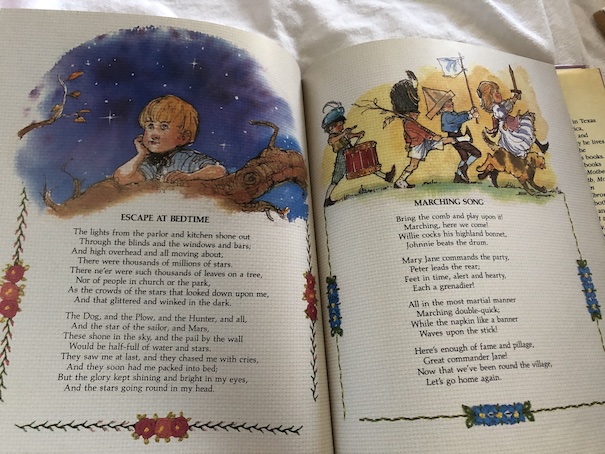
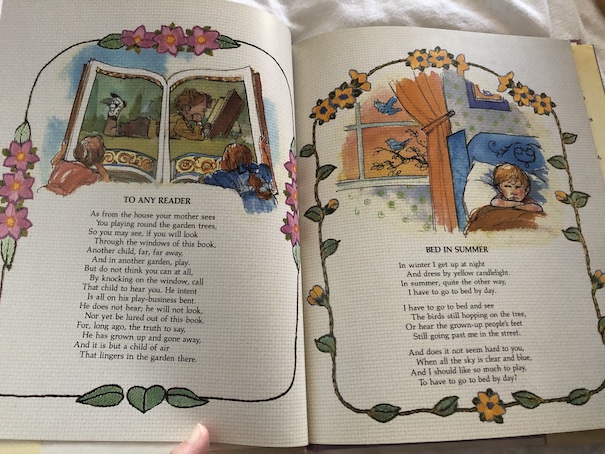
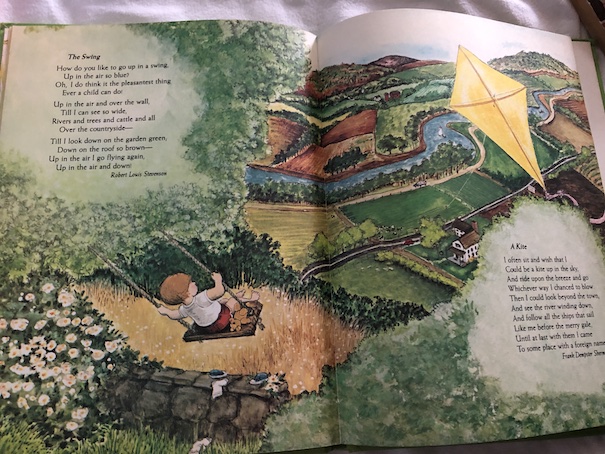
This is a reprinting of the classic collection of children’s poems by Robert Louis Stevenson first published in 1885 as Penny Whistles. What makes this edition of the book different from other printings is the illustrations, which are an unusual combination of watercolors and embroidered borders. Mary Pope Osborne, author of the Magic Tree House series wrote an introduction to the book about the life of Robert Louis Stevenson and his youth in Scotland in the 1850s, which inspired his poems for children. (See my list of Books from 1850s for the types of books children were reading during this time period, but remember that they also would have read books that were published in previous decades.)

The poems have gentle themes from the lives and fantasies of children, like games of pretend, bedtimes, and the little things that children notice and that adults often take for granted, like shadows and the beauty of stars. Some of them have things that are now anachronistic, like lamplighters, but they’re still imaginative and enjoyable for all ages.

I’ve always liked Robert Louis Stevenson’s children’s poems, and this book has my favorites! My personal favorites are:

To Any Reader – Robert Louis Stevenson speaks to children reading these poems about the child he used to be and how the poems are like a window on his childhood, although his own youth is long gone.
Escape at Bedtime – About a child who sneaks out of bed at night to look at the stars.
The Swing – I mentioned this one before because it’s included in another collection of poems, and I’ve often thought of it when I’ve been on swings.
Picture Books in Winter – A child enjoys picture books indoors when it’s cold outside.
The Land of Storybooks – About the adventures that children who love books enjoy in their imaginations.

However, my mother’s favorite children’s poem is Bed in Summer because it reminds her of her own childhood and having to go to bed while the sun was still shining in summer and other children in the neighborhood were still playing outside. (I didn’t have this experience when I was growing up because I never lived in a place that had daylight savings time, which changes the clocks by one hour, providing an extra hour of daylight before sunset. Arizona is very hot, so there’s a benefit for doing things after the sun has set, and few people have any interest in pushing back time to maximize the scorchingly hot daylight hours. My childhood memories include going to parks with my parents after the sun set and being put to bed after we got home.)

There are many copies of this book available in various printings online both at Internet Archive and Project Gutenberg because the text of the original book is now public domain. I didn’t see this particular printing with these illustrations available online, but if you just want to read the poems, there are plenty of other copies of the book to choose from!

A Child’s First Book of Poems

A Child’s First Book of Poems with pictures by Cyndy Szekeres, 1981.

I think this actually might have been my first book of poetry. At least, I’ve had it since I was a fairly young child, and I can’t remember reading any other book of poetry before this one. If I had an earlier book of poetry, it was probably a book of Mother Goose rhymes.

The poems in the book are about a variety of topics and some of them are by famous people and were popular poems for decades before this book was published. Among the authors whose poems appear in this book are Emily Dickinson, A.A. Milne, and Robert Louis Stevenson.

Among my favorite poems in the book:

Wild Beasts by Evaleen Stein – About children pretending to be animals.
Choosing by Eleanor Farjeon – About choosing between various nice things.
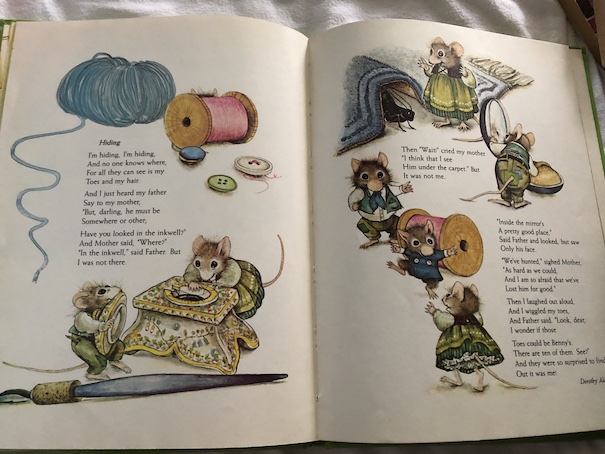
Hiding by Dorothy Aldis – A child hides while his parents search for him. My mother often quoted from this poem when we were kids and she was looking for one of us. “I’m hiding, I’m hiding, and no one knows where …”
The Swing by Robert Louis Stevenson – I think of this poem whenever I’m on a swing.
Bedtime by Eleanor Farjeon – Children making excuses to stay up later.

The pictures really make this book special. They are all drawn in a realistic style. Some just show ordinary children and animals, but some contain whimsical elements, like animals wearing clothes, depending on the poem.

The book is available to borrow and read for free online through Internet Archive.

The Magicians’ Challenge

The Magicians’ Challenge by Tom McGowen, 1989.

This is the third book in The Magician’s Apprentice trilogy. It picks up soon after the second book, with the magician Armindor, his apprentice Tigg, Jilla, and Reepah the grubber on their way to the city of Ingarron, where Armindor and Tigg were originally from. They’ve already told the people of the city of Inbal of the threat posed by the reen, the ratlike creatures that are scheming to take over the world by finding old forms of lost technology and using them to dominate and destroy humanity.

Before they return to Ingarron, they want to stop in Orrello and take care of some business there, letting that city know about their discoveries about the reen and the ancient technology they’ve uncovered. On the ship to Orrello, they begin to get some insight into one of the pieces of old technology they’ve uncovered – the magnetic compass. When they first found it, they didn’t know what purpose it served. All they could tell about it was that the compass’s arrow always points in one direction, no matter how you move it. When they show it to the captain of the ship, he says that he could see a purpose in having such a thing if it pointed to a place that he knew he wanted to go, and Tigg begins to realize that the compass doesn’t point to a specific place but the general direction north. They still have a concept of north and south as directions, but they don’t think in those terms unless they’re comparing one known location to another known location, which is why they didn’t think of it before. Armindor is overjoyed at the revelation. Their people currently depend on known locations or observing the sun and stars in the sky to find their way, but with a compass (which they consider a “spell” of finding your way), people could navigate even in unfamiliar areas where the sky isn’t easily visible. This is the sort of thought and investigation that “magicians” (scientists) have had to do since the old technologies were lost and forgotten following a great nuclear war. After thousands of years, people are starting to rebuild society and redevelop technological knowledge, but because they don’t yet understand most of the principles behind it, they think of it as “magic” and “spells.”

However, as they are about to arrive in Orrello, they discover that the city has already been attacked by the reen, and many people there are dead. The captain of the ship says it’s not safe to go to the city now, so Armindor asks him to drop off his party further down the shore so they can continue to Ingarron and warn them of the danger. Now that they understand how the compass works, they can use it to find their way. (Although, readers will notice that, because language and writing have changed over the centuries, they don’t understand which of the letters on the compass actually represents “north”, and they think it’s the ‘S’ symbol, so ‘E’ represents “west” and so on. Close enough. They have the basic principle, and as long as they’re consistent, it will still work.)

On the way to Ingarron, they find a young man who escaped from the attack on Orrello. The young man, tiLammis, turns out to be the nephew of an important merchant in Ingarron, and he confirms that it was reen who attacked Orrello. The others are grateful that tiLammis witnessed the attack so he can help describe and confirm their accounts of the reen.

When they reach Ingarron, they are relieved to see that it has not yet been attacked. Tigg is promoted from Apprentice to Novice Sage and becomes a member of the Guild of Sages. They warn the other sages and the Lord Director of Ingarron about the reen, and tiLammis’s account of the attack on Orrello helps to convince them of the danger. Because they know that the reen hide among human populations and spy on them, Armindor says that they will have to make their preparations to protect Ingarron in secret. No one outside of the city leaders and sages should be told about what is happening. Rumors are already starting to spread about the destruction of Orrello, but the city leaders decide to pretend that they think some marauding barbarians are responsible. They discuss the armor and weapons they’ll need and the possibility of making a first strike on the reen by going into the sewers and tunnels beneath the city, where they know the reen are hiding, pretending to be normal rats.

Thanks to Tigg’s deprived upbringing in the streets of Ingarron, he knows someone who could be invaluable – the King of the Ratcatchers, Goorm. The Ratcatchers are a guild of intermarried families who, for generations, have made their profession catching and killing rats, thus eliminating a city pest and providing meat to poor families, who can’t afford anything else. When Tigg approaches Goorm and the other Ratcatchers to explain the problem of the reen and why the city needs their help, he discovers that they already know about it. They didn’t know exactly what the reen were or how many of them there were, but they’ve encountered them before while hunting rats, and they’ve even lost some of their members to them. They’re more than ready to help lead an expedition against them with the help of the city’s soldiers.

There is a complex system of underground roads beneath Ingarron, which the Ratcatchers explain were once above-ground roads because Ingarron was built over the ruins on a much-older city. Sometimes, Ratcatchers even find old artifacts from the Age of Magic (our time) there. The reen have poison darts that kill instantly, but the humans have improvised incendiary weapons made of flammable liquid in bottles. (Basically, they’ve figured out how to make Molotov cocktails, although they don’t call them that. They just call them “fire bottles”, which is descriptive.) The ensuing underground battle between the reens and the humans seems to end in victory for the humans with many reen dead. The humans are quick to celebrate their victory, but the story isn’t over yet. Tigg and Armindor determine that, although hundreds of reen were killed in the human attack, it’s not enough to account for the full reen population. Although the Lord Director and soldiers want to believe that the remaining reen have fled, they haven’t, and the battle has really just begun.

However, as Tigg and Jilla seek shelter from the reen’s retaliatory attack underground, they come face-to-face with the reen and realize that there is more than one faction of reen, including one that might be willing to negotiate instead of fight.

The book is available to borrow and read for free online through Internet Archive.

My Reaction

I haven’t talked about religion in this post-apocalyptic future, but they do have a different concept of religion from our time. They are polytheists in the fashion of ancient civilizations, with gods who represent different natural forces, like weather, or different professions, almost like patron saints. However, the names for their gods are completely unfamiliar, not based on any classic mythology. I haven’t explained about this before because they only make passing references to their gods and don’t go too deeply into their lore, so it’s hard to say much about them.

In the last book, they described the origins of one god, Roodemiss, who is the god of sages and “magicians”, and it seems that he might be based on some scientist or astronaut from the past because they describe him as a magician who ascended into the sky in a machine that he built in order to keep watch over the Earth from above during the nuclear holocaust that brought an end to civilization as we know it on Earth. However, they don’t explain any more about him, and he apparently never came back to Earth, which leaves a lot of unanswered questions. Was there supposed to be some kind of space station or maybe a Martian space colony where some humans went? I’m guessing a space colony would make more sense because space stations need to be resupplied from Earth, something that would be impossible for people to continue to do after the nuclear holocaust. On the other hand, because we don’t know who “Roodemiss” is, he might not necessarily be a human being, even though they describe him as being a “magician.” It occurred to me that, just as people in this time don’t really understand the difference between “science” and “magic” or “inventions” and “spells,” they might have gotten the story about “Roodemiss” wrong, and Roodemiss might actually be a satellite that would monitor conditions on Earth from above. Since they really only have legends about Roodemiss and no direct, continuing contact, it’s hard to say. Roodemiss is only represented by an eye because he is supposed to be watching over the world. If Roodemiss was a human in a space ship, space station, or space colony of some kind, we have no information about what happened to him or whatever group he may have been with in the thousands of years that have passed since his time. Sometimes, I wondered if the names of the gods are something that I should recognize, like corruptions of the names of modern people or things that I should know, but I just don’t recognize them and can’t think of what they are or would be, so that might not be the case. If anyone thinks they can recognize what “Roodemiss” or “Badoween” (the weather god) or “Durbis” or “Garmood” are supposed to reference, please comment below.

Part of the reason why I’m talking about religion now is that the Ratcatchers have made their headquarters in what is clearly an abandoned church. Tigg recognizes from the way it looks that it was once a place of worship, but he’s not quite sure what god was worshipped there. He looks at the pictures on the walls and describes seeing winged humans (angels), but he doesn’t know what to call them and doesn’t know what god they are surrounding. It gives him an odd feeling, and he worries about what happens to a god if people forget about him. We don’t know by what process this monotheistic society (we know from the previous book that Tigg’s society is located somewhere in North America) turned polytheistic or whether they will ever uncover their religious and cultural past, but there are remnants of that past still there, waiting to be uncovered, along with lost technology.

In the end, the humans and the reen do negotiate with each other. Although a large faction of the reen have wanted to destroy humans, another faction would really rather just be separate from human society. What they want is to leave human cities and build their own civilization in the uninhabited Wild Lands, where humans normally don’t go. The decision to negotiate isn’t easy for the humans because they don’t trust the reen. They consider possibly attacking the reen as they leave the city because they will be vulnerable, and if they kill them there, they could eliminate an enemy who might return to attack them again later. However, Armindor argues that a sneak attack after a peace agreement would be a dishonorable betrayal. There are also the other communities of reen in other cities to consider. If they hear stories about betrayal and massacre of their kind in Ingarron, it will only fuel their hatred of humans and lead to further war and massacre. Armindor and the other sages have the sense that, even though they don’t really understand what exactly the nuclear weapons that lead to the destruction of the past civilization were, that they were weapons of some kind that were used in a great war, and they don’t want their civilization to go the same way, just when they’re beginning to make some real progress on rebuilding it. The Lord Director is persuaded by their arguments and decides to allow Tigg to carry the message to the reen that they will be allowed to leave the city in peace and go to the Wild Lands.

It seems like a sudden end to the conflict with the reen, but only on the surface. There really are no easy answers. In the last book, the humans made the discovery of a computer with tutorials about ancient knowledge, but although the computer is telling them things they’ve always wanted to know, they first have to understand the language that the computer uses, and that’s going to take time. Even then, they’re going to have to work their way up through simple concepts to more complex ones in order to regain the level of technology that society once had. This agreement with the reen of Ingarron is also only the first step into an unknown future. The reen of Ingarron are only one faction of a much larger reen society that extends to other human cities. The reen have already destroyed and conquered Orrello, and as the book and the trilogy ends, it remains to be seen whether reen in other human cities will favor conquest and destruction or if they will join with the reen from Ingarron in building a new society of their own. They have a shared resentment of humans from generations of being treated like pests that need to be eliminated, but they’ve reached the point where they now have intelligence and abilities that are equal to those of human beings. Whatever happens to them, they now don’t have to live off of the crumbs of human society and can continue to build an independent society of their own. It’s possible that gaining recognition as an intelligent species with a society of their own that must be respected will calm some of their anger and resentment, so their future with the humans may include trading with human society as an independent, sovereign nation, but all of that is left to the imagination. It’s enough to know that all of the societies that now inhabit the Earth, both human and non-human, are beginning to change, and that’s a start.

The Magician’s Company

The Magician’s Company by Tom McGowen, 1988.

This is the second book in the Magician’s Apprentice trilogy.

The story picks up where the previous book left off. Armindor the Magician, his apprentice Tigg, and their friend Reepah, who is a creature called a grubber, are on their way home with the “magical” devices that they retrieved in the last book, taking them back to their Guild for investigation. On their way home, they pass through a land consumed by civil war, and they pass a wagon surrounded by dead bodies. They can tell that the people were civilians, probably entertainers, and further down the road the find a young girl about Tigg’s age (around 12 years old), struggling along, carrying her belongings. They ask the girl about herself, and she breaks down crying, telling them how she and her family were fleeing the war, but her aunt and the other members of their puppeteer troupe were murdered by soldiers. The girl, whose name is Jilla, survived by hiding in a secret compartment in their wagon. After her aunt and the others were killed, Jilla gathered up what she could, taking the puppets that would help her to earn her living and a few other belongings not stolen by the soldiers, determined to continue her journey to a safer place, like the city of Inbal.

Armindor and Tigg have horses, and they offer to help the girl on her way to Inbal, a city in another territory. Along the way, Tigg tells Jilla the story of their previous adventures, and Armindor invites Jilla to stay with them awhile longer and even come home to Ingarron with them because it would be very difficult for a young girl to manage on her own in a strange city. Jilla is happy to stay with them because she is thankful for their help and worried about managing on her own yet.

In Inbal, Armindor and Tigg visit the sages in the city to show them their discoveries. They speak to Tarbizon, an old friend of Armidor’s, showing him what they found and explaining the threat posed by the reens, a species of intelligent but diabolical creatures that evolved/mutated from rats, have the ability to talk, use blowguns with poisoned darts, and are plotting to take over the world. (Yes, really. Even they think it’s weird.) Before they continue their journey to Ingarron, they decide to stay in Inbal for the winter because it would be difficult to travel until spring. Someone breaks into the place where they are staying and goes through their belongings. They have no idea who did it, but apparently, whoever it was didn’t find what they were looking for because nothing seems to be missing. Since they will be staying in the city for awhile, they decide to rent a house instead of staying in the guestinghouse (inn) where they have been staying.

While they are looking for a house to rent, Tigg is kidnapped. Fortunately, Reepah is able to sniff out where he is. Armindor pretends that his “magic” is what told him where his apprentice was in order to intimidate the kidnapper. Caught and frightened of the magician’s powers, the kidnapper admits that he was paid to abduct Tigg by Pan Biblo, who is the head servant of Councilor Leayzar, who is part of the High Council of Inbar and who has convinced the other sages that the reen do not pose a serious threat in spite of Armindor’s warnings. When they rescue Tigg, Tigg says that a man had questioned him about the spells that he and Armindor retrieved from the Wild Lands and Armindor would be willing to trade them for Tigg. From this information, Armindor realizes that Leayzar wants the lost technology they’ve discovered, but he can’t figure out why. It doesn’t take long for Armindor to realize that Leayzar is working with the reen. The reen have hired humans to work for them before, and they desperately want pieces of lost technology in order to gain dominance over humans.

Armindor and the others go to the sages in the city and tell them what they’ve discovered about Leayzar, and the other sages take it seriously. Some of them wonder why Leayzar would want to ally with a group that is an enemy of his own species, but Armindor says that it’s hard to say because they don’t know what the reen told Leayzar. Maybe Leayzar doesn’t understand what the reens’ full plans are and whatever they promised him in return was just too compelling to resist. At the end of the previous book, some of the weenitok gave Armindor a sealed box that they found, left over from the end of the Age of Magic. The sages decide that it’s time to open the box and study its contents in the hope of getting some answers. If the last book didn’t fully establish that their world is our world in the far distant future, the contents of the box explicitly state it.

Inside the box, there is a recorded message from the year 2003 (the future at the time this book was written, but the past to us in early 2021, and it’s interesting what this message has to say about the world in 2003). The message is from Dr. Dennis Hammond of the National Science Foundation Project for the Preservation of Civilization. He says that there has been a war between the “Pan-Islamic Brotherhood” (the closest real-life equivalent would probably be the Muslim Brotherhood, but that’s more of a social/political movement or terrorist group (depending on who you ask) rather than an official alliance of nations) and the United States and its allies, including Canada, Europe, China, and the Soviet Union (which stopped existing just a few years after this book was published in real life and would just be called Russia in 2003). Dr. Hammond says that thermonuclear war is pending, and he and other scientists are worried because they think the resulting destruction will be the end of civilization as they know it. (He doesn’t explicitly say this is World War III, but that’s basically what it amounts to. In real life, we haven’t actually had World War III yet as of early 2021, although in 2001 and the following years, there was some speculation that the destruction of the World Trade Center and other terrorist attacks might eventually lead to World War III, so it seems that the author has caught on to a source of world tension even if he didn’t predict how it would come out.) In order to preserve existing knowledge about science and world history, they made a series of these boxes containing small computers designed to last for about 10,000 years and hid them at various locations around North America (so now we know roughly where these characters are) so that future generations that find them will have access to knowledge that may have been lost. The computers even contain language tutorials just in case language has changed too much for this speech to be understandable. It’s fortunate that the early 21th century scientists thought of that because it turns out that none of the sages understood a word of what the voice in the box said. The readers now understand the full situation, but the characters don’t.

Everyone is astonished at this talking box. They’ve never even heard of such a thing, and they think that it must be a “spell” from a past “magician”, which he created to preserve his voice. They understand that the voice is speaking an unfamiliar language, and there is a picture on the included screen showing a finger poking one of the buttons in the box, so they get the idea that the box wants them to press buttons. When Armindor presses the red button indicated, the computer in the box begins a simple language tutorial, showing them pictures of familiar things and saying their names, like “sun” and “cloud.” The sages understand that they’re being taught an ancient language, and they quickly begin taking notes. Armindor is moved to tears because this is exactly what he has been hoping to discover for years, the secrets behind all of the ancient “magic.” They can tell that the “magician” who made the box was trying to teach them, and they’re more than ready to learn!

But, there is still the matter of Leayzar and the reen to deal with. When they learn that Leayzar is looking for Armindor, Jilla suggests a cover they could use to hide their identities: becoming a troupe of puppeteers with her puppets! Becoming puppeteers also gives them the opportunity to spread word of the reen threat to the public through their puppet plays.

The book is available to borrow and read for free online through Internet Archive.

My Reaction

I said in my review of the last book that Armindor and Tigg don’t find any easy answers or any miraculous device that instantly solves all of their society’s problems and launches them back into an age of technology. The computer in the box comes the closest to that, but it’s still not an easy answer because Armindor and the other magicians and sages of his time can’t understand the language it uses or how the computer works when they first find it. They understand enough to know that it’s trying to tell them something and that its creators are trying to teach them how to understand and use it, but it’s going to take some time before they reach the point where they will understand enough of the language to figure out all of the information that the computer has to share. There will be enough work cut out for future “magicians” (really, scientists) of their time, like Tigg, to figure out how the computer works, what information it has to share, and how they can teach the rest of their people what they’ve learned. It’s a turning point in their history, but it’s not an instant solution. Plus, although the characters don’t really understand it at first, the readers are told that there are other boxes that are still waiting to be found. Do these boxes all contain the same information, or are there other pieces of knowledge in each one? There are plenty of secrets for a new generation of scientist/magicians to unravel.

The Magician’s Apprentice

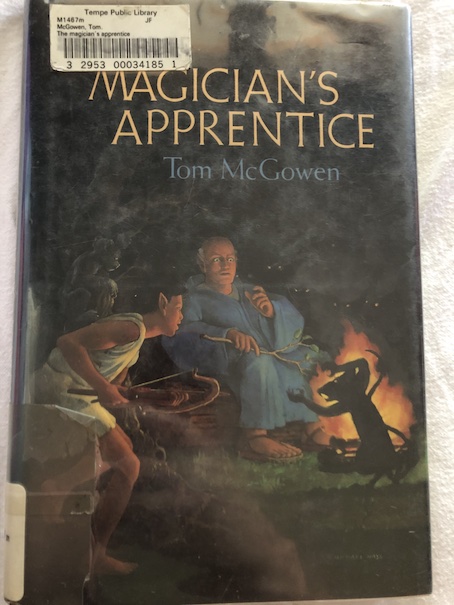
The Magician’s Apprentice by Tom McGowen, 1987.

From the title of this book and others in this series, it sounds like the stories take place in a fantasy world. When you’re reading this book, it seems like fantasy at first, but it’s not. It’s actually science fiction.

Tigg is a poor orphan boy who makes his living in the city of Ingarron as a pickpocket because he has no other means for survival. One night, he notices that a sage has left the door to his house open, and although it’s a risk, he decides to enter and see if he can find anything worth stealing. The sage, a man called Armindor the Magician, catches Tigg. In fact, Armindor had deliberately left the door open for Tigg to enter. When, Armindor questions Tigg about who he is, Tigg says that he’s about 12 years old (he’s unsure of his exact age and defines it in terms of “summers”) and that he has no family that he knows of. He lives with an old drunk who makes him pay to live with him with the money he steals.

Tigg asks Armindor what he plans to do with him. He can’t really punish him for stealing from him because Tigg hadn’t had a chance to take anything of Armindor’s before he was caught. Armindor says that’s true, but he was planning on stealing something, so Armindor tells him that he will do the same to him – plan to take something he has while still leaving him with everything he has. Tigg is confused, and Armindor explains his riddle. He witnessed Tigg picking someone else’s pocket and was intrigued by the boy because he seemed to possess courage, wit, and poise. He left his door open for Tigg because he has been looking for a young person with those qualities to be his apprentice. If Tigg becomes his apprentice, he will have to put his good qualities to use for him, but yet, he would keep these qualities for himself as well.

Tigg likes the praise but has reservations about becoming a magician’s apprentice because an apprenticeship would limit the freedom he currently has. His current existence is precarious, but the long hours of work and study involved in an apprenticeship sound daunting. However, Armindor isn’t about to let Tigg get away. He takes a lock of Tigg’s hair and a pricks his thumb for a drop of his blood and applies them to a little wax doll. He tells Tigg that the doll is a simulacrum and that it now contains his soul, so whatever happens to the doll will also happen to him. If Tigg runs away from his apprenticeship, Armindor can do whatever he likes to the doll as his revenge or punishment. Tigg, believing in the power of the simulacrum and feeling trapped, sees no other way out, so he becomes Armindor’s apprentice.

Although Tigg is fearful and resentful of his captivity as Armindor’s apprentice, it soon becomes apparent that life with the magician is better than what he used to have living with the old drunk. Armindor gives him a better place to sleep and better food. There is work and study, but it’s not as difficult or unpleasant as Tigg first thought. At first, he is daunted at the idea of learning to read and do mathematics, but Armindor is a patient and encouraging teacher, and Tigg soon finds that he actually enjoys learning things he never thought he would be able to do.

Armindor’s magical work seems to mainly involve healing sick people. When people come to him with illnesses, he gives them medicines that he calls “spells.” He keeps a “spell book” with instructions for remedies that he’s copied from other sources. Armindor teaches Tigg about the plants he uses in these spells. Armindor also does some fortune-telling, and he teaches Tigg that, too.

However, Tigg is still uneasy because, although Armindor treats him well, he still has that simulacrum of him, and he can also tell that the money he takes in doesn’t seem to account for his personal wealth. Armindor sometimes goes to meetings with other sages, and Tigg is sure that they’re doing something secret.

It turns out that Armindor is planning a special mission involving Tigg, one that will take them on a journey through uninhabited lands to the city of Orrello. Tigg realizes that if he leaves the city with Armindor, he will be committed to whatever secret plans Armindor has. At first, Tigg wants to take the simulacrum and escape, but when Armindor intentionally leaves the simulacrum unguaded where Tigg can easily take it, Tigg realizes that Armindor is telling him that he’s not really a captive and that Armindor is giving him a choice, trusting him to make the right one. Tigg realizes that he likes being trusted and that he trusts Armindor, too. He decides to stay with Armindor as his apprentice and go with him on his mission.

Tigg and Armindor leave town with a merchant caravan. On the way, the caravan encounters a wounded creature called a grubber. Grubbers are described as furry creatures about the size of a cat and have claws, but they have faces like bears and walk on their hind legs and may be intelligent enough to make fire and have their own language. One of the soldiers with the caravan things that the grubber is wounded too badly to save and wants to put it out of its misery, but Tigg insists on trying to save it. Armindor treats the grubber for Tigg, and it recovers. It is intelligent, and Tigg teaches it some simple human words, so they can talk to it. He tells them that his name is Reepah because grubbers have names for themselves, too. Armindor asks him if he wants to return to his own people when he is well, but by then, the caravan has taken them further from the grubber’s home and people, and he says that he doesn’t know the way back, so he’d like to stay with Armindor and Tigg, which makes Tigg happy.

However, Tigg soon learns that their journey has only just begun. They’re not stopping in Orrello; they’re just going to get a ship there to take them across the sea. Their eventual destination is the Wild Lands, an uninhabited area said to be filled with monsters and poisonous mists. Tigg is frightened, but also feels strangely compelled to see the place and have an adventure. Armindor finally explains to Tigg the purpose of their secret mission.

Years ago, there was another magician in Ingarron called Karvn the Wise, and he possessed some rare “spells” that no one else had. Armindor now has one of these “spells”, which he calls the “Spell of Visual Enlargement.” Tigg describes it as looking like a round piece of ice, and when he looks through it, things look much larger than they really are. Tigg is amazed.

Anyone reading this now would know from its description that what Armindor has is a magnifying lens. Tigg and Armindor don’t know the words “magnifying lens”, which is why they call it a “spell”, but that’s what they have. This is the first hint that this book is actually science fiction, and the “spells” are really pieces of lost technology and knowledge that are being rediscovered. One of Arthur C. Clarke’s Three Laws of science fiction is “Any sufficiently advanced technology is indistinguishable from magic.” Armindor the Magician thinks of himself as practicing magic with “spells” because he’s doing things and using things he can’t fully explain, but he’s actually a doctor and scientist. He doesn’t fully understand why these things work like they do, but he’s investigating how different forms of science, technology, medicine, and knowledge work, and he’s passing that knowledge along to his student and assistant, Tigg. So, you might be asking at this point, who made the magnifying lens and why doesn’t Armindor understand exactly what it is?

Armindor knows enough to understand that the lens is made of glass, not ice. He knows what glass is, but he says that their people don’t have the ability to make glass that clear and pure themselves. This lens is the only one of its type they have, and it’s more than 3000 years old, from what Armindor calls the “Age of Magic.” Tigg has heard stories and legends about the Age of Magic, when people apparently had the ability to fly through the air, communicate over long distances, and even visit the moon. The events that brought an end to the “Age of Magic” were “The Fire from the Sky and the Winter of Death.”

Spoiler: I’m calling it a spoiler, but it really isn’t that much of a spoiler because, by the time you reach this part in the story, it starts becoming really obvious, even if the characters themselves don’t quite know what they’re describing. This fantasy world is our world, but far in the future. For some reason, thousands of years in the future, so much of our knowledge and technology has been lost, society has reached the point where people don’t know what magnifying lenses are. Also, there are creatures in this world, like grubbers, that don’t exist in other times. Something major must have happened, and it doesn’t take too long to realize what it was. Even when I read this as a kid in the early 1990s, I recognized what the characters are talking about. This book was written toward the end of the Cold War, in the 1980s, and the concept of nuclear winter was common knowledge at the time and something that was pretty widely talked about and feared, even among kids. We know, without the characters actually saying it, that the winter was caused by nuclear weapons rather than an asteroid striking the Earth because Armindor knows from writings that he’s studied that animals mutated after the “Fire from the Sky.” An asteroid or massive eruption can cause climate change due to debris in the air, but they wouldn’t cause mutation like the radiation from a nuclear explosion would. People also mutated, and Tigg and Armindor and other people now have pointed ears. People have been like that for so long, they think of it as normal, and it’s only when Armindor explains to Tigg about the concept of “mutation” that Tigg wonders what people in the past looked like.

Armindor explains that Karvn had a nephew who was a mercenary soldier. One day, this nephew came home, seriously wounded. He died of his wounds, but before he died, the nephew gave Karvn this lens, explaining that it came from a place in the Wild Lands. He said that there were many other types of “spells” and magical devices there left over from the Age of Magic. The nephew and his friends had hoped to make their fortune selling the secret of this place, but there was a battle, in which the nephew was seriously wounded and his friends were killed. He told Karvn where to find this place in the Wild Lands, but Karvn was too old to make the journey himself. He wrote an account of his nephew’s story, and after his death, all of his belongings and writings became property of the Guild of Magicians, to which Armindor also belongs. Armindor has studied Karvn’s writings, and he thinks he knows where to find this place with magic and spells, and he is going there to claim whatever he can find on behalf of the Guild.

There is danger on this journey. These lands, which Armindor says were once one country long ago, are now smaller countries that war with each other. (This is probably the United States and the different lands were once individual states. When they travel across water, I think they’re crossing one of the Great Lakes, although I’m not completely sure. The author lived in Chicago, so I think that might be the jumping off point for the crossing.) There are bandits and mercenaries and the strange creatures that inhabit this land, and it’s difficult to say whether there is more danger from the creatures or the humans.

This book is available to borrow and read for free online through Internet Archive.

My Reaction

I remembered this series from when I was a kid. It made a big impression on me because of the way that technology was treated as magic. The types of futures depicted in science fiction books, movies, and tv series can vary between extremely advanced technology and civilization, like in Star Trek, and this kind of regression to the past, where even simple forms of technology that we almost take for granted today seem wondrous and are the stuff of legends. Nobody knows what the future actually holds, but I thought this series did a nice job of showing how people who had forgotten much of the everyday knowledge of our time might think and feel when encountering it for the first time, knowing that people who lived in the past were once able to make these amazing things themselves and use them every day.

Because of the mutations that have taken place in animals, probably due to radiation from nuclear fallout, some types of animals have become intelligent. The grubbers, who call themselves weenitok, are peaceful, but the reen (which Armindor realizes are a mutated variety of rat) actually want to gain access to old technology so they can conquer the humans and take over the world for themselves. These are Armindor and Tigg’s worst enemies, along with the human they’ve hired to do their dirty work. (Yes, the mutated rats are paying a human mercenary. Even the characters in the book realize that’s weird.)

When Tigg and Armindor finally reach the special place with the magical devices, it turns out to be an old military base. Much of what they find there has been destroyed by time. Armindor tells Tigg to look for things that are made out of glass, metal that hasn’t corroded, or “that smooth, shiny material that the ancients seemed so fond of” (plastic) because these are the things that are most likely to still be usable. Tigg makes a lucky find, discovering a “Spell of Far-seeing.” It’s a tube that can extend out far or collapse to be a smaller size, and it has glass pieces similar to the magnifying lens, and when you look into it, it makes things that are far away look much closer. (Three guesses what it is.) Tigg also discovers a strange, round object with a kind of pointer thing in the middle that moves and jiggles every time the object is moved but which always points in the same direction when it settles, no matter which way the object is turned. Most of what they find isn’t usable or understandable, but they do find four other objects, including a “spell for cutting” that Armindor thinks that they might actually be able to duplicate with technology and materials that their people have. Each object that they find is described in vague terms based on its shape and materials because Armindor and Tigg don’t know what to call these things. Modern people can picture what they’ve found from the descriptions, and it isn’t difficult to figure out what they’re supposed to be. Sometimes, Armindor and Tigg can figure out what an object is supposed to do just by experimenting with it, but others remain a mystery. Armindor explains to Tigg that is what magicians do, investigate and solve these types of mysteries, “to take an unknown thing and study it, and try it out in different ways, and try to think how it might be like something you are familiar with.” (They’re using a form of reverse engineering.) Tigg decides that he really does want to be a magician and make this his life’s work. He’s going to become a scientist.

I liked it that none of the objects they find are any kind of advanced super weapon or a miraculous device that instantly solves all of their society’s problems and launches them back into an age of technology (although there is an odd sealed box that proves to be important in the next book). There are no easy answers here. In the grand scheme of things, they risked their lives for things that nobody in modern times would risk their lives to retrieve, but they have to do it because, although these things are common in our time, they are unknown in theirs. If they can figure out not only how the objects work and what they were supposed to do but why they work the way they do, they can gradually rebuild the knowledge of the past. The objects that they find are generally useful. Some are labor-saving devices, some are examples of scientific principles they would use to create other things (demonstrating concepts like optics and magnetism) and one is a medical device, which if they can figure out how to use it, will help advance their medical knowledge and treatments.

One of the fun things this book inspired me to do was to look at the world around me while imagining that I had never seen some of the basic objects in the world before. This could be a fun activity to do with kids, something like the archaeology activity that some teachers of mine did with us years ago, where we had to intentionally create objects from some kind of “lost” civilization for our classmates to analyze, to try to figure out what they were supposed to do and how that civilization would have used them. But, you don’t even have to create anything if you use your imagination and try to think what a traveler from another time or another world might think if they saw some of the things in your own home right now. Imagine what someone from a world without electricity would think of something even as basic as a toaster. How would you explain such a thing to someone who had never seen anything like it?
An Early American Christmas

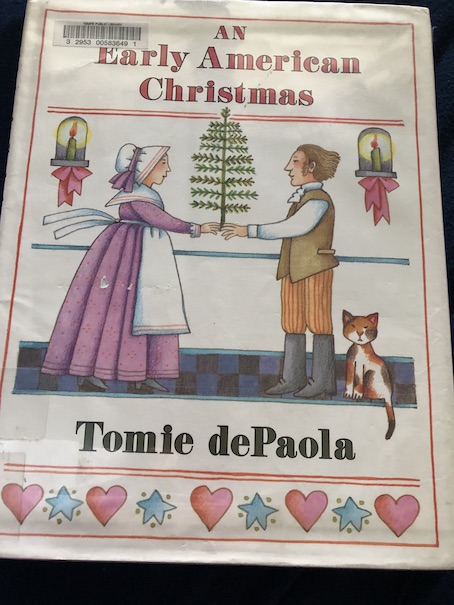
An Early American Christmas by Tomie dePaola, 1987.

A note at the beginning of the book explains the story behind the book, which is based on the history of early Colonial America. Although Christmas is now a popular American holiday with lavish celebrations, many early colonial groups didn’t celebrate Christmas much at all. Even among Christian groups, Christmas was not regarded as a major holiday. In particular, groups like the Puritans, Presbyterians, Quakers, and Baptists tended to avoid celebrating Christmas, seeing it as a frivolous sort of celebration. However, there were other groups, like Catholics, Lutherans, and Episcopalians, who did celebrate the holiday in a festive fashion. The author of this book imagines what it would have been like for a family that celebrates Christmas if they moved to a New England community that didn’t during the early 1800s. In particular, he used New Hampshire as his inspiration.

The beginning of the story describes a New England town that doesn’t celebrate Christmas with decorations or songs. Then, a new family comes to the village. They were originally from Germany, and they had lived in Pennsylvania before coming to the village. (This would make them Pennsylvania Dutch.) They are usual because of their festive Christmas celebrations.

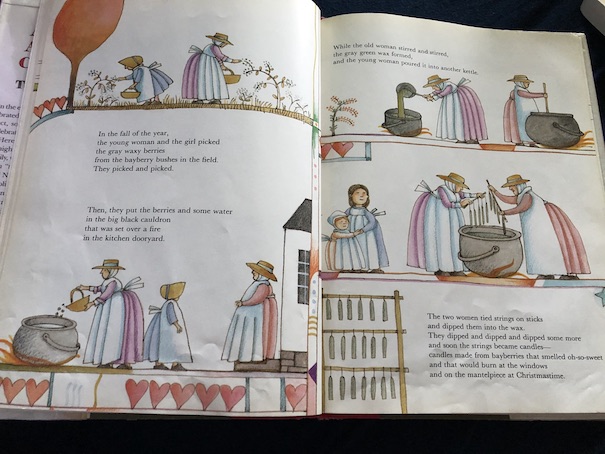
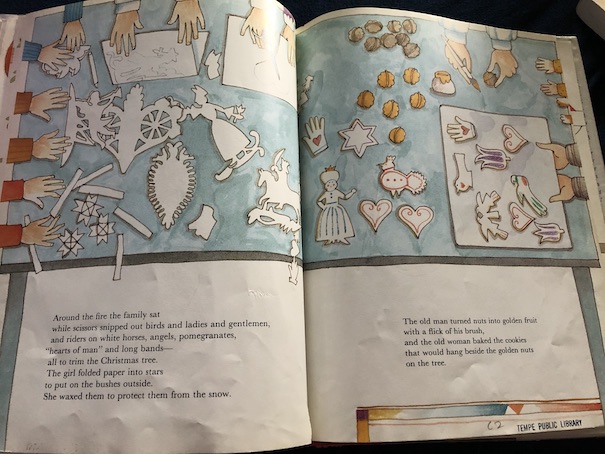
They begin planning for their Christmas celebration in the fall. The women and girls pick bayberries and use them to make candles. They say that bayberry candles bring good luck when they’re burned on Christmas.

The men and boys gather the crops that they will need for their feast. The grandfather of the family carves figures for their manger scene.

In December, the whole family makes paper decorations and specially-shaped cookies. I liked the variety of baked goods that they show in the pictures. They pick out a tree and make strings of popcorn and dried apples.

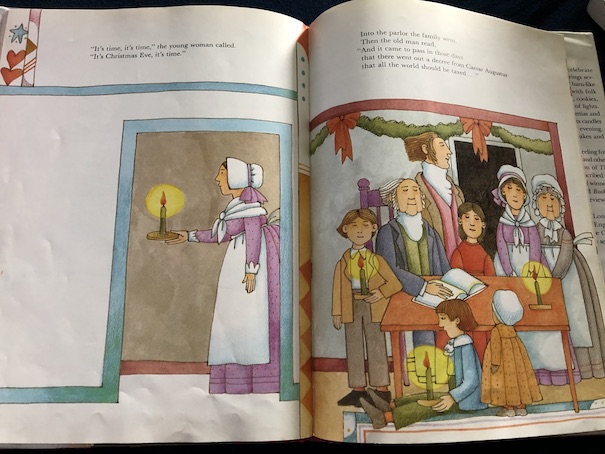
On Christmas Eve, they read the story of Jesus’s birth and decorate their home with all of the decorations they have prepared.

As the years go by and other people in town see what the Christmas Family is doing, they begin to celebrate Christmas, too.

The book is available to borrow and read for free online through Internet Archive.

The Legend of Old Befana

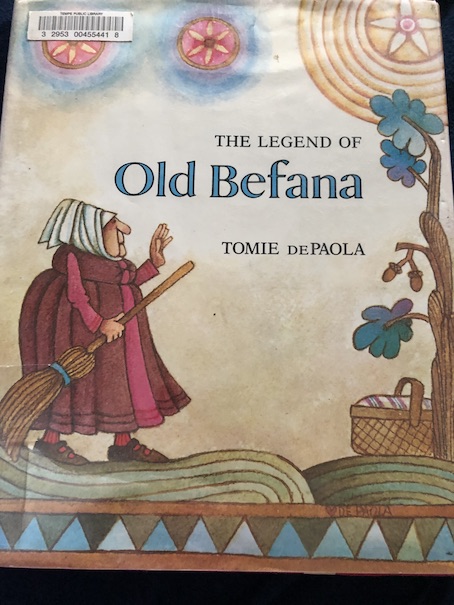
The Legend of Old Befana by Tomie dePaola, 1980.

The story is based on a Christmas story from Italian folklore. According to Italian tradition, Old Befana visits the houses of children on January 6th, the Feast of the Three Kings, and leaves treats and gifts. Legend has it that she is on an eternal search for The Christ Child.

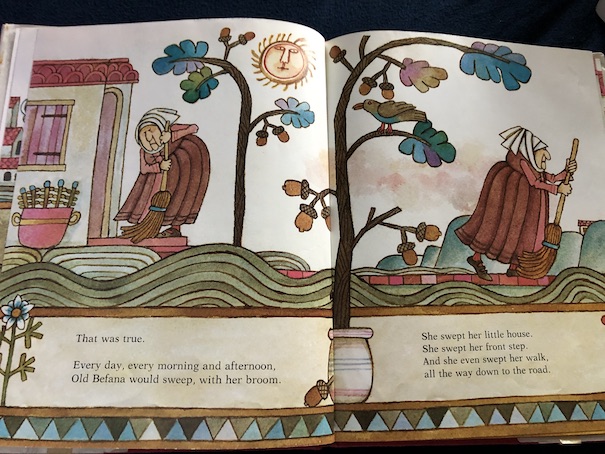
Old Befana is a strange old woman who living in a village in Italy. She is a grumpy woman who spends almost all of her time sweeping. Sometimes, she bakes good things to eat and sings lullabies, although she lives alone, so there’s no one for her to bake for or sing to. People think that she is crazy.

One night, Old Befana wakes up to see a bright light. There is a dazzlingly bright star in the sky, and it makes it difficult for her to sleep.

The next day, as she is doing her usual sweeping, she hears the sound of bells. A strange and beautiful procession comes over the hill. Among the procession are three men in royal robes.

The three kings stop and ask Old Befana if she knows the way to Bethlehem. She says that she has never heard of the place. The kings say that they are looking for “the Child,” but Old Befana doesn’t know what child they mean. They explain to her that this Child is a king and that His appearance was signaled by a bright star in the sky.

Old Befana confirms that she has also seen the star. A boy among the procession tells Old Befana that they are bringing gifts to the Child because He has come to change the world. The boy urges Old Befana to come with them, but old Befana says that she is only a poor woman and continues her sweeping.

After they leave, however, Old Befana continues thinking about what they said, and she starts to think that maybe she should go see the Child. She bakes all kinds of cookies and candies as gifts. She also decides to take her broom so that she can sweep the Child’s room because His mother will be tired. However, she stops to do her usual sweeping before she leaves her home.

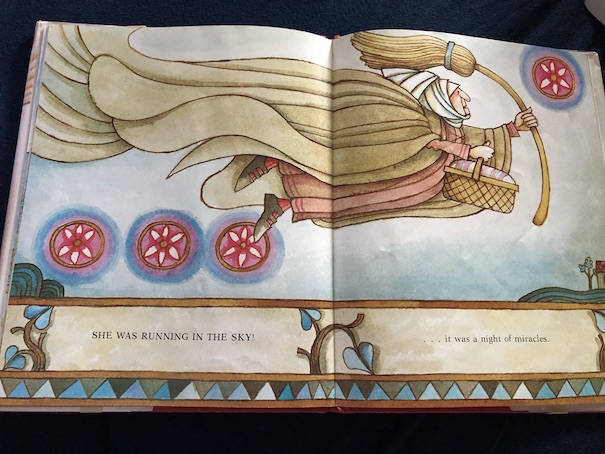
By the time she is finished with her sweeping, the procession is so far ahead that she is unable to catch up to them. Just as Old Befana laments that she cannot catch up to the procession, the angels declare that, “This is the night of miracles.” Suddenly, Old Befana can run fast, even running across the sky.

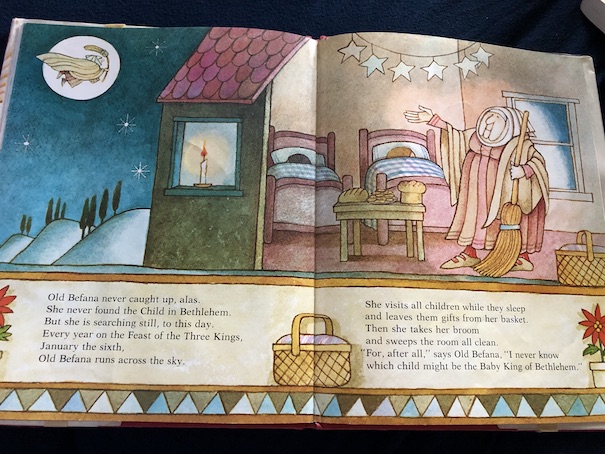
Unfortunately, Old Befana still doesn’t know the way to Bethlehem or who the Child is, so she doesn’t get to see the Christ Child. However, she still continues her search. Every year on January 6, she runs across the sky, carrying her broom and her basket of treats. At every house she finds with a child, she sweeps the room clean and gives the children gifts and treats because she never knows for sure which of them might be the Child she is seeking.

The book is available to borrow and read for free online through Internet Archive.

The Puppy Who Wanted a Boy

The Puppy Who Wanted a Boy by Jane Thayer, illustrated by Lisa McCue, 1958, 1985.

A puppy named Petey tells his mother that he wants a boy for Christmas. His mother says that he might get one if he’s good, and when Petey is a good puppy, his mother tries to find one for him.

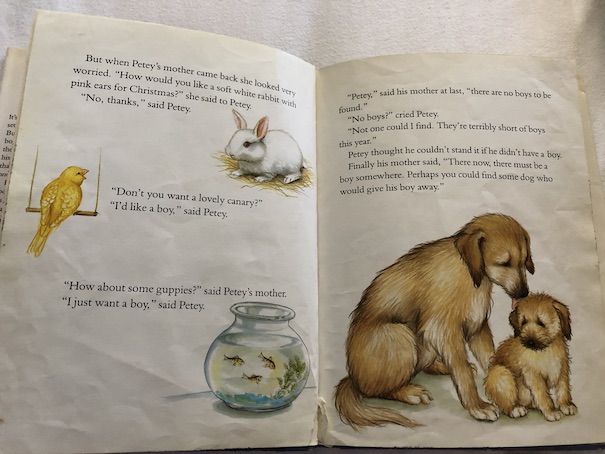
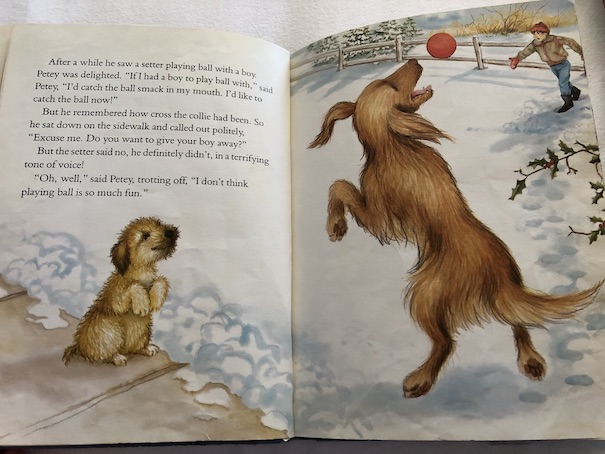
Unfortunately, Petey’s mother just can’t seem to find a boy for Petey anywhere. She suggests trying to see if any other dog is willing to part with his boy. However, no other dog wants to give up his boy.

Eventually Petey comes to an orphanage with a sign that says Home for Boys. Petey decides that if the boys have no parents, maybe they could also use a dog. It’s Christmas Eve, and most of the boys are inside are singing Christmas carols, except for one boy, sitting by himself outside.

Petey jumps into the lonely boy’s lap, and the boy loves him right away. When a lady comes to check on the boy, the boy asks if he can bring the puppy in, and she says yes.

All of the boys in the home love Petey and want to keep him. The lady says that Petey can stay if his mother lets him, and Petey knows that she will. Instead of getting just one boy for Christmas, Petey found fifty!

The story was first published in 1958, but my edition is from 1985 and has different illustrations. In the older book, the puppy looked like a beagle.

The book is available to borrow and read online through Internet Archive (multiple copies).