The Indian in the Cupboard

The Indian in the Cupboard by Lynne Reid Banks, 1980.

Omri thinks that he’s starting to get tired of collecting and playing with plastic figures when his friend Patrick gives him a plastic American Indian figure that he doesn’t want anymore for his birthday. At first, Omri doesn’t think much of the Indian figure because it’s just a used plastic figure that doesn’t match any other figure sets he has, so he’s not sure how he can use it in his games. Then, his brother Gillon gives Omri a wooden cupboard that he rescued from an alley. Omri likes the cupboard, and his mother lets him have an old key that happens to fit the cupboard so he can lock it. His mother says that the key used to belong to her grandmother’s jewelry box, which fell apart years ago. As Omri tries to decide what he wants to keep in the cupboard, his mother suggests putting his American Indian figure in it because she found it in the pocket of his other pants. Omri puts the toy in the cupboard and locks it. Later, he hears sounds coming from the cupboard, and when he opens it, he discovers that his toy Indian figure has come to life!

Omri is startled to see that the Indian has come to life, and the tiny Indian is afraid of him. The Indian pricks him with his tiny knife and threatens to hurt him if he comes closer. The Indian insists that he’s not small, it’s Omri who is big. When Omri’s mother comes into the room, Omri quickly shuts and locks the cupboard so his mother won’t see that his toy has come to life. Later, when he opens the cupboard again, the Indian is just a plastic toy again. Omri is sure that he didn’t imagine the figure coming to life, but he’s not sure why that happened or why it’s just a toy again now.

Then, that night, after Omri locks the Indian in the cupboard again, he comes to life once more. This time, when Omri opens the cupboard and talks to the Indian, he asks the Indian what happened. The Indian replies that nothing happened, he just went to sleep. Then, he asks Omri for food and a blanket. Omri asks the Indian more about himself and learns that the Indian is named Little Bear and is the son of an Iroquois chief. He offers Little Bear a plastic teepee from his collection of toys to sleep in, but Little Bear recognizes that it’s not a real teepee and besides, Iroquois sleep in longhouses, not teepees. Omri can’t provide a longhouse, so he makes a better-looking teepee out of sticks and a piece of felt, so it’s at least not plastic. Little Bear accepts it.

Omri begins to realize that either his new cupboard or the key that he’s been using with it or both are magical and can bring toy figures to life. He begins doing experiments to see how it works and what else he can make real. The plastic teepee becomes a real one after being locked in the cupboard, but a metal toy car doesn’t change at all, making Omri realize that, for some reason, the cupboard only works with plastic toys.

Omri tells Little Bear that he’s in England now, not America, and Omri discovers that Little Bear approves of the English because the Iroquois fought with the English against the French and the Algonquins. Omri asks Little Bear if he also fought, and Little Bear brags about what a fighter he is and how many scalps he’s taken, but adds that they were French and not English. It sounds kind of stereotypical, but the author is referring to real battles that took place during the 17th century and 18th century around the Great Lakes area, during the French and Iroquois Wars and the French and Indian War, giving Little Bear a rough time period and location. This is meaningful not only for historical reasons, but also because it indicates that Little Bear isn’t just a toy with no personality or history. As far as Little Bear is concerned, he’s a real person with a past and memories and a life beyond being Omri’s toy. In fact, he doesn’t really know anything about being a toy sometimes in Omri’s time period. Omri also realizes that Little Bear’s history makes him a real person, somehow pulled more than 200 years into the future in miniature form, instead of just a toy brought to life.

Still, Omri delights in having adventures with Little Bear, introducing him to things Little Bear otherwise wouldn’t have. When Little Bear says that he’s never hidden a horse before because the Iroquois don’t have them in his time, Omri brings one of his plastic horses to life so Little Bear can ride. When Little Bear gets hurt, Omri brings a WWI medic from his set of toy soldiers to life so he can treat the wound. The medic, Tommy Atkins, is alarmed when he sees Omri and confused when he’s asked to treat an American Indian, but he does so anyway, deciding that it’s all just a dream. Omri lets him think so and then puts him back in the cupboard to send him home.

Omri does some research about Iroquois to learn more about Little Bear and his history. Patrick wonders about Omri’s obsession with the little toy figure he gave him, but Omri is reluctant to tell him. Then, when Omri buys another Indian figure, an old Indian chief, and brings it to life, the poor old man goes into shock at the site of Omri and dies. Omri feels terrible about causing the old man’s death, coming to recognize that the old man was also a real person, sometime and somewhere, and he wouldn’t have died if Omri hadn’t put him in the cupboard and brought him into his time as a miniature person. Then, Patrick gives Omri a plastic cowboy figure. Omri doesn’t want it because he doesn’t want the cowboy to come to life and hurt or kill Little Bear. Patrick is impatient, saying that’s how the game of cowboys and Indians goes and that’s what people do with figurines of cowboys and Indians, have them fight. That’s when Omri realizes that he needs to explain to Patrick that it’s more than just a game and there are real people involved.

Patrick is stunned when Omri shows him Little Bear, and when Omri tells him about the dead chief, he comes to realize that this game is serious. In spite of that, Patrick asks Omri to let him bring just one figure to life. At first, Omri tries to prevent Patrick from bringing another figure to life because the situation is already complicated enough, but Patrick does so anyway when Omri leaves him alone in his room … and the figure that Patrick picks is the cowboy.

Having an American Indian and a cowboy both in Omri’s room, even in miniature form is just as much trouble as Omri feared it would be. The two of them pose a very real threat to each other, and Omri tries to do his best to help them get along with each other. To make things more complicated, Little Bear says that he wants a wife, and the boys take him to the store to pick out a female American Indian from the plastic figures. The school principal sees the figures, but fortunately, decides that he’s just unwell and hallucinating. Meanwhile, Omri has to impress on Patrick that their little people are actually people and not toys simply to be played with. Of course, there’s only one way to ensure that their new little friends will be able to safely continue their lives: send them home!

Personally, I would have ended the game and sent Little Bear home as soon as I realized that he could die, like the chief in the story, but the boys keep their miniature living people for much longer. In fact, this is the first book in a series, and the boys have further adventures with Little Bear, Boone the cowboy, and other figures/people.

This book was commonly used in schools when I was a kid, and it might still be. When I was a kid, my teacher didn’t go into detail about Little Bear’s time period or explain about the context of his life and the conflicts with the French and Algonquin that he described. Now, as an adult, I have more context for understanding what he’s talking about. I also appreciate the author of the book pointing out that different types of Native Americans lived in different types of homes in the past, something that Omri didn’t understand at first, and I liked that Omri started doing his own research to better understand the Iroquois. The book never gives an exact date to Boone the cowboy or Little Bear’s time periods, but by context, Boone has to be more than 100 years younger than Little Bear, from sometime in the late 19th century. I appreciate having some historical details added to a fantasy story about toys coming to life, but the book isn’t very specific, focusing more on the complications involved in keeping miniature people from the past alive and secret in Omri’s bedroom.

There is also a movie version of this book. The book is available to borrow and read for free online through Internet Archive.

Mystery of the Melted Diamonds

Mystery of the Melted Diamonds by Carol Farley, 1986.

This is the last book in the Kipper and Larry mystery series.

This time, Larry has come to visit Kipper and his family on their farm in Kansas while his father attends a police convention in Florida and will be spending Christmas with them. At first, Kipper thinks that Larry probably regrets this visit because Kansas isn’t very exciting, and it’s snowing while Larry’s father is in sunny Florida.

The situation gets worse when Kipper gets into a fight with his friend Scooter when Larry and Kipper were supposed to be spending the night at Scooter’s house. Scooter apparently cheated at a game, and Kipper got so mad that he said that he and Larry would just go home. The problem is that the boys have to walk a couple of miles to reach the farm where Kipper’s family lives, and the snow has turned into a blizzard.

The boys start to get scared that they might freeze to death when Larry spots a light from a house nearby and heads toward it. Kipper thinks that it’s a dangerous mistake because the house with the light is the old Morgansterne house, and it’s been empty for years. However, when the boys reach the house, there are oil lanterns burning in the windows and a fire in a wood-burning stove. Out of desperation, the boys let themselves into the house to warm up, but then they start to wonder who lit the fire and the lanterns. They search the house to see if there’s anyone there, but they don’t find anyone. The only thing they find upstairs is an old box of Christmas ornaments.

The boys spend the rest of the night in the house without seeing anyone and continue to the farm in the morning. When they explain to Kipper’s mother what happened and where they spent the night, she’s concerned, both because the boys were out in the snowstorm and because nobody should be in the old Morgansterne house. Old Miss Morgansterne, who owns the house, has been living in a retirement home, and no one else is supposed to be there. Kipper’s mother decides to call the sheriff and have him look into it.

The sheriff comes and questions the boys about what they saw in the house, and they ask him about a robbery at a jewelry store in town that the family heard about on the radio while waiting for him to arrive. Larry wonders if there’s a connection between the robbery and the supposedly empty house that seemed to be occupied by someone before they arrived. The sheriff doesn’t see why there would be a connection between the two events, but Kipper’s younger brothers think that maybe the robbers were in the house the whole time, hiding in some kind of secret passageway, like in books and movies. The sheriff thinks that the boys have overactive imaginations.

However, there is more to the theory that the house and the robbery are connected than the sheriff thinks. Soon, the sheriff is alerted that the car that is believed to belong to the robbers has crashed into a pond near a dangerous curve in the road and the two men inside the car are dead. When they search the car, they find some of the jewelry from the robbery, the less expensive costume jewelry, so it seems that they were correct that these men were the robbers, but strangely, the most expensive jewels from the robbery, diamonds, are still missing. The sheriff says that it’s almost like they melted away, like the diamond-like snow that Larry commented on earlier.

It makes sense to the boys that the robbers were in the Morgansterne house before they were. They remember seeing a car like the robbers’ car along that road before the snow storm got bad, and it would explain why the house was empty all that night. The robbers accidentally saved the boys’ lives by lighting the stove in the house for them, but they never returned to their hideout in the empty house because they had their car accident. But, somewhere along the way, the diamonds they stole seem to have vanished. Can the boys figure out how?

The book is available to borrow and read for free online through Internet Archive.

My Reaction

Overall, I liked the story. I had more than one theory about where the diamonds were, and one of them turned out to be correct, but there was enough doubt in my mind to keep the story interesting until the end.

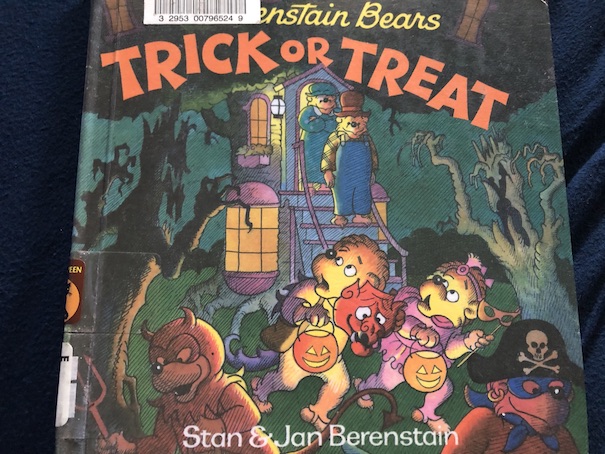
The Berenstain Bears Trick or Treat

The Berenstain Bears

The Berenstain Bears Trick or Treat by Stan and Jan Berenstain, 1989.

“Even little bears
expect a good fright
when they go out for treats
on Halloween night.”

Brother and Sister Bear are looking forward to trick-or-treating on Halloween night with their friends. Sister is going as a ballerina, and Brother is dressed as a monster. When Brother jumps out at Mama in his monster costume, she pretends to be frightened, and when he takes off his mask, Mama comments that “appearances can be deceiving.” Sister asks what that means, and Mama explains that “things aren’t always what they look like.”

This is the first year that Brother and Sister will be allowed to go out trick-or-treating without their parents. They plan to trick-or-treat with friends, and they talk about the houses that they plan to visit. The one house in the neighborhood that they don’t want to visit belongs to Miz McGrizz. Miz McGrizz’s house looks spooky, and the kids think that she might be a witch. Mama tells them that’s nonsense and that Miz McGrizz is a nice person.

As the young bears set out to trick-or-treat with their friends, some of the bigger, tougher cubs in the neighborhood try to talk them into joining them in some pranks. First, they want to decorate Miz McGrizz’s house with toilet paper.

However, before the cubs can do anything, Miz McGrizz comes out of her house, and seeing the cubs, tells them that she’s ready for them. Although the kids are frightened at first, it turns out that Mama really was correct about Miz McGrizz. Miz McGrizz is just a nice old lady who has a special treat for the cubs who are brave enough to visit her house.

In real life, trick-or-treaters shouldn’t go into the houses of people they visit unless they know them very well, but in this case, it’s not so bad because the cubs’ mother approves of Miz McGrizz and would be fine with the children visiting her.

The book is available to borrow and read for free online through Internet Archive (multiple copies).

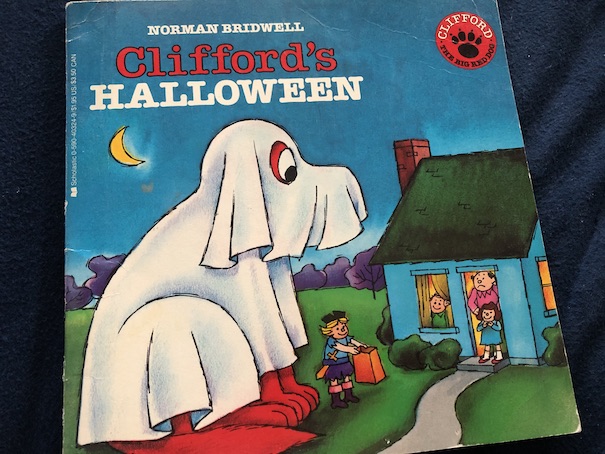
Clifford's Halloween

Clifford

Clifford’s Halloween by Norman Bridwell, 1986.

Halloween is Emily Elizabeth’s favorite holiday! Emily Elizabeth talks about the various holidays that she and Clifford enjoy, but Halloween is the one they enjoy the most.

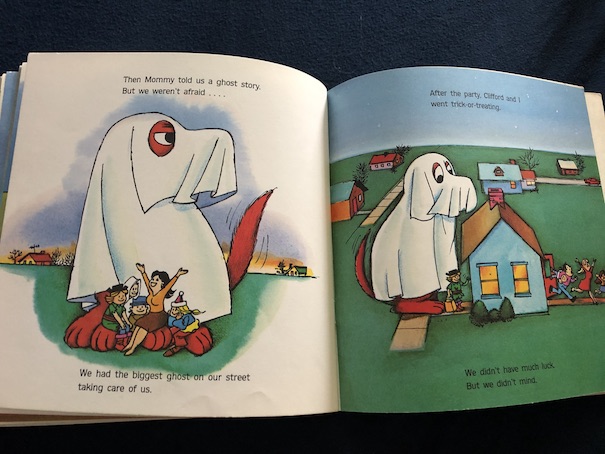
Last Halloween, she considered various costumes for Clifford, but Clifford decided that he wanted to be a ghost, covered with a giant sheet. (I love how they say that nobody could guess who the giant ghost is, like there could be someone else in the neighborhood that big.)

When you’ve got a giant dog, bobbing for apples doesn’t go the way you expect.

However, when you’ve got a giant dog, nothing else is very scary, either.

The book ends with Emily Elizabeth considering different costumes for Clifford for this Halloween, inviting the reader to think of other possible costumes.

I like the idea of letting kids consider which Halloween costumes they like the best from the ones that Emily Elizabeth considers. Kids like making choices, and trying to think of costumes that would work on a gigantic dog presents a creative challenge. When Emily considers dressing Clifford as a knight, they don’t consider where she’s going to get a suit of armor that size, but the books in this series don’t worry much about the logistics of caring for a dog the size of Clifford.

When I first read this book back in the 1980s (I was four years old when the book was new, although I can’t remember exactly how old I was when I first read it), I didn’t think too much about the Indian (Native American) costume with a pipe, although I wouldn’t think of suggesting that as a costume for anyone now. It’s partly because there’s something of a stigma against Native American costumes now. It’s not enough of a stigma to get people to stop wearing them and major costume retailers from selling them, but enough that some people raise eyebrows at them because of some of the connotations attached to them. If you read some of the reviews of Native American costumes on Amazon, like I did, it seems that more of them were purchased for school plays and projects or Thanksgiving plays than for Halloween. However, the part about this costume that particularly jumped out at me was the ceremonial pipe. Kids sometimes dressed as American Indians for Halloween when I was young, although the practice is discouraged now, but with all of the anti-smoking campaigns aimed at children when I was young, most of our parents wouldn’t have even considered giving us a peace pipe as part of a costume, even ignoring the social and cultural implications of that. I think that idea shows the age of the book’s creator. I grew up in the American Southwest, but I didn’t grow up on old western shows where peace pipes were a common feature. I didn’t see those shows until I was older, and by then, they looked pretty cheesy. I think that the book’s author was from the generation that was raised on those westerns and had nostalgic associations with them.

The book is available to borrow for free online through Internet Archive.

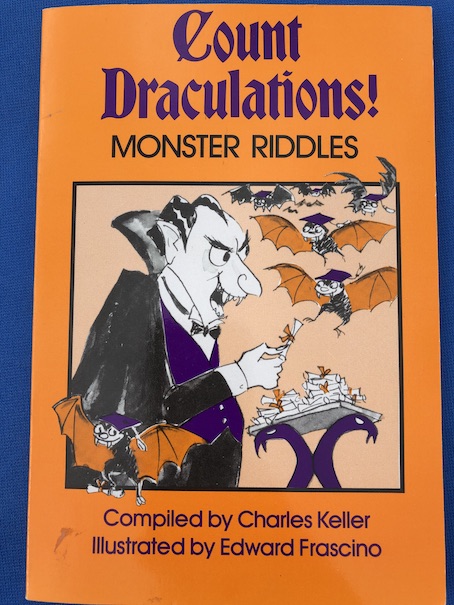
Count Draculations!: Monster Riddles

Count Draculations!: Monster Riddles compiled by Charles Keller, 1986.

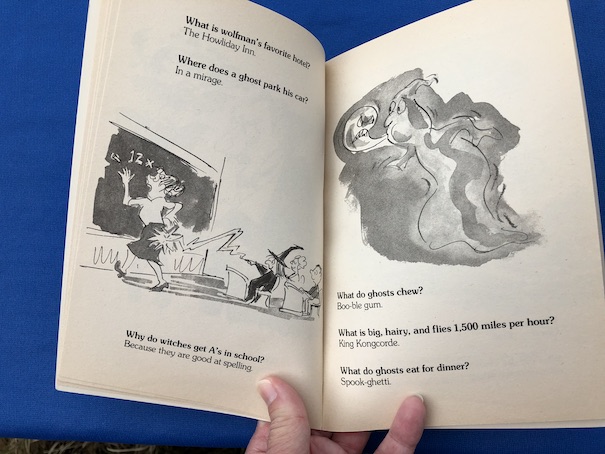
This is one of those themed joke books for kids that has monster and Halloween-themed jokes.  The jokes are the basic kid-friendly question-and-response type with lots of puns.  There are also some cute black-and-white illustrations.

Some of my favorite jokes:

Why do witches get A’s in school?

Because they are good at spelling.

How do you get into a locked cemetery?

With a skeleton key.

Why did Frankenstein’s monster go to the psychiatrist?

He thought he had a screw loose.

Why did the invisible man go crazy?

Out of sight, out of mind.

The Spookster’s Handbook

The Spookster’s Handbook by Peter Eldin, 1989.

This is a fun book of jokes and tricks for Halloween or just having some spooky fun with friends, possibly at a sleepover. The book is divided into the following sections:

Making Monsters – How to make costume pieces and turn yourself into a bug-eyed monster, a warty witch, and more! There are also tricks, like making a ghost image appear on a wall, casting a glowing face on someone else’s shadow, and making Bigfoot footprints.

Screamingly Funny – A chapter of ghost jokes.

Ghostly Tricks – Magic tricks that look somewhat ghostly, like making a friend “float” in the air and making magical symbols appear on blank cardboard.

Monster Pranks & Practical Jokes – Tricks that produce ghostly illusions, like how to take ghostly pictures, produce taps with no obvious source, and cause ghostly flashes of light in a dark room.

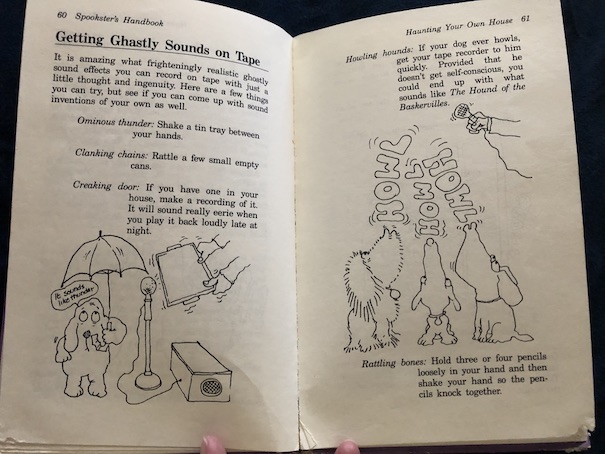
Haunting Your Own House – Describes typical do-it-yourself haunted house tricks for producing scary noises.

Monster Laughs – A chapter of monster jokes.

Scare Your Friends – Tricks and pranks for spooking your friends with a finger in a box, strange noises, or a glowing skull.

Terrible Trivia – Fun facts about superstitions and telling the future.

Fang-Tastic! – A chapter of jokes about vampires.

My favorite parts of the book are the superstitions and the ways to make scary haunted house noises. I haven’t actually tried the noise tricks yet, but at some point, I’m planning to try a few!

The book is available to borrow and read for free online through Internet Archive.

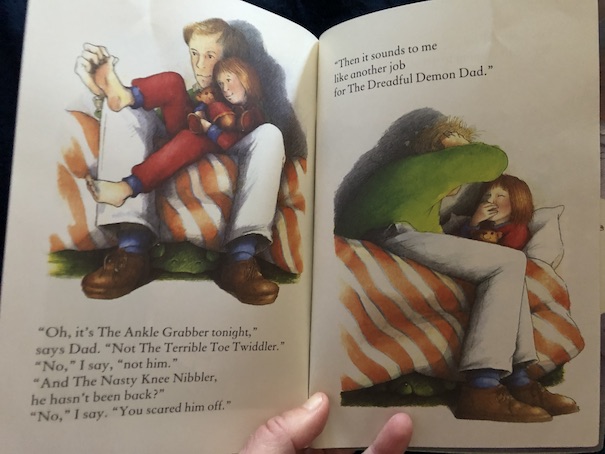
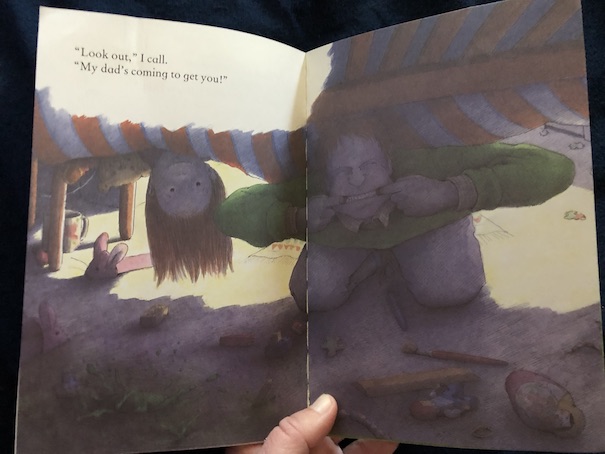
The Ankle Grabber

The Ankle Grabber by Rose Impey, 1989.

This book is part of the Creepies series, where children have fun imagining monsters. The stories are about the power of imagination and the fun of being a little scared. Sometimes, even though the children know that they made up the monsters themselves, they also get scared of their creations. Books in this series can be good for talking to children about how their imaginations can run away with them and scare them, but I’d use caution when introducing them to very young children because they can make nervous children more nervous by feeding their imaginations. These books would probably be best for ages seven and up. Fortunately, even when the kids’ imaginations run away with them, the stories always end in reality, and the hero of this story is … Dad!

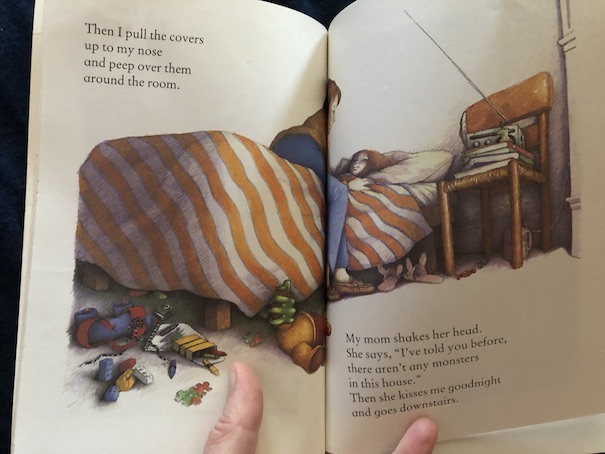
Every night, a little girl has her mother check her room for monsters, but no matter how well her mother searches for them, the girl is still terrified of the monster who lives in an invisible swamp under her bed. She calls this monster the Ankle Grabber because she believes that if she isn’t careful, the monster will reach out from under the bed and pull her down into the swamp by her ankles.

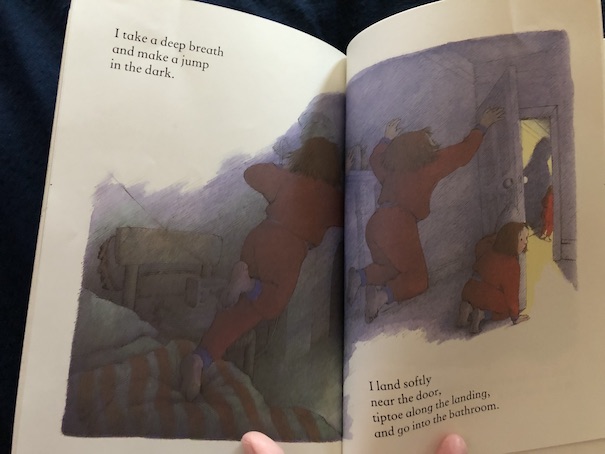
But, as is inevitable when you’ve got a monster under your bed, the girl realizes that she has to go to the bathroom. Getting in and out of bed without being caught by the Ankle Grabber is a tricky proposition. The girl tries to get into and out of bed by jumping so that she can avoid the monster.

When she misses her jump back into bed and lands on the floor, her father comes in to see what’s wrong. Her father has scared off monsters for the little girl before, so he sticks his head under the bed to scare off the Ankle Grabber, too.

Nothing is so scary that Dad can’t make it better!

The book is available to borrow and read for free online through Internet Archive.

The Witches of Hopper Street

The Witches of Hopper Street by Linda Gondosch, 1986.

Kelly McCoy and her friend, Jennifer, are offended that another girl from school, Rae Jean, is having a Halloween party and didn’t invite them. Jennifer says that they could just throw their own party on Halloween, but Kelly says that’s no good because everyone else they know is going to Rae Jean’s. It isn’t so much that Kelly really likes Rae Jean; it’s more that she hates being excluded.

The girls talk about what they want to dress as for Halloween, and Kelly suggests that they be witches because she’s fascinated by the witches she saw in a play of MacBeth. Kelly also has a book called “Magic and Witchcraft”, and she says that they could study the book and become real witches. Jennifer doesn’t see the attraction of becoming a witch, but Kelly promises that they’ll only perform white magic, where you use magic to perform good deeds, instead of black magic, which involves cursing people. Although, she might make an exception for just a few little black magic spells against Rae Jean. Jennifer says that Kelly can’t be serious, but Kelly says that she is because it’s awful being the only ones in the sixth grade not invited to Rae Jean’s party. Jennifer points out that Adelaide also wasn’t invited. The girls know that Adelaide isn’t popular because she’s overly tall and awkward and much smarter than the other kids. Then, Kelly gets an idea – there were three witches in MacBeth, so maybe they should invite Adelaide to become a witch with them.

When the girls see Adelaide on her way to Rae Jean’s house to help her with her math homework, they stop her and suggest to her that she join them as witches. Kelly tells her that Rae Jean is dangerous and that dangerous things will happen at her party. Adelaide says that she’s not going to the party anyway. Then, Kelly pretends to tell the future with a deck of cards, predicting that there will be a mysterious death in 24 hours. Her prediction comes shockingly true when Rae Jean’s cat kills her pet parakeet.

Kelly knows that the parakeet’s death was partly her fault for taking him out of his cage when Rae Jean brought her cat around, showing off her prize-winning pet, but she also blames Rae Jean for bringing her cat to her house in the first place, and the reason why they took the bird out of his cage was that Rae Jean was goading them about how dumb the bird was. (I think that the kids’ mother shouldn’t even have let Rae Jean bring her cat into the house. The other kids said that they didn’t want to talk to her, but the mother insisted that they let her in because she’s a “nice” girl. That was an irresponsible thing for the mother to do, and she’s not a good example to her children. When you have a pet in the house, you have to make the pet’s safety a priority, especially over being polite to someone who is rude and insulting anyway. Rae Jean shouldn’t have been allowed to bring a predatory pet into their house, uninvited, simply because she wanted to and the mother didn’t have the guts to say no and enforce some house rules. Of course, this is one of those annoying incidents in books that’s used to move the plot forward. If the parents acted anything like mine, it wouldn’t have happened, and this would be a different story.) Adelaide is impressed that Kelly’s prediction came true, and she agrees to be a witch with Kelly and Jennifer.

Kelly walks the others through rituals for being a witch, like signing their names in a Black Book (really, it’s an old brown science notebook), preparing their broomsticks (they’re supposed to be rubbed with the fat of a newborn piglet and belladonna, but the best they can do is strips of bacon and dieffenbachia), and preparing magical rings to protect themselves from evil creatures (Kelly got hers at an estate sale so she’d have one that belonged to a dead person, but the others just got their rings from the quarter machines at the supermarket). The girls pledge to keep their “coven” secret, but then someone leaves a message for them that says, “Midnight is the witching hour. Then you shall be in my power.” All of the girls deny having written it. So, who did? Who else knows about their witchy activities?

Kelly still hasn’t given up her plans to use this witch business to ruin Rae Jeans’ party. She soon acquires a new pet, a skunk, from her brother Ben’s friend Buster, whose father is a veterinarian. She calls the skunk Cinnamon and declares that he is her familiar. To keep the boys quiet about their activities, they have to let Ben and Buster join the coven as warlocks. As an initiation, all of the witches and warlocks have to drink salt water and eat beef liver. Kelly’s mother is perplexed by some of the odd things that they do, but she doesn’t question them too much, and none of the adults ever discover that the kids sometimes sneak out at night to perform rituals. (I could never have gotten away with this sort of stuff as a kid because my mother was always the type to ask a lot of questions about everything and get specific answers.)

Kelly gets the idea of making a voodoo doll of Rae Jean, using an old sweater of hers that Rae Jean’s mother gave her because she helped to get a box of old clothes down from the attic for a sale and because Rae Jean told her that the sweater was scratchy. To get Rae Jean’s hair and nails, the witches open a “spa” business at Kelly’s house. They succeed in getting hair and nail clippings, but Rae Jean gets scared away when their “spa” treatment involves mud that they just dug up in the backyard and has a worm in it. After they make the doll, they decide it looks really awful and sticking toothpicks in it is creepy, so they take the toothpicks out and get rid of it. Instead, they decide to focus on giving Rae Jean the “evil eye” – basically staring at her to make her feel uncomfortable. (That one works whether you’re a witch or not.) When Rae Jean and some others in class get sick, some of the other kids start to believe rumors that the girls have spread about a “poison plague.”

Eventually, Halloween comes, and Kelly gets the idea for her, Jennifer, and Adelaide to use their witch act while passing out candy to the trick-or-treaters. They put the candy in their “cauldron” (an old camping pot), give themselves fantastical names, and perform chants while handing out candy. They have fun with that, but they still feel left out of the party, so they decide to try one last witchy trick on Rae Jean. They decide to brew up a love potion (just apricot juice with honey, and they even think it tastes good themselves), sneak into the party as fortune tellers, and slip the potion into the party punch. Rae Jean’s mother is amused by their fortune telling act and lets them into the party, although Rae Jean isn’t happy to see them.

When Kelly’s new pet skunk gets loose in the party, there is some momentary chaos before Kelly manages to explain that the skunk is deodorized and can’t spray. During their time at the party, the girls learn the true identity of their mystery message writer and have an honest talk with Rae Jean about their feelings and apologize for the witchy things they’ve been doing. Rae Jean also tells them the reason why she didn’t invite them and how left out she felt when she didn’t get invited to a big party that Kelly had soon after she moved to the neighborhood. Rae Jean comes to realize how much she has provoked the other girls into hating her with some of her behavior, and she apologizes bringing cat to Kelly’s house and killing her parakeet. However, Kelly is also forced to acknowledge that she’s also provoked Rae Jean with her quick temper and attempts at revenge. All of the girls owe each other some apologies, and they make up. Kelly and her friends promise to give up all the witch stuff.

However, before they cut it out entirely, they have one last thing to do. Adelaide read about an old superstition that explains how to see a real witch at midnight on Halloween night, and before Halloween is over, the whole “coven” decides that they have to try it. What they see is a bit startling, and although it has an apparently logical explanation, gives the kids an appropriately witchy scare. Could there possibly be a real witch in their neighborhood?

I didn’t like the parts of this story about dead animals. I hated the part where the parakeet was killed, and later, I felt sorry for a cat that died (of natural causes, and it was a sickly stray, not Rae Jean’s cat). I never like stories where animals die, especially through human cruelty or carelessness. Yet, I have to admit that I have a particular attachment to this book, which I remember reading when I was ten years old. Some of their rituals are a little gross, but as I a kid, I think I was attracted to the idea of having a secret, mysterious club and intrigued by the identity of the mysterious message-writer. At the end of the story, they think they know who wrote the note, but their last midnight ritual causes them to have second thoughts.

This book is available to borrow for free online through Internet Archive.

My Halloween Story About My History With This Book:

This particular book and I have a history. This book was important to me as a kid because it sparked something formative, but to tell you what that something was, I have a confession to make: When I was a kid, I wanted to be a witch. I was in high school before the first Harry Potter books appeared, so it wasn’t about that. No, my introduction to witches was The Wizard of Oz, my favorite movie when I was five years old. I liked Glinda, the Good Witch of the North. Dorothy was my favorite character, but I liked Glinda, too. Later, when I saw the movie of Bedknobs and Broomsticks, my interest in witches increased. I also read The Blue-Nosed Witch when I was young, and I was hooked. For a portion of my early childhood, my favorite Halloween costume was a traditional witch costume.

I didn’t want to curse people or be an evil witch, like the Wicked Witch of the West, in spite of my traditional witch costume with the pointy hat. No, I wanted to be a Good Witch and maybe ride a broom and bring suits of armor to life and maybe defeat Nazis in a way that is far less gross than melting them, like in Indiana Jones and the Raiders of the Lost Ark. I had discernment. I had standards. I also had a fear of heights after falling off the monkey bars when I was four, so that probably should have been a clue that broomstick-riding was out for me, but when you’ve got magic, I guess these things aren’t much of a problem. I can’t say that I was really ambitious about wanting magical powers because I didn’t really do anything to acquire them, it was just that I kind of liked the idea … except for that one time, and that’s what this little side story is leading up to.

When I was about ten years old, I read this book with a friend, and we were both enchanted with the idea of making up our own rituals and becoming “witches” and maybe trying some spells on Halloween, just to see if magic works. I only had sort of a vague notion of what kind of spells that we could do. I guess I was picturing something like Bedknobs and Broomsticks, where you recite a rhyme and something is supposed to happen, but I didn’t know any real spells, just movie stuff, and I was clever enough to realize that the stuff in movies probably wasn’t real. Naturally, being a bookish person, I decided that the best way to learn more was at the library. PSAs on tv always told you to “Read more about it“, whatever “it” was. (This was the early 1990s, and I didn’t have access to the Internet yet. That wasn’t even an option.) If anybody had some real spells books, especially ones placed at a convenient height on shelves that a not-very-tall ten-year-old could reach, it would be my local public library, right? I was actually surprised myself when I found one in the library catalog. I really didn’t think it was going to be that easy. That wasn’t the hard part. The hard part was when I actually picked up the book and opened it.

Now, I have to admit here that I didn’t read the whole book, and years later, I can’t remember the title or even what the cover looked like. I kind of wish I did because there are people I would like to show this book to just to prove that it actually exists. When I told my mother about it later, she thought that I dreamed the whole thing, but I swear I didn’t.

This book did have “spells” of various kinds. I picked one from the table of contents (I forget what, but something that sounded like something two ten-year-old girls might want to do on Halloween) and looked at the instructions. It was disgusting. It involved things like animal entrails, which I wouldn’t have known where to get and wouldn’t have wanted to touch even if someone handed me a free bag full. There were other things about animal parts on different pages that disgusted me, too. Under no circumstances was I going to kill cute animals just to do some dumb trick on Halloween, and I wouldn’t have wanted these animals parts even if someone else had done the dirty work of getting them. I wasn’t a vegetarian, but these were definitely not things I could just buy at the grocery store, or better yet, cooked and yummy with a side of fries and a plastic toy.

As I was staring at this book, I suddenly realized that I had no desire to do anything it described and that I was never going to do anything it said. Then, I had a worse thought: someone else must have thought this was a good idea, or they wouldn’t have written it down. Maybe I didn’t want to mess with animal entrails and body parts to gain magical powers, but someone else obviously would. What kind of person would do such a thing? Whatever kind it was, it wasn’t me, and I knew it. The image of the type of person I would have to be in order to do any of this, in order to take any of this seriously, disturbed and repulsed me more than just what was written in the book itself. I slammed the book shut, shoved it back on the shelf, and ran away. I never saw it again, although I did try to find it again once to show it to my mother so that I could prove that I wasn’t dreaming. It wasn’t even in the catalog anymore then.

My guess is that, whatever this book was, either someone stole it from the library (it is the sort of thing an aspiring evil witch might do) or lost or damaged it or some parent or librarian realized that this might not be the best book for children and had it removed from the shelves. Since then, I’ve wondered who put that in the kids’ section in the first place. I’m not fond of censorship, but I have to admit that this book was pretty dang gross and creepy. Was that spell book really serious, or did I miss some introductory part that would have explained that it was all part of some larger ghost story or something? What was the point of the book? I’ve often wondered. All I really remember now is that it was in the first row of children’s non-fiction books at the library, probably the 100 or 200 section of the Dewey Decimal System.

I’m actually glad I did look at it, though, because it made me realize a few things about myself. I realized that there were limits to the things that I was willing to do and that I had the power to say no when something was beyond my limits. My friend was disappointed and thought I was a bit of a wimp for chickening out on our witch experiment so soon and not even showing her the book, but I didn’t care that much. I was firm. I also came to realize that sometimes, it’s the things we don’t do or won’t do that define who we really are. In the end, it may not matter what that book actually was so much as that it left me with a stronger sense of who I was. I should have paid more attention to the part in the Bedknobs and Broomsticks movie where Miss Price said that she realized a long time ago that she could never really be a witch because nobody who felt the way she did about “Poisoned Dragon’s Liver” could be a real witch. I came to appreciate the sentiment.

This experience didn’t completely scare me away from stories with witches in them, as evidenced by the Halloween stories I cover here. I was born close to Halloween, and I like the holiday because I enjoy the imaginative costumes and playing pretend. (Not to mention chocolate. I also enjoy chocolate.) I enjoyed the Harry Potter books, too. But, I know where the dividing line is between pretend and real. It doesn’t trouble me now because I already put the book back on the shelf and said no when it was asking too much, and some decisions stick for life. I don’t worry too much about giving fantasy books to kids, either. Everyone has decisions to make in life about who and what they want to be, and I figure that the younger generations might as well learn where the dividing line between fantasy and reality lies early in life. A bit of a scare now and then might even help them to think more deeply about life’s consequences and make better choices.

If that spell book had been less scary and disgusting, like something that Wiccans use that involves pretty things like crystals and herbs instead of entrails, I actually might have tried a few spells as a child, probably raiding the spice drawer in the kitchen or dismantling my rock collection for spell ingredients. However, Jenny Nicholson did a YouTube video, demonstrating how that typically goes for the aspiring witch. I thought it was hilarious, especially after my childhood escapade. I doubt that I would have had quite the range of objects that Jenny describes, and my parents would have been mad at me if I tried to throw eggs at trees, but I probably would have achieved similar levels of results if my friend and I had actually gone through with our experiment that Halloween. As an adult, I mostly think that things like that are more psychological tricks than anything else, and I find descriptions of them amusing now.

Anyway, that’s my creepy experience with “real” magic. If anyone thinks that they know what that creepy spell book was, feel free to tell me. I don’t feel like I have anything to prove magic-wise, but I still have people I’d like to convince that I didn’t just imagine that the book exists.

Ramona Forever

Ramona is in third grade now, and there are new changes coming in her life. At the beginning of the book, she and her sister Beezus still go to Howie’s house every day after school so Howie’s grandmother can look after them because both of their parents work, although lately Beezus has been finding other places to go after school, like her friend’s house and the library. That’s how Ramona knows from Howie that his rich Uncle Hobart, who has a job in the oil industry, will be coming to visit soon from Saudi Arabia. Ramona mentions it one night at dinner when her Aunt Beatrice is visiting. Aunt Beatrice says that she remembers Hobart from when they were kids and went to the same school, but she hasn’t seen him in years.

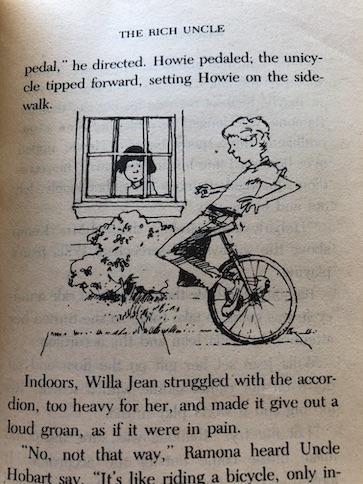
When Uncle Hobart comes, he brings a couple of small camel saddles for Howie and Willa Jean to play with. He also gives Howie a unicycle and Willa Jean a small accordion. When he meets Ramona, he embarrasses her by calling her Howie’s girlfriend and singing a verse from an old song about a woman named Ramona (links repaired Nov. 2023), and Ramona takes an instant dislike to him. She flat out tells him that she doesn’t like adults who tease (Neither do I, and I’m in my 40’s.), and he promises to reform, although Ramona thinks that he’s still joking around and isn’t satisfied.

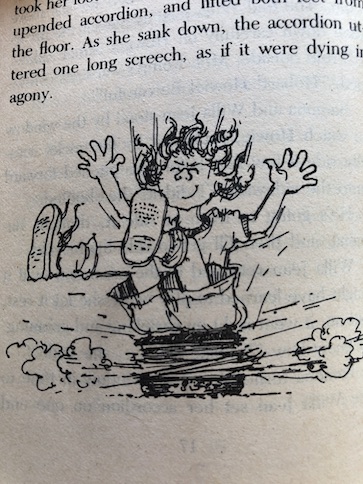
Uncle Hobart takes Howie outside to learn to ride the unicycle, and Willa Jean and Ramona try the accordion. When neither of them can figure out how to use it, little Willa Jean gets frustrated and sits on it, breaking it. Howie’s grandmother, Mrs. Kemp, gets angry at the girls, and Ramona thinks that the accordion was a dumb present to give to a little girl who wouldn’t be able to use it properly for years. Mrs. Kemp tries to shame Ramona to Uncle Hobart, blaming her for the incident. (As if Ramona was the babysitter instead of Mrs. Kemp, who incidentally, is being paid by Ramona’s parents to watch her as well as watching her own grandchildren. Ramona didn’t think of this, but I certainly did.) Ramona never really liked being watched by Mrs. Kemp, but the blaming and shaming makes her realize that Mrs. Kemp actually doesn’t like her and wants to make her feel bad, which is a disturbing feeling from someone who is supposed to be taking care of her. Ramona decides right then that Mrs. Kemp will never look after her again.

When the family talks about the situation at dinner that night, Beezus supports Ramona’s assertion that Mrs. Kemp doesn’t like them, saying that’s the reason why she’s been trying to find other places to go after school. Ramona’s mother asks her if she ever thought that maybe Mrs. Kemp would rather not be a babysitter at all, for either her grandchildren or Ramona, but women of her generation were only brought up to take care of their homes and children, and that’s all she knows how to do, whether she likes it or not.

Personally, I think this is true, but also irrelevant. Mrs. Kemp has a job to do, one that she’s being paid for, and if she’s taking the money, she also needs to take responsibility. Mrs. Kemp blames Ramona for not watching Willa Jean when that was her job, not Ramona’s, and Mrs. Kemp also has a responsibility to Ramona herself because that’s what she’s being paid for. Ramona is Mrs. Kemp’s babysitting charge. She’s a child, the child of paying customers who are specifically paying Mrs. Kemp for childcare. Ramona is not Mrs. Kemp’s personal servant or the babysitter for her granddaughter. Ramona is especially not Mrs. Kemp’s personal therapist or caregiver, who needs to help her manage her emotions or life decisions. Ramona is a child who is only with Mrs. Kemp for the purpose of being cared for by her, so let’s keep it straight who has a responsibility to whom in this situation. Besides not liking adults who tease like bratty children, I also don’t like adults who try to make kids be responsible for things that they should be responsible for themselves. Seeing Mrs. Kemp accepting money in exchange for irresponsibility and a bad attitude about her own general life choices that she takes out on her childcare charges is that much worse. Mrs. Quimby’s insights, while probably true, are also completely unhelpful to the situation. Mrs. Kemp is what she is, and what she is does not make her a good caregiver. Ramona and Beezus are correct to call her on it. Mrs. Quimby is concerned about hurting Mrs. Kemp’s feelings, but I think that should be the least of her concerns in this situation since Mrs. Kemp doesn’t seem to care about the children’s feelings and she’s in a position of trust over them. She is demonstrably not doing the very thing she is supposed to do, which care for the children she is paid to provide with childcare. You have one job, Mrs. Kemp, just one job! Mrs. Kemp is an adult, more than old enough to know better about how to behave and take responsibility for herself and the young children in her care, and she should choose to act like it or be prepared to face the consequences, not continue to get paid and thanked for work she’s not even willing to do, making her young charges miserable every single day. She’s taking advantage of the Quimbys’ desperation for child care, and that’s not right. I wished Mrs. Quimby would step up and support her daughters’ efforts to stand up for their well-being instead of enabling Mrs. Kemp’s bad behavior and making excuses for it, as if it were somehow Ramona’s fault that Mrs. Kemp doesn’t like being a babysitter and that eight-year-old Ramona actually has the power to solve Mrs. Kemp’s life problems. I can only suppose that the reason why Mrs. Quimby doesn’t is that she just doesn’t know where else to find someone willing to watch the girls after school.

Mr. Quimby asks Ramona what she thinks she should do about the situation, and Ramona hates being asked that because she wanted help from the grown-ups, not the responsibility of figuring out the problem with her adult caregiver by herself. Again, I really have to side with Ramona here. It’s not her job to be the adult in this situation, and the older I get, the less patience I have for irresponsible adults. I hated them when I was a kid Ramona’s age (and I ran into plenty of them, too), and I don’t feel any better about them 30 years later. If you want the authority of saying that you’re an adult, you have to take the responsibilities that come with that authority, taking the adult actions and making the adult decisions, not expecting the kids to do your job for you. That’s my attitude. I honestly don’t know what response Mr. Quimby was even looking for from Ramona, either. What can Ramona do if Mrs. Kemp is unhappy about her life choices and doesn’t treat her well because she doesn’t want to be her babysitter? Get some books on psychology from the library and turn into a therapist or career counselor at the age of eight to help Mrs. Kemp work through her emotional issues? Invent a magic potion that will age her to 58 so she can be Mrs. Kemp’s new best friend and they can go out for champagne brunches together instead of Mrs. Kemp babysitting her? What solution are you imagining here, Mr. Quimby? Ramona is an eight-year-old, and what what she thought she should do about this bad situation was talk to her parents, who hired Mrs. Kemp to take care of her in the first place, and get their help. How was she supposed to know that you didn’t want to help her, either? If I were one of the parents in this situation, I’d say that I understood the problem and that I’d think over some other after school possibilities for the girls, maybe look into some temporary care for the girls, possibly in the form of some kind of after school lessons in art or music or sports, paid for with the money that I would have given Mrs. Kemp for babysitting, especially since I already know that the Quimbys are already considering some coming changes for their family that will change their childcare situation. Of course, all of this is setting the stage for what happens next in the story.
Ramona asks if she can just stay home alone after school because some kids do, but her parents don’t like that idea. Beezus says that she could stay with Ramona because she’s in middle school and old enough to babysit. Ramona worries a little that Beezus will be bossy and that they’ll fight with no adults around, but Mr. and Mrs. Quimby agree to let the girls try it for a week while Uncle Hobart is visiting so Mrs. Kemp can spend more time with her son. If the arrangement works and the girls behave themselves, they can keep doing it after Uncle Hobart leaves.

Ramona asks Beezus why she’s so willing to look after her after school, and Beezus explains that things haven’t been to pleasant at her friends’ houses lately. Mary Jane needs to spend a lot of time practicing her piano lessons, and she got into a fight with Pamela because Pamela was acting like a snob and giving her a hard time about her dad’s work situation. Mr. Quimby has had a series of different jobs, and now, he is working only part time and going back to college to train to become an art teacher. Pamela has been bragging to Beezus that her father has a real job and that Mr. Quimby should “stop fooling around and really go to work.” (This is one of those snide kids’ comments that you can tell really came from Pamela’s parents and that she’s just repeating what they say to sound big. Pamela’s parents have probably been bad-mouthing the Quimbys behind their backs to talk themselves up because their employment has been more stable and some people need to look down on someone in order to feel good about themselves. I’ve seen that type before, too. By this point in the story, I had the feeling that the Quimbys seem to know a lot of people who are real jerks in one way or another, and I think it’s time that they made some new friends.) Beezus can’t take it anymore, so she’s stopped speaking to Pamela, which is about all you can do in a situation like that.

Beezus worries about their family’s future because she’s heard that schools are laying off teachers, and she fears that her father might not find a job when he’s done with his degree. She also think that their mother is probably pregnant because of the way that Aunt Bea keeps asking her how she’s feeling and a few months ago, she seemed to be suffering from morning sickness. If that’s true, she probably won’t be able to work much longer because she’ll have to take time off to have the baby and look after it. It make things difficult when the family is already concerned about money, although Beezus says that she wouldn’t mind helping to look after a baby because she likes babies. Ramona worries about the new baby and why their parents would want another child when they already have her and her sister, and she doesn’t like that the adults seem to be keeping important secrets.

The girls try to be extra good and responsible when they’re home alone together so they’ll be allowed to continue staying home alone, but they get into a fight one day when Howie comes over and offers to let Ramona ride his bike because he’s going to practice riding his unicycle. Beezus is afraid that Ramona will get hurt riding the bike and she’ll be considered responsible, but Ramona wants to go ahead and do it anyway because she’s been waiting for Howie to agree to loan her his bike. Ramona likes riding the bike, but she does fall off and scrape her elbow. Beezus refuses to help Ramona clean up afterward because Ramona insulted her before she went bike riding, and Ramona is angry with Beezus. In spite of that, the girls decide not to tell their parents about what happened because they don’t want to go back to Mrs. Kemp and their father specifically tells them not do anything to worry their mother, another sign that she’s probably expecting a baby.

Then, one day after school, the girls discover that their cat, Picky-picky has died, probably of old age. At first, they don’t know what to do, but remembering that they’re not supposed to upset their mother, they decide to bury the cat themselves. The girls are upset, but they manage to bury the cat, and they also make up with each other after their earlier fight. When their parents come home and find out about the cat, they feel badly that the girls had to handle the situation on their own. Mrs. Quimby says that, after they handled this difficult situation, she knows that they can be trusted on their own and that there’s no need for them to go back to Mrs. Kemp.

The girls’ mother finally admits that she’s going to have a baby, and the family begins talking about the new changes that they’ll have to make when the baby comes. The girls wonder who will have to share a room with the new baby, and they come up with ideas for names. Ramona worries about being a middle child now and not the youngest, but her mother reassures her that she still loves her. The Quimbys also consider that they may have to move in order for Mr. Quimby to find a teaching job, although Beezus and Ramona don’t like the idea of moving.

However, there are still more changes to come. Aunt Bea and Uncle Hobart announce that they are getting married! Ramona still doesn’t like Uncle Hobart and doesn’t really want him for an uncle, and after they’re married, they’re planning to move to Alaska because Uncle Hobart will be working in the oil industry there.

Changes aren’t always easy, but the girls enjoy taking part in their aunt’s wedding, and at the end of the book, their mother has the new baby, who turns out to be a girl. They call her Roberta, for a twist on her father’s name. Ramona begins to feel happy and comfortable with the changes in her life because she realizes that she’s growing up.

The book is available to borrow and read for free online through Internet Archive (multiple copies).

The Official Koosh Book

The Official Koosh Book by John Cassidy and Koosh ball inventor Scott Stillinger, 1989.

This book is part of the classic children’s hobby and activity series from Klutz Press. Originally, this book came with three mini Koosh balls, which were attached to the book at the holes on the left side of the book. I can’t remember now whether I actually got my set of mini Koosh balls with this book or if I bought them separately because my book was used. I’ve had this book for a long time, and my favorite activity in the book is juggling, a favorite staple activity of the Klutz series as well as a personal favorite of mine.

My copy of the book isn’t a first edition, and the introduction explains some changes that had taken place since the book was first written. John Cassidy of Klutz Press partnered with the inventor of the Koosh ball, Scott Stillinger, to write the book to explain various ways kids could use Koosh balls and games people could play with them when the toy was a new product. Since the book was first written, Koosh balls had become much more popular, and new varieties of Koosh balls were created, including the Mini Kooshes that came with the book.

Koosh balls are rubber balls covered with rubber filaments that are something like short spaghetti, making them feel soft, even if you get hit in the head with them while learning how to juggle. (I speak from experience.) This soft, painless-when-hit-with-one quality of Koosh balls was completely intentional on the part of the creator. It’s also the reason why they’re still a popular toy and the basis for many of the Koosh games in the book.

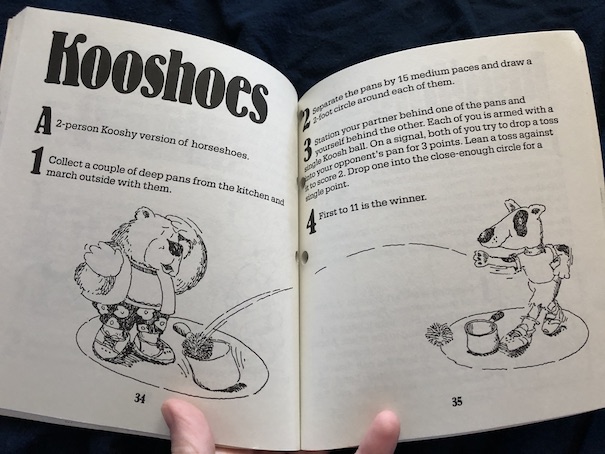
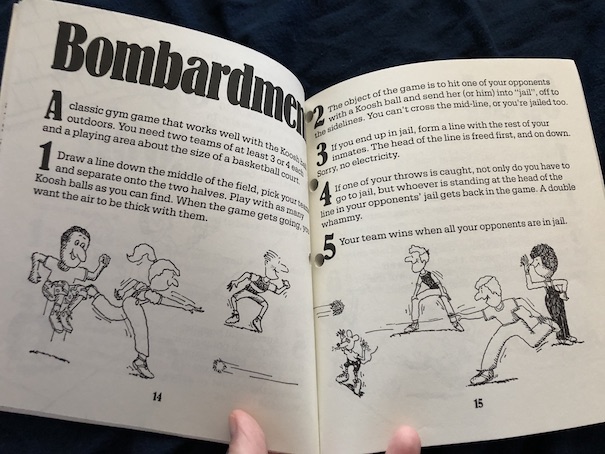
Many of the games in this book make use of the fact that it doesn’t hurt to be hit with a Koosh ball to give battle games like Dodge Ball and Bombardment a new twist. As the book says, “Dodge Koosh also fulfills the basic human need to bonk others of our same species.” I get that feeling some days, but when it’s done with Koosh balls, it’s pretty harmless.

Because Kooshes are soft, you can even play games indoors that usually wouldn’t work indoors because of the damage that could be done to things and people.

The book also suggests using Koosh balls for variations on Footbag (or Hacky Sack) or Horseshoes. Koosh balls work for these types of games because they don’t roll like regular balls. Because Koosh balls are made of rubber, they can also be used in a swimming pool.

The book is available to borrow and read for free online through Internet Archive (multiple copies).