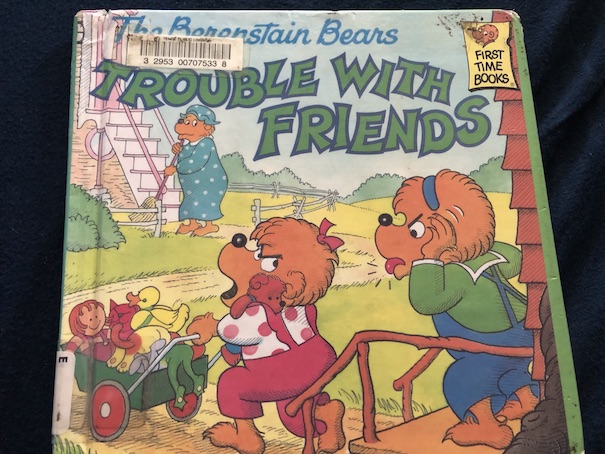
The Berenstain Bears and the Trouble with Friends

The Berenstain Bears

The Berenstain Bears and the Trouble with Friends by Stan and Jan Berenstain, 1986.

“When making friends,
the cub who’s wise
is the cub who learns
to compromise.”

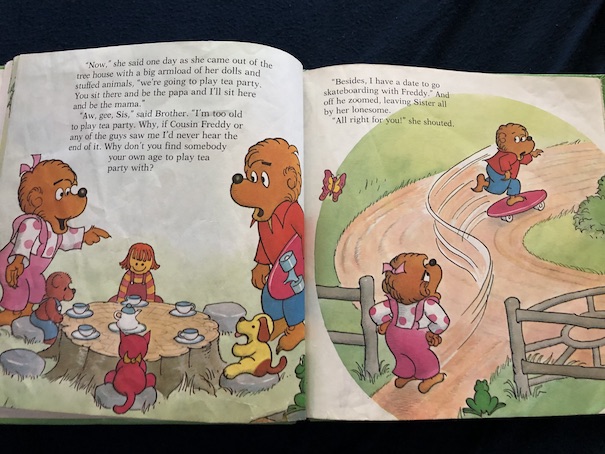
Brother and Sister usually play pretty well together, but Brother is two years older than Sister, and he doesn’t always want to play girls’ games like tea party and house. Brother likes to hang out with Cousin Freddy, but Sister doesn’t have a friend who lives close enough to play with her after school.

Then, one day, a new family moves in down the road, and they have a girl who’s Sister’s age. The new girl’s name is Lizzy, and she likes to do many of the things that Sister likes to do. The girls start playing together right away. Sister thinks that Lizzy is fun, but a little bossy … kind of like Sister herself.

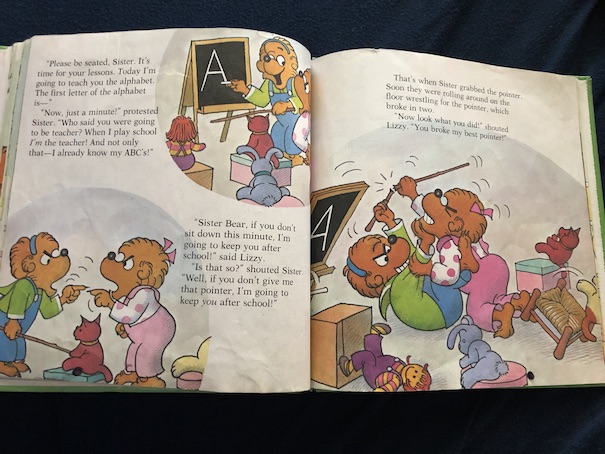
Later, Sister takes some of her stuffed animals to Lizzy’s house so they can play school. However, the girls argue over who is going to play the part of the teacher. Both of them want to play the teacher, and during their argument, they break Lizzy’s pointer stick.

Sister goes home angry, but Mama Bear reminds her of the reasons why she might want to make up with her new friend. Getting along with people can be difficult, but there are many things that are difficult to do alone. Having friends can be a lot of fun, certainly much more fun than sitting home and being lonely. If Sister wants to make up with Lizzy, she needs to accept her for the person she is and recognize that she can be a bit bossy herself sometimes. Both of the cubs need to give a little, let each other have their way sometimes, and care about each other’s feelings.

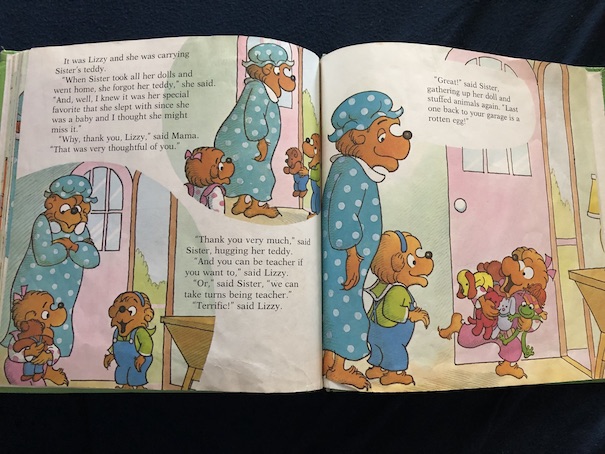
Lizzy drops by to return Sister’s teddy bear, which she left behind. She remembers what Sister told her about her teddy bear and why it’s important to her, showing that she does care about Sister’s feelings. The girls make up and agree to compromise and take turns being the teacher when they play school. Both the girls realize that getting along with friends means considering each other’s feelings and being willing to compromise.

The book is available to borrow and read for free online through Internet Archive (multiple copies).

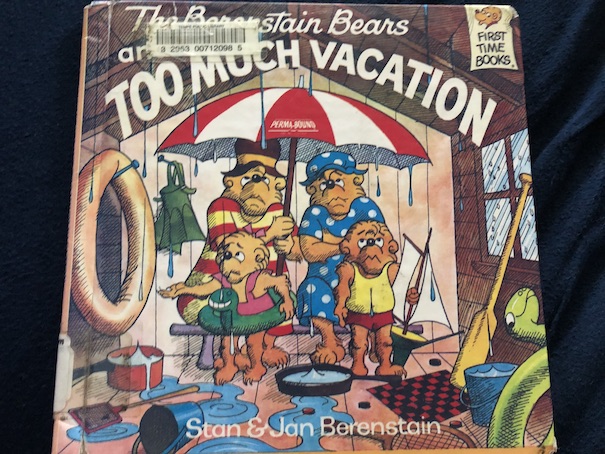
The Berenstain Bears and Too Much Vacation

The Berenstain Bears

The Berenstain Bears and Too Much Vacation by Stan and Jan Berenstain, 1989.

“Can a bear’s vacation
with more rain than sun
end up being
the one that’s most fun?”

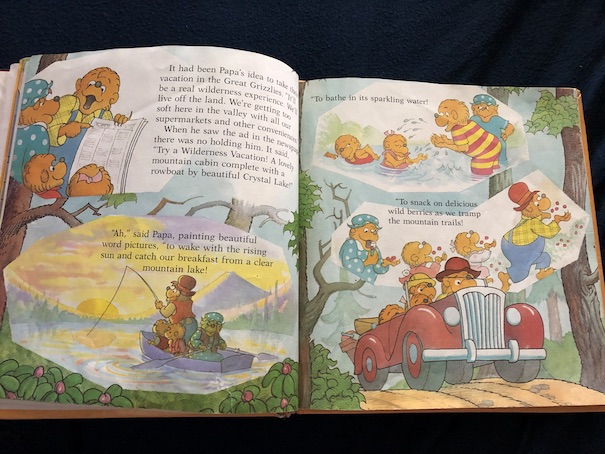
The Bears are looking forward to their family vacation! The vacation was Papa’s idea because he saw an ad in the newspaper for a rental cabin the mountains. Papa likes the idea of a wilderness vacation and living off the land. He describes to his family how much fun it will be to swim and fish in the lake and eat wild berries.

However, when they arrive at the cabin, it soon becomes apparent that their vacation is not going to be as it was advertised. The cabin is run-down and messy. The water from the pump is brownish, and the lake is too.

From the very beginning, nothing on their vacation goes right. Papa’s “wilderness stew,” made from plants that he gathered, is terrible, and the wild berries are sour. Their rowboat sinks, and fishing is a disaster!

When it starts to rain, their cabin leaks, and Papa falls down in the mud. By then, everybody has decided that they’ve had enough and that it’s time to go home.

So, what did they get out of their worst vacation ever? Memories! The experiences were pretty awful, but Mama’s pictures of everything that happened turn out to be hilarious! This is a fun story about how even disappointing situations can have a humorous side.

The book is available to borrow and read for free online through Internet Archive (multiple copies).

Spot Visits the Hospital

Spot

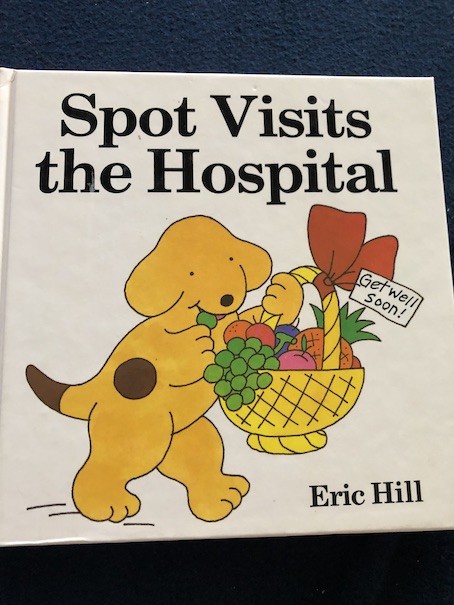
Spot Visits the Hospital by Eric Hill, 1987.

Spot’s friend Steve, who is a monkey, is in the hospital with a broken leg. Spot and some of their other friends decide to go visit him and take some presents to cheer him up.

Steve likes their presents, and Spot and his friends sign Steve’s cast. They play in the hospital’s playroom, where they have toys, games, and books for child patients.

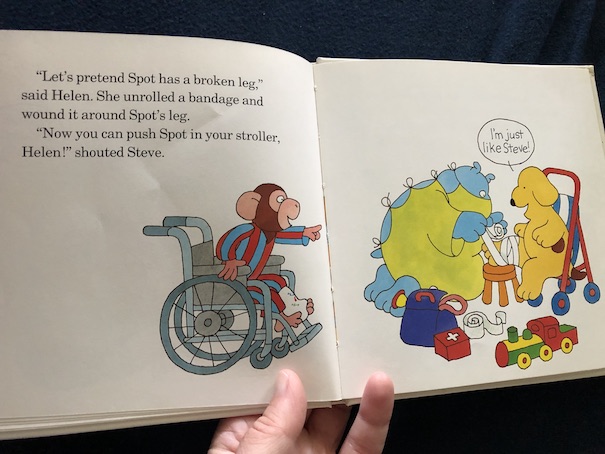
Spot’s friend Helen decide to play doctor, and she puts a bandage on Spot’s leg, as if his leg is broken, like Steve’s. They start pushing Spot around in a stroller, like it’s a wheelchair.

Their friend Tom hides, and they all go looking for him, finding him in an x-ray room. In real life, they would probably get in trouble for goofing off around the x-ray equipment, but in the book, nobody catches them doing it. I think the reason why the book has this episode in it is to have a reason to show readers the x-ray equipment and explain how the doctors used it to examine the break in Steve’s leg.

Spot is fascinated by what he sees in the hospital and tells his mother that he might like to be a doctor someday.

This story could encourage children who find the idea of studying medicine and helping people interesting, but it also makes a visit to the hospital seem less scary for children who may worry about what happens there and what all the big machinery, like the x-ray machines, are for.

The book is available to borrow and read for free online through Internet Archive.

Spot Goes to the Beach

Spot

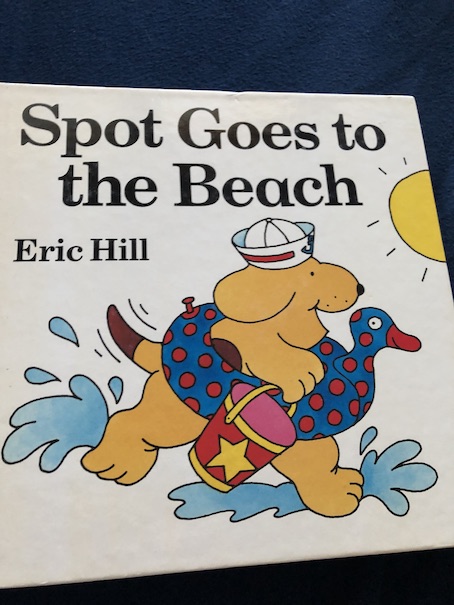
Spot Goes to the Beach by Eric Hill, 1985.

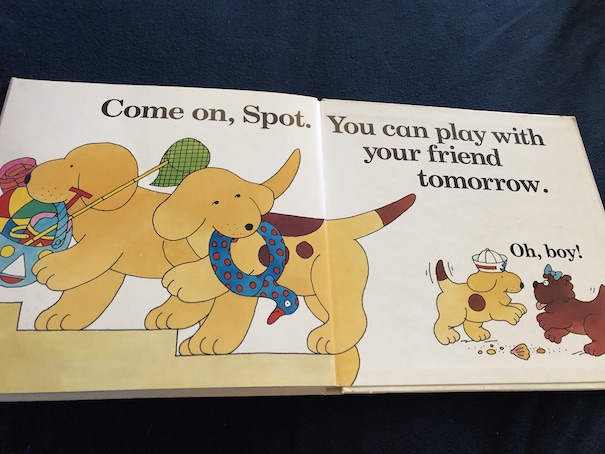
Spot’s parents take him to the beach to spend the day there. When they get to the beach, Spot wants to get a sailor hat from a stand selling beach equipment, and his father also buys him some beach toys.

Spot plays with a beach ball, builds sand castles, and buries his father in the sand.

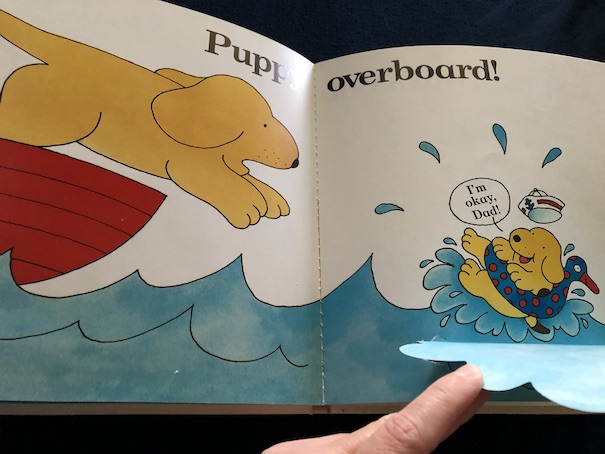
Spot and his father later go fishing, and Spot falls in the water, but Spot is fine because he’s wearing a pool float.

Before they leave the beach, Spot also makes a new friend, another puppy!

This is just a cute book for children about the fun things that they can do at the beach.

Like other Spot books, this book is a lift-the-flap picture book. The British version of the title is Spot Goes on Holiday. It’s available to borrow and read for free online through Internet Archive (multiple copies).

Spot Goes to School

Spot

Spot Goes to School by Eric Hill, 1984.

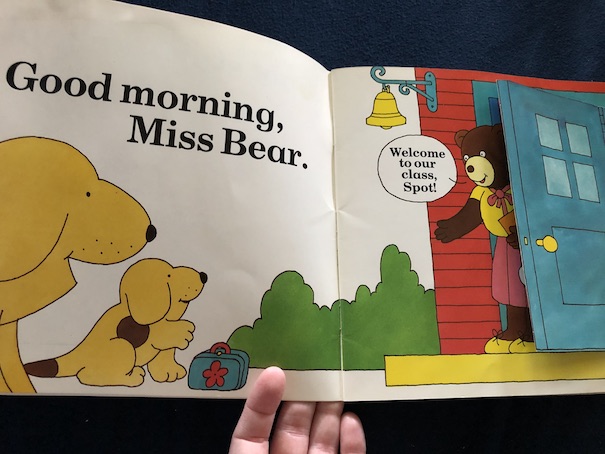
Spot is going to school for the first time. His mother drops him off at the school, where he meets his teacher, Miss Bear.

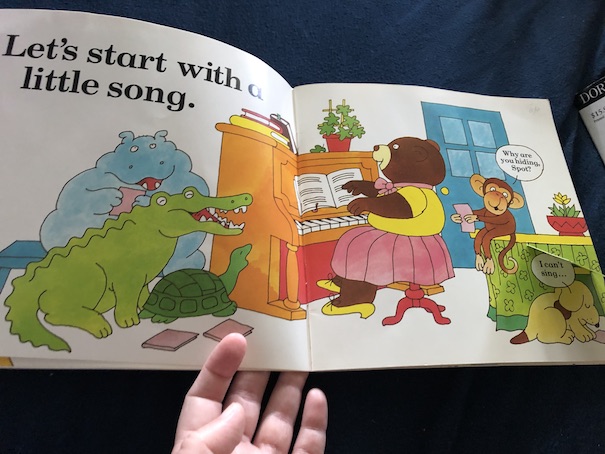
Spot and his animal friends participate in typical kindergarten activities. They sing a song while their teacher plays the piano (although Spot hides because he can’t sing), and they play dress up in the classroom playhouse.

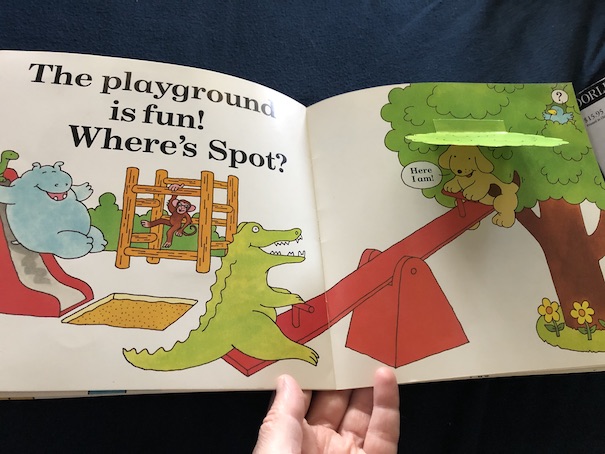
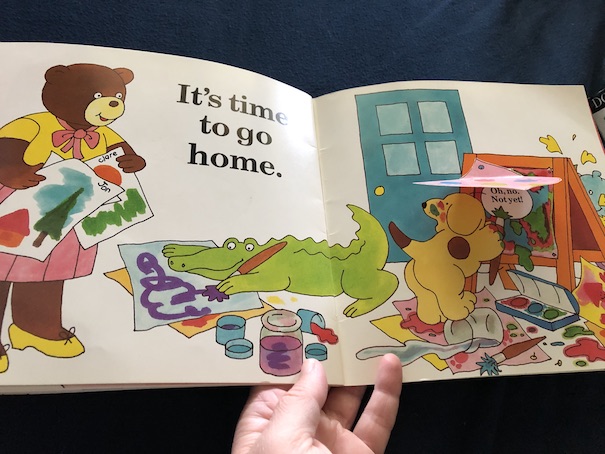
They play on the playground and show what they brought for show-and-tell. Spot roughhouses with a friend during storytime, and he loves painting pictures with his friends. When school is over, Spot doesn’t even want to go home because he’s had so much fun!

Like other Spot books, this is a lift-the-flap book. It is available to borrow and read for free online through Internet Archive (multiple copies), but to be honest, it’s not as much fun to read electronically because you can’t experience the lift-the-flap effect.

Where’s Spot

Spot

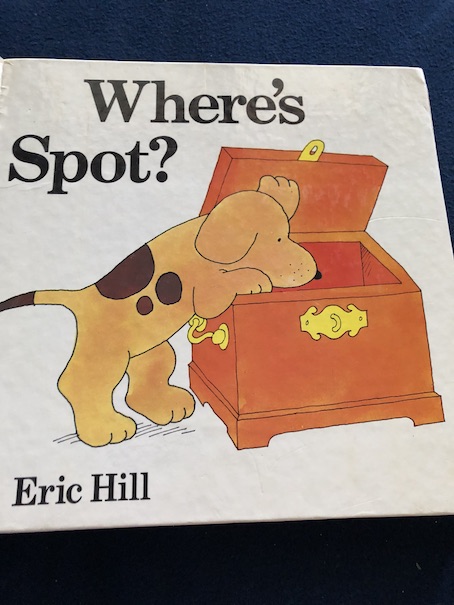
Where’s Spot? by Eric Hill, 1980.

This is the first modern lift-the-flap book for children, inspired by the author’s young son, who was playing with some sheets of papers on which he had drawn some concepts for an advertisement. There was an earlier style of lift-the-flap book from the 18th century, but this first book in the Spot the Dog series led to the popularization of modern lift-the-flap books for children.

Spot’s mother, Sally, notices that her puppy hasn’t eaten his dinner. She doesn’t know where he is, so she goes looking for him.

Sally searches for Spot all around their house, looking behind a door, in a closet, inside a clock and piano, under the stairs, and under the bed. In each place, she finds different animals (no explanation, there are just a lot of animals in this house).

Finally, the turtle hiding under the rug suggests that Sally check the basket, which is where she finally finds Spot.

The story is very simple, and the lift-the-flap concept is what really makes it work. The interactive element is fun, as if the readers are participating in a game of hide-and-seek with the characters. Kids enjoy being surprised by the different kinds of animals hiding all over the house. I loved it when I was a kid!

The book is available to borrow and read for free online through Internet Archive (multiple copies), but to be honest, it’s not really a good book to read online because the lift-the-flap effect doesn’t carry over.

The Girl in the Window

Kiley Mulligan Culver lives in a fairly small town, Meander, in the southern United States.  Although not much usually happens in their small down, about a year before the story begins, a little girl named Leedie Ann Alcott was kidnapped.  The crime literally hit Kiley very close to home because she and her father (Kiley’s mother died when she was a baby) live on the Alcott family’s estate.  The Alcott mansion was once a plantation, and Kiley and her dad, who is an author, live in the old house that once belonged to the plantation’s overseer, so they know the Alcott family well.  Mr. and Mrs. Alcott are divorced, and Mr. Alcott lives in another state.  Mrs. Alcott owned a children’s clothing shop in town, Kiley would sometimes babysit or play with Leedie Ann, who was younger than she was.  In some ways, Leedie Ann was kind of like a little sister to Kiley.  At the time she disappeared, Leedie Ann was four years old, and Kiley was about nine.  Mrs. Alcott never received a ransom note for Leedie Ann, but everyone is sure that her disappearance was a kidnapping, not just a child wandering off.

A year later, when the story begins, Leedie Ann has still not been found, and no one knows what happened to her.  After Leedie Ann disappeared, her mother closed her clothing shop, and a strange gypsy woman named Pesha came to stay with her.  Pesha is mysterious and secretive, and no one knows why Mrs. Alcott has her staying with her, although they seem to be holding seances.

Then, one evening, Kiley looks up at the Alcott mansion and sees Leedie Ann Alcott standing in the window of her old room! But, before she can do anything, another, shadowy figure closes the drapes on the window.  By the time that Kiley can tell her father what she’s seen, Leedie Ann is gone.  Her father goes to the Alcott house to ask Mrs. Alcott if everything is all right and if she needs anything, and everything seems to be normal (or what passes for normal at that time).  Kiley’s father thinks that Kiley imagined the whole thing, but Kiley knows that she didn’t, and she is sure that she wasn’t mistaken and that it was really Leedie Ann.

Kiley tells her friend, Sarah, about what she saw and persuades her to help find out whether Leedie Ann is really in the Alcott house or not.  Sarah is nervous about it, but she agrees to go along with Kiley’s plan to go to the Alcott house and ask to use the bathroom, pretending that she has been waiting for Kiley to meet her at her house but that she just can’t wait anymore.  While Sarah is supposedly using the bathroom, she’s supposed to check Leedie Ann’s room upstairs.  Kiley can’t do this herself because she wouldn’t have the same excuse that Sarah would and because Mrs. Alcott would know that Kiley knows where the downstairs bathroom is and that she would have no reason to go poking around upstairs.

When Sarah follows through on Kiley’s plan and checks Leedie Ann’s room, she tells Kiley that she did see Leedie Ann there!  However, Pesha saw her spying and made her leave the house.  Kiley and Sarah think that perhaps Pesha has both Mrs. Alcott and Leedie Ann under a spell and is holding them prisoner in their house.  But, what can the girls do to help them?

Kiley comes up with a daring plan to trick Pesha into revealing what she knows about Leedie Ann Alcott by writing an anonymous letter to her as if she already knew that Pesha was involved in her disappearance, but the plan backfires.  The police reopen the inquiry into Leedie Ann’s disappearance (don’t ask me why they didn’t notice that the letter appeared to be written by a child), but Kiley accidentally implicates an innocent person.  Adults in town are nervous, and Sarah’s mother doesn’t want Kiley to see her anymore.  Just as Kiley thinks things can’t get any worse, Pesha asks for her help, offering a charm to help restore Kiley’s friendship with Sarah in return.  Pesha claims that her only purpose is to use her psychic abilities to help Mrs. Alcott find Leedie Ann and that what Kiley believed was Leedie Ann in the window was actually a mannequin left from Mrs. Alcott’s clothing store that Leedie Ann had always begged to have as a life-size doll for herself.  Is Pesha really as innocent as she claims to be?  Can Kiley trust her?  What about Mrs. Alcott?  Above all, where is Leedie Ann Alcott?

Although Kiley may have made a big mistake, the reopening of the kidnapping case does bring to light the real secret behind Leedie Ann’s disappearance.

The book is available to borrow and read for free online through Internet Archive.

One of the side plots in the story is about how differences between people can lead to mistrust because people sometimes get a false impression.  Kiley knows that her friends’ mothers don’t really approve of her because she is being raised by her father alone.  Some of her friends’ mothers, especially Sarah’s because she’s overprotective, think that Kiley is a wild child because she doesn’t have a mother to look after her, and they worry that Kiley will be a bad influence on their daughters.  Kiley does sometimes get into trouble because she’s a little daring and a little impulsive, but those are more personal character traits rather than the result of growing up without a mother, and some of her escapades are undertaken in the name of helping someone, like trying to find Leedie Ann.  Her friends’ mothers don’t understand Kiley’s intentions, though, and they never ask enough questions to find out what is really going on.  It seems oddly cold behavior from mothers to me.  Where I grew up, other people’s mothers would have taken more of an interest in a motherless child, purposely checking up on her and wanting to have her hanging around where they could keep an eye on what she was doing.  If they push her away, then she’s even less monitored than she was before.

However, Kiley realizes that everyone’s suspicions about Pesha, including her own, were also based largely on the fact that Pesha is different from everyone else.  For awhile, Kiley helps Pesha to hide from the police because Pesha fears their inquiries.  The two of them get to know each other better.  Pesha is actually a Holocaust survivor. Pesha has the tattoos on her body that the Nazis used to put on prisoners in their concentration camps (I’ve see those tattoos in real life, and I recognized them from the book’s description before Kiley understood what they were) and she tells Kiley about a place in Germany where her family was and terrible things happened.  Besides Jewish people, gypsies were also targets of the Nazis during the Holocaust and were sent to concentration camps along with them.  Pesha fears the police because she fears being locked up again, something that Mrs. Alcott tells to the police to explain Pesha’s sudden disappearance.  Knowing this helps Kiley to become more sympathetic to Pesha and more determined to help straighten out the mess that she helped to cause, eventually discovering the real whereabouts of Leedie Ann in the process.

Something that bothered me about the adults in the story, pretty much all of them, is their lack of interest in asking questions and taking charge.  Even after Kiley’s father realizes that she was helping Pesha to hide from the police, he doesn’t ask enough questions about why she was doing it.  He simply reports Pesha to the authorities and orders Kiley to stay out of it, just like he simply told her to stop imagining Leedie Ann Alcott and making up stories back when Kiley first saw the girl in the window.  Kiley’s father didn’t want to ask the awkward questions to verify what Kiley saw, so it was easier to assume that she didn’t see anything.  Part of that is a plot device, so that Kiley has a reason to dig for the truth herself, but it also figures into the way other adults, like Sarah’s mother, treat Kiley and how they approach the whole inquiry into Leedie’s disappearance.  Instead of checking on what motherless Kiley is doing and helping her father to supervise her, they want to just shrug her off as a problem they don’t want to deal with, figuring that someone else will handle it because they don’t want to get involved.  Then, when Sarah’s mother finds out about Sarah helping Kiley to write the letter that reopened the investigation, she refuses to tell the police the truth about it, allowing the investigation against Pesha to go forward even when she knew it was groundless, just because she didn’t want to get involved.  Disbelieving adults/adults not wanting to get involved is a trope of children’s mysteries because the adults’ non-involvement provides a reason for the children to investigate, but I still find it annoying and irresponsible.

Pesha’s innocence is finally established when Kiley finds the courage to admit what she did in front of everyone at Pesha’s court hearing.  Kiley comes to realize that a quality that she and her father both have is honesty.  Her father didn’t try to hide it when he discovered that Kiley was harboring a fugitive the way Sarah’s mother tried to hide the truth to avoid becoming involved and to hide her child’s involvement, and that’s something to be proud of.  The aftermath of her confession also gives Kiley the opportunity to spot the tell-tale clue of Leedie Ann’s current whereabouts, and Leedie Ann is safely returned to her mother.
Mystery Madness

Mystery Madness by Otto Coontz, 1982.

While Murray’s parents are on vacation, his older sister, Blanche, is in charge of the house. One day, he calls Blanche to get a ride home from the dentist and hears what he thinks is Blanche shooting their housekeeper.
Earlier that morning, he had heard Blanche talking on the phone to someone about a gun. Then, when he calls home, a friend of Blanche’s, Harold, answers, and Murray hears a gun going off in the background and Blanche apologizing to the housekeeper and talking about blood on the carpet. When Murray gets home, his mother’s Persian rug is missing and sees what appears to be a head in a bucket under the sink in the kitchen, further proof that the housekeeper is dead and that her blood stained the carpet.

Murray doesn’t know what to do because he is sure that his sister would never shoot anyone on purpose, and he doesn’t want to see her go to jail. He consults a private detective, Mat Cloak, who he met in a doughnut shop, for help.

The detective agrees to look into the case, and along the way, he realizes that it has connections to a case that he is already investigating. What really happened to the housekeeper? Is Blanche really guilty of murder? Moreover, who is the strange man who is following Murray around?

It’s a very funny story with some twists that readers won’t be able to guess right away. Part of the mystery is pretty obvious because Blanche is a theater student, but the real mystery is one that Murray isn’t even trying to solve and the real villain is someone who Murray thinks is a victim.

The book is available to borrow and read for free online through Internet Archive.

Detective McGruff Sniffs Out a Thief

Detective McGruff Sniffs Out a Thief by Megan Durand, illustrated by John Sullivan, 1983.

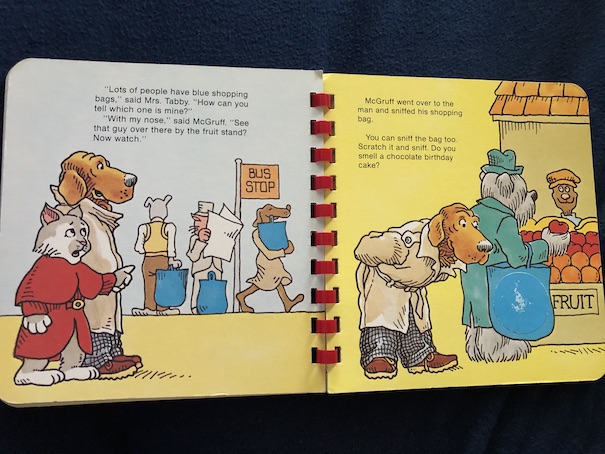
Sniffy books, or scratch-and-sniff books, were popular during my early childhood in the 1980s, and they are still being made today. Scratch-and-sniff books are picture books with special patches that release a scent when they’re scratched. Kids like interactive books, so it can be fun for them to scratch a flower or some food in a picture and then smell it. I know from my old books that these scented patches eventually wear out, although I’m amazed that some of them still have a scent more than 30 years after the books were originally made. I had expected that the ones that my brother and I liked and scratched the most would be the ones that would eventually wear out the fasted, but it also depends on the strength of the original scent. The milder, more subtle scents are often more difficult to smell decades later. Scratching a little harder can sometimes help. This picture book is a mystery story, and I thought that it was clever, using the sniffy patches as part of the mystery story.
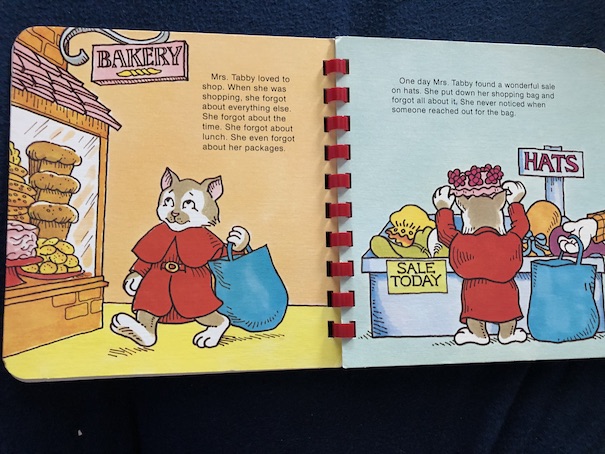
Mrs. Tabby loves shopping, but she often forgets to pay attention to her purchases while she’s looking at other things. One day, someone steals her shopping bag while she’s trying on hats at a sale. It’s terrible because the bag contained the chocolate cake for her son’s birthday.

Fortunately, Detective McGruff is nearby when Mrs. Tabby realizes that her bag is missing. Unfortunately, finding it isn’t going to be easy because many people are carrying blue shopping bags that look like hers. Mrs. Tabby isn’t sure what to do, but McGruff decides to use his nose to sniff out the correct bag.

McGruff approaches various shoppers and gives their bags a sniff. All of the bags look alike, but readers can scratch and sniff the special patches on each bag and try to guess what they contain before McGruff reveals the truth.

After sniffing several bags, McGruff eventually locates the one that smells like chocolate and finds the cake. But, curing Mrs. Taffy of being forgetful is another matter.

Detective McGruff, or McGruff the Crime Dog, was created in the early 1980s as a mascot for anti-crime messages from U.S. police and law enforcement agencies through the National Crime Prevention Council, including anti-drug messages and information related to the issue of child abduction. Sometimes, police use McGruff costumes when visiting schoolchildren to talk to them about crime.

Peter Rabbit's Sniffy Adventure

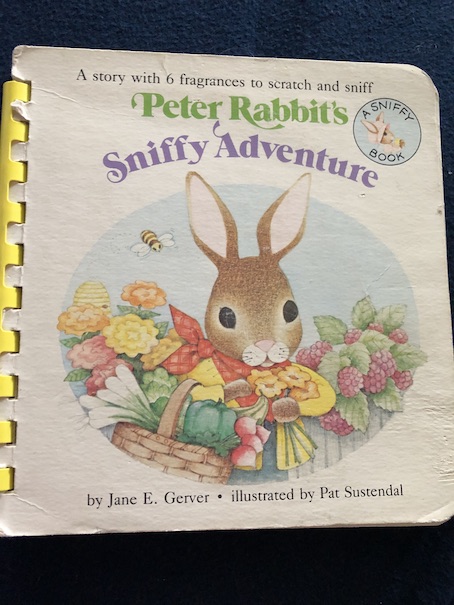
Peter Rabbit’s Sniffy Adventure by Jane E. Gerver, illustrated by Pat Sutendal, 1984.

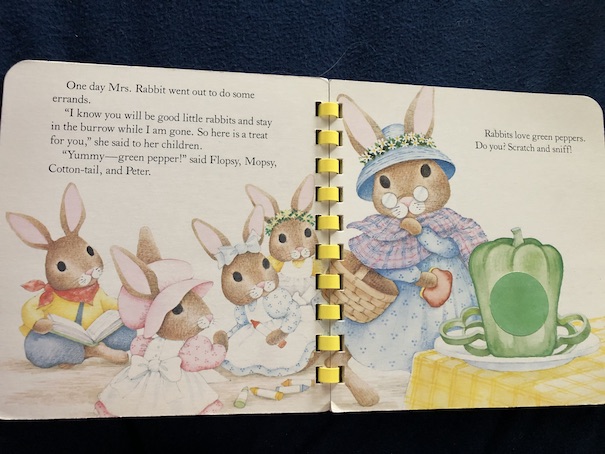
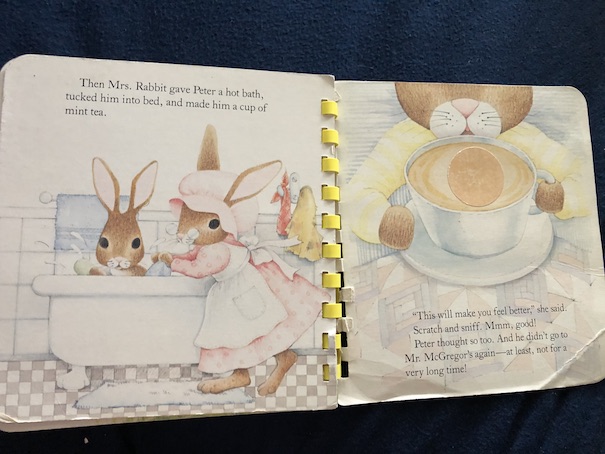
Sniffy books, or scratch-and-sniff books, were popular during my early childhood in the 1980s, and they are still being made today. Scratch-and-sniff books are picture books with special patches that release a scent when they’re scratched. Kids like interactive books, so it can be fun for them to scratch a flower or some food in a picture and then smell it. I know from my old books that these scented patches eventually wear out, although I’m amazed that some of them still have a scent more than 30 years after the books were originally made. I had expected that the ones that my brother and I liked and scratched the most would be the ones that would eventually wear out the fasted, but it also depends on the strength of the original scent. The milder, more subtle scents are often more difficult to smell decades later. Scratching a little harder can sometimes help. If you look carefully at the pictures of our old book, you can see where the round scent patches are on the illustrations.

This book is based on The Tale of Peter Rabbit by Beatrix Potter. It’s meant as a continuation of Peter Rabbit’s adventures.

Peter Rabbit lives with his mother and three sisters. One day, Mrs. Rabbit leaves her children alone while she goes to run some errands, giving them a green pepper to eat while she’s gone.

Then, Peter’s cousin, Benjamin comes by and asks Peter to come with him and visit Mr. McGregor’s garden. Peter is reluctant to go because of the trouble that he got into the last time, but Benjamin finally persuades him to come.

In Mr. McGregor’s garden, the bunnies eat raspberries, get into a sawdust pile, and stop to pick some flowers. Peter’s clothes become more dirty, stained, and torn through their adventures.

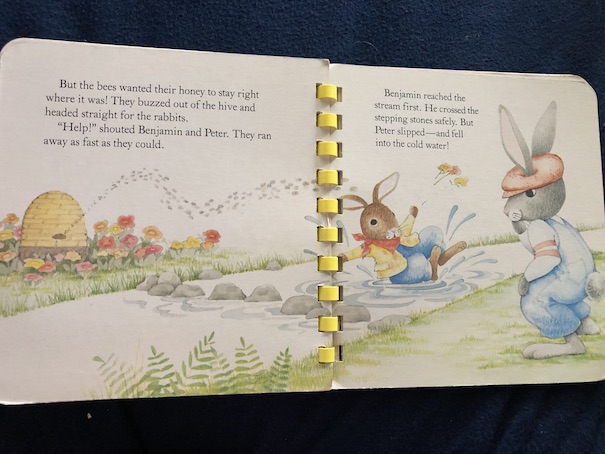
Then, Benjamin spots a beehive and suggests that they get some honeycomb to take home. They end up angering the bees, and Peter falls in a stream as they run away.

When he returns home, Peter is a mess, and he apologizes to his mother for going to Mr. McGregor’s, promising not to do it again. His mother gives him a bath and puts him to bed with a cup of mint tea.