Happy Birthday, Samantha

American Girls

Happy Birthday, Samantha by Valerie Tripp, 1987.

This is part of the Samantha, An American Girl series.

Samantha is turning ten years old! She is having a birthday party with some other girls, and Aunt Cornelia’s younger sisters, the twins Agnes and Agatha, are coming to visit. Samantha’s grandmother is very strict, with very precise ideas about the way that things should be done. The twins are accustomed to being raised more permissively. When Samantha complains that her grandmother makes her wear long underwear for most of the year, even when it’s really too hot to wear it. Her grandmother thinks that it will help ward off illness. The twins encourage Samantha to think for herself. Few people wear long underwear anymore or believe that they will get sick by not wearing it, the twins say, and if Samantha doesn’t want to wear it, she should be allowed to make up her own mind about it. Samantha agrees that ten years old should be old enough to decide about simple things, like what kind of underwear to wear.

The twins have a lot of interesting ideas about how to do things differently, and they encourage Samantha to be a little more daring and try new things. When the cook talks about Samantha’s birthday cake and how it will have ten candles on it, the twins suggest that she could make ten smaller cakes, called petite fours, and put one candle on each of them. Samantha thinks that sounds so elegant that she wants to try it, although the cook thinks that it sounds a little strange for birthday cakes. They’re also going to have ice cream at the party, homemade. Samantha and the twins help to make it, although they are annoyed by Eddie, the nosy and bossy boy from next door, who shows up and tries to tell them what to do, hoping for a taste of ice cream himself.

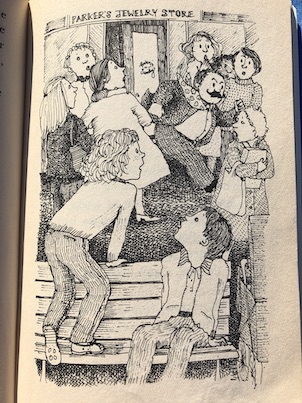
At first, girls the party act a bit self-conscious, trying to be polite and grown-up in their party clothes. After Samantha opens her presents, her Uncle Gard and Aunt Cornelia show up with a special surprise: a puppy named Jip. Jip is a little wild and doesn’t know how to obey commands. He runs off with Samantha’s new teddy bear (a recent invention in Samantha’s time), and the girls have to chase him and get him to drop the toy. Samantha distracts the dog by offering him her shoe, and Eddie, who was watching, picks up the bear. At first, he says that he’ll give it back if they give him some ice cream and let him play with the dog, but Samantha refuses because he was not invited to the party, and she doesn’t like him nosing in. Agatha wrestles the teddy bear away from Eddie before Samantha’s grandmother arrives and tells them that young ladies shouldn’t fight or make spectacles of themselves. Most of the rest of the party is elegant, and the girls are a little more relaxed, now that they look a little less elegant from chasing the dog. However, Eddie gets revenge on the girls by adding salt to the ice cream they made. Even though everything else is fine, including the petite fours, Samantha is still angry at Eddie for ruining the ice cream.

Since Samantha didn’t get to eat the ice cream at her birthday party, the twins and Aunt Cornelia suggest that Samantha return to New York City with them for a visit, and they can all go to a fancy ice cream parlor there. Grandmary agrees and says that she would like to go to New York City herself. On the way to Uncle Gard and Aunt Cornelia’s new house, Grandmary says to Samantha that she hopes that she thinks that the twins get too carried away with some of their ideas. She thinks that they’re too impulsive and don’t think before they act, and while they’ve been raised to be very modern children, she still thinks that some of the old ways are best.
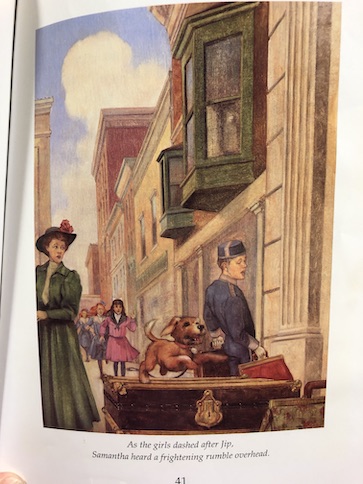
When Grandmary and Samantha see a protest held by women’s suffragists, Grandmary is annoyed at the women, making public spectacles of themselves and inconveniencing passing traffic. She thinks that it’s just another “newfangled notion” that’s a lot of fuss and bother over nothing. She’s never had to vote in her entire life, and she doesn’t see why any other woman would need to. Samantha can tell that this opinion bothers Aunt Cornelia and the twins when Grandmary says it in front of them, but they don’t seem to want to discuss it further.

The twins and Samantha ask to take Jip to the park, and Aunt Cornelia says that’s fine. She has a meeting to attend, but she wants them back home in time to go to the ice cream parlor after her meeting. However, Jip gets away from the girls when they try to put him in Samantha’s doll carriage, and they chase him to the place where the suffragists are meeting. Although Samantha knows that her grandmother doesn’t approve of the suffragists, they have to go after the dog. There, the twins tell Samantha that Cornelia is also a suffragist, and she is speaking at the meeting.

Jip charges right up to the stage where Cornelia is giving her speech, and Cornelia lectures the girls about not thinking about the consequences of their actions and not following her instructions for taking proper care of Jip. Sometimes, they are too impulsive and don’t think ahead. Cornelia explains to the girls about the need to follow agreed-upon rules for safety and how that is different from the changes that her group is advocating. While Grandmary has been saying that the suffragists are also too radical and impulsive and making a fuss about nothing, Cornelia says that much thought, planning, and hard work has gone into their movement to ensure that the changes they’re advocating will be for the better. Grandmary doesn’t appreciate how much thought and preparation the group has done and how long it has taken them to get this far because she hasn’t really thought about the issues at all herself and she has not been to any of previous meetings, where the planning has taken place.

Note: The women’s suffrage movement was already decades old by 1904, when this story takes place, so it’s not really as “newfangled” as Grandmary describes it. It had been building for a long time. However, Grandmary may not have been aware of that because she never needed to be aware. Consider what her life has been like. Remember that Grandmary is a wealthy lady and that marriage and social connections have been the basis of her life. Her husband was wealthy, and she was likely born into a wealthy family. Her life has always been comfortable without her needing to have a job or vote or do anything other than be a wife and mother. Growing up, becoming a well-behaved young lady, and getting married set her for life, and up to this point, she hasn’t had any major problems with money or her lifestyle and hasn’t really needed to think much further than that. She’s used to letting the men in her life handle business and politics and provide her with money, and she now lives on the money that her husband left to her, which is more than ample. Mostly, what Grandmary has needed to manage in her life are the social graces necessary for entertaining her husband’s business associates and their wives and for helping to facilitate her children’s marriages and careers. Grandmary’s daughter was also married to a well-off man before their early deaths. Her son is also a wealthy man, who can provide for his wife, and Cornelia is also from a wealthy family in New York City, a natural extension of their social circle. Grandmary assumes that Samantha, raised in this wealthy social atmosphere, will also naturally meet and marry a wealthy man through the connections of her friends and family, one who will support her and their children in a comfortable fashion. She thinks that, besides caring for her future children, Samantha will likely occupy her time with good works for the less fortunate and that she will give elegant parties for the fashionably-dressed ladies of their social level to solidify their social connections. The elegant affair that her tenth birthday was supposed to be was also practice for her future, as Grandmary envisions it. Grandmary thinks that life will continue to follow this same general course in their family and that there will never be a need for anything different because her own life has been fairly smooth, comfortable, and predictable, largely unshaken, even by the deaths of her husband and Samantha’s parents. But, she’s about to change her mind.

The girls are a little disheveled when they go to meet Grandmary at the ice cream parlor because there is no time to go home and change. As they explain to Grandmary about why the girls look a little disheveled, she tells them that she already knows because she was there, watching the speech. When she saw that Cornelia was the one speaking, she decided to stop and listen, and she was impressed by what she heard. She liked the part where Cornelia talked about the importance of standing up for what is right, and that’s something that Grandmary believes in, too. She is now more open to the suffrage movement than she was before.

The story is partly about growing up and how Samantha realizes that she needs to learn to make her own decisions. She can’t always go by what her grandmother tells her, and sometimes, listening to the twins isn’t always the wisest choice, either. Samantha also begins to see that she has choices to make about the kind of young lady that she will grow up to be. She can be the elegant lady at the party or the public crusader for the causes she believes in or maybe something that combines aspects of both. In the end, Grandmary also begins to see the possibilities of change.

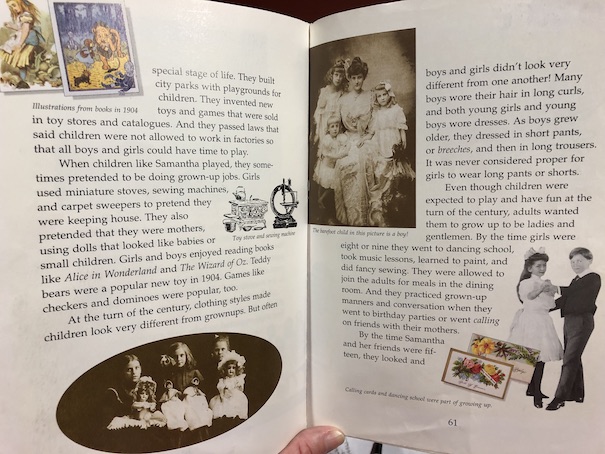
In the back of the book, there is a section about babies and children during the early 1900s. It discusses what children liked to do for fun and how adults would begin training children to be young adults early in life, emphasizing social skills, like dancing, how to behave at the dinner table, and how to engage in polite adult conversation. A girl from a wealthy family, like Samantha, might go to a finishing school instead of college after completing her basic education. At finishing school, she would learn how to manage a household, including how to manage servants (how to hire them, how to tell if they were doing a good job, etc.) and how to throw elegant dinner parties. She might have a coming out or debutante party to introduce her to society as an adult, which meant that she would be ready for introductions and dates with young gentlemen and would probably soon be considering marriage. (This is likely the path that Samantha’s grandmother took in life and the one that she is considering for Samantha.) However, some young ladies did go to college, had careers, or become suffragists, and some did some combination of the above. Samantha’s life is full of possibilities, and her future hasn’t been decided yet. Because Samantha was ten years old in 1904, she would have been eighteen in 1912. For an example of what college life would have been like for an eighteen-year-old girl at a college in the eastern United States in 1912, see the novel Daddy-Long-Legs.
The book is currently available to borrow for free online through Internet Archive.

Knots on a Counting Rope

Knots on a Counting Rope by Bill Martin, Jr. and John Archambault, 1966, 1987.

The reason for the two copyright dates is that this book originally had somewhat different text and different illustrations.  I don’t have a copy of the original version, so I’m not sure how it compares to the 1987 version.

The story is told in the form of dialog between a young Navajo boy and his grandfather.  The story doesn’t explicitly say that they are Navajo, but they refer to hogans, which are a traditional type of Navajo house.  There are no words in the story other than what the characters say to each other, not even to indicate who is speaking, but you can tell who is speaking based on what they say.

The boy asks his grandfather to tell him the story of when he was born. The grandfather says that he already knows the story, but the boy persuades him to tell the story again.

The grandfather tells him that, on the night he was born, there was a storm, and it sounded like the wind was crying the word “boy.”  The boy’s mother knew that she was going to give birth to a son.  The grandfather quickly brought the boy’s grandmother to be there for the birth, and when the boy gave his first cry, the storm suddenly stopped.

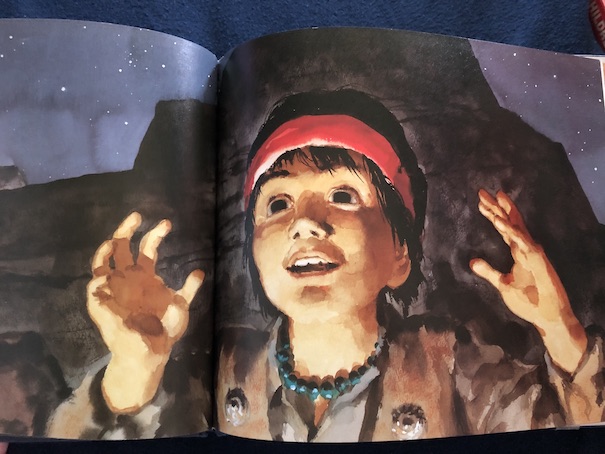
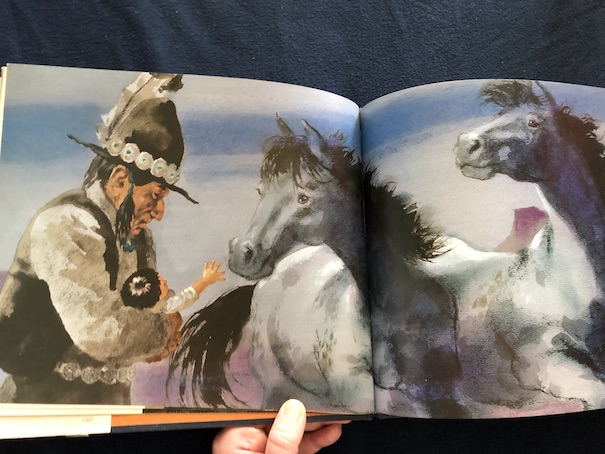
When the boy was born, he was very frail, and everyone was afraid that he would die.  Then, when morning came, the grandfather carried him outside, and although he did not open his eyes to the morning sun, he lived his arms up to two horses that had galloped by and stopped to look at him.  The grandfather took it as a sign that the boy was a brother to the horses and would live because he had the horses’ strength.  The boy did become stronger and was given the name of Boy-Strength-of-Blue-Horses.

However, the boy was born blind. It is a hardship that he will always have to deal with.  Even though the word “blue” in his name, the boy says that he doesn’t really know what “blue” is or what it’s like because he’s never seen it.  The grandfather describes it as being like morning because the sky in the morning is blue, and the boy says that he understands what mornings are like because they feel and sound different from night to him.

The boy has a horse of his own, and the two of them have a special bond.  The two of them perform well at races, and the horse acts as the boy’s eyes when he’s riding.  His grandfather says that it’s like the two of them are one.

As the grandfather tells the boy stories about himself, he ties knots on the counting rope.  He says that when the rope is full of knots, the boy will have heard the stories enough that he will be able to tell them himself.  The grandfather says that he will not always be there to tell the stories, and the boy is frightened, wondering what he will do without his grandfather. The grandfather says that he will be all right because his love will be with him.

The book is partly about the relationship between the boy and his grandfather and the grandfather preparing his grandson for the day when he will be gone, making sure that he knows the family stories about himself and the knowledge that he will need for the future. It’s also about the boy’s own struggles in life, which the grandfather refers to as the “dark mountains” that he must cross. Because of the boy’s blindness, he lives in a world of darkness, and there are things that are challenging to him that would be less challenging to a person with normal vision. Yet, the boy has innate skills which allow him to do things that some people with normal vision can’t do. Not everyone has the affinity for horses that the boy has. He shares a special bond with horses, and when he rides, he and his horse are a team. Because he has skills and a strong spirit, the grandfather knows that his grandson will be all right in his future, in spite of the challenges of his blindness.

The book was featured on Reading Rainbow, and it is currently available online through Internet Archive.

What Eric Knew

What Eric Knew by James Howe, 1985.

After his friend, Eric, moves away, thirteen-year-old Sebastian Barth receives strange messages from him, hinting at a mystery in the small college town of Pembroke. Eric always used to rope his friends into investigating things and having adventures, but before his family moved away, he started acting strangely and suffered an accident falling downstairs and breaking his leg.

Sebastian shares the notes with his best friend, David, and with Corrie, the new minister’s daughter. Corrie’s family has moved into the house where Eric used to live, near the church and graveyard. Eric’s notes seem to refer to a local legend about the ghost of a prominent woman, Susan Iris Siddons, who used to live in their town and supposedly searches for her lost wedding ring. Corrie thinks she sees this ghost in the graveyard. There is also something mysterious going on in the church, where the Siddons family still maintains a tradition of ringing the bell regularly at 9 o’clock in homage to their ancestors, Susan and her husband, Cornelius.

The dark secrets of the past mix with the troubles still surrounding the Siddons family. Can Sebastian and his friends solve the clues and learn what their friend Eric knew?

The book used to be available to borrow online through Internet Archive, but when I checked recently, it was no longer there.

My Reaction

The story leaves some things unresolved. The kids are never entirely sure how much Eric discovered before he moved, but they do learn that he recruited a couple of friends to help create the appearance of the ghost, possibly to draw attention to the real problem in modern times, which has nothing to do with the supernatural, although there is another troubling secret about the past that the kids uncover, too.

Both sets of problems do center around the prominent Siddons family and the pressures that the current family members, especially the younger generation, suffer as they try to keep up appearances and live up to images of their supposedly perfect relatives. The past secret explains one of the reasons why the Siddons family isn’t as perfect as they had always pretended to be and helps to put the “ghost” of Susan Siddons to rest. This is not a mystery story for very young children because of the dark and serious nature of the problems with the Siddons family. I would say the book would be best for ages 10 and up. The only question at the end is how much of these things Eric really knew.

Once Upon a Dark November

Once Upon a Dark November by Carol Beach York, 1989.

Katie Allen likes her part-time job helping Mrs. Herron with her housework. One of the best parts of the job is that she gets to see Mr. Herron, her English teacher, at home. Katie has a crush on Mr. Herron, although no one but her best friend knows it.

One day, while she’s at the Herrons’ house, Mrs. Herron tells her that her cousin Martin is coming for a visit. She says that Martin hasn’t been in Granville in years, although he used to live with their aunt when he was young. Their aunt is Miss Gorley, the creepy lady who lives across the street from Katie’s house. When Martin arrives, he turns out to be pretty creepy himself. He never says very much to anyone and spends a lot of his time just staring out the window. Mrs. Herron is not happy to have him there and wishes that he would leave.

One day, Martin disappears, and the next day, Miss Gorley is found murdered in her house. Did Martin return to Granville just to murder his aunt? Where is he now, and who is that mysterious person who tried to attack Katie at her house, dressed in a Frankenstein costume? Did Katie see something that she wasn’t meant to see?  Katie doesn’t remember seeing anything important, but now she has to figure out what it was before it’s too late!

This book is not for young children.  It would be best for kids in middle school (about 12 and up).  There is murder and attempted murder, including the attempted murder of Katie, who is a child, because the murderer of Miss Gorley thinks that she knows too much.  There is also some discussion of child abuse, which was part of the motive behind Miss Gorley’s murder.  Katie did see some things that are important to the case, but their full importance doesn’t occur to her until the attempt on her own life.  People are not quite who they seem to be, and some of Katie’s initial impressions were closer to the truth than someone wants her to know.

The book is currently available to borrow for free online through Internet Archive.

In a Dark, Dark Room

In a Dark, Dark Room and Other Scary Stories retold by Alvin Schwartz, 1984.

This is a collection of classic scary stories based on folktales from around the world.  A special section in the back of the book explains more about where the stories came from.

This book was a favorite scary book of mine when I was a kid, and the stories are the type that kids commonly like to tell at camp or at sleepovers to spook each other.  Stories like these stay with you for years!

Sometimes, you can find individual stories from this book read aloud on YouTube. The book is currently available online through Internet Archive.

Stories in the Book:

The Teeth – A boy meets a series of strange people with increasingly long teeth.  Based on a story from Suriname. (Here is a video of someone reading this story as an example.)

In the Graveyard – A woman sees bodies carried into a graveyard. Based on the song “Old Woman All Skin and Bone.”

The Green Ribbon – A girl wears a green ribbon around her neck for her entire life, refusing to explain to even her husband why she wears it, until she is old and about to die.  Based on a European folk tale.  Originally, it was a red thread.

In a Dark, Dark Room – Classic slumber party story!  “In a dark, dark wood, there was a dark, dark house.”  What will it all lead to?  It is known in Europe and America.

The Night It Rained – A man gives a boy a ride home on a rainy night.  When he returns the next day to pick up the sweater he loaned the boy, he gets an eerie surprise.  Based on a class of ghost story known as “The Ghostly Hitchhiker,” which has many variants.

The Pirate – When Ruth visits her cousin’s house, her cousin tells her that her room is haunted by the ghost of a pirate.  Based on a British folktale.

The Ghost of John – A short poem. The author of this book first heard this from a young girl in California in 1979.

Who Knew There’d Be Ghosts?

Who Knew There’d Be Ghosts? By Bill Britain, 1985.

Tommy Donahue and his friends, Wendy “Books” Scofield (the smartest kid in their class as well as being pretty tough) and Harry “the Blimp” Troy (known for being the tallest and biggest kid in their class), prefer playing around the abandoned Parnell house instead of at the park because they like to play games of pretend, based on adventure stories that Tommy has read.  It’s hard to play games of pretend in such a public place as the park because other people either laugh or think that they’re just getting in the way.  Almost nobody goes near the old Parnell house because people think that it’s haunted.  They’re right; it is haunted.

Some people in their town have been trying to arrange for the Parnell house to be turned into a museum because the Parnells were the founding family of their town, but the movement hasn’t been able to raise the money needed to renovate the place.  Now, Tommy’s father, a lawyer, has been recruited to arrange for the house to be purchased by a private citizen who says that he wants to renovate the house and use it as his own residence.  However, Tommy and his friends overhear the buyer, Avery Katkus, and a confederate talking as they look over the house.  Mr. Katkus isn’t interested in the house at all; he wants something valuable that is hidden inside.  When they hear the two men plotting to sneak into the house at night to do some searching for this mysterious something, the kids decide that they will come back at night and watch for them to find out what they’re looking for.  The kids don’t want anything bad to happen to the house because they’ll lose their private playground.

Tommy is the first to go and check out the Parnell house at night, and that’s when he meets the ghosts, Horace and Essie Parnell.  At first, Horace tries to scare Tommy away, but when Tommy explains that he only came to keep watch, Horace asks him what he means by that.  Tommy explains to him about Mr. Katkus, and Horace says that he could use Tommy’s help.  Years ago, Horace’s father made a dying wish that all members of their family should be buried in the family cemetery on the property of the house.  Most of the members of the family are buried there, but Horace, who was killed during the Revolutionary War, and Essie, who accidentally fell overboard from a riverboat and was permanently lost in the Mississippi River, were only two Parnells who were not buried on the property, so their spirits are now bound to the house.  Naturally, Horace and Essie are concerned with the future of the house.

Tommy tries to tell his friends about the ghosts, but they don’t believe him until they see the ghosts for themselves.  When the three kids return to the house the next night, Horace saves them from being attacked by Mr. Katkus’s hired confederate.  Now convinced of the ghosts’ existence, Harry and Books are eager to help save the house, and the key in doing so is discovering what kind of hidden treasure the house holds.

The book is available to borrow for free online through Internet Archive.
Who Stole the Wizard of Oz?

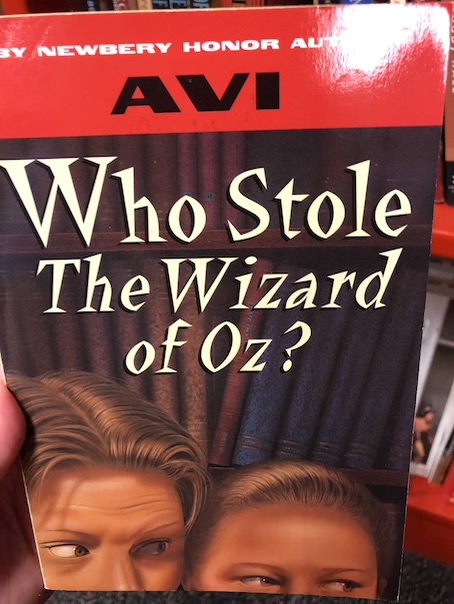
One summer, Toby and his twin sister Becky see the police go to their local library. To the children’s surprise, Mrs. Brattle, the librarian, phones their house and asks Becky to come down to the library and bring one of her parents.  The children’s parents aren’t home, so Becky and Toby go.  Mrs. Brattle doesn’t seem to want to say much over the phone, only that The Wizard of Oz was stolen, and they need to talk to Becky.

As Becky and Toby walk down to the library from their house, which isn’t far, Becky says that shortly before school let out for the summer, Becky’s teacher for sixth grade next fall handed out a summer reading assignment.  The kids have to write two book reports over the summer, and the books can’t be mysteries, fantasies, or romantic adventures.  Miss McPhearson, the sixth grade teacher, believes in only factual books.  However, Becky decided that the best thing to do was to get the book reports over as soon as possible, so she went to the library.  (Toby wasn’t involved because he has a different teacher.)  While she was there, she decided that she’d check out The Wizard of Oz for Toby, knowing that he likes fantasy books, but she was told that it was already checked out.  Mrs. Brattle told her that there would be a book sale at the library tomorrow and that she had a copy of The Wizard of Oz that Becky could buy for five cents, but since the librarian wouldn’t sell her the book that day and Becky didn’t want to make a special trip to the library the next day, she turned down the offer.

When they come to the library, the policeman accuses Becky of stealing the copy of The Wizard of Oz that the librarian showed her as well as some other children’s books.  According to the librarian, the books were actually valuable collector’s copies, worth thousands of dollars.  Becky asks the librarian why she offered to sell her one for nickel if they were so valuable and Mrs. Brattle says that it was a mistake.  The policeman says that if Becky has the books, she can return them now, and there will be no problem, but Becky is insulted and insists that she didn’t take them.  In the face of Becky’s denial, the policeman says that there isn’t much that he can do because there is only the librarian’s word that the books were valuable, and she doesn’t deny that she earlier tried to sell them for five cents each.  Missing children’s books worth less than a dollar isn’t exactly a police problem.  (I’d like to say here that I was very glad that the policeman took that attitude. I hate those children’s books where adults not only falsely accuse children of doing things that they didn’t do but also make petty incidents seem like major crimes. The policeman is correct that there is no proof that the books were as valuable as the librarian says and that this evaluation of their worth comes only after their sudden disappearance and after she was offering to sell them very cheaply.)

Even though the matter seems to be dropped for the moment, it bothers Becky that the librarian still thinks that she might have taken the books.  She suggests to Toby that they could investigate and try to find out what really happened to the books.  The first thing that they decide to do is to look for the original owner of the books.  After inspecting other children’s books at the sale and looking at the names in the front covers, they decide that Gertrude Tobias is the most likely former owner because many of the other books at the sale belonged to her.  Unfortunately, Gertrude Tobias died a few months ago.  However, it turns out that her niece is Miss McPhearson.  Becky hurriedly finishes her book reports so that she and her brother will have an excuse to visit Miss McPhearson and ask her about the books.

When they ask Miss McPhearson about her aunt, she calls her aunt a “foolish woman” who “didn’t know any better.”  However, she refuses to explain any further what she means, and the children see her crying before they leave.

When the children speak to Mrs. Chesterton, they get a very different picture of Miss McPhearson’s aunt.  When Gertrude Tobias was a young woman, she was wealthy. She could have gotten married if she wanted to, but most of the young men didn’t like women who seemed too smart, and Miss Tobias prided herself on her intelligence and cleverness.  She resented the idea that adults seemed to want women to play dumb to get a husband, so she refused to get married and spent most of her time in the company of children.  Mrs. Chesterton remembers her saying, “Children like me smart. Grown-ups want me stupid.”  She liked to read children’s books, and she often volunteered to read books to children at the library.  The children liked her and often confided in her, just like she was their aunt.  She spent a lot of her money buying children’s books for her collection.  Mrs. Chesterton says that Miss Tobias and her niece never really got along well and that Miss McPhearson used to tease her aunt about her love of children’s books.  However, Miss Tobias was rich, and Miss McPhearson didn’t have much money at all.  Miss Tobias told her that she would leave her all of her “treasure.”  When she died, it turned out that she had left her niece five children’s books – the five that are now missing.  The others were willed to the library.

At first, the picture seems like it’s becoming more clear: Miss Tobias had one last joke on her niece by giving her valuable children’s books that Miss McPhearson thought were worthless simply because they were children’s books, and the person who took them recognized what they were worth as collectors’ items.  However, the situation is actually more complicated than that.  A series of strange break-ins have been occurring around town. Nothing else has been taken, but someone is clearly searching for something.  Miss Tobias was clever, and her books have an even deeper meaning than most people have realized.  To learn Miss Tobias’ secret, Toby and Becky have to learn the secrets of the books themselves.

The book is currently available online through Internet Archive.

I really loved the puzzle in this book! There were parts that I got before the kids did and parts that they realized before I did. It isn’t a kind of puzzle that readers call fully solve before the characters in the book because it requires knowledge of their home town to get the full answer.

As an unmarried, childless adult who also enjoys children’s books, I could kind of sympathize with Miss Tobias. Children’s books, like some adults, are often very clever but go unappreciated by people who underrate them for what they appear to be. For example, Through the Looking Glass, which was one of the books featured in the story, involves a game of chess. The author, Lewis Carroll (real name Charles Dodgson), was a mathematician. His books are full of word games and logic puzzles, and the chess game described in Through the Looking Glass is an actual chess game that can be played with real pieces on a real board with a definite ending square, where Alice the pawn becomes Alice the queen (one of the clues to solving the final mystery in this book). To many adults who only know the basic story of Alice, it might just seem like a silly, nonsense children’s story, but they miss the real, clever puzzles planted in the story, just like Miss McPhearson did with her aunt’s legacy.

In the end of the story, Miss McPhearson never learns the truth about her aunt’s legacy, just as her aunt knew she would miss it. Toby and Becky come to an understanding with the real thief about Miss Tobias’ treasure that allows the library to benefit from the legacy, which is something that Miss Tobias would have appreciated. Miss McPhearson decides to give up teaching and leaves town to find another job, working with computers, a very “adult” field indeed. It’s only a pity that she wasn’t mature enough to behave nicely with her aunt and not tease her, so that her aunt would be more generous with her. People who play childish games are sometimes surprised when they meet a better game player.

Like Miss Tobias, I have little patience for people who try too hard to be “adult” or are too concerned with whether certain things are right for adults to do, especially when they show their immature sides in other ways. In the story, Miss McPhearson makes a point of being “adult” in all situations, but she wasn’t above childishly taunting an older woman about her hobbies, still expecting that woman to leave her all of her money. It reminds me of the kids I knew in elementary school who liked to act really grown up at age ten. Kids go through a phase where they start talking about doing grown-up things like having first boyfriends and girlfriends and wearing makeup and watching adult tv shows and listening to adult music, but in between doing all of that, they still act like childish brats because what they’re doing is trying on the trappings of adulthood without the real substance. Until they get some real maturity and better behavior, they’re just kids playing dress-up. Sometimes, I think that some people never quite leave that phase, which is how I view the character of Miss McPhearson.

I think of this every time I hear some adult my age or older talking about how real adults drink alcohol or real women wear high heels and lipstick. To hear them talk, there are quite a lot of rules to being grown up that very few people I know actually follow. Alcohol is expensive, plenty of people abstain for health or religious reasons, and driving drunk certainly isn’t mature behavior. High heels damage your feet the more you wear them. I’ve forgotten how much makeup I’ve thrown away because, most days, I’m just too busy to even think about putting it on, and they eventually dry out and get gross. It would be a waste of money for me to buy more, knowing I’ll never use it all. To my way of thinking, if you really are an adult and you know who and what you are, you have nothing to prove. If you aren’t mature as a person, things like high heels and lipstick aren’t going to help you, and alcohol just lowers your inhibitions and makes the immaturity more obvious. Maturity is a way of looking at things, assessing situations, and acting accordingly. It can be difficult to define, but you know it when you see someone living it, not just looking the part. Real adults don’t need to “act” like adults at all times because they aren’t “acting”; they’re just being themselves, confident that they are mature enough to handle what life throws at them along the way.

Cam Jansen and the Mystery at the Haunted House

Cam Jansen

#13 Cam Jansen and the Mystery at the Haunted House by David Adler, 1986, 1992.

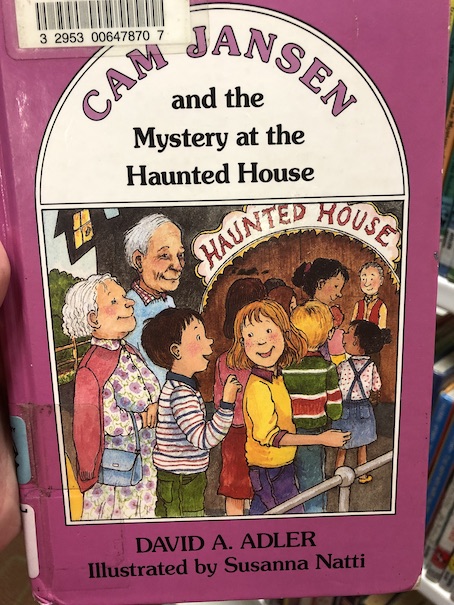
Cam’s Aunt Katie and Uncle George take Cam and her friend Eric to an amusement park.  When they stop to buy food at the refreshment stand, Aunt Katie realizes that her wallet is missing.  She isn’t even sure exactly when it disappeared.  Cam thinks that someone stole her aunt’s wallet.  Who could have taken it?

Cam thinks at first that it might have been a couple of boys on roller skates who ran into her aunt earlier, but it wasn’t them.  Cam notices that another woman is complaining about a lost wallet and realizes that she had gone through the haunted house just before they did.  Someone in the haunted house is taking people’s wallets!

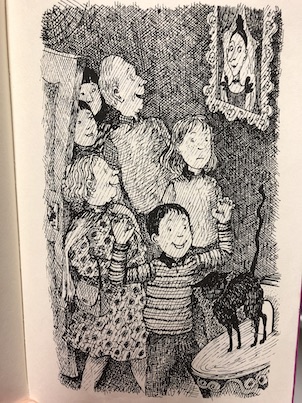
When they all go through the haunted house a second time, Cam figures out that a man dressed in black has been stealing people’s wallets.  When they went through the haunted house the first time, he jumped out at them, and they thought that he was just a part of the attraction meant to scare them.  She spots the man leaving the haunted house and tells the park’s security guards.  Everyone gets their wallets back, and the park’s owner gives Cam four free passes to the park for a month.

The book is currently available online through Internet Archive.

Cam Jansen and the Mystery of the Stolen Diamonds

Cam Jansen

#1 Cam Jansen and the Mystery of the Stolen Diamonds by David A. Adler, 1980.

This book is the first in the Cam Jansen series, introducing readers to her amazing photographic memory. Cam’s real name is Jennifer, but when people discovered her photographic memory, they started calling her “The Camera,” which was later shortened to Cam. When Cam wants to remember something, she says “click,” which she says is the sound that her mental camera makes.

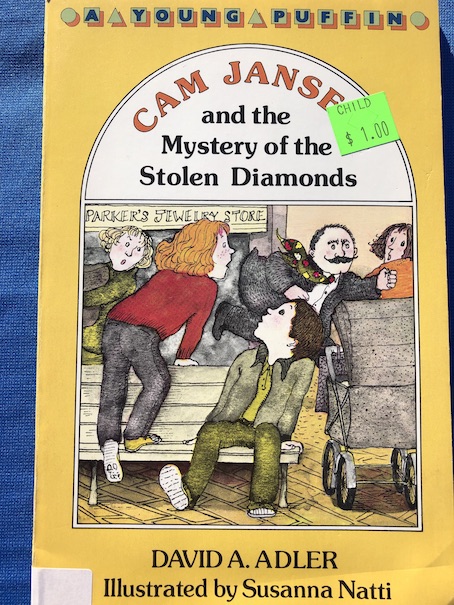
While Cam is at the mall with her friend, Eric, and his baby brother, Howie, a jewelry store is robbed.  The thief got away with some diamonds.  Although the police caught the man who ran away from the scene of the crime, the people who witnessed the crime say that he was not the thief.  As Cam goes over the pictures in her mind, she realizes that something strange is going on.

Partly, Eric and Howie give Cam the clue that she needs to solve the mystery. Cam is an only child, but as she watches Eric taking care of Howie, she realizes how much stuff a baby needs. Howie has an entire diaper bag full of supplies. However, a couple who left the jewelry store earlier appeared to have only a baby in a blanket and a rattle. Cam realizes that a couple with a real baby should have been carrying more than that.

The man and woman with the “baby” were the running man’s accomplices. It was that man who actually committed the crime.  The other man who ran was a distraction.  The couple carried a doll and pretended it was their baby.  They hid the diamonds in the baby’s rattle.  Cam realizes that they were strange because they didn’t have a diaper bag or anything else with them that parents would normally carry around for their baby, like the bag that Eric’s mother has for Howie. 

Cam and Eric follow the thieves to their hideout and then get the police, although there is a tense scene where Cam is caught by the thieves, and she must hide with Howie until the police arrive.

The book is currently available to borrow online for free through Internet Archive.

Norma Jean, Jumping Bean

NormaJeanJumpingBean

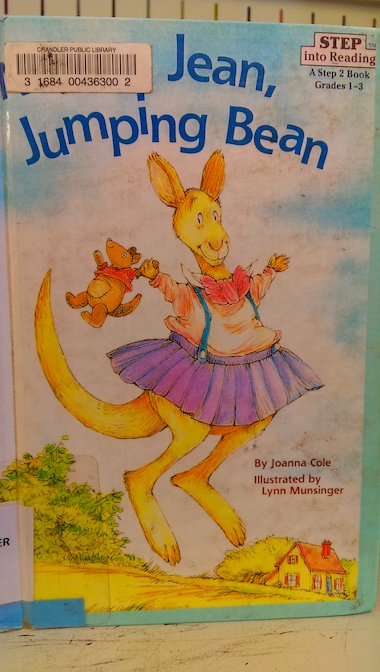
Norma Jean, Jumping Bean by Joanna Cole, 1987.

Norma Jean, a kangaroo, loves to jump!  She goes hopping and jumping everywhere, all the time.

NormaJeanJumpSchool

It’s pretty normal for a young kangaroo, but it sometimes causes problems.  She keeps wanting to jump when her teacher wants her to sit still and and listen.  Sometimes, accidents happen because she’s jumping around.

NormaJeanLunch

Without meaning to, she sometimes plays too rough with her friends because she has so much energy.  One day, when her friends stop wanting to play with her after a series of disasters, Norma Jean decides that the only thing to do is to give up jumping.  It makes her sad, but she doesn’t want to be thought of as a rough, clumsy klutz, who can’t sit still – a jumping bean.

NormaJeanSad

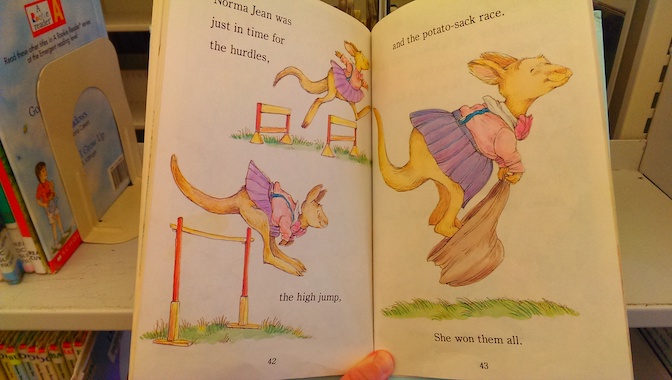
But, with the school’s field day coming up, Norma Jean realizes that jumping is okay, at certain times and certain places.

NormaJeanFieldDay