Sixteen and Away from Home

Sixteen and Away from Home by Arleta Richardson, 1985.

The year is 1889. Mabel O’Dell turns 16 years old at the beginning of the book, and her mother gives her a journal as a present. Soon, she and her best friend, Sarah Jane Clark, will be starting the final years of their education at the academy in town. Mabel worries about going to the academy, first whether they’ll pass the entrance exams, and then whether they’ll be homesick because they will have to board in town. Sarah Jane assures her that it will be okay because they’ll be going together, and they’ll probably be too busy at school to think about homesickness much. Mabel’s mother is a little worried about the foolishness that young women can get into when they’re on their own. However, the girls do pass their exams and are admitted to the academy, and their parents agree to let them go.

In town, the girls will be staying with Sarah Jane’s Aunt Rhoda. Aunt Rhoda’s housekeeper, Lettie, seems to resent the girls being there for reasons they don’t understand. When school begins, the girls are shocked to learn that they’ll have to wear bloomers for “physical culture” classes. The teacher gives them a sewing pattern so they can make the uniform themselves. The girls imagine that their parents would be shocked to see them running around without skirts on. Fortunately, Mabel and Sarah Jane will have all the same classes, along with all of the other first year students. They have to take Grammar and Rhetoric, Biology, Latin, History, Calculus, and Physical Culture (physical education or PE).

They also quickly realize that the class troublemaker is going to be Clarice Owens, who unfortunately sits near Mabel because they all sit in alphabetical order by last name. Clarice deliberately picks on Mabel and Sarah Jane for coming from the countryside, calling them “hayseeds.” Mabel is disgusted because she can never think of a good comeback until after Clarice walks away. (Yeah, I’ve been there before.) Sarah Jane thinks she’s jealous of Mabel for being prettier. Mabel doesn’t really believe that, but she appreciates the thought. Molly, one of the other town girls, is friendlier. She says that she knows Clarice has always thought she was better than everyone, but she’s not usually this deliberately mean. Mabel says that maybe it would help if they knew the reason.

Through the rest of the school year, Clarice tries one scheme after another to cause trouble for the girls, especially Mabel. Mabel tries to be as patient as she can with Clarice, trying to let her know that she’d rather be a friend than an enemy, but Clarice gets angry and upset when Mabel tells her that she forgives her for all the awful stuff she does. Mabel thinks that there’s something hurting Clarice and affecting her behavior, although Molly tells her that she shouldn’t waste her sympathy on Clarice because “she gets what she wants.” Molly thinks that they should just be grateful for those times when Clarice isn’t immediately stepping on them to get what she wants because that happens, too.

When Mabel is injured in a sledding accident and has to stay in bed for awhile, she worries about falling behind in her classes. Lettie talks to her and brings into question the reason why she’s so concerned about her standing in class. Is it really because she loves learning, or is it because she’s trying to compete with the other students? Mabel starts to consider how too much competitiveness can spoil a person’s attitude and take the enjoyment out of things. Competition has much to do with Clarice and her attitude.

Things get worse when Clarice’s grandmother becomes ill and her parents arrange for her to stay in the house with Mabel and Sarah Jane while they go to see her grandmother. Clarice is rude to the servants in Aunt Rhoda’s house and sneaks out of the house during the night. Lettie tells the girls that Clarice’s mother was strong-willed as a girl, and she’s given a lot of her attitude to Clarice. There was a boy that Clarice’s mother had always wanted for herself, but he married someone else. Although Clarice’s mother also married and had a child, she never completely got over losing her first choice to someone else. Since the man she originally loved has a son the age of her daughter, Russell Bradley, she might be hoping that Clarice will marry him. Clarice certainly is interested is Russ … who is apparently more interested in Mabel.

Mabel considers that allowing Clarice to be with Russ and not trying to compete with her would help settle things between them, but as Sarah Jane says, Russ’s feelings on the issue matter. To get the most out of her education, Mabel needs to focus on her love of learning instead of comparing herself to her classmates, and to get the most out of their relationships with other people, all of the girls need to focus on caring about other people and their feelings.

The book is part of the Grandma’s Attic series. It is available to borrow and fread for free online through Internet Archive.

My Reaction

The problem with Clarice and her mother and their attitudes and expectations is that they do not take anyone else’s feelings into account other than their own and don’t even inform people of what they really want, yet they expect everyone else to somehow accommodate their wishes and feel toward them exactly how they want them to feel. These are not reasonable expectations at all. For most of the book, Mabel is completely unaware that Clarice’s meanness comes from the fact that she sees her as competition, and even then, it’s not really clear at first what Clarice is trying to compete for. Mabel didn’t ask or agree to be Clarice’s competitor in anything, and she’s not even trying to be. In fact, she’s been trying everything that she can to avoid it. Russ also apparently has no idea what Clarice is really after because he doesn’t have the same feelings about Clarice that she has about him. He’s just trying to live his life and focus on his own feelings and interests, and as far as he’s concerned, Clarice doesn’t really enter into it. Russ has no obligations to Clarice and her mother, and even Mabel doesn’t have the right to tell him how to feel or what to do to get rid of Clarice’s ire.

When Clarice pulls one last trick on Mabel, and she still forgives her, Clarice finally tells her that she gives up because, “You can’t go on disliking someone who refuses to be disliked.” I have to admit that I found the end to be a bit unbelievable. I’ve never encountered anybody who was that much of a pain and who ever let someone else’s kind behavior stand in the way being a pain. The response that I’ve usually seen is that they congratulate themselves on finding someone who’s never going to fight back and use that opportunity to run roughshod over them. They usually blame the kind person for making it easy to take advantage of them. As even the book says, people cannot decide how anyone else should feel or force them to feel anything in particular. It just doesn’t work. Mabel cannot “refuse to be disliked” because what Clarice likes or dislikes is all in her own mind. All that Mabel can decide is how she feels and what she’s going to do about it.

What Mabel really does decide is that, whether she likes or dislikes Clarice, she’s not going to compete with her and try to fight or match her meanness. It isn’t so much a matter of likes and dislikes in the end as Clarice discovering that she’s running a race with no other runners. If there’s no one to race against, there isn’t really a race at all, and no one cares if you walk off with the trophy or not. Maybe there was never even a trophy there to begin with.

If I’ve said it once, I’ve said it a million times, I don’t like bullying or one-upmanship, and I have no interest in sympathizing with anyone who does those things. Part of the trouble I have with overly-competitive personality traits is the same trouble that actors sometimes suffer when they’re out in public: they don’t always know when to stop acting, stop posing, or stop performing. Overly-competitive people don’t know went to stop competing. Where does the one-upmanship end and the human person actually begin? Or is that their personality all by itself? Do they have any interests outside of being competitive, or are they only about competition just for the sake of competition? Do they wan to be good at something for a purpose or because they just love it, like the love of learning, or is everything they do just about trying to look better than someone? I was reading this article recently, about how trying to keep up an image all the time too often leads to a person having no real substance or sense of self.

By herself, Clarice doesn’t present much to connect with or sympathize with. Clarice doesn’t really seem like a real person to me. She’s rather a one-dimensional character. This is a problem with a lot of bullies in children’s books. She apparently has very generic family issues that are supposed to explain her behavior with little insight into how she really feels about anything. At least, that was how she seemed to me. The explanation behind these family issues comes from a youthful romantic trauma of her mother’s, but what does that really mean to Clarice herself? She seems to have some kind of fear of being second-best, possibly because her mother has pushed her in that direction, but again, we return to the question of second-best at what? Is it that she fears being rejected by classmates or potential boyfriends, or does she fear not living up to her mother’s expectations? If her mother is still pining for her first boyfriend, what does that say about her parents’ relationship with each other? Does her mother view her own husband as second-best, the consolation prize in the contest of life, and what does that mean for Clarice’s relationship with her father? What does Clarice really want out of life and what, specifically does she want to be the best at doing? The idea of romance with Russell may be wish-fulfillment for her mother, but what do she and Russell really have in common? What does she have in common with anybody, when we mainly see her in competition with everyone?

I wouldn’t have nearly as much patience with her as Mabel because, when it comes right down to it, I wouldn’t see Clarice’s friendship as a prize worth winning. Mabel went through quite a lot to get through to Clarice, but her efforts only pay off right before the end of the book, so we don’t really see much of what Clarice is like after she says that she’s giving up the competitive mean girl act. Apparently, Mabel will get the benefit of not having to put up with Clarice’s mean tricks from now on, which is something, but if Clarice isn’t being mean and sneaky, what is she? Who is she, really?

In real life, people have hobbies, interests, and life goals, but Clarice doesn’t seem to have much that really interests her. Are Clarice’s goals really hers or her mother’s, as they hint? What does Clarice want, or has she even thought about what she wants? In modern times, a sixteen-year-old still has years of education ahead of her because more people attend college these days, but once Clarice finishes at the academy in town, her education is likely over. She only has a couple of years left to think about a direction for her life before she has to get on and live it as a full adult. Even if her destiny seems to be someone’s wife and mother, connecting with someone emotionally to the point where they would want to be married and sharing a life with her would be difficult for someone who has no real interests to connect to or a sense of how to build a shared life with someone else. For a while, she seemed to do well at memorizing the reading from Alice in Wonderland that she was going to perform with Mabel at the end of the school year, but that was just another part of her tricks so that she could back out at the last minute and let Mabel down. It was all part of an act by itself. Does Clarice really like acting? Does she like books? Does she like anything?

Clarice doesn’t even seem to have any close friends of her own, which is very unlike the real-life bullies I’ve known. Most of them do have friends and hangers-on who enjoy their mean humor (the thing that often binds them together and bolsters their bad behavior) or who put up with it because of some other benefit they get from that friendship, but Clarice doesn’t seem to have anybody and isn’t really offering anything. It just doesn’t seem realistic and makes me feel like Clarice is there mostly to be the cardboard cut-out of a nemesis. That may be why she gives up so easily in the end.

I would have found her change more believable if Russ had straight-up told her that her mean tricks and selfish attitude are the reasons why he doesn’t like her and isn’t interested in her. That would have been motivation for Clarice to change because it would give her both something to lose by not changing (Russ and others getting angry and saying they’ve had enough of her attitude) and something to gain by taking on different habits (like the possibility that Russ might change his mind if she can demonstrate that she can do as many unselfish deeds as Mabel, something that might actually appeal to Clarice’s competitive personality). I would also have found it believable if Clarice changed her mind about Russ because she ultimately realized that Russ is what her mother wants for her, not what she wants for herself, and that there are other possibilities that she likes better. I would also have liked it if Clarice had been planning to back out on the reading of Alice in Wonderland in order to ruin the presentation for Mabel but changed her mind at the last minute because she realized that she loves the story or performing so much that she just can’t bring herself to miss the event, that she has found something that she loves doing more than causing problems for someone else. Reassessing the consequences of behavior or finding different goals are the kinds of self-motivation that provoke real people to change.

On the other hand, maybe the real issue is Clarice has sensed that she’s fighting a losing battle for Russ, and as Sarah Jane noted, you can’t control the way other people feel. If Russ doesn’t love Clarice, he’s just not going to love her. Perhaps she can tell, even when he’s with her, that he’s not thinking of her and just isn’t going to be interested in her the way she is with him. There’s only so much effort that a person can pour into getting someone’s attention before it starts to get really awkward when they don’t get the attention they’re looking for. Even if Russ doesn’t spell it out for her, she can probably tell that she doesn’t want to be with someone who clearly doesn’t want to be with her. Clarice still might not know quite what she really wants yet, but she might have figured out that’s one thing she doesn’t want, to be with someone who doesn’t think of her as his first choice or even much of a choice at all. All along, she’s been trying to compete with someone who doesn’t even want to compete for a prize that doesn’t want to be won by her because he’s already picking another winner. It brings us back to the idea of one person attempting to run a race all alone. It’s not really a race, it’s just one person running down the street, getting sweaty and tired, with no real prize to win, and who is there to care when they start or stop? That might actually be the most believable explanation of them all.

The books in this series have Christian themes, including this one. As the characters discuss the problem of Clarice and other situations, they often turn to the Bible for inspiration, sometimes discussing specific quotes that relate to the concepts they consider, like forgiveness and revenge.

On a fun note, I liked the description of the Halloween party activities. I was born around Halloween, and I often have a Halloween-themed birthday party. I’m sometimes fascinated by the traditions of Halloweens past. In the book, they call it a Halloween party, but the activities are more harvest-themed than spooky. They bob for apples and run races with apples balanced on their heads, and they also play tug-of-war and Skip to My Lou.

Samantha Saves the Day

American Girls

Samantha Saves the Day by Valerie Tripp, 1988.

This is part of the Samantha, An American Girl series.

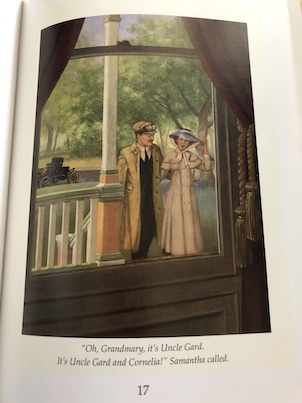
Samantha and her family are spending the summer at their summer home at Piney Point. Besides Grandmary, Uncle Gard and Aunt Cornelia will be there. Cornelia has also brought her younger sisters, a set of twins named Agnes and Agatha. They are close in age to Samantha. Grandmary’s friend, Admiral Archibald Beemis, is also visiting from England.

The family’s summer home isn’t just a single house. They have a lodge in the style of a log cabin and separate guest cottages. This summer, Samantha and the twins will get a cottage to themselves with no adults. The girls have fun exploring the area around the lake together. However, there is one place that Samantha is afraid to go, the island in the lake called Teardrop Island. The only way to get to the island is by boat, and there are sharp, treacherous rocks in that part of the lake. That was where Samantha’s parents had their boating accident and drowned during a storm. To Samantha, Teardrop Island is a place of sadness and danger.

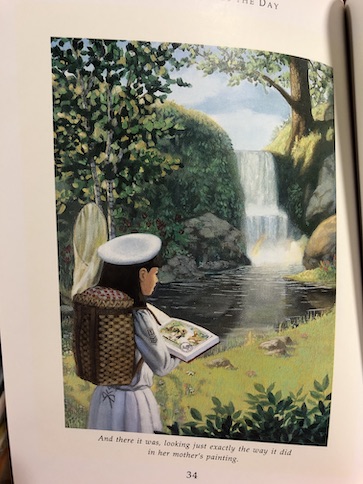
One rainy day, the three girls go up to the attic of the lodge to look for more paintbrushes so they can paint pictures. In the attic, they find old clothes and pictures of Samantha’s family. They also find Samantha’s mother’s old sketch book, labeled “Happy Memories of Teardrop Island.” In the sketch book, she drew pictures of Samantha and her father as they had picnics and played by a waterfall. Samantha was a very young child at the time, and she has no memories of having been on the island with her parents. From the pictures, it looks like it used to be her family’s favorite place.

Seeing the pictures makes Samantha want to visit the island once more, hoping to bring back memories of her earlier visits and her parents. The next day, the three girls go out to the island and try to find the places that Samantha’s mother drew in her book. Teardrop Island turns out to be a beautiful place, and Samantha loves it. The more time she spends there, the more she feels like she has been there before, although her memories are vague and dream-like.

However, the girls forgot to tie up their boat, and they find themselves stranded on the island! A storm comes, and the girls are afraid. When the Admiral tries to come out to the island to help them, he is injured, and the girls realize that they are going to have to find a way to save him! Can they make it home through the storm, or will they meet the same fate as Samantha’s parents?

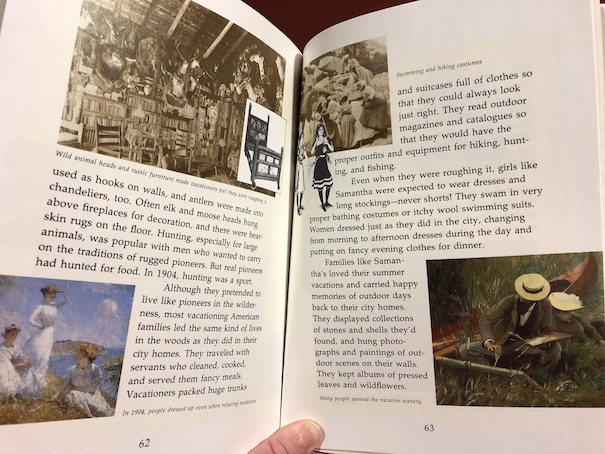
In the back of the book, there is a section with historical information about how people would spend their summers during the early 1900s. Wealthy families like Samantha’s would go to summer homes in the countryside to escape the heat of the cities.

The book is currently available to borrow for free online through Internet Archive.

Samantha Learns a Lesson

American Girls

Samantha Learns a Lesson by Susan S. Adler, 1986.

This is part of the Samantha, An American Girl series.

Samantha attends Miss Crampton’s Academy for Girls in Mount Bedford. She is doing well and has some friends at school, but she misses her friend Nellie. She knows how poor Nellie’s family is and worries about how they are doing.

One day, Samantha comes home from school to a surprise: Nellie has returned to town with her family. Samantha’s grandmother recommended Nellie’s family to a friend, Mrs. Van Sicklen, who has hired Nellie’s father as a driver and Nellie’s mother as a maid. Nellie and her sisters will also be helping with household chores. They will also get the chance to go to school, although they will be attending public school and not the private school that Samantha attends.

When they begin attending school, Nellie’s younger sisters do fine in the first grade, where they are expected to be beginners, but Nellie herself has trouble in the second grade. Nellie is a little old for second grade, so the other children make fun of her for being there, and she is so nervous that she makes embarrassing mistakes in front of her teacher and the other students. Nellie thinks that perhaps she’s too old to start going to school, but Samantha realizes that what she needs is a little extra help.

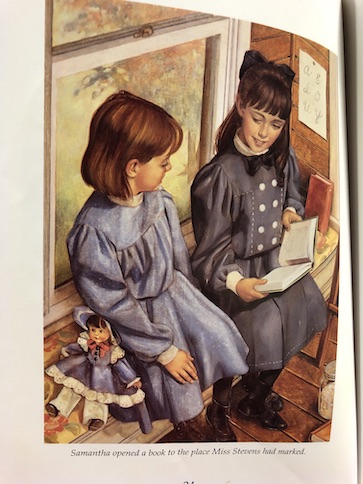
Samantha talks to her own teacher and explains the situation. She says that she would like to help teach Nellie what she needs to know, but she is not sure what Nellie needs to know in order to pass the second grade. Samantha’s teacher, Miss Stevens, thinks that it is nice that Samantha wants to help Nellie and gives her a set of second grade readers to study with pages marked for assignments. Samantha tells her grandmother what she is planning to do, and she says that it is fine, as long as the extra tutoring doesn’t interfere with Nellie’s house work too much.

Nellie accepts Samantha’s help at their secret, private “school” that Samantha calls “Mount Better School.” During their lessons, Samantha discovers that Nellie is very good at math because she used to have to help her mother with shopping and had to keep track of her money. Nellie cannot always come for lessons because of her work, but Samantha’s tutoring helps her to improve.

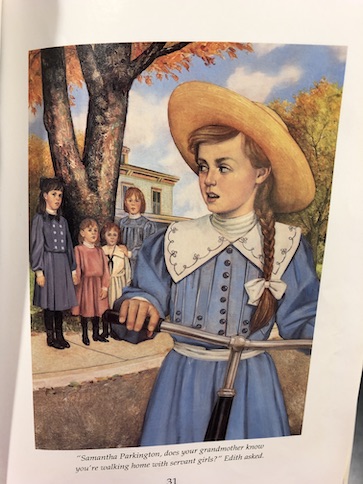
One day, when Samantha is walking home from school with Nellie and her sisters, a mean girl from Samantha’s school, Edith, sees them and criticizes Samantha for spending time with servants. She says that her mother would never allow her to play with servants. Samantha asks her grandmother what Edith means, and her grandmother says that Edith is a young lady. When Samantha asks why she is allowed to play with Nellie, her grandmother says that they are not really playing, that Samantha is helping Nellie, which makes it different. That explanation doesn’t entirely satisfy Samantha.

However, her grandmother is both understanding of the help that Samantha has been giving to Nellie and serious about the need to help others. When Edith’s mother and other ladies of the neighborhood come to visit and complain about Nellie’s family and how Samantha is spending time with them, Samantha’s grandmother defends them and says that Samantha is doing good.

Meanwhile, Samantha’s school is preparing for a public speaking contest with the theme “Progress in America.” To prepare for her speech, Samantha asks her grandmother, her Uncle Gard, and other people what they think about progress and what the best inventions are. They mention inventions like the telephone, electric lights, automobiles, and factories. Samantha is fascinated by the idea of factories and the variety of products that they can make. However, when Samantha reads her speech to Nellie, Nellie is not nearly so enthusiastic about factories as a sign of progress. Nellie used to work in a factory herself, and she knows that they are not pleasant places. She tells Samantha how factories are noisy and how dangerous the machines are for the workers. The factory workers are also very poorly paid, which is why the products they make are so cheap.

Nellie’s stories about factories bother Samantha. When it is time for the public speaking contest, Samantha delivers a changed version of her speech in which she discusses the dangers of child labor and how some form of progress, particularly ones that endanger children, are not good forms of progress. Samantha’s thoughtful speech wins the contest, and her grandmother understands that Samantha has been learning things from Nellie even while teaching her.

In the back of the book, there is a section with historical information about education and child labor during the early 1900s.

The book is currently available to borrow for free online through Internet Archive.

Meet Samantha

American Girls

Meet Samantha by Susan S. Adler, 1986.

This is the first book in the Samantha, An American Girl series.

Samantha Parkington is a nine-year-old orphan. She belongs to a wealthy family and lives with her grandmother, called Grandmary, in the Hudson Valley in New York. Grandmary is often strict with Samantha, trying to teach her to be a proper young lady, but Samantha finds it difficult. Samantha’s grandmother loves her, but she has very old-fashioned ideas about how girls should behave. When Samantha wants to try making and selling boomerangs in order to earn money to buy a doll, using instructions from The Boys’ Handy Book, her grandmother stops her, saying that young ladies do not earn money. She would rather that Samantha earn the doll as a reward for doing what she is told and practicing her piano lessons. Samantha also has an uncle, Uncle Gard, who has a girlfriend named Cornelia. Cornelia is a more modern woman, who would see nothing wrong with Samantha wanting to earn some money.

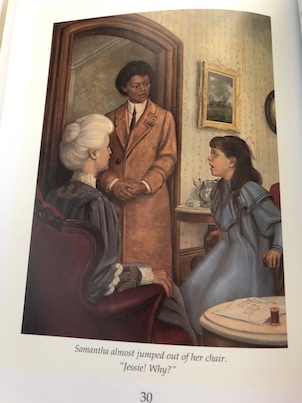
One of her grandmother’s servants, a black woman named Jessie, is kind and motherly to Samantha. Jessie often patches Samantha up after her various escapades and mishaps. Jessie’s husband, Lincoln, is a train porter, and Jessie tells Samantha exciting stories about the places that Lincoln has seen in his work, like New Orleans. Sometimes, Lincoln brings Samantha post cards from these places.

Samantha soon learns that a new girl her age is coming to a neighbor’s house. She has been wanting a playmate, so she goes over to the neighbor’s house to introduce herself. The new girl’s name is Nellie, but she has come to be a servant for the neighbors, the Rylands. Nellie’s family is poor, so Nellie needs to work as a maid help her parents earn money and support her younger sisters. Samantha is surprised when Nellie describes her family’s circumstances in New York City. Samantha has never been poor, and she doesn’t know what it’s like to be cold and hungry. Nellie says that the air in the countryside is better for her, and she gets better food working for the Rylands. Nellie tells Samantha that she has never been to school, and Samantha offers to teach her.

Then, Jessie suddenly announces that she is leaving her job at Grandmary’s house. Grandmary doesn’t seem surprised, but Samantha is. Jessie offers no explanation for leaving, and when Samantha tries to ask, Grandmary and the other servants do not want to talk about it. Samantha tells Nellie about Jessie leaving, coming up with fanciful reasons why she might leave her job, but Nellie offers the practical explanation that Jessie might be having a baby. Nellie knows more about it than Samantha because she has younger sisters, but she acknowledges that adults of this time period do not like to talk about people having babies, particularly in front of children. Neither Nellie nor Samantha entirely knows why.

However, Samantha is still concerned about Jessie. Samantha doesn’t know where Jessie lives, but Nellie does. The two girls sneak out one evening to visit Jessie and learn for themselves what the matter is. This is the first time that Samantha has been to the part of her town where black people live, further opening her eyes to the lives of people from lower classes of society. Nellie is a little surprised at how Samantha, who is more educated, sometimes knows so little about the ways that other people live.

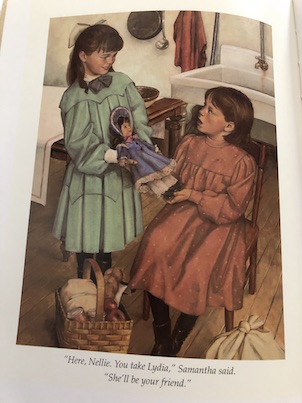
It turns out that Jessie does have a new baby. Jessie reassures Samantha that she and the baby are fine, but since her husband needs to travel because of his job as a train porter, she needs to stay at home with her baby now. Samantha thinks of a way to help Jessie keep her job and care for her baby at the same time, persuading her grandmother to let Jessie come back. Unfortunately, Nellie soon has to leave because Mrs. Ryland doesn’t think that she’s strong enough to work as a maid and decides to send her back to her family in New York City. Samantha gives Nellie her new doll as a going-away present, and she is very concerned about how Nellie and her family will manage.

In the back of the book, there is a section with historical information about how wealthy people and their servants lived during the early 1900s.

Something that occurred to me later is that Jessie is about the right age to be Addy‘s daughter, from another American Girls series. I don’t think that there’s a real connection between Jessie and Addy because the Samantha books were written before the Addy series. However, when I stopped to think about their relative ages (Addy would be about 49 years old in 1904, and Jessie is probably in her 20s), it occurred to me that if Addy had a daughter, she would probably be an adult at this time, and she might be doing something very similar to what Jessie is doing, working as a seamstress.

The book is currently available to borrow for free online through Internet Archive.

Sarah, Plain and Tall

Sarah, Plain and Tall by Patricia MacLachlan, 1985.

This is a popular book to read in schools in the United States, the first in a series.  It’s a Newbery Award winner, and it shows aspects of farm life during the early 20th century and the concept of mail-order brides, a practice from American frontier days where men living in the West or Midwest, where there were not many available women in the population, would write to agencies or advertise for a bride from the East.  The process for arranging these marriages could vary, but it typically started with written correspondence before the man and woman would meet in person.  In this book, the man looking for a bride, Jacob Witting, is a widower with two children who has a farm on the Great Plains.  The story is narrated by his older child, Anna. The book isn’t very long, and it’s a pretty quick read, but it’s filled with colorful imagery and emotion.

Anna has had to help take care of her little brother, Caleb, since he was born.  Their mother died shortly after giving birth to him, and Caleb frequently asks Anna questions about what their mother was like.  Anna’s memories of their mother are fading because she was still very young when she died, but she really misses her.

Then, Jacob tells the children that he has advertised for a bride from the East, the way a neighbor of theirs did.  The children like their neighbor’s new wife and wouldn’t mind having a mother like her.  The father has received a reply to his advertisement from a woman in Maine, Sarah Wheaton.  Sarah has never been married, and now that her brother is getting married, she feels the need for a change in her life.  She loves living by the sea in Maine, but she is willing to move to start a new life.  She says that she would like to know more about Jacob and his children.

Jacob and the children write letters to Sarah, getting to know her better.  They come to like each other, but the children worry about whether Sarah will change her mind about coming to see them or whether she’ll like them or their farm when or if she comes.  When Sarah tells them that she’s coming during the spring, she says that they will know her because she will be wearing a yellow bonnet and describes herself as being plain and tall (the title of the book).

Sarah will stay with the family for a time while they decide if they can be a family together and if she will marry Jacob that summer.  There are adjustments that they will all have to make.  Life on the prairie is very different from what Sarah is used to, and the children still worry that she won’t want to stay.  Sarah brings seashells from Maine to show them, and they teach her about the local wildflowers.  One of my favorite scenes was where Sarah cuts Caleb’s hair, and they put the hair clippings out for birds to use in their nests.  Caleb was particularly concerned about whether Sarah would sing like their mother used to, and Sarah does. 

Through it all, the children can tell that Sarah really misses the sea.  Sarah does say that the land around the farm kind of rolls, a little like the sea, and they play in a haystack, like it was a dune by the sea.  When they visit their neighbors, Sarah talks with Maggie, the mail-order bride who came from Tennessee.  Maggie understands Sarah feels, missing her home in Maine, and it upsets Anna to hear them talk about missing their old homes.  However, Sarah says that things were changing at home, and Maggie comments that, “There are always things to miss, no matter where you are.”  What the women realize is that, although they miss their old homes, they have grown to love the new people in their lives and would miss them if they tried to go back to where they came from.

At one point, Sarah goes to town alone, and the children worry that she won’t come back, but she does.  She just went to town to buy colored pencils in her favorite sea colors.  Sarah does stay and marry Jacob, setting up the rest of the series.

The book is available to borrow and read for free on Internet Archive (multiple copies).

My Reaction

There is a movie version of this book, which follows the story pretty well. The book wasn’t specific about the time period, although it seems to take place during the early 1900s. The movie and its sequels are set during the 1910s, which makes sense for the rest of the series. The book also didn’t say exactly where the farm was, but the movie clarifies that it’s in Kansas. The movie also emphasizes how much the whole family, particularly Jacob and Anna, misses the mother who died.  In the movie, Jacob forbids the children to use any of his dead wife’s things and doesn’t want to talk about her.  However, when Sarah realizes that trying to avoid his wife’s memory is hurting Anna, she brings out some of the dead wife’s belongs to use, helping the family to make peace with the past and prepare for the future. 

In the movie, Jacob’s pain over his wife’s death is partly about guilt as well as grief. The book doesn’t really talk about why Anna’s mother died after childbirth, but in the movie, Jacob has a painful discussion with Sarah about how he blames himself for his wife’s death because the doctor had warned them that they shouldn’t have any more children after Anna.  Apparently, Anna’s birth had been difficult and caused complications because his wife was so young, and the doctor had said that having another child would be dangerous.  However, after a few years went by, they decided to try for a son to help run the farm, thinking that enough time had gone by for it to be safe.  When his wife died giving birth to Caleb, Jacob felt terrible, thinking that he should have taken the doctor’s warning more seriously and not tried to have another child.  Confessing all of this to Sarah helps Jacob to make his own peace with what happened.  However, none of this discussion appears in the book.

In both the book and the movie, Jacob also has to adjust to Sarah’s different personality.  Sarah is more stubborn and independent than his first wife, with her own way of doing things.  Living with her is different from living the mother of his children.  However, Jacob comes to love Sarah for the person that she is.

Tomorrow’s Wizard

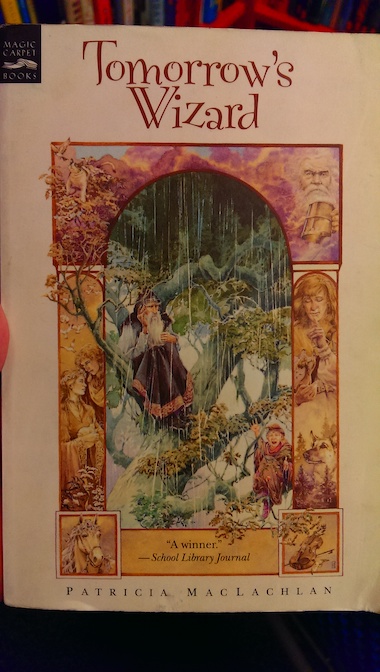
TomorrowsWizardTomorrow’s Wizard by Patricia MacLachlan, 1982.

In a way, this story is a collection of shorter stories, but they are all tied together. In the beginning, Tomorrow’s Wizard (that’s actually his name, he’s also called Tomorrow) has just been given an apprentice wizard named Murdoch. Their job is to listen for important wishes to grant. Each of the shorter stories in the book involves a different wish and how Tomorrow and Murdoch grant it.

The First Important Wish – Rozelle is a pretty girl but wild and given to fits of temper. Her parents had her later in life and never disciplined her, so she has never had a reason to learn to control herself. However, her tantrums drive everyone else crazy. Rozelle’s father, acknowledging how difficult it is to deal with Rozelle, wishes that he could find a man who was willing to marry her. Tomorrow hears the wish and sends a variety of suitors to meet Rozelle, but she doesn’t like them, and none of them really like her, either. Then, another possibility occurs to the wizards: the villagers have been complaining that they are afraid of a nearby giant. Tomorrow knows that he giant is really harmless and gentle, just lonely. Could it be possible that Rozelle is the company that he needs?

Three-D – Miller Few and his wife, Mona, are nasty people, two of a kind. Because he’s the only miller in town, Miller Few (known to his neighbors as Three-D for Dreadful Dastardly Demon) freely cheats his customers. He and his wife have no friends because they’re so awful. Then, one day, Three-D saves Murdoch’s life. To reward the miller, Murdoch agrees to grant him a wish. The miller and his wife decide that they want a nice, sweet child who would do their work for them. The child Murdoch grants them is indeed sweet. A little too sweet. Not only does little Primrose look pretty and do the housework, but she helpfully reminds the miller about his debts and the other things her parents do wrong. The miller and his wife become more careful and agreeable and gain new friends because of Primrose, but they aren’t very happy. They aren’t really being themselves, and they’re tired of being on their best behavior all the time. But, perhaps there is one thing that can stop Primrose from being overly sweet: the miller’s old cat, Clifford.

The Comely Lady and the Clay Nose – Geneva is a very beautiful young woman and has many admirers, but she knows that they are more in love with the way she looks than with who she is. It worries her, and she wishes for someone who would love her for the person she is. To help solve her problem, Tomorrow makes an ugly clay nose for Geneva to wear, telling her that it will help her to find the person she is looking for. When she puts it on, her former admirers flee, and for awhile, Geneva is very lonely, but she perseveres and ends up finding the love that she is looking for.

The Perfect Fiddle – Bliss, the fiddle-maker, is ironically an unhappy man. The reason is that, no matter how good his fiddles are, he can never make one that’s completely perfect. After Bliss tries several crazy schemes to capture perfection in his fiddles, Tomorrow goes to visit Bliss’s wife, Maude. Like Tomorrow, Maude has seen the problem with Bliss’s approach to his fiddles and finally asks Bliss the question that makes him reconsider whether perfection should be his goal.

The Last Important Wish – Although Tomorrow is impatient with his apprentice, Murdoch, he does like having him live with him, and he has also grown attached to the horse that lives with them both. However, he has come to see that the life of a wizard isn’t the one that Murdoch is really suited for. More than anything, Murdoch wants the experience of being born and living among humans. The horse, too, wishes for a kind master and a family. Tomorrow sees that it’s time to grant both of their wishes, giving the horse and Murdoch (as a baby) to a kind farmer with a wife and other children.

The book is currently available online through Internet Archive.

The Whipping Boy

The Whipping Boy by Sid Fleischman, 1986.

Jemmy is an orphan who lives in the royal castle as the prince’s new whipping boy.  Prince Horace, or Prince Brat, as the prince is commonly called, is known for constantly misbehaving, playing mean pranks, and refusing to do his lessons (he tells his tutor that he doesn’t need to learn how to read because he could always get someone else to do his reading for him).  However, in their land, it is illegal for anyone to use any kind of physical force or punishment on a prince.  Instead, the royal family employs a whipping boy to take the prince’s punishments for him.  As you can imagine, seeing someone else whipped in his place does little to correct the prince’s bad behavior.  In fact, the prince usually likes the spectacle of the whipping boy yelling.  He doesn’t like it that, unlike the others, Jemmy never yells when he’s whipped.

Jemmy was recruited for the role of whipping boy off the streets, where he survived by being a mudlark and rat catcher.  There are benefits to living in the palace, even if his purpose in being there is to take the prince’s punishments.  Jemmy gets food to eat and nice clothes to wear and attends the prince’s lessons with him, where he pays attention when the prince does not.  Jemmy actually loves the books and learning he receives.

After about a year, though, the prince suddenly comes to Jemmy in the middle of the night and tells him that he’s running away from home and wants Jemmy to come with him as a manservant.  When Jemmy asks him why he wants to leave, the prince says that he’s bored.  Jemmy wonders why Prince Brat wants him to come along instead of a friend, but then he realizes that, as nasty as he is, Prince Brat doesn’t have any real friends.

When the two of them are outside of the palace, Jemmy is tempted to run off and leave Prince Brat to fend for himself, but before he can make up his mind about it, the two boys are taken prisoner by bandits, Cutwater and Hold-Your-Nose Billy (named for all the garlic he eats).

Prince Horace tries to pull rank on the bandits, telling them who he is and ordering them to go away.  It’s a mistake.  When the bandits see the royal crest on the saddle of the horse that the boys are riding, they decide that they can probably get a good ransom for the prince.  Since neither of the bandits can write, they try to make the prince write his own ransom note, but of course, Prince Brat can’t write because he’s refused to learn. 

Jemmy, seeing an opportunity to turn the situation around, offers to write the note instead.  As Jemmy suspected, when the bandits realize that he can write and Horace can’t, they start assuming that he’s actually the prince and that the two boys have switched places.  After writing the note, Jemmy suggests that they let the “whipping boy” (Horace) take it to the castle, thinking that not only will Horace get safely away but that he’ll be rid of Horace after that.

To Jemmy’s surprise, Prince Horace ruins the whole scheme by refusing to return to the castle.  Jemmy tries to reason with him, but Horace says that he won’t go home until he’s ready.  The boys to manage to slip away on the bandits, and Horace insists on following Jemmy even though Jemmy wants to be rid of him.

Although Jemmy can’t understand why, Horace says that he’s having the time of his life.  For once in his life, he doesn’t have people fussing over him and telling him to keep his clothes clean.  Horace has found palace life stifling and boring, and he feels like his father hardly notices him or cares.  Part of the reason why Horace acts up is to get his father’s attention.  Jemmy is surprised by these insights into the prince’s life and character, and he is also surprised that, when he finally gets the chance to slip away and leave Horace behind, he can’t do it.  He knows that Horace isn’t used to life outside the palace, and Jemmy worries about what might happen to him if he’s left alone, although he tells himself that Horace could always return to the castle.

Before their adventures are over, Horace gets to experience what it’s like to do chores for himself and even to be whipped by the bandits, when they think he’s the whipping boy.  Being whipped himself shows Horace what he has subjected others to on his account.  Jemmy is surprised that Horace bears the punishment without crying or complaining, something which Horace says that he learned from watching Jemmy, who made it a point to take whippings with quiet dignity.  Horace also learns what other people really think of him when a woman at a fair comments on the prince’s disappearance, using the “Prince Brat” nickname and saying that the young prince is a “terror” and bound to be a terrible king when he’s older.  Usually, people are careful about what they say in front of the prince, and Horace is shocked to find out how disliked he is because of his bad behavior.  However, Horace’s new experiences and realizations bring a change in his outlook and personality that make him more sympathetic and likeable.  There is also the realization that what Horace really needs in his life isn’t a whipping boy to take his punishments for him but someone who can be a real, honest friend with him, like Jemmy.

In the end, Jemmy becomes the prince’s companion, not his whipping boy, so that the prince will be less lonely and stop acting out to get attention.  The king promises that Horace can keep Jemmy as his companion and his responsibility as long as Horace himself can behave responsibly and do his lessons as he should.

Although the country and characters in the story are fictional, the practice of keeping a whipping boy so that princes wouldn’t have direct physical punishment was a real practice.  Even today, the term “whipping boy” can stand for a person who takes blame or punishment in the place of someone with higher rank or authority, even when the person of higher rank is the one at fault.  For example, if a business manager or CEO makes a bad decision and orders one of his employees to do something they shouldn’t and the employee gets the blame for it as if what they did was their idea and not the boss’s, that employee can be considered the “whipping boy.” Another example would be if a stepchild in a family was given blame or punishment in place of a biological child because of favoritism on the part of the punishing parent (similar to the crude saying “beaten like a red-headed stepchild“). In fact, depending on the circumstances, a “whipping boy” might not even be a person, but a thing or a concept that is blamed instead of the person or thing that is the true cause of a problem, such as blaming “modern society” or “kids these days” for an individual’s bad habits or behavior, “the government” or “the system” for a business’s bad decisions or policies, or “millenials” for practically everything they’ve been blamed for by older people. It is similar to the concept of the “scapegoat” or “fall guy” but with the connotation that the person who is really at fault, the one who is trying to avoid blame or punishment, succeeds because of higher rank, authority, seniority, or some other form of favoritism among those who will assign blame or punishment.

This book is a Newbery Medal Winner and is available online through Internet Archive (multiple copies).

There is also a movie version of the book, sometimes called Prince Brat and the Whipping Boy.  The movie follows the concept of the original story pretty well, but it elaborates more on Jemmy’s life before he became the whipping boy and on how Horace feels neglected by his father.  In the movie, Jemmy is pressed into service as whipping boy by the king’s soldiers, who don’t bother to find out if he has any other family.  Although Jemmy is an orphan in both the book and movie, in the movie, he also has a younger sister he looks after, and part of what he wants to do when he leaves the palace is to find her.  The boys together learn that the younger sister was arrested for attempting to steal a handkerchief in Jemmy’s absence, and they have to rescue her from prison, a side adventure that didn’t occur in the book.  In the movie, Horace also explains to Jemmy that his mother died in a riding accident when he was young and that his father pays more attention to affairs of state than he does to him.  Horace is shown multiple times trying to get his father’s attention, only to be brushed off because his father is too busy.  In the movie, the king almost declares war on another country, thinking that Horace was kidnapped over a border dispute, something that didn’t happen in the book.  In both the book and the movie, Jemmy’s new friendship with Horace brings about a change in the prince.  At the end of the movie, both Jemmy and his sister are taken in to the palace as companions for Horace. Sometimes you can find this movie or clips of it on YouTube. Although it was originally released on VHS, it is currently available on DVD.

King Bidgood’s in the Bathtub

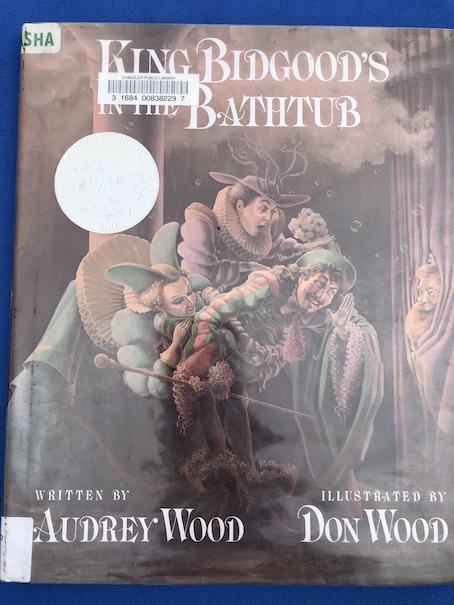
King Bidgood’s in the Bathtub by Audrey Wood, 1985.

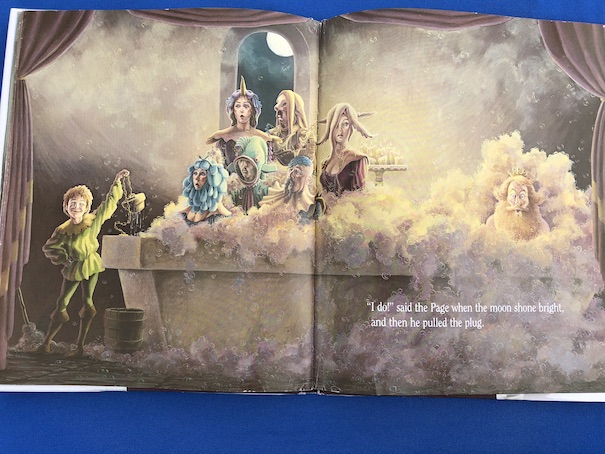
King Bidgood loves being in his bath, but one day, he just doesn’t want to get out!  When the young page realizes that the king is refusing to leave the bath, he calls out to the courtiers, asking what to do about it.

One by one, they try to interest the king in other activities, but each time, he keeps inviting them to join him (fully clothed, although he apparently isn’t, just mostly hidden by bubbles) in order to prove that absolutely everything can be done in the bath.

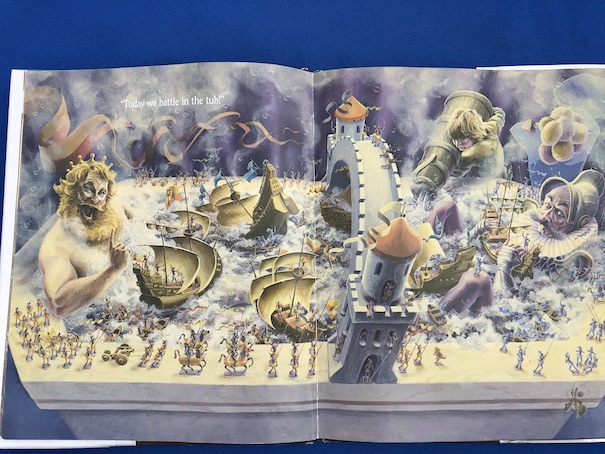
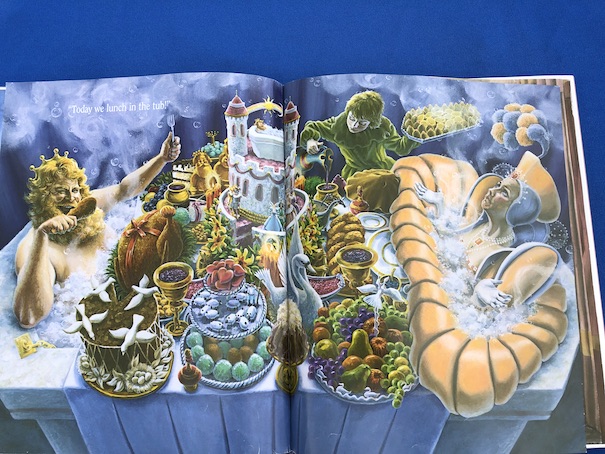
When the knight says it’s time for battle, they end up having a battle with toy ships in the tub.  When the queen tells him that it’s time to eat, they have a fancy feast right there in the tub.  The king’s activities eventually include a fishing trip and a dance.

In the end, the page is the one who figures out how to put an end to this never-ending bath.

I love the pictures in this book, and the repetition as each person steps forward with a suggestion should appeal to young children.  This book is a Caldecott Honor Book. It is currently available online through Internet Archive.

Talking to Dragons

Talking to Dragons by Patricia C. Wrede, 1985.

This is both the fourth book in the Enchanted Forest Chronicles and the first book in the series that was written.  The author wrote this story before the others and then wrote the other three to explain how the characters got to this point.  The first three books in the series focus on Princess Cimorene and her adventures, but this book focuses on her son, Prince Daystar.

Partly because this series is kind of backwards, with the last book being the first written, I’m going to start with a spoiler.  When the book begins, Daystar is unaware that he is a prince and that his father is the king of the Enchanted Forest.  He grew up in an ordinary cottage on the edge of the forest, so he is accustomed to the presence of all kinds of fantasy creatures and fairy tale characters.  He thinks of himself and his mother as ordinary poor folk.  However, his mother has taught him not only reading and writing but other skills that are more unusual for peasants, like music, fighting, and even a little magic.

When Daystar is 16 years old, a wizard named Antorell comes to their house.  Daystar’s mother, Cimorene, seemed to know him, and he knows her.  Antorell demands “the sword” and the boy, and Cimorene casts a spell to melt him.  (“’No! Not again!’ he screamed.”  If you’ve read the other books, you already know why.  But, again, this book was written first.)

The next day, Cimorene gives Daystar a sword that he’s never seen before but which seems to draw him to it, and she starts giving him instructions.  The instructions are vague, but Cimorene insists that Daystar is to go into the Enchanted Forest and not to come back until he can explain why he had to go in there in the first place.  Also, he is not allowed to draw the sword from its scabbard unless he really needs to use it.  Cimorene says that she can’t explain more because it might “ruin everything.”  Not knowing what else to do, Daystar starts into the Enchanted Forest.  When he glances back, Cimorene and the cottage have suddenly disappeared.  Daystar has no idea why, but he has no choice but to keep going.

In the forest, Daystar meets a talking lizard called Suz, who claims to know everything about the Enchanted Forest and what goes on there (a tall claim, considering everything that goes on there).  When Daystar asked him if he knows anything about the mysterious, magical sword that his mother gave him, Suz tells him that it’s the Sword of the Sleeping King and that everyone has been looking for it.  Daystar knows nothing about it, which surprises Suz.  To Daystar’s surprise, both the sword and Daystar’s lack of knowledge agitate Suz, who says that he must get Kazul, who will know what to do.  Before he then runs off, leaving Daystar wondering who Kazul is, Suz tells him that he’s going to have to learn about the sword by himself because there are certain rules associated with magic, but that he should follow the sword to find out.

The next person Daystar meets is a red-haired girl who is stuck in a hedge.  She is surprised by how easily Daystar can get into the magical hedge, and at first, she thinks that he is a wizard.  She is relieved when she finds out that he’s not.  The girl, Shiara, tells Daystar that wizards have been chasing her because she burned the Head Wizard’s staff.  Most people could never accomplish that because wizards’ staffs are extremely powerful and have protective spells on them, but Shiara is a fire-witch.

As the two of them talk, Daystar learns that, while fire-witches are extremely rare and powerful come by their powers naturally, Shiara’s abilities are more unpredictable than most.  She has trouble casting spells on purpose, but when she gets mad, she can do some extremely powerful ones without really trying.  Fire-witches tend to have tempers, and Shiara is no exception.  Because of that, she doesn’t have many friends.  Most people are afraid to be around her because they never know when she’ll lose her temper and accidentally set things on fire.  Even worse, for Shiara, is knowing that most fire-witches are able to do very impressive spells and are almost invulnerable, but yet, she can’t even burn her way through a hedge when she tries it.  The wizards are very interested in her because most fire-witches are immune to their spells.  When they learned that she was a fire-witch who couldn’t cast her own spells, they tried to kidnap her in order to study her magic, which she how she ended up setting the Head Wizard’s staff on fire.

Daystar and Shiara finally get out of the magical hedge when Daystar suggests that Shiara try being polite to it instead of losing her temper.  Creatures and objects in the Enchanted Forest tend to respond well to politeness.  When they’re out of the hedge, a wizard shows up and tries to kidnap Shiara again, but Daystar defends her with his sword.  However, Daystar’s hand is injured when he tries to pick up the pieces of the wizard’s staff, and it explodes.

Daystar and Shiara seek help from Morwen, a witch who lives nearby.  It is from Morwen that Daystar begins to get a sense of what his sword is capable of doing.  He also meets up with Suz again, who tells him that he should go to the castle and that Kazul will meet him there.  Daystar still doesn’t know what he’s walking into, but missions in the Enchanted Forest can’t be ignored, and he has a mission to complete that everyone has been waiting for since before he was born.

By the end of the story, Daystar has learned what he needs to do to rescue his father, and Cimorene and Mendanbar are reunited.  Shiara ends up getting what she wants, partially, because she gains the ability to use her powers, but is forced to be polite in order to do so, which really irritates her.  She becomes Kazul’s new princess, where she will learn both the personal skills and magical skills she needs to control both herself and her ability.  Cimorene believes that Shiara will end up marrying Daystar eventually and becoming the next queen of the Enchanted Forest.  However, the series ends here, and the future is left to the imagination.  Morwen also decides to marry Telemain, a character from the previous books.

Like other books in this series, this book contains a lot of humor and parodies on popular fairy tales and fairy-tale creatures. Personally, I like the first two books in the series the best, but this one is also fun. There is a mild touch of romance to it, which is also nice.

The book is currently available online through Internet Archive.

There is one more story after this series, a short story in the collection Book of Enchantments that features Daystar and both of his parents but does not have Shiara.

Do-It-Yourself Magic

Do-It-Yourself Magic by Ruth Chew, 1987.

Rachel and her younger brother, Scott, stop by the discount store on the way home to admire the model kits.  Most of the model kits are too expensive for them to buy, but one kit has been put on discount, The Build-Anything Kit.  The kids think it’s a good deal because they can use it to build more than one kind of model. 

When they get it home and begin to play with it, they are confused at first.  Scott tries to build a model stock car racer, but all the wheels and other pieces are all different sizes.  Then, Rachel finds a double-headed hammer labeled, “sizer.”  The kids discover that when they hit the model pieces with the hammer, they can make them bigger or smaller.  Besides working on pieces, the sizer can also make people bigger or smaller.  Rachel makes Scott smaller so that he can drive his stock car model around the room.  Then, when he drives outside, she makes both him and the car bigger, so the car is the size of a normal car.  A neighbor spots them in this strange car and calls the police, so the children are forced to shrink the car again quickly. 

When they get home, they discover that they left the door open and that a man is trying to steal their tv set.  Without thinking, Rachel hits him with the sizer and shrinks him.  Now, they have to decide what to do with him before the situation gets worse!

At first, the kids keep the thief in a glass, but then they let him out and allow him to drive around in the stock car model.  While they are trying to decide what to do with him, they take a look in the model box again and notice some pieces that weren’t there before.  They look and feel like stone blocks, so they begin building a castle with them.  To their surprise, the man they shrunk runs into the castle.  They are worried about him, so they hit the castle with the sizer to make it bigger.  Suddenly, the castle is as large as life, and they go inside to discover that they are back in medieval times. What will happen to the thief in the past, and will the kids get back home?

The book is currently available online through Internet Archive.