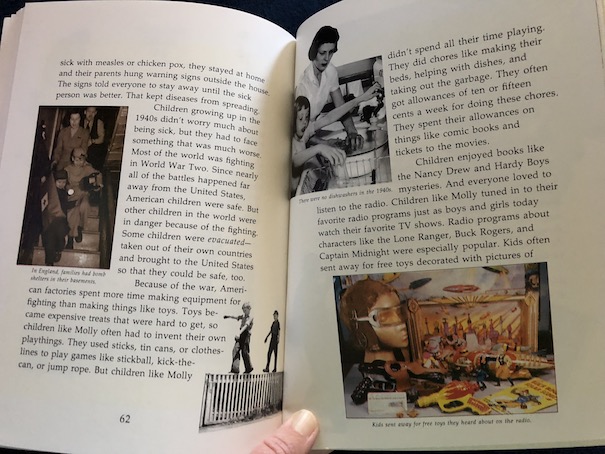
Arthur’s Valentine

Arthur’s Valentine by Marc Brown, 1980.

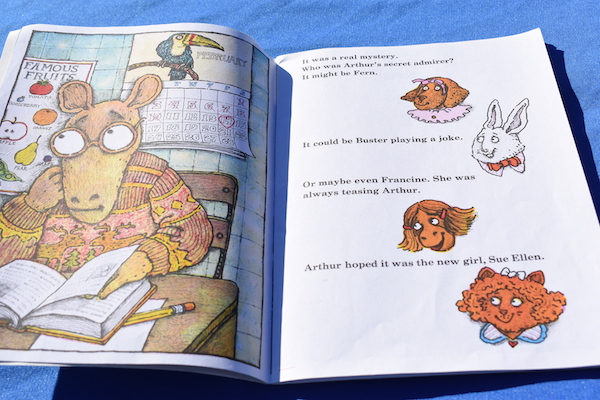
During the week before Valentine’s Day, someone keeps leaving unsigned valentines for Arthur.  He wonders who it is, thinking about the different girls in his class at school. On the other hand, maybe someone is just playing a joke on him.

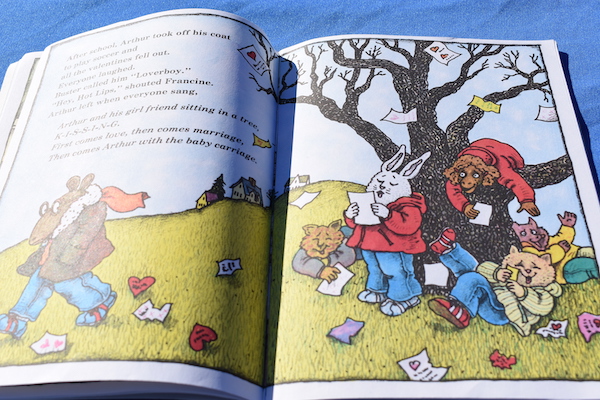
When his friends find out about his secret admirer, Arthur gets a lot of teasing.  At one point, he thinks that he knows who the secret admirer is, but when he writes a valentine of his own for her, it turns out that he’s wrong, and it leads to more embarrassment.

However, Valentine’s Day isn’t over yet. Arthur’s secret admirer gives him a movie ticket, saying that she’ll meet him at the theater.  With this last message, Arthur realizes who is secret admirer is and arranges a surprise of his own.

This is just a fun, cute Valentine’s Day story, part of the Arthur Adventure Series.

Tortillas Para Mama

Tortillas Para Mama selected and translated by Margot C. Griego, Betsy L. Bucks, Sharon S. Gilbert, and Laurel H. Kimball, illustrated by Barbara Cooney, 1981.

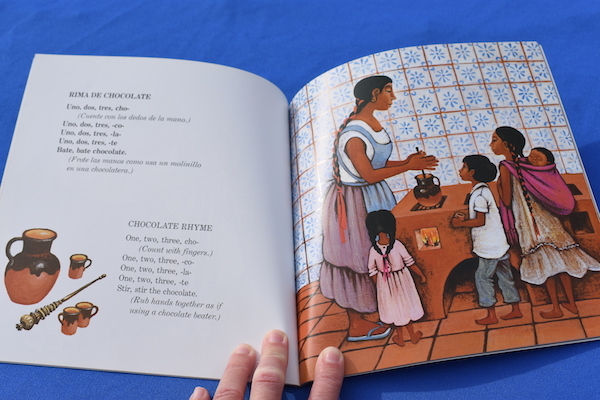
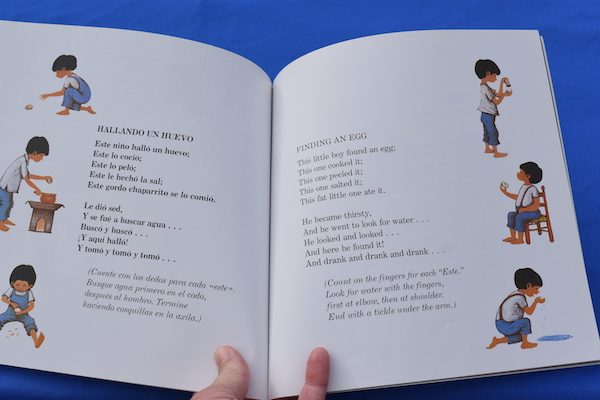
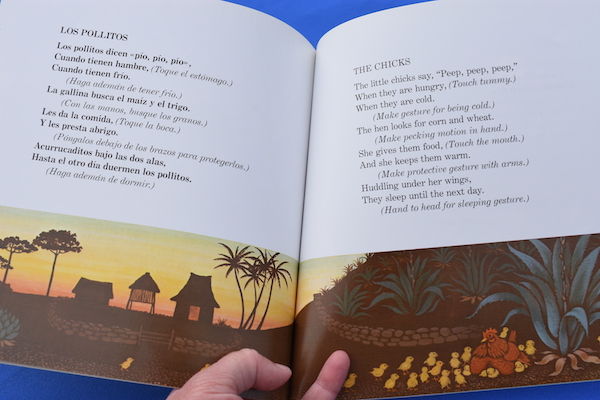
This is a collection of Spanish lullabies and nursery rhymes in the Americas.  The introduction to the book explains how these traditional rhymes have been passed down through the generations of families.  They are not specific to any one country, more generally known where there are Spanish speakers. The rhymes are in both in English and Spanish.

Like children’s rhymes everywhere, they are about small, everyday things, like family, animals, cooking, and other things people do every day, like helping little kids to get dressed.

There are rhymes and songs that involve counting on fingers or making hand motions.

My favorite is the lullaby Los Pollitos (The Chicks), which I first heard when I was little through Kidsongs. I always liked that song.

The illustrations, paintings by Barbara Cooney, are beautiful.  Some people may recognize the art style from her other works like Miss Rumphius and Roxaboxen.

Edward the Emu

Edward the Emu by Sheena Knowles, illustrated by Rod Clement, 1988.

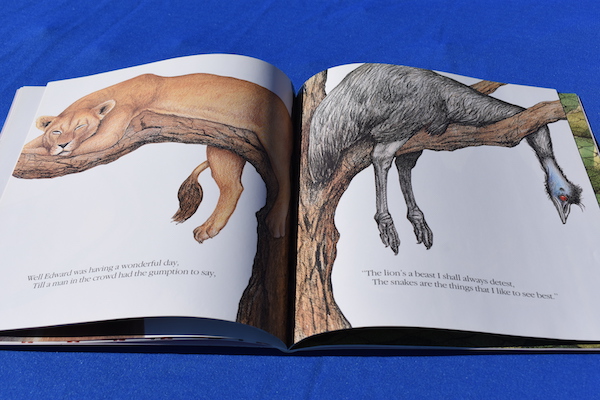
Edward the Emu lives in a zoo, but he finds it boring.  He is so bored that he decides to try living with and acting like the other animals. 

First, he envies the seals who live in the pen next to his and always seem to be swimming and having fun.  So, one night, he jumps out of his pen to join the seals.  The next day, he hangs out with the seals, lying in the sun and balancing a ball on his nose.  It’s much more fun than his boring old pen, but then he overhears a zoo visitor say that the lions are “the best thing to see at the zoo.”

Edward once again switches pens, deciding that he’ll try to be a lion.  He spends the next day growling and snarling while the lions roar.  It’s a lot of fun, but then another visitor comments that he likes snakes the best. 

Once again, Edward switches pens and tries being a snake.  This time, someone comments about great emus are.  Feeling better about himself, Edward decides to return to his own pen. 

However, to Edward’s surprise, there is another emu in his pen, his replacement because he disappeared!  It’s not a problem, though, because the new emu, Edwina, is glad to see him, and Edward is less likely to be bored now that he has a friend.

A friend sent me this cute picture book from Australia.  The story is told in rhyme, and the pictures of Edward trying to be different types of animals are fun.

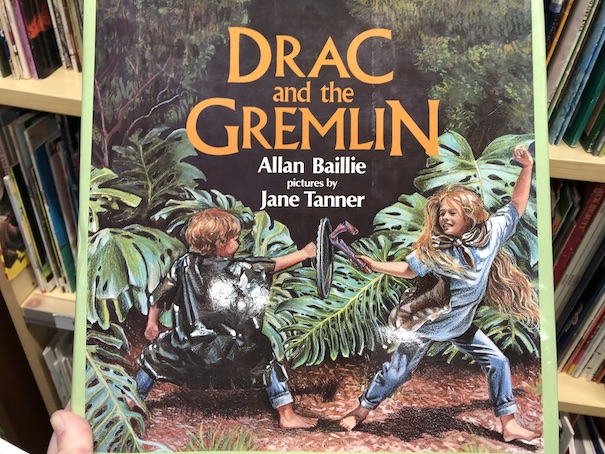
Drac and the Gremlin

Drac and the Gremlin by Allan Baillie, pictures by Jane Tanner, 1988.

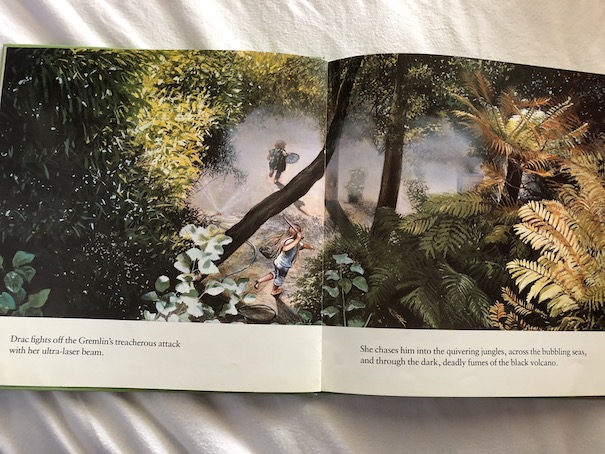
The great thing about this book is that you really need to look at the pictures in order to get the full story.  If you read the text alone, it sounds like a magical space adventure story, but when you see the pictures, you realize that it all takes place in a girl’s imagination as she and her younger brother play in their backyard.  The book never mentions the children’s names (or directly talks about reality at all).  The girl calls herself “Drac, the Warrior Queen of Tirnol Two”, and her younger brother “the Gremlin of the Groaning Grotto.”

DracGremlinChase

Drac begins by trying to capture the The Gremlin.  She pursues him across the jungles, but when she finally traps him, she receives a message from the White Wizard.  The White Wizard is being attacked by “General Min” (their cat, Minnie) and desperately needs her help!  Drac persuades the Gremlin to help her.

DracGremlinCapture

The two of them get into Drac’s “anti-gravity solar-powered planet hopper” and race to the rescue!  They arrive just in time to save the White Wizard in her current form (a moth).

DracGremlinPlanetHopper

But, they are soon facing another peril: “The Terrible Tongued Dragon” (their dog)!   Drac is almost overcome by the dragon, but the Gremlin saves her just in time!

DracGremlinRescue

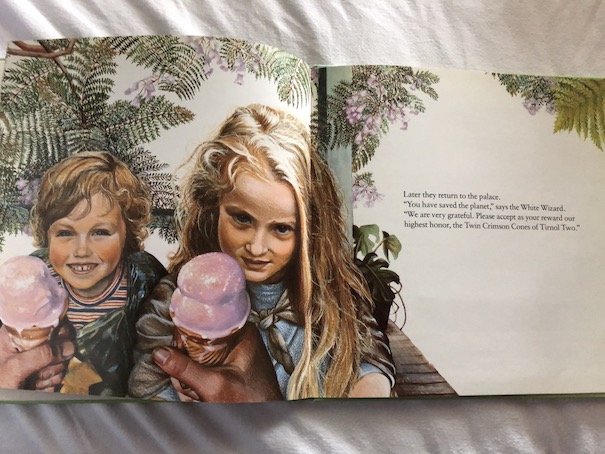
Their adventure ends at the palace, where the “White Wizard” (their mother) rewards them with “the Twin Crimson Cones of Tirnol Two” (ice cream).

DracGremlinReward

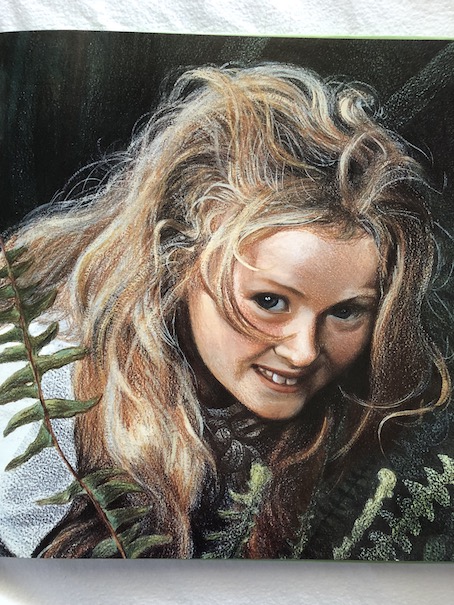
I love the way that the adventure unfolds in the children’s minds and the pictures show what is actually happening to the children, as their mother and everyone else sees them.  The pictures are beautiful and realistic.  The book was originally published in Australia, and I recognize some of the plants from pictures that a friend of mine there has sent me!

The book is available to borrow and read for free online through Internet Archive.

Drac

The Princess in the Pigpen

The Princess in the Pigpen by Jane Resh Thomas, 1989.

Elizabeth is the nine-year-old daughter of a nobleman in London in the year 1600, and she’s very sick.  However, while she’s lying in her bed with a terrible fever, she suddenly finds herself in a pigpen in 20th century Iowa with no idea how she got there. At first, she doesn’t even know where she is, and when she is found by the McCormick family, the family who owns the farm, they have no idea who she is or where she came from.  That she is very ill is obvious, so they take Elizabeth to the local doctor, who says that she has scarlet fever (what strep throat turns into when it’s neglected, it’s serious and life-threatening) and gives her penicillin, which helps her to recover.

However, there is still the question of how Elizabeth ended up on the McCormick farm in Iowa in the first place.  Elizabeth tells them that she is from London and insists that the year is 1600.  Ann, the McCormicks’ daughter, who is about the same age as Elizabeth, doesn’t believe that Elizabeth is really from the past.  The current year is 1988, and Ann thinks that Elizabeth is probably crazy, but obviously in need of some help.  The McCormicks tell the local sheriff about Elizabeth, and he begins looking through reports of missing persons to find one that fits her.

Still, it’s hard to explain Elizabeth’s strange clothing (Ann is sure that Elizabeth must be rich because her dress is obviously very fancy) or the antique toys that were found with her (a doll and a music box).  When Ann goes to school, Elizabeth stays at home with her mother, Kathy, and asks her about all the strange things that she’s been seeing around her, like cars and electric lights.  Kathy assumes that Elizabeth is merely confused and that her memory has been affected by her illness.

By coincidence, Kathy is a historian, teaching at a nearby university, and has studied English history.  She is aware of Elizabeth’s family, including her father, Michael the Duke of Umberland.  When Elizabeth asks her if she knows what happened to her mother, who was also ill when she last saw her, Kathy says that she was still alive in 1605, which means that she must have survived her illness.  Kathy quizzes Elizabeth in English history, and Elizabeth knows the correct answers because they are all current events to her.  Kathy thinks that someone must have taught Elizabeth history but notices that Elizabeth really seems to believe everything she says and knows a surprising amount of detail.

Further research into history and Elizabeth’s family tells Elizabeth the years when her parents and other people she cares about will die, which is distressing to her.  Ann begins to believe Elizabeth about her life when Elizabeth describes her home to her, and the description matches one in a book.  In the same book,there is also a portrait of Elizabeth’s family from 1605.  In the portrait, Elizabeth is a little older than she is now, and her mother has had another baby.  Elizabeth’s doll and music box are also in the painting.  The book also contains an account of the fire that later destroyed the manor house.  According to the book, Elizabeth managed to save the lives of her family by alerting them to the fire and also managed to salvage a couple of valuable books.

Now that Ann is convinced that Elizabeth is really from the past, they must find a way to help Elizabeth to return home so that she can save the lives of her family!

The book is available to borrow and read for free online through Internet Archive.

My Reaction

There were a couple of things that I liked about the time travel in this story. One is that it seems that it was fated to happen. Elizabeth is meant to survive her illness and to save the rest of her family. She was only able to do that because she had been to the future and learned about the dangers they would be facing. When she returns to her own time, she doesn’t change the past but makes sure that things turn out the way they were supposed to.

I also found it interesting that Elizabeth’s family has no living descendants in the late 20th century. Her family continued beyond Elizabeth’s time, but the family line apparently ended before the time period of the modern characters in the story, so we don’t have one of those moments that sometimes occurs in time travel stories where the modern characters meet a descendant of the past characters. That can be a fun moment in some stories, but I appreciate the variety.

At one point in the book, Ann makes a reference to the book A Wrinkle in Time, about other children who get “lost in space and time.”

Four Dolls

FourDolls

Four Dolls by Rumer Godden, 1983.

This is a collection of four stories about different, special dolls.  Each of the stories is from the perspective of the dolls themselves, talking about their owners and their adventures.  A common thread through all four stories is the bond between the dolls and their owners and how they make a difference in each other’s lives.

Even though the collection of stories is from 1983, each of the individual stories in the book was written separately, in different years.  You can find each of these stories as their own individual books as well as part of other collections.  I give the original years of each story next to their titles.

The pictures in the book are wonderful, some of them in black and white and some in full color.

The book is currently available online through Internet Archive.

The four dolls and stories are:

Impunity Jane (1955)

FourDollsJane

The word “impunity” basically means freedom from harm, and it’s an apt nickname for the doll Jane.  She’s a very sturdy little doll, the kind that can stand up to the rough play of children and last for a long time.  From the time when she is first bought, she stays with her original owner’s family, passed down through the generations and enjoyed by various girls in the family.  However, they mostly keep her in the family doll house and play with her in different ways.  One girl likes to sew clothes for her and another, who wants to be a teacher, gives her lessons.

There is just one problem: Jane is frequently bored.  More than anything, she wants to be a pocket doll, carried around in her owner’s pocket, seeing the world and experiencing everything.  She doesn’t get much excitement in the doll house where the girls keep her, and her latest owner doesn’t seem interested in playing with her at all.  But, unexpectedly, a boy in the family comes to her rescue, the younger cousin of her current owner.  Although most boys aren’t interested in playing with dolls, Gideon likes to use Jane as his “model”, taking her outside, carrying her around in his pocket, and giving her rides in his toys, giving Jane the adventurous life she’s always dreamed of!

At first, Gideon borrows the doll without his cousin’s permission, and Jane dreads the day that he will give her back, even though she hates to see Gideon feel guilty.  Fortunately, when Gideon does take her back, it turns out that his older cousin is getting rid of a lot of her old toys because she’ll soon be heading off to boarding school. She tells Gideon that he can have anything he wants, so he keeps Jane, who continues being Gideon’s model and good luck charm.

The Fairy Doll (1956)

FourDollsFairy

Elizabeth is the youngest of her siblings and feels like she can’t do anything right.  She’s always making mistakes and can’t even ride a bicycle.  Everyone is used to telling her what to do, and she receives a lot of criticism from teachers and parents and teasing from other children, giving her poor self-confidence.  She is clumsy and break things, she forgets things, and she is frequently punished for every little thing she does.  The more they all scold her, the more mistakes she makes, and they can’t seem to figure out why.

(It’s painfully obvious while reading it – Elizabeth’s family makes her live in a constant state of nervousness, and she’s afraid of really trying many things because they keep telling her that she can’t do anything.  Her siblings seem more outright abusive rather than simply teasing, and her parents seem clueless, not punishing the older siblings for their terrible, bullying behavior.  I think that the family is meant to seem merely impatient with Elizabeth because they forgot how much younger she is than the other children and perhaps thoughtless to the effect that they’re having on her, but it seriously looks like they’re actually gaslighting the poor kid, purposely and systematically undermining her self-confidence for their own sick amusement, even the girl’s father.  Seriously, I hated all of them (except Elizabeth, whose only real problem is being a little kid) before I was very far into the story.)

However, the Fairy Doll that has been passed down in their family seems to have a kind of magic effect on Elizabeth.  No one knows quite where the doll came from because it’s been around for so long, although they use her as a Christmas decoration every year, at the top of the tree.  Only Elizabeth’s mother and great-grandmother seem concerned about Elizabeth at all, and it is at the great-grandmother’s insistence that Elizabeth be given the Fairy Doll to play with all year, after Elizabeth accidentally breaks a crystal bowl. (Which she only did because her bratty sister Josie shoved her from behind while she was holding it. Why did the parents never notice and properly punish the little brat Josie like they should?  I’m telling you, they’re clueless and useless, and possibly gaslighting her.  It really looks like that.  The father even makes a big deal about what use it is to give Elizabeth Christmas presents like the other children when she doesn’t ride the bike he gave her. Look, she’s just a little kid, and it takes some kids longer to learn to balance than others.  What a weird, oddly vindictive father.)

The Fairy Doll seems to suggest things to Elizabeth.  When Elizabeth doesn’t quite know how to do something, the Fairy Doll gives her hints.  When Elizabeth is in danger of forgetting something, the Fairy Doll reminds her.  In other words, the Fairy Doll does what a family is supposed to do and what her family could do if they weren’t so busy bullying her. The Fairy Doll offers Elizabeth help, support, and guidance.  Elizabeth is only seven years old at the oldest in the story, and Elizabeth’s family is too busy yelling at her for doing little things wrong or not knowing things to properly teach her anything.  They say that they tried to teach her to ride a bike, but I wonder how much “teaching” actually happened and how much it was really just yelling and mocking her for not already being able to do it.  I think they also get kind of a kick out of seeing Elizabeth look bad because they think it makes themselves look better. 

(The father in the story seriously disturbed me.  What kind of father is that hateful just because a very young child has some trouble riding a bike? Also, what’s the hurry in her riding it right away? Bikes don’t come with an expiration date, so it’s still going to be there when she grows a little more and learns to balance better.  Taking a little while to learn to ride a bike is hardly a sin, but Elizabeth’s father makes it clear that he does not care about Elizabeth’s feelings at all.  She has to buy his affection by . . . learning to ride a bike?  Because only bike riders are truly worthy of love?  Elizabeth’s family is really useless and weirdly vindictive.  I still hate them.  They are that horrible, just hearing about them.)

Little by little, Elizabeth’s small successes add up, and Elizabeth slowly crawls out of her shell, becoming more confident while her nasty, bratty, horrible siblings (yeah, I’m still angry, and I wonder if the father’s favorite little darling is the little psycho Josie) marvel at how she changes.

Little by little, Elizabeth comes to realize that she can do more than she thinks she can.

The Story of Holly and Ivy (1959)

FourDollsHollyIvy

Holly the doll doesn’t like being in the toy shop.  Abracadabra the owl frightens her, and she wishes that someone would buy her and give her to some girl as a Christmas present.

Meanwhile, Ivy is a troubled orphan who dreams of a new home with a grandmother who could take care of her.  When other children from the orphanage are taken to spend Christmas with families and Ivy is left behind, she tries to take matters into her own hands and find a family for herself.  Is there someone who could make wishes come true for both Holly and Ivy?

I worried about Ivy during this story, even though I knew that she and Holly would eventually end up together and okay.  She is lucky that she didn’t freeze to death.  Abracadabra the owl is also kind of a disturbing character, but they also get rid of him by the end of the story.  Apparently, the assistant in the toy stop doesn’t like him, either.

Candy Floss (1960)

FourDollsCandyFloss

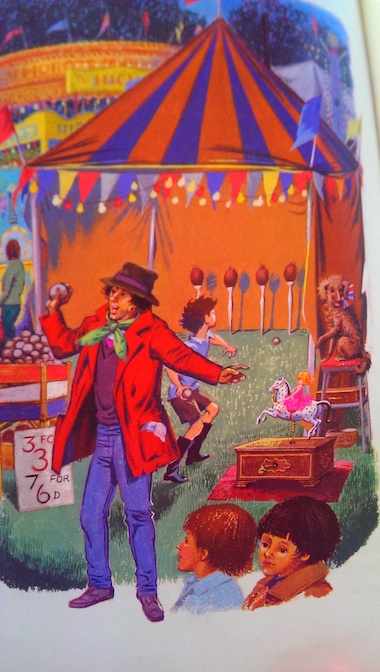
Candy Floss the doll belongs to Jack, who runs a carnival game, a “coconut shy,” where people try to throw balls at coconuts to knock them down and win a prize.  She enjoys living with Jack and his dog.  Jack has a special music box with a little horse on top, and Candy Floss sits on the horse while the music box plays and Jack’s dog begs nearby.  In this way, Candy Floss and the dog earn a little extra money.  When Jack is done working, he takes his dog, Cocoa, and Candy Floss the doll with him to see the rest of the carnival, and both of them enjoy it.

One day, a spoiled girl named Clementina attends their carnival.  Although Clementina is from a wealthy family, and her parents give her all sorts of things, she finds that she is frequently bored and unhappy.  When Clementina sees Candy Floss, she wants her, too, and is angry when Jack says that she can’t have her.  It’s the first time in her life that anyone has said “no” to Clementina about anything.  Clementina steals Candy Floss just to prove the point that when she wants something, she gets it.

However, Candy Floss wants to return to Jack.  She refuses to accept Clementina as her new “owner,” resists Clementina’s efforts to play with her (much to Clementina’s surprise), and finds a way to teach Clementina a lesson about greed.

In the end, Clementina not only returns Candy Floss but helps Jack to run his carnival game for awhile.  Part of Clementina’s unhappiness is caused by the fact that, even though she has many toys to play with, she doesn’t have much to do that is really meaningful to her.  She is surprised when she discovers how good it can feel to really earn something, like the coins that Jack gives her for helping him.

One of the cute things about this story is that it includes the music and words for the tune in the music box.

The book, which contains all four of these stories, is currently available online through Internet Archive.

The Polar Express

PolarExpress

The Polar Express by Chris Van Allsburg, 1985.

One Christmas Eve, a young boy is lying awake in bed when he hears strange sounds.  When he looks out of his window, he is astonished to see a train outside of his house, where there aren’t any train tracks.  He goes outside to investigate, and the train conductor tells him that the train is heading to the North Pole and asks the boy if he wants to come.

PolarExpressTrainRide

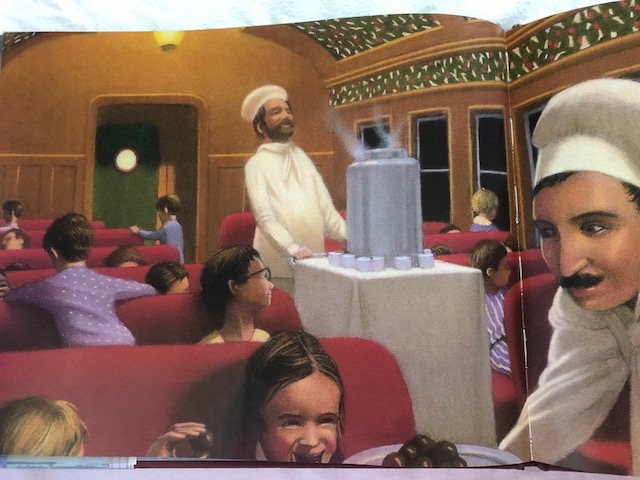
The boy (who is never named) believes in Santa Claus even though some of his friends no longer do, and he gets on board the train.  The train is filled with other children, singing Christmas songs, eating candy, and drinking hot cocoa.

PolarExpressSantasCity

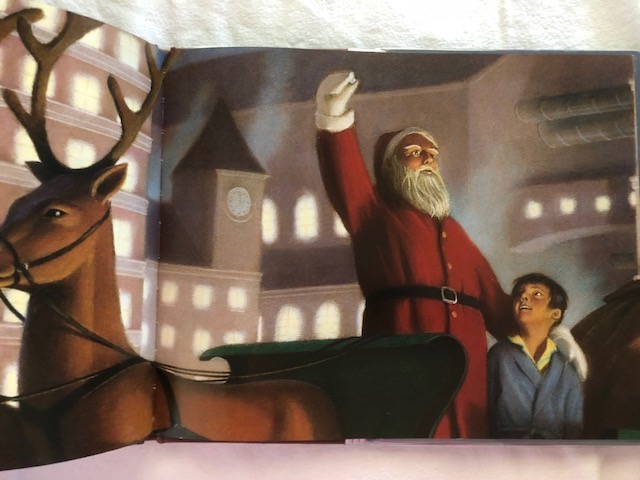
After a long trip over mountains and through forests, they arrive at Santa’s city at the North Pole, where they get to take part in a ceremony to give the first gift of Christmas.  Out of all the children from the train, the boy who narrates the story is chosen to receive the first gift.  He can ask for anything he wants for Christmas, but he asks for a bell from Santa’s sleigh as proof of his adventures and Santa’s existence.

PolarExpressGift

When the children get on the train to go back home, the boy seems to have lost the bell because of a hole in his pocket, and he is sad.  However, the bell reappears on Christmas morning as a mysterious extra present under the tree.  The boy’s parents can’t hear the bell ring, and they think it’s broken, but the boy and his sister, Sarah, can hear it.  The boy says when he and his sister grew up, Sarah eventually reached the point where she could no longer hear the bell, but he still can because only people who believe in Santa can hear the bells on his sleigh.

PolarExpressChristmasMorning

The book is a Caldecott Medal winner, and it has become a Christmas classic!  Some places that have trains hold special Polar Express train rides where they decorate the trains with Christmas decorations and try to re-create the ride from the book.  There is also a movie version of the book, although the story in the movie includes incidents which weren’t in the book to make the movie longer and more dramatic.  The original story was very calm and low-key, although still magical, the kind of thing that you could easily read to a child in bed on Christmas Eve.

Most of what Internet Archive has about The Polar Express is related to the movie, but there is also an audio version of the original book. For the benefit of teachers and homeschooling parents, there is also A Guide for Using The Polar Express in the Classroom on Internet Archive.

Changes for Molly

American Girls

MollyChanges

Changes for Molly by Valerie Tripp, 1988.

MollyChangesLetterMolly’s family has wonderful news!  Molly’s father is coming home from the war to take charge of a veterans’ hospital right in their home town!  Everyone in the McIntire is happy, but Molly has one worry: In her father’s letter, he talked about how much her brothers and sister have grown and changed since he’s been away, but not her.  Molly still feels like plain old Molly, and she thinks that her father will look at her like she’s still a dumb little kid.  What can she do to show her father that she’s grown in the last two years, like her siblings have?

One thing she can do is get the role of Miss Victory in her dance school’s performance.  She’s favored to get the party anyway because she dances it so well.  But, with her plain, old, straight braids, Molly thinks that she looks too plain and little-kid like to get the part.  What she wants more than anything is to have curls.  Miss Victory’s pretty crown would look great on a girl with a head full of curls.

MollyChangesPinCurlsHer friends try to help her by buying a box of hair permanent and offering to help her use it, but it soon becomes obvious that they really don’t know what they’re doing.  Fortunately, Molly’s older sister, Jill, catches them before their experiment goes too far and talks them out of it.  Molly’s older sister likes to trade hair tips with her friend, Dolores, and she’s more experienced with doing hair.  She says that if curls are important to Molly, she’ll help her to set her hair in pin curls until it looks the way she wants.

As Jill helps Molly with her hair, Molly talks to her about how grown up she is and how she still feels like such a kid who hasn’t changed much since their father went away.  Jill says that she doesn’t think that it’s true.  Jill is five years older than Molly, and she tells her that growing up is something that takes time.  A ten-year-old like Molly just isn’t going to be the same as a fifteen-year-old like Jill, and she shouldn’t try to be.  Jill says that the war and their father’s absence has made them all grow up a little faster than they would have otherwise.  They’ve had to become more mature, more accustomed to making little sacrifices and making do.  In a way, Jill envies Molly for having some of her childhood left to spend with their father when he comes home.  Jill has already left a lot of hers behind.  But, she says that even if Molly doesn’t look very different on the outside, she’s changed somewhat on the inside.  She’s developed a more mature outlook on the world.  She’s become more aware of some of realities of life and what’s important (at one point in the story, she and her friends talk about the people they know who have returned from the war permanently injured and some, like their teacher’s fiancé, who were killed and will never come back), and she’s starting thinking about other people more (Jill reminds Molly of how understanding and generous she became when Emily was staying with them).  Molly just wishes that she would look more mature on the outside, too.  More than anything, she hopes that her father will arrive home in time to see her as a beautiful Miss Victory!

Molly gets part of her wish in getting the role of Miss Victory, but it seems like everything is ruined when she comes down with a bad ear infection and won’t be able to be in the performance at all.  Her father’s arrival home is also delayed, so Molly is stuck at home alone while everyone else is at the performance.  But, just when Molly is feeling horrible and gloomy, what seems like a disappointment turns into something good when she is the first person to welcome her father home, a father who is glad to see her looking just the way he remembered her, braids and all!

In the back of the book, there is a section of historical information about the end of World War II and what happened when soldiers began returning home.

The book is currently available online through Internet Archive.
MollyChangesHistorical

Molly’s Surprise

American Girls

MollySuprise

Molly’s Surprise by Valerie Tripp, 1986.

MollySurpriseFamily

Christmas hasn’t been the same in the McIntire house since Molly’s father went overseas as a doctor during World War II.  As Molly writes her father a letter before Christmas, she and her mother and siblings talk about whether or not he might send them presents.  Molly is sure that he’ll send something and adds a “thank you” to the letter she’s writing, but her older sister, Jill, is less sure and worries that he’ll feel bad if Molly thanks him for presents that he was unable to send.  The boys talk about whether or not any presents that he might send could be shot down before reaching them, and Brad, the youngest child in the family worries about whether Santa might get shot down, too.  The children’s mother reassures them, but it’s just another sign of how the war has changed the feeling of Christmas.

MollySurpriseTreeBuying

Jill tries to be realistic and tells Molly that she should be, too.  Jill thinks that there probably won’t be many presents this year, and what they get will be mostly practical things, handmade gifts, or hand-me-downs because of war rationing and the family’s need to be frugal.  Everyone is determined to be practical and patriotic, but Molly finds all this “realistic” talk depressing.  When her father was home, Christmas was always a time of surprises, and she likes to believe that, somehow, he will still find a way to surprise them.

When the children’s grandparents call and say that they won’t be able to come after all because of car trouble, and they won’t be able to bring them a Christmas tree as promised.  The kids are depressed, but Molly says that they’ll just have to do as their mother told her earlier and rely on themselves to make their own Christmas surprises this year.  Jill, Ricky, and Molly pool their money and go out to buy a tree.  As in the Charlie Brown Christmas special, the only tree they can afford is small and scrawny, but it’s better than no tree at all.

MollySurprisePackage

Once they get the tree decorated, it looks much better.  As they decorate the tree, Jill admits that some of her attitudes about how this Christmas should be different and more simple from others is because she really misses their father, and when everything looks the same as it did before he left, it just reminds her of how much she misses him.  Molly also admits that she doesn’t really care what presents their father sends; she’s only worried that, if a package doesn’t arrive, it might mean that something bad had happened to him.  All of the kids want the reassurance that their father is still okay.

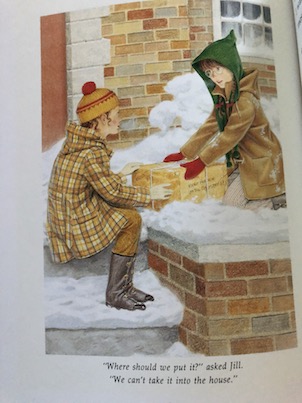
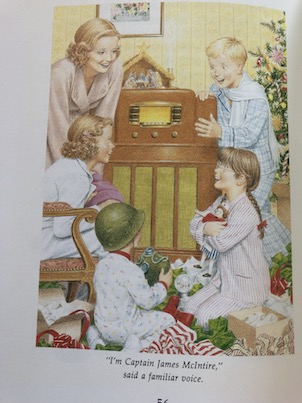
The next day, when the children go out to play in the snow, they find the package from their father that they’ve been waiting for!  However, there is a note on the package that says, “KEEP HIDDEN UNTIL CHRISTMAS DAY!”  Probably, their father wanted their mother to hide the package from the children, but since Molly and Jill are the first to find it, they decide to do the hiding themselves, putting the box in the storage room above the garage.  Jill thinks they should tell their mother about it, but Molly persuades her to wait because she doesn’t want to ruin their father’s surprise.

MollySurpriseRadio

On Christmas Eve, the girls retrieve the box and put it under the tree after everyone else is asleep.  However, that’s not the end of the Christmas surprises.  Their father has one more special surprise for them . . .

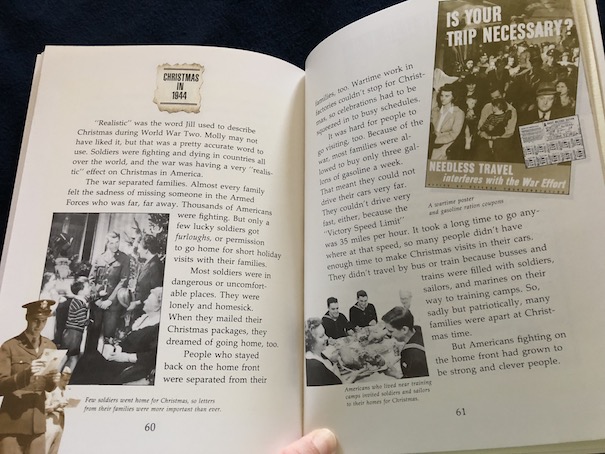
There is a section in the back of the book with historical information about Christmas during World War II.  Many families couldn’t be together during the war because families members were overseas and because many civilians limited their traveling during the war in order to save gasoline.  In fact, speed limits were greatly reduced in order to save gas – the “Victory Speed Limit” restricted people to driving no faster than 35 mph.  Public transit, like trains and buses, was often needed to transport soldiers, so civilians avoided traveling as much as possible.

MollySurpriseHistorical

People also had to get creative about Christmas treats because some essential ingredients, like butter and sugar, were rationed.  People also made their own decorations.  The selection of toys was somewhat limited because factories had been converted to making war materials, and many families gave their children practical gifts. However, there were still toys available, and people managed to give their children a few special surprises.

The book is currently available online through Internet Archive.

Happy Birthday, Molly

American Girls

MollyBirthday

Happy Birthday, Molly! By Valerie Tripp, 1987.

MollyBirthdayEmily

Molly is excited because she has just learned that an English girl will be coming to stay with her family for a while.  The girl, Emily, is one of the child evacuees from London.  Really, she’s supposed to be staying with her aunt, who also lives in Molly’s town, but her aunt is in the hospital with pneumonia and won’t be able to take her for another couple of weeks.  In the meantime, Molly and her friends are eager to meet her, imagining her to be something like the English princesses, Elizabeth and Margaret Rose.

The girls have a fascination for England after all the things they’ve seen in movies and newsreels.  Recently, they saw a newsreel about bomb shelters in England.  Inspired by what they’ve seen, the girls make a pretend bomb shelter under an old table and enjoy pretending that they are like the people in the newsreel.  Molly’s brother, Ricky, says that it isn’t very realistic, and the girls say that they’ll have to ask Emily when she comes.

MollyBirthdayBlackOut

However, Emily turns out to be very shy and quiet.  She’s pale and skinny and hardly talks at first.  When the girls show her their “bomb shelter”, she doesn’t want to play in it.  Molly thinks that maybe Emily doesn’t like them, but her mother reminds her that, in World War II England, bomb shelters aren’t places to play.  Emily is the same age as Molly, and the war has been going on since she was a little kid.  Molly’s mother points out that Emily probably doesn’t remember much about life before the war.  Emily is accustomed to bombings and danger all around her, and Molly’s mother compares her to a flower “who’s not sure it’s spring yet.  It will take some time for her to realize it’s safe to come out now.”

Emily goes to Molly’s school, and their classmates are fascinated with her.  This fascination makes Emily even more shy than she would be otherwise as kids try to imitate her accent and ask her questions about what it’s like to see buildings bombed.  To the America kids, the war seems exciting, and they want to know what it’s like to see it up close, but Emily dodges their questions.

Molly finally comes to understand why Emily is so evasive when their town has a blackout drill.  When the drill starts, a siren sounds, and everyone has to go down into their basements until they get the signal that it’s all clear.  Molly is surprised to see that Emily is actually frightened by the drill, but everyone assures her that it’s just for practice, not because Illinois is actually going to be bombed.  In Molly’s family, it’s almost like a game, but Emily has memories of real bombings during the Blitz.  As they sit in the basement during the drill, Emily explains it to Molly: the fear, the explosions, destroyed buildings, people getting hurt or killed.  Molly and her friends thought it was exciting to hear about the war in newsreels, but living it is an entirely different thing.  The drill and everyone’s questions about what bombings are like bring back bad memories for Emily.

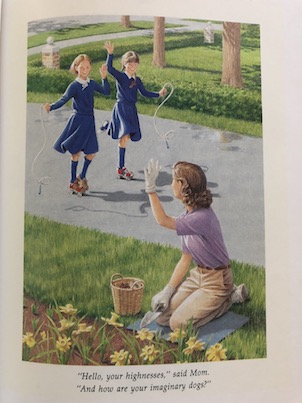
As Molly comes to understand Emily’s feelings more, Emily opens up to her.  The girls discover that they share a fascination with Princess Elizabeth and her sister Margaret Rose.  They start playing a game where they pretend to be the princesses, dressing alike in blue skirts and sweaters.  Because the princesses have pet dogs, the girls also pretend that they have dogs, using jump ropes as leashes for their imaginary pets.

MollyBirthdayPrincesses

Molly’s birthday is approaching, and she offers to let Emily share in her party and help plan it.  She’s curious about what people in England do on their birthdays, and the idea of an English tea party sounds great to her friends.  However, Molly doesn’t like the way that Emily describes English birthdays, and the types of sandwiches that the English tea with tea don’t sound very good.  Worst of all, Emily says that, at her last birthday before the war rationing started, she had a lemon tart instead of a cake.  Molly can’t imagine her birthday without a birthday cake.  Mrs. Gilford, the housekeeper, has been saving up rationed goods for her cake this year, and it’s what she’s been looking forward to the most!

Sharing things with Emily becomes more of a trial for Molly, and when the girls argue about their countries’ contributions to the war effort, they get into a fight and Molly starts thinking that she doesn’t even want Emily at her birthday party.  However, Molly’s mother points out to the girls that the war effort is a team effort.  A couple of special birthday surprises help the girls to make up, including something extra special that helps Emily to heal further from the trauma of the war.

In the Molly, An American Girl movie, Emily plays a larger role than she did in the books.  This is the only book in the series where Emily appears.  Her story was changed somewhat for the movie, too.  In the movie, she says that her mother was killed in a bombing.  In the book, her parents are both still alive, and it was her dog who was killed.  Molly doesn’t learn that until the end of the book when her family gives the girls a pair of puppies as a present, and Emily tells her about her pet dog who died.

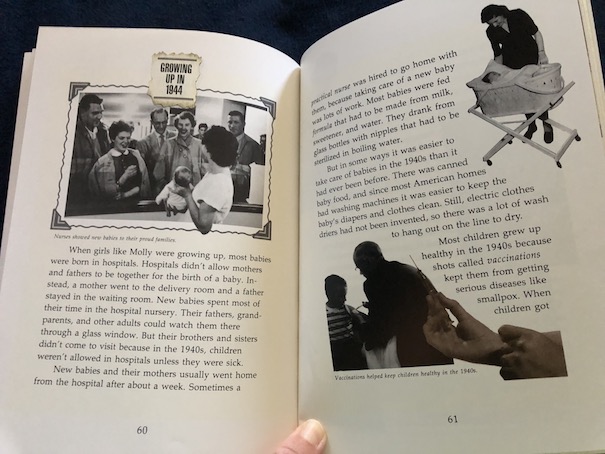
In the back of the book, there’s a section with historical information about what it was like to grow up in the 1940s.  It explains how women used to stay in the hospital for about a week after giving birth, and sometimes, they could hire a practical nurse to help them at home as well.  Canned baby food was a new invention, and vaccines helped to prevent disease.  Back then, people still got smallpox shots because the disease hadn’t been eradicated, but there was still nothing to prevent chicken pox or measles, so children with those diseases had to be kept at home with warning signs out front to tell people to stay away from the quarantined house.  (Note: My father was born in 1944, the year that this series takes place, and he said that throughout his early childhood, parents who knew of a child who had chicken pox would deliberately take their children to visit and get the disease.  It wasn’t that they really wanted their children to get sick, but since there was no way to prevent the disease at the time, they had to accept that it was inevitable that their child would catch it eventually, and chicken pox is somewhat peculiar in that there is a kind of age window in which the disease isn’t likely to be too bad.  If you waited too long, and the child got older or even to adulthood without getting it, it was bound to be much worse when they eventually caught it.  So, if your child was about the right age for getting it, in early childhood but no longer a baby, people thought it was best to get it over with so they could benefit from the lifetime immunity afterward.  This remained true even up through the 1980s, my early childhood, which is why I have a permanent scar on my face from the disease.  Now, there are vaccines to prevent it, although I understand that some people still have chicken pox parties in places where the vaccine isn’t readily available. If you have the option, go for the vaccine.  Preventing chicken pox also prevents shingles.)

MollyBirthdayHistorical1

The historical section also talks about child evacuees, like Emily, and what teenagers did during the 1940s.  It was around this time that people began looking at the teenage years as being a distinct phase of life, and businesses began specifically catering to teenagers.

The book is currently available online through Internet Archive.

MollyBirthdayHistorical2