The Time of the Forest

The Time of the Forest by Tom McGowen, 1988.

The story takes place in the prehistory of Denmark, among its earliest inhabitants.  It shows the conflict between the hunter-gatherers, who are native to the forests of that land, and the farmers, who have traveled to the area to build a new home on the edge of the forests.

When the two groups learn of each other’s existence, they become frightened of each other. The hunters are afraid that the new people will take over their hunting grounds, and they are offended that the newcomers cut down the trees to build their homes and clear land for farming. The farmers are afraid of the forest, the wild animals inside it, and the hunters, who they fear might start hunting them.

A young hunter, Wolf, watches the farmers to learn more about them, and he is fascinated by what he sees. In some ways, the two groups are alike, and Wolf finds himself wanting to know more about the ways of the farmers and maybe even make friends with the pretty girl, Bright Dawn, who he sees tending the farmers’ goats.

However, the son of Wolf’s chief has decided that the newcomers must be destroyed. When Wolf saves Bright Dawn from the chief’s son, the two of them must learn to work together and combine the skills of their different peoples in order to survive.

In the end, after a bloody clash between their respective peoples, both Wolf and Bright Dawn are each exiled from their tribes.  However, their exile actually gives them the freedom to start their own tribe that combines aspects of both of their societies.

The book is available to borrow and read for free online through Internet Archive.

My Reaction

This story was somewhat speculative about the early days of Europe, when societies were starting to shift from hunter/gatherer groups to more settled agricultural groups.  The author says that he was theorizing about the cultural clashes that may have taken place during this time.

Something I noticed about the story is that the groups, particularly the hunter/gatherer group, somewhat resembled some Native American groups around the time that they first encountered European settlers.  The author didn’t say anything about using their lifestyles as inspiration or drawing any parallels between them and early Europeans, but it did make me think about the similarities between groups that are living similar lifestyles but in different places.  In other words, it does seem reasonable that hunter/gatherers living in Europe would be living in circumstances that would be very similar to hunter/gatherer groups in the Americas.

The Quilt Story

The Quilt Story by Tony Johnston and Tomie dePaola, 1985.

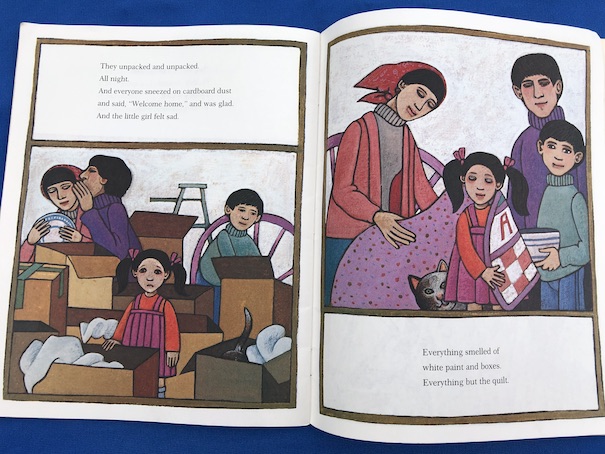
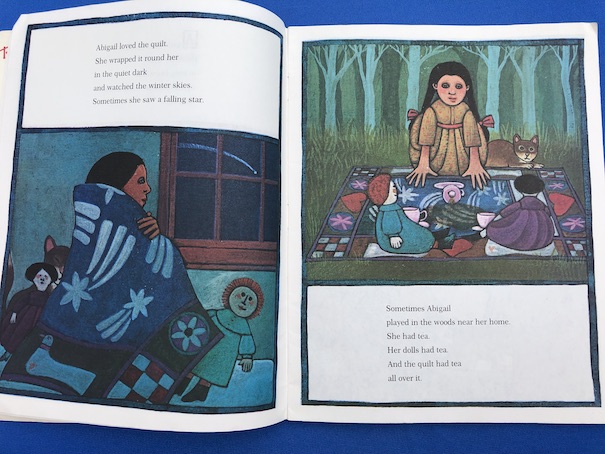
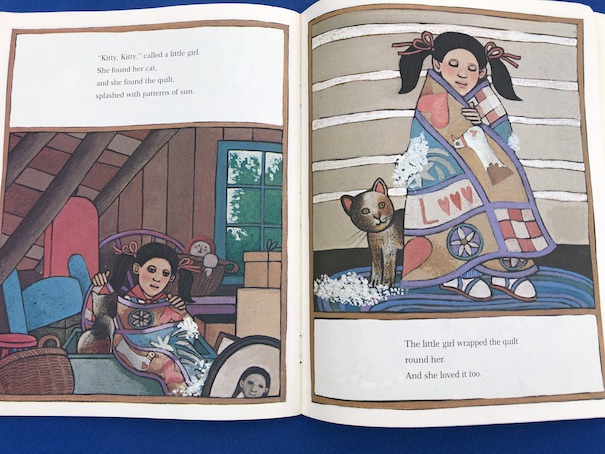
A woman (at some point in the 1800s, from the pictures) makes a special quilt for her young daughter, Abigail.  It has Abigail’s name on it and a pattern of falling stars.  Abigail loves it!

Abigail uses the quilt all the time, not just in bed.  She has tea parties with her dolls on the quilt, hides under it when playing hide-and-seek, generally taking it everywhere and playing all kinds of games with it.  The quilt gets worn and torn in the playing, but her mother mends it when necessary.

Eventually, Abigail and her family move to a new home, traveling in a covered wagon.  Everything in their new home seems strange to Abigail, but her old quilt comforts her.

Eventually, when Abigail is older, she puts the quilt away in the attic, and people forget about it.  Still, animals use the quilt.  A mouse makes a nest it in.  A raccoon hides food in it, and a cat naps on it. Then, one day, another girl finds the quilt in the attic.  She loves it and brings it to her mother to be repaired. 

Like Abigail, though, the modern girl’s family soon moves to a new home, where everything seems new and strange.  However, the old, familiar quilt comforts the girl once again.

This is a gentle, comforting story that would make nice bedtime reading or a story that could be read to a young child who is moving or has recently moved, reminding them that, even in a new place, you can bring a sense of home and the familiar with you.

The book is currently available online through Internet Archive.

When I Was Young in the Mountains

When I Was Young in the Mountains by Cynthia Rylant, illustrated by Diane Goode, 1982.

This nostalgic picture book is based on the author’s experiences living with her grandparents in West Viriginia when she was young.  It paints a vivid picture of Appalachian life in the past. The story doesn’t give any particular years to describe when it takes place, but the author apparently lived with her grandparents during the 1960s, although from the pictures, it would be easy to believe that the story takes place in a much earlier time. Partly, the style of the clothes and stoves give that impression, but for me, it was really the cloth cover over the camera that made me think it was during the first half of the 20th century. You can still get these covers, but they’re not as common in modern times.

In the story, the author describes various aspects of Appalachian life, starting each section with “When I was young in the Mountains . . .”  She remembers her grandfather coming home after working in a coal mine and how they would all have cornbread, fried okra, and pinto beans for supper.

For fun, the kids would go swimming in the swimming hole.  They would also use the swimming hole for baptisms. They would also use the schoolhouse as their church.

She describes the general store where her family would go for groceries and how they would have to heat water on the stove for baths.

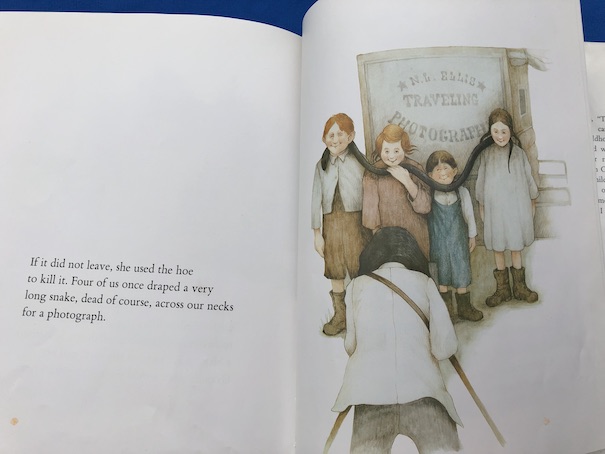
Sometimes, they had to deal with snakes, and once, when their grandmother killed a particularly big one with a hoe, they took a picture of the children with it.

Overall, the story is about enjoying the simple pleasures in life in a place you love, surrounded by people you care about.

This is a Caldecott Honor Book. It is currently available online through Internet Archive. Sometimes, you can also find people reading this book aloud on YouTube. I particularly like this reading because I think the reader has a good accent for reading this story, and she comments on her own experiences growing up in the country.

Lauren’s Treasure

Sleepover Friends

#8 Lauren’s Treasure by Susan Saunders, 1988.

The Sleepover Friends have volunteered to take part in an archaeological dig on the site of an old mansion, which is also on land where a Native American tribe once lived.  Other students from their school and a school in a nearby town will also be taking part.  Stephanie isn’t sure that she’s going to like being part of the dig because she doesn’t really like getting her hands dirty and she thinks it would be gross if they uncovered the bones of dead people during the dig.  The others are more excited about the dig, but at first, it doesn’t turn out as well as expected for Lauren.

First, Lauren’s hair is weird on the day of the dig because the other girls tried to give her a perm at a sleepover and it didn’t go well.  Then, she attracts some unexpected attention from Walter, a new neighbor of Stephanie’s.  Walter is in the fourth grade, but only because he skipped a couple of grades to get there.  He’s only eight years old, but he’s something of a child genius.  He’s not really a bad kid, but when he starts following Lauren around and acts like he’s got a crush on her, Lauren is embarrassed because he’s so much younger than she is.

Then Lauren makes an exciting discovery on the dig: a carved rabbit charm.  The archaeologist in charge of the dig is excited because its presence, along with some yellow paint, means that they’ve found a Native American burial spot.  She takes the younger children off the dig and has her grad students continue searching for the grave itself.  Lauren is pleased at being the one to make an exciting find, but the charm mysteriously disappears at the dig.

The archaeologist thinks that, most likely, the charm fell out of the tray Lauren was using to collect things on the dig when everyone started pushing to get a look at the spot where it was found.  She says that she and the grad students will keep an eye out for it as they continue the dig.  For Lauren, it just seems like another piece of bad luck in her bad luck streak.

Walter continues paying too much attention to Lauren at school, and later, writes an anonymous note, asking her to meet him at a local pizza place.  At first, Lauren thinks that the note was writing by Jenny Carlin, a rival at school, because of a series of pranks they were playing on each other earlier.  When Jenny denies being responsible for the note, Lauren goes to the pizza place and sees Walter.  Unfortunately, Jenny and her friend Angela show up there, too, curious to see who was meeting Lauren, and they tease her and Walter.  Lauren is embarrassed at having a kid so much younger than she is (genius or not) chasing after her, and she hates the teasing that she gets at school about it, but she’s not quite sure what to do about it, other than ignoring Walter as best she can.  However, Walter is actually the key to solving the mystery of what happened to the rabbit charm.

You might guess at this point that Walter was the one who took the charm in the first place.  I thought it was pretty obvious myself.  Walter wasn’t trying to cause trouble.  He explains to Lauren that he was trying to get her attention, and his first plan was to pretend that he found the missing charm after a search so that he could look like a hero to her.  He just never got the chance to give it back because he got interrupted, and then Lauren started avoiding him because of the teasing.  It all works out for the best because Lauren gives the charm back to the archaeologist, who doesn’t press her too closely about where she found it, and Walter gets a crush on a different girl who is a little closer to his age. 

Getting a crush on someone who either doesn’t feel the same way or just isn’t available is a normal part of life (if it wasn’t, it wouldn’t appear so often in tv shows, movies, and books – people find this type of situation relatable), and so is being the subject of a crush from someone you don’t love or find unsuitable (again, that’s why this situation comes up often in fiction – it happens often enough in real life that people understand the feeling).  When it comes to getting boyfriends or girlfriends, one of the people involved has to be the first to stick their neck out and say that they’re interested, and there’s no guarantee that the feelings will be returned.  It’s not easy, but this is a part of how relationships start.  When the feelings aren’t returned, which is bound to happen from time to time, there’s always some awkwardness.  The first person is usually disappointed, and there might be a struggle for the other person as they try to find a way to turn the other person down without hurting their feelings.  The situation in this book is especially awkward because precocious young Walter is so young, and it’s likely a first crush for him.  Lauren has also never had to deal with a situation like this before and isn’t quite sure how do handle it. 

In a way, having Walter simply lose interest in Lauren feels a little like a cop-out for the situation so neither of them really has to confront the situation directly, but there are a couple of things that Walter has come to realize by the end of the story that may be useful.  One good point is that there are limits on the things people should be allowed to do to get someone’s attention and start a relationship with him.  When Walter was just trying to strike up a conversation with Lauren or be helpful to her at the dig, it wasn’t bad.  It didn’t get Lauren’s approval for him, but it wasn’t because his behavior was bad (more about this later because it’s important).  The bad part came when he stole the charm to get her attention.  When Walter’s mother later finds out about his theft of the charm, she grounds him and makes him give the charm back and confess to Lauren what he did.  Learning that life has limits and that some behaviors don’t get you the kind of attention you’re really looking for is a good life lesson.  Some people do come on too strongly when they’re seeking attention, and I’m not just talking about kids who aren’t experienced enough to know how to behave; even adults don’t always know the best way to approach romantic relationships or understand others’ limits and boundaries regarding them.  I’m no relationship expert, but I think that the solution is partly developing a kind of situational awareness and an ability to empathize with other people and read their reactions.

Before the story is over, Walter learns more about reading other people’s reactions and understanding how his actions fit into the larger situation from someone else’s viewpoint.  At first, Walter doesn’t seem to sense Lauren’s discomfort, and her friends criticize him for not taking a hint.  Lauren felt a little awkward about his helpfulness at the dig not because it was a bad thing (he was really trying to be nice and there was nothing objectionable about what he said or did until he took the charm – I want you to understand that she wasn’t rejecting him for being a nice guy or anything like that) but because she had reservations about getting too involved with someone so much younger than herself, and she felt like his attention put her in an awkward position.  Walter is a genius, but he is still physically and socially about three years behind the other kids in the story, and at first, he can’t see why that would create awkwardness in a romantic relationship, especially for kids who are only just starting to get old enough to be interested in romance.  The difficulty for Lauren and the reason why she was so irritable with the situation was that she found it difficult to tell a younger kid who was being so nice to her that she didn’t welcome his attentions when he wasn’t doing anything really wrong and didn’t want to hurt his feelings.  As I said, an awkward situation.  Sometimes, even a person who is trying to be nice can unintentionally create awkwardness if they don’t understand the other person’s circumstances, and that’s something that adults do as well as children.  This is basically what’s at the heart of a situation where “nice guys” get rejected or “friend-zoned.” It’s not about the “nice guy” doing anything wrong so much as a case of the wrong relationship at the wrong time with someone who isn’t quite as compatible with them as they thought.  

In a romantic relationship, both of the people involved have to agree to it equally, one isn’t enough.  When Jenny and her friend start teasing Lauren and Walter after the incident at the pizza place, Walter comes to see why a relationship with him would make things awkward for Lauren because of their age difference and the reactions of the other kids.  If they were in their 20s or 30s, an age difference of two or three years wouldn’t mean anything, but for where they are in their lives now, as kids in elementary school, it means a lot.  At the end of the story, Walter’s new love interest is a little closer to his age, making less of a problem, and he has developed enough social awareness to use his age difference to get a little revenge on Jenny for her teasing by publicly asking her about meeting him at the pizza place later, as if she were interested in dating him.  Walter could have been hurt and insulted about being rejected and teased because of his age (and it would have been understandable), but he has realized that, under the circumstances, it would be better to move on and find someone who is more suitable for him and who might be more open to a relationship with him.  In the end, he feels good enough about the situation to use his age for the joke on Jenny, and his other classmates approve of his humor and the well-deserved jab at Jenny’s teasing.

The one thing that I really wish they had added to the story would be for Lauren to learn how to gracefully turn down an offer of a relationship when she isn’t interested because I think that would be an important life lesson for her and for young readers. Socially awkward situations occur in life, but there are ways of handling them to minimize the embarrassment for everyone involved. In the story, Lauren’s main tactic is trying to ignore Walter and hope that he’ll take it as a hint until he finds someone else, and in real life, that’s not good enough. I’m not sure what she would have said if Jenny and her friend hadn’t interrupted her and Walter at the pizza place, but I would hope that it would have been something like, “I appreciate the help you gave me at the dig, Walter, and you seem pretty nice, but I just don’t think that we have enough in common. I think that there is too much of an age difference between us, and I’m not interested in that kind of relationship.” The rejection still might sting, but some simple honesty would at least be more respectful than ignoring him and hoping that he’ll take that as a hint.

I read this book years ago when I was a kid, although there was only one part that really stayed with me, and for a long time, I thought that I was remembering the incident from one of the Baby-Sitters’ Club books.  The scene that stuck in my memory was from the sleepover at the beginning of the book.  The girls were angry at Jenny for some mean comments that she made, so they requested a song on the radio called “You’re a Jerk” by the Lurkers and dedicated it to her.  When they made the request, they told the radio station that they were “well-meaning friends” instead of giving their names, and the radio DJ made a joke about it when he played the song.  It was this incident that started off the series of pranks that Jenny and the girls play on each other throughout the book.  I think part of the reason this scene stuck with me was the “well-meaning friends” phrase and part of it was because I had always wondered if the song they requested was a real song.  I don’t think it is because I can’t find it on the Internet. The Lurkers are a real band, but I can’t find anything about that song. If that song actually exists and someone can find a video of it, let me know, and I’ll link to it!

The book is currently available online through Internet Archive.

Kate’s Camp-Out

Sleepover Friends

#6 Kate’s Camp-Out by Susan Saunders, 1988.

Kate’s family is spending the weekend at a cabin at Spirit Lake, and Kate is allowed to bring her Sleepover Friends with her.  However, what promised to be a fun and exciting weekend soon comes with complications.  First, Kate discovers that the Norwood family will be in a cabin nearby.  Dr. Norwood is a colleague of her father’s, but his two sons, Sam and Dave, are pests who like to play practical jokes.  When they arrive at the cabin, there is also no electricity (a problem that they fix the next day), and they learn that the reason the lake is called Spirit Lake is because there are some scary stories about the place.  Kate’s father tells the girls a story before bed about an old fur trapper who murdered another fur trapper for his money.  The ghost story is interrupted by Dr. Norwood, who comes over to see if everything is all right because there have been some break-ins in the area recently.

The girls are spooked by the ghost story, but the next day, they also encounter the Norwood boys and realize that they’re every bit as awful as Kate remembers them.  First, Sam and Dave trick a couple of the girls into wading out into a deeper area of the lake so that they’ll fall in and get wet.  Then, when the families meet for a barbecue, the boys give a couple of the girls worms in a bun instead of sausages.

Because of their bad experiences with the boys, the girls are allowed to go back to their cabin while the others finish the barbecue.  While the girls are at the cabin, they accidentally find a secret hiding place in the fireplace with a pouch of old coins inside!  The girls wonder if that could be the stolen money from the ghost story, but Stephanie, who has been reading a book about ghost stories from the area, says that the dates on the old coins are later than the story took place.  According to the book, a ghost child was once seen around their cabin, but the girls can’t figure out why a child would have hidden so much money.

While the girls wait for the adults to return from the barbecue, they fix dinner for themselves and decide to hold a séance to contact the spirits.  They don’t really believe that the séance will work when they try it, but without any tv or radio, they don’t have anything else to do, and they can’t get their minds off the ghost stories. 

To the girls’ surprise, they actually hear strange knocks in reply to the questions that they ask the spirits.  Then, a child’s giggle convinces them that it’s just the Norwood boys, spying on them and trying to scare them again.  It’s the last straw, and the girl plot how to get even with the Norwood boys!

The book is currently available online through Internet Archive.
My Reaction and Spoilers

This is one of those stories that has a somewhat ambiguous ending. When the girls try to catch the Norwood boys playing ghost, they instead discover the identities of the people behind the recent break-ins at the cabins. Later, they learn that Sam and Dave actually have alibis for the time that they heard the ghost noises, leaving them wondering if the knocking and giggling could have actually been a ghost. The girls do manage to play a prank on the boys before the end of the story, but they never learn the story behind the old coins.

I liked the part where they never firmly establish whether or not there was a ghost because it’s fun to leave people wondering. People who like ghost stories can imagine that the girls did hear a ghost, but if you don’t like the scary explanation, you can imagine that there’s another explanation for the noises. However, I found the lack of resolution behind the presence of the coins a little disappointing. The owner of the cabin they were using lets each of the girls keep a single coin as a souvenir (and the coins really are valuable collectors’ items) and gives the others to a local museum. I think I would have liked the story better if the girls found an explanation for the presence of the coins at the museum, so at least part of the story would be resolved.

There are two main theories that I have behind the events in the story. One is that the thieves in the area hid some stolen coins in the cabin for some reason and they were the ones trying to scare the girls during their seance. The other is that the mystery of the coins ties in with the child ghost in some way, hinting at dark unknown deeds from the past. Alas, there is no confirmation about which of these theories, if any, is true.

The Bear That Was Chicken

The Land of Pleasant Dreams

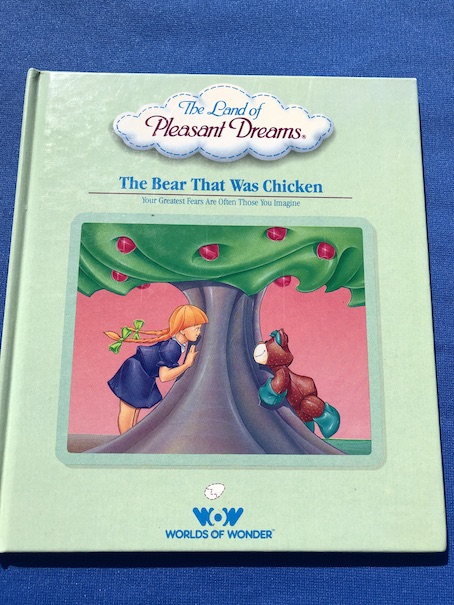
The Bear That Was Chicken by Ane Weber, Ron Krueger, Tony Salerno, 1986.

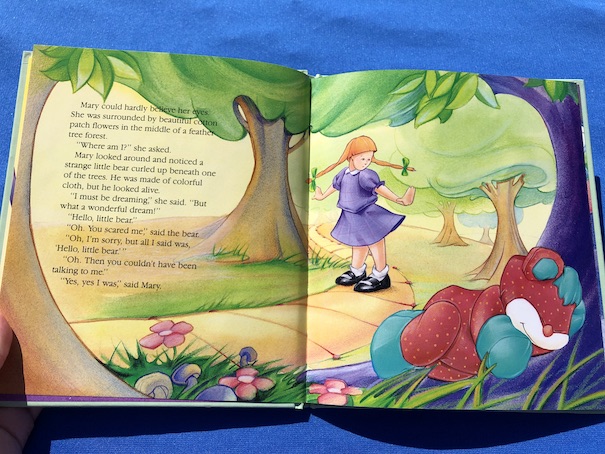
In her dream, Mary meets Threads the Bear.  When she meets him, he’s trying to sleep under a tree.  He’s sad and tells Mary that he thinks he’s a chicken and that all of his friends say so.  (It’s not a nice thing for friends to say, and I wish the story had said so.  There’s a song about it on the tape that accompanies the book with the words given in the book, but it bothers me because calling people “chicken” is something that I associate with people who are trying to goad people into doing things that they really shouldn’t do. I don’t think that it’s good to teach children to react to being called “chicken” or any other insulting names.)

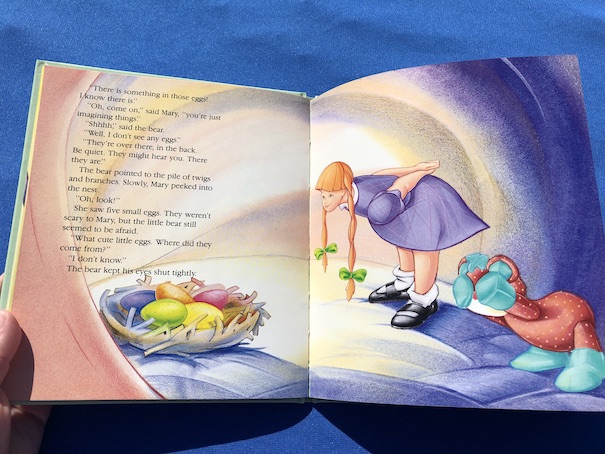
Mary thinks that Threads’ imagination is getting the better of him and that’s why he’s so afraid of so many things.  However, Threads tells Mary something that isn’t imaginary: there are some strange eggs in his cave that appeared there suddenly and mysteriously.  That’s why he’s sleeping in the forest, because he doesn’t know where the eggs came from or what they are.  Mary bravely offers to go with him to have a look at the eggs.

When they go to look at the eggs, Mary thinks that they look pretty harmless.  They’re kind of cute and colored like Easter eggs.  Threads is still worried about them and what they might hatch into.  Mary says again that Threads is imagining the worst and volunteers to sit with Threads while he takes his nap and keep an eye on the eggs to see what happens.

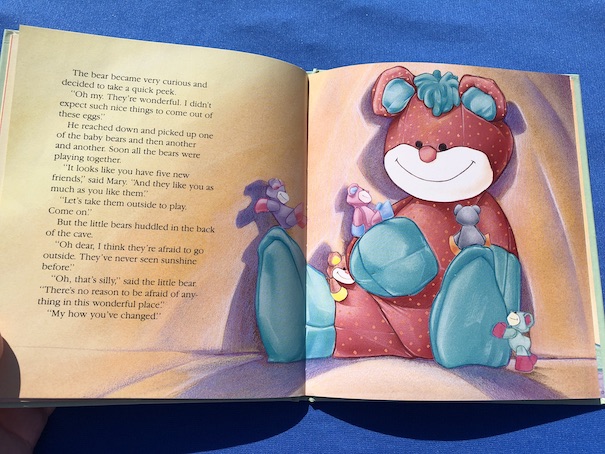
The eggs do hatch, and it turns out that they contain tiny teddy bears, very much like Threads.  When Threads sees the little bears, he loves them and thinks that they’re adorable.  The little bears seem worried when Threads wants to take them outside to play, but Threads encourages them, telling them that there’s nothing to be afraid of.

Moral: Your Greatest Fears Are Often Those You Imagine.

The main message of the story is that it’s better to face your fears than imagine the worst. However, I found some of this story a little confusing as a kid, and some of the implications are a little alarming when you begin to analyze it.  Where did those little bear eggs come from?  Did Threads lay them himself in his sleep? Are those little bears his children?  Did Threads lay eggs because he was a “chicken”?  But, Threads is a boy bear!  Then again, this is supposed to be a dream, so I guess it doesn’t really have to make sense.

I still don’t like that the story uses “chicken” as an insult and in a way that implies that people who are called “chicken” should try to prove that they’re not. This just seems like a recipe for disaster, encouraging children to accept dares.

The book is available to borrow and read for free online through Internet Archive. This book is currently available online through Internet Archive. It was made into an episode for the tv show version of this series with puppets.

A Fence Too High

The Land of Pleasant Dreams

A Fence Too High by Jeanine Bartelt, Jeff Parker, and Tony Salerno, 1986.

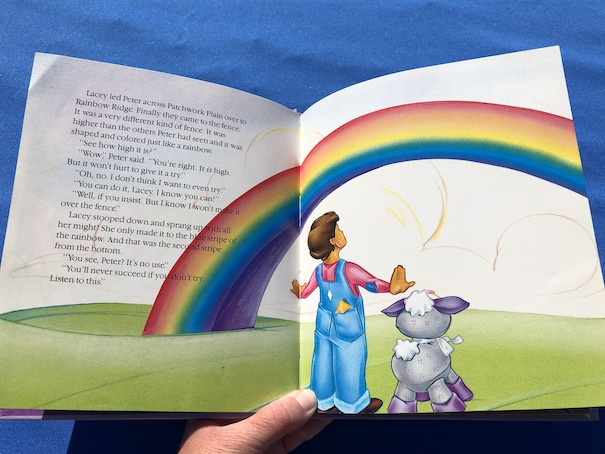
Peter falls asleep while counting sheet jumping over the fence and meets Lacey the Lamb in his dream. Lacey the Lamb is sad and worried because, even though she’s growing up to be a fence-jumping sheep, there is one fence that she just can’t get over. Peter offers to take a look at the fence with her and see if he can help. When he does, it turns out to be a giant rainbow.

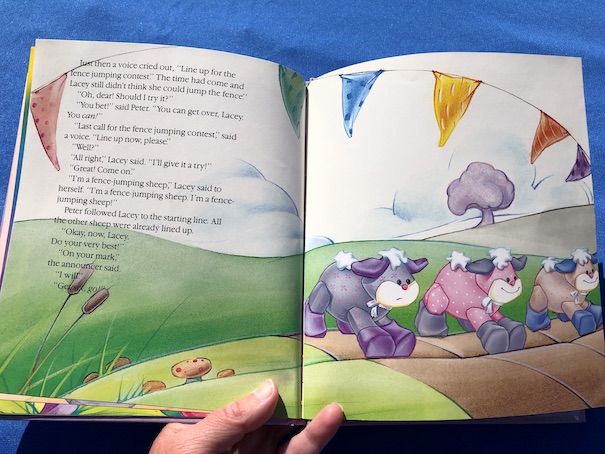
It’s important that Lacey make it over this fence because she is taking part in a fence-jumping contest in less than an hour. Lacey doesn’t think that she can learn to jump this fence in so little time. However, Peter encourages Lacey to try again.

After a few more tries in which she hits the blue stripe on the rainbow and then the yellow stripe and then the orange stripe, Lacey is ready to give up. She thinks that it’s hopeless. Peter points out that it isn’t hopeless because each time that Lacey has tried, she has improved, gradually hitting higher and higher marks on the rainbow. He doesn’t think that Lacey should give up so easily.

Even though she’s still feeling very unsure of herself, she decides to participate in the contest. This time, Lacey does make it over the fence, and she feels much better about herself because of her success. She thanks Peter for giving her the encouragement to try one more time.

Moral: If At First You Don’t Succeed, Try, Try Again.

It’s a nice story about the importance of making an effort, trying again, and not giving up just because there are obstacles and challenges. Life has many challenges, and just because something is difficult doesn’t mean that it’s impossible or not worth doing. People don’t need to be perfect; it’s enough to be willing to improve.

This book was made into an episode for the tv show version of the series with puppets.

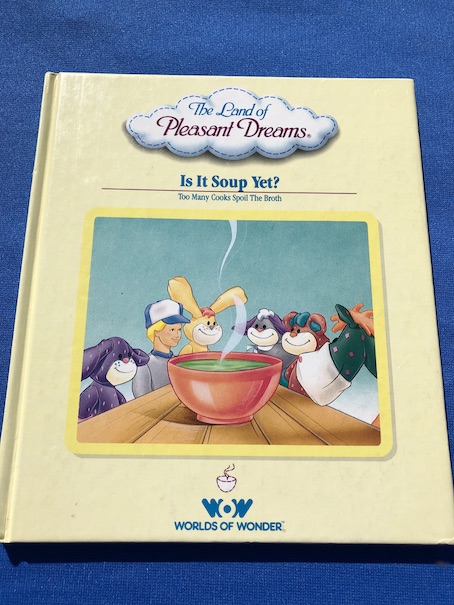
Is It Soup Yet?

The Land of Pleasant Dreams

Is It Soup Yet? By Ane Weber, Ron Krueger, and Tony Salerno, 1986.

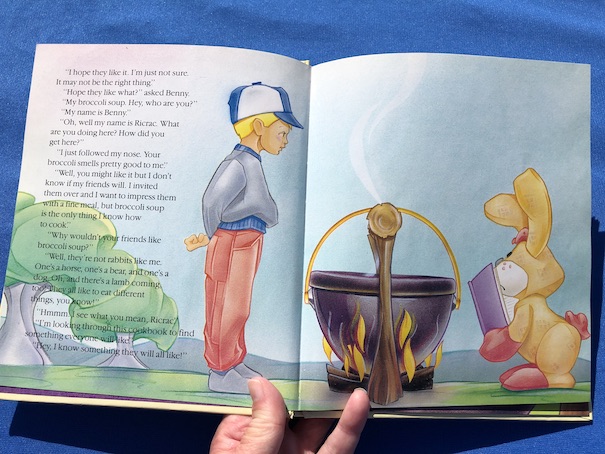
When Benny enters the Land of Pleasant Dreams, he meets Ricrac Rabbit.  Ricrac is trying to cook something for his friends, but he’s worried because the only thing he knows how to make is broccoli soup, and he doesn’t know if his friends will like it because they all have different tastes.

Because Benny’s father is a chef, he suggests that Ricrac try his recipe for black bean broth because everyone loves that when his father makes it.  Ricrac decides to give it a try, adding the black beans to his broccoli soup. 

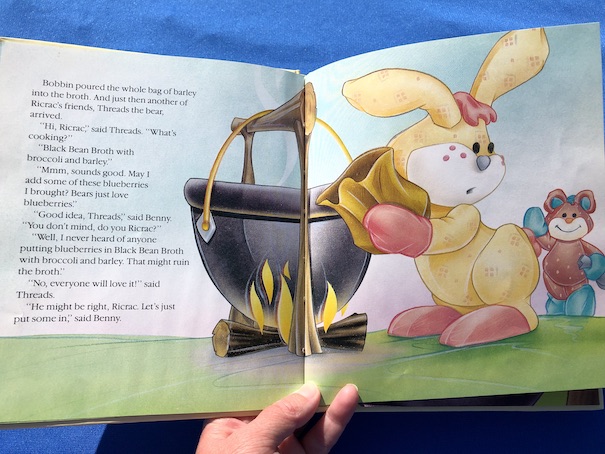
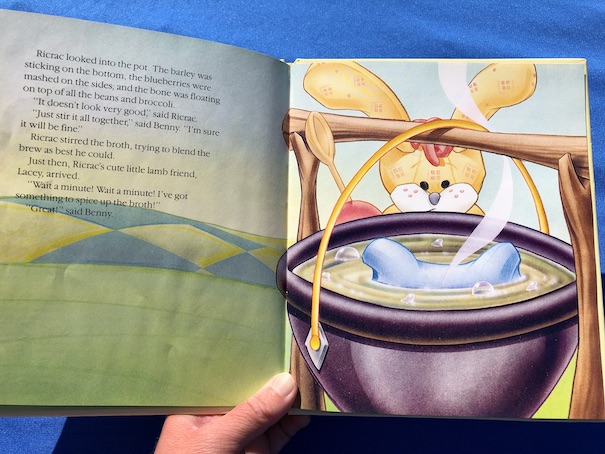
However, as each of Ricrac’s friends arrive, they also decide to bring their favorite ingredients with them.  Bobbin the Horse brings barley, and Threads the Bear brings blueberries.  Then, Snips the Dog brings a bone, and Lacey the Lamb brings buttercups.  In an effort to please everyone, Ricrac adds each ingredient to the soup.

When they finally try it, the soup is horrible.  At first, everyone argues about which ingredient ruined the soup, but Benny realizes that their real mistake wasn’t trying the soup according to Ricrac’s original recipe.  When they try the broccoli soup as it was supposed to be made, without the extra ingredients, it’s really good.

Moral: Too Many Cooks Spoil the Broth.

The point of the story is that trying to please everyone often means pleasing no one.  When planning a project, if you try to stretch it in too many different directions, it’s difficult to accomplish anything because you’re not focusing on anything in particular. In the end, you have to pick one way and stick with it, focusing on what you can do best.

The book is available to borrow and read for free online through Internet Archive. This book was made into an episode for the tv series with puppets. Sometimes, you can find it or clips of it on YouTube.

Can’t You Sleep, Little Bear?

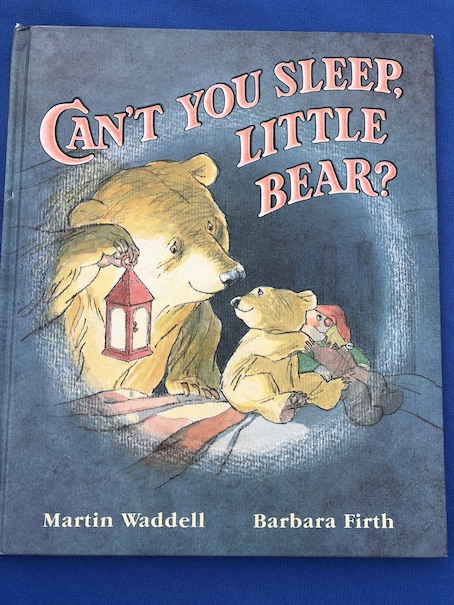
Can’t You Sleep, Little Bear? By Martin Waddell and Barbara Firth, 1988.

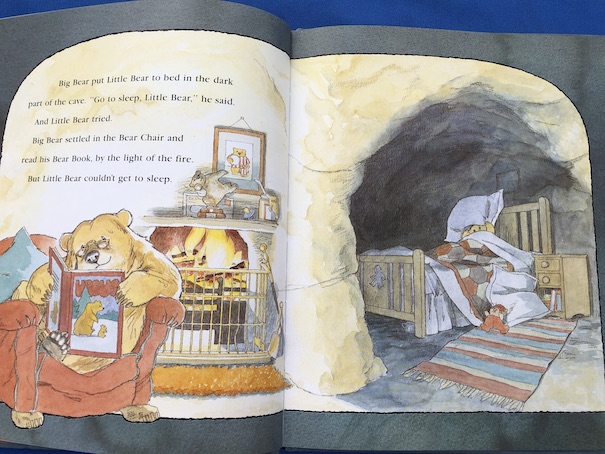
Big Bear and Little Bear live in their Bear Cave.  (Big Bear is apparently the father of Little Bear, but they don’t call him that.)  After Big Bear puts Little Bear to bed at night, Little Bear has trouble sleeping.  Little Bear says that he can’t sleep because he’s afraid of the dark.

Big Bear gives Little Bear a lantern, but that doesn’t work.  Little Bear says that the lantern isn’t big enough.  Big Bear tries to bring two larger lanterns, but neither of those helps, either.

Little Bear says that the dark beyond the cave bothers him.  To prove to Little Bear that the darkness outside isn’t scary, Big Bear takes him outside.

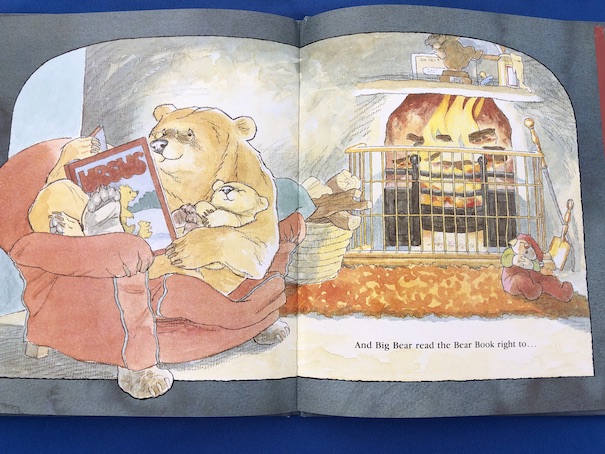
Outside, he shows Little Bear the moon and the stars, so he’ll know that it’s not completely dark.  Little Bear falls asleep in Big Bear’s arms.

This is one of those cute bedtime stories that can help to reassure young children at bedtime. Sometimes, it is a big, scary, dark world out there, but it’s not always as dark as it seems when you take a second look, especially if you’re with someone you can really trust. Because the bears appear to be father and son, it also makes a nice father/son story.

The book is currently available online through Internet Archive. There is also an animated version of this story. I haven’t seen it for sale (if anyone knows where to get it, let me know), but it sometimes appears on YouTube (link repaired July 18, 2024).
Old Bear

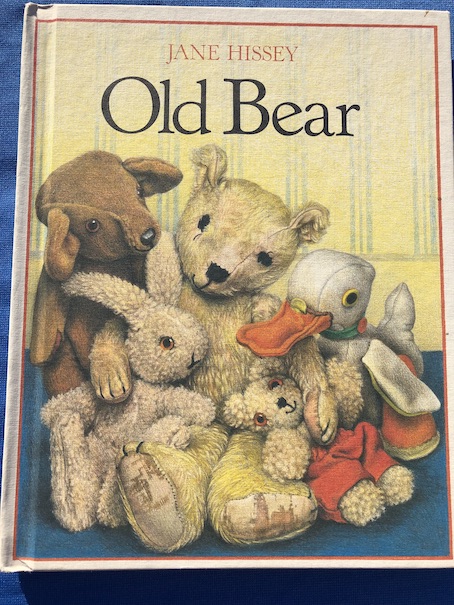
Old Bear by Jane Hissey, 1986.

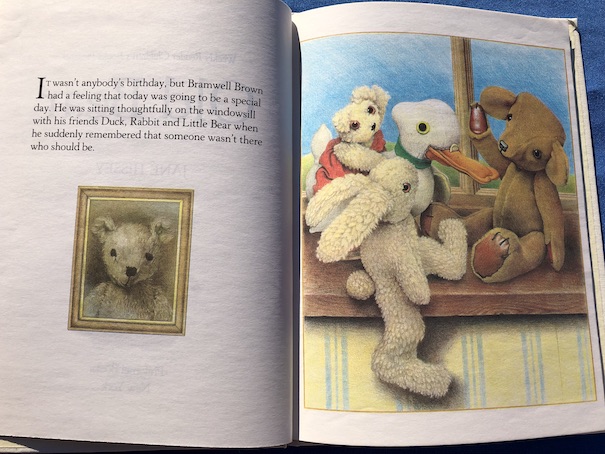
A group of stuffed animals remember that an old friend of theirs, Old Bear, was put up in the attic because he was an old toy and the children of the house were too rough with him.  The other stuffed animals miss him and worry that the humans in the house have forgotten about him, so they try to think of a way to get him out of the attic.

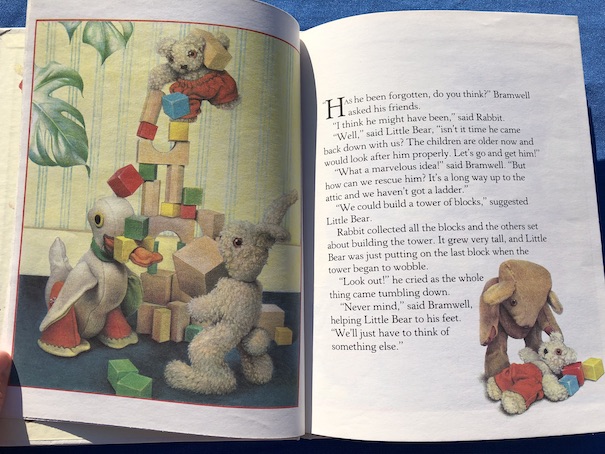
The problem is that the entrance to the attic is in the ceiling, high above their heads.  The stuffed animals try various tricks to get up to the attic, from building a tall tower of blocks to jumping on the bed.

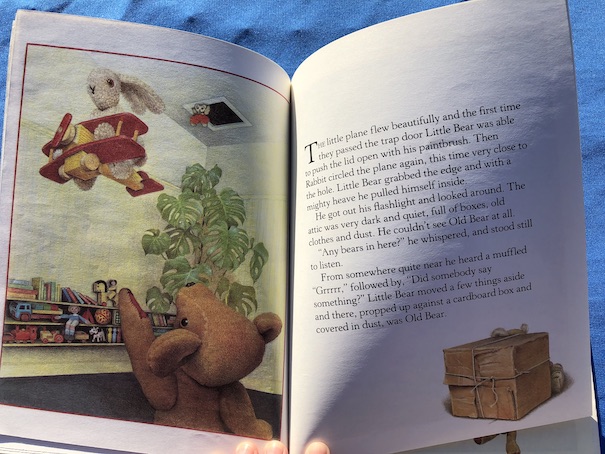
Eventually, they are successful when they use a toy airplane.  After Little Bear finds Old Bear in the attic, they use parachutes made of handkerchiefs to parachute back into the playroom to rejoin the other stuffed animals.

Old Bear says that he spent most of his time in the attic sleeping, but he is glad to be back with his friends.

I remember my mother reading this book to me when I was a young child in the 1980s! One of the things that I like about this book is the detailed pictures. The textures on the stuffed animals are excellent, giving readers the feeling that they could reach into the book and touch the fluffy Little Bear, Bramwell’s paws (which look like they’re made of vinyl), and the Duck, who looks like he’s made of felt.  The stuffed animals’ schemes to reach the attic are also fun and clever, using other children’s toys.

The book is part of a series originally published in the UK. The series was later made into a British television series during the 1990s. This particular story is one of the episodes, and you can see this episode on the author’s YouTube channel.

The book is available to borrow and read for free online through Internet Archive. (To borrow a book through Internet Archive, you have to sign up for an account, but it’s free, and then you read the book in your browser window.)