Bear really loves the moon and decides that he would like to give the moon a birthday present. The problem is that he doesn’t know when the moon’s birthday is. He tries asking it, but it doesn’t answer.
Deciding that he needs to get closer to the moon to talk to it, Bear goes to the mountains to ask the moon when its birthday is. In the mountain, Bear hears his own echo and thinks that it is the moon answering him. When Bear tells the moon that his birthday is tomorrow, the “moon” replies that its birthday is tomorrow. Bear is pleased, especially when the moon echoes his wish for a hat for its birthday.
Bear buys the moon a hat and puts it on top of the moon by putting it in a tree. The following morning, the hat is on Bear’s doorstep, and Bear accepts it as the moon’s present to him.
When the wind blows poor Bear’s hat away, Bear goes to the mountains again to apologize to the moon for losing the hat. It’s okay, though, because Bear and the moon still love each other.
Bear never realizes that what he’s hearing is his own echo. It’s sweet although somewhat silly. If you wonder what happened to the hat in the end, it’s shown on the back cover of the book, holding a bird’s nest.
The book is currently available online through Internet Archive. (When you borrow a book from Internet Archive, you have to set up an account, but it’s free.)
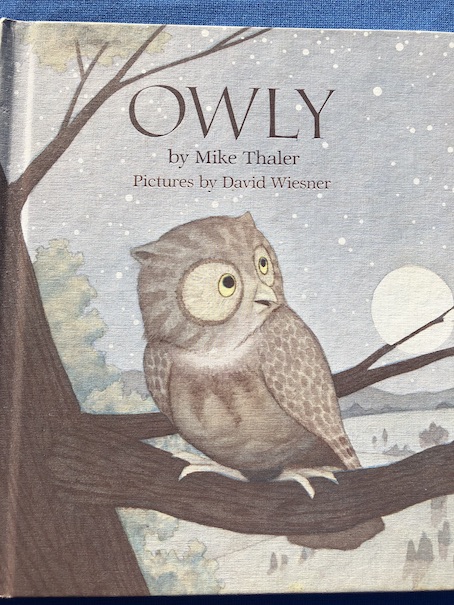
Owly is a curious young owl. He is always asking his mother questions, like how many stars there are in the sky or how high the sky is.
Owl’s mother tells him to go and see these things for himself, but there are too many stars in the sky to count, and he can’t fly high enough to reach the sky.
The story continues with Owly’s questions and attempts to find the answers, but all of his questions are unanswerable because they involve amounts too big to count or measure.
In the end, Owly and his mother talk about how much they love each other, and they compare it to the number of stars in the sky and the other things that couldn’t be counted or measured.
This is one of those children’s books where the story leads up to how much the parent loves the child (and vice versa). I’ve seen other books where the author sets up a cute way to talk about how much parents love their children, and sometimes, the set up is pretty obvious in this type of story. However, the message is still sweet, and this gentle story might make nice, calming bedtime reading. The pictures are as gentle and calm as the story itself.
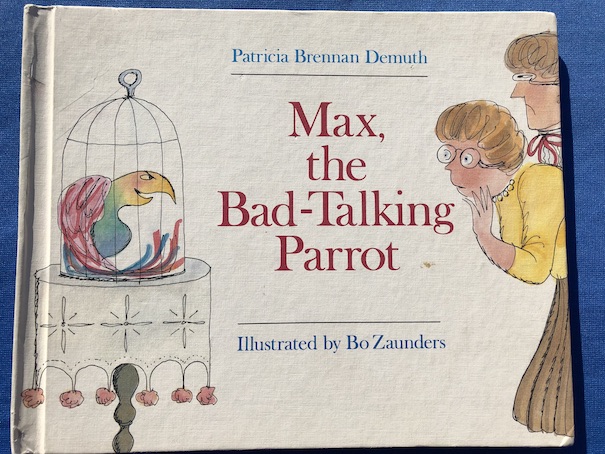
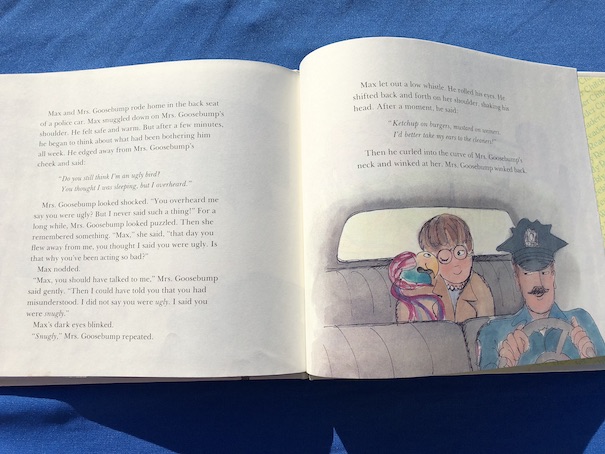
Max, the Bad-Talking Parrot by Patricia Brennan Demuth, illustrated by Bo Zaunders, 1986.
Don’t worry, Max’s “bad” talk isn’t really that bad.
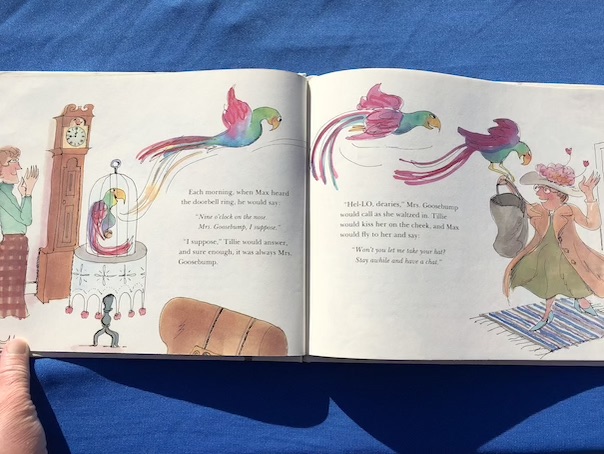
Max is a parrot who belongs to a woman named Tillie. They live in a house that has been made into two apartments. The woman who lives in the apartment above them is Mrs. Goosebump. Mrs. Goosebump is Tillie’s friend, and Max likes her, too.
Because Mrs. Goosebump works the night shift in a toll booth, she always comes to see Tillie and Max in the morning, when her shift is over. Max always greets her with one of his rhymes. Everything Max says is a rhyme.
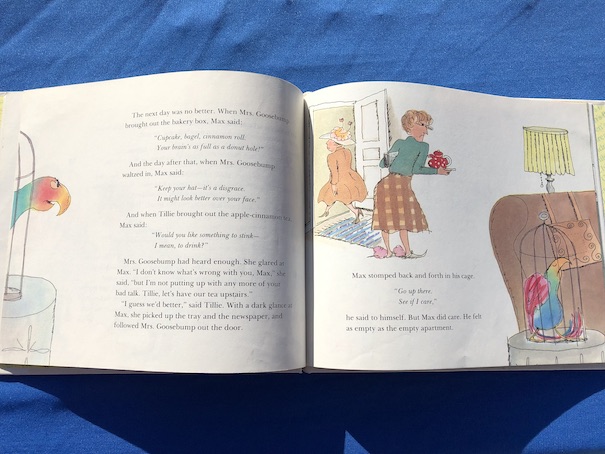
However, one day, as Max is dozing on Mrs. Goosebump’s shoulder during one of her visits, he thinks that he hears her calling him an ugly bird. Max gets upset and returns to his cage, not ever saying goodbye to Mrs. Goosebump when she leaves. He feels badly about the insult, and when Mrs. Goosebump visits later, he only gives her insulting rhymes, like, “Cupcake, bagel, cinnamon roll, Your brain’s as full as a donut hole!”
Mrs. Goosebump and Tillie have no idea why he’s so angry. The only thing that they can think to do is ignore him.
Later that night, a burglar breaks into Tillie’s apartment and starts stealing some of her things, including Max! Max is scared, but by coincidence, the burglar stops to pay at Mrs. Goosebump’s tollbooth. When Max recites some of his rhymes for her, she recognizes one of his usual rhymes and calls the police.
After Max is rescued, he finally tells Mrs. Goosebump why he was so angry, and Mrs. Goosebump explains that she actually said that he was “snugly”, not ugly. With the misunderstanding cleared up, the two of them become friends again. Max is also considered a hero for alerting Mrs. Goosebump about the robber.
When I
was a kid, I thought that Max’s rhymes were funny, and the scene with the
robber at the tollbooth is funny because Max tricks Mrs. Goosebump into
believing that the burglar is insulting her before he says the rhyme that Mrs.
Goosebump recognizes. The book is also a
good lesson about the importance of talking to people about what you’re feeling
in order to clear up misunderstandings.
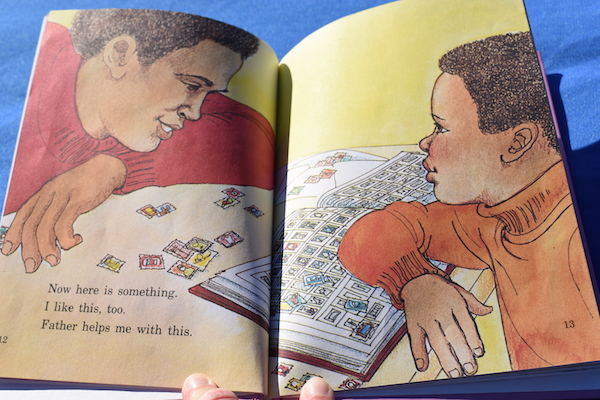
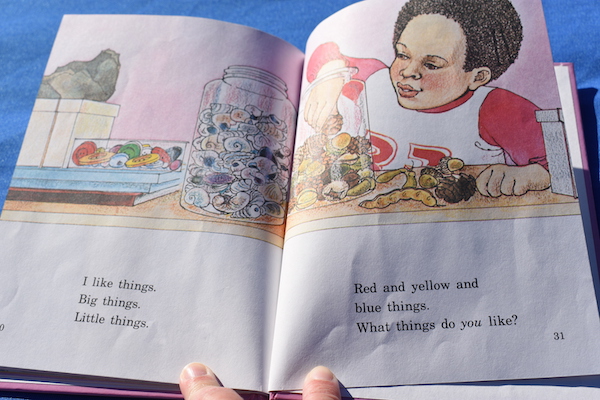
I Like Things by Margaret Hillert, illustrated by Lois Axeman, 1982.
This is
a cute little picture book about the fun of collecting things. A young girl talks about the things that she
collects and why she likes them.
She enjoys collecting all kinds of things with different shapes, sizes, and colors. Sometimes, she likes to sort the things in her collections, like buttons, by color or size.
Sometimes, her father helps her with her stamp collection. She also likes to find seashells and rocks at the beach. Sometimes, she and her friend trade sports cards from their collections.
At the end of the story, the girl asks readers what kinds of things they like, so adults can use the story to get kids to talk about what they like to collect.
I thought it was interesting how the girl put one of the bigger rocks in her collection into a jar that was partly full of water so that the water would act as a magnifier, making the rock look bigger.
One
thing I noticed is that the girl never refers to the objects in her collections
by name. Mostly, she just talks about
what she does with them using very simple words. I think that’s to make the book easier for
younger children. There is a word list
in the back of the book of all of the words used in the story, and there are
only 64 different words.
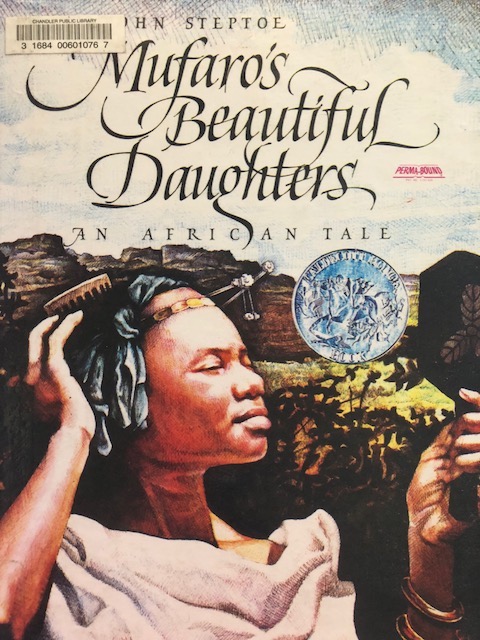
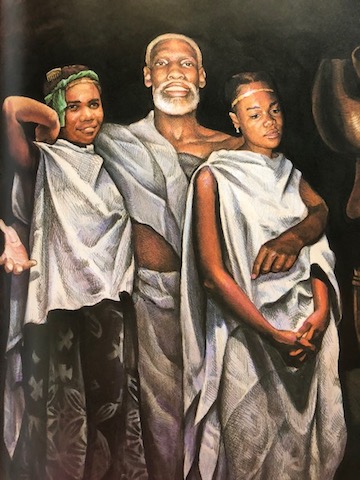
Mufaro’s Beautiful Daughters by John Steptoe, 1987.
This story, based on an African folktale, is somewhat similar to other folktales and fairy tales from other parts of the world such as Cinderella, Mother Holle, and Vasilisa the Beautiful, where a girl with a kind, hard-working nature triumphs over a mean sibling because someone in authority recognizes her good nature and rewards it.
In a small village in Africa, a man named Mufaro has two daughters, Manyara and Nyasha. Both girls are beautiful, strong, and clever, but they have very different natures. Nyasha is kind, gentle, and patient. Manyara is bad-tempered, jealous, and self-centered. She frequently taunts Nyasha about how, one day, she will be the queen and her sister will be her servant. When Nyasha asks her why she is so mean, Manyara says that she hates the way people praise Nyasha for her kindness. She thinks that Nyasha is their father’s favorite child, and she wants to prove that Nyasha’s “silly kindness is only weakness.”
Since there is nothing that Nyasha can do to change her sister’s mind or attitude, she just continues doing her usual chores and being kind to people and animals. In particular, she makes friends with a small garden snake, knowing that his presence in her garden will keep away pests.
Manyara is sneaky and always behaves herself when their father is present, so Mufaro doesn’t know about the troubles between his daughters. When a messenger arrives, saying that the Great King is seeking a wife and that beautiful, worthy girls are summoned to his city so that he can choose from among them, Mufaro is proud and eager to present both of his beautiful daughters. Manyara tries to persuade her father to send only her, but Mufaro is firm that both girls must present themselves for the king’s decision.
Manyara decides that the only way to get the better of her sister is to be the first to arrive and present herself to the king, so she slips out in the middle of the night and begins the journey alone. However, both the journey and the king are not what Manyara thinks they are. Along the way, Manyara encounters various strange characters who ask for help or offer advice, but thinking that a queen doesn’t need to pay attention to others or do anything she doesn’t want to, Manyara ignores them all.
Nyasha, on the other hand, gets ready to leave at the appointed time in the morning. Everyone worries about Manyara but decides that the best thing to do is to follow her to the city, since she seems to have gone on ahead. As Nyasha travels with the rest of their friends and family, she listens to the people Manyara ignored and shows them kindness.
When they finally reach the city, Nyasha encounters a terrified Manyara, who hysterically insists that when she went to meet the king, she found a horrible monster instead. However, like everything else, it’s just another part of the test, and Nyasha is the one who passes because she, like her sister, has actually met the king before, but unlike her sister, she actually paid attention to him.
The pictures in the book are beautiful and colorful. A note in the front of the book says that the buildings in the illustrations were based on an ancient city in Zimbabwe that is now ruins. The note in the book also explains that the names of the characters in the story come from the Shona language. The meanings of the names are clues to the characters’ natures. Manyara means “ashamed”, and Nyasha means “mercy.”
The book is a Caldecott Honor Book. It is currently available online through Internet Archive.
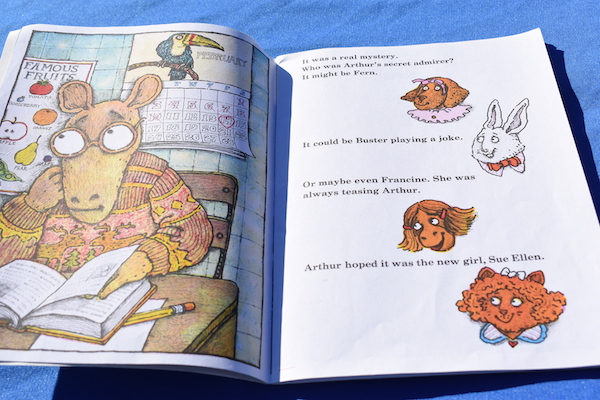
During the week before Valentine’s Day, someone keeps leaving unsigned valentines for Arthur. He wonders who it is, thinking about the different girls in his class at school. On the other hand, maybe someone is just playing a joke on him.
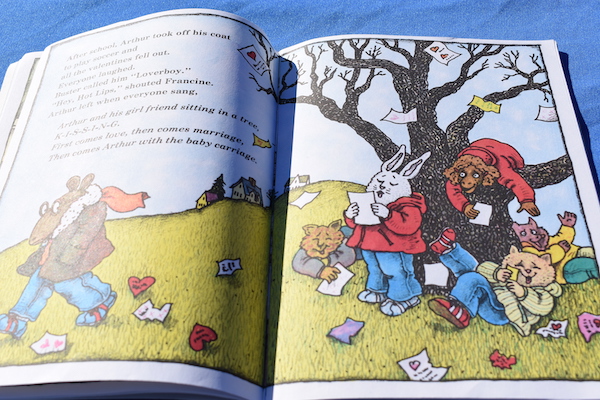
When his friends find out about his secret admirer, Arthur gets a lot of teasing. At one point, he thinks that he knows who the secret admirer is, but when he writes a valentine of his own for her, it turns out that he’s wrong, and it leads to more embarrassment.
However, Valentine’s Day isn’t over yet. Arthur’s secret admirer gives him a movie ticket, saying that she’ll meet him at the theater. With this last message, Arthur realizes who is secret admirer is and arranges a surprise of his own.
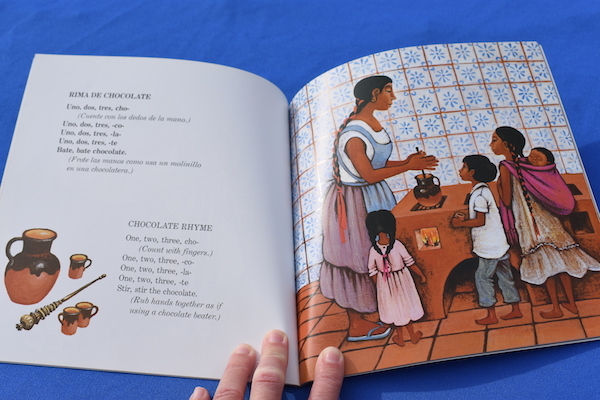
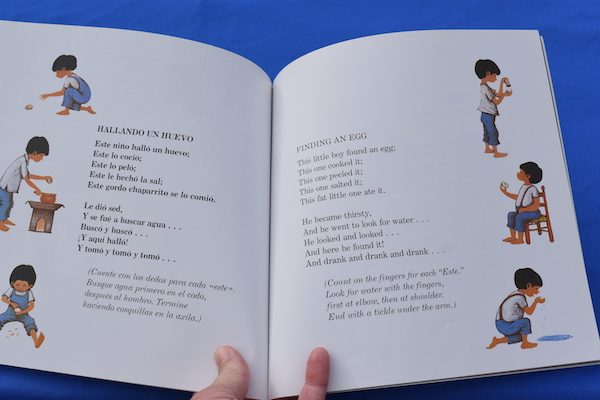
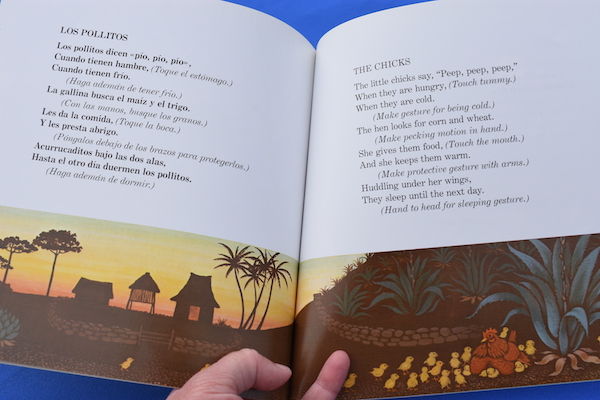
Tortillas Para Mama selected and translated by Margot C. Griego, Betsy L. Bucks, Sharon S. Gilbert, and Laurel H. Kimball, illustrated by Barbara Cooney, 1981.
This is a collection of Spanish lullabies and nursery rhymes in the Americas. The introduction to the book explains how these traditional rhymes have been passed down through the generations of families. They are not specific to any one country, more generally known where there are Spanish speakers. The rhymes are in both in English and Spanish.
Like children’s rhymes everywhere, they are about small, everyday things, like family, animals, cooking, and other things people do every day, like helping little kids to get dressed.
There are rhymes and songs that involve counting on fingers or making hand motions.
My favorite is the lullaby Los Pollitos (The Chicks), which I first heard when I was little through Kidsongs. I always liked that song.
The illustrations, paintings by Barbara Cooney, are beautiful. Some people may recognize the art style from her other works like Miss Rumphius and Roxaboxen.
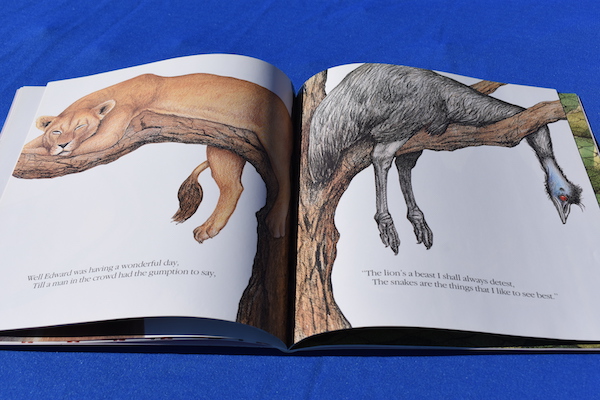
Edward the Emu by Sheena Knowles, illustrated by Rod Clement, 1988.
Edward the Emu lives in a zoo, but he finds it boring. He is so bored that he decides to try living with and acting like the other animals.
First, he envies the seals who live in the pen next to his and always seem to be swimming and having fun. So, one night, he jumps out of his pen to join the seals. The next day, he hangs out with the seals, lying in the sun and balancing a ball on his nose. It’s much more fun than his boring old pen, but then he overhears a zoo visitor say that the lions are “the best thing to see at the zoo.”
Edward once again switches pens, deciding that he’ll try to be a lion. He spends the next day growling and snarling while the lions roar. It’s a lot of fun, but then another visitor comments that he likes snakes the best.
Once again, Edward switches pens and tries being a snake. This time, someone comments about great emus are. Feeling better about himself, Edward decides to return to his own pen.
However, to Edward’s surprise, there is another emu in his pen, his replacement because he disappeared! It’s not a problem, though, because the new emu, Edwina, is glad to see him, and Edward is less likely to be bored now that he has a friend.
A friend sent me this cute picture book from Australia. The story is told in rhyme, and the pictures of Edward trying to be different types of animals are fun.
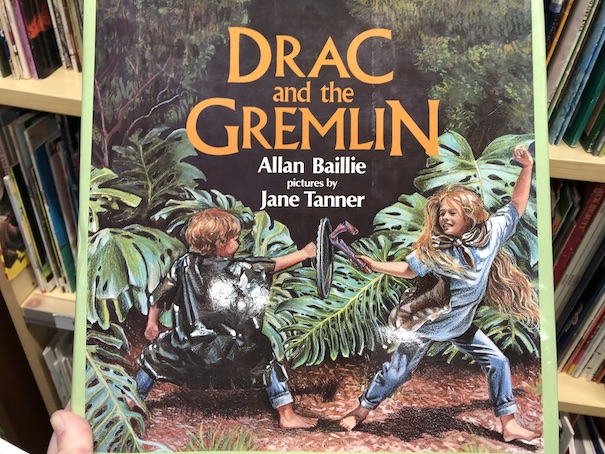
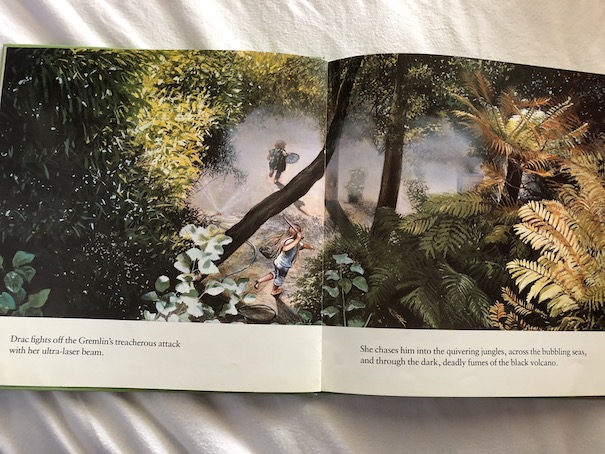
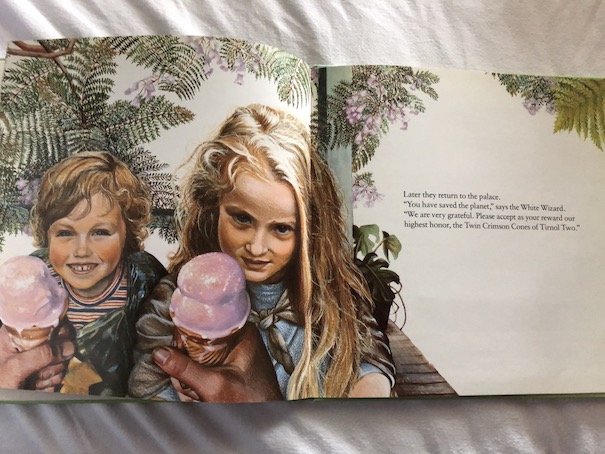
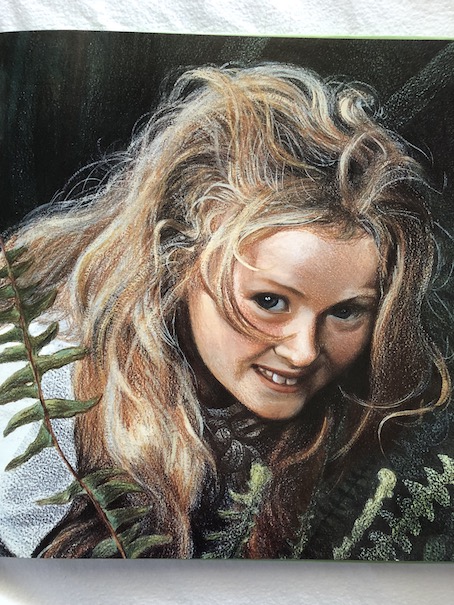
Drac and the Gremlin by Allan Baillie, pictures by Jane Tanner, 1988.
The great thing about this book is that you really need to look at the pictures in order to get the full story. If you read the text alone, it sounds like a magical space adventure story, but when you see the pictures, you realize that it all takes place in a girl’s imagination as she and her younger brother play in their backyard. The book never mentions the children’s names (or directly talks about reality at all). The girl calls herself “Drac, the Warrior Queen of Tirnol Two”, and her younger brother “the Gremlin of the Groaning Grotto.”
Drac begins by trying to capture the The Gremlin. She pursues him across the jungles, but when she finally traps him, she receives a message from the White Wizard. The White Wizard is being attacked by “General Min” (their cat, Minnie) and desperately needs her help! Drac persuades the Gremlin to help her.
The two of them get into Drac’s “anti-gravity solar-powered planet hopper” and race to the rescue! They arrive just in time to save the White Wizard in her current form (a moth).
But, they are soon facing another peril: “The Terrible Tongued Dragon” (their dog)! Drac is almost overcome by the dragon, but the Gremlin saves her just in time!
Their adventure ends at the palace, where the “White Wizard” (their mother) rewards them with “the Twin Crimson Cones of Tirnol Two” (ice cream).
I love the way that the adventure unfolds in the children’s minds and the pictures show what is actually happening to the children, as their mother and everyone else sees them. The pictures are beautiful and realistic. The book was originally published in Australia, and I recognize some of the plants from pictures that a friend of mine there has sent me!
The book is available to borrow and read for free online through Internet Archive.
The Princess in the Pigpen by Jane Resh Thomas, 1989.
Elizabeth is the nine-year-old daughter of a nobleman in London in the year 1600, and she’s very sick. However, while she’s lying in her bed with a terrible fever, she suddenly finds herself in a pigpen in 20th century Iowa with no idea how she got there. At first, she doesn’t even know where she is, and when she is found by the McCormick family, the family who owns the farm, they have no idea who she is or where she came from. That she is very ill is obvious, so they take Elizabeth to the local doctor, who says that she has scarlet fever (what strep throat turns into when it’s neglected, it’s serious and life-threatening) and gives her penicillin, which helps her to recover.
However, there is still the question of how Elizabeth ended up on the McCormick farm in Iowa in the first place. Elizabeth tells them that she is from London and insists that the year is 1600. Ann, the McCormicks’ daughter, who is about the same age as Elizabeth, doesn’t believe that Elizabeth is really from the past. The current year is 1988, and Ann thinks that Elizabeth is probably crazy, but obviously in need of some help. The McCormicks tell the local sheriff about Elizabeth, and he begins looking through reports of missing persons to find one that fits her.
Still,
it’s hard to explain Elizabeth’s strange clothing (Ann is sure that Elizabeth
must be rich because her dress is obviously very fancy) or the antique toys
that were found with her (a doll and a music box). When Ann goes to school, Elizabeth stays at
home with her mother, Kathy, and asks her about all the strange things that she’s
been seeing around her, like cars and electric lights. Kathy assumes that Elizabeth is merely
confused and that her memory has been affected by her illness.
By
coincidence, Kathy is a historian, teaching at a nearby university, and has
studied English history. She is aware of
Elizabeth’s family, including her father, Michael the Duke of Umberland. When Elizabeth asks her if she knows what happened
to her mother, who was also ill when she last saw her, Kathy says that she was
still alive in 1605, which means that she must have survived her illness. Kathy quizzes Elizabeth in English history,
and Elizabeth knows the correct answers because they are all current events to
her. Kathy thinks that someone must have
taught Elizabeth history but notices that Elizabeth really seems to believe
everything she says and knows a surprising amount of detail.
Further research into history and Elizabeth’s family tells Elizabeth the years when her parents and other people she cares about will die, which is distressing to her. Ann begins to believe Elizabeth about her life when Elizabeth describes her home to her, and the description matches one in a book. In the same book,there is also a portrait of Elizabeth’s family from 1605. In the portrait, Elizabeth is a little older than she is now, and her mother has had another baby. Elizabeth’s doll and music box are also in the painting. The book also contains an account of the fire that later destroyed the manor house. According to the book, Elizabeth managed to save the lives of her family by alerting them to the fire and also managed to salvage a couple of valuable books.
Now that Ann is convinced that Elizabeth is really from the past, they must find a way to help Elizabeth to return home so that she can save the lives of her family!
The book is available to borrow and read for free online through Internet Archive.
My Reaction
There were a couple of things that I liked about the time travel in this story. One is that it seems that it was fated to happen. Elizabeth is meant to survive her illness and to save the rest of her family. She was only able to do that because she had been to the future and learned about the dangers they would be facing. When she returns to her own time, she doesn’t change the past but makes sure that things turn out the way they were supposed to.
I also found it interesting that Elizabeth’s family has no living descendants in the late 20th century. Her family continued beyond Elizabeth’s time, but the family line apparently ended before the time period of the modern characters in the story, so we don’t have one of those moments that sometimes occurs in time travel stories where the modern characters meet a descendant of the past characters. That can be a fun moment in some stories, but I appreciate the variety.
At one point in the book, Ann makes a reference to the book A Wrinkle in Time, about other children who get “lost in space and time.”





















 Jestress's Forgotten Books and Stories