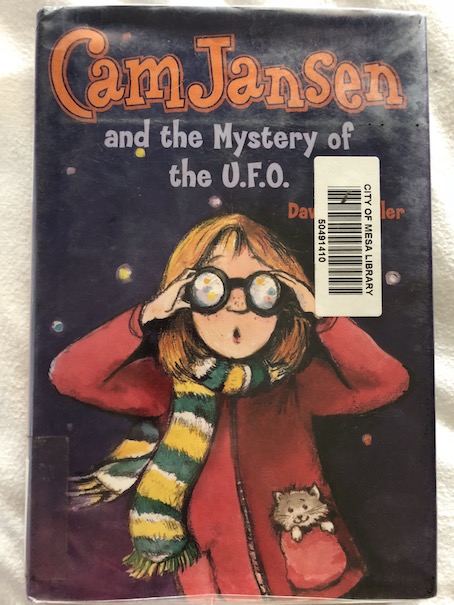
Cam Jansen and the Mystery of the UFO

CJUFO

Cam Jansen and the Mystery of the UFO by David A. Adler, 1980.

Cam Jansen‘s friend, Eric, wants to enter a photography contest.  All of the pictures for the contest must be taken in black-and-white, have to be “of local interest”, and must be completely natural, not posed.  As Cam and Eric look for things to photograph, Cam spots a kitten trapped in a tree.  Eric takes a picture of her rescuing the kitten.

Then, they see a bunch of people standing around, pointing at some strange, multi-colored lights in the sky.  A local newscaster even shows up to cover the mysterious lights and talk about UFOs.

Cam and Eric decide to investigate the area where it look like the UFOs landed.  When they get there, they spot some strange creatures with silvery skin and pointed heads!  However, it soon becomes obvious that these “aliens” aren’t what they appear to be.  They speak English, are called “Cindy” and “Steven”, and are actually covered in aluminum foil.  But, why are they playing alien, and what are the UFOs really about?

Cam decides to keep the cat that she rescued and names her Neptune.  When the true purpose behind the aliens’ hoax is revealed, Neptune helps to foil their plans.


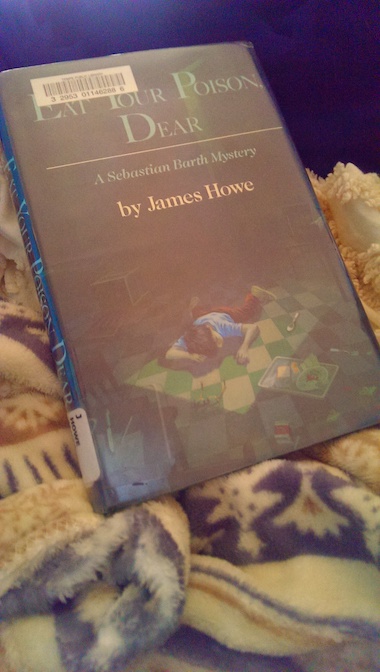
Eat Your Poison, Dear

EatYourPoisonDear

Eat Your Poison, Dear by James Howe, 1986.

Milo Groot is the editor of the school paper at Sebastian Barth’s school. Milo is something of a social outcast at school, but after he gets extremely ill eating in the school cafeteria, Sebastian and his friend David begin to wonder if there’s been some foul play. Although everyone thinks it’s just a bad case of the flu at first, it’s strange how Milo’s symptoms only come up after eating lunch at school.

Milo recently wrote an editorial for the school paper, criticizing a group of boys at school who have adopted kind of a “greaser” look, wearing leather jackets, smoking cigarettes, wearing temporary tattoos (so badass), and calling each other by biker-style nicknames. The biker boys, who like to call themselves the Devil Riders (they don’t actually have motorcycles, but they like to stand around and look at pictures of them a lot), have been kind of mean to other kids, even former friends, but the school’s principal says that there’s no school rule against simply wearing leather jackets, so there’s nothing he can do about their biker persona. Milo starts up a petition against them, though, trying to get the principal to crack down on their little group. Could one of them be behind Milo’s poisoning?

Then, suddenly, two more kids at school get sick in the same way. The school cafeteria has always gotten good health ratings, leading Sebastian to think that whatever is harming people at school must be deliberate. Soon, whatever is harming the students affects a large part of the student body, with seventy-seven students all getting sick on the same day. But, still, who is doing it and what is their motive?

The book is currently available online through Internet Archive.

My Reaction and Spoilers

The story gets somewhat philosophical about the nature of hurt and why people hurt each other. Sebastian asks his friend Corrie’s father, Reverend Wingate, for his opinion about why people hurt others. Sebastian’s grandmother thinks that people hurt others because of some hurt that they have themselves. This is part of the reason why the Devil Riders act the way they do. It is revealed that the leader of the little gang, Harley (not his real name, that’s his “biker” nickname) has a very unhappy home life that he often lies about to others. Acting tough with his friends and pushing other people around is his way of dealing with it. One thing that Reverend Wingate notes is that “There is no way for people to stop hurting one another except to stop.” He relates it to the arms race of the Cold War (contemporary with when the story was written), saying:

“If we justify building up our own arsenals because they have more weapons, then we only heap one folly on top of another. There comes a time when we must say, ‘Enough! I don’t have to have more toys than you. I don’t need the last word. I will turn the other cheek.’”

In other words, some battles aren’t worth fighting because the cost is too high, higher than the gains of victory, and in those cases, it’s better just to move on. In a way, both Sebastian’s grandmother and Reverend Wingate are correct; the villain that they’re looking for is someone who’s been harboring hurt for a long time and hasn’t yet realized the cost of getting revenge.

I found it interesting when Harley (who is not the villain, even though he is the primary suspect for a time) tells Sebastian that a person who is less popular than others is at a disadvantage when they do something wrong. Harley says that his social worker tells him, “. . . everybody makes mistakes. She says, you make a mistake on the blackboard, what do you do? You erase it and try again. I say to her, sometimes somebody writes on the blackboard with a magic marker, just to be mean, and everybody sees it and nobody can erase it away. It’s always there, and always will be the rest of your life.”

Popularity can make other people more willing to forgive a wider range of behavior, however I think that the situation that Harley describes is less a matter of popularity and more of method and intent. When someone does something “just to be mean,” it’s always going to leave a mark, at least emotionally, and “magic marker” isn’t meant to be erased, so it’s a bad choice for someone airing only temporary feelings.  If he had chosen chalk, then yeah, whatever mean or rude thing he wrote would have been erased and forgotten, but Harley didn’t do that, and that’s his own fault. If his aim was to hurt people, he can’t legitimately complain that people got hurt because all that happened was that he succeeded in what he deliberately set out to do. He also can’t legitimately complain about lasting consequences when he deliberately chose a lasting form of inflicting that hurt.  Some people just have poor priorities and bad strategy, and that’s what gets them into trouble.  Harley is still blaming other people for his own bad choices, and he’s going to continue having problems until he realizes that he, and he alone, is the one responsible for the thing he does and only he can change what he decides to do.

That being said, some things that are apparently permanent aren’t really, if you know how to clean up after yourself and have the will to do it.  You can even get permanent marker off of a chalkboard, if you have some rubbing alcohol.  People have figured out how to do that because there are times when they’ve had the need to do it, and they tried ways to fix the situation until they found what worked.  Life is like that.  You can gripe about things being wrong and unfixable, or you can try ways of fixing things before you decide that they’re impossible to fix.  People also appreciate people who make an effort.  Harley needs to learn both how to behave himself in the first place and how to clean up after himself in the second.  He could use a practical adult who understands how to fix things, and he needs to develop the mindfulness to keep himself from creating more problems to solve.

Before the story is over, Sebastian himself makes a big mistake, accusing the wrong person because he made a false confession. However, Sebastian is willing to face up to the apologies that he will owe others after he learns the truth, realizing that a false accusation was part of what the real villain was hoping for. Anger is also a kind of poison. Truth can hurt at first, but unlike poison, it can make things better.
Nate the Great and the Halloween Hunt

NateHalloweenHunt

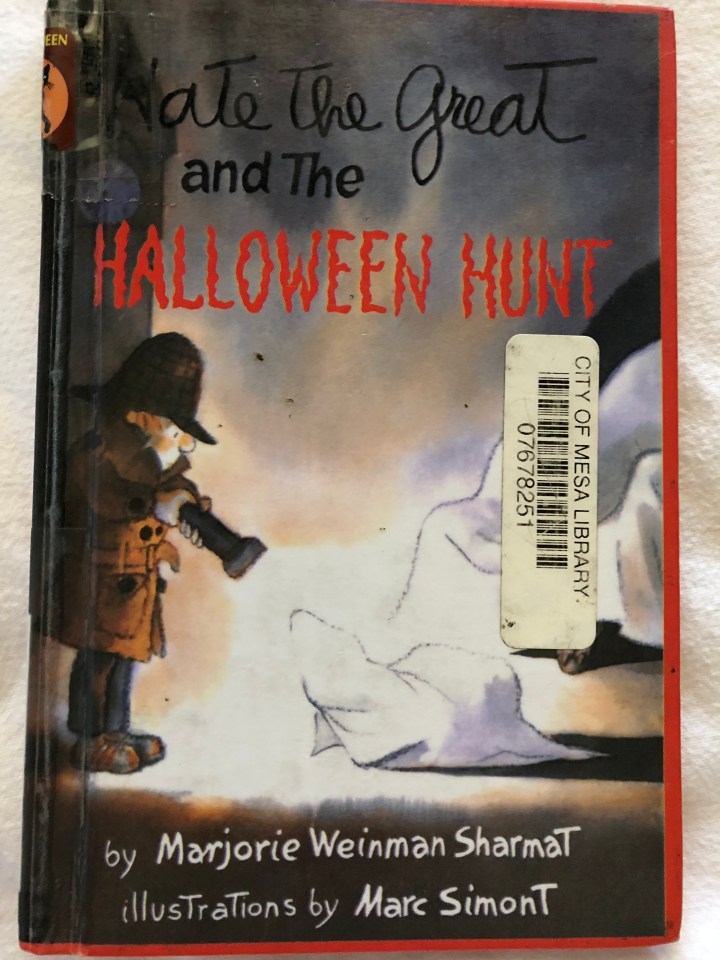
Nate the Great and the Halloween Hunt by Marjorie Weinman Sharmat, 1989.

Nate the Great gets a Halloween case when Rosamond asks him to help her find one of her cats.  Rosamond and Annie show up at Nate’s house, trick-or-treating.  They’re both dressed as Little Red Riding Hood, and Annie’s dog, Fang, is the wolf/grandmother.
Rosamond has several cats, all named “Hex”: Big Hex, Plain Hex, Super Hex, etc.  But, she’s worried because she can’t find Little Hex.  Every Halloween, her other cats like to go to an old house in the neighborhood that is supposedly haunted in order to help haunt it, but Little Hex is afraid on Halloween and apparently hid somewhere.  Nate thinks that Little Hex will probably come out as soon as Halloween is over, but Rosamond is so worried that he agrees to look for Little Hex anyway.

NateHalloweenHuntTrickOrTreat

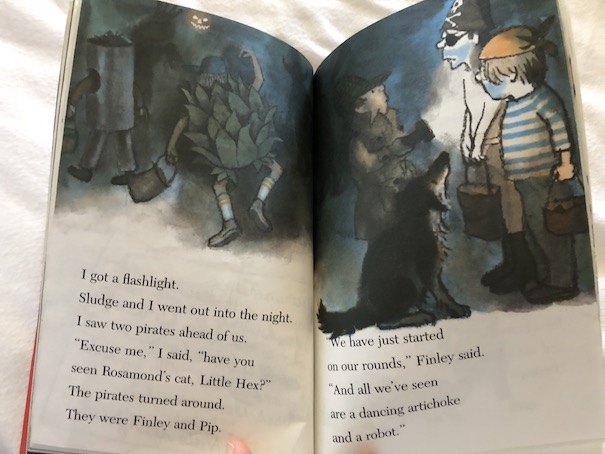
Nate interviews kids in the neighborhood to see if they’ve seen Little Hex, but they haven’t.  Then, he and his dog, Sludge, go to the haunted house to look around.  He sees Rosamond’s other cats, but not Little Hex.  There’s a scary moment when he realizes that he’s locked in the house, but Sludge helps him to escape.

Little Hex isn’t as far away or lost as Rosamond thinks, and Nate realizes that both Sludge and Rosamond herself have given him the clues he needs to solve the mystery.  Sludge demonstrates what an animal might do when it’s frightened, and Nate suddenly realizes why Rosamund’s treat basket was so much heavier than Annie’s even though they had been to the same houses.

The book is available to borrow and read for free online through Internet Archive.

The Spooky Halloween Party

SpookyHalloween

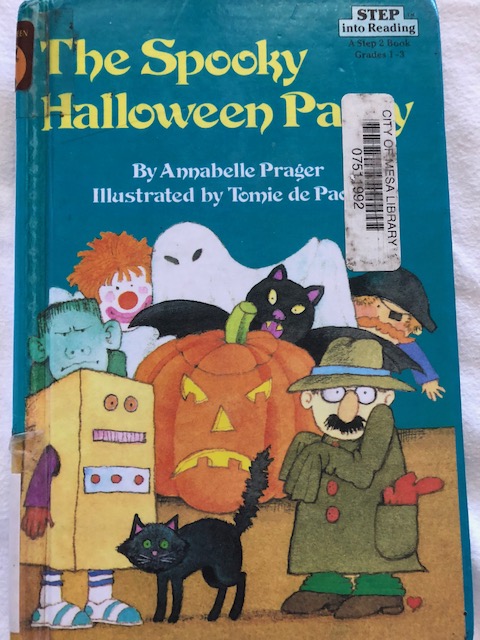
The Spooky Halloween Party by Annabelle Prager, illustrated by Tomie de Paola, 1981.

This book was an old Halloween favorite of mine when I was a kid.  It’s funny, slightly spooky, and has a bit of a twist ending!

Albert’s friend, Nicky, is inviting all of their friends plus his cousin Suzanne to a spooky Halloween party at his new apartment on Halloween night.  Albert hasn’t been to his new apartment yet, and Nicky says that it’s going to be really scary because he wants everyone to come in costume and to not tell anyone what they’re going to be so that everyone will be surprised when they take off their masks at the end of the evening.

SpookyHalloweenNickysParty

Albert doesn’t think Nicky’s party is going to be all that scary because he’s pretty confident that he’ll know who his friends are right away, even in costume.  Some of them have already given him hints.  Nicky was practicing going, “Whoo, whoo!” in order to scare people, so Albert knows that, whatever his costume is, it’s something that makes that sound.  Jan called up and asked Albert if he had an old mop that she could borrow, so he thinks that she’s probably going to be a witch and that she just got confused, thinking that witches carry mops instead of brooms.  Dan told Albert straight out that he’s going as a pirate because he doesn’t see the point in keeping his identity a secret.  So, Albert isn’t expecting any real surprises at Nicky’s party.

As for Albert’s costume, he’s tired of wearing the usual old clothes in the dress-up box, so he decides that this time, he’ll wear the box itself.  He cuts holes for his eyes and arms and decorates it so that he looks like a robot.  Almost completely covered by the box, he’s sure that everyone will have a harder time guessing his identity than he will theirs.

SpookyHalloweenElevator

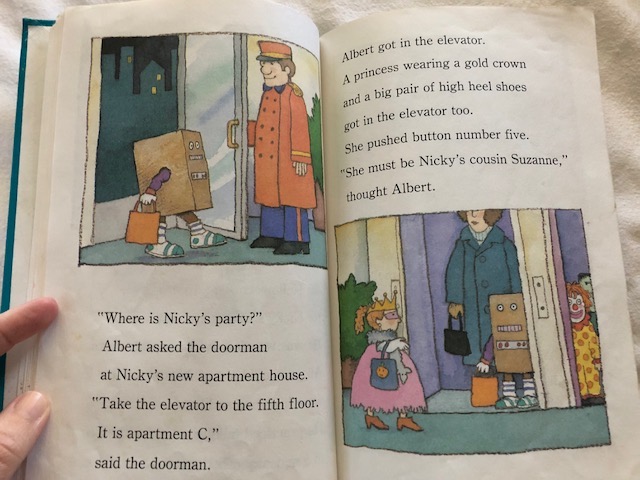
When Albert arrives at Nicky’s new apartment house, he meets a girl dressed like a princess in the elevator.  She says that she’s going to the Halloween party on the fifth floor, and when Albert says that he is too, she suggests that they walk there together.  Albert guesses that she is Nicky’s cousin, Suzanne, who he hasn’t met before.

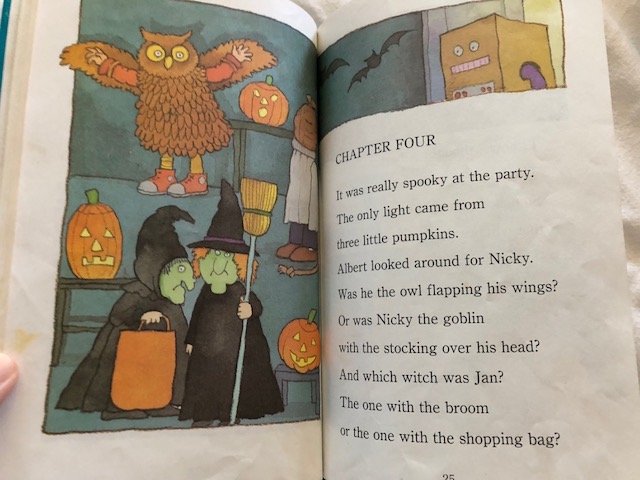
The apartment is pretty spooky, lit by jack o’lanterns, and there are already some guests there.  Albert is a little surprised that he doesn’t see a pirate, but there are a couple of witches and an owl, who could be Nicky.  Yet, when Albert tries to talk to the other guests, they seem to be acting strangely, and he realizes that he’s not quite sure who is really who.

SpookyHalloweenArrival

The princess is pretty spooked, and as the party goes around the apartment house, trick-or-treating, she kind of clings to Albert.  When some strange noises and a far-away “Whoo, whoo” sound startle her, Albert reassures her that it’s only Nicky in his owl costume.  Then, the princess tells him that she knows the owl, and it’s not Nicky.  That’s when Albert really starts getting scared, wondering why he doesn’t seem to know his own friends.

SpookyHalloweenTrickOrTreat

The book is available to borrow and read for free online through Internet Archive.

My Reaction and Spoilers

The reason why Albert doesn’t seem to know anyone becomes apparent when they unmask themselves after trick-or-treating.  Albert is really among strangers!  The princess isn’t Nicky’s cousin at all, and he followed her to the wrong Halloween party!  There were two Halloween parties on the fifth floor that night.  Nicky lives in apartment C, and Albert accidentally joined the party in apartment B.  Fortunately, Albert’s friends are also trick-or-treating around the apartment building and show up at that moment.

What started out as a potentially embarrassing mistake actually ends up making the evening more fun for everyone.  Albert’s mix-up brought an element of real suspense to both of the Halloween parties, with him wondering who everyone really was, the guests at the wrong party wondering who he was, and all of Albert’s friends wondering where he was.  Also, Albert gets some new friends out of this experience, and both parties end up combining into one big party at Nicky’s apartment.

SpookyHalloweenBigParty

Race isn’t important to the story and is never mentioned, but I’d just like to say that I appreciated the diversity of characters in the pictures.  Albert is black and so is Jan (you can see that when she isn’t wearing her clown costume), and the boy in the owl costume looks like he might be Asian.  I also really love that owl costume!  I don’t think I’ve ever actually seen anyone dress as an owl for Halloween, but it looks awesome!

Cranberry Halloween

CranberryHalloween

Cranberry Halloween by Wende and Harry Devlin, 1982.

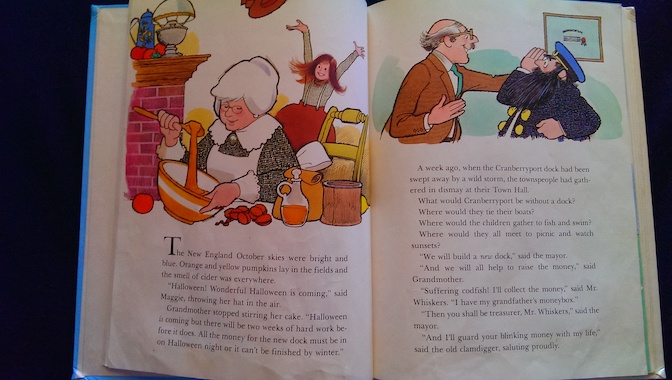
The citizens of Cranberryport need to raise money to build a new dock after theirs was destroyed in a storm. Almost everyone in town volunteers to help, and Mr. Whiskers volunteers to keep the money they raise in his grandfather’s old moneybox.

CranberryHalloweenRaisingMoney

Mr. Grape, a rather cranky old man, not only refuses to donate money to the cause but he insists that it is a mistake to trust Mr. Whiskers with the money because he is a sloppy and careless person. However, Maggie’s grandmother speaks up for Mr. Whiskers, and he gets the job of treasurer for the fund.

CranberryHalloweenSpookyHouse

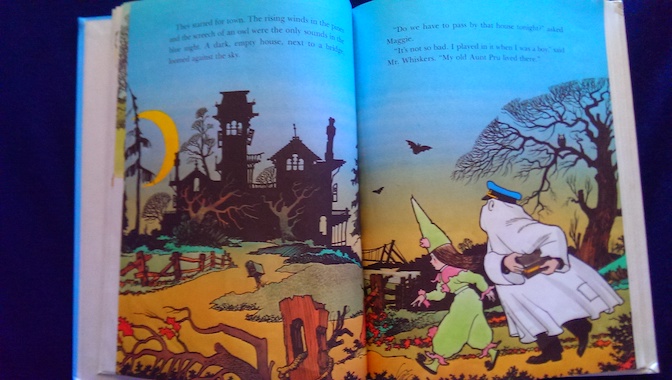
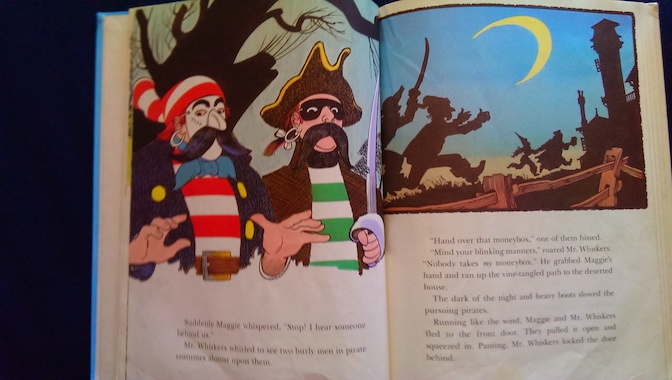
On Halloween night, Mr. Whiskers and young Maggie make their way to the town party, where Mr. Whiskers will present the money for the dock at the town hall.  As they pass by the spooky old house where Mr. Whiskers’s aunt used to live, two men in pirate costumes try to steal the money from them.

CranberryHalloweenPirates

Mr. Whiskers and Maggie hide in the spooky old house, but the pirates are still waiting for them outside. What are they going to do?

CranberryHalloweenTrapped

Mr. Whiskers uses his memories of the old house to find a way out, and it isn’t long before they uncover the villain who put the pirates up to the attempted theft.

The book includes a recipe for Cranberry Dessert in the back.

CranberryHalloweenRecipe

That Terrible Halloween Night

TerribleHalloween

That Terrible Halloween Night by James Stevenson, 1980.

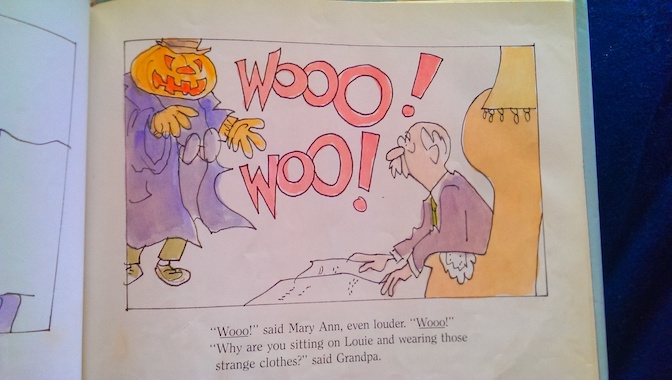
It’s Halloween, and Louie and Mary Ann think that it would be funny to play a joke on their grandfather and scare him.  First, they try putting a scary mask on their dog, Leonard, but their grandfather just pats the dog on the head.  Then, Mary Ann sits on Louie’s shoulders, and the kids put on a big, old coat and a pumpkin head.  However, their grandfather still isn’t frightened.

TerribleHalloweenCostume

When the kids ask him why he isn’t scared, their grandfather says that he doesn’t get scared much since “that terrible Halloween night.”  When the kids ask him what he means, he starts telling them about a Halloween when he was a kid.  He was out trick-or-treating when he saw a mysterious old house and couldn’t resist taking a look inside.

TerribleHalloweenTrickOrTreat

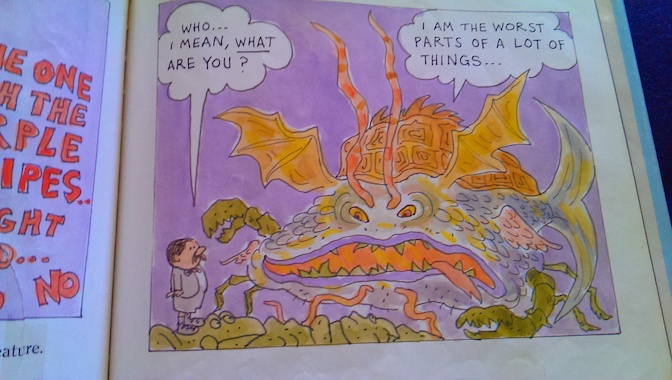
As the grandfather, as a kid, explores the house, he encounters all kinds of strange and frightening creatures.  (My favorite is the one that’s “the worst parts of a lot of things” just for the description.)

TerribleHalloweenMonster

But, nothing in the house is as scary as whatever is behind the final door in the house, the one that the monsters warn him not to go through . . .

TerribleHalloweenOldMan

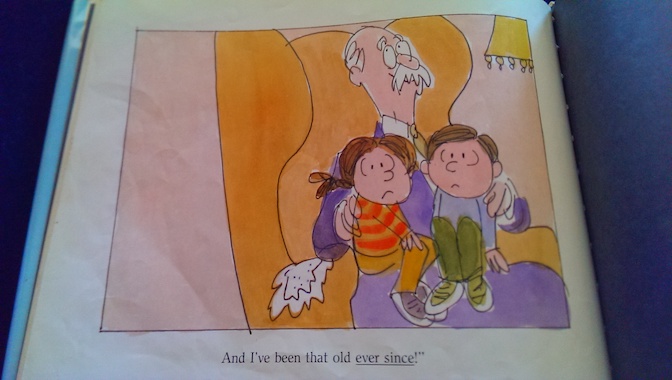
You never see what’s behind the door, but the result is the punchline of the story.  Typical grandfather way to frighten the kids!

TerribleHalloweenPunchline

One of the fun things about this story is that the grandchildren aren’t just listening to the story but are shown reacting to it as the grandfather tells the story, sometimes interrupting with questions or comments.  The pictures are drawn in a comic style, and much of the dialog is contained in speech bubbles in the pictures.

The book is currently available online through Internet Archive.

Ghosts, Witches, and Things Like That

GhostsWitchesThings

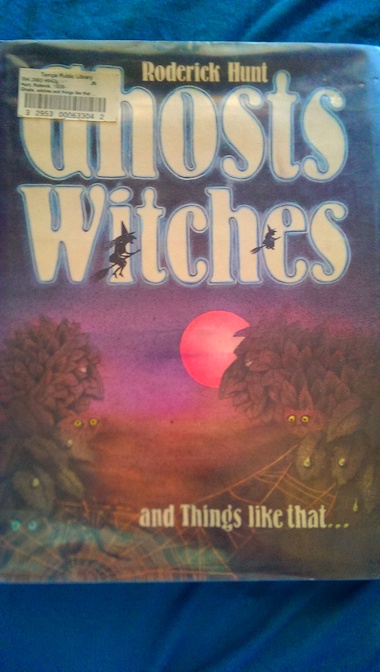
Ghosts, Witches, and Things Like That by Roderick Hunt, 1984.

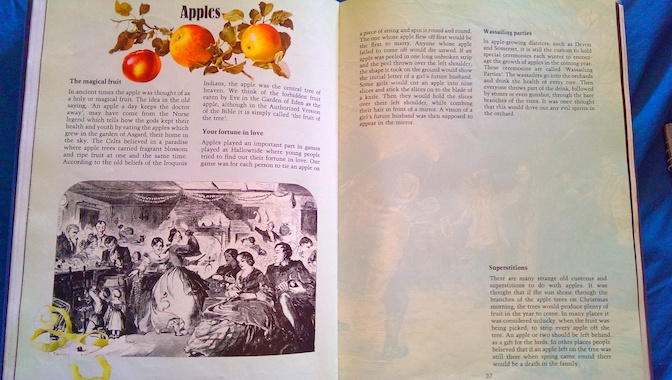
This is a collection of information about the history of Halloween and other things related to Halloween, like folklore, games, recipes, crafts, and poems.  There are sections about specific topics, starting with the section about Halloween itself (spelled Hallowe’en, this is a British book).  The section about Halloween talks about the origins of the holiday and has tips for holding a Halloween party, including how to make costumes and decorations, the rules for games to play (including some old traditional games), and recipes for various Halloween treats.

Other sections of the book focus on various monsters and mythical creatures associated with Halloween, such as witches, ghosts, fairies werewolves, and vampires.  There is a section of ghost stories and some fascinating historical information about spiritualists and how people have faked ghosts in the past, including the Pepper’s Ghost illusion that is still used in the haunted house in Disneyland.  The sections about witches, fairies, and monsters also include a mixture of history and folklore along with some jokes and poems about the various creatures.

GhostsWitchesHistory

This is a fun book to read around Halloween.  It’s a mixture of historical background, folklore, party-planning tips, games, and recipes.  I think that the information about traditional games is still my favorite part.

GhostsWitchesApples

Encyclopedia of Legendary Creatures

LegendaryCreatures

Encyclopedia of Legendary Creatures by Tom McGowen, 1981.

This book is organized into brief encyclopedia-style entries, describing legendary creatures from around the world.  Everything is in alphabetical order, not organized by country or any other over-arching categories.

There are two things that I particularly like about this book.  One is that the mythological creatures in the book aren’t just limited to the common ones, like giants, vampires, werewolves, and unicorns (although they each have entries of their own); there are also some lesser-mentioned creatures like the Hulder Folk and the Abatwa People.  The Hulder Folk, who come from Norse folktales, look like ordinary humans, but they have tails like cows.  According to the book, they love to sing and dance, but their songs are always sad, which makes me think of country music.  They also can intermarry with humans, although their marriages are usually unhappy, which also, oddly, makes me think of country music.  The Abatwa People are part of the folklore of the Zulus in South Africa.  They are tiny people, but fierce warriors, and they get offended if people don’t treat them like they are the same size as humans.  (There are also real people in Africa called Abatwa who are pygmies.  The legendary people in this book may be connected to old legends about them, exaggerating their shorter-than-average height.)

LegendaryCreaturesNisse

The other thing that I really like about this book is the pictures.  There are many books about mythology and folklore that don’t have pictures of the creatures, and it really makes a difference being able to see what something looks like (or supposedly looks like, since these are legendary creatures) as well as read a description.

As a side note, there is an episode of the kids’ cartoon show, Arthur, where his friend, Sue Ellen, who isn’t usually frightened by scary stories, hears a strange noise that makes her think about various mythological monsters that she’s heard about in the different countries that she’s visited with her parents.  These unusual monsters, like Baba Yaga, Kappas, and Bashees, which most of her friends haven’t heard about before, do frighten her.  When I saw Kappas described in this book, it reminded me of that.

Blossom Culp and the Sleep of Death

BlossomSleepDeathBlossom Culp and the Sleep of Death by Richard Peck, 1986.

This book starts shortly after the previous book in the series ends.  After Blossom’s old history teacher was run out of town for his scandalous behavior, he was replaced by Miss Fairweather.  Miss Fairweather is a tough, no-nonsense woman who pushes her students to study hard and take history seriously.  Unexpectedly, she comes to appreciate Blossom, an outcast from a poor family, because Blossom demonstrates some knowledge of Ancient Egypt.  Little does Miss Fairweather know that Blossom’s comments in class were inspired by one of the visions that Blossom occasionally gets because of her psychic gifts.

Blossom experiences a visitation from the spirit of an Ancient Egyptian princess who says that she needs Blossom’s help.  Years ago, her mummy and some precious objects were stolen from her tomb.  The princess doesn’t seem to know exactly where her “earthly form” is now, but she’s sure that it’s somewhere nearby.  She’s very concerned because she senses that archaeologists in Egypt are digging to find her tomb and knows that when they finally reach it, they will discover that she isn’t there.  Rather than being concerned about her tomb being violated by the archaeologists, the princess senses that they are searching for her remains in order to venerate them, that if they find her mummy, they will take it to a place of great beauty where it will be treated with the utmost care and respect (a museum).  She wants that and fears that she will miss her chance at the kind of immortality that this form of glorification, care, and study will provide.  So, she asks Blossom to find her earthly remains and inform the searchers of her true whereabouts.  At first, Blossom has no idea how she can accomplish that, but the princess threatens her with a true Egyptian curse if she doesn’t try.

Then, Blossom receives a clue to the mystery in the form of a beautiful Egyptian scarab that her mother found one day while she was out scavenging.  If Blossom can find the place where her mother found the jewel, she can also find the princess’s mummy.  Fortunately, Miss Fairweather has assigned the class special projects about Ancient Egypt, and she is thrilled when Blossom says that she wants to study grave robbers.  Blossom sees this as a good way to collect some extra information about grave robbers that she can use to find the princess’s mummy as well as get a good grade in Miss Fairweather’s class.  It also proves to be an excellent way to draw Alexander Armsworth into her search for the mummy.

Alexander still denies to Blossom that he has real psychic abilities like hers, even after their previous adventures together.  He insists that it was just a phase that they were going through, one that he wants to leave behind.  He’s been busy flirting with Letty, the class snob, and he’s trying hard to get into a prestigious fraternity so that he can give Letty his fraternity pin.  Not only does Blossom think that the boys in the fraternity are a bunch of idiots who do stupid things, but the idea of Alexander giving Letty his pin as a sign of their relationship is just sickening.

Blossom is reluctant to admit her real feelings for Alexander, but the two of them are close in ways that Letty and Alexander never will be because of their shared abilities and adventures, and Blossom has a sense that their futures will be intertwined as well.  Alexander is angry that Blossom is roping her into yet another supernatural escapade, but he has to go along with her project idea because he has already gotten on Miss Fairweather’s bad side and needs to do well on the project to save his grade in class.

Along with the supernatural adventure, there is also a look into the past, the world of 1910s America as well as Ancient Egypt.  First, there are the traditions of stunts associated with Alexander’s initiation into his fraternity and the tradition of giving a girl a fraternity pin as a precursor to engagement (“engaged to be engaged”).  Then, they discover that Miss Fairweather is a suffragette, which is the reason why she left her previous teaching job.  Her feminist ideals cause problems for her in her new, small town when they become known, but with Blossom’s help, she wins over some of the influential women in town as well as a male admirer.

The book is currently available online through Internet Archive.

The Dreadful Future of Blossom Culp

DreadfulFutureBlossomCulpThe Dreadful Future of Blossom Culp by Richard Peck, 1983.

This book is part of the Blossom Culp Series.

It’s 1914, and Blossom Culp is just starting high school. Although the principal of her old school tells her that this is a chance for her to make a fresh start, it looks like Blossom’s future is going to be very much a continuation of her immediate past.  In high school, she’s still a social outcast, looked down on by girls from better-off families, like Letty, the class president.  Also, despite her principal’s assertion that Blossom’s previous forays into the occult were imaginary, the product of the mental confusion that accompanies puberty, and that she is bound to grow out of them, Blossom knows that her psychic abilities are a natural gift and will not be ignored.

Blossom begins high school friendless because Alexander Armsworth has been ignoring her lately because of his important new position as class vice-president, his infatuation with Letty, and his friendship with a couple of local hooligans, Bub and Champ. Alexander is looking forward to his role in planning the school’s Halloween Festival, telling Blossom that he’s over their earlier, childish occult escapades and the Halloween pranks he used to pull.  Meanwhile, all of the other girls in school are infatuated with their handsome history teacher, Mr. Lacy, and so is the girls’ gym teacher, much to Blossom’s disgust.  Blossom thinks that Mr. Lacy is full of himself and denies that she has any such silly crush on Alexander.

Blossom makes an unexpected friend in a girl called Daisy-Rae, a girl from the country who has brought her younger brother into town to attend school and hoped to get an education herself but has been too afraid of the big town to actually attend classes.  Daisy-Rae hides in the school during the day and lives alone with her brother at night in the old chicken coop at the abandoned Leverette house.  It is through Daisy-Rae that she learns that Alexander and his friends aren’t so above childish pranks as they claim to be.  Blossom also discovers that Mr. Lacy has been romancing her old principal.  Mr. Lacy isn’t quite what he appears to be and has some unsavory secrets in his past.

Matters come to a head when Alexander (at Letty’s urging) tries to persuade Blossom to dress up and become the fortune teller for the haunted house that the freshmen class is doing for the Halloween Festival.  The haunted house is also a fundraiser, and Letty figures that they can get extra money from people if they’re willing to pay to have their fortunes told, and who would be better for the job than Blossom?  However, Blossom isn’t one to go out of her way to please others, especially Letty, and it turns out that they’re holding the haunted house in the Old Leverette place.  For some reason, that old house makes Blossom’s mother uneasy.  She seems to think that it’s haunted, but in an unusual way.  Blossom tells Alexander that she will not agree to be their fortune teller until he agrees to check out the house with her before Halloween and find out what’s wrong with it.  She figures that, since both of them are psychic, they can learn what’s so unusual.

As Blossom learns, her abilities don’t confine themselves to the past and people who have died but extend to the future and the people who haven’t yet been born.  Inside the Old Leverette house, Blossom suddenly finds herself entering the distant future, the 1980s.  In the 1980s, the Leverette house is once again lived in, and Blossom meets a boy named Jeremy who is a lonely social outcast, like herself.  Jeremy is a computer nerd, living with his divorced mother.  He takes Blossom on a tour of their town as it is in Blossom’s future, much larger than it used to be and with many familiar landmarks missing.  However, what Blossom sees in the future gives her the inspiration she needs to solve her problems in the past and hope that things will improve.  In return, she also proves to Jeremy that he is far from alone and has had a friend for longer than he ever imagined.

The time travel to the 1980s comes off as being a little corny (or so it seemed to me), but the writing quality of the book is excellent.  The author has an entertaining turn of phrase, and the book, like others in the series, is humorous and a lot of fun to read.

Besides being a kind of fantasy story, there are some interesting tidbits of history in the book, showing how people lived in the 1910s.  Blossom explains about the things she and her classmates did at school, like wearing beanies on their heads to show which year they were (freshmen, future graduating class of 1918).  At one point in the story, Blossom takes Daisy-Rae and her brother to their first movie, a silent film with an episode of The Perils of Pauline serial.  While Blossom worries about the future, readers can get a glimpse of the past!

As for what Blossom learns about her own future, she avoids finding out too much because she’d rather not know the details.  However, there are implications that she and Alexander may eventually marry and live in his family’s old house.

The book is currently available online through Internet Archive.