December Secrets

The Kids of Polk Street School
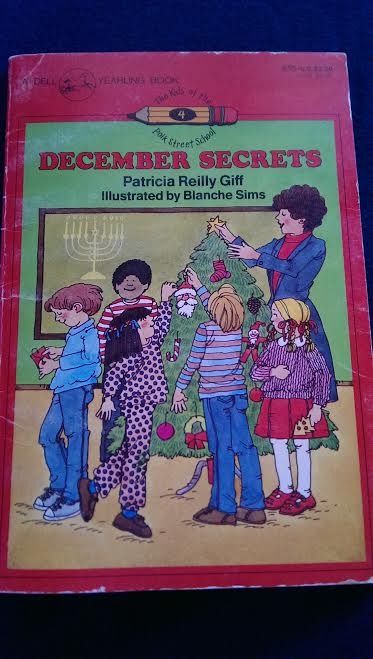
decembersecrets#4 December Secrets by Patricia Reilly Giff, 1984.

It’s December, and the kids in Ms. Rooney’s class at Polk Street School are learning about Christmas and Hanukkah.  To get everyone in the holiday spirit, Ms. Rooney has everyone choose someone else in class as their “Secret December Person,” kind of a Secret Santa-style activity.  The kids will give small presents and do nice things for the person they pick.

Emily would have picked her friend Dawn for her person, but they’ve been fighting since Emily wouldn’t let Dawn cut in front of her in line when the fire truck came to school and the kids who were first in line were allowed to actually get in the front seat.  Emily tries to pick someone else to be her Secret December Person, but her other favorite choices are taken.  When she asks Ms. Rooney who is still available, Ms. Rooney suggests Jill Simon.
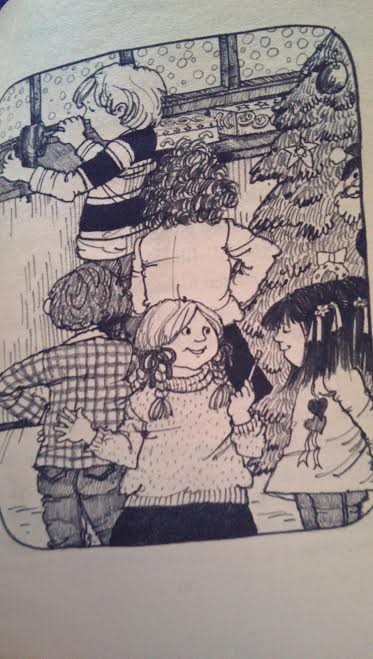
decembersecretspicEmily doesn’t think much of Jill Simon because she’s fat and a crybaby.  Whenever the least little thing goes wrong, Jill tears up.  She hardly ever smiles.  But, although Emily isn’t thrilled at first to have Jill as her Secret December Person, she then thinks that she can use this as an opportunity to help Jill.  Maybe her presents will help Jill to become a happier, maybe even thinner person.

The book is available to borrow and read for free online through Internet Archive.

My Reaction

Although Emily wants to help Jill, her first attempts fall flat because she’s focusing too much on correcting Jill’s faults instead of thinking about what would really make Jill happy.  Jill becomes a happier person when Emily notices the good things about Jill and helps her to see them for herself.  The project helps Emily to become a more thoughtful person, and she also makes a surprising discovery about the Secret December Person who has been leaving thoughtful presents for her.

The reason why it has to be “Secret December Person” instead of “Secret Santa” is because there are both Christian and Jewish children in the class.  That’s why the kids learn about both Christmas and Hanukkah.  They don’t want anybody to feel left out.  The name “Secret December Person” is a little cumbersome next to “Secret Santa”, but the sentiment is nice.  I don’t recall doing anything like this as a class activity when I was in elementary school.  I remember that I was in first grade when a Jewish girl and her mother explained Hanukkah to the class.  They gave everyone small plastic dreidels to play with, and I spent the Christmas holidays that year playing dreidel with my brother for peanuts and M&Ms.  They were just little party favor dreidels, but I had a lot of fun with mine, and I still have it.  Sometimes, little presents do mean a lot.

The Zucchini Warriors

zucchiniwarriorsThe Zucchini Warriors by Gordon Korman, 1988.
One of MacDonald Hall’s former students, Hank “the Tank” Carson, has made it big with his zucchini stick snack company.  As a former football player, he also wants to create a winning football team for his old school, funded by his zucchini fortune.

Mr. Sturgeon isn’t happy to see Hank again.  He was in Mr. Sturgeon’s math class, before Mr. Sturgeon became the school’s headmaster.  Hank was always a loud, obnoxious student, and against his morals, Mr. Sturgeon gave him a passing grade even though Hank actually failed the class.  He only did it because he couldn’t stand another year with Hank as his student, although he’s felt guilty about it ever since.

The boys aren’t thrilled about the new football stadium and team, either.  What they really wanted was a new rec hall.  But, when Bruno gets up the nerve to tell Hank about it, Hank makes the kids a deal: if they get a football team together and make a decent showing with it, he’ll fund a rec hall for them, too.  Bruno, as the one who wanted the rec hall the most, becomes the driving force behind the new football team, talking the other guys into playing and even eating Hank’s zucchini sticks even though everyone at school actually hates them.

The biggest stumbling block that the MacDonald Hall Zucchini Warriors faces is that they know nothing about the game.  In fact, the only one around who’s really into football is Cathy, one of the girls across the street at Miss Scrimmage’s Finishing School for Young Ladies.  But, football is a man’s game . . . right?

This book is part of the MacDonald Hall Series (or Bruno and Boots series). It is currently available online through Internet Archive.

The War with Mr. Wizzle

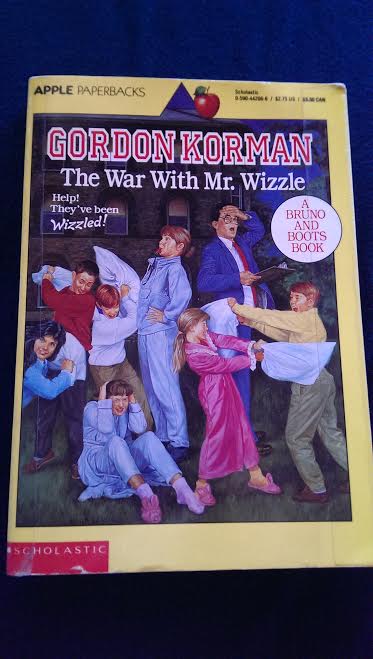
warwizzleThe War with Mr. Wizzle by Gordon Korman, 1982.
MacDonald Hall hasn’t been the same since Mr. Wizzle came.  He’s obsessed with computers and analyzing and categorizing everyone and everything.  He uses his computers to analyze the boys’ personalities, making changes to their schedules and activities based on the results.  But, no computer could ever understand the wacky and complex personalities of the students at MacDonald Hall.

Mr. Wizzle thinks he can understand everything with his computer, but he doesn’t understand the boys at all.  The boys soon get sick of being tested and analyzed and ordered around and told that they should consider changing their last names because the length is too inconvenient for the computer.  Even Mr. Sturgeon and the other faculty members are getting fed up with Mr. Wizzle, but they can’t do anything about it because the school’s board of directors are still hoping that Mr. Wizzle will modernize the school.

Meanwhile, the boys’ friends across the street at Miss Scrimmage’s Finishing School for Young Ladies are having personnel problems of their own.  Miss Scrimmage’s new athletics teacher, Miss Peabody, used to be a U.S. Marine, and she’s trying to train the girls like they’ve signed up for boot camp.  Like the boys, they would do just about anything to get rid of this new nuisance!

What ensues is a series of hi-jinks in the usual spirit of McDonald Hall as the students at each school attempt to drive out the new faculty, but along the way, the kids are forced to acknowledge that they don’t really want anything bad to happen to these new people.  It’s not that they’re bad people, they’re just not right for the types of schools and the students they’re trying to teach.  Then, a thought occurs to them: Is it possible that Mr. Wizzle and Miss Peabody might be right for . . . each other?

This book is part of the MacDonald Hall Series (or Bruno and Boots series). It is currently available online through Internet Archive.

Beware the Fish!

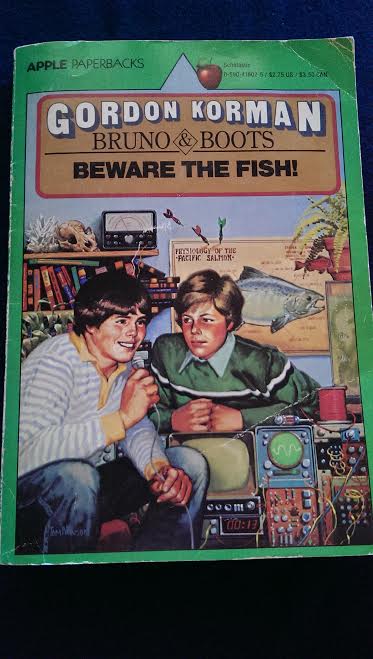
bewarefishBeware the Fish! by Gordon Korman, 1980.
In spite of MacDonald Hall’s prestigious reputation, it is continually plagued by money problems.  The students can’t help but notice all the budget cutbacks, and now, there are rumors that the school might even have to close permanently.  The last thing anyone wants is to leave MacDonald Hall.  Bruno, the school’s resident idea man and master prankster, decides to spearhead a movement to raise money and publicity for MacDonald Hall so they can save the school!

Bruno, his best friend Boots, and their other fellow students try everything they can think of to spread the word about what a great place MacDonald Hall is so that enrollment will go up and the school can earn enough money to stay open.  They enlist the help of the girls at the nearby finishing school to help them break a world record.  The school’s science whiz, Elmer, shows the boys some of his inventions in the hope that one of them will make the school famous.

Unfortunately, as usual, nothing turns out as planned.  World records are extremely difficult to break, and Elmer’s inventions backfire.  One of his inventions backfires in such a way that it comes to the attention of the local police, and even the government becomes convinced that a gang of terrorists may be operating somewhere in the vicinity of MacDonald Hall.

The boys try to keep their activities secret from their headmaster, Mr. Sturgeon (or, as the boys nickname him, “The Fish”), while government agents snoop around, looking for the head of the organization that’s been issuing cryptic messages over television signals, a shadowy figure known only as “The Fish.”

This book is part of the MacDonald Hall Series (or Bruno and Boots series).  It is currently available online through Internet Archive.

The Eleventh Hour

The Eleventh Hour by Graeme Base, 1989.

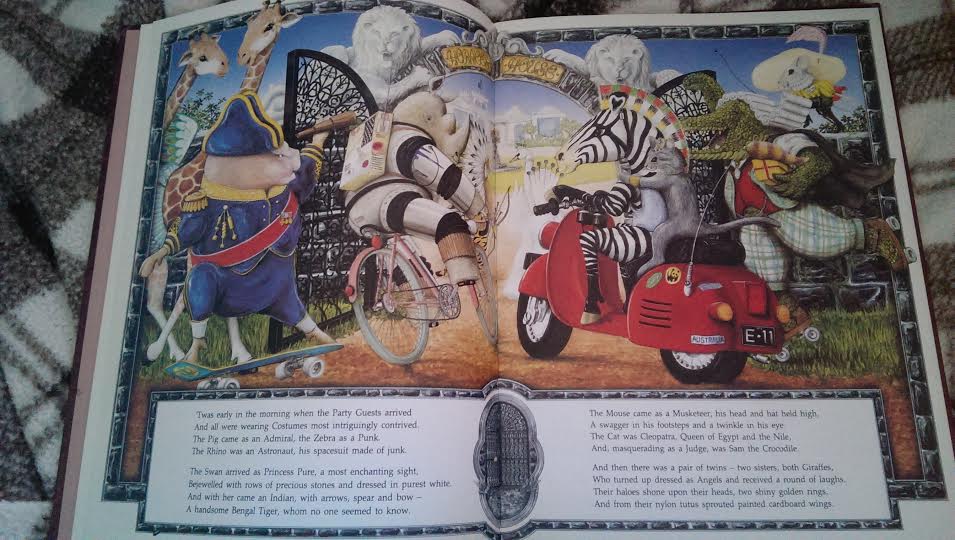
Horace the elephant is turning eleven years old, so he’s invited all of his animal friends to his house for a costume party.  The best part will be the extraordinary feast that Horace has created himself with all kinds of cakes and pastries and other desserts.

eleventhhourguests2

But, Horace refuses to let his friends eat any of the goodies until after they’ve played the party games. The guests have a lot of fun, but through all the games, they’re still thinking about that glorious feast. Only, when they finally go to eat, the food is all gone! Who could have taken it?

The book is available to borrow and read for free online through Internet Archive.

My Reaction

This picture book is actually a puzzle book, with puzzles difficult enough to even challenge adults.  Hidden within each of the large pictures taking up the entire page of each page in the book, are secret messages that hint at the identity of the thief, who is one of the party guests.  Some of the messages are in code.  Although a young child might enjoy the pictures in the book and the rhymes of the story, it would take someone older to be able to solve the puzzles.

There is a way to find the thief without finding the hidden messages or solving any codes, but it still requires attention to detail. There is a section in the back of the book that explains everything, pointing out all the secrets that you can find in the pictures, including the names of one of the giraffes and the swan, whose names are not given in the story itself.

But, don’t skip straight to the answers.  As Base himself says at the beginning to the section of answers, “the getting of wisdom is no match for the thrill of the chase, and those who choose the longer road shall reap their reward!”

Jumble Joan

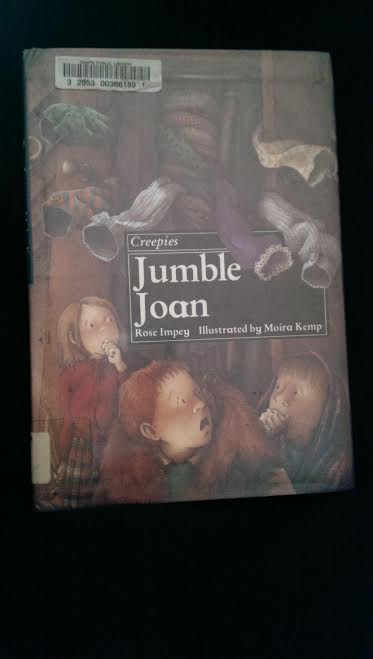
jumblejoanJumble Joan by Rose Impey, 1989.

A boy and his friend, Mick, take his little sister upstairs to explore their grandmother’s attic one evening.  The boys are hoping to scare the girl by telling her all sorts of creepy stories about the stuff they find in the attic, but if they’re scaring anyone, it might just be themselves.

A rocking horse becomes one of the dreaded “Ten O’Clock Horses” that might drag a child off into the night if she isn’t in bed on time.  An old stuffed parrot in a cage becomes “The Deadly Vampire Bat”, waiting to suck their blood.  But, the most sinister creature of all might be “Jumble Joan”, who hides by pretending to be a pile of old clothes, ready to steal away any little girls who might want to play dress up in their grandmother’s attic!

Although the brother narrates the story, the pictures show that his little sister knows exactly what the boys are trying to do, and she does things to turn the situation around.

This is one of the books in the Creepies Series.  Kids under the age of seven might find stories in this series a little scary because they focus on how stories about monsters can build in the imagination, even if you know that you made them up yourself.  Still, all of the books have good endings, and this one is pretty funny.

This book is available to borrow and read for free online through Internet Archive.

The Flat Man

flatmanThe Flat Man by Rose Impey, 1988.

Before Slender Man, there was . . . The Flat Man!  And he wasn’t quite as scary. As far as I know, there is no connection between the two fictional characters other than a similarity in name.  Still, the Creepies Series, while picture books, should probably only be given to children no younger than seven who like scary stories.  They might provoke nightmares in very young children and sensitive children.  I liked these stories as a kid for their imagination, but individual tastes may vary.

Like all the books in the Creepies series, The Flat Man features a child who enjoys being a little scared and makes up his own imaginary monster to battle with at bedtime.  The entire time, the boy knows that the monster is imaginary and prides himself on knowing just how to deal with him.

While lying in bed one night, the boy imagines the scary creature called the Flat Man for the fun of it.  He amuses himself with imagining that every sound he hears is the Flat Man, a paper-thin creature that can sneak in anywhere, squeeze himself through any crack. But, the Flat Man has weaknesses: he’s afraid of light and open spaces. The boy acts out his duel with the imaginary Flat Man, enjoying his triumph . . . right up until his father comes in to find out what’s going on.

This book is available to borrow and read for free online through Internet Archive.

My Reaction

Even though his imaginary creature is frightening, the boy enjoys it, comes up with his own solution for defeating it, and acts out a triumphant battle with it. Those who don’t mind a bit of spookiness will appreciate the boy’s imagination and may giggle at how he gets a bit carried away with his fantasy.

Scare Yourself to Sleep

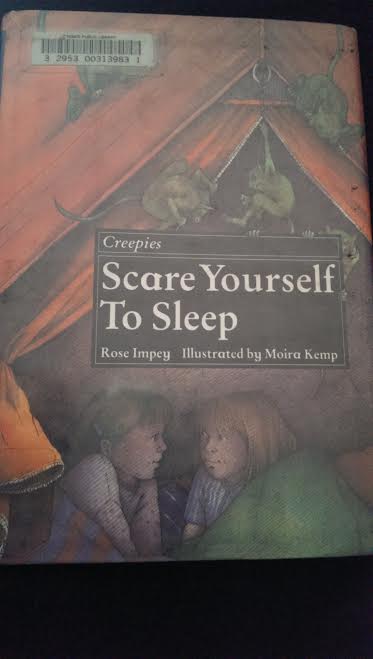
scareyourselfScare Yourself to Sleep by Rose Impey, 1988.

A girl and her cousin are camping out in the backyard when they decide to play a game they made up themselves called “Scare Yourself to Sleep.” They take turns inventing and telling stories about monsters lurking out in the darkness. The winner of the game is the one who successfully scares the other.

They talk about the Garbage Goblins, who live in trash cans. The Flying Cat is a creature that is half-cat, half-moth. The Tree Creeper lives in trees and looks like a branch, just waiting to fall down on someone. But, the best of all is the Invisible Man!

However, their stories are interrupted by the girl’s brother, Simon, who is trying to scare them . . . at least, they think it’s probably Simon. The monsters are made up, aren’t they?

The book is currently available online through Internet Archive. It’s part of a series.

scareyourselfpic1

My Reaction and Spoilers

I first read this when I was about seven years old, and I’ve loved it ever since! The pictures show not only what’s happening in the girls’ imaginations but hint at what’s happening in real life, just outside their tent as Simon acts out the things in their stories. It might be a little too scary for very young children, but kids about seven and up will like it (provided that they also like creepy stories).

The illustrations are vivid and detailed, and readers may be wondering up until the very end how much is really imagined. All the books in the Creepies Series are about the power of imagination and how it can be fun to be a little bit scared.

scareyourselfpic3

The Haunted Hotel

The Haunted Hotel

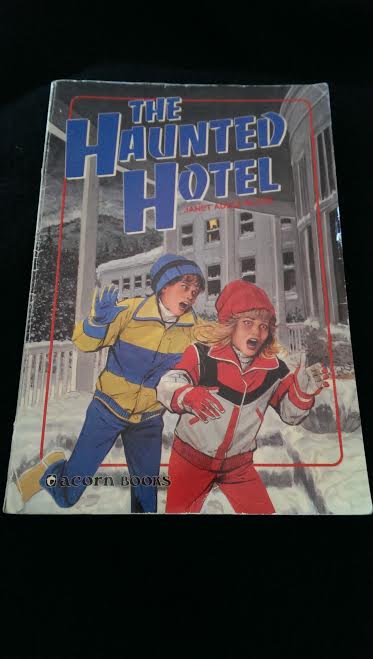
The Haunted Hotel by Janet Adele Bloss, 1989.

Laura and Bill are visiting their Uncle Joe, who is the caretaker of a large hotel in New Hampshire. The hotel is closed for the winter because it is too old and poorly-insulated to heat. The children think that the big, old hotel is fascinating, especially when they begin hearing stories about the ghost of a princess who is said to haunt the hotel and put people under her spell to do her bidding.  It’s just the sort of thing that Laura reads about in her favorite series of mystery books, and she’d love the chance to investigate something like the heroine, Gwen Gilderstar.

Bill rolls his eyes at Laura’s melodramatic mystery obsession, but then the children begin noticing that their uncle is behaving strangely, and they start to wonder if he is under the princess’s spell.  When they first arrived, their uncle told them that his sister, their Aunt Gigi, had gone away to visit a sick friend.  Then, Laura overhears him talking to Gigi on the phone, saying that she and her brother and parents went out to dinner, so she can’t talk to them.  Later, Laura gets the chance to talk to Aunt Gigi and finds out that she only went to visit her friend because Joe insisted and that her friend isn’t sick.  What is going on?  Why would her uncle lie?  Is he under the princess’s spell?

Laura and Bill see mysterious lights and a shadowy figure in the windows of the closed hotel.  Could that be the ghost of the princess?  Even though their parents have forbidden them to go inside the old hotel, the kids go there to investigate.  They hear organ music and a woman laughing, and they find a red rose on the floor, just like the roses in the portrait of the princess.  Then, Bill catches a glimpse of the princess in the elevator, carrying a silver axe!  Laura is determined to solve the mystery, just like Gwen Gilderstar.  She’s afraid, but she knows that she has to do something for her uncle’s sake.

My Reaction

I loved this book when I was a kid because it’s a fun mystery. Laura is a girl after my own heart, who loves mystery stories in the classic girl detective style. “Gwen Gilderstar” seems to be a character similar to Nancy Drew, Trixie Belden, or other girl detective characters. Because of her taste in books, Laura looks at everything that happens through the lens of a spooky mystery story, initially not seeing the more practical explanations for the things happening around her. Although the setting of the book, a seemingly haunted hotel that’s closed for the winter season, reminds me of The Shining, the actual plot reminds me more of Northanger Abbey, the classic book by Jane Austen about a girl with an active imagination and a taste for frightening stories.

Return of the Third-Grade Ghosthunters

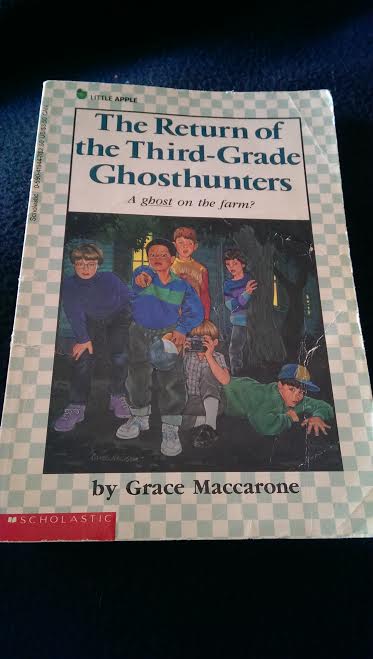
return3gghostThe Return of the Third-Grade Ghosthunters by Grace Maccarone, 1989.

This is part of the Third Grade Ghosthunters series.

The same kids who were assigned to figure out the mysterious happenings at their school are now going on a field trip to a farm with their class. They’ll be spending a couple of days on the farm, sleeping over.  Adam has been looking forward to the trip, and he brings his ghost hunting gear with him, just in case.  He hasn’t lost his taste for ghost stories since their last adventure.

At first, things are pretty normal.  Then, during the night, the boys hear howling and see apparitions of a ghostly wolf in their bunk house. Could the farm be haunted?  Or is this some kind of mean joke?  Perhaps it’s the work of the class bully, Jeff? The ghost hunting committee assembles again to solve the mystery.

return3gghostpic2They try to use scientific methods to study the haunting.  They measure the placement of the furniture to see if anything moves while they’re out and sprinkle flour on the floor to get footprints.  But, even though they watch carefully and don’t see anyone enter the bunk house, when they go inside, everything is a mess, and the flour doesn’t appear disturbed.  Everyone else is about ready to admit that this one is a real ghost, but Adam has another theory.

The solution has an interesting twist to it. It’s a good mystery for kids beginning chapter books who like a little creepiness in their reading.

The book is currently available online through Internet Archive.