Jumble Joan

jumblejoanJumble Joan by Rose Impey, 1989.

A boy and his friend, Mick, take his little sister upstairs to explore their grandmother’s attic one evening.  The boys are hoping to scare the girl by telling her all sorts of creepy stories about the stuff they find in the attic, but if they’re scaring anyone, it might just be themselves.

A rocking horse becomes one of the dreaded “Ten O’Clock Horses” that might drag a child off into the night if she isn’t in bed on time.  An old stuffed parrot in a cage becomes “The Deadly Vampire Bat”, waiting to suck their blood.  But, the most sinister creature of all might be “Jumble Joan”, who hides by pretending to be a pile of old clothes, ready to steal away any little girls who might want to play dress up in their grandmother’s attic!

Although the brother narrates the story, the pictures show that his little sister knows exactly what the boys are trying to do, and she does things to turn the situation around.

This is one of the books in the Creepies Series.  Kids under the age of seven might find stories in this series a little scary because they focus on how stories about monsters can build in the imagination, even if you know that you made them up yourself.  Still, all of the books have good endings, and this one is pretty funny.

This book is available to borrow and read for free online through Internet Archive.
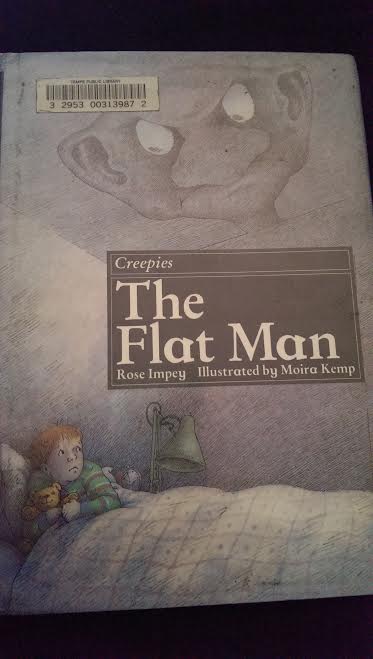
The Flat Man

flatmanThe Flat Man by Rose Impey, 1988.

Before Slender Man, there was . . . The Flat Man!  And he wasn’t quite as scary. As far as I know, there is no connection between the two fictional characters other than a similarity in name.  Still, the Creepies Series, while picture books, should probably only be given to children no younger than seven who like scary stories.  They might provoke nightmares in very young children and sensitive children.  I liked these stories as a kid for their imagination, but individual tastes may vary.

Like all the books in the Creepies series, The Flat Man features a child who enjoys being a little scared and makes up his own imaginary monster to battle with at bedtime.  The entire time, the boy knows that the monster is imaginary and prides himself on knowing just how to deal with him.

While lying in bed one night, the boy imagines the scary creature called the Flat Man for the fun of it.  He amuses himself with imagining that every sound he hears is the Flat Man, a paper-thin creature that can sneak in anywhere, squeeze himself through any crack. But, the Flat Man has weaknesses: he’s afraid of light and open spaces. The boy acts out his duel with the imaginary Flat Man, enjoying his triumph . . . right up until his father comes in to find out what’s going on.

This book is available to borrow and read for free online through Internet Archive.

My Reaction

Even though his imaginary creature is frightening, the boy enjoys it, comes up with his own solution for defeating it, and acts out a triumphant battle with it. Those who don’t mind a bit of spookiness will appreciate the boy’s imagination and may giggle at how he gets a bit carried away with his fantasy.

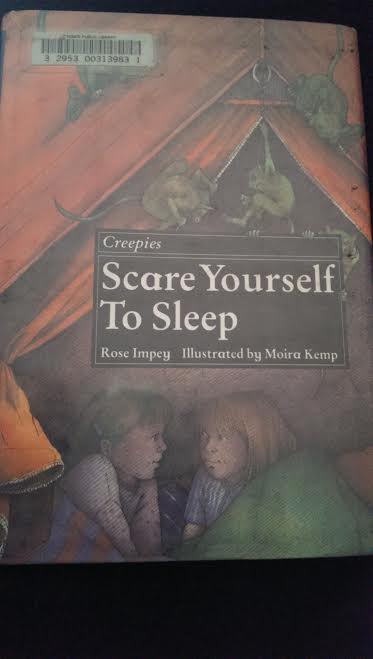
Scare Yourself to Sleep

scareyourselfScare Yourself to Sleep by Rose Impey, 1988.

A girl and her cousin are camping out in the backyard when they decide to play a game they made up themselves called “Scare Yourself to Sleep.” They take turns inventing and telling stories about monsters lurking out in the darkness. The winner of the game is the one who successfully scares the other.

They talk about the Garbage Goblins, who live in trash cans. The Flying Cat is a creature that is half-cat, half-moth. The Tree Creeper lives in trees and looks like a branch, just waiting to fall down on someone. But, the best of all is the Invisible Man!

However, their stories are interrupted by the girl’s brother, Simon, who is trying to scare them . . . at least, they think it’s probably Simon. The monsters are made up, aren’t they?

The book is currently available online through Internet Archive. It’s part of a series.

scareyourselfpic1

My Reaction and Spoilers

I first read this when I was about seven years old, and I’ve loved it ever since! The pictures show not only what’s happening in the girls’ imaginations but hint at what’s happening in real life, just outside their tent as Simon acts out the things in their stories. It might be a little too scary for very young children, but kids about seven and up will like it (provided that they also like creepy stories).

The illustrations are vivid and detailed, and readers may be wondering up until the very end how much is really imagined. All the books in the Creepies Series are about the power of imagination and how it can be fun to be a little bit scared.

scareyourselfpic3

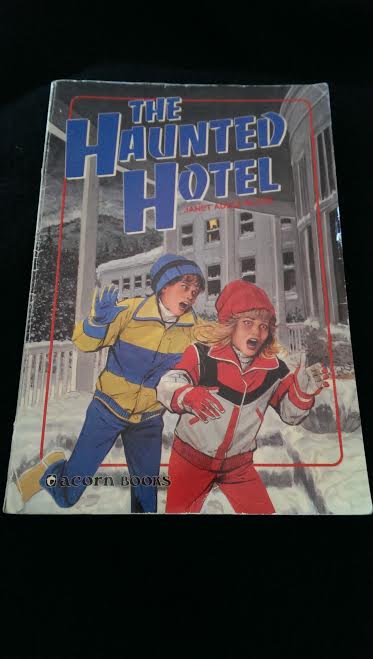
The Haunted Hotel

The Haunted Hotel

The Haunted Hotel by Janet Adele Bloss, 1989.

Laura and Bill are visiting their Uncle Joe, who is the caretaker of a large hotel in New Hampshire. The hotel is closed for the winter because it is too old and poorly-insulated to heat. The children think that the big, old hotel is fascinating, especially when they begin hearing stories about the ghost of a princess who is said to haunt the hotel and put people under her spell to do her bidding.  It’s just the sort of thing that Laura reads about in her favorite series of mystery books, and she’d love the chance to investigate something like the heroine, Gwen Gilderstar.

Bill rolls his eyes at Laura’s melodramatic mystery obsession, but then the children begin noticing that their uncle is behaving strangely, and they start to wonder if he is under the princess’s spell.  When they first arrived, their uncle told them that his sister, their Aunt Gigi, had gone away to visit a sick friend.  Then, Laura overhears him talking to Gigi on the phone, saying that she and her brother and parents went out to dinner, so she can’t talk to them.  Later, Laura gets the chance to talk to Aunt Gigi and finds out that she only went to visit her friend because Joe insisted and that her friend isn’t sick.  What is going on?  Why would her uncle lie?  Is he under the princess’s spell?

Laura and Bill see mysterious lights and a shadowy figure in the windows of the closed hotel.  Could that be the ghost of the princess?  Even though their parents have forbidden them to go inside the old hotel, the kids go there to investigate.  They hear organ music and a woman laughing, and they find a red rose on the floor, just like the roses in the portrait of the princess.  Then, Bill catches a glimpse of the princess in the elevator, carrying a silver axe!  Laura is determined to solve the mystery, just like Gwen Gilderstar.  She’s afraid, but she knows that she has to do something for her uncle’s sake.

My Reaction

I loved this book when I was a kid because it’s a fun mystery. Laura is a girl after my own heart, who loves mystery stories in the classic girl detective style. “Gwen Gilderstar” seems to be a character similar to Nancy Drew, Trixie Belden, or other girl detective characters. Because of her taste in books, Laura looks at everything that happens through the lens of a spooky mystery story, initially not seeing the more practical explanations for the things happening around her. Although the setting of the book, a seemingly haunted hotel that’s closed for the winter season, reminds me of The Shining, the actual plot reminds me more of Northanger Abbey, the classic book by Jane Austen about a girl with an active imagination and a taste for frightening stories.

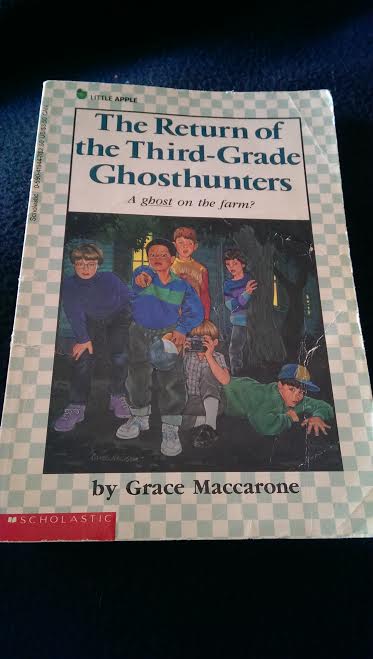
Return of the Third-Grade Ghosthunters

return3gghostThe Return of the Third-Grade Ghosthunters by Grace Maccarone, 1989.

This is part of the Third Grade Ghosthunters series.

The same kids who were assigned to figure out the mysterious happenings at their school are now going on a field trip to a farm with their class. They’ll be spending a couple of days on the farm, sleeping over.  Adam has been looking forward to the trip, and he brings his ghost hunting gear with him, just in case.  He hasn’t lost his taste for ghost stories since their last adventure.

At first, things are pretty normal.  Then, during the night, the boys hear howling and see apparitions of a ghostly wolf in their bunk house. Could the farm be haunted?  Or is this some kind of mean joke?  Perhaps it’s the work of the class bully, Jeff? The ghost hunting committee assembles again to solve the mystery.

return3gghostpic2They try to use scientific methods to study the haunting.  They measure the placement of the furniture to see if anything moves while they’re out and sprinkle flour on the floor to get footprints.  But, even though they watch carefully and don’t see anyone enter the bunk house, when they go inside, everything is a mess, and the flour doesn’t appear disturbed.  Everyone else is about ready to admit that this one is a real ghost, but Adam has another theory.
The solution has an interesting twist to it. It’s a good mystery for kids beginning chapter books who like a little creepiness in their reading.

The book is currently available online through Internet Archive.

The Haunting of Grade Three

HauntingG3The Haunting of Grade Three by Grace Maccarone, 1984.
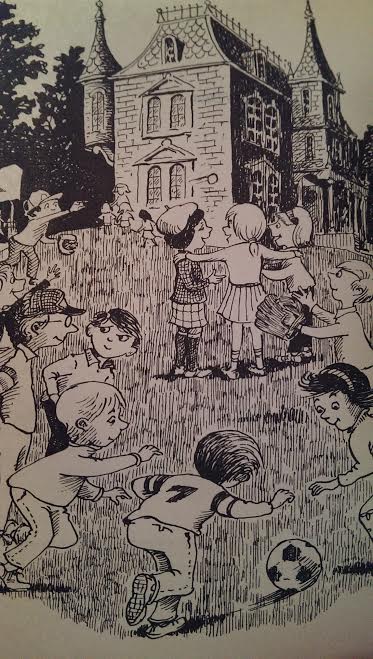
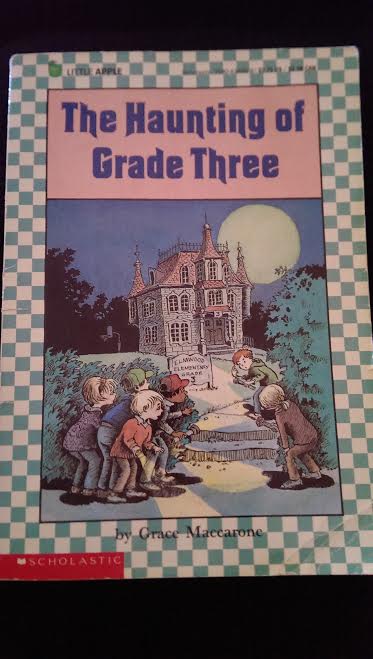
Elwood Elementary has become overcrowded, so the third-graders have been moved to an old mansion, Blackwell House, which has been empty for years. The house looks kind of spooky, and there are a lot of local ghost stories about it. Fortunately, Adam Johnson likes scary stories, so he thinks that it’s wonderful to go to school there.

Soon after the students move into the house, strange things begin happening. Objects fall off desks and shelves, and door slam for no reason.  Some of the kids discover a grave marker on the property for a boy about their age who died during the Civil War.  The kids start getting nervous, and so does their teacher, Mr. Jenkins. Then, Mr. Jenkins decides to give the kids group assignments. Each committee gets to go to a different place in town and learn about it. Adam’s committee is assigned to study Blackwell House and decide if it’s really haunted. The kids think their assignment is pretty strange, but Adam is excited.  He wants to be a ghost hunter like on Ghostbusters!

HauntingGradeThreeMost of the group members are misfits in one way or another. Norma Hamburger is a shy girl, frequently teased about her last name. Debbie Clark is a talkative girl who’s really into science. Chuck Webber, Adam’s best friend, is the class clown, always telling stupid jokes (and one of the main people who teases Norma about her name). Danny Biddicker is strong and good at sports, but he worries that he’s not as smart as the others. Joey Baker feels overshadowed by his large family, so he tells tall tales to get attention. The other kids don’t understand and get annoyed with his lies. By working together, they not only learn the secret of Blackwell House, but they learn more about each other and become a real team and friends.
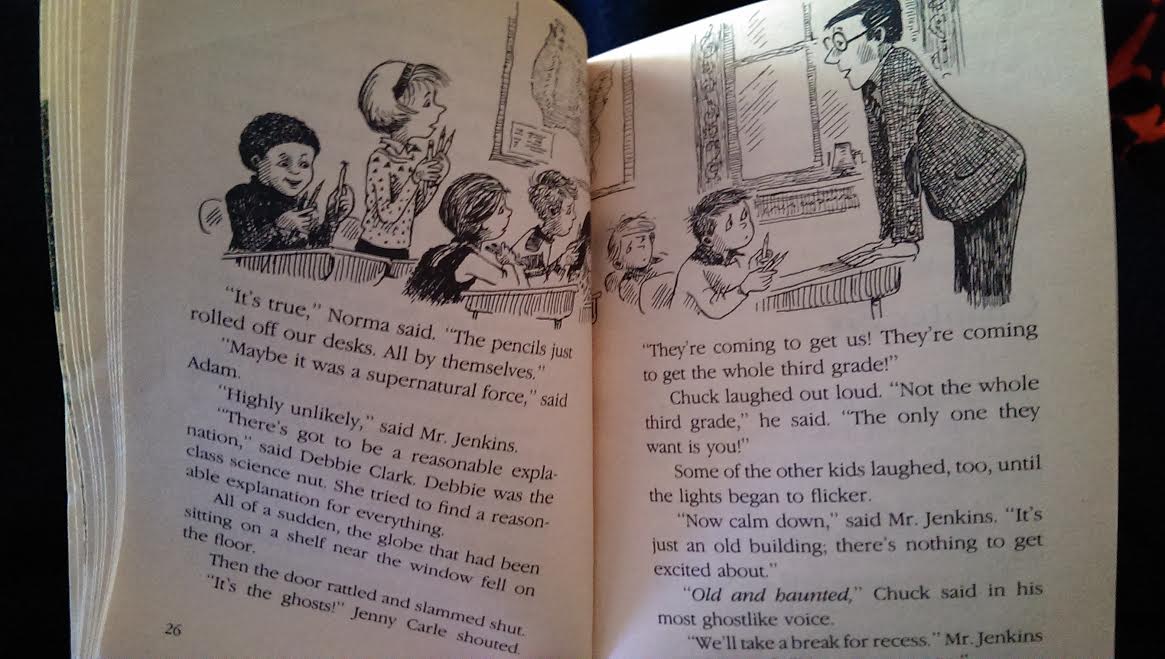
In the end, there is a reasonable explanation for the haunting of Blackwell House.  The kids take a methodical approach to the mystery, gathering their facts and ruling out various possibilities along the way.  Joey gets a chance to be a real hero, Danny proves to himself and everyone else that he’s smart and has good ideas, and Adam gets a new life ambition.

HauntingG3Pic

One other thing that I thought was interesting is that Adam, the main character in the story, is African American, but it’s never mentioned in the text of the story.  You only know because it’s shown in the pictures.  It’s just a little detail and not important to the story, but I thought it was interesting in a story that encourages kids to notice details.  I also liked it that Adam isn’t defined by race or appearance as so many characters in kids’ books are.  He stands by himself as an interesting character with his own ideas, courage, and leadership abilities.

This is the first book in the Third Grade Ghosthunters series.  It is currently available online through Internet Archive.

The Green Book

greenbookThe Green Book by Jill Paton Walsh, 1982.
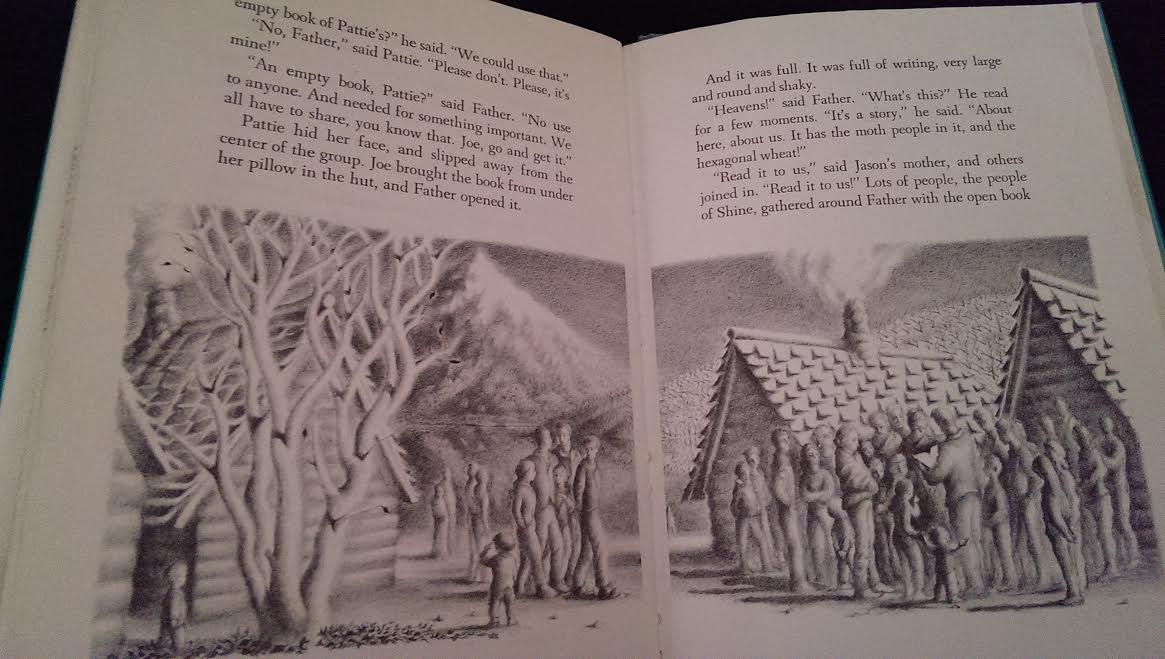
The story takes place at an indeterminate time in the future. Earth is dying as the sun grows dimmer. The only hope for humans is to find new homes on other planets. In one of the last ships to leave Earth is a father and his three children: Joe, Sarah, and Pattie. They can take very little with them, only a few practical things, a couple of small keepsakes, and a single book each.

The journey to their new planet takes years, and people quickly go through their own books. Pattie, who is very young, brings a blank book with a green cover, which the others criticize and tease her about.  What use is a book with nothing in it that you can’t even read?

When they finally arrive on their new planet, everything is strange. The native plants seem to have a glass-like quality which makes them sharp, shiny, and dangerous to eat. Their guide came equipped with a set of rules to help them get their colony established, but soon they run out of rules and are completely on their own. Survival is a constant struggle, and everything involves a new discovery.

At first, it seems like they aren’t going to make it, but the children’s willingness to take a chance saves the day. Also, the little green book that Pattie brought gives the colonists hope. As they have exhausted all the old stories, she provides them with the first new one on their new world.

The book is currently available online through Internet Archive.

greenbookpic

The Castle in the Attic

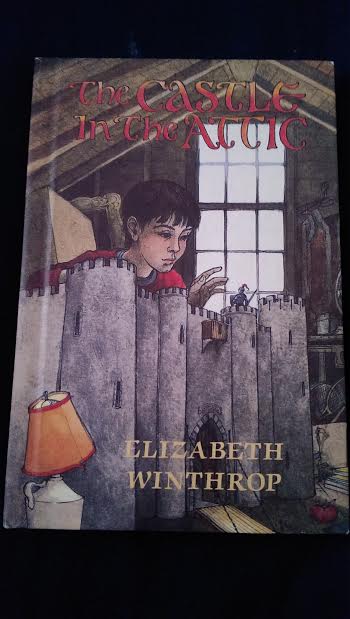
CastleAtticThe Castle in the Attic by Elizabeth Winthrop, 1985.

Ten-year-old William’s life is being turned upside down.  Mrs. Phillips, his nanny, is leaving for good!  Mrs. Phillips has lived with William’s family and helped to take care of William ever since he was born. Both of his parents work, so William spends most of his time with Mrs. Phillips after school. She fixes him his snacks, takes him to his gymnastics lessons, spots for him as he practices his routine, and reads stories about King Arthur with him. However, now that William is ten years old, Mrs. Phillips thinks that she would like to go live with her brother in England, which is where she is from. William is upset because he can’t imagine life without Mrs. Phillips. Mrs. Phillips tells him that he will be fine without her and that his parents will start spending more time with him after she leaves. William tries everything he can think of to get her to stay, but she is determined that it’s time for her to go.

As a leaving present, Mrs. Phillips gives him a toy castle that has been in her family for generations, along with a little lead figure known as the Silver Knight. Still, William is determined to find a way to keep Mrs. Phillips from leaving.  Then, he discovers that the toy castle is magic! When the little knight comes to life and gives him a magic token that can make people small, William thinks he’s found the way he’s been looking for. With Mrs. Phillip’s impending departure and his fears of losing her, William suddenly realizes that he can use the magic coin to keep Mrs. Phillips with him.  Before she can leave, he shrinks her and puts her in the castle with the knight.

Of course, turning his nanny small and keeping her inside the toy castle was unethical, as Mrs. Phillips and the knight point out, but William’s mistake proves to be only the beginning of a fantastic journey that will fulfill a legend, free the knight’s kingdom from the reign of an evil wizard, and give William the confidence he’s been looking for.

Over the drawbridge of the castle is a poem about the beginning of a quest. Mrs. Phillips had said that there was a legend about the little knight, and when he comes alive, he tells William that his name is Sir Simon and that he was turned to lead by an evil wizard who has taken over his kingdom. The poem is the key to defeating the wizard, and the little token is really only half of one that the wizard was wearing around his neck. When William turns Mrs. Phillips small, he cannot reverse the spell because he lacks the other half of the amulet. To get it, he must become small himself and fulfill the poem by crossing the drawbridge as Sir Simon’s squire.  The two of them set out together to defeat the wizard and retrieve the other half of the token. Along the way, they become separated, and William must continue on to the wizard’s castle and finish the quest by himself. William has an inner strength that he doesn’t fully appreciate at first, and he can use it to defeat the evil wizard!

There is a sequel to this book called The Battle for the Castle.

My Reaction

I liked this story when I was a kid, and it’s a good coming-of-age story.  The sequel is also a coming-of-age story, but in a different way.  This book is about William coming to a better understanding of what kind of person he is and what he’s really capable of doing.  He can do more and handle more than he thinks he can.  In the end, although William is still a little sad at saying goodbye to Mrs. Philips when she leaves, he feels a little better about her going because he knows that he can take care of himself now, thanks to his magical adventures. Mrs. Phillips tells him that he always had what he needed inside himself but that he just didn’t believe it before.

The next book focuses on what it really means to be a man instead of a boy.  As William and his best friend grow up and are under social pressure from other boys to do a certain stunt in order to prove that they’re really grown-up, William and his friend set out on a magical adventure that teaches them that there are more ways of becoming a man than one.

Wayside School is Falling Down

WaysideFallingWayside School is Falling Down by Louis Sachar, 1989.
The books in the Wayside School Series are collections of short, funny stories about a school that was accidentally built sideways.  Instead of being a one-story school with thirty classrooms all in a row, Wayside School is a thirty-story school with only one classroom on each floor.  Strange things are always happening there. The stories mostly focus on the kids in Mrs. Jewls’s class on the top floor of the school.  Like the first book in the series, there are 30 short stories in this book.

It would take too long to describe all the stories in the book individually, but they’re just as funny as in the first one.  Mrs. Jewls has a new student, Mark Miller, except that Mark Miller is really Benjamin Nushmutt.  Benjamin would correct Mrs. Jewls except that he seems to be a much better and more popular student as Mark Miller.  But, as he soon learns, answering to a name that isn’t yours is about the least strange thing at his new school.

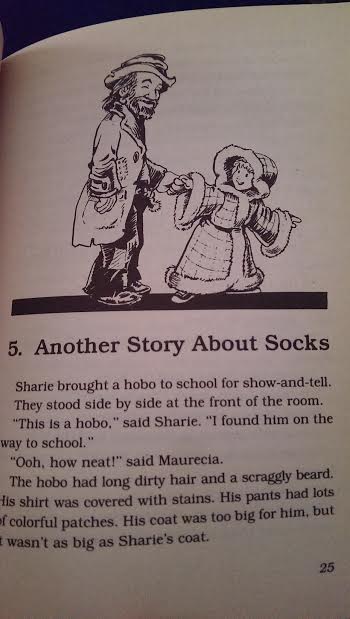
WaysidePic1Socks figure into many of the stories, with a special jingle invented by Mac, who used to be named Nancy until he traded names with a girl.  It’s fortunate that Mac invented the jingle because Allison uses it to free herself from the non-existent 19th story.  Myron chooses freedom over safety, emancipating himself from the school’s rules.  Bebe invents a younger brother, and things turn around for Leslie when her pigtails pull Paul.  Rondi fears that she’s no longer cute now that her front teeth have grown in.  Joy learns the best thing about the toy dog that Todd brought to school, and Ron actually tries the school lunch.
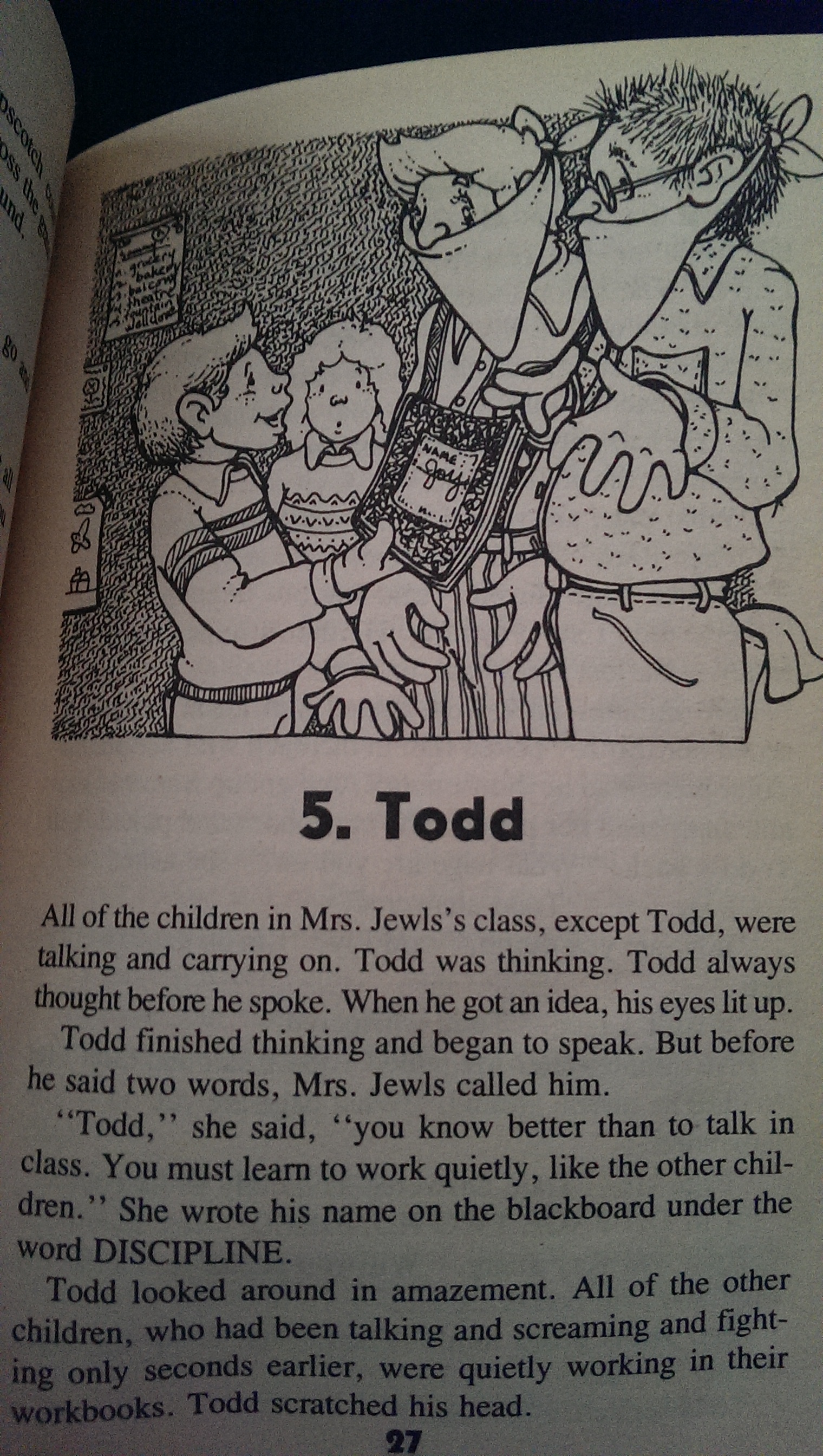
There are plenty of lessons to learn.  Watch as Mrs. Jewls teaches her class about gravity using her brand new computer!  Dana thinks that she hates stories until she learns that she actually loves them.  Mrs. Jewls teaches Jason not to chew pencils using masking tape.  Dameon learns about love via a dead rat.  Stephen explains how uncomfortable clothes and strangling ties make people look important, and Mrs. Jewls says that it’s what’s underneath that counts, so it’s best to wear expensive undies.  Then, everyone learns to tango in dance class (except Myron).

But, one windy day, the children are faced with an alarming possibility: Can their overly-tall school actually fall down?  (Lyrics courtesy of Kathy, who still hates everyone.)

This book is currently available online through Internet Archive.

Sideways Stories From Wayside School

Wayside

Sideways Stories From Wayside School by Louis Sachar, 1978.

The books in the Wayside School Series are collections of short, funny stories about a school that was accidentally built sideways.  Instead of being a one-story school with thirty classrooms all in a row, Wayside School is a thirty-story school with only one classroom on each floor (the compensation is the extra-large playground).  Also, they accidentally left off the 19th story.  Strange things happen at the school.  Even stranger ones happen on the non-existent 19th story.  But, the stories mostly focus on the kids on the top floor of the school.

WaysideStoriesPic1Each of the books contains thirty stories, like the school (ha, ha!).  It would take awhile to describe them all, but there are stories about each of the kids in Mrs. Jewls’s class.  Mrs. Jewls took over the class on the 30th floor after Mrs. Gorf accidentally turned herself into an apple.  She used to turn her students into apples when they made her mad, but most forms of revenge backfire eventually.  Mrs. Gorf ends up turning herself into an apple when one of her students holds up a mirror, and then, Louis the yard teacher eats her.

Mrs. Jewls is a much better teacher.  She helps Joe learn to count.  Joe can usually only get the right answer when he counts numbers in the wrong order.  She helps John learn to read right-side up instead of upside down.  She teaches Bebe that when it comes to art, quantity doesn’t equal quality (although Bebe did have a pretty good system going there for awhile) and cures Dana’s mosquito bites with the power of arithmetic.  Mrs. Jewls even invents new flavors of ice cream when Maurecia gets tired of every flavor in existence.

The students in Mrs. Jewl’s class are pretty amazing, too.  Todd saves the day when confused bank robbers burst into the class.  Sharie shows her intelligence by sleeping in class, D.J. smiles constantly, and Kathy hates everyone and everything.  Rondi is cute for the things she doesn’t have (like her two missing teeth) and the stuff she doesn’t do (everyone laughs when she doesn’t tell a joke), but what can she do about it?  Paul just wants to pull Leslie’s pigtails, and Leslie thinks maybe she should sell her toes because she can’t find a use for them.

WaysideStoriesPic2Mrs. Gorf does make one more reappearance on the Friday before Halloween.  Mrs. Jewls and the children argue that she can’t haunt the school if it’s not Halloween, but when Halloween falls on a weekend, schools have to have their Halloween party on the Friday before.  Stephen’s just happy that the ghost of Mrs. Gorf justifies his costume.

As Louis the yard teacher says, “It has been said that these stories are strange and silly.  That is probably true. However, when I told stories about you to the children at Wayside, they thought you were strange and silly. That is also probably true.”  Fair is fair.

This book is available online through Internet Archive.