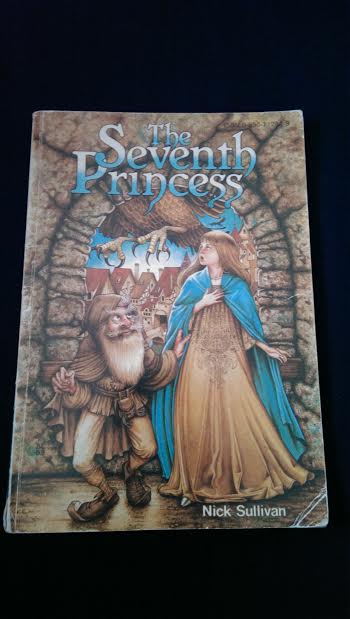
The Seventh Princess by Nick Sullivan, 1983.
Jennifer never remembers her dreams, so she doesn’t think that she’ll be able to complete the essay that her teacher assigned them to write: My Strangest Dream. While she’s worrying about not being able to finish her homework, she dozes off on the school bus on her way to school.
Suddenly, Jennifer finds herself in a beautiful carriage being driven through a dark forest. Jennifer is happy that she’s apparently going to have a dream that she can write about, so she decides to enjoy it as much as possible, trying on the beautiful gown, cloak, and jewelry that she finds in the carriage with her. Eventually, the carriage stops at a huge palace, and Jennifer comes to the realization that the carriage never had a driver.
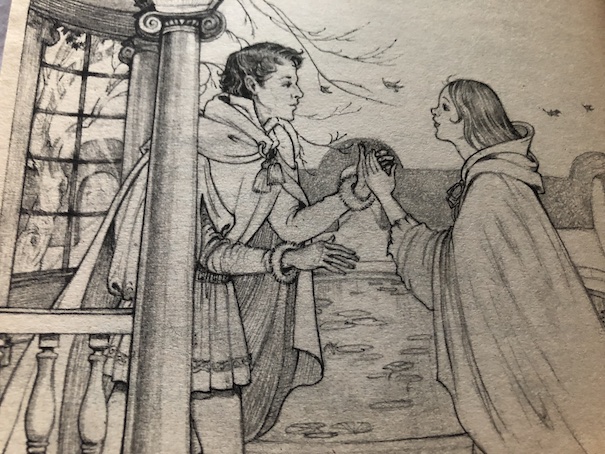
She is greeted by Duke Rinaldo, the Lord High Chancellor of the kingdom of Eladeria. Jennifer is informed that she is Princess Miranda, the king’s adopted daughter. Actually, Jennifer is the seventh of the king’s “daughters.” There were six others before her . . . and their fates are unknown.
This is no ordinary dream. The king of Eladeria is ill, possibly bewitched. The king’s son is missing. There is treachery in the palace. People live in terror of the evil enchantress Swenhild and her harpies. Soon, they will demand a tribute: a golden-haired princess with blue eyes . . . like Jennifer, er, Princess Miranda!
The only one who seems to want to help Jennifer is her new friend, Samson the dwarf, who is the palace’s court jester. He introduces her to his friend, Prospero, who can do magic and understands more of what’s happening than most people. He tells her that her only hope is to find the Paladian Scroll and use its power. Can Jennifer and Samson find this mysterious scroll in time? It might still be possible to save the other princesses, but Jennifer worries about whether she’ll ever wake up in her own world again.
This book is available online through Internet Archive.
My Reaction
One of the things that I love about this book is how it brings in some lesser-used fantasy creatures, like the harpies, and characters, like the dwarf jester. The “was it a dream or wasn’t it” trope has been used a lot, but the adventure within the dream itself is fun, exciting, and very well-done.


 The Dastardly Murder of Dirty Pete by Eth Clifford, 1981.
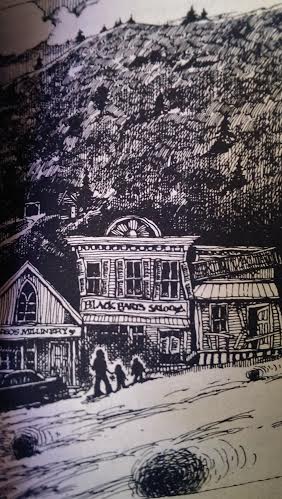 Harry Onetree and the girls find a ghost town with a hotel, an opera house, and several other buildings. Although Harry only means to look around for a little while, he forgets to set his parking brake (something else Mary Rose warns him about, which he ignores), and their car rolls backward into a ditch. Since it’s getting dark, they’re stranded in the ghost town for the night. But, they’re not alone there.
 Scared Silly by Eth Clifford, 1988.
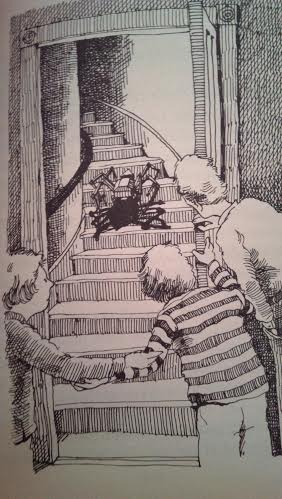 While the Onetree family is visiting the museum, a pair of shoes that once belonged to a Chinese emperor disappears. Like the two Onetree sisters, Gus considers himself the sensible brother and doesn’t take Razendale, the dreamier sibling, very seriously. He thinks Razendale ran off with the shoes as a prank. But, Erik, who seems more sensible than either of his uncles, says that they can’t just accuse him without proof. Gus provides them with an invention that could settle the whole matter, but that depends on whether or not they can trust Gus.
 Just Tell Me When We’re Dead! by Eth Clifford, 1983.
 The first place he goes is to an island in the middle of the lake near his house. The island has campgrounds and an amusement park, which is now closed for the season. Mary Rose and Jo-Beth, realizing where Jeff has gone, follow him there. But, the children are not alone on the island. When Jeff is captured by two criminals who are looking for loot that they stashed on the island years before, he has to keep his wits about him to find a way to summon help. Meanwhile, Mary Rose and Jo-Beth have no idea what they’ve just walked into.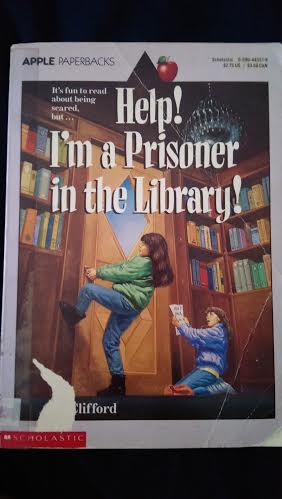

 Be a Perfect Person in Just Three Days! by Stephen Manes, 1982.

 This is the last of the four books I have in this
  Triple Trouble in Hollywood by Michael J. Pellowski, 1989.
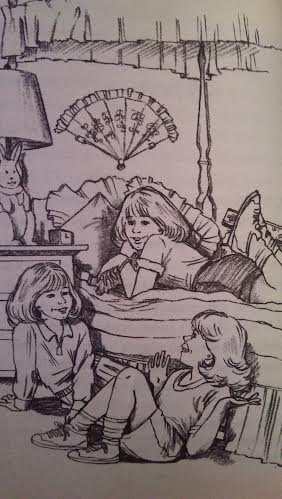 Sandi doesn’t want to do it because it would be dishonest, but Randi and Mandy talk her into it. It’s partly to help Mandy, partly to get back at Tara for her rotten attitude, and partly for the chance to meet the heartthrob Judd Morrison who will also be in the commercial. Of course, as is always the case when the girls switch places, nothing goes as planned. But, to the girls’ surprise, their younger brother Teddy helps to make things better in the end.
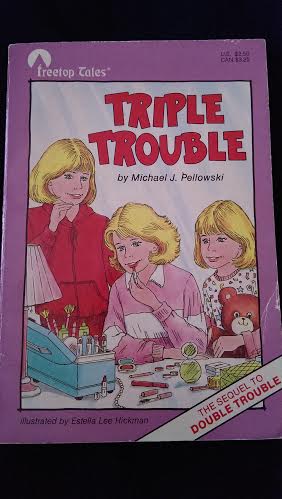 Triple Trouble by Michael J. Pellowski, 1988.
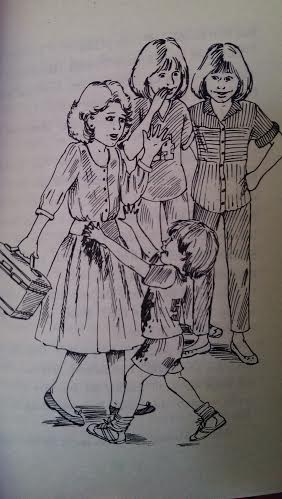 But, Mandy’s snobbish attitude rubs Randi and Sandi the wrong way. Mandy doesn’t want to do anything because she might get dirty or break a nail, and she keeps bragging about how grown up she is compared with her not-much-younger cousins. The twins argue with their cousin, and they play tricks on each other. When Mandy takes advantage of acting skills and her similar appearance to the other girls to try spending time with a boy they like by pretending to be them, Randi and Sandi decide it’s the last straw! They decide to show Mandy that playacting is a game that three can play at.
 Jestress's Forgotten Books and Stories