The Lives of Christopher Chant

This is the fourth book in the Chrestomanci series.  In this series, there are many different dimensions, and in each of those different dimensions, there are alternate versions of our world, and there are copies of every person in the world.  Different versions of our world can differ dramatically in their history, and individual people’s lives can differ dramatically between the worlds. There is one person in each generation who has no duplicates in any of the other worlds.  This person is called the Chrestomanci.  All of the talents, abilities, and lives that would have been spread across their duplicates in the other worlds are now centered on that one person, giving that person, literally, nine lives.  The Chrestomanci fills an important role, being better able than anyone else to travel across the dimensions and between worlds, and he acts to keep a balance between them and make sure that the different worlds keep their proper course. This book is about the childhood of the current Chrestomanci, Christopher Chant, and how he came to be the Chrestomanci.

Young Christopher Chant’s early childhood isn’t very happy. His parents have a very unhappy marriage, and his father never pays any attention to him at all. In fact, Christopher hardly even sees him and isn’t confident that he’d recognize him if he met him anywhere. Christopher later learns that his parents’ marriage was one of convenience. His mother has a great deal of money, and his father is from an important family. Christopher’s social-climbing mother wants him to be very important when he grows up. Christopher is mostly raised by a series of nannies and governesses, none of which stay very long. Servants in general don’t stay very long in the Chant household because the parents’ angry bickering and the passive aggressive notes that they force servants to pass to each other when they eventually stop speaking to each other directly make life unbearable. Christopher only learns that this is not how most households are when his nannies and governesses apologize to him before they leave.

Eventually, his parents’ relationship collapses entirely after his father loses a great deal of money, and his father either leaves his mother or is sent away in disgrace. His mother brings her brother, Christopher’s Uncle Rafe, to live with them instead, and she lets Uncle Rafe run the family finances and attend to Christopher’s education. Christopher enjoys having Uncle Rafe in the house because Uncle Rafe is a jolly man and actually pays attention to him, unlike his own father.

Something else that Christopher first thinks is normal but later learns isn’t normal at all are the strange dreams he has. Christopher often dreams of a strange place filled with valleys. Every time he enters one of the valleys, he has adventures there, and people give him presents. He often loses the presents before he returns home, but sometimes, he manages to keep them, waking up with them in his bed in the morning.

One day, the new governess Uncle Rafe hired catches Christopher playing with one of the strange objects and asks him where he got it. When he tries to tell her about his dreams, she doesn’t believe him at first. Thinking that he may have stolen the strange object from somewhere, she takes him before his mother and Uncle Rafe. However, Uncle Rafe does believe Christopher’s explanation. He says that Christopher seems to be a spirit traveler, having the ability to go to other worlds in his sleep, and he is amazed that Christopher was able to bring an object back with him.

Uncle Rafe asks Christopher to try a few tests of his abilities. First, he asks Christopher to look for a man in his dreams and to bring back a package from that man. Christopher does so successfully. The man is called Tackroy, and Tackroy explains more about the other worlds to Christopher. Every valley Christopher sees is a different world. There are series of worlds, and those series of worlds have numbers. The world where Christopher lives is number 12. At first, Tackroy thinks that there are only 12 worlds, but Christopher says that there are many more than that. Christopher can see better in the space between worlds because, as Tackroy realizes, he is actually there physically, where Tackroy can only be there mentally or in spirit. It is because Christopher can go to other worlds physically that he can bring back objects. Tackroy has hardly any substance in these other worlds, being almost like a ghost, until Christopher realizes that he can help make him more substantial. Both Tackroy and Uncle Rafe are excited by Christopher’s abilities.

Then, they decide to do a test of whether Christopher can carry something living from one world to another. Tackroy asks Christopher to get one of the cats from a temple in world 10. When Christopher enters the temple, he meets a young girl, just a little younger than he is. She says that she is the living embodiment of the goddess Asheth, which gives her special powers. However, she is not allowed to leave the temple except once a year to do a blessing, and she can’t interact much with anything or anyone from outside the temple. It’s a very boring life, and she isn’t very happy in it. When Christopher explains to her about wanting one of the temple cats for his uncle, she agrees to give him the most disagreeable cat in exchange for some books from his world because she is so bored. Christopher agrees, and she helps him to capture the cat. Unfortunately, the cat gives him away when he tries to leave the temple. Christopher is actually killed when a temple guard puts a spear through his chest! That is the first indication that Christopher has nine lives.

When Christopher wakes up, he is in his own bed at home, he has no injuries, and he still has the cat. At first, Christopher’s lack of injury makes him think that the other worlds might be a kind of dream after all, but that doesn’t explain how he still has the cat. Then, he has an accident while pursuing the cat in his room that brings down the curtain rod, which stabs him in the chest again! When he screams, the governess rushes in and tends him.

When Christopher wakes up again, he hears the governess and Uncle Rafe talking. The governess has placed healing spells on him, and she thinks he will recover. Uncle Rafe says that the cat from the Asheth temple is very rare and magical and that wizards would pay a lot of money for parts from the cat. Later, when Christopher sees that the cat is pleading for Christopher to let it go, he does so. As much as a he wants to please his uncle, it does seem cruel to kidnap an animal from its own world and take it to another to be killed and have its parts sold off, even if it’s a mean cat that almost got him killed. When the governess looks for the cat later and can’t find it, Christopher just reminds her that it is a magical cat, so she supposes that it just vanished.

Then, unexpectedly, Christopher’s worried father comes to see him without his mother’s knowledge. His father tells him that he had placed a spell on Christopher to monitor his life, and it seemed like the spell had told him that Christopher was dead. Christopher assures him that he’s fine. His father is relieved, but he is also still worried. He tells Christopher that he did Christopher’s horoscope and that the next year and a half will be dangerous for him. He also warns Christopher that his Uncle Rafe isn’t a nice person and that he should avoid getting mixed up in his business.

In spite of his father’s warnings, Christopher continues to participate in his uncle’s experiments in other worlds with Tackroy. Tackroy apologizes to Christopher profusely for the incident with the spear, saying that he would have felt horrible if Christopher had been killed. It becomes clear that Uncle Rafe’s “experiments” involves a business collecting and selling rare objects from one world to people in another. As Christopher helps Tackroy with it, the two of them become friends, and they enjoy exploring and learning about other worlds.

Things change when Christopher is sent to boarding school. He likes school and making his first friends with other boys. He does well in most of his subjects, although strangely, he can’t seem to do any magic in his magic lessons. It’s strange because Tackroy had told him that he’d probably be really good at magic because of his ability to travel through worlds. He hates to give up on magic studies because he really does want to learn more about magic.

Remembering his promise to bring some books to the goddess girl, Christopher asks a school friend with a sister for advice about what girls like. He buys a set of books about a schoolgirl called Millie. Unfortunately, he can’t seem to travel in his dreams at school, like he did at home. His uncle becomes impatient with him for not keeping his appointments with Tackroy, too. Christopher can’t think what’s wrong. Was there something special about his night nursery at home? Is he growing out of his old abilities?

When the school matron notices that Christopher is having trouble sleeping, she removes the new braces that he had put on his teeth, thinking that they’re causing him pain. Suddenly, Christopher is able to travel in his dreams again. He is able to deliver the books to the goddess girl and rejoin Tackroy in their work in the other worlds. Then, another accident that kills him again reveals his secret, extra lives to everyone, including his parents.

At first, it’s difficult to prove that Christopher has multiple lives, and his parents (of course) argue about what to do about it. After learning that Christopher’s mother secretly plans to take him abroad, Christopher’s father quickly removes him from his boarding school and takes him to Cambridge to be tested by an expert. In spite of his earlier apparent neglect, Christopher’s father does care about him, and for Christopher’s own good, needs to confirm a few things that he has already suspected about Christopher. The expert not only discovers the reason why Christopher was unable to perform magic in class (a sensitivity to silver that shuts down his powers whenever he comes in contact with it) but also proves that Christopher is a rare, nine-lived enchanter. Being one of those rare enchanters means that Christopher is destined to become the next Chrestomanci!

Christopher is shocked and dismayed when he is immediately made the ward of the current Chrestomanci, Gabriel DeWitt, and sent off to Chrestomanci Castle. It’s really the best place for him to learn about his new-found abilities, but Christopher fights it. DeWitt embarrasses him by telling him things about both of his parents and why neither of them is really suited to be his guardian. It’s all true, but that only makes it more embarrassing.

Christopher is lonely as the only child in Chrestomanci Castle, and while he is considered very important, nobody there seems to consider his feelings at all. Nobody cares that he would rather be a professional cricket player than a Chrestomanci! If it wasn’t for his natural abilities, which were just an accident of birth, nobody would have any interest in him at all. Also, even the heavy enchantments of Chrestomanci Castle can’t seem to stop the series of bizarre accidents that begin robbing Christopher of his extra lives. The only person who seems to understand Christopher is his secret friend, the goddess girl in world 10. Like Christopher, she is also a prisoner in her temple, being used by other people for her abilities but not really cared for as a person. More than anything, she wishes she could be an ordinary girl, like the girls in the books Christopher brings her, going to school and having friends.

Christopher wants to keep on working with Tackroy for his uncle because he loves exploring the other worlds and because it gives him some freedom from his life in Chrestomanci Castle, but Tackroy points out that his uncle has also been taking advantage of him. His uncle is getting rich off their activities, and he hasn’t even been paying Christopher for making them possible. Tackroy now knows that Christopher has died or nearly died more than once for his uncle’s business. Christopher has been getting deeply involved in something he doesn’t fully understand. The full truth is going to hurt, but Christopher needs to see it to save the lives he has left and realize his proper place in the world(s).

The book is available to borrow and read for free online through Internet Archive (multiple copies).

Some book lists place this book first in the Chrestomanci series because, if you follow a linear timeline of events in the stories, it does come before the other books, but it was originally the fourth book published, and I think it’s best to read the other books first, especially Charmed Life. The books in this series are fantasy, but they’re also mystery stories. There are secrets to be revealed in every book, and if you read this book first, it spoils some of the mysteries in Charmed Life.

It is a good book to read, though, because it provides some of the missing backstories of some of the other characters. At the end of Charmed Life, Christopher (as the current Chrestomanci) tells Eric/Cat about how he found out that he had nine lives and that he was going to be a Chrestomanci even though he couldn’t cast spells at first. His sensitivity to silver is a part of the story, and the way it is revealed in this book matches his earlier description in Charmed Life.

During the course of the book, we also learn a little more about the extended Chant family and get brief glimpses of Christopher’s cousins, who later go on to marry each other and become the parents of Cat and Gwendolyn Chant. The Chants are known for being a powerful magical family that produces enchanters, who are much more powerful than ordinary witches. Once every generation, they produce a disreputable one, which happens to be Christopher’s father in this generation. Christopher’s father is an enchanter, so he’s more powerful than general witches, but not nearly as powerful as Christopher. He has an over-reliance on the horoscope charts he draws, and they don’t always turn out right.

Christopher’s mother and his Uncle Rafe are part of the Argent family, which is also magically powerful but has a bad reputation. DeWitt doesn’t even specify at first what they are known for, only that he would never associate with them. It’s Christopher’s father, who does care about his son even though he doesn’t really know how to care for him, who points out that “Argent” means “silver”, and this is part of the reason for Christopher’s sensitivity to the metal. The Argent family, including his mother, and especially his Uncle Rafe, are toxic to Christopher in ways that he doesn’t fully understand and finds difficult to accept. Christopher’s mother doesn’t actually mean him any harm, like his Uncle Rafe does, but she is foolish and easily swayed by Rafe. Christopher comes to forgive her because he was also tricked by Uncle Rafe into doing his evil business when he was too young and naive to understand.

We also learn the origins of Christopher’s future wife, Millie, in this book. She is very powerful in Charmed Life, but this book explains why she is so powerful. One thing that I don’t think is adequately explained is how Christopher’s children, Julia and Roger, are not Chrestomancis themselves. After all, there is only one of their father, so I think it should be assumed that there are no duplicates of either of them in the other worlds, but they may be exceptions somehow because there was never a chance that they could have had duplicate selves or because their mother is actually the incarnation of a goddess.

The books in this series blend dark parts with some humor, which make the books lighter to read than they otherwise would be. Because of the dark parts, I wouldn’t recommend these books for anyone younger than the middle school level. Christopher does get killed multiple times in the book (although he still has extra lives left at the end), and there is trading in human lives and souls. The goddess girl, who takes the name of Millie, comes to realize that she is meant to be sacrificed when she gets too old to be the young incarnation of the goddess, which is a horrifying revelation. She runs away to Christopher’s world and begs him to help her go to a boarding school, like in the books she likes to read. Her goddess’s followers pursue her to Christopher’s world, and there is more bargaining for her life. Fortunately, the old priestess who has been caring for her is not as heartless as it seems at first. When she finally meets with the girl in front of Gabriel, she admits that she usually finds a way of sparing the young goddess incarnations, buying their lives with one of the nine lives from the temple cats. She has to do it in secret, but she has saved up enough money in jewels to pay for Millie’s education where she can be safe in this other world. To spare Christopher and the cats the children love from losing their lives, Gabriel kindly gives the priestess one of his own spare lives because he still has several lives left. He also accepts the responsibility of having Millie as his ward and arranging for her education.

Through his adventures and having to take charge as the Chrestomanci and rescue Gabriel when he is in trouble, Christopher comes to more fully understand what it means to be the Chrestomanci. He also comes to understand Gabriel a little better. He is surprised to realize that Gabriel has hated the job of Chrestomanci. Like Christopher, he also felt forced into the role and resented it, but he made himself do the job anyway because it is a vital job for the protection of his world and others. To Christopher’s even greater surprise, he realizes that when he does the job for real instead of just having boring lessons, he actually likes the job much better than Gabriel does and no longer resents being trained for it. Gabriel has also realized how lonely and isolated Christopher is, and he says that he is taking steps to bring other young magicians to the castle to work and be trained, so Christopher will have companions. The story ends happily, and there is even a reconciliation between Christopher’s parents.

Witch Week

This is the third book in the Chrestomanci series.  In this series, there are many different worlds, and in each of those different worlds, there is a copy of every person.  Different versions of our world can differ dramatically in their history, and individual people’s lives can differ dramatically between the worlds. However, there is one person in each generation who has no duplicates in any of the other worlds.  This person is called the Chrestomanci.  All of the talents, abilities, and lives that would have been spread across the other worlds are now centered on that one person, giving that person, literally, nine lives.  The Chrestomanci fills an important role, being better able than anyone else to travel across the dimensions and between worlds, and he acts to keep a balance between them and make sure that the different worlds keep their proper course.

This story takes place in a world where witches are being burned at the stake in the 1980s. At a boarding school for troubled children and orphans, everyone is aware of what an accusation of witchcraft can mean. One day, one of the teachers finds a note in a social studies book saying that one of the students in class 6B is a witch. It’s a serious accusation, but how seriously should anyone take it? This is, after all, a school for troubled children, and children in general play pranks. Mr. Crossly finds the note worrying. Some of the teachers are convinced that this is just a prank or someone playing up for attention. Miss Hodge says that there is a sick mind in class 6B. Mr. Wentworth, whose own son, Brian, is in that class, says that he’s sure that all of the kids in class 6B have sick minds, but that’s just typical. He thinks it’s best if the teachers take no notice of the note. But, the note is correct. There is a witch in class 6B.

Strange things start happening in class 6B and to the students in that class. A flock of assorted birds swarms into their music class. In gym class, Nan Pilgrim can’t manage to climb the rope, no matter how hard she tries. When she and two other students are called to have lunch with the headmistress, Nan finds herself making disgusting comments about the food without her even wanting to say anything, but for some reason, the headmistress can’t hear a thing she says, even though the other students can. Then, it is revealed that Nan’s real name is Dulcinea, which is the name of a famous witch. Could Nan secretly be the witch in class 6B?

Although she can’t openly admit it, Nan is descended from the famous witch Dulcinea, who tried to stop the persecution of witches, and she is also what is called a “witch orphan”, meaning that her parents were witches. However, Nan insists that she’s not a witch herself, and Nan isn’t the only suspicious student in the class. Everyone there is troubled in some way. Brian Wentworth is often picked on for being the son of a teacher. Simon Silverson, Dan Smith, and Theresa Mullet are bullies. They are all eager to point fingers at Nan for being a witch, but could that be to cover up for themselves?

Charles Morgan was sent to the boarding school because his parents think that he is troubled and disobedient and a bad influence on his younger brother. In a way, he is very troubled, but he can’t explain what is really troubling him. When he was younger, he witnessed a witch being burned, something that still traumatizes him. Then, he helped another witch who was being hunted to escape. He can’t admit to his parents that he helped this witch because it was illegal, but the witch promised him good luck for doing so. So far, he hasn’t noticed any good luck, and he feels terrible every time he hears about another witch being burned, thinking that it might be his witch. It all makes him angry and depressed, and he hates the boarding school and everyone there.

Miss Hodge tries to investigate the students by having them act out witchcraft inquisitions. Since most of the children don’t know what happens at an inquisition and aren’t very good actors, most of them are terrible at it. But, she comes to think maybe Charles is the witch because he gets angry at Nan over all the disgusting things she said at lunch and taunts her about them in a way that makes it sound like he’s saying some kind of spell.

When Miss Hodge tries to tell Mr. Wentworth about it, he shrugs it off because he also heard the things Nan said at lunch. Mr. Wentworth interviews Nan about why she said all those things at lunch, but she can’t explain herself. She doesn’t know what made her say those things. Sometimes, she just can’t seem to help herself, and she felt almost possessed. Mr. Wentworth knows about her family’s history and warns her to be careful.

Then, when Charles is trying to escape from some bullies, he somehow manages to turn himself invisible. He doesn’t understand it, but he tries to do something else magical as a test. Since Dan Smith hid his spiked shoes earlier, Charles tries making Dan’s spiked shoes disappear. To Charles’s horror and astonishment, he succeeds! Somehow, he has apparently been a witch the whole time without knowing it. Charles thinks maybe he did some of the other strange things without knowing it, too. He’s always heard that witches are evil, and he thinks maybe he has secretly been evil this whole time and had better confess. An accidental mix-up when he goes looking for the headmistress stops him from confessing immediately, but it leaves him unsure what to do.

Mr. Wentworth has a private conversation with Charles about Miss Hodge’s suspicions about him. He knows what Charles was really talking about when he was arguing with Nan, but he points out to Charles how bad it might sound to someone who didn’t know what he was talking about. Information about witches and the past witch uprisings is drastically censored. There is almost nothing about it in the school library, but Mr. Wentworth understands the situation and explains it to Charles in a no-nonsense way. Nan’s ancestress, Dulcinea Wilkes, had been an advocate for witch’s rights in the 18th century, particularly the right not to be murdered. She said that witches couldn’t help being witches because they were born that way, and it wasn’t fair for them to be murdered for something they just couldn’t help. She said that witches would only use their powers in good ways if people would stop hunting them and burning them, but the murders and burnings continued, and Dulcinea lost her temper. She retaliated with violent spells that frightened people so much that they also murdered Dulcinea by burning her. In remembrance of that, people still continue to burn effigies of her, like they do of Guy Fawkes. Mr. Wentworth says that he thinks what happened to Dulcinea was unfair, but he is worried about his students because there has never been so much stigma against witches at any earlier point in history. Although his students wouldn’t remember it, there was a major witch uprising around the time they were all born. The news of this uprising was largely hushed-up, but the witches attempted to take over the entire government. The revolutionaries were all civil servants, and they were all burned when the uprising was crushed, but the government has been paranoid about anyone with any sign of witchcraft since. When they learned that the leader of the uprisings started showing signs of witchcraft when he was about 11 years old, they even started allowing children to be arrested for witchcraft, even on slight suspicion. The inquisitors have powers that go largely unchecked. Mr. Wentworth knows that any of his students can be hauled away and executed with little recourse.

Even though Mr. Wentworth is concerned with protecting Charles, Charles gets angry with him for giving him a black mark as a reminder to control his behavior, and he glares at Mr. Wentworth. It’s a terrible mistake. It turns out that Charles has the evil eye, and it seems like he accidentally makes Mr. Wentworth disappear. Although Charles tries to pretend like everything is normal, he is desperate on the inside. Soon, someone will realize that Mr. Wentworth is missing and that Charles was the last person to see him. He even tries burning his own finger on a candle to remind himself that burning hurts, and he needs to control himself to avoid being burned to death. When he tries to fix what he’s done with magic, Mr. Wentworth does return, but everyone’s shoes mysteriously disappear.

To Charles’s surprise, the memories of the witch he saw burned and the witch he helped to escape stop bothering him so much after he knows and accepts that he is a witch himself. It’s like he’s always known, inside, that he would be a witch, and once he becomes reconciled to his true nature, he becomes calmer and more self-confident. He knows that he can’t stop being a witch. He can only try to avoid being caught. However, it turns out that he is not the only student who has witchcraft, and when the desperate students seek help or a method of escape from this prison-like school, they accidentally summon Chrestomanci to straighten everything out.

The book is available to borrow and read for free online through Internet Archive (multiple copies, including some in different languages).

Like all of the books in the Chrestomanci series, this book takes place in an alternate world or alternate reality. It explores not only the suspicion and paranoia that go with witch hunts but also the mechanism by which these alternate worlds or realities are created. When the students who have realized that they are witches try to escape, they are given a spell that calls Chrestomanci from his world to theirs. Chrestomanci is accustomed to being summoned to random places on short notice (it’s just one of the hassles that come with the job), but he finds this particular world puzzling. He knows from the similarities between this world and others in the series of worlds that contains his own that he must be in that particular series of worlds, but he recognizes immediately that there is something wrong with it. It has way too many similarities with the world that is “our” world in the series, but yet, there shouldn’t be any witch trials or burnings in the 1980s. He explains that alternate worlds are created when there is some major event that has only two outcomes with an equal chance of happening. Every time that happens, the world splits into two separate worlds where each of the possibilities happen. Because this world is so much like the world that is “ours”, he knows that whatever event caused the split happened fairly recently in history, but for some reason, the split wasn’t complete. There is no real magic in “our” world, but this odd, dysfunctional, split-off world is full of it.

By talking to the students about what they know about the history of their world, Chrestomanci is able to pinpoint the event that caused the problem. As with other Chrestomanci books, Chrestomanci doesn’t just magically solve the problem all by himself, but once he understands the situation, he shows the students at the school where the problem lies and what they need to do to fix it themselves, making use of their own powers, and even some of the mistakes they’ve made, to set their world right and re-integrate their world with “our” world. Once their world is repaired, it’s as if all the witch trials never happened. People who were burned are alive again, and people who were in prison are living perfectly normal lives. The children must sacrifice their magical abilities and all or most of their memories of their old lives to join with our world, which some of them are initially reluctant to do, but once they do it, all of their lives change for the better. Orphans have their parents back, the school is now a day school instead of a boarding school where the children were basically prisoners, and the children are all much friendlier toward each other now that they are no longer part of that toxic atmosphere, where suspicions always surrounded them and everyone is afraid of exposure.

Parts of the story were stressful because of the bullying among the students and the constant threat of imprisonment or death for any child who was proven to be a witch. Most of the adults are not that concerned with the welfare of the students because this entire society is engulfed with paranoia, and everyone is desperate to protect themselves at all cost. The adults are often so preoccupied with saving themselves that they would be willing to throw the children to the wolves rather than face imprisonment or death themselves. The major exception is Mr. Wentworth, who tries to warn children who show signs of witchcraft that they need to be careful. His efforts to protect the children are touching because he has more to lose than some of the other teachers who play along with the politics and paranoia of their society. (Spoiler!) Mr. Wentworth and his son Brian are both witches, and Mr. Wentworth is being blackmailed for most of his salary by the headmistress. Mr. Wentworth advocates self-control to the students as the best way to avoid being caught, but it soon becomes apparent that nobody with witchcraft abilities can fight using them forever. That’s why some of the children’s abilities come out unconsciously, without them even being fully aware of what they’re doing. That’s where the mystery of the story comes in.

Chrestomanci books always contain an element of mystery in some way or other, and from the beginning of the story, there are the questions of who wrote the note about there being a witch in class and who the witch is. We never learn who wrote the note (I don’t remember that being definitely revealed), and in the end, it doesn’t really matter. When Charles realizes that he is a witch, that seems like the answer. However, Charles is not the only witch in class. As one of the other students points out, all of the weird things that have been happening at the school are very different in character, so there is more than one person involved. By the end of the book, it is revealed that (spoiler) the vast majority of the students at the school are witches. Some have been doing magical things unconsciously as their powers have started asserting themselves, and some have done things on purpose because they know they can. Chrestomanci realizes that many more people in their society in general are witches than these paranoid people ever suspected, and witches are only regarded as a minority because of the atmosphere of fear they live in. Everyone has been trying so hard to conceal any sign of abnormality that they all have a warped view of who they all really are and what their society is actually like.

I couldn’t help but notice that, witch or not, absolutely nobody in this society can be called an innocent person. Everybody is doing something illegal, unethical, or simply deceptive. They all have secrets, and they all do things to cover up what they’re doing. Even non-witches are often doing horrible things that they have to cover up. The apparently sweet and proper headmistress is actually a cold-hearted blackmailer. Teachers are manipulative for personal and professional reasons. The so-called “normal” (or “real”, as Nan thinks of it) children are all either secret witches or just horrible bullies and rotten human beings. Like their elders, the “normal” children are sneakily manipulative and practice blackmail and brutality against the other students, knowing that’s the way to get to top of their social heap. As I said, the entire society is toxic, not just the school, and everything the children do is a reflection of their elders (and vice versa, when you think about it). Grown-up witch hunters are like overgrown child bullies, and people like the headmistress probably started their blackmail and manipulation at a young age, just like the students, as tools of survival and self-promotion in this cold, toxic, pitiless world.

The normalization of the toxic parts of this world is both stressful and worrying. People can adjust to many awful things if they are not given any alternative, and that’s what this dysfunctional world represents. There are moments of lightness, though, and some characters are more caring than others. The story is told from the point-of-view of different characters, and much of this book is a psychological study in the different ways people deal with bullying, suspicion, and paranoia. As I said, Mr. Wentworth risks himself sometimes to help students in danger and make them see the seriousness of their situation. Some of the students band together to try to help each other survive their mutual risk, while others are more self-centered, prepared to throw each other under the bus to save themselves. It’s a relief to see all of that end when the world is set right, but it occurs to me that the story has exposed all of the characters’ true characters, what each of them are capable of doing in extreme circumstances. The extreme circumstances brought out the worst in some characters, while others were more creative and caring in spite of everything.

The Magicians of Caprona

The Magicians of Caprona by Diana Wynne Jones, 1980.

This is the second book in the Chrestomanci series.  In this series, there are many different dimensions with different worlds, and in each of those different worlds, there is a copy of every person.  Different versions of our world can differ dramatically in their history across the dimensions, and individual people’s lives can differ dramatically between the worlds. There is one person in each generation who has no duplicates in any of the other worlds.  This person is called the Chrestomanci.  All of the talents, abilities, and lives that would have been spread across the other worlds are now centered on that one person, giving that person, literally, nine lives.  The Chrestomanci fills an important role, being better able than anyone else to travel across the dimensions, and he acts to keep a balance between them and make sure that the different worlds keep their proper course. This book begins with a brief explanation, although most of this was established in the first book in the series, Charmed Life.

In the world where the Chrestomanci lives, magic not only exists but is a known and accepted profession, and society is a little more old-fashioned than in our world. Also, there is a kind of alternate history, and some of the countries are organized differently. This story is set in Italy, which is not a unified country in this world, but a series of small dukedoms. The Chrestomanci series is a somewhat loose series, meaning that, while Chrestomanci appears in the different books and always plays some kind of role, he is not always one of the main characters. This story sets up a Shakespearean kind of feud between two families.

The dukedom of Caprona is known to having the best spell-makers in the world. The problem is that the best spell-makers belong to two particular families, the Montanas and the Petrocchis, who have a long-standing feud. The adults in the families never explain how, exactly, the feud started. They just warn the children to avoid to avoid the children of the other family. When members of the two families meet in public, they usually ignore each other, although sometimes fights break out. The fights are particularly bad when they use magic. Locals and tourists alike are alarmed by these fights and get out of the way to avoid being caught up in them.

Because the adults don’t talk about the cause of the feud, the children of the two families tell each other stories about it. In the Montana family, the children say that it started because the Duke of Caprona favored their family over the Petrocchis. The children also tell each other stories about the other family’s atrocious habits. Young Rosa Montana particularly likes telling her siblings and cousins scandalous stories about how the Petrocchis never bathe and sometimes kill their unwanted babies or eat their own family members. Because the members of the two families almost never see each other, the other Montana children can only suppose that the stories they hear about the Petrocchis are true.
When young Tonino Montana starts school, he is very upset. Things don’t seem to come as easily to him as they do to his siblings and cousins, and he feels awkward when the teacher tells him to do things differently from the way he’s always been taught to do them or repeats things that he’s already learned. When Tonino runs off into the city by himself because he’s upset, the rest of his family worries about him. Old Niccolo, the head of the family, talks to Benvenuto, the head cat in the Montana household, about Tonino. The Montana family keeps cats, who help them at their spell-making, but not everyone in the family has the ability to talk to the cats and understand them. Old Niccolo can communicate with the cats, but even Tonino’s father, Antonio, can’t. Benvenuto tells Niccolo that he will look after Tonino and not to worry about him. Tonino, like Niccolo, can talk to cats, and he hasn’t fully appreciated the talent yet.

Benvenuto becomes Tonino’s special friend. He helps Tonino to understand that, like the kittens he talks to, he’s still young and learning. Tonino needs to give himself time to develop. Benvenuto also tells Tonino that it’s fine to tell his teachers what he already knows, and Tonino comes to realize that he is far ahead of the other students in some ways, having already learned to read. His talent for talking to the cats also gives him a special place in his family. Benvenuto also allows Tonino to give him brushings, which he would never allow from any other family member before, so he becomes more well-cared for.

As time goes on, however, Tonino comes to realize that the adults in the Montana family are worried about the state of their family and the state of Caprona itself. Other dukedoms around them are becoming more powerful, and some of the old spells that the two families made to protect Caprona are breaking down. Of course, the Montanas blame the Petrocchis for the weakness of the spells and for not maintaining them properly, but Tonino realizes that the old Montana spells are breaking down as well. It’s not, as the older Montanas said, that they have had to bear the weight of making up for the weak Petrocchi spells.

Tonino gets his first look at the Petrocchis when both families are summoned to the duke’s palace to discuss the state of their spells and the rival states that are seeking to conquer Caprona. Speaking together for the first time in a long time, both families come to realize that, even though they have separately been working to make their spells stronger, each year, the protective spells they cast on Caprona have been getting weaker. There is a rumor that there is an evil enchanter who has been working against them on behalf of their enemies. Naturally, both Petrocchis and the Montanas secretly suspect each other of being involved. They also can’t help but notice that something is seriously wrong with the duke himself. He seems strangely childlike, and his wife seems to be running everything.

The Montana family offers a solution that even they aren’t sure they can fulfill. There is an old story that all of the children know about an angel who once protected Caprona with a magical song. Everyone thinks that, as along as the song is sung, Caprona will be safe. The children learn this song in school, but what they don’t know is that the words they learn to the song aren’t the original words to the song. The tune is original, but the original words were lost to time. The Montanas know that the song is a powerful spell, but it won’t function correctly until the original words to the song are restored. In their pride against the Petrocchis and their worry about the state of Caprona, the Montanas have pledged that they will find the original words to the song. Also, naturally, the Petrocchis have promised the same. Neither family knows exactly how they will do that, but they are each determined to somehow do it before the other family can.

There is only one person both of the families accept and who can work with either family without earning the resentment of the other: Chrestomanci. The situation is serious, war is pending, and Chrestomanci has also been summoned for help. As the most powerful enchanter in the world, he has the respect of all sides. Since Chrestomanci is British, he admits that he is somewhat limited in how far he can interfere in Italian affairs. His main interest is in the evil enchanter and their misuse of magic, although he will help Caprona and his friends in the magical families, if he can.

Chrestomanci notices that, aside from being able to talk to cats, Tonino also has an ability to tell when someone is an enchanter without being told. Chrestomanci says that he needs to go to Rome to make some inquiries, and he asks Tonino to stay close to his grandfather when his grandfather has to meet with anyone, to see if he can spot the evil enchanter. However, the evil enchanter already knows too much about the two families and about Tonino in particular.

When Tonino is kidnapped by the evil enchanter, his family immediately blames the Petroccis and sets out to confront them … only to be met halfway by the Petrocchi family, on their way to confront the Montanas about kidnapping one of their children, Angelica. The feud between the two families becomes worse than ever, but an accidental encounter between Tonino’s brother Paolo and Angelica’s sister Renata reveals that neither family has kidnapped anyone. The evil enchanter is playing both of the families against each other to distract them from what they really need to do: find the children and prepare to defend Caprona from its enemies. Paolo and Renata have trouble convincing either of their families of the truth because they are already too convinced that the other family is their real enemy, so they struggle to figure out how to save Tonino and Angelica themselves.

Meanwhile, Tonino and Angelica team up in captivity to find a way to escape and tell their families where to find the secret words to the angel’s song. While they are being held captive together, Tonino and Angelica argue about the nature of their families, but by talking together, they come to realize that each of their families has held half of the answer to the problem all along. If only the children can get together and reach their families to tell them the truth about the angel’s song and the identity of the evil enchanter!

The book is available to borrow and read for free online through Internet Archive (multiple copies, including some in different languages).

My Reaction

During the course of the story, we never learn the original cause of the feud between the two families. It might have been something with one family thinking that the other was being favored by a past duke, or maybe it was some private quarrel between the heads of the two families. The cause is less important than the result. For generations, each family has been quietly maligning the other to the children of the family, who have continued to pass on the stories.

When the younger members of both families finally meet and talk to each other, they are initially offended that the other family has been saying the same horrible things about them that they’ve been saying about the other family, but it’s also an eye-opening experience. The two families are actually very similar to each other, both in their professional work and in their private family life. In fact, they live nearly identical lifestyles. The fact is that both families have been contributing to the spells maintaining their city for centuries, working together since before their feud began. Their spells were always intertwined and made to work together. Since the feud started and the families stopped working together, they have still had to work together in the service of their city and duke, but the feud has also served as a distraction from the real sources of danger.

As with other Chrestomanci stories, Chrestomanci doesn’t solve all of the problems of the story himself. Instead, he acts as a helper, revealing key information and providing guidance to help the other characters to solve their own problems. As a neutral observer, Chrestomanci sees both of the families and their quarrel for what they really are. He also helps to reveal the true villain of the story for who they really are.

Chrestomanci also points out the hidden talents of the children in the story. Although Tonino doesn’t think he’s as good as magic as others in his family, he does have other talents and magical abilities. At the end of the story, he goes to England with Chrestomanci to study for a while. His adventures in England are part of one of the short stories in Mixed Magics.

Kiki’s Delivery Service

More Americans would probably recognize the title as the title of a Studio Ghibli animated film for children than as a book title, but the book came before the movie, and it is actually the first in a series, which continues the story about Kiki’s life and adventures, although I don’t think the later books in the series have been translated into English (at least, I haven’t found them in English). The original Japanese version of this book was written in 1985, and I read the English translation from 2003.

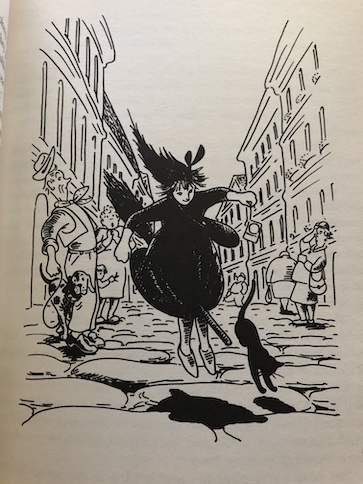
Kiki is a young witch, and in keeping with the traditions of young witches, she is expected to leave home at age 13 and live for a year in a city with no other witches.  It will be a test of her developing skills and a coming-of-age experience, helping her to recognize her talents and find her place in the world.

When Kiki sets out for her journey with her cat, Jiji, she doesn’t know exactly where she is going to go or what she will find when she gets there. Some young witches know early on what their talents are and how they plan to support themselves during their year away from home, but Kiki is less sure (like so many of us who “don’t know what we want to be when we grow up”).  The term “witch” just refers to a person’s ability to do magic.  It’s not a job title by itself, and witches are expected to develop a specialization, such as brewing potions or telling the future. Kiki’s mother has tried to teach Kiki her trade, growing herbs and making medicines from them, but Kiki hasn’t had much patience with it.  The only major ability Kiki has is flying, which is something that witches are expected to do anyway.  Still, she has an adventurous spirit and is eager to set out and see what life has to offer.

Once Kiki locates a city with no other witches, she has to find a place to stay and a job to earn money. She finds a city by the sea, which seems exciting to her.  As she explores the city, she meets Osono, a woman who owns a bakery with her husband. When she helps deliver a baby’s pacifier to a bakery customer who left it behind, flying to the customer’s house on her on her broom, Osono offers to let her stay in a small apartment attached to the bakery. Kiki feels a little overwhelmed by the big city at first, but she realizes that, in a large city like this, there are probably a lot of people who have small delivery errands that wouldn’t be covered by ordinary parcel delivery services.

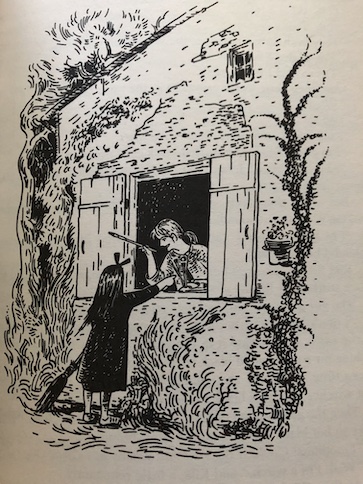
Kiki opens a delivery service, delivering small packages and running errands for people around the city.  At first, business is slow, and some people are afraid of her as a witch. During a trip to the beach, a curious boy borrows her broom and breaks it. Kiki is distressed, and the boy apologizes. The boy’s name is Tombo, and he is part of a club of other kids who are interested in flying. He has made a study of flight and had hoped to learn more about how witches fly by trying Kiki’s broom, but Kiki expains that only witches can fly with brooms and that the ability is inherited. Kiki has to make a new broom, and it takes her a while to break it in, but it actually works to her benefit. People who were initially afraid of her for being a witch become less afraid of her and more concerned about her when they see that she is just a young girl, clumsily trying to master a new broom. Kiki gets some additional support and business from people who feel moved to help a struggling young witch. Tombo also makes it up to her and becomes a friend when he helps Kiki to figure out a way to carry a difficult object on her broom.

During her very first delivery assignment, Kiki was supposed to carry a toy cat to a boy who was having a birthday, but she accidentally dropped it. When she searched for it, she met a young artist, who was enchanted by Kiki as a young witch and painted a portrait of Kiki with Jiji. When the artist asks Kiki to take the painting to the place where it will be on exhibit, Kiki isn’t sure how to carry it at first. It’s kind of a bulky object to carry on her broom. Remembering that Tombo has made a study of flying, she asks him for help. Tombo ties balloons onto the painting to make it float and tells Kiki that she can now pull the painting along on a leash, as if it were a dog. The idea works, and when people see Kiki pulling a painting of herself along through the sky with balloons tied to it, it acts as advertising, bringing her more business.

Some of Kiki’s new jobs are difficult or awkward, and some customers are more difficult to deal with than others. There are times when Kiki finds herself missing home or trying to remember how her mother did certain things, wishing that she had been better at watching and remembering what her mother did. Still, Kiki learns many new things from her experiences and acquires new skills.

Kiki’s experiences also help her to realize a few things about herself and life in general. Like other girls, Kiki worries about how boys see her. When Tombo makes a comment that he can talk to her when he can’t talk to other girls, Kiki worries that he doesn’t see her as a girl at all. A job delivering a surprise present to a boy from another girl her age helps Kiki to realize that everyone is a little shy and uncertain about romance and even people who act confident feel a little awkward about first relationships.

As her first year away from home comes to an end, Kiki wonders how much she’s really changed over the year. Although she has successfully started a new business and done well living away from her parents, she still experiences a sense of imposter syndrome, where she doesn’t quite feel like she’s really done all of the things she’s done. Her first visit home to her parents reminds her that her new town has really become her new home. She has become a part of the place, and she feels her new business and friends calling her to return.

In 2018, the author, Eiko Kadono, was awarded the Hans Christian Anderson for her contributions to children’s literature.

My Reaction

I think of this story as one of those stories that takes on more meaning the older you get.  Young adults can recognize Kiki’s struggles to make her own way in the world and establish herself in life as ones that we all go through when we start our working lives and gain our first independence.  It can be a scary, uncertain time, when we often wonder if we really know what we’re doing. (Life Spoiler: No, we don’t, but no one else completely does, either, so it’s normal and manageable. Some things just have to be lived to be really understood, and that’s kind of the point of Kiki spending a year on her own, to see something of life and how she can fit into it.) However, it’s also a time of fun and adventure as we try new things, build new confidence, make new friends, and learn new things about ourselves. Like so many of us, Kiki doesn’t always do everything right, but she learns a lot and endears herself to the people of her new town.

The Miyazaki movie captures the feel of the story well, although the plot isn’t completely the same. There are incidents and characters that are different between the book and the movie. Tombo appears in both the book and the movie, but there are other characters who appear in the book who weren’t in the movie. In the book, Kiki makes friends with a girl named Mimi, who is her age, and the two of them discuss crushes on boys and how each of them was a little envious of the other because, while each of them is struggling with their own uncertainties in life, they each thought that the other acted more confident. The movie version developed the character of the young artist more. Kiki also didn’t lose her powers during the book, although that might be a part of one of the other books in the series, since I haven’t had the chance to read the others yet.

The Mystery of the Blue Ring

Polka Dot Private Eye

The Mystery of the Blue Ring by Patricia Reilly Giff, 1987.

When Dawn Bosco first joined Ms. Rooney’s class at Polk Street School, she stole Emily Arrow’s toy unicorn. Now, that incident has come back to haunt her. When the book begins, her theft of Emily’s unicorn was just weeks ago. Now, she and Emily are starting to be friends, although their friendship is a bit shaky.

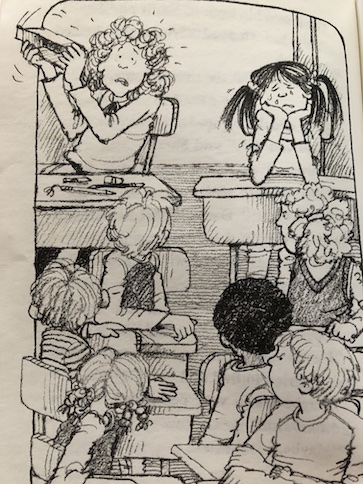
At school, the teachers are talking about vegetables because it’s Good Vegetable Day. Everything is geared around vegetables all day, and the art teacher has the children make sculptures of vegetables out of clay. Dawn is bored because she’s been reading a mystery book, and she’d rather be finding mysteries and learning to be a detective than making silly vegetables out of clay.

Dawn gets irritated with Emily when she says that she’ll make a cucumber, which is what Dawn was going to make because it’s easy. The teacher won’t let Dawn make a cucumber because Emily already claimed that idea, so Dawn has to make a carrot instead. (Not that much different in shape, really, except one end is more narrow.) However, she still resents Emily for using the cucumber idea first.

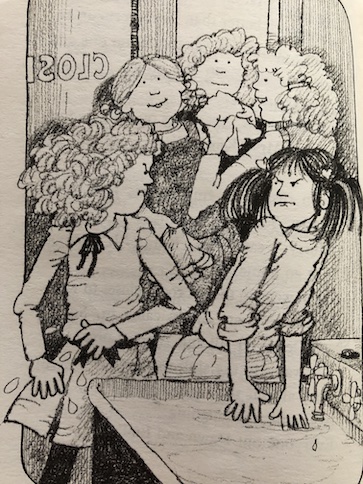
As the girls push against each other by the sink, cleaning up from using the clay, Dawn spots a ring next to the sink. Later, Emily says that her ring is missing. It’s a special ring with a blue stone that she got for her birthday. Dawn is pleased that she’s found a mystery to solve. Remembering that she saw a ring next to the sink in the art room, Dawn proudly goes back to the art room to see if she can find the ring and return victorious. However, the ring isn’t there when she checks.

Then, suspicion turns to Dawn herself. After all, everyone knows that Dawn stole Emily’s unicorn before. Instead of being the hero detective, Dawn is turning into the main suspect in this crime. Now, she really needs to find the ring to clear her name!

Dawn’s grandmother, Noni, gave her a special detective kit for her birthday. Dawn uses it to turn into The Polka Dot Private Eye to hunt down Emily’s ring.

The book is available to borrow online through Internet Archive.

My Reaction

I liked the way the series returned to the subject of Dawn’s theft and used it to spark a spin-off mystery series. This is the first of the Polka Dot Private Eye books. In this series, Dawn becomes a more likeable character than she was when she first appeared in Fish Face, and she gets a little comeuppance for her earlier, unpunished theft of Emily’s toy unicorn in the form of her classmates’ suspicion of her. When I read this book for the first time when I was a kid, I hadn’t read the book where Dawn was first introduced, Fish Face, so I didn’t really understand the relationship between Dawn and Emily and how Dawn took Emily’s toy unicorn. We never really find out in either book exactly why Dawn took the unicorn, although in this book, she thinks of herself as having “borrowed” it instead of having stolen it.

Reading Fish Face isn’t necessary to understand the basic story in this book, but after having read it, I appreciate Dawn’s position in this book a little better. By now, everyone knows what Dawn did, and although Dawn thinks of “weeks ago” as a long time ago, it’s not really that long, and it’s still fresh in everyone’s mind. Dawn is still a relatively new kid in class, and one of the few things everyone knows about her is that she has a history of taking things that don’t belong to her. It is a logical conclusion that Dawn might have helped herself to another of Emily’s belongings when everyone knows that she’s done it before. As my grandfather used to say, it’s easier to keep a good reputation than to redeem a bad one, but Dawn works at it and learns that she likes being a detective and that she has a talent for figuring things out. After Dawn figures out where Emily’s ring is, the two of them become better friends. Solving the mystery also makes Dawn a class hero and begins to establish Dawn’s reputation as a person who likes to solve mysteries and crimes rather than commit them.

This book gets bonus points from me for mentioning jelly sandals. Jelly shoes were a regular part of my childhood in the 1980s and early 1990s, and I’ve seen some of them return again in the early 2000s, probably partly because people my age now have children, and they’re nostalgic for some of the things from their childhoods. Jelly shoes (or “jellies,” as we called them) are sandals and sandal-like shoes made from flexible plastic in different colors, some clear or with sparkles inside. They were cheap when I was a kid, and I used to get a new pair or two when the weather turned warm. Eventually, they wear out, and the plastic bits snap. I’d wear them around my backyard with my toes sticking out the front as they started breaking, and I started growing out of them. By the time they were too broken to use anymore, my toes were usually beyond the bottom of the shoes, and I was always kind of proud of that because it was a sign that I’d grown over the summer. It wasn’t much of a loss when the shoes wore out because they’d be too small for me at that point anyway, so we’d throw them away, and I’d wear more solid shoes when the weather turned cold. Jellies, flip-flops, and cheap canvas shoes were a major part of what I wore when I was young and growing out of shoes fairly quickly. They were all inexpensive, and while they didn’t last very long, they lasted about as long as they needed to before I needed the next size and weren’t much to lose when I was rough on them.

The Clue in the Classroom

The Bobbsey Twins

#9 The Clue in the Classroom by Laura Lee Hope (Stratemeyer Syndicate), 1988.

Before I begin, I’d like to acknowledge Sean Hagins, for supplying me with photos of this book! Usually, I take pictures of books myself, but I just couldn’t find a physical copy of this one. Sean is a big fan of the Bobbsey Twins, particularly the New Bobbsey Twins mysteries, and you can see some of his video reviews as well as videos about his photography work on his YouTube channel, SJHFoto. Thanks, Sean!

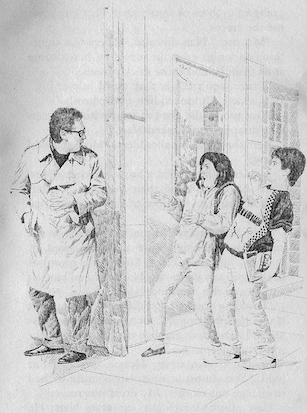
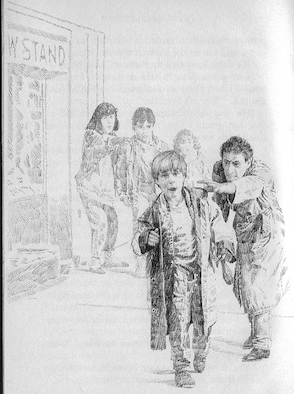
Nan and Bert are walking to school when Bert starts trying to follow Nan, practicing shadowing someone, like his favorite comic book detective, Rex Sleuther. Nan thinks that Bert’s attempts at following her are ridiculous, especially since she already knows he’s there. Then, she spots a tall man who is really being shadowed.

The tall man keeps looking over his shoulder and ducking into doorways, like someone is after them. It doesn’t take the kids long to realize who is following him because a man in a trenchcoat, who is walking behind the tall man, keeps pausing and pretending to tie his shoe or look in store windows every time the tall man glances back. It’s not very subtle. When the man in the trenchcoat sees Nan and Bert watching him, he gives them a menacing look and seems like he’s about to confront them, but then, he leaves. They lose sight of the tall man. It’s a bizarre experience, and it ends when the kids’ mother drives up with their younger siblings and gives them a ride.

At school, Nan meets her new science teacher, and she realizes that he is the tall man who was being followed by the man in the trenchcoat. He introduces himself as Mr. Newman (ha, ha), and he seems much more relaxed than he was before. That is, until they all see the message written on the blackboard in the classroom: “Newman, give up your plans. We’re watching you.” Mr. Newman exclaims, “Oh, no! They’ve found out! They know!” (I seriously wish that at least one of my old teachers had started their first day in class by saying that exact thing.) Mr. Newman doesn’t explain what it’s about. He just quickly erases the message on the board and begins talking about the science project he’s assigning.

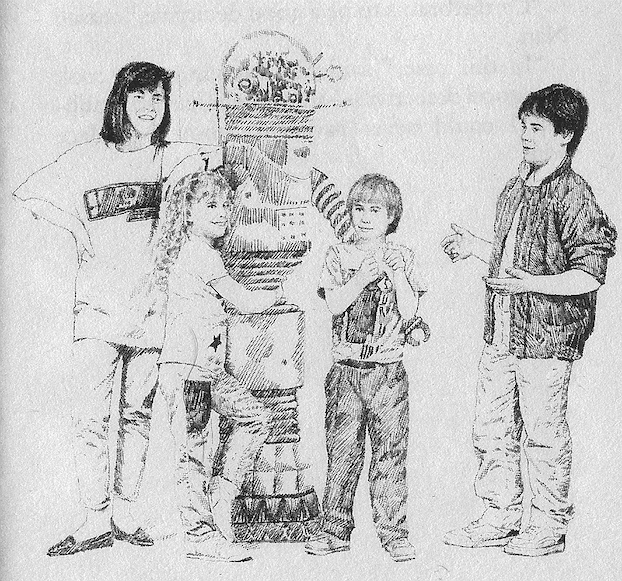
When Nan tells her siblings about Mr. Newman and what happened in class, Freddie says that Mr. Newman will also be teaching the afternoon science club that he joined. Mr. Newman will be teaching them about robots, and they’re going to have a meeting at his house, where Mr. Newman will show the club his inventions. Bert says that Freddie can help them figure out what Mr. Newman is doing and what and who he’s afraid of after he’s seen the projects that Mr. Newman is working on.

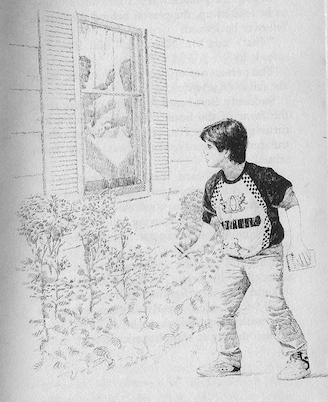
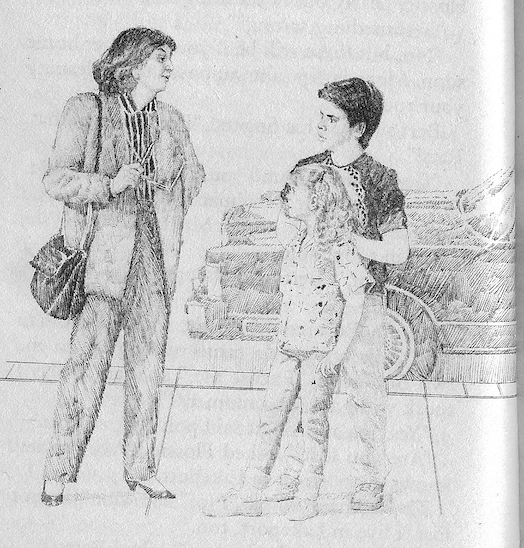
Bert decides to take a walk past Mr. Newman’s house to get a look at it before Freddie goes there. While he’s doing his reconnaissance, Bert sees what looks like people fighting in one of the windows. When he knocks on the door to see if Mr. Newman is all right, Mr. Newman says that he is and insists that there’s no one else there. Then, a strange woman shows up and starts asking Bert questions about Mr. Newman. She says that she’s his former boss at a computer company and wants to know if Bert saw anything in his house. She seems very interested in what he might be working on, but Bert just says that Mr. Newman was too busy for visitors.

Is this woman really Mr. Newman’s former boss, and does she have anything to do with the mysterious man in the trenchcoat? Someone breaks into the school and trashes Mr. Newman’s classroom. What is this secret invention of Mr. Newman’s that everyone seems so interested in, and why would someone threaten him over it or try to put a stop to his work?

The book is available to borrow and read for free online through Internet Archive.

My Reaction

The kids’ first thoughts about the mysterious people who are after Mr. Newman is that they might be spies, and they’re partly right. This is a matter of industrial espionage. People are after Mr. Newman’s invention because they can make a lot of money from it.

The robot Mr. Newman is building is really impressive, even by modern 21st century standards. Back in the 1980s, when this was written, a robot that large and sophisticated would have seemed almost like science fiction, although increasing developments in robotics technology would have made it seem more possible. Companies were working on developing robots during the 1980s, and Honda was working on a humanoid robot that could walk on two feet. Kids had toy robots. (I wanted one but never got one.) I don’t remember any classes for building robots for kids, but there may have been some that I didn’t know about at the time because I was still pretty young in the 1980s. In the 21st century, there are modern robotics classes for kids, and they sometimes show off their robots at competitions.

The Chocolate-Covered Clue

The Bobbsey Twins

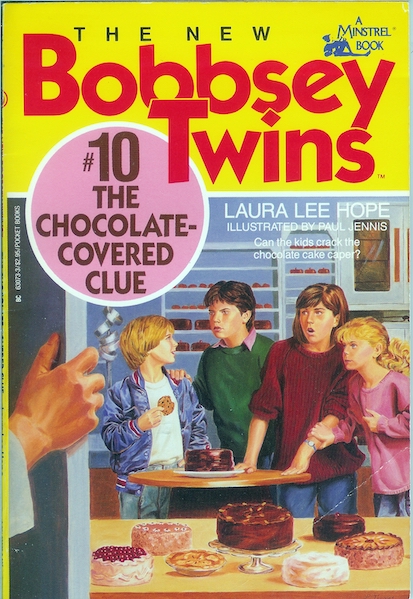
#10 The Chocolate-Covered Clue by Laura Lee Hope (Stratemeyer Syndicate), 1989.

Before I begin, I’d like to acknowledge Sean Hagins, for supplying me with photos of this book! Usually, I take pictures of books myself, but I just couldn’t find a physical copy of this one. Sean is a big fan of the Bobbsey Twins, particularly the New Bobbsey Twins mysteries, and you can see some of his video reviews as well as videos about his photography work on his YouTube channel, SJHFoto. Thanks, Sean!

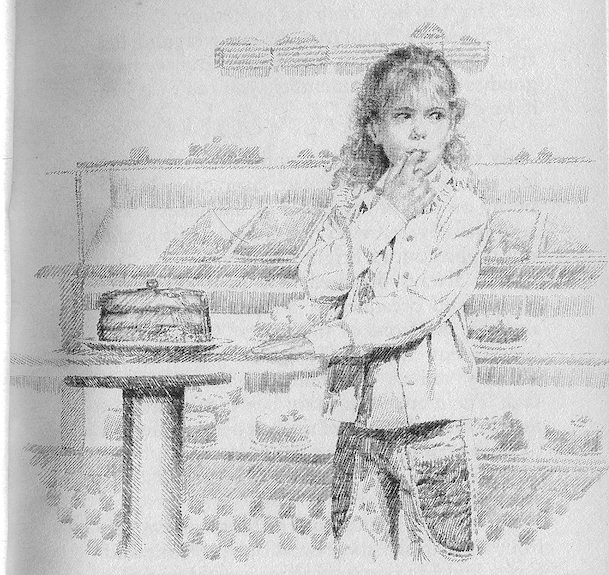
Flossie has made a new friend, Casey Baker, whose parents own Baker’s Bakery. They invite her to come for a tour of the bakery to see how they make everything. It means getting up very early on a school morning because the baking has to start very early. They need to have everything freshly baked by the time the bakery opens for customers. Although it’s difficult to get up that early, Flossie enjoys the tour, seeing the large electric mixers where they make the cake batter and the enormous oven where they can bake over 100 cookies at once.

While the Bakers are showing her everything, they all realize that they feel cold. Someone has left the door to the alley open. Nobody is around, so they assume that it must have just been left open by a deliveryman making an early delivery.

Later, while Flossie and Cassie are admiring a beautiful chocolate cake, something really strange happens. A masked man suddenly runs into the shop, grabs the cake, and runs away with it! Who could be so desperate for chocolate cake that they have to resort to theft? The Bobbsey Twins’ mother is covering a series of recent burglaries for the local newspaper, but this is the weirdest theft the kids have ever heard of.

It gets weirder as the day goes on. While Freddie and his mother are running errands, they stop at a diner, and the same masked man runs in and smashes the chocolate cake on the counter with his bare hands! Freddie tries to chase him, and the man throws cake at him. The cake that was smashed was also from Baker’s Bakery.

The Bobbsey Twins talk to Casey, and she tells them that someone stole their delivery list. From then on, this crazy cakenapper starts tracking down and stealing and smashing every chocolate cake Baker’s Bakery made that day – including the one that the Bobbseys had delivered to their house.

What’s behind all of this cake carnage and chocolate destruction? Does someone have a grudge against the Bakers or against chocolate-based desserts?

The book is available to borrow and read for free online through Internet Archive.

My Reaction and Spoilers

I really liked the premise of this mystery! It’s such a fun, crazy concept of someone going all over town, smashing cakes, apparently for no reason. It’s the sort of mystery that I sometimes call a “Bizarre Happenings” mystery. That’s a mystery where strange things happen that encourage the characters to investigate, but it’s not obvious what’s behind it all or what sort of crime is really being committed. An example from adult literature would be the Sherlock Holmes story, The Red-Headed League, where the characters know that someone has been deceived into joining a special club for red-headed men that doesn’t actually exist and paid to copy entries from the encyclopedia, but they’re not sure why at first. In the case of the Bobbsey Twins mystery, the characters know that someone is stealing and destroying chocolate cakes, which is a very bizarre form of theft, but they’re not sure why. Readers can guess from the beginning that this rash of cake thefts is related to a different crime.

Actually, the solution to the story is very similar to that of another Sherlock Holmes story, The Adventure of the Six Napoleons, where someone is stealing and smashing busts of Napoleon. It has nothing to do with Napoleon or the busts themselves. There is something hidden inside one of the busts that someone is desperate to find, but because the busts all look alike, they have to track down and smash them all to find the one they really want. It’s like that with the cakes. The destruction of the cakes has nothing to do with the Baker family, their business, or the cakes themselves. Someone came into the bakery, looking for a place to hide, and dropped something in the cake batter while it was being mixed. Because the batter in the massive mixer was made into multiple cakes, they can’t be sure which cake now contains what they want. They need to track down the right cake in a hurry, before someone else finds what they hid. What seems to be an oddball crime puts the Bobbsey Twins up against a dangerous criminal!

Encyclopedia Brown Takes the Cake

Encyclopedia Brown

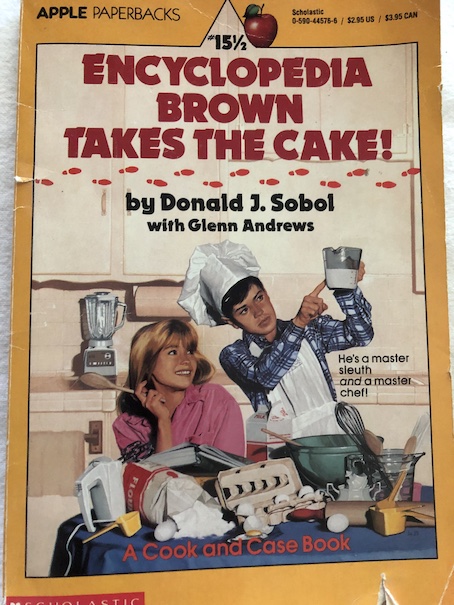
Encyclopedia Brown Takes the Cake by Donald J. Sobol with Glenn Andrews, 1982, 1983.

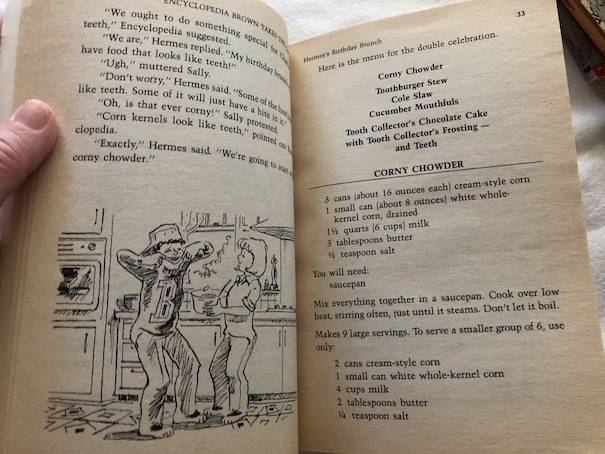
This book is a little different from other books in the Encyclopedia Brown mystery series. Like other books, it’s a collection of short solve-it-yourself mystery stories with the answers to the mysteries in the back. However, this book also has special sections with recipes and cooking tips after each story. The recipe sections are based on things that happen in each of the stories. It’s best to read the stories first to avoid some of the spoilers in the recipe sections.

The book is available to borrow and read for free online through Internet Archive (multiple copies).

Stories and Recipe Sections:

The Case of the Missing Garlic Bread

Encyclopedia Brown’s neighborhood nemesis, Bugs Meany, and his friends stole some garlic bread and a chocolate cake meant for a birthday party. They deny it, but Encyclopedia Brown knows how to prove that they’re the thieves.

Kitchen Basics

The birthday boy’s mother gives the kids kitchen tips, like how to peel and cut vegetables.

The Case of the Fourth of July Artist

On the Fourth of July, a local boy known for trying to cheat people attempts to sell a picture of the Liberty Bell supposedly painted by one of his ancestors on July 4, 1776. Encyclopedia explains why the painting is a fake. (It was a good enough painting that the guy should have just tried to sell it as an ordinary painting instead.)

The Fourth of July Party

Encyclopedia and his friends make oven-fried chicken, some side dishes, and a red, white, and blue shortcake for their Fourth of July party. All the recipes are provided.

The Case of the Oven Mitt

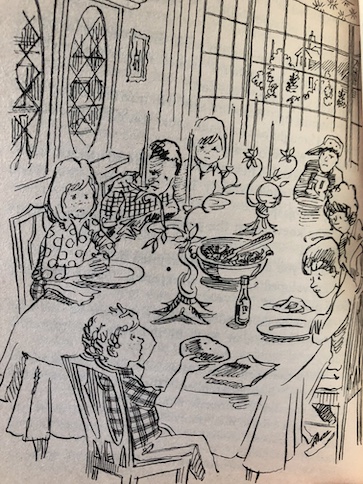
A friend of theirs has started working in her father’s kitchenware store. On her first day, while she’s helping their friend, Hermes, to decide on a present for his mother, someone sneaks in the back and steals a couple of mixers. She feels badly about it, and at Hermes’s birthday party, Encyclopedia realizes that the thief is one of the party guests.

Hermes’s Birthday Brunch

In honor of a friend’s tooth collection, all of the food at the birthday party has something to do with teeth or foods that resemble teeth, like corny chowder and tooth-collector’s chocolate cake with frosting and teeth in the form of bits of marzipan and slivered almonds.

The Case of the Overstuffed Pinata

Bugs Meany steals a pinata from another boy. He insists that it’s his, but Encyclopedia proves it’s not.

A Mexican Fiesta

Encyclopedia and his friends make Mexican food, including cookies called polvorones, which are also known as Mexican Wedding cookies.

The Case of the Missing Watchgoose

A girl’s pet watchgoose goes missing. I didn’t like the solution to this one.

An Italian Dinner

The goose’s name was Christopher Columbus Day, so the kids cook an Italian-themed dinner.

The Case of the Secret Recipe

A friend of Encyclopedia’s, Beauford Twitty, invites his friends to his private potato museum to see his exhibits and sample a new recipe he’s created with a new variety of potato that his grandfather developed on his farm. While they’re there, someone steals a potato autographed by Yankees pitchers.

Dinner at the Twittys’

As a reward for helping to recover the potato, the Twittys give a dinner with no potato dishes at all: cream of chicken soup, meat loaf, corn pudding, baked tomatoes, lemon-buttered green beans, and apple pie.

The Case of the Chinese Restaurant

Oliver, who is a fan of Chinese food and the treasurer of the Service Club, is suspected of stealing from the Letterman’s Club treasury that was entrusted to him. Encyclopedia proves that he’s innocent.

A Chinese Banquet

Encyclopedia and his friends make Chinese food, including egg drop soup, Chinese riblets, egg rolls, and sweet and sour meatballs.

Snacks and Lunches

This section isn’t a story, just a collection of additional recipes for things like pizza made with pita bread, a variety of sandwiches, Twitty’s recipe for French fries from the potato story, French toast, cookies, and brownies.

Pointers from Pablo

Pablo, a young artist, offers advice on how to present and serve food while helping himself to cookies that Encyclopedia and Sally made.

Hilda’s Restful Chair

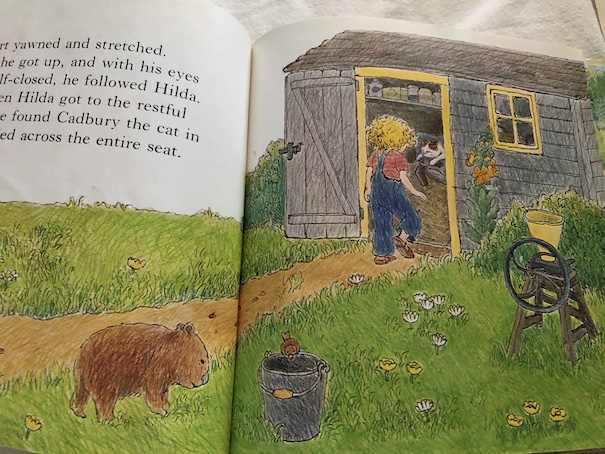
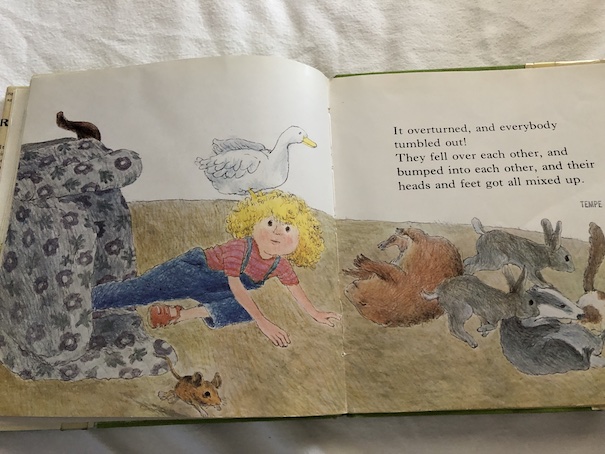
Hilda’s Restful Chair by Iris Schweitzer, 1981.

One hot morning, Hilda finishes watering her garden and decides that she needs to rest for a while.

When Hilda needs to rest, she has a special place she likes to go – an old armchair that she keeps in a shed. She calls the chair her “restful chair.”

Hilda is joined in her restful chair by Osbert the wombat and Cadbury the cat. However, Osbert and Cadbury aren’t the only animals who enjoy the restful chair. Soon, a pair of rabbits ask to join the others in the chair.

As Hilda and her animal friends sit in the restful chair, other animals come to join them. As the chair becomes more loaded with animals, it starts to creak and groan.

Eventually, the chair just can’t take it anymore, and it falls over, dumping everyone onto the floor.

Still, all the animals decide that they had a good rest. As the animals leave, Hilda sets the chair up again, and she and her animal friends go inside to have some watermelon.

The book is available to borrow and read for free online through Internet Archive.

My Reaction

This is a cute, fun story about animals who enjoy a comfortable chair as much as a little girl. Kids like stories with repetition, and they would probably enjoy seeing the parade of animals who come to join Hilda in her chair. They would probably also see the ending coming, that the chair won’t be able to hold everyone. It’s just a question of which animal is going to be the last straw for the chair. Fortunately, no animals were harmed by this experience, and even the chair seems okay, even though it fell over.

Because there is a wombat in the story, I assumed that the story takes place in Australia. It probably does, but from the publication information, it looks like it was first printed in Great Britain. The author was originally from Israel, but she was living in London at the time the book was published.

The Secret of the Sunken Treasure

The Bobbsey Twins

Bobbsey Twins The Secret of the Sunken Treasure cover

The Secret of the Sunken Treasure by Laura Lee Hope (Stratemeyer Syndicate), 1989.

Before I begin, I’d like to acknowledge Sean Hagins, for supplying me with photos of this book! Usually, I take pictures of books myself, but I just couldn’t find a physical copy of this one. Sean is a big fan of the Bobbsey Twins, particularly the New Bobbsey Twins mysteries, and you can see some of his video reviews as well as videos about his photography work on his YouTube channel, SJHFoto. Thanks, Sean!

The two sets of Bobbsey Twins and their parents are on vacation in Florida for a week. It’s just a fun family vacation, although Mrs. Bobbsey is hoping to write an article about a sunken treasure ship called the Granada. The Bobbsey Twins are intrigued at the idea of searching for sunken treasure, although nobody has detected a sign of the treasure since the ship sank in 1801. Dan Chester, he brother of a family friend, lives in the town where the Bobbseys are staying along with his 15-year-old daughter, Meg. Dan and Meg are divers, and they have been searching for the wreckage of the Granada, and they think they have a lead. The Bobbsey Twins are excited to think that they might be able to participate in the search for the treasure or be there when the Chesters find it!

However, when Dan and Meg pick them up at the airport, they have bad news. Although they were able to locate the wreckage of the Granada, they were delayed reaching shore to claim their find because their boat propeller broke, and someone else claimed the Granada before they could. Joe Lenox, the man who claimed the wreckage, runs an underwater salvaging company, and he’s tough competition for the Chesters because he can afford all the latest sonar equipment. It’s a heavy blow to Dan and Meg, losing such an important find when they were so close to claiming it. The only consolation is that everyone will be able to watch the old safe from the wreckage being hauled to the surface. The safe is supposed to contain the treasure the ship was carrying.

When Joe Lenox learns that Mrs. Bobbsey is an out-of-town reporter, he invites the entire Bobbsey family to come with him on his boat to see the treasure being recovered. They accept the invitation, although the kids feel a little funny about it because Joe is Dan and Meg’s competitor.

On the boat, Joe shows the Bobbseys his equipment and explains how everything works. (I grew up in Arizona and have never been diving, so I have very little context for understanding diving equipment. This part looks informative, but since this book was published decades ago, there may have been some changes in equipment since then. I wouldn’t know.) Flossie is hoping that, when the treasure is brought up, she will get the chance to try on the famous tiara that is supposed to be in the safe. However, everyone is in for a shock. When the divers go to recover the safe, they discover that someone has already managed to open it and remove the strongbox containing the treasure!

Now, Joe feels cheated out of a treasure he thought he had safely claimed, and he wants to know who’s responsible. The logical suspects would be Dan and Meg, who felt cheated out of their opportunity to claim the treasure first and who have the diving skills needed to reach the safe. A charm belonging to Meg is found in the safe, making Joe and the police believe that the Chesters are guilty. Although, there are also the other members of Joe’s crew to consider. They were the only other people who knew where the wreck was. Could any of them gone out to raid the wreck before the official salvage operation? Can the Bobbsey Twins find the real thieves?

The book is available to borrow and read for free online through Internet Archive.

My Reaction

I had a couple of favorite suspects early on in the story. The book establishes that it would have taken at least two people to deal with the safe, so I was looking for a pair of people. I was only partly right, though, because there’s another suspect who isn’t introduced until later in the book. The first person I suspected is guilty, but there were more people involved than I thought.

The book explains a little about how a person can lay claim to a sunken ship. The characters say that they have to fill out paperwork at the courthouse. There are laws regarding claiming a sunken ship and official procedures to follow. It’s not as simple as finders keepers. It does matter who found it, where they found it, and who the ship belonged to originally. There were also some changes to the laws around the time this book was written and published with the Abandoned Shipwreck Act of 1987. I’m not completely sure whether each Joe or Dan and Meg could have legally claimed the ship. It partly depends on whether or not it was within US territorial waters or outside the official three-mile limit, and it also depends on whether or not the ship was property of a foreign government which could lay claim to it. For the purposes of the story, we have to assume that Joe Lenox was able to successfully lay a claim to the ship and that Dan and Meg could have done so if they had reached the authorities first. What makes me doubt this is how it would have worked in real life is that the treasure on the ship belonged to a Spanish countess, which makes me think that it could be regarded as property of the Spanish government, but it would be difficult to determine that without additional information.