The Dark-Thirty

The Dark-Thirty: Southern Tales of the Supernatural by Patricia C. McKissack, 1992.

There are ten short, scary stories in this book, not thirty. The author explains in the beginning that the name of the book comes from an expression kids used when she was young. The “dark-thirty” was the last half hour of light before it became truly dark outside, when the kids had to hurry home so they wouldn’t be out after dark, when the monsters came out. The author was African American, and the stories in this book have African American themes. They were based on stories that the author heard from her grandmother when she was young.

This is a book that I remember a school librarian introducing to us when I was in elementary school, probably around age 10 or 11. My memories of it are a little vague. I had forgotten most of what the stories were about, although the title stuck with me, and I remembered thinking that I should read it again someday. I have to admit that most of the emotions that I experience while reading this book as an adult were anger and frustration. The sad truth is that those are the emotions that permeate much of African American history, from the harsh conditions of slavery to the injustices of racism, and those are the aspects of the stories that stand out to me most as an adult. As I recall, I did think more about the ghost parts of the stories when I was a kid, but I didn’t have as deep an understanding of the background of the stories then. Maybe part of the lesson here is that human monsters are more terrifying than anything supernatural, partly because it’s the people who are or should be closest to you in a shared humanity are the ones who have the most opportunity to cause harm, if that’s what they’ve decided to do. That’s a rather dark thought, but these are dark stories with dark themes.

On a lighter note, I found the stories that introduced pieces of folklore fascinating. I’ve had an interest in folklore since I was a kid, which is part of why this book stuck in my mind for so many years.

I wouldn’t recommend this book for kids younger than 10 years old because of the dark themes. There is also derogatory racial language in the stories (including the n-word), particularly used by the villains, which helps show why they’re villains. I think, before kids are ready for this book, they need to have some background information on the subjects of racism and slavery to understand what’s going on, and they should also know that there are certain words they shouldn’t use themselves, even if other people do.

The book is a Newbery Honor Book. It’s available to borrow and read for free online through Internet Archive.

Stories in the Book:

The Legend of Pin Oak

The story is set during slave days. Harper McAvoy, a plantation owner, has resented one of his slaves, Henri, since they were both young. Harper was neglected by his father after his mother died giving birth to him, and years later, when his father finally returned to their estate, called Pin Oak, he learned that his other had another son with a free black woman, Henri. Their father had hoped that the two boys might be friends and that Henri would help Harper run the estate one day, but Harper always resented Henri for being more like their father than he was and for receiving the attention that his father never showed him. After their father died, Harper thought that he could sell Henri and be rid of him forever, but Henri has actually been a free person all along because his mother was free.

When the slavers try to take Henri anyway, he and his wife run away with their baby. They apparently die jumping to their deaths at a waterfall, although some say that they actually turned into birds and flew away while Harper is killed pursuing them. Others think that Henri and his family may have survived by jumping into a cave behind the waterfall, although there is evidence that Henri didn’t know there was a cave there. Their fate is left ambiguous.

We Organized

As part of the government’s effort to get people back to work during the Great Depression, the Library of Congress employed writers to record the stories of people who had been slaves. This chapter is a poem based on one of those stories.

Justice

This story is about the Ku Klux Klan. A wealthy and influential man called Riley Holt is murdered. The identity of the murderer is unknown, but local people are so shocked and angry at the crime that they are determined to get “justice” … one way or another. A bitter and suspicious local man called Hoop Granger blames a young black man named Alvin Tinsley. However, Alvin has an alibi, and the chief of police, knowing that Hoop is a bully and a liar and has a history of pushing Alvin to take responsibility for things he’s done himself, asks Hoop if he has an alibi, too. He says that he was working at his service station and his friends will vouch for him, but Chief Brown doesn’t think much of any of them as witnesses.

Hoop is a member of the KKK, and to throw suspicion for the murder from himself, he convinces his fellow KKK members that Alvin is guilty and needs to be punished. They capture Alvin and lynch him, but before Alvin dies, he promises to come back and prove his innocence. Hoop and his friends tell everyone that Alvin hanged himself after confessing to Holt’s murder. Not everyone in town believes the story, but they have no way of proving it’s a lie, and the authorities seem satisfied with the explanation (mainly because the mayor’s son was also part of lynch mob, and the mayor is forcing everyone to cover for him). However, Hoop can’t forget what Alvin said about coming back to prove his innocence. He seems haunted by Alvin’s words. Soon, he starts seeing things and becomes convinced that Alvin is coming back for him. Is it really a restless spirit or Hoop’s own guilty conscience?

The 11:59

This story is about train travel and the Brotherhood of Sleeping Car Porters. The Brotherhood of Sleeping Car Porters had stories that they liked to tell each other, like this story about a phantom train called the Death Train or the 11:59.

A retired porter enjoys telling the younger porters stories about how the Brotherhood was formed and the truly great men among the porters. Many of his stories are tall-tales. One of his stories is about the 11:59. When a porter hears the whistle of this phantom train, he only has 24 hours left to live, and nobody can escape it. Not even old Lester.

The Sight

There’s an old superstition that babies who are born with a caul over their heads will have psychic abilities and could be able to see the future or spirits. A boy named Esau gets “the sight” and is able to tell the future from a young age. However, people with “the sight” have to be careful who knows they have that power because some people will try to use them for unethical purposes, which might cause them to lose their gift, and Esau’s father is a con man. Esau knows that his father can’t be trusted, but when he feels compelled to warn his father of danger, his father learns what Esau can do. His father forces him to help him win at gambling with his gift until the gift finally fades. Then, his father deserts him and his mother. Esau’s mother says maybe it’s just as well to lose the sight, and Esau agrees, not liking it when he sees that bad things are about to happen.

Years go by, Esau grows up, and he eventually becomes a soldier in WWII. He manages to make it home safely, but he is surprised by the sudden return of his gift just in time to save his family.

The Woman in the Snow
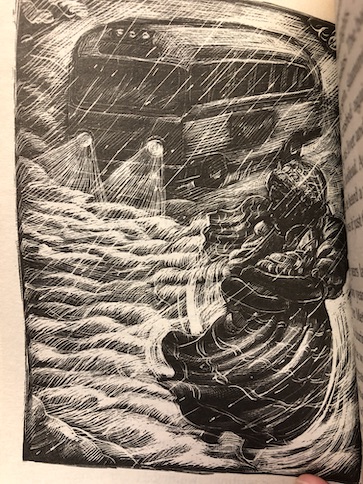
This story involves the bus boycott in Montgomery, Alabama in the 1950s.

Grady Bishop, a white man with a bad history and a chip on his shoulder, has recently started working as a bus driver, although he’s never happy when he has to take the less prestigious route through the city, where a lot of black people catch the bus. Driving makes him feel powerful, but he considers this route beneath him.

One day, during a bad snow storm, a poor woman with a sick baby begs him for a ride although she doesn’t have money to pay. She’s afraid if she can’t get the baby to the hospital, she’ll die. Grady refuses to give her a free ride, convinced that she’s making too much out of nothing and just trying to get a free ride. Later, he hears that the woman and baby froze to death in the storm. A year after that, he sees the same woman again on the same route. Startled, Grady crashes his bus and is killed.

Years later, a black bus driver has that route, and other drivers tell him about the ghost lady with the baby that they see whenever it starts snowing. He becomes the last person to see the ghost lady … because he’s the first to give her a ride.

The Conjure Brother

This story explains that “conjure women” were women who sold herbal cures and practiced folk magic to help people change their luck.

A girl named Josie is tired of being an only child and wants a brother. However, her mother shows no signs of being pregnant, even though Josie keeps asking her for a brother. When she hears a couple of women talking about the local conjure woman, Josie decides to go see her and ask if she can help her get a brother. The conjure woman gives her a set of instructions to follow, but Josie performs the ritual too early at night. Instead of getting a baby brother, Josie gets an older brother, called Adam. Her parents act like Adam has always been their oldest child. Adam is bossy, and some of the things that used to belong to Josie now belong to Adam. Josie starts to think of Adam as a pest and returns to the conjure woman to ask her to do something about Adam, but instead, she learns an important lesson about sharing her life and house with a sibling.

Boo Mama

This chapter talks about the tumultuous times of the late 1960s and the assassinations of Martin Luther King, Jr. and Robert Kennedy. Some people felt so overwhelmed by everything that was going on that they just wanted to “drop out” of society and ignore the chaos around them.

Leddy has been a social activist since she was in her teens, but then, her husband is killed in the war in Vietnam, leaving her with a young child. After the deaths of Martin Luther King, Jr. and Robert Kennedy soon after her husband’s death, Leddy feels completely overwhelmed. She’s been putting forth all of the effort she has for a long time, and the deaths of the man she loved and the people who inspired her feel like too much. She has a breakdown and starts questioning whether everything she and her friends have done has really accomplished anything. Deciding that she needs a change of scene for her and her son, she moves to a rural community in Tennessee.

At first, her young son seems to do better in the countryside, and Leddy finds the change of pace relaxing, but then, her young son disappears. He wanders away while his mother is hanging out the laundry. The locals put together a search party. They search for days, but all they can find is the boy’s teddy bear. Everyone is convinced that he’s dead, but Leddy can’t give up hope that her son is still alive. Her son does turn up, but he is strangely different. Where has he been, and what has happened to him?

The Gingi

There is an old superstition that “Evil needs an invitation.” Among the Yoruba people of West Africa, there is a belief that evil spirits need someone to welcome them into a house before they can enter, so they will try to trick unsuspecting people into giving them an invitation. They use special talismans called gingi to guard against evil.

A woman named Laura is fascinated by a strange statue that she sees in a shop window. However, when she tries to buy it, the shopkeeper says that she’s never seen it before and warns Laura that evil spirits sometimes disguise themselves to trick people into taking them into their homes. Laura thinks this is just superstition and insists that she wants the statue. The shopkeeper charges her a price that’s too high to discourage her from buying the statue, and it almost works, but for some reason, Laura feels compelled to buy it and pays for it anyway. Seeing that she can’t prevent Laura from taking the statue, the shopkeeper insists that she take a small complementary talisman and keep it with her. The talisman is a small doll, and she gives it to her young daughter to play with.

The Chicken-Coop Monster

The final story in the book is semi-autobiographical, inspired by the author’s feelings when her parents got divorced when she was a child.

A young girl named Melissa is upset about her parents’ divorce. Her parents send her to stay with her grandparents in Tennessee while they’re sorting things out, but she becomes convinced that there’s a monster living in the chicken coop on her grandparents’ property. She and her friends are part of a group called the Monster Watchers of America. Melissa’s grandmother doesn’t believe in the monster, but her grandfather teaches her an important lesson about facing up to life’s monsters.

101 Valentine Jokes

101 Valentine Jokes by Pat Brigandi, illustrated by Don Orehek, 1994.

This is one of those little themed joke books that I used to pick up at school book fairs and used book sales when I was a kid. Most of the jokes are really corny, but I remember finding them fun when I was a kid. Happy Valentine’s Day!

One of the things that surprised me about this book is that some of the jokes are weirdly insulting for a Valentine-themed book. It just struck me as odd that there were jokes with people basically insulting their boyfriends or girlfriends or sending insulting Valentines.

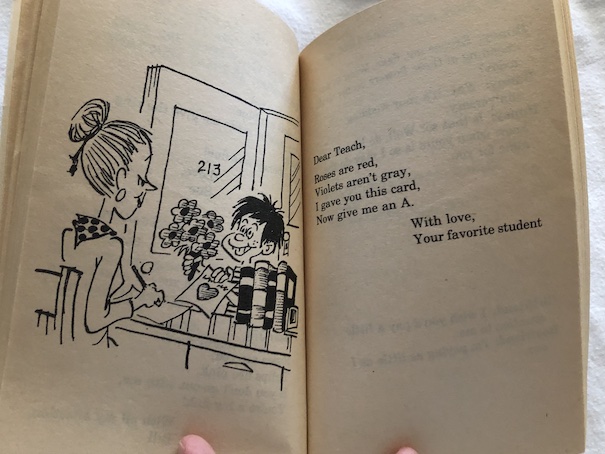
Actually, as I kid, I think I understood the point of the insulting joke Valentine cards because, when you’re a kid in school, there are rules that require you to give a Valentine to every person in class, whether you like them or get along with them or not, so nobody feels left out. Those rules make sense because teachers don’t want to create a situation a situation where somebody in class is being deliberately ignored by other students or the kids are playing one-upmanship about who is more popular than who. But at the same time, when someone else in class has been picking on you all year, that’s the last person you want to give a Valentine. You can’t really give people nasty Valentines like this (at least, not without getting into trouble), but there are times when it can be fun to imagine that you could so you can tell off some jerk who desperately needs it.

But, when it comes to people insulting their boyfriends or girlfriends, I’m just thinking, “If you feel that way about this person, why are you going out with them? Go find someone else!”

Fortunately, not all the jokes in this book are mean. It would have been depressing if all of them were negative in some way. There are the usual knock-knock jokes, jokes based on puns, and a few jokes that are told in story form or silly conversations.

There is one long joke that’s a form letter for “thanking” someone for a present. (Hint: It’s implied that the present wasn’t that great and the person isn’t thankful for it. It reminded me of one of the joke poems in The D- Minus Poems of Jeremy Bloom, and I think the poem was better.)

Overall, I think the best jokes were the kind that I think I kids really could use in class Valentines without getting in trouble. Because of all the insulting ones, though, I felt like there weren’t enough of this kind of joke.

What did the chewing gum say to the show?
I’m stuck on you.

This book does have the classic:

Will you remember me tomorrow?
Of course I will.
Will you remember me next week?
Of course I will.
Will you remember me next month?
Of course I will.
Will you remember me next year?
Of course I will.
Knock, knock.
Who’s there?
See, you forgot me already!

The book is available to borrow and read for free online through Internet Archive.

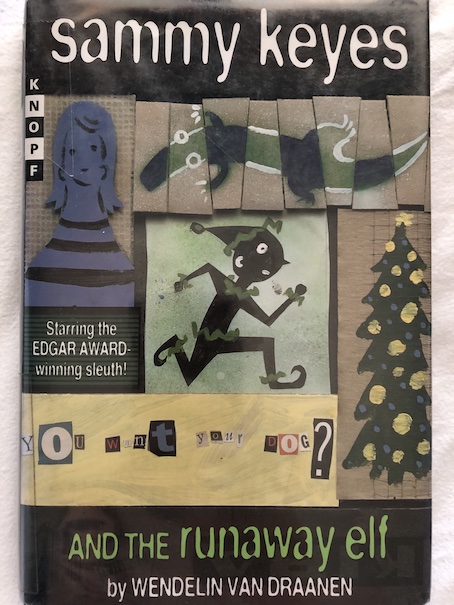
Sammy Keyes and the Runaway Elf

Sammy Keyes

Sammy Keyes and the Runaway Elf by Wendelin Van Draanen, 1999.

Every year, Sammy’s town, Santa Martina, puts together a calendar with pictures of people’s pet dogs. People whose dogs are chosen for the calendar pictures get to ride in the town’s Christmas parade with their pets. Sammy is a cat-lover instead of a dog-lover, so she’s usually not too interested in the parade float with the dogs, but now, her friend Holly is living and working with the people who own the dog-grooming business and who prepare the float.

Sammy goes to the parade early to help Holly and the others to get the canine calendar float ready. She meets Mr. Petersen, the disagreeable man who assembles the dog calendar. Then, they learn that one of the dog owners has broken her leg and will need someone else to manage the dog, Marique, on the float. Marique is important because she’s trained to jump through a hoop, and they’re planning to have her jump through a Christmas wreath on the float. The dog owner’s daughter says she can’t be on the float with the dog because she promised her mother that she would make a video recording of the parade for her, so she has to be in the audience. Various other people also refuse to handle Marique because they have other jobs to do or other dogs to manage. Eventually, Sammy gets recruited to ride on the float and handle Marique.

At first, it goes pretty well, and Marique is a big hit with her jumping-through-the-wreath act. Then, some people show up dressed like the Three Wise Men and carrying cats, for some reason. Marique jumps off the float and runs off into the crowd. Before Sammy can do anything more than shout a warning to the others on the float to hold on to their dogs, both the cats and the other dogs start going wild and running in all directions. Everyone jumps off the canine calendar float and begins chasing after their dog. Sammy searches for Marique through the chaos.

Sammy doesn’t find Marique, but she does meet an unhappy little girl named Elyssa, who is dressed as an elf. Officer Borsch finds both girls and escorts them back to Elyssa’s mother. Officer Borsch wants to take Sammy home (which is a problem because Sammy secretly lives with her grandmother at a retirement community that doesn’t allow children, and they’ve been trying hard to avoid anyone finding out), but Elyssa insists that she wants Sammy to stay with her. When Elyssa goes to buy Sammy a soda, her mother questions Sammy about what Elyssa said to her. Elyssa seems to have an odd obsession with the moon and a tendency to run off by herself (making her the “runaway elf” in the title), but her mother doesn’t want to explain it. Elyssa asks if Sammy can spend the night with her. Sammy says that she has to get home, but Elyssa’s mother says it’s okay if the girls want to see each other tomorrow. Elyssa’s mother encourages the friendship between Elyssa and Sammy because Elyssa seems to need someone to open up to, although Sammy isn’t quite sure why.

Sammy’s grandmother’s friend Hudson finds Sammy, and she explains what happened with the Canine Calendar float. The more Sammy thinks about it, the more she suspects that her school nemesis, Heather Acosta, was one of the people dressed as Wise Men and holding cats. She can’t prove it, but it’s the sort of nasty trick Heather would do. The problem is that Sammy has also realized that Marique jumped off the float right before the cats and dogs went crazy. Just before the chaos started, Sammy heard someone calling Marique’s name, and Marique took off in the direction of the voice. Who was calling to Marique, and where is the dog now?

Marique’s owner, Mrs. Landvogt, is blaming the groomer who was managing the float for the disaster and her dog’s disappearance, which Sammy knows isn’t fair. Then, Sammy’s best friend, Marissa, calls her and says that Mrs. Landvogt is a neighbor of hers and wants to see Sammy. When Sammy meets Mrs. Landvogt, she is angry and in no mood for excuses. Mrs. Landvogt has received a ransom note for her dog, proving that someone took the dog on purpose. Rather than expecting apologies from Sammy for losing her dog, she insists that Sammy find Marique and get her back. At first, Sammy says that she doesn’t think she can do that, but Mrs. Landvogt says that she knows all about Sammy, and more importantly, she knows where Sammy really lives. If Sammy doesn’t find Marique, Mrs. Landvogt threatens to report Sammy and her grandmother for violating the terms of the retirement community. Sammy has no choice but to undertake the investigation. She also needs to find out where Mrs. Landvogt gets the information she uses to pressure people. Sammy isn’t her only victim … and therein may lie the solution to the mystery.

The book is available to borrow and read for free online through Internet Archive (multiple copies).

My Reaction

In this book, Sammy feels a little awkward about Elyssa wanting to be friends with her because Elyssa’s a few years younger than she is. When kids are young, a few years’ difference in age makes a big difference in terms of knowledge, behavior, and interests, and she has trouble seeing what she and Elyssa would have in common and do together. When she talks to Hudson about it, he doesn’t think that age is such a big issue. He’s in his 70s, about the age of Sammy’s grandmother, and a few years’ age difference doesn’t make much of a difference to adults. Sammy is uncomfortable, thinking about how Hudson is decades older than she is. She likes spending time with him, but she worries that maybe she looks like a baby to him and that he just tolerates her in the way she tolerates Elyssa as first. As an adult who’s spent time babysitting and playing with younger cousins, I know it’s not really like that, not to people with depth to their relationships and personalities. People of different ages and backgrounds can still bond with each other over common interests and enjoying talking to each other and spending time together. People who are young at heart and enjoy nostalgia can also have fun sharing in kids’ activities. Playing kids’ games with kids won’t make you a kid again, but it can be fun to feel like one for a few hours at a time, now and then. There’s also something to be said for getting in touch with earlier versions of yourself that have never completely left you and being reminded of the things that you loved when you were young, another theme that enters into the story when Sammy considers some of the unhappy adults around her and what’s made them that way. During the course of the story, Sammy and Elyssa become real friends, and Sammy does help her to come to terms with what’s really bothering her.

During her investigation and through her budding friendship with Elyssa, Sammy begins to learn the secrets of some of the unhappy people in her community. The truth is that everyone has suffered some form of hardship or loss in their lives, and as I mentioned last year when I was talking about experiencing Christmas in a Pandemic, feelings like this can come out stronger around Christmas. Christmas is both the last major holiday before the New Year and a time that people romanticize as being perfect and magical. The problem is that life itself isn’t perfect and magical, and people can feel angry and depressed when the reality of their situations doesn’t match their vision of how their life and Christmas should be, especially if they’re really dealing with a serious situation or long-term unresolved feelings, as many people in this story are.

There is real grief and loss in the story. Elyssa is still struggling to come to terms with the death of her father the year before. He was a police officer who was killed in a situation that went horribly wrong. Elyssa was not at her father’s funeral because a psychologist said that she might find it traumatic at her age. Instead, her mother simply told her that her father went to heaven. However, Elyssa understands more than her mother thinks she does. She knows where her father is buried, and when she runs off by herself, she often goes there to stare at his grave and try to understand how he can be underground and in heaven at the same time. Elyssa’s worries and confusion come out when Sammy’s nosy neighbor, Mrs. Graybill, the one who suspects the truth about Sammy’s life with her grandmother and has often tried to expose it in the past, becomes injured. Mrs. Graybill’s health deteriorates, and she becomes a patient in the nursing home where Elyssa’s mother works. Sammy becomes her only visitor there and learns the truth about her unhappy past and how the resentments she’s borne throughout her life have harmed her and left her with many regrets. Sammy is actually at Mrs. Graybill’s side when she dies, and the two make peace with each other before the end. Witnessing the death of a former nemesis and coming to terms with her real humanity is an emotional roller coaster for Sammy, but facing her own inner turmoil helps her to see how to help Elyssa face hers.

Not everything in the story has a perfect resolution. Sammy does figure out where Marique the dog is, and the dog is safe, but she can’t bring back Elyssa’s dad or Mrs. Graybill, and there are some people who are going to have to learn some lessons of their own about how to resolve their feelings and face up to their own hardships and bad decisions. The brighter spots in the story are what Sammy learns from her experiences and with helping other people face their problems. People really do have to face up to their situations, even when they’re unpleasant, and deal with their emotions in healthy ways. The people in the story who are the most unhappy are those who have tried to hide from their feelings or deal with them through spite and long-term resentment. Sammy comes to understand the importance of forgiveness and focusing on positives instead of negatives when it comes to dealing with one of her own long-term problems: her own mother.

Before the beginning of the series, Sammy’s mother, Lana, left Sammy with her grandmother while she was pursuing an acting career. Even though Sammy had missed her mother when she first left, she has come to realize that she resents her mother for abandoning her to the precarious, secretive life she lives with her grandmother and for putting her second to her acting ambitions. She feels like being a mother wasn’t important to Lana and that her mother only thinks of her as an afterthought when Sammy was depending on her so much. I would say that there is definite truth that Lana has neglected Sammy and her welfare and that Sammy has justification for being angry with her. In this book, Lana is excited about getting her biggest part yet, and Sammy is mortified to find out that this amazing role is in a commercial for anti-gas medicine. Lana sees the commercial as a possible stepping stone to something better, but Sammy thinks it’s embarrassing and a terrible result for the sacrifices that Sammy herself has had to make in her life for the sake of Lana’s “career.” However, seeing what long-term anger and resentment has done to other people in the story causes Sammy to consider that she should also learn to cultivate some forgiveness in her life for Lana so she won’t go down the unhappy paths that other people have. To get past the parts that she has genuine reason to feel angry about Sammy remembers the good times that she and her mother shared before, the times when Lana was nice to her and motherly, and the reasons why she missed her mother in the first place.

I can see why a little forgiveness can be healing, but I don’t see it as a perfect solution, especially not to problems like Sammy’s. Sammy and her grandmother are genuinely living a precarious life which Lana doesn’t seem to understand or appreciate. Even though Sammy finds a way to stop the blackmail in this story, her danger isn’t over, and she lives with it every single day. If Sammy is caught living with her grandmother, her grandmother could actually lose her home, and Sammy might be sent into foster care because social services might decide that neither her mother nor grandmother can or is willing to provide for her. I think it’s important to understand that Sammy isn’t just harboring a petty resentment against her mother; she’s dealing with a serious situation. Hiding in her grandmother’s little senior apartment with only extremely minimal belonging isn’t a fun adventure for her, it’s actually a serious situation with lasting consequences to her well-being. While her desire to temper her resentment toward her mother with some forgiveness and positive memories can help her get a healthier emotional balance, as a responsible adult, I think that Lana’s failure to address the reality of this situation and her role in it is going to remain an unhealthy problem in the lives of her nearest and dearest. If this were real life instead of a fictional story, I think it’s likely Sammy would be showing even more emotional trauma and would probably be in foster care already. It wouldn’t matter then if Lana wanted forgiveness or for people to look only at her good points when she had fun with her little girl because I don’t think judges award custody on that basis, not to someone with a long-term history of neglect because she wanted the freedom to “follow her dreams.”

This book isn’t a particularly happy story for Christmas. It turned out to be darker even than I thought it would be when I started, and Sammy Keyes mysteries tend to be a bit gritty. I would say that it’s more thought-provoking. I would not give this book to a child currently suffering from trauma because, when someone is actively suffering, dealing with characters’ suffering can feel like pulling double duty or rubbing salt in the wound. However, for those in the mood for a deeper understanding of dealing with life’s difficulties, especially at a time of year when everyone expects happiness and joy, it isn’t bad.

Parts of the story are genuinely touching. Sammy is understanding and gentle with Elyssa and changes her life for the better. There are even a couple of bonding moments between her and Officer Borsch. Officer Borsch was a friend of Elyssa’s father, and when Sammy asks him about what happened, Officer Borsch candidly admits that he was there when he was killed and still has nightmares about it. Sammy understands nightmares because she had them when her mother left her. Later, the two of them help each other. Sammy uses some of Hudson’s advice for a little psychological warfare on Heather that gets her to admit the cat prank in front of Officer Borsch. Officer Borsch promises to put some healthy fear into Heather that will help keep her in line in the future. The resolution of the prank also saves Officer Borsch some embarrassment at the office because he was on duty when it happened and took some flak for it, and Sammy also learns something about Borsch’s nemesis on the force from Mrs. Landvogt that will allow Borsch to resolve a serious problem that both he and Elyssa’s father had tried to solve.

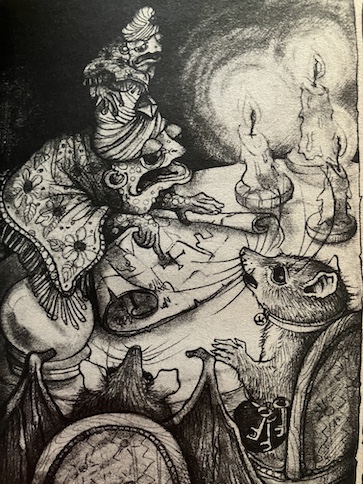
The Bell Tolls at Mousehaven Manner

This book is the sequel to Shadow Over Mousehaven Manor.

Since the characters’ adventures in the previous book, Minabell Mouse has come to live with her Aunt Pitty Pat in their ancestral home, Mousehaven Manor. Just as Aunt Pitty Pat and Minabell have finished their spring cleaning, Minabell’s cousin Violet Mae arrives for a visit … apparently a long one, based on the amount of luggage that she brought with her.

Also, the prairie hawk who brought Violet Mae to Mousehaven Manor brings a package for Minabell, although there’s nothing to say who the package is from. Minabell finds the package disturbing and is afraid to open it. Instead, she stashes it in the music room. Still, the package leaves her feeling weak and unwell, as if it were somehow cursed.

That evening, their friend Percy the bat comes to dinner, and they are also joined by a mysterious stranger bat who calls himself Count Von Flittermouse. Count Von Flittermouse is a traveler, but he has no luggage except for a large box, which he declines to bring inside. They invite him to join them for dinner, but he says he’s already eaten, so he will just join them in conversation. Aunt Pitty Pat asks the Count if he’d like to spend the night at Mousehaven Manor, but the Count says that he’s a nocturnal creature, so he’s active at night. He asks for directions to Springfield because he says he wants to camp in the Oak Ridge Cemetery and visit Lincoln’s tomb. After dinner, the Count leaves, and they see he’s carrying a long box on his back. He’d mentioned that he brought his bed with him, so they figure that’s what it is. Percy seems a little uneasy about the Count, and Minabell notices that the Count left some odd kind of dust on the chair where he was sitting.

Minabell is in charge of security at Mousehaven Manor, but that evening, she accidentally leaves the music room window open. At night, Minabell hears someone moving around the manor, but she never sees the mysterious intruder, and in the morning, nothing is missing, so her aunt thinks it might have been her imagination.

Meanwhile, a country singer mouse called the Rhinestone Rodent arrives in town. (A joke on the Rhinestone Cowboy song.) Minabell is shopping when she stops to watch the singer perform. Then, an alarm goes up among the mice in town because Mousehaven Manor is on fire! Minabell rushes home, and Percy rings the bell at Mousehaven Manor to summon help. Others come to form a bucket brigade, and they successfully put the fire out. Aunt Pitty Pat is fine, but it takes them awhile to find Violet Mae. Violet Mae casually strolls downstairs and tells them that she was upstairs, having a nap and missing the whole thing.

Part of the mansion is damaged from the fire, and they have to clean everything up. Violet Mae meets the Rhinestone Rodent and develops a crush on him. While Violet Mae and Aunt Pitty Pat go to see the Rhinestone Rodent perform, Minabell and Percy inspect the site of the fire. They determine that the fire was set deliberately, but it was never intended to burn down the whole mansion. It seems like whoever set the fire was using it to cause a distraction while they did something else, but they’re not sure what.

The mysterious package that Minabell hid in the music room is still there, and Minabell finally opens it in front of Percy. It turns out that it’s from Wendell Weasel, a member of the local law enforcement agency, the Illinois State Ski Patrol. The mysterious package contains an equally mysterious ancient box, and Wendell’s letter explains that this box has been passed down in the Mouse family for generations, always held by the head of the family. Until recently, it was in the possession of Colonel Mouse, who was Violet Mae’s guardian but has recently passed away (something that Violet Mae has completely failed to mention to anyone, which is weird). Wendell says that Violet Mae doesn’t know anything about the box, but Colonel Mouse wanted Minabell to look after both the box and Violet Mae. Wendell says that there is a document in the box itself that will explain the purpose of the box, but each caretaker of the box is bound to use its contents to help others and not just for personal gain. Also, there are evil people who may try to steal the box, so Minabell is going to have to be careful.

In the mysterious antique box, Minabell finds a pile of sand surrounding a bottle holding something intensely cold and an old map written in Spanish. It seems like this is what their mysterious intruder was looking for, but what does it mean, and who wants it?

The book is available to borrow and read for free online through Internet Archive (multiple copies).

This story is more supernatural than the previous book in the series, which was an adventure story. I thought that the villain in the story was pretty obvious, although I did have a couple other suspects in mind for a more devious twist. It turned out to be the obvious choice, though.

Count von Flittermouse is not what he seems, in more ways than once. Percy figures out pretty quickly that the Count is a vampire bat, but what that seems to mean in this version of the animal world is not only different from what vampire bats actually are, but it’s also kind of confusing. I expected that he’d turn out to be like a human vampire, only with a bat as his main form – drinking blood, being immortal, etc. But, that’s not it. Count von Flittermouse is a shapeshifter. He can change into different scary animals, like wolf and spider. That’s his main super power. So, he’s not exactly what I think of as a “vampire”, he’s more like a werewolf, or werebat, or werewolf bat or something. We never see him drink blood or try to drink blood, although there are some bones in his lair that suggest that he might eat other animals. They don’t really go deep into the lore of it or outline the rules for vampire bats in their version of Illinois. You just have to take their word for it that vampire bats are shapeshifters, and that’s it. That’s their thing. Also, their vampire bats aren’t immortal vampires. That’s really the problem that Count von Flittermouse has. He’s actually a very old vampire bat and not likely to live much longer unless he can get his little winged paws on the package that Minabell received.

The bottle in the mysterious package turns out to contain water from the Fountain of Youth. Generations back, one of Minabell’s ancestors accompanied Spanish conquistadors on their search for the Fountain of Youth, and they not only found it but saved some water from it. Count von Flittermouse wants it to restore his youth and make him immortal. It wouldn’t be so bad if he wasn’t also evil and a werewolf bat.

Of course, our heroes are victorious. They find a way to use the special water so that it benefits everyone, except for the evil bat, and everything ends happily. I actually think that this book might make a fun Disney cartoon, something like a more supernatural version of The Great Mouse Detective. Even though I thought that the book’s version of what a vampire bat is and what it does is a little confusing, a movie version could clarify some of the rules regarding what vampire bats are supposed to be and what they do. The lore about human vampires varies depending on the source, although they usually do have the ability to shapeshift into bats, an ability which is kind of pointless if the vampire happens to already be a bat. It’s understandable that the story has to tweak the traditional vampire lore to fit into this animal society. I kind of picture that the vampire bat would only be able to change into things whose blood it sucked earlier, but that’s just my theory; the book doesn’t clarify that point. Still, it’s a fun story, and I think a movie version would also be fun.

North American Indian Sign Language

North American Indian Sign Language by Karen Liptak, 1990, 1995.

This book is going to be one of three I’m planning to cover on the same topic because this book includes a list of recommended reading about North American Indian Sign Language, and I happen to have two other sources from that list in my collection. The other books I have are much older, and I’d like to compare them to this newer book and explain why the newer one does things differently.

To begin with, older books about this topic frequently just use the term “Indian” or “American Indian” to refer to Native Americans. This particular book defines its terms right at the beginning. The author says, “North American Indians are currently called both American Indians and Native Americans. I have chosen the term American Indians to reflect the preference voiced in a recent informal survey at an intertribal powwow in Reno, Nevada, and to help readers find the book more easily. The signs presented in this book are based on the sign language used by the American Indians of the Great Plains.” I appreciate it when authors explain their thinking clearly.

The introductory section of the book explains the purpose and history of using sign language for intertribal communications. It starts with an example of a fictional encounter between two members of different tribes who are strangers to each other. At first, they’re not sure who the other one is and if they’re someone who can be trusted, but when they begin using sign language to signal to each other who they are and what their intentions are, they realize that they’re from tribes who are friendly with each other and that it’s safe to continue communicating.

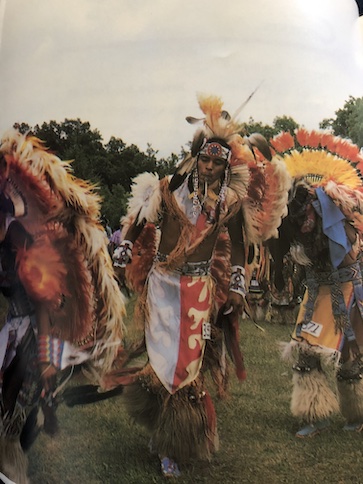
This particular form of sign language was particularly popular among Native Americans of the Great Plains, including the Cheyenne, Sioux, Kiowa, and Blackfoot tribes to allow communication between tribes that did not share a common spoken language and also within tribes in situations that demanded silent communication, such as during hunting and warfare or when communicating with people who could not hear well. American Indian sign language isn’t commonly used in modern times because there are others more commonly used, but it still appears sometimes at powwows or in Native American ceremonial festivals. This book is meant to present the sign language for fun and education.

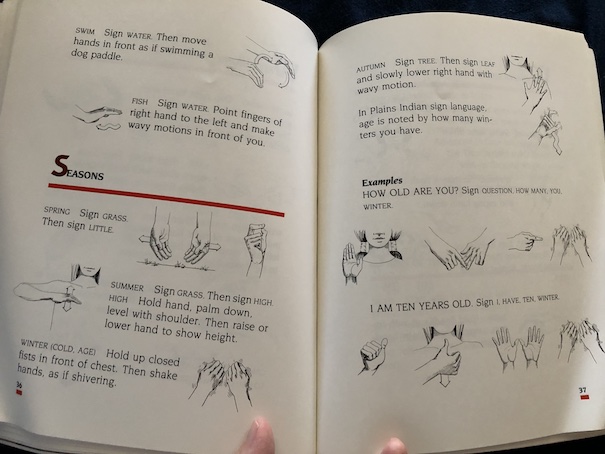
It begins by explaining basic hand and finger positions and introducing some basic vocabulary, demonstrating signals for simple words, like “I”, “You”, “Yes”, and “No.” All of the hand signs are shown in drawings with arrows to indicate movement where necessary. It also introduces how to signal that you are asking a question.

The rest of the vocabulary is presented in themed sections, introducing words for family members, counting, seasons of the year, weather, time, food, clothing, feelings. This is different from the older books about American Indian sign language, which had vocabulary words organized alphabetically, like a dictionary. I prefer the approach of the themed sections because they demonstrate related words together and provide information for forming sentences as needed, like how to indicate that a concept is past tense. Later sections build on earlier sections, like when the section about seasons draws on the earlier concepts of counting and how to ask questions to demonstrate how to ask how old someone is or how to tell someone your age.

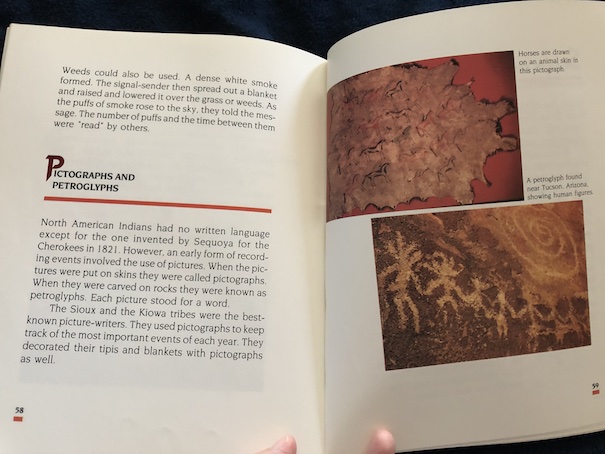
There are also sections at the back of the book discussing other methods of communication used by Native Americans, including smoke signals, pictographs, and petroglyphs.

The book is part of a series by the same author about various aspects of Native American culture. It’s available to borrow and read for free online through Internet Archive.

The Bone Keeper

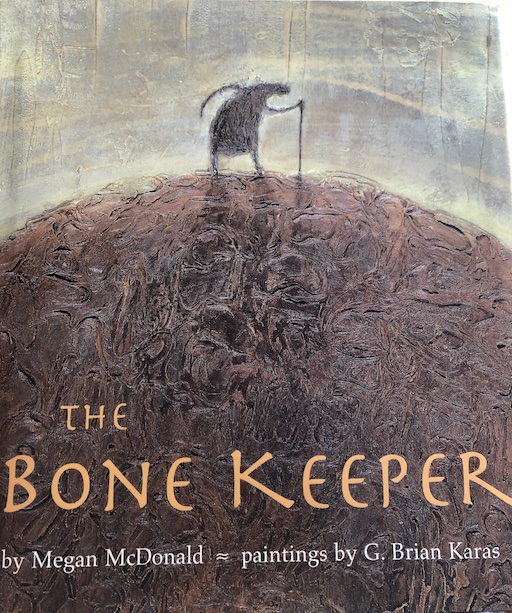
The Bone Keeper by Megan McDonald, paintings by G. Brian Karas, 1999.

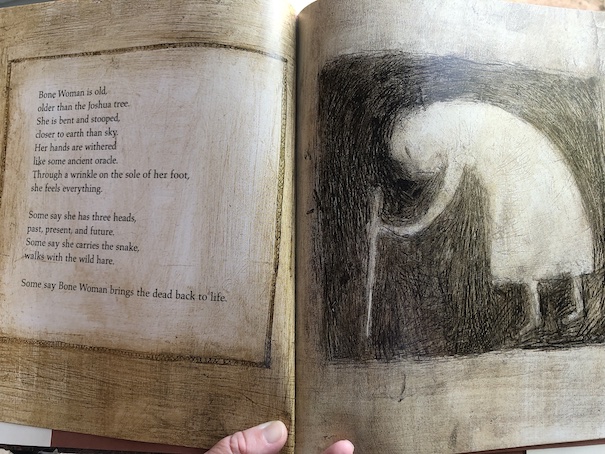
The story in this picture book is written as an unrhymed poem and illustrated with paintings that resemble paintings on a cave wall.

Bone Woman is a strange old woman. She is ancient, legendary, may have powers to bring back the dead, and lives in a cave full of bones.

She spends her time searching for bones in the desert sand. She collects the bones, studies them, and arranges them to form complete skeletons.

When she manages to complete a skeleton, she performs a ritual to bring the creature back to life!

The book is available to borrow and read for free online through Internet Archive.

My Reaction

This is one of those picture books that I think would actually be appreciated more by adults than by children. The poetry and art style seem more sophisticated than the styles that children seem to prefer. Most of the pictures are not very colorful, using a lot of grays and browns and black, although the art style is unusual and fascinating, looking like paintings and drawings scratched into rock.

I think kids could understand the action of the story – a strange old woman who lives in a cave collects bones, assembles them into skeletons, and can use them to bring animals back to life. It’s a strange story, partly because there is no explanation about why she is doing this.

One of my regrets about this book is that it doesn’t explain the background of this story. I had expected that there would be a section at the back of the book that would explain more, but there isn’t. From the context – the pictures, the style of the story, the names that the woman is called, and the fact that the artist thanked the Phoenix Public Library and the Heard Museum (both places that are familiar to me) in the dedication – adults can figure out that this is a story from folklore, but it’s not immediately clear what kind of folklore. Anyone who doesn’t already know the story might be confused. I didn’t know this story when I read the book, so I had to look it up.

The story of the Bone Woman has been told and referenced in other books. The story of La Huesera (the Bone Woman) is a Mexican folktale. Sometimes, it’s also called La Loba (the Wolf Woman) because that is the animal that she particularly wants to resurrect. The Bone Woman is a “wild woman” or a “crone” who uses a kind of natural magic to bring life to lifelessness and restoring what was lost.

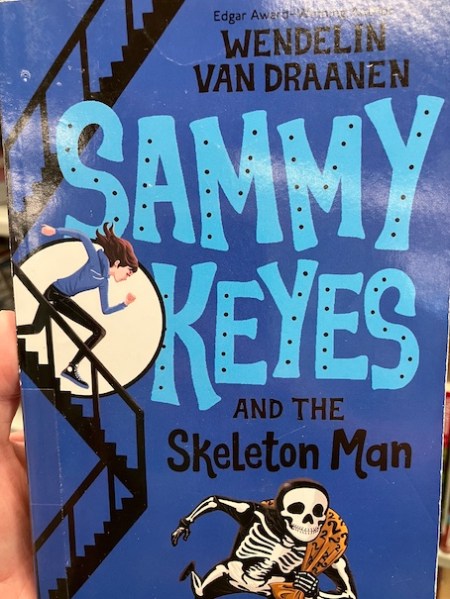
Sammy Keyes and the Skeleton Man

Sammy Keyes

Sammy Keyes decides that she wants to go trick-or-treating even though her grandmother thinks that she’s getting too old to do it. She’s still living secretly in her grandmother’s apartment in an apartment building that’s intended only for seniors, so she jumps at the chance to go out with friends on Halloween night. Dot (real name Margaret/Maggie), a new girl at school, invites her and Marissa to come over to her house to get ready before going out trick-or-treating, which works well for Sammy.

As Dot’s house, Dot is painting herself yellow as part of her bee costume. Sammy is going to color herself green so she can be a marsh monster (something she made up, but it sounds like a swamp monster from old movies). When Marissa comes, she brings Sammy a green sweater that she borrowed from her mother that would be good for a marsh monster costume, and the other girls help Marissa wrap herself in toilet paper for her mummy costume. As the girls set off to trick-or-treat, Sammy gets the idea to go by the old Bush House. The Bush House isn’t haunted, but it is a creepy place and there are stories about the crazy Bush Man who supposedly lives there and will jump out of the tangled bushes that surround the house and kill people. Sammy’s grandmother says that the stories are just stories and the old man who lives in the house is just a lonely old man, but Sammy thinks that it would be thrilling to visit the house and see it up close on Halloween.

As the girls approach the house, they almost collide with someone in a skeleton costume who’s running away. He looks bigger than the girls are, and he’s carrying a pillowcase that looks pretty full. The girls are startled, but Sammy is determined to go up to the Bush House and just knock on the door once for the experience of it. What Sammy sees when she knocks on the door is even more startling.

The door of the house just swings open, and there’s a pile of newspapers on the floor inside that are on fire. Sammy calls out to see if there’s anybody in the house. There’s no answer, so Sammy rushes inside and manages to put out the fire by smothering it with her marsh monster sweater. As the girls are about to leave, Sammy sees someone in a Frankenstein costume in a chair, and they scream and run outside. Then, Sammy realizes that the Frankenstein mask was on sideways, and it’s not easy to breathe in a sideways mask, when the nose and mouth holes don’t line up, so she decides that she has to go back and see if the person wearing the costume is really alright. It’s definitely a human in a costume, and not a dummy. When Sammy removes the mask, she at first fears that the person in the costume is dead because he’s so still, but it turns out that the person under the mask is the Bush Man. He’s tied up, has a head injury, and is barely conscious. He begs the girls for help. The Bush Man is having trouble talking, so after the girls untie him, he writes a message down on paper, asking the girls to go next door and call the police. He also wants to know if the girls saw the skeleton man.

The Bush Man’s real name is Chauncy LeBard, and the reason he can’t talk is that he’s had surgery on his throat because of smoking-related throat cancer. He needs a device held up to his throat to really speak in an electronic voice (an electrolarynx, I’ve seen one used before). While Dot and Marissa run next door and call the police, Sammy stays in the house with him. When the police come, Sammy uncomfortably recognizes the police officer who knows her from the previous book in the series, Officer Borsch. Last time, she and Marissa told him that Sammy is Marissa’s foster sister so they wouldn’t have to reveal where Sammy is actually living. Dot is confused when Marissa refers to Sammy as her “sister”, but she doesn’t give them away.

Mr. LeBard explains that the man in the skeleton costume had forced his way into the house and tied him up, but he doesn’t know who the man is or why he did it. The girls can’t fully describe the man because he was wearing a full-body costume, although they agree that he seemed like a full adult, not just a tall teen. It seems like the skeleton man was a thief because Mr. LeBard’s wallet and a pair of candlesticks are missing.

After the night’s adventures are over, Sammy winds up spending the night at the house of an elderly friend, Hudson Graham, because her grandmother’s nosy neighbor is awake, trying to find proof that Sammy is illegally living with her grandmother in their apartment building. Hudson agrees to let Sammy stay with him, and it turns out that he’s also an old friend of Chauncy LeBard. Mr. LeBard used to be a political science professor at the local college, and Hudson was one of his students. The two of them liked to get together and have political debates. Then, Mr. LeBard’s mother died, leaving him her estate. The local rumors say that’s when Mr. LeBard went crazy and became the Bush Man. The reality is that he developed health problems because of his smoking and didn’t want his old friends to know. Chauncy also has a brother, who was disinherited by their mother because she disapproved of his wife, but nobody knows why the mother didn’t like her.

Sammy can’t forget about what happened with Chauncy LeBard, even if she wants to. She at least has to go back to the Bush House to get Marissa’s mother’s sweater, which turns out to be worth a lot more than either of them thought. Marissa tells her that, even though her mother never wears that old green sweater, she did notice that it was gone and was upset because it turns out that it was a designer sweater that she bought for $500. Sammy is horrified because, having put out a fire with that sweater, she’s pretty sure that it’s done for, and if she has to come up with $500 to replace it, so is she! When Sammy goes to see Chauncy about the sweater, she starts learning more about him and how his inheritance from his mother turned out to be more of a curse than a blessing. Sammy also starts to wonder whether theft was really the motive for what happened on Halloween. If Chauncy didn’t have that hole in his throat from his surgery, the sideways mask might have smothered him. Did the skeleton man want Chauncy dead?

The mystery of the skeleton man and the ruined $500 sweater aren’t Sammy only problems, though. At school, there’s a nasty rumor going around that Sammy has been calling a boy name Jared, trying to get him away from his girlfriend, Amber. Amber is angry with Sammy, and Sammy’s school nemesis, Heather, has been gleefully making sure that everyone in school knows about it in order to embarrass her as much as possible. Sammy knows that she has never called or even spoken to Jared in her life and doesn’t care about him, but it’s not easy to convince everyone else of that. So who really has been calling Jared? Sammy is sure that it’s really Heather, pretending to be her and saying embarrassing things to get her in trouble. It would certainly be in character for Heather to do that. The rumors are get so out of hand even in a day that one of Sammy’s teachers even suggests that maybe she should talk to a school counselor about her issues with Jared so it won’t affect her schoolwork.

Because the characters are middle school kids, Sammy decides that the best way to get evidence that Heather is her phone imposter is to crash her Halloween party. With everyone in costume and the whole class from school invited (except for Sammy, of course), Sammy, Marissa, and Dot are pretty sure that Sammy can sneak in with them, posing as Dot’s cousin “Nikki.” What could possibly go wrong?

The book is available to borrow and read for free online through Internet Archive (multiple copies).

There are characters in the Sammy Keyes series who smoke, which was becoming uncommon in children’s books in general when I was young in the 1980s and 1990s because adults didn’t want to set a bad example for children. In the last book, the fortune teller character smoked, and it kind of surprised me, but it seems that the series follows the unspoken rule for children’s books that include smoking, that the only characters who do it are either villains or oddballs, not cool people to be imitated. This book confronts the issue of smoking more directly, with Chauncy LeBard’s throat cancer. Mean girl Heather also turns out to be a secret smoker who bribes one of her friends to spy on Sammy and her friends by giving her cigarettes. Sammy later finds out that Chauncy’s mother was also a smoker who died of lung cancer. Between Chauncy’s throat cancer and his mother’s death, the story helps illustrate the hard realities of long-term smoking. Chauncy seems to be living in reduced circumstances, without heat or electricity in his house. My first thought was that his mother’s medical expenses and subsequent funeral and Chauncy’s surgery drained his funds. Medical expenses have wiped out people’s savings before in the US, and I remember that one of the stories they told us to discourage smoking when I was in school years ago was about a woman who was forced to sell her family’s heirlooms to cover her cancer treatment. When Sammy meets Chauncy’s brother, Douglas, she finds out that Douglas was trying to get his mother and brother to quit smoking, but neither of them would, and that’s part of the reason for the family rift. Douglas says that if Chauncy has suffered health problems and blown through the family’s money, it’s really his own fault. It’s true that Chauncy should have taken the hint and quit smoking a long time ago, and he might have spared himself a lot of pain and misery if he had, but it turns out that he didn’t sell the family heirlooms to pay for his medical expenses. There was something in his house that was worth a great deal of money, something that Chauncy couldn’t bear to part with even to improve his own living situation because of the sentimental value. The thief is one of the few people who understood what Chauncy had and how to take it without him even noticing that it was gone right away. In a way, what the thief really stole is as much of a mystery for most of the book as who the thief was. The skeleton man turned out to be one of the people I suspected, but not my first suspect, so I was actually in suspense for most of the book.

As for the side plot with Heather calling Jared as Sammy: Oh, criminy! This is one of those ridiculous tween problems that seems so impossibly complicated when you’re in middle school but pretty dumb when you’re not. I appreciate that the math teacher is concerned when Sammy seems distracted in class and her work suffers, but I have trouble believing that an adult teacher would really be interested in rumors about who at school is calling who. I can’t remember any of my teachers ever caring about that stuff because adults usually know that rumors are wrong and that this kind of school drama passes faster if you don’t feed it. I don’t recall any massive rumor campaigns getting the attention of teachers when I was a kid, and I can’t imagine any of my old teachers giving rumors much weight or interest. I think my teachers would have just told us to stop being drama queens, focus on our work, and save the gossip for after school. A few of the more outspoken and direct communicators on the faculty would have flat out told us that gossip isn’t worth anything, that most of it is wrong anyway (that was actually the subject of a play I was in at school once), and that everyone will have gotten bored of whatever it is and moved on in a week or two because nothing we were talking about was really that earth-shaking and we all had the attention spans of chihuahuas on a sugar rush.

If I had to say something to these kids about this situation, I might just tell Sammy not to go calling people who don’t want to speak to her (if I were to assume that she was doing that) because it’s just going to annoy everyone. As for Amber, it’s not really her business to control either her boyfriend or the person calling him, whoever it is. Her decision is whether or not she’s satisfied with how Jared is responding to the situation and if she wants to still be his girlfriend when he acts that way. I’d make it a point to tell Jared, as the center of this drama, that if he doesn’t want to talk to somebody on the phone, he should just hang up without saying anything. You don’t need to stay on the line with someone who’s bothering you. With today’s caller IDs and cell phones that identify everyone who calls, it’s even easier because you don’t have to pick up the phone in the first place if you recognize a number you don’t want to answer. I can’t remember if they had those in the late 1990s, or if that was more an early 2000s development, but I know we definitely had answering machines, and I knew people who would just let the machine answer most of the time, only picking up if they recognized the voice leaving a message. Either way, just because someone calls you doesn’t mean that you have to take the call. On the other hand, if Jared likes being called by a girl other than his girlfriend, it might be time for him to rethink his relationship and decide what he really wants. That seems to be where Jared is. The book describes him as not being too bright and going on an ego trip from whoever keeps calling him. Actually, if I were one of the teachers, the people I’d really want to talk to the most would be Jared’s parents because I think they’d have more power to stop the situation than anybody, no matter who the caller was. Jared’s a kid who still lives at home, so his parents could answer the phone first and find out who wants to talk to him or let the machine record a message that could be used as proof against a prankster who’s bothering him if it gets excessive. Most child pranksters would give up if they called a few times and only got the boy’s parents, especially if the parents sound annoyed or angry when they answer. If Jared’s family got the call on a landline (probable for the 1990s), an annoyed parent could also *69 to last-call return the prankster’s number or look it up on their phone bill if they want to confront the prank caller or talk to the prankster’s parents. It’s annoying to deal with a prank calling kid but not really that hard. I didn’t have access to my parents’ phone bill as a kid, but everyone knew how to *69. Of course, if people in the book handled the situation sensibly, the book would probably be less exciting, and we wouldn’t get the payoff of seeing Sammy get the best of Heather.

There are some laughs when Sammy finds a clever way to record Heather making one of her calls and play the recording for the whole school. It was the sort of victory moment that I would have loved when I was about twelve. However, Sammy’s secret life living in her grandmother’s apartment complicates any problems that Sammy has with the authorities and school administration. After she turns Heather into a public spectacle during a school assembly, the vice principal insists that Sammy’s mother attend a parent-teacher conference. Since Sammy’s mother isn’t available, her grandmother has to attend instead, risking the exposure of their secret.

There is a little more insight into Heather when Sammy sees what Heather’s home and mother are like, but understanding doesn’t equal approval. Heather’s life isn’t perfect, and she lets slip at her party that her mother is a 40-year-old who dresses really inappropriately and flirts with much younger men, possibly including some of her daughter’s teenage classmates. She doesn’t appear to know about Heather’s smoking habit or the truth about any of the other things Heather does. Knowing that her mother is odd and may have really inappropriate taste in men/boys doesn’t make Heather any more likeable, though. At the end of the book, Heather’s outbursts in front of the vice principal may lead to the school insisting on counseling for Heather, which is a hopeful sign, but since Heather remains a bully mean girl for the rest of the series, it’s not that hopeful. You can lead a person to professional help, but you can’t make them internalize it and make use of it.

For me, one of the best parts of this book was the further development of the relationship between Sammy and her grandmother and Hudson Graham. There are hints that Hudson is romantically interested in Sammy’s grandmother, and he treats Sammy like his granddaughter. He seems to be in on the secret of Sammy living with her grandmother and is one of Sammy’s best protections against getting caught. He willingly aids and abets Sammy’s investigations, giving her knowledge and guidance whenever she needs it, and at the end of the book, he gives Sammy and her grandmother a ride to the parent teacher conference.

The ending of the story sets up the beginning of the third book in the series with Sammy being given the assignment of completing some volunteer hours to make up for the disruption that she caused at school.

Scared Stiff

Kelly Anderson and her brother Chace rarely have visitors to their house because their parents are morticians, and there is no way to even get to the children’s bedrooms without passing a dead body somewhere because the family home is the mortuary. Their house is a big, old mansion in Maryland with the mortuary on the ground floor and the family quarters above. The kids’ parents say that it’s traditional for morticians to live at the mortuary, but Kelly still thinks that it’s creepy, even though she’s been around it her whole life. She also hates it that she always has to be quiet because there might be a viewing or funeral going on. When she was little, she was always afraid that they would accidentally bury someone who was still alive. However, her brother thinks living in a mortuary is kind of cool and makes jokes about it, saying that his parents are “professional boxers” and that they live in a “body shop.”

One evening, Kelly’s parents go out to a Chamber of Commerce banquet, leaving Kelly and her brother home alone with Chace’s friend, Matt. Before her parents leave, her mother says that she’s ordered pizza for them and suggests that Kelly go down to the video shop and rent a movie. She says that Kelly can also invite a friend over, if she wants, and Kelly complains that no girls she knows want to hang out in a mortuary. In fact, kids have been teasing her mercilessly and telling her that she and her family are gross and creepy. Chace just makes jokes about these comments, but they really bother Kelly. It bothers her even more that her best friend seems to be siding with other people who keep telling her not to take it seriously, especially now that she’s dating one of Kelly’s tormentors. (Yeah, it usually is the people dishing it out who want everyone to just be cool about everything they inflict on someone else. Insert eye roll here.) Kelly just wants someone to care about her feelings.

On the other hand, some of Chace’s friend’s are morbidly fascinated by what happens at the mortuary. Chace has been giving them tours of the embalming room where they prepare bodies for burial without his parents’ knowledge or permission. Chace says that the appeal for his friends is that they like to be scared. His friends are always afraid that a dead body will come to life, so Chace likes to grab his friends’ necks so they feel like the dead body was reaching for them. Then, they get scared and run away. It thrills Chace’s friends every time, although Chace says it’s all starting to feel a little routine. The kids’ parents would punish Chace if they knew what he was up to.

Before Matt comes over, he calls Chace and asks if any new dead bodies have arrived at the mortuary. Chace promises him that, if there’s no dead body to see, they can still look at the coffins. Kelly tells Chace that, for about the last month, she’s been having some premonitions that something bad is going to happen, but she’s not sure what it is. Her premonitions start getting worse when a sudden storm comes in.

At first, Matt’s visit seems pretty normal. The kids eat the pizza (which the pizza delivery guy just flung at the door because even pizza delivery guys are afraid of the mortuary), and the boys start playing video games. Then, Kelly hears that their mother’s grandfather clock chimes the wrong number downstairs. The clock is an antique, and it does that sometimes. Chace doesn’t want to go downstairs and fix the clock because he’s playing a game. Kelly is nervous about going downstairs because the mortuary gives her the creeps, but she doesn’t want to admit that she’s nervous in front of Matt, so she goes to fix the clock anyway. While she’s fixing the clock, she gets the odd feeling that there’s a dead body in the building even though Chace had told her that they didn’t have any “customers” that day. When she takes a look in the chapel, she sees that her parents have left a red light on by the door to the embalming room, which is the signal that there’s a body there.

When Kelly goes back upstairs, she asks Chace why he said that there was no body when there is. Chace says that the light was off earlier, and the three kids go downstairs to check. The light is definitely on, and Chace says that he must have made a mistake before. He’s surprised because their dad usually tells them when a body has arrived, and he didn’t this time. Matt asks them what their parents do with the bodies, and the kids describe the process of preparing a body for burial. Matt asks if he can see the body because he’s never seen one before. Kelly says that the boys shouldn’t go in there because it’s against the law for anyone but a licensed mortician to be in there, and also the body might be in a really bad condition if it’s been in an accident. Matt thinks that just makes it sound even more cool. Chace hesitates because, while he doesn’t usually mind giving his friends secret tours, he’s starting to get an odd feeling from the situation. Things aren’t like they usually are, and he’s starting to share Kelly’s premonition.

However, Matt insists that he wants to see the see the body, so Chace says that they’ll just take a quick look. Kelly goes upstairs and locks herself in her room, and the boys go in the embalming room. Although Kelly tells most of the story, she says that Chace told her later what they saw. There is a body on one of the tables in the embalming room, covered by a sheet. The feet sticking out from the sheet have ugly yellow toenails, and the toe tag says “J. L. Torbett.” Matt asks if he can see the face of the body. Both of the boys are nervous about moving the sheet because Chace still has an odd feeling, but Chace finally pulls back the sheet. J. L. Torbett turns out to be an old man with white hair, who is oddly wearing an orange jumpsuit. Chace’s odd feeling grows when he realizes that his father hasn’t even started to work on this body. He usually starts prepping bodies immediately upon arrival. Then, the body moans. At first, Chace tells Matt not to panic because it’s probably just air escaping from the body, and that happens with dead people. (That’s true. It is probably one of the factors of human decomposition that led to stories of vampires and other undead creatures. But, this is a scary story.) Then, the body sits up on the table, and Matt screams and runs. Chace hesitates for a moment, thinking that it might just be an odd nerve impulse that caused the body to sit up, but then, its head turns toward Chace, it opens its yellow eyes to look at him, and it starts reaching for him. Chace faints.

When Matt and Kelly come to find Chace, they find him on the floor of the embalming room, disoriented, and the old guy in the jumpsuit is standing in the middle of the room, swaying like he’s trying to get his balance. Kelly demands that the guy tell them who he is and what he’s doing in there. The boys tell her that he’s the corpse, but she says that’s impossible because he’s up and walking. The kids are terrified, but the man prevents them from leaving. The kids tell him that he’s in a mortuary and he’s supposed to be dead. The man is confused because he just remembers going to sleep in his cell and waking up there. The kids realize that he must be a criminal, but the man insists that he’s not. He asks the kids what day it is, and they say that it’s Friday, November 13. (Yep, Friday the 13th!)

That date excites Torbett. He says that he has spent 50 years in prison for a murder he didn’t commit, and the day has come to take his revenge by killing the people who sent him there. Of the twelve jurors, one is still alive, and so is the judge and a key witness. The kids realize that Torbett is talking about murdering three people. They also realize that, when he smashes some bottles in his agitation, he cuts his hand … and it doesn’t bleed. The kids try to run away, and Torbett grabs Kelly. Kelly realizes that his skin is cold and his eyes are lifeless. Torbett really is a walking dead man, brought back to life by his intense need for revenge. The kids struggle with Torbett, and Torbett runs out of the room, looking the children inside.

However, the embalming room has a telephone. Kelly remembers that her friend, Gretchen, is babysitting at the house where the old judge lives, and she wants to call her and warn her, but Matt says that they need the police and calls 911. Unfortunately, when the kids try to explain what the problem is, the operator doesn’t believe them and thinks its a prank. Kelly gets angry with the 911 operator, hangs up, and calls Gretchen, but the phone line at the house is busy. Matt says that, weirdly, the embalming room is probably the safest place for them to be because it’s the last place Torbett will want to return to, but that doesn’t help much. Torbett is still out to kill people, and if and when he does come back, the kids are trapped. What are they going to do?

The book is available to borrow and read for free online through Internet Archive.

I’ve been looking for this book for awhile because I remember reading it when I was a kid in elementary school. Actually, that kind of amazes me now because I’ve always been easily spooked, and I’m still kind of surprised that I read this and remembered liking it. I was also easily grossed out as a kid, and I still am, so, while I think that it’s really interesting that the author included some real details about the morticians’ professions, I have to admit that I still find it gross. There are reasons why I got a ‘C’ in health class in high school and declared myself to be a conscientious objector about dissection and did reports instead. I’m very squeamish.

Feeling the way I do about these things, I can’t remember why I decided to read this book when I was a kid, but I know why I finished it. The book is well-written, and once you become involved with the characters’ situation, it’s compelling to keep reading and find out what happens. Actually, the only parts of the story that I remembered before I re-read it where the very beginning and the very end.

The kids manage to break out of the embalming room and try to help the people that Torbett said that he would go after. They already know that it’s too late for one of Torbett’s victims because Kelly was talking to her on the phone and trying to convince her of the danger when Torbett broke in, but they know who and where the other two possible victims are, and they decide to try to reach them before Torbett does.

Part of the story that I had forgotten is that Matt comes from a bad neighborhood. One of the people Torbett is trying to kill also lives in that neighborhood, and when they go there, Kelly says that the neighborhood gives her the creeps. Then, she realizes that she might have offended Matt in the same way people have offended her for making fun of the place where she lives, and she apologizes to him. Matt says it’s okay, and he understands because it’s not a safe neighborhood. I liked that part of the story because I thought that it was an interesting comparison. There are different reasons why someone might have to live in a place that people consider undesirable (lack of money in Matt’s case, and their parents’ profession, in Kelly and Chace’s case), and it’s not always a reflection on the person so much as their circumstances.

In case you’re wondering if maybe Torbett is actually alive and was faking that he’d been dead, no, he actually is a risen corpse. At one point, he gets shot, and the hole is big enough for the kids to look right through it, and it doesn’t stop him. Torbett also isn’t lying about not being guilty of the murder he was sentenced for. Along the way, the kids learn who the real murderer was, and it’s one of Torbett’s victims.

The story has a kind of open ending. Just after the kids think that they’ve finally dealt with Torbett by cremating him, their parents come home from their dinner, saying that they had to leave early to pick up a body … at the state prison. It’s Torbett, and as the book ends, they see his head move under the sheet.

The Secret Secret Passage

Clue

#2 The Secret Secret Passage created by A. E. Parker, written by Eric Weiner, 1992.

At the end of the previous book of solve-it-yourself mini-mysteries, it looked like Mr. Boddy had been murdered, but at the beginning of this book, he explains that he was only knocked unconscious. All of the books in the series follow this pattern from this point on – Mr. Boddy seems to be murdered in the final story, but he’s okay again in the next book, mimicking the pattern in the Clue board game, where players solve our host’s murder in his mansion over and over again. There’s generally a humorous twist to how he survives and explains the situation.

The book is available to borrow and read for free online through Internet Archive.

Stories in the Book:

The Secret Secret Passage – Professor Plum accidentally stumbles on a secret passage in the mansion that nobody knows about it. As various other guests either try to rescue Plum or try to follow his explanation of what happened to him, they also get trapped in the secret secret passage, until someone eventually tries to shoot Professor Plum over it.

The Challenge – Colonel Mustard is in a bad mood because he lost a tiddlywinks tournament and starts challenging everyone to a duel. Mr. Boddy and the other guests try to calm him down, but Mr. Green, who won the tournament provokes him into losing his temper. The two of them actually fight a duel, and readers are challenged to keep track of which weapons they use. (Of course, everyone survives the duel to appear in the other stories.)

The Joke Contest – The guests start telling each other jokes, but then they start to argue about who’s the best at telling jokes. To settle the matter, they decide to vote on it by secret ballot. Mrs. White wins, but Miss Scarlet is angry about losing. She wants to get back at whoever voted against her, and then, she realizes who it must be.

Mrs. White’s Horrible Plan – Mrs. White discovers that all of the other guests have left her something in their wills, and she makes a plan to eliminate them, but it has unintended consequences.

Boddy Language – Mrs. Peacock is so obsessed with good manners that she gets upset about the new mystery movie that Mr. Boddy funded and wants to show to his guests when she finds out that there is a scene where a white horse walks through a mud puddle. She just can’t stand any kind of “filth” in films. Mr. Boddy refuses to call off the showing of the movie, so she decides that she’s going to do something about it herself, but various others notice her attempts and thwart her. Readers are asked to figure out which weapon she was holding when she was thwarted for the last time.

Plum’s Plasma – Professor Plum has invented a fantastic cure for injuries, and after a series of injuries involving the knife, the other guests could sure use it … if readers can help Plum remember which room he left it in.

A Show of Talent – Mr. Boddy and his guests are putting on a talent show. Unfortunately, because the guests include the various weapins from the Clue game intheir acts, people end up getting hurt.

Trick or Treat – Mr. Boddy invites his friends to a Halloween party, but when they all show up in costume and start scaring each other, Mr. Boddy has to admit that he’s confused about who is who. Can you figure out who’s wearing each costume?

The Wrong Briefcase – Professor Plum is going to give the guests a scientific lecture about relativity, but when he goes to check his lecture notes, he discovers that he has the wrong briefcase. This briefcase is full of money! Professor Plum’s first thought is that he must have picked up the wrong briefcase while he was at the bank and that he should call the bank to let them know. However, the other guests try to persuade him to keep the money … and share it with them. When that fails, naturally, they decide to steal it from Plum themselves.

Mr. Boddy’s Pyramid – Mr. Boddy has decided that, when he dies, he wants to be buried in the style of an Egyptian pharaoh. He’s had a pyramid built for the purpose on his property with secret doors and hidden chambers full of treasures that he plans to have buried with him. Of course, he tells his guests all about it, asking them to make sure this last request of his is fulfilled. Also of course, someone tries to kill him for the treasure.

Who Killed Mr. Boddy?

Clue

#1 Who Killed Mr. Boddy? created by A. E. Parker, written by Eric Weiner, 1992.

This book is a collection of short solve-it-yourself mini-mysteries based on the Clue board game. It’s the first in a series that uses the setting, characters, weapons, and other tropes from the board game. Each book in the series contains short mysteries that the reader is urged to attempt to solve before the characters do. The solutions to the mysteries come after each chapter.

The book, like others in the series begins with Reginald Boddy greeting you and welcoming you to his mansion. Then, he tells you about his other guests and asks you to be on the lookout for clues in case anything suspicious happens.

Most of the mysteries involve a crime of some kind, but not all. In the final chapter of the book, it seems like Boddy, our host, has been murdered, and the reader has to solve his murder, just like in a game of Clue. However, Mr. Boddy doesn’t actually die. It becomes a pattern in the series that he seems to have been killed in each book, but he always survives somehow to reappear in other books in the series.

The book is available to borrow and read for free online through Internet Archive.

Stories in the Book:

Who Killed Pitty-Pat? – Someone has killed Mr. Boddy’s annoying parrot!

Who Stole Miss Scarlet’s Diamonds? – Miss Scarlet asks Mr. Boddy to put her diamonds in his safe. Mr. Boddy is sure that he’s the only one who knows the combination to the safe, but someone else finds out.

Happy Birthday, Mr. Green – It’s Mr. Green’s birthday. Various guests give him presents that are the weapons in the Clue game, but Professor Plum really takes the cake by telling Mr. Green that one of his presents is a time bomb (which he says that he thought would be really exciting), and he can’t remember which room of the mansion it’s in. Can the guests find it before it goes off?

The Ghost of Mrs. Boddy – The guests hold a seance to try to contact Mr. Boddy’s late wife, Bessie. Mr. Boddy is happy when the seance is successful and his wife gives raps to indicate that she’s happy and waiting for Mr. Boddy. However, after he goes to bed, the guests realize that one of them was faking the raps just to make Mr. Boddy happy. (A rare instance where they care about his feelings.) Can you find the faker?

Hide and Seek – During a game of hide-and-seek, Mrs. White is accidentally knocked unconscious at the same time that the mansion catches fire. Can you help the other guests find her in time to save her?

Where There’s Smoke, There’s Fire! – There’s another fire in the mansion, and one of the guests is responsible. Can you determine from their statements which of them caused the fire?

The Secret Changes Hands – Mr. Boddy forms a photography club with his friends. However, Professor Plum, desperate for money to fund his research about which animal blinks the most, takes the opportunity to spy on Mr. Boddy and learn the secret of his discovery for making extra-long-lasting gumdrops to sell to a rival company. Unfortunately, he’s not the only one interested in Mr. Boddy’s secrets, and after he photographs Mr. Boddy’s secret documents, other people try to steal his roll of film. Can you find the person who ends up with it?

The Sleepwalking Killer – A member of Mr. Boddy’s house party starts sleepwalking. After having a midnight snack in the kitchen, this person finds a gun and thinks that they’re supposed to shoot someone. Who is the mysterious sleepwalker?

Miss Feather’s Gossip Column – One of Mr. Boddy’s guests writes a gossip column about the others. Since the gossip columnist is obsessed with analyzing everyone’s manners, it isn’t hard to figure out that it’s Mrs. Peacock. When the others confront her, she refuses to retract the article, and the other guests later try to attack her while wearing masks. Mrs. Peacock demonstrates that she knows who all of the masked people are and invites the reader to figure out who is who.

Who Was Fiddling Around? – Mr. Boddy invites his guests to join him for a musical evening. However, a strange, hunchbacked woman also shows up and plays the violin. Then, Mr. Boddy’s rare Stradivarius violin disappears. It seems that the strange woman took it, but who was the strange woman, really?

The Night the Maid Became a Zombie – Someone hypnotizes Mrs. White to steal Mr. Boddy’s new statuette.

April Fools – A series of April Fools jokes seems to end in murder.

Who Killed Mr. Boddy? – Mr. Boddy tells his friends how much he’s appreciated their companionship since his wife’s death and reveals that he’s made them all heirs in his will. Naturally, someone plots to kill him.