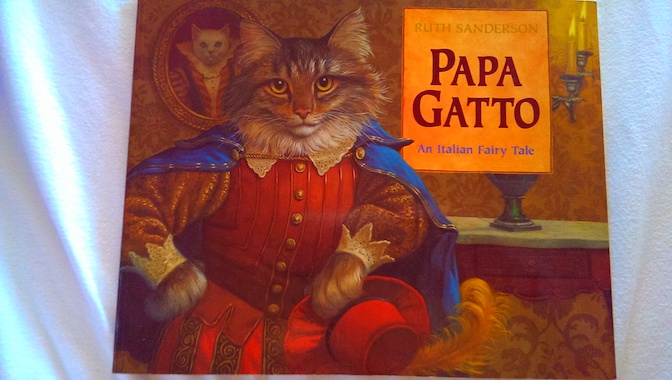
Papa Gatto

PapaGatto

Papa Gatto by Ruth Sanderson, 1995.

This beautiful picture book, set in a fairy-tale Italy, is based on several folk tales, as the author explains on the page with the publishing information.  Among the tales that served as inspiration for this story is The Colony of Cats, which is from Andrew Lang’s The Crimson Fairy Book.  In some ways, this story is similar to Cinderella and Mother Holle, with its wicked stepmother and stepsister.

In the distant past, so the story says, it was common for animals to talk, and one of the wisest cats was Papa Gatto, who served as an adviser to the prince.  Papa Gatto had a lovely wife and a beautiful mansion, but soon after the birth of their eight kittens, his wife died.  Needing someone to help care for the motherless kittens, Papa Gatto decides to advertise for someone to help.

PapaGattoAdvertises

In the town, there is a widow who has a daughter named Sophia and a stepdaughter named Beatrice.  As in many fairy tales, the widow favors her own daughter, who is lazy and spoiled, while giving all of the hard work to her stepdaughter, who is much nicer.  When they hear about Papa Gatto’s advertisement, Beatrice feels sorry for the young kittens and wants to help.  However, the widow, thinking of the generous fee that the wealthy Papa Gatto is offering, decides that she wants it for Sophia.  Sophia doesn’t want the job, but at her mother’s urging, she goes to see Papa Gatto anyway.

PapaGattoSophia

Papa Gatto gives Sophia the job tending his house and family while he’s away on a trip, but Sophia doesn’t know how to work hard and has no real intention of doing a good job.  She simply makes herself at home in Papa Gatto’s lovely mansion, trying on his dead wife’s jeweled collars as bracelets and neglecting the housework and kittens.  When Papa Gatto returns home and sees what she’s done, he sends her away in anger.

When Beatrice hears that Papa Gatto is once again looking for help, she goes to see him without telling her stepmother about it.  Papa Gatto sees how interested she is in the kittens and how gently she treats them, he gives her the job, reassured that she will do it well.

PapaGattoBeatrice

Sure enough, when he returns from his next journey, he sees that Beatrice has taken good care of the house and kittens and rewards her with the jeweled necklace/bracelet that Sophia had admired.  Needless to say, Beatrice’s stepmother and stepsister are angry with Beatrice when she returns home, and Sophia takes the bracelet for herself.

Meanwhile, Papa Gatto has told the prince about Beatrice.  The prince has been thinking about marrying, and he says that he would like to meet Beatrice.  Papa Gatto tells him that she will probably be at the coming fair in town, and the prince should attend and look for the girl with the bracelet.

At first, the prince mistakes Sophia for Beatrice, a deception that she and her mother encourage.  However, when the prince speaks to Papa Gatto again, Papa Gatto realizes the deception and sets things right.
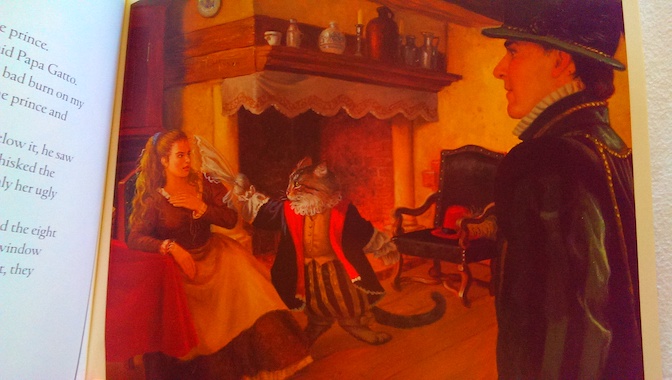
PapaGattoRevelation

The pictures in this book are beautiful!  And, of course, there’s a happy ending.

I liked it that Beatrice didn’t accept the prince’s offer of marriage immediately, saying that she’d like to get to know him first.  It’s more sensible than the fairy tales where they get married right away.

PapaGattoHappyEnding

Mrs. Armitage and the Big Wave

ArmitageWave

Mrs. Armitage and the Big Wave by Quentin Blake, 1997.

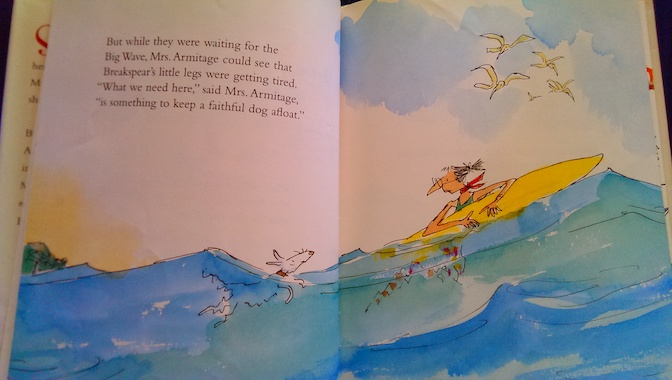
Mrs. Armitage goes the beach with Breakspear in order to go surfing.  She explains to Breakspear that they have to swim out and wait for the “Big Wave.”  But, waiting takes longer that Mrs. Armitage expected, and soon Breakspear is tired, and they’re both hot.

ArmitageWaveDogTired

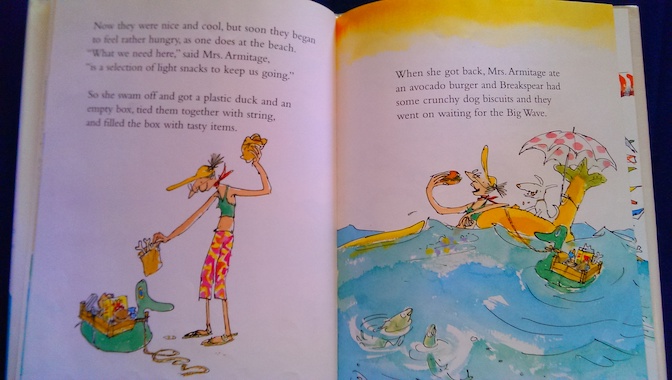
Of course, Mrs. Armitage finds a solution for everything.  With an inflatable toy for Breakspear to ride on and some protective gear, they wait some more.  Needless to say, Mrs. Armitage doesn’t stop there.  As they wait for the perfect wave, there are plenty of other things that they need to keep themselves busy and make themselves more comfortable.

ArmitageWaveFloaties

When the Big Wave finally comes, Mrs. Armitage not only makes an incredible show, but she also has what she needs to save a little girl who swam out too far and needed to be rescued.

The book is available to borrow and read for free online through Internet Archive (multiple copies, including one in Spanish).

ArmitageWaveRescue

Roxaboxen

Roxaboxen

Roxaboxen by Alice McLerran, illustrated by Barbara Cooney, 1991.

This story is based on reminiscences from the author’s family about the games they and their friends played when they were children in Yuma, Arizona. The section in the back about the author and illustrator explains a little about it. The author was born in 1933. Her Aunt Frances (one of the children named in the story) was 80 years old when the creators of the book were writing the story and drawing the pictures, so she was born around 1910. That means that the children in the story probably made up their imaginary town and played in it in during the late 1910s and into the early 1920s. The clothes that the children wear in the pictures appear to be from around that time as well (some of the girls have dresses with dropped waists, and some of the children wear sailor-style outfits).

One of the great things about this book is the power of imagination. Readers are not only taken back in time to someone’s remembered childhood, but to the place that the children invented: a town that both isn’t there but yet always is because of the imaginations of the children who once played there.  The pictures in this book are beautiful!

RoxaboxenDesertBeginning

A group of neighborhood friends living in a small town in Arizona play games on the edge of the desert. They make a town of their own from stones and old boxes and other things they find, naming it Roxaboxen. Marian, one of the oldest children, names the town and becomes its mayor.

RoxaboxenMayor

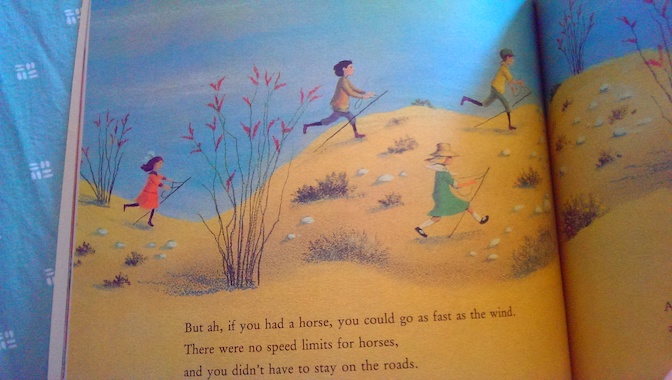
Using stones, the children outline the streets, houses, and shops of their town. They sell things to each other, using little black stones for money, and decorate their “houses” with old bottles and bits of broken glass in different colors. Using other things they find, the kids pretend that they have cars and horses. There are rules against speeding in their “cars”, so they also appoint a policeman and create a “jail.” Sometimes, they have “wars”, boys against girls.

RoxaboxenHorses

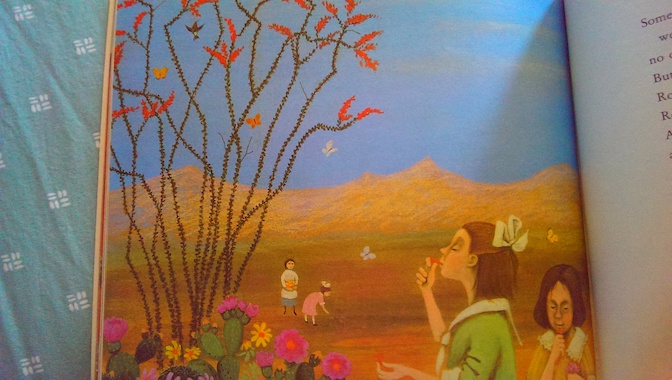
Time passes, but the children continue to play in Roxaboxen year after year, adding to the town and its lore. Even years later, when they’ve grown up and have moved to other places, Roxaboxen still lives in their minds. In a way, they said that their imaginary town always existed, just waiting for those with the imagination to see it, and through the story and illustrations in the book, it now draws in those who read about it but have never seen it themselves.

RoxaboxenOcotillo

Another great thing about the book is the sense of freedom that the children have. Many modern children wouldn’t be able to go out on the edges of their town and build something for themselves in the same way that the children in the story did. Although, in the freedom of their own minds and their own backyards, maybe some kids are building their own Roxaboxens as we speak.

The book is available to borrow and read for free online through Internet Archive (multiple copies, including one in Spanish and a video reading).

RoxaboxenFrances

Mailing May

MailingMay

Mailing May by Michael O. Tunnell, 1997.

Four-year-old Charlotte May lives in a small town in Idaho in 1914. May, as her family calls her, wants to visit her grandmother in another town, but travel during this time is difficult and expensive. With a lack of roads that are easy to travel, the only comfortable way to get to May’s grandmother’s town is by train. Unfortunately, May’s family can’t afford to buy a train ticket for her.

MailingMayParents

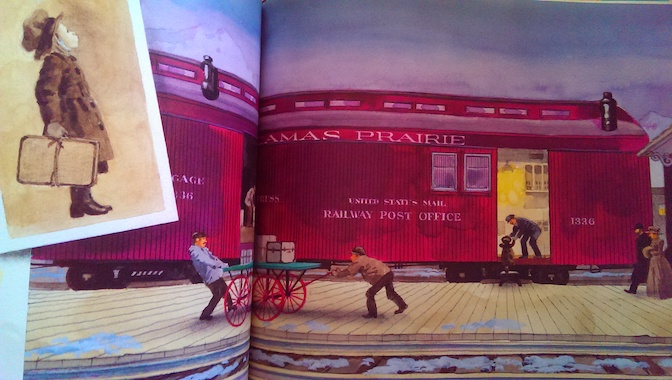
May wants so badly to go see her grandmother that she even asks at the local general store if the owner can hire her, but he doesn’t have any work that a little girl could do.  Then, May’s mother’s cousin helps the family to find a more affordable alternative. If May can’t travel as a passenger, is it possible for her to travel as . . . mail?

MailingMayPostOffice

It turns out that the rate for mailing a live package the size of May is much cheaper than the fee for a passenger ticket.  Because May’s mother’s cousin works in the mail car on the train, he could take responsibility for her during the trip.  So, with a label on her clothes, declaring her to be “baby chicks” and the proper postage stuck to her jacket, May undertakes the journey to her unsuspecting grandmother’s house.

MailingMayTrain
MailingMayMailCar

This story was based on a real incident. In fact, May wasn’t the only child to be sent through the mail when their parents couldn’t afford to send them as passengers. I also like the book for its glimpse at travel and mail services over 100 years ago.

The book is available to borrow and read for free online through Internet Archive.

MailingMayGrandmother

Changes for Felicity

American Girls

FelicityChanges

Changes for Felicity by Valerie Tripp, 1992.

FelicityChangesPennyThis is part of the Felicity, An American Girl series.

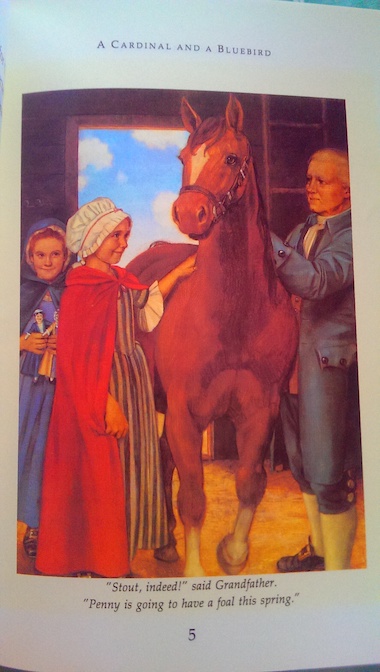
Everything is changing for Felicity. To begin with, her horse, Penny, is expecting a foal. Penny has been happy and healthy since she came to live with the Merrimans, but Felicity worries about what will happen when Jiggy Nye, her abusive former owner, gets out of prison. He has been in jail for not paying his debts. Felicity learns that he was once a respected member of the community and an expert with animals, but he became an alcoholic after his wife’s death. However, Felicity can’t bring herself to feel sorry for Nye after the way he’s behaved, even when she learns that he is sick. Felicity’s friend, Elizabeth, convinces her that they should send him some medicine and other supplies in prison, partly to have pity on him and partly so that he will feel grateful to Felicity when he gets out and not make trouble for her.

FelicityChangesGrandfatherSickUnfortunately, Elizabeth’s father also soon ends up in prison. Tensions between Patriots and Loyalists are high. The former governor has fled Williamsburg, and Patriots are arresting Loyalists. That Mr. Cole is a Loyalist has been well-known for some time. Felicity fears for Elizabeth and wonders what will happen to their friendship.

Then, Felicity’s grandfather also becomes ill. He soon dies of his illness, devastating her family, but before his death, he takes steps to make things better for Elizabeth’s family, Jiggy Nye, and his own family, especially Felicity. In return for Felicity’s charitable gift and her grandfather’s honorable payment for the horse, Jiggy Nye also helps Felicity and Penny when they need him the most, redeeming himself in everyone’s eyes.

FelicityChangesMotherWith the war everyone has dreaded finally becoming reality, there are still more changes yet to come. Elizabeth’s father must leave Williamsburg, Felicity’s father decides how he will support the war effort, and Felicity begins to play more of a role in the running of her father’s shop, as she had wished to do before.
In the midst of Felicity’s grief over her grandfather’s death and worries about the coming changes in all of their lives, her mother has some poignant thoughts about the nature of death and change. While Felicity wishes that it were summer again, back when her grandfather was alive and they were all happy, her mother says that not all changes are bad ones. As she points out to Felicity, even though it might be tempting for her to wish that she were a child again herself, when both of her parents were still alive, to go back to that time would mean giving up her life with her husband and her children. She loves her children and enjoys seeing them grow up and change.  The ability to witness those happy changes is worth dealing with the less happy changes in life as well.  Death, like change, is just another part of life, and Felicity’s mother points out that love still connects us to those we’ve lost.  Like everyone else, the only way Felicity can move in her life is forward, and that’s a good thing. Felicity still has growing up to do and happier changes yet to come.

In the back of the book, there is a section of historical information about the Revolutionary War.

The book is currently available online through Internet Archive.

Felicity’s Surprise

American Girls

FelicityChristmas

Felicity’s Surprise by Valerie Tripp, 1991.

FelicityChristmasBenProtestThis is part of the Felicity, An American Girl series.

Christmas is coming, and Felicity is excited. She and Miss Manderly’s other students, Elizabeth Cole and her older sister, Annabelle, have all been invited to the Christmas party at the Governor’s palace! Miss Manderly is a friend of the dancing master who has been giving the governor’s children dancing lessons, so she was able to get invitations for her students. There will be a special dance lesson for all the children who come. With food, music, and dancing at the party, Felicity and Elizabeth are looking forward to dressing up like grown-up ladies going to a ball.

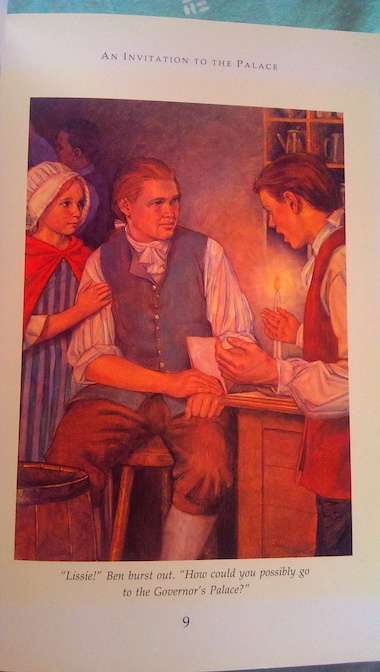
However, Ben, her father’s apprentice is against the idea of Felicity going because the Governor sides with the King and the Loyalists against the Patriots. He can’t understand why Felicity would want to attend a party with people who have treated the colonists so badly and have even boycotted her father’s store because he refuses to sell the taxed tea. However, Felicity’s father understands that the invitation was meant kindly and that it would be a special event for Felicity, so he tells her that she can go if she likes. Christmas should be a time for peace and enjoyment.

FelicityChristmasMotherIllAt Miss Manderly’s the girls start having dancing lessons, and Felicity wishes for a new gown, like the one on the elegant doll at the milliner’s shop. Since Felicity is usually not very interested in clothes, her mother decides to grant her wish.

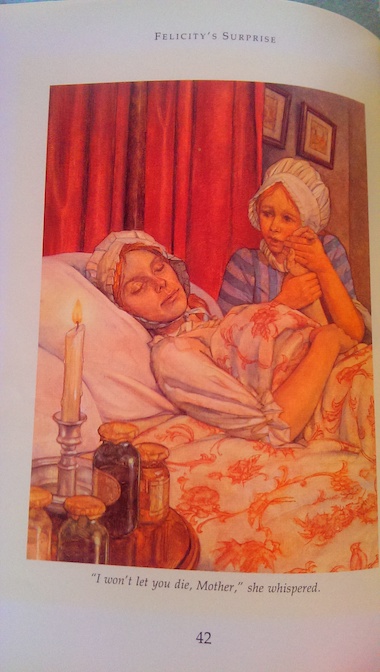
When Felicity’s mother falls ill, not only do Felicity’s Christmas dreams seem dashed, but she worries about whether her mother will recover from her illness. Everything that Felicity was concerned about before, the dress, the dancing, the party, all suddenly seems unimportant and silly in the face of something more serious. However, miracles come to those who work for them, and Felicity receives some unexpected help from friends.

There is a section in the back with historical information about how Christmas was celebrated in Colonial America.

The book is currently available online through Internet Archive.

Happy Birthday, Felicity!

American Girls

FelicityBirthday

Happy Birthday, Felicity! by Valerie Tripp, 1992.

FelicityBirthdayGuitarThis is part of the Felicity, An American Girl series.

It’s Felicity’s birthday, and her grandfather has given her a very special present: a guitar that once belonged to her grandmother, who is now dead. Felicity’s grandfather has heard Felicity singing and thinks that she shares her grandmother’s gift for music. He also thinks that Felicity is old enough to take proper care of the instrument, stressing the need for her to be responsible with it. Her mother tells her that she should keep the guitar safely in the parlor since she isn’t quite old enough for proper music lessons, like the ones Miss Manderly is giving Elizabeth’s older sister, Annabelle. Annabelle has been getting on Elizabeth and Felicity’s nerves by bragging about how they are still to young to even hold her guitar, although Annabelle really has no musical talent and struggles in her lessons.

Although Felicity knows that she should leave the guitar at home, she can’t resist taking it to Miss Manderly’s so that Miss Manderly can tune it for her and so that she can show it off to Elizabeth and Annabelle. Miss Manderly does tune the guitar for her and compliments her on owning such a fine instrument.

FelicityBirthdayGunpowderHowever, on the way home, something frightening happens. Felicity sees Elizabeth’s father, a known Loyalist, talking to a British soldier. She ducks into a bush so they won’t see her, and she hears them talking about the governor removing the gunpowder from the Williamsburg arsenal so the colonists can’t use it in the rebellion that has been threatening to come for some time.

Felicity hurries home to tell her family what she has heard, but when her mother and grandfather see that she has taken the guitar out of the house and gotten it wet and dirty while she was hiding, they refuse to listen to her. Her grandfather, also a Loyalist, particularly thinks that she’s making up stories to cover her irresponsibility about the guitar.

But, Felicity knows what she heard, and the situation is serious. What can she do to prove it to everyone?

In the back of the book, there is a section with historical information about how children were raised in Colonial America.  Another good book on the same topic is Going to School in 1776.

The book is currently available online through Internet Archive.

Samuel Eaton’s Day

Samuel Eaton's Day

Samuel Eaton’s Day: A Day in the Life of a Pilgrim Boy by Kate Waters, 1993.

This is the story of a boy who traveled to America from England on the Mayflower and whose family lived in Plymouth, Massachusetts. The book focuses particularly on how a boy like Samuel would have helped with a harvest during the year 1627.  The role of Samuel in the book is played by a boy who is one of the reenactors at the Plimoth Plantation living history museum.

Samuel’s mother died when he was a baby, but his father remarried, and he now has a stepmother (whom he calls “Mam”) and a younger half-sister, Rachel.  Now that Samuel is seven years old, he is considered old enough to help the men bring in the rye harvest.  Samuel is eager to help because he wants to prove that he is no longer just a little boy and that he is capable of doing a man’s work.

The book begins with Samuel waking up and getting dressed in the morning.  He has a few routine chores to perform, such as getting water, gathering firewood, and checking a snare that he has set for catching wild game, before he and his father go to the fields to help with the harvest.  After breakfast, Samuel and his father meet up with a neighbor, Robert Bartlett, and go to the fields with the other men.

SamuelEatonBinding

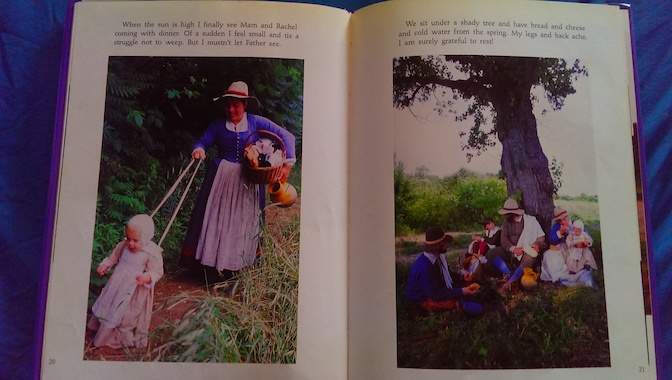
Robert Bartlett tells Samuel that it will take a few days for them to complete the harvest.  Samuel isn’t considered old enough to wield a sickle by himself, so he is given the task of gathering up the rye that his father and Bartlett cut and binding it into sheaves.  It’s hard work, and at times, Samuel wonders if he’s really up to the task.  When his Mam comes with lunch, she gives Samuel the chance to come home with her, if he is too tired, but Samuel is determined to stay and finish out the day.

SamuelEatonLunch

At the end of the day, Samuel is very tired and has blisters, but he is proud of the work he has done, and the men congratulate him.

The end of the book has a section that explains a little about the real Samuel Eaton, who eventually had his own farm when he grew up, and the boy who reenacted his life, Roger Burns.  There is also information about the clothing of the period, the Wampanoag people (seen briefly when Samuel is helping to gather mussels for the family’s dinner), the rye harvest, and the Plimoth Plantation living history museum.  The book also provides the lyrics to the song that Samuel and the others sing to entertain themselves while they’re working in the fields, The Marriage of the Frog and the Mouse.

Sarah Morton, a girl who was featured in an earlier book in the series, also appears briefly in this book.

The book is currently available online through Internet Archive.

SamuelEatonSarah

Tapenum’s Day

Tapenum's Day

Tapenum’s Day by Kate Waters, 1996.

This is about a day in the life of a Wampanoag boy living in the area around Plymouth, Massachusetts during the 1620s.  His life is reenacted by Issac Hendricks, who was a participant in the Wampanoag Indian Program at the Plimoth Plantation living history museum.

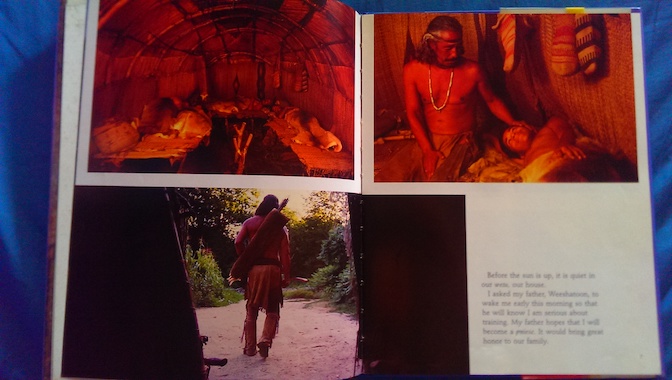
In the beginning, Tapenum introduces himself, explaining a little about his people and the strangers who have only recently come to their land, the English colonists, whom the Wampanoag call wautaconuoag (meaning “coat-men”).  Tapenum has just learned that he was not among those young men chosen to train as pniesog, a special kind of warrior among the Wampanoag who also possessed spiritual powers and acted as advisors and diplomats for their chief.  It has come as a great disappointment to him that he was not chosen for training.  To improve his chances of being chosen later, Tapenum has decided to train himself to improve his strength and hunting abilities.

Tapenum's Day Begins

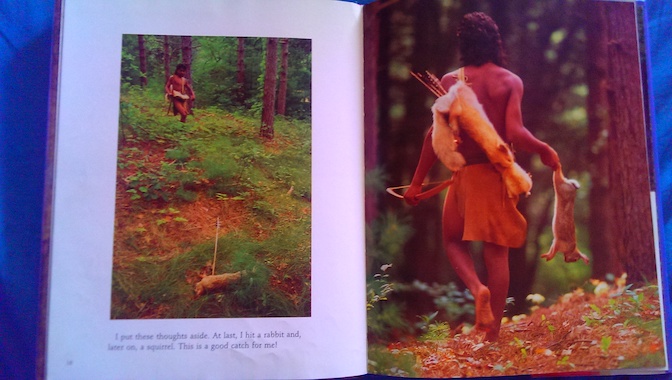
Tapenum goes out hunting early in the morning, while his mother and sister are still asleep.  He starts before eating anything because he says that being hungry “makes the hunter more serious.”  Eventually, he catches a rabbit and a squirrel.  His mother is pleased with his catch, although his father has done even better by bringing home a wild turkey, which is even more difficult.

Tapenum's Day Hunting Trip

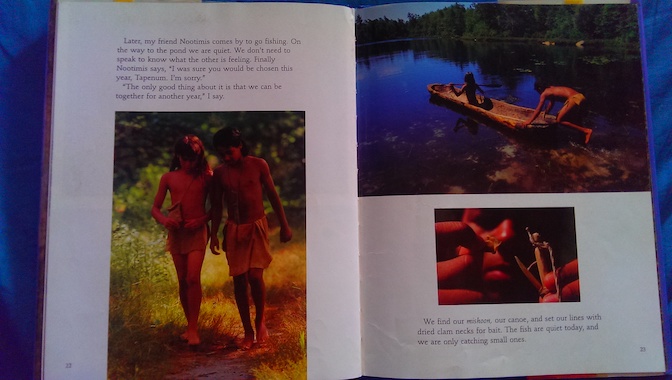
Later, Tapenum meets up with a friend, Nootimis.  The two of them go fishing in a canoe.  Nootimis knows that Tapenum is disappointed about not being chosen, but Tapenum says that at least he can still spend time with him before (hopefully) going away for training next year.

Tapenum's Friend

After fishing, Tapenum goes for a run as part of his training, and he sees smoke.  When he investigates, he finds an old wise man named Waban making a canoe.  Waban was a pniese himself when he was younger, and Tapenum offers him the fish he caught, hoping that Waban can tell him some things that will help him to be chosen for training.

Tapenum meets Waban

Tapenum ends up spending the rest of the day with the older man, learning and perfecting his skill at fletching arrows.  Waban also explains to him the importance of patience.  Tapenum is in too much of a hurry to grow up and begin serious training, but growing up takes time and so does developing the kind of strength and wisdom that he will need as warrior.

Tapenum learns some lessons

There is a section in the back of the book that explains more about the Wampanoag people, the the Wampanoag Indian Program, the Plimoth Plantation living history museum (now called Plimoth Patuxet), and the boy reenacting Tapenum’s life.

This is part of a series of books focusing on the lives of children in Colonial American history.  It is available to borrow and read for free online through Internet Archive.

Games From Long Ago

Historic Communities

GamesLongAgo

Games From Long Ago by Bobbie Kalman, 1995.

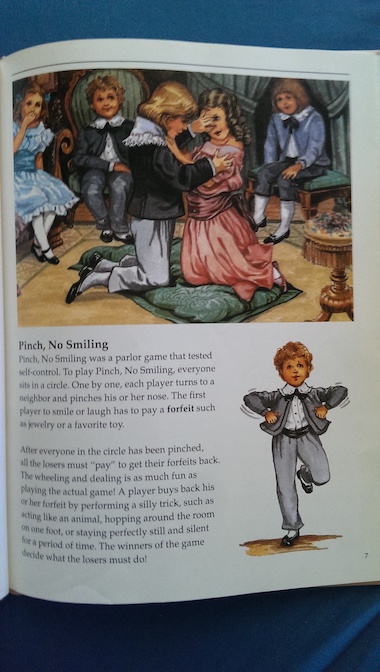
GamesLongAgoForfeitsThis book is about games people would play in 19th century America.  There is a variety of different types of games, although the main focus is on parlor games.  Many of them have been passed on for generations by word of mouth and are still played today, such  as Charades and Blind Man’s Buff, although the book discusses games that are no longer common.
One important concept in 19th century games was the “forfeit”, where losing players would have to perform a kind of silly stunt. The other players might hold onto an object belonging to the losing player, holding it as hostage until they performed the stunt.  Forfeits were a common part of parlor games.

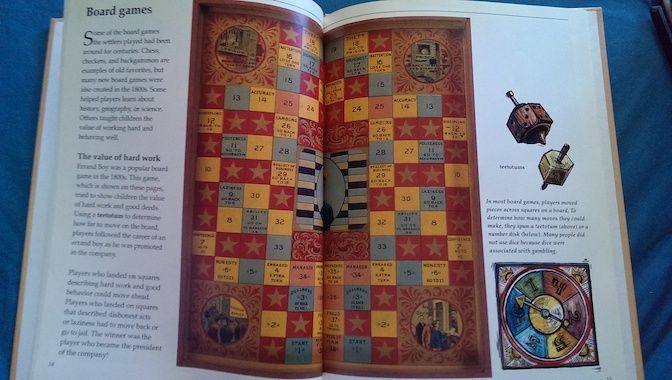
The book also talks about popular tabletop games such as dominoes, cards, tiddlywinks, and pick-up sticks.  Because dice were often associated with gambling, movements in board games were often determined by spinners or special numbered spinning tops called “teetotums,” which look something like dreidels but with more sides.  Board games for children were often educational, teaching them about subjects like history or geography or moral lessons, rewarding “good” decisions and penalizing “bad” ones (although, since movements in these games were determined by spinners, the players were at the mercy of the random chance as to which of these choices their playing pieces landed on, not making actual good and bad decisions by themselves).

GamesLongAgoTeetotum

There are also examples of games played at work parties, parties or “bees” organized around farm tasks such as barn-building or harvests.  These parties might include a hay maze (like a corn maze, but with hay sheaves), a game of Gossip (an early version of Telephone, played exactly the same way), or Bobbing for Apples.

GamesLongAgoHoliday

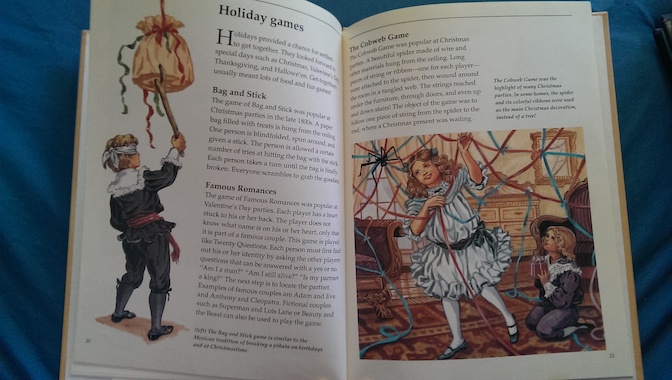
There is a short section about games for specific holidays, although there are only three given.  Two of them are for Christmas (one of those is a basic version of Pinata called Bag and Stick), and one for Valentine’s Day.  There are also sections about outdoor games and sports.

The book is currently available online through Internet Archive.

GamesLongAgoOutdoor